Nicki Chen's Blog, page 30
November 12, 2015
Twelve Authors and Their Books
 Today I’m teaming up with eleven other authors for an ebook sale. For the next ten days you’ll be able to load up your Kindle, Nook, iPad or phone with some new reading material for less than you’d spend on a trip to Starbucks.
This is how it works. First I’ll tell you a little something about my novel and where you can buy it (at a discounted price). Then I’ll give you the links to the other authors’ blogs or websites, and you can click on over and take a look at what they’re offering.
My novel: Tiger Tail Soup, a Novel of China at War

Chinese brush painting by Nicki Chen
You’ve heard about the rape of Nanking. Perhaps you’ve seen Empire of the Sun and are familiar with the story of a British boy’s wartime experiences in Shanghai. But when the Japanese invaded China starting in 1937, the entire country was affected —north, south, east, and west, male and female, adult and child, soldier and civilian.
Tiger Tail Soup tells the story of a Chinese woman, her soldier-husband and their mothers, children, and maids. It’s a tale of fear and bravery, suffering and survival.
When the novel opens, An Lee is pregnant and her husband is missing. In the near distance she hears what sounds like bombs, but she can’t bring herself to believe that the war is moving south toward her home, an idyllic little island at the edge of the South China Sea.
Soon she’ll be surrounded by Japanese troops. And the war that engulfs China won’t be over until seven years later when the Americans drop atomic bombs on Hiroshima and Nagasaki. In the meantime, An Lee will battle fear, hunger, disease, loss, and loneliness. If she and her family hope to survive, they will need all the courage and resourcefulness they can muster.
My inspiration for the novel was the stories my late husband told me about his early childhood during China’s war with Japan.
You can buy an electronic version of Tiger Tail Soup at the discounted price of $1.99 from any of the sites listed below.

barnesandnoble.com, and
* * *
Now, I hope you’ll take a look at what my fellow authors have to offer.
Barbara Monier — contemporary literary fiction https://barbaramonier.wordpress.com/
John Howell — fiction thriller http://johnwhowell.com/
Michael Fedison – a YA Sci-fi/Fantasy Adventure.– https://eyedancers.wordpress.com/
Shehanne Moore — historical romance – https://shehannemoore.wordpress.com/
Janice Spina — middle-grade junior detectives series https://jemsbooks.wordpress.com/
Luciana Cavallaro — historical fiction–mythology retold –http://luccav.com/
Evelyne Holingue –middle grade fiction – http://evelyneholingue.com/
Jo Robinson — nonfiction publishing guide for newbies, two short stories, and mainstream fiction – https://africolonialstories.wordpress.com/
Sonya Solomonovich — time travel fantasy – https://sonyasolo.wordpress.com/
Jennifer Chow –adult cozy mystery (the beginning of a new series) – http://jenniferjchow.com/
Katie Cross — YA fantasy – http://kcrosswriting.com/


November 8, 2015
The Serenity of a Japanese Garden
 When you walk under the red lacquered torii gate and enter the Japanese Garden at Butchart Gardens, you step into a world that seems far removed from the flashy, showy gardens behind you.
No wonder. The aesthetic of a Japanese garden is a far cry from that of a Western garden. Our gardens are meant to amaze. Theirs intend to inspire meditation and peace.
When my sister and I visited the main part of Butchart Gardens this October, the first thing we saw after descending into the sunken garden was a huge bed of tightly-packed rose-colored chrysanthemums. “Wow!” I shouted, pulling out my iPhone to take a picture. What else could one do with a splash of color so bright and amazing.
 A few steps farther we were dazzled by a bed of bright yellow mums … and on and on to the pink begonias and the row of multi-colored dahlias that elicited so many oohs and aahs, so much picture-taking and posing.
 By contrast, walking into the Japanese garden made me want to slow down. To stand and contemplate the lily pond. To listen to water whispering over the rocks.
 The landscape of a Japanese garden creates an illusion of nature—nature tamed and miniaturized. The best parts of nature. Everything in it is real, but each element is carefully chosen for our pleasure. The most beautiful trees, the most noteworthy rocks, the sweetest little streams and waterfalls. We walk on winding paths that lead us to the surprise of a curving red bridge.
 We cross the water on conveniently-spaced stepping stones. We sit in a small pavilion and, feeling the garden’s serenity and inspiration, compose a haiku and commit it to memory.
This is what I remember from Butchart Garden’s Japanese Garden, although in reality, I didn’t sit in the small pavilion. My sister sat there, deleting excess photos from her iPhone.
 The experience may not have been exactly what Jennie Butchart and Isaburo Kishida intended when they designed the garden more than a hundred years ago. Not with all the tourists blocking the paths and posing for selfies. Still, it would have been impossible not to feel the serenity of this beautiful Japanese garden.
 And here I am, not at my most serene best.

If you enjoyed this post, tweet it or share it with your friends on Facebook or Google+.

November 1, 2015
Butchart Gardens, a Lesson in Problem Solving.
 A problem in Jennie Butchart’s backyard.
We all have problems, some big, some small, some seemingly insoluble. Jennie Butchart had a huge problem: a big hideous hole in her backyard.
Admittedly the hole was off to one side and the property was large. On the other hand, the hole was actually a pit, a gigantic scar on the earth left behind when her husband’s company extracted tons of limestone from the quarry.
So what would you do? Jennie’s first attempt to mitigate the problem was to plant poplars and Persian plums between the pit and the house. Good. Problem solved. Right? I might have added a fence so no one would fall into the abandoned quarry. But it was 1908. People weren’t so concerned about safety in those days.
A bold solution.
In the face of a problem as colossal as a limestone quarry in the back yard, you and I might have thrown up our hands in despair or taken half measures and left it at that.
Not Jennie Butchart. She conceived a bold plan for a sunken garden. She’d have the rubble at the bottom of the pit pushed into piles to make the basic structure of terraces and hills. Then she’d have massive amounts of topsoil brought in by horse cart.

a hill inside the quarry
As things got underway, she realized the gray quarry walls looked grim, so she dangled over the side in a boson’s chair and planted ivy in crevices in the rock.
 Her husband, Robert, had spent six years (1902-1908) digging out the limestone and making a fortune selling bags of cement up and down the West Coast. It took Jennie until 1921 to complete her sunken garden.
From famous and free to a commercial venture.
The gardens were famous even before they were finished. In 1915, 18,000 people showed up to view the fantastic gardens. The Butcharts, who had named their home Benvenuto, didn’t turn anyone away or charge them a penny. In fact, they welcomed visitors in and served them a cup of tea.

the star pool, part of the Italian Garden
Jennie’s unflagging generosity continued into the 1930s and ‘40s. Eventually the couple moved to Victoria. Before Mr. Butchart’s death, they gave the gardens to their grandson, Ian Ross, for his twenty-first birthday. Quite a birthday gift, eh? Ian ran Butchart Gardens for the next fifty years, transforming it into a commercial venture and an internationally famous destination. Today his daughter is in charge of the gardens that her great-grandmother brought into existence.
 The dahlias were in full bloom when my sister and I visited on October 13, 2015.
 Fall color and a sunny day in October … Victoria, BC, receives 308 sunny days a year and only 26 inches of rain thanks to being in the rain shadow of Washington State’s Olympic Mountains.
 This grouping is on its last leg, but I liked the contrast of colors and textures.
 Butchart Gardens has 50 full-time gardeners, 70 during the summer. This gardener is watering forget-me-nots that will bloom in the spring. Tomorrow, if the bulbs from Holland arrive on time, he’s going to plant 5000 daffodil and tulip bulbs in this one flowerbed. Then, after one season, the bulbs will be pulled up and thrown in the compost heap. After that, new ones will be planted.
 According to the gardener, these begonias were going to be pulled out two days after I took the photo.
 I liked the romance of these arches.
Next week’s post will be about the Japanese Garden which is also part of Butchart Gardens. It has quite a different look from what I’ve shown here.
October 25, 2015
Little Things
 Most days I watch the news while I eat lunch. I slurp my healthy soup, chomp on my organic salad, and swallow my vitamins while I fill my mind with contentious, noxious images and talk.
Not a recipe for whole body and mind health, I suppose, but I’m not about to change my ways. I like knowing what’s happening in the nation and the world—the good and the bad of it. I’m a big believer in truth, in accepting reality.
But national and international news are only one side of reality, the side that’s big and far away. For the most part, our lives are composed of little things near at hand.
So yesterday afternoon I took my cellphone, and without bothering to lock the door since I wouldn’t be gone long, I walked down my street and the next one with the intention of looking for pretty little things, the kind of things I might otherwise drive right past. I wasn’t surprised that I found way too many to share on today’s post, but here are a few of the little things I saw:
Pretty little things
 A late blooming rose beside my driveway.
 Harry and Barbara’s fall-blooming camellias.
 A long-legged bug appropriately found on these long yellow petals.
 Lacy growth from knot in rough cedar bark.
Funny little story.
Family life is made up of many small things–little stories, often funny, that we tend to remember and repeat. Something my daughter told me during a recent phone call may turn out to be one of them.
My son-in-law (her husband) is proud of his eyebrow-raising skill, one eye at a time. (It’s really quite remarkable.) Before bed, he and his son (my seven-year-old grandson) were practicing eyebrow raises. What I’m waiting to see is whether it was a general practice session or specifically targeted at the next day’s yearly school photo shoot.
Little new things
 No matter how overflowing with clothes and shoes my closet is, something new is always fun. Last week I ordered shoes from a catalog. And here they are–lace-up cranberry shoes for fall. I have no idea how the company, Hotter, found me, but the shoes fit and they’re comfortable.
A little poem
My other son-in-law always makes puzzles for my granddaughter for her birthday. This year’s puzzle is like a scavenger hunt using haikus written by family members as clues. I’m not sure exactly how it works. After reading the following haiku, she’s supposed to guess it was written by me. What do you think?
Sprinkles of fall rain
on my sketch pad and pencils.
Yellow leaves on grass.
A delicious little drink
 “A cherry wine with natural chocolate flavor” from Icicle Ridge Winery in Peshastin, WA given to me by daughter #2. A delicious small pleasure this afternoon.
Color, color everywhere


Thanks to my neighbor, Sandy, for the first five. The stewardia tree in its autumn splendor grows beside my driveway.
October 18, 2015
The Job Comes First.

Eugene in the brown pants. He was a hands-on engineer.
No! I hear you shout. Family comes first. Living a good life comes first. Health is more important than a job. Follow your bliss. Love. Serve God and your fellow man.
And, yes, I believe all that too. Heck, I graduated from college in 1965 when jobs were easy to come by. We didn’t worry about finding work. You graduated … you got a job. It was as easy as that.
By 1970, the situation had changed, especially for engineers like my husband. The family-owned company he worked for sold out to a large corporation that was believed to be looking for a tax write-off. Within a year most of the employees were let go. They laid Eugene off the week before Christmas.
We celebrated the holidays, and then he started his job hunt. Unfortunately, Boeing, Seattle’s biggest employer, had recently lost a big contract. The situation in the Pacific Northwest was so bad, someone put up a sign that read: “Would the last person to leave town please turn out the lights.”
My husband spent the next seven months looking for a job. When he finally found one, it was in the Philippines. He would be a Project Engineer at the Asian Development Bank. It was a good job. The only trouble was, his starting date coincided with my due date.
 The Bank, being a firm believer that “the job comes first,” wanted him right away. Finally, after some persuasion, they made a small concession. They gave him an extra month.
So, in the last few days of my pregnancy and the first few weeks after giving birth, we sold our house and disposed of all our possessions. The hardest part, as I remember it, was making so many decisions. Every item in every drawer and closet had to be put in one of the following categories:
Suitcases
Air freight
Sea freight
Storage in Mom and Dad’s attic
Garage sale
Give-away.
You’ve probably been through it. Right?

one day old baby with daddy
Luckily, the baby (our third daughter) cooperated with our schedule. She was born without complications exactly on her due date. Her sisters (ages one and three) also cooperated by behaving well during all the commotion.
Along with the packing and cleaning and garage sale, we found time for goodbye parties …
 … and a baptism.
 And then we took off … five days early … so we could meet my father-in-law in Hong Kong.
 The day after we landed, we left the baby with Father’s friend and, despite being worn out from a long flight, did some sightseeing. Here we are (me with some baby weight yet to lose) taking in the view from Victoria Peak.
 Daughter number one won her grandfather’s heart by polishing off a couple baskets of xia jiao.
Three weeks after giving birth was not the optimal time to uproot our young family and move to the other side of the world. But when you’ve been without a paycheck for seven months and there are no other prospects in sight, the job really does come first.
Have you had times when “the job comes first?” Or do you remember a time when something else took precedence?
October 11, 2015
A Convention by Any Other Name …
 Top spots for conventions.
Can you guess America’s top convention city? I thought it would be Las Vegas, but according to Qvent, for 2015, Chicago is number one, followed by Orlando and then Las Vegas.
Most attended, however, is not the same as favorite. Readers of USA Today voted on the “Best Convention City,” and you’ll never guess which city they chose. It was Indianapolis, followed by Boston and then Nashville. Las Vegas didn’t even make the list. Chicago was number ten.
Writers have “conferences.”
Writers don’t have conventions. We have conferences. There are hundreds of them in the United States alone.
 This past weekend a popular writers’ conference, Write on the Sound, was held in my own back yard.
So … you may wonder why would I go to a writers’ conference? Well, here are some of the reasons:
Inspiration
Reinforcement of the basics of good writing
Keeping up to date, and
Networking and having a little fun.
I’m guessing that most convention attendees of any sort would have a similar list.

We like to sit in the front row. (The yellow coat is mine.)
My first session: Body Language
One of my favorite presenters was Mary Buckham. She started her talk by referring to Albert Mehrabian’s research on communication. Mehrabian found that in certain circumstances, the words a person speaks account for only 7% of his communication. The rest is supplied by tone of voice (38%) and body language (55%). In other words, a writer had better observe body language and know how to describe it.
If a character’s nostrils flare, her eyes widen, and her fists clench, no matter what she says, the reader will understand she’s afraid of something.
Here are a few examples of the differences between men and women:
Men nod when they agree. Women nod to show they’re listening.
Women smile more than men.
Women touch to show support or connection. Men touch to show control or superiority.
Men take up more space to look bigger—knees spread, elbows out, hands on hips.
The quickly changing world of publishing and marketing a book
I attended a couple of practical classes on publishing and marketing.
Sylvia Taylor’s presentation focused on building a professional platform. “Platform” is the current buzz word for preparing the ground for a writing career. It has to do with getting your name and work noticed by the public. According to Sylvia, I should have started building a platform before I ever put pen to paper.
Brian Schwartz has a sure-fire method for becoming an Amazon bestselling author in twelve steps. His presentation was very convincing. I think I’ll look him up when I’m ready to publish my next novel. Of course, by then, the publishing world may look different.
Networking and having fun
It’s always fun to talk to other writers. At one presentation I ran into a neighbor who has just published a book. Congrats Leroy!
 My friends and I took advantage of the perfect weather to walk down the hill and have lunch–Thai Cottage on Saturday, the Rusty Pelican on Sunday.

lunch at Thai Cottage, Edmonds
Talk about having fun, my daughter (the actuary) attends a five-day convention every year in a different state. She and her fellow actuaries go to seminars for four and a half days and save half a day for fun. Last year she did zip lining in a pine forest in Florida. This year she went tubing down the San Antonio River. It sounds like actuaries (like blonds) have more fun. Hmm.
October 4, 2015
An Authoritative Voice
 If not for George and his authoritative voice, I might be a teacher of ESL (English as a Second Language) today instead of a writer. I was more than halfway there. I’d completed all my theoretical classes at Seattle University and most of my practical coursework at their affiliate in Ballard.
I was also well on my way to becoming a published author. I’d earned an MFA in Creative Writing from Vermont College of Fine Arts, and I’d had a few short stories published.
Now that I was home after a couple of decades accompanying my husband overseas without a work visa of my own, I felt I should have a real job. I liked to write, but writing wasn’t … you know … a real job.
I was conflicted.

Painting courtesy of HikingArtist.com
One afternoon I mentioned my situation to George. My husband, Eugene, and I were in Issaquah having a drink with George and his wife in their lovely apartment. Afterward we would have dinner at George’s favorite local restaurant, Shanghai Garden. The chef would come to our table and ask if we wanted something that wasn’t on the menu, and George would suggest a special Dungeness crab dish.
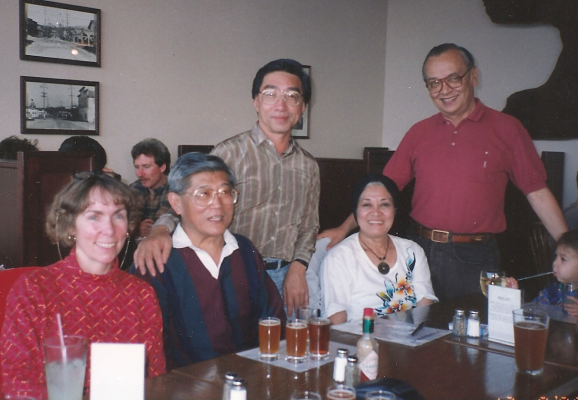
George in red shirt
George hadn’t lived in Issaquah long, but he already had friends in both high and low places. Making friends and contacts was a natural trait for him and also a habit developed during his early years as a reporter for the South China Morning Post and then as editor for the Asia Magazine.
Giving his scotch a swirl, George turned to me and asked about my writing.
“My writing?” I paused to sip my rum and coke—an indecisive drink if ever there was one … a depressant poured into a stimulant. “I’m thinking of getting a job as an ESL teacher,” I said.
He cocked his head and narrowed his eyes. And somehow his one sentence response became a turning point for me.
Why? What gave him such an authoritative voice in my personal decision?
Maybe it was the persuasive timber of his voice. George had been a print journalist, but he had a voice that could have made him just as successful on TV.
It was more than his tone of voice though. His absolute confidence gave him power. George never used words and phrases like “maybe” or “kind of” or “I guess.” He had a way with words, a journalist’s knack for convincing his audience that he knew exactly what he was talking about and that what he had to say was worth listening to.
So when George placed his scotch on the coffee table and paused dramatically before telling me what he thought, his comment was bound to make a deep impression. “Nicki,” he said in his most authoritative voice. “Anyone can be an ESL teacher.” Though I didn’t believe for a minute that just anyone can be a successful ESL teacher, I knew what he meant. He thought I should devote myself to writing.
And George’s words made all the difference. He had an authoritative voice. And besides … those words were exactly what I wanted to hear.
September 27, 2015
Bruce Lee and Me
 Bruce Lee was just down the hill from me. While I was at Seattle University studying to be a teacher; he was in a small basement studio on 8th Street in Seattle’s Chinatown teaching martial arts.
I hadn’t heard of him yet. Nobody had. It was 1961. He was a recent graduate from Edison Tech who had just started classes at the University of Washington as a drama major. (Some sources say as a philosophy major.)
 His future wife, Linda Emery, was also enrolled at UW. She signed up for his kung fu class, and soon they were dating. My future husband, Eugene, didn’t have a kung fu class (although he was a bouncer in Seattle’s Chinatown for a while, and he did teach judo at the University of the Philippines). Even though he was just across campus from me at Seattle U—he was an engineering student, deep in his studies and working his way through school–I didn’t meet him until after he graduated.
By 1964, when Eugene and I finally started dating, Bruce and Linda were ready to tie the knot. If I’d heard of Bruce Lee in those days, I would have found it interesting that another white American woman was marrying Chinese man. But in 1964, I hadn’t even heard of kung fu. Most Americans hadn’t. Now, some fifty years later, people around the world are familiar with Chinese martial arts. We can thank Bruce Lee for that.
 My first martial arts movie was The Big Boss, Bruce Lee’s first big hit, released in 1971. By then, Eugene and I were married with three children, all girls. Bruce and Linda had a boy and a girl.
 Remembering back, I think The Big Boss shocked me. When Eugene and I were dating, we saw Mary Poppins together. Some of my favorite movies were The Sound of Music and Fiddler on the Roof. A totally different movie-going experience from that of The Big Boss. And even though I’d grown up watching cowboys and Indians kill each other on TV, the violence in The Big Boss was different. It was personal. Fist in face. Foot crashing into head. Blood spurting. Exaggerated sound effects churning your stomach. For a novice like me, it was a disturbing movie.
And yet … yet … I liked it. Bruce Lee was such an appealing leading man. And the bad guys really did deserve whatever they got.
 Eugene, like Bruce Lee, had begun studying martial arts in his teenage years. Both their fathers had hoped that disciplined fighting would be an antidote to street fighting. During Eugene’s college years, he started down a different path than Bruce Lee’s, but he never lost his interest in martial arts.
We caught all the Bruce Lee movies: Fist of Fury in 1972, Way of the Dragon also in 1972, and Enter the Dragon in 1973.
When Bruce Lee died in 1973, we joined his many fans in grieving his death.
So why this interest in Bruce Lee forty-two years later?
A few weeks ago, my daughter, son-in-law, grandson and I caught the Do You Know Bruce? exhibit at the Wing Luke Museum on King Street in Chinatown (now referred to as the International District). It closed on September 6. But part 2: Do You Know Bruce? Breaking Barriers begins on October 3.

photo courtesy of Joe Mabel
We’d stopped in Chinatown on the way home from the airport. We had dim sum, and then we went to the museum. There my seven-year-old grandson hurried past the permanent exhibits about Asian American immigration to the Pacific Northwest. As soon as we reached the Do you Know Bruce? exhibit, though, he slowed down.
He’d never heard of Bruce Lee. But he takes taekwondo classes a couple days a week after school. I wonder, if the opportunities to study martial arts would be as plentiful around the country if it hadn’t been for Bruce Lee?
What do you think, do you like martial arts movies? Are you a Bruce Lee fan?
See also: my guest post on Speaking of China, “Yin-Yang: Discovering a Whole New World with my Chinese Husband.”
September 20, 2015
Braving the Steep Climb and the Sharp Thorns
 The best blackberries
.
The best blackberries
.
Isn’t that where you always find the largest clumps of ripe blackberries, plump and smug at the top of the bush, higher than you could possibly reach without jumping? And you can’t jump unless you want to get tangled in their evil thorn-studded branches.
 “Ouch!” My seven-year-old grandson, visiting from the East Coast, is picking blackberries for the first time.
“Watch out for the thorns,” I say.
He frowns at the little red mark on his perfect child’s skin.
Instead of sympathizing—It’s such a small wound—I tell him something about a knight who must fight a dragon in order to rescue the fair maiden.
He’s not impressed. Maybe I should have used Star Wars imagery or Thor or Iron Man. He elects to hold the bowl for me and point out ripe berries that are within reach.
There’s something to be said for the low-hanging fruit.
The best views.
When you’re hiking, the best views always seem to be at the top of the mountain or hill. The fact that you’ve earned the view by scrambling up a steep trail makes it all the sweeter.
On the steep trail behind Roche Harbor, my little grandson (and his very fit parents) left me in the dust. Last time I’d climbed that hill to look down on the old abandoned quarries, the trail wasn’t nearly as steep. I’m sure it wasn’t. Also the quarries were filled with water then. Not so this year of the hot, rainless summer.
Before we started hiking, I’d prudently stashed my oversized iPhone6 in the trunk of the car. So, sorry, no photos from the lookout.
Here are some photos from the gentler trail we hiked the following day at English Camp. (also on San Juan Island)


Madronas
The most unusual sights.
If you want to view whales and orcas, you don’t have to brave thorns or climb steep trails. But unless you’re extremely lucky and catch a glimpse of an orca from a ferry deck, you’ll need to shell out some money for a whale-watching trip or a cruise to Alaska.
Everything special costs in one way or the other.

The ferry arrives as we head out.
After our little hike, we cleaned up and drove to Friday Harbor for a whale-watching cruise. At 2:00 pm sharp, our boat left the dock and set out to find some orcas (also known as killer whales). The captain and his crew were familiar with the orcas’ habits, especially those of the J, K, and L pods, and other whale watchers shared sightings with them.
Nevertheless, the ocean is big, and the orcas swim where they will. Our wildlife guides advised us to think positive thoughts as we cruised down to the south end of San Juan Island and out into the Strait of Juan de Fuca.
And yes, it worked. Ahead of us was the surest sign of the presence of orcas: other whale-watching boats. (In case you’re concerned about the wellbeing of the orcas, there are rules for watching them. All boats must stay 200 yards away and 400 yards out of their path.)
 Along with other enthusiastic whale-watchers, we crowded the deck and adjusted our binoculars. And the orcas put on a show for us, circling and breaching, blowing and slapping their tails. At one point, they seemed to be attacking (and eating?) a Harbor Porpoise—a sure sign they weren’t from J, K, or L pods. Hmm. They must have been Transient Orcas.

 Eventually they swam away and we turned around, pausing near a tiny island to watch enormous male Steller Sea Lions soak up the sun and fight and bark. Another very special sight.
September 13, 2015
Second Anniversary of my Blog

Okay. I admit, I missed it. I should have celebrated the anniversary of my blog on August 7. But the occasion totally slipped my mind until one day I clicked on Timo’s post, “Second Blogaversary.” You see, Timo started his blog Crazy Chinese Family a few days after I started mine. And he kept track of the date. (If you haven’t already, check out his blog for cute baby pictures, funny stories about his mother-in-law, and the ups and downs of life for a young man from Finland and a woman from China living in Germany.)

Gulangyu, China
So today, approximately five weeks late, I’m celebrating the second anniversary of my blog. I named the blog “Behind the Story” because my original intention was to talk about subjects related to my first novel, Tiger Tail Soup. I stuck to that goal pretty well during my first year. Three of my first four posts were about Gulangyu, the setting for my novel. Here’s an example: “No Room at the Inn.”

by B_cool-from-Singapore
During that first year I wrote about Chinese food, bound feet, tigers, and the attack on Pearl Harbor.
 I also wrote about the Chinese civil service exams, famine survivors, and Chinese dresses.

Iron Goddess of Mercy Tea
During the second year, my focus changed somewhat. I didn’t totally neglect topics related to my novel. I wrote a post I called All the Tea in China that highlighted oolong tea and its origins in Fujian Province. I wrote about “The Great Tiger Hunter of Fujian,” and also about a ghost in a wartime cemetery who had a bit part in my novel.
 Looking back, though, I see that gradually my blog became more personal and varied. I wrote about how I became a writer and how I met my Chinese husband.

Tulips meet daffodils at RoozenGaarde.
I shared photos from my wedding and from trips I took. I wrote about winter and springtime and my grandson’s graduation from high school.
As for year three, I expect it to be similar to year two. When I’m far enough along on my second novel, I’d like to include some background information on the novel’s setting—Manila during the coup attempts that followed the People Power Revolution and Vanuatu as it was twenty-five years ago.
I’m looking forward to that. But knowing my writing speed and my penchant for revising, I may not get that far until year four.
What kind of posts do you hope to see on my blog during year three? Did you have any favorites from year two?
If you haven’t already signed up and would like a reminder of future blog posts, just leave your email address in the box on the upper right of the page and click subscribe.