Douglas Rushkoff's Blog, page 20
October 30, 2016
Sibos 2016 – Closing Keynote: “Platform Cooperativism”
Watch the closing keynote at Sibos 2016.
The post Sibos 2016 – Closing Keynote: “Platform Cooperativism” appeared first on Rushkoff.


This Week in Startups – How Growth Became the Enemy of Prosperity
Listen to this podcast at This Week in Startups
The post This Week in Startups – How Growth Became the Enemy of Prosperity appeared first on Rushkoff.
September 28, 2016
Digital Trends – The Best Smartphone is the One You Already Own
Read this piece at Digital Trends
Now that Apple has disappointed early adopters with a mere incremental iPhone upgrade, and Samsung has done even worse by releasing exploding Galaxy Note 7s, the preposterous futility of the smartphone wars should be coming apparent. Those people who are trading in perfectly usable phones for the latest models are the suckers.
A brand new smartphone is anything but a status symbol. It simply means you’ve been fooled into valuing a shiny new object over its impact on labor, the environment, or even your own time. And it’s not entirely your own fault.
After all, our Twitter streams are filled with comments about Apple’s latest product launch and links to Medium posts and unboxing videos by those delighted or vanquished by their new purchases. It’s hard not to want the button, the two-lens camera, or iris-recognition security. Such innovations make a single lens or thumbprint security feel, well, so last quarter.
Yet the gadgets truly in need of glorification in our Instagram feeds are those battered, bruised, and still-ticking devices that don’t demand their own replacement every 365 days.
Hidden costs
The less-told stories here, and the ones deserving our attention, are the human and climate cost of all these new and unnecessary devices – costs brilliantly externalized by the aesthetic and marketing of tech products.
The Bauhaus elegance of an iPhone, for example, makes it feel as if the device’s primary functions are really occurring inside its new, water-resistant case. The battery is for your screen, and little else. The lion’s share of processing activity – and energy consumption – is actually occurring on servers streaming all those videos and making all the harder calculations and analyses. Siri is not in your phone, she’s on a bunch of HP servers in the cloud. That energy consumption is immense, particularly in comparison with that of recharging our phones every night. Watching an hour of video on your smartphone every week for a year actually uses two refrigerators’ worth of electric power.
And all that electricity only accounts for around 20 percent of the electricity a smart phone will use in its lifetime, once you factor in the energy used for production and distribution of the phone itself. If the phone materials were actually recycled, there would be additional energy costs – but at least those would have been well spent. As it is, most e-waste is just dumped in huge piles in developing nations, forming small mountains of toxic trash on which impoverished families scavenge for sellable parts. E-waste is estimated to reach 60 million tons next year.
Finally, every new smartphone contains several grams of rare earth metals and “conflict” minerals including gold, tin, tungsten, and tantalum. These are mined for, at gunpoint, by child slaves in the Congo. That’s right: Your purchase of a new smartphone requires a kid to go into a cave for minerals, and empowers the people and companies who are exploiting him. (To be fair, most smartphone manufacturers feel really bad about this, and wish they could come up with a way of supplying you with a new phone every year that didn’t depend on raping and killing children.)
Why do you need that phone again?
Companies have an excuse. Corporate activity has almost always depended on slave labor and environmental destruction. Meanwhile, shareholders demand quarter-over-quarter growth from the companies they own – particularly when they’re technology companies. When Apple sells fewer iPhones than it did the year before, the company’s valuation decreases by billions of dollars.
What’s our excuse? Is a wireless headphone port or wraparound screen really worth the social and environmental cost? How many socially conscious tweets would it take to compensate for the damage caused by a single smartphone purchase?
No, the only real response – the true techie’s response – is to learn how to make one’s phone last as many years as possible. Instead of buying our way out of obsolescence, we program, adapt, and workaround. What makes a phone great is not how new it is, but how long it lasts.
That’s why the person who wins my admiration at a party or conference is not the guy with the latest model smartphone or laptop, but the woman sporting an iPhone 3 and a 2009 MacBook Pro. And not because she’s a luddite, but because she’s the one with user mojo capable of participating at high efficiency in any essential digital activity with the same technology that less savvy consumers would have to consider obsolete.
I once had a guitar teacher who tried to make me feel better about the fact that all the other kids in the music school had expensive Martins while I had a used no-name. He said that in his experience, people’s ability to play was inversely proportional to the cost of their instruments. Willie Nelson’s guitar – holes and all – is testament to the sort of materialism that values the world’s existing objects more than those that have yet to be sourced and assembled.
What’s old is cool again
It’s time we technology consumers began demanding something different from our manufacturers: longevity. That’s a big ask. Even when our phones don’t wear out, they are nonetheless obsolesced by OS upgrades and network changes that seem designed to do little more than force new hardware purchases. App developers can be wiped out by a single iPhone update, and are often forced to choose between serving those on the “old” OS or those who have moved to the new one.
And the more of us stick with the phones we have, the more pressure we will exert on developers to maintain true backwards compatibility – the same way committed Windows 3.1 users forced Netscape and Internet Explorer to remain compatible with them if they wanted to gain market share in the browser wars of the late ‘90s.
Our numbers matter. If we flocked to the new phones, we support a technology landscape that favors change for change’s sake over stability, ease of use, open development, environmental sustainability, and basic human rights.
Love the phone you’re with.
The post Digital Trends – The Best Smartphone is the One You Already Own appeared first on Rushkoff.
September 22, 2016
Motherboard – The Economy Needs to Be More Human: A Chat With Douglas Rushkoff
“When I first heard digital,” Douglas Rushkoff said at a book event in May, launching into a thought stream, a gyroscopic, physical whirligig of economic theories, history, and emphatic hand gestures, “this is what I thought of as the digits,” and he flitted his fingers. The professor of media studies was there in the early days of the Web, when social networking was message boards and chatrooms, and initially he thought “that the digital age was for people to get back into human creation, human production. For people to have their hands back on the—it’s a terrible metaphor, I was going to say the steering wheel, the dashboard—back on the green engines of creation.”
Instead, the economy became more corporatized, not more local; people became more remote from the economy and each other, not closer. The economy got optimized for financial prosperity, not human prosperity. Rushkoff slumped behind the podium.
“I’m really disturbed how all of these apps and platforms are developed to really make all of their effects invisible. It’s lovely that on Uber you don’t have to tip the driver. You don’t even have to talk to them. It’s lovely that on a smartphone you don’t have to see the two refrigerators worth of electricity every time you download things. You just see the plug you’re putting in the wall. The whole rest of the world is not there.”
He continued: “And this great word—convenience! What does convenience really mean in a digital age? Convenience means, I’m not going to look! Ah, pretty colors, swipe, swipe, it’s all good,” he said, looking into his hands, mimicking browsing on a smartphone.
“But it’s going to land on you. Its really going to hit you like a ton of bricks eventually. All the stuff you’ve externalized is going to come back.”
No, you probably don’t want to invite Rushkoff to your startup party. Over the better part of three decades he’s been pulling back the curtain on the economy, in a smorgasbord of media: not only in books and articles and radio but in documentaries, a format that doesn’t easily accommodate topics like branding or smartphone addiction or an economy built around capital growth and competition rather than sustainability and cooperation. Rushkoff has mastered the lecture game too—he is often invited to speak to many of the same tech executives he pillories—and has a knack for the tweetable aphorism (“The more you touch your phone, the smarter your smartphone gets about you and the dumber you get about it.”).
But lately, the medium he’s most interested in is face time.
“When you do look up from your phone and you do make eye contact with other people there’s power in that,” he said. “Eye contact is what forges solidarity, that’s when the mirror neurons are going off, when you build rapport, when you see someone’s pupils getting bigger because they’re agreeing with you, or smaller because they’re confused, or they nod: they breathe with you. That’s when the conspiracy begins. Literally, conspire means to breathe together. When people are breathing together is when they’re dangerous.”
In the hopes of gathering new ideas—actual solutions to the problems he’s worried about—Rushkoff has been putting in a lot of face time lately with some of the people he admires most on his new podcast. (We premiered it on Radio Motherboard earlier this month.) I asked him about the podcast, about the reception to his recent book Throwing Rocks At The Google Bus, and what’s bothering him at the moment.
Motherboard: You’re not new to the format, what with your WFMU show, but I wonder what led you to return to it, and what’s valuable about a podcast from your perspective. And where’d you get the name “Team Human”?
Rushkoff: We actually changed the format. The original WFMU show was an hour slot, during drive-time. So I wanted to have a few different elements. It was a “show,” after all. It was really hard for me to let go of that format: monologue, an eccentric “real person doing a real thing” (as almost a sarcastic demonstration of how none of us—except the guest—are doing anything real; we’re just blogging and complaining), and then the main discussion with the in-studio guest.
As we moved from radio show to official media-branded podcast and finally to the freeform podcast we’re now launching, we realized that a big formatted show isn’t really the best way to utilize the medium. The internet breaks everything down into its component parts. So even if we’re going to do a “real person doing real things” interview, it should stand on its own as a component.
So now, each show is basically a single theme, with a monologue by me and a conversation with a guest. It’s much more about the live engagement than whatever book or accomplishment the guest comes with. This is not a show to talk to authors on tour, but to authors not on tour, if you know what I mean. So nobody is pitching anything other than what they’re saying then and there. This is a chance to wrestle with the bigger questions about being human in a digital age.
A few months after the book, after going on tour and hearing feedback from readers—among them tech folks and executives—I wonder which concepts or models preoccupy you the most now. Are there some you are still working through and wondering about? Critical hurdles to a fairer and more human future? Ideas that people have pushed back on? Things that leave you particularly curious or anxious or worried?
Yeah, well, that’s part of the reason I started the show. The main thing I’m getting is deluged by people looking for specific answers. CEOs write me: “How do I convince my shareholders to accept dividends instead of capital gains?” People ask how to start local currencies in their towns, or how to do crowd-funding for local businesses. Companies want to know how to become B-Corps. Others want to become platform co-ops. It’s nuts. So that’s the main overwhelming response.
The thing that surprised me—the thing I’m working through now—is this whole idea of guaranteed minimum income. I make a pretty strong case for it in the book: In a society with abundant resources, people deserve food, housing, and medical care. We have gotten to a place where people need jobs not because we need all that work done, but because we need an excuse to let them have the food and housing which is already in abundance. That’s ass-backward. So just let them have it.
But I spent some time at Uber, and I heard my guaranteed minimum income argument come back to me but from their lips, and it sounded different. They were telling me how they understood that Uber drivers don’t get paid a living wage—but that once the government instituted a guaranteed minimum income, then it wouldn’t matter that the drivers don’t get paid enough to live! Or that their jobs were replaced by machines. At least they’d have enough money to hire Uber cars when they need to get somewhere!
So guaranteed minimum income doesn’t really empower anybody. It just creates more cash for people to spend as consumers. It doesn’t give the workers any more ownership of the “means of production” than they had before.
And I’m still working on this problem, since I believe that food, housing, and medical care are basic human rights for which you shouldn’t need a job, but I don’t like how guaranteed minimum income becomes an excuse for more exploitation of those at the bottom, and a new two-tiered society.
Given what you’ve written recently, including the piece about Trump being the epitome of a “digital” candidate, do you have any particular hope for the way the internet develops, going forward? I’m thinking particularly of the way the web and its platforms, economies, and media are built predominantly upon advertising—and how journalism has been folded into this media landscape, to its detriment, and at a time when it’s never been more needed.
My hope doesn’t lie in the way we develop the internet so much as in the way we learn to compensate for its effects out here in the real world. Journalists in the mainstream TV and print media, for example, can no longer feign “balance” in a media space as polarizing as ours is today. In a sense, the extremists have “hacked” the mainstream’s allegiance to balance, by moving the fulcrum of balance itself. Where balance may have once meant questions such as, “how much of our attention should be on global warming—half or all?” now it’s at the level of, “is science real or the work of the devil?”
There are ways to change our real-world behavior and approaches that can easily compensate for the dehumanization of the web, the corporate surveillance of our every action, and the mockery of the democratic process. They require us to be more conscious—more human—thus, Team Human.
As for the web itself, indeed. It is built predominantly on advertising. And now that navigation and discovery are controlled by advertising companies like Google and Facebook it’s all the trickier. You see publications moving into the supposedly safe harbor of Facebook because all of their incoming traffic consists of social media links, anyway, and they know Facebook is going to promote them a lot better if they surrender to Facebook assimilation than if they try to go it on their own with their own websites.
Eventually, though, Facebook will create such a walled garden that people will come to realize it is not the equivalent of the internet. Just as they realized this about AOL in 1998. And those of us who have remained on the open Internet will become really interesting to people again. So it’s really a matter of time, and of not feeling oh-so compelled to participate in the Borg for a sense of existence.
The other thing I’ve been thinking, almost musing on, is that originally the net was where we counterculture people went find a safe haven. And now that the net is utterly infected by corporate interests, we find refuge out here in the real world. The losers are running around online for fear of missing out, and all their getting is the honor of being data-raped. Those of us in the real world are having flesh experiences as well as high bandwidth intellectual encounters that make anything online pale by comparison. That’s part of why I’m conducting most of my interviews for Team Human in real life.
How have the issues you discuss around labor now—both an always-on, cultural activity and something that’s increasingly tenuous and scarce, as economic growth slows—impacted you personally in recent years, and how do they impact you now, as a university professor? And how do you address these concerns personally?
Well, my wife has had some difficult medical issues over the past few years. And as the economy gets more exploitative, I see it the best through the way she and her doctors are treated by the corporations that have taken over medicine. We pay more, the doctors are paid less, middle management is bloated, and incentivization is wack. When buying medication, it’s often cheaper not to use insurance. A co-pay on a drug may be $500/month, where buying it without insurance is $60. Or insurance forces us to use a pharmacy that the insurance company owns, then charges double for the medication. So I’m seeing the convoluted things that happen when large corporations take over an industry, and when government regulation is written to soothe those companies instead of serving people’s needs.
As far as my life choices, I’m lucky. I was in the right place at the right time—and ready to chronicle and analyze the emergence of an entirely new media landscape. Had I not written books like Cyberia or Media Virus in the early ’90’s, I don’t think I would have been given a platform to write and speak about things now. It’s rough out there, where everyone expects you to work for free in order to support some other thing. So you’re supposed to write for free in order to support talks, or speak for free in order to support a consulting career, and so on.
That’s gotten harder and harder. The freelance life is not easy, particularly with a family and with real life crises, parents who need support, and so on. I am glad to have the teaching gig, because it’s a way to avoid participating in the darker side of the tech world, or marketing, or any of the other industries through which I could supplement my income. The more leftist and people-oriented my work, the less most publishers are willing to pay for it. If a book can be somehow convoluted as a how-to-market-online title (even Present Shock and Media Virus were purchased primarily by marketers looking to understand how communication works today), then it will get a good advance. If a book is clearly about the disintegration of the economy or social injustice, then its business applications seem more limited, and—as we live in a world increasingly defined by business interests—won’t generate as much interest from the publishers.
Partly for these reasons, I decided to do the podcast as a completely free thing, instead of going with a radio network or even a media company like VICE. I wanted to do something completely devoid of market considerations—which doesn’t mean less popular, but may not be as good a backdrop for advertising, not so good at scraping data from listeners, and fully dedicated to human welfare. That means adopting a more natural rhythm, producing episodes as we want to rather than to meet some official schedule, and just not worrying about how this fits into some business plan.
Really, I’ve learned that the market as it’s currently configured, and human life, are at odds. Without intervention, the market will kill humanity. It will kill us as individuals—whether we are dead or just walking dead—and will kill us as a civilization. That’s why I’m on Team Human.
The post Motherboard – The Economy Needs to Be More Human: A Chat With Douglas Rushkoff appeared first on Rushkoff.
September 18, 2016
CNN – Wells Fargo Scam Exemplifies “Extreme Capitalism”
It’s not hackers breaking into your bank account that should scare you; it’s the banks themselves. Details are now surfacing about more than 1.5 million unauthorized Wells Fargo bank and credit card accounts created on behalf of unwitting customers by bank employees hoping to cash in on new account bonuses.
I’m finding it hard to take comfort in the fact that more than 5,300 employees have just been fired for engaging in the practice. 5,300 employees? That’s not a few bad actors, but an indication of the systemic, institutionalized extraction that has been guiding banking for the past several decades, if not longer.
Neither is this yet another story of digital technology gone awry. Yes, digital technology amplified employees’ ability to create fake accounts in volume, while also distancing them just a bit from the abstracted names and numbers in the company’s spreadsheets.
But the real driving force here are incentives, the incentives given to employees to open new credit card accounts, no matter the impact on customers, as well as the incentives given to the banks themselves to further financialize our economy, no matter the impact on our lives and world.
We are not watching an otherwise just banking system get corrupted by a single, tainted credit card scheme. Rather, we are watching what we might call “extreme capitalism” at work. Banks don’t make money by creating value; they make money by extracting funds from anyone who wants to build a business or even just make transactions.
As long as the economy is growing, more businesses need loans, and more people make purchases. That means banks can continue to grow, and please their shareholders with capital gains. Now that the economy is in the doldrums, however, banks must resort to extraordinary measures to show the growth that they used to, particularly when shareholders can just cash in their banking shares for those of high-tech stocks, which seem to have no problem shooting to the stratosphere (at least for the moment).
So to create growth synthetically, banks look to extract more money, somehow, from the same customers and transactions. This means selling them new credit cards with higher fees, new loans with high origination costs, or just worse terms on existing accounts and debt. And how to sell consumers on higher finance costs for the same old products? Good marketing in the form of slick TV commercials, and good sales, in the form of highly incentivized bank employees.
Employees know that if they don’t meet the quotas on new accounts set by their managers, they may be next on the chopping block of layoffs. So what’s the harm of opening a few new unauthorized accounts? Particularly if everybody is doing it? That’s what we call a company culture. Or, in this case, an industry culture.
The only real solution here is for banks, like any business, not to be required to grow. Banks, particularly savings banks, are more like utilities than businesses. With their monopoly power on the ability to issue currency, they are in a unique role to enable business of every other kind. This makes them at least as responsible to the public good as their shareholders.
By seeking to extract a higher percentage of our economic activity to pay for their financial services, they don’t help anyone. Rather than promoting business, they serve as drag.
No, banks don’t get to grow all the time, no matter what’s happening in the real world. It is they who have hacked the economy to all of our detriment, and it’s time to reject the premise of growth on which they are based.
The post CNN – Wells Fargo Scam Exemplifies “Extreme Capitalism” appeared first on Rushkoff.
September 12, 2016
2 Dope Boys and a Podcast: Douglas Rushkoff and Throwing Rocks at the Google Bus
Listen to this interview at 2 Dope Boys and a Podcast.
Topics include:
How do we include more people in the tech economy? Why does taking startup capital curse companies like Twitter? The assumptions that the age of extractive growth was built on are dying. What does the concept of the commons mean in the internet age? And how did early internet anti-government sentiment lead to corporate control of the internet? Douglas’s early correct call on the AOL/Time Warner merger. The “Singularity” as an update of industrial focus on human utility.
The post 2 Dope Boys and a Podcast: Douglas Rushkoff and Throwing Rocks at the Google Bus appeared first on Rushkoff.
September 8, 2016
The Real Impact Of Your Phone
Read this post at Motherboard
Your phone uses the equivalent of two refrigerators’ worth of electricity every year.
No, charging your phone doesn’t suck up as much energy as your TV, Apple TV, your fridge, or your vacuum does. But if you add in all of the electricity required to store and move data across high-speed cable and wireless networks and climate-controlled server farms to deliver an hour of video to your phone each week, in the space of a year it adds up to more power than two new Energy Star refrigerators consume in the same time.
The estimate, from a 2013 report by the U.S. National Mining Association and the American Coalition for Clean Coal Electricity—is a controversial one, but perhaps no estimate of the energy impact of our electronics use isn’t: measuring the aggregate impact of the supply chain and infrastructure behind your phone across its life cycle is a very difficult thing to do.
Perhaps the only uncontroversial estimate is zero, which is generally what we may be tempted to think it is. “The harm I’m doing every day with all my stuff my highly digital electronic carbon-filled lifestyle, the damage I’m doing is just invisible to me,” says Douglas Rushkoff, professor of technology and media studies, on his new podcast, Team Human, which we’re featuring on this special episode of Radio Motherboard.
The past decade has brought some big efforts to measure that impact better, and to pressure tech companies to lighten it. In addition to industry efforts to improve environmental, labor and mining standards (see, for instance, the situation in the Congo), there are also efforts like the Fairphone, with its unusual social, environmental, and ethical standards, and groups like iFixit that are trying to cultivate a culture of DIY electronics repair, even as electronics get smaller and harder to open up.
And yet, sometimes it’s hard to tell how much us electronics users care. When Apple released its last sustainability report, the internet appeared to pay more attention to a mention of “MacOS”—evidence that Apple was changing the name of its operating system—than to the report itself, which included the company’s new estimates for the lifespan of its products (an OS X or tvOS device is expected to last about four years, while an iOS or watchOS device gets a three year lifespan).
Professor Richard Maxwell explores the impacts of electronics—and how we think and talk about them—in a world that we tend to think of, incorrectly, as “post industrial.”
“I like to say when I look at these technologies, like a smartphone,” Maxwell tells Rushkoff, “totally clean—you could eat off of it.
“But a better representation of a smartphone would be if the thing had an exhaust pipe, little puffs of smoke coming out of the back of it, because really it’s connected still to the old fashioned industrial supply chain. If you become aware of that—it’s still hard to comprehend—but it’s invisibility has partly to do with the enchantment we have with advanced technology, which appears to a lot of people like magic.”
In this excerpt from the Team Human podcast, Maxwell talks about the impact our electronics have in the planet. It’s a topic Motherboard has explored a lot, and it’s an especially poignant one as the new iPhone comes out this week. By certain standards, it’s going to be the most environmentally friendly iPhone yet, I suspect. And yet, as as Maxwell points out, the most environmentally friendly phone is probably the one you’re holding right now.
Listen to the full version of this episode of Team Human and more episodes at teamhuman.fm.
The post The Real Impact Of Your Phone appeared first on Rushkoff.
Douglas Rushkoff’s New Podcast Explores The Future Of Humans In A Digital World
After Douglas Rushkoff wrote Throwing Rocks at the Google Bus, a book talking about how the digital economy can be reshaped so that everyone can prosper, he started getting dozens of emails a day asking practical questions—how to create a worker co-op, how to design an app that isn’t “extractive” of users, how to use technology in a way that doesn’t destroy the environment.
In a new podcast called Team Human, he gets into those details. “All those sorts of questions are answerable,” he says. “There are people who are working in these fields. So I thought what the show could do is really help people find the others. Where are the other people doing this? How do I get the knowledge and the resources to actually do something?”
In the first episode, he talks with the founders of the Debt Collective, an Occupy-inspired project that buys back student debt and releases it. Along with the interview, there’s a page of resources, from how to organize to fight debt to background on health care debt and links to projects like the Campaign for Free Student Tuition.
In other early episodes, he talks with a labor activist about worker cooperatives in the digital age, a futurist who worked on the Panama Papers investigation, and an artist who scrapes DNA from subways and creates 3D masks representing the people it came from.
The podcast is meant to push for deeper conversations than might happen on other platforms. “I want to challenge my friends with the same kinds of questions that I have, the nagging, awful self-doubt that all of us leftist progressives have about what they’re doing,” he says. “Let’s push that through to another level. But then let’s also have what we might consider ‘bad guys’ come on. Let’s have the CEO of companies that are doing awful pollution. Let’s have the stockbrokers and the algorithm writers, whoever it is who we think we may not like, and engage with them as human beings.”
Rushkoff wants to talk about how we can design a more human-friendly future—reshaping technological and economic systems—at a time when businesses prioritize algorithms and profits over people. “This is really trying to address what I see as a widespread need for solidarity around the issues that can help humans make it through the next century or so,” he says.
It’s also meant to share stories of human quirks—the type of fringe culture that the early internet once celebrated. “Team Human is largely about kind of folding that fringe stuff back into the center and selling it as not just weird and fun but as necessary to our future as a species,” he says.
The post Douglas Rushkoff’s New Podcast Explores The Future Of Humans In A Digital World appeared first on Rushkoff.
September 6, 2016
Team Human: Our Last Best Hope for Peeps
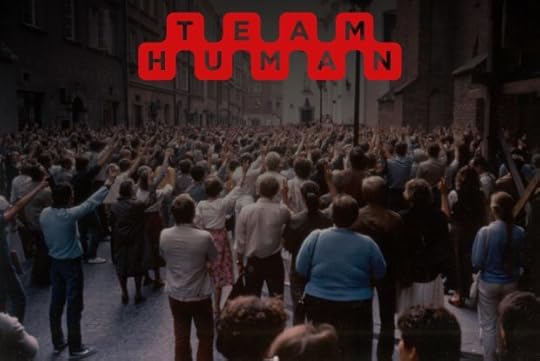
I thought long and hard about how best to respond to the thousands of emails I’ve received since publishing Throwing Rocks at the Google Bus. People, companies, mayors, cooperatives, towns and big corporations, all looking for ways to distribute prosperity more widely, start local currencies, build platform cooperatives, convert to employee ownership, offer dividends instead of capital gains, or crowdfund a bookstore. I’ve answered more than half – or about 20,000 of them – individually. But I realized that it’s really not me who has the answers; it’s you.
I’m not a one-stop shop for new social and economic strategies. But I know a heck of a lot of the people who have the answers – people who understand we have to stop optimizing human lives for economic growth, and start optimizing the economy for human prosperity. People who want to stop programming people for technology, and start programming technology for people. The people I’ve come to call Team Human.
So I’m going back on the air with a new audio show – my first since doing The Media Squat on WFMU a decade ago. It’s a weekly podcast called Team Human, looking to challenge the operating systems driving our society, reveal its embedded codes, and share strategies for sustainable living, economic justice, and preservation of the quirky nooks and crannies that make people so much more than mere programs.
Team Human is where the conscious beats the automatic. An intervention by people, on behalf of people. All in delightful audio – perhaps the most intimate, enveloping medium yet developed.
My books may have been good for addressing the symptoms of social and economic injustice, and doing forensic analysis of the root causes for our problems – sometimes dating back to things like the invention of central currency and chartered monopolies in the late Middle Ages. But social change requires more than knowledge of where we are and how we got here. It requires a shift in values, in perception, and in the way we understand what it means to be a human being. It’s more fundamental than policy, because it is what animates us in the first place.
If we understand human beings the way the market does – in terms of our ‘utility value’ – then all is surely lost before we’ve even begun. Machines will always have greater utility value than humans. And people are certainly an impediment to a marketplace where assets are abstractions of derivatives, not the stuff that sustains life. To the market, the derivatives on water are worth a whole lot more than water, itself.
Meanwhile, if we look at human beings the way some of the scientists and CEO of our leading technology companies do, then we’re just some temporary stage on information’s journey toward higher states of complexity. The minute humans are outpaced by artificial intelligence – the moment of the ‘singularity’ – we will be officially and effectively obsolete. In their perverted understanding of evolution, human beings should pass the torch. Any effort to stick around as something more than a memory card may as well be hubris.
Well, I don’t buy that. And I know a lot of you don’t, either. It’s time we forge the solidarity we need to press for the human agenda – without shame or embarrassment.
People are cool, in our own weird, clumsy, and ambiguous way. The markets and technologies we’ve created are not new gods. They are not our replacements, but mechanisms we’ve constructed to make our lives better, more just, and more meaningful.
That’s why I’ll be engaging in real-time, no-holds-barred discussions with people who are hacking the machine to make it more compatible with human life, and helping redefine what it means to stay human in a digital age. Members of Team Human such as debt activists Astra Taylor and Tom Gokey, Occupy Wall Street founder Micah White, YesMan Andy Bichlbaum, Institute for the Future chief Marina Gorbis, co-op organizer Esteban Kelly, DNA artist Heather Dewey-Hagborg, tech environmentalist Richard Maxwell, and so many more, including, hopefully, you too.
Please join Team Human – both as a listener and as a human teammate. It’s not too late to reclaim planet Earth for its people, to give land and labor a voice along with capital, and to share our best strategies for mutual aid, environmental sustainability, and economic justice. In the real world, we humans have the home field advantage. Let’s use it.
The post Team Human: Our Last Best Hope for Peeps appeared first on Rushkoff.
August 24, 2016
Video From Talk at New Zealand Open Source Society
Watch video of the feed to New Zealand OS/OS 2016 conference:
The post Video From Talk at New Zealand Open Source Society appeared first on Rushkoff.