Douglas Rushkoff's Blog, page 17
June 1, 2017
Team Human: Fighting for a Human Agenda
This week’s TeamHuman guest, communications architect Dan Berninger, suggests we are optimizing people for technology instead of the other way around. Everyone gets dehumanized in the process, but maybe that’s the point.
And speaking of humans, I tried listening to Donald Trump as if he were a human being. Strangely enough, I was able to empathize with his perspective, and came to see how the mainstream media is pushing him and his followers further into a corner.
Have a listen:
The post Team Human: Fighting for a Human Agenda appeared first on Rushkoff.


May 23, 2017
Team Human: The Play is the Thing
Just getting a thousand humans into a room together to sit and watch other humans act out something on stage is the miracle. Playwright J.T. Rogers understands why the very act of doing live theater is so hopeful, and applies this hope to intractable problems like the Middle East conflict – with surprising, and Tony-nominated results.
Also, a monologue from me on the Manchester bombing, and what it means when a fatal stampede at a Who concert in Cincinnati can be considered the good old days.
The post Team Human: The Play is the Thing appeared first on Rushkoff.
May 17, 2017
Team Human: Defaulting to Colonialism
On this week’s Team Human, we discover one of the reasons why knowing history matters. William Hogeland, author of Autumn of the Black Snake, tells the story of how and why the US Army was created – not to defend our borders, but to wipe out indigenous nations. And all that, in an effort to satisfy the growth mandate embedded in our economy by heroes of the neoliberal left like Alexander Hamilton. Make no mistake: Hogeland is a live wire.
The show opens with a related monologue from me about why successful businesses should refrain from scaling up. How about staying local, and letting other companies just copy your model? Why and how has the need to scale and colonize new territory become our default?
The post Team Human: Defaulting to Colonialism appeared first on Rushkoff.
May 9, 2017
Team Human: Civic Engagement Beyond Electoral Politics
I’m really proud of my conversation with Civic Hall founder Micah Sifry on this week’s episode of Team Human. We get deep into the way electoral politics, though important, can actually distract us from the civic engagement we need to do here in the real world. Be sure to register for Personal Democracy Forum 2017 or volunteer to help out at the conference and get a free ticket!
Also, a monologue from me about why so many of us have to drive to work. (Hint: it’s not because the world was created that way.)
The post Team Human: Civic Engagement Beyond Electoral Politics appeared first on Rushkoff.
May 3, 2017
Team Human: Tessa Fights Robots
I had a great talk with composer/performer Tessa Lena – one of those conversations where you get into the nature of life, what we can do with our time together, and how we are truly different from the machines and institutions that would control us.
Luckily, we were in the Team Human audio booth at the time, and it’s now a new episode of the show: Tessa Fights Robots. Take a listen and let us know what you think. I open with a monologue about whether it’s really the robots we should be fearing, or the drive to become more robotic, ourselves.
The post Team Human: Tessa Fights Robots appeared first on Rushkoff.
April 26, 2017
Team Human: No Shame! Towards a Cooperative Economy
We just posted an entirely actionable episode of Team Human, with the founder of the Net Party, Pia Mancini. It begins with a monologue by me about the way shame over everything from gender and sex to money inhibits our ability to forge solidarity – by design.
That segues to a great discussion with Pia Mancini, who has built a new platform allowing cooperatives to collaborate and fund by leveraging the power of transparency. Again, breaking the self-destructive boundaries of shameful secrecy, we tap into the power of humans truly working together toward mutually reinforcing outcomes.
Visit teamhuman.fm for more on this episode and Pia’s work with Open Collectives.
The post Team Human: No Shame! Towards a Cooperative Economy appeared first on Rushkoff.
April 21, 2017
New Team Human Episodes
We just posted a great new Team Human episode with David Sax, author of the Revenge of Analog. It begins with a monologue from me about our growing intolerance for ambiguity in a digital age. Seeming stalemates and unresolved conflicts – take North Korea – feel like they must now careen toward one crazy conclusion or another. As Mike Pence explained, we have no more “patience.”
And please take a listen to last week’s episode with Laszlo Karafiath, memeticist and philosopher, as well as my monologue about what to believe and how to resist the rabbit holes in a news media constitutionally incapable of discerning the truth.
The post New Team Human Episodes appeared first on Rushkoff.
April 13, 2017
Alibi: Review of Aleister & Adolf
By Mikee Riggs
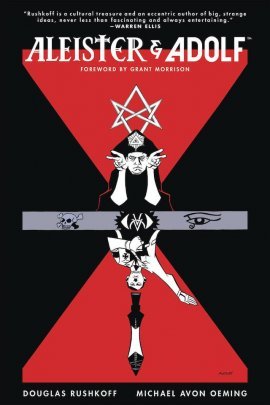
Aleister and Adolf
By Douglas Roushkoff, Illustrated by Michael Avon Oeming
Dark Horse Originals
88 pages
$19.99
In varying degrees, evil can be viewed as subjective. What someone may perceive as a monster, another person could see as tame. Aleister and Adolfseeks to show you just that. While the book is by no means saying Adolf Hitler wasn’t evil, it does paint Aleister Crowley in a better light. To some, Crowley is a man of pure evil. Perhaps the most famous occultist, Crowley’s views are often seen as controversial. In Aleister and Adolf Crowley is painted as a deep thinker who at times is very self-centered, but is certainly not evil; in this way, the work is a breath of fresh air.
Aleister and Adolf is a work of historical fiction by Douglas Rushkoff and Michael Avon Oeming. At the very beginning of the book, Rushkoff notes “Most of the stuff in this story really happened. The rest may as well have,” implying that the overall story being used to share the facts is an interpretation, but only to a certain degree. The story begins in 1995 with Roberts, a young web developer, attempting to transfer a logo for a company online. The logo is thought to be corrupted, so he goes looking for answers from its original designer. Instead of an easy answer, he finds a story that takes place during World War II involving Aleister Crowley, who is attempting to manipulate and in turn defeat the Nazis. The logo’s designer is working for the army and has been tasked with coercing Crowley into helping America seize an item dubbed the Spear of Destiny from Hitler. Roberts soon finds himself sliding deep into a rabbit hole of sexual ritual and occult beliefs.
The story itself revolves around the power and deeper meaning of symbols. Crowley is convinced the swastika is feeding Hitler’s power and in turn, tries to come up with a strong symbol that can counteract it. The book spends a lot of time digging into the power of symbolism and uses it as a means to show Roberts’ descent into occultism.
Rushkoff’s writing in this graphic novel is astounding. He creates well-crafted characters and uses them expertly to move the story along. The story itself is rich, complex and well researched. Rushkoff has taken the time to learn the subject matter and does it justice without making it seem at all hokey. He manages to tackle Crowley, occultism, the Holocaust and iconography without once making the story feel muddy or bogged down.
Backing up this strong plot and taking it to the next level is the art of Michael Avon Oeming. Oeming has been developing his talent for decades now. His work on Powers solidified him as a business mainstay as well as one of the contemporary greats. In Aleister and Adolf, Oeming does some of his best work to date. His style is sharp and concise, making the story even more engaging. His panel work is something to be marveled at. Throughout the book, Oeming creates amazing two- and single-page layouts that jump off the paper. His style is stark but compelling, creating a whole that is nothing short of brilliant. Aleister and Adolf’s art alone could be viewed as a master class in graphic storytelling.
Overall, this is a strong story about what’s on the surface and what meanings are hidden. It asks you to look past its source material and ask questions about the world around you. In a time where questioning what you see is as important as ever, Aleister and Adolf is a must-read book.
http://alibi.com/art/53252/Aleister-a...
The post Alibi: Review of Aleister & Adolf appeared first on Rushkoff.
April 7, 2017
Stir to Action: DIY approaches to the New Economy
Here’s a great new magazine out of the UK for those of us looking for hands-on DIY solutions for the new economy. I did an interview with them, too, asking people to evaluate just what value they’re really getting from the platforms they’re on.
Q&A with Douglas Rushkoff
by Oliver Sylvester-Bradley
Dec 27, 2016

STIR Magazine is a media partner for next year’s Open Co-op Conference, London. Book tickets here!
This Q&A with writer, documentarian, and lecturer Douglas Rushkoff is byconference team organiser Oliver Sylvester-Bradley.
OSB: You’ve mentioned that “the model of the ever expanding economy is bankrupt” and highlighted the “corporate charters” and “central currency” as the core components of the present “bankrupt” system. How can we hope to challenge the corporate charters?
DR: Well, you sound like you believe the way to change corporate structure is for citizens to take action against the corporations. That’s certainly one possible approach, and useful in a situation where there are no human beings within the corporation who are willing or able to change the corporations from the inside. What might be surprising to you is that most of the people in corporations actually do not want to kill people, do not want to be enslaving children in resource-rich nations, and do not want to make the planet uninhabitable. They are the ones in the best position to change corporate actions, since they are inside the companies themselves.
They simply need to be educated about what is possible. I tried to do some of that in my book. CEOs and Boards of Directors need to understand that they do have legal authority to act in the best long term interests of the company. So-called “activist” shareholders really cannot sue Boards for hurting the short-term value of shares – especially when the Boards are acting in the long-term interests of the shareholders. Not destroying the planet is in the best long-term interests of shareholders. Likewise, companies can restructure and reorient from within to favor dividends and public reinvestment over capital gains and extraction.
So, as I argue in my book, the key is to convince CEOs and others who are running corporations that they can exercise human agency in their decisions. They do not have to behave automatically. They can use their decision-making authority. They need to communicate with shareholders, and explain the advantages of getting lots of dividends instead of a one-time “pop” of share price, followed by an inevitable decline. Companies can actually make more money with ongoing revenues than blindly pursuing growth.
They can stop selling off their most productive assets, and instead remain powerfully competent companies. Steady state economics is about maximizing circulation rather than extraction. To anyone who understands how business works, they should see how this is a healthier choice for those within the business, as well as the distant shareholders who only want money at any cost.
OSB: You have described how “digital giants are running charter monopoly software…” and that their “technology enforces the monopoly”. At Open we are keen to see NGOs, co-ops, non-profits and even Local Authorities start to utilise open source software and, in return, to fund the development of a suite of open source apps which facilitate collective ownership and collaboration. What steps do you think are required to disrupt the digital giants’ monopolies?
DR: Of course, I was using the word “software” a bit metaphorically. The corporate charter is itself a program that can be changed. Instead, it is being further amplified by technology. What I mean by that is that the corporation works in a particular way, as dictated by the charters and contracts making up their business plan. So a company’s core code – long forgotten – may assume that the way to make money is to prevent people in the regions where the company operates from making any money. And while that may have been a good strategy for maintaining a slave state in the 1400’s, it doesn’t work so well in places where people are supposed to be free or employed.
But the company’s directors may have forgotten all of this by the 21st century, and simply implemented new plans based on the same strategy of exploitation and extraction. So now they are writing software and building platforms that embed these same assumptions about their users. And they end up extracting value and time from people without helping them create or retain any for themselves.
Or a business plan might be to make money by extracting metal ore from the ground. Then, the company builds technology to do that, which makes the extraction happen a lot faster. They don’t realize that extracting so quickly and totally may deplete things in new ways. And because they don’t realize that the core “code” of the company is actually changeable, they don’t see any way out of the problem.
Now, you’re talking about software solutions themselves, and how people from the outside can give up entirely on the corporate solutions, and build alternative software that works in greater consonance with the needs of real people and places. That’s pretty easy to do. We can write an alternative Uber that lets the drivers participate in the profits. Or an alternative Facebook that doesn’t manipulate people’s news feeds to try to program people’s future choices. The trick is getting people to use the alternatives when they’re not so pretty or universally accepted.
OSB: It has been suggested that the open-source / platform co-op alternatives to corporate software solutions will need to do two things at least:
– Be easier to use / provide a better experience
– Cost the user the same or less (i.e. provide better value for (conventional) money.
What do you think about the possibility of an “open app ecosystem” (a library of interoperable apps, covering all aspects of communication, organisation and even trading needs) sweeping into dominance over the corporate alternatives once it provides the same level of utility, at the same price, as the present corporate systems?
DR: The easiest tactic is to help people experience the impact of various pieces of software on their own existence. Does Facebook make them happier? How is it helping them take command of their lives? People sometimes have to become more aware of the surveillance state, the extractive quality of these tools, and the nauseous, empty, angry feeling they have after using this stuff in order to feel motivated to make a change.
OSB: Your chapter in Ours to Hack and Own entitled ‘Renaissance now’ explains how we are on the verge of a modern-day renaissance. There is no doubt that revitalising and retrieving lessons, techniques and habits from the past could help bring about change but the last renaissance was also driven by a shift in intellectual thinking. Do you have any thoughts on how, and where, an intellectual shift might come from?
DR: I think changes in experience can change people’s world view. If they have terrific experiences working in co-ops or using local currency or simply sharing stuff, then their world view will change.
OSB: You explained how “banks were invented to extract value from our transactions not to authenticate transactions”. Do you have any thought on why LETS and time banks haven’t made a more effective transition to the web?
DR: I think part of the reason LETS and alternative, trust-enabling systems have not developed is that most people are not actually proud of the value they create. Too many people feel that they don’t have enough to offer, and need to hide behind anonymous cryptocurrencies and traditional anonymizing monetary systems in order to mask things. Meanwhile, if a person is sitting in a cubicle working for a mortgage broker or collecting debt from student loans, how are they supposed to participate in a local LETS system? What real value are they creating for others? Such people find it easier to take some of the cash they’ve made and “invest” it in Ethereum than… become part of some local favour bank. To create and exchange value, you have to be able to create some value for other humans – not just help some corporation extract value from people.
OSB: I am excited about the idea that platform co-ops and the collective ownership of our local facilities and businesses could potentially completely disrupt capitalist democracy as we know it. Where do you stand on ‘working with and within the present system’ vs ‘building a new system which makes the present system obsolete’?
DR: Well, I don’t think it’s one or the other. People can vote on public and municipal activities through traditional democratic participation, and people can vote on private and business activities through their participation in cooperatives. I do believe that the more influence real people have on the private sector, the more freedom our public activities will be from corporate control. A platform cooperative is not going to lobby the government for destruction of the environment where its workers are living. So government ends up able to deal with reconciling the different views of its people, rather than that of its people with that of its non-human corporate actors.
OSB: Do you think there is a direct correlation between the amount of external investment an organisation accepts (and hence ownership / governing authority it relinquishes) and the real value an organisation has for society?
DR: Well, it has more to do with how much a business actually needs to operate and satisfy its market. If a business is really inexpensive to operate, then it doesn’t make sense for that business to take billions of dollars in investment. I know that sounds crazy, but it’s true. If you take billions of dollars of investment, then the people who gave you that money expect to get that money back. This means you need to make billions of dollars in revenue. That’s really hard – especially if you’re a small business that can actually function with just a few thousand dollars. If you take less money, then you are not obligated to grow the business so fast. You are still *allowed* to grow your business fast, but you don’t have to become a multi-billion-dollar business right away.
The more money you take, and the less proportioned to the real size of your business, the more power you have to surrender to the people giving you the money.
OSB: We are often exposed to the vision of a world full of hate and extremism and scarcity but rarely hear about a positive alternative. If platform co-ops, the solidarity / generative economy take hold it strikes me we could be living in a very different world in the future. Can you describe what you think this world might look like?
DR: I’m not a utopian, so I don’t envision a world or economy entirely transformed into a new state where all the value people create is properly registered, the commons is reinstated and appropriately governed, and selfishness is exchanged for true compassion.
“The generative, solidarity-inspired economy I envision is one where humanity stands a good chance of making through the next century without going extinct.”
The generative, solidarity-inspired economy I envision is one where humanity stands a good chance of making through the next century without going extinct. I am trying to envision a world where global warfare won’t be the only way to prevent impoverished populations from enacting violent revolutions on their own governments. I’m imagining a world where the wealthy don’t simply try to earn even more money in order to insulate themselves from the problems they’ve created by “externalizing” the real costs of their business practices.
So the radical alternative I’m envisioning is simply a world where the most extractive and destructive practices don’t absolutely dominate us. Where people have the ability to work for one another if there are no corporate jobs available.
I can imagine a near future without people starving in the streets, without China cashing in its chips by purchasing America’s greatest companies and properties, and without a continuation of the shift of wealth from the poor to the rich. I can imagine it not getting significantly worse than it is now, but that will take a huge shift in power and attitude.
OSB: What do you see as the main stepping stones for this vision to become a reality?
DR: Well, from a policy standpoint, I think a shift in tax policy would do a lot: punish capital gains and reward dividends and revenue. Right now, we punish companies and people who earn money, and reward those who simply extract capital out of the economy. That has to be reversed.
People and companies have to look toward earning money with the thing they do, rather than by selling the company itself. You can earn money, or you can “flip” your business (sell it to short-term investors). The latter leads to really bad practices.
We also have to accept that growth is an artefact of a currency system, not necessarily a symptom of a healthy economy. There are some economies that may be full grown.
OSB: Thanks Douglas, you have given us plenty of food for thought. The proposal that the users might buy back Twitter seems to demonstrate the growing appetite for platforms which are owned and controlled by their members. Here’s hoping more people start to realise the benefits of member ownership and governance, and how this creates a virtuous cycle of value creation. As you say, it seems essential if we’re going to survive the great challenges of our time.
The post Stir to Action: DIY approaches to the New Economy appeared first on Rushkoff.
April 5, 2017
Team Human: Episode 31 – R.U. Sirius “Counter What?”
Just posted a new episode of Team Human.
My friend and personal hero, R.U. Sirius, evaluates the state of the counterculture, What is it we’re supposed to be “counter”, anyway? Maybe it is we humans who are the culture, and they who are counter….
Plus, a thought essay from me about what happens if Trump gets cornered. If he’s willing to throw up world-threatening distractions on minor revelations on taxes or electoral malfeasance, imagine what he’ll do if he’s truly exposed. Makes it almost tempting to leave him alone.
The post Team Human: Episode 31 – R.U. Sirius “Counter What?” appeared first on Rushkoff.