Douglas Rushkoff's Blog, page 18
March 31, 2017
Team Human: Get the blood off your phone, but keep the fingerprints
We posted a great new episode of Team Human this week. Bas van Abel, creator of the Fairphone, helps uncover the real human costs of smart phone manufacturing, as well as his efforts to develop a viable alternative. The show opens with a monologue that asks if the Broadway musical Hamilton gives the Left a dangerously compelling a fantasy about neoliberalism.
Meanwhile, check out this TeamHuman Meetup in Cardiff!
The post Team Human: Get the blood off your phone, but keep the fingerprints appeared first on Rushkoff.


February 21, 2017
Heleo — Against the Clock: How Technology Has Changed Our Experience of Time
Alan Burdick is a staff writer and former senior editor at The New Yorker whose first book, Out of Eden: An Odyssey of Ecological Invasion, was a National Book Award finalist and won the Overseas Press Club award for environmental reporting. His most recent book, Why Time Flies: A Mostly Scientific Investigation, chronicles his quest to understand the nature of lived time. He recently joined Douglas Rushkoff, media theorist and author of Present Shock: When Everything Happens Now, for a conversation on what we miss about the nature of time when we only think about it as a number.
This conversation has been edited and condensed. To view the full conversation, click the video below.
Douglas: [Both our books are] about time, or about the now. For me, the Present Shock was that there are two kinds of time. The Greeks have two words for time: “chronos”, which is like time on the clock, and “chiros”, which is more like readiness, human time. You crash the car at 4:27, but when do you tell dad that you crashed the car? I always say, “After he’s had his drink, before he’s opened the bills.” That’s chiros, human time, the way we experience time, versus real time or number time.
For me, it became important in the digital age, as our style of clock time changed, what does that do to our understanding of real time? You looked at the same relationship in a different way.
Alan: I started out feeling like I understood what space-time is, but that doesn’t really have a lot to do with the time that we actually live in from moment to moment. Then there’s clock time. I came to understand what that is, and it turns out to be really strange. But I didn’t really understand what is this stuff in us that we call time? It turns out that we have all kinds of clocks in us—in our cells, in our mind—and I had begun with a notion that there is this tension between clock time and technological time. I didn’t even want to wear a watch for a long time.
Then I came to embrace it, as I began to understand that time isn’t just a thing that I put on my wrist, but it’s a thing that we create organically between us, almost like a language.
Douglas: Right, if you burrow deep into it, it becomes real again. [When] the clock went up in the clock tower in the medieval village, people stopped trading value and started working for time. It was the invention of the employee and hourly wages, which led to five centuries of “time is money,” which is why in some ways the watch or the Google Calendar feels oppressive. Then you pushed through that and found something reassuring.
Alan: I think so. Even cavemen had to deal with time, to a certain degree. Even if their clock is just the sun, daylight and nighttime, you need time in order to coordinate your activities, even if it’s hunting wooly mammoths. “Let’s all meet at the cave entrance at sunrise.” Then we get it in our clock towers, and now we have it on our wrists, and it is this organizing force, for better or worse. But it does start to get oppressive when you’ve got it on your phone and you pull your phone out of your pocket, and there’s the time, and you’re always thinking about the time. It gets a little overwhelming.
Douglas: And that stream of time feels like it doesn’t really take into account the way my organs and the body and the culture moves through temporal landscapes. There’s the circadian rhythms or chrono-biology through which we experience the world. Indigenous cultures tended to use the moon as a way of organizing their sense of time, and when they used the moon, they were getting in sync with some stuff that we’re only learning about now, the different neurotransmitters that tend to dominate during different weeks of a lunar cycle. It’s like our obsession with that number makes us lose track of all these other cycles that are moving along with it.
Alan: All times become basically equivalent, even though they actually aren’t.
Douglas: Right, generic, it’s just a number. It’s not just a number.
Alan: That was really interesting to me, this notion that there are different better times of the month to be doing things. Your own schedule takes that into account. Can you say more about that?
Douglas: I did take it into account until I surrendered back to the demands of the world. I got disciplined when I found out that the four weeks of the lunar cycle and the first week of a new moon tends to be dominated by acetylcholine, the next week is dominated by serotonin, then dopamine, then norepinephrine. I started looking up what happens to a body and a brain when it’s bathing in acetylcholine versus dopamine. I realized, in the first week of a new moon, acetylcholine, I’m going to do lots of gathering of new ideas. The second week, the serotonin week, it’s as if you’ve got a bunch of Prozac in you: I’m going to work, to barrel through and get my writing done.
Dopamine week is a party week, a week that I stop writing, force myself to not write, to engage with people. Then the norepinephrine week is the fight or flight week, which is when you pull back and get very analytic. That’s where I would put all my notecards on the wall, make my crazy wall of ideas, and reorganize things, what goes in what chapter. When I worked that way, I actually wrote fewer days per month, but I got more done.
My productivity went up, and my sense of well-being went up too. It felt like a discipline at first, and then it almost felt like there was an internal compass I was getting in touch with. It made sense—there’s four seasons, there’s four parts of the breath, there’s four directions. Not being religious about it, but being aware of it.
Alan: But you let all that go?
Douglas: Well, it let me go. The problem is the demands of the modern life. You’ve got the inbox, and there’s all these people and everybody wants something, or you’re in book promotion mode. When a book comes out, your schedule is no longer your own, the publisher calls, there’s NPR that wants to talk to you at four in the morning, you’re up. You serve that, but you can’t live like that all the time.
Alan: When I was working on this, I had a full time job, and so I always had to decide, “Am I going to get up super early, at four o’clock in the morning?” which is a time of the day not particularly conducive to doing anything except lying in bed. “Or am I going to stay up until two o’clock in the morning?” What I ended up doing was neither. I would go to bed early, and then wake up at midnight or one o’clock in the morning and work for two or three hours. It was like there was this whole other day packed away in the middle of the night. I actually learned there’s a great book about the history of the night.
It turns out that before the advent of modern lighting, people did not sleep eight hours straight. They would go to bed, have what they called the “first sleep”, and then they would wake up at midnight or one. Sometimes they’d stay in bed, but a lot of people got out and dealt with their cows or their fields, or they would even go into the village and do a little work in their shop.
Douglas: At night? With little candles?
Alan: Yeah, and then they would go back to bed at two or three in the morning.
Douglas: The opposite of siesta. That’s so weird, but in a way that’s perfect.
Alan: But it all went away with electric lights, because now—
Douglas: You stay up later.
Alan: Now we think you can colonize any part of the day.
Douglas: Right, the colonization of human time. I’m sure there’s people from the captology labs of Stanford thinking, “How can we use what we’ve learned from [Why Time Flies] to make people spend more time on our website, but think that it’s only been a minute?”
Alan: Science has half-figured out how. Mars has a 25-hour day, and our circadian cycles are 24 hours long, so if we do make it there and live there, it’s like crossing three time zones every two days. They figured out a way to zap you with certain wavelengths of light at certain times of day that will actually give you a 25th hour of the day.
“Time can go faster, or slower, depending on what drug [a person takes] or what they’re doing—meditation, ecstatic experience, entertainment experiences—there’s a joy in it. The disconnection from the clock itself is exhilarating, whichever way it happened.”
Of course you’re spending that hour of the day being exposed to peculiar wavelengths of light, so I’m not sure you’re really gaining.
Douglas: The joy of your book is this sense of connection and disconnection from the clock, this sense of what does it take for a person to move into almost a god-like place. Time can go faster, or slower, depending on what drug [a person takes] or what they’re doing—meditation, ecstatic experience, entertainment experiences—there’s a joy in it. The disconnection from the clock itself is exhilarating, whichever way it happened.
Alan: I was in Alaska for a couple of weeks in the summer, where the sun never sets. It’s freaky and disorienting. It’s absolutely beautiful. But people divided themselves up into two groups. There were the people who just went with it and slept whenever they wanted and ate whenever they wanted. They were in their own temporal world. Then other people, including myself, felt like, in order to remain sane, “I am going to wear my watch and go to bed at 9:30, even if it’s broad daylight, and I’m going to wake up at six a.m., even if it’s broad daylight, and I’m going to live according to my watch.”
Douglas: That’s a little bit like Lord of the Flies—there’s the ones who stay with civilization, maintain the codes to stay sane, and the others who are like, “We’re free, let’s go nuts.” But you want both in your life. You want to have those moments where you’re disengaged. Because our brain is working all the time to make sense of this stuff. You’ve got this great section where you say that one of the main things the mind does is it takes all these data points from reality, and desperately tries to string them together into something that makes sense.
You said it almost as if it’s quite possible it makes no sense. We’re just doing this in order to have a coherent experience of this chaos.
Alan: Part of time is understanding and grasping the order in which things happen in time—sequence. That actually turns out to be a lot more plastic than we give it credit for. You can fool the brain into thinking that B comes before A, in some cases.
I took part in an experiment in which you press a keypad and move your mouse on the screen, but effectively, it had the appearance of the cursor moving before I pressed the button, so effect came before cause. It was super freaky. Every time, I would see my cursor move and think, “I’m going to fool it now and not press the button,” and then I couldn’t stop myself from pressing the button.
How would you describe your relationship to time?
Douglas: It’s gotten screwed up. I don’t blame tech, but I blame the way we’re applying tech, at least. It has to do with my ability—and I feel like this is a national problem—to have perspective on the past. I feel like the past used to be smaller, because it happened a long time ago, and now… The simplest way to say it is if a person I utterly forgot about from second grade now tries to friend me on Facebook, they come into my present without the scale of a person from far away.
They’re at the same scale as any other friend on Facebook, and I feel like this whole nationalism thing, whether it’s Britain doing Brexit, or Trump saying, “Make America Great Again,” it abuses a false connection to the past. It’s exploiting this inability to have proper proportion and perspective on the past. That feels so digital to me.
Alan: When Edison invented the phonograph, there was this scathing review in the Spectator, of this critic saying, “We’re completely disregarding the virtues of oblivion, the benefit of being able to forget.” Now that every voice can be stored forever, we’re going to be haunted by these voices that won’t ever go away.
Douglas: That’s true. Somewhere in Talmud there’s this rule that Jews are not supposed to remind someone of something embarrassing from their past. You can’t say, “I remember when you were 12, and you used to…” Because it doesn’t give the person the liberty to move past that. You keep bringing them back to it.
This whole effort, whether it started with My Life Bits and Facebook timelines, that everyone’s supposed to record their history as if Yale University Library Archives is waiting to store our entire history for future researches—most of us are not that interesting. But everyone is doing that. That’s a strange thing, it pulls you out of the chiros, the present, it doesn’t give you those when time flies moments. It keeps tying you back.
Alan: I have this vision of Facebook in 100 years in which even people who have died, their Facebook presence continues—not only remains, but expands. We’ll not only be able to see pictures of them, but we’ll hear their voices. Your great-grandmother will be calling you with advice about who you should or shouldn’t date. It will all not only be available, but will start speaking.
Douglas: With AI, Ray Kurzweil-ian now-ness to it.
Alan: We’re going to be nostalgic for futurism, because it’s going to be all past-ism.
Douglas: The other thing that got me weirded out from your book was I thought that atomic clocks didn’t really work right, which is why they moved them every once and awhile. But it’s not.
Alan: No, Earth is the problem.
We’re drifting away from the sun, but the sun is getting bigger. That could be a problem in five billion years. In the 1960’s, seconds were defined from the top down: there’s the day, rotation of the Earth, 24 hours, 60 minutes in an hour, 86,450 seconds in a day. It’s just division, a theoretical thing.
Then physicists were like, “Well, if you get a cesium atom and it goes through nine billion plus phase transitions in the span of a second, as defined by this 86,000 metric, then we can do the same thing,” and that’s what we’ve been doing, except that we get farther and farther away from that 1960 definition of the top-down second, because that keeps slowing down.
Douglas: But as far as human bodies are concerned, that’s the only one that matters. When we change time from the segments of the day from the portions of the cycles of life to these independent durations, a second is no longer a part of a minute. That’s screwed up, too. Doesn’t that turn time from this way of understanding our experience to this tyranny of numbers?
Alan: The way that national clocks create time is they have atomic clocks that tick seconds, and then you can add seconds up to figure out the time of day. But the phrasing they use is they “realize” seconds, and they “disseminate” the time. It’s like propaganda.
Douglas: I love that, though. Time is the ultimate propaganda because death is the ultimate fear. Time is the best medium through which to trigger and exploit that Becker denial of death stuff.
Alan: Do you have tricks for turning off the time?
Douglas: It’s hard when there’s a child going to school in the morning. This is a big project, but I’m wondering if there’s a way to be free of the Google Calendar, if I could do it for a month or two. I don’t like that I spend a large portion of my day answering emails which means putting more things into that calendar, most of which I don’t even really want to do. Then, if the Google Calendar is dictating my next month, and there’s only three hours in it left for me, that’s not good. I don’t want to keep doing things now that screw up the passage of time in the future. I’m bankrupting my own temporal landscape.
Alan: When we talk about this experience of time flying as we get older, the years seem to go by faster, what’s actually happening, studies show, is that we’re under more time pressure as we get older. It’s not that the years are actually going by faster, it’s that we are spending more of our later years scheduling. We’ve got more to do, you’re looking at your calendar more, you’re trying to get more done in the same amount of time than you were when you were five or 10 years old. Of course time went a lot slower when you were five or 10, because you didn’t have a schedule, you weren’t thinking about time.
Douglas: We didn’t have play dates. That infinite, open sky quality of childhood, which is [now] less and less wandering around the neighborhood and finding worms, good stuff. There was an expansiveness. After reading your book, I would say the expansiveness was expansiveness of time. I thought of it as space; it wasn’t, it was time.
Alan: It was the expansiveness of not thinking about time.
Douglas: That’s a liberty I think we deserve, and I’m going to make it come back, I am.
Click here to see full video interview.
The post Heleo — Against the Clock: How Technology Has Changed Our Experience of Time appeared first on Rushkoff.
January 30, 2017
Hollywood Reporter — How Donald Trump Skillfully Taps Into Twitter’s “Ocean of Emotional Chaos”
Read this article at Hollywood Reporter.
Author Douglas Rushkoff, who coined the term “viral media,” reveals how POTUS successfully pushes buttons on the social media site, which “rewards those who can generate an immediate response.”
Donald Trump is no more the master of Twitter than Twitter is the master of him. And while Twitter elevated an upstart, attention-seeking candidate, it may not prove as friendly an environment for a president who may actually want to get stuff done.
Twitter may let people do an end run around the media’s traditional gatekeepers, but it does so at a price. Social media platforms make money by tracking the flow of posts and reposts. They are selling the currents of influence and the data that can be gathered about each user. More tweets and retweets mean more data and more money, so the whole platform is optimized to trigger impulsive sharing and resharing. It rewards those who can generate an immediate response. If a tweet doesn’t generate that instantaneous call to action in the two seconds it took to read, it won’t get retweeted and will scroll out of sight, forever.
Both the algorithms driving Twitter and the culture that has grown on the platform are driven by impulsiveness. Stars who succeed in provoking a broad response tend to do so by breaking accepted rules or just breaking down: the human equivalent of those car crashes that force us to turn our heads.
That’s why the most successful personalities on Twitter are less significant for the content they’re creating than for the emotions they are tapping. It’s not tweets but retweets that tell the story. They’re like a direct feed from the collective cultural unconscious. An ocean of emotional chaos. This is more true on Twitter than on Facebook, which has home pages and some semblance of geographical landmarks and categories. Twitter is just a fire hose. It is the standing wave of culture at any given moment.
Charlie Sheen was the last figure to get the sort of national attention that Trump has been garnered. And it wasn’t because he was saying anything so brilliant or entertaining. He simply jumped into that standing wave of culture and surfed it for all it was worth. Then he wiped out.
Likewise, Donald Trump didn’t do anything particularly creative or substantive on Twitter. He simply recognized the undertow, threw himself into the current and surfed it all the way to the presidency. In that sense, Trump served more as a vessel for Twitter’s agenda than Twitter served as a vessel for his.
As an acting president rather than a contentious upstart, however, our Tweeter in Chief may have a problem. Twitter favors the underdog, the one tilting at windmills. The crowd can’t help but retweet a grenade thrown from the bottom up and against an established power. They’re likely to feel differently about a president lobbing insults down at his lessers. At the very least, he’ll have to choose between giving his 22 million Twitter followers the sensationalist car crashes they will retweet or the good governance they’ll ignore.
The post Hollywood Reporter — How Donald Trump Skillfully Taps Into Twitter’s “Ocean of Emotional Chaos” appeared first on Rushkoff.
January 20, 2017
Fast Company – The Silver Lining Of Anti-Globalism Might Be The Creation Of A True Digital Economy
Read this article at Fastcoexist.com
The folks at Davos this week are trying to behave as if everything is normal. Sure, England is Brexiting from Europe and the United States appears to be retreating from the global stage altogether. But somehow the word from Switzerland is that a mix of the right interest rates, investment strategies, and business optimism will keep free trade and globalization on course and safe from this boorish surge of populism.
They’re missing the point. The rise of nationalist sentiments are not the cause of the economic shift underway, but a result of it. The real force energizing these changes is digital. While the digital economy has accelerated and amplified many of the mechanisms investors and corporations use to grow their capital, it has left most people with less money and less opportunity. This latest burst of fear stemming from that lack of opportunity is coming in the form of nationalism, and even protectionism, but it also could offer us a fleeting but real chance to turn our digital economy toward the needs of people instead of finance itself.
Don’t get me wrong. I’m all for prosperous businesses, digital and otherwise. But I’ve also witnessed with horror over the past 20 years as the potential for widespread, bottom-up prosperity unleashed by digital technology have been surrendered to the priorities of extractive global capitalism. This is not the way it was supposed to go, at least not according to me and my cyberpunk friends of the late ’80s.
Back then, the emergence of low-cost computers and networking appeared to augur a peer-to-peer, fluid, and more open economic landscape, one where we all step off the industrial-age, punch-the-clock treadmill and work in our own time, collaboratively, on creative pursuits, from home, in our underwear. Instead, we’re getting an exacerbation of some of extractive corporatism’s worst effects: joblessness, disenfranchisement, wealth disparity, corporate lethargy, artificial growth, and financialization.
Why aren’t we getting new, digitally enabled forms of community currency, worker-owned businesses, networked cooperatives, and peer-to-peer marketplaces? It turns out it is not because they don’t work; it’s simply because there are entrenched powers and limited visions preventing their rise. They find it hard to see digital technology as anything other than an investment opportunity. A company is not a provider of goods or services, but a “disruptor” capable of overturning an existing marketplace and generating 100x returns to the early shareholders. It doesn’t matter what the company does, if anything, after that.
So young developers in their dorm rooms may come up with a great idea for a revenue-generating and largely beneficial application. But then, almost automatically, they rush to find angel investors or venture capitalists to back their ideas. Along with the infusion of capital come unrealistically high valuations and unrefusable demands to “pivot” away from whatever the company may have once sought to accomplish. Instead, the company must focus on how to hit a 100x “home run,” usually by disrupting an existing marketplace and establishing the sort of temporary monopoly that convinces a new round of investors to buy the shares of the last ones.
Silicon Valley may trumpet its innovation bona fides, but this is a very old way of doing business, which digital technology should have rendered obsolete instead of amplifying. But most business leaders, bankers, and even economists tend to accept venture capitalism as a pre-existing condition of nature. It is not. The rules of capitalism were invented by human beings, at particular moments in history, with particular goals and agendas. It’s like a computer program, with accumulated lines of code written by developers throughout history with specific functions in mind. By refusing to acknowledge this, we end up incapable of getting beneath the surface. We end up transacting, and living, at the mercy of a system—of a medium, really.
In fact, there are precedents to the digitally distributed economy so many of still imagine. And they are often characterized by a retreat from international ambitions and restored focus on the power of local, circulatory economics.
The last example of this happening on a grand scale was back in the late Middle Ages, just after the expansionism of the Crusades. As European soldiers returned home, they brought with them many innovations from the Arab world. One of them was the bazaar, or what became known as the market. It was a local economic innovation that turned market activity into a bottom-up, generative, and local affair. Former peasants began to trade the goods they made with one another, instead of simply paying up to the lords. They also imported the idea for market moneys that were good just for one day—like poker chips, except representing a loaf of bread or pound of grain—and optimized for priming transactions. And they began to get wealthy.
Threatened by the rise of a middle class, the aristocracy and monarchs “innovated” against the former peasants. They made market moneys illegal, and forced merchants to borrow from the central treasury, at interest. That allowed the wealthy to make money simply by controlling currency, while also setting in motion the growth trap we’re caught in today. The monarchs also restricted entrance to particular industries by issuing “monopoly charters” to their favorite businesses, in return for a stake in the profits.
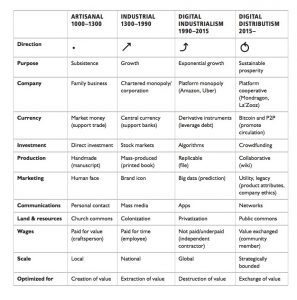
So, as I’ve tried to show in my book Throwing Rocks at the Google Bus, from which the chart above is taken, the hands-on economy of the artisanal market was overtaken by the more extractive rules of early industrialism. Workers were disconnected from the value they created and paid by the hour instead. In this light, industrialism and mechanization were just ways to remove human beings from the value chain.
That’s the economy we’ve been living in for the past 600-or-so years. The growth mandate was great for colonial powers looking to expand into new territories. As long as there were new people to enslave and resources to extract, capital could grow. But by the end of World War II, those people and places started to push back. Could we finally give up the global expansionist agenda of late medieval capitalism, and revisit an economic model that didn’t require the sort of growth that was proving impossible to maintain?
Now, digital technology should have been able to retrieve the values of pre-industrialism, and realize them in new ways. The human-to-human contact of the local marketplace is retrieved by the personalization of our digital networks. Market currencies can be retrieved by blockchains or even simpler authentication methods. Web-enabled cottage industries should thrive with their newfound equal footing and distributive power. Meanwhile, the commons and crowdfunding—enclosed and regulated out of existence during the corporate industrial era—find new life in an age whose foundational technologies are based in sharing processing cycles.
But by the early 90s, the cyberpunks’ human-centered vision of a networked marketplace was replaced by another vision of digital business, the one espoused by the libertarian early editors of Wired magazine and the corporate-sponsored futurists of Cambridge, Massachusetts. They looked at digital technology and saw the salvation of the securities markets and the infinitely expanding global economy. The stock market had crashed in 1987, along with the bursting of the biotech bubble. But now digital technology was to restore the NASDAQ to its former glory, and beyond. Indeed, just when it looked like we had reached the limits of the physical world to supply us with more opportunities for growth, it seemed we had discovered a virtual world from which to extract still more value. This new digital economy would augur a “long boom” of economic growth: a digitally amplified, speculative economy that could literally expand forever.
To do that, however, technologies with the potential to distribute value throughout their marketplaces and generate long-term sustainable revenue streams are instead converted into powerfully extractive versions of themselves. Amazon, for one ready example, could have developed itself into a value-creating marketplace like eBay. Instead, it adopted a scorched earth approach to its markets. Amazon chose the book industry as its initial beachhead not because of Jeff Bezos love of reading, but because it was a no-growth, highly inefficient market, ripe for domination. Amazon’s purpose is not to make authors and publishers wealthier, but to use its capital to undercut existing players, establish a monopoly, and then used that monopoly to “pivot” into other “verticals.” It’s the same extractive model utilized by 20th-century behemoths like Walmart, except the total domination of a market occurs even more quickly.
Uber, likewise, could have developed a thriving taxi marketplace by letting local companies and drivers maintain their autonomy on the platform or, alternatively, allowing drivers to earn shares proportionate to the miles they’ve driven. At least that way, once robots replace the human drivers, they would still get some revenue from the platform they helped build with their labor. But that’s not Uber’s goal. The company is still on the chartered monopolist’s script. Only in this case, instead of using the King’s law to maintain their status, they use code. They can’t see that having wealthy customers and employees is actually good for the long-term health of their businesses because they’re trapped in an early colonial mindset that sees markets as territories to conquer, resources to extract, and people to enslave.
Reinforcing all this is a shareholder mentality obsessed with growth and a tax code that favors capital gains over real earnings. No wonder companies focus on stock price, IPOs, and acquisition over real, taxable revenues. Most digital companies’ shares are their only true product.
So instead of moving to the last column of the chart—digital distributism—we have ended up stuck in the third: a digitally amplified version of the same old global industrialism. Digital industrialism is characterized more by the destruction of value and its conversion into share price than the creation of value and its distribution to the stakeholders who made it possible. Digital industrialism exacerbates the imbalance between the traditional factors of production – land, labor, and capital, giving voice only to the needs of the venture capitalists and their mindless pursuit of growth.
But it’s working too well for its own good. These corporations are great at extracting capital from the markets they enter but really bad at deploying it. Corporate profit over size has been declining steadily for decades, now. They grow obese and lose the ability to innovate. So, Google becomes Alphabet, a “holding company” that buys and sells technology companies because it can no longer innovate, itself. Facebook’s biggest moves are not technology developments but acquisitions. Digital industrialism turns its biggest players into vacuum cleaners that suck out the value, and maybe park it in share price or, worse, overseas—but don’t know how to distribute it or even put it to work.
That’s because they’re trapped trying to run 21st-century digital businesses on a 13th-century printing-press-era operating system. The real problem with the digital economy as it is currently constituted is not the digital, but the economics.
The nationalism and protectionism of today’s anti-globalists may be based in jingoism and xenophobia, but it could also—at least temporarily—create the boundary conditions necessary for something more like local, circulatory economic activity to take root. Such boundaries, like closing borders or enacting harsh import tariffs, don’t just prevent the leak of jobs overseas. They discourage businesses from thinking of their markets as global, much less infinite. The markets in which they operate are decidedly finite.
This forces them to stop thinking of themselves as simply sucking up all the cash in a particular territory and then moving on to the next. They must develop local economies that are capable of renewing themselves and delivering ongoing revenue. Instead of earning 10 dollars once, businesses must figure out how to earn the same dollar 10 times. That means promoting not the extraction of capital from a market, but the velocity of money through a market. What goes around comes around.
With any luck, businesses will take a cue from those who already operate this way, such as the US Steelworkers Union. Faced with the declining stock market of 2007, the steelworkers were looking for alternative investments for their pension fund. Instead of outsourcing their funds to S&P index funds, they got the fantastically circular idea to invest in construction projects that hired steelworkers. They invested in a project that not only earned them equity but paid them back their investment as wages.
Such strategies are actually more consonant with digital networks, which circulate information in a distributed fashion and share resources more easily than they hoard them. They are not infinitely expanding; they are bounded and self-sustaining. But they are really difficult to execute in an economic environment characterized by rapid growth startups and infinitely scaling corporate growth. The real world doesn’t scale.
A momentary withdrawal from that game forced by anti-globalist protectionist policies may actually allow for some digital distributism to gain traction. It will force us to remember that an economy doesn’t require global scale or growth to function; it simply needs people with skills, people with needs, and a means of exchange. The finance ministers and corporate chiefs attending Davos—as well as the decisions they make—are inconsequential to this activity. Their effort to salvage the global economy is really just an effort to keep us back in the third column of the chart, the digital industrialism that extracts value from people by evermore technologically creative means.
In contrast, a genuinely distributed economy requires those on the ground to develop strategies for economic and social viability from the bottom up. Don’t be surprised to see labor cooperatives, commons-based approaches to resource management, and even local currencies emerge to fill in where federal action falls short. While these mechanisms may not have worked convincingly before, digital technologies may just lend us the decentralized methods of accounting and authentication we lacked in the Middle Ages.
Whether we like it or not, it’s again time to return from the Crusades, and try a second time to build a new economy here at home.
The post Fast Company – The Silver Lining Of Anti-Globalism Might Be The Creation Of A True Digital Economy appeared first on Rushkoff.
January 19, 2017
CNN – Trump as job creator – hope or hoax?
Trump is not as experienced in doing great, profitable business as he is in making people feel good about doing business with him. He has the heart and soul of a borrower. He knows how to sit around a table where he’s the only one in debt, and somehow get the other guys to lend him even more money. He knows how to read a room, figure out what story those people need to hear, and then close the deal.
This is why Trump’s business policies can only be understood through the lens of public relations. Mood over Moody’s. Market sentiment, not market fundamentals. In his schema, it matters less how much money people are making or how secure their jobs really are than how much money they feel like they’re making and how secure they believe their jobs to be.
There may be no real defense against job-killing automation, outsourcing, and efficiencies. But a few big media-friendly, highly demonstrative job-saving gestures show these uneasy workers that someone in power is going to take care of them.
Trump wants businesses to help him make America feel great again, and now those businesses are forced to decide whether and how far to play along.
The post CNN – Trump as job creator – hope or hoax? appeared first on Rushkoff.
January 6, 2017
Bleeding Cool – Aleister and Adolf Favorite Graphic Novel 2016
Read this review at Bleeding Cool.
This book has been an outlier on many press radars, but it’s one of those densely crafted, significant works that hopefully will be the gift that keeps on giving, showing comic creators and fans what new directions in the medium can be taken. Written by powerhouse social critic Douglas Rushkoff and drawn by the endlessly original Michael Avon Oeming the book tracks a fictional account of Aleister Crowley’s media wars with Adolf Hitler based on a few key historical facts. It follows the life of a young military reporter assigned to Crowley through the course of “sigil” developments, like the swastika by the Nazis and V for Victory by Churchill in the war over human minds during WWII. Rushkoff’s characterization, research, and narrative framing devices, combined with Oeming’s emotive and often highly symbolic artwork make sure this book has something significant to say about the ongoing role of symbolism and propaganda in the way we see the world around us. It might just remind you of the dangers and the positive powers of belief and focus to influence any struggle, even on an international level. Aleister & Adolf may be about the second World War, but it’s highly relevant to our times and makes for a thought-provoking, and at times disturbing, read.
The post Bleeding Cool – Aleister and Adolf Favorite Graphic Novel 2016 appeared first on Rushkoff.
January 3, 2017
Proletariat Pong
I made this videogame/NewYear’s card with my friends at http://getready.io – a new platform for people who want to make interactive stuff with a simple drag-and-drop toolset. Ready is to programming what WordPress is to markup, or Mac/Windows were to DOS. Or if you’re old like me, imagine what would have happened if Hypercard and the Video Toaster had stayed in development all these years, and you get some idea of why this matters.
Most of all, feel free to mix and remix. And Happy New Year!
The post Proletariat Pong appeared first on Rushkoff.
December 27, 2016
Gutter Trash – Aleister and Adolf
Listen to this podcast at Gutter Trash
On episode 340, the Gutter Trash podcast discusses Aleister and Adolf
“In a story spanning generations, and featuring some of the most notable and notorious idealists of the 20th century, legendary occultist Aleister Crowley develops a powerful and dangerous new weapon to defend the world against Adolf Hitler’s own war machine spawning an unconventional new form of warfare that is fought not with steel, but with symbols and ideas. Unfortunately, these intangible arsenals are much more insidious and perhaps much more dangerous than their creators could have ever conceived.”
The post Gutter Trash – Aleister and Adolf appeared first on Rushkoff.
BoingBoing – Crowley & Hitler Wage Occult War in Rushkoff’s Latest
Read this review at BoingBoing
Anyone who’s waded any distance into the murky waters of legend surrounding British occultist Aleister Crowley has likely heard the stories about his involvement with British intelligence in WWII. He helped interrogate Rudolf Hess after Hess flew a plane from Germany to Scotland to negotiate peace. He worked closely with Ian Fleming (and Fleming’s Blofeld is based on him). He falsified astrology charts to throw off Hitler’s soothsayers. Or, these are the apocryphal stories, anyway.
In Aleister & Adolf, author, media theorist, and now comic book writer, Doug Rushkoff makes clever use of these and other tales about the self-proclaimed Beast 666 to make a deeper point about the profound manipulating powers of “charged” symbols in our modern world. It’s ultimately a book about how the manipulation of symbols and the effective use of propaganda can have deep consciousness-changing effects on a population, and can lead to fascism. Timely, eh?
The book runs with one well-known story from the Crowley apocrypha, that he was responsible for creating the V for victory symbol to be used by Churchill as a counter-sigil (occult symbol) to neutralize the swastika. Rushkoff casts Crowley and Hitler as real-world superhero and supervillain (or maybe, supervillain working for the good guys and straight-up supervillain) in an intense war of symbols and psychic combat. Actually, we don’t see much of Adolf in this book, Aleister & Adolf is mainly about the Crowley side of the magical front lines, as seen through the eyes of a young American army newspaper photographer sent to spy on Crowley and possibly recruit him to work for the U.S. The Crowley story is bookended by a tale set in New York, 1995, of a young web designer for a big corporation who stumbles upon the Aleister and Adolf war story and its ominous relevance to advertising and the burgeoning web.
While the subject-matter is certainly compelling enough, the whole project really becomes something special in the hands of artist Michael Avon Oeming (best known for the Powers comic book with Brian Michael Bendis). Oeming achieves some very intense and charged occult imagery within these pages. Using very vivid, bold, and black-saturated panels, Oeming’s graphic narrative creates a succession of dizzying, dark and shadowy corridors that you feel like you’re stumbling through in some opiated haze. This book feels like a trip through a haunted house. Or at least that’s where the visuals took me. I can’t think of an artist who could have done a better job of rendering Rushkoff’s story than Michael Oeming.
[Perhaps even more magical to me than the art in the book is watching Mike Oeming ink up a panel of it in this YouTube video]
Aleister & Adolf
by Douglas Rushkoff, Michael Avon Oeming (Illustrator)
Dark Horse Originals
2016, 88 pages, 6.3 x 0.5 x 9.3 inches, Hardcover
$16 Buy one on Amazon
The post BoingBoing – Crowley & Hitler Wage Occult War in Rushkoff’s Latest appeared first on Rushkoff.
December 22, 2016
Digital Trends – Trump is a Media Virus
Read this piece at Digital Trends
We’ll likely never touch the man, sit in the same room, or establish rapport with him. But he has nonetheless infected all of us quite intimately — some of us willingly, and some less so. That’s because he is less invasive as a person than he is as a virus. Yes, Donald Trump is a media virus, in the truest sense of the term.
I should know. I’m the guy who came up with the notion of a “viral media” back in 1994 when I coined the term for my book Media Virus: Hidden Agendas in Popular Culture. Back then, I was using the expression less as a metaphor than as functional description for the way ideas could spread in our newly interactive mediaspace, which suddenly included fax machines, camcorders, cable TV, email, and a budding World Wide Web:
The message in our media come to us packaged as Trojan horses. They enter our homes in one form, but behave in a very different way than we expect once they are inside. This is not so much a conspiracy against the viewing public as it is a method for getting the mainstream media to unwittingly promote countercultural agendas that can actually empower the individuals who are exposed to them.
One of the first examples: A black man gets beaten by white cops in 1991 Los Angeles. The event is captured on a camcorder, and the infamous “Rodney King tape” spreads across the world via cable news, overnight.
A meme is born
At first, the story spread because no one had captured anything this real, this horrific on a home video before. Someone just happened to be in the right place at the right time, and with a camera in hand. But the reason for the full-scale rioting in Los Angeles that followed went deeper than grotesque novelty. It was because, as a culture, we still had many unresolved and unexpressed issues regarding race relations, urban conditions, and police brutality. (We still do, which is why Facebook live footage of black lives not mattering still provokes such widespread response.) The important thing to get here is that a media virus spreads because of the way it interacts with its environment, not solely because of some unique trait within itself.
A real, biological virus works the same way. A sticky protein shell very much like the protein in our own bodies is wrapped around genetic material. Unable to recognize the shell as an invader, we allow it to attach to our own cells and inject its DNA inside. The DNA then interpolates with our own DNA, looking for weak spots to nest and then order the cell to reproduce. All the virus really means to say is “Make me!” It doesn’t care which parts of the genetic code it’s challenging, so long as it gets spread and replicated.
For the Rodney King virus, the sticky shell was its novel media format: a camcorder tape. That’s what fascinated the media; media welcomes stories about media, the same way that a protein-based organism welcomes protein-wrapped invaders. The code within the Rodney King virus – the race-based violence – was what our culture found so challenging. That’s why it provoked the prolonged response and cathartic rioting.
Marketers loved the concept of a media virus, and latched onto the most superficial ways of understanding it. It finally gave them a way of understanding how messages spread in an interactive media space. They saw it as a digital form of word-of-mouth advertising, and tried to craft commercials that would “go viral,” which to them simply meant something that one internet user might pass on to another one. Their mistake, however, was in thinking that the subject of the virus — the cookie, or pop star, or cat — was the thing people cared about. As if a virus spreads because of some intrinsic quality in the virus. That’s not what happens. The virus spreads because of an intrinsic, latent quality in the culture. Both biological and media viruses say less about themselves than they do about their hosts.
That’s why the extent to which we are infected by Donald Trump says less about him than it does about our immune response as a society. A virus doesn’t make us sick unless we lack an immune system capable of recognizing the shell and then neutralizing the code. Until we do that, the virus replicates, and our immune system goes berzerk, giving us the fever, chills, congestion, or vomiting — which manifest in culture as media confusion, protests in the street, sleepless nights, and Twitter wars.
Give the people what they want
To become viral, a product, a cause or, in Trump’s case, a celebrity must actually surrender to the wave of culture. One’s own identity is less important than what the greater culture wants to engage with. Michael Jackson was a virus in his time, spreading unresolved cultural fascination with underage sex, the difference between blacks and whites, and the quest to remain young. Madonna pushed buttons on everything from virginity and teen pregnancy to gay culture and Catholicism.
On the viral level, at least, it’s less appropriate to think of Donald Trump as a new Berlusconi than a new Charlie Sheen. He was the last celebrity to jump into the standing wave of culture, and ride it for everything it’s worth. Of course, Sheen puttered out when he tried to recraft his Twitter meltdowns into a stage show, since the memes he was spreading about online self-destruction really only worked online. Remember: The virus only works in the right environment.
Trump keeps on replicating because — as I was trying to warn back in the early 90’s — this flood of memetic contagion has broken the levees of cable news and the internet to swallow the rest of our media. Reality TV broke the first dyke. While we all know now that reality TV is scripted, it is done so almost passively by finding wannabe media stars willing to embody the current values of culture. The Apprentice’s breakout love-to-hate star Omarosa was to that show what Donald Trump is to presidential politics: the contestant most willing to be possessed by the conflicted rage of the crowd.
None of this necessarily has anything to do with what Trump believes, does, or says. It’s not the ideas or facts he peddles, but the viral memes he generates. America has huge, unresolved issues regarding race. We haven’t had an honest conversation about slavery, much less Black Lives Matter; but neither have we engaged thoughtfully with fear and anxiety of white men who see themselves blamed for everything from income inequality to attacks on the Jedi. Whether it’s about race, sexual harassment, business impropriety, collusion with Russia, America’s lost greatness, climate science, or globalism, Trump’s memetic discharge invariably provokes an immune response on media left and right, top-down and bottom-up.
Deal with it
We can’t help ourselves. This is the fractious nature of our nascent digital political sphere, as yet un-moderated by experience or wisdom.
Even this article will be understood by many of Trump’s supporters as an attack, and by many detractors as an apologia. Yet understanding our response to Trump is the very best medicine we can take if we want to develop the ability to engage in the conversations his viral spread has proven need to take place.
The Donald Trump media virus has exposed the unresolved, hidden agendas in our popular culture. Our only choice is to engage with them, for real.
The post Digital Trends – Trump is a Media Virus appeared first on Rushkoff.