Wessel Ebersohn's Blog, page 9
August 17, 2022
Fire Season
I am writing this in early August, fire season in our part of the bushveld where it is generally referred to here as Winter sport. In recent weeks I have been reading about heatwaves and the resulting fires in Europe. Although this is their summer, for an outsider from the southern hemisphere heatwaves in Europe are a little hard to get your mind around.
Our neighbourhood is quite different. Rain comes in summer, and is usually at its most intense in December and January and the season ends in about March. Until October, perhaps September if you are lucky, we have no rain, none at all.
It is fire season here. Almost every day on one of the farms or smallholdings we see the smoke that indicates some farmers or small holder family is losing grazing, or perhaps a tools shed, an animal pen or their home. The threat is real. Many have invested in trailers outfitted with water tanks that can be taken quickly to the scene of a fire somewhere on their property or that of a neighbour.
Of course, so many fires do not start on their own. It is clear that we have a substantial number of arsonists visiting the area. The farmers and plotters, as the small holders are called, believe that the arsonists come from the shack villages and unemployed Zimbabweans in the area, but few are caught and no arrests are made. In our community, the prevailing myth is that those who are arrested are freed on bail the next day to continue their anti-social activities.
In the second half of our winter the grass is thigh deep and dried out. Regulations say we all have to cut a fire break around our properties to control the spread of a fire. The thought is sound, but the application is not always possible. Cutting perhaps a kilometre long ten metre strip of tough veld grass around your property takes a lot of work and if outside labour is required, expensive.
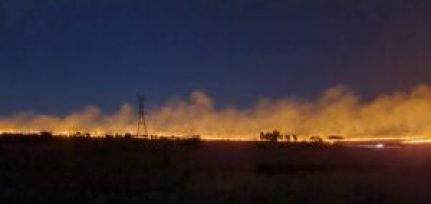 The fire cresting the ridge and heading in our direction. Photograph provided by Miriam.
All of this was in our minds when the cattle farm adjoining our back fence caught fire. The fire crested the ridge on the cattle farm and put on a pretty spectacular display. The flames reaching some three metres in height, not bad for a grass fire. It swept down the gentle slope towards our property, straight at our house and outbuildings
Supported by a few neighbours, we drew ourselves up in military fashion to meet the threat. We were armed with garden hoses, sacks for beating the fire and buckets for pouring water onto it. We hoped not too much water would be needed. Fire season is the dry season for grass and the lean season for boreholes.
We need not have been concerned. Relief came from a surprising quarter. Not long before, the herd of Brahman cattle from the cattle farm had descended on our back fence and denuded it of a delightful display of black-eyed Susans. The mighty beasts had enjoyed the feast so much that they often congregated along our fence, waiting perhaps for the return of the flowers. During these visits they absent-mindedly munched the grass.
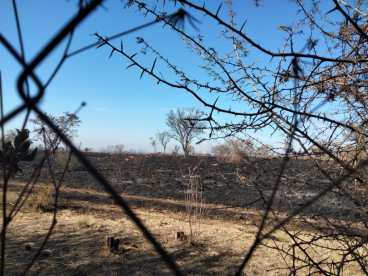 The view of destruction through the fence the next morning. Photo supplied by Miriam.
Until the day of the fire, we had not realised just how much grass they had eaten. The stretch near the house for a hundred metres on either side had been flattened with the earth. When the fire reached it, the flames shrank from a few metres high to less than ankle depth, then died. The Brahmans had destroyed our black-eyed Susans, for which activity we cursed them, but created a perfect fire break for which we are truly grateful. They still hang around our fence, hoping for a new growth of black-eyed Susans, but that’s all right with us.
Go read the story about the destruction of the black-eyed Susans here.
The post Fire Season appeared first on Wessel Ebersohn.


August 10, 2022
The Black-eyed Susans and the Brahman
Our house is right at the back of our small-holding, only twenty paces or thereabouts from the fence. On the other side of the fence is a cattle farm, commonly called the Beesplaas by the locals.
Over some months our fence suffered an invasion, but it was conducted by the most charming invaders. They were Black-eyed Susans. If you have been deprived of a relationship with Black-Eyed Susans and do not have the privilege of an acquaintanceship, let me explain that they are the most charming orange flowers, each with a black eye that contrasts perfectly with their colour. They are a delight.
 Image credit: BR Cutrer, Inc.
The Beesplaas is divided into a number of camps and for some years, as the grass has been allowed to recover from grazing, the camp across the fence has stood empty. But then, with our Black-eyed Susans growing in dense profusion along perhaps fifty metres of fence wire, the owner of the Beesplaas did the unthinkable. He let his cattle into the camp. The cattle in question were Brahmans, huge white cattle, beautiful in their own lumbering way. The bull was about the size of a pick-up truck, if your pick-up truck is pretty big.
This formidable creature knew what he wanted. And what he wanted was our Black-eyed Susans. So did the rest of his family. The herd descended on our fence with purpose. In an hour it was denuded of the flowers, every one, leaving us with bare iron wire. It was very sad.
But that is not the end of the story. A metre or so on the inside of the fence is a water tank on a steel stand. The slaughter on the fence was observed by a single Black-eyed Susan plant clinging to the stand. It had just four or five flowers and what was happening on the fence must have been terrifying.
In the year or two since the day of the massacre that plant has taken up the fight and there are now hundreds of flowers on the stand, but still none on the fence.
Recently the Brahmans were again let into the camp. Remembering the scene of their previous crime, they made straight for that section of fence. But flowers and leaves were gone and those on the water tank’s stand were out of reach. All they could do was stand around disconsolately, drooling over the flowers on the stand. I crowed with vengeful delight.
But know this: the stand is close enough to the fence for the Black-eyed Susans to close the gap easily and spread across to the fence, but they have stayed where they are safe. So don’t tell me flowers can’t think. Our Susans certainly do. And don’t tell me Brahmans do not possess memory. This lot does.
The post The Black-eyed Susans and the Brahman appeared first on Wessel Ebersohn.
August 4, 2022
Manuscripts and Bumps on the Way
 I started writing novels on an old Olivetti portable typewriter. I loved my Olivetti. At that time the IBM electric typewriters were the latest and most desired technology, but they were out of my price range. Also, they were heavy, whereas I could take my little portable with me wherever I went. It was my constant companion, even on holidays. It made me feel like a real writer. Today, using a PC, you only need to touch each key lightly, but my lovely old Olivetti was a different matter. You had to drive the keys down hard. At least I had to. For me typing was my physical exercise.
When it came to making changes to the text and I always had plenty of changes, if I thought of a better angle, I changed the story. I changed the dialogue if the character came up with a snappier line, and I changed the grammar and spelling when I realised I got it wrong – again. What I had to do every time was type out a replacement for the line or two or even the paragraph that I wanted to change, then cut the thin strips and retire for hours to a light table to paste it over the offending piece.
Well, stripping up changes was not that simple. On later examination I was often not happy with the change I made. So I would type out another new piece and paste that upon the piece I had already stripped up. Sometimes I was not happy with that either. I could end up with strips that were three or four or more pages deep, causing strange bumps in the manuscript. And when that happens twenty or thirty times in a two hundred page novel, the manuscript gets to look very strange indeed and impossible to fax, which was the way I sent it to my publisher.
I remember looking at a stripped up manuscript and wondering what I was going to do with it. An added problem was that, to give myself an extra copy I used carbon paper with everything I wrote, but I did not strip up the carbon copy.
Thank heavens for the personal computer. It is a wonderful device. But I dearly loved my old Olivetti. She had a special place in my heart. What happened to her after I received my first PC is a heart-rending story. I will tell you about the sad death of my Olivetti the first chance I get.
The post Manuscripts and Bumps on the Way appeared first on Wessel Ebersohn.
July 26, 2022
The Classifier
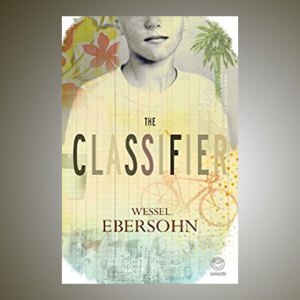 Synopsis of The Classifier by Wessel Ebersohn
The teenage love affair of Chris and Ruthie takes place against the turbulent political backdrop of South Africa in the 1970s. He comes from the white suburb of Red Hill and she from coloured Greenwood Park on the other side of the valley.
They try to ignore the realities that surround them, but that his father is the head of the city’s Race Classification office is a fact that cannot be wished away. Both families are threatened. The precarious trans-racial house of cards of which Ruthie’s family consists will crumble at the smallest conflict with authority. But eventually the unwavering, insecure leadership Chris’s father provides is revealed to be equally vulnerable.
The reader journeys into the love of two young people who will not recognise the odds against them. On one level, this is the story of a young Afrikaner growing up, living a life full of the young-manly pursuits of which his community approves, until he finds love where the unwritten scriptures of his people forbid it. On another, it is the tragedy of the white man in Africa, applying the strictest racial restrictions on all who fall outside his group and ultimately faced with the knowledge that he may have outstayed his welcome.
Then there is Ruthie, a barely pubescent young woman, a child in a female-headed household. She has grown up knowing that politics is not for her. Ma Peterson, her mother, has explained to her children many times that catastrophe can result in their drawing the slightest attention of the authorities to themselves. ‘We are building a life,’ she tells her children. ‘We can’t afford to do politics.’
Ruthie will introduce Chris to music he will grow to love. She will extract from him levels of emotion that he did know could exist and plunge with him into a despair neither could have anticipated. Together they travel towards a destiny that has elements of both catastrophe and triumph.
The Classifier takes readers inside the race classification machinery as the pressures on the system are building. The inner workings of apartheid’s very core and the fears that brought it into being are laid bare.
The years in which the story takes place are those between the 1974 revolution in Mozambique and the 1976 schools rebellion. Both have a deep impact on Chris’s family and on himself personally. In the first of these events he witnesses the processing of the Portuguese refugees from Mozambique, as they are divided into those white enough to be allowed to stay and those too dark, who have to be sent on the Brazil. Eventually, it is time spent in his father’s office that brings Chris face to face with the truth he had never fully understood.
Chris’s view of the sorting through of the Portuguese is not a broad altruistic one though. As far as he, with his boyish world view is concerned, the Portuguese dishonoured their country when they fled Mozambique and they did not deserve better. But then there is Ruthie, and where would she have been placed in such an orgy of race classification? he asks himself. And where is she placed now?
The Classifier is both an uncompromising telling of a tragedy typical of the time and an uplifting story of a love that would change the lives of everyone it touched.
Published by Umuzi, June 2011
ISBN:978 1 4152 0151 0
Click here to get a Podcast about the Classifier from Reading Matters
Buy The Classifier on Amazon.com | Amazon.co.uk | Amazon.ca
The post The Classifier appeared first on Wessel Ebersohn.
The Top Prisoner Of C-Max
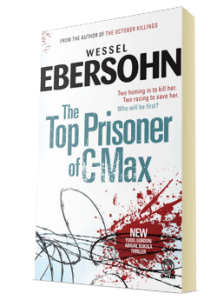 Synopsis for The Top Prisoner Of C-Max by Wessel Ebersohn
This is the third novel in the series. The first novel is The October Killings and the second novel is Those Who Love Night
Enslin Kruger is a dying man, but he is the top prisoner in C-Max prison, and must name his successor. This means blood. Kruger sees an unexpected opportunity to achieve this and at the same time exact revenge on his old nemesis, Yudel Gordon. He will anoint as his heir the man who slaughters Gordon’s protégé, the beautiful Beloved Childe.
A race ensues, by road and rail, from Pretoria to Cape Town… and by the time Gordon gets a whiff, it is already hopelessly late. To save Beloved, Gordon and his associate Abigail Bukula must figure out what the would be killers are up to, and quickly.
ReviewsTiffany Markham says this of The Top Prisoner Of C-MaxI’ve said before that I’m not a wild fan of local crime fiction. But Wessel Ebersohn was the writer who converted me, so it’s highly appropriate that I’m reviewing his latest offering. (And, although The Top Prisoner of C-Max is the sequel to Ebersohn’s The October Killings, I’ve not read the latter and I still enjoyed this book thoroughly.)
To begin with, The Top Prisoner of C-Max brings back oddball Jewish psychologist, Yudel Gordon – who fascinated me in Those Who Love Night – and pairs him with talented lawyer Abigail Bukula. There’s also the improbably named Beloved Childe, an American prisons prodigy, and a cast of highly charged, overly politicised, brightly colourful and deeply scary characters in the post-1994 Dept of Correctional Services.
The story is packed with chases, subtle in its violence and authentic in its dialogue. What’s also interesting is that this is the latest of six thrillers featuring Yudel Gordon, the first of which was penned in the 1980s. My, my – how times have changed for the character and his allies.
Full Review of The Top Prisoner of C- Max by Tiffany Markman
Buy this book from Amazon.com | Amazon.co.uk | Amazon.ca
The post The Top Prisoner Of C-Max appeared first on Wessel Ebersohn.
A League Of Geniuses
 A League Of Geniuses Synopsis
Dr Cyril Daniels, a senior psychologist in the Department of Correctional Services, is unhappy. He is nearing retirement and is dissatisfied with the pension he is going to receive. In recent years younger people and those who are seen as coming from disadvantaged circumstances are passing him by.
But he has a solution to his problems. Under his personal care is a gathering of extremely talented criminals. He believes that, if he can harness their talents, he can pull off a bank job that will leave him with a very comfortable retirement. He can also treat his dying wife, Charlotte, whom he loves dearly, to a trip to South America, a continent she has always wanted to visit.
Only two problems stand in his way. The first is that those under his care, supremely talented though they may be, are all insane. The second is that Yudel Gordon, his colleague and friend of many years has become aware that something untoward is brewing. Yudel has been a party to the solving of many crimes and Daniels is well aware that the matter has to be kept as far from him as humanly possible.
Whatever the risks, Daniels is determined to go ahead. His team consists of a brilliant hypnotist who is also a schizophrenic, a safecracker who suffers from multiple personality syndrome – four personalities in all, an alarm specialist whose left hand is in rebellion against his brain, and a getaway driver who once won Le Mans but now finds any criminal activity irresistible. Daniels has to weld his group into a working unit while keeping their lunacy from causing the whole enterprise to descend into farce.
For his part, Yudel cannot allow the bank to be robbed, but he also cannot face seeing Daniels imprisoned and Charlotte deserted in the closing days of her life. Problems, conflicts and Daniels’s need for sudden wealth are compounded into a story full of both thrills and laughter.
The post A League Of Geniuses appeared first on Wessel Ebersohn.
Those Who Love Night
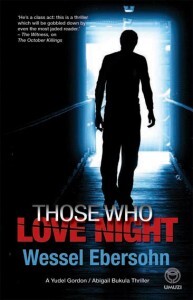 Synopsis of Those Who Love Night by Wessel Ebersohn
Those Who Love Night is the second book in the series. The October Killings is the first book and the third book is The Top Prisoner of C-Max
When Abigail Bukula, a young lawyer in the South African Justice Department, learns that the secret son of her aunt, who died in a massacre years ago, has been arrested by the Zimbabwean government, she races to his aid. She’s as determined as ever but perhaps a bit naive as well. Accused of being a part of the so-called Harare Seven, her cousin is being held as a political prisoner in the country’s most brutal prison.
With only an eager young lawyer as an ally and a director of the country’s intelligence agency either helping her or setting her up, Bukula will not leave without winning her cousin’s freedom and learning what really happened to her aunt so many years ago. By cunning, by bribery, by sheer audacity—and with the help of her friend prison psychologist Yudel Gordon—Abigail is determined to prevail in Those Who Love Night, Wessel Ebersohn’s explosive follow-up to his critically acclaimed series debut, The October Killings.
Reviews of Those Who Love NightBookPage by Joanne ClarkZimbabwean mystery crackles with suspense – Crime and politics in sub-Saharan Africa keep a tight hold on readers of Those Who Love Night, a truly fine mystery by acclaimed author Wessel Ebersohn. This tense, elegantly written narrative is the second in a series starring Abigail Bukula, a young South African lawyer in her country’s Department of Justice.
See the full review from BookPage here
Booklist’s Joanne WilkinsonAbigail Bukula, introduced in The October Killings (2011), returns in this intense story that reaches back into Zimbabwe’s violent past. An accomplished lawyer and rising star in the South African Justice Department, Abigail is shocked to learn that she has a cousin, Tony, whom she never knew existed and that he has been imprisoned in Zimbabwe as part of the activist Harare Seven. With the aid of an idealistic lawyer, she determines the best course of action to procure the young activists’ release from one of the government’s most notorious prisons, but government and prison officials claim they are not even holding the group. She is joined in her efforts by brilliant prison psychologist Yudel Gordon and seems to have gained the favor of one of the secret police’s high-level bureaucrats, Jonas Chunga. But what does Chunga really want from her, and why is she so willing to put her marriage vows aside? Like fellow South African Deon Meyer, Ebersohn excels at depicting the treacherous politics of an unstable country, one in which the search for justice is always fraught.
Kirkus ReviewLooser and more engaging than Abigail’s debut (The October Killings, 2011, etc.), but just as committed in its anatomy of the unending legacy of apartheid.
Full review of Those Who Love Night by Kirkys Review
Anne Corey from Reviewing The EvidenceThe repression of the populace in Zimbabwe is the focus of this riveting novel by South African writer Wessel Ebersohn. Abigail Bukula, a South African lawyer, is pulled into a harrowing situation in Zimbabwe when a lawyer from Harare contacts her and pleads for her help. A cousin of hers, whom she did not know existed, has been arrested, along with several others who have opposed the dictatorial regime. A brutal secret government organization called the CIO has most likely taken them but denies any knowledge of their whereabouts.
Abigail is in her thirties, beautiful, black and rich since she is married to a wealthy newspaper owner. She suspects her husband of infidelity and also feels pressure from forces within her own government. Although initially reluctant to get involved, she eventually decides to go. Once in Zimbabwe, she meets the lawyer, Krisj Patel, who had called her. She realizes how poor and desperate he is, and how poor and desperate and starving all the people of this country are. She also meets the head of the CIO, a man named Jonas Chunga. Something instantly occurs between them and the attraction is palpable. Although the people who are trying to free Tony treat Chunga with great fear and loathing, Abigail fights with herself against this strong physical attraction to a man she knows she must hate.
A dear friend and colleague, Yudel Gordon, comes to her aid and together they must plot how to proceed. Although they know that the government is lying to them, the truth is not simple to extract as other members of the anti-government group are imprisoned and killed. Chunga is a complex character and Abigail has many pressures on her, including her marriage and the dawning realization of how her extended family is involved in the Zimbabwe events.
The oppressive regimes associated with Germany during WWII and also Russia during the Cold War are quite familiar to fiction readers. Tales of people of these eras trying to fight against secret government organizations that kidnap, torture and kill with impunity those who oppose them are the setting for many novels. These eras may intrigue us but we know they are in the past. The story Ebersohn tells of strongmen without limits and people who are “disappeared” into horrific prisons in modern-day Africa is likewise fascinating but, sadly, a contemporary story. Many of us are unfamiliar with the horrors of these regimes, so this book provides an eye-opening experience as well as a suspenseful one.
Get Those Who Love Night from Amazon.com | Amazon.co.uk | Amazon.ca
The post Those Who Love Night appeared first on Wessel Ebersohn.
The October Killings
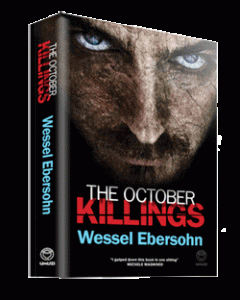 Synopsis for The October Killings by Wessel Ebersohn
The October Killings is book 1 in the series. Book 2 is Those Who Love Night
Abigail Bukula was fifteen years old when her parents were killed in a massacre of antiapartheid activists by white apartheid security forces. Because a young soldier spoke up in her defense, she was spared.
Now she’s a lawyer with a promising career in the new government, and while she has done her best to put the tragedy behind her, she’s never forgotten Leon Lourens, the soldier who saved her life. So when he walks into her office almost twenty years later, needing her help, she vows to do whatever she can. Someone is slowly killing off members of the team who raided the house where her parents were murdered, and now Leon and an imprisoned colonel are the only targets left.
Abigail turns to Yudel Gordon, an eccentric, nearly retired white prison psychologist for help. To save Leon’s life they must untangle the web of politics, identity, and history before the anniversary of the raid—only days away.
The October Killings, from Wessel Ebersohn, not only brings to life the new South Africa in all of its color and complexity but also Abigail Bukula—the sharpest, most determined sleuth in international crime fiction.
Reviews for The October KillingsPublishers Weekly said of this South African ThrillerSouth African author Ebersohn kicks off a promising new series pairing psychologist Yudel Gordon, last seen in 1992’s Closed Circle, with Abigail Bukula, chief director of South Africa’s justice department, who can more than hold her own with the brilliantly eccentric Gordon. As a 15-year-old girl, Bukula survived a raid on an African National Congress house in Lesotho on October 21, 1985, thanks to the intervention of a white soldier, Leon Lourens. In 2005, Lourens seeks Bukula’s help after learning that almost all his colleagues on the raid have been murdered on the exact anniversary of the assault. To catch the killer, Bukula hooks up with Gordon, who lost his government position with apartheid’s end, to get access to the imprisoned commander of the attack, Marinus van Jaarsveld. The complexities of South Africa a decade after the end of white rule help fuel a compelling plot that builds to several dramatic climaxes.
Booklist’s Thomas Gaughan saysLawyer Abigail Bakula has a high-profile post in the South African government’s Department of Justice, but just 15 years before, she was present when her father and many other blacks fighting apartheid were murdered by white security forces. Teenage Abby would also have been murdered, but Leon Lourens, a young white soldier, saved her. As this book opens, Abby is busy at work when Leon appears at her office. He tells her that he’s one of the last members of that security force left alive and that he expects to be killed in coming days. To keep her savior alive, she must revisit the darkest moments of her life. Abby teams up with quirky, aged prison psychologist Yudel Gordon to track down Michael Bishop, a mysterious and brutal white assassin who supported the anti-apartheid forces. Ebersohn, an established South African novelist, has created engaging characters; a gripping plot; a great backstory involving the country’s recent, violent past; and trenchant commentary on South Africa today.
More Praise For The October KillingsThe Globe and Mail
“A brilliant novel of memory, reconciliation, and revenge. Ebersohn was always one of South Africa’s best, and this new book–the beginning of, I hope, a series–shows why. . . . Definitely one of the best mysteries of the year.”
Kirkus Reviews
“His horrors, rooted so closely in history, have a nightmare quality that’s hard to shake.”
Get it now on Amazon.com | Amazon.co.uk | Amazon.ca
The post The October Killings appeared first on Wessel Ebersohn.
Closed Circle
Closed Circle by Wessel Ebersohn is a rerelease of the original novel. It includes some updates and is now in eBook format.
Synopsis of Closed Circle by Wessel Ebersohn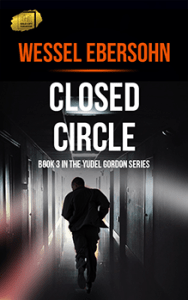 In Wessel Ebersohn’s third Yudel Gordon novel, the South African prison psychologist is under financial pressure. When he is offered a large sum to conduct an investigation privately for a group of political activists, he agrees – even though it is against regulations.
Over a number of years, several prominent liberals have been murdered. Is one group responsible for the killings, or are they unconnected? It is possible that the extreme rightwing Afrikaner Revival Movement is involved. But, more chillingly, could the murderers be found within the country’s security polices?
Following a trail of death across South Africa, Yudel slowly edges closer to the truth. . . and earns himself some very powerful enemies, including the sinister Colonel Wheekwright.
Reviews of Closed CirclePublishers WeeklyIn this compelling commentary on an unjust society, South African Ebersohn wraps up his narrative’s mystery, but leaves his tale, like his country’s political crisis, without an ultimate, moral resolution.
Closed Circle is coming soon on Kindle
The post Closed Circle appeared first on Wessel Ebersohn.
Divide The Night
Divide The Night by Wessel Ebersohn is a rerelease of the original novel. It includes some updates and is now in eBook format.
Synopsis for Divide The Night by Wessel Ebersohn
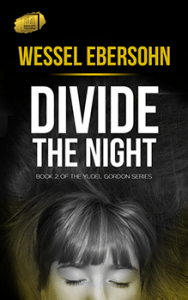 Johannesburg, South Africa, 1974
“From the place where Cissy stood in the shadow of the usedcar dealer’s sign, watching, she could see the door dearly. She had passed it coming down the road and it had been open then. Through the narrow opening she had been able to see the stack of biscuit boxes that did not seem to have been opened yet.
“The cement floor was cold, she heard feet move on the floor. “Come out. I don’t want to play games with you. I don’t want any trouble.” Cissy pushed the boxes away and scrambled out, half-rising, her hands clasped together in an attitude of supplication. “Please, Mister. Please, Mister. Me and my brother are very hungry.”
Cissy Abrahamse was the eighth person to die in or near the store room of the Twin Sisters café. Most were street children, all were hungry and all yielded to the temptation of the half open store room door. The killer in every case was the aged and partly crippled café owner Johnny Weizmann. Protected by the Criminal Procedure Act through which such killings could easily be presented as self-defence, the courts had so far not seen his actions as crimes.
But Weizmann has ignored a court ruling that forced him to seek psychiatric help. When Colonel Freek Jordaan of the CID realises this, he compels Weizmann to visit prison psychologist Yudel Gordon.
Yudel’s treatment of Weizmann brings him into conflict with the old man’s friends in the security police who secretly approve of his killings. It also brings Yudel face-to-face with a mysterious black activist by the name of Muntu Majola. What the connection is between the activist, the old murderer and the security police is a puzzle that complicates the search for a way to stop Weizmann killing again.
Reviews of Divide The NightNew York Times Book review“a powerful book and a well written one that just happens to fall within the genre of the police procedural”
San Diego BooksThis is one of those rare novels that can be read as two levels, either as a gripping suspense novel or a powerful indictment of a repressive, fear-ridden society.
Betty on Goodreads
If Jim Thompson is noir, Ebersohn is noir squared in “Divide the Night,” the second Yudel Gordon mystery. South Africa in the 80s is grim and Ebersohn spares us nothing: apartheid, Afrikaans vs English, murder, injustice, torture, poverty. Powerful book but I recommend it only to the brave.
Divide the Night Coming soon on Kindle
The post Divide The Night appeared first on Wessel Ebersohn.