Wessel Ebersohn's Blog, page 8
October 19, 2022
The Girl and The Bomber
A writer should always be awake to any opportunity. If an interesting story turns up, you need to pounce on it before it slips away and someone else writes it.
That piece of wisdom was not in my mind when Miriam and I were taken to lunch by a well-known film maker the year before Covid struck. In a short time she had become a good friend.
The three of us were discussing our childhood years and their effect on each of us. Our stories were entirely different to each other and her’s were most singular of all. She started her growing up years in Johannesburg, but went to London with her mother when the marriage fell apart.
In her high school years she returned to Johannesburg with her father. He placed her in Roedean, a private girls’ school with an international reputation. While there, she impressed a young male teacher who took to removing from her usual class and placing her alone in a classroom where he would teach her individually, but mostly he just talked.
“What he talked about was politics,” she told us. “He explained to me how terrible Apartheid was and its awful effect on South Africans.”
As she told the story she mentioned his name. It was John Harris. I thought nothing of it. Johannesburg has endless men and boys called John and, no doubt, quite a few Harrises. Then suddenly, as if it belonged to a different subject, she said, “They hanged him.”
I said, “That John Harris?”
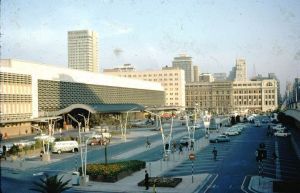 Johannesburg Station in the late 1950s, early 1960’s. Source: Gordon Clarke (https://www.theheritageportal.co.za)
She said, “Yes, that John Harris.”
Harris had taken his resistance to Apartheid to extreme lengths. On 24 July 1964 he had planted a bomb on Johannesburg station and it had killed an elderly lady and disfigured her granddaughter who was with her. Neither had anything to do with Apartheid. His defence had consisted of his having sent warnings fifteen minutes before the bomb exploded, to two daily newspapers, not to the police. At that time the railways police had an office on the station, just across the concourse from where the bomb exploded.
The day after our lunch I called her. “It’s quite a story,” I said. “Will you tell it to me in every detail so that I can write it?”
“I’ll think about that,” she said. “I’ve never told it to anyone.”
I waited anxiously for a few days and was about to call back when Covid struck. she was taken ill and died, and the story of the girl and the bomber died with her.
The post The Girl and The Bomber appeared first on Wessel Ebersohn.


October 12, 2022
Guardian of the Trash
We live on a small plot in a rural area. Most of our neighbours are really kind hearted. Regular food parcels, that are paid for by community donations, are delivered to families where jobs have been lost. When recently a family’s house and everything in it burnt down and they had no insurance, the community got together and donated everything from corrugated iron roof panels to electric frying pans to help them back on their feet.
The people of our community are also kind to animals. That was not always true of communities like ours, but times have changed and people with it. Today most people see their animals as part of the family
Not all people are kind to animals though. An ugly aspect of humanity has become apparent in recent years. Every summer holiday, dogs and cats are dumped along our roads by city people who are going on holiday and do not want to take them along or pay kennel fees. The animals often chase after the car of their beloved owner, only stopping when the car is out of sight and they can run no further.
Many dogs have been collected and cared for by members of the community. We know one older lady who has 24 dogs and a family that has over 70, all refugees who have been dumped.
Most dogs are fine people, much better than their so-called owners. They are loyal, faithful and courageous. And this also applies to all dogs who get dumped. They deserve better. Just recently a sturdy pit bull, was dumped together with a pile of trash. When the car from which he had been ejected disappeared from sight, he settled down next to the trash to guard it with the same loyalty he no doubt felt for his owner. He was determined that no one would interfere with it. A local farmer made an attempt to remove the trash, but was driven off by the snarling and barking custodian of the trash pile.
After three days in which he had nothing to eat or drink he was still loyally stopping anyone from interfering with his trash. But he was weaker now. The farmer fed him and returned to give him water and feed him every day until the dog finally accepted that this was a friend and the one who dumped him was not coming back. Eventually he took up the invitation to get into the farmer’s car.
It was only after he was installed in his new home that the trash could be removed. The farmer calls him Hero, a fitting name.
The post Guardian of the Trash appeared first on Wessel Ebersohn.
October 5, 2022
A Lifestyle Change
I have always believed and still do that as a writer, I have to live surrounded by people and their stories. I have always been the observer, standing on the side lines watching the stories unfold around me. I never felt that I was part of the crowd.
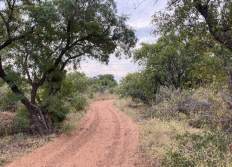 After many years in the city, we sold our house in the city and moved to a little farm on top of a rocky hill, where the closest neighbour’s house is about a kilometre away. In the quiet isolation and not having to work for a living, I was able to write full-time. What bliss and what an education it was.
The community we found ourselves in is both supportive and sympathetic, but also very critical, judgmental and ready to fight with each other, conducting their battles on the community WhatsApp groups. Old people are taken care off. Needy old folks, those without work or single mothers get weekly food parcels from the community.
And if anyone in the community has a home or farm invasion, which are regular occurrences, a call on the radio network brings help within minutes in the form of armed, strong, young men. Livestock is stolen regularly, fence wires are cut routinely, borehole pumps change ownership and leaving your washing on the line is sure to invite online shopping, as it is called here and, if you are the victim, you have to invest in a new wardrobe.
The saying “dogs are a man’s best friend” has meaning here. Everybody has more than one dog, some even as many as twenty or more. They are not only pets, but guards and protectors and are hated by those who visit uninvited at night. It is not uncommon for the dogs to be poisoned by something called Two Step, which is put into some meat, often the heads of slaughtered chickens. One of our neighbors woke up to find all seven of his dogs dead on the front veranda. Only dog lovers understand the heartache and sense of loss the bereaved feel. As soon as darkness descends on the bushveld, our two dogs are taken into the house only to be let out again with the early light of dawn.
So the small holders of our area survive, despite invasions, theft, load shedding and other annoyances. The sunsets are still wonderful and the peace of those bushveld nights, when the only invaders are the small creatures of the region, is unsurpassable. The cry of a jackal, the wide-eyed dash through the trees of nagapies and vervet monkeys, the scrambling in the undergrowth of a hedgehog or the sudden call of a crested lourie: you do not get them in the suburbs. No wonder people flee the cities every time they have the smallest opportunity.
If you are interested you can read about our very own bush fires here –
Fire SeasonPeace and DestructionThe post A Lifestyle Change appeared first on Wessel Ebersohn.
September 28, 2022
The Death of My Olivetti
We were living on the edge of the Knysna forest on the southern coast of Africa when my lovely old Olivetti typewriter and I parted ways in a traumatic fashion. When my eldest daughter presented me with a computer for my birthday I realised the personal computer had arrived, turning the world, including my small corner of it, upside down. We enjoyed endless games of Pacman on it. But my Olivetti still had first place in my writing. Frankly, I must admit that I did not know how to do anything but play Pacman on my computer, despite the effort of my kids to teach me.
So on a day something was needed from town. I can’t remember what it was, but Miriam and my daughter, Tes, both insisted I go and collect it. At that moment I should have smelled a rat, as they say. It was a big and very smelly rat. But I trusted them. What a mistake.
To understand the story you need to know that I was determined to avoid the digital age. I had my old Olivetti and what could that thing do that my Olivetti could not? I really did ask that question. They tried to answer, but I was not listening. After all, love trumps everything, doesn’t it?
So I agreed to go into town and collect whatever it was. When I got back a few hours later wife, daughter and granddaughter Sheena lined up to meet me, doing their best to look sorrowful. “A terrible thing happened,” one of them said, without explaining further.
I am reluctant to admit that I was taken in by their act. “What was it?” I asked.
 “I was dusting your desk when I accidentally bumped your typewriter and it fell to the floor,” Miriam said. “And now it doesn’t seem to be working too well.”
Not working too well? That was a good one. It was not working at all.
I took off the cover and saw that the chassis, or whatever you call it on a typewriter was shattered right through. It was clear that my Olivetti would never type another line, not even a word.
“I’m so sorry,” Miriam said. Because she never lies, I believed her.
It was much later that I finally heard the full story. The three of them had conspired to destroy my old, dearly beloved Olivetti to force me to use the new computer. While I was away in town, they had pushed it off the desk and onto the floor. But game little fighter that she was, she survived it.
So they took her outside and dropped her onto a concrete slab, but she survived that too. Eventually, Tes got up on a kitchen chair with Miriam and Sheena holding onto her to steady her, and held my typewriter above her head. Then she threw it as hard as she could to the cement floor. My trusted friend of decades was gone.
Now I had no choice but to learn how to use the computer. Today I have to admit that the computers have some advantages, but I will never feel about one of them the way I felt about my old Olivetti. She was beautiful, and she died bravely.
More on the joys of writing novels on a manual typewriter here.
The post The Death of My Olivetti appeared first on Wessel Ebersohn.
September 25, 2022
Deluge – A Yudel Gordon Novel
 A Synopsis of Deluge
Almost everyone agreed the end of Apartheid was inevitable and necessary. But there were those who felt that they were losing the country they love. Gysbert Moolman, one of them, believed there was no future for him or his children in South Africa under the new ANC government. As a demonstration of his anger and to make clear the hopelessness of his situation he plants plastic explosives in a school hostel. One of the police interrogators, trying to get the truth out of him, gets carried away and Moolman is unconscious after being tortured.
Time to save the children is slipping away and Yudel Gordon is called in to revive him. He agrees, but only if he can use his own methods to try to extract the truth from the suspect. “You have half an hour,” he is told. Yudel’s challenge is to find the hostel, before he blows it up, and so save the children. The case brings back memories of another one thirty years earlier when in that case too the subject was beaten by the police of the Apartheid government in almost the identical way.
The one big town in the Kalahari Desert was a quiet place. But in 1994 because the first democratic election was taking place and because the mighty river that flows by the town was coming down in flood it had stopped being a quiet place. Two deluges were facing the town, one political and the other caused by the flooding river.
Adding to the effect of the political deluge was the mob killing of a police officer in the township and the determination of Judge Meyer to find the entire mob guilty of murder for which the sentence is death. Yudel Gordon, in town on prisons business, and Colonel Kobus Malan, the town’s most senior police officer, find themselves struggling to deal with this seemingly impossible situation and a murderer.
Yudel Gordon saw the killing himself. One man, at the centre of an excited mob, did the killing, but only one. Judge Meyer felt increasingly uneasy during the days when it was clear the old Apartheid order was losing power. What kind of an object lesson was it, he asked himself, if a mob kills a policeman, to sentence only one person? How was that going to stop a communist-inspired revolution? Insurrection seemed to be everywhere. If blood was going to run, let it be the blood of revolutionaries, he thought, the more the better.
The case is a recipe for confusion that becomes even more confused when, in the court room, Yudel arranges an example of the problems around the blind acceptance of witness testimony. His demonstration is striking, but Judge Meyer is not amused by the chaos Yudel causes in his courtroom.
The post Deluge – A Yudel Gordon Novel appeared first on Wessel Ebersohn.
September 21, 2022
Common Purpose
Under the Common Purpose doctrine anyone who was present at a homicide and was judged to be of one mind with the killer was also guilty. If Common Purpose is applied, instead of being found guilty as an accessory, the onlooker can also be judged a murderer.
 Judge Meyer was one of the judges who felt increasingly uneasy during the days when it was clear the old order was losing power. What kind of an object lesson was it, they asked themselves, if a mob kills a policeman, to sentence only one person? How was that going to stop a communist-inspired revolution? Insurrection seemed to be everywhere. If blood was going to run, let it be the blood of revolutionaries, they thought, the more the better. Not all judges agreed with that sort of thinking, but there were plenty who did.
Yudel Gordon saw the killing himself. One man, at the centre of an excited mob, did the killing, but only one. Judge Meyer’s view was different. To him every member of the mob had the same purpose. All were equally guilty. That meant death for all of them. It was a doctrine that had been applied a few times in other cases.
Advocate Andrea Statham wants Yudel’s help in the defence of her clients. The prosecutor, who is under Judge Meyer’s control, wants his help on their side of the argument. He is after all an employee of Correctional Services, a government department. And before the trial Judge Meyer has already made up his mind.
The case is a recipe for confusion that becomes even more confused when, in the court room, Yudel arranges an example of the problems around the blind acceptance of witness testimony. His demonstration is striking, but Judge Meyer is not amused by the chaos Yudel causes in his coutroom.
Years later this case returned to Yudel out of the vast array of criminal actions stored in his memory. Pressing in on him right now, as he approaches retirement age, is something quite different. A white supremacist suspect feels he has lost his country and is planning to sacrifice the children in a school hostel to show his anger at this loss. The security policemen in whose custody he is, are unable to get him to reveal the location of the bomb. Yudel’s challenge is to find the hostel, before he blows it up, and so save the children.
Read the book, DELUGE. It will be released next week.
Read about the creating of Yudel here.
The synopsis for DELUGE is here.
The post Common Purpose appeared first on Wessel Ebersohn.
September 14, 2022
The Events that Inspired DELUGE
As the old political order started to fall away in South Africa, the changes in the country affected everyone. Many of the unfranchised majority, especially young people, who were going to feel themselves free for the first time, were seized by a great urgency. Was it possible, they wondered, that the hope of freedom could be snatched away just as they thought it was theirs? On the other hand, some of the beneficiaries of the old order feared that everything they had worked for might be snatched away in the approaching revolution.
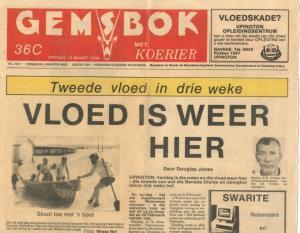 The front cover of the Gemsbok on 18 March 1988, an Upington newspaper. It is an Afrikaans paper and for those of you who do not know Afrikaans the headline reads “Second flood in three weeks” and “Flood is here again”. The photograph on the left is of children on the way to school by row boat.
These fears, from opposing directions, were bound to clash and they did, many times. One of the most notable clashes occurred in the Northern Cape town of Upington. A township killing resulted in the real possibility of an entire crowd being charged for the murder of just one person. The town and its people faced a deluge of emotions brought on by the political and legal situation.
Running past the northern edge of the town is the Orange River. It is a typically African river that, not unlike the Nile, flows a thousand kilometres across a desert to reach the sea. It is prone to flooding. During flood times it has caused chaos in the town of Douglas, closer to the mountains, but has usually flattened out by the time it reaches Upington. Not always though. It sometimes arrives at the town with unusual ferocity. This was the case in 1988.
My novel, DELUGE, is not based on these two deluges, one political and the other natural. It is inspired by them though. The background is real. The story is thrilling.
DELUGE will be released at the end of this month.
If you would like a synopsis of the book, you will find it here and more on Yudel Gordon, the prison psychologist hero, here.
The post The Events that Inspired DELUGE appeared first on Wessel Ebersohn.
September 7, 2022
The Creating of Yudel Gordon
The first Yudel Gordon story was entitled A LONELY PLACE TO DIE. At the time there had been a succession of attacks on well-known opponents of Apartheid. Some of them resulted in assassinations. I was still unpublished, but in these attacks I saw plenty of material for thrillers and also a great deal for serious novels. I decided to write stories that contained both elements. They had to be good books, but they also had to have the edge-of-the-seat quality of all good thrillers. Above all, brutality against those seeking justice was a subject that should be written about.
I needed a central character. I wanted someone who would be stronger in brains than in brawn. He needed to be intelligent, intuitive and willing to ignore the rules of society to solve the cases that confronted him.
I wanted him to work for the government so that the reader would get a look inside the departments of the Apartheid regime. He had to be white because no black person made much progress in government in those days. But to be a typical white South African of the times did not work either. Although I am not Jewish, I made him Jewish. This was not because I thought they were stronger opponents of the system than other liberal whites, although some were. But being Jewish set him apart. And in my experience being Jewish in the civil service, while not out of the question, made him suspect in many circles. I called him Yudel, which means little man.
Purely by chance at the exactly the right time, I ran into the ideal model for my hero. He was small, Jewish, absent-minded and a brilliant psychologist. He brought relief to most patients, but occasionally fell asleep while listening to one of them recounting the facts around his or her boring neurosis. He had a sound system through which he sometimes hypnotised patients. But it worked poorly, occasionally bursting into loud crackling that jerked the patient violently back to the surface of consciousness. Despite it all he was good at his work and committed to it. He made a good basis for Yudel whom I placed in the Department of Corrections where he would be near the centre of the country’s criminality.
As Apartheid came to an ended and the democratic South Africa, with a completely new set of challenges, replaced it, Yudel found a worthy associate in the redoubtable Abigail Bukula. She is a senior lawyer in the Department of Justice, fearless and clever. Yudel is fascinated by her, while she is both amused by and admiring of him. Their relationship is one of friends, who give support to each other. They have never been lovers and never will be.
My new Yudel Gordon thriller, DELUGE, will be released at the end of September 2022.
Go read more about DELUGE here.
The post The Creating of Yudel Gordon appeared first on Wessel Ebersohn.
August 31, 2022
DELUGE: My New Yudel Gordon Thriller
 The cover of my new book, DELUGE. The image is by Dorothe from Pixabay.
Writing a thriller is different to writing any other kind of novel. The story’s structure is everything. Scenes have to follow each other logically and they have to draw the reader in so that he or she simply cannot put the book down. The reader simply must know what is going to happen next. I was bearing all this in mind when I wrote my new Yudel Gordon thriller, DELUGE. I believe I have found a really compelling story line, one that meets these requirements.
Yudel Gordon has been around a long time and he is no longer a young man, but police officers with whom he had worked in the past ask him to revive a suspect they have beaten so badly that he is unconscious. One of the officers went too far in trying to get the truth out of the suspect who had allegedly planted a bomb in a school hostel.
The bomb is due to explode in a few hours. Yudel agrees to revive him, but only if he and associate, Abigail Bukula, are allowed to try to get the truth out of the suspect. The case brings back memories of another one thirty years earlier when in that case too the subject was beaten by the police of the old government in an almost the identical way.
The one big town in the Kalahari Desert was a quiet place. But in 1994 because the first democratic election was taking place and because the mighty river that flows by the town was coming down in flood it had stopped being a quiet place. Two deluges were facing the town, one political and the other caused by the flooding river.
Adding to the effect of the political deluge was the mob killing of a police officer in the township and the determination of Judge Meyer to find the entire mob guilty of murder for which the sentence is death. Yudel Gordon, in town on prisons business, and Colonel Kobus Malan, the town’s most senior police officer, find themselves struggling to deal with this seemingly impossible situation and a murderer that here too has been too badly beaten by an officer who cannot contain his anger.
DELUGE, my new Yudel Gordon thriller, will be published at the end of this month.
The post DELUGE: My New Yudel Gordon Thriller appeared first on Wessel Ebersohn.
August 24, 2022
Destruction and Peace
Nights are quiet in Bultfontein. The occasional lowing of cattle, or the complaint of a calf that has found herself separated from the herd, perhaps the cry of a startled kiewiet: these just add to the sense of peace.
But we do have nights when our peace is ruptured. Somewhere on our Bult it happens every night, but not to us personally all that often. When it does, the results can be dramatic. A few nights before this was written we had such an occasion.
The darkness had been as peaceful as on any other bushveld night. Then some time around midnight our two dogs woke us with a chorus of excited barking. Most often the reason they bark is someone approaching the house at an unlikely hour. Their barking usually has the effect of chasing off whoever who does not belong. Under these circumstances the most likely course of action is to try to ignore the dogs and go on sleeping. This time they kept at it.
I got complainingly out of bed and was about to wander down the passage to the dogs when I saw how brightly the curtains were glowing. Miriam was also awake. “You switched on the outside lights,” I told her. “Did we have an intruder?”
“I didn’t switch anything on,” she mumbled.
In that moment it was obvious she had done it in her sleep. I went to the switch, but found it in the “off” position. The curtains were glowing like a Christmas decoration, so I finally staggered to the window, moved a curtain and looked out.
Fires in the dry winter grass can be alarming in the day time when most of what you see is smoke. By night the picture is different. The scene can be more spectacular in glorious, blazing technicolour than anything Hollywood can conjure up. On this night the flames were all of two metres high, spread right across the landscape of our property and advancing on the house from three sides as if their mission was to burn it down and eliminate us from the face of the earth. Some inner warning system caused me to rush to the other side of the house. Another wall of flame, as wide and seemingly determined, was approaching through the tinder-dry grass of the cattle farm.
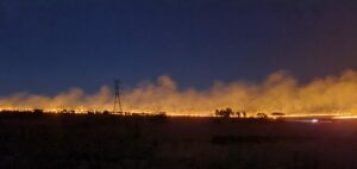 Destruction in the making. Photo supplied by Miriam.
We had made provision, a sort of typically passive Wessel provision, against such a day. The grass in our garden, an acre or two around the house, is cut so close to the ground that there is practically nothing to burn. That works in the front of the house, but on the side of the cattle farm the house was too close to the fence for our very short grass to be a protection and the largest flames were no more than twenty metres from our back door. We watched helplessly while praying our trees between the house the fence would not catch fire.
But fate had taken an unexpected turn in our favour. In last week’s musing I told about the cattle farm’s huge Brahman cattle that eliminated the array of charming black-eyed Susans from our back fence. Well, after that the Brahmans, no doubt hoping for the return of the Susans, tended to loiter around our back fence. And while they were there, they ate. The result is that they created an excellent, but narrow fire break along our back fence. Our black-eyed Susans, the Brahmans and the love of one for the other, while seemingly vandalistic at one stage, helped to keep the fire at bay.
And then there was the community. And that is something you have to appreciate in Afrikaner people. They have a great sense of community. Ten minutes after a desperate radio call for help, guys with water trucks turned up, one team in the front of our place and two fire engines in the cattle farm. Miriam and I stood outside watching them and feeling true gratitude.
Within half an hour everything was over, only feebly glowing stumps of grassy clusters and foul-smelling smoke remained, as the night settled back into fireless darkness and quiet. But that is Africa and our predisposition towards both destruction and peace. The two go together on our continent.
The post Destruction and Peace appeared first on Wessel Ebersohn.