Wessel Ebersohn's Blog, page 10
July 26, 2022
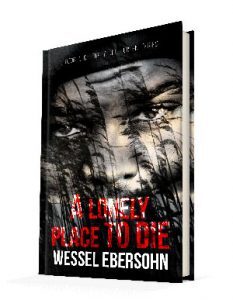
A Lonely Place To Die
A Lonely Place To Die is a Yudel Gordon Novel. This is a rerelease of the original novel. It includes some updates and is now in eBook format.
Synopsis of A Lonely Place To Die by Wessel Ebersohn
 The South African highveld, 1977
“They were coming for him as he had known they would. He could see the headlights on the track far below where the first truck had stopped at the donga and the second truck still struggled up the incline. Behind him was the spur that went all the way to the crest of the hill and, just beyond the crest, the barbed-wire fence. He knew that beyond the fence there was nothing like you had on this side – no hill, no farmlands, no distant plain – nothing at all.”
Muskiet Lesoro, terrified and schizophrenic, is accused of the murder of the local member of parliament’s son. Farmworkers and family all agree that he had enough motive to murder the violent and racist young man. Like the victim, Lesoro also had an undeniable tendency towards violence. Only one matter raises doubt in the mind of eccentric prison psychiatrist Yudel Gordon: this was a poisoning and, in his view, Lesoro was no poisoner. Someone else, someone with greater control and the ability to plan must be guilty of the crime.
To discover the truth, Yudel travels to the country town where the crime was committed. He finds a society in which the truth is a carefully guarded secret and the townspeople, the people of the nearby black township, and the priests and brothers of a hillside monastery: all live in fear.
Yudel finds his own life at risk as he asks the questions no one else has dared ask. A night time flight through as burning field of maize brings him face to face with the reality he has been seeking. The solution is not one he would have chosen, had there been a choice.
ReviewsDaily TelegraphA brilliant book
Washington PostBrilliantly evoking South African society.
Anthony PriceMr Ebersohn’s prison psychologist hero is just the man to save an underdog from going under: a most original hero in a setting tylor-made for him. Of whom we must have more, much more.
Dionisio GoodreadsI came for the mystery and was rewarded with complex characters and a strong sense of place. The social and political climate of South Africa in the seventies is laid bare in the pages of this book.
Kirstie Pier GoodreadsI like mystery writers with the chops to be able to weave the political climate into their books. This was an early book, late 70’s, so very different from the latest book. Very interesting race and power context.
Coming soon on Kindle
The post A Lonely Place To Die appeared first on Wessel Ebersohn.


November 21, 2017
South Africa, political correctness and the thriller
Probably because South Africa is still a new democracy, and yes, twenty-three years makes us still new, political correctness stalks the land. It gets in the way of novelists, movie makers, visual artists, in fact talented people of every kind who think for themselves. In some company, if you are not careful about your opinion, you can get an entire dinner party descend on you as one, seemingly ready to tear you, or maybe just your thinking, limb from limb. (Is it possible to tear a thought limb from limb?)
The truth of the matter is that what constitutes political correctness depends on the society you are talking about. In most modern western countries it seems to be a sort of left-leaning socialism cum liberalism. Within this framework, unions are good, Trump is bad, race as a word is taboo, policemen who shoot someone are automatically guilty and homeless Syrians should be allowed to flood into Europe.
In South Africa, political correctness means falling in with a certain kind of thinking that has as its stated aim assisting all who were discriminated against by Apartheid, surely a noble cause. In this way of thinking, discriminating in favour of black people is upliftment, discriminating in favour of whites is racism, dismissed employees are automatically innocent of any wrong-doing, limiting the number of whites in the national cricket team is good, but insisting on one white in the national football team is only raised as a point of discussion by lunatics. I believe it is something that we will get over it in due course.
In Hitler’s Germany, Nazism was politically correct, in mid-century Russia Stalinism was, in North Korea today their own whacked-out form of communism is. The one towering advantage all political correctness has, is that it obviates the need to think. If you want to be on the right side, with never the need to think at all because other clever people have done it for you, this is the way to go. No good writer, of thrillers or anything else, can possibly be politically correct. No one aspiring to be a writer dare be.
The post South Africa, political correctness and the thriller appeared first on Wessel Ebersohn.
South Africa, political correctness and the thriller
Probably because South Africa is still a new democracy, and yes, twenty-three years makes us still new, political correctness stalks the land. It gets in the way of novelists, movie makers, visual artists, in fact talented people of every kind who think for themselves. In some company, if you are not careful about your opinion, you can get an entire dinner party descend on you as one, seemingly ready to tear you, or maybe just your thinking, limb from limb. (Is it possible to tear a thought limb from limb?)
The truth of the matter is that what constitutes political correctness depends on the society you are talking about. In most modern western countries it seems to be a sort of left-leaning socialism cum liberalism. Within this framework, unions are good, Trump is bad, race as a word is taboo, policemen who shoot someone are automatically guilty and homeless Syrians should be allowed to flood into Europe.
In South Africa, political correctness means falling in with a certain kind of thinking that has as its stated aim assisting all who were discriminated against by Apartheid, surely a noble cause. In this way of thinking, discriminating in favour of black people is upliftment, discriminating in favour of whites is racism, dismissed employees are automatically innocent of any wrong-doing, limiting the number of whites in the national cricket team is good, but insisting on one white in the national football team is only raised as a point of discussion by lunatics. I believe it is something that we will get over it in due course.
In Hitler’s Germany, Nazism was politically correct, in mid-century Russia Stalinism was, in North Korea today their own whacked-out form of communism is. The one towering advantage all political correctness has, is that it obviates the need to think. If you want to be on the right side, with never the need to think at all because other clever people have done it for you, this is the way to go. No good writer, of thrillers or anything else, can possibly be politically correct. No one aspiring to be a writer dare be.
The post South Africa, political correctness and the thriller appeared first on Wessel Ebersohn.
October 26, 2017
Getting to the core of the South African government
All of my Yudel Gordon novels take place at least partly in government offices, the early ones in offices of the Apartheid government and the latter ones offices of the democratic government. Creating a convincing picture of either can be a challenge.
When writing about government and what takes place in government offices, it is very easy to let your prejudices run away with you. Those prejudices can be of a nature that sees everything government does as inept or even criminal, or they can as well be the kind that sees everything government does as perfect. The latter is less common among writers of fiction though. Most of us seem to have doubts about the government of our country, wherever that is. But the best books avoid prejudices altogether or, if not altogether, at least to a degree that prevents them from getting in the way of the story.
There is more to writing about the activities of government functionaries than reining in your prejudices. You cannot tell a story set in government offices convincingly unless you have spent time in those offices and among those office bearers. The truth is the civil service does not consist of a bunch of clowns, and it is certainly not made up of a bunch of gangsters. What they are is a group of human beings, with all that means, who are operating under singular circumstances and subject to the prevailing culture in the department or section where they work. Ultimately, writing about the civil service is like writing about anything else. Do not do it unless you are close or at least have been close.
And then there is satire. Surely, you may ask, can we not stretch the truth a bit when writing satire. It surely does not have to be the unvarnished truth. Satire is certainly something special, but I believe when creating a story in that genre there should remain an underlying strain of reality that gives your story the ring of truth. I tried to do this in Klara’s Visitors, which is a satirical attempt at the idea of Hitler’s diaries. I leave it to the reader to judge whether I succeeded.
Yudel Gordon stories set in Apartheid times:
A Lonely Place to Die
Divide the Night
Closed Circle
Yudel Gordon stories set in the democratic era:
The October Killings
Those who Love Night
The Top Prisoner of C-Max
The post Getting to the core of the South African government appeared first on Wessel Ebersohn.
Getting to the core of the South African government
All of my Yudel Gordon novels take place at least partly in government offices, the early ones in offices of the Apartheid government and the latter ones offices of the democratic government. Creating a convincing picture of either can be a challenge.
When writing about government and what takes place in government offices, it is very easy to let your prejudices run away with you. Those prejudices can be of a nature that sees everything government does as inept or even criminal, or they can as well be the kind that sees everything government does as perfect. The latter is less common among writers of fiction though. Most of us seem to have doubts about the government of our country, wherever that is. But the best books avoid prejudices altogether or, if not altogether, at least to a degree that prevents them from getting in the way of the story.
There is more to writing about the activities of government functionaries than reining in your prejudices. You cannot tell a story set in government offices convincingly unless you have spent time in those offices and among those office bearers. The truth is the civil service does not consist of a bunch of clowns, and it is certainly not made up of a bunch of gangsters. What they are is a group of human beings, with all that means, who are operating under singular circumstances and subject to the prevailing culture in the department or section where they work. Ultimately, writing about the civil service is like writing about anything else. Do not do it unless you are close or at least have been close.
And then there is satire. Surely, you may ask, can we not stretch the truth a bit when writing satire. It surely does not have to be the unvarnished truth. Satire is certainly something special, but I believe when creating a story in that genre there should remain an underlying strain of reality that gives your story the ring of truth. I tried to do this in Klara’s Visitors, which is a satirical attempt at the idea of Hitler’s diaries. I leave it to the reader to judge whether I succeeded.
Yudel Gordon stories set in Apartheid times:
A Lonely Place to Die
Divide the Night
Closed Circle
Yudel Gordon stories set in the democratic era:
The October Killings
Those who Love Night
The Top Prisoner of C-Max
The post Getting to the core of the South African government appeared first on Wessel Ebersohn.
October 23, 2017
Landscape and the thriller
South Africa has landscapes of every type. For a medium sized country the variety of settings for a novel is astonishing.
In romantic stories and rural epics the landscape often plays an important role. We have all seen Gerald O’Hara looking across his cotton fields and telling us that “Land is the only thing worth living for, it’s the only thing worth dying for, because it’s the only thing that lasts.”
Fine, but what about the thriller writer? Can landscapes play a role in building up the tension in a thriller. If used well, I think they can. Many years ago I tried to set the scene that way in A Lonely Place To Die. By night train Yudel Gordon approaches the town and monastery where the action takes place: “In a moonlight made clear by the highveld’s moistureless air…the pine forest rose up higher and closer until he could see only the tops of the main domes and their crosses still etched in the white light, then the track twisted in behind a spur, and buildings and forest were all gone.”
If my memory serves me well, in the Silence of the Lambs, Thomas Harris succeeds very well with his description of the river where Buffalo Bill has left the bodies of his victims.
So landscape can be used to compelling effect in a thriller. Whether you are describing a forbidding sea before the storm, a gentle flower-filled meadow that no one would guess conceals the body of a murder victim or the cloudy crags of a mountain range in which some of the action takes place: all of it can be used to build the tension and draw the reader deeper into the story.
South Africa’s landscapes of forests, deserts, savannah, mountains, bushveld and tropical vegetation are a range of wonderful panorama for the writer to draw on.
The post Landscape and the thriller appeared first on Wessel Ebersohn.
Landscape and the thriller
South Africa has landscapes of every type. For a medium sized country the variety of settings for a novel is astonishing.
In romantic stories and rural epics the landscape often plays an important role. We have all seen Gerald O’Hara looking across his cotton fields and telling us that “Land is the only thing worth living for, it’s the only thing worth dying for, because it’s the only thing that lasts.”
Fine, but what about the thriller writer? Can landscapes play a role in building up the tension in a thriller. If used well, I think they can. Many years ago I tried to set the scene that way in A Lonely Place To Die. By night train Yudel Gordon approaches the town and monastery where the action takes place: “In a moonlight made clear by the highveld’s moistureless air…the pine forest rose up higher and closer until he could see only the tops of the main domes and their crosses still etched in the white light, then the track twisted in behind a spur, and buildings and forest were all gone.”
If my memory serves me well, in the Silence of the Lambs, Thomas Harris succeeds very well with his description of the river where Buffalo Bill has left the bodies of his victims.
So landscape can be used to compelling effect in a thriller. Whether you are describing a forbidding sea before the storm, a gentle flower-filled meadow that no one would guess conceals the body of a murder victim or the cloudy crags of a mountain range in which some of the action takes place: all of it can be used to build the tension and draw the reader deeper into the story.
South Africa’s landscapes of forests, deserts, savannah, mountains, bushveld and tropical vegetation are a range of wonderful panorama for the writer to draw on.
The post Landscape and the thriller appeared first on Wessel Ebersohn.
September 21, 2017
The creation of Yudel Gordon
All but one of my thrillers have Yudel Gordon as the central character. Down the years, many people have asked me on whom I based him. Usually I’ve tried to avoid the question.
The truth is that he is an amalgamation of three real men, all of them psychologists, and this amalgam compounded with my own imagination. The three psychologists in question did not all arrive at the same time. When I wrote A Lonely Place To Die and Divide The Night, the first two Yudel Gordon stories, I had only met one of the three.
He was a brilliant, but eccentric man, whose practice suffered because of his eccentricities. A habit of his that found itself straight into one of the books was the way he would avoid his receptionist’s attempts to contact him during consultation if he found the patient interesting. A light set into his desk would flash if the time for a consultation was up, but he would slide a book over it to avoid interrupting the meeting. On the other hand, if the patient bored him he sometimes fell asleep, losing patients that way.
This was just the beginning of Yudel’s development. Once you start writing, a character tends to develop an independent life. This is true of Yudel. During the six published novels that have featured him his personality has developed, growing characteristics that did not exist in the earlier ones. His personality stopped being that of the original source of inspiration and emerged almost entirely from some unknowable place.
A great deal has been written about the creation of fictitious characters and the extent to which they can be based on real people. A school of thought exists that believes that all characters are based primarily on the writer, or aspects of the writer’s personality. De that as it may, Dickens is said to have based a charming young heroine on a young woman who at the time enchanted him, but when he ran into her again later the enchantment had worn off. That time he based a dull housewife on her. Let’s hope she never knew.
The post The creation of Yudel Gordon appeared first on Wessel Ebersohn.
The creation of Yudel Gordon
All but one of my thrillers have Yudel Gordon as the central character. Down the years, many people have asked me on whom I based him. Usually I’ve tried to avoid the question.
The truth is that he is an amalgamation of three real men, all of them psychologists, and this amalgam compounded with my own imagination. The three psychologists in question did not all arrive at the same time. When I wrote A Lonely Place To Die and Divide The Night, the first two Yudel Gordon stories, I had only met one of the three.
He was a brilliant, but eccentric man, whose practice suffered because of his eccentricities. A habit of his that found itself straight into one of the books was the way he would avoid his receptionist’s attempts to contact him during consultation if he found the patient interesting. A light set into his desk would flash if the time for a consultation was up, but he would slide a book over it to avoid interrupting the meeting. On the other hand, if the patient bored him he sometimes fell asleep, losing patients that way.
This was just the beginning of Yudel’s development. Once you start writing, a character tends to develop an independent life. This is true of Yudel. During the six published novels that have featured him his personality has developed, growing characteristics that did not exist in the earlier ones. His personality stopped being that of the original source of inspiration and emerged almost entirely from some unknowable place.
A great deal has been written about the creation of fictitious characters and the extent to which they can be based on real people. A school of thought exists that believes that all characters are based primarily on the writer, or aspects of the writer’s personality. De that as it may, Dickens is said to have based a charming young heroine on a young woman who at the time enchanted him, but when he ran into her again later the enchantment had worn off. That time he based a dull housewife on her. Let’s hope she never knew.
The post The creation of Yudel Gordon appeared first on Wessel Ebersohn.
August 24, 2017
Writing for a changing world
For decades serious South African writers wrote largely about the ways Apartheid affected themselves and their countrymen. It was such a singular system, it contained so many aspects and such powerful material emerged from it, that it was impossible to ignore.
Then came 1994 and for all of us everything changed. Not only did we see things differently, but the entire world saw us differently. Whereas we had been the polecats of the planet, led by men the rest of the world saw as dictators, we now had a president that all admired. Nelson Mandela had spent twenty-seven years in prison and emerged showing no bitterness towards those who had imprisoned him. When he travelled overseas, lunches were arranged when heads of state, political leaders, business moguls, movie stars, pop idols: all who could afford it paid to sit near the great man. And some of the glory rubbed off on all South Africans. The days, when on an overseas trip, you were shy to admit your nationality, were over.
After 1994, our writing had to reflect this new and entirely different world. Not only that, but you had to show overseas readers that, while Mandela was an immense gift to the country, things were not perfect and at least some of our writing was bound still to reflect elements of past subject matter. On the other hand, it sometimes seemed that those people from other countries who subscribed most strongly to the great liberal values that Mandela had come to represent, were slowest to understand that our country was less than perfect. After all, we had Mandela and we had a constitution that all the world admired, what challenges could possibly remain?
In The October Killings I sought to explore a world in which the villains can as easily come from the side of virtue as from the oppressors.
It turned out there were many. Some were echoes of the past and others, sadly, were introduced by elements of the new democratic regime. In this space we will look at both and how they affect South African writers.
The post Writing for a changing world appeared first on Wessel Ebersohn.