
Frater Acher's Blog, page 5
December 17, 2018
On MA'AT and Learning Solidarity
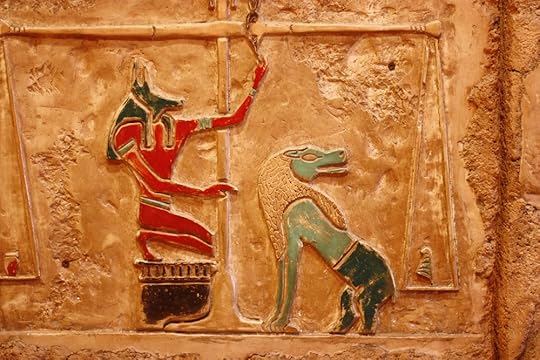
Ma’at, or a world that requires agency
If our eyes allowed us to see the inner dynamics of a human body, we would overcome a few misperceptions quickly. Notably the erroneous assumption that somehow by magic this compound of a myriad living forces exists in a state of constant harmony - only because our human senses (under normal conditions) do not perceive its ever-lasting struggles and efforts. The opposite is true though: Our bodies are constantly at work on the inside. Sometimes this work is heavy lifting, to pull us back from brink of illness, to swing an organ back into its proper rhythm when it was lost; but always it is a careful awareness, a watching and tending, a rebalancing and rearranging. No ecosystem can maintain itself without daily struggles, and neither can our human bodies. That is why we need ample amount of sleep, water, nutrition and sunlight - because natural resources are constantly consumed and applied. The myth of a perpetuum mobile, of a self-sustaining ecosystem, is precisely that, wishful thinking. Real life living systems are progressively dependent on the watchful care of all their combined hive-components. A single one of them goes down, the entire system may ultimately falter.
If we aim to understand the (social) nature of Ma'at, we have to understand not only the physical planet we live on, but the entire cosmos we are woven into, as one gigantic living system. According to the Ancient Egyptians, this cosmic body follows precisely the same dynamics as any living gestalt: it is entirely dependent on the active agency of its components to safe itself from falling into chaos and disintegration. The cosmos needs care. It doesn't need a human hand alone - it needs all hands of all its visible and invisible species united in daily acts of service, integration and rejuvenation.
Always act in such a way that you do not break the web of acting for one another.
— Egyptian Saying
The term Ma'at in this context refers to much more than its often traditional translation 'world-order'. It refers to the process in which the individual being or force not only realizes itself, but at the same time takes its proper place towards everything else that exists in creation. Ma'at describes the process of self-realization just as much as self-localization within a single hive-cosmos, where each part is attempting to 'speak and do Ma'at’ in every single movement.
Let's pause for a moment and reflect on how such a worldview might differ from ours today? In a world where humans have failed so significantly to take their proper place, where a single species almost managed to push an entire cosmos off its scale, it is easy to believe that the complete extraction of this species equals healing - or 'doing Ma'at'. The Ancient Egyptians would have seen this quite differently though: The simple abandoning of a habitat by an entire species - whether that is a small pond, a nature reserve, or an entire planet - will not bring it back to wholeness. It might allow it to recover from its immediate imbalance. However, in the long run, what is required for a healthy ecosystem to sustain itself, to be truly resilient to the attacking forces of chaos, is the united services of all species that were born from it - also the human one.
Ultimately this reveals a most essential ethical dilemma: Our human actions easily distort an ecosystem way beyond their intended consequences; yet according to Ancient Egyptian views, not acting at all is equally unethical. 'Doing Ma'at' as we begin to see requires mastery just like any other skill we like to learn. In fact, 'doing Ma'at' is the ultimate human skill worthwhile living for.
"The Egyptian Gods not only were in the world, but they were the world. Their collaboration brought forth the world, i.e. the continuous process which we call 'cosmos'. For this it required Ma'at. It ensured the synergy of all coaction, which allowed the cosmos to emerge from the constant interaction of forces and from the overcoming of opposing energies." (Jan Assmann, Ma’at, p.35)
As we can see, in its ephemeral yet constantly rejuvenating way of being this Ancient Egyptian cosmos could not have been more different from the Ancient Greek and Gnostic ones: Nothing in the Egyptian cosmos is static, immutable, eternal and ideal; yet everything is fluid, social, changing, interdependent and organic. If the perfected gestalt of the Greek cosmos was a flawless statue carved from white marble, the Egyptian was the meandering, ever-breeding delta of the Nile.
So what did this mean for Ancient Egyptian everyday life? Clearly Ma'at was not an abstract parameter or concept; instead it was the horizon of success for all things mundane as well as divine. How should you live? How should you love? How should you serve and rule? How should you be remembered? And how should you live on? 'Speaking Ma'at, doing Ma'at' was the answer to life (and afterlife) in all its myriad facets and dimensions.
The three Vices of Ma’atNothing illustrates this better than the three core vices against the Ma'at: inertia, deafness and greed.
Inertia in this context was a function of forgetfulness. The sloth lived in the moment, with no yesterday and no tomorrow. Yet without the respect for time there was no Ma'at. Every yesterday's act required a response today. Every act performed today held the promise of an echo returning tomorrow. Ma'at was encapsulated in the demand that yesterday held for today and it required memory and active recalling. The Egyptian language had a wonderful way of expressing this idea: We often find the term that every act requires jointing. Just like bricks stacked up to turn into a building, they will come to nothing, unless each deed is followed by an act of jointing - a response that completes the act, provides its echo and closes its gestalt. Inertia and forgetfulness in light of this meant to untie the ribbon between act and echo.
"Solidarity requires social memory, d. H. a horizon of motivation that is not always constituted anew from day to day according to the respective interests, but reaches back into the past, embraces yesterday and today, ties back today to yesterday. That means responsible action in the sense of Ma'at.” (Jan Assmann, Ma’at, p.63)
An Egyptian saying goes "Whoever is deaf to the Ma'at, has no friends." (Assmann, p.69). Just like good memory wove yesterday's acts into today, so the ability to listen wove mutual acts together into friendship and into solidarity. Acting in this context always formed a function of communication, of responding to what one had heard. Because the Egyptian cosmos was embalmed in a process of constant birth and death, there were very few hard and fast rules. Philosophical paradigms and static maxims didn't bode well, when the entire world could change over night. What took their place instead, was everyone's ability to listen and to understand by themselves. 'Speaking Ma'at' and 'doing Ma'at' first and foremost required the ability to listen.
Characteristically to Egyptian language is the idea that emotions do not emerge from within the body of the perceiver - but that they radiate out from the person who evokes them. Thus it is a person (or a spirit, god, etc.) who radiates fear, love, etc - and the person next to them is simply absorbing and echoing the impulse they set free. Exuding love - and being loved in return - thus turns into a responsibility of every single community member. Especially so in a society where wellbeing and salvation were so closely tied to the way how one was remembered by fellow humans, spirits and progeny.
Thus the corresponding virtue to deafness was not simply the ability to listen, but actually the quality of one's 'heart's-patience' (Herzensgeduld). The act of active, mindful listening was determined by one's heart's ability to be patient and to fully absorb the speech of the speaker. Most forms of social injustice therefore were either blamed on the disintegration of inverse acts (i.e. weaving together yesterday and today) or on one's inability to skillfully listen.
"When what is heard enters the hearer, the hearer
becomes one to be heard." (Egyptian saying)
The third and most straight forward of the vices was greed. Simply put, greed was considered the anti-principle of all things Ma'at. If Ma'at was considered a socially positive principle, that created synergy and coherence on the three layers of time, society and individual, then greed was its destructive, evil twin on all three layers. Greed in this context was a direct function of autarky - of placing one's personal autonomy over the common good.
What is important to reconcile in light of this, is that according to the Ancient Egyptian worldview all social bonds and even ties of blood were completely depended on whether one managed to do Ma'at. A father or mother who did not treat their children well or failed to ensure their inheritance had no hope for prayers and requiems to be read at their grave. Being ill remembered or forgotten, however, was the most devastating, terrifying prospect Egyptians could imagine. All deeds, one's entire life, was aimed at earning good memory amongst fellow citizens, family and progeny - at becoming a person who radiated love both in this life and in the afterlife. Ma'at was the conscious antipole to a raw everyday reality that often turned out to be cruel, unfair or favoring the healthy and strong: To 'speak Ma'at', to 'do Ma'at' precisely was not any kind of natural law, but a service that had to be chosen in every single word and act. A service directed towards realizing oneself, one's community and the world one aimed to be positively woven into one with.
Why to start with Ma’at, and not with Magic"A man's paradise is his good nature" (Egyptian saying)
Now I sit here and wonder what Ma'at could mean for us today? Learning about the ethics of the Ancient Egyptians certainly was a stark reminder for me not to attempt anything in magic that I haven't yet mastered in my mundane, everyday life. Who am I to approach chthonic or celestial spirits with the request to walk through their gates - if I can't even yet calm my heart, and bed it on patience?
Most of all the idea struck me, that the cosmos - or any habitat for that matter - is nothing hierarchical and stable at all. I realized how much I had fallen into the trap of believing that all it took for healing to take place, was to stop or somehow extract our destructive human behavior. Isn't that the metaphor we often encounter these days: to look at mankind as some kind of virus - that once contained or killed off would allow again for a prospering ecosystem to restore itself. It turns out life might be much more complex than that - and much more in need not of human passiveness, but of our positive agency.
I think of the female act of giving birth. I think of how much care we have learned to give to these moments (or hours!). Not to over-engineer it, and yet not to abandon it. To maintain a caring, watchful presence, gently supporting the process, stewarding both mother and the emerging life, without considering ourselves neither the conductor nor the creator of the moment to unfold. In these moments we still know how to stay true to the origin of the word 'response', which originally meant 'promising something in return'. For every movement mother and child are performing, we offer a promise in return. -- What if I knew how to walk through every normal day like this? Like a midwife to the small cosmos I am part of, to the world that surrounds me, and which is continuously caught up in the process of being born and being also taken into death again.
What if I had mastered such level of listening, of patience, of jointing together each act of promise and counter-promise, of deed and counter-deed, of weaving together yesterday and today, the last moment and then the next. Wouldn't that be quite the way to aspire to live? The way of the Adept, without a single step into the magical circle - but out, unrestricted into the open world. Speaking Ma'at. Doing Ma'at.
Here is to a better 2019.


September 15, 2018
Working with Sacred Space: What I learned about Magical Temples
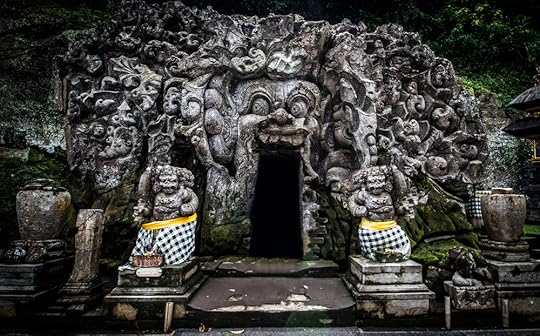
It's been four full years of ritual magic abstinence for me. Now this time is coming to an end. Next week, I'll be consecrating my new temple, and then slowly from there begin to engage with it: Take all my time to realise its beings and patterns, to see where it touches and ties into the land around me, as well as the Inside-Land, the abundance of light and life we call the Inner Desert.
So before I get myself into new trouble, I thought I take a moment to reflect on what I have learned so far about working with and from within magical temples. As this topic has been central to my practice as a lone-practitioners, there are already quite a few posts that reflect on this topic. Here is a short selection, which both illustrates my own journey on this topic, as well as some foundational learnings and working assumptions I’d still subscribe to today:
Getting rid of structure | 2012: This post I wrote when taking down the temple in which I performed the rituals described in the Holy Daimon book. It was by far my largest and most romantic temple yet - hosted in a large abandoned, two-storey annex building to the countryside farm from 1917 we lived in at the time. Seven years later this post still resonates with me - in particular with regards to the light it sheds on the magical need to be as skilled in creating new structures as in dissolving existing ones. This is especially true when working with magical paraphernalia. Normally the largest one of these is formed by the actual temple we work with.
Read Post
Building it up | 2012: This post from later in the same year speaks to an entirely different approach I took to build out my new temple. It is an echo of a wonderful time - the months when Josephine and I were in deep conversations which ultimately led to the emergence of Quareia. Which basically means: I got myself into so much trouble and so often almost blew up myself that finally I convinced Josephine to lend a hand to struggling magicians like myself... -- The post is still a great reminder to me of the importance to work from the inside out, and not the reverse, which often foolishly can seem so much more easy.
Read Post
Taking it down | 2015: Three years later it was already time again to dismantle all outer access to the temple I had worked incredibly heavy in. In fact this period of magical practice had been so intense it led me into my own 'dark night of the soul' following the crossing of the abyss in 2013. -- This post still feels as if I had written it only yesterday. It speaks to the interference of our human bodies, stories and patterns and how magical tools (and temples) become part of our organic being over time. Whenever it is time for this being to go through significant phases of transition, it also means we might need to shed the 'skin' we have built up in terms of outer magical tools and places.
Read Post
A Manifest for Working with Spirits | 2015: Finally, shortly after taking down the outer structure of my last temple, this manifest came through loud and clear. While not directly connected to temple practice as such, it still sums up all I have to say today about how to work with spirits. Rather than focussing on the locus of interaction - the physical or visionary space of the temple - we should focus on the fuel from which it is run and accessed through: our human presence and how its patterning by our values and intentions.
Read Manifest
Now, looking back on this journey from my current vantage point in late 2018, the real advise my experience with magical temples offers up to me is plain clear: Do not interfere too much, but allow the temple to build itself. Better still: Do not call too loudly, but listen intently. Do not aim to form and create, but to perceive what already exists. Most importantly: listen to how the temple wants to emerge from within. Operate off the assumption that it already exists, resting calmly, quietly in the dark of the future. All you have to do is to hear it's calling - and then walk towards it with a light.
As so often in life, it seems, women have an advantage to men on this subject? Or maybe life just chooses to teach them harder and earlier from the onset? Either way - giving physical birth can be quite the humbling experience with regards to any dreams of grandeur about who is in charge, who controls what happens next, how this will all go about and most importantly WHAT we are about to give life to…. 'Life is always right.' they like to say. And we might want to add, wise are the ones who shut up often enough to look life in the eye quietly, and listen. This is especially true when working with beings and powers of age immemorial, beings who hold agendas and biographies reaching back in time further than the emergence not only of any of our individual selves - but of all of mankind.
I guess here it is: I'll approach this new temple in humility, silence and joy. One step at a time. Eyes closed. Carefully orientating myself towards the hand that guides me: a future version of myself, my noble self, reaching back in time to me. And far out beyond it, the sphere of my Holy Daimon.
September 8, 2018
A Manifest for the Interspace
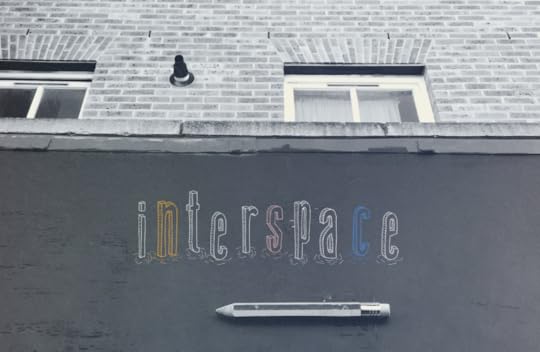
Prologue.
Our results-driven time is filled to the brim with tasks, requirements and objectives. No longer does time suffice to satisfyingly complete the pent-up amount of professional and private transactions. 'Luckily' gaps turn up unexpectedly, in the shape of short breaks, which in return are immediately filled again with anything available. Like an uncontrollable reflex, it's all about typing: in apps, e-mails, short messages, or to complete short mobile phone calls. Every second is squeezed from the interim in order to avoid further task-backlog. Then we continue caught in our completion-mindset, both professionally and privately. This mental task-mode is constantly seeping into all kinds of interim states, wipes out the emergence of any interspace, and doesn't even allow to consider that for a short period the possibility would have existed to take a deep breath, to step back, to calm down, and to re-position oneself in harmony with the present situation. Such relentless baiting makes us dissatisfied, unproductive and in its final consequence, sick. People in haste live in a state of emotional tailback - they act without control, hurt each other easily, and do not have access to constructive thoughts or creative solutions. Avoid the interspace: 'Mind the gap' it says - do not step into the dark gap between platform and tube.
1. Let's stop the relentless discriminationand annihilation of interspace.
Interspace is the biotope of the human being. It is the prerequisite for people to feel, think, and act constructively. It is the result of the cultivation of mankind, and proof of everyone's personal cultural evolution. It deserves respect and regard. Interspace is as inviolable as the dignity of man.
2. Let's take a stand for the conservationand emergence of interspace.
Interspace requires our protection. We speak up against its continuous downsizing and discrediting in professional as well as private environments. Interspace is the source of all creativity. It enables reflection, orientation and innovation. It is a space of conscious being, of realising belonging and cohesion.
3. Let's protect interspace inevery kind of communication.
Interspace serves to protect mutual respect and esteem in all social contexts. Interspace is an essential buffering space, preventing extreme opinions, strong emotions, as well as degrading and inhuman behaviours to clash undamped. It cannot be sacrificed under the dictatorship of time and costs; it is indispensable. Because only interspace can ensure that there is sufficient space for the foreign and different to stand next to the familiar and secure.
4. Freedom for the interspace!Interspace is a space of freedom and of free emotional and cognitive movement: within interspace there is liberty of movement, liberty of assembly, free election of perspective, liberty of speech, and the guaranteed liberty to always take a new position towards oneself and the world. Interspace has to be liberated of the detrimental influence of rigid biographical patterns as well as any external interests.
5. Give interspace the chanceto show what's in it!
Interspace is full of momentum. Within it rests the power of self-organisation, self-development and evolution of potential. Being present in the interspace strengthens our ability to be present in the here and now, it opens new perspectives which enable practical steps into one's future. It slows down processual sequences, in order to recharge these with new energy. Paradoxes and oppositions are the elixir of interspace!
Epilogue.Interspace might be the most precious space to mankind. It is critical to revive it as a place of primary power and essential meaning, as well as to search out the opportunities and perspectives that can only unfold within it. Now is the time to stop, to pull the emergency break, to get out and to change. That is true for every single one of us, for every couple, every family, every work team, every cultural institution and every form of civil society. We have to take life into our own hands, and infuse it with meaning through independent action, empowered by nothing but our own responsibility. Such revolution starts with the necessity to anchor the interspace, with all its creative potential, deeply within each one of us. It starts by developing the required interspace-competence.
Increasingly our time bears the risk of being content with primitive and polarising answers to the pressing questions of our time. Negating or fighting the interspace will result in an incontrollable descent into reactivity. Its renouncement leads to unresolved permanent stress, to hate and violence, or to complete withdrawal from everything that grants us permanent reason for being as humans. Let's take a stand for more interspace, as well as interspace of a higher quality! Let's demand more time for the interspace! Let's make it our trusted friend and daily companion!
THE INTERSPACE TEAM | DAS ZWISCHENRAUM TEAM
Zentnerstr.19 im Hof | 80798 München
www.ZwischenRaum.org | Tel.: +49 0179 1292321
June 30, 2018
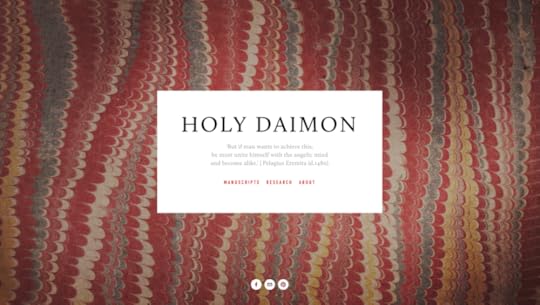
The Holy Daimon Online Project - now live.
Today the Holy Daimon Online Project is opening its doors for curious visitors, avid readers and engaged practitioners.
Over the last ten months, with the help of several amazing people, some wonderful institutions and no insignificant private funding, we have worked hard to offer you completely free access to the current stock of material. This consists of both first-time English translations as well as original research essays on authentic 15th to 18th century grimoires. Each one of these forgotten source-works is taking their own approach to a form of magic we like to describe as daimonic theurgy. You can now access the project, explore its continuously emerging content or more of its background here:
the Holy Daimon Project
Project Purpose
The idea to this project emerged in 2017, following the completion of my manuscript for the forthcoming Scarlet Imprint title Holy Daimon. After ten years of working with the being that I call my holy daimon (you can call it your Holy Guardian Angel, or whatever you prefer), it had become painfully clear how truncated, one-dimensional and in most cases superficial our 21st century understanding of this class of spiritual beings had turned. Our current lack of practically probed, diversified ways of engaging with it, becomes particularly evident when we compare it to the significant amount of practical source-works on the subject our Late Medieval ancestors still had at hand. Almost none of these are publicly available in the English language today. As a consequence, this subject, which is covering some of the heartland of the Western tradition of magic, is known to most serious practitioners through two books alone: either the famous Book Abramelin (approx. 1606) or alternatively Aleister Crowley's Liber Samekh or Bornless Ritual (1904). Both of them, in my humble opinion, present authentic and fully workable pathways towards communion with our daimon. Yet, obviously, knowing only these two source-works cannot grant us a broader vista on the many diverse ways in which our ancestors knew how to engage with these unique spirits. This is where the Holy Daimon Online Project comes in.
According to our humble means, we will be releasing a slowly expanding amount of original source-works focussed on daimonic theurgy specifically. The initial wave of translated manuscripts is taken from the precious collection of Latin and German Late Medieval grimoires preserved in the University Library of Leipzig. Future releases from alternative and broader sources, including an unknown mago-mystical cabalistic treatise which heavily influenced the authors of the Zohar are planned for 2019 and beyond. All work is entirely privately funded; and all transcriptions, translations and original research has to happen in the periphery of several very busy, yet passionately committed lives.
Finally, it should be called out that the Holy Daimon Online Project is entirely independent, neither affiliated with nor sponsored by any magical school or institution of other nature. It's purpose and goal is as philanthropic as it might be naïve: to contribute to the resurfacing of an active, living tradition of Western Ritual Magic.
Current ContentAs a starting point you can find three translations of manuscripts of so called angelic or celestial practice: a voluminous manuscript of the magical hermit Pelagius Eremita, the most important teacher of Johannes Trithemius, detailing a mago-mystical path of attaining communion with your holy daimon. Next to this you will find two shorter treatises with similar goals but likely of somewhat later origin; one to capture a familiar spirit in a glass, the other with its original ritual provided in Latin language which is currently still being finalised in its full translation.
Accompanying these three initial translations we also welcome a guest text of much more sinister origin: a most concise manuscript, called Ars Phytonica, detailing an authentic Late Medieval ritual to enliven a necromantic skull for divinatory practice. This chthonic sibling is of particular curious nature; which is why it is flanked by a detailed original study, first published here on the Holy Daimon project.
Finally, several longer research texts have been completed - in particular focussing on Johannes Trithemius and his seminal role in the tradition of Western daimonic magic. As these texts probably exceed the length and depth that most people would explore online, these have been reserved for a future print release later in 2019.
Enjoy the journey.
LVX,
Frater Acher
May the serpent bite its tail.
The Holy Daimon Project
BUT IF MAN WANTS TO ACHIEVE THIS, HE MUST UNITE HIMSELF WITH THE ANGELIC MIND AND BECOME ALIKE.
— Pelagius Eremita, 15th century
May 20, 2018
Holy Daimon.
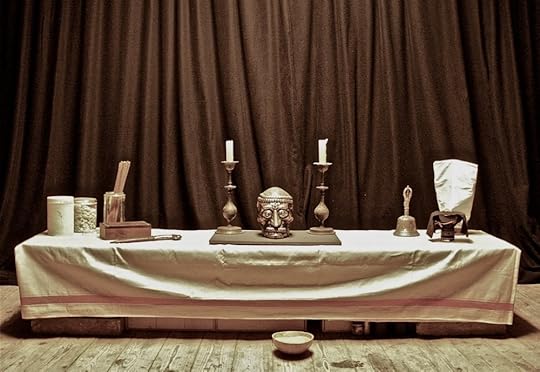
Yesterday Scarlet Imprint announced my forthcoming book with them, Holy Daimon. I thought that was worthwhile sharing a little bit of related background and news. (Note: In case you received this post as a newsletter email - apologies for the broken links; they all now work here.)
The personal spirit entity known since the Ancient Greek as the holy daimon forms a critical cornerstone of magical practice in the West. Only since the early 20th century its practice has been dominated by the Abramelin rite and Crowley's Liber Samekh; yet much of its older historic roots and ritual practices have been forgotten. Therefore, in the first section of the book we'll cover extensive historic background to better understand what our ancestors believed this entity is and what it is not. It is also from such historic context that the critical importance of our own magical experience emerges. In the second part of the book, therefore, I am sharing the magical records of my personal journey towards communion with my holy daimon. The value of these, I hope to show, lies in holding on to our uniquely own path, to the raw, subjective experience of it - while not aiming to live up to or to fulfil any traditional expectations. The third and central part of the book consists of careful, practical instructions towards achieving your own communion with your holy daimon. Writing that section has both been the hardest and yet most fulfilling magical work I had the privilege of doing in many years. Whether it was worthwhile or not - as it should be, the verdict will soon be with you.
order now
As a companion to the physical book I am preparing an online project called 'The Holy Daimon project'. In fact, this project only emerged after I had finished work on the book. Through several 'coincidences' I was pointed to a significant body of German magical manuscripts from the 15th to 18th century - many of which represent authentic ritual instructions to create communion with our holy daimon - and none of which have yet been critically edited or translated into English. Daunted by the new task, I realised the Holy Daimon book, even before its release, had become a critical foundation for this work - yet not its endpoint. The online project would simply not be possible without the forthcoming physical book, and vice versa. - I guess the subject of the holy daimon will guide me through another decade of magical work to come.
So far - with the help of a few amazing people - we have carefully transcribed the handwriting of four of the German magical manuscripts, translated them into English and I have begun to write extended essays on their content as well as the origins of these wondrous texts. A lot of the focus centres on the 16th century German black abbot, Johann Trithemius, and his alleged magical teachers Pelagius Eremita and Libanius Gallus. I am delighted to share, that despite the significant amount of work and financial resource that has gone into this unique project, all of its content - translated manuscripts as well as research essays - will be made accessible online and for free to you later this summer.
Thanks for your support and time - have a wonderful Whitsunday.
LVX,
Frater Acher
The Holy Daimon online project
coming in June 2018 ✶ 15th to 18th century magical manuscripts in their first English translation ✶ critical analysis and new essays ✶ by Frater Acher & collaborateurs
visit now
May 2, 2018
Saturnal Rebellion & the Ossuary of Milan
Here are a few personal thoughts on my current state. In fact, I guess, it is a short meditation on what it means to work in harmony with the forces of Saturn. And why, in times like ours, this might manifest as a form of rebellion.
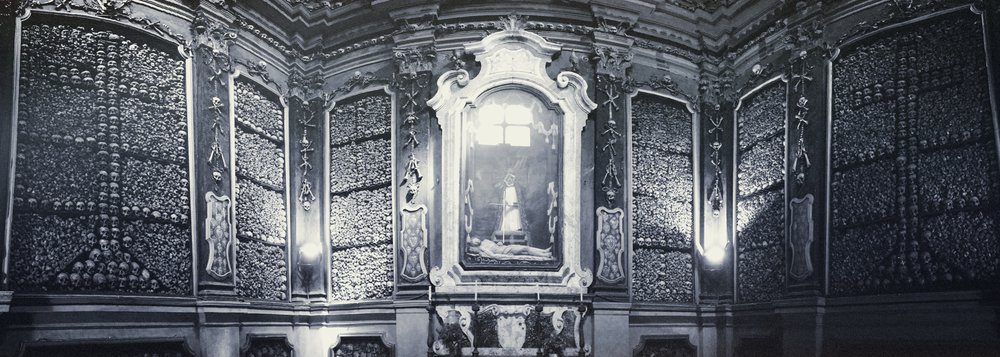
I also had the privilege of sitting in a very special place when pondering about these things. So I am trying to pass this privilege on as best as I can, and share some of the impressions from the amazing ossuary in a small chapel in Milan with you below.
LVX, Frater Acher
Saturnal RebellionJust like for many of us, patience for me never was a virtue I aspired to perfect. What good could come, I guess I thought, from just another word for procrastination or pleasure delay?
However, for many months now my inspiration by far exceeded my limited capabilities to execute upon it. Projects that began as sudden hints from inner contacts grew, expanded and took on roots far beyond what I originally conceived. By simply following their leads, step by step, early morning after early morning - when I normally get to do my research and writing - they led me deeper down the rabbit hole. And just as much as they continued to amaze me with the connections and insights they revealed, they also turned daunting in light of what it would take to tell their whole story. The longest of these projects has accompanied me for more than ten years and has now finally settled into a shape close enough to its original idea for it to be born in a physical form.
After all this work, I am still no fried of patience. But it turned me into a much closer ally of Saturn than I ever have been before. Saturn is connected to the great, black mother of Binah. And just like any mother, her spirit holds a deep understanding of all the processes in play, hidden from our human eye, below a surface level. Here the word patience is nothing but an entrance gate to encounter the virtues of endurance, humility, service and ultimately the Great Work. For no great work can be rushed, nor does it come easy, nor is it quickly mastered or acquired.
They say it takes 10,000 hours of training to master any skill. That number roughly equals 2.3 years of training, every day, for 12 hours a day, with no exception. What they don't say is that it also takes putting in 10,000 hours worth of practice, without knowing exactly where your work will really lead. As part of this journey nobody gets a 'sneak peak' of the person we will be when we emerge from it. Of course we all hold visions, dreams of how it could be, of what we could be, but in most cases these will never come to be. Reality just like deep magic hold their own plans for us. What is ours, is to stay in our track and to fulfil them, one day at a time, to the best of our ability. To bring through the shape of ourselves - or of any significant piece of work we are engaged in - is a process of dedication and discipline, much more than it is of creativity.
Of course creativity is crucial to this path, but mostly it plays in the periphery. It shines a light when we run up against obstacles, when we search for ways around these, like a river searching for its way around or underneath a mountain. The rest of it is holding on to our intent, and fulfilling our training or work one day at a time. The rest of it is Saturn.
As I said, there is still no beauty in patience for me. But I did discover a tremendous amount of beauty, force and marrow in things that cannot come without it: That is in calmness, in rhythm and ritualised habits, in enjoying slow and organic growth, in following the tides and seasons without trying to speed up the harvest. As any mother knows, there is beauty and pure joy in seeing something significant, something living grow from within you, slowly but surely, into the outside world. There is beauty in sending a part of you into this world - and realising it as something entirely foreign, different and new as part of this slow process of emergence.
At the end of day, there might be no virtue these days which is more subversive, more counter-culture, more occult for lack of a better word, than mastering one's patience. Nothing more seditious, then engaging in the art of pleasure delay. Not for the sake of it alone, but in service to the acts of significance that may come from it.
Of course, going counter-culture in isolation, without being carried by a communal current yet, is a tall order. All by yourself it takes pulling away from the riptide of instant gratification, from the lure and bait of social networks, and from the grand illusion that having great ideas would equal accomplishing ventures of greatness. Putting in 10,000 hours of training into the skill of devotion is a particularly lonely road. These days it might have become the ultimate form of Saturnal rebellion.
San Bernardino alle OssaThese were the thoughts I had, sitting in the small ossuary across the street from the famous dome of Milan. Time truly is of no concern here; and one might hardly find a better place to mediate upon Saturn and the black mother Binah.
Skulls and bones have been collected here in a small room next to a cemetery since the early 13th century. After a fire in 1712 had destroyed the already enlarged bone-chamber, a new church was built in its place and dedicated to St.Bernardino of Siena.
'The vault was decorated with frescos by Sebastiano Ricci with a Triumph of Souls and Flying Angels, while in the pendentives are portrayed the Holy Virgin, St. Ambrose, St. Sebastian and St. Bernardino of Siena. Niches and doors are decorated with bones, in Roccoco style. In 1738 King John V of Portugal was so struck by the chapel, that had a very similar one built at Évora, near Lisbon.' (wikipedia)




March 10, 2018
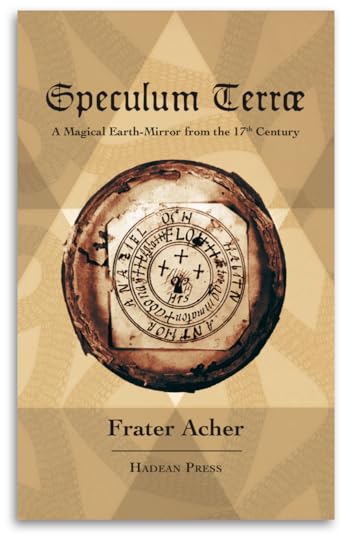
‘Speculum Terræ’ - a new release with Hadean Press
Have you ever looked into a magical mirror that is more than 300 years old? With the exception of John Dee’s famous Shew-Stone in the British Museum, the answer for most of us is likely to be a resounding ‘no’.
In my new publication with Hadean Press ‘SPECULUM TERRÆ’ I hope to help us change this - and allow all of us to take a peak into such a curious, ancient device. But before we get to that, let me share a few lines on why I believe studying these devices in close detail has so much to offer.
Magical mirrors are of particular symbolic power to the practicing magician: While other paraphernalia such as the wand, dagger or chalice represent the essential creative forces that are consciously brought forward and directed in ritual, the mirror represents the magician themselves.
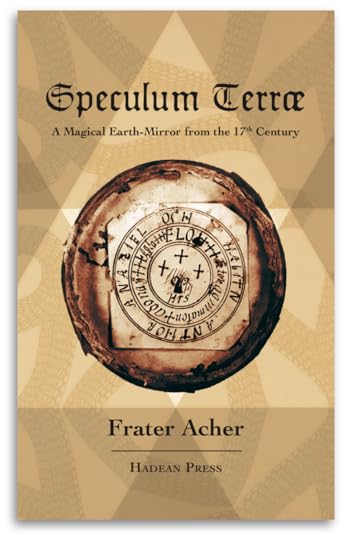
Speculum Terrae
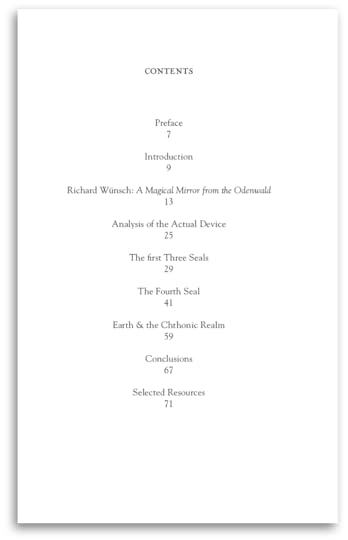
Hadean Press & Frater Acher | Softcover, 76 pages | A study on an original, rare 17th century magical mirror, including it's four seals and the first English translation of Prof. Richard Wünsch's analysis from 1904.
preorder here
From ancient times the mirror in magic was not leveraged to reflect who or what was staring into it. It was not a tool to behold oneself, but to behold what lies beneath it. The magical mirror holds the object lesson of what it means to become a gate. The further we go back in time, the more clearly we see this principle realized in magical practice: The true goês or adept magician no longer uses an externalised threshold to cross between the realms of living and dead, the spirit and physical world or the celestial and chthonic realm; instead the goês has become this threshold themselves. Their breathing bodies, their magical minds have turned into bridges that allow both themselves to traverse between multiple realms - as well as offer crossing for spirits alike. They have become hybrid beings- both with regards to the multiple realms as well as beings that constitute their ‘selves’.
“And so this was the primal sorcery of the first goêtes: to establish and maintain boundaries between the realm of the dead and the living, to uphold the threshold between the chthonic and the human world. Equally, they were the very forces through which human priests also would cross these thresholds - and interact with forces and beings from the other side. The Idaian Dactyls all in one represent the door, the key, the threshold as well as the guardians who watched over it.” (Frater Acher, Goêteia)
So this is why to the true goês or adept the magical mirror turns into a symbol, a representation, and yet ceases to be a tool of active practice: The magical mirror turns from an external object into an internal constituent of the goês. The magician merges into one with the mirror - and begins to walk the path of the empty hand where no temple, tools or tricks are no longer needed to perform powerful magic. Where, indeed, every step in the everyday world - willingly or unwillingly - turns into an act of mediated magic itself.
So much to the reflections on why studying magical mirrors, and how they were used by our ancestors, might be of particular interest to our own craft: Because it teaches us about the forces and capabilities that one day we’ll become one with.
— And that is precisely what ‘SPECULUM TERRÆ’ hopes to offer. In this short study we examine an original 17th century Earth-Mirror. Despite all odds this fragile little device survived in the far German West, in a tiny village museum in the Odenwald region. It was during the research for ‘Cyprian of Antioch - A Mage of Many Faces’ (Quareia Publishing, 2017) that I first came across the traces of this unique paraphernalia. While it immediately sparked my interest, it was clear that it would need to be a separate study. And to my great delight, this is was Hadean Press will be releasing shortly.
As it turned out, it seems this little device is not only extremely rare by its very age and nature, but also holds fascinating historic leads into our Western Tradition that are of particular interest.
On our little journey ‘beyond the surface’ of this magical mirror, we’ll rediscover the original expert interpretation of the mirror’s seal by the famous 19th century professor Richard Wünsch and present its first full English translation. We excavate previously overlooked magical seals contained in the mirror, retrace their divine and angelic names, are being led into Italian Palazzos and to the masquerades of Swedish queens, and finally discover authentic connections to the artefacts of the early Rosicrucian movement.
In addition to these varied historic explorations, the small study also has magical purpose: Just like any magical mirror presents a threshold, a gate or bridge between two states of being, so the story of this device allows us to bridge aspects of our tradition that often seem (artificially) separated: Within the makeup, and particularly within the seals, of this mirror we discover bridges that helps to unite folk and so called high magic, ritual magic proper with early Rosicrucian traces as well as more pragmatically the chthonic and celestial realms in the open eyes and palms of the practitioner.
Personally, I am deeply grateful for the journey this little device allowed me to travel, the things it taught me and the prejudices it helped me break away from. I am also happy to offer a ride on this magical journey to all of you now.
Finally, with each purchase of this book you are supporting the wonderful work of Hadean Press directly. None of the funds are going to me as the author, but all help to contribute to future publications of this very fine occult publishing house.
March 3, 2018
Venomous Words | an Afternoon Tea in London
So today I had the privilege of a free afternoon in London. It offered just enough time to take a cab down to the Natural Museum and to see their current exhibition on these venomous beauties.


The most wonderful part to me of this truly dark and amazing exhibition was Justin O. Schmidt's four-point scale of venomous pain. Established over many years of self-inflicted torture Schmidt gathered each single data point by making the world's most poisonous insects deliberately sting, scratch and bite his true hands-on-researcher-body. Analysing the following personal perception of pain, he came up with a wide differentiation of various levels of poisonous pain. His detailed classifications read like this:
Level 1: Red fire ant - Sharp, sudden, mildly alarming. Like walking across a shag carpet and reaching for the light. (...)
Level 1,5: Suturing army ant - A cut on your elbow, stitched with a rusty needle. (...)
Level 4: Warrior wasp - Torture. You are chained in the flow of an active volcano. Why did I start this list?
Level 4: Tarantula hawk wasp - Blinding, fierce, shockingly electric. A running hair dryer has just been dropped in your bubble bath.
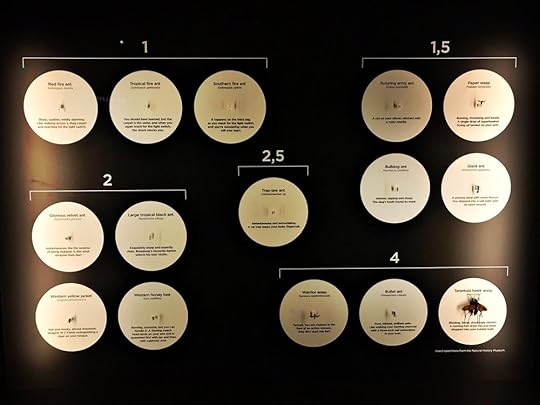
J.O. Schmidt's 4-point scale of poison pain. click to read more examples...
Well, the actual full list forms the appendix of his recent book The Sting of the Wild. And as you'd expect from a true researcher it goes on in small font over many pages of pure, personal, sharply dissected pain.
How to have more fun on a Saturday afternoon? Obviously - except for the mandatory British Museum visit - there is just one other place that offers equal delight: the Watkins Book Store.
With relative regularity I get to visit this wonderful book store, crouched in between the edge of London's Leicester Square and the outskirts of Soho. And each time I leave, after an hour or so, I feel the same bittersweet mix of pleasure and pain. Actually, not unlike Justin O. Schmidt possibly after a nice afternoon tea with e.g. the trap-jaw ant (level 2.5).
First the bitter: I truly had hoped this wave had passed? Yet it seems, there are still so many new books coming out that drip with equal amounts of pride and insecurity of their authors. Even though English is not my native language, I am reading and writing it professionally for more than 20 years now. So if I don't even understand the bare bones of what an English speaking author on magic is trying to tell me, it just pains me. I guess, deep inside the pain I actually feel the urge to sit down with some of these authors - best it might be over a hot cup of camomile tea - and carefully ease them into the simple truth: When writing non-fiction, hiding behind smoke and mirrors of arcane language is never good style, but just another version of the Emperor's New Clothes. If your younger siblings wouldn't understand - at first glance that is - what your sentence has to say, cut it down and re-write it. Magic will dwell in your words, when you have sentences to say that can be read and understood on multiple levels - not by replacing an 'i' with a 'y' or trying to imitate the powerful and yet complex language of one Daniel Schulke.
If I had more time, I would have written you a shorter letter.
— unknown, possibly Lessing, Twain or Marx
Many, many years ago the wonderful proverb was coined "If I had more time, I would have written you a shorter letter". It has been accredited to Gottfried Ephraim Lessing, Mark Twain and even Karl Marx. Yet it still captures the essence of all quality (non-fiction) writing: Pinning down the precise meaning of what you are aiming for in just a few, plain words is incredible hard work.
Obviously I am writing this as someone who is guilty of not doing this as well. In fact, guilty like hell! By the time I turned 20 I had to throw away my collected personal diaries. I just couldn't stand anymore the words and stories I had hidden behind. Their sheer lack of authenticity. I also had to bury my first three novels for the same reason: I was imitating other people's voices instead of being bold enough to find my own. Ultimately that is what brought me to write in English: Here I had to deal with the hugely limited amount of the few words I actually knew. It's hard to meander or decorate if you can hardly express yourself.
Now, as mentioned, leaving the Watkins Bookstore is always bittersweet. And here is the part that was just sweet. I found the below five treasures and took them home. In fact, the book that currently shines the brightest and most glorious in the shop is Fulgur's outstanding Touch Me Not. I literally had to pull myself away from the beautiful standard edition three times, knowing my fine edition was somewhere on a plane, heading towards the Alps already...
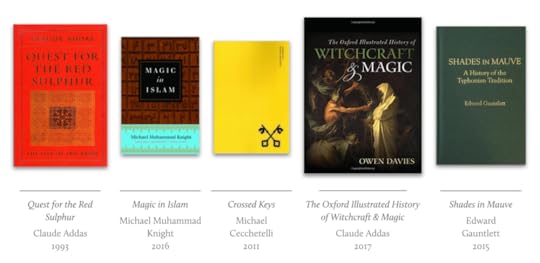
A quick word on two of the books in particular.
I strongly recommend Michael Muhammad Knight's introduction to Magic in Islam. Just take time to delve into its first fifteen pages. They have to be amongst the finest on such a complex subject I have ever read: The language is plain, the thought process Knight illustrates is sharp like a needle and it's easy to follow its weaving and see fantastic new patterns emerge. History lessons from a master - I cannot wait to read the rest of it.
And then this: Quest for the Red Sulphur by Claude Abbas. The first modern biography of Ibn 'Arabī (1165-1240), the saint, scholar, mystic, poet, philosopher and greatest of all masters of Sufism. Even though in its first edition from 1993 already, I'd bet, the founding fathers of the Golden Dawn in their graves would still kill for holding this book in their hands. Understanding this man's life properly forms a bridge that not only leads right into the piercing bright desert-light of Sufism. It also forms an essential bridge into better understanding the heretic path of our own Western Tradition of Magic.
So much for now, fellow traveler. Enjoy the rest of your week or weekend - whenever you might read this.
December 27, 2017
'Decad of Intelligence' by ithEll colquhoun
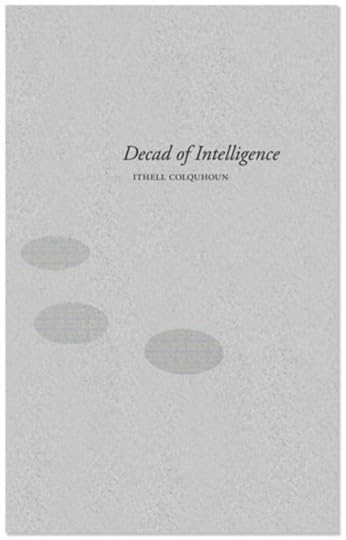
Decad of Intelligence
a collection of magical artworks by Ithell Colquhoun | an important 2017 FULGUR publication
purchase a copy
Whether we choose to work with saints, ancestors or symbolic patterns - the ability to use thresholds in magic, to approach, unlock, traverse and return from them is a key skill for any initiate to perfect.
The topic is particular relevant to my own practice, as recently a lot of it focussed on deciphering how such work can be done with the help of (magical) saints. In these cases the actual threshold can be a story, a prayer, a spell, or as in the most classical form of all for saints - an icon of the former person themselves.
The term 'threshold' in this context has very little metaphor to it and a lot of magical practice instead: We literally learn to move our spiritual bodies over these doorsteps, through these windows or keyholes - and explore the realms beyond in vision. To my knowledge, the most essential practical guide to mastering this core skill is offered in the Quareia curriculum: Stripped free of man-made patterns or religious symbolism it sets the practitioner free to use their senses, their entire magical body in fact, as a tool for spiritual communication, exploration or exaltation. And yes, that is what shamanism kind of always has been about.
Now, when we look into the archive of our Western Tradition we find many artefacts that were meant to enable such spirit journeys and which had been created by magicians for magicians. In most of these cases, however, these artefacts were produced within initiatory traditions that either taught the related skills orally, in secrecy or had forgotten about them at all. Today these artefacts are called e.g. steles for path-working, cards for tattva visions, doorways for elemental journeys or simply scrying star-sapphire rings...
Decad of IntelligenceJust recently in 2017 FULGUR added a set of 10 outstanding doorways to the already existing body of magical expedition maps. Their breathtaking book 'Decad of Intelligence' is a beast so rare and precious, it actually is not a book at all. It is the kind of object you will not want to place on a shelf, but rather allow it to breathe in your temple. At its heart, it is a set of 10 powerful doorways, bound in silver silk-cloth, that only loosely hinge in their locks - and upon the slightest magical touch will open into another realm. - I guess it's obvious: I am truly blown away by the beauty and power of the tools they have placed in our hands.
'Decad of Intelligence' essentially is a short introduction to the British artist Ithell Colquhoun (1906-1988) who created this body of art and practice in the late 1970s, it is also a set of 10 poetic-ritual texts and most importantly it consists 10 unique enamel prints, now printed on thick cardboard, each one presenting Colquhoun's own doorways into the power of the ten Sephiroth.



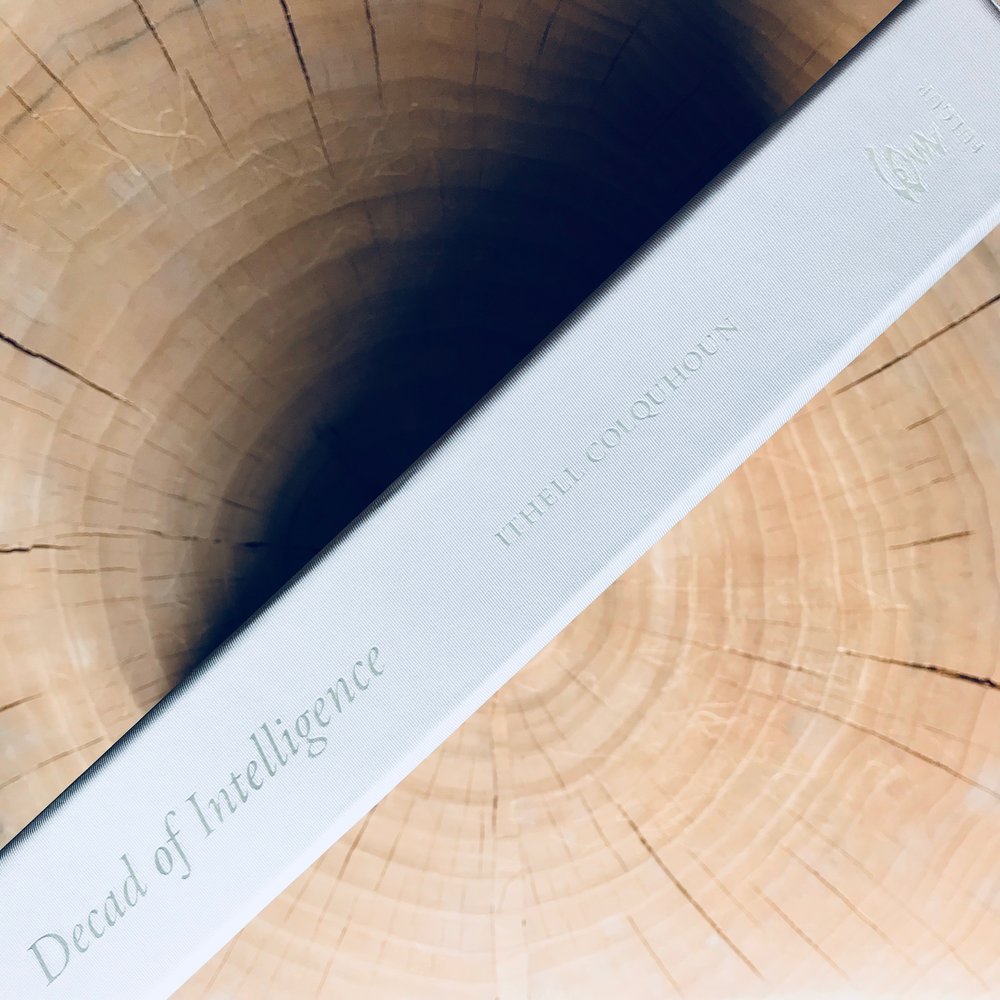


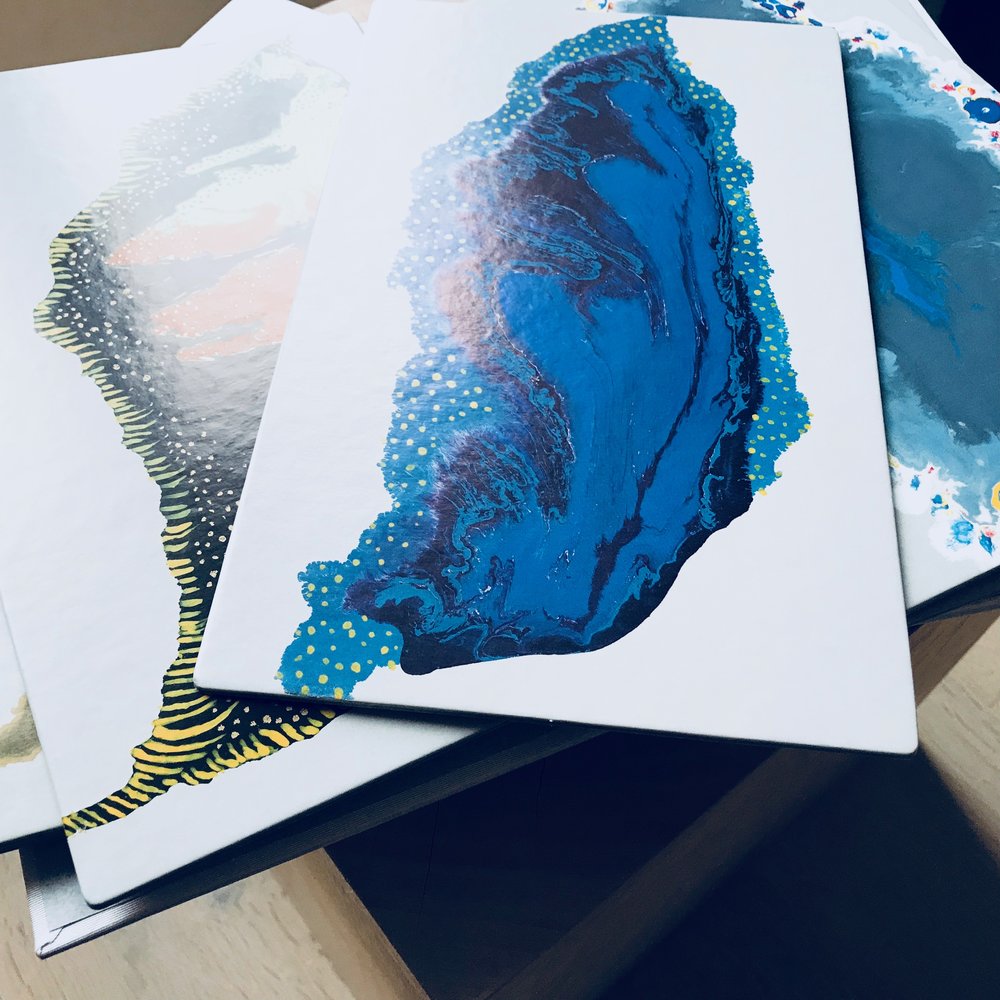
"Building on Colquhoun’s work with the kabbalah, the Decad of Intelligence was developed during the 1970s and is based on the list of sephirotic intelligences as set out in the Sepher Yetzirah. The work was designed to be a small book of ten enamel pieces, each depicting a different sephira, accompanied by a description of their properties.
Colquhoun intended this work to be used as a guide to contemplation for understanding the deep nature of each of the sephiroth, both in isolation and in completeness. It is offered here as a book of texts and individual cards with this aim in mind. The cards have been produced with gold and silver highlights to better capture the nuance of the original works. The minimal design of the book echoes the sparse yet rich language of the contemplative texts."
(from Fulgur's book release text)
Colquhoun's 10 enamel pieces emerge from the background of the tradition of the Hermetic Order of the Golden Dawn as they heavily lean on the order's colour theory. As Dr.Amy Hale points out in her concise introduction, the very intentional use of colour was meant to supersede the need for narrative imagery - and enable a contemplative experience of the ten creative forces first described in the Sepher Yetzirah. By avoiding any symbolic narrative structure and instead fully utilising the experience of color, Colquhoun intended to enable the viewer a vision guided by the 'invocatory purpose' expressed in each of the 10 images.
What Dr.Hale didn't mention though is that such attempt has its own magical roots in the West beyond the confines of the Golden Dawn. In particular the 1901 book 'Thought-Forms' by the prominent Theosophists Annie Besant and C.W. Leadbeater has to be mentioned. Not only did Besant and Leadbeater delve deep into the magical use and meaning of colours, they also attempted to map a core set of human emotions to colour-based thought-forms and then build an entire framework around it.
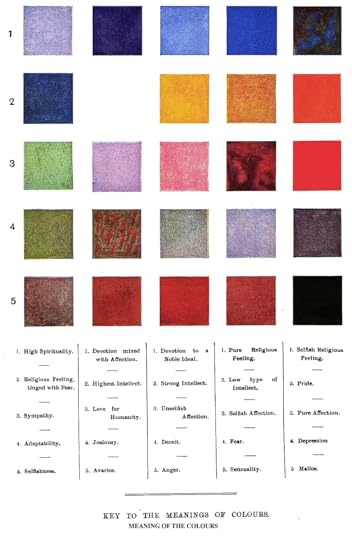
'Key to the Meanings of Colours' from Besant & Leadbeater's 1901 Thought-Forms
What sets Colquhoun's approach and its published body in 'Decad of Intelligence' very much apart from the colour-theory based frameworks in the official Golden Dawn and Theosophical teachings is precisely its very intimate and explorative nature. Here we get a glimpse into the workshop of a powerful female magician experimenting in the latter years of her life (1977-1978) with an explosive mix of organic form, pure colours and sparse ritual sounds. To me there is nothing more exciting than witnessing original magical art such as this coming (back) into life.
I'd encourage all of us to experiment with the powerful images provided in the 'Decad of Intelligence'. They are meant to be put into practice, not hung on a wall. If, in the end, behind these beautiful 10 doorways we get to discover entire sephirotic realms, or rather the personal emotional landscapes of one of the most fascinating occult artists of our recent time, that is to be judged by each one of our own explorations.
How in the world FULGUR managed to produce such breathtaking design, printing- and binding-perfection for such a highly affordable price will remain their very own magical secret.
The images above do not do their work justice at all - but hopefully give you a rough idea of the power of this fine publication. I intentionally didn't share more photos of the actual enamels in full or in higher quality to respect the copyright. There is just no way around experiencing them yourself.
Thank you, FULGUR and Robert Ansell for putting such exciting magical work back into the world - and into the stained hands of so many magicians around the globe. It will remain in mine for a long time to come.
get your own copy
Frater Acher's Blog
- Frater Acher's profile
- 69 followers

