
Frater Acher's Blog, page 2
January 8, 2022
An Example of the Olympic Spirits in Folk Magic
 I. The Olympic Spirits.
Paracelsus (1493-1541) coined the term of the Olympic Spirit(s) in 1531/1532 when he wrote De causis morborum invisibilium, which was printed posthumously in 1564. He expanded on the nature of these spirit(s) in his opus magnus, the Philosophia sagax, written in 1537 and first printed in 1571. Four years later, in 1575, the Olympic Spirit(s) received the ‘grimoire treatment’ with the original publication of the Arbatel.
From this moment onwards in the late 16th century and all through the 17th century, the Olympic Spirit(s) quickly established themselves at the heart of the learned tradition of Western Magic. They were adopted into the evolving currents of Solomonic Magic, Rosicrucian Magic, as well as soaked up by the broad, meandering river delta of Western folk magic.
Unsurprisingly, what was remembered about the Olympic Spirit(s) in these various traditions of magic were not the intricate mago-medical considerations with which Paracelsus originally introduced the term in the 1530s. Instead, the spirits were uprooted from their Paracelsian soil and truncated to fit the general mould of technical grimoires. What we are left with, in most cases of their appearance across the 17th- and 18th-century textual traditions, are their alleged names and seals, as they first appeared in the Arbatel.
In my upcoming book Holy Heretics (Scarlet Imprint, 2022) I am attempting to restore the Olympic Spirit(s) in their original magical context and ritual purpose. Already in 2020, I shared a first online addendum to the finished manuscript of Holy Heretics, where we examined the seal construction of the Olympic Spirits.[1] Here I am offering a second brief addendum: A largely unknown example of how the Olympic Spirits were pragmatically incorporated into the ever evolving strands of folk magic.
II. The Manuscript Cod.Mag.66The passage itself is taken from the manuscript titled “Magia de Furto” (Magic of Theft) and registered as Cod.mag.66[2] in the unique Leipzig collection of grimoires.[3] The whole collection was acquired by the Leipzig University in 1710. Cod.mag.66 was identified as a translation from an earlier Latin text, thus should be dated to the late 17th-century or possibly earlier.
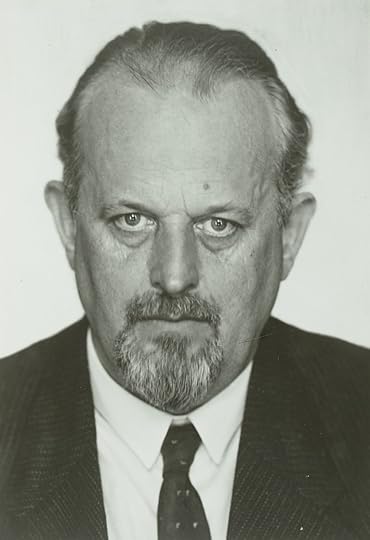
Adolf Spamer, around 1950 (SLUB/Deutsche Fotothek, open access, copyright reserved)
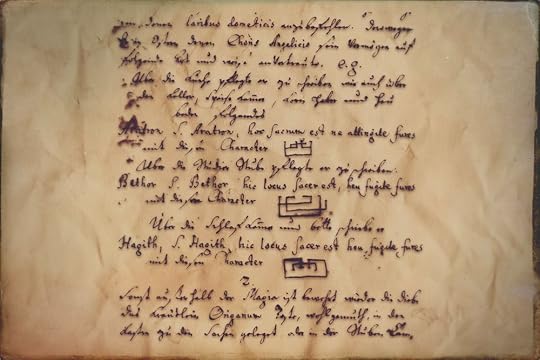
It was first spotted by Adolf Spamer (1883-1953) to contain a reference to the Olympic Spirits. Still a figure overlooked in English-speaking countries, Spamer was a preeminent scholar in establishing both the field of German Volkskunde (Anthropology) as well as specifically the academic research on the grimoire tradition. His 23,000 item strong slip-box collection “Corpus der Segen und Beschwörungsformeln” (Corpus of Benedictions and Conjurations) contains an unparalleled number of transcripts of benedictions, conjurations, charms, amulets, celestial letters, and letters of protection dating from the Middle Ages to the 1960s.[4] The current excerpt forms part of the collection under the keyword ‘Confronting Thieves’ (Diebsstellung – III C1).[5]
A full translation of the “Magia de Furto” is still outstanding. From an initial overview, though, it keeps the promise made by its full title: MAGIA DE FURTO this is various secrets to keep one’s things from thieves, to banish thieves so that they have to bring back the stolen good, also to torment and damage such [people] in various ways.[6]
Accordingly, Bellingradt and Otto in their first full survey of the Leipzig grimoire collection give the following summary:
View fullsizeCod.mag.66 is all about protecting one's goods from thieves, regaining stolen goods, and punishing or torturing thieves by different procedures. These include the use of protective prayers, sigils and charactêres, various types of divination, and the construction of a sophisticated figurine of the thief. The technical terminology used throughout the text reveals that the text has been translated from Latin, and a Latin reader has indeed amended lengthy commentaries – which include alternative recipes – in the margins of some pages. Some of the recipes in this book resemble prescriptions in the nineteenth century German compilation Romanusbüchlein.[7]

Spamer's Transcript View fullsize

Title 'Magia de Furto' View fullsize

Original Excerpt III. The Olympic Spirits as Lares
What makes this example stand out from the broad array of appearances of the Olympic Spirits in 17th to 19th-century folk magic is their explicit use as household deities or lares as the original Latin term.
As we can see from the below translation, their application is both innovative as well as eclectic: Three of the seven Olympic Spirits are assigned to specific rooms or spaces in and around a house. Following common practice, known already from Archaic Greek and Jewish traditions, their names and brief conjurations could have been written directly on the crossbeam of the respective door, or on a paper-note which then was fixed there or slipped into the wall.[8]
In a seeming act of apotropaic magic Aratron, the Olympic Spirit assigned to Saturn, is asked to guard the domestic places that otherwise would be considered most vulnerable to the negative impact of Saturnian forces, i.e. loss, hunger and poverty. Thus, Aratron is asked to protect the kitchen, larder, and all other locations where food for animals are stored.
Bethor, the Olympic Spirit associated with Jupiter, finds a more traditional application and is asked to guard the study – the traditional place of domestic learning, writing and reading.
Finally, Hagith, the Olympic Spirit associated with Venus, is asked to protect the domestic locations of rest, renewal, intimacy, as well as – if ever practised – of incubation and dream-magic.
The short excerpt below refers to this practice as given by an anonymous “theologus” at an unspecified time in the past. While it is positioned as a practice explicitly against thievery, the text also recognises the three Olympic Spirits as general “laribus domesticis” (domestic spirits/ household deities/ hearth god/goddess). Therefore, it does not seem unlikely that this magical practice was originally intended to establish general dominion and protection of the respective Olympic Spirits over the respective locations. However, it found inclusion in the current manuscript through a distinctly utilitarian perspective – that is, the classical lens of all folk-magic – and was narrowed down to the pragmatic use of warding off thieves.
As such, the excerpt can be read like a typical specimen of ritual folk-magic: It still shows echoes and outlines of a once more coherent and professional creative process of spirit-partnership. Yet, in its present form, it places the accessibility of the practice, the immediacy of the effect, and the utilitarianism of the layman above all else.
Further studies should examine how Olympic Spirits in Western folk-magic came to displace traditional household guardians such as goblins or brownies from their ancestral positions. What exactly conditioned the belief in the higher efficacy of these relatively unknown spirits, who had only recently been introduced into the pantheon of German folk magic?
Finally, as I have shown in Black Abbot · White Magic (Scarlet Imprint, 2020), several of the manuscripts in the Leipzig grimoire collection appear to be copied from Latin documents today kept in the Bibliothèque Nationale de France. Could a thorough search in their archive reveal the original Latin source of Cod.mag.66? If so, it might allow us to retrace one of the pathways the Olympic Spirits took to arrive in the broader river delta of German folk magic.
IV. Excerpt of Cod.Mag.66 English TranslationGerman/Latin Transcript
Chapter.1
How one should keep his things from thieves, so that they cannot steal anything, nor carry away the stolen good.
1.
A certain theologian has [missing] ago recommended a proven means to keep one’s things from the thieves, to command the laribus domesticis [i.e. domestic spirits / household deities / hearth god/goddess]. Therefore, during Easter he entrusted his property to those angelic choirs in the following manner. E.g.
Over the kitchen he used to write as well as over the cellar, pantry, granary, and hayloft the following:
Aratron, S. Aratron, hoc sacrum est ne atlingite fures [this [place] is sacred, lest thieves snatch away], with this character: [seal of Aratron]
He used to write over the study room: Bethor, S. Bethor, hic locus sacer est, heu fugite fures [this is a sacred place, alas, it will drive away the thieves], with this character: [seal of Bethor]
Over the bedchamber and bed he wrote:
Hagith, S. Hagith, hic locus sacer est heu fugtet fures [this is a sacred place, alas, it will drive away the thieves] with this character: [seal of Hagith, inverted]
Footnotes
Cap.1
Wie man seine Sachen soll vor den Dieben verwahren, dass sie nichts können stehlen, noch von dem gestohlenen Gute fortbringen.
1.
Ein gewisser Theologus hat vor … ein bewährtes Mittel rekommandiert, seine Sachen vor den Dieben zu verwahren, denen laribus domesticis anzubefehlen. Deswegen er in Ostern denen Choris Angelicis sein Vermögen auf folgenden Art und Weise anvertraute. E.g.
Über die Küche pflegte er zu schreiben wie auch über den Keller, Speisekammer, Kornhaber und Heuboden folgendes:
Aratron, S. Aratron, hoc sacrum est ne atlingite fures, mit diesem Character
Über die Studierstube pflegte er zu schreiben: Bethor, S. Bethor, hic locus sacer est, heu fugite fures, mit diesem Character
Über die Schlafkammer und Bett schrieb er:
Hagith, S. Hagith, hic locus sacer est heu fugtet fures mit diesem Character
[1] Frater Acher, The Arbatel Sigils Deciphered, theomagica.com, 2020, https://theomagica.com/the-arbatel-sigils-deciphered
[2] https://histbest.ub.uni-leipzig.de/receive/UBLHistBestCBU_cbu_00000089
[3] https://www.ub.uni-leipzig.de/aktuelle-ausstellungen/zauberbuecher-die-leipziger-magica-sammlung-im-schatten-der-fruehaufklaerung/ – for an indexed list of the grimoire manuscripts included see: http://studies-vartejaru.blogspot.com/2013/08/complete-list-of-leipzig-university.html
[4] Available for digital access in German: https://www.isgv.de/projekte/volkskunde/erschliessung-und-digitalisierung-des-nachlasses-adolf-spamer/corpus
[5] Accessed on 01/07/22: http://digital.slub-dresden.de/idDE-611-BF-67803
[6] MAGIA DE FURTO das ist Unterschiedene Geheimnüße, Seine Sachen vor dieben zu verwahren, diebe zu bannen, daß sie den diebstabl müßen wiederbringen, auch solche auf unterschiedene art zu peinigen und zu lædiren.
[7] D. Bellingradt and B.-C. Otto, Magical Manuscripts in Early Modern Europe, Cham: Palgrave Macmillan, 2017, ISBN 9783319595245, with an open access appendix: THE CATALOGUS RARIORUM MANUSCRIPTORUMhttps://link.springer.com › bbm:978-3-319-59525-2 › 1.pdf
[8] For further reference on the magical use of doors see for example: (1) Hanns Bächtold-Stäubli (ed.); Handwörterbuch des deutschen Aberglaubens, Augsburg: Weltbild, Band 8, 2000, columns 1185-1209, (2) Heinrich Cornelius Agrippa; Three Books of Occult Philosophy, Book 1, Chapter 42, Rochester: Inner Traditions, p.140-141, (3) Pliny the Elder, The Natural History, Book 28, Chapter 27, (4) Aletta Seifert; Der Sakrale Schutz von Grenzen im Antiken Griechenland - Formen und Ikonographie, Freiburg, 2006


November 25, 2021
A Personal Note: Repatriating ‘Christian’ Magic
This note is long overdue. The fact that it requires expression, seems to mark an important shortcoming in my recent books and social media posts. I hope to remedy some of it with this post, and more of it with future publications.
Here is the problem as I have come to realise it: Over the last years I spent considerable time researching on, experimenting with and writing about aspects of magic that emerge from the heretic periphery of Late Medieval Christianity. Whether this relates to my work on Johannes Trithemius, the Rosicrucian Movement, or even Paracelsus – all of them were deeply embedded into a Christian paradigm. Additionally, and originally stemming from my practical work with the Holy Daimon, I have come to stress aspects of integrity, applied personal ethics. Repeatedly, I have summarised this latter aspect of learning to attune ourselves to a nobler version of our selves under the Trithemian term of ‘becoming alike to the angelic mind’.
What I didn’t realise, was that the combination of these factors in some circles now garnered me the reputation of working with a specific Christian-bias, or even worse, with a hidden agenda of Christian proselytism.
Allow me to take a clear position on these perceptions. Firstly, I am not a Christian – I am a magician who seeks magic and wisdom in all corners of human thought, be it religions, mysticism, sciences and art. Secondly, let me explain how this approach materialises in my work with Christian sources of magic or mysticism, as well as with spiritual paradigms in general.

woodcut from: Paracelsus, Prophecies and Divinations, 1548
Living in a European country dominated by a Christian past and present, (a strongly Catholic community) means living in the ruins of my own plundered and broken tradition every day. Organised Christianity – and due to its long historic legacy first and foremost the Roman Catholic Church amongst it – is the killer of the common as well as the learned traditions of magic. The little that lived on within its cloistered walls was forcefully appropriated, and the roots of pagan philosophy and spirituality were either cut off, hidden or brutally reinterpreted to fit a monotheistic paradigm, as well as an opportunistic political agenda that followed the flavour of the day.
The impressive Christian art treasures of the last two millennia are precisely not an achievement of Organised Christianity. They are a painful expression of the complete usurpation of spiritual life in the Middle Ages under the yoke of a power-hungry criminal organisation, which stopped at nothing. Artists, artisans and intellectuals of the last 1000 years in the West had no choice but to submit to the Christian paradigm, at least outwardly, in order to have access to education and a career. Not only were there no possibilities of artistic expression outside the church-dominated realm of public life, there were simply no possibilities of a life at all.
Such ancestral territory comes with a choice: I can escape it, or I can face it?
A few years ago then I chose the latter. I knew it would be a balancing act: Maintaining the integrity of my own magical path, while deliberately opening up to and searching out the Christian tradition and influences all around. I decided this would need to be a journey without bitterness, but Promethean spirit instead: To walk right into the brutal legacy of the Christian tradition and to steal as much of their mystical fire, as my own hands can carry. Examining the Christian tradition of magic and mysticism, to me, is a necessary act of repatriating our own indigenous goods – tangible and intangible – out into the pagan wilderness of the sole magician’s workshop.
I was prepared for this journey by my magical training with IMBOLC – part of the curriculum was to embed ourselves into specific religious paradigms for several months and to attempt to ‘go native’ for that period. The focus of the training was to become agile in switching spiritual paradigms, not only cognitively but also emotionally, as lived experiences. It was a practical training in switching emic and etic perspectives of various spiritual cultures. Later on I studied anthropology for a while, and then immersed myself deeply into intercultural studies.
As I had to learn on this journey, it led me past many tombstones of holy heretics who attempted to do the same before me. My next book with Scarlet Imprint (Holy Heretics, 2022) will tell the story of some of the things and practices I found. I sincerely hope it will also shine a light on the beauty, integrity and ongoing relevance of a spiritual mystical path, for as long as it stays entirely disconnected from any man-made organisations of power. This is true for all religions, not just Christianity. Every religion holds their own fruits of learning for the magician if we are willing to put aside our baggage and explore without prejudice.
It is this context and journey, which most recently led me to the writings of Henry Clay Trumbull. In the introduction to the little volume in which I share some of his memorable quotes on what makes for good character, I affirmed my genuine believe that good people show up everywhere. And it is worthwhile to sit with them, to listen to them, and to learn from them what we choose to make our own.
The Power of a Paradigm lies in abandoning it.If Western Magic today still deserves to be called an unruly craft, one that undermines authority and resits orthodoxy in whatever disguise they appear, it should continue to take lessons from all sorts and walks of life. As heretics ourselves, we should remain open to learn from present and past, from grimoires and Christians, from folk people and noble people, from East and West.

woodcut from: Paracelsus, Prophecies and Divinations, 1548
Nature does not do paradigms. Nature also does not do ideologies or isms. One of the highest privileges of walking a magical path, is that allows us to step outside the realm of the man-made, the environment that was fashioned and shaped by humans.
The moment we do this, we are entrenched in raw nature, which often appears to us as a foreign realm of Otherness. This realm of nature, far beyond the compartments of human language, does not know any orthodoxies or man-made traditions. It simply is. It is in nature in every moment. Sometimes cruel, sometimes kind, always fulfilling itself.
As mentioned above, much of our work as magicians consist of getting rid of the cultural, social and religious baggage we carry with us, mostly unknowingly. If we walk the magical path well and far enough, we will more and more see raw nature – rather than its man-made, polished surface – shine through our everyday experience.
In a Paracelsian sense, this cultural baggage, we are trying to get rid off, are imprints that have shaped our collective and individual imagination. Operating magic without having cleared the glass of one’s imagination is not only ineffective but right down dangerous: It entails the danger of imagining a spiritual paradigm to be something. Instead of clearing the garbage of our mental images, and freshly immersing ourselves into lived mystical experiences and thus gaining first-hand knowledge through our own emic lens.
Much of the work of the magician resides in cutting off, rooting and clearing out all sorts of collective fantasies and imaginations. Because what we strive for is experience, not collective validation or conformity.
Spiritual paradigms are amongst the most elaborate and yet dangerous imaginations our ancestors have left us behind. They are incredibly well guarded and fiercely defended from any heretical attack.
The original term paradigm relates to an exemplary model. That means, a paradigm is a man-made pattern through which we are offered to look out into the world. Once we put on the goggles of a paradigm we reduce entropy, noise and dissonance, and we increase coherence and meaning in our worldview. The mess suddenly starts to make sense! That is, for as long as we wear these goggles, and only for as long as what we see allows itself to be bent into the patterns that we want to see.
In this respect trying out different paradigm-goggles is a powerful exercise, both in training our mental capabilities, as well as on a magical and mystical path. However, associating any kind of capital-T truth to the patterns we have put over our eyes, is mistaking cognitive comfort with raw reality.
As we said before, nature doesn’t do paradigms. Yet, we as humans benefit from looking at it through diverse paradigms so we can learn to appreciate, understand, and co-exist with it better. – What no paradigm can ever replace, though, is the power that resides in perceiving raw nature without any man-made overlays. The power of willingly exposing ourselves to unfiltered, radical Otherness. The deliberate act of reversing what a paradigm lends our minds: Not to reduce entropy and chaos in how we see the world, but to invite it in. To allow our dreams and fantasies to be shattered, in pursuit of the fluid, subjective, always emergent experience of lower-t truth.
This actually reminds me of the beautiful manifesto published in 1973 in the New York Review of Books. So many aspects of it still resonate with urgency and relevance today. Allow me to quote its final section below. Maybe, as you read it, replace the term intellectual with magician (as well as the old-fashioned he with a gender neutral they) and see what it has to tell about a genuine path of applied magic?
For me, I hear an echo, of a craft that once knew how to apply dissent and critique as well as agreement and appreciation to any source of information. Even to our own first-hand experience. Still today from this manifesto, I hear an invitation to walk our magical path “without messianic pride, independently of all authority and, if need be, in opposition to [...] all orthodoxy, all conformity, all demagogy.”
The first duty of the intellectual, in whatever part of the world he may be, to whatever “camp” he may be committed, is to speak the truth, or at least what he humbly believes to be the truth. He must do this without messianic pride, independently of all authority and, if need be, in opposition to it, whatever it may represent; independently too of all orthodoxy, all conformity, all demagogy. At no moment should intellectuals move from criticism to apologetics. There is no individual or collective Caesar who deserves universal support. The ideally just society is not a society that is devoid of conflict— there is no end to history—but one in which the contestants, when they come to power, in their turn may be contested; a society in which criticism is free and sovereign, and there is no need for apologetics.
— Lucien Bianco, Jean-Paul Brisson, Jacques Brunschwig, Claude Cadart, Gerard Chaliand, et al.; A Manifesto, The New York Review of Books, October 18, 1973
woodcut from: Paracelsus, Prophecies and Divinations, 1548
November 7, 2021
On Character in Magic
 On Character in Magic – Extracts from Henry Clay Trumbull’s
Character-Shaping and Character-Showing (1889)
Here is the second, slender volume in the series titled Büchlein Morgenstern. On less than twenty pages it offers an introduction to some of the essential thoughts on character-shaping and character-showing as concisely summarised by Henry Clay Trumbull in his 1889 book of the same title. As it might seem unusual to see his name appear in the context of practical magic, I am sharing my own short introduction and a personal note below.
As I have to presume the PDF version will travel all by itself through the internet, I have included my introduction there as well. The actual extracts from Trumbull’s excellent work begin on page 10.
If Western Magic today still deserves to be called an unruly craft, one that undermines authority and resits orthodoxy in whatever disguise they appear, it should continue to take lessons from all sorts and walks of life. As heretics ourselves, we should remain open to learn from present and past, from grimoires and Christians, from folk people and noble people, from East and West.
It is in this spirit, and quite to my own surprise, that I find myself sharing magical life lessons from a once famous American clergyman, a lecturer at Yale Divinity School and a life-long believer in “personal evangelism”.
LVX, Frater Acher
I. On Character in MagicIn the hypothetical situation that Henry Trumbull (1830-1903) and I spent a night out on a long walk under the moon, and a few hours in front of a fire with a whisky or two, it is likely we would have not seen eye to eye on many things. Quite certainly we would have disagreed on a broad array of topics, such as relating to lineage, loyalty and hierarchy, to nation-states and the military, to religious orthodoxy and evangelism, and most obviously on topics such as magic and the occult. – At the same time, I would have considered it a privilege sharing a toast with this man, and walking out under the moon with him.
[image error]Free PDF Essay
Click to download complete essay in PDF format. © Copyright 2021, Frater Acher; all rights reserved. Free for digital distribution only.
DownloadThis is a lesson it can take a while to come to appreciate: That people we consider peers or teachers, whether dead or alive, will never be flawless or perfect. Quite the opposite: In most cases we will discover as many admirable as well as regrettable character traits in them. Unfortunately, as it is true for all of us, wisdom has the tendency to appear in small doses. It tends to break through the clouds of our minds momentarily, only to withdraw again behind the dim light of our mundane minds.
This short pamphlet is not meant to be an introduction to Henry Clay Trumbull’s work, and neither to his biography. It rather is a homage in its simplest form: Trumbull’s work have long gone out of copyright, and thus have never been as freely available as they are today. Unfortunately though open access does not automatically create application, and neither relevance. At least to my knowledge his thoughts have never been picked up and woven into a context of magical practice. Thus, as an appetiser to more in-depth study, we present short extractions from his work Character-shaping and Character-showing (Philadelphia: John D. Wattles, 1889).
Now you might ask what the subject of character-shaping has to do with applied magic?
Whether the latter is perceived as an art, a science or a craft – isn’t it the precise privilege of a current, that was forced to remain underground for millennia, to be open to all heretics? Isn’t the opportunistic focus on pure impact and efficacy one of the most marked character traits of magic in the West? Isn’t the deliberate neglect of moral boundaries and ethics, of ought, might, and should, the very reason that pushed magic into the social underground, and yet allowed it to resiliently survive and prosper there?
Perhaps, I would dare to answer. Perhaps that is true and we can disregard the following extracts of Trumbull’s work. Perhaps what you’ll find on the following pages is not only a distraction from your practical magical work, but a poison in spirit that might render it void?
Or perhaps it is time to return to an appreciation of ethics and morals not as topics of social, but equally of magical relevance? In this case the very terms require careful resetting: Here, ethics and morals would no longer relate to social dimensions, to Bourdieu’s habitus and behavioural categories of reward, repentance, and retribution. Here we would utilise the terms through the lens of animistic spirit practice.
The collective they would need to be embedded into, or drawn out from, is no longer one of humans alone, but of spirits and humans. Ethics in this case would turn into a field of study in an inter-species setting. If there ever was such a novel faculty as inter-species ethics it would have to beg, borrow and steal insights from a vast range of existing faculties: From social science and psychology, from anthropology, intercultural study, comparative religious studies, as well as of course from biology and chemistry. Most essentially, however, it would need to be open to learn from the spirits.
Most 21st century ritual magicians seem to be comfortable with a staggering amount of cognitive dissonance: For all the right reasons, most of us have come to appreciate the vulnerability of the ecological balance in this world. Since the socio-ecological apocalypse that was the industrialisation of the 18th and 19th century, the field of human empathy slowly and gradually has expanded again to regain appreciation beyond one’s closest family and self-interest. Today, for many of us it includes again large parts of the animal, the plant and now also the broader ecological realm. Still, judging from many recent publications, it seems considerable parts of the Western Magical community’s interest in spirits is strangely stuck in a consciousness of industrial exploitation and colonialism.
Ironically, the modern-mechanistic worldview has prevailed in the very domain that once was understood as its precise opposite: the archaic and occult, the organic and ambiguous realm of telluric and celestial spirits.
By no means do I advocate for a naive or infantile attitude towards the spirit realm. Just take modern wildlife protection as a field of comparison: Despite its positive intent, its work can have grave negative consequences, unless it is undertaken from a foundation of deep respect for Otherness, of a thorough understanding of ecology, and most of all, of first-hand knowledge and study of the respective animal species. Magic, i.e. the cultivation of our relationship with spirits, should be studied, explored and practiced in the exact same vein.
With such an approach to magic character matters greatly. I suggested before that it is our character that spirits see first when we encounter them on the inner realm. Just like human-to-human interaction is greatly informed by physical presence, visual and tonal cues as well as nonverbal communication, so spirit-to-human communication is informed by the presence of our human spirit and the way it expresses itself through our character.
II. A Personal NoteI encountered Trumbull’s work as part of the research for Ingenium (Scarlet Imprint, 2022), a book that will delve deeply into matters of occult ethics and how these might be utilised for practical purposes in magic. The sections I am quoting below resonated strongly with me, and I want to share some personal context of why that might be.
Of course, I was and remain fascinated by the conciseness and simplicity of Trumbull’s voice - and how much his words require repeating 130 years after their first publication. Additionally, Trumbull’s words immediately wove themselves into the thought process of several subject I have written about recently: The ecology of the spirit world according to Paracelsus, the idea of our own Forestedness, the possibility of reforging our alliance with spirits through the lens of Rosicrucian Magic, the importance of wrestling with the thorny idea(l) of Authenticity in Magic, and equally the restoring of the idea of a tradition of White Magic from cliche and ridicule.
None of the above, even is a remote possibility without a strong foundation of knowing what shapes and shows our own character.
So, in reading the following extracts form the first three chapters of Trumbull’s work, I invite you to participate in a small experiment: As you come across sentences that strike a chord with you, take a moment to pause, and consider what their meaning is to you within the magical circle as well as in your mundane life? How does your character reveal itself today to the world around you - that is made up both of humans and spirits? Considering your magical practice, which implicit ethical choices have you already made? If you attempt to look at yourself as a magician through the lens of a spirit you have worked with: What would they say about your reputation, your conduct and eccentricities, and finally about your character?
In my own work, I recall at least three defining moments when I invited spirits to help me change my character, my conduct as well as ultimately my reputation. Neither of these works were undertaken with particularly high-standing ideals in mind, but rather to help me avert the demons I am trying to hold at bay inside.
Looking back at my own biography, I come from a place where ethics seemed a privilege of the safe and the protected; and for a long time I didn’t consider myself in that camp. Before I even got a conscious grasp of my own character or reputation, both had already deteriorated into tools of manipulation and self- protection. Like we all, I was a teenager at the time, discovering the magical and daunting powers of free will - and yet looking into the mirror of myself for the first time and seeing how much I had abused them already.
When I listen to Trumbull’s words that ten year old within me is still listening in. I can feel the shame as well as the fascination he holds with this old man’s perspective. I can sense him teetering on the threshold of leaning forward and following their call, or falling backwards and rejecting it all. Luckily, fate allowed me to lean forward, and not fall back. Or at least not as hard as I could have.
Years ago now my magical and mundane life begun to blur into one. Either the ritual circle broke, or it expanded to entail all of life? Today, character to me – much more so than sigils, wands, chalices or lamens – is a word that holds great magical power.
Just like the Babylonian brick maker Trumbull references, it speaks of the stamp with which we mark each one of our actions, or each brick we lay in the house of our life. And it is this stamp that is seen and read by humans and spirits alike. – To me, aspiring to make this seal the most decent, perhaps even noble, under the inner and outer conditions I live by, is the mark of a good life.
LVX,
Frater Acher
May the serpent bite its tail.
Note: I resisted the urge to modernise the use of gender terms in Trumbull’s original text. As unfortunately often the case with older texts, we need to make the effort to read either wo/man or human where the text says man.
November 1, 2021
On Authenticity in Magic

As humans, we are spirit-generating and spirit-interfacing beings, whether we choose to work as magicians or not. Just like most people cannot stop their mind from thinking, so we cannot stop our imagination from attracting or creating spirits.
The nature of an ecosystem is that once you are a part of it, there is no more stepping out of it. The system runs through you. It grows, meanders, evolves not with you as a counterpart, but as an integral component.
That is the human condition regarding its relation to the spirit world: To interact with the spirits, we do not need to shift or alter our consciousness. Just like we host millions of bacteria in our gut with whom we coexist, so on a spiritual level we are continuously interacting with a broad weave of spirits, coming and going, moving with the tides of time. What we can do, is to learn to become conscious of these processes – and then to engage with purpose in this already present, effervescent exchange.
In the East, the path towards such conscious spirit interaction is often marked by the idea of inflation. I.e., what blocks our current inability to literally see the forest of spirits before the trees, is that our selves have begun to cling on to too many ideas, objects, and experiences. We have become inflated. Our sense of self has swelled into an amoeba-like form of I, Me and Mine, always hungry to accumulate more within the perimeter of our selves that is already stretched to the breaking point.
Many forms of the Eastern paths are thus marked by the practice of letting go, of reducing to what we cling to and identify with. Once our self becomes leaner and lighter, once our self turns from a tower of accumulated thoughts and beliefs into a transparent cloud, we can begin to see the world around us, without getting in our own way. Phenomena reveal their true nature to us, once we have reduced the phenomena of our Self.
Inflation-free, rootless, victorious over all: there is nothing else to accomplish. With such realization devils are pacified. Moreover, it is self-occurring self-pacification. Noncognizant stupidity in the realm of phenomena cognized as objective is deluded by grasping.
– Machik’s Complete Explanation, London: Snow Lion, 2013, p. 297
In the West, the path of liberating ourselves from the ecosystem we were born into took a slightly different turn. Looking at more than two millennia of spiritual practice in the West, the central position in its armoury of spiritual tools is firmly held not by techniques of non-thought, but by prayer.
Nuns, monks, folk-men, and noblemen all have searched for this path: Of casting their self aside entirely, not even taking the time to dismantle the illusions it is caught up in, but instead seeking to direct their gaze directly and immediately into the light and presence of Divinity. Where meditation dismantles the idea of any counterpart, of any form of dialogue, prayer is the epiphany of dialogue, as it is a human’s attempt to directly converse and commune with the being that resides beyond all forms of creation.
If we juxtapose root-practices of East and West in such an exaggerated way, it is to make one point clear: Neither of them is the way of the magician.
We said the human condition is a hive, is being a legion of spirits. As magicians, we hold no intention to escape this state. Our journey is not one towards divine transcendence or even ethereal sublimation. As magicians, explicitly, we do not attempt to escape the ecosystem of creation we have been thrown inside, woven inside. Rather, our path is to begin to see and empower ourselves so that we can consciously engage from within this chaotic, mesmerising, beautiful, painful cycle of creation and destruction.
To achieve this, we will happily blur the artificial lines between East and West, between meditation and prayer, between becoming transparent and becoming illuminated. We walk our path without any sense of pride or prejudice, but open to stealing from anywhere. As long as it serves our purpose of becoming an empowered part of the weave of creation, by working in close collaboration with the spirits.
So at times we might aim to gaze into the Light of Divinity. At other times, we might aim to become weightless and to reverse the process of inflation. Yet, none of our practices ever aim at becoming lost to the world, but to affect change from within it.
Magicians are the ultimate agents of creative involution. Where other spiritual traditions have erected stairways to heaven to escape the ruthless wheel of creation, we happily take another ride. To be a magician, you have to be in love with a deeply flawed and often cruel creation. Otherwise, what would motivate you to invest all of yourself in it?
This informs the essentially opportunistic attitude of the magical path: The mage’s training for months if not years might follow strictly the same patterns as e.g. a Buddhist or Christian monk adheres to; only to suddenly branch off and apply everything that has been gathered and learned not to step back from creation, but to step deeper into it.
This opportunistic pattern can partially explain the confusion that marks the nature of the magical path. The dichotomies it has been artificially trapped and become entangled in are countless: Whether it was defined relating to a dominant spiritual culture (orthodoxy vs. heterodoxy), relating to a social position (mainstream vs. underground) or relating to the purpose of its ritual approach (folk vs. high magic, theurgy vs. goêteia, etc.).
Now, to bypass these dichotomies we might need to shift our attention away from techniques and towards attitudes: We might need to stop trying to sharpen the characteristics of the magical path by differentiating its outer practices, its social position or its relation to power. Instead, we might want to begin examining the inner human qualities, which we as practitioners need to master, precisely to not get trapped in dichotomies such as the above.
Why would this matter, you might ask? To concentrate on the inner attitude towards one’s work, rather than the work itself? – Well, let me answer with an observation: These days it is easy to come across people who have spent years delving into magical practices, and yet do not have the simplest clue about magic.
While such a statement will make me sound terribly aloof and arrogant, it is actually not an extraordinary thing to observe at all. Magic in this respect is no different from any other liberal art or craft: One can easily waste a lifetime studying it, without ever coming to embody it. These days, many people have gone into the business of perfecting a persona as an artist or magician, without ever creating something worthwhile being called art or magic. One can curate an identity of being on the edge, of being out there, attuned to the weird and Other, while actually doing nothing but remixing other people’s accomplishments. Or not even that.
This is actually not a problem at all; unless people, who major in the business of publicly or privately curating their personas, would actually want to become authentic magicians. Because when we begin to be authentic, out of pure necessity of the process, we cease to curate.
Becoming authentic means we stop having a choice. Not even in the stillness of our heart, alone with ourselves. Especially not then. Being authentic means that the expression of who we are stops being a product. Instead, it becomes a byproduct of our pursuit, of our struggle, our million failures, and few successes in seeking a genuinely authentic voice. And in this expression, if we get lucky, we will tangentially touch truth. Not capital-T-truth, but lower-case truth: the ephemeral, delicious, precious moment, when we see eye to eye with the world we are woven into. Strangeness looking into the eye of strangeness, Divinity being perplexed about the miracle it encounters in itself, a wonder faced by a wonder.
This is the human position in a world filled to the brim with miracles, many painful, some pleasant, all of them poisonous. They are poisonous, not as in the poison of death, but as in the venom that induces the breaking away from what currently is. The venom of stepping into Otherness. Standing in this poison, drinking from this venom day by day, gently and slowly guides us towards Charon’s low boat, that safely will ferry us from this shore to the other, when it’s our time.
If we choose to be on this journey, there is no need for questions of persona, identity, belonging, or even community. If we choose to be on this journey, we will always be by ourselves, but we also hold the privilege to be no one but ourselves.
Our essential tools on this journey - our version of a compass, a Swiss-army knife, and a pair of battered boots - will not be found in books on magical techniques or ritual detail. (These are indispensable on the journey as well, but inversely to times long gone they are now present in abundance.) Rather, our traveling tools will be found in learning how we hold ourselves against this world, as it breaches the perimeter of our beautifully curated egos and splinters our sense of self again.
The tools of authenticity lie embedded in the unimpressive quality of being able to call us back into the present moment with all of our (magical) senses. They are found in the silent quality that allows us to reconnect with our (magical) sight, taste, hearing, and overall sensing, right at that moment when the house of cards that we call our Self comes down again. Standing wide awake with all of our senses, surrounded by the debris of the certainty we lost, counts among the most magical of all life skills.
As we will see, becoming authentic in magic means we work forever nakedly. No dressing up in tradition, no shielding by other people’s Truths, no path paved for us out into the open. Only the big black door of ‘Here & Now’ in front of us, and the Moirae’s question if we dare to touch its handle.
September 19, 2021
On the Foundations of Animistic Spirit Practice in Paracelsus’s Works

As I continue to study the writings of Late Medieval German magicians and mystics, I am often overwhelmed with the amount of fresh insights, new perspectives and innovative approaches I see myself confronted with. Most of this research I do in the early morning hours, between 5am and 8am, before the world around me awakens. Often I stumble out of these hours into my days, filled with equal amounts of inspiration and cognitive dissonance, feeling thoroughly knocked off-centre.
It was through this experience that I came to write the essay I am sharing here: On the Foundations of Animistic Spirit Practice in Paracelsus’s Work.

Free PDF Essay
Click to download complete essay in PDF format. © Copyright 2021, Frater Acher; all rights reserved. Free for digital distribution only.
DownloadThis small study came to life as an offshoot from the research I began for Holy Heretics (Scarlet Imprint, 2022) and am still continuing for my next book, loosely titled Ingenium. By reading carefully across Paracelsus’s collected works (which equals at least twenty heavy volumes in highly complex Early Modern German language, and many texts only remaining as fragments), it quickly became apparent how central the idea of the human inner firmament and the related idea of the inner ascendant are to his entire oeuvre.
However, as much as I studied the English and German secondary literature, there is almost no mentioning of either of these concepts. It is as if, despite the critical position these concepts take in Paracelsus’s cosmology, they had been deliberately overlooked in Paracelsian studies for several centuries. Why is that, I can only hypothesise? Most likely, it might be due to a combination of the difficulty to access Paracelsus’s works overall (especially outside of the German language), the deliberate attempt to eradicate mystical and magical thinking from his works as witnessed in e.g. Sudhoff’s interpretations, and thirdly, in a general lack of attention to his works overall.
The current essay by no means can make up for these shortcomings. Rather, it is intended to be a torch thrown into the dark, unexplored realms of this man’s genius. My obvious and probably naive hope is that someone might catch this torch and walk on with it. If, however, its flames will die down in full flight, my more realistic hope remains that it might hit some magicians and astrologers as a blunt club to the head. For that is what happens to me, each time I delve deep into Paracelsus’s writings: I see my mind cut, I bleed certainties, only to witness the morning star of new possibilities.
I am sharing this little essay as the first volume in a loose new series of digital releases called Büchlein Morgenstern.
The German term translates as Booklet Morningstar and has at least two ways in which it should be read: The celestial morning star, Venus, has long been associated with Lucifer, the light-bringer, in all his Promethean glory and hubris. Equally, the German term Morgenstern can be translated as mace, and thus identifies an ancient, blunt and yet most brutal weapon. Delving into the authentic depths of Paracelsus – with other authors to follow in this series, as my studies progress – precisely offers this dual promise: A promise of seeing new light as long as we accept the stark pain of losing part of our (intellectual) armoury on this journey.
This first humble contribution, On the Foundations of Animistic Spirit Practice in Paracelsus’s Work, therefore might be both: A torch thrown, and a mace swung at you. It is both to me; for personally I am still wrestling with the insights it presents as they relate to my own magical practice and work.
A final note: I am neither a medic, a botanist, a geologist, a theologist, a studied philosopher, nor a properly trained astrologer. Paracelsus was all of that and much more. The limitations of my own contribution on his work, therefore, are more than clear from the outset. I am writing this essay, first and foremost, as a magical practitioner. Thus, while touching on many aspects of the above faculties, the main focus lies on understanding better what underlies, enables and defines our magical practice with spirits – according not to my own, but to the authentic ideas of Paracelsus. I am not sharing this context to ask for forbearance for the many mistakes in this essay; but to create awareness for how to get the most from it.
To finish, I have to acknowledge that this essay is entirely self-published. Thus, it has not undergone professional copy-editing or proof-reading. I apologise in advance for slips of pen or obvious grammatical errors. They are all my own, and unfortunately had to be accepted, in order for this work to be shared openly and freely with you all.
LVX,
Frater Acher
August 7, 2021
Paracelsus on the Role of Faith in Magic


What is happening?— The Matrix, 1999
He is beginning to believe.
Let’s do something dangerous. In the attempt to offer a short exposition on Paracelsus’s teachings on faith in magic, we will not begin in the 16th century, but in the perilous arena of modern pop culture.
The risk with studying historic sources of magic always is that we allow them to remain in the past. That their voice remains a distant echo, safe on its pages, rather than an imminent call to us in the present moment. In studying the history of magic as practitioners, our goal is to turn a dialogue of the dead into an invitation to ourselves. – It is with this in mind, that we will be leveraging a modern pop culture example as well as some of my own experiences to illustrate what we can learn from Paracelsus about faith in magic.
If you hold more of a purist preference, I invite you to study the direct translations from Paracelsus’s works included in this post. They alone hold ample powder to blow through brick walls in our minds. Much of what it takes is the spark of allowing Paracelsus’s voice to come through in our present moment.
LVX,
Frater Acher
May the serpent bite its tail.
Towards the end of the first instalment of the popular The Matrix series, the story’s hero is finally ready to fully transcend his identity away from the colourless software engineer he had been within the matrix, Mr. Anderson, and towards the saviour figure called Neo. This conscious change in believe forms the central theme of the film. It is coming to a climax when Neo chooses to stop running from the Matrix’s ubiquitous agent Mr. Smith, and to face him as an equal in power and potential. In classical cinematic identification with the protagonists, this is the moment, we, the viewer have been waiting for during the previous 120 minutes: A moment of self-authorisation, of self-empowerment over who we are, of what we allow to define or confine us. And even in one of the most daring science-fiction movies of its time, all of this hinges on the inherently human quality to take control over what we believe in.
For know this of faith, that faith can do this, whether I use it wrongly or not, yet it works signs. […] For it is faith that does it, it creates outcome, it bears its fruit, according to how you believe. Therefore, that you do not abuse it, the commandment is given, because it comes true. […] So it is with the faith: the same has force. If I believe wrongly, it goes out; if I believe righteously, it goes out. (Paracelsus, Liber de superstitionibus et ceremoniis 1)
In a world obsessed with technological progress, scientific innovation, industrial automation and, of course, artificial intelligence, it seems hard to find a subject that seems more archaic, backwards-looking or simply outdated than this: faith.
Now, the first thing we need to do to uncover the magical force called faith is to let go of any association with organised religion. To understand the inherent potential in man’s ability to believe in something, we have to free this organic capacity from millennia of debris heaped upon it by man-made religious organisations. While often using similar terminology, the latter most of the time have little to do with personal empowerment for actual spirit-work, and much more with rigorous power-politics and social exploitation.
Almost five hundred years ago, Paracelsus made this point unmistakably clear. In his collected works, we come across more than a dozen separate instances where he pauses to explain the natural force embedded into man that is faith. Above and in the following quotes, we are offering a few direct and modernised translations from his old vernacular in German.
If the medic […] anchors themselves in faith, then the faith splits itself into two: one faith in God, the other in Satan. If he believes truthfully, according to the Gospel, a mountain will sink itself into the depth of the ocean; and even much easier than that he will be able to heal a sick man. Such remedy does not need any help but faith in Divinity. Yet when his faith does not stand in God but in the infernal ones [inferos], it follows that such faith takes effect through the infernal forces, which hold a pharmacy that contains all mysteries of nature that are administered by them. (Paracelsus, Philosophia sagax 2)
As we can see from the quote, Paracelsus is very explicit on this point, that man should attach their faith to Divinity, but in principle is free to attach it to anything. In fact, if man was to attach it to the “infernal ones” what is waiting for them is not the usual threat of eternal damnation but rather an entire telluric pharmacy resided over by the chthonic spirits. So according to Paracelsus, it is the application of man’s free will to their capacity to have faith that opens the doors of spirit contact and enables daemonic access and affiliation.
Paracelsus actually expresses a very straightforward idea: Like breathing, like standing on a cliff and calling to the sea, like carefully tasting an unknown fruit for its bitterness or sweetness, faith is an inherent skill embedded into each human. Unlike the physical senses and their external capabilities, however, faith resides on the inside, on the intersection between man’s mind and soul. Therefore, faith as a capability is equally rooted in our heart as it is in our head.3
If we were to translate Paracelsus’s explanations on faith in the above quotes and elsewhere into a 21st century position, we could give it as such: He defines the human capability of having faith in something as the ability to flow into one – whether this means becoming one with an idea, an object, or a person, may this be temporarily or permanently. For Paracelsus, therefore, faith is our capacity to flow and merge into full identification with something. To have faith in something means that relating to this particular idea, person or object we burn the bridges of “If and But”, and resolve the boundaries of “I”.
Let’s illustrate this in a mundane context and consider the person you love most in your life: The relationship you hold to them is special for many reasons. One critical reason for all of us, however, is the fact that in this person’s presence we do not need to guard ourselves. Loving them, among many other things, means we are willing to lower all defence mechanisms in their presence, and openly hand ourselves over to them. That does not mean we do this in an egotistical or self-abandoning way. But in a way that blurs the lines between “I” and “Thou”, a way that allows this other person to step up so close to us that in some moments rather than sensing two separate people we begin to experience a unified a field of us: Perceptions, words, emotions flow unconstrained between us. Like clouds temporarily assume one body, so we become one. In these moments, the threshold that normally separates us from the world has turned so low, so thin, that even with the tips of our fingers we cannot feel it any more.

An illustration of Sympathia, the force that operates equally in nature and magic and turns things alike on their outside and inside. (Sudhoff, Karl (ed.); Paracelsus Sämtliche Werke, Band X, München und Berlin: Verlag R. Oldenbourg, 1928, p. 585)
Like a magnetic field, activated by an electric current, faith is the force that unites. It is nothing in itself, but a field of potential that requires both careful activation and deliberate direction. A magnetic field requires at least two objects that react to it so it can take effect in the world. Faith also requires at least two objects between which it can work to close out distance and distinction. Faith, therefore, is a human’s inherent capability to – consciously or unconsciously – create affiliation, alikeness, or in magical terms, sympathy.
This is why Paracelsus pauses so often to explain the power and poison that can be the force of faith: In our magical operations faith is a most essential and yet most often overlooked tool. In magic, unlike in a romantic relationship, we do not use it to lower the threshold between ourselves and another person. Instead, we use it to lower the threshold between the physical realm that contains our bodily self, and the realm of the spirit. In magic, at its most essential level, faith is what at least temporarily pulls us out of our identification with our blood, bones, skin and hair, and allows us to step over the threshold of becoming fully one with our travelling spirit.
Here is a helpful example that you can practice for yourself: You might be familiar with Josephine McCarthy’s root-exercise of accessing the Flame of the Void. The importance of this simple yet essential spiritual operation cannot be overstated. Here is a brief excerpt of the longer exercise:
[…] Light a candle and close your eyes.
See the candle flame with your inner vision and see it grow before you. Be aware of a flame within you, the flame of being seated deep in your centre. The flame within you grows strong, and the candle flame before you grows bigger. See yourself in your imagination step into the candle flame and let the two flames merge. You bathe in the flames that do not burn, and the power of life flows through the flames and into your body, strengthening you.
When you are ready, see yourself step forward through the flames with the intent to pass into the void. You step through the fire and find yourself in a still dark place where there is no time, no space and no movement. There is nothing but stillness and silence. You let your thoughts fall away, let your sense of your body fall away and the details of your life, they too fall away, leaving you still and silent. […]
(Josephine McCarthy, Working with the Void)
This exercise offers a powerful and safe way to experience the power of faith: I’d invite you to do this exercise on a day of average chaos and madness, with average calm and purpose, in the same way you would clean your teeth before going to bed. Note the results. Then I’d invite you to do it again with faith: This means that as you sit in silence, looking at the flame, getting ready to do this small operation, you decide to make it count as if it was the last thing you’ll ever do. Performing magic with faith, means you hand over all of yourself to the work of the very moment. Contrary to the attitude of an academic researcher or an anthropologist on their field studies, you immerse yourself fully. You are all in. You bring all of your skin into this operation. Most importantly for the present exercise, performing it with faith means you switch your identity fully into the flame. The flame becomes Neo, the flame becomes you. What you experience inside this flame, and once you have stepped through it on the other end, you are willing to accept as stark and raw reality. No human filtering, no “Ifs or Buts”…
It’s your faith that decides whether performing the Flame of the Void will be a short mindfulness meditation, or an expedition into an unknown reality. It’s your faith that determines if you will work this operation as a soothing wellness strategy, or if you punch that door open into a magical reality. In short, faith is the currency that determines how much this operation will matter. Faith invites us to not hold anything back, but to operate in unconditional trust. Faith has to flow in equal amounts from the fire of our minds and the wellspring of our hearts.
In light of this, it should be obvious how adept and agile a magician has to become in handling their faith: In one moment they need it to be a firehose, in the next the measured drips from a vial. They will want to apply it in spades to the moment when they cross the threshold into the inner realm, and pull free from the iron grip of physical reality. And yet they will handle it as carefully as their own heart, when deciding to which spirit (or person) to apply it to. Allowing ourselves to become alike is the binding poison that is made up of a human’s capacity to have faith.
Here is a personal and rather extreme example: Once, I allowed a spirit in vision to tattoo a magical sigil onto my solar plexus. Next to crossing the abyss, that counts among the most daring and courageous magical operations I ever conducted. At that moment when it happened, I knew with the same certainty as I feel oxygen flowing into my lungs now, that this would change the rest of my life – and of many lives to come. There was nothing left of me that stood outside this moment and experience. I was in it; no thresholds, no safe-keeping, no way back. It took a lot of experience and technique, craft if you want, to arrive at this moment, to enable it. However, this moment would have been nothing but a ghostly echo, had I not worked in unconditional faith with the spirit who was present with me.
Equally, it is important to understand that the degree of faith I was willing to invest in this moment, would have not changed anything about the ontological reality of the spirit I was working with. That spirit, just like the myriad of spirits we are constantly surrounded by, couldn’t care less about how much faith I brought to the table of our work. Instead, the side of the equation where it mattered was entirely my own: In magical operations faith determines the degree of fully embedded consciousness we bring to an operation. It determines how much of our awareness, our inner senses, our subtle perception we will be able to switch on and away from the physical reality. Faith is the only gatekeeper, the only threshold between Castaneda’s tonal and nagual, or Gustav Meyrink’s Hüben und Drüben.
As beings endowed with free will, we hold the power to allot and charge our consciousness with faith. Faith then becomes the great activator, the master-switch of shifting our presence from here to there. This is not because we randomly and one-sidedly create our own fantasy-reality, but because we operate with faith in its original etymological sense: in the idea of placing our entire trust into something. Faith can become the key that during our magical operations temporarily allows us to shift from embodied human into embodied spirit.
Obviously, there is much more to be said and experienced about faith in magic and Paracelsus position on it. Naturally, it is arduous work – both in practice and education – to overcome centuries of misperception and confusion over this central term. All too often has it been either belittled as the opposite of knowing, or as the fundamentalistic sibling of imagining. And yet, helping us learn how to coin this term anew in the light of an essential human capability is of critical importance. Already almost five-hundred years ago, this very idea formed a cornerstone of Paracelsus’s magical program.
For now, we will close with three additional short translations, which provide rich food for further study on the subject of faith in magic. The first one is taken from Paracelsus’s The Books of the Invisible Illnesses (Die Bücher von den Unsichtbaren Krankheiten, 1531/1532); the second one from the first volume that forms part of his Philosophia magna: de divinis operibus et seretis naturae. The third one emerges from the periphery of the possibly spurious Archidoxis magica, and together with other shorter treatises was first printed as an appendix to the latter in Strasbourg in 1570. We will never know if this last paragraph truly emerged from the hand of Paracelsus; however, the spirit with which it was written wonderfully illustrates Paracelsus’s understanding of the essential role of faith in magic.
Paracelsus on Faith in MagicModernised Translations from his Collected Works
You know how the Gospel is giving a succinct understanding of the might and power of faith, where it says the following sentence [Luke 17:6]: And if you had as little faith as a grain of mustard seed, but from within this faith and with the power of it you said to the mountain: you, mountain, send yourself down into the ocean, then so it will be. Therefore, you should know that our power, which the body commands from its flesh and blood, is but a small power, but that our mighty power lies in the faith alone. And as gentle and easy as we might pick up a grain of mustard seed and throw it into the ocean, as if there existed no weight, just as gentle and easy we throw the giant mountains into the ocean through our faith. That is why we have to understand faith and that wondrous powers reside within it, powers which the visible body may not think of in its own senses. (…) all power that we should need and have will exist through faith. And this is how the power of faith should be understood and seen, as we have shown here.
But further you should understand, the spirits are equally capable of this, and they may throw the [mountain] Olympum into the Read Sea, or they may throw all oceans on Mount Aetna, and similar things, if God imposed it. Therefore know, the spirits have no body, neither blood nor flesh, and thus they don’t hold the [respective] powers; they affect everything through the faith that they have. So remember the sum of the Gospel is this, as if Christ wanted to speak: What are you, humans, in your powers? Nothing. But this I say to you, from where you shall take your power: take it from faith. Once you have faith, and even if it was as little as a mustard grain of seed, behold, you will be as powerful as the spirits. For then, despite you being humans, your might and power will be equal to the spirits (…). So remember, it is through faith that we turn ourselves into spirits.
– Paracelsus, Die Bücher von den unsichtbaren Krankheiten4
But where faith will not fall into your heart, but into ceremonies, [holy] images, [and sacred] paintings, you will have to have these. But now know that it is an evil heart with thee. For though these things move thee and make thee groan, yet the cause and beginning is nothing. This means: you have taken the beginning from the images, and into the images it goes again. If you have taken the beginning from the ceremonies, it returns to them. If you have taken it from the painting, it goes back into it. For all things return to their first beginning, from which they came. And these beginnings are transient, are mortal. Likewise, your faith will be mortal, transient and fragile.
– Paracelsus, Liber de superstitionibus et ceremoniis5
For what theologian (who has also understood magic) has ever cast out a devil or otherwise expelled or brought to him a spirit? Or much less and lower that he has ever made a sick person well or otherwise done any help, just by his faith? I doubt that he moved a great mountain by it, and even cast it into the sea? From this it follows that they themselves understand little and not much about this faith of which Christ speaks, and yet it is in their mouths every day, they talk and teach much about it, and yet they themselves do not know how to try it, and thus perform a sign of which one would like to say understand faith and know how to use and prove the same. And when another one comes who does a sign by faith, whether good or evil, they call him a sorcerer, although it is beyond their reason and human wisdom, and they do not know how to distinguish magic from sorcery. For magic is a pure and nimble art, not stained and sullied with ceremonies or incantations as is nigromantia. For in it neither ceremonies, conjurations, consecrations, benedictions, nor maledictions are used and added, but only faith, of which Christ says that it moves mountains and casts them into the sea. The one who can also command all spirits and ascendants, who can master and conquer them, in him this faith is perceived.
– Paracelsus, De occulta philosophia 6
FootnotesSudhoff, Karl (ed.); Paracelsus Sämtliche Werke, Band XIV, München und Berlin: Verlag R. Oldenbourg, 1933, p. 367-369. Modernised German version: “Denn das wisse vom Glauben, dass der Glaube das vermag, ob ich ihn falsche gebrauche oder nicht, so wirkt er doch Zeichen. […] Denn der Glaube der tut es, er gibt Werk, er gibt seine Frucht, je nachdem wie du glaubst. Darum dass du ihn nicht missbrauchst, darum ist das Gebot gegeben, denn er wird wahr. […] So ist es mit dem Glauben: der selbige hat Kraft. Glaube ich falsch, es schreitet hinaus, glaube ich gerecht, es schreitet hinaus.” ↩︎
Peuckert, Will-Erich (ed.); Paracelsus - Gesammelte Schriften, Band IV, Basel: Schwabe Verlag, 2009, p. 294/295 ↩︎
The magical method called prayer in such a context breaks free from any orthodox handcuffs. Equally distorted like the term faith through centuries of dominion of organised religion, prayer is not a liturgical text learned by heart and recited at the correct moment. In stark opposition, Paracelsus portrays it as the science and art of knowing how to “seek and knock”. If done “in the appropriate way and with a pure and unconditional heart, all that we seek will be given to us to be found, and all that is otherwise occult and cast away from us, will be opened and unsealed.” (Sudhoff, Karl (ed.); Paracelsus Sämtliche Werke, Band XIV, München und Berlin: Verlag R. Oldenbourg, 1933, p. 513) ↩︎
Sudhoff, Karl (ed.); Paracelsus Sämtliche Werke, Band IX, München und Berlin: Verlag R. Oldenbourg, 1933, p. 260-261 ↩︎
Sudhoff, Karl (ed.); Paracelsus Sämtliche Werke, Band XIV, München und Berlin: Verlag R. Oldenbourg, 1933, p. 371. Modernised German version: “Wo aber der Glaube in dein Herz nicht fallen will, sondern in die Zeremonien, [heiligen] Bilder, [und sakralen] Gemälde, so wirst du diese haben müssen. Jetzt wisse aber, dass es ein böses Herz ist bei dir. Denn ob diese Dinge dich schon bewegen und zum Seufzen bringen, so ist doch der Grund und Anfang nichts. Das meint: du hast den Anfang von den Bildern genommen, und in die Bilder geht er wieder. Hast du den Anfang von den Zeremonien genommen, so kehrt er wieder in diese zurück. Hast du ihn von dem Gemälde genommen, so geht er wieder darein. Denn die Dinge gehen alle wieder in ihren ersten Anfang zurück, aus dem sie gekommen sind. Und diese Anfänge sind vergänglich, sind sterblich. Ebenso wird dein Glaube sterblich sein, vergänglich und zerbrechlich.” ↩︎
Sudhoff, Karl (ed.); Paracelsus Sämtliche Werke, Band XIV, München und Berlin: Verlag R. Oldenbourg, 1933, p. 538-539. Modernised German version: “Denn welcher Theologe (der auch hat die Magie verstanden hat) hat je einen Teufel ausgetrieben oder sonst einen Geist vertrieben oder zu ihm gebracht? Oder noch viel weniger und geringer, dass er je einen Kranken gesund gemacht oder sonst eine Hilfe getan hat, allein durch seinen Glauben? Ich bezweifele dass er dadurch einen grossen Berg versetzt und gar ins Meer geworfen hat? Daraus folgt, dass sie diesen Glauben, von dem Christus spricht, selber wenig und gar nicht viel verstehen, und doch faehrt er ihnen täglich im Maul herum, reden und lehren sie viel davon, und wissen ihn selbst doch nicht zu probieren, und damit ein Zeichen zu tun, von dem man sagen möchte sie verstuenden den Glauben und wissen den selben zu gebrauchen und zu bewähren. Und wenn ein anderer kommt, der durch den Glauben ein Zeichen tut, es sei gleich gut oder böse, heissen sie ihn einen Zauberer, obgleich es ueber ihre Vernunft und menschliche Weisheit geht, und sie wissen die Magie und Zauberei nicht zu unterscheiden. Denn die Magie ist eine reine und behände Kunst, nicht mit Zeremonien oder Beschwörungen befleckt und besudelt wie denn die Nigromantia. Denn in ihr werden weder Zeremonien, Beschwörungen, Heiligungen, Segnungen, noch Verfluchungen gebraucht und hinzugenommen, sondern allein der Glaube, von dem Christus sagt, dass er die Berge versetzt und ins Meer wirft. Derjenige der auch allen Geistern und Aszendenten gebieten kann, der sie meistern und bezwingen, in dem nimmt man diesen Glauben wahr.” ↩︎
August 4, 2021
Paracelsus' Wisdom on the Ecosystem of Spirits

View fullsize
View fullsize
View fullsize

View fullsize

View fullsize

Western Magic is often distinguished into strands of high and low magic, learned and folk magic. Such and similar differentiations mainly centre on human social backgrounds as well as correlated motives of action and practice. I.e. they are rooted in an anthropological understanding of magic and how it is leveraged to make sense and alter the world. Unfortunately, with such seemingly obvious approach a lot of damage is already done. And mostly such damage has gone unnoticed and turned into thoroughly embedded bias in our Western tradition.
By centring on a human worldview and agenda, we inherently fail to give equal importance, value and explorative space to the rest of the (spirit) ecosystem of which man forms but a tiny part of. An introduction to magic, explored and explained from a more holistic perspective, could not pivot on human motives, but would need to begin at the precise opposite end: It would need to introduce us to the functions, forces and fields of living consciousness that exist around us - and which all hold their own motives and agendas.
Luckily for us, and yet sadly forgotten by most, Paracelsus (1493-1541) has done precisely that. And it took him less than two pages to set out the essential foundations of an ecosystem of spirits. In the following, I am sharing a few introductory remarks and observations to this short gem of a text, and then provide my own English translation as well as a modernized German one.
LVX,
Frater Acher
May the serpent bite its tail.
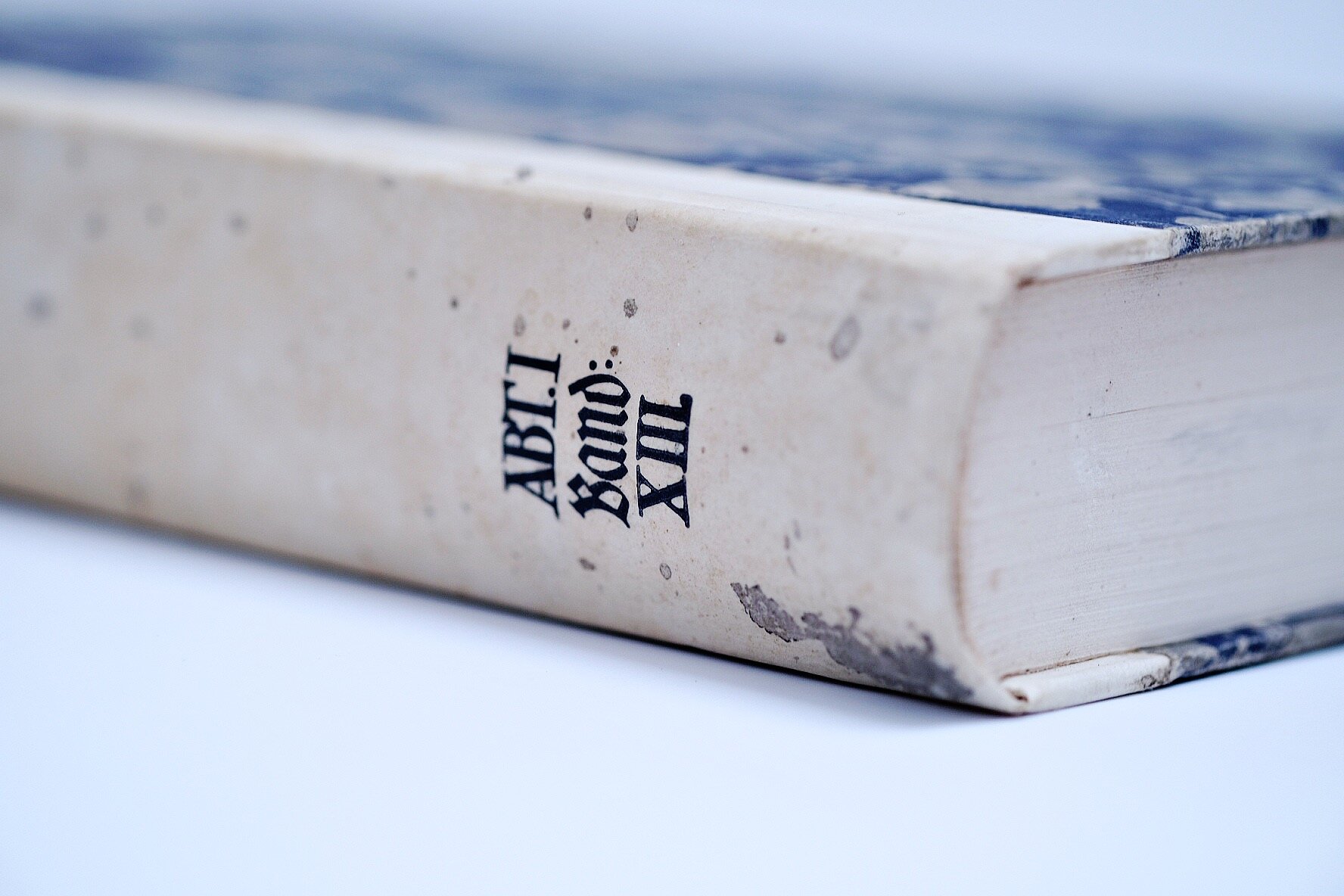
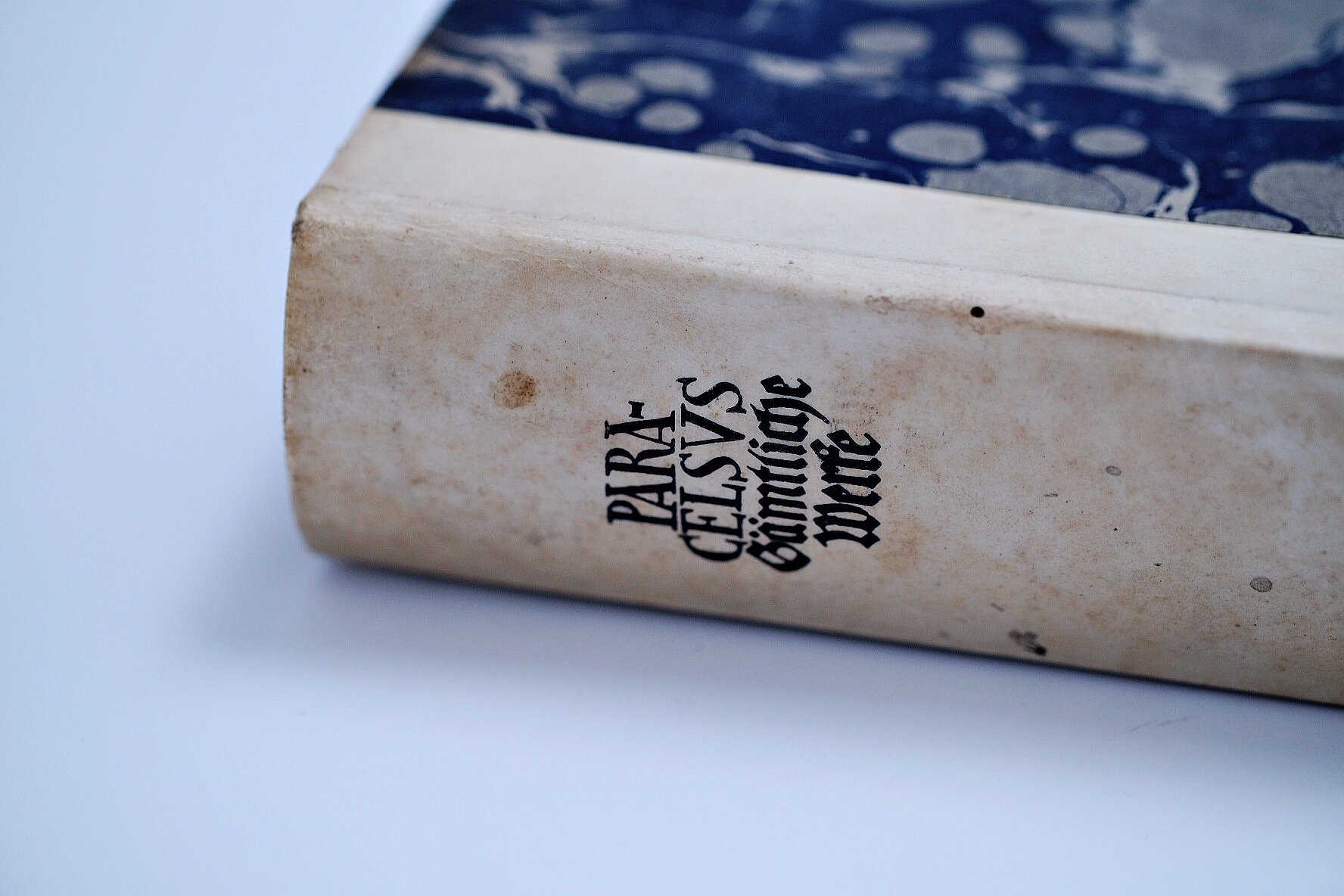
Paracelsus’s short treatise on the ‘Difference of Body and Spirit’ first appeared in print in 1572, thirty years after his death. Like several other shorter writings, it was included as an appendix to his Archidoxis magicain an early German print edition from Basel. The text forms the fourth of five short treatises, known plainly as Philosphiae tractus quinquae. The translation provided below is a modernised version taken from the critical edition of Paracelsus collected writings, where it appears on pages 350-351 in volume XIII (Sudhoff, Karl von (ed); Theophrast von Hohenheim gen. Paracelsus, Band 13, München und Berlin: R. Oldenbourg Verlag, 1931).
It takes Paracelsus less than two pages to establish a critical foundation for a Western type of shamanism almost entirely forgotten or overlooked today. In sparse words and with the precision of an adept in his field, he gives us the essential outline of the ecosystem of spirits within which the magus operates and orientates themselves. Making his subject plain simple, avoiding all abstractions but rather pulling on simple everyday comparisons, Paracelsus establishes the essential dichotomy of body and spirit.
What we are presented with is a clear hierarchy of power: The spirit is being presented as the superior function, teaching, training but equally seducing the material body. Their symbiosis is wonderfully summarised in the almost offhand statement: “The body remembers, the spirit accomplishes.”
As Paracelsus expounds in the following fifth treatise in further detail, the spirit fades into the background when the body is awake and vice versa. Like two sides of a coin, like night and day, body and spirit under natural circumstances are never witnessed standing side by side, but co-inhabit the realm of creation in their own tides. – As Paracelsus explains in a later text also bound into the Basel edition of the Archidox (Liber de Imaginibus), this straight-forward setting establishes the essential challenge for the work of the mage: To enable their consciousness to temporarily shift out of its natural attachment to the body and to travel with their spirit instead. Much of the work of the mage according to Paracelsus, one could say, consists of mastering the art of crossing over thresholds that normally - and for very valid reasons - uphold separations between functions, forces and organic fields.
Essentially for Paracelsus complex idea of man, we do not find a value judgement assigned to the three constitutive components of body, spirit, and soul. They each do what they are supposed to, in mutual dependency, and neither could replace the function of the other. Such is the ecosystem or hive-being that is the microcosm of man. It follows, and this is the relevant point to stress, that man as such is not any more genuinely expressed in their body, their soul, or their spirit. While there is a sharp distinction in functionality, and a clear hierarchy in power, there is no hierarchy of veracity in how these functions embody the identity of a human being. The latter only exists as a microcosm of all three of them coming together in one ecosystem. Man is not their body, man is not their soul, and neither their spirit. Man is what happens when all of these are bound into a single temporal shape. Man is the endless expedition this trinity travels on together on.
All the above is expressed in just 20 lines of text.
From this introduction, Paracelsus moves on and now opens the broad vista of spirits dwelling and residing outside of man, around them, above and below them. He lists celestial, infernal, human, and the spirits of the four elements, and yet he does so in giving each of them the same terminology: “spiritus” followed by the Latin term for the species of spirit. Thus, Paracelsus again portrays a level playing field and tries to absorb any biased perception of judgement or hierarchy. While he does call out the angels as “the best spirits”, he wants his reader to see all of these creatures inhabiting the world as one, in one and the same moment. The remaining sections of the text are then dedicated to expound on precisely this notion of uniqueness, diversity and mutual dependency of the spirits, forming one living ecosystem. Paracelsus compares the spirits to the world of workers and craftsmen: Their function is unique and portrays a skill, power, and beauty that none of their peers could fill if their work was absent. Like the tailor depends on the weaver, like the carpenter cannot cut stone and the mason doesn’t know how to work with wood, that is how each species of spirits depends on the other – including the human spirit.
When we speak of the ‘art’ in a magical context, I wish, we would begin to understand it in a more Paracelsian way: Not as a singular, but as a living compendium of ‘artes’, of crafts and skills and talents and gifts – each bestowed upon a different species of spirits. Perfecting the art that is magic, thus, for humans means not only mastering their own gifts and talent as a species of spirits. It also means to develop understanding and respect for the myriads of spirit ‘artists’ we all live surrounded by.
You would think, assuming our position in the ecosystem would be one of the most instinctual, natural things to for a magician. And yet, it seems to be one of the hardest things to accomplish these days? Maybe that is, I wonder, because we have become so obsessed (or confused?) with high and low magic, with learned and folk magic, with native cults and modern temple magic, that we no longer see the forest for the trees: We are all a weave, and nothing out of ourselves.
TRACTATUS IV. OF THE DIFFERENCE OF BODY AND SPIRIT.TRACTATUS IV. VON DEM UNTERSCHIED DER CORPORUM UND SPIRITUUM.
There are two contrarious to each other, the body, and the spirit. For the spirit instructs the body and deceives the body in many evils and sins, and yet the body must pay for such sins, and the body may not instruct nor deceive the spirit. So the body is visible and comprehensible, but the spirit is invisible and incomprehensible. So the body sins and does evil, but the spirit does not, neither does the soul, therefore the body must pay again and not the soul or the spirit. So the body eats and drinks, but the spirit believes. The body is destructive and perishable, the spirit eternal. The body dies, but the spirit remains alive. The body is overcome by the spirit, but the spirit is not overcome by the body. The body is dull and dark, but the spirit is clear and transparent. The body becomes sick, but the spirit remains healthy. To the body everything is dark, but to the spirit the darkness is light and transparent like a crystal, therefore it can see through all mountains to the lowest ground. The body remembers, the spirit accomplishes. The body is mumia, the spirit is balm. The body is of death, the spirit of life. The body is of the earth, the spirit of heaven and of God.
So it is to be known also further that the spirits are many, and they are each one differently than the other. For there are spiritus coelestes, spiritus infernales, spiritus humani, spiritus ignis, spiritus aëris, spiritus aquae, spiritus terrae, etc.. And the spiritus coelestes are the angels and the best spirits, the spiritus infernales are the devils, the spiritus humani are the dead human spirits, the spiritus ignis are the salamanders, the spiritus of the air are the sylvani, the spiritus aquatici are the nymphs, the spiritus terrae are called the sylphs, pygmies, Schrötlein1, Büzlein2, and mountain men.
And each one has their special office and their special profession from God. And everything what is imposed to man by God his creator, may it be good or evil, that he accomplishes and carries out in his dwelling or in his chaos. For no one can intervene with the other in their office or do the other's handiwork. In the same way as among us men there are different crafts and trades: One is a carpenter, another a stonemason, a third a weaver, a fourth a tailor, a fifth a cobbler, a sixth a locksmith, etc.. And the carpenter cannot hew the stone as he hews the wood, just as the stonemason cannot do the work of the carpenter. The weaver cannot weave a skirt or trousers, but he can make the cloth for them. The rest he leaves to the tailor, who makes skirts, coats, pants, and other clothes out of it. It is the same with the shoemaker, the locksmith, and all other craftsmen.
Likewise, you should know about the spirits: That no one alone can be a carpenter, a stonemason, a weaver, a tailor, a locksmith, a shoemaker, etc. and all of it together. For although everything is possible for the spirits and they can accomplish everything, just like men and even much better, one spirit cannot do everything alone. Instead, one spirit can do this, the other that, the third something different again – and thus the spirits carry their arts together, just like we humans.
Es sind zwei sich widerwärtig [feindselig gesinnt], der Leib und der Geist. Denn der Geist unterrichtet den Leib und verführt den Leib in vielem Übel und Sünden, und muss doch der Leib solche Sünden bezahlen, und der Leib mag den Geist nicht unterrichten noch verführen. Also ist der Leib sichtbar und begreiflich, der Geist aber unsichtbar und unbegreiflich. Also sündigt der Leib und tut übel, aber der Geist nicht, auch die Seele nicht, darum muss der Leib wieder bezahlen und nicht die Seele oder der Geist. Also isst und trink der Leib, dafuer glaubt der Geist. Der Leib ist zerstörerisch und vergänglich, der Geist ewig. Der Leib stirbt ab, der Geist aber bleibt am Leben. Der Leib wird vom Geist überwunden, der Geist aber nicht vom Leib. Der Leib ist trüb und finster, der Geist aber lauter und durchsichtig. Der Leib wird krank, der Geist bleibt gesund. Dem Leib ist alles finster, dem Geist aber die Finsternis licht und durchsichtig wie ein Kristall, darum können sich durch alle Berge hindurch sehen bis auf den untersten Boden. Der Leib gedenkt, der Geist vollbringt. Der Leib ist Mumia, der Geist ist Balsam. Der Leib ist des Todes, der Geist des Lebens. Der Leib ist von der Erde, der Spiritus vom Himmel und von Gott.
So ist auch weiter zu wissen, dass der Geister vielerlei sind, und sie je einer anders als der andere sind. Denn es gibt spiritus coelestes, spiritus infernales, spiritus humani, spiritus ignis, spiritus aëris, spiritus aquae, spiritus terrae, etc.. Und die spiritus coelestes sind die Engel und die besten Geister, die spiritus infernales sind die Teufel, die spiritus humani sind die abgestorbenen Menschen Geister, die spiritus ignis sind die Salamander, die spiritus der Luft sind die Sylvani, die spiritus aquatici sind die Nymphen, die spiritus terrae sind die Sylphen, Pygmäen, Schrötlein, Büzlein, Bergmännlein genannt. Und ein jeder hat von Gott sein besonderes Amt und seinen besonderen Beruf. Und alles was ihm von Gott seinem Schöpfer, dem Menschen zu tun auferlegt ist, es sei denn Gutes oder Böses, das vollbringt und verrichtet er in seiner Wohnung oder in seinem Chaos. Denn keiner kann den anderen in seinem Amt greifen oder des anderen Handwerk treiben. Zu gleicher Weise wie unter uns Menschen unterschiedliche Handwerke und Gewerke sind: Der eine ist ein Zimmermann, der andere ein Steinmetz, der dritte ein Weber, der vierte ein Schneider, der fünfte ein Schuster, der sechste ein Schlosser, etc.. Und der Zimmermann kann den Stein nicht hauen wie das Holz, ebenso wie der Steinmetz auch nicht die Arbeit des Zimmermanns vollbringen kann. So kann der Weber keinen Rock oder keine Hose weben, aber wohl das Tuch dafuer kann er machen. Das andere überlässt er dem Schneider, der macht daraus Rock, Mantel, Hosen, und andere Kleider. Genauso ist es mit dem Schuster, dem Schlosser, und allen anderen Handwerksleuten zu verstehen.
Desgleichen sollt ihr auch wissen von den Geistern, das auch nicht einer allein ein Zimmermann, ein Steinmetz, ein Weber, ein Schneider, ein Schlosser, ein Schuster, etc. und alles miteinander sein kann. Denn obgleich den Geistern alles möglich ist und sie alles vollbringen mögen, ebenso wie die Menschen und noch viel besser, so kann doch einer zumal nicht alles miteinander. Sondern jener kann das, der andere dieses, der dritte auch ein anderes, und auf diese Weise tragen die Geister ihre Künste zusammen, gleich wie wir Menschen.
see: “Schrötlein […] schrötlein or more often schröttlein, which not infrequently occurs as a variant of schrätlein, schrätzlein and denotes a kobold: incubus ... der alp, das nachtmänlein, der schrötle” (Deutsches Wörterbuch von Jacob und Wilhelm Grimm. Lfg. 10 (1897), Bd. IX (1899), Sp. 1794, Z. 23) ↩︎
Diminutive form of old German “Butz”, a master ruling of other unruly chthonic spirits in German folk-magic and specifically related to the wild days of carnival (see: Deutsches Wörterbuch von Jacob und Wilhelm Grimm. Lfg. 3 (1855), Bd. II (1860), Sp. 588, Z. 40) ↩︎
May 6, 2021
Why Study Western Magic – at IMBOLC?
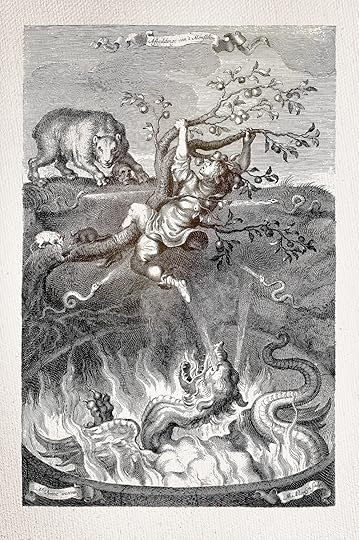
Man in Apple tree threatened to fall out, Michiel Mosjin, around 1640-1655
So, why study Western Magic – at IMBOLC? In this article I am sharing my personal answer to this question. Obviously, you will find your own. The reflections offered here are meant to be helpful in that process of yours: To decide whether the proper, fully committed study of the solitary practitioner’s path in Western Magic is for you, as well as more specifically, the distance learning course offered by the independent training institute that is IMBOLC.
Run since 1992 by Agrippa (the magical pen-name of its founder), I enrolled with IMBOLC in 2001 and continued my active studies until 2011. Trying to condense what I learned during these years into a few paragraphs is impossible. That’s why I will be focussing on a few essential points, that might help you in making your own decision.
Back in 2001, through a matter of synchronicity as they happen in life to all of us, I enrolled at IMBOLC almost at the same moment, when I also enrolled at my university. In the same year, I started my daylight studies on Anthropology, Communication Science and Intercultural Communications, and I also started my dawn and dusk studies on ritual magic with IMBOLC. During the first five years, rigorously, I got up at about 6am every morning and dedicated myself to the respective theoretical and practical magical studies for an hour or two. Then another training slot would follow on many evenings, and longer practice sessions on the weekends. This was just my personal choice of pace and investment, and it might be different from yours.
However, it helped me realise quickly that being successful at university was rather straight forward, compared to being successful at IMBOLC. Of course, I had to do a lot of the same chores one also does at an academic university for IMBOLC, such as reading, remembering, and reproducing specialised content during theoretical exams. Personally, I hold an arbitrary aversion to writing exams and taking tests. Yet, all in all, over the course of my ten years at IMBOLC, I wrote significantly more and much longer exams on Western Magic than I ever did for my academic studies.
So, given there are some parallels to an academic education, why then was studying at IMBOLC still so much harder than succeeding at a university? Well, it would be wonderful to discuss this over a bottle of wine in front of an open fireplace in an old pub. As that’s not going to happen unfortunately, let me condense my answer into three essential points: (1) Becoming adept at magic mattered immensely to me. (2) The work at IMBOLC continuously had me walking on the edge of my fears, i.e. what I thought I simply could not be doing. (3) And – in line with the idea of the solitary practitioner’s path – IMBOLC’s unique didactics enabled me to learn how to stand alone and all by myself.
Let me expand on all three of these aspects. I hope this offers some help and insights in making your own decision, if this or a similar path is for you.
LVX,
Frater Acher
How much does mastering magic matter to you? Knowing your personal, your real answer to this is essential when you consider enrolling in IMBOLC. See, like many others, I did my university studies because I had to do something. However, in contrast to my questionable motivation for academia, I threw myself into the work at IMBOLC like I was going to war. A war, this would be, against my own stupidity. My blindness, my inability and not knowing.
Especially during the first five years I was in daily combat training against myself. Now it’s important to differentiate here – and you will learn to do this as well, should you choose to follow this path: I was not at all in combat against my genuine self. I was fighting the many layers of lies that I had become, which all were hiding my real Self. I was battling the rock I was hidden within. I fought against the boy that I was still trapped inside.
I shouldn’t be writing this, as it will sound desperately entitled, but this is what it was: Even at that early age, I knew magic should be familiar territory to me. I intuitively knew that I had done these things before; and yet my incarnated brain did not remember a single thing. Here I was, literally, back in school again, needing to learn the simplest of things. I was rowing out onto the ocean of my own shortcomings, led only by the naive hope, beyond that horizon I would bump into an island of distant memories, of echoes of skills I once possessed. – That island, many years later, I actually found it. Today I call this island my Holy Daïmon and wrote a book about how we recovered each other.
So the lesson is, if carving out your own magical path, if winning back your own magical identity does not matter to you, safe your money, safe your time, and all the hassle.
Gustav Meyrink, in his novel ‘The Green Face’ (Das Grüne Gesicht) gave a fierce account of just how much this goal needs to matter to us, so that we have reason to hope that someday we will become magic.
“If you seriously want your destiny to gallop, you must - I warn you against it and at the same time advise you to do it, because it is the only thing man should do and at the same time the gravest sacrifice he can make! - you must call upon your innermost core, the core of your being without which you would be a corpse (and even not that), and command it - that He leads you the shortest way to the great goal, - the only one worth striving for, however little you realize it now, - mercilessly, without rest, through sickness, suffering, death and sleep, through honours, wealth and joy, always through and through like a speeding horse pulling a chariot forward over fields and stones and past flowers and blossoming groves! This is what I call: Calling God. It must be like a vow before a listening ear!"
Well, dial that down a little. But what I am reaffirming is this: For this path to work out for you, becoming a magician needs to be one of the few essential life goals you hold for yourself. Maybe next to being a good father or mother, and leading a happy life in general. Whatever your choice will be, becoming magic needs to feature in the top three, so that this journey can be fuelled with sufficient will and perseverance on your end.
2. Accepting Fear As A Companion
In retrospect this is the point I benefited most of – initially unintentionally, especially outside my magical practice. A lot of the suffering many of us inflict upon ourselves is caused by our attempt to bypass our fears. Most people’s life-maps are full of wiggles and mazes that make no sense at all and lead nowhere – except for away or around what they are afraid of. Humans are great at wasting entire incarnations meandering around their fears. This becomes really tragic, once we realise that most of our fears are nothing but shadows we cast ourselves. They hold no substance, no spark, no ontology by themselves. This is what I learned to break through at IMBOLC.
In my essay On the Path of the Ritual Lone Practitioner I have provided several examples of such breaking-through; so we don’t need to repeat these here. Let’s rather get to the essence of it: The work at IMBOLC is hard because there is no success-formula to it. Every Teaching Letter comes with challenges of entirely different nature: Sitting in my asana for two hours straight without moving eyelids or shoulders was a challenge. Bringing up enough money to rent a remote cellar in the middle of the city, fitting it out into a ritual temple, and showing up at night to perform my first rituals was a challenge. Years later, taking that temple down again, and explaining to the owner why I had painted 270 square feet – plus ceiling and floor – in night-dark blue that was now impossible to get back to white, was a challenge. Walking out into the woods at midnight, marking my magical circle with flour, lighting my candles and speaking to the spirits was a challenge. Explaining to my wife, why I needed this time every day from 6am to 8am for my practice, as well as many weekends of solitary work in our cellar, was a challenge. – Many of these things now seem easy in retrospect, but I still recall how daunting and sometimes insurmountable they seemed when I faced them for the first time. The point is: IMBOLC will take you through many gates of first-times. And many of these will seem tightly locked when you first walk up to them. IMBOLC only reveals itself to be an open path, if you are willing and courageous enough to overcome yourself.
From these ten years of training there is now a pattern, deeply embedded in my muscle memory, that I had never experienced in the same way before: This pattern equals a concoction, mixed from the same amounts of excitement, fear, and intimidation. We all know the beginning of this pattern: It’s the dream-like thought of ‘What if I really did this...’. Then years of imaginations easily follow, and the pattern dilutes. We imagine ourselves in the situation, how different and bold it would feel, how we’d come to manifest so many of the qualities we desire, and yet we flinch to embrace them in real life. Such daydreaming can carry us forward into entire epics of ‘What Ifs’. And yet nothing ever happens in real life.
IMBOLC helped me to actually do these things. To go on adventures that I thought would only happen in books. Until I did them. And Agrippa (the pseudonym of IMBOLC’s founder) was always there to ensure I didn’t go about these adventures in a reckless or juvenile way, but with determination, preparation, and care. He was also always there to kick my ass, when I was about to bow out in the last minute.
The irony is, these adventures taught me a lot about my very real personal limits. As a human being, it’s our natural state to be surrounded by limitations. Many of these are imagined, and some of them are real. Walking out into adventures, which you thought only happened in books, helps to differentiate the two. You begin to learn about your real limits. And that respecting these has absolutely nothing to do with cowardice. On the other hand, whenever we are not talking about meaningful limitations that should be upheld for a good reason, fear is nothing but noise signal. It is a noise signal that is trying to disturb the actual message from coming through, from the message to materialise in your life. That message is the genuine, noble self you deserve to be.
3. Learning To Stand Alone“The role of the good citizen requires that he be predictable, because our hankering for security, for not taking risks, our fear to be authentic, our fear to stand on our own feet, especially on our own intelligence — this fear is just horrifying. So what do we do? We adjust.” Fritz Perls, Gestalt Therapy Verbatim, p.49
At some point on this journey one thing will become incredibly clear to you: Agrippa is not teaching you, you are teaching yourself. Agrippa is not there when you are walking out into the woods all by yourself. He will be equipping you with all the skills to do this safely, and then he will be kicking your butt so you gather the courage to do it all by yourself. At the end of the day, though, it is you alone who is slowly growing into a magician.
Again, Gustav Meyrink expressed this notion sharply and slightly polemically in another section of his initiatory novel ‘The Green Face’.
“I understand very well that what you have heard before must only confuse you. Nevertheless, you can derive great benefit from it, if you take it as the first teaching and seek spiritual instruction not from others, but within yourself. Only the teachings that our own spirit sends us come at the right time, and for them we are ready. For the revelations in others you must become deaf and blind. The path to eternal life is as narrow as the sharpness of a knife; you cannot help others when you see them staggering, nor can you expect help from them. If you look at others, you lose your balance and fall. Here there is no stepping forward together, as it is in the world; and as absolutely necessary as a guide is: He must come to you from the realm of the spirit. Only in earthly things can a person serve you as a guide, and their way of acting should be your guideline to judge them.”
What IMBOLC offers is a scaffolding to the tower of power you will build all by yourself. IMBOLC offers a map, boots, equipment, and years full of training to acquire and master essential techniques. But laying down each stone after stone, that you will do all by yourself. Intentionally so, you will never know how others laid their stones, how they designed their own tower of power. You will have heard them talk about it, you will have read about it in books. But during many years of training you will ever only see your own tower grow out of the ground, as you continue to lay stones upon its walls.
I have spoken about this aspect in the above-mentioned essay. What I did not mention there, is that this is one of the greatest tricks to lead an independent, mature and most importantly happy life. Orientating yourself against others, is the worst thing you can do in magic; and often the same is true for life in general: Your ambitions, your art, your skills and dreams could be so much more unique, colourful, creative and strictly speaking, your own if you stopped looking at what others do. Whether these others are dead or alive does not at all matter.
Once you have mastered the essential techniques, how e.g. Aleister Crowley performed certain rituals is not only irrelevant, it is at risk of fading out your own voice. Now, let me be explicit on this notion, as it is easily misunderstood: Real magic is not at all a course in navel-gazing and psychological self-realisation. However, real magic will cause incredibly painful and taxing side effects unless your genuine self shows up to do the actual work. Being present as an authentic, independent, mature human being is not at all the purpose of adept level magic. It is one of its many prerequisites.
ConclusionsIn this short text, as you might have realised with disappointment, I did not speak much about traditional ritual magic. I did not mention swords, daggers, wands, chalices, incense, smoke, circles, etc. All of these magical paraphernalia feature heavily in the work that you would be doing at IMBOLC. But I’ll leave it to you to explore these, and to turn them into your own real life experiences. What I wanted to point out here is something different: By walking this path in earnest, with sincerity and commitment, the magic you will create, will create yourself in return.
Whatever we read about magic, must be tested against the evidence of our hands and hearts. And yet, as humans we are fragile objects, wrapped in skin that bleeds and hearts that crack. Learning how to manage this balance, of putting magic into practice, and yet enabling our selves to grow and not degenerate as part of this work, is the long road into a magical and happy life.
Not many of our ancestors achieved to walk it: Take a look at most magician’s biographies and you stand in the bright light of awe-inspiring magical explorers and yet deeply broken everyday biographies. Taking the time to build thorough foundations, taming your desire to exhaust yourself on the first 300 yards, but finding the calm rhythm of walking an entire life into the magical realm, is what makes all the difference. Few of us are capable of creating such journeys by themselves. They are the lucky ones. For all the rest of us, places like IMBOLC exist.
Saint Margaret of Antioch, Philippe Thomassin, 1589
April 30, 2021
Double Book Launch - Clavis Goêtica & Rosicrucian Magic
 Introduction
So let’s get this out: Spirits do not do goêtic sorcery, and neither do they do Rosicrucian Magic. I was hoping this was clear, but fear it might be necessary to point this out again. In the very same vein, nature does not do mathematics, nor even physics. And yet, we find perfect equations and powerful formulas woven into each grain of sand or cosmic wave arriving at our telescopes.
The truth is, humans are awe-inspiring dragomen: We decipher, we translate and we appropriate. Unfortunately, we also tend to forget that everything that remains with us, after such complex processes of investigation and research, is no longer the actual subject we aimed to investigate, but our very own way of making sense of it.
This is no different in Western Magic: This craft is an art and science invented by humans, with the intention to expand human agency, to partake and to co-create in realms that otherwise do not invite us in. Magic in all its forms is a cultural artefact. That fact makes no statement about its inherent power, functionality, or beauty; it only helps to distinguish that the beings we aim to create proximity with (i.e. spirits in all their forms), they do not use the same tools of engagement from their end. Humans, as I said, are an awe-inspiring dragomen.
This week I have the very rare opportunity to share two new books with you. They grew and materialised in completely separate ways through my practical work and historic research over the last decade. They also found entirely different pathways into publishing with two excellent partners, Hadean Press and TaDehent Books. And yet, they chose to come alive and be available for purchase on the same day, without anybody actively pursuing this. It simply happened, like magic likes to do.
Let me tell you a bit about both books. Just enough so you know what to expect, and whether they are for you.
View fullsize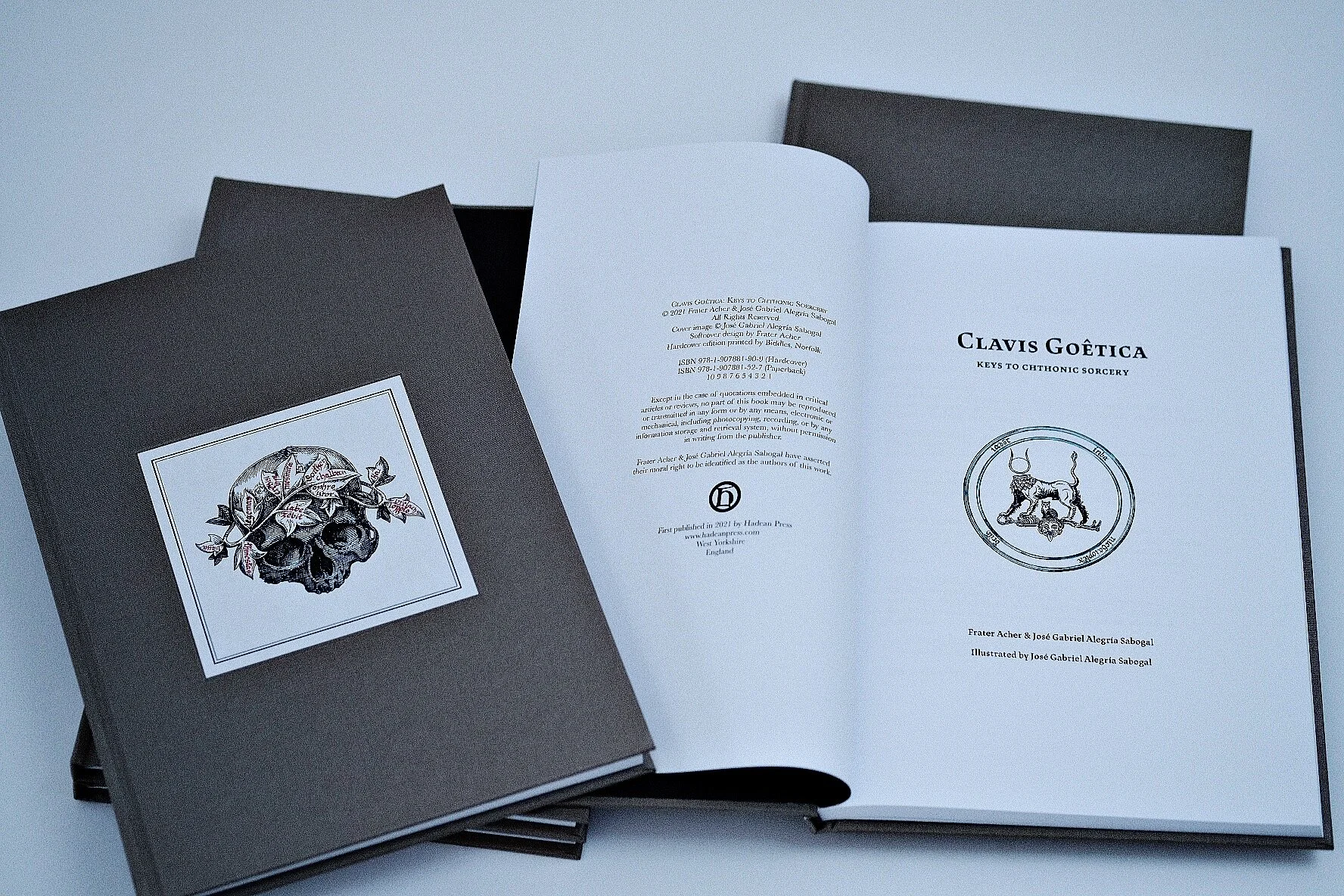
View fullsize
View fullsize
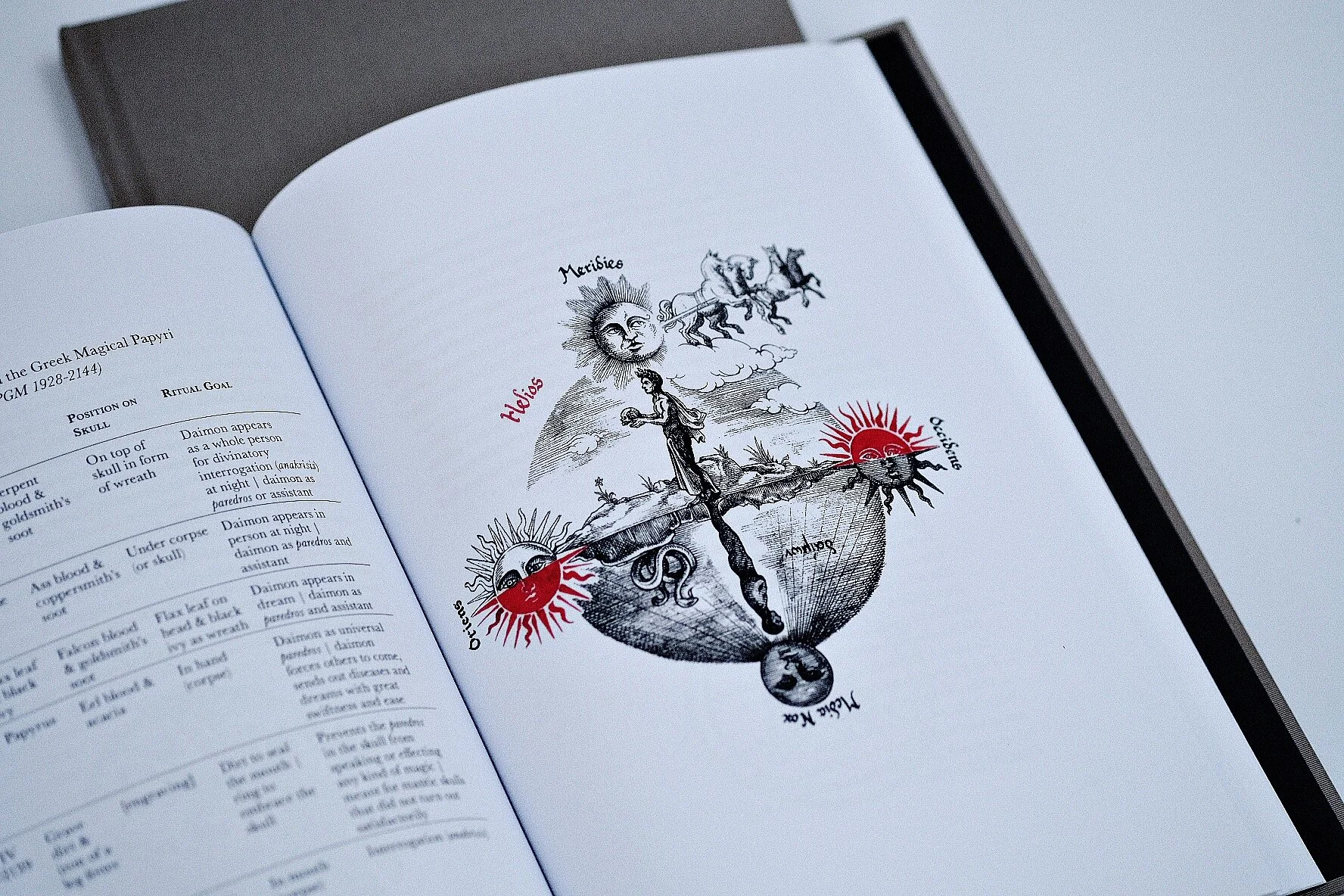
View fullsize
Clavis Goêtica
Clavis Goêtica obviously represents the darker, chthonic underworld aspect of this dual book launch. However, just like Rosicrucian Magic, it is a book written by a practitioner for practitioners. Its purpose is to continue the important work Jake Stratton-Kent started with his Encyclopedia Goetia: To liberate goêtic practice from the artificial confines of Medieval grimoire culture, to break away from the orthodoxy of Solomonic Magic, and to open instead new pathways into this ancient craft. I wrote the book in the form of several essays, intentionally diverse in color and context, some of them deeply personal, others entirely focussed on historical analysis and accuracy.
The purpose of Clavis Goêtica is precisely not to offer you ‘a key’ to magical operations with the spirits of the chthonic realm, but to enable you to find your own keys really anywhere. As pointed out above: Spirits do not do goêtia, humans do. Therefore, what should determine efficacy and entry points of our craft is not at all any kind of human sense of lineage, tradition or ‘correct practice’ (orthopraxy). What should guide our magical call and touch instead, is the echo we are receiving back from the realm of the spirits.
As a magical practitioner, who works with an open hand, we have no reason to distrust the spirits we will encounter on our journey, just like we have no reason to trust them either.
Neither false intimacy nor rigid control can offer any safety on this path. Wishful thinking, one way or the other, has no place in our art and science. What we are focussed on instead is to work as unbiased as possible, upheld by our independent sense of critical thinking and accountability, driven not by what we want to be real, but by what we consider to be possible.
In this spirit, Clavis Goêtica introduces us to authentic magical workings of the underworld. That is, magic with bones and skulls, from caves and riverbanks, under the moon, with stained hands. We will explore an array of magical operations, that all draw us into the world, that invite us to partake. Each one of these magical workings are meant to reaffirm our position as a living, breathing, fleeting component of a vast spiritual ecosystem, that we jointly uphold together with myriads of spirits.
Clavis Goêtica was released in three versions: hardcover, softcover (£ 20) and epub (£ 15). The softcover and epub versions are available directly via Hadean Press or at most internet book retailers. The hardcover edition has now sold out; it was released April 27th 2021 in a limited edition of 300 books.
buy from Hadean Press View fullsize
View fullsize
View fullsize
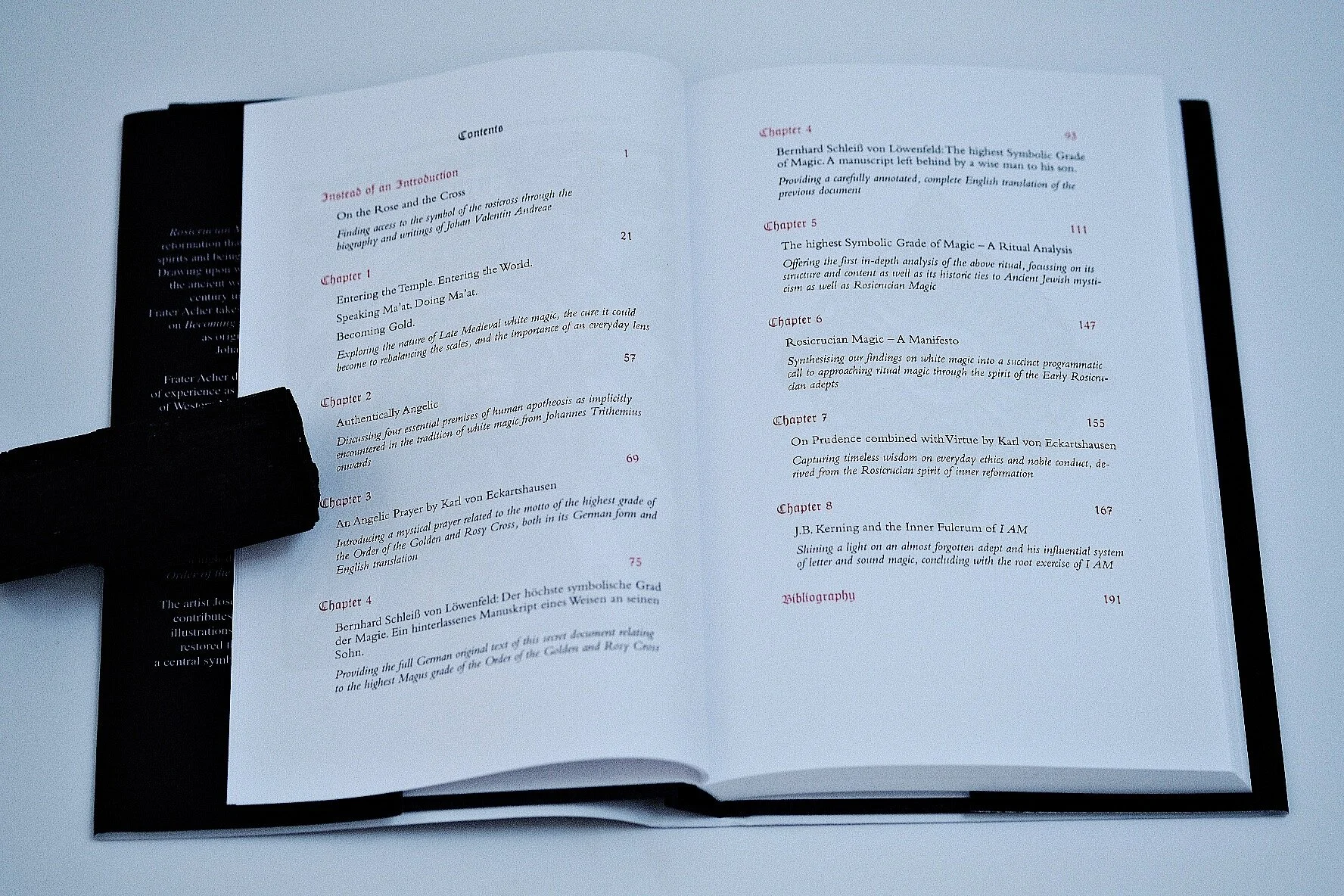
View fullsize
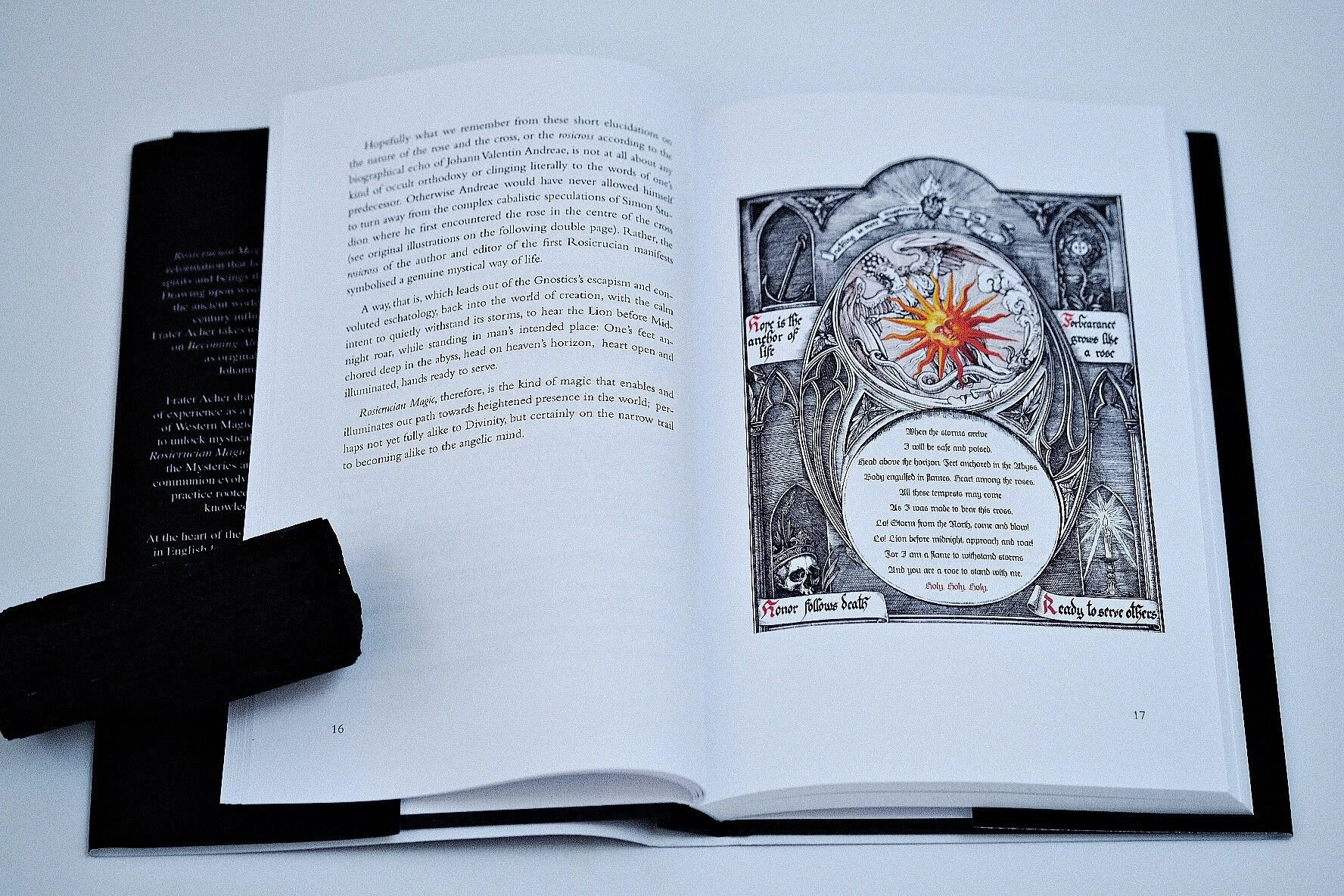
Rosicrucian Magic
Rosicrucian Magic, on the other hand, is not primarily focussed on drawing in the spirits from the surrounding spheres. Instead, it offers a collection of essays which all explore what it means to be human.
Now, answering that question as a shamanic-magical practitioner is impossible without speaking about the beings we co-exist with, the patterns we share, the realms we co-habit. Thus, to understand what is quintessentially human we have to familiarize ourselves in particular with the angelic realm.
This by no means is an arbitrary choice or an expression of personal judgement: I love my work with chthonic spirits, speaking to the beings in my skulls, sitting in a cave, travelling the underworld, learning about the ancient past and sensing the echo of archaic beings. Yet, what I experience in such magic as a human being is otherness, not humanness. Reversely, I can choose to travel towards the inside, not the outside: These are the moments when I commune with my Holy Daïmon, when the world is turning silent, when my consciousness is falling away, blending effortlessly into hers/his, like a stone sinking into a river. These are the moments when I – just like many others before – get a glimpse of the vast responsibility we hold as humans.
The purpose of Rosicrucian Magic is not at all to be a comprehensive primer. Rather than a broad sweep, the book aims to be a short sharp pinch: A reminder for some, a new insight for others, that the most powerful tool any mage will ever is hold the integrity of their intent and actions.
Knowingly or not, we all choose whether the crown we wear will be made from crystal, thorns or ashes. What determines our life’s path, our magical journey, more than most other factors is the simple decision how we like to hold ourselves against the world. How we show up, when the storm comes and the lion roars at midnight. – If I can contribute to anything at all with this humble book, I hope to inspire you to think in greater terms of yourself, and to willingly live up to that responsibility. Like only humans can.
Of course, in any context the term Rosicrucian deserves particular explanation. And so, that is what we are offering in the first chapter of this book. You can find an overview on the other chapters on the image above.
Rosicrucian Magic is now available on all Amazon platforms, and soon at other internet book retailers. It’s retail price is $41.90 (or £33.99 / €37.99). As usual with print-on-demand hardcover titles, the initial shortage of availability as well as fluctuation of sale price is out of the publisher’s control. A kindle eBook version is currently being prepared.
amazon US amazon uk amazon de AcknowledgementsFinally, I want to point out a few things: Both books contain sections you might have read online, here on theomagica.com, but which have never appeared in print before. Both books, of course, also feature ample new research and pragmatic exercises derived from my own practice.
Furthermore, both books contain new and absolutely stunning occult images of no other than José Gabriel Alegría Sabogal. I feel deeply grateful for having the opportunity to see some of the work I initially saw in vision or old manuscripts, through his inspired art. What an astonishing sight it is! I am also simply happy to share it with you.
Lastly, let me point out that any money made from both books – which is anything but a fortune – remains with the publishers, Hadean Press and TaDehent Books. I am hopeful to be able to contribute to their excellent work and that these funds enable them to undertake more exciting projects in the future.
April 8, 2021
How to build & maintain a Magical Library
Having just completed the spring-cleaning of my magical library, I thought I’d share a few lessons I have learned over the last twenty odd years of collecting occult books. Maybe these simple lessons will be of value to you, fellow bibliophile. For we might be in this challenge together: To have the great opportunity and yet the acute limitation of building and maintaining a standard-size magical library.
Well, and here we already get to the first lesson: The question of what defines a standard-sized library, is not at all answered by e.g. running meters of shelves or pure number of books. Actually, the answer is much simpler than that: A standard-size magical library is the kind of library that doesn’t cause divorces. That’s it. In my case, and possibly in yours as well, such a library then either consists of one large wall or a small to mid-sized room full of bookshelves. No more than that! As I painfully needed to learn over the years, a standard-sized library does not mean erecting little satellite libraries in other rooms when running out of space. The kind of library we are talking about doesn’t function in a hub-and-spoke model; it only does hub. – It also does not mean boxing up books in the cellar or in a garage. It means we accept the challenge to continuously curate a selection of expertly chosen books within the given confines of our standard-sized library.
Initially, of course, many of us will accept such limitations only in order to safe our relationship, or bank account for that matter. Over many decades, however, we might come to the grudging conclusion that actually operating one’s library within defined confines is essential to ensuring it remains relevant and centred.
This leads us to another lesson, one which took me at least a full decade to accept: Libraries are like gardens. Just like plants, books need to be looked after and cared for. They thrive on being seen. Our eyes, roaming over their backs on the shelves, offers them nutrition. And yet, only when we hold them in our hands, consult them, read them, then we allow them to grow. Books grow upon seeding their ideas into our minds. They prosper from merging their words with the substance of our thinking. They turn flesh, when we choose to act upon them.
For just like plants, so also books host spirits. And it is these spirits that can get out of hand, when not looked after regularly. A wild garden is a wonderful thing! However, an essential difference between herbs and books is, that books don’t die when their natural habitat gets overly crowded. They simply pile up, and yet their spirits wither and fade. Thus, one of the main jobs of the bibliophile, just like in gardening, is to weed out books. Regularly, professionally, and uncompromisingly.
Now, here is the third lesson I have to offer, and it’s a good reason to enjoy having a standard-size library, or maybe even a small one.
When it comes to weeding out books, I allow my choices to be guided by two simple axis: The first axis runs from good books all the way to bad books, with many stages in-between. As you can see below, this axis is established by relatively (!) objective criteria. Normally, of course, I’d think there are no bad books in my library, because I gave them away right after discovering their plagiarised, dull hearts. But life isn’t as simple as that: Once you have collected books for a decade or more, you begin to realise that bad books crept in and stayed with you, simply because you didn’t know it better at the time. Your knowledge of the subject was too limited to spot their lack of authenticity, genuine perspective and insights, etc. You might have still learned excellent things from a second-hand source; but nothing compares with drinking the fresh waters of the original spring.
Personally for me, many books I once owned on the topic of practical ritual magic I found out to be bad books, only after they had spent fifteen years or more on my bookshelves. I guess, curating a library is a constant source of humbleness and learning.
Now, the second axis is quite different, in that it is unapologetically subjective: It defines whether a book holds relevance to your personal journey. That means, by reading it, by inhaling its spirit, do you discover practical value of its essence for your own everyday as well as magical life? Does it hold the potential to change your thinking, as well as your actions? When you open it, can you feel the brimming of its pages wanting to turn flesh through you?
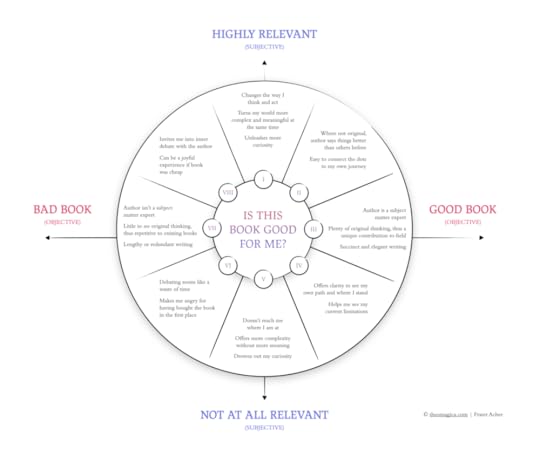
If we overlay the two axis upon each other, we arrive at the simple circle diagram with eight categories, as shown above. This little circle has been a great decision-making companion to me to identify books to give away on a regular basis. Not only because space in my standard-sized library is so limited, but also because I want to be so conscious with which spirits I surround myself, I decided to give away all books that fall into categories V. to VIII.. Especially books in category VIII. can be incredibly hard to part from, as they make me feel so smart! Isn’t it great to win an inner debate with a dead author each time you open their books? I know… – But it’s still not good enough a reason to keep their books in a standard-sized library.
The final lesson I learned from collecting books is one that is especially relevant during our present time of a dangerous pandemic, one that comes with significant amounts of social and geographical isolation.
It is quite simple, and yet it will only work if your library is indeed very well curated. Here is how it works for me: When I stand in front of my bookshelves and look at the familiar and foreign spirits that survived my weeding and trimming – each time I stand there – I get a delightful sense of imminent danger!
Right now, in this very moment I look at books that are silently, patiently waiting for me: Jean Gebser’s collected works, the twelve volumes of the Pritzker Edition of the Zohar, the Legend of the Nā-Ro-Pa, Artaud and the Gnostic Drama, many other, highly relevant unread volumes, waiting for me to travel with them. Immediately I am slightly overwhelmed by the sense of horizon, of broad vistas, of unknown countries, and of adventures lying in wait.
Being in the presence of a magical library – and this is only true for when they are well curated, when above everything they hold books that threaten our sense of safety, comfort and knowing – is one of the most daring, humbling and yet joyful experiences a bibliophile will ever encounter. Other people in this pandemic seem to waste away in their four walls, and yet an occult bibliophile in the presence of a well curated library doesn’t even see walls: They see spirits, inviting them to drink from their poison, to disappear within their stories, and to return as a different version of themselves.
Here is to only keeping the books that dangerous enough to overthrow what we think we know.
Frater Acher's Blog
- Frater Acher's profile
- 69 followers

