
Frater Acher's Blog, page 4
February 21, 2020
Of Wolfs, Ghouls and The Book of the New Sun
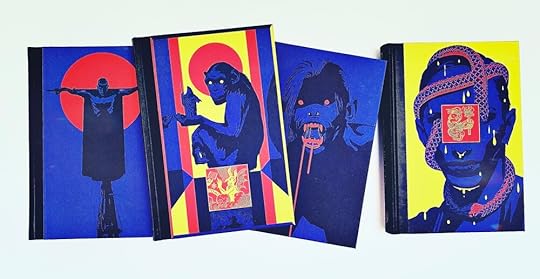
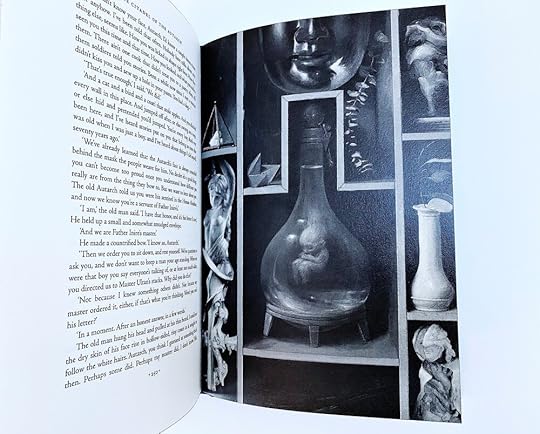
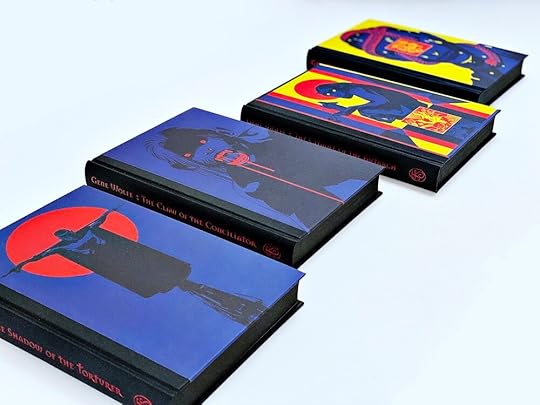
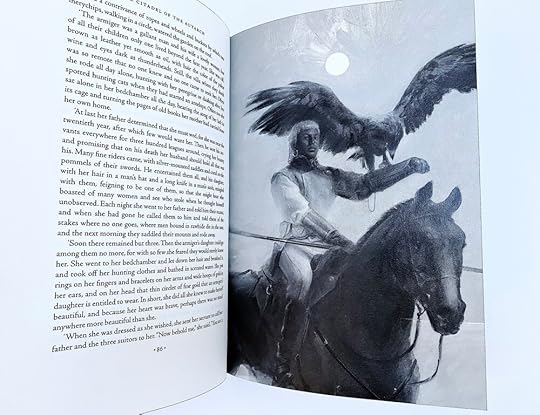
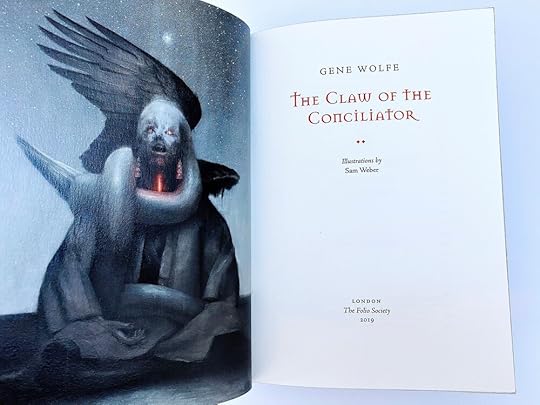
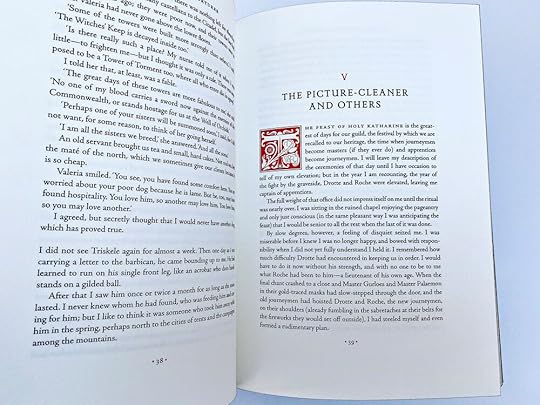
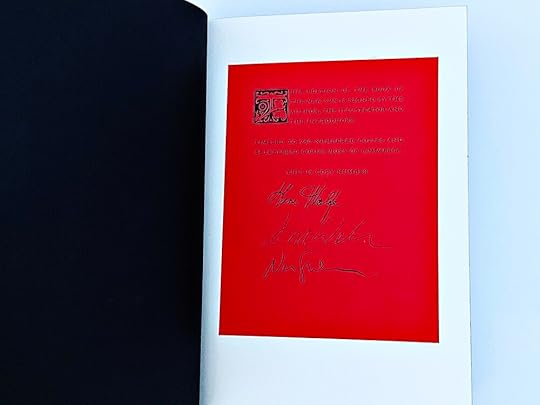
I have been waiting to share this with you for many moons. For I have travelled in a strange and foreign land - forcing myself not to speak of it, until I had fully traversed it. But is that even possible? Now I cannot hold back any longer, having almost arrived at the end of Gene Wolfe’s The Book of the New Sun saga. Thank you to my good friend A.A., with whom I read these books in parallel and who never tired of discussing its beautiful, mesmerising labyrinth. Thank you also to everyone who has left their mark on the trail before, and the many good books that have been written about the magnum opus of one of the most underestimated science fantasy authors of our time. Finally, thank you in particular to the Folio Society and the amazing Sam Weber, whose art adorns this limited fine edition of Wolfe’s masterpiece (see his making-of video below | all other pictures taken from my personal set).
If you have never heard of this fantastic book before, I hope this short piece can lure you into it. If you have traversed it long before myself, I welcome you as a friend.
LVX,
Frater Acher
May the Serpent bite its tail.
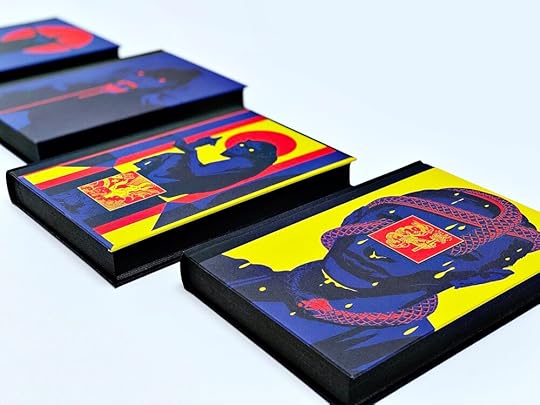
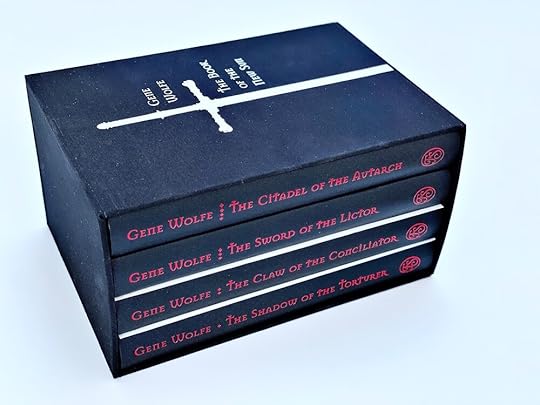
I. Not a Book Review.
With regards to uniqueness of vision, style, and execution, Gene Wolfe in his four volume fantasy-masterwork The Book of the New Sun (+ the fifth volume: The Sun of the New Urth) puts most modern fantasy authors to shame. In thirty years of reading experience, I have never come across such precision as well as density of groundbreaking ideas captured on paper, and woven into one magical canon. While on the surface accepting the literary genre rules of 1980s science fantasy, Wolfe's cycle can be considered the very definition of unconventional writing. More directly, Wolfe's book should be understood as a full frontal attack on any kind of traditional literary genre expectations. The author's imagination and inventiveness is so wild and exuberant, it seems hard to imagine the pain Wolfe would experienced himself when reading more traditional genre pieces? Despite the fact that his full cycle spans more than 1200 pages, we can see its author struggling to push the entire vista of this new world - with all its color, cruelty and compassion - through the limitation of the reader's average ability to follow into the unknown. Only in the final and fifth volume of the cycle, Wolfe seems to have loosened these reins slightly, and given in to the sheer animalistic force and power of his vivid visions...
So. What can one say about an epic of such proportions? Of course, we could write an epic book review through a practitioner’s lens - pulling carefully on the many threads of magic woven deeply into the five volumes of The Book of the New Sun. And yet such review would add very little to the actual magic of experiencing these books first hand. More likely, it would only take away from it. So instead of attempting to compress the mesmerising kaleidoscope that this epic journey presents into online fast-food, we will focus on one single aspect, a short but piercing gaze through a keyhole into its cosmos alone. For the exploration of the many horizons beyond that door, we all need to turn the handle ourself, and step over the threshold of the first page. Now, if you still crave a more in depth review, I recommend this one here; or this general advise on how to best prepare for your personal expedition into the lands of the Urth.
II. Meet the Alzabo.The Book of the New Sun is set on a dying Earth (or Urth), set so far in the future that our Old Sun is dimming and growing cold. The light is less than in our time. The skies in the day are red, not blue. Be aware of things and people that were dead returning to life. That is, after all, where the book be- gins: after a drowning, at the gates of a graveyard. (...) The Book of the New Sun is a hymn to memory, a Borgesian labyrinth crafted into a whole world, a sequence of mirrors and reflections that allow us to travel the universe of a dying Earth that may live again. (Neil Gaiman, in the Introduction to the 2019 Folio Society Edition of Gene Wolfe’s The Book of the New Sun)
So here is our single, sharp look into the world of Severian the Torturer. We will examine nothing, but one of its most fascinating creatures and the particular magical elixir prepared from it. As we will see, the mythical Alzabo holds several significant lessons in store for us which directly apply to our journey as spirit-workers. But first, let's hear from Wolfe himself about this ancient predator:
Much later I was to hear the sound the alzabo makes as it ranges the snowswept tablelands of the high country; its laughter is horrible. (The Claw of the Conciliator)
"Do you know of the analeptic alzabo?” I said, “No, Chatelaine, but I have heard tales of the animal of that name. It is said it can speak, and that it comes by night to a house where a child has died, and cries to be let in.” Thea nodded. “That animal was brought from the stars long ago, as were many other things for the benefit of Urth. It is a beast having no more intelli- gence than a dog, and perhaps less. But it is a devourer of carrion and a clawer at graves, and when it has fed upon human flesh it knows, at least for a time, the speech and ways of human beings. The analeptic alzabo is pre- pared from a gland at the base of the animal’s skull. Do you understand me?” (The Claw of the Conciliator)
The beast that waited there stood upon four legs; even so, its hulking shoulders were as high as my head. Its own head was carried low, with the tips of its ears below the crest of fur that topped its back. In the firelight, its teeth gleamed white and its eyes glowed red. I have seen the eyes of many of these creatures that are supposed to have come from beyond the margin of the world—drawn, as certain philonoists allege, by the death of those whose genesis was here, even as tribes of enchors come slouching with their stone knives and fires into a countryside depopulated by war or dis- ease; but their eyes are the eyes of beasts only. The red orbs of the alzabo were something more, holding neither the intelligence of humankind nor the innocence of the brutes. So a fiend might look, I thought, when it had at last struggled up from the pit of some dark star; then I recalled the man- apes, who were indeed called fiends (...). (The Sword of the Lictor)
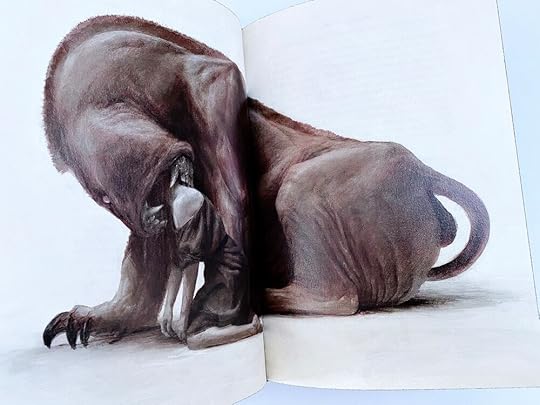
Sam Weber’s illustration of the ‘alzabo’ for the Folio Society limited edition of The Book of the New Sun
III. The Arabic Origins of the Alzabo
Now, let’s start at the beginning: Gene Wolfe derived the name of this mythical beast from the Arabic word for the wolf, which is aldhiyb (الــــــذئــــــب). Despite its obvious difference in notation, phonetically, that is when spoken out loud, aldhiyb will sound like alzabo to Western ears. However, the connection of the alzabo to an Arabian wolf goes beyond the pure outer resemblance.
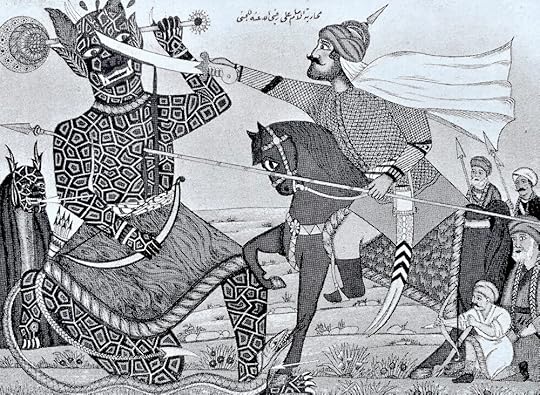
In ancient Islamic societies the animal realm was closely connected to the realm of the jinn. Julius Wellhausen in his widely published ‘Remains of Arabic Paganism’ (Reste Arabischen Heidentums, 1897) asserted that Islamic ‘zoology is at the same time demonology’; a notion that sounds rather familiar to the student of Ancient Egyptian magic. Thus in Islamic times, being depicted as furry reflected the animalistic side of many jinn (Wellhausen, p.151). However, especially the jinn- species of the necromantic, desert-dwelling, female ghouls was considered to be shape-shifting, and often appeared in various animal forms.
The gūl (gīlān and agwāl in plural forms) amongst the Arab is a female, es- pecially cruel and hostile demon, a variety of the marīde that also belong to the jinn, who by shifting their shapes lead humans, especially travellers, away from their path, and then suddenly attack, kill and devour them. (Hentschel, p.36)
The position of man concerning the ghouls was destitute, and thus the physical territories they were known to roam were avoided as much as possible. If one still had to traverse through lone stretches of desert, one needed protection. On needed an ally mighty enough to ward off the deceitful attacks of the ghouls. The only being fierce enough to do this trick, according to Arabic folklore, was the wolf. But how much did this leave the desert-traveler between a rock and a hard place? Thus the old saying:
‘A brother of the desert has to be friend with the wolf, and familiar with the ghoul.’ (Wellhausen, p.151)
The wolf was believed to be the only animal which the ghouls feared themselves. For it had the ability to track the desert demons, and when encountering them would attack, kill and devour them, just like these attempted to do with humans. This was particularly true for the ghoul variant of the si’lah, often described as the worst kind of ghouls, particularly fond of feeding off human flesh (Lebling, p.96). The Medieval Arabic medic, astronomer and geographer Zakariyā al-Qazwīnī (1203 - 1283) describes such a wolf’s hunt for the si’lah:
The wolf sometimes hunts her at night, and then eats her. As he tears into her she raises her voice saying, ‘Save me. The wolf is eating me.’ Sometimes she will say, ‘I have a thousand dinars and whoever rescues me will take it.’ People know that these are the words of the si’lah and nobody rescues her and the wolf eats her. (Leibling, p.97, quoted after Al-Damiri)
So here we encounter a most likely origin story of the fantastical alzabo: a hybrid being of wolf and ghoul. From the Medieval account above it was a small step for Gene Wolfe to consider what happened after the wolf had devoured the female jinn? Can you really kill a shape-shifting desert demon by devouring her - or would her consciousness not rather become embedded into the predator? More specifically, in al-Qazwīnī’s tale we already discover the very same ingredients Severian encounters when meeting the alzabo: a massive wolf-like creature calling for help with a human voice, thus attempting to attract more sapient bait. Only in Wolfe’s account the si’lah and the wolf have merged into one.
Yet, even for this we find a blueprint amongst old Berber folklore, as Michael Andre-Driussi points out in his Lexicon Urthus. For Pliny the Elder (24 - 79 CE) in his Natural History provides a narrative relating to the African hyena, that seamlessly weaves into the mythical being of the alzabo, part demon, part wolf:
IV. The Magical Virtue of the Analeptic AlzaboCHAP. 44. (30.)—THE HYÆNA. It is the vulgar notion, that the hyæna pos- sesses in itself both sexes, being a male during one year, and a female the next, and that it becomes pregnant without the co-operation of the male; Aristotle, however, denies this. The neck, with the mane, runs continuously into the back—Bone, so that the animal cannot bend this part without turning round the whole body. Many other wonderful things are also related of this animal; and strangest of all, that it imitates the human voice among the stalls of the shepherds; and while there, learns the name of some one of them, and then calls him away, and devours him. (...) It is the only animal that digs up graves, in order to obtain the bodies of the dead. The female is rarely caught: its eyes, it is said, are of a thousand various colours and changes of shade.
As we learn in the second volume of the cycle, The Claw of the Conciliator, Wolfe’s imagination has only warmed up with the physical encounter of the alzabo. The real magic of this beast we discover in a mysterious concoction that can be derived from ‘a gland at the base of its skull’. In the subsequent three (or rather four) novels now we are introduced to an idea that takes us deep into magical terrain. As we learn that the consciousness of any being devoured by an alzabo is stored in this very gland of the animal’s brain. Thus when an old alzabo is captured, its gland extracted and prepared as part of an elixir - anybody who drinks from this potion will become part of the hive-consciousness originally assembled by the alzabo. The bait eaten by the alzabo doesn’t die, yet its spirits are woven into one within the an- imal. It turns out therefore, as we delve deeper into the universe of the Urth, that it is this notion that resides at the heart of Wolfe’s entire epic: an analeptic concoction that does not only contain the memory of the people devoured by the alzabo, but the entire sapient spirit of these personalities. In essence, we encounter an alchemical procedure by which humans transcend not only their personal consciousness, but their entire notion of self into multiple selves. We literally turn into legion. The price we pay, however, is our own human self.
The hallmark of any great novel, we can say in paraphrasing Gustav Meyrink, is to play a trick on the reader’s mind: By leveraging settings, stories and characters that initially seem familiar, a novel should lure the imagination of the reader away from its habitual paths and out into the unknown. A good novel, according to such standards, acts like a ghoul on our consciousness: It initially presents itself in a familiar shape, only to lead us astray, and to then attack and devour our everyday imagination. And once devoured - we are no longer bound by our old selves, but we can see the world through the imagination of the author. We come together in the text, our consciousness becomes a hive-being.
So here is the connection of the fantastical alzabo with the not-quite-so-fantastical reality of actual ritual magic: When we work as adepts with certain spirits our relation to them very much resembles the act of drinking from the analeptic alzabo. If understanding this process in detail is of interest to you, I recommend reading Wolfe’s epic cover to cover - not as a science-fiction saga, but as a magical primer. Because here is the thing: Once we forge our path into magic deeply enough, we will experience quite similar effects as Severian the Torturer, who at some point stops being Severian the Torturer. And who is to say, who he truly is once he has drunken from the magical potion that contains so many souls? Similarly - who is to say who we are, once we have become familiar with celestial and chthonic spirits? Paracelsus knew a lot about these things. How the soul of the magical operator is changed, when striding out into the depths of magic. For deep magical contact is neither temporary, nor confined to the outside of the circle of the art. True communion, in this sense, means being united with a spirit inside the same alchemical flask, and being put over a scolding fire that burns for a lifetime.
If you are up for the ride, we will explore more of this subject in a future book - and take a closer look at the spiritual process we also hear echos of in the Jewish ibbur or the Arabic manhal. For now, if you haven’t had the pleasure yet, I recommend delving into the depths of Gene Wolfe’s most singular vision. For it might teach you more about the nature of magic than many books that have the word printed in bold on their cover.
V. Selected ResourcesAndre-Driussi, Michael; Lexicon Urthus: A Dictionary for the Urth Cycle, Sirius Fiction 2008
Andre-Driussi, Michael; Gene Wolfe's The Book of the New Sun: A Chapter Guide, Sirius Fiction 2019
El-Zein, Amira; Islam, Arabs, and the Intelligent World of the Jinn, Syra- cuse University Press 2009
Hentschel, Kornelius; Geister, Magier und Muslime, Eugen Diederichs Verlag 1997
Lebling, Robert; Legends of the Fire Spirits, I.B.Tauris 2010
Nünlist, Thomas; Dämonenglaube im Islam, De Gruyter 2015
Wellhausen, Julius; Reste Arabischen Heidentums, Georg Reimer Verlag,
1897
Wolfe, Gene; The Book of the New Sun, Vol.1-4, Folio Society 2019,
https://www.foliosociety.com/row/the-...
Wolfe, Gene; The Complete Book of the New Sun: The Shadow of the Torturer, The Claw of the Conciliator, The Sword of the Lictor, The Citadel of the Autarch, The Urth of the New Sun, Orb Books 2017


February 1, 2020
The Master-Key to a Secret Script
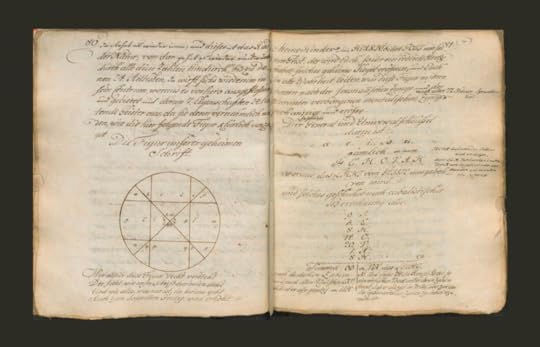
Alchemical and magical manuscripts are filled to the brim with obscure seals and secret scripts. The vast majority of these figures remain undeciphered today. Which is why the vast majority of modern magicians, following the highly pragmatic nature of their art, tend to simply accept these seals and sigils as orthodox practice. No further questions asked. For most of us, the collective memory for deciphering such diagrammed riddles only begins in very recent times - in the early 20th century, to be specific, when both the Golden Dawn and A.O.Spare began to reveal more overt techniques to either generate one’s own glyphs and seals, or to reconstruct the ‘correct’ versions of more ancient ones.
The tendency to be lax about such things was not at all shared by a manuscript we came across as part of the research on a ritual related to the Arbatel. Quite the opposite indeed: While confusing the reader with its secret script on previous pages, it provides the actual key to the alphabet at its end. Furthermore, it goes into specific detail on how to apply it as part of its Cabbalistic practice.
The manuscript we are referring to is part of the massive magical archive that one of the most important researchers and writers on Western Occultism left behind after his death, Karl Kiesewetter (1854-1894). While subsequent authors were wondering about the occult nature of Kiesewetter’s rare sources, these can now all be accessed online in their digitalised form. I am speaking of thousands manuscript pages from the late 18th century, waiting to be rediscovered, transcribed, translated and hopefully one day, published with careful annotations.
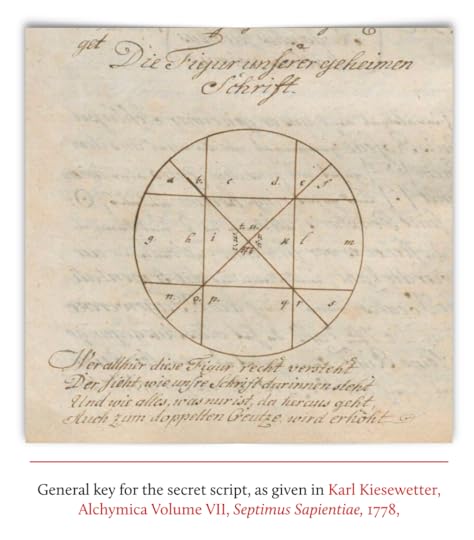
Here, in the seventh volume on Alchymica we find the magical script- and seal-generator, that very well might have inspired the Golden Dawn’s evolution of drawing seals from their version of the Rosy-Cross. The following images are taken from the manuscript. They show several of the double pages of the text, including the secret script, and then the circular masterkey at its end. The German text around the key says:
The figure of our secret script.
Who understands this figure right here,
He sees how our writing is placed inside,
And how all things that exist, are generated from it,
And [how they] will ascend to the double cross.
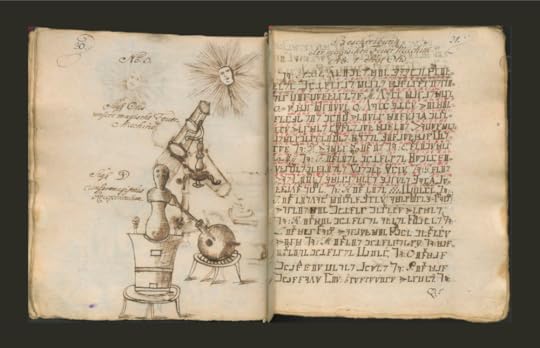
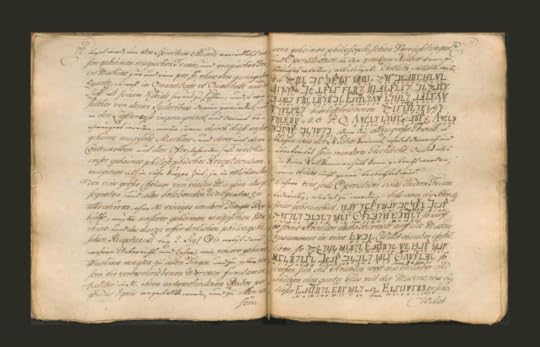
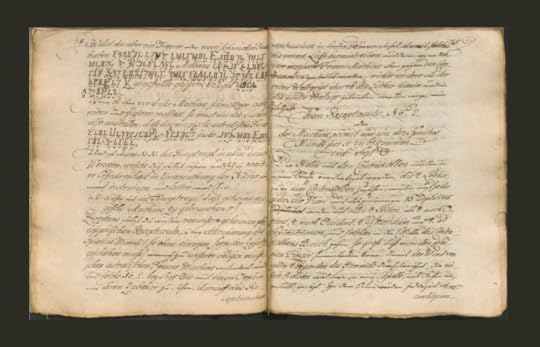
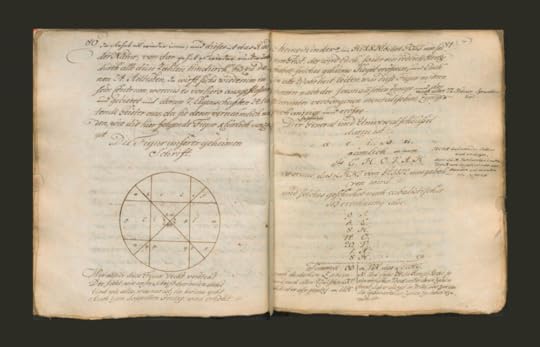
As you can see, an eager reader of the manuscript - possibly Kiesewetter himself? - had unlocked the code of generating the simple letters from the circular master-key, and carefully annotated the previous pages. Following their lead, we overlaid each letter onto the master-key to make the process more visible, how one is intended to ‘draw out’ the letters from it. The following images give you the master-key and then the full alphabet of letters extracted from it. Of course, as in any manuscript, personal handwriting came into play, which is why each letter on the previous pages might look slightly different. But if you go back to the above pages, you’ll get the hang of it quickly.
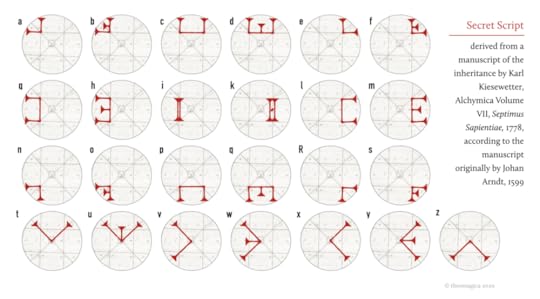
Of course, the entire manuscript deserves thorough research and investigation, and this short post does not intend to speak about the actual alchemical secrets guarded by the ciphered script. Of particular interest for future investigation, however, would be the mentioning of no other than the famous Johan Arndt (1555-1621) as the original author of this text. A truly fascinating lead into late the 16th century current of mago-mysticism.
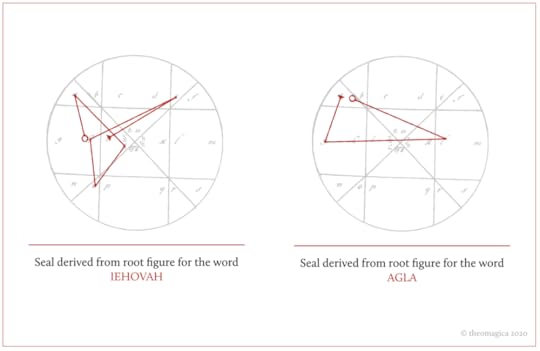
Yet, we want to share one more observation on the master-key. The actual instructions on its use are short and crisp. Not only is the script placed inside of it, but it is meant to generate anything that exists. We see the diagram praised as a truly universal key. Now, the extraction of the angular letter-shapes certainly is not a hard riddle. So one should wonder if such an obvious use alone, already let the author to praise this key so highly? The following pages of the document are concerned with numeric keys of Christian Cabbala; and subsequent manuscripts in the same volume begin to give specific and long instructions on the conjuration of several little know planetary princes. What if, therefore we might ask, the mater-key had a second use - beyond generating the simple cipher-letters. What if we used it to generate spirit seals instead?
Below we are giving two simple examples, of how to draw the seals of the Tetragrammaton and the divine Hebrew name AGLA from the master-key. Now, the final line of the instructions underneath the seal, could begin to make sense? For it the diagram was meant to generate spirit seals to be used in conjurations, it truly is turned into a source of all things that exist and it would allow the practitioner through proper use to ascend to the double cross.
My Children in the Lord, ask God for His spirit, who will open you this secret seal, for as long as you have a pure heart, and will lead you into all the truth, which this figure holds in itself, and which, when spoken through the sensing as well as the mentalistic tongue, will reveal and show itself to you.
— Alchymica, Vol VII, p.81
January 14, 2020
The Problem of Magical Presence

The following short text is an excerpt from an upcoming book. It forms the introduction to a chapter on conjuring celestial spirits with nothing but the sound of your voice and a magical bell. The deceptive simplicity of the operation can make us fail to realise the complexity that underpins it. Often the simplest of rituals take the highest of skills to accomplish. Much of the magic at an adept level resides in not getting lost in the maze.
So while I am knee deep in working through the details of the operation, I thought you might enjoy the introduction.
LVX, Frater Acher
And yet no roasted dove will ever fly into your jap.
— Henry Nollius (17th century Rosicrucian)
Here is a simple problem worthwhile pausing over: The classical planets divide the heaven into 7 orbits, the Zodiac into 12 realms, the lunar mansions into 28, the decans into 36. The Earthbelt realm goes all the way to 360. And every star, Behenian or not, is supposed to have an intelligence, a demon and a ruler at least. So just when you look up at the night sky - how many spirits to do you see? That vast dark canvas can easily get a little crowded. Or maybe it is just our human mind that gets lost in the maze of celestial complexity. So here is the problem worthwhile pausing over: If all of these spirits indeed exist - 443 to sum up just the above - then they have to exist all at the same time, at every single moment. They gaze and breath and experience with us. Now, and now, and now again. None of them wait for Jill or Joe to call them into being. They are all present, conscious, working and weaving, all the time. So when you prepare for a ritual that calls on a single planetary spirit or on a particular family of beings - can you begin to see the perfection and craft it takes to ensure your arrow hits its mark? Literally, you have a night sky full of beings listening - and yet somehow you need to work the magic of connecting the cloud of dust you are to that one stellar being you call for. What a long shot, one might say.
A wise woman once said to me, everything is always present. Whenever we enter into an experience, we actually make a choice. For every experience creates a division between foreground and ground; between the part that takes shape and the part that remains in the dark. In singing one note, we silence all others; in seeing one face, we become blind to all others. As humans, we walk on a weave and have mastered the art to only see the thread right in front of us - and often not even that. The consciousness of all the beings that create, destroy, maintain and evolve the cosmos, constantly surrounds us - and yet when we pour a coffee, when we cross the street or stare on a mobile phone, our consciousness connects with none of them. Over millennia humans have mastered the art of walking undis- turbed, of becoming focused on a single task, of absorbing the melody that creation is, and to listen to one instrument only, one note at a time. We have become surgeons of focus and effectiveness to complete a single task - and in the process we have become deaf to the orchestra of voices and experiences that awaits our attention. We have numbed out oceans of possibilities, in order to learn how to ride a single wave. Now, when we work magic at an adept level, we aim to return from riding the wave, to becoming part again of the vast space deep down underneath it. As adept magicians we aim to be back in the ocean, not on top of it. We aim to let go of our humanness, and bring to the foreground the part of us that always knew how to breathe under water, how to navigate through patterns and waves, and to sing with the whales. As adept magicians we do not aim to perfect our humanness. We are no longer in the business of leveraging magic as crisis support for everyday life problems. We aim to reconnect with the medium that is our spiritness.
Of course, nobody has said that would be easy. Experience and consciousness are directly correlated. The more complex our consciousness, the more complex the experiences we get to make. Magic of the adepts is amongst the most complex experiences humans can make. Intentionally tuning into and consciously co-creating the symphony that is an adept ritual is not only a form of art - it is an interdependent art-form that relies on the complex interplay of contacted consciousness, our inner and outer senses, and the entire living world around us. For most of us it takes decades of training to first experience it, and a lifetime to refine it.
Now in this work, one could argue, the thing that matters most is our ability to send a magical call. But what is a call in magic? What does it essentially consist of, whether it takes the form of a prayer or a pact? Essentially, a magical call is nothing but vibrations traveling on the weave. A traveling sound that awakes the attention of the beings in resonance with it. Thus, a single call can awake legions or just a single being. It depends on the key that was placed inside the call; and that key con- sists of three elements mainly: intention, intonation and integrity. We will explore these in detail further below. But for now, just hold on to this: The problem of magic - and adept magic in particular - is not that it might fail to work. The real problem is that magic will always work. That is, no call properly placed will ever go unnoticed. Whether it hits its intended mark or not - something will respond - some ears will be pricked. Finding that single weave between us and the spirit(s) of our work, and then placing our call onto its string - that is at the heart of the magical art.
(...)
December 24, 2019
Thoughts on Magical Identity | Part 2

Here is the second part of our short exploration into Magic and Identity. If you have missed the first part, you can still read it here. Also, be warned: I attempt to keep this blog focussed entirely on the Western Magic Tradition. The first post was an inroad to the problem, which identities present to advanced forms of magic, which lived up to that notion. For we spoke about a rather magical dream. In this post, unfortunately, I won’t be able to spare us from a little bit of social theory. I know, it sucks. Or maybe does it? Either way, just stay with me - for we will close with a practical magical vision into the belly of the mountain.
LVX, Frater Acher
May the serpent bite its tail.
In our 2020 Instagram world, many people live or die by the strongly curated identity they project to the outside. The amount of effort that goes into curating such personas is disproportional, to say the least, to the very limited time people have left encountering actual experiences of growth. That is: to be fully immersed in the rather adverse space of becoming, where it is not quite clear yet as who or how we will emerge from it. The latter means letting go of who we thought we were, in order to experience something new. The former means marketing our Self as if it was a brand, which by definition has to be clear-cut and geared towards explicit consumer expectations. And this is only one side of of the problem.
From a sociological perspective identities are tools to fulfil three main purposes: They are designed to create simplification, standards and safety for all community members. Therefore they have to work both on an individual and a collective level, as well as for outsiders and insiders to this identity. Here is a brief overview on this critical aspect on how we choose to relate to the world. For an easy to read deeper dive I recommend the wonderful book 'The Lies That Bind' by Kwame Anthony Appiah.
(1) Identities separate chaos into labels. They provide social demarcation lines; they provide orientation and thus reduce ambiguity and complexity. Example: By choosing to identify as e.g. a Pagan Neoplatonist we unlock the doors to a world of clear orientation: All the ideas and answers any Neoplatonist ever found, we can now claim as ours. We immediately become part of the 'tribe' of Neoplatonists and have ideas on how to relate to other 'tribes', e.g. Christians. We also stop attempting to find our own answers to a huge amount of essential questions. By giving ourselves up to an identity, we move from a blank map to one that is neatly pre-populated on our behalf. We make a choice of comfort over complexity.
(2) Identities create normative significance, i.e. ideas on how a member of an identity group should behave given their identity, a set of intrinsic expectations. Thus identities provide subjective meaning as they tell members how to fit into the social world as part of a group, and which specific behavours or norms are 'theirs'. Example: As a member of an order and holder of a specific degree you are meant to use specific signs and watchwords when encountering other members of the order. A huge amount of socially relevant information can thus be processed with minimal effort. At the same time YOU disappear entirely behind so- cially constructed categories.
(3) Identities provide orientation to others on how to treat members of this identity, i.e. how to behave towards them. Example: By knowing that you identify with the Golden Dawn, Thelema or Ifa I might stop asking a hundred questions about YOU as a person, because my mind tells me I can replace YOU with information stored about the respective social cat- egory (the technical term is 'essentialism'). This is hugely efficient if my goal is to live in a simple world. And it is comlpetly unreliable if my goal is to better know YOU.
So why this long excursion into the academic field of identity research? Well. Because nothing stops you short from growing beyond your own wildest dreams, like the desire to hold on to a clear identity. By definition, having a clear answer to the question who you are - both to yourself and the world - means you have stepped out of the process of becoming. This is a wise thing to do, when we are at risk of losing our own boundaries, when we have walked out into the open too far, when we need to narrow the ring of our self into a more tangible sphere again. It is a positive and powerful mechanism when it is implemented with purpose - and deliberately for a limited period of time only. To mark out a life phase, to describe a transition we went through, or simply not overwhelm the world around us with our complexity. It is the deathbed of your own authentic magical journey, however, if it remains stable and untouched for too long.
Here is a small journey in vision I invite you to. Personally, when I realise I got too locked up in my own skin, I like to remind me of the following image. I settle back into it and allow myself to feel one with this vision. It has helped me a great deal on my path - to stay flexible, permeable and open, where otherwise I might have begun to defend, fight and judge. So here we go:
When you think of your journey of becoming, think of the silence inside of a mountain. All precious stones are grown in wombs of rock. For centuries they lie brooding, their dormant mind present to the experience of utter darkness, heat and cold, pressure, patience and most of all silence. Once they surface, each gem is a perfect expression of the conditions they emerged from; their process of be- coming has peaked and taken shape in the crystalline structure that we behold. Now they are ready to pass on the particular influences and patterns from which they were born, some will heal, some will sicken us, all depending on the reaction that unfolds between their organism and ours, and the specific conditions under which we meet.
For the precious stones that we will once become, we do not know their final colour, shape or patterns yet. Right now, as incorporated souls, we are all still deep under-earth, in our bed of rock, in our brooding state of becoming. We too endure immense pressures, heat and cold and are firmly wrapped in the darkness of our not-understanding. Yet, our dormant minds like to dream. And so we dream of being precious stones already, of having finished our journey of becoming, of leaving our wombs, of being broken open as a vein of gold from amongst a wall of rock. We dream of being longed for, and we dream of that moment when are found in love. By the hands of that searcher who hasn't been born yet, who carries us out through the shaft of the mine that hasn't been dug yet. But for right now, we are still deep under-earth. And our journey is far from being finished, as otherwise we would not be in this world that is a mountain. So the silence goes on. And so does the darkness and the pressure that one day will perfect the substance from which we are made.
In this alchemical process we call life, the biggest favour we can do ourselves as stones-of-becoming, is to stop dreaming and to truthfully seek understanding of the conditions we are under: None of us is gold or silver, amethyst or diamond yet. And even if we were, for as long as we are inside the mountain, there is work to be done, and none of us will yet shine perfected or be adorned. Instead, we are together in a state of raw emergence, of seemingly endless, nameless becoming. And within this process there is no need for 'I' or 'us' outside of our dreams. There is no need for creed or tribe or nation or any other imaginary boundaries between and around us. We are stones-of-becoming, surrounded by mountains-of-becoming, together with whom we are one, in the silent experience of a birth, lasting for millennia.
One day our true shapes will be born from this silence. For nothing awakes us better from dreams of pure identity, of perfection and grandeur, than being present in silence. Experiencing the silence in between breaths, images, desires - nothing breaks the spell of dreams more powerfully than being with the experi- ence where nothing is.
Thoughts on Magical Identity | Part 1

A few people asked me to list the five most influential books on my path as a magician. Reflecting upon it, I realised, books indeed have been incredibly important on my journey so far. Yet, to a lesser degree because they ‘shaped’ me, and to to a much larger degree because they helped me validate curious first-hand experiences I had made. Books are truly magical tools, especially for making sense of the world in ways that otherwise would remain occult to us. They are powerful interventions that help us question what we thought was true or obvious, as well as to create a sense of inner community beyond the boundaries of time and space (‘Ah! So you experienced this as well - like two thousand years ago?’). However, in my humble opinion, none of the books that knocked me off centre would have worked this way, without the most essential ingredient all books rely on in order to create change within us: that is the raw substance of our own first-hand experience. And for magicians specifically, this means first-hand magical experience.
I have written about some of my own liminal magical experiences elsewhere: my ten year training at Imbolc, burying myself in a coffin and encountering my Holy Daimon, crossing the Abyss and encountering many powerful contacts in the Inner Library. What I have never shared though is the following experience. I thought I might offer this up, instead of a list of books, as a slightly more personal gift to whoever has interest in it. I’d like to call out that it is not at all a special or highly ad- vanced form of magical experience. It is amongst the most humble ones, open to all of us, every night of our lives: a dream.
This particular dream is more than twenty years old now; it happened long before I acquired any significant real-life magical experience in daylight. During that night, I was catapulted out of a previous dream-sequence, and very abruptly found myself on a vast, bright stretch of high desert dunes. I remember the piercing bright sky above me, and the rolling waves of golden sand reflecting the light back into the heaven.
I walked amongst the sand dunes, and after a while I found myself standing on top of a particularly large one. I was about to walk on, when I spotted something in the sand. It was a dark object, and as I bent down, and pushed the sand aside, the top of a black stone altar emerged. I dug further, and a black chalice, a dagger and other ritual items emerged from the sand. All of them had been buried intentionally at the peak of this giant sand dune. In fact, I realised, they had not been laid to rest for good, but simply temporarily covered with sand - until their owner returned. It then struck me: this was a temple still in operation, still in use, that I had accidentally stepped into.
Suddenly, and I have no clue how it happened, my mind caught up with the events that had happened in these desert dunes before I had arrived there. I could taste the magic that had been performed here, just by touching these paraphernalia I could feel their previous work inside of me - and suddenly I saw the silhouette of their owner standing on top of the dune where I was standing at that very moment. Let me be clear: that person did not appear in my dream, rather my mind’s eye looked back in time, saw the man standing in my place, working his magic on the altar - and for a moment his and my figures began to blur.
Never in my life before or after did I witness something so powerful and evil. Even now, so many years later, recalling the presence of that magician makes me go all silent on the inside. I compare the ‘emotional imprint’ I received from him to e.g. the Nazi ancestors who lived in the country I live on now. And still - the unwavering readiness to work through, with, and inside the realm of evil of this black silhouette on top of the desert dune is beyond comparison. Most likely any attempt to compare is foolish in itself - for who is to tell that this silhouette was human on the inside? Anyway, I am not telling the story of this dream to resolve a mystery, but to make a point about how our journey of becoming can be traced back to few significant events. For me this dream was one of them.
I awoke the next morning and could feel beyond the shadow of a doubt that this ‘place’ I had stumbled into in my dream indeed existed somehow somewhere. It was clear that this was not the usual download of mental images that happens overnight, this had been way too real and foreign. I began to think of it as an acci- dent, a bug, a flaw in the dream-matrix, that had made me a part of a sequence I didn’t belong into. But more importantly, following that night a single clear conclu- sion formed in my mind: If such condensed, pure evil exists out there somewhere and if it is actively working magic, how do I begin to think of my own magical path in relation to it? Of course, at the time I did not have a clear answer. Yet, a few fragments were obvious: If ever I met this magician again, I’d be done in a heartbeat, unless I became better - and much better! - at handling significant amounts of power. I needed a thick skin, experience to uphold it, and most importantly a space I could operate within that was not intruded by any kind of fear or self-doubt.
So this became the journey of my first ten years as a magician. As I went through the many changes that were part of this experience, I never had a clear mental image of who I’d like to become coming out of it. In fact, I never really be- lieved I’d come ‘out of’ this process of becoming any time soon. However, each step on this journey happened with one eye still fixed on the silhouette of the magician I saw on top of that dune. Whatever I intended to do or learn next, I always asked myself: Is it necessary to be ready to face this being again? For many years, my path was very much defined in antagonistic relation to this dream-figure. And however much I despised who he (or it?) was, in my heart I knew, I needed a lot of the same qualities in order to stand up to him one day: the ability to walk without fear, to hold power tightly, to endure pain, to numb emotions when unnecessary, to concentrate for long periods of time, etc. We both needed to become Saturn - but different sides of the same coin. For while he and I would be forged by similar forces, I was deliberate to put them to use in the opposite direction that he had been working on top of that sand-dune.
I guess, sometimes our identity can emerge from the most unusual places? Much more than a goal in itself, it can become the byproduct of a more meaningful journey we find ourselves entangled in… In this example, for a few chapters of my journey, who I was busy becoming actually had very little to do with what I personally wanted or desired. Rather it was determined by what I believed I had to get ready for one way or another, and pretty much despite any of my personal dreams or agendas. They say ‘common enemies unite’. In the same vein, a good enemy can make us grow quicker and taller than we would have ever attempted to do without them. So here is to all the things foreign and forbidding - and to us knowing how to treat them with respect.
[to be continued]
October 4, 2019
Visions in Environmental Magic.
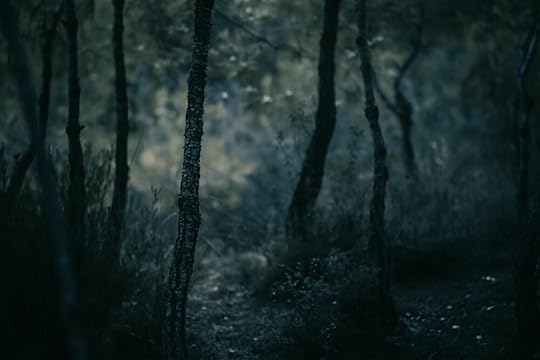
As magicians we are the most ordinary people on the outside. On the outside, our means to fight global warming in no way exceed everyone’s ways: using more public transport, avoiding one-way plastics, buy organic products, taking shorter showers, keeping wildlife-friendly plants in our gardens or on rooftops … The list is long, and of course it ends with donating whatever money we can afford, and giving it to organisations that focus on the most powerful lever of all: fighting the root causes of deforestation and actively driving reforestation.
On the inside - in the inner realms of magic - things look quite different however. While even here all of our powers are highly limited, we know beings and we know pathways between them, the world and us. Here we can act as silent messengers, as sacred vessels of information and power, we can bridge time and protect or unlock patterns that otherwise would remain dormant or suppressed. Very few other species can work in the way humans are empowered. Which is why nature desperately needs us to show up!
In light of this critical mutual dependency and yet our insufficient levers on the outside, I am inviting you to practice some basic environmental magic with me. Let’s do our fair share in protecting this planet from the inside out. Because that is the way magicians have worked since the old days - from periphery to centre and from seed to form. For many good reasons, this is the reverse direction of the pathways of most social or political activist. A further common differentiation is that the latter tend to work in networks and crowds, whereas magicians have a habit of working in secrecy, often as lone practitioners or in tiny root-groups. Of course, in the best of all worlds, both pathways come together and meet in the middle - the spark of the magician, and the flame of the activist.
So let’s get practical.
Just recently Josephine McCarthy rediscovered some of her archive treasures and made them available for free on the Quareia website. Amongst these texts, are four particular magical operations that focus on our relationship with and active support to the ecological environment we are an integral part of. These visions can be read as four practical steps towards applying ourselves to the world as agents of protection and healing - naturally, from the inside out. All four of these visions are short and most powerful if performed correctly. No equipment is needed, except for a clear mind, a quiet heart, and a firm hand. You do not need to be a Quareia student or adept of any other magical tradition in order to participate with impact. Everyone with basic visionary skills is invited to do this work in silence and all by themselves.
‘Your mission, should you chose to accept it…’ Well, it’s quite simple in this case. Josephine has shared all the details you need in the overview below. Good luck - I’ll see you on the other side.
LVX,
Frater Acher
And here is short introduction to the four visions in Josephine’s own words.
On the recent archive section of the free books page, I included some visions that I and others have worked with for years in various places dotted around the planet: it is basically environmental magic.
Four of those visions in particular have great relevance for the time we live in, with climate instability, loss of diversity, and the ever encroachment of toxics, poisons, and over populations of humans who devour everything in their path.
These four visions work from the outside in... first with 'Breathing the Forest' which tunes you and the land together, then 'Carrying the Forest through Time' which works to carry the inner pattern of the forest into the future, then the 'Inner Landscape' vision which tunes you deeply into the complex creative inner pattern of nature, and finally the vision of 'Paradise on Earth' where you work very deeply with angelic beings to flow with the tide of creation in nature from Divine utterance to the manifestation of the inner Divine vessels.
These visions, worked with repeatedly over time in the area where you live can have a slow but steady and profound affect on both the magician and the land - it draws you together. I have been working in my area for ten years now, and I am really starting to see the difference it can make.
Finally, here are the direct links to all four visions in sequence. As always, please respect the copyright of these magical visions with Quareia and Josephine McCarthy. They are intended for your private use only.
1st Operation: Breathing with the Forest
2nd Operation: Carrying the Forest through Time
3rd Operation: The Inner Landscape
4th Operation: Paradise on Earth
September 19, 2019
Exploring Ancient Christian Mysticism
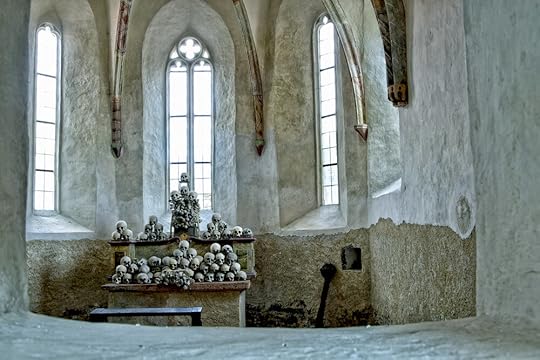
As a practicing magician, writing about Christianity is not only a difficult, but possibly a rather dangerous undertaking. At least that is what I am learning. Currently I am exploring aspects of the mystical tradition of the Christian path from 190 CE to 1900 CE for a future book. Anybody undertaking such an expedition quickly finds themselves wading through the bones, blood and ashes of their own magical ancestors. And yet, at the same time they will also find themselves confronted with beauty and genuine practice, with true grace and deep spiritual power.
For me, the attempt to see the world through the eyes of Christian mystics from many different centuries is an attempt to shine a light on the flame they carried forward. And yet, I find my heart filled with dissonance and tension when walking in their shoes. For it seems, they all carried both - one hand holding the flame, the other clutching on to darkness.
Strangely, this tension seems to increase the further we walk back in time. Once we arrive in the early centuries of Christianity it is hardly bearable. Maybe that is because the actual humans have been lost, behind the thick veil of time separating us from them? All we hear now is the echo of the echo of their words. Or maybe it is because the fanatical extremism that guided the Egyptian Desert Fathers was a magical sword pulled from its scabbard? Just as easy as it cuts through the veil of the world, it also cuts through what makes us essentially human.
Either way, excavating and exposing some of the powerful techniques practiced by our ancestors will be a tightrope act. For immersing oneself in their way of thinking, living and working, always bears the risk of forgetting where we stand ourselves. Attempting to view e.g. Origen's view of Jesus Christ not from the vantage point how we would judge it today, but how he possibly perceived it at his own time, requires the objectivity of an anthropologist. How did Origen truly think about the world? How did he create coherence in his world view? How did he forge the foundations of what would come to be one of the world's most powerful paradigms? -- In our field work, we have to leave our own values and filters at home, in order to truly encounter the Other. And yet, abandoning one's own values - even for short moments in time - always bears the risk of losing one's integrity altogether.
This also bears the question, for whom is this book intended for? Well, at least to this I have a clear answer: it is for you. You and I will be going on an expedition together, travelling from grave to grave, from country to country, century to century. It will be a long journey indeed, out into foreign lands, always bearing the risk of not allowing us to return to the people we once were. For seeing through the eyes of the Other, for becoming a seeker of understanding changes us, and changes everything.
Now, my presumption on this expedition will be that we both hold certain essential travelling skills: (1) To willingly manoeuvre our hearts into a silent, non-judgemental space; (2) to realise the Other for what it is, rather than seeing our own projections in it (may these be fears or desires); and (3) in our pursuit of discovery, to put things that are dear to us on the scales without knowing where the path will lead us. Most of all, however, I'll trust (4) your ability to debate within your own mind. That means, to hold conflicting truths in your minds eye, and not to close either of them out. To experience (cognitive and spiritual) dissonance and tension, in the pursuit of developing your capability to wrestle with a world that completely exceeds our ability to fully make sense of it. In short, I'll trust we both show up as grown ups.
Obviously these presumptions might be foolish. And I might lead us out on a journey that will reap more old misunderstandings than create new vantage points. I am deep in thought about this aspect of a writer's decision. How much can I trust the expertise of my audience - or how much should I presume, my words will land in the lap of a fourteen year old looking for ways of binding themselves to their soulmate? Once taken out of the earth and excavated, do all mysteries truly still protect themselves?
What I know for certain is this: As a magician, it is impossible to speak about Christian mystics, what they discovered, preserved and passed on - while not shuddering over the poison this gift contained. Today and for many centuries past, we see the outer effect of this poison when looking at the Catholic Church... It is a most dangerous threshold to cross - to walk into their inner library and to study the archive of their living practice. For it is easy to fall under their spell or to cast one upon them. To glorify or condemn their path. To drink from its poison or to break the flask.
Truly, to examine the Christian poison carefully, neither raising it to our lips, neither bedevilling the many hands that created it - that is a dangerous path indeed. And yet, isn't this what magicians should be doing best? To calmly stand at the crossroads. To calmly look the Other in the eyes. Neither falling for its exotic lure, nor enchaining what is beyond our own power or perception. Yet, to be fully present to the experience itself, free of the emotions of the gut, anchored in the flame of our heart. Seeking true understanding is a most dangerous undertaking. All books on the Faustian tradition teach us so much. I will be adding one more next year.
August 20, 2019
The Knower and the Known

The Knower and the Known
“(...) God is everywhere, visible to those who see by the light emanating from his beautiful face. He is ahead, and all men follow, holding his hand. Those friends of God who are behind, as well as those who walk ahead, have given news of arrival at their destinations.
When they become self-aware like Adam, they may reveal news of the Knower and that which He knows.
One of them dove into the ocean of Oneness and said, 'I am Truth.'
Another rode in a boat on the same ocean, and told of how far he was from the shore.
One looks at the outside and talks of dry land, while gathering shells,
and the other plunges into the ocean and gets the pearl.
One starts talking about the bits and parts of things, how they appear and function,
Another begins telling of the Eternal One and then of the creatures who live and die.
One speaks of long curls of hair, the beauty spot, the curves of her eyebrows, the beloved man in dim candle light, passing a goblet of wine.
The other speaks only of himself and his opinions.
And the other loses himself in idol's of love, identifying himself with the monk's rope around his waist.
Each one speaks the language native to the level he has reached, and it is hard to understand what he says.
You the seeker of understanding, you must strive to learn the meaning of what they say.”
| from the Gulshan-i Raz, by Sheikh Mahmoud Shabistari, 1317 CE
So who will we be? One of the many mentioned above, or ‘the seeker of understanding’ to whom the text speaks - the one who learns the meaning of what each one of the others see?
There is no judgement here, no good or bad, first or second. Whether we walk behind the Godhead or ahead of Her/Him, it is of no significance. The one who dives into the ocean, who rides the boat, who walks on dry land; they are all of equal value to the Great Work we call life.
We are a closed circle of beings, each one of us manifesting different parts of divine creation. We each have arrived at our destination; now we open our eyes and see, and speak, and experience. And no two of us will ever see, speak or experience the same: The mystic dives into the ocean and becomes one with it. The cartographer builds themselves a vessels and measures the shores. The dualist sees the conflicting forces at work underneath, and knows how to harvest their powers. The adventurer holds their breath and looks for pearls; to them the ocean is peril. The engineer is blind to being, but at awe with its functions. The scholar has read about a thing called waves and tries to hear their ocean sound on paper. And so the circle expands - each one of us seeing a different side of creation, and each one of us finding our own way of creating meaning from what we see.
On our magical (or mystical) path it can be hard to maintain clear orientation. Are we behind the Godhead, or right next to Her/Him? And where are the people around us, in relation to Her/Him and ourselves? To address this problem, many traditions have invented gateways, that are meant to mark out the journey we are on. The most well known ones in the West might be the degrees of Masonry or alternatively the degrees of the Order of the Golden Dawn, mirroring the ascent on the kabbalistic Tree of Life. The problem of any such gateways (or experience badges as we should probably call them) is that they introduce an entirely human and non-divine aspect into our journey: that of measuring our own progress against others, and in fact, of considering progress itself a valid quality on our path. This especially is problematic when our journey becomes more of a mystical than a magical one; i.e. one that focusses more on the first-hand experience of Divinity, rather than on acquiring a broad diversity of skills in manipulating its energies within creation.
The story above is taken from the “Rose Garden of Secrets", a collection of poems written in the 14th century by Sheikh Mahmoud Shabestari. It is considered to be one of the greatest classical Persian works of the Islamic mystical tradition known in the west as Sufism. The poem is addressed to the seeker of understanding. Their position relative to all other people mentioned in the poem is no higher or lower; yet their numbers are few and have been few throughout time. The difference between the seeker of understanding and the others, is that the latter are all looking down at their own business of drawing meaning from creation. Only the seeker of understanding is looking up into everyone’s faces - seeing the living circle they all form together, precisely by engaging with the world in so many diverse ways.
Our ability to expose ourselves to Divinity in unconstrained ways differs greatly. Of course, we can change and alter it, should this be our chosen business. Some of us are ready to walk into it openly and without any kind of ceremony, like a simple step forward in the present moment. Others of us, we need to shield our eyes and often our hearts from such boundless vastness. Yet we all make a contribution from where we stand. We are building a house together, not by what we say, but by forming a circle with our spirits. It is the business of the seeker of understanding to always be conscious of this circle, to keep it alive - and to hold it together as a co-worker of Divinity.
P.S. As a magician walking the Quareia path you can get a first-hand impression of the ‘house’ mentioned above. Just visit the Inner Library and walk past its endless shelves, and see the myriad of creatures walking with you, or sleeping in the living books or upholding the substance of its walls. It might raise your gaze to the circle you form a part of. It will take your breath away. It also might change your business, into better understanding the ocean of otherness and oneness we are surrounding by at all times.
May 5, 2019
Prudence combined with Virtue.
Introduction
Since the emergence of rock n' roll in the 1950s we have all become quite familiar with the idea of a 'cover version' in music. Unfortunately that is not true yet in literature. Thus many gems of wisdom remain buried in time, expressed in voices and tones that make them stand apart from our modern times. Rather than digging them up, reinterpreting them and bringing them to light again, we pass by them on dusty shelves, and fail to unite our spirit with theirs. However, most wise things have been said before. And we could save ourselves from reading and writing a lot of mediocre books, if only we looked a little closer at the great but forgotten ones, and used our own voices to amplify the echo resounding from their pages.
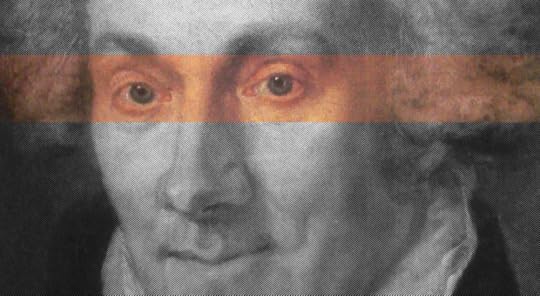
The following short excerpt is precisely such a reinterpretation, a literary cover version if you'd like. The text in its original form spanned over more than 400 pages and yet had been a hybrid by birth. For most readers - unlike the names of his 18th century contemporaries such Eliphas Levi, Count Alessandro di Cagliastro (aka Giuseppe Balsamo, 1743-1795) or Comte St. Germain (1710-1784) - the original compiler's name does no longer conjure up images of ancient lineages, masonic lodges and grimoires in smoke filled rooms. Now that, indeed, might be a good thing; as it makes for a less prejudiced and more unbiased encounter with the actual man: Carl von Eckartshausen (1752-1803) was a German author, philosopher, occultist and alchemist; he also was a lawyer, one of the youngest ever privy councillors at the Munich Court, a Secret Archiver and member of the Bavarian Academy of Sciences. He was an early member of Carl Weishaupt's Order of the Illuminati, yet quickly left again, became a prominent critic of it and mainly pursued mystical, kabbalistic and specifically numerological studies in his later years.
Karl von Eckartshausen.
Klugheit vereint mit Tugend, oder die Politik des Weisen, für gute Menschen.
München 1790. Link to digital version.


The text that forms the basis of the following excerpt was first published in 1790. Eckartshausen is humbly noted as its editor. He explains in the preface that the book presents a curated effort to bring together some of the essential theories on virtue and prudence in the modern world. Specifically, he refers to the French book 'La veritable politique des personnes de qualite' (The True Politic of People with Character) as its main source; a book which originally had been published 1700 and seen several editions since. However, no author is named anywhere and Eckartshausen admits that while he liberally took quotes from various related works he also interspersed his own ideas and voice into the more than 400 pages. As we can see, despite its relative old age, we are dealing with a book that never had a pure original form, but from the beginning only existed in its 'cover' or 'remixed' version.
Now, despite the French Revolution and general instability that Europe experienced at the time, printing paper must have been in solid supply for Eckartshausen and his Munich publisher Joseph Leutner in 1790. Otherwise it would have been not only easy, but a welcome effort to any reader, to trim the circumlocutory and repetitive text into a small pamphlet of much more succinct impact. Eckartshausen's own introduction together with the first 100 paragraphs contain most of the key ideas of the book; to the modern ready 230 years later much of the rest is repetition and digression.
The much shorter text you will be reading, therefore, follows in the same footsteps Eckarthausen himself took ninety years after the publication of 'la veritable politique': More than two centuries later it’s time for another remix, time to bring this wonderful voice back to the foreground of our journeys again. Because the prudence and virtue it shares could not be more important to our current times. To me, they are a stark reminder of why turning into a wolf when living amongst wolves simply isn't good enough.
Now, please note, the metaphor of the wolf in this context is exactly that, a symbol. No matter all the beauty, skill and social intelligence the actual species of wolves holds, at least since Roman times the metahpor of the brutal, selfish, outlawed wolf has developed in fables, tales and stage plays of the classical West. Whether we take the ancient proverb 'lupus fablis' (literally: (he appears like a) wolf in the fable, the original source of today's better known proverb ‘speaking of the devil’) or saying 'homo homini lupus est' (man is a wolf to man), the anthropomorphic wolf had turned into the epiphany of the predatory, uncivilised force that disrespects and destroys all social bonds. Which is why on the cover emblem of Eckartshausen’s book we see children cutting off wolves tails. A gruesome symbol for unmasking the vicious motives behind most modern politics.
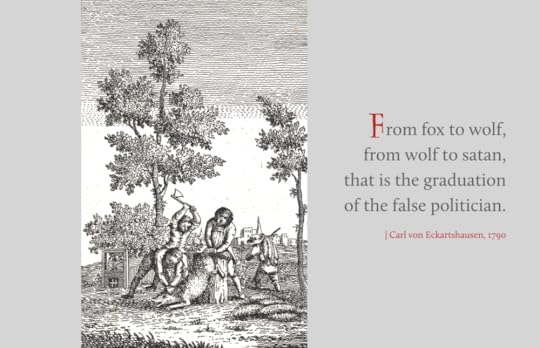
Carl von Eckhartshausen.
Prudence combined with Virtue | 2019 Remix.
The theory of prudence is an essential science for the virtuous human who lives in social states and in political circumstances. A lack of knowledge of the human nature, and consequently the judgement of others according to one's own heart, often lets people plunge into disaster, and makes them commit many mistakes against the basic rules of prudence. Repeated experience and disappointments turn the good man warily, and small is the step from love for mankind to hating it. Thus it is necessary to adopt certain theories of prudence, to safeguard the good heart against deceit and malice. Yet it is hard to discover such teachings, as the majority of mankind posses the wrong kind of cleverness, one that is generally called politics, and which in itself is nothing other but the art of deceit.
No one defiles humanity more horrendously than the false politician; just as truth and benevolence adorn the soul with splendour, so baseness and deceit deform it. Wherever such politic exists, no virtue can dwell, but its semblance alone which betray the virtuous. The innocent impulses of the human nature are suffocated, and replaced by factitious ones. Lies and falsity create world politics. And hard is it in national states and courts to choose the middle-path, not to depart from the true prudence and never to alight on false politic. The virtuous one will always ask: What is to do? And there is only one thing that can be given as response - that what all fine people have done before: to walk the path of virtue at the hand of prudence.
As fine as the woman is who unites true prudence with virtue, as hideous is the character of the false politician who unites base cleverness with vice, who has no word, no capacity to think of their own, who always turns into whatever the circumstances dictate, who always smiles and always huddles against. And smiling and huddling they suppress and yet regret to have become the tool of suppression themselves. They master the art of exploiting the noble heart to their own advantage, to do everything for themselves and nothing for others, and on the rubble of the failed luck of their neighbour they erect the throne of their own.
At last, the high-minded will not to change the world; all that is left to them, is to do as much good as lies within their power, and to always protect innocence with prudence.

Mankind in its essence never changes much, yet time and context cause all the difference that separate today's people from the ones of centuries past. The finest, most clever gentleman of the 12th century might be quite awkward and bashful in our time.
With court and politics things really are no different from theatre: love and ambition are the common material of every play, yet it is in the weave of the net of intrigues where the story differs. It is important to know the fashions of one's time.
With respect to temporality honour is nothing but the work of man, it is nothing from within itself. Yet through the immense span of time during which it has lived among mankind, it has achieved so much gravity and esteem, that its value seems to supersede most other temporal things. Thus one cannot take care enough of one's good reputation, and to honour the name one received at birth.
Everything that sparkles is suspicious. Beware not to aim to excel in your mental capabilities to the detriment of your heart's voice. You did not receive your cognitive mind to sport it in public, but to use it for the good. It should shine through you, yet not be admired.
And remember in all your doing, that the way you act and the grace that accompanies your deeds, will substitute for most other things.
Yet, be strict in keeping your word, and always act upon what you have said. Frequently remind yourself of what one of the wise men in Greece once said: 'Three things are required to become like a god: doing good, speaking the truth and keeping your word.'
Honour is entirely build from virtue. Both are the only two goods entirely independent from good fortune as well as from the orders of the sovereigns.
Therein lies wisdom if one is neither embarrassed to talk nor to be silent. Silence not always veils great insights. The one talks the best who never talks untimely.
Always be wary of the unforgiving enemy called self-love. She stirs all desires and causes turmoil.
A noble naivety exists, she is the friend of all wisdom. She is most suitable to discard the errors of self-love, as she is more sublime than anything that could be acquired by study or education.
Yet our hearts know too many weaknesses, which make it easy for self-love to intrude. Everyone accounts for their own worth so much higher than it is. There is so much self-deceit in the choice of careers, as people deem themselves able to become everything that flatters their self-love and opens an unrestricted field to their desires.
So do not allow for your errors to turn grey. A long habit of co- existing with evil always is a more sovereign empress than common sense.
Self-love slips through every crack and crevice. She is so attentive and so delicate, that irrespectively of how alert you are and seek to know yourself, you will still overlook her here and there.
Always remember the proverb of an old Spaniard: 'A ship seems great in a river and yet is tiny at high sea.'
The world is full of shallow-minds. They do not possess anything that is their own, and only live on borrowed knowledge. Endeavour to find the ones from whom speak true common sense and thorough learning. Be mindful to act equitable upon their advise. Only trust talent that stems from first-hand experience.
Do not aim to stand in apparent respect of other people; never beg for their praise. Do not search for any other glory in your deeds than the one of having done them. Do good because of the good; this is the true ground upon which your name should be built. This alone is how, over time, you will force people to respect you.
Flee from avarice; of all vices she is the most base. The prodigal makes themselves despised, the scrooge makes themselves generally detested. Be generous and bountiful. Imagine you would lose everything you do not give. Yet for not to become a prodigal do often consult prudence for advise. There is no virtue without the latter.
The best technique to always enjoy the matters of luck with inner calm, is to always be prepared to lose them without grieve.
To gently prevent poverty, which is always on the hunt for the ones who cannot even forego the most dispensable needs.
Do not become the weather vane of chance. Never take your sight from the main object that will lead to your happiness. Too many projects make for none of them being successful.
Make good use of the adversities in life, whenever hostile luck plunges you into them. Consider that they will sharpen your mind, and grant buoyancy and firmness, which both will strengthen and develop your courage.
Never shrink from the gravity of great virtue. Not once will she push you down to the ground. Quite the opposite, you will carry her with increasing ease the more you are laden with her.
Never raise your caring view so far into the future that you forget the present moment over it.
Ensure that you are loved by other people, and not feared. Friendship holds ineffable benefits - an evil sign if one does not feel these.
Make friends irrespective of the costs that will come with it. Whatever they cost you, they are worth it, for as long as they are loyal and honest with you in return. However, to find such friends, you need to possess the qualities you seek for in others in yourself in the first place.
Great service done often is less relevant and less of a prove for true friendship as many small favours. Only the latter reveal how much you are really caring for your friends all the time. Great service is done with deliberation, often on purpose and more often even out of vanity. Small favours happen naturally and without any pressure applied. They gently follow the dynamics of the heart, from where they stem, and where they are governed.
But beware to befriend sentimentals; they sigh and whine in gentle elegies, yet in their actions alone they are as vapid as the sounds they make.
Also beware that a true friend will contradict you often, and that precisely is the testament of their unfeigned friendship. Look upon all flatterers as your enemies, who are more interested to praise your taste, then to better your heart and to illuminate your mind.
No better mirror exists than old friends. Take them for your soul doctors; accept their advise like healing potions, subject to their directive, or you will have to renounce your cure.
And remember: scholars and wisemen in general are ragged and wild humans. They deal so much with the dead, they do not know how to dwell amongst the living.
The most useful of all sciences is the one taught through self- knowledge and improvement of self. The only reason for not improving yourself further, is because you are not seeking diligently enough to know yourself better.
We know of nothing less than of our selves. And still nothing is of graver importance with respect to ourselves than not to deceive ourselves.
The sign of a bright mind is to know how to live with oneself. Make your inner calm independent of other people just as much as of good luck. Learn how to be your own best friend at all times.
Never envy the superiority of other people's talents. Rather delight in having found your master. Love reason where it reveals itself.

Nothing compares to the agony we inflict upon each other in disputes. Most things can be looked upon at least from two different angles. It is therefore an unjust thing to demand everyone to look from exactly the same angle that we happen to hold.
In general, you struggle to find the words only if you haven't allowed yourself enough time to think carefully in the first place.
Let it be said again: One has to learn to live in peace with other people. You can hold on to your own opinion if you consider it valid, however, without discarding the opinions of others. That is unless the latter concern your honour or the reputation of your neighbours.
Dislike of loneliness in general is a sure proof of mediocrity. Many there are who cannot even be by themselves for half an hour without being bored. They do not know how to put the time to use, and thus become uneasy and sullen. Loneliness makes them sad; they become unbearable to themselves.
A man of solid mind knows how to turn to use every moment of their life, and never are they occupied more usefully as when they are alone. And yet, we cannot forget that virtue means to learn how to live amongst the living.
Be it as it may: I very much recommend you the way of the outsider. Learn how to fight against the constant current of bad examples, hold your ground and hold on always and unswervingly to the good. Yet you will only succeed through the highest level of alertness: without it all our good intentions turn to smoke, the crowd sweeps us along, and we will perish in the face of others.
December 27, 2018
Start with the End.
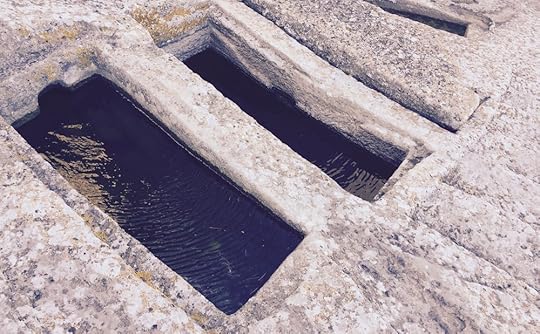
{ Introduction to a book in progress, titled ‘becoming king’ }
Let's start this journey at its end. Let's start with the moment you step into your grave.
I want you to read this paragraph, and then close your eyes. Close your eyes and look at yourself as the person you have become in the last moments of your life. What do you see? Who do you see? Which qualities shine through? Which scars do you hold - and what have you made of them? The Ancient Egyptians had a curious way of looking at emotions. According to their logic, whatever you felt in the presence of another person weren't your emotions. They thought of emotions as emanating from the person who caused them - not the person who perceived them. Thus people could be considered to be love-exuding, fear-exuding, bitterness-exuding, etc.
Now, close your eyes again. And look back at yourself as you are stepping into your grave, one more time. Who have you really become? Consider each day a handful of emotions you have fed this future version of yourself. What do they exude now? What do they cause in others? What do they cause in you, the silent observer, as you sit still behind your closed eyes, observing them...
Still no clear vision? Then try this. In your mind's eye, see a group of children running up to your old self. Children are experts in picking up the emanations of people. As the small group gathers around you, what does the first child ask you? Through their child's eyes, what do you have authority over? What do you hold authenticity in? Which aspect of life do they perceive you a story-teller of?
Since time immemorial the mysteries have started by stepping into one's own grave. Today we tend to mistake such ritual act as a symbol, a cipher. When what it really has to become is a sensual, first-hand reality - for its echo to take effect. For the grave to take away the person who is blocking access to a nobler version of ourselves. Because it is in the grave that our current life will fade away, and where we reconnect to the black soil that holds the cup of all other seeds in its womb.
Osiris is a black god, the Ancient Egyptians knew. His mysteries do not begin with glory, good fortune or acquiring might and powers. They start with falling at the hand of his enemy, with being dismembered and descending into a hundred graves at once. You, on the other hand, will only need to step into a single grave. And that is where your mysteries begin.
Beholding, seeing clearly, the person you aim to be by the time you die is of critical importance for your life's journey. I was fortunate enough to first witness my 'ancient self' in a workshop organized by the wonderful John Harrigan of the FoolishPeople. We were lying stretched out in a cellar room, lights dimmed, eyes closed, John's voice guiding us. I felt myself lifted out of my body and rise up through the cellar ceiling, through the stories of the house above, into the evening sky and higher still. Then I shot forward in time, further and further still, a long distance over many decades. Until I slowly descended again into the same street I had lifted away from, only much later in time. John asked us to observe the street, to stand still and look around. Until we see our 'ancient self'. -- I first saw myself standing at the entrance to a small alley, in front of a stained red-brick wall, a tall, slender old man. I had lost all of my hair, and wore a white, patchy beard. I walked closer and looked at myself. The sight of my 'ancient self' completely took me by surprise: My current self was young at the time and had anticipated so see some kind of sign of success on this person, some kind of emblem of accomplishment or accolade of whatever sort. Yet, there I was, a humble old man, slightly bent over. The man exuded something monkish. Yet, most prominently was the calm, the quiet happiness that I felt when seeing him. I don't think I had been that happy for a very long time? Seeing this person, I realised, he clearly had learned how to be content. There was a fluid quality about him, that I absolutely did not know from myself at the time. I sensed an ability to make due with whatever situation life threw him into. Yet that ability was not based upon survival skills, virile perseverance or grit. Instead it seemed to be based upon the ability to flow. On the ability to flow forward like water, playfully, around or underneath any obstacles, rather than fighting them head-on. My old self seemed gently at ease, like a deserter from the fight against himself and others, and yet still deeply engaged in life. -- Irrespective of the many years that have passed since that evening in the old Treadwell's souterrain room, that vision of my old self has stayed with me every day.
Once we behold the person we want to be when stepping into our grave, we are empowered to take control of our lives. Only then can we fashion every single day as a step on the journey that will ultimately lead to us becoming that man or woman. Choices of career, of family planning, of relocation or financial investments - they can then all be tied back to becoming this ancient version of ourselves. Rather then asking what it will take to achieve a certain professional position or pay-grade, the question becomes if these experiences would be valuable contributions to pulling that future self out of the soil of our everyday lives? If I pursued this job, if I founded a family, if I relocated to that place X - which character traits would these experiences shape upon me - and are they in line with the face that I saw at the edge of the grave? If we consider each day a chissel and a hammer set upon the stone that we are - are our days chipping away stone at the right places to become our old self? On that day at the edge of our grave nothig else will matter at all. But how we engaged in life - in order to leave it in a version of ourselves that we are in peace with.
So, to start at the end. To turn yourself into black soil, a black god, and back into a mortal again, there is only one question worthwhile truly wrestling with. And that is: which virtues are you willing to draw out of yourself? In this royal art of transformation, where you are the artist, the art and the artifact, nature holds the seeds of everything, but it will not bring it to perfection without a human's helping hand. Yes, nature can perform the full alchemical cycle all by itself, and produce gold in the athanor of the natural world. Yet, it takes millennia to do so and results in tiny flakes of gold alone. To produce an entire human heart of gold - and within the short life-span we are given - we have to turn ourselves from the passive object nature's forces work upon, into its humble, yet conscious co-creator. The gold we will create as a result of this arduous process, however, is not a mundane currency at all. In fact, rather than making our lives easier, more comfortable and convenient, it will often get in our way, make us stumble or be expelled. The gold we are talking of are virtues that we weave into the fabric of our selves. The gold we are talking of is a high character and goodness.
If this kind of gold doesn't weigh heavy enough in your hands for an entire life to be dedicated to its creation, there are only two options. Either you are not an alchemist, and then this journey is not for you. Or you just need to spend a little more time in this world, and observe acutely. Look around you. And see what we do to this world, what this world does to itself, in the absence of decency. And decency itself is far from being our gold - it is the passive sibling of any virtue only, originally describing the respite of combat, i.e. the calm composure to take time to think before we act impulsively. A virtue is knowing how to create peace, not to delay the attack.
In essence, this will be the journey of this book. To teach ourselves how to produce gold and weave its threads into our hearts. Because for anyone of us to become a king, we first have to become of high character.
Repeated experience finally makes the good distrustful, and small is the step from from the love for mankind to the hate for it. It is therefore necessary to adopt teachings on human prudence, to protect the good heart against deceit and spite. Hard it is however to frequent such teachings of prudence, as most of mankind possesses the kind of prudence which one generally calls politics, and which in itself is nothing but the art of betrayal. (...) Hard it is to walk the middle-path in great states and at the courts; not to depart from the true prudence, and never to descend to false politics. The good will always ask: what is it that needs doing? And one can only reply: That what noble people have done - to walk the paths of virtue at the hand of prudence. (Karl von Eckartshausen, Klugheit vereint mit Tugend, 1790)
Frater Acher's Blog
- Frater Acher's profile
- 69 followers

