
Ronald E. Yates's Blog, page 54
May 24, 2021
A Hedge Fund Vulture Plunders my old Home: The Chicago Tribune
There are only a few places, outside of my actual home, that I ever felt I could call “home.”
One was the U.S. Army Security Agency where I spent almost four years on active duty. Another was the University of Kansas where I earned a bachelor’s degree in journalism.
However, perhaps the most significant of these ersatz “homes” was the Chicago Tribune, where I spent almost 28 years as a reporter and foreign correspondent covering turmoil and war from Asia to Latin America and a few other places on the planet.
So naturally, I am concerned when I hear that my “Tribune home” is about to be gobbled up by the Alden Global Capital hedge fund. Alden, which already owns nearly one-third of Tribune Company, stands to take full control of the Chicago Tribune, Baltimore Sun, the New York Daily News, the Orlando Sentinel, and a half-dozen other Tribune papers by June 30 in a deal worth roughly $630 million.
Why does that concern me? The Tribune, which was founded in 1847 and has a storied journalism past, may not survive the Alden seizure. Hedge funds are notorious for acquiring newspapers, sacking staff, selling off everything of value, wringing them dry of cash, and then depositing them on the journalistic scrapheap.
As with a plethora of other American newspapers, the Tribune has watched powerlessly as the collapse of print advertising eroded its revenues. That has made legacy newspapers sitting ducks for vulture investors like Alden.
The Tribune is not alone in this precarious place.
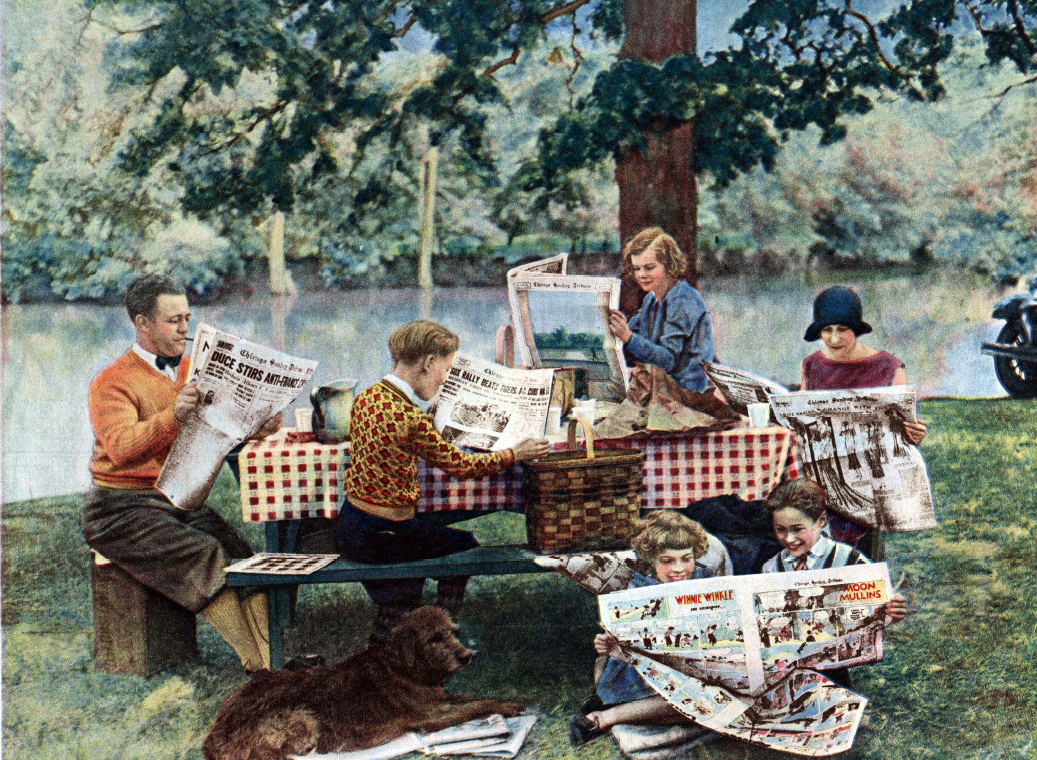 Once Upon A Time when Chicago Families Read the Sunday Tribune
The newspaper industry has struggled during the digital age as revenues dwindled because of a precipitous and persistent decline in print advertising.
In the past two decades, publishers have shut down more than 2,000 newspapers. Newsroom employees shrank by more than half — from 71,000 to 35,000 — between 2008 and 2019, according to the Pew Research Center.
Even though millions of newspaper readers have migrated to digital editions, that has not offset the considerable loss of once-lucrative print advertising.
Last year, Tribune Publishing’s employment fell by 30%, dropping from 4,114 employees at the end of 2019 to 2,865 employees at the end of 2020, according to the company’s annual reports.
The writing was on the wall for the once influential and financially robust Chicago Tribune when five years ago it sold the iconic Tribune Tower for $240 million and moved to a much less imposing abode.
 Tribune Tower
Constructed in 1925, the 35-story Gothic tower was an iconic fixture on the northern edge of Chicago’s “Magnificent Mile” at 435 North Michigan Avenue.
I can recall my heart hammering when I entered the Tribune Tower’s cavernous lobby on my first day as a general assignment reporter in July 1969. I had been hired just days after my graduation from the University of Kansas—an unheard-of opportunity the Tribune seldom granted newly-minted journalism school graduates.
Naturally, I was determined to show everybody that I belonged in this epitome of renowned and legendary Chicago “newspaperdom.”
But when I got out of the elevator on the fourth floor and entered the Tribune’s yawning newsroom I was (input an appropriate adjective here) overwhelmed, stupefied, staggered, dumbfounded, flummoxed.
If the lobby was daunting, the Tribune’s newsroom was even more intimidating and overwhelming.
The place was humungous. It was also louder than the “clatter wheels of hell,” as my grandpa used to say. Telephones were ringing, people were yelling, typewriters were clacking, telex machines were dinging and clattering, copy boys and girls were scurrying, and above it all, I could hear my heart pounding like a bass drum in my ears.
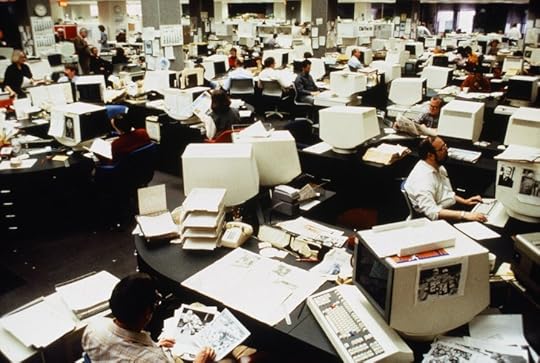 The “Old” Tribune Newsroom 1975 with its “New” Computer Terminals
God, what have I gotten myself into? I wondered.
Of course, I didn’t start my life at the Tribune in that outsized grotto of the fourth estate. No, not by a long shot. Instead, I was assigned, as were all rookie reporters in those days, to something called “Neighborhood News” off in a much quieter and less imposing area of the tower.
But nine months later, after I proved that I could write intelligible and accurate stories about the lesser regions of the Chicago Metropolitan area, I was hurled into the reportorial breach of the city room and found myself ensconced at an ancient battleship gray wooden desk that was shared by several other nomadic reporters.
In those days, new general assignment reporters “hot-desked it,” meaning you sat at a vacant desk as long as some old-timer sporting a fedora and smoking a big stogie didn’t tell you to move.
Yes, boys and girls, back then the Tribune newsroom was saturated with cigarette and cigar smoke. Hell, some crusty old copy editors wearing green eyeshades even had spittoons next to their chairs.
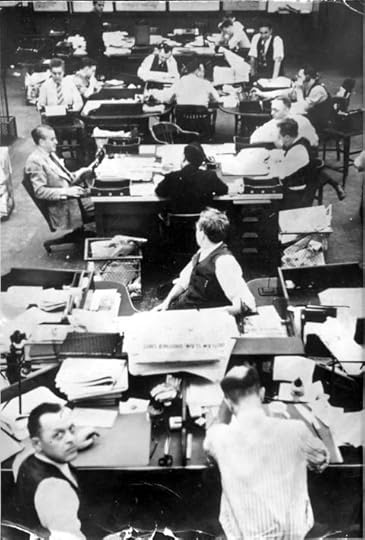
 Chicago Tribune Copy Desk ca. 1970
And sometimes (gasp!) the drawers on those old wooden desks contained half-full bottles of Old Grandad or Wild Turkey.
Ah yes, it was a very different time.
But I digress. In front of me on that scuffed and gouged wooden desk sat a big black Underwood typewriter. I was sure the damned thing was just daring me to write something on it.
I could almost hear it shouting with a distinctive Chicago inflection, “Go ahead, ya big Kansas hick. Write somethin.’ I dare ya! I double dare ya!”
I’m sure I gulped several times watching the turbulent activity in front of me with reporters running in and out of the newsroom amid a discordant cacophony of bellowing editors and tolling telephones.
I wondered how long before I would be one of those reporters. My heart thumped. My palms sweated. My mouth dried.
I didn’t have to wait long. From about thirty feet across the room, I heard somebody shouting my name.
“Yates, Yates,” the voice said.
I jumped to attention, just like I did on my first day of basic training in the U.S. Army when a rock-solid staff sergeant with a tan campaign hat covering his square, close-cropped head, called my name.
Only this voice didn’t come from my drill sergeant. It emanated from a bespectacled man in shirtsleeves sitting in the driver’s seat of the Tribune’s horseshoe-shaped City Desk. He was flanked on both sides by a squad of rewrite men (not many women back then), a photo assignment editor, and a bank of squawking radios blaring raspy police and fire department calls. A couple of the grizzled rewrite men even wore (you guessed it!) green eyeshades and garters on their shirtsleeves.
The man impatiently calling my name was the Chicago Tribune’s Day City Editor. His name was Don Agrella.
I looked over at him just in time to hear him say. “Yates, take an obit.” I looked down at the black telephone on my desk just as it started ringing.
An obit? I found myself thinking. Geez, what a start!
“Hello,” the voice on the other end said, “this is Weinstein’s Funeral Home on West Devon. Are you ready for me?”
“No, I’m not dead yet,” I quipped.
The voice on the other end of the phone wasn’t amused.
“Okay, NOW are you quite ready?”
“Sorry. It’s my first day.”
I looked around the newsroom. No one was paying attention. I was relieved. But I was also thankful to be even a tiny cog in that enormous, churning throng of reportorial humanity.
By the end of the day, after writing I don’t know how many obits and three-paragraph stories that Tribune editors enigmatically referred to as “four-heads,” I was sure I would earn my journalistic spurs in Tribune Tower.
Today, I can’t imagine working as a Tribune reporter in any place BUT Tribune Tower. But that is not the case today. First, the newspaper moved out of the Tribune building in 2018 and into the Prudential Building across the Chicago River. Then, in January 2021 The Tribune moved once again—this time into the paper’s Freedom Center printing plant at 777 W. Chicago Ave.
That means neither of Chicago’s two remaining major dailies has newsrooms in the city’s immediate downtown area. The Chicago Sun-Times, which had been at 350 N. Orleans St., relocated to 30 N. Racine Ave. on the Near West Side in 2017.
 Abandoned Chicago Sun-Times Building
Things could be worse, I guess.
Chicago could become the first large American city not to have a single newspaper covering it.
That’s an unthinkable prospect when you consider that at one point in the early 20th century there were 10 competing newspapers in Chicago.
Oh well, as the ancient Romans used to say:
“Omnia mutantur, nos et mutamur in illis.” (“All things are changed, and we are changed with them.”)


May 23, 2021
A Commencement Speech that Every College Graduate Should Hear
We are in the middle of graduation season when high schools, colleges, and other institutions of higher and (sometimes) lower learning hold their commencement ceremonies. When that happens, of course, you can expect to hear a surfeit of advice–some good, some bad, some forgettable, and some unforgettable from a broad range of personages who may (or may not) feel entitled to hold forth while wearing assorted academic caps, gowns, and other scholarly regalia.
As a former college Dean at the University of Illinois, I presided over at least eight of these rituals and listened to an assortment of both predictable, and occasionally, unpredictable commencement speeches.
Looking back, I wish someone had given the commencement speech in my College that I am about to share with you.
Now, here is a little confession: This commencement speech has never been given, but it should be. It was written by former syndicated talk show host Neal Boortz in protest of never having been invited to give a commencement address. It became the springboard for his first book, “The Commencement Speech You Need to Hear.” Later he produced an audio CD of the speech complete with crowd noise and applause, which was aired on his radio program. Read on. You won’t be disappointed.
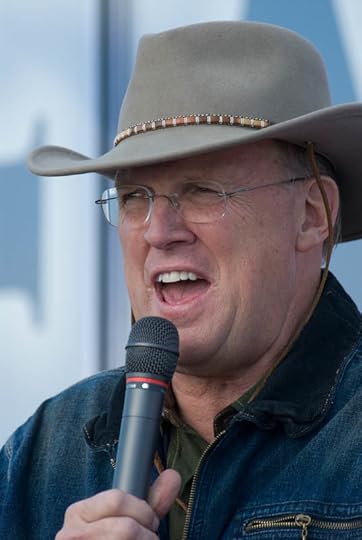 Neal Boortz
“I am honored by the invitation to address you on this august occasion. It’s about time. Be warned, however, that I am not here to impress you; you’ll have enough smoke blown up your bloomers today. And you can bet your tassels I’m not here to impress the faculty and administration.
You may not like much of what I have to say, and that’s fine. You will remember it though. Especially after about 10 years out there in the real world. This, it goes without saying, does not apply to those of you who will seek your careers and your fortunes as government employees.
This gowned gaggle behind me is your faculty. You’ve heard the old saying that those who can – do. Those who can’t – teach. That sounds deliciously insensitive. But there is often raw truth in insensitivity, just as you often find feel-good falsehoods and lies in compassion. Say goodbye to your faculty because now you are getting ready to go out there and do. These folks behind me are going to stay right here and teach.
By the way, just because you are leaving this place with a diploma doesn’t mean the learning is over. When an FAA flight examiner handed me my private pilot’s license many years ago, he said, “Here, this is your ticket to learn” The same can be said for your diploma. Believe me, the learning has just begun.
Now, I realize that most of you consider yourselves Liberals. In fact, you are probably very proud of your liberal views. You care so much. You feel so much. You want to help so much. After all, you’re a compassionate and caring person, aren’t you now? Well, isn’t that just so extraordinarily special? Now, at this age, is as good a time as any to be a liberal; as good a time as any to know absolutely everything. You have plenty of time, starting tomorrow, for the truth to set in.
Over the next few years, as you begin to feel the cold breath of reality down your neck, things are going to start changing pretty fast… Including your own assessment of just how much you really know.
So here are the first assignments for your initial class in reality: Pay attention to the news, read newspapers, and listen to the words and phrases that proud Liberals use to promote their causes Then, compare the words of the left to the words and phrases you hear from those evil, heartless, greedy conservatives.
From the Left you will hear “I feel.” From the Right, you will hear “I think.” From the Liberals, you will hear references to groups — The Blacks, the Poor, the Rich, the Disadvantaged, the Less Fortunate. From the Right, you will hear references to individuals. On the Left, you hear talk of group rights; on the Right, individual rights.
That about sums it up, really: Liberals feel. Liberals care. They are pack animals whose identity is tied up in group dynamics. Conservatives think — and, setting aside the theocracy crowd, their identity is centered on the individual.
Liberals feel that their favored groups have enforceable rights to the property and services of productive individuals. Conservatives, I among them I might add, think that individuals have the right to protect their lives and their property from the plunder of the masses.
In college, you developed a group mentality, but if you look closely at your diplomas you will see that they have your individual names on them. Not the name of your school mascot, or of your fraternity or sorority, but your name. Your group identity is going away. Your recognition and appreciation of your individual identity starts now.
If, by the time you reach the age of 30, you do not consider yourself to be a conservative, rush right back here as quickly as you can and apply for a faculty position. These people will welcome you with open arms. They will welcome you, that is, so long as you haven’t developed an individual identity. Once again you will have to be willing to sign on to the group mentality you embraced during the past four years.
Something is going to happen soon that is going to really open your eyes. You’re going to actually get a full-time job!
You’re also going to get a lifelong work partner. This partner isn’t going to help you do your job. This partner is just going to sit back and wait for payday. This partner doesn’t want to share in your effort but in your earnings.
Your new lifelong partner is actually an agent; an agent representing a strange and diverse group of people; an agent for every teenager with an illegitimate child; an agent for a research scientist who wanted to make some cash answering the age-old question of why monkeys grind their teeth. An agent for some poor demented hippie who considers herself to be a meaningful and talented artist, but who just can’t manage to sell any of her artwork on the open market.

Your new partner is an agent for every person with limited, if any, job skills, but who wanted a job at City Hall. An agent for tin-horn dictators in fancy military uniforms grasping for American foreign aid. An agent for multi-million dollar companies that want someone else to pay for their overseas advertising. An agent for everybody who wants to use this agent’s unimaginable power for their personal enrichment and benefit.
That agent is our wonderful, caring, compassionate, oppressive government Believe me, you will be awed by the unimaginable power this agent has–power that you do not have. A power that no individual has, or will have. This agent has the legal power to use force, deadly force to accomplish its goals.
You have no choice here. Your new friend is just going to walk up to you, introduce himself rather gruffly, hand you a few forms to fill out, and move right on in. Say hello to your own personal one-ton gorilla. It will sleep anywhere it wants to.
Now, let me tell you, this agent is not cheap. As you become successful it will seize about 40% of everything you earn. And no, I’m sorry, there just isn’t any way you can fire this agent of plunder, and you can’t decrease its share of your income. That power rests with him, not you.
So, here I am saying negative things to you about government. Well, be clear on this: It is not wrong to distrust the government. It is not wrong to fear government. In certain cases, it is not even wrong to despise government for government is inherently evil. Yes, a necessary evil, but dangerous nonetheless, somewhat like a drug. Just as a drug that in the proper dosage can save your life, an overdose of government can be fatal.
Now let’s address a few things that have been crammed into your minds at this university. There are some ideas you need to expunge as soon as possible. These ideas may work well in the academic environment, but they fail miserably out there in the real world.
First is that favorite buzzword of the media and academia: Diversity! You have been taught that the real value of any group of people – be it a social group, an employee group, a management group, whatever – is based on diversity. This is a favored liberal ideal because diversity is based not on an individual’s abilities or character, but on a person’s identity and status as a member of a group. Yes, it’s that liberal group identity thing again.
Within the great diversity movement group identification – be it racial, gender-based, or some other minority status – means more than the individual’s integrity, character, or other qualifications.
Brace yourself. You are about to move from this academic atmosphere where diversity rules, to a workplace and a culture where individual achievement and excellence actually count. No matter what your professors have taught you over the last four years, you are about to learn that diversity is absolutely no replacement for excellence, ability, and individual hard work. From this day on every single time you hear the word “diversity”, you can rest assured that there is someone close by who is determined to rob you of every vestige of individuality you possess.
 Who Were Those Masked Graduates?
We also need to address this thing you seem to have about “rights.” We have witnessed an obscene explosion of so-called “rights” in the last few decades, usually emanating from college campuses.
You know the mantra: You have the right to a job. The right to a place to live. The right to a living wage. The right to health care. The right to an education. You probably even have your own pet right – the right to a Beemer for instance, or the right to have someone else provide for that child you plan on downloading in a year or so.
Forget it. Forget those rights! I’ll tell you what your rights are. You have a right to live free, and to the results of 60% -75% of your labor. I’ll also tell you this. You have no right to any portion of the life or labor of another.
You may, for instance, think that you have a right to health care. After all, our president said so, didn’t he? But you cannot receive health care unless some doctor or health practitioner surrenders some of his time – his life – to you. He may be willing to do this for compensation, but that’s his choice. You have no “right” to his time or property. You have no right to his or any other person’s life or to any portion thereof.
You may also think you have some “right” to a job; a job with a living wage, whatever that is. Do you mean to tell me that you have a right to force your services on another person, and then the right to demand that this person compensate you with their money? Sorry, forget it. I am sure you would scream if some urban outdoorsmen (that would be “homeless person” for those of you who don’t want to give these less fortunate people a romantic and adventurous title) came to you and demanded his job and your money.
The people who have been telling you about all the rights you have are simply exercising one of theirs – the right to be imbeciles. Their being imbeciles didn’t cost anyone else either property or time. It’s their right, and they exercise it brilliantly.
By the way, did you catch my use of the phrase “less fortunate” a bit ago when I was talking about the urban outdoorsmen? That phrase is a favorite of the Left. Think about it, and you’ll understand why.
To imply that one person is homeless, destitute, dirty, drunk, spaced out on drugs, unemployable, and generally miserable because he is “less fortunate” is to imply that a successful person – one with a job, a home, and a future – is in that position because he or she was “fortunate.”
The dictionary says that fortunate means “having derived good from an unexpected place.” There is nothing unexpected about deriving good from hard work. There is also nothing unexpected about deriving misery from choosing drugs, alcohol, and the street.

If the Liberal Left can create the common perception that success and failure are simple matters of “fortune” or “luck,” then it is easy to promote and justify their various income redistribution schemes. After all, we are just evening out the odds a little bit. This “success equals luck” idea the liberals like to push is seen everywhere.
Former Democratic presidential candidate Richard Gephardt once referred to high-achievers as “people who have won life’s lottery.” He wants you to believe they are making the big bucks because they are lucky. It’s not luck, my friends. It’s a choice. One of the greatest lessons I ever learned was in a book by Og Mandino, entitled, “The Greatest Secret in the World.” The lesson? Very simple: “Use wisely your power of choice.”
That bum sitting on a heating grate, smelling like a wharf rat? He’s there by choice. He is there because of the sum total of the choices he has made in his life. This truism is absolutely the hardest thing for some people to accept, especially those who consider themselves to be victims of something or other – victims of discrimination, bad luck, the system, capitalism, whatever.
After all, nobody really wants to accept the blame for his or her position in life. Not when it is so much easier to point and say, “Look! He did this to me!” than it is to look into a mirror and say, “You S. O. B.! You did this to me!”
The key to accepting responsibility for your life is to accept the fact that your choices, every one of them, are leading you inexorably to either success or failure, however you define those terms.
Some of the choices are obvious: Whether or not to stay in school. Whether or not to get pregnant. Whether or not to hit the bottle. Whether or not to keep this job you hate until you get another better-paying job. Whether or not to save some of your money, or saddle yourself with huge payments for that new car.
Some of the choices are seemingly insignificant: Whom to go to the movies with. Whose car to ride home in. Whether to watch the tube tonight, or read a book on investing. But, and you can be sure of this, each choice counts.

Each choice is a building block – some large, some small. But each one is a part of the structure of your life. If you make the right choices, or if you make more right choices than wrong ones, something absolutely terrible may happen to you. Something unthinkable. You, my friend, could become one of the hated, the evil, the ugly, the feared, the filthy, the successful, the rich.
The rich basically serve two purposes in this country. First, they provide the investments, the investment capital, and the brains for the formation of new businesses. Businesses that hire people. Businesses that send millions of paychecks home each week to the un-rich.
Second, the rich are a wonderful object of ridicule, distrust, and hatred. Few things are more valuable to a politician than the envy most Americans feel for the evil rich.
Envy is a powerful emotion. Even more powerful than the emotional minefield that surrounded Bill Clinton when he reviewed his last batch of White House interns. Politicians use envy to get votes and power And they keep that power by promising the envious that the envied will be punished: “The rich will pay their fair share of taxes if I have anything to do with it.” The truth is that the top 10% of income earners in this country pays almost 50% of all income taxes collected. I shudder to think what these job producers would be paying if our tax system were any more “fair.”
You have heard, no doubt, that the rich get richer and the poor get poorer. Interestingly enough, our government’s own numbers show that many of the poor actually get richer, and that quite a few of the rich actually get poorer. But for the rich who do actually get richer, and the poor who remain poor .. there’s an explanation — a reason. The rich, you see, keep doing the things that make them rich; while the poor keep doing the things that make them poor.
Speaking of the poor, during your adult life you are going to hear an endless string of politicians bemoaning the plight of the poor. So, you need to know that under our government’s definition of “poor” you can have a $5 million net worth, a $300,000 home and a new $90,000 Mercedes, all completely paid for. You can also have a maid, cook, and valet, and a million in your checking account, and you can still be officially defined by our government as “living in poverty.” Now there’s something you haven’t seen on the evening news.
How does the government pull off this one? Very simple, really. To determine whether or not some poor soul is “living in poverty,” the government measures one thing — just one thing. Income.
It doesn’t matter one bit how much you have, how much you own, how many cars you drive or how big they are, whether or not your pool is heated, whether you winter in Aspen and spend the summers in the Bahamas, or how much is in your savings account. It only matters how much income you claim in that particular year. This means that if you take a one-year leave of absence from your high-paying job and decide to live off the money in your savings and checking accounts while you write the next great American novel, the government says you are living in poverty.”
This isn’t exactly what you had in mind when you heard these gloomy statistics, is it? Do you need more convincing? Try this. The government’s own statistics show that people who are said to be “living in poverty” spend more than $1.50 for each dollar of income they claim. Something is a bit fishy here. Just remember all this the next time Charles Gibson tells you about some hideous new poverty statistics.
Why has the government concocted this phony poverty scam? Because the government needs an excuse to grow and to expand its social welfare programs, which translates into an expansion of its power. If the government can convince you, in all your compassion, that the number of “poor” is increasing, it will have all the excuse it needs to sway an electorate suffering from the advanced stages of Obsessive-Compulsive Compassion Disorder.
I’m about to be stoned by the faculty here. They’ve already changed their minds about that honorary degree I was going to get. That’s OK, though. I still have my PhD. in Insensitivity from the Neal Boortz Institute for Insensitivity Training. I learned that, in short, sensitivity sucks. It’s a trap. Think about it – the truth knows no sensitivity. Life can be insensitive. Wallow too much in sensitivity and you’ll be unable to deal with life, or the truth, so get over it.

Now, before the dean has me shackled and hauled off, I have a few random thoughts.
* You need to register to vote unless you are on welfare. If you are living off the efforts of others, please do us the favor of sitting down and shutting up until you are on your own again.
* When you do vote, your votes for the House and the Senate are more important than your vote for President. The House controls the purse strings, so concentrate your awareness there.
* Liars cannot be trusted, even when the liar is the Speaker of the House. If someone can’t deal honestly with you, send them packing.
* Don’t bow to the temptation to use the government as an instrument of plunder. If it is wrong for you to take money from someone else who earned it — to take their money by force for your own needs — then it is certainly just as wrong for you to demand that the government step forward and do this dirty work for you.
* Don’t look in other people’s pockets You have no business there. What they earn is theirs. What you earn is yours. Keep it that way. Nobody owes you anything, except to respect your privacy and your rights and leave you the hell alone.
* Speaking of earning, the revered 40-hour workweek is for losers Forty hours should be considered the minimum, not the maximum. You don’t see highly successful people clocking out of the office every afternoon at five. The losers are the ones caught up in that afternoon rush hour The winners drive home in the dark.
* Free speech is meant to protect unpopular speech. Popular speech, by definition, needs no protection.
* Finally (and aren’t you glad to hear that word), as Og Mandino wrote,
1. Proclaim your rarity. Each of you is a rare and unique human being.
2. Use wisely your power of choice.
3. Go the extra mile, ‘drive home in the dark.
Oh, and put off buying a television set as long as you can. Now, if you have any idea at all what’s good for you, you will get out of here and never come back. Class dismissed.”
May 21, 2021
Just for Fun: A Story & Some Obscure & Generally Trivial Information
Today I am sharing some obscure knowledge with you, as well as a short and dubious yarn. Just what’s needed for a Friday morning. Enjoy!
Yesterday I got my permit to carry a concealed weapon. So, today I went over to the local gun shop to get a 9mm handgun for home/personal protection. When I was ready to pay for the pistol and ammo, the cashier said, “Strip down, facing me.”
Making a mental note to complain to the government about gun control wackos in California running amok, I did just as she instructed. When the hysterical shrieking and alarms finally subsided, I found out she was referring to how I should place my credit card in the card reader!
I do not get flustered often, but this time it took me a while to get my pants back on. I’ve been asked to shop elsewhere in the future. They need to make their instructions a little clearer. I still don’t think I looked that bad! I just need to wear underwear more often. 
‘A SHOT OF WHISKEY’ – In the old west a .45 cartridge for a six-gun cost 12 cents, so did a glass of whiskey. If a cowhand was low on cash he would often give the bartender a cartridge in exchange for a drink. This became known as a “shot” of whiskey. Hmmm. Son of a gun. Who knew?
BUYING THE FARM – This is synonymous with dying. During WW1 soldiers were given life insurance policies worth $5,000. This was about the price of an average farm so if you died you “bought the farm” for your survivors. Sounds plausible.
IRONCLAD CONTRACT – This came about from the ironclad ships of the Civil War. It meant something so strong it could not be broken. It seems logical.
RIFF RAFF – The Mississippi River was the main way of traveling from north to south. Riverboats carried passengers and freight but they were expensive so most people used rafts. Everything had the right of way over rafts which were considered cheap. The steering oar on the rafts was called a “riff” and this transposed into riff-raff, meaning low class. I’ll buy it.
COBWEB – The Old English word for “spider” was “cob.” Really? Okay, I guess.
SHIP STATE ROOMS – Traveling by steamboat was considered the height of comfort. Passenger cabins on the boats were not numbered. Instead, they were named after states. To this day cabins on ships are called staterooms. Are they ranked by the relative wealth of the states they are named after?
SLEEP TIGHT– Early beds were made with a wooden frame. Ropes were tied across the frame in a criss-cross pattern. A straw mattress was then put on top of the ropes. Over time the ropes stretched, causing the bed to sag. The owner would then tighten the ropes to get a better night’s sleep. Seems very plausible. I have slept in beds like this all over the world.
SHOWBOAT – These were floating theaters built on a barge that was pushed by a steamboat. These played small towns along the Mississippi River. Unlike the boat shown in the movie “Showboat”, these did not have an engine. They were gaudy and attention-grabbing which is why we say someone who is being the life of the party is “showboating.” Seems credible.
OVER A BARREL – In the days before CPR a drowning victim would be placed face down over a barrel and the barrel would be rolled back and forth in an effort to empty the lungs of water. It was rarely effective. If you are over a barrel you are in deep trouble. Okay. I’ll accept it.
BARGE IN – Heavy freight was moved along the Mississippi in large barges pushed by steamboats. These were hard to control and would sometimes swing into piers or other boats. People would say they “barged in.” Is that like a barge in a China closet?

HOGWASH – Steamboats carried both people and animals. Since pigs smelled so bad they would be washed before being put on board. The mud and other filth that was washed off was considered useless “hogwash.” I remember hosing down pigs on the farm. The pigs loved it because it made mud which they quickly rolled around in. Our pigs had a permanent layer of hogwash.
CURFEW – The word “curfew” comes from the French phrase “couvre-feu”, which means “cover the fire”. It was used to describe the time of blowing out all lamps and candles. It was later adopted into Middle English as “curfeu” which later became the modern “curfew”. In the early American colonies homes had no real fireplaces so a fire was built in the center of the room In order to make sure a fire did not get out of control during the night it was required that, by an agreed-upon time, all fires would be covered with a clay pot called a “curfew.” Sounds reasonable to me.
BARRELS OF OIL – When the first oil wells were drilled they had made no provision for storing the liquid so they used water barrels. That is why, to this day, we speak of barrels of oil rather than gallons. Seems like I heard this somewhere before, so I’ll give it a thumbs up>
HOT OFF THE PRESS – As the paper goes through the rotary printing press friction causes it to heat up. Therefore, if you grab the paper right off the press it’s hot. The expression means to get immediate information. I always thought it referred to the hot type the old letterpress presses once used. But hey, after 25 years as a working journalist who am I to argue?
There, don’t you feel smarter now?
Here’s something I learned in Vietnam: The liquid inside young coconuts can be used as a substitute for Blood plasma.
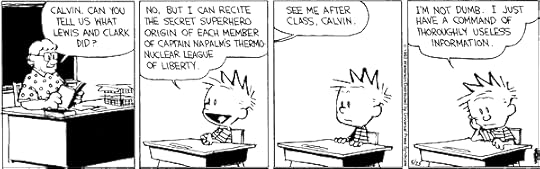
Here’s another bit of little-known and possibly useless information: No piece of paper can be folded in half more than seven (7) times.
Oh, go ahead. I’ll wait…
MORE USELESS FACTSDonkeys kill more people annually than plane crashes or shark attacks. (So, watch your Ass)
You burn more calories sleeping than you do watching television. (That’s especially true if you walk or jog in your sleep!)
Oak trees do not produce acorns until they are fifty (50) years of age, or older. (I guess growing old does have its benefits!)
The first product to have a bar code was Wrigley’s gum. (And there is a lot of Wrigley’s gum stuck under the bar too!)
The King of Hearts is the only king WITHOUT A MOUSTACHE (I think the Queen of Hearts has one though!)

American Airlines saved $40,000 in 1987 by eliminating one (1) olive from each salad served in first-class. (Today, they are saving millions of dollars by eliminating everything–including service.)
Venus is the only planet that rotates clockwise. Because Venus is normally associated with women, what does this tell you? (That women are going in the ‘right’ direction.? Hmmm)
Apples, not caffeine, are more efficient at waking you up in the morning. (And also keeping the witch doctor at bay.)
Most dust particles in your house are made from DEAD SKIN! (Yech!)
The first owner of the Marlboro Company died of lung cancer. So did the first ‘Marlboro Man’.
Walt Disney was afraid OF MICE! (I wonder why he never drew cats?)
PEARLS DISSOLVE IN VINEGAR! (That’s why I couldn’t find my wife’s pearls when they fell into my salad and I had a strange case of indigestion later.)
The ten most valuable brand names on earth: Apple, Coca-Cola, Google, IBM, Microsoft, GE, McDonald’s, Samsung, Intel, and Toyota, in that order. (What happened to Amazon?)

Geez, what’s THAT say about people who live in Louisiana?
It is possible to lead a cow upstairs…But, not downstairs. (That is “udderly” amazing!)
A duck’s quack doesn’t echo, and no one knows why. (Could it be that there’s a quack in the sound barrier?)
Dentists have recommended that a toothbrush be kept at least six (6) feet away from a toilet to avoid airborne particles resulting from the flush. (I keep my toothbrush in the living room now!)
Turtles can breathe through their butts. (I know some people like that, don’t YOU?)
And there you have it, a litany of useless information that you can wow friends and strangers with at a bar, a wedding, or a funeral–even your own!
May 19, 2021
California Dreamin’ or California Leavin’?
California is in trouble. For the first time since a prospector struck gold at Sutter’s Mill in 1849, California has recorded an annual net loss in population.
The state’s population, which has for years been inching toward the 40-million mark, actually dipped by 182,083 people last year as Californians packed up and headed for more business and taxpayer-friendly places like Texas, Arizona, Idaho, Nevada–and even Florida on the other side the continent.
And the exodus is not finished. More are expected to flee the tarnished “Golden State” in 2022.
I’m not surprised. California’s ultra-leftwing government, led by an inept, out-of-touch Democrat Gov. Gavin Newsome, is driving businesses and a frustrated electorate out of the state with a barrage of higher taxes, onerous regulations, and skyhigh prices for everything from gasoline and housing, to food and clothing.
The Golden State was always a beacon that attracted people from across America and the globe. The state was synonymous with opportunity and prosperity–where the sky was the limit if you were hardworking and creative. Of course, that was before the state became a political monopoly controlled almost exclusively in Sacramento by leftist Democrats.
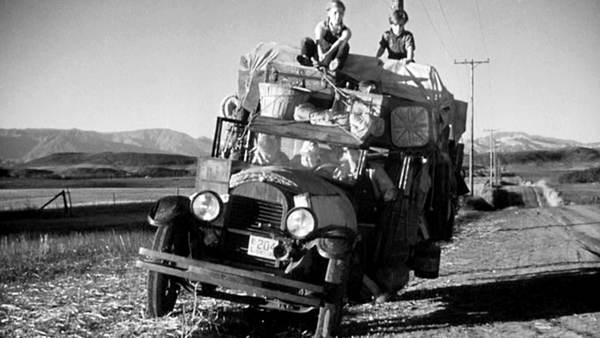 The Joads Arrive in the Golden State in “The Grapes of Wrath”
Even before the COVID-19 pandemic, California had the highest poverty rates in the nation based on the Census Bureau’s cost-of-living-adjusted standard.
And here’s more news I never expected to hear about California. It ranks 50th; dead last; at the bottom of the heap, of all American states when it comes to quality of life, according to a recent ranking by U.S. News & World Report.
I guess I shouldn’t be surprised by this revelation. After all, I live in California and I have witnessed what has happened to a state that once was the envy of the other 49.
California today is a terminus for the homeless, illegal aliens, MS-13 gang members, welfare cheaters, and clueless socialist politicians determined to transform the state into an abortive political and societal hodgepodge somewhere between communist Cuba and the impecunious wilds of Northern Mexico.
But let’s get back to the U.S. News analysis. The magazine’s quality of life rankings considered two sets of metrics for every state:
The natural environment, comprising drinking-water quality, air quality, and pollution, and industrial toxins.Social environment, comprising community engagement, social support, population density, and voter participation.And guess what? California ranked near or at the bottom in each of those categories.
 Gov Newsome: “Feckless & Out of Touch”
Little wonder. California is a mismanaged behemoth controlled by a mob of far-left zealots led by Gov. Newsome, the state’s supreme leftist potentate.
Democrat lawmakers are quick to remind us that California remains the world’s fifth-largest economy and that California’s tech industry is booming – as evidenced by an astounding $75.7 billion budget surplus in the midst of the pandemic.
They fail to point out, however, that the state still has a debt to GDP ratio of 15.6 percent. That means the debt for every one of California’s 39 million people is $10,818 and growing.
What they also won’t tell you is that median home prices are approaching $750,000 statewide and are actually above $1 million in some metro areas. They won’t tell you about the exploding homeless crisis; crumbling infrastructure; water shortages; lousy public schools; growing crime rates; and various governmental scandals. Then there are the annual wildfires caused by poorly managed, drought-stricken forests.
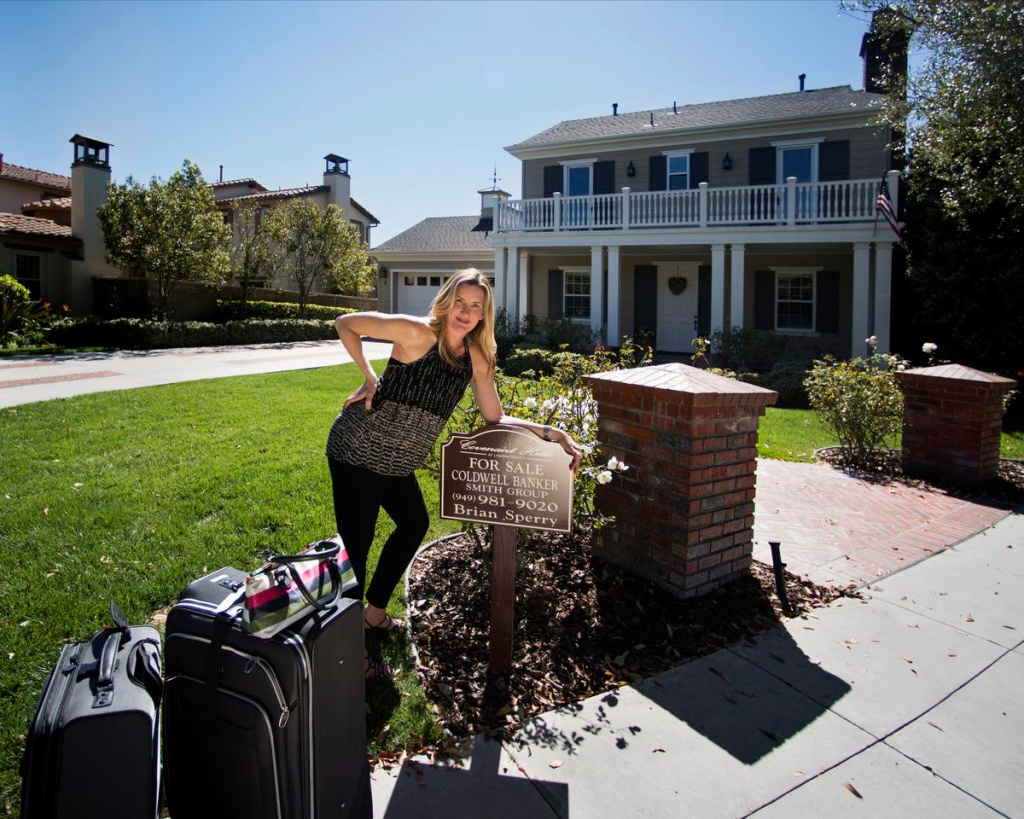 Jennifer Leach & family are heading for Colorado
The state has long been a lodestone for illegal immigrants, but since the governor declared California a “sanctuary state,” a tidal wave of illegals, many with criminal backgrounds, is sweeping over the state’s splintered social landscape.
It is interesting to note that California’s high cost of living and its rising illegal immigration rates were two metrics that did not factor into the quality-of-life rankings.
Yet both are among the most obvious and disturbing issues facing the state.
Sanctuary cities such as San Francisco, Los Angeles, and Oakland have opened their doors and coffers to illegal immigrants while American citizens are afforded the privilege of paying ever-higher taxes to pay for this foolish munificence.
Recently, I received a tongue-in-cheek story suggesting that Washington sell California back to Mexico for $10 trillion. A map depicted the new U.S.-Mexican border running from Texas all the way to Oregon. There are some who feel jettisoning California might be a good thing. After all, Mexico ceded California to the United States in 1848 after the Mexican-American War. Maybe it’s time to send it back. Ten trillion dollars would certainly offset a large portion of the U.S. national debt.
In any case, to watch California crumble before one’s eyes is disconcerting. But wait, you might ask, what about all of the millionaires living in places like Beverly Hills, Calabasas, Silicon Valley, San Francisco, San Diego, and the Orange County coast? How can California be disintegrating when you still have all that wealth?
 Number California’s Homeless approaching 200,000
The fact is, more than one-third of the state is now populated by immigrants, half of them illegal. Then, the state’s homeless population is growing at an alarming rate with some 30,000 in Los Angeles alone. In Orange County, thousands of homeless tents and hovels occupy miles and miles of land along the Santa Ana River. As a result, human feces, discarded hypodermic needles, and mounds of trash litter the bicycle path that runs between the fleapits and the river while expensive homes sit just a few hundred yards away. Census figures show that almost one-third of all of the nation’s homeless live in California.
To make matters worse, housing prices have gone through the roof, leaving only a minority of Californians able to buy a house. What about renting? In the Los Angeles area, including San Diego and Riverside Counties, rents for a one-bedroom apartment are running about $1,900 a month and for two and three-bedroom apartments and homes, rents are between $2,500 and $3,500 per month.
This is NOT the same California that I first moved to in 1976 or that former Governor Ronald Reagan oversaw between 1967 and 1975.
Yes, California is a state of incomparable wealth. The movie and music industries reside here as do enormously productive agricultural and high tech industries. In fact, California recently leapfrogged France and the United Kingdom to become the fifth-largest economy in the world with a gross domestic product of $2.5 trillion. Only Germany, China, Japan, and the European Union have higher GDPs.
So what’s the problem?
Let’s begin with the state’s water supply. It is unreliable and can barely sustain the current population and the needs of the state’s thirsty, drought-ridden agricultural sector. Then there is the crumbling infrastructure of freeways, roads, and bridges. To make matters worse, there is a wall of debt acerbated by an onerous and punitive tax structure, as well as a volatile budget system. Another recent study found that California ranked 49th in the cost of doing business and 50th in “business friendliness,” which translates into such things as onerous regulations, tax breaks, and quality of the workforce.
There are also missed payments and mounting debt for excessive public retirement benefits, rising healthcare costs and diminishing access to health care, unstable funding for K-12 education, and poor student performance compared to other states. In addition, there are new and harsh restrictions on gun ownership that many see as a direct assault on the Second Amendment. Add to that the state’s skyrocketing cost of living and declining homeownership and the welcome mat looks a bit soiled.
Finally, there is rising crime and an overcrowded and costly prison system as well as a lack of transparency and eroding public trust in government that is compounded by apathetic voters and consistently low voter turnout.
All of that adds up to California’s 50th ranking when it comes to quality of life for its citizens.
Is it any wonder that hundreds of thousands of over-taxed Californians and hundreds of companies are bolting the state every year for places like Texas, Arizona, and Washington?
Meanwhile, California continues to be the nation’s leading nanny state for illegals, the homeless, criminals, and those who swill at the public trough.
A recent editorial by the Southern California News Group may have said it best when it wrote:
“Every one of these problems is the result of long-standing state policy. You’ll rarely hear a state leader talk about opportunity – or admit that California has been actively chasing people away. It remains a great place to live, but only for those who already have achieved their dreams. The weather’s nice, but the political climate is chilling – even if the governor remains in denial.
“Population statistics are now finally catching up with reality. So, sure, the state’s first population drop in a century doesn’t change anything of substance – but it should change the way Californians view themselves. We’ve gone from “California dreaming” to “California leaving” and all the budget surpluses in the world won’t fix it.”
What’s next for the Golden State?
It could fall into the Pacific Ocean, I guess.
May 18, 2021
Kurt Vonnegut’s Greatest Writing Advice
Today, at the request of several followers and subscribers, I am reposting a commentary I did a while back about the late Kurt Vonnegut. It is jam-packed with great advice on writing. Enjoy!
It’s been 14 years since the world lost Kurt Vonnegut–one of America’s greatest writers and writing teachers. During Vonnegut’s 50-year-long career as an author, he published fourteen novels, three short story collections, five plays, and five works of non-fiction. Many more collections of his work were published after his death in 2007.
Vonnegut is most famous for his darkly satirical, best-selling novel Slaughterhouse-Five (1969), which was based on his own experiences as an American prisoner of war in Dresden, Germany when it was fire-bombed for three days by British and American bombers in February 1945. An estimated 25,000 civilians were killed during the raids. It was an experience he never forgot.
Here is some of his no-nonsense advice on writing–along with a bit of Vonnegut’s wry humor tossed in now and then. These bits of wisdom are gleaned from some of his essays and his many interviews. When I was a correspondent for the Chicago Tribune I was fortunate to have interviewed Vonnegut. He was a self-effacing man who never took himself or life too seriously. Once, when he was asked about life, he said this: “I tell you, we are here on Earth to fart around, and don’t let anybody tell you different.”
Here then, is some of his sage advice on writing for those of you who are writers and for those of you who love to read.
On proper punctuation:
Here is a lesson in creative writing. First rule: Do not use semicolons. They are transvestite hermaphrodites representing absolutely nothing. All they do is show you’ve been to college. (From A Man Without a Country)
On having other interests:
I think it can be tremendously refreshing if a creator of literature has something on his mind other than the history of literature so far. Literature should not disappear up its own asshole, so to speak. (From “an interview conducted with himself, by himself,” for The Paris Review)
On the value of writing:
If you want to really hurt your parents, and you don’t have the nerve to be gay, the least you can do is go into the arts. I’m not kidding. The arts are not a way to make a living. They are a very human way of making life more bearable. Practicing an art, no matter how well or badly, is a way to make your soul grow, for heaven’s sake. Sing in the shower. Dance to the radio. Tell stories. Write a poem to a friend, even a lousy poem. Do it as well as you possibly can. You will get an enormous reward. You will have created something. (From A Man Without a Country)
On the theory of teaching creative writing:
I don’t have the will to teach anymore. I only know the theory… It was stated by Paul Engle—the founder of the Writers Workshop at Iowa. He told me that, if the workshop ever got a building of its own, these words should be inscribed over the entrance: “Don’t take it all so seriously.” (From “an interview conducted with himself, by himself,” for The Paris Review)
On plot:
I guarantee you that no modern story scheme, even plotlessness, will give a reader genuine satisfaction unless one of those old-fashioned plots is smuggled in somewhere. I don’t praise plots as accurate representations of life, but as ways to keep readers reading. When I used to teach creative writing, I would tell the students to make their characters want something right away—even if it’s only a glass of water. Characters paralyzed by the meaninglessness of modern life still have to drink water from time to time. One of my students wrote a story about a nun who got a piece of dental floss stuck between her lower left molars, and who couldn’t get it out all day long. I thought that was wonderful. The story dealt with issues a lot more important than dental floss, but what kept readers going was anxiety about when the dental floss would finally be removed. Nobody could read that story without fishing around in his mouth with a finger. Now, there’s an admirable practical joke for you. When you exclude plot, when you exclude anyone’s wanting anything, you exclude the reader, which is a mean-spirited thing to do. You can also exclude the reader by not telling him immediately where the story is taking place, and who the people are [and what they want].
And you can put him to sleep by never having characters confront each other. Students like to say that they stage no confrontations because people avoid confrontations in modern life. “Modern life is so lonely,” they say. This is laziness. It’s the writer’s job to stage confrontations, so the characters will say surprising and revealing things, and educate and entertain us all. If a writer can’t or won’t do that, he should withdraw from the trade. (From “an interview conducted with himself, by himself,” for The Paris Review)
On not selling anything:
I used to teach a writer’s workshop at the University of Iowa back in the 1960s, and I would say at the start of every semester, “The role model for this course is Vincent van Gogh—who sold two paintings to his brother.” (Laughs.) I just sit and wait to see what’s inside me, and that’s the case for writing or for drawing, and then out it comes. There are times when nothing comes. James Brooks, the fine abstract-expressionist, I asked him what painting was like for him, and he said, “I put the first stroke on the canvas and then the canvas has to do half the work.” That’s how serious painters are. They’re waiting for the canvas to do half the work. (Laughs.) Come on. Wake up. (From The Last Interview)
On love in fiction:
So much of what happens in storytelling is mechanical, has to do with the technical problems of how to make a story work. Cowboy stories and policeman stories end in shoot-outs, for example, because shoot-outs are the most reliable mechanisms for making such stories end. There is nothing like death to say what is always such an artificial thing to say: “The end.” I try to keep deep love out of my stories because, once that particular subject comes up, it is almost impossible to talk about anything else. Readers don’t want to hear about anything else. They go gaga about love. If a lover in a story wins his true love, that’s the end of the tale, even if World War III is about to begin, and the sky is black with flying saucers. (From “an interview conducted with himself, by himself,” for The Paris Review)
On a good work schedule:
I get up at 7:30 and work four hours a day. Nine to twelve in the morning, five to six in the evening. Businessmen would achieve better results if they studied human metabolism. No one works well eight hours a day. No one ought to work for more than four hours. (From an interview with Robert Taylor in Boston Globe Magazine, 1969)
On “how to write with style,” aka List #1
Find a subject you care about
Find a subject you care about and which you in your heart feel others should care about. It is this genuine caring, and not your games with language, which will be the most compelling and seductive element in your style.
I am not urging you to write a novel, by the way—although I would not be sorry if you wrote one, provided you genuinely cared about something. A petition to the mayor about a pothole in front of your house or a love letter to the girl next door will do.
Do not ramble, though
I won’t ramble on about that.
Keep it simple
As for your use of language: Remember that two great masters of language, William Shakespeare and James Joyce, wrote sentences which were almost childlike when their subjects were most profound. “To be or not to be?” asks Shakespeare’s Hamlet. The longest word is three letters long. Joyce, when he was frisky, could put together a sentence as intricate and as glittering as a necklace for Cleopatra, but my favorite sentence in his short story “Eveline” is this one: “She was tired.” At that point in the story, no other words could break the heart of a reader as those three words do.
Simplicity of language is not only reputable, but perhaps even sacred. The Bible opens with a sentence well within the writing skills of a lively fourteen-year-old: “In the beginning God created the heaven and the earth.”

Have guts to cut
It may be that you, too, are capable of making necklaces for Cleopatra, so to speak. But your eloquence should be the servant of the ideas in your head. Your rule might be this: If a sentence, no matter how excellent, does not illuminate your subject in some new and useful way, scratch it out.
Sound like yourself
The writing style which is most natural for you is bound to echo the speech you heard when a child. English was Conrad’s third language, and much that seems piquant in his use of English was no doubt colored by his first language, which was Polish. And lucky indeed is the writer who has grown up in Ireland, for the English spoken there is so amusing and musical. I myself grew up in Indianapolis, where common speech sounds like a band saw cutting galvanized tin, and employs a vocabulary as unornamental as a monkey wrench.
In some of the more remote hollows of Appalachia, children still grow up hearing songs and locutions of Elizabethan times. Yes, and many Americans grow up hearing a language other than English, or an English dialect a majority of Americans cannot understand.
All these varieties of speech are beautiful, just as the varieties of butterflies are beautiful. No matter what your first language, you should treasure it all your life. If it happens to not be standard English, and if it shows itself when your write standard English, the result is usually delightful, like a very pretty girl with one eye that is green and one that is blue.
I myself find that I trust my own writing most, and others seem to trust it most, too, when I sound most like a person from Indianapolis, which is what I am. What alternatives do I have? The one most vehemently recommended by teachers has no doubt been pressed on you, as well: to write like cultivated Englishmen of a century or more ago.
Say what you mean
I used to be exasperated by such teachers, but am no more. I understand now that all those antique essays and stories with which I was to compare my own work were not magnificent for their datedness or foreignness, but for saying precisely what their authors meant them to say. My teachers wished me to write accurately, always selecting the most effective words, and relating the words to one another unambiguously, rigidly, like parts of a machine. The teachers did not want to turn me into an Englishman after all. They hoped that I would become understandable—and therefore understood. And there went my dream of doing with words what Pablo Picasso did with paint or what any number of jazz idols did with music. If I broke all the rules of punctuation, had words mean whatever I wanted them to mean, and strung them together higgledy-piggledy, I would simply not be understood. So you, too, had better avoid Picasso-style or jazz-style writing, if you have something worth saying and wish to be understood.
Readers want our pages to look very much like pages they have seen before. Why? This is because they themselves have a tough job to do, and they need all the help they can get from us.
Pity the readers
They have to identify thousands of little marks on paper, and make sense of them immediately. They have to read, an art so difficult that most people don’t really master it even after having studied it all through grade school and high school—twelve long years.
So this discussion must finally acknowledge that our stylistic options as writers are neither numerous nor glamorous, since our readers are bound to be such imperfect artists. Our audience requires us to be sympathetic and patient readers, ever willing to simplify and clarify—whereas we would rather soar high above the crowd, singing like nightingales.
That is the bad news. The good news is that we Americans are governed under a unique Constitution, which allows us to write whatever we please without fear of punishment. So the most meaningful aspect of our styles, which is what we choose to write about, is utterly unlimited.
For really detailed advice
For a discussion of literary style in a narrower sense, in a more technical sense, I recommend to your attention The Elements of Style, by William Strunk, Jr. and E.B. White. E.B. White is, of course, one of the most admirable literary stylists this country has so far produced.
You should realize, too, that no one would care how well or badly Mr. White expressed himself, if he did not have perfectly enchanting things to say. (From “How to Write With Style,” published in the Institute of Electrical and Electronics Engineers’ journal Transactions on Professional Communications in 1980.)
On how to write good short stories, aka List #2:
1. Use the time of a total stranger in such a way that he or she will not feel the time was wasted.
2. Give the reader at least one character he or she can root for.
3. Every character should want something, even if it is only a glass of water.
4. Every sentence must do one of two things—reveal character or advance the action.
5. Start as close to the end as possible.
6. Be a sadist. No matter how sweet and innocent your leading characters, make awful things happen to them—in order that the reader may see what they are made of.
7. Write to please just one person. If you open a window and make love to the world, so to speak, your story will get pneumonia.
8. Give your readers as much information as possible as soon as possible. To heck with suspense. Readers should have such complete understanding of what is going on, where and why, that they could finish the story themselves, should cockroaches eat the last few pages.
The greatest American short story writer of my generation was Flannery O’Connor (1925-1964). She broke practically every one of my rules but the first; great writers tend to do that. (From the preface to Bagombo Snuff Box)
On ignoring rules:
And there, I’ve just used a semi-colon, which at the outset I told you never to use. It is to make a point that I did it. The point is: Rules only take us so far, even good rules. (From A Man Without a Country)
On the shapes of stories:
Here is a real treat. Click on this URL and you will see Vonnegut himself giving a waggish four-minute talk on The Shapes of Stories. You won’t be sorry!
May 15, 2021
A Note to ForeignCorrespondent Subscribers, Friends, and Visitors
Hello, subscribers and friends of ForeignCorrespondent.
You may have noticed a few changes on our blog in the past week or so.
Here’s what has happened.
First, we have simplified the method by which you can comment on posts. In the past, you were required to comment through the Facebook interface. That is no longer the case.
Now, all you have to do is register by creating a free account. You do that by clicking on the red “Create a Free Account” link at the bottom of every post, such as this one.
This is a ONE TIME exercise and once you have created an account you are automatically registered as a subscriber/member of the growing ForeignCorrespondent community and can comment quickly and easily.
Next, if you go to the main page of the ronaldyatesbooks.com website, in addition to a couple of book trailers you will see under the heading “The Latest From My Blog” short previews of twelve of my most recent blog posts. Just click on any of these and you will be taken to the ForeignCorrespondent Blog page where you can read the post you ticked.
That’s it.
But before I go, please feel free to share any of our posts or content with your friends or the public at large.
Cheers!
Ron Yates
May 14, 2021
CDC says no more masks or social distancing indoors & outdoors for fully vaccinated people!
Boo Hoo. Millions of mask-loving leftists and other human-sheep must be bawling their eyes out at this news.
I have never seen so many people dedicated to wearing face masks in my life—unless of course, we are talking about people who admire Spiderman, Darth Vader, Hannibal Lecter, Leatherface, or Doctor Doom—sometimes known as Dr. Fauci.
 Hannibal Loves His Face Mask
Yes, folks, Dr. Rochelle Walensky, director of the Center for Disease Control & Prevention announced unequivocally Thursday during a White House COVID-19 briefing that people who are fully vaccinated against coronavirus no longer need to wear masks while indoors or outdoors or physical distance in either large or small gatherings.
That seems pretty clear to me, folks.
 CDC Director Dr. Rochelle Walensky
STOP WEARING FACE MASKS INDOORS AND OUTDOORS & CEASE SOCIAL DISTANCING IF YOU’VE BEEN FULLY VACCINATED.
So now what? Here’s what I think is going to happen when it comes to COVID-19, aka, the Wuhan China Virus.
Because fully vaccinated individuals were still advised to wear masks while taking public transportation or in places like hospitals, prisons, and homeless shelters, the terrified bleating sheep among us will still demand that everybody continue to wear face masks in other indoor venues such as grocery stores, restaurants, gyms, and offices.

Just wait and see. What do you want to bet that signs like “Face Masks Required” will not disappear on entranceways anytime soon—despite the CDC’s new pronouncement.
Why? Because apparently, mask-wearing has become as American as apple pie and baseball. And if you refuse to slap that mask onto your mug, why you are just downright unpatriotic—or worse, you’re a domestic terrorist, white supremacist, or an evil Nancy Pelosi-hating insurrectionist.
Mask wearing is now an explicit political statement, like driving an electric car or being a vegan, or refusing to buy goods made by Uighur slave labor in China.
No, wait. That last item can be ignored. After all, Americans still need to buy stuff.
So what else did Dr. Walensky say Thursday?
“We have all longed for this moment when we can get back to some sense of normalcy. Based on the continuing downward trajectory of cases, the scientific data on the performance of our vaccines, and our understanding of how the virus spreads, that moment has come for those who are fully vaccinated.
“I want to be clear that we followed the science here. While this may serve as an incentive for some people to get vaccinated, that is not the purpose. Our purpose here is as a public health agency to follow the science and to follow where we are with regard to the science and what is safe for individuals to do,” she said.
She added that individuals with weakened immune systems should consult a physician before giving up masks.
Now, do you get it, sheep people?
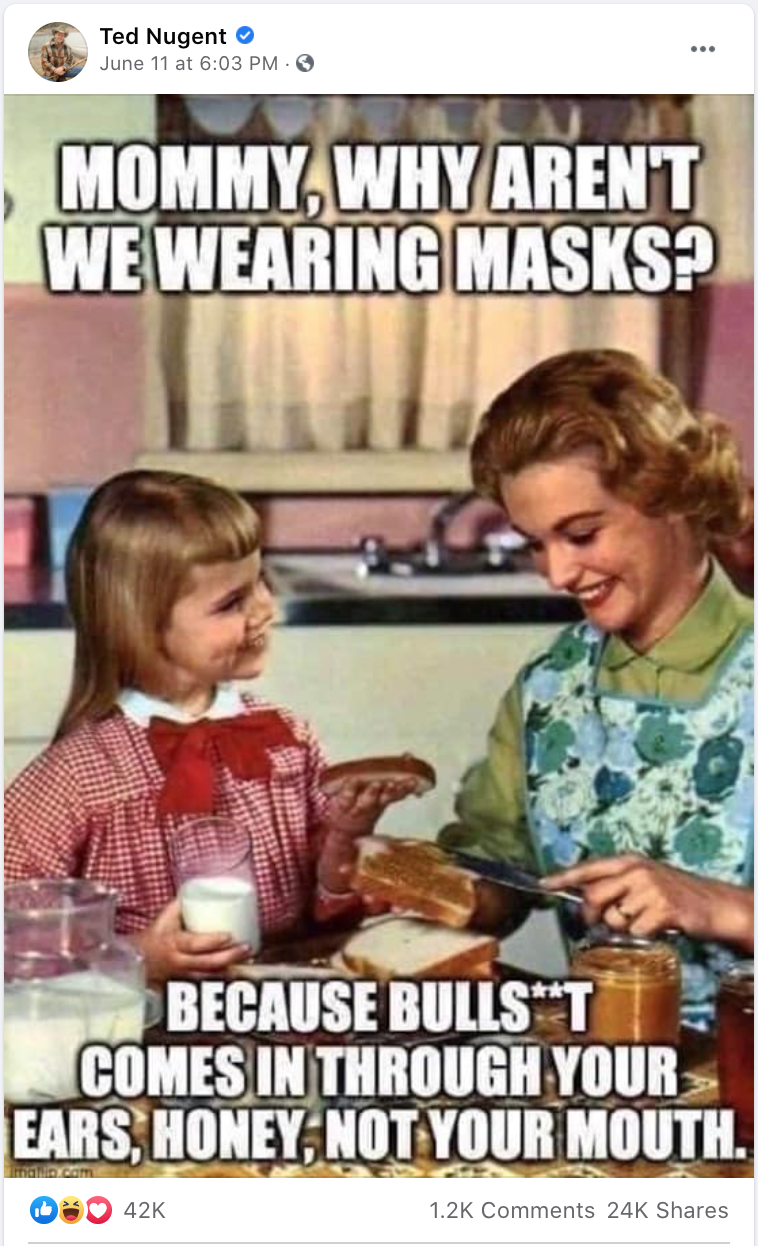
Not wearing a mask is SAFE. You will not get the China Virus and die if you brush against a mask-less fully-vaccinated brute in your local Safeway store or Costco, or Walmart.
Just think of it. You will survive innumerable brushes with these mask-less cretins, despite what millions of whining and panicky sheep people no doubt will tell you.

“You can’t believe the CDC,” the sheep people will bleat. “They have been wrong before. Please put your mask on. Be respectful of others. Don’t be unpatriotic.”
Maybe they will change their minds if they hear our stumbling, mumbling, bumbling president say it’s okay not to wear masks once you are vaccinated.
But wait! Biden did say that Thursday, echoing what Dr. Walensky said.
Never mind that good ole fully vaccinated Joe walked to the outdoor podium all by himself, wearing HIS mask.
A reporter asked what kind of message that sends Americans?

Joe flashed a big smile and said he wanted the cameras and media to see him take his mask off: “and watch me take it off and not put it back on until I got inside.”
But Joe, YOU NO LONGER NEED TO WEAR A MASK INSIDE!
“Never mind! Nothing to see here,” as the Scarlet Lady, aka press secretary Jen Psaki likes to say.
That’s just good ole stumbling, bumbling, mumbling Joe, being Joe.
May 13, 2021
American History: Twisted by Socialist Teachers & Professors
George Orwell once made this prescient statement: “The most effective way to destroy people is to deny and obliterate their own understanding of their history.”
Guess who was listening to the author of 1984?
Joe Biden was. So were the leaders of the American Federation of Teachers Union, the bogus wannabe historian named Nikole Hannah-Jones who created the fallacious 1619 Project, and the fatuous and Marxist Critical Race Theorists.
Apparently, they were all listening.
And now millions of America’s children are paying the price.
Instead of learning that the United States was created out of the 1776 Declaration of Independence by men and women seeking to break away from a tyrannical British Empire, they are learning that our nation was actually created in 1619 when a foreign ship carrying a few dozen African slaves arrived on the shores of what someday would become the United States of America.
The 1619 Project, which is being rammed down children’s throats in countless schools administered by a growing cadre of socialist/Marists, says the following:
“American colonists fought for independence from the British Empire on the grounds that an America untethered from Britain would allow the institution of slavery to flourish”
That allegation is so wrong, so factually inaccurate, that leading historians (BTW, Hannah-Jones is a journalist, not a historian) of both conservative and liberal persuasions, systematically went through her research and found no evidence supporting her contention. They did, however, find a trove of historical inaccuracies and distortions.
But hey, Joe Biden and the American Federation of Teachers Union, to whom our stumbling and mumbling president is beholden, are not letting that little fact get in the way of their plan to indoctrinate children to the point that they grow up despising the country they were born in.
And never mind that for most of its 230-plus years America has been a beacon of hope and freedom for millions of the world’s politically and socially oppressed people. What does it say on the Statue of Liberty in New York Harbor?
“Give me your tired, your poor,
Your huddled masses yearning to breathe free,
The wretched refuse of your teeming shore.
Send these, the homeless, tempest-tossed to me,
I lift my lamp beside the golden door!?”
No, slavery is what defines and has defined America from the time the first Europeans arrived at Plymouth Rock—not what is inscribed at the base of Lady Liberty.
After all, we fought the Revolutionary War to preserve slavery, right?
Wrong.
But we actually DID fight a brutal and bloody Civil War TO END slavery. That was a war in which more Americans died (a majority of them white Americans) than in any other war in our history—620,000.
And by the way, the United States is the ONLY nation EVER to fight a war to END SLAVERY!
The Critical Race Theorists and Hannah Jones would have our children believe that somehow slavery was “unique” to America, when in fact, slavery has been a fact of human existence for millennia. The Roman Empire enslaved millions of people, as did the Egyptians, the Greeks, Arabs, the Chinese, and even the tribes of Africa.
In fact, slavery existed in the New World among the native populations in North and South America when the Spanish and Portuguese arrived to pillage and plunder in the 1500s.
It didn’t begin in 1619 with the arrival of a ship carrying African slaves. It was already here, and flourishing, thank you very much.
Next in the erroneous and specious history curriculum created for young and malleable American minds is the preposterous and outrageous notion of Critical Race Theory which insists that America is a systemically racist nation, always has been, and that white people are inherent and irredeemable racists by virtue of their birth.
Rather than me arguing against this patently absurd notion, I will turn to Dr. Carol Swain, retired professor of political science and law at Vanderbilt University, who is also a scholar in the areas of race relations, immigration, representation, evangelical politics, and the United States Constitution. Dr. Swain also served as vice chairman of the 1776 commission, which President Biden abolished on the first day he took office.
 Dr. Carol Swain
God forbid that a President of the United States should allow children and others to learn about the TRUE founding of our nation. Instead, let’s make sure they drink the poisonous Kool-Aid of the 1619 Project and Critical Race Theory.
Here is what Dr. Swain has to say about CRT:
“Let me explain what critical race theory is. It comes out of Marxism. And it divides the world into oppressors and the oppressed, or the victims. Minorities are the victims. White people are the oppressors. It argues that all White people are racists. That they have a property interest in their whiteness. That they should divest themselves of their whiteness. And they divest themselves by becoming anti-racist.
“And you become anti-racist by actively engaging in the society in fighting racism wherever it appears. The problem is the left continually redefines what is considered racist. And the whole exercise of this diversity, equity and inclusion training focuses on making white people aware of their privileges that are undeserved – that is tied to the sins of their fathers and themselves.
“CRT argues that all white people are racist. It’s not enough to say that you are not a racist. You have to actively do something that proves that you aren’t. The problem in America, and the problem for churches, is that it’s like a whole new gospel because it requires every white person to confess with their mouths that they are racists.
“Because they were born with white skin color, they are required to become woke. And when they become woke, then they have to engage in anti-racist behavior to make themselves right on this issue.
“In America it is unconstitutional, I believe, it’s a violation of the equal protection clause to single out one particular race for shaming or for discrimination. It’s also a violation of the Civil Rights Act of 1964 that prohibits racial discrimination. And what takes place in those sessions, and in many orientation exercises, is a shaming of white people that would be inappropriate if it was being done to any other group.”
Well said, Dr. Swain.
And yet my grandchildren are learning that they are wicked and racist because of their white skin. They are being indoctrinated by a cadre of America hating socialist/Marxists who could just as well have been teaching American history in the old and now extinct “Evil Empire,” AKA. The Soviet Union.
So instead of listing to Henry Wadsworth Longfellow’s classic poem “The Midnight Ride of Paul Revere,” perhaps children will listen to teachers read from the incantations of Critical Race Theory about how Revere and his disgusting white male cronies went to war against the most powerful empire in the world to preserve and sustain slavery.
They will learn that they are little racist oppressors while their fellow black, Hispanic, and Asian classmates will be told they are victims of oppression.
Way to encourage Americans to judge people by the color of their skin rather than by the content of their character, President Biden.
Was Martin Luther King wrong to say that is the way he wanted his children to be judged?
I think not. What MLK said was brilliant and should be the guiding principle in ALL American schools.
Instead, they are being taught the 1619 Project and Critical Race Theory.
I can’t help wondering if American children and students might begin to question the flawed notions of CRT and the 1619 Project when they recall that the United States is a nation of immigrants.
When they do, I hope they will ask their teachers this question: Why do millions and millions of people of all races, religions, and ethnicities continue to risk their lives every year to enter a systemically racist nation where they will be oppressed?
I wonder how their teachers will answer THAT question.
Above: Detail from a watercolor of four American soldiers from the diary of Jean Baptiste Antoine de Verger, an officer in Rochambeau’s army, painted during the Yorktown Campaign, 1781. The African American soldier is an enlisted man in the First Rhode Island Regiment. Anne S.K. Brown Military Collection, Brown University.
May 12, 2021
Is America a Nation of “Wussified” Men?
In an era where there is a lot of complaining about “toxic masculinity” (a bogus term as far as I’m concerned), Hollywood has apparently unilaterally decided that men in today’s films need to be “feminized” or cerebrally castrated in order to satisfy the “wussification factor” spreading throughout America.
What do I mean by the “wussification factor?” Simple. I mean the apparent strategy in our K-12 schools to turn little boys and adolescent young men into namby-pamby, effeminate geeks.
Boys are too often discouraged and berated by teachers for being “too assertive,” for “rough-housing,” for good-naturedly cuffing one another, and even arm-wrestling—in short, for behaving like boys have always behaved the world-over from time immemorial.
These “wussified” boys then grow up confused about their gender, their masculinity, and their role in a feminized society where girls and women are given special and preferential treatment when it comes to college admissions and hiring in the workplace.
You only have to examine the kind of trash Hollywood is turning out these days to see how this has manifested itself in our nation.
 Dwayne “The Rock” Johnson
In film after film men the size of Dwayne “The Rock” Johnson, Tom Hardy, and Channing Tatum somehow are beaten senseless by 110-pound women.
Those who aren’t muscle-bound, cower when faced with danger and kowtow to those in power.
But more alarming than Hollywood and the entertainment media’s assiduous emasculation of men is what is happening in our military today. It is being “dumbed down” in terms of physical requirements in order to accommodate women and a growing transgender element.
As a result, I worry about unit and task cohesion, combat effectiveness, and the bonding of soldiers that is necessary for an efficacious fighting force. I don’t believe the military should be a laboratory for conducting societal and gender experimentation.
[image error] Building Critical Unit CohesionThe military has one purpose: to fight and win wars when and wherever needed. At least that’s what I was taught during my four years of active duty in the U.S. Army.
How many of you recall the 1978 Willie Nelson and Waylon Jennings song, “Mamas Don’t let your Babies Grow up to be Cowboys?”
“Mamas, don’t let your babies grow up to be cowboys.
Don’t let ’em pick guitars or drive them old trucks.
Let ’em be doctors and lawyers and such.
Mamas don’t let your babies grow up to be cowboys.
‘Cos they’ll never stay home and they’re always alone.
Even with someone they love.”
Today, the title of that song, at least in the minds of many, should be rewritten to: “Mamas, Don’t let your Cowboys Grow up to be Babies.”
Take a listen to Tony Joe White singing just that song here:
https://www.youtube.com/watch?v=sD8P2-Aw718
Men, for some reason—especially white men, are somehow considered an “existential threat” if they are determined, overtly masculine, decisive, resolute outdoor types who hunt, fish, drive pick-up trucks, enjoy contact sports like football, boxing, MMF, and hockey, and generally behave as most men have always behaved on this planet—like men.
But not in 2021 America. Here they are called “domestic terrorists,” and worse.
Hollywood deems those hearty souls “brutes” and “beasts” who are in need of some form of “comeuppance.” Intriguingly, it seems to be okay for Hispanic or black men to be masculine, but not white men. Why is that? Is it because we are being fed the ubiquitous and pervasive B.S. about “white supremacy” running rampant in our country?
Possibly, but I confess, I don’t have the answer. However, Hollywood apparently thinks it does—especially when it comes to portraying elements of manhood in films.
But, hey, this is just me prattling on. I wonder what others think?
Here’s one individual who has examined and studied all of this through the lens of Hollywood and has arrived at some interesting conclusions. Take a look.
Educator and writer Jeff Minick says America is turning out a nation of male “snowflakes.”
“Recently, I heard a woman in the coffee shop where I sometimes write expressing her dismay and astonishment that one of her employees, a 20-year-old male, had sent his mother to work to discuss problems her son was having on the job,” Minick recently wrote.
“Not good,” he continued. “Most of us have heard of the “helicopter moms” who call professors or college administrators to protest a bad grade or disciplinary action earned by their sons. Some of these young men are old enough to buy beer, drive a car, and enlist in the Army, but rely on Mommy to do their fighting for them.”
“When we treat legal adults as children, we are creating what C.S. Lewis called “men without chests.”
On the other hand, Minick writes, history both ancient and modern reveals an army of mothers who raised their sons to enter into the fray of life.
As their sons marched off to war, Spartan mothers called out, “Come back with your shield—or on it,” meaning come back honorably alive or bravely dead.
Cornelia of Ancient Rome regarded her two boys as her jewels and reared them to be fighters and patriots.
Andrew Jackson’s widowed mother raised her son to be tough, telling him in the last words she would speak to him:
“You will have to make your own way” and “Sustain your manhood always.” Later Jackson would say of her, “She was gentle as a dove and as brave as a lioness. Her last words have been the law of my life.”
Of course, today Andrew Jackson is vilified for his belligerent and assertive conduct, both as a general and as our seventh president. Never mind that “Old Hickory” defeated the British at the Battle of New Orleans in 1815 and survived an assassination attempt in 1835, beating senseless his would-be assassin with his walking cane.
Today, such a display of toxic masculinity would be condemned by the snowflakes who comprise the majority of our news media.
But when I look at President Biden, stumbling his way up a ramp to Air Force One and bumbling his way through a light sprinkling of fluffy questions from deferential and sycophantic reporters that behave more like caregivers in a nursing home than the watchdogs of government they are supposed to be, I am more convinced than ever that America is in serious decline.
When our president must be protected from an obsequious and feeble media, I find myself wondering if we will ever see another president with a spine like Andrew Jackson, or Teddy Roosevelt, or Ulysses S. Grant.
Then, I think, maybe it is time that a woman becomes President of the United States. Because I’m not sure if there are any men left in this country who are as tough, independent, and as gristly as some of the women I know.
And I know damn well they won’t be accused of displaying “toxic femininity.”
May 4, 2021
TOOLS OF A FOREIGN CORRESPONDENT, THEN AND NOW
Back in 1975 B.C. (Before Cyberspace), I lugged a 17-pound Olivetti Lettera 32 portable typewriter from the jungles of Cambodia to the central highlands of Vietnam as I covered the fall of both countries to communist forces.
That Olivetti never failed me, though it took a severe pounding as I jumped on and off helicopters, bounced down rutted roads in jeeps and trucks, and exposed it to 110-degree temperatures and monsoon rains.

Its solid, blue metal shell behaved like armor plating. No matter how much I threw that typewriter around or how often I dropped it when I unzipped the vinyl case and pulled it out, the platen always held my paper in position, and the keys always worked.
In 1975, this was state-of-the-art technology. Tough. Dependable. Cheap. Easy to maintain.
Today that Olivetti resides on a shelf in my garage. And I am sure if I cranked a sheet of paper into it and began banging on the keys, those low-tech black letters would start marching, albeit haltingly, across the page, just like the old days.
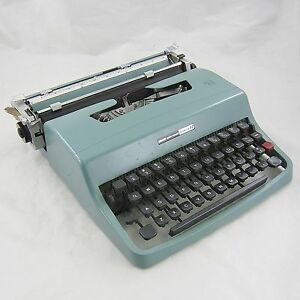 My Olivetti Lettera 32
But as reliable and sturdy as that old Olivetti was, would I consider lugging it back to Vietnam if I were to return for the 47th anniversary of the fall of Saigon on April 29? Not on your life. Of course, that’s a moot point now because of the Wuhan Coronavirus unleashed on the world by China.
Instead, I would carry my Dell laptop computer. Unlike my old typewriter, the Dell XPS 7590 weighs only 4 pounds.
And, unlike my portable typewriter, it is crammed with software products that allow me not only to write my stories and record notes, but to do my expense reports, communicate with the outside world, keep track of contacts and sources, and even play games when I get tired of doing real work—all in living color.
 My Dell XPS 7590
 If I were able to go back to Vietnam, I would sit in my hotel room in Saigon with the Dell’s screen aglow and wonder how I ever got along without this kind of technology in 1975.
The answer seems obvious enough. Most of the work a correspondent does involves observation and interviewing, otherwise known as reporting.
These are things that no machine—not my low-tech Olivetti typewriter nor a high-tech Dell laptop–can do for you.
There is little doubt that the actual process of writing this time around in Vietnam would be made infinitely easier by the Microsoft Word program inside the Dell.
After all, in just a few seconds, I could spell-check my story and even use Word’s electronic thesaurus to juggle adjectives and verbs. Try that on a portable typewriter.
Today, I think about all those times in 1975 that I found myself in the Vietnamese outback with a story written, but with no way to get it back to the Chicago Tribune. Few Vietnamese cities outside of Saigon had a public telecommunications office where you could take a hard copy of your story, punch it into a telex machine, and have it transmitted to Tribune Tower 12,000 miles away.
That meant you had to “pigeon” your story. “Pigeoning” a story meant that after I reported it and wrote it on my portable typewriter, I would jump into a taxi and head for the nearest airport.
There I would run frantically through the terminal looking for a pilot—often one of the CIA’s Air America airplane drivers—and give him my story to take back to Saigon.
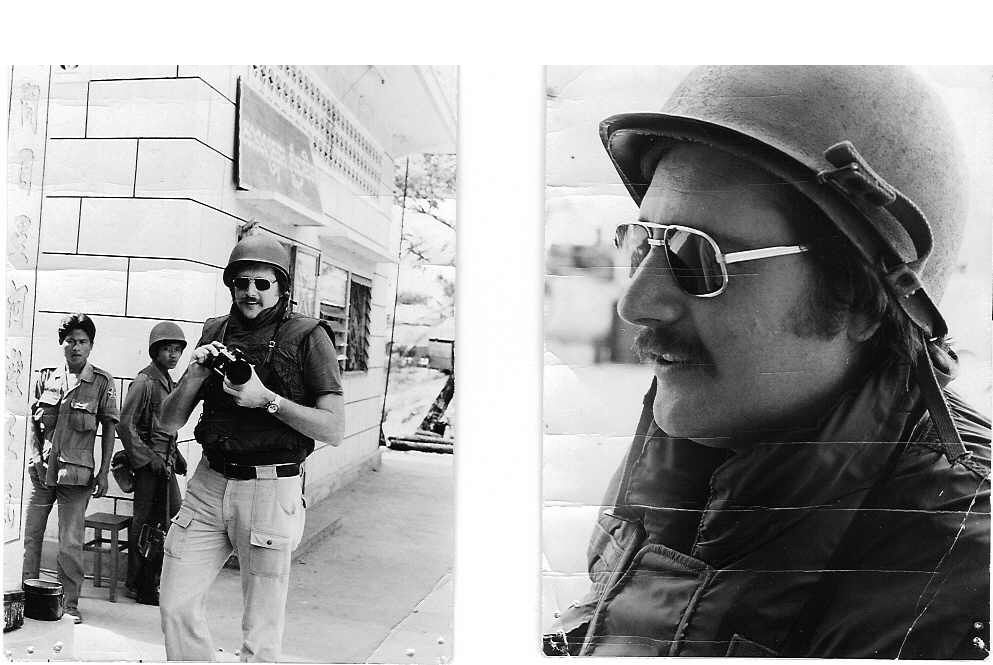 Your humble correspondent covering Cambodia & Vietnam 1975
Once in Saigon, the pilot would drop the story off at the PTT (Public Telephone and Telegraph) office, and a congenial young woman named Miss Minh would unfold the crumpled pages and try to decipher all of the barely legible editing notes I scribbled in the margins.
Then Miss Minh would switch on her telex machine and convert the whole thing into about 20 feet of paper telex tape. That done, she would dial-up 253638, which was the Tribune’s old telex number.
 A Telex Machine ca. 1975
If all systems were “go,” then maybe 10 or 15 minutes later, one of the Tribune’s old gray telex machines would hump its carriage a few times, ring a few bells, and my story would clank forth, printed on an 8-inch-wide roll of yellow paper.
The total elapsed time from when I finished the story until that old telex machine regurgitated it in the Tribune’s wire room would be close to 8 hours. It might be longer if the pilot stopped off at the Continental Palace Hotel’s veranda for a few beers before trudging down Le Loi Boulevard to the PTT office.
The cost for all of this could run close to $200 because, in addition to the $160 or $170 it cost to transmit the story, I was obligated to buy dinner or several rounds of drinks for the pilot when I returned to Saigon. Today, I could send that same 1,500-word story with the Dell in less than a minute the Internet. The cost? Negligible.
Back in 1975, it not only cost more to get a story from Saigon to Chicago, but the psychic outlay of pigeoning a story was substantial.
After all, I had no way of knowing if the story I handed to a pilot was sent until I returned to Saigon several days later.
About the only thing that comes close to equaling that sensation in this, the computer age, is that plummeting feeling you get when the hard drive in your laptop fails, and you haven’t backed up your work.
In 1975, my backup system consisted of a few sheets of threadbare carbon paper and a tattered 8-by-11 manila envelope. There were no CMOS batteries, no fragile hard disks, and no central processors to worry about— unless you counted me.
There is no doubt that advanced computer technology, for all its brilliance, comes with drawbacks. For example, what would I have done with a laptop in Phnom Penh in 1975? The city, which was under constant bombardment by the communist Khmer Rouge, only had electricity an hour a day. That would have barely given me time to recharge my computer’s battery or the two nickel-metal hydride battery packs I could use as a backup.
 Your humble correspondent possibly contemplating new technologies in Saigon?
Then there is the most significant liability of all. I have a feeling I would treat an expensive laptop a lot differently than I treated my Olivetti typewriter.
For example, in 1975, I occasionally used my $99 Olivetti to shield myself from airborne shrapnel and the other fluttering detritus of war.
But I suspect that given the $1,149 price tag of a Dell XPS 7590, I might use my body to protect it during mortar and artillery bombardments.
Just consider the mathematics. You could buy about twelve Olivetti portables for the price of one Dell XPS 7590. And that’s not counting the software.
But then, when I think about all those times I trudged down Tu Do Street to attend the military briefings we used to call the “5 O’clock Follies,” and all the times I swore I would never again waste my time going to them, I’m convinced that the technological advantages of a 2020 laptop definitely outweigh the shrapnel-shielding capacity of a 1975 Olivetti.
For example, had there been laptops and on-line news retrieval in 1975, I could have plugged in my modem to the nearest phone jack and picked up the salient points of the Follies while sipping a vodka tonic at a table on the veranda of the Continental Hotel—otherwise known as the “shelf.”
On second thought, that might not have been a good idea. The obstreperous collection of hacks, soldiers of fortune, and castoffs that used to gather in the shelf and other watering holes in Saigon in those days tended to slosh drinks and spill plates of food.
And while my old Olivetti was irrigated more than once with Vietnamese “33” beer” and assorted food products, I shudder to think what a single glass of vodka or a small dish of Saigon fish sauce might do to the innards of a $1,200 laptop.


![[image error]](https://ronaldyatesbooks.com/wp-content/uploads/2018/03/th.jpg)
![[image error]](https://ronaldyatesbooks.com/wp-content/uploads/2020/03/Slaughterhouse-Five_first_edition_-_Kurt_Vonnegut.jpg)
![[image error]](https://ronaldyatesbooks.com/wp-content/uploads/2021/05/children-doing-pledge-of-allegiance_u-l-pyldig0.jpg)
![[image error]](https://ronaldyatesbooks.com/wp-content/uploads/2021/05/African-American-History.jpg)
![[image error]](https://ronaldyatesbooks.com/wp-content/uploads/2021/05/Unit-cohesion.jpg)
![[image error]](https://ronaldyatesbooks.com/wp-content/uploads/2021/05/i-refuse-to-accept-as-guilt-the-fact-of-my-own-existence-quote-1.jpg)
![[image error]](https://ronaldyatesbooks.com/wp-content/uploads/2021/05/overview-Andrew-Jackson.jpg)