
Luke Gilkerson's Blog, page 3
November 2, 2015
3 Big Covenant Eyes Improvements
Covenant Eyes is pleased to announce three major improvements to our services.
Improvements to Your Online Account – When you sign into My Account, you can now see all the users on your account as tiles (they used to be just in a list). This will allow you to see and edit nearly every setting for each user all from that main user management screen.
Improvements to Accountability Reports – Our Report improvements include…
We gave the Reports a more modern look, making them easier to read.
We added a Summary module at the top of the Report so you know right away what items need closest attention.
We cleared up some of the confusing jargon on our Reports, making the language clearer.
Improvements to Our Android App – Next week we will have a beta version of our new Android Filter. This version provides protection on the most popular bowsers including Chrome, Browser, and Opera. Because we’re not able to filter every app yet, the Covenant Eyes Filter for Android will work best if combined with our built in App Locking feature.
July 2018 Update: We have released a new version of our app for Android. Learn more here.
The post 3 Big Covenant Eyes Improvements appeared first on Covenant Eyes.


October 21, 2015
Preaching About Sex: Using the Song of Solomon to Challenge a Porn Culture

Three thousand years ago, Solomon’s most celebrated love song, “The Song of Songs,” presented a very countercultural view of sex, one that shattered both pagan and prudish views of sexuality. Today, the message of the Song of Songs is needed just as much as when it was written, to speak to a culture that needs to know the goodness and power of sex in God’s created order.
To help us unpack this rich topic, we are speaking with George M. Schwab, Sr., Professor of Old Testament at Erskine Theological Seminary. Professor Schwab is author of several books in Old Testament studies, including the revised edition of the Expositor’s Bible Commentary of The Song of Solomon.
Shows Notes:
0:37 – What is the book, The Song of Solomon, all about?
1:52 – What does the book tell us about the woman’s family life before she was married? What does this tell us about the way in which love best flourishes?
7:21 – What does the book mean when it warns the reader not to arouse or awaken love until it pleases?
9:56 – Why does the woman ask the maidens of Jerusalem to swear by “the gazelle” or by “the does of the field”?
12:34 – How is sex described in the Song of Solomon? How did it challenge alternative views of sex in the past? How does the Song of Solomon challenge views of sex today?
18:14 – The Song of Solomon hearkens back to Genesis in several ways. First, how does it describe the covenant of marriage?
20:12 – Second, how does it describe marriage as a reclamation of the Garden of Eden?
Professor Schwab’s Divisions of the Book:
Poem #1 – 1:2-12
Poem #2 – 1:13-2:7
Poem #3 – 2:8-17
Poem #4 – 3:1-5
Poem #5 – 3:6-11
Poem #6 – 4:1-7
Poem #7 – 4:8-5:1
Poem #8 – 5:2-8
Poem #9 – 5:9-6:3
Poem #10 – 6:4-10
Poem #11 – 6:11-7:12
Poem #12 – 7:13-8:4
Poem #13 – 8:5-7
Poem #14 – 8:8-14
Get our weekly podcasts in your inbox
").append(e.clone()).remove().html();
e.siblings("input,select,textarea").before(fielddesc);
e.remove();
});
})(jQuery);
} } );jQuery(document).bind('gform_post_conditional_logic', function(event, formId, fields, isInit){} );
Listen to more of our podcasts on iTunes.
The post Preaching About Sex: Using the Song of Solomon to Challenge a Porn Culture appeared first on Covenant Eyes.
October 15, 2015
Why Playboy Is Saying Goodbye to Nude Photos (and why I have mixed feeling about that)
Playboy magazine’s editorial team has just announced they will no longer be featuring nudity.
I know what you’re thinking: “Um, what’s a magazine?”
Playboy just had its 62nd birthday this month. On October 1, 1953, the 27-year-old Hugh Hefner incorporated HMH Publishing Co., and just a couple months later, the first edition of Playboy magazine was published—with none other than the iconic Marylyn Monroe gracing its cover.
At the time, Hefner (“Hef”) didn’t even know whether his magazine would survive. But survive it did. The first issue sold out within weeks. Hef, 89, is now a self-made millionaire. The Playboy brand is now one of the most recognized in the world. Playboy Enterprises has spawned its own premium cable channel, whole network of pay-per-view channels, and a host of of websites. Its activist arm, the Playboy Foundation, has donated more than $20 million to fight censorship and promote research on human sexuality.
For many, this recent no-nudes move by Playboy seems out of step. In reality, it couldn’t make more business sense, and it’s hardly a win for those who support conservative sexual ethics.
The Mainstreaming of Pornography
A lot has changed in 62 years.
Pornography used to be a cultural taboo, an underground industry, but with Playboy came the first example of porn distributed through the main channels of American capitalism. And this was part of the commercial genius of Playboy. Hef created not just a pornographic magazine but a “lifestyle” magazine for upwardly mobile men. He created an identity for them—the image of the playboy. It was a magazine filled with articles about how to mix cocktails and hors d’oeuvres, how to set the mood with music, and how to engage a woman in quiet discussion about Picasso, philosophy, jazz, and, of course, sex. All of this pretense was placed alongside pictures of naked women. Thus the mainstreaming of adult media was born.
Today we live in a world where pornography is now largely accepted, especially by Millennials. According to a 2007 study among college students, 66.5% of young men and 48.7% of young women say viewing pornographic materials is an acceptable way to express one’s sexuality. Moreover, just as pornography has become normalized, so ordinary films, television, theater, music, and advertising have become more porn-like. Brian McNair of the Queensland University of Technology calls this “the pornographication of the mainstream.”
For all the jokes about “reading Playboy for the articles,” the magazine already boasts an impressive history of interviews from culture leaders: jazz legend Miles Davis, civil rights leader Martin Luther King, Jr., reclusive film director Stanley Kubrick, movie critics Siskel and Ebert, Apple founder Steve Jobs, and Beatles legend John Lennon. Award-winning writers have written for the magazine over the years, including children’s author Roald Dahl, James Bond‘s Ian Flemming, journalist Gabriel Garcia Marquez, and Fahrenheit 451‘s Ray Bradbury.
In other words, Playboy has always been a lifestyle magazine. Pornographic, yes, but the heart and soul of the magazine has always been to promote the life of the playboy—a life of sex, style, and pop intellectualism. The photos were, of course, what kept consumers coming back—which is what kept sponsors happy—but it was the magazine’s messaging and style that made it the bridge between pop culture and porn.
The Death of the Porno Mag
Playboy Enterprises CEO Scott Flanders says the political and sexual climate has dramatically changed in the last 62 years—and so has technology. “We are more free to express ourselves politically, sexually and culturally today, and that’s in large part thanks to Hef’s heroic mission to expand those freedoms,” Flander’s commented. Playboy has now been outdone by the changes it spearheaded—porn magazines are thing of the past. “That battle has been fought and won,” said Flanders. “You’re now one click away from every sex act imaginable for free. And so it’s just passé at this juncture.”
The new magazine will feature what they call more accessible and less airbrushed “PG-13” photos. It will have more a collectible look and feel, targeting urban young adult men. Sort of like Vice magazine, says Flanders, except “we’re going after the guy with a job.”
This recent move reflects the changing times. Way down from its peak subscriber base of 5.6 million in 1975, Playboy now has only 800,000. In some way, Playboy magazine is lucky its still around, since many nudity-filled “lads mags” have died in recent years—Nuts, Zoo Weekly, Gear, Front, and Loaded, to name a few.
It was only last year Playboy Enterprises decided to rebrand its website as a safe-for-work site and immediately saw explosive growth, averaging a 400% increase in monthly unique visitors and lowering the median age of its visitors from 47 to 30. Doing this allowed for greater sharability on social media, and so far this tactic has been working.
The magazine is now following suit in the hopes of resurrecting some of its former glory—and, of course, doing so in an age which might be very ripe for its messages.
Why This Isn’t a Moral Victory
It has been said that the real problem with pornography isn’t that it shows us too much sex, but that it doesn’t show us enough—enough of what real sex actually is. When you boil down the human person and sexual expression into a two-dimensional collection of pixels, this isn’t a celebration of sex. Instead, we are cheapening it. This is at the heart of why Judeo-Christian folks like me are opposed to porn—not because we hate sex but because we think its just too good be commercialized.
With these values in mind, what can we say about Playboy‘s changes? No doubt, having less crude and nude photos in the world is good for the human race, but there are several reasons why this isn’t exactly a victory for those with more conservative perspective.
1. This will only serve to boost the Playboy brand.
This rebranded image is, in some fashion, exactly what a “matured” Playboy would naturally look like in today’s sexualized culture. There’s no sense in trying to recreate the envelope-pushing magazine of yesteryear or trying to compete with hardcore video material available for free online. The porn industry, thanks in large part to Playboy, won the culture war already, and now they can bask in it.
Only time will tell how well Playboy‘s distribution will be impacted, but I think they have more than a fair shot at becoming the magazine they’ve always dreamed of being—a mainstream publication that promotes the playboy philosophy. As a progenitor of the Sexual Revolution, Playboy‘s brand has the benefit of more than half a century of nostalgia to buttress its business goals. Unlike the lads mags of our own day, Playboy Enterprises has always been more than just a juvenile fixation on prolonged adolescence and naked women. It is, at its heart, a consumer’s magazine—the naked girls are just one of the high priced commodities being sold to a class of lascivious, professional bachelors.
And like a good consumer’s magazine, if done well, it stands to make a lot of money.
2. This will inject Playboy content and messaging into an already pornographic youth culture.
The idea that Playboy would try to make itself more palatable to a younger crowd shouldn’t be a shock to anyone, but with this change, Playboy will likely be able to more easily market itself indirectly to underage consumers.
Now, this is nothing new for Playboy—the same magazine that featured the cartoon image of scantily-clad Marge Simpson on its cover back in 2009, the same business that had their mansion featured in the children’s movie Hop in 2011, and the same company that has placed its recognizable bunny-head logo on products attractive to children (Playmate Pink glitter cream and Bunny Pink lipstick are big hits with preteen girls).
3. This will serve as a clever cover for Playboy’s perverted past.
Saying Playboy has a perverse past is not to suggest its current plans are somehow innocent—far from it. Rather, as one might expect of a magazine that treats women like sexual trophies, Playboy‘s libido has taken its readers in very dark directions.
In the past, Playboy loved to eroticize the vulnerability of youth. In 1984, the U.S. Department of Justice funded a study examining the images of children in popular pornographic magazines. Over 3,000 child images, such as photos or cartoons, were found on the pages of Playboy, and 14% of these featured children in a happy or neutral sex scene with adults, implying incest or molestation. Most children portrayed were between six and eleven years of age. Moreover, more than 30% of Playboy images overall were found to be designed as “child magnets.”
This should hardly come as a surprise when we look back at what fueled Hefner’s creation of his magazine in the first place. Hef credits the work of Dr. Alfred Kinsey in the 1940s, which changed his whole perception of sex.
For anyone familiar with Dr. Kinsey’s work, he hardly needs (or deserves) introduction, but for those of us fortunate not to know, Kinsey’s influence on the field of sexology can hardly be overestimated. Kinsey’s work in the field of human sexuality was not only fraudulent but frightening. Up to 2,034 children were used in Kinsey’s experiments, though many are unaccounted for in the official research documents. Some children—even those documented in his books—were as young as 4 years old.
This was the deviant research that moved Hef to create a magazine that championed a new sexual ethic. He called himself “Kinsey’s Pamphleteer”—and indeed, that is exactly what he became.
4. Nudity isn’t the only way promote a misogynist message.
This new Maxim-for-professionals type of Playboy will hardly be a step in the right direction.
Psychologists from the University of Surrey and Middlesex University did an experiment where they took quotes about women from convicted rapists and then took quotes from men’s lifestyle magazines. They asked participants to label which ones came from sex offenders and which ones came from the men’s magazines, and most people could not distinguish the sources of the quotes. At best they were just guessing.
This is because the messaging of these kinds of magazines is clear, regardless how much nudity is present: women are objects to be used for the pleasure of men.
What Is a Playboy?
The move away from nudity in Playboy is, of course, a big shift in the identity of the magazine. But I will be saving my applause.
After all, what is a playboy? Before the word was associated with the brand, it was chiefly defined as a man who lives a life devoted primarily to the pursuit of pleasure. Regardless of how they do it—whether it is through nude centerfolds or pop intellectual drivel—the world doesn’t need more hedonist men. At least not more like Hef.
The post Why Playboy Is Saying Goodbye to Nude Photos (and why I have mixed feeling about that) appeared first on Covenant Eyes.
October 14, 2015
The Missing Foundation of Family Life

When couples hit a marriage crisis or when parents hit a parenting crisis, often what is needed is not just more or better information to solve the problems. Rather, what is needed most are deeper and richer relationships—relationships that equip us to react to one another in love, forgiveness, and compassion. Joy-filled relationships are the bedrock of family life and health.
Today, we are speaking to Keith Dorsche, creator of The Communication Cure, a simple product that helps families create joy-filled conversations and experiences.
(For faith-based talks, go to faith.thecommunicationcure.com.)
Show Notes:
1:07 – What is The Communication Cure and how is it used?
3:51 – Why did you create The Communication Cure?
8:57 – What research from the field of neuroscience shape the way The Communication Cure was designed?
12:47 – Did neurology play a role in both the audio and video experiences?
21:23 – How did the Scriptures shape the vision for The Communication Cure?
25:27 – If someone thinks this whole thing is a little corny, how would you convince people to give this a try?
Get our weekly podcasts in your inbox
").append(e.clone()).remove().html();
e.siblings("input,select,textarea").before(fielddesc);
e.remove();
});
})(jQuery);
} } );jQuery(document).bind('gform_post_conditional_logic', function(event, formId, fields, isInit){} );
Listen to more of our podcasts on iTunes.
The post The Missing Foundation of Family Life appeared first on Covenant Eyes.
October 8, 2015
Porn Use as Grounds for Divorce: How My Opinion Changed
“I am hurting so much over this…If I believed in divorce I would already have done it, and I am beginning to maybe believe divorce is ok. After all, this seems like a type of adultery to me. Am I wrong?” – Mary Ann
After writing more than 1,200 articles for Covenant Eyes and having replied to too many comments and e-mails to count, undoubtedly the most heart-wrenching stories I hear are from women who are living with a porn-addicted husband.
When a woman has discovered her husband is entrenched in pornography, reactions can vary greatly, but for many women it is nothing short of traumatic. Whether she’s dealing with the initial blow of uncovering a 20-year-long secret addiction, or she’s facing the daily blow of her husband’s coldness, for these women their life feels like a living hell.
In the past, when asked if divorce could ever be a viable option for these women, my typical response has been a reluctant no. As much as my heart went out to these women trapped in horrific marriages, I simply didn’t see any biblical justification for divorce in situations of porn use.
About a year ago I decided I was going to write my Master’s thesis about this topic and had intended to write a robust biblical defense of my position.
I never imaged for a minute I would come to the opposite conclusion.
Some Caveats
Divorce is ugly. We must acknowledge, when addressing the subject of grounds for divorce, the situation that even prompts us to ask this question is under divine judgment. It is a question that involves real hearts, real homes, and a real God. So it is with great sobriety that we take up this study.
Having grounds for divorce is not the same as actually getting divorced. This article seeks to answer the grounds question as it relates to pornography. But having legitimate grounds for divorce does not necessitate divorce.
This article is long and heady. This is not a delicate how-to article for couples in crisis. It is a clumsy attempt to summarize a 33,000-word theological Master’s thesis. Reader be warned.
The opinions expressed here are my own. Divorce is a contentious issue, and I won’t dare to assume a single article forever settles the debates. I only hope it is a significant addition to the discussion.
The Central Text: Matthew 19:9
The locus of the debate about whether pornography use is ground for divorce is Matthew 19:9:
“I say to you: whoever divorces his wife, except for sexual immorality, and marries another, commits adultery.”
Time and space do not permit me to get into every detail of this text, but a few observations are important:
1. This comment comes after a very strong affirmation about the divine intention for marriage. Just a few verses prior, Jesus says, “Have you not read that he who created them from the beginning made them male and female, and said, ‘Therefore a man shall leave his father and his mother and hold fast to his wife, and the two shall become one flesh’?” (Matthew 19:4-5).
Jesus uses a type of exegesis common early rabbinic Judaism called gezerah shavah, where the activity of God in the first text (making us male and female) is inferred in the second text (the two becoming one flesh). Thus, God is one who joins man and woman together in the covenant bond of marriage. God is the one who unites husband and wife in whole-life oneness. Therefore, what God has joined together, man should not separate (v.6). Marriage is meant to be a lifelong, loving covenant bond.
2. Jesus strikes at the Pharisees’ liberal view of marriage by saying all remarriages after invalid divorces are adulterous. In Jesus’ day, the majority position, promoted by Rabbi Hillel, was “any cause” divorce: any kind of indecency—real or imaginary—was grounds for divorce. As such, divorce was actually quite common among many of the Pharisees. This view is reflected in the Pharisee’s opening question to Jesus: “Is it lawful to divorce one’s wife for any cause?” (19:3). In other words, “Jesus, do you agree with Hillel’s position on divorce?”
Jesus’ answer is ruthlessly conservative: getting remarried to another is adultery after getting an invalid divorce. Jesus uses similar logic in other divorce texts (Matthew 5:32; Mark 10:12; Luke 16:18). Against all their cultural expectations of young men to get married, after hearing Jesus’ brazenly conservative view, even the disciples second-guess whether marriage is worth it (Matthew 19:10). Nonetheless, Jesus is stalwart in his view, assaulting the very attitude behind the Pharisees’ question. Marriage is never to be thought of as a casual union, subject to the cavalier whims of an lordly male. Marriage must be treated with respect and reverence.
3. Jesus nuances His view with an exception clause. Jesus’ conservative approach does not mean all marriages are completely undissolvable. After a marriage is severed, remarriage to another is not adulterous in the case of πορνείᾳ (porneia)—sexual immorality.
The majority Protestant position understands porneia to include any illicit sexual intercourse outside of marriage.*
The critical matter for our consideration is this: Would Jesus include pornography use as a divorcible offense?
Straw-Man Arguments
Generally, when I bump into those who think porn use can be grounds for divorce, I come across three very bad arguments. In the past, the weakness of these arguments kept me firmly convinced that pornography in itself could never be biblical grounds for divorce.
Bad Argument #1: Pornography is detrimental to a marriage, therefore it is grounds for divorce.
I agree pornography can be detrimental to a marriage, but grounds for divorce ought not be determined by how detrimental a sin is.
Some theologians want to stretch the definition of porneia to the breaking point, saying it encompasses all manner of offenses like emotional or physical abuse, blasphemy, or other generally destructive behavior. Quite simply, regardless of what we say about these terrible offenses, there’s nothing about the term porneia that suggests these meanings.
Bad Argument #2: Porn = Lust = Adultery = Grounds for Divorce
Viewing porn generally involves lust. In the Sermon on the Mount, Jesus said the man who looks at a woman lustfully commits adultery with her in his heart (Matthew 5:28). Jesus also said adultery is grounds for divorce—if we take porneia to mean adultery (Matthew 5:32; 19:9). Therefore, it is argued, viewing porn must be grounds for divorce.
There are a couple major problems with this argument. First, it misapplies Jesus’ own words. The intention of Jesus’ teachings in the Sermon on the Mount is to help His disciples understand the heart of the Law (Matthew 5:17). For instance, Jesus said to be innocent of murder is not enough; anger is also sinful and worthy judgment before the court and ultimately hellfire (v.21-22). It would be wrong to take Jesus’ hyperbolic comments about punishing anger and suggest we set up a formal tribunal to dish out penalties to those who speak harsh words to others. Similarly, to suggest spouses have grounds for divorce for moments of lust goes far beyond Jesus’ intention.
Second, to suggest instances of lust provide grounds for divorce is to give nearly any spouse in the world grounds for divorce. This liberalizes Jesus’ position so much it makes Him look like the Pharisees he was rebuking.
Bad Argument #3: Pornography Comes from the Word Porneia
Some use a linguistic argument showing porneia’s relationship to the modern term “pornography.” The term “pornography,” meaning “writings of/about prostitutes,” stems from the Greek porn– word group.
However, this is an exegetical fallacy. To interpret a Greek term by how that term has impacted modern languages leads to illegitimate conclusions. For instance, when the Bible says, “God loves a cheerful giver” (2 Corinthians 9:8), it uses the term ἱλαρός (hilaros) from which we get the English word “hilarious.” If we tried to use a modern definition of “hilarious” to help us define the meaning of the original Greek term, we would come to erroneous conclusions. This makes a mistake of chronology: the Greek authors of the New Testament are not responsible for the development of another language hundreds of years after they wrote their materials.
Doubt Sets In
In the past when I’ve commented on the subject of porn and divorce, my motivation has been to defend Jesus’ conservative view of marriage against the encroachments of liberalism—all the while, trying to show immense compassion for the person whose spouse is deeply mired in pornography.
I reasoned, “Sure, in instances where porn addiction escalates to physical adultery or when an unbelieving spouse is so mired in porn they utterly abandon the marriage, we can talk about the possibility of divorce. But porn use in an of itself is not a legitimate grounds for divorce.”
Generally, the question tends to be phrased this way: “Can pornography use ever be considered adultery?” If it can, some reason, it could be grounds for divorce. Of course, answers to that question will vary depending on who you talk to.
But I now believe we come to misinformed stances on this issue because we’re simply asking the wrong question.
A couple years ago I watched a short video interview with Pastor Douglas Wilson where he addresses this very question. Wilson’s point is that when Jesus uses the term porneia in Matthew 19:9, it is a broad term for “sexual uncleanness,” including adultery but not limited to adultery.
Not too long after this I read these words by Pastor John MacArthur in his book The Divorce Dilemma: God’s Last Word on Lasting Commitment:
In the Greek text, Jesus employs the word porneia, which is capable of a broad range of meanings. It is a general term for fornication (illicit sexual intercourse), but can also apply to various kinds of lascivious or immoral behavior, ranging from a moral flaw in one’s character (such as an obsessive addiction to pornography) to the act of bestiality—or even worse. It’s not the specific Greek word for adultery, which would be moicheia—but certainly includes adultery. (The Divorce Dilemma, p.23-24)
Here were two conservative theologians saying essentially the same thing: Jesus didn’t say “except for adultery”; He said “except for porneia,” which is a broader term.
I knew further investigation was warranted, so I set out to find answers.
So, What Does Porneia Mean?
Often, lexicons will define porneia as illicit or unsanctioned sexual intercourse or any sexual activity outside of marriage. The word can also have a nuanced meaning determined by context—such as a specific kind of sexual sin like incest or prostitution.
A widespread Protestant position on Matthew 19:9 is that Jesus is speaking primarily of adultery, and there’s good reason to think this. Nearly any kind of porneia you can name, when committed by a married person, is adulterous in effect. Adultery was the commonly assumed ground for divorce in the Near East in Jesus’ day, so undoubtedly, this was the primary manifestation of porneia that would have come to mind for Jesus’ listeners.
But there are many reasons to believe porneia is not merely a synonym for adultery—even though the terms are closely linked.
Porneia and adultery are often paired as separate sins in the New Testament (Matthew 15:19; Mark 7:22; 1 Corinthians 6:9; Hebrews 13:4).
In the New Testament, the term porneia sometimes implies not just isolated acts of sexual immorality but habitual immorality and an attitude of lasciviousness (Romans 1:29; Galatians 5:19; Colossians 3:5; Revelation 2:21).
Other works of Greek literature show porneia is not synonymous with adultery, but is rather the disposition and behavior that leads to adultery (Sirach 23:23; Herm. 1:3-8).
Sometimes the word is used to describe an attitude and motivation of lust and objectification (Tobit 8:7).
In other words, porneia focuses on the violating attitude and act, where as adultery focuses on a common effect of this act.
With this broader meaning in mind, it is best to not translate porniea as “adultery” (The Message) or “fornication” (KJV, ASV). The terms “unfaithfulness” (NLT, Phillips) or “sexual unfaithfulness” (CEB) could also lead be misleading. Rather “sexual immorality” (ESV, HCSB, NIV, NKJV) or “unchastity” (NRSV) are closer to the actual meaning.
Prostitution in Rome in the Days of Christ
The word porneia is also undeniably linked to the concept of prostitution. In Greek culture, the complexes where prostitution took place were called porneia. It was also a term of derision: people who held licentious parties in their homes were said to turn their houses into porneia. Thus, if we’re going to understand what the term porneia means, we need to understand the profession of prostitution as it was practiced in Jesus’ day.
Prostitution was practiced all throughout the Mediterranean region, including Israel, Egypt, Chaldea, Phoenicia, Syria—and especially Greece and later Rome. In the sixth century B.C., the statesman Salon of Athens was not only the “father of democracy,” he was also the father of state-sponsored sex slavery, establishing houses of prostitution in Athens and filling them with female slaves. Brothels were found throughout Athens, especially near the marketplace and in front of the citadel. Throughout Greece, it was generally accepted that young men and even married men would frequent prostitutes.
Rome essentially followed much of the Athenian model and developed laws to regulate prostitution. The first time Roman administrators established a full registry of Rome’s brothels there were 64 official bordellos containing 35,000 women and 2,000 men. Prostitution in Rome complimented the mixed sexual morals of the culture.
But the sex industry also had a vibrant and visible entertainment wing. In a class of their own were the prostitutes that engaged in formal entertainment: the aulētris (flute player), the psaltria (singer), and the orchēstris (dancer). With some exceptions, these entertainers had a generally low sexual and social status, though highly talented entertainers were counted among the upper-class courtesans. These entertainers were common at Athenian banquets and private parties. Ionian and Phrygian woman were widely know and well paid for their skills: a performance of flute playing, zither playing, or drumming combined with erotic dancing that amounted to a striptease. Often they had other skills such as juggling, fencing, and acrobatics.
While these entertainers also working the streets, they frequented Greek symposia (parties for socializing, drinking, intellectual discussion, and entertainment).There are numerous references to erotic dancers in comedic and sympotic literature. The comic playwright Aristophanes called these women “dancing pornai.”
Pornography as the Entertainment Wing of Prostitution
While the erotic dancers, singers, and flute players of ancient Rome were specialized entertainers in their own right, they were, at the heart of their profession, slave-prostitutes. Their erotic performances at banquets and symposia were a manifestation of their trade: the sale of their bodies for the pleasure of freemen.
The parallels between the modern porn industry and the symposia entertainers of Rome show us that the term porneia was not limited merely to behaviors involving sexual intercourse, but all kind of licentious behaviors, embracing both activity and attitude.
First and foremost is the nature of their professions: the sale of their bodies for sex and their roles as “entertainers” for the lusts and enjoyment of men. For the orchēstris of Rome, the open door symposia was their stage. For prostituted women today, their stage is millions of publicly accessible websites. Thanks to webcam technology, for instance, there is virtually no line between “interactive pornography” and virtual prostitution.
Like the brothels of ancient Athens and Rome, women in porn industry today are subjected to the same kinds of terrible conditions in their line of work: body-punishing sex, STDs, as well as a toxic and abusive environment.
Like many of the lowest class of slave-prostitutes in ancient Rome, many of those featured in porn films today are indeed trafficked women and children. Many are in positions of economic desperation—they “consent” but only in the most demented sense of the word.
Like the few select aulētrides of ancient Rome who climbed ladder of success to be counted among the wealthy and elite, the porn industry too has its superstars. Big money-makers branch out beyond their personal appearances in porn films to build a brand around their name, and like the prostitute-entertainers of old, gain a measure of freedom and wealth.
Like the socially respectable symposia of ancient Rome, the pornography industry in Western culture has become mainstream. With the proliferation of porn, in many circles casual or even routine engagement with porn is seen as normal and healthy. In addition, mainstream movies, television, theater, music, and advertising have become porn-like—what Brian McNair calls “the pornographication of the mainstream.”
The pornography industry is the entertainment wing of prostitution, just as the dancing girls of the brothels (the porneia) in the Roman Empire were the sources of entertainment for Roman nobility.
An analogy might bring some clarity to the question. At what point in the following series of scenarios does someone cease to be guilty of porneia?
Scenario #1: A man openly, habitually, and unrepentantly frequents prostitutes to have sex with them (clearly porneia).
Scenario #2: A man openly, habitually, and unrepentantly visits homes where prostitution is taking place, but instead of having sex with them, he immerses himself in the sex-saturated environment, watching the orgies, so he can masturbate in front of them.
Scenario #3: A man openly, habitually, and unrepentantly connects to prostitutes online to watch live-stream videos of them having sex with others while he masturbates.
Scenario #4: A man openly, habitually, and unrepentantly watches recorded videos of prostitutes having sex with others while he masturbates.
Scenario #5: A man openly, habitually, and unrepentantly watches the same videos as scenario #4, but the women don’t call themselves prostitutes. They call themselves “porn stars.”
Drawing a hard line is no easy task. The change of physical proximity, timing, or labeling of the participants does not change the fact that in each scenario the man is seeking the services of prostituted women to immerse himself in a world of licentiousness.
Jeremiah 3-4: The Key to Application
In my studies about this issue, the million dollar question I kept asking is this: How does a person differentiate between the everyday lusts of the heart and the kind of porneia Jesus says is a divorcible offense?
The answer is found in the rest of Jesus’ comments to the Pharisees.
After stating his position on the matter, the Pharisees ask Jesus, “Why then did Moses command one to give a certificate of divorce and to send her away?” (Matthew 19:7). The background to their question is the first century debate about Moses’ divorce legislation in Deuteronomy 24:1-4. If Moses permitted divorce, how does this square with Jesus’ very conservative position?
Jesus replies with this statement: “Because of your hardness of heart Moses allowed you to divorce your wives, but from the beginning it was not so” (Matthew 19:8). God permits divorce as a concession for the victims of partners with hard and stubborn hearts.
Behind Jesus’ answer is Jeremiah 3-4, God’s dire warning to Judah that judgment is coming unless she repents of her unfaithfulness. As her covenant husband (Isaiah 54:5; Jeremiah 2:2; Ezekiel 16:8-14), God wants to shower blessings on her, but she is rebellious, prostituting herself before other gods.
That this is the text in Jesus’ mind is evidenced by three major observations:
Jeremiah is clearly alluding to Moses’ divorce legislation from Deuteronomy 24 in his prophecy (Jeremiah 3:1,8). In fact, it is the one indisputable text in the whole Old Testament that makes reference to Moses’ divorce law—so it makes perfect sense why Jesus would appeal to it in light of the Pharisee’s question.
In the Greek translation of this text (the LXX), the term porneia is used to describe Israel’s sin. “Because she took her whoredom [porniea] lightly, she polluted the land, committing adultery with stone and tree” (3:9). Repeatedly, Judah’s sin is likened to prostitution (3:1-2, 6-10, 13), a sin for which God sent Israel away with a decree of divorce (3:8).
In the Greek translation of this text, the term “hardness of heart” (σκληροκαρδίαν) is used (4:4)—the same term Jesus uses to describe the reason why divorce is permissible in certain instances. Judah was not merely playing the whore. She treated her prostitution lightly (3:9). Judah refused to be ashamed of her sin (3:3). She was rebellious (3:13). Her seeming repentance was nothing but pretense (3:10). In a word, Judah was hardhearted.
In other words, if divorces must happen at all, they should happen according to pattern given to us by God Himself. God divorced Israel because of her porneia and hardness of heart, which amounted to more than just adultery—it was unrepentant rebellion.
On this basis, some Christian denominations have recognized Jesus did not mean that single acts of sexual thoughtlessness are grounds for divorce—not even in case of a physical affair—but rather Jesus was talking about persistent, unrepentant sexual sin.
The same is true of pornography use. Alone, instances of using pornography or even a habit of looking at porn are not the only factors to consider. Rather, it is critical to assess hardness of heart.
Thus, we should not think of grounds for divorce as a solid line one crosses but rather a continuum of heart-hardening rebellion. God did not divorce Israel after a single instance of spiritual adultery—had He done that, He would have divorced her at Mt. Sinai, or in the wilderness, or during the reign of the judges, or during Solomon’s reign. God was patient, but eventually He wrote Israel a bill of divorce and sent her away into exile because of her callousness.
Porn and Hardness of Heart: Practicing Discernment
Even if we’re convinced pornography use can be a manifestation of hardhearted sexual rebellion, how do we assess the state of someone’s heart?
The words of Jesus in Matthew 18:15-17 are particularly helpful in this regard. Here Jesus offers for His followers a model of confrontation in cases of persistent sin.
If your brother sins against you, go and tell him his fault, between you and him alone. If he listens to you, you have gained your brother. But if he does not listen, take one or two others along with you, that every charge may be established by the evidence of two or three witnesses. If he refuses to listen to them, tell it to the church. And if he refuses to listen even to the church, let him be to you as a Gentile and a tax collector.
Jesus presents a three-tiered approach:
In cases of pornography use, assuming the offending partner has not brought the offense to light of his own accord, the first people to discover the offense are often those closest to the situation. This can be spouse, a child, or even an employer. Regardless of the circumstances of the discovery, an individual Christian should approach the offending spouse to discuss the nature of his fault. This should be done with a motivation of restoration: “If he listens to you, you have gained your brother.”
If this confrontation is not followed by a process of clear repentance and reconciliation, “one or two others” should then become involved. These two or three individuals—ideally those who are spiritually mature and objective—can lovingly confront the offender and, if necessary, provide witness to the confrontation should the case be brought to the church as a whole later on.
If this conversation or series of conversations are met with a refusal to listen, the church should be made aware of the sin. How one should “tell it to the church,” of course, involves discernment and will depend somewhat on how the church is governed. In this third stage, the goal is still restoration, not unnecessary humiliation.
If this final confrontation is met with stubborn refusal to listen, the result should be excommunication: “let him be to you as a Gentile and a tax collector,” that is, as an outsider and unrepentant sinner. And yet even this should be done in a spirit that aims at the sinner’s eventual repentance (1 Corinthians 5:5; 2 Thessalonians 3:14-15).
As for the offended spouse, this process of church discipline should serve as a divinely given means to both expose hardness of heart as well as push the erring person in one direction or another.
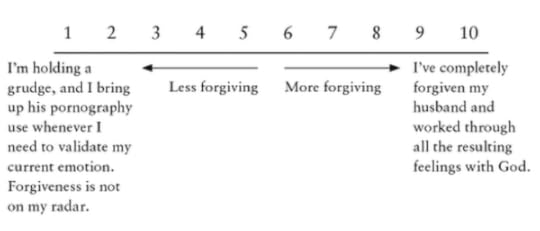
Vicki Tiede, in her book When Your Husband is Addicted to Pornography, advocates for women to go through these three levels of confrontation prescribed in Matthew 18:15-17. Tiede includes a couple helpful diagrams for wives to consider so they can discern the Lord’s will in their situation. First, she asks women to consider their own hearts: on a scale of 1 to 10, how forgiving they have been with their husbands?
Next, she asks women to examine their husbands’ hearts, evidenced by their behavior: on a scale of 1 to 10, how repentant have their husbands been?
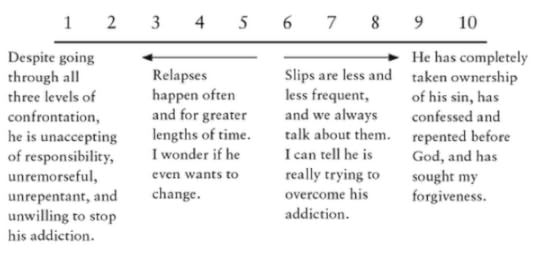
Tiede writes, “Divorce enters the picture if heart is operating near the high end of the scale, with continuous movement towards ten, while your husband’s heart is operating very near the low end of the scale” (p.246).
Once the third and final level of confrontation is reached, Vicki Tiede recommends a time of mediated separation for the couple in order to “create the crisis necessary for him to seek help and finally work toward restoration,” with the goal still being the restoration of the marriage. She writes:
“Think of it this way: the greatest gift you can give your husband is to love God more than you love your husband. God can redeem your husband; you cannot. Thus you love him more by loving in light of his need to repent” (p.244).
It is important churches and spouses avoid unnecessary extremes when it comes to church discipline. On one hand, it is best to keep the number of people involved deliberately small. The tenor behind Jesus’ words is to keep the matter as narrow as possible when it comes to involving others in the communication. On the other hand, church members should avoid making promises of “confidentiality” in the strict sense of the word. To promise not to gossip or slander is biblical, but to promise confidentiality only closes the door to future biblical discipline.
Churches should not rush the process. Each stage of communication might take several meetings, especially if there are at least hints of cooperation from the offending spouse. Plus, only time will tell just how much the erring spouse has truly listened at any stage. The goal is not only the promise to stop the pornographic behavior, but the rebuilding of trust and intimacy in the marriage through changed behavior. Tiede comments:
“You will choose to trust your husband when you are ready. Don’t worry—trusting and forgiving are not the same thing. Rebuilding trust will probably take much longer than it will take to forgive. You will know it’s time to trust when your heart helps you to choose to believe that he will make the right choices. His behaviors will become your trust barometer” (p.89).
Conclusion
In my opinion, pornography use, when it is hardhearted and unrepentant, can certainly qualify as porneia and therefore grounds for divorce.
The Westminster Confession of Faith wisely urges, in the unfortunate and hopefully rare cases where divorce is being considered, that “a public and orderly course of proceeding is to be observed; and the persons concerned in it not left to their own wills and discretion, in their own case.” As in many highly emotional and life-altering situations, when divorce is being considered, God does not want couples to be left on their own to discern His will and wisdom in the matter.
As the church we have a high calling to stand with couples in crisis and point them to the One whose love for His bride knows no end, whose justice is perfect, and whose grace increases more than all the infidelities in the world.
* For the sake of simplicity and brevity, in this article we do not address some of the other views of how porneia should be translated in this text, such as an unlawful or illicit marriage or as premarital sex before or during betrothal. These views have been championed by many intelligent Catholic and Protestant commentators, and they are dealt with at length in my thesis.
The post Porn Use as Grounds for Divorce: How My Opinion Changed appeared first on Covenant Eyes.
October 7, 2015
How to Conquer the Power of Sin
Paul tells us in Galatians 5:16-18, “But I say, walk by the Spirit, and you will not gratify the desires of the flesh. For the desires of the flesh are against the Spirit, and the desires of the Spirit are against the flesh, for these are opposed to each other, to keep you from doing the things you want to do. But if you are led by the Spirit, you are not under the law.”
What does it mean to walk in the Spirit? In today’s program, we explore this topic in detail.
Show Notes:
0:32 – One of the earliest Christian debates: How do we live out our faith? What does obedience to God look like now that Jesus has come?
3:50 – Why did God give us the law covenant of Moses? To show us our inability to follow God in our own power.
7:23 – If we don’t obey God under the old covenant of law but rather under the new covenant of the Spirit, what does it mean to keep in step with the Spirit? The book of Galatians offers us three clues…
9:32 – We walk in the Spirit by indulging in Spirit-born desires. We don’t kill sinful desire by pushing it down, but by trumping it with something more desirable than sin—the wholesome desires of God and His good gifts.
17:18 – We walk in the Spirit by stirring up our Spirit-inspired hope. We shouldn’t fight against sin as if we still a slave to it, but knowing we belong to Christ, knowing it is our destiny to become righteous.
29:06 – We walk in the Spirit by resting in our Spirit-given identity. We shouldn’t fight sin as if we are a spiritual orphans trying to earn God’s love, but knowing we are adopted sons of God, loved beyond comprehension already.
“The soul tends to shrink to the size and quality of its pleasures.” – John Piper
Get our weekly podcasts in your inbox
").append(e.clone()).remove().html();
e.siblings("input,select,textarea").before(fielddesc);
e.remove();
});
})(jQuery);
} } );jQuery(document).bind('gform_post_conditional_logic', function(event, formId, fields, isInit){} );
Listen to more of our podcasts on iTunes.
The post How to Conquer the Power of Sin appeared first on Covenant Eyes.
September 30, 2015
Bringing the Sexual Spark Back to a Porn-Scarred Marriage

Often we hear from couples struggling in their marriages because of a husband’s use of porn. How do couples bring both trust and real sexual intimacy back to their marriages when they’re facing a deep feeling of betrayal and insecurity about their sex life?
To help us address these concerns, today we are talking with Sheila Wray Gregoire, author of The Good Girl’s Guide to Great Sex and the popular blog To Love, Honor, and Vacuum.
Show Notes:
0:38 – Why did you write The Good Girl’s Guide to Great Sex?
1:20 – What is the book about?
2:05 – What are the biggest obstacles women face when it comes to enjoying their sexuality?
4:08 – What do you say to women who feel like their husbands’ porn problem is their fault?
13:52 – What is the best way for a woman to bring sexual passion back to her marriage?
20:25 – What can women do when they don’t have a good Christian support system?
21:55 – What if your husband refuses help?
Get our weekly podcasts in your inbox
").append(e.clone()).remove().html();
e.siblings("input,select,textarea").before(fielddesc);
e.remove();
});
})(jQuery);
} } );jQuery(document).bind('gform_post_conditional_logic', function(event, formId, fields, isInit){} );
Listen to more of our podcasts on iTunes.
The post Bringing the Sexual Spark Back to a Porn-Scarred Marriage appeared first on Covenant Eyes.
September 23, 2015
The Lies Men Believe About Porn
Often when it comes to overcoming a deeply ingrained habit of looking at pornography, men often don’t know where to start. The most pressing need they feel is quitting something that has taken over their lives, but what men often overlook is that pornography use is often not just about lust. It is often a symptom of something much deeper.
Today we’re interviewing Stephen Kuhn, founder of Belt of Truth Ministries, and author of 10 Lies Men Believe About Porn. On today’s podcast, Stephen tells us just a few of the lies written about in this book.
Be sure to listen to the end of the podcast for a special offer from Belt of Truth.
Show Notes:
1:05 – Why did you write 10 Lies Men Believe About Porn?
4:14 – What does this lie mean: “My Pornography Addictive Defines Who I Am”?
10:36 – What does this lie mean: “I Am Alone in My Struggle with Porn”?
16:14 – What does this lie mean: “I Can Compensate for My Porn Addiction By Doing Good in Other Areas”?
25:57 – Special deal for those wanting the book
Get our weekly podcasts in your inbox
").append(e.clone()).remove().html();
e.siblings("input,select,textarea").before(fielddesc);
e.remove();
});
})(jQuery);
} } );jQuery(document).bind('gform_post_conditional_logic', function(event, formId, fields, isInit){} );
Listen to more of our podcasts on iTunes.
The post The Lies Men Believe About Porn appeared first on Covenant Eyes.
September 16, 2015
Is Courtship in Crisis? (Part 3 of 3)

For the last two weeks we’ve been interviewing Thomas Umstattd, Jr., author of Courtship in Crisis: The Case for Traditional Dating. For seven years Thomas ran the website PracticalCourtship.com, but eventually, after speaking with a lot of people trying to follow the so-called “courtship model,” he began to wonder if courtship is all its cracked up to be.
In today’s interview, he describes what “traditional dating” is and why he thinks its a better system.
Show Notes:
1:14 – If I want to be involved in my children’s romantic choices, why is traditional dating a good model?
4:13 – What is “traditional dating” exactly? What are the rules of engagement?
13:14 – What does parental involvement look like in a traditional dating model?
16:07 – Why is good parenting not very compatible with modern courtship?
18:16 – For someone wants to start practicing traditional dating, isn’t that hard to do if you’re surrounded by people who don’t hold that model?
Get our weekly podcasts in your inbox
").append(e.clone()).remove().html();
e.siblings("input,select,textarea").before(fielddesc);
e.remove();
});
})(jQuery);
} } );jQuery(document).bind('gform_post_conditional_logic', function(event, formId, fields, isInit){} );
Listen to more of our podcasts on iTunes.
Leave a comment: What do you like about the “traditional dating” model? What do you dislike about it? Where does it have the potential to go wrong? Where could it be a help to singles?
The post Is Courtship in Crisis? (Part 3 of 3) appeared first on Covenant Eyes.
September 9, 2015
Is Courtship in Crisis? (Part 2 of 3)

Last week we began our conversation with Thomas Umstattd, Jr., author of Courtship in Crisis: The Case for Traditional Dating. Seven years ago, Thomas would have been an unlikely person to write such a book—he was a big proponent of the so-called “courtship model.” However, after many conversations with both singles and married people raised in a courtship culture, he began to rethink the dating vs. courtship debate.
In today’s interview, he responds to some of the criticisms he’s received, defending why he believes courtship is “fundamentally flawed.”
Show Notes:
0:58 – If courtship is “fundamentally flawed,” why are there all kinds of people who meet and get married through this social norm?
4:13 – Isn’t the real problem with modern dating or modern courtship just that sinful people sin in the name of those models?
13:09 – Isn’t the version of courtship you’ve critiqued too radical?
15:24 – Why do Christians have an aversion to the idea of “dating”? How is “traditional” dating different than “modern” dating?
18:53 – Aren’t the problems associated with courtship just a result other factors, like homeschooling culture?
24:43 – How exactly does modern courtship take us away from our “roots”?
Get our weekly podcasts in your inbox
").append(e.clone()).remove().html();
e.siblings("input,select,textarea").before(fielddesc);
e.remove();
});
})(jQuery);
} } );jQuery(document).bind('gform_post_conditional_logic', function(event, formId, fields, isInit){} );
Listen to more of our podcasts on iTunes.
Leave a comment: Thomas says the fundamental flaw of courtship is that it provides no social context where individuals can get to know one another (and themselves) in a one-on-one setting before making commitments to exclusivity. Do you agree or disagree? If you agree this is a dynamic in courtship, do you agree it is a problem?
The post Is Courtship in Crisis? (Part 2 of 3) appeared first on Covenant Eyes.
Luke Gilkerson's Blog

- Luke Gilkerson's profile
- 9 followers

