Elizabeth Fitzgerald's Blog: Earl Grey Editing, page 13
July 1, 2018
Akata Warrior by Nnedi Okorafor
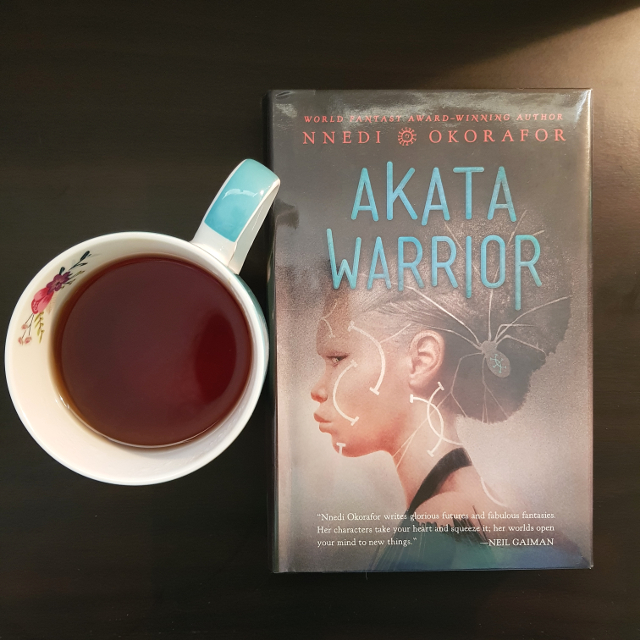
Keen fans of the Hugo Awards will be aware that 2018 marks the inaugural presentation of the World Science Fiction Society Award for Best Young Adult Book. The shortlist for this Hugo-adjacent award (which will, barring shenanigans at the AGM, henceforth be known as the Lodestar Award) includes Akata Warrior by Nnedi Okorafor.
Today I’m over at the Skiffy and Fanty Show to take a look at this wonderful book about bridging worlds and cultures.


June 24, 2018
City of Lies by Sam Hawke

Published: July 2018 by Tor Books
Format reviewed: E-book (mobi)
Series: Poison Wars #1
Genres: Fantasy
Source: NetGalley
Reading Challenges: Australian Women Writers Challenge 2018
Available: Abbey’s ~ Amazon (AU, CA, UK, US) ~ Barnes & Noble ~ Book Depository ~ Booktopia ~ Dymocks ~ Indiebound ~ Kobo
Disclaimer: I was provided with a free copy of this book in exchange for an honest review.
The author is a friend. I have done my best to give an unbiased review.
I was seven years old the first time my uncle poisoned me…
Outwardly, Jovan is the lifelong friend of the Chancellor’s charming, irresponsible Heir. Quiet. Forgettable. In secret, he’s a master of poisons and chemicals, trained to protect the Chancellor’s family from treachery. When the Chancellor succumbs to an unknown poison and an army lays siege to the city, Jovan and his sister Kalina must protect the Heir and save their city-state.
But treachery lurks in every corner, and the ancient spirits of the land are rising…and angry.
City of Lies is an enthralling novel that subverts fantasy tropes to examine issues of family and class.
The story is told from the point of view of two siblings, alternating chapters from each of them. Jovan is a proofer, a young man trained to detect the presence of poison in food. He’s bound by honour and friendship to protect Tain, heir to the city of Silastra. That suddenly becomes harder when both his uncle and the Chancellor are killed by a mysterious poison. Flipping the usual focus on the poisoner to the person trying to prevent the poisoning really raises the stakes of the story, since the latter is much more difficult. Jovan is also obsessive-compulsive, with his compulsions increasing during times of stress. He worries about the judgement this brings from others, but is supported by his sister and Tain.
Kalina is the elder of the siblings and was originally destined to be the proofer. However, it became apparent early in her training that her chronic illness made this unfeasible. While she still harbours some resentment over this, she is fiercely loyal to both Jovan and Tain. She’s also determined not to be sidelined, turning instead to diplomacy and spycraft to prove her usefulness. However, her brother sometimes makes this difficult by being overprotective. This isn’t entirely without reason; there’s an interesting interplay between Jovan’s somewhat patronising attempts to make sure she rests and Kalina’s tendency to push herself too hard.
There are some mystery elements, as the siblings and Tain try to figure out who poisoned their uncles. These elements dovetail into the political landscape of the story. The Chancellor may have final say on what happens in the city of Silastra, but he is supported by a council comprised of the heads of several powerful families and guilds. Of course, council members are largely only there for their own interests and it soon becomes apparent that (as the title suggests) each of them has their own secrets. Sorting through those secrets to determine which of them is the killer creates a tension throughout the narrative.
One of the things I loved about the story was the way it looks at the role Tain plays as Chancellor. He should be the most powerful man in the city and yet the story shows just how little power he has. He is not ominpotent or omnipresent, which means he has to rely on others. And, as the poisoning of his uncle demonstrates, those others can’t always be trusted.
There are also issues of class at play. Jovan and Tain, in particular, come face-to-face with the privilege of their upbringing and the blind spots it has created. I especially enjoyed seeing Jovan wrestle with this because even when he’s made aware of it he struggles not to centre his own experience.
Family is at the heart of City of Lies, but not quite in the usual ways. It centres the siblings’ relationship not by dwelling on their rivalry but by showing how they function as a team. It also downplays the role of traditional parents. I’ve spoken a bit of uncles in this review, and they connect to an interesting piece of worldbuilding. Silastra has what we would consider some different norms around motherhood; the role of child-rearing is taken on by a trusted male relative of the mother’s, leaving the mother free to pursue other interests. This male relative is referred to as a Tashi and is frequently the uncle of the child. In contrast, the father of Kalina and Jovan is considered so insignificant, he’s not even mentioned. Their relationship with their mother is distant. This setup allows the book to avoid some of the sexist norms usually present in epic fantasy.
From the very beginning, the writing style sucked me in (and kept me awake far too late). Silastra is vibrant and alive, painted in detail but not enough to be overwhelming. The pace is kept reasonably swift and although there’s often a lot of talking (councils will do that), it’s balanced with plenty of action.
The ending wraps up enough threads to be satisfying but leaves open some questions regarding the bigger picture. I did have some quibbles about some of the supernatural elements of the ending, but overall they didn’t detract from the story.
All in all, City of Lies is an impressive debut and among my favourite reads of the year so far. And, considering the epilogue, I’ve got my fingers crossed for more.


June 17, 2018
Continuum 14

A week ago, I was in Melbourne attending Continuum 14. This speculative fiction convention ran from Friday 8 June until Monday 11 June. The Guests of Honour were Cat Sparks and Alison Evans.
As is my habit, I live-tweeted a bunch of panels. Since Storify is no longer a thing, I’ve rounded them up here. You can click on the tweets included below to view the entire thread.
My trip didn’t exactly get off to the best start, thanks to a four-hour flight delay. The bright side was getting to hang out with Sam Hawke and Kim Gaal over lunch. And, despite the delay, I didn’t miss any programming.
In an effort to be a more sustainable convention, Continuum requested attendees bring their own lanyards. Mine was sporting a new addition, thanks to Femmecraft.
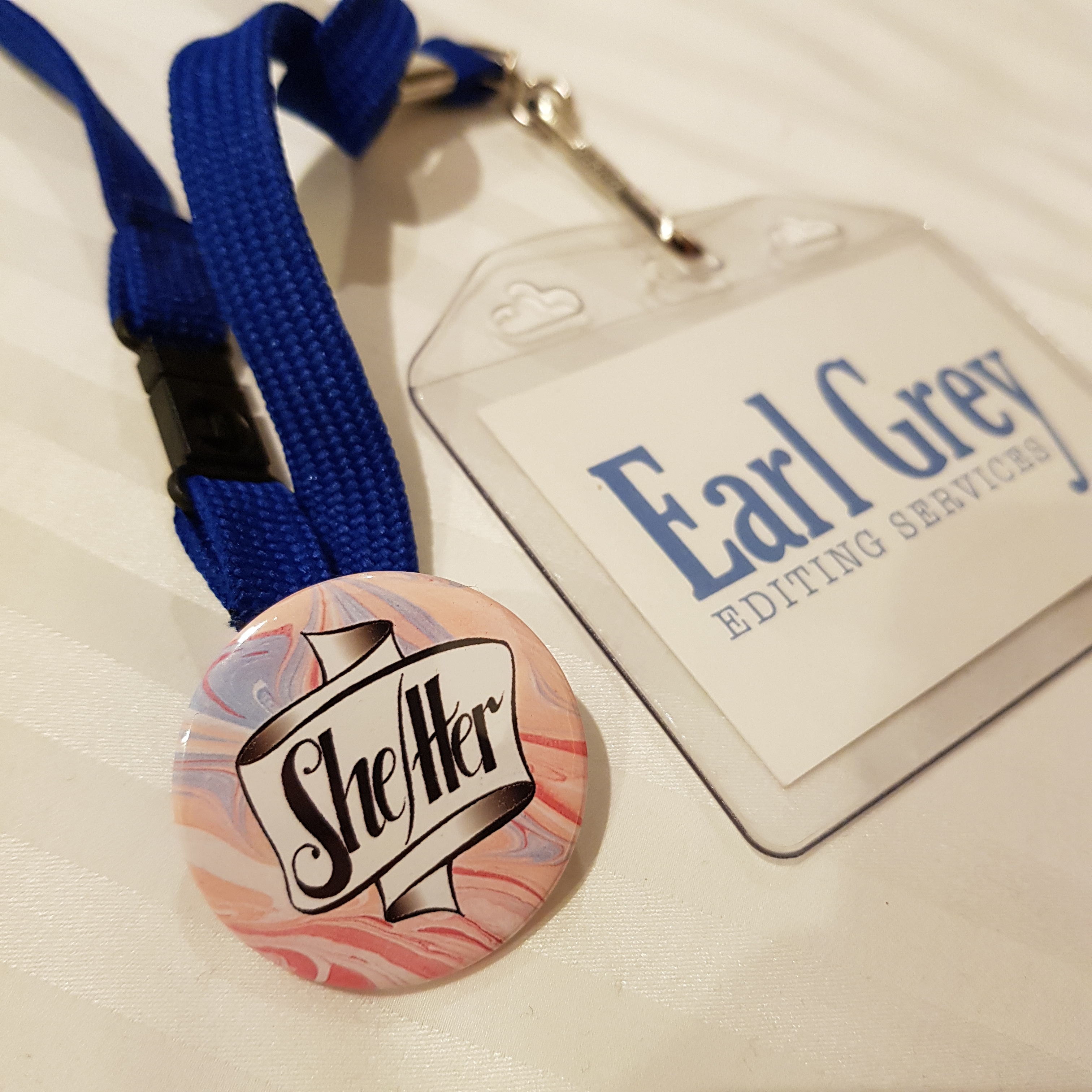
It wasn’t entirely necessary, since the con’s name tags had a space for including pronouns: a wonderfully inclusive touch.
Friday
For me, Friday was more about being on panels than seeing them. My first panel was So You Want To Be A Book Reviewer. My fellow panel members were Figgy O’Connell and Marisa Wikmanayake. Between us, we had quite a diversity of experience. Marisa works for more established venues, such as the West Australian. Figgy spoke about establishing the book reviewing arm of 100% Rock Magazine, while I spoke from a more indie perspective. The audience was small, so we kept things informal, allowing plenty of questions.
I had time to grab a quick dinner before heading back in to moderate Feminism and Tabletop Games. My fellow panel members were games illustrator Tania Walker, Brit from Hella Gay Games, indie designer Bismuth and long-time player Lexie. I had such a wonderful time with this panel. Once again, the con programmers did an excellent job of gathering panelists from a variety of backgrounds and those panelists were both insightful and articulate. Lauren Mitchell managed to live-tweet some of it, thread starting below:
Now at Feminism and TTRPGs, with speakers Tania, Bis, Elizabeth, Brit, and Lexie. Elizabeth announced herself as GM rather than moderator, which amused the room. #con14
Lauren (@LEBMitchell) June 8, 2018
The opening ceremony was followed by the Norma K. Hemming Awards. The NKHs are basically Australia’s equivalent of the Tiptree Awards, recognising excellence in Australian speculative fiction exploring gender, sexuality, race, class, and/or disability.
Rose thanks the old guard & Tehani discusses the changes to the award: inclusion of a short story category.#Continuum2018
Elizabeth Fitzgerald @ Continuum (@elizabeth_fitz) June 8, 2018
Saturday
I started out the day with a tour of the dealers room and came out with these:
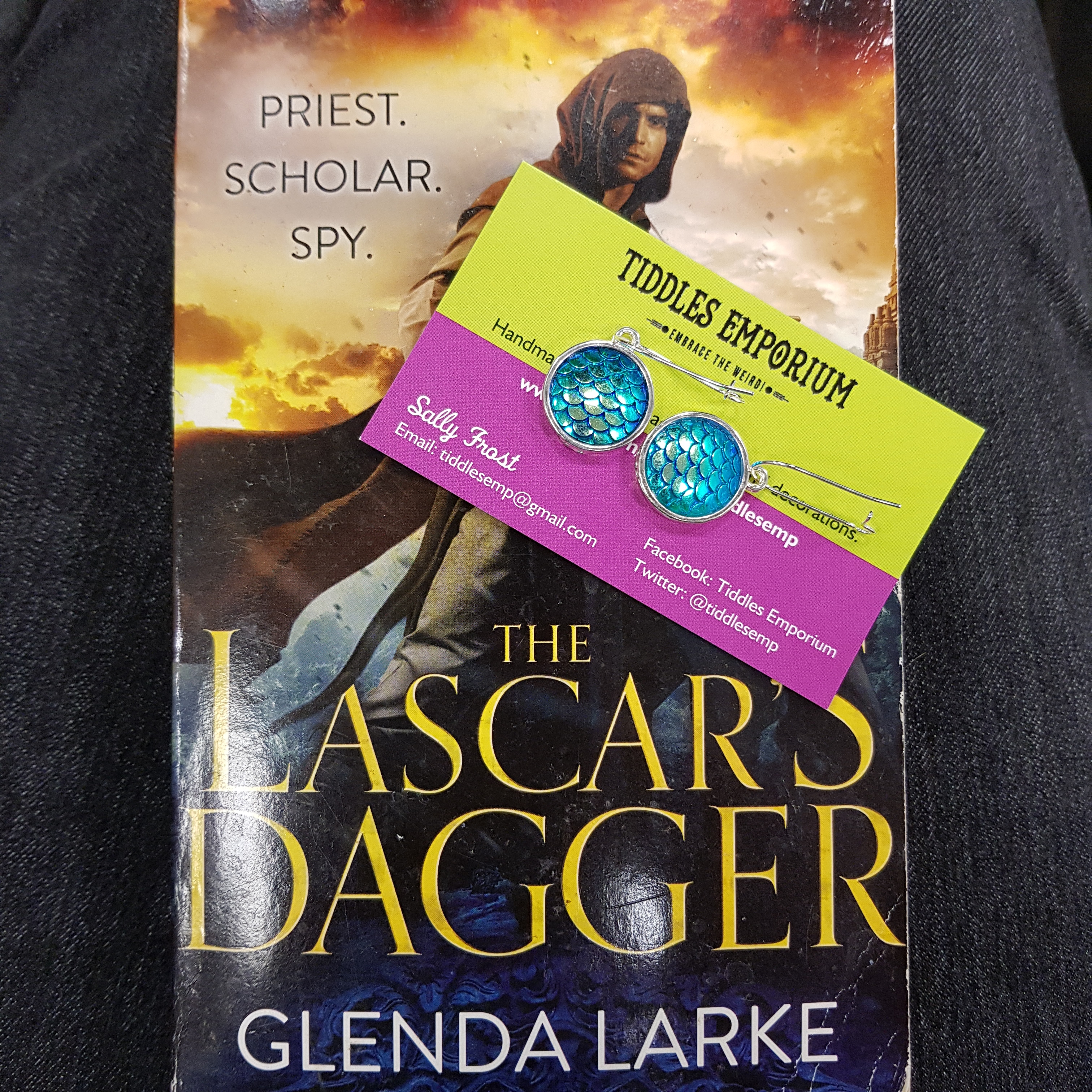
I am in love with the blue scale earrings and immediately put them on. Tiddles Emporium clearly have my number. Last year, I bought a lovely pair of teapot earrings that are already starting to look a bit worn from sheer use. Safe to say I love their work.
Then I actually got to watch my first panel.
Discussing favourites. George likes Origami Yoda in which a young boy makes an origami Yoda finger puppet who takes on a life of its own & begins to dispense sage advice.#con14 #continuum2018
Elizabeth Fitzgerald @ Continuum (@elizabeth_fitz) June 9, 2018
This was followed by a panel on the Monstrous Feminine, which proved very popular.
Tansy talks about how the Amazons didn’t exist but were created by the Greeks as a symbol of everything to be conquered. #con14 #continuum2018
Elizabeth Fitzgerald @ Continuum (@elizabeth_fitz) June 9, 2018
Cat Sparks’ Guest of Honour speech was so packed I wasn’t able to get a seat. Instead, I took an early lunch break and came back with these:

Regathered myself to see SF in YA with @editormum75, @cakeandmadness, @SlushRottweiler, @marleejaneward & @FiggyO.
Elizabeth Fitzgerald @ Continuum (@elizabeth_fitz) June 9, 2018
Saturday night involved a tradition for me and a bunch of friends. Whenever we’re all able to attend the same convention, one of us runs a tabletop RPG. This year it was Alis’ turn, and the game was Dungeons and Dragons 5E. Being a talented artist, Alis made us some stunning character sheets.
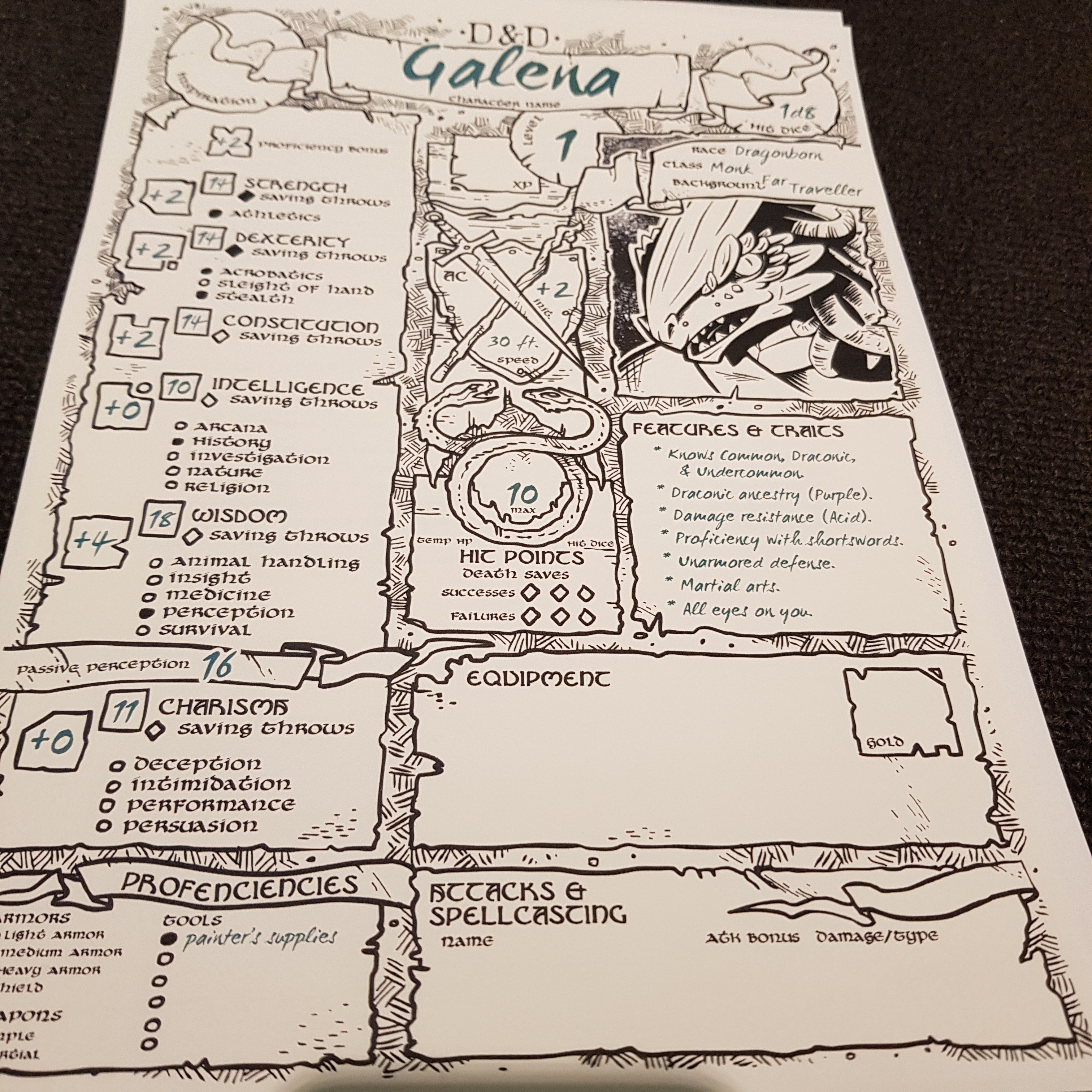
Alis wrote a bit about the game and shows the process of inking one of the character portraits she drew. Her con report also contains some lovely portraits of the speakers she saw.
The game itself was a blast. I had a wonderful time being excessively cheerful and trying to make friends with all the NPCs. And, as is always the case with our games, there was much laughter.
Sunday
Despite the relatively late night, I started off strong:
Freya recommends Romancing the Beat, which breaks down the structure of romance. This template can be transferred to fantasy between the protagonist & what they want.#Continuum2018 #con14
Elizabeth Fitzgerald @ Continuum (@elizabeth_fitz) June 10, 2018
Alison has always read a lot of fantasy and a lot of children’s lit. They liked books with girls and dragons. They didn’t come across genderqueer characters until they were in their 20s & even then, it was a friend’s manuscript. #Continuum2018 #con14
Elizabeth Fitzgerald @ Continuum (@elizabeth_fitz) June 10, 2018
The editors had only met each other twice before embarking on the anthology. Tansy sent a formal pitch to Rivqa, who was a bit intimidated by Tansy’s big reputation in the community. #continuum2018 #con14
Elizabeth Fitzgerald @ Continuum (@elizabeth_fitz) June 10, 2018
There were cupcakes for theMother of Invention party.
Next panel: Out In The Open with @daggyvamp, @_lizbarr, @lokabrenna & Ashleigh.#Continuum2018 #con14
Elizabeth Fitzgerald @ Continuum (@elizabeth_fitz) June 10, 2018
The above panel was on the way fanfic is becoming more accepted by the mainstream and the blurring lines between fan and pro creators. I feel that my tweets really didn’t do the panel justice. It was a challenging one to capture, since I was fatigued and didn’t have a thorough enough grounding in fandom spaces to entirely follow the conversation. It didn’t help that the panelists spoke quickly and frequently interrupted each other. Fortunately, Liz Barr discusses the panel in her con report with a bit more clarity than I managed.
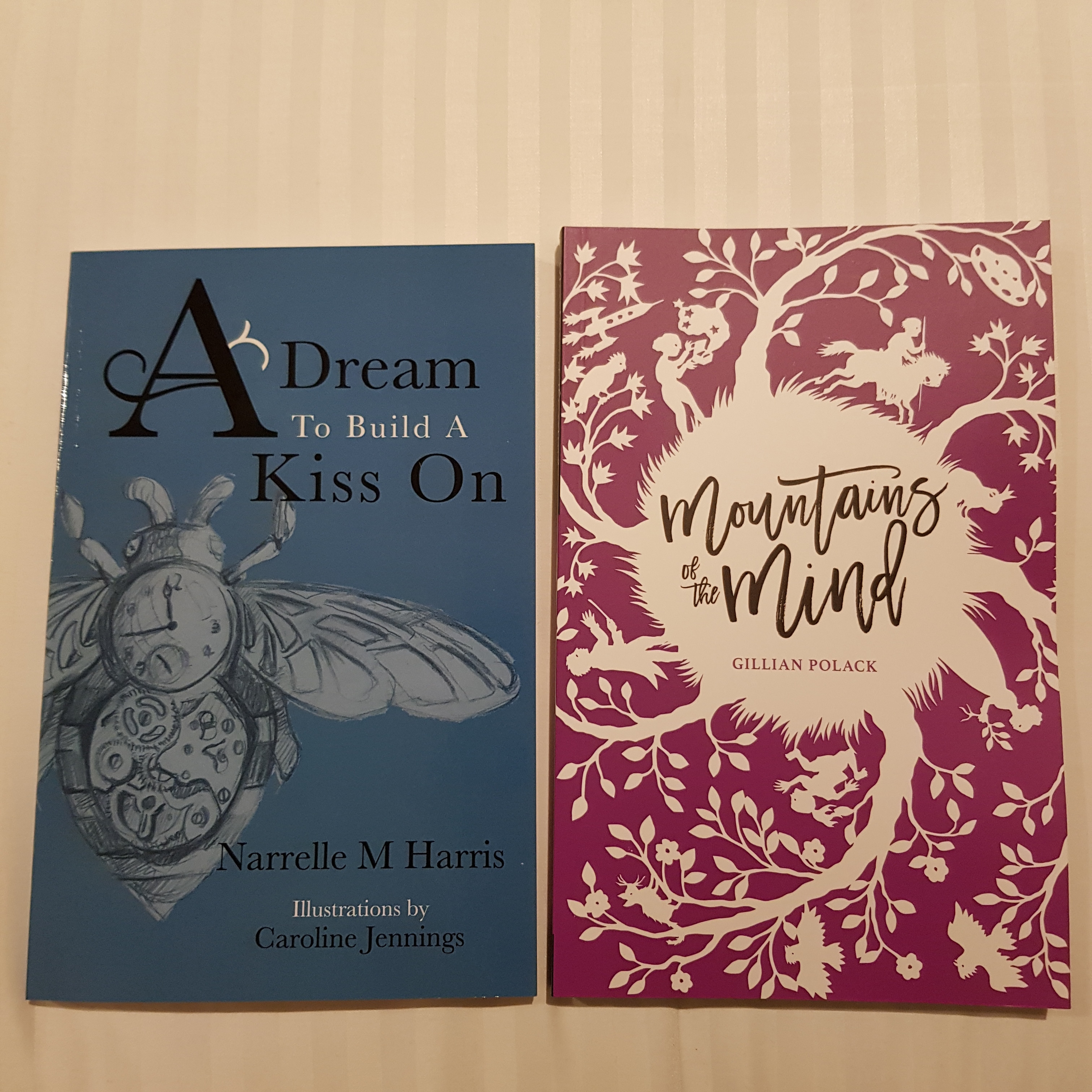
However, it did prompt me to make a last trip to the dealers room for a copy of Narrelle’s new book A Dream to Build a Kiss On to add to the pile. I also attended the launch of Gillian Polack’s new anthology of short stories Mountains of the Mind (where Narrelle also gave a very lovely launch speech. I swear I wasn’t stalking her).
Monday
My energy was really flagging by this point and I made the decision not to tweet about anything I saw that day. Which was a shame because Mai Su and Gillian Polack both gave excellent talks. Su spoke of the ways in which portal fantasies reflect the immigrant experience, while Gillian spoke about the intersection of language and culture, and how language is used to other or include.
I also had my last panel, which was on one-star reviews. My fellow panel members were Devin Madson, Figgy O’Connell and Liz Barr. Once again, the panel was very well balanced, so we were able to approach the issue from the side of the author as well as the reviewer. While we all agreed that harassing reviewers was not okay, what exactly constituted acceptable contact between author and reviewer varied between panel members.
The closing ceremony finished up with the announcement that Continuum will be playing host to the natcon next year. The guests of honour will be Kate Elliott and Ken Liu. I very much hope to attend once again.
In the meantime, for more perspectives on Continuum 14, I recommend Rivqa Rafael’s live-tweets, which she thoughtfully compiled into a meta thread, starting below.
Here’s my #con14 meta-thread. I had such a great time seeing friends etc!
Rivqa Rafael (@enoughsnark) June 11, 2018
Justin Bennett posts about the Mental Health in Speculative Fiction panel, which I regret missing.
Kat Clay has a Goodreads list of recommendations from the Speculative Detectives panel.
And Cat Sparks has a wonderful album of photos from the convention.


June 12, 2018
Loose-leaf Links #63
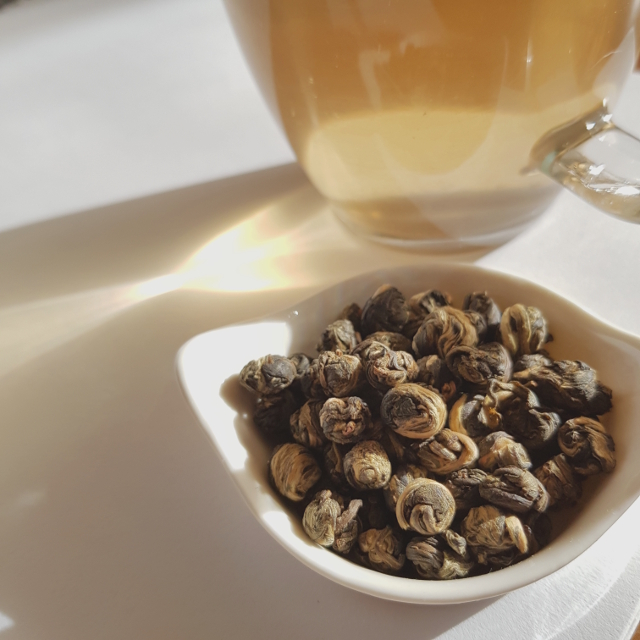
Loose-leaf Links is a feature where I gather together the interesting bits and pieces on sci-fi, fantasy and romance I’ve come across and share them with you over tea. Today’s tea is Buddha’s Tears from T2. It’s a light green tea flavoured with jasmine, good with meals or whenever you need something gentle and relaxing.
Awards News
Lots going on with the Aurealis Awards! The judging panels for 2018 have been announced (I’ll be judging the YA categories!), and the awards are currently open for entry. This year it includes the Sara Douglass Award for Best Series.
The finalists for the 2018 Mythopoeic Awards have also been announced. Particular congratulations to Garth Nix, whose middle grade fantasy Frogkisser! was nominated for the children’s category.
The Melbourne Prize Trust have announced a new award for early-career writers of all genres. The Readings Award will offer $5000 cash and a residency at the Norman Redpath Studio.
Community and Conventions
Conflux have announced Ambelin Kwaymullina as their Guest of Honour. I’m excited!
Swancon is headed for Fremantle in 2019. Guests of Honour include Annalee Newitz and Charlie Jane Anders.
On Equity
Juliet E. McKenna discusses the inherent biases of Wikipedia in relation to women SFF writers.
Over at Book Riot, Kelly Jensen offers a librarian’s guide to finding diverse books before they’re published.
The New Zealand Book Council interviews romance writer Nalini Singh, who suggests a few more NZ romance writers to check out.
Bogi Takacs kicks off a series recommending work by trans and intersex authors.
For Writers
Romance publisher Less Than Three Press are currently taking submissions for their anthology Life After All. Stories should be post/apocalyptic LGBTQIA romance between 8K & 15K words. Submissions close 31 July.
Joel Noum is running a 2-month course on self-publishing. Joel has a lot of experience in the publishing industry–including establishing Pan Macmillan’s (former) digital imprint, Momentum–so it’s an excellent opportunity. He’s also looking to gauge interest in an Australian writers festival for self-publishers.
Keen academics and roleplayers might be interested in this call for papers on transmedia storytelling, tabletop roleplaying, and fandom. Submissions close 15 July.
For Readers
I attended a couple of book launches while at Continuum, including Gillian Polack’s Mountains of the Mind. This collection of short stories is now out from Shooting Star Press and has a cover by the amazingly talented Kathleen Jennings.
Vulture Bones is a new magazine featuring spec-fic from trans and enby writers. Their first issue is now online.
Jessica Pryde has a list of time travel romance novels for those looking to move beyond Outlander.
And if you haven’t already seen this article from Geek & Sundry about the middle school girls D&D club, you should definitely check it out.


June 5, 2018
Mt TBR Report: May 2018
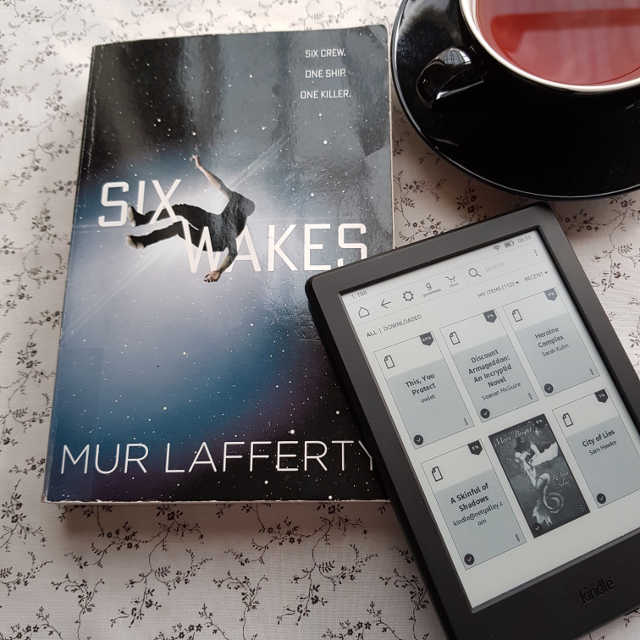
My reading for May was slightly less intensely focused on the Hugo Awards. Things have been very busy in the lead up to Continuum and I found I had to break things up with some lighter fare. Judging from my book count for the month, it looks like last month’s binge is easing off… however, I think that’s partly because I read a whole heap of fanfic instead.
Mt TBR Status
Mt TBR @ 1 January 2018: 351
Mt TBR @ 30 April 2018: 363
Mt TBR @ 31 May 2018: 366
Books Read
54. Paper Girls, Vol. 3 by Brian K. Vaughan and Cliff Chiang. Shortlisted for the Hugo Awards. Four teenage newspaper deliverers from the 80s are accidentally thrown back in time to the caveman era. They must stick together and find a way home. Not really my jam.
55. Soft Hands by Ariel Bishop. Ice hockey m/m romance. Review forthcoming.
56. True Pretences by Rose Lerner. Regency romance. A Jewish con artist tries to persuade a rich heiress to marry his brother but falls in love with her instead. This was utterly delightful. Ash hasn’t had the easiest life and the connection between him and Lydia is very sweet. There were some clever parallels between con artist and society hostess, and I loved Lydia’s iron will.
57. New York, 2140 by Kim Stanley Robinson. Shortlisted for the Hugo Awards. Climate change has hit and the ocean levels have risen, flooding lower Manhattan. The book is ostensibly about the lives of several residents of a building in the area as they investigate who is trying to sabotage their home. However, it’s really more about how climate change might impact the city and how these changes might be adapted to. Hard sci-fi isn’t usually my thing, but the ideas were fascinating and there was enough character work to keep me hooked.
58. Charm or Dare by Tansy Rayner Roberts. A short fantasy story from the Castle Charming series. Corporal Jack is roped into one of the princes’ drinking/kissing games. Sweet fun with one of my favourite characters (shh… they’re all my favourite characters).
59. Baker Thief by Claudie Arseneault. Reviewed here.
60. Penric’s Mission by Lois McMaster Bujold. Fantasy novella. On his first covert mission, Penric is betrayed and imprisoned. He must escape and figure out what went wrong. I love Bujold’s Penric and Desdamona books and this was no exception. In this book, Penric is a little older and has a few more scars. However, he manages to retain some of the cheerfulness and sense of wonder I love so much about him. I also loved the widow Nikys for her practicality and her fortitude in the face of male stupidity. I kind of hope there’ll be more of her somewhere down the line.
61. Creative Incentives by Kit Rocha. Sci-fi erotica. A short story set after the Beyond series. Cruz resorts to some creative incentives to get Ace to complete his physical therapy exercises.
62. Catching Captain Nash by Anna Campbell. Regency romance novella. On the night of her engagement party, Morwenna Nash’s long-lost husband returns home. After several years of imprisonment and torture, Robert has some ghosts. I particularly enjoyed the way Morwenna was able to easily see through his facade and support him in quiet ways.
63. Ida by Alison Evans. Reviewed here.
64. Akata Warrior by Nnedi Okorafor. Shortlisted for the Hugo Awards. Review forthcoming.
65. Penric’s Fox by Lois McMaster Bujold. Fantasy novella, shortlisted for the Hugo Awards. Penric’s peaceful day of fishing is interrupted when one of his friends calls on him for assistance in solving a suspicious death. As always, a delightful read from Bujold. I particularly enjoyed seeing more of the shamans and to see people other than Penric treating their demons with respect. It was also nice to see Penric be a bit of a badass, even though it left him feeling morally troubled.
Books Acquired
Raven Stratagem by Yoon Ha Lee
The Cloud Roads by Martha Wells
Paper Girls, Vol. 3 by Brian K. Vaughan and Cliff Chiang
Akata Warrior by Nnedi Okorafor
A Natural History of Dragons by Marie Brennan
Six Wakes by Mur Lafferty
Charm or Dare by Tansy Rayner Roberts
Creative Incentives by Kit Rocha
Penric’s Fox by Lois McMaster Bujold
The Curse of Chalion by Lois McMaster Bujold
Ida by Alison Evans
Three-man Advantage by Ariel Bishop
Moon-bright Tides by RoAnna Sylver
Heroine Complex by Sarah Kuhn
Tricks for Free by Seanan McGuire.
Online Reading
Lots of online reading this month! First, I read through the short stories shortlisted for the Nommo Awards. You’ll be able to hear my thoughts on the Skiffy and Fanty Show with my co-hosts Trish Mason and Brandon O’Brien in the next few weeks.
Then, after finally watching Spiderman: Homecoming, I fell down a rabbit hole of Peter/MJ fanfic and may have accidentally read somewhere around 500K words. I’m too lazy to list them all, but a couple of favourites were:
people in my hometown are pointing to the sky, do they truly see me? will they scream and sigh? by ephemeral cloud.
Five Times MJ Doesn’t Need Rescuing by nire.
The L in Love Stands for Loser a series of 6 short stories by AppleJuiz.


June 3, 2018
Ida by Alison Evans

Next weekend I’ll be attending Continuum, a speculative fiction convention held in Melbourne. Whenever I’m attending a convention, I always like to try to review something by one of the Guests of Honour. This year, Continuum is playing host to Alison Evans, one of Australia’s up-and-coming talents in YA SFF. Their debut novel Ida won the Victorian Premier’s People’s Choice Award and was shortlisted for this year’s Aurealis Awards.
Today over at the Skiffy and Fanty Show I take a look at this queer, quiet, time loop horror.


May 31, 2018
Continuum 14 Schedule

Next Friday I’ll be down in Melbourne gearing up for the start of Continuum 14. The Guests of Honour are Cat Sparks and Alison Evans. This will be my second year attending; I was really impressed by the programming last year and couldn’t resist coming back.
Speaking of programming, I’ve been scheduled on some fantastic panels this year.
So You Want to be a Book Reviewer
When: Friday, 8 June, 5 PM
Panelists: Elizabeth Fitzgerald, Marisa Wikramanayake, Figgy
An exploration of the best ways of getting on publisher lists, experiences had with publishers (positive or negative), and the pros and cons of e-copy of physical review copies.
Feminism and Tabletop Roleplaying Games
When: Friday, 8 June, 7 PM
Panelists: Elizabeth Fitzgerald, Bismuth, Tania Walker, Lexie (Darren), Brit Snaggel
Games that foster diversity and inclusivity. Games that specifically open space for genderqueer, asexual or disabled characters. Games that don’t necessarily focus on epic tales of heroism, but treat relationships and the domestic sphere as worthy of focus.
One Star
When: Monday, 11 June, 11 AM
Panelists: Devin Madson, Elizabeth Fitzgerald, Figgy, Liz Barr
How to handle negative reviews as an author and as a reviewer. Some forums, especially Goodreads, can foster an Us versus Them mentality. What’s the professional and respectful way to approach critical reviews?
Raise the Castle or Raze the Castle?
When: Monday, 11 June, 12:30 PM
Panelists: Devin Madson, Elizabeth Fitzgerald, Figgy, Liz Barr
Western Epic Fantasy seems to default to a European Feudal background. Why? Is this a good thing or a bad thing? What sort of different backgrounds would be good, without straying into the territory of cultural appropriation?
In addition to the panels, I’ll also be at the book launch for Mother of Invention taking place at 2 PM Sunday 10 June. I’m so proud to have a story in this anthology and I’m looking forward to seeing it out in the world.
If you’re along this year, please say hi! However, if Melbourne is a bit too far away for you or conventions aren’t your scene, I’ll be writing up a report once I’m home again.


May 27, 2018
Baker Thief by Claudie Arseneault

Published: June 2018 by The Kraken Collective
Format reviewed: E-book (mobi)
Genres: Fantasy, superhero
Source: Publisher
Available: Amazon ~ Barnes & Noble ~ Gumroad ~ Kobo
Disclaimer: I was provided with a free copy of this book in exchange for an honest review.
Adele has only one goal: catch the purple-haired thief who broke into her home and stole her exocore, thus proving herself to her new police team. Little does she know, her thief is also the local baker.
Claire owns the Croissant-toi, but while her days are filled with pastries and customers, her nights are dedicated to stealing exocores. These new red gems are heralded as the energy of the future, but she knows the truth: they are made of witches’ souls.
When her twin–a powerful witch and prime exocore material–disappears, Claire redoubles in her efforts to investigate. She keeps running into Adele, however, and whether or not she can save her sister might depend on their conflicted, unstable, but deepening relationship.
Although it has some dark elements, Baker Thief is a charming story whose strength lies in its interpersonal connections.
The cast is wonderfully diverse with characters at the intersections of multiple marginalisations. No one shows this better than the titular character. Claire is genderfluid, sometimes feeling more comfortable as Claude. She splits her roles as baker and thief between her genders: by day, he is Claude the baker, by night, she is Claire, the Exocore Thief. While this works to protect her identity, it also works against her because her genderfluidity isn’t that neat. For example, there are days when Claude wishes he didn’t have to open up the bakery and could spend the time as Claire instead.
In addition to being genderfluid, Claire is also fat. This seems like an unconventional choice for a superhero, but her fatness is never slows her down. Indeed, it is never a big deal in the story. Better still, her figure is shown as one still desirable to a more conventionally attractive character, which was something I very much appreciated. And it in turn led to some exploration of Claire’s aromantic identity.
Pretty much the rest of the cast is likewise diverse in at least one way. Adele suffers from asthma. Her boss uses a prosthetic arm. Other members of their team are trans and one is an older, black, polyam woman. This diversity is supported by the worldbuilding: this is a society where it is normal to include one’s pronouns when introducing oneself and there are a variety of pronouns used throughout the story. It’s a society in which Claire’s reticence about her genderfluidity is rather unusual–a possible weak point of the story. It is portrayed as being the result of Claire’s own uncertainty about her identity, but it does seem a little out of keeping with the setting.
Another thing I very much enjoyed about the story is that it features found family and family. Both Claire and Adele have good relationships with their sisters, each of which plays an important part in the story. The disappearance of Claire’s twin sister raises the stakes for her, lending urgency to her investigation of the exocores, while Adele’s investigation of Claire’s thefts leads the policewoman to develop a closer relationship with her own sister–an expert in the field of energy technology.
This might be a superhero story, but it’s not a lone superhero story. A key theme is learning to rely on others. Both Claire and Adele start out on their own, each with a heavy burden to shoulder. At first, they try to do it on their own, but they slowly learn that there are times they need to ask for help and to recognise that there are communities around them waiting to support them. In Adele’s case, this is the new police unit she has been transferred to. In Claire’s case, it is the witchy community she has been out of touch with since her family fled the city.
And while there is a strong focus on relationships, these moments of personal connection were counterbalanced with some of the dramatic set pieces so characteristic of superhero stories.
All in all, Baker Thief was a delightful book with a vibrant setting and a fantastic cast of characters. I’ve got my fingers crossed for more, since there is plenty of space for future stories to explore and I would love to hear more from Claire and Adele’s friends.


May 20, 2018
Loose-leaf Links #62
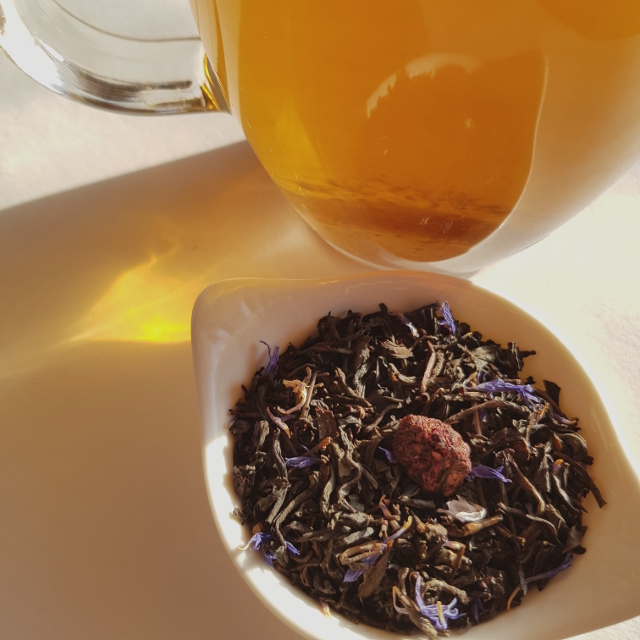
Loose-leaf Links is a feature where I gather together the interesting bits and pieces on sci-fi, fantasy and romance I’ve come across and share them with you over tea. Today’s tea is Blueberry and Almond from the Tea Centre. While the blueberry flavouring comes through clearly, there’s a disappointing lack of almond.
Awards News
The winners of the 2017 Nebula Awards were announced over the weekend.
Community and Conventions
Alisa Krasnostein has undertaken an informal audit of Australian SFF convention Codes of Conduct and their enforcement and has released some results.
The Tiptree Award is currently running an online auction to raise funds for the award. Bids close 16 June.
The Romantic Times Book Reviews is closing its doors.
On Equity
Locus Magazine is sponsoring memberships for PoC looking to attend the Locus Awards weekend.
Feminism in India has a wonderful interview with Hugo-nominated editor Mimi Mondal.
Christina at Books and Tea interviews Kelsi Morris on myths, monsters and fighting marginalisation.
Laura Goodin takes a look at agency and empathy in relation to Harriet the Spy.
For Writers
A reminder that the Superheroes Beyond conference has a call out for papers. The conference takes place in Melbourne from 30 November until 2 December. The proposal deadline is 25 May.
SFWA released their market report for May.
Writers looking for tools to set word count goals may find Pacemaker useful.
Lynn O’Connacht takes a look at four core traits of plotted slice-of-life fiction.
Lisa Fleetwood calls for a self-published writers festival in Australia.
For Readers
A new space opera trilogy is coming from James S.A. Corey.
After many years of being out of print, Joanna Russ’s books are finally being published digitally. You can check out an excerpt on The Book Smugglers website.
Amanda Bridgeman reveals the cover for the seventh book in her military sci-fi series Aurora.
Over at Lady Business, forestofglory hosts an excellent roundtable on short fiction reading habits.


May 13, 2018
An Unkindness of Magicians by Kat Howard
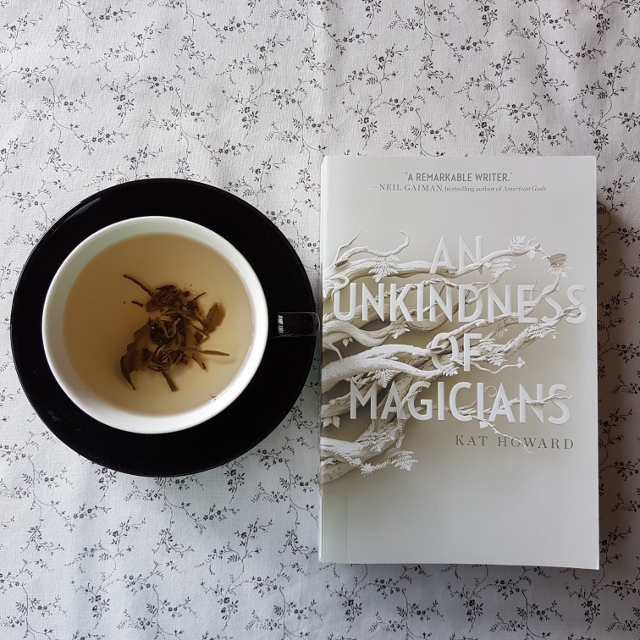
Published: November 2017 by Saga Press
Format reviewed: Paperback, 356 pages
Genres: Dark contemporary fantasy
Source: Library
Reading Challenges: Beat the Backlist
Available:Abbey’s ~ Amazon ~ Barnes & Noble ~ Book Depository ~ Booktopia ~ Dymocks ~ Kobo
The Unseen World of wealthy and literally powerful magicians in New York City prides itself on remaining invisible.
Ever twenty years, vying for power and standing during the Turning, the heads of magical houses elect a champion–a family member or magician-for-hire–and begin a series of duels.
But the Turning has come early, after only thirteen years, and Ian Merlin, the heir to the most powerful house in the Unseen World, has been elected to become the champion of his father’s chief rival, House Prospero.
Enter Sydney: an unknown magician from a candidate house, an outsider easily dismissed among the established wealth and power of the Unseen World.
What the Unseen World will soon learn is that Sydney is a formidable duelist with power that hasn’t been seen in decades, and she has a score to settle.
I am a sucker for secret magic societies and fantasy worlds that exist just under the surface of our own. So An Unkindness of Magicians feels like it was tailor-made for me. It is a dark and atmospheric contemporary fantasy that incorporates thriller elements and had me glued to the page.
This is a novel about power struggles. The Turning has arrived and the magical elite Houses of New York City vie for control of the Unseen World, while new candidates compete for a chance to establish their own House. The story is told from the viewpoint of a number of different characters, with the focus being on the ruling House Merlin, their closest rival House Prospero, the dark and mysterious House of Shadows and the candidate House Beauchamp. It’s a large cast, particularly for a standalone novel, but I had no trouble following along. The rivalry between the houses is an obvious place for power struggles, but the way magic is set up in this world opens up narratives about oppression in a way I found satisfying. Magic requires physical sacrifice. It is also starting to fail–sometimes simply not working, at other times twisting to harm the caster. The privileged elite of the Unseen World will do whatever they can to increase their store of power and to avoid paying the physical price for it.
The world-building was one of the things I loved most about the book. The magic system is well thought out and important to the plot. I also enjoyed the way the Houses are named after famous magicians of history and pop culture but no direct references are ever made to these figures. Another element I loved was the way the physical Houses are also entities in their own right. Seeing House Prospero interact with different characters was a delight and I was a little bit disappointed there wasn’t more.
Particularly because there is a strong focus on relationships–family, friends, lovers. A couple of threads in this book involve violence against women. However, this is counterbalanced by some strong female friendships. Sydney is largely an outsider to the Unseen World, but she is not alone. Her friendship with Madison Prospero (a minor cousin in the House) is wholly supportive and a wonderful antidote to some of the darkness of the story.
The women were generally a strong point because their numbers allowed variety and contrast. Sydney might be a powerful magician, but Madison is not. And there’s also a lovely contrast between Sydney and the head of House Prospero, Miranda. Both are powerful women. However, Miranda is a privileged beneficiary of a corrupt system, whereas Sydney has been the oppressed and is keen to burn down the system that supports Miranda.
Speaking of the characters, the story is always clear about who it wants you to like. While the good characters have their flaws, the bad characters don’t tend to have equivalent redeeming features. In another book, this may have bothered me, but here it works. We know from the beginning that one of them is a serial killer, and all of them are involved in violence against women in some way or another. The tension lies more in what happens when the characters finally confront each other.
So, it was disappointing to have the end resolve so quickly.
However, that’s a small quibble. Overall, I adored An Unkindness of Magicians and will be keeping my eye out for more of Kat Howard’s work.