Scott Edward Anderson's Blog, page 8
July 28, 2017
My poem, “Becoming,” for John Ashbery’s 90th Birthday
Whatever you think of John Ashbery’s poetry — and there are opinions for and against, none of which I’m going to get into here — you cannot argue with the fact that he has been a presence in the word of Art and Letters since first emerging on the scene in 1956.
I have a soft spot for Mr. Ashbery, not necessarily because of his poetry or the fact that he hails from Rochester, New York, outside of which I spent my middle and high school years.
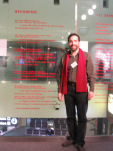
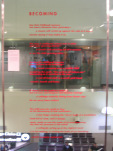
Rather, my fondness stems from his selecting one of my poems, “Becoming,” which is part of my Dwelling sequence and appears in my book Fallow Field, to represent the Millay Colony for the Arts, in its 30th Anniversary Exhibit at the Albany (NY) International Airport Gallery, in a juried show, from January-August 2004.
The poem, along with others in the sequence, was written during my residency at the colony in November 2002.
A heady feeling having my poem displayed in this context, adhesive red vinyl letters applied to the thick glass walls overlooking the security area. As I recall, my poem was positioned next to one by Colette Inez, another former resident at the colony, as a dear friend. In a way, it was a bit like being in an Ashbery poem.
(The photos here, blurry and boozily out-of-focus, seem to exemplify that feeling. And I had no idea my scarf was going to mimic the colors of the letters!)
Here is my poem, “Becoming,” with thanks to Mr. Ashbery — on this, his 90th birthday –for recognizing it in the way he did.
Becoming
Say that childhood memory
has more relevance than yesterday–
a moose calf curled up against the side of a house
merely saying it may make it so.
The way a sunflower towers over a child,
each year growing shorter–
a hermit crab crawling out of a coconut
–no, the child growing taller.
a sharp-shinned hawk swooping over a stubble field
imagining the earth, “the earth is all before me,”
blossoming as it stretches to the sun–
a brilliant red eft – baby salamander — held aloft in a small, pink hand
Is home the mother’s embrace?
a white cabbage butterfly flitting atop purple flox
The child sees his world or hers
stroking the furry back of a bumblebee
head full of seed, until it droops,
spent, ready to sow the seeds.
Say that our presence in the world
a millipede curling up at the child’s slightest touch
is making the book of our becoming.
–Scott Edward Anderson


April 30, 2017
National Poetry Month 2017, Bonus Poem: My poem, “Deaths of the Poets”
Two Poems by Scott Edward Anderson in The American Poetry Review
Ben Franklin was wrong. Only death is certain; taxes fluctuate — and some even get away without disclosing or paying them.
Last April, my friend the poet A.V. Christie died. It was not entirely a shock, she’d been battling stage 4 cancer for several years, but the fact that she was my age and we’d shared a stage together reading our poems meant it hit close to home.
Four and half months before that, another poet friend, David Simpson, died. I last saw David reading his poems in New York, his book had just come out. He was seriously ill, but celebrating. That was a lesson for me to choose abundance.
Add to that the myriad of more well-known and lesser known poets who die in any given year and it starts to add up: Heaney, Angelou, Kinnell, Waring, Batin, Knott, Strand, Levine, Ritvo, Harrison, Williams, Lux, Tolan, Walcott…the list goes on.
All this death — certain, inevitable death — and a growing number of memorial services and poetry reading “remembrances” over the past few years prompted me do two things: 1.) I started celebrating living poets by acknowledging their birthdays and sharing one of their poems on Facebook; and, 2.) I wrote a poem that tried to shed a little humor on this dark subject.
The poem is called “Deaths of the Poets,” turning on its head the famous Samuel Johnson title, “Lives of the Poets.” I see it as a tribute to the poets who have passed and a kind of companion piece to my poem, “The Poet Gene.”
This poem borrows a few lines from the Lynyrd Skynyrd song, “Free Bird,” which I’ve always wished someone would shout out at one of my readings, as was done at concerts back in the 70s and 80s. (Imagine the lines read in “poet voice,” if you will.)
I threatened to shout for “Free Bird” if my friend the poet Alison Hawthorne Deming didn’t open a recent reading by singing a few bars of “Stairway to Heaven,” which is the title of her new book of poems. She did it brilliantly and I have photo evidence. Alas, no recording.
Here is my poem, “Deaths of the Poets,” which appeared in The American Poetry Review earlier this year:
Deaths of the Poets
Sweet sorrow then, when poets die,
as so many of them have this year.
Goodbye to them, as we linger
over their works, forgiving their deeds,
maleficent or magnanimous.
We remember their kind gestures,
wholesome smiles, constructive criticism,
and witty remarks over drinks or dinner.
We seldom recall what a bore they were at readings,
droning on about their poems or rushing through them,
or how they showed up ill-prepared,
rifling through papers trying to find
the exact poem they wanted to read next
or constantly looking at their watch
and asking the host or hostess,
“How much time do I have?”
Sometimes when I hear poets read in their “poet voice,”
I want to shout out “Free Bird,” like hecklers at old
rock concerts. “Play ‘Free Bird’!” ‘til they recite,
“If I leave here tomorrow
Would you still remember me?
For I must be traveling on, now
‘Cause there’s too many places
I’ve got to see.”
Sweet sorrow in their passing then,
poets gone this year and last and yet to come.
And in our mourning let us not forget
Seamus Heaney’s story about two Scottish poets
at a reading, one on the podium struggling
to find his poems and the other, seated in the front row,
saying, “When they said he was going to read,
I thought they meant read out loud…”
–Scott Edward Anderson
c) 2017 Scott Edward Anderson
First published in The American Poetry Review, Vol. 46, No. 01, January/February 2017


April 28, 2017
National Poetry Month 2017, Week Four: ANAR’s “The Brightness of Wind”
My poem, “Pantoum for Aceh” translated into Tamil by Appadurai Muttulingam, 2014.
A few years ago, my friend and former colleague at The Nature Conservancy, Sanjayan, introduced me to Tamil poetry after a long chat about poetry while we were both speaking at a conference in Aspen.
Sanjayan, a Sri Lanka-born Tamil, recommended I start with Poems of Love and War, selected and translated by A. K. Ramanujan, a remarkable book of Tamil poems from throughout history.
Long-time subscribers to my Poetry Month emails will recall I shared a few poems from the anthology in April 2009. Sanjayan sent my email to his father, Appadurai Muttulingam, who in turn sent me a copy of his own delightful book of short stories.
I responded by sending Appadurai a few of my poems (my book was not yet out) and he offered to translate one of them, “Pantoum for Aceh,” into Tamil for a Canadian-based Tamil-language journal, URAIYAADAL, which was published in 2014 (see photo above). He also sent me an anthology of contemporary poetry in Tamil, which I reviewed on my blog, here.
That post led the Sri Lankan Tamil poet known as ANAR (Issath Rehana Mohamed Azeem), whose poem, “Marutham,” I had called out in my review, to reach out to me earlier this year and send me some of her poems.
How small the world becomes when we are open to discovery and exploring cultures beyond our own. We are a global people and, I’m convinced, the movement to close our borders and shut out “foreign” cultures will soon die, because technology and travel and our future on this planet demands it.
ANAR has been writing poetry in Tamil since the 1990s. Her works include Oviem Varaiyathe Thurikai, Enakkuk Kavithai Mukam, Perunkadal Podukiren, Utal Paccai Vaanam, and Potupotuththa Mazhaiththooththal (a collection of Tamil folk songs from Sri Lanka).
A number of ANAR’s poems have been translated into English and published. Her books have won several awards, most notably the Government of Sri Lanka’s National Literature Award, the Tamil Literary Garden’s (Canada) Poetry Award, the Vijay TV Excellence in the Field of Literature (Sigaram Thotta Pengal) Award, and the Sparrow Literature Award.
ANAR writes regularly on her blog, anarsrilanka.blogspot.com (Google Chrome will translate it for you) and lives with her husband and son in the Eastern Province of Sri Lanka at Sainthamaruthu.
Here is her poem, “The Brightness of Wind,” in an English translation by Professor Jayaraman and its Tamil original:
“The Brightness of Wind”
I allow the wind
To eat me
My eyes
I stroked its cool cheeks
For the first time
Before it showed itself in the wind
Intoxicated I drank the image day and night
Kisses I plucked from the wind
Overflowed as would the floods
These watery fingers
Reaching out from the wind
Play on my flesh
Tunes not known before
My dwelling has turned into a wind
You, the total haughtiness of the wind
You, the never-ending slight of the wind
The expanse of sand has gone dry with joy
Body, the green sky
Face, the blue moon
I saw the brightness of wind
In a flash of lightning
—ANAR
translated into English by Professor Thanga Jayaraman
And in the original (Not sure how the beautiful Tamil script will work in WordPress, we’ll see):
காற்றின் பிரகாசம்
காற்றைத் தின்னவிடுகிறேன்
என்னை …
என் கண்களை …
குளிர்ந்த அதன் கன்னங்களை வருடினேன்
முதல் முறையாக
காற்றில் வெளிப்படுமுன் பிம்பத்தை
பகலிரவாக பருகினேன் போதையுடன்
காற்றினுள்ளிருந்து எடுத்த முத்தங்கள்
வெள்ளமாய் பெருக்கெடுத்திருக்கின்றன
காற்றிலிருந்து நீளும் நீர் விரல்கள்
முன்னறியாத ராகங்களை
இசைக்கிறதென் சதைகளில்
என் வீடு காற்றாக மாறிவிட்டது
காற்றின் முழுமையான அகங்காரம் நீ
நீ காற்றின் முடிவற்ற அலட்சியம்
மகிழ்ச்சியில் உலர்ந்துகிடக்கின்றது மணல்வெளி
உடல் பச்சை வானம்
முகம் நீல நிலவு
நான் பார்த்தேன் காற்றின் பிரகாசத்தை
ஒரு மின்வெட்டுப் பொழுதில்
–ANAR
c) 2007 ANAR, used by permission of the author
(On a side note, you should check out Sanjayan’s new video series on Vox, made in conjunction with the University of California. Here’s a link: Climate Lab.)


April 21, 2017
National Poetry Month 2017, Week Three: Donald Hall’s “Ox Cart Man”
Kicking the Leaves by Donald Hall, 1978
I began to write poems with some seriousness in my teens. During that time, I consumed as much poetry as I could get my hands on, devouring books like a beast impossible to satiate.
My high school English teachers, Richard Taddeo and Jack Langerak, fed that beast too. They paid attention to what I was reading, asked me questions, and suggested other books and poets in a kind of personal curation that predated Amazon’s algorithm by almost 30 years. (Taddeo also published my first poem to appear in print, a short couplet of little note, in the school literary magazine.)
It was Taddeo who gave me Donald Hall’s Kicking the Leaves, shortly after it came out in 1978. Hall’s poems in that book spoke to me. As a native New Englander, the landscape was familiar – Hall’s hardscrabble New Hampshire a good match to Frost’s flinty Vermont, where I’d summered as a child.
Donald Hall’s example in Kicking the Leaves – and hearing Elizabeth Bishop read her work later that fall — showed me a different path: I wanted to become a poet. A decade later, after I met Hall at one of George Plimpton’s Paris Review parties at the latter’s Sutton Place apartment, we began a correspondence.
I sent him poems. He wrote back, postcards mostly, which I knew from one of his essays were recorded by Dictaphone while watching Red Sox games from his blue chair in the same farmhouse described in Kicking the Leaves. He hated everything I sent him and told me so. This was good. Tough love was just what I needed. He helped me improve, revise, and be hard on my own work.
In the late 90s I gave a craft talk at the University of Alaska Anchorage as part of their Writing Rendezvous conference. In the lecture, which I called “Making Poems Better: The Process of Revision,” I examined many drafts of Hall’s poem “Ox Cart Man,” including the version that appears in Kicking the Leaves, and my own “Black Angus, Winter,” which was part of a group of poems that won the Nebraska Review Award in 1997. You can read it here.
Hall’s book – his 7th book of poems — came out when he was about to turn 50. My book, Fallow Field, came out as I turned 50, and includes “Black Angus, Winter” and several poems that Hall hated in earlier versions, all of which were improved by his terse, meaningful criticism.
You can find Donald Hall’s “Ox Cart Man” here (permission restrictions prevent me from publishing the poem in its entirety and an excerpt won’t do it justice) or better yet, buy his Selected Poems. And here is a recording of Donald Hall reading “Ox Cart Man.”


April 14, 2017
National Poetry Month 2017, Week Two: “Dark Harbour” by Alison Hawthorne Deming
Dark Harbour Sunset, August 2016
For several years our friend, the poet Alison Hawthorne Deming, told us about Grand Manan Island off the coast of New Brunswick, Canada. Alison is a long-time summer resident on Grand Manan.
We finally made it up there last summer – and were we glad we did.
To say the island is a special place is a bit of a cliché and certainly doesn’t do the island justice. But then, when is a cliché not mostly true?
Remote and fairly difficult to get to from New York – you drive to the edge of Maine and keep going — Grand Manan sits on the western end of the mouth of the Bay of Fundy and was formed by colliding plates. You can see the fault line where Triassic and Cambrian rock meets.
Here time is marked by arriving and departing ferries, dramatic in-coming and out-going tides, and when the herring is running. The landscape is rugged basalt and a dense forest of birch and conifers, with pockets of wetlands, marshes, and rocky cliffs all formed and deformed by the sea, salt spray, and wind.
One evening before sunset, Alison took us over the top of the island to the other side, to Dark Harbour, a place that seemed somewhat stuck in time. I felt a bit like an intruder, although the place was oddly familiar as well, surrounded by encroaching darkness. There are rumors of pirates or a pirate curse in Dark Harbour.
Dark Harbour is also the dulse capital of the world. Dulse is an edible seaweed harvested by hand at low tide and dried in the sun outside during the summer months. Grand Mananers love their dulse, which seems a healthy substitute for chewing tobacco or potato chips. Dulsers are a special breed, as this video from Great Big Story attests: http://www.greatbigstory.com/stories/dulser-dark-harbor
Several poems in Alison’s new book of poems, STAIRWAY TO HEAVEN, feature the people and landscape of Grand Manan. There are echoes in these poems of another Canadian Maritime setting by another poet from New England with Maritime ties, something about the cold and crystal clear water, a quiet observation and an older way of life, the dark forest and the sea.
We’re going back this summer.
Here is Alison Hawthorne Deming’s poem, “Dark Harbour”:
“Dark Harbour”
Dulse camps teeter on cobbled basalt
where storms have heaped a seawall
topped with tumult of silvered
wharf timbers and weir stakes
enough driftwood scrap to salvage for a shack
paint the battered door dusty blue.
A rusty slatted bed kerosene pooled
in a glass-chimney lamp waiting for a match
dirty teapot on the camp stove
it’s home for a night or two
when tides are right for gathering.
Stone slips wait gray and smooth from wear
where yellow dories are winched and
skidded to motor offshore headed
for the dulsing ground. A man
who works the intertidal shore
says I can smell the tide coming in.
I raise my face to the wind to try to catch
what he knows. Cold and crystal clear
the water laps the rocks and rattles them
as it recedes. The man pulls fistful
of purple weed off tide-bare rocks
a gentle rip sounding with each pull
the ribbons gathered in his basket
dark as iodine deep as hay scythed
and piled in ricks harvest picked by hand
gathered from the transmutation of light
that sways at high tide like hair in the wind
and lies still for combing when the tide recedes
cropland where sea and rock do the tillage.
–Alison Hawthorne Deming
c) 2016 Alison Hawthorne Deming. Used by permission of the author.


April 8, 2017
National Poetry Month 2017, Week One: “Silence” by Catherine Ayres
Catherine Ayres
Poets who can say much with few words are rare. Writing is hard; concision even harder. When these poets are funny, touching, sad, and poignant all in very few lines, the reader marvels. Catherine Ayres is such a poet.
I met Catherine Ayres through Jo Bell’s “52” poetry group three years ago. 52 was a private group of poets Jo organized from England, but which soon expanded around the globe.
Each week, Jo fed us a poetry prompt and some of us who were insane enough to take up her suggestion and write a poem each week for the entire year. Then we shared our poem with the group and received comments and criticism, parsing and praise.
Some of us stuck with 52 the entire year. Some became and remained friends on Facebook after the year ended. We watched as poem after poem by our 52 mates got published, won awards, and became a part of collections.
One such poem was Catherine Ayres’s “Silence,” which like many of the poems in what became her first collection, Amazon, deals with illness and survival, the body and our perception of our own bodies head-on and with unflinching wisdom, humor, and pathos.
Catherine’s poems impressed me each week. There was something timeless and yet timely about her poems, with their heady mix of myth and “medicalia,” to coin a phrase, Her poems were the real deal. When I heard she was publishing her first book, I ordered it straightaway from the small UK-based publisher, Indigo Dreams. I was not disappointed.
Catherine Ayres is a teacher from Northumberland – Basil Bunting territory – her poem, “Silence,” won the Elbow Room Prize in 2016. Here is Catherine Ayres’s “Silence”:
“Silence”
The last man to touch my breast held a knife.
My lover said nothing;
his eyes told me to wear a vest
Sometimes I spread my hand over the scar
to feel its cage
How does a woman speak
with a closed mouth on her chest?
She unpicks in silence
until the rain comes
like burst stitches on the glass
– Catherine Ayres
Used by permission of the author. You can order Catherine Ayres’s Amazon (and you should) directly from the publisher http://www.indigodreams.co.uk/catherine-ayres/4593286356


January 7, 2017
My poem “Villanelle on a Line Hated by Auden”
W.H. Auden
“September 1, 1939” is one of the most famous poems by W. H. Auden. He wrote the poem after learning the news of Hitler’s invasion of Poland at the start of World War II, published it a month later in The New Republic magazine, and reprinted it in his collection, Another Time, the following year.
Despite – or perhaps because of — rushing it into print, Auden appeared to dislike the poem almost as soon as it was published. As little as five years later, reprinting the poem in The Collected Poetry of W. H. Auden (1945), he cut the stanza with its most famous line, “We must love one another or die.”
“Between you and me, I loathe that poem,” he wrote to the critic Laurence Lerner, and resolved to keep it out of future collections of his work during his lifetime. He relented in 1955, allowing Oscar Williams to include it in his New Pocket Anthology of American Verse, but only with the proviso that the last line be edited to “We must love one another and die.”
Why did he hate this line – and the poem — so much? He claimed in a preface to the 1965 edition of his Collected Poems, “Some poems which I wrote and, unfortunately, published, I have thrown out because they were dishonest, or bad-mannered, or boring.”
In a Penguin anthology the previous year, the poem and four others were included along with a caveat: “Mr. W. H. Auden considers these five poems to be trash which he is ashamed to have written.”
What was it about the poem and, in particular, this line that Auden didn’t like? Was he embarrassed by its earnestness and sentiment, as some have suggested? Did he feel it was sappy and self-indulgent, as others would have it? Or was it “the most dishonest poem I have ever written,” as he put it?
And yet, the last line endures and the poem remains one of Auden’s most famous, surviving even today as one of the most eloquent pleas for empathy and peace in the face of totalitarianism. The poem even resurfaced as a touchstone for people in the wake of 9/11, as I have written elsewhere.
I wrote “Villanelle on a Line Hated by Auden” on 3 September 2014 as part of Jo Bell’s “52” experiment, and it was recently published in The Road Not Taken: The Journal of Formal Poetry.
Here is my poem, “Villanelle on a Line Hated by Auden”:
“We must love one another or die,”
The poet instructs, though doesn’t believe it.
“We must love one another and die.”
Revised to inclusive and on another try,
Then repudiated the poem, banning it.
He who must love another or die.
“Ours is not to reason why,”
Another poet said with the soul of wit.
Ours is to love one another. We die.
Changing a word makes meaning fly
To the far reaches of our minds and sit.
Must we, really, love one another or die?
Can we exist without knowing why–
Knowledge straining at the bit–
Until we can only love each other and die?
When we live without love, we die.
At least, those of us who desire it.
We must love one another or die.
We must love one another and die.
–Scott Edward Anderson


April 29, 2016
National Poetry Month 2016, Week Five: My poem “Villanesca”
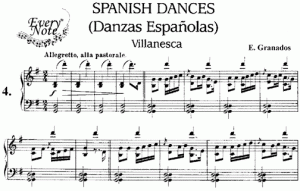 For the fifth and final week of National Poetry Month this year, I’m featuring one of my own poem, “Villanesca.”
This poem was published last summer in Cimarron Review, thanks to poet Alfred Corn, who chose the poem in his role as a contributing editor.
Alfred also provided some critical guidance to help me finish this poem, which I’d been working on for several years. The poem sprang from a conversation overheard between my friend and colleague, Jan Almquist, and his daughter on the train to DC a decade ago.
We were traveling down to pitch the design of The Nature Conservancy’s Annual Report when Jan got a call from his then teenage daughter about leaving her score for Enrique Granados’s “Spanish Dances,” at home and asking him to bring it to her. That was all I needed to prompt the poem, although it obviously went in a different direction.
Sometime later, after boarding a plane, I found a program of Granados on the audio channel featuring the fabulous interpretations of De Larrocha. Obviously, I had to get that into the poem somehow and it helped build another layer.
As mentioned in last week’s post, I shared this poem with poet A.V. Christie a few months before her death. I was very touched by her response to the poem. She wrote, “I love the tone of this poem & the subtle/textured types of communication it’s built up out of…I experience it…it’s so active & in motion…”
Here is my poem, “Villanesca,”
Before the cabin door shuts, I check messages.
You forgot your score for “Spanish Dances” on the piano,
left open at the “Villanesca,” a piece with pastoral repetitions
you found hard to reproduce. Your rough interpretation
reminds me of your voice and its effect (or its affect).
Headphones on, I listen to Alicia de Larrocha
performing Granados. The program host has a soothing lisp,
enunciating every syl – la – ble, like a reporter on NPR.
Quoting from a review, she says De Larrocha’s playing speaks
to “a glorious inevitability achieved through immense discipline.”
“Can you bring the score to my rehearsal?” you ask
via voice mail, forgetting my flight this afternoon.
Unlike De Larrocha you always forget the score,
ignore signals, struggle to find the right notes, refuse
to face the music of our own inglorious inevitability.
I press delete, choosing not to repeat past mistakes;
at least, for the duration of my flight.
–Scott Edward Anderson


April 22, 2016
National Poetry Month 2016, Week Four: A.V. Christie’s “Folding the Fitted Sheet”
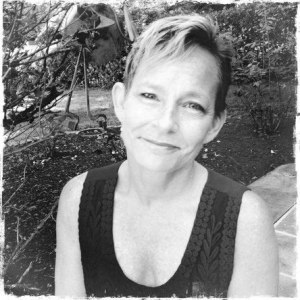
A.V. Christie
(Photo: Darcie Goldberg)
Poet A.V. Christie died this month. Poets die all the time – celebrities, too, and friends, family members. Death is inevitable. We are all dying as we go on living.
Over the past two years there have been countless poets passing, some well-known, such as Seamus Heaney, Galway Kinnell, and Philip Levine; some not as known as they should be: Belle Waring, Wendy Batin, and David Simpson.
Somehow, though, Ann Christie’s death hit home more than the others. Perhaps because she was my age; perhaps because I was in Philadelphia when I heard the news, across the river from where she lived. Perhaps, too, because we’d read together over the years in different venues in the Philadelphia area.
But also because we had just corresponded a few months back via Facebook, as she continued to battle Stage 4 cancer. When I asked if there was anything I could do to help her with her struggle, she asked me to send a recent poem. (I did and will share it you next week.)
Ann was generous like that and cared deeply about poetry and people. She experienced a great deal of pain in her life – her brother committed suicide when he was 32, which she wrote about so eloquently and forcefully in her first book, Nine Skies (University of Illinois Press, 1997).
I’ve been re-reading Ann’s work the past week or so, and eagerly awaiting the publication next month of her last chapbook, And I Began to Entertain Doubts, coming out from Folded Word Press. Her other books include, The Housing (The Ashland Poetry Press, 2004) and The Wonders (Seven Kitchens Press, 2014).
In thinking about a poem of hers to share, it suddenly dawned on me – actually, as I struggled to fold a fitted sheet in our laundry room the other night — that a poem that shows off the facets of Ann’s poetry jewels is her poem on that subject, “Folding the Fitted Sheet,” which of course is about more than that, but it made me smile thinking of and reading it again, which is what her poems do best: rouse us out of our everyday reality.
Her poems make us feel something new, look at things a different way – from heartache to routines – they challenge our perspective on the world. This, in the end, is what great poetry is supposed to do.
Here is A.V. Christie’s poem, “Folding the Fitted Sheet”:
There is a way to do this.
The sheet stiff from the line
and king-size overwhelming as an hour can be.
Arms outstretched.
She apes a stance that looks like welcoming.
This obstinate sea!
The day has been so far fear and syllables rippling.
So commence to fit each messy gather
one to the next—.
Pulled to, like a widespread inner panic managed
repeatedly.
One corner puckers, then droops— a sun
that, disaffected, simply drops from out of the sky.
In this method the right side and the wrong
confound. She says aloud the words Counterpane—
Horizon— thinks out the demands of tomorrow’s
presentation, velocity, the power-point resources
circulating and the cool weight
of what gets infolded.
We watch her,
the one moving deeply along a nerve—
toward some far city or god.
-A.V. Christie (1963-2016)
Source: Cave Wall (2009)
You can learn more about A.V. Christie’s poetry here: http://www.avchristie.com/
A Memorial reading will take place at Moonstone @ Brandywine Workshop in Philadelphia on 26 May.


April 15, 2016
National Poetry Month 2016, Week Three: Gregory Pardlo’s “Epistemology of the Phone Booth”
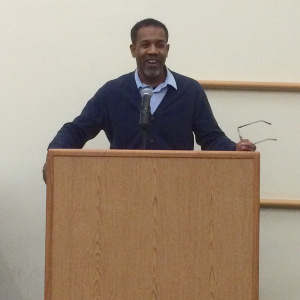
Gregory Pardlo reading at LIU Brooklyn. Photo by SEA
When I heard that Gregory Pardlo won the Pulitzer Prize last year for his poetry collection, Digest, I thought about the phrase “booty call.”
That’s right, booty call.
I had this memory of meeting Gregory Pardlo in Camden, NJ, sometime in the early 2000s, standing out front of a bar with Daniel Nester and Tom Hartman after a reading or an editorial session of Painted Bride Quarterly, which I helped edit at the time.
We were discussing the poetical possibilities of the phrase. I’m not sure where the conversation went after that; there were other phrases we thought had a natural tone and scanned well, but this was before phrases like “person of interest” and “shelter in place” became well known.
Pardlo, who was born in Philadelphia, but grew up in Willingboro, NJ, earned his BA from Rutgers-Camden and later got an MFA at NYU. Somehow I missed his first collection, Totem, which won the APR/Honickman Prize and was published by Copper Canyon Press in 2007. Digest seemed to come out of nowhere to nab the Pulitzer.
So when Pardlo read at the Brooklyn campus of Long Island University this past February, I had to answer the call and go hear him. I was not disappointed.
Pardlo has an engaging reading style that is part college professor, part Brooklyn stoop-storyteller. And the complexity and tenderness of his poems, what one critic called “both dense and accessible, literary yet urban,” is captivating.
In his poem “Epistemology of the Phone Booth,” a fourteen-year-old boy uses a prepaid phone card, the back pages of a local free weekly, and a phone booth to seek a knowledge of the unknown and, perhaps, unknowable. He’s on the brink of discovery and, simultaneously, on the verge of repentance only to find that the ability to acquire knowledge in this manner may be finite. It’s a kind of “booty call” about the nature of knowledge.
Here is Gregory Pardlo’s poem, “Epistemology of the Phone Booth”:
I found the scrap of City Paper
classified, the 1-900 number and photos
like candidates there, in love’s voting machine.
Discomfort station. No pissoir. Hothouse maybe for
a fourteenth-year sprig: me. Light box
to slideshow the introvert
cloaked in a prepaid identity
discreet as a shirttail in the fly.
Ma Bell’s shelter
was brutal & snug. I’d heard the ram’s horn hum.
A hymn. Just like prayer I thought. No answer.
Clack’d the splendid tongue
and bloom!
Salutations rose like pollen, prepped me for
the inverse of police
sketch artists, the one who would evoke so I could render,
in my mind, the enigma of the wanted; one to source
the vacuum wrenching stutters like rivets
off my tongue.
Plink. Into the sewer of the mouthpiece.
Then the universal ballad of the waiting room.
Casiotone.
Hold (me) music.
No orgone
closet. More like that other-lonely doom—the body
encapsulated, its inventory ever unknown. Dantean vestibule.
Anti-chat room.
When the genderless voice beyond
began to lavish I grew ears all over,
inner ears
swiveling from one tepid libretto to the next
tuning for some satin frequency the culture
promised until, I repent (forgive me father), the card went bust.
–Gregory Pardlo
Copyright @ 2014 by Gregory Pardlo. Used with permission of the author.
Read more about Gregory Pardlo and his work at http://www.pardlo.com/