Scott Edward Anderson's Blog, page 4
April 13, 2022
National Poetry Month 2022, Week Two: My Translation of Vitorino Nemésio’s “Navio”
 Nemésio and his translator. Painting by Henrique Mourato, 1992.
 Photo by Ana Cristina Gil, University of the Azores.
My apologies for not being on top of my game with regards to National Poetry Month Mailings this year. Samantha and I just returned from an emotional trip to our beloved island of São Miguel, in the Azores, after two years away.
It was emotion-filled not only because the pandemic kept us way for two years—we had tried to go back as recently as December, but Omicron dissuaded us—but because in the interim years we had determined that we want to divide our time between there and our new home in the Berkshires and this trip solidified and confirmed that plan.
On top of that, we held a ceremony to place a plaque at the Praça do Emigrante (Emigrant Square) honoring the memory and sacrifice of my two great-grandparents who emigrated from the island in 1906. Joining us were cousins from my family there, the Casquilho family, along with the director and staff from the Associação dos Emigrantes Açorianos.
It was a windy afternoon, and the waves were crashing against the rocky shore along the north coast of the island, as if the spirit of my great-grandparents were making their presence known.
All this to say that I’m behind in my weekly mailings and I apologize. This week, I’m going to share post one of my translations of the great Azorean poet Vitorino Nemésio, “Ship,” which I hope you will enjoy. It originally appeared in Gávea-Brown Journal and was reprinted in my new book, Wine-Dark Sea: New & Selected Poems & Translations. Here it is in the original Portuguese and in my translation:
Navio
Tenho a carne dorida
Do pousar de umas aves
Que não sei de onde são:
Só sei que gostam de vida
Picada em meu coração.
Quando vêm, vêm suaves;
Partindo, tão gordas vão!
Como eu gosto de estar
Aqui na minha janela
A dar miolos às aves!
Ponho-me a olhar para o mar:
—Olha-me um navio sem rumo!
E, de vê-lo, dá-lho a vela,
Ou sejam meus cílios tristes:
A ave e a nave, em resumo,
Aqui, na minha janela.
—Vitorino Nemésio, Nem Toda A Noite A Vida
___
Ship
My flesh is sore
from the landing of some birds
I don’t know where they’re from.
I only know that they, like life,
sting in my heart.
When they come, they come softly;
leaving, they go so heavy!
How I like to be
here at my window
giving my mind over to the birds!
I’m looking at the sea:
look at that aimless ship!
And, seeing it, give it a lamp[i],
or my sad eyelashes:
the bird and the ship, in a nutshell,
here, at my window.
—translated from the Portuguese by Scott Edward Anderson
[i] For “vela,” I like “lamp” here, rather than “candle” or “sail,” because it echoes the idea of lighting a lamp to draw in a weary traveler—although I think “salute” or “sign” might also work, although not technically accurate. Also “lamp” hearkens back to Nemésio’s stated desire, expressed in his Corsário das Ilhas, which I’ve been translating for Tagus Press, of wanting to be a lighthouse keeper.


April 12, 2022
National Poetry Month 2022, Week One: Dana Levin’s “Instructions for Shopping”

I’m behind in posting this year’s National Poetry Month poems, and I was reminded of that fact by several readers who reached out wondering whether they’d fallen off the list. My apologies!!
We finally made it back to the Azores after two years away and I’ve been busy preparing for a lecture I am giving at the University of the Azores this evening (as I write this) and a book launch event at the bookstore of my Azorean publisher, Letras Lavadas, in Ponta Delgada on Thursday.
Still, no excuse.
Then, this morning, I saw Dana Levin’s poem below, posted by several friends on social media from its appearance in the New York Times Magazine this week, and—given recent events in Ukraine and Sacramento—I decided it was the poem to start with this year.
Dana Levin is a national treasure. Her poetry is both erudite and approachable, a rich combination of everyday observations, science, and deep human feeling.
Dana grew up in California’s Mojave Desert, earned a BA from Pitzer College and an MA from New York University. Her collections of poetry include Banana Palace (2016), Sky Burial (2011), Wedding Day (2005), and In the Surgical Theatre (1999). She teaches at Maryville University in St. Louis, where she is distinguished writer-in-residence.
Here is Dana Levin’s poem, “Instructions for Stopping,” from her new book, Now Do You Know Where You Are, out now from Copper Canyon Press.
Instructions for StoppingBy Dana Levin
Say Stop.
Keep your lips pressed together
after you say the p:
(soon they’ll try
to pry
your breath out—)
—
Whisper it
three times in a row:
Stop Stop Stop
In a hospital bed
like a curled-up fish, someone’s
gulping at air—
How should you apply
your breath?
—
List all of the people
you would like
to stop.
Who offers love,
who terror—
Write Stop.
Put a period at the end.
Decide if it’s a kiss
or a bullet.
—
Here’s how it appeared in the New York Times Magazine on Sunday: Insructions for Stopping.
March 2, 2022
WINE-DARK SEA BOOK LAUNCH & READING
On #pubday eve, Kathryn Miles and I got together to chat about my new book, Wine-Dark Sea: New & Selected Poems & Translations. We had a wide-ranging conversation about the book, specific poems, finding love at middle age, the idea of home, and the Azores — and I even read a poem in Portuguese.
Have a look here:
The book came out March 1st and is available through the links on my website: scottedwardanderson.com/wine-dark-sea
November 24, 2021
My Year in Writing: 2021
 Poster for my talk at the Humanities Forum of Providence College, September 2021
 Now is the time of year, between my birthday and the end of the year, when I take stock of my year in writing.
What a year it’s been, deepening my connections to my ancestral homeland of the Azores, as well as my ties to the diaspora throughout North America. Here we go:
Signed contract with Shanti Arts for Wine-Dark Sea: New & Selected Poems & Translations to be published in Spring 2022. (Technically signed this at the very end of 2020, but thought it was worth mentioning again.)Published “Five Poems by Vitorino Nemésio” in my English translations in Gávea-Brown: A Bilingual Journal of Portuguese-North American Letters and Studies.Interview and review by Esmeralda Cabral appeared in Gávea-Brown and was later translated into Portuguese by Esmeralda and Marta Cowling and appeared in Diário dos Açores.Published four translations by Margarida Vale de Gato from Dwelling in Colóquio/Letras by the Gulbenkian Foundation. And signed contract with Poética Edições for Habitar: uma ecopoema, translation by Margarida of my book Dwelling: an ecopoem. Received funding for Margarida’s translation from FLAD.Associação dos Emigrantes Açorianos AEA video presentation, “Açores de Mil Ilhas” for World Poetry Day.Azorean Suite/Suite Açoriana review by Maria João Covas (video); and translation of Vamberto Freitas’s (2020) review published in Portuguese-American Journal .Wrote a poem in português for Letras Lavadas’s celebration, Dia Internacional da Mulher. Here is the video presentation, which includes the fabulous Aníbal Pires reading my poem, “A outra metade do céu/The other half of the sky.”Talk for New Bedford Whaling Museum on “Azorean Suite: A Voyage of Discovery Through Ancestry, Whaling, and Other Atlantic Crossings”Dwelling featured in a class at Providence College on Environmental Philosophy, thanks to Professor Ryan Shea; spent a week there, including teaching three classes and giving a reading/talk at the PC Humanities Forum.Readings: RONDA: Leiria Poetry Festival (March); Filaments of Atlantic Heritage (March), Cravos Vermelhos Oara Todos os Povos/World Poetry Movement Reading (April); A Nova Revolução dos Cravos (April), Cagarro Colloquium—Azores Day & launch (May); ASLE Spotlight Series (June); Juniper Moon’s Sunday Live reading series (August), LAEF Conference/PBBI (October); and A Voz dos Avós Conference/PBBI (November). Phew, I’m exhausted just writing that schedule!Translated poems by Luís Filipe Sarmento, Ângela de Almeida, and Adelaide Freitas.Panelist for PALCUS on Embracing Modern Portuguese Culture (spoke about Cagarro Colloquium, translation, etc.).Participated in “Insularity and Beyond: The Azores & American Ties” webinar with University of the Açores.Participated in session with Margarida Vale de Gota’s translation students at University of the Lisbon via Zoom.Recorded a video—em português—for Letras Lavadas’s second anniversary of bookstore in PDLFinished a draft of my translation of Vitorino Nemésio’s Corsário das Ilhas and revisions corresponding to new (2021) Portuguese edition.Published my talk from PC Humanities Forum in Gavéa-Brown .Published “Wine-Dark Sea” (poem) in America Studies Over_Seas.Published two poems, “The Pre-dawn Song of the Pearly-eyed Thrasher” and “Under the Linden’s Spell,” in The Wayfarer .Published “Phase Change” (poem) in ONE ART (online poetry journal).Scrapped portions of my work-in-progress, The Others in Me, after consulting with two writer friends about it, but found a new approach through working with Marion Roach Smith, which I will start in 2022…What a year! I am exceedingly grateful to everyone who has supported my writing over the past year. As Walter Lowenfels wrote, “One reader is a miracle; two, a mass movement.” I feel like I’ve been blessed by a mass miracle this year!
May 31, 2021
UPDATED: Reading and Talk: “Azorean Suite: A Voyage of Discovery through Ancestry, Whaling, and Other Atlantic Crossings”

Please join me this Thursday, 3 June, at 7PM EDT, for a reading and talk I’m giving for the New Bedford Whaling Museum, which focuses on the connections between the Azores, New Bedford, and Rhode Island, whaling, and other Atlantic Crossings.
Inspired by my explorations into my family heritage, which in turn inspired my book-length poem Azorean Suite/Suite Açoriana, this reading and talk will explore the journeys of various waves of immigrants to America and their connection across the Atlantic to the Azores.
I’ll share passages from Azorean Suite, as well as from my work-in-progress, a research-driven memoir called “The Others in Me: A Journey to Discover Ancestry, Identity, and Lost Heritage.”
The ZOOM event is past, but you can watch the video here: Whaling Museum
Hope to “see” you there!
Upcoming Reading & Talk: “Azorean Suite: A Voyage of Discovery through Ancestry, Whaling, and Other Atlantic Crossings”
Please join me this Thursday, 3 June, at 7PM EDT, for a reading and talk I’m giving for the New Bedford Whaling Museum, which focuses on the connections between the Azores, New Bedford, and Rhode Island, whaling, and other Atlantic Crossings.
Inspired by my explorations into my family heritage, which in turn inspired my book-length poem Azorean Suite/Suite Açoriana, this reading and talk will explore the journeys of various waves of immigrants to America and their connection across the Atlantic to the Azores.
I’ll share passages from Azorean Suite, as well as from my work-in-progress, a research-driven memoir called “The Others in Me: A Journey to Discover Ancestry, Identity, and Lost Heritage.”
The ZOOM event is free, but please register in advance here: Whaling Museum
Hope to “see” you there!
May 2, 2021
National Poetry Month 2021, Bonus Week: My translation of Vitorino Nemésio’s “A Árvore do Silêncio”
For my bonus post this year, wrapping up this Poetry Month featuring poets of the Azores and its Diaspora, I want to share one of my translations of the great 20th Century Azorean poet Vitorino Nemésio. (This translation appears in the current issue of Gávea-Brown: A Bilingual Journal of Portuguese-North American Letters and Studies, along with four others.)
 Vitorino Nemésio statue on Terceira Island, the Azores islands, Portugal.
Photo by Manuel de Sousa, Creative Commons License
A poet, essayist, and public intellectual, Nemésio was born on Terceira Island in 1901 and is best known for his novel Mau tempo no canal (1945), which was translated into English by Francisco Cota Fagundes and published as Stormy Isles: An Azorean Tale.
In 1932, the quincentennial year of Gonçalo Velho Cabral’s “discovery” of the Azores, Nemésio coined the term “açorianidade,” which he would explore in two important essays, and which would become the subject of much debate over the years. There are those who see the term as somewhat limiting: describing as it does a specific, fixed set of qualities of the island condition—insularity, for example—that belies a greater dynamism in the spirit of the islanders.
Nevertheless, I think its usefulness as a term is somewhat expanded when we look at what Nemésio himself said about it, reflecting the entirety of his term rather than one dimension of it. Instead of limiting it as a descriptor to what it’s like to be born on the islands, Nemésio asserted that it was appropriate, too, for those who emigrated from the islands, as well as those who later returned. (And, by extension, as I said in a recent interview, I like to think he intended it to continue through or beyond the generations.)
The term, wrote Antonio Machado Pires in his essay, “The Azorean Man and Azoreanity,” “not only expresses the quality and soul of being Azorean, inside or outside (mainly outside?) of the Azores, but the set of constraints of archipelagic living: its geography (which ‘is worth as much as history’), its volcanism, its economic limitations, but also its own capacity as a traditional ‘economy’ of subsistence, its manifestations of culture and popular religiosity, their idiosyncrasy, their speaking, everything that contributes to verify identity.”
As a “warm-up exercise” for translating Nemésio’s travel diary, Corsário das Ilhas (1956), for which I am currently under contract with Tagus Press of UMass Dartmouth (with financial support from Brown University), I started with some of his poems. And I hope to continue with more, because Nemésio is worthy of a larger audience here.
I hope you’ve enjoyed this brief tour of some of the poetry of the Azores and its Diaspora.
Here is Vitorino Nemésio’s “A Árvore do Silêncio” and my translation, “The Tree of Silence”:
A ÁRVORE DO SILÊNCIO
Se a nossa voz crescesse, onde era a árvore?
Em que pontas, a corola do silêncio?
Coração já cansado, és a raiz:
Uma ave te passe a outro país.
Coisas de terra são palavra.
Semeia o que calou.
Não faz sentido quem lavra
Se o não colhe do que amou.
Assim, sílaba e folha, porque não
Num só ramo levá-las
com a graça e o redondo de uma mão?
(Tu não te calas? Tu não te calas?!)
—Vitorino Nemésio de Canto de Véspera (1966)
_____________
THE TREE OF SILENCE
If our voice grew, where was the tree?
To what ends, the corolla of silence?
Heart already tired, you are the root:
a bird passes you en route to another country.
Earthly things are word.
Sow what is silent.
It doesn’t matter who plows,
if you don’t reap what you loved.
So, why not take them,
syllable and leaf, in a single bunch
with the graceful roundness of one hand?
(Don’t you keep quiet? Don’t you keep quiet?!)
—translated from the Portuguese by Scott Edward Anderson
from Gávea-Brown—A Bilingual Journal of Portuguese-North American Letters and Studies, vol. 43. Brown University, 2021
April 30, 2021
National Poetry Month 2021, Week Four: Adelaide Freitas’s “In the Bulge of Your Body”
Continuing to explore the poets and poetry of the Azores and its Diaspora, this week I’m featuring a poem by the late Adelaide Freitas, a wonderful Azorean poet, novelist, and essayist deserving of more attention.
Freitas was born 20 April 1949 in Achadinha, on the northeastern coast of São Miguel Island. She attended school in Ponta Delgada before moving with her family to the United States, where she attended New Bedford High School in Massachusetts. In 1972, she graduated with a BA in Portuguese from the Southeastern Massachusetts University (now UMass Dartmouth) and went on to earn a master’s degree in Comparative Literature from the City University of New York and a PhD in American Literature from the University of Azores. She lived in Ponta Delgada with her husband, Vamberto Freitas, and was a professor of American Literature and Culture at the University of the Azores.
 Smiling in the Darkness by Adelaide Freitas
In 2018, Adelaide Freitas was honored by the Legislative Assembly of the Autonomous Region of the Azores with the Insígnia Autonómica de Reconhecimento (Commendation of Recognition), just a few weeks before she passed away after a long battle with Alzheimer’s.
“Adelaide Freitas had gone silent years ago through the devastation of illness,” wrote one of her translators, Emanuel Melo, on his blog. “Her husband, Vamberto Freitas, himself a man of letters and important literary critic in the Portuguese diaspora, with enduring love and faithfulness kept her by his side, even writing about her, but above all loving her with steadfastness. In one of his blog posts he wrote how in the middle of a sleepless night, with her resting in the next room, he would take her books from the shelf and read her words to himself when he could no longer her the voice of his beloved wife.”
Her novel, Smiling in the Darkness, is an intimate portrait of what life was like on the Azores during the latter half of the 20th Century, and follows a young woman who struggles with the absence of her emigrant parents—who left her behind when they went to America—and her desire to explore the world beyond her island home. It was recently published in a translation by Katherine Baker, Emanuel Melo, and others. You can order a copy (and you should) from Tagus Press here: Smiling in the Darkness.
Here is her poem, “No bojo do teu corpo” in its original Portuguese and my English translation:
“No bojo do teu corpo”
No bojo do teu copo
olho translúcido o teu corpo
Vibra a alegria da tua emoção
e em mim se dilui a sua gota
Ballet agita o copo
treme a boca da garrafa
A mão abafa o vidro morno
cala-se enterrada a ternura dos lábios
A folha verde voa etérea
pousa no líquido desfeito
Dela nasce uma flor
e o mundo nela se espelha
branca a luz se intersecta
refrecta o whisky beijado
Guardanapo assim molhado
refresca a tua fronte
Gentil ela se inclina
no Outro se confunde
No tchim-tchim da efusão
treme bojo do teu corpo
—
“In the bulge of your body”
In the bulge of your glass
I see your translucent body
Vibrating with the joy of your emotion
and your drop dissolves in me
Ballet stirs the glass
the mouth of the bottle is trembling
The hand stifles the tepid glass
the tenderness of the lips is buried, remains silent
The green leaf flies ethereal
lands in the dissolved liquid
From it a flower is born
and the world is mirrored in it
white light intersects
refracting the whisky kiss
Such a wet napkin
refreshing your brow
Gently she leans
into the Other, gets confused
In the Tchim-tchim![1] of effusion
the bulge of your body trembles
—Adelaide Freitas (translated by Scott Edward Anderson)
[1] Tchim-tchim! is an expression like Cheers! An onomatopoeic phrase that connotes the clinking of glasses. I decided not to translate it here, although I could have gone with “cling-cling!” or something similar.
April 18, 2021
National Poetry Month 2021, Week Three: Logan Duarte’s “My Statue”
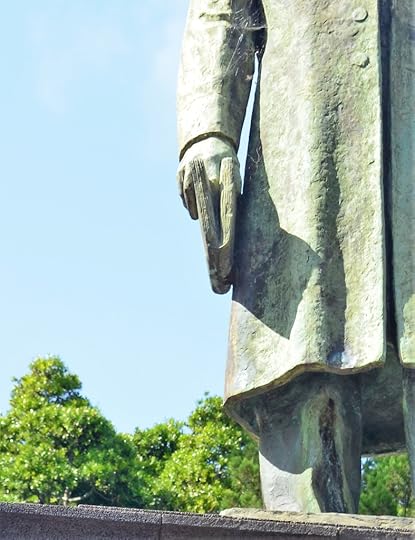 Detail of José do Canto (1820-1898) statue,
Jardim Botânico José do Canto, Ponta Delgada, Azores. Photo by SEA
I first encountered Logan Duarte through Christopher Larkosh’s “Writing the Moment Lusodiasporic” event last June. A two-day event sponsored by the College of Arts and Sciences and the UMass Dartmouth Department of Portuguese, it brought together Luso-North American writers from throughout Canada and the U.S.
The event was originally supposed to be held in April at the Casa da Saudade Library in New Bedford, but due to the pandemic, it was moved to Zoom in June. The event featured a combination of presentations by writers and cultural agents like Irene Marques, Humberto da Silva, and Emanuel Melo, along with a generative writing workshop led by Carlo Matos.
(Larkosh, who tragically died this past December, served as Logan’s professor and adviser at UMass Dartmouth, and I’d like to dedicate this post to his memory.)
I next saw Logan when we both read for Diniz Borges’ Filaments of the Atlantic Heritage symposium in March 2021. I was impressed with Logan’s poetry, enthusiasm, and scholarship.
One of the poems Logan read during that session was “My Statue,” which he described to me as, “an act of homage towards a man who is the lifeblood of my açorianidade, and a testament to those who have gone before; those whose presence grows stronger in physical absence and gives us the confidence to smile in the rain.”
Logan is an Azorean Portuguese American writer currently based in Taunton, Massachusetts. His family came from São Miguel Island in the 1960s, which makes him first generation American; although he sometimes jokingly refers to himself as “0.5 generation,” having called Lisbon, Portugal, his home for part of his life.
His writing centers around cultural identity in the Luso-American diaspora and has been a runner-up for the Disquiet International Literary Program’s Luso-American Fellowship (2019) and featured in the Legacy section of the Tribuna Portuguesa (2020). He has a forthcoming set of poems in the upcoming issue of Gávea-Brown, a bilingual journal of Portuguese American letters and studies published by Brown University.
Logan is expected to graduate with a master’s in teaching from UMass Dartmouth in 2021, from which he also received his BA in Portuguese. He also studied at Universidade Católica Portuguesa and Universidade de Lisboa and has taught Portuguese at Milford and Taunton high schools and at Escola Oficial Portuguesa. He will be a graduate Teaching Fellow at UMass Dartmouth beginning his second masters in Portuguese Studies in the upcoming academic year.
Here is Logan Duarte’s “My Statue”
My Statue
Rain pelts the cobblestone calçada. A utopia turns to a warzone.
Tourists scatter…I walk
Knowing all too well the dangerous potential of a slick calçada.
Some of them slip. Now they know.
Walking, thinking, unperturbed by the hail of crossfire in which I am caught, I lift my head to see a statue.
I stop, my eyes examining its unique character.
It stands firm; the quintessence of gallantry; completely untouched by the bombardment letting loose on the city.
All else assumes a deep gray despondence, battered by the bombs that fall from the clouds. The streets are barren; a wasteland.
But the statue stands unscathed.
Only light shines on this singular obra-prima perfectly guarded in a safe corner of the universe.
A man stands chiseled out of the finest marble.
His eyes look directly at me…no one else.
Below him, a plaque:
“Ocean-crosser, storm-braver, fearless warrior”.
Who could it be?
A hero to the people? A national figure? The sacred one-eyed man?
No. This is no ordinary statue. This one is only mine.
I continue walking, still thinking. I still see a statue…
My statue…my avô.
The corners of my mouth raise nearly to my ears at the sight of my statue, and the rain clears. Tourists emerge from their hideaways; some still rubbing their bruises.
Their selfies one shade darker now,
But my statue remains unscathed.
It guides me through the warzone—a beacon amidst brume.
So that when others run, and sometimes slip,
I walk and think of my statue who in life sacrificed so much
So that I may not fear the rain.
And that I may turn my warzone into utopia.
—Logan Duarte
(This poem, used with permission of the author, originally appeared in Tribuna Portuguesa, in a slightly different version.)
April 11, 2021
National Poetry Month 2021, Week Two: Elaine Ávila’s “Grandma’s Embroidery”
There’s a particular light one experiences on the islands of the Azores. A combination of atmospheric and environmental factors contributes to creating this light, including aspect of the sun, the way the sun’s rays cut through the ubiquitous cloud-cover and pervasive sea mist, the reflection off the surrounding sea and refraction through a sometimes-oppressive humidity that lingers, at various times of the day and the season.
 Elaine Ávila’s FADO, published by Talonbooks.
It also depends upon the perspective of the individual—how they are feeling, what they are longing for, who they are becoming. You know it when you see it—almost I want to say, you feel it. And the variety and diversity of the light on the islands is remarkable: just as no two people can see things the same way, the way we experience island light will be as various as our very nature.
“Luz insular,” Elaine Ávila calls it in her poem, “Grandma’s Embroidery,” describing it as “a light so/ particular, it floats,/ promising miracles,/ as if only somewhere else/ will relieve/ a thousand deprivations.” And in this sense, it has a double meaning: island light and an interiority of light, a light from within, a light that “should tell the truth,/ like Grandma’s embroidery.”
Better known as a playwright, Elaine Ávila is an American-born Canadian of Azorean descent, the granddaughter of one of the first photographers from Ribeiras on the island of Pico, who emigrated to America.
Ávila told me in an email that she first experienced this island light in her grandfather’s photographs. “They had this blurry light, looking like the ‘holy spirit,’ floating through the photos,” she wrote. “I assumed it was because his brownie camera leaked light, but when I took pictures in the Azores, I noticed that light shows up in contemporary photographs and in the sky when you are there.”
Her Azorean grandmother, also from Ribeiras, trained as a tailor and milliner. On her mother’s side, her heritage is mostly a mystery, a product of the hidden history of women who surrendered children for adoption in the days before Roe vs. Wade.
Ávila’s father was a mathematician who worked for NASA and her mother is a painter. This caldo of cultures and intriguing, enigmatic history makes for a rich broth from which Ávila draws in her poetry.
Her plays, which have a decidedly biographical and historical predilection, prompted the Pulitzer Prize-winning playwright Suzan-Lori Parks to describe Ávila as “a wonderful writer, tremendously gifted, reliable and innovative.”
Her latest play, FADO: The Saddest Music in the World, is a musical following a young Portuguese Canadian woman “on a multicultural journey back to Lisbon’s meandering back alleys and lively cafés, winding through fados of resistance, emigrant fados, queer fados, in the hope of reclaiming her heritage and retrieving her own true song.” It has just been published by Talonbooks in Canada.
Here is Elaine Ávila’s poem, “Grandma’s Embroidery”:
Grandma’s Embroidery
In full bloom
Grandma’s blue hydrangea
tumbles through space
shining, alone, overturned,
while Grandpa’s boat
beckons, with sails of gold
unfurling on a white-blue sea.
She’s done it, broken the patterns
made something original
found American threads so brilliant
she can capture Azorean light.
In the Azores, we call it
“luz insular,” a light so
particular, it floats,
promising miracles,
as if only somewhere else
will relieve
a thousand deprivations.
Luz insular should tell the truth,
like Grandma’s embroidery.
If you leave
you may discover yourself
tumbling, overturned
out of proportion, alone
yet, able,
stitch by stitch,
to make Azorean light
dance.
—Elaine Ávila, used by permission of the author