
Lucy V. Hay's Blog, page 38
November 16, 2016
BEST OF 3: Dark Days by @writers_hq
Times are good for writers of dystopian fiction, which happens to coincide with bad times for the climate, for politics, for general global sanity BUT YOU KNOW LET’S GLOSS OVER THAT RIGHT NOW at least we have our books, eh? Too bloody right. Here are three of the finest shit-just-got-real dystopias to grace our book shelves:
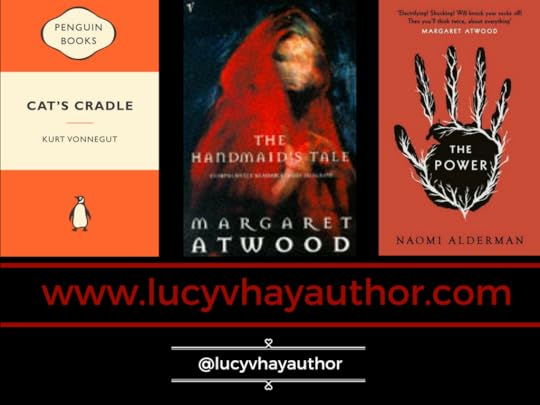
1) Cat’s Cradle by Kurt Vonnegut
A dude writing about the end of the world meets the offspring of the man who built the bomb that dropped on Hiroshima, who happen to own an isotope that will take out every molecule of water on Earth. Gloriously ridiculous, horrifyingly hilarious, science v religion and all the rest. The world is built on lies, and happiness only comes from embracing them. Too blinkin’ true. MORE: Writing Tips From Kurt Vonnegut
2) The Handmaid’s Tale by Margaret Atwood
You know how it goes: darkly secretive sect take over America, force the few remaining fertile women to conceive and carry babies for the monied elite.
A glorious object of readerlust, but also remarkably prescient. Islamic terror attacks causing political turmoil, the vulnerabilities of digital finance, oppressive control over women’s bodies. Sounds familiar, eh?
3) The Power by Naomi Alderman
A new contender on the block, and a world in which women develop a superpower that makes them stronger than men may, for many of the fairer sex, sound like a utopia. But Alderman is on the toppest of top form, and after a year or two being coached by Atwood, she is not particularly sympathetic to man nor lady. The world with women on top is not the caring, sharing, gently-gently paradise you would imagine!
BIO: Sarah Lewis is one half of Writers’ HQ, an organisation for badass writers with no time or money. WHQ has just launched a range of online creative writing courses designed specifically to fit around your embarrassing Netflix habit and your crippling debt. Find out more, HERE.


November 15, 2016
CRIMINALLY GOOD: Interview with author Maggie James
Happy (re)publication day to author Maggie James, whose novel His Kidnapper’s Shoes comes out today – Nov 15th, 2016 – via Lake Union. You can get it HERE. Now, over to Maggie …
 1) So, who are you & what have you written?
Hi, thanks for interviewing me on Criminally Good! My name is Maggie James, and I’m a British writer of psychological suspense novels. At least that’s how I’d describe them, but to my surprise they have proved popular with readers of crime fiction. One person has described them as being ‘crime fiction without all the police milling around’, which made me smile! I’m not comfortable writing police scenes; hence my books focus more on the emotional repercussions of crime, examined from a psychological viewpoint. If you’d like to sample some of my fiction, my novella Blackwater Lake is available free.
You can find LIKE my page on Facebook, find me on Amazon HERE, check out my website HERE and follow me on Twitter as @mjamesfiction.
2) Why do you write crime fiction?
Rather than writing classic crime fiction, I’m drawn to examining the psychological effects of crime on its victims. What I enjoy is portraying strong feelings, and crime engenders fierce emotions. For example, His Kidnappers Shoes looks at the effect on a young boy after being kidnapped as a four-year-old, both from the point of view of the child and also the woman who abducted him. It’s possible I may branch out into other genres, such as dystopia or supernatural fiction one day, but for now I’m happy writing what I do.
3) What informs your crime writing?
I don’t have a background in police work (I’d be hopeless at it!), but I’m lucky enough to know two retired police officers, one of whom is now a novelist herself. They’ve been very helpful in guiding me regarding matters of police procedure. I’m fascinated by the workings of the human mind, so all my books feature a psychological element. Also, I write in the same genre in which I prefer to read – I enjoy psychological suspense fiction, as well as supernatural novels by authors such as Stephen King. I learn so much from other authors’ work.
Some of my themes have been loosely inspired by real-life events, but I’d be uncomfortable basing a book around an actual crime. A few people have commented that my novel Guilty Innocence must be founded on the James Bulger case, due to certain similarities, but it isn’t. My inspiration came from wondering what it would be like to discover someone you love is concealing a terrible secret. And there’s not much worse than hiding a conviction for child murder.
4) What’s your usual writing routine?
I’ve had to become quite disciplined with my daily routine. At first my writing day felt unstructured and I wasn’t getting much done. Nowadays I’m far more organised. I write and edit in the mornings, because that’s when I’m most creative, despite being a night owl. Afternoons are reserved for blogging, marketing and planning my business. Unlike many other authors, I don’t write every day. I prefer to keep my weekends and evenings free; that way my brain gets a rest!
5) Which crime book do you wish YOU’D written, and why?
It’s not so much a crime book as a legal thriller – I’m thinking of . by Thomas H Cook. I enjoy legal thrillers, but prefer crime fiction so I don’t often read in that genre. I thought this book was exceptional, however. It’s different because it blends a murder trial with a love story, the latter being approached from an unusual angle. You’d think the two wouldn’t go well together, but somehow the author manages it, and I loved this novel!
November 14, 2016
DYSTOPIAN NOVEMBER: A chat with author Phil Williams (WIXON’S DAY)
 1) So, who are you & what have you written?
I’m a self-published author and (aspiring) screenwriter – I also freelance as a writer, editor and tutor. I’m making my way through publishing a hoard of novels – my debut was the post-apocalyptic Wixon’s Day (available through Amazon in print and eBook). I’ve got a sequel on the way for that, and a novel set in a world where WW3 had no winners (which is accompanied by a spec feature screenplay called The Faergrowe Principle).
When I’m not writing about societies devoid of happiness, I write contemporary fantasy novels and non-fiction study guides for English learners. I run a popular English language learning website, www.englishlessonsbrighton.co.uk, and have a somewhat quiet author site at www.writerightnow.co.uk.
2) What’s your book about?
Wixon’s Day follows Marquos, a canal boat drifter in a sunless vision of England, as he gets drawn into a savage war. He travels across an anarchist world with steampunk technology but a lack of historical awareness, with society having struggled to survive for centuries after a long-forgotten disaster.
Marquos is determined to explore the world without ties, until his efforts to rescue a girl from the mines reveal that their world is less anarchistic than he realised – and behind the scenes there are war mongers in charge. His journey builds into a crescendo of violence as he’s drawn into a hidden war with a good measure of hazy morals.
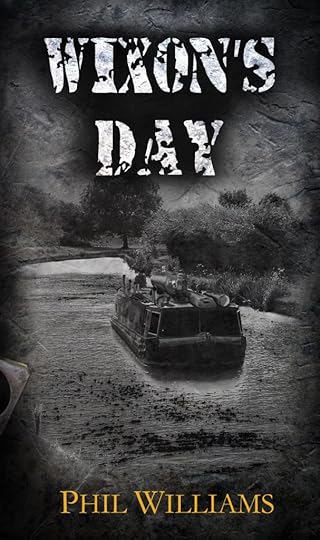 3) What inspired your book?
I wrote Wixon’s Day around a time that I was doing a lot of travelling, hence its disaffected protagonist and the ‘post-apocalyptic gap year’ quality of its early chapters. I couldn’t say what inspired the setting, but a literary inspiration came from Mark Twain’s The Adventures of Huckleberry Finn. Wixon’s Day doesn’t aspire to be anything approaching that classic, but Twain gave me a real yearning to live on a boat … We had a lot of exposure to wars with ambiguous morals in the media around that time (and still do), so that mood combined with my boat-yearning to produce this tale.
4) What’s your usual writing routine?
I’ve typically sacrificed sleep for writing, and a lot of my past novels were written between 10pm and 3am. Almost in secret. I try to keep to more sociable hours now that I’m freelancing, finding a few half-days a week to knuckle down to creative projects. When something grabs me all bets are off, though; I’ll live through whatever I’m writing in my head, day and night, and write whenever I get near a computer. With my latest novel I wrote the first 40,000 words in a week, and I honestly couldn’t tell you when that happened between my other obligations. It’s a little bit creepy really.
5) Which dystopian book do you wish YOU’D written, and why?
There’s probably a hundred I wish were mine – too obviously is Orwell’s 1984 – it can’t be beaten for its relevance and how complete and inevitable its bleakness is. In more commercial fiction, I’m a fan of all the Stephen King dystopias I’ve read (I love the simplicity of The Long Walk) and Hugh Howey’s Wool Trilogy. But if I’m allowed to go for a full post-apocalypse dystopia, the novel I really wish I’d written is Riddley Walker by Russel Hoban. I can’t imagine ever writing something so completely immersed in its own world – I know it’s not a novel for everyone but it is a remarkable literary achievement that will have you thinking in another language by its end.
6) What’s the ONE thing our current society should stop doing in your opinion, else we’ll end up in a dystopia too?
I’m not yet fully a veggie, but I’m fairly sure the meat industry has us on a path to destruction. We can navigate limitations with a lot of resources, and our frightening world of politics can go either way, but when things go wrong with food we’re really fucked. (I can swear here can’t I? I think the collapse of society warrants it!)
Thanks Phil!
November 12, 2016
Book Versus Film: THE MAZE RUNNER – 11 Ways The Film Is Better
So, as in my first ‘Book Vs. Film’ post on DIVERGENT, I’m going to break down the differences as I see them between the film and book versions of The Maze Runner. However, where this will differ is that unlike Divergent (which I think works as both), somewhat controversially, I think The Maze Runner is actually better as a movie! GASP, I know … Here’s why:
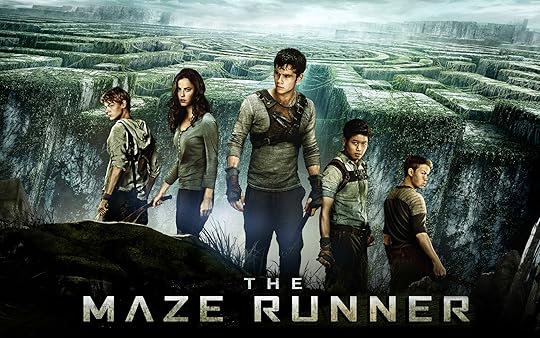
THE STORY
When Thomas wakes up in the lift, the only thing he can remember is his name. He’s surrounded by strangers – boys whose memories are also gone. Outside the towering stone walls that surround the Glade is a limitless, ever-changing maze.
The maze is the only way out – and no one’s ever made it through alive, thanks to bio-mechanical monsters the boys call ‘grievers’ who’ll hunt you down and tear you apart. Then a girl arrives. The first girl ever. And the message she delivers is equally terrifying. Everything is going to change …
As stories go, THE MAZE RUNNER is basically ‘Lord Of The Flies … in a maze’. It’s concept gold, a brilliant idea. As far as dystopian YA goes, such disparate groups of characters are usually led by a female protagonist too, so immediately this story is differentiated by virtue of it being a virtually all-male environment, too. It’s no wonder this has been an incredibly popular property in there dystopian genre.
Now, onto my SPOILERIFIC review of the book and the film …
THE BOOK
Like so many YA properties, The Maze Runner is told from Thomas’ POV throughout. For me, the strongest element of the book is the characterisation: it’s layered and unusual, bringing us characters we recognise that are subtly different to what we expect.
Thomas is a complex character, capable of great empathy and understanding of others’ emotional needs. He becomes very close very quickly to the youngest member of The Glade, Chuck. He’s strong and capable, like you’d expect in a YA hero, but he is neither brooding or irascible, but open and honest.
In this version, Minho and Newt play very strong roles ‘upfr
ont’. Minho is a young man of Korean descent and not a ‘typical’ BAME character: he is loud and flamboyant, prone to outbursts, yet also cunning and clever. He is manly and strong, able to run at huge speeds and is a good leader of the rest of the Runners.
Newt is second in command to official Glade leader Alby. Like Minho he was a runner, but now he limps after a run-in with a Griever. Newt is nearly always in good humour, except when he has to sort the rest of the boys out: then he shouts, but he remains a fair leader and does not let his heart rule his head.
Both Minho and Newt like Thomas and trust him at his word. Abby is less effusive and there is a undercurrent of dislike between him and Thomas from the start. However, it’s Gally who attacks Thomas, claiming he ‘remembers’ him – plus he spends all his time trying to discredit him.
Dialogue throughout is excellent, with the boys talking in a completely new dialect that’s nevertheless very easy to follow – from new words like ‘klunk’ and ‘slinthead’, through to new expressions and ways of talking, ‘Good that’. When Teresa arrives, Thomas seems to remember her as she does him; they discover they’re able to communicate telepathically.
Overall, The Maze Runner is a four star read for me: the characters are excellent, but some of the plotting feels a little muddled. Read my full review, HERE.
THE MOVIE
As with any extremely popular movie adaptation, the screenwriters have to stay more or less ‘on track’, otherwise audiences simply won’t accept it. And author James Dashner certainly starts the book *like* it’s a movie, with Thomas in the lift on his way to the Glade … Screenwriting-wise, learning WITH a character about a new situation is an ‘oldy but a goody’ and this works very well indeed.

Unlike the book however, the film seem to make more of the actual RUNNING, with new set pieces that are not in the source material, such as The Blades sequence. It’s also one of the very first things Thomas does. He legs it from the Gladers, someone yelling ‘Looks like we got a runner!’ … only to have to stop when he discovers the Maze walls. This is an inspired start and really cements us in the story world, whereas in the book Thomas ends up pranking Gally with Chuck, which seems a bit of a departure.
Other small, key differences include:
2) Time scale / story world In the book, the boys have been in the glade for two years. In the movie, it’s three. I suspect this is to have a larger cast, since one Glader per month is delivered by the box. In the book, the graders have all kinds of stuff like a well stocked kitchen with condiments like mayonnaise, but in the movie they live solely off the land, which I think works much better.
3) Dialogue. The screenwriters make use of the impressive dialect from the source material, but only pepper the words here and there. Thomas and Minho also use ‘normal’ swear words like ‘shit’ and ‘son of a bitch’.
4) The Griever problem. In the book, everyone’s seen Grievers and knows what they look like. One of the characters even shows Thomas straight away what one looks like through a handy window in the maze wall. In the movie, there are no windows and no one has seen a Griever and lived to tell the tale. This immediately makes it ‘feel’ more dramatic to me, especially as Thomas will be the first one to kill a Griever.
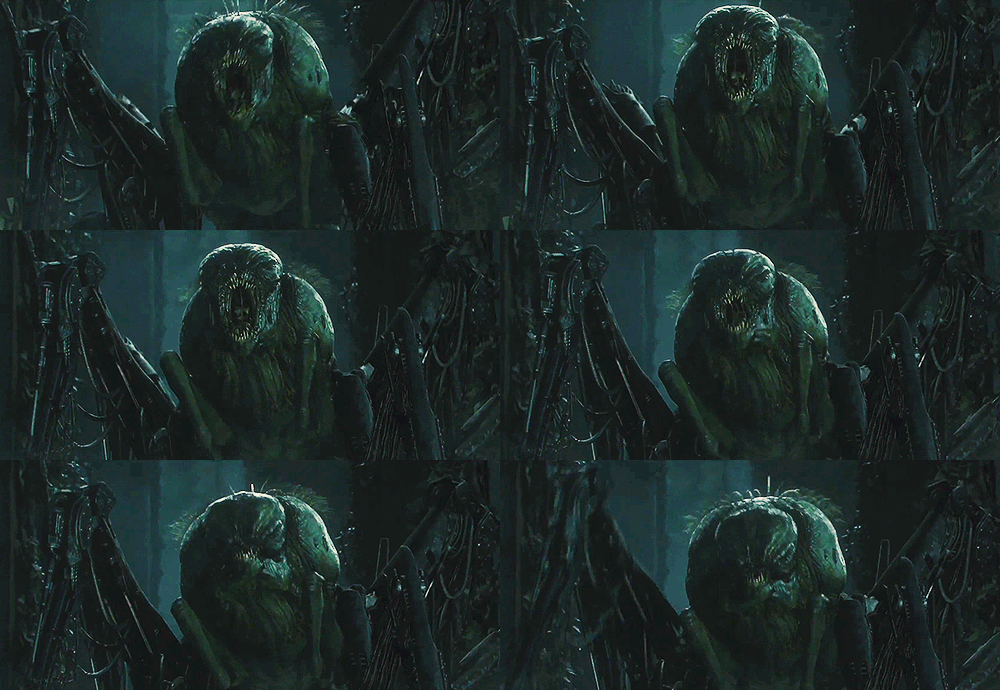
5) Grief serum and beetle blades. The beetle blades from the book – the Glade’s version of CCTV – are missing altogether. This is good because it means the Gladers don’t know they’re being watched (thus feeding into Gally’s storyline), though some might suspect it. The grief serum is only introduced with Teresa, in time to save Alby. Before this, the boys all died of Griever stings. In the book, they had grief serum all along, which saps jeopardy in my opinion.
6) The Cliff. In the book, Thomas and Minho ‘kill’ no less than four Grievers by supposedly getting them to run off the cliff inside the maze. I had some trouble visualising a cliff in the middle of a maze (seems a bit odd to me), plus we discover later that The Griever Hole, the Gladers’ eventual escape route, is beyond the cliff-face … So why would falling down here be such a problem? It’s not that I don’t get it *at all*, it just seems a bit woolly somehow.
7) First Griever death. In the movie, Thomas tempts a Griever to chase him as maze walls are closing. This not only squishes the Griever, it enables the Gladers to go back and take a look at the bio-mech for the first time and retrieve its ‘brain’ which contains a tracking/homing device. This forms a major plot point as Minho and Thomas later ‘follow’ where this homing device takes them … straight to the Griever hole. Nice and straightforward and very exciting, since Thomas only just escapes getting squished himself.
8) The maze itself. They already know the maze is unsolvable before Thomas gets to the glade. Minho knows the patterns and combinations of maze off by heart and shows Thomas via a scale model (Alby has kept this news from the rest of the Gladers to prevent panic). But these numbers will be the ones the escapees all need to get out of the maze via The Griever Hole, of course. In the book, they don’t realise they can’t solve the maze until the last minute but instead work out the patterns are creating words from a variety of maps which Alby then burns cos he doesn’t want to leave. Luckily, Newt had already hid the maps, which seems off when Alby told him to hide them.
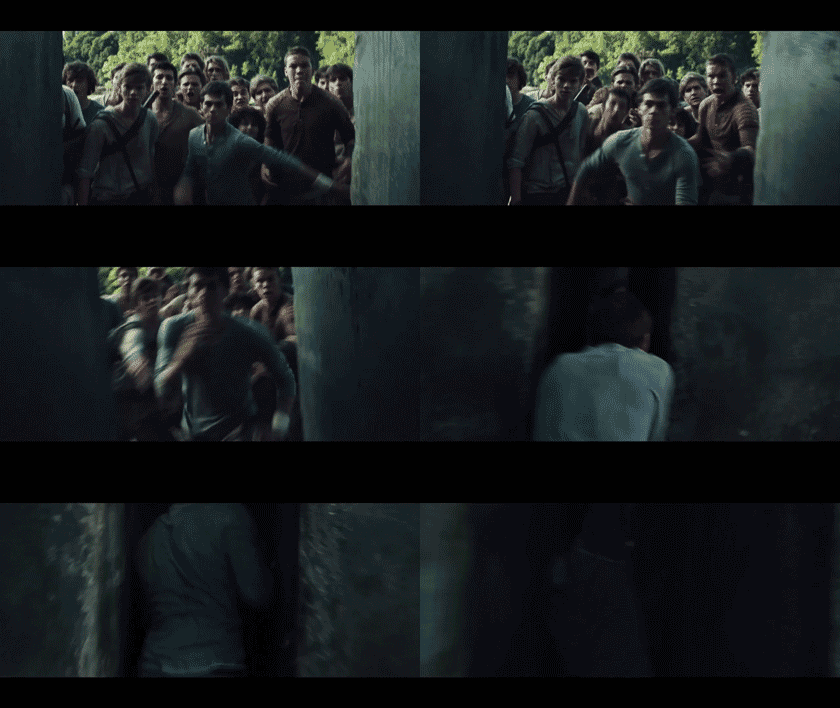
9) Massacre in The Glade. When the maze doors don’t close for the night, the Grievers descend on the glad. This is a scary sequence and one of my favourites, where many Gladers are killed, including Alby. In the book, for some reason the Grievers come each night and only carry off one victim per night (had this come earlier in the plot, this could have worked, but it felt ‘too late’). Here, the filmmakers use it to propel Thomas and the others into a decision – do or die – with Gally telling them they should stay in the Glade.
10) Endgames. In the book, there is an epic fight with multiple Grievers and they get through the Griever Hole where there are yet more Grievers. I found it difficult to believe that kids could take on so many bio mech monsters and still have any left standing, especially when none were stung (which again, seems a bit handy). In comparison, in the movie they storm just two beasts and though some Gladers are killed, I could believe that strength in numbers would deliver them through. Secondly, when they get through to the other side and find the lab deserted, with WCKD’s message to them, this felt stronger than everyone simply waiting for them.
11) Gally’s story arc makes much more sense. In the book, Gally says he remembers Thomas and tries to throttle him, but weirdly doesn’t get banished like Ben does. This is ‘fixed’ in the movie by having Ben remember Thomas when he gets stung by the Griever. What’s more, in the movie Gally is resentful of Thomas: first because he’s the new kid getting so much attention; then he beats him in the ring; then he is brave and respected by Minho for killing the Griever; then for bringing the Grievers to their door.
Everything Gally does, is completely understandable so when he tells the others he not only doesn’t want to leave, but that they BELONG to the maze, we get it — even if it is screwed-up logic. What’s more, Gally’s behaviour in the movie brings forth a philosophical layer in keeping with Plato’s allegory of The Cave – the idea that many people PREFER to be oppressed, rather than take risks or make the effort of going against ‘the norm’.
In comparison, in the book Gally is a big problem for Thomas and then simply disappears, making his way out through the maze which seems rather handy. Even though Gally reappears with the creators and it’s suggested he’s being controlled somehow, we don’t really know why they would call him back or for what purpose. When Gally then tries to kill Thomas, again it seems a little weird (after all, aren’t WICKED *pleased* with Thomas’ leadership??), whereas in the movie Gally follows them out to stop them leaving, because he’s so desperate to be right.
CONCLUDING:
Though The Maze Runner as a book has excellent dialogue and characterisation, I prefer the movie because every plot element they bring in is (in my opinion) an improvement on the original. Being a movie, it’s inevitable some of the psychological element is lost, especially regarding characterisation: Minho is not as flamboyant or irascible as the book (though he retains his other ‘non typical’ qualities) and Alby is your classic wise, self-sacrificing leader in the movie, which is a little dull. That said, Thomas is still a very interesting and unusual male protagonist, not afraid to show his feelings, either with Teresa or especially at Chuck’s untimely death. Lastly, Gally’s much improved story arc gives another, much more philosophical layer to the story that more than makes up for the loss of the psychological element in my view.
What did you think? Which do you prefer, the movie or the book? Let us know in the comments!
November 10, 2016
DYSTOPIAN NOVEMBER: Author Jacqui Canham (THE FORGOTTEN WOMEN)
 1) So, who are you & what have you written?
 I’m Jacqui Canham and I’ve been writing for many years. Because I’m freelance, the sort of writing I do is diverse – from newspaper and magazine articles to corporate scripts and screenplays. One of my short stories features in Twisted50, an anthology which recently entered the bestsellers list on Amazon. My most recent project is a novella, written to tie-in with the dystopian film, Tear me Apart. It’s called Darklight and is part of the The Forgotten Women series.
2) What’s your story in The Forgotten Women anthology story about?
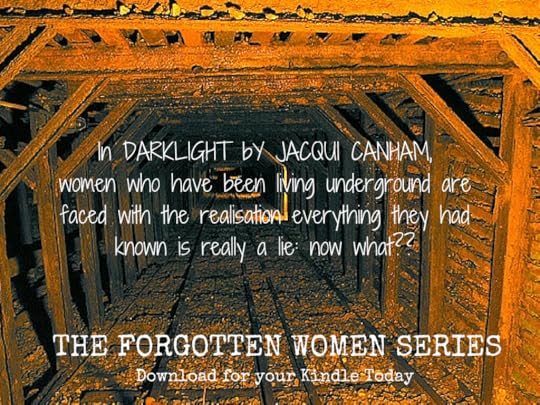
Darklight is about a young woman living under an illusion. In a world where women are dying out and society has broken down, she’s convinced her claustrophobic, underground existence is the only civilised way to live. When finally she defies her seductive custodian and ventures into the light of day, her whole belief system cracks and she’s forced to see the world through fresh eyes.
3) What inspired your Forgotten Women story?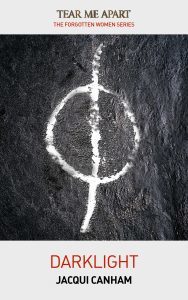
A location inspired me. I grew up with Northumberland on my doorstep and have always loved the bleak beauty of its moors. When Tom Kerevan, writer and producer of the movie Tear Me Apart asked me to write a companion novella to his film, I immediately remembered there were disused leadmines dotted about the region and thought they’d be an ideal setting for our dystopian world.
4) What’s your usual writing routine?
It varies from day to day depending on what I’m writing, but I’m definitely better in the morning. My brain seems to seize up late afternoon.
5) Which dystopian book do you wish YOU’D written, and why?
George Orwell’s 1984 of course – one of the most prescient novels of the 20th century. I also have a soft spot for HG Wells’ The Time Machine.
6) What’s the ONE thing our current society should stop doing in your opinion, else we’ll end up in a dystopia too?
We should stop obsessing about economic growth. Never-ending development and manic consumerism are destroying the planet.
Buy Darklight as a standalone by CLICKING HERE or buy The Forgotten Women whole anthology, HERE.
November 8, 2016
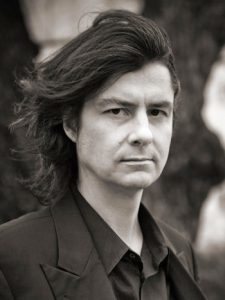
CRIMINALLY GOOD: Interview with author Antti Tuomainen
 1)
So, who are you & what have you written?
1)
So, who are you & what have you written?
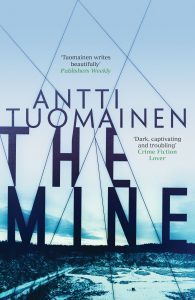
My name is Antti Tuomainen. I’m a Finnish author living in Helsinki, Finland. I’ve published altogether six novels. Three of them have been published in the UK, most recently The Mine. Earlier books are The Healer and Dark As My Heart. My books have been translated into 28 languages, I’ve been nominated for the Petrona Prize, have won the Clue Award for the Best Finnish Crime Novel. (There is also a feature film in the works.) I’m most active on Facebook (you can LIKE my page here) and I’m also on Twitter @antti_tuomainen and Instagram @anttituomainen and I have a website at www.anttituomainen.com.
2) Why do you write crime fiction?
I find the crime story a perfect vehicle or a framework to tell the kind of dramatic stories I want to tell. It gives me an ideal opportunity to investigate and explore human beings in all kinds of extreme situations. And I don’t know if I ever made a conscious choice. It came about very naturally. I just started out writing stories the way I wanted to tell them. Also, it has a lot to do with what I liked and still like to read.
 3) What informs your crime writing?
The human condition. We’re all so wonderfully flawed and so imperfectly perfect. We can be good and we can be so bad. I’m interested in the way we act in time of crisis, in desperate situations, how we respond in different situations.
4) What’s your usual writing routine?
I like routines and I like to keep office hours. Also, when I’m deep into a book, I like to work intensively every day from morning until evening. I’m a full time writer now which makes some things easier and some things harder. (I never would have guessed this.) When I was a full time copywriter at an advertising agency I wrote on weekends and evenings and on every single holiday. And I still managed to spend time with my wife and family. Somehow that all worked, too.
5) Which crime book do you wish YOU’D written, and why?
There are so many. One book that made a huge impression when I was a young aspiring writer was Raymond Chandler’s The Long Goodbye. I realized then that you can make the crime novel into anything, even a literary novel, and you can write as beautifully as you like, even make it almost poetry, and still call it a crime novel.
November 7, 2016
DYSTOPIAN NOVEMBER: Farzana Rahman (THE FORGOTTEN WOMEN)
Following on from yesterday’s post on How I wrote Skyjack, my novella in The Forgotten Women Series, I’m delighted to welcome one of my fellow authors, Farzana Rahman to the blog today. Farzana wrote book 2 in the anthology and is a fascinating writer with loads of great ideas, so enjoy!
 1) So, who are you & what have you written?
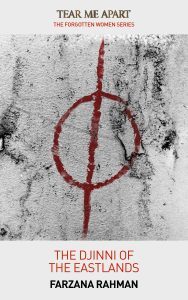
I’m Farzana Rahman, I used to like writing stuff a lot, but have recently fallen out of love with it, we’re on a break. The Djinni of the Eastlands came about as part of an anthology called The Forgotten Women, part of the story world of TEAR ME APART, a British Film produced by Cannibal Films.
2) What’s your story in The Forgotten Women about?
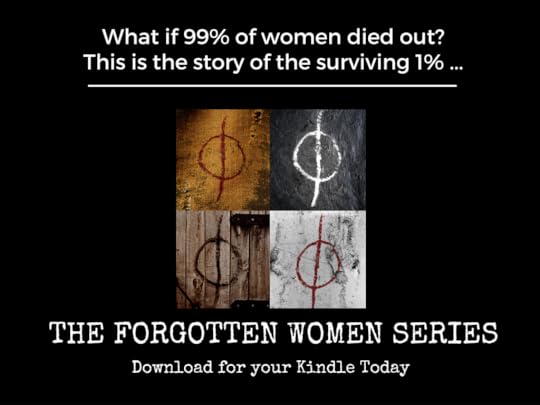
My story centres around disparate groups of women, men and djinns ( I will explain what djinns are in a second ), post the mysterious ‘Fall,’ which has seen many women disappear overnight. In order to survive, the women who remained have militarised and formed small tight cohesive groups according to their pre-existing beliefs and values (pre-Fall). A race war has reversed the previous status of black and white in society, with the former lower status whites now fighting to usurp the once powerful status held by blacks. One of these groups is led by a Muslim woman called Nusaibah; she is forced to take in a white woman, who realises that not everything is as it seems, and that propagation of a ‘race war,’ serves other ulterior motives. Djinns are spirits made of ‘smokeless fire’ according to Islamic mythology, the djinns are integral to this story as they observe society from a non-corporeal perspective.
3) What inspired your story?
I’ve always been interested in djinns and non western mythologies. This seemed like a good way to introduce an audience unfamiliar to djinns and to explore their worldview. Racism in society at a higher structural level has always interested me and affected me on a personal level, coupled with Islamophobia (hence writing in strong female Muslim characters), which also affects me personally. I wanted to demonstrate the strengths and character weaknesses of these characters … Especially that Muslim women are not a monolithic ‘oppressed’ group! They are INDIVIDUALS, they make their own choices. I wanted to show that even in a society such as the post-Fall dystopia, when men are hunting and killing women for sport and keeping them only as sex slaves and for procreational purposes (much like ISIS), that Muslim women are more than capable of resisting and fighting against their oppressors.
4) What’s your usual writing routine?
I don’t have a routine, I just write whenever I have the urge, I’m definitely struggling at the moment to dedicate energy and creative goodwill towards writing.
5) Which dystopian book do you wish YOU’D written, and why?
My fave is of course The Handmaid’s Tale. Rhiannon, one of my protagonists is based loosely on Offred. I love Offred so much, I have one of her quotes tattooed across my back (not a tramp stamp thank you): “Don’t let the bastards grind you down.”
6) What’s the ONE thing our current society should stop doing in your opinion, else we’ll end up in a dystopia too?
I think we are all too ‘overexposed’ and some of us are more than willing to participate in this at the expense of our personal safety (Kim Kardashian’s robbery in Paris for example). All the various platforms that are open to us now to overindulge in gratuitous overexposure of every detail of our otherwise very boring lives. There is a relentless and incessant need to hype up every aspect of our daily monotony, so that it’s desensitised us to celebrating small achievements. I’m guilty of it too, every time a friend posts news of her engagement, I roll my eyes and think “that’s not the same as climbing as fucking Everest.” But what the hell do I know? To her, it’s probably a very big meaningful achievement and indicates that in terms of her romantic and partnered life: she and her partner are taking formal steps to consolidating their hitherto frivolous relationship.
We should guard against overexposure of our daily lives: it’s meaningless in some respects and a distraction against what those in power are doing to keep the balance of power in their favour. Adam Curtis clumsily makes this argument in his latest documentary “Hypernormalisation.” We don’t really know or care to know what’s real and what is manufactured for our consumption. Power has moved away from the elites controlling the news production, but can we really be trusted ourselves to produce the type of inane ‘news’ about ourselves that we are now subjected to?
Buy The Djinni Of The Eastlands by CLICKING HERE or buy the whole anthology of The Forgotten Women, HERE.
November 6, 2016
DYSTOPIAN NOVEMBER: How I Wrote SKYJACK, a post-apocalyptic novella (THE FORGOTTEN WOMEN)
When I was asked to write a novella as part of The Forgotten Women series by Tom Kerevan, writer/producer at Cannibal Films, I knew exactly what I wanted to write straight away.
This is rare for me, not only because I like to road test all my concepts, characters and storylines first, but because I have SO MANY ideas! Trying to focus on one is usually excruciating for me, but for some reason Skyjack flowed effortlessly out of my brain, from picking my protagonist, the precocious and resentful woman-child Maddy, through to my supporting cast and plot.
But first, some background
As part of The Forgotten Women series, Skyjack ties in with the storyworld of TEAR ME APART, a British dystopian movie set in a near-future where 99% of women have either died because of a mysterious event known as ‘The Fall’, or because men have killed the survivors. In the movie, two brothers find a young woman, Molly, whom may just be the very last female left alive. Set amidst gorgeous Cornwall scenery, the two brothers come to blows over what happens to Molly.
But Skyjack – and the rest of the stories in The Forgotten Women series – are prequels to TEAR ME APART. In these stories, there is still a handful of woman left. With most women gone, many of the remaining females in this landscape as oppressed and handled as commodities, bought and sold by feral packs of young men who call themselves Raiders. This is a true patriarchy where women’s very gender is both a prize and cross to bear: to be female in this landscape is dangerous. Many of the women have banded together, suspicious of males altogether in case they could be Raiders, hiding away in female-only spaces.
Of course, even in this horrendous dystopia not all men are bad or part of Raider groups. Some, especially those who were served as soldiers in the world before the apocalypse, have made it their duty to protect and hide woman. Realising strength in numbers (like the Raider packs) these men have created barracks and forts in rural areas like Devon, living with women and children amongst them and have vowed to keep them safe – or die trying.
This is where SKYJACK kicks off
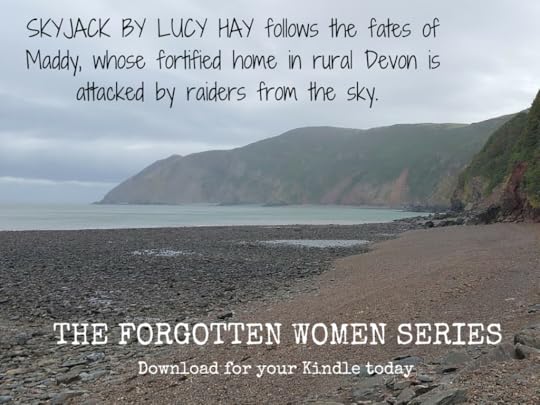
In my story, Maddy lives in such a fort in rural Devon – the picturesque seaside village of Lynmouth on the North Coast. Her people have taken up residence in a big hotel on the cliffside. As part of a huge valley, there are only a few main roads into this village leading from the moor.
Maddy’s father Bill – leader at the fort – has ordered the roads blocked with large boulders, which are not in short supply thanks to the massive gorge that runs into the river and out into the sea.
They are protected, they think, from all eventualities: from a high vantage point, they can see any potential Raiders from the sea, road or moor.
But they forget the air!
Writing Skyjack
Skyjack was the combination of just three things that had been germinating in my mind for a long time – longer than I realised. So when Tom Kerevan asked me if I’d like to write something ‘with female characters, in a rural area like Devon and they’re under attack for some reason’ – I knew EXACTLY what I do:
1) Lynmouth is a real place
I visit Lynmouth a lot, it’s one of my favourite day trips as I’m lucky enough to live in Devon; it’s roughly an hour away from my house now. The beach in the picture above is Lynmouth beach. Called ‘Little Switzerland’ by some, it was a favourite destination of Percy and Mary Shelley’s, they holidayed there with Lord Byron. So in my head there was already that literary, feminist connection (Mary Shelley’s mother was Mary Wollstonecraft after all!), plus I’d already clocked what a useful place it would be if there really was an apocalypse due to its geographical isolation. My husband and I had already joked many times that if The Walking Dead ever made it into reality, Lynmouth would be the place we’d pack up with the kids and hide at, creating a fort at The Tors Hotel on the cliffside (also a real place).
2) Devon has the military in mind
Growing up in Devon, you get used to seeing soldiers, military vehicles and signs everywhere. There are lots of barracks in places like Exmouth and Chivenor, plus you’d be well advised to stay away from training grounds on the moors or at places like Braunton Burrows.
As a teenager, I found myself both attracted to, and repelled by, soldiers. On the one hand, they were often lean, strong men (and women!) who were capable and confident, whom I’d want on my side in a crisis. On the other, they were not only symbolic of violence and government oppression (especially to me, as a hippy-esque teenager), I’d also seen their brute force first hand on more than one occasion in pub fights and street brawls.
As a result I both admired them and avoided them and I took this element into Maddy, my main character who might love her father Bill, the fort’s leader, but she also resents him too. He’s been away, deployed in places like Afghanistan for most of her youth … but at the same time, it was him who rescued her from government scientists and took her to the fort.
3) I saw the luckiest parachutist EVER
My family had just been to a wedding. We were travelling home the next day on the motorway, the kids asleep in the back. It was very clear, hardly any cars on the road and my husband was humming along to the radio. I was bored and as I frequently do, staring up at the sky through the car sunroof.
It was July and one of those exceptionally sunny days, where the blue sky seemed to go on for miles. Through the sunroof, I noted a black swirly thing, going round and around in a weird pattern. I didn’t know what it was so squinted and realised it was a parachute, coming in unbelievably fast. The chute was basically half-up, half-down which accounted for the weird swirling movement. The guy was almost-but-not-quite in freefall.
Still very high up, the ‘chute sailed over the car, as if the parachutist was going to land in the middle of the motorway on the other side of the boundary. I was so shocked I couldn’t speak: I was convinced in that second I was going to see a man from the sky run over by a lorry coming the other way.
But as luck would have it, either he didn’t lose enough momentum or the up-draught got him again because the parachutist sailed over a massive fence to a barracks nearby!
As we sailed past, I watched through the wire as the parachutist landed, rolled twice and sprang up to a standing position, arms in the air, dragging the red and white chute. He close enough so I could see him shouting, gesticulating wildly: it was clear he was saying something like “Stop! It’s okay!”
And I could see why the parachutist had his arms in the air: five or six soldiers were running at him, their weapons raised! They must have thought he had chute-bombed them with sinister purposes in mind — Yikes.
So …
… turns out a pitch like ‘female characters, in a rural area like Devon and they’re under attack for some reason’ was my DREAM proposition!
Skyjack is, of course, a total work of fiction, but sometimes these stories reside inside us, almost whole, just waiting to be woken up.
Want to read the first chapter of SKYJACK, free? CLICK HERE.
Buy SKYJACK for your Kindle, HERE.
Buy THE FORGOTTEN WOMEN series, HERE.
November 5, 2016
DYSTOPIAN NOVEMBER: Top 10 Movies
Dystopian societies have long been a popular choice for novels, film and now TV shows such as Westworld and The 100.
The idea of what the future could possibly hold for us is an exciting and equally thrilling prospect but also TERRIBLE, so to kick off our Dystopian November, we’ve chosen our top ten picks of movies you need to watch this month …
Most of these started off life as books, so how many have YOU read?
1) 1984 (1984)
In a tyrannical future society, a man whose job is to rewrite history decides to rebel by falling in love.
2) Battle Royale (2000)
The government forces a class of students once a year to participate in a deadly game where there can only be one survivor.
3) Brazil (1985)
Set in a retro future, a government official tries to correct an administrative error landing himself and the woman of his dreams as enemies of the state.
4) The Matrix (1999)
A computer hacker learns the true nature of his reality and the role he will play in the war against the controllers.
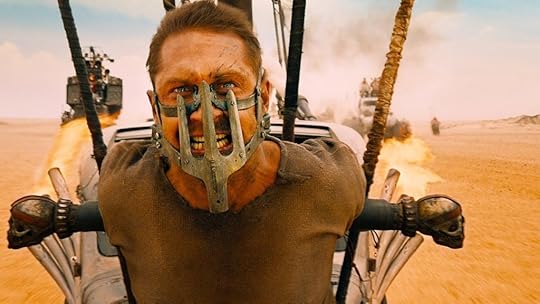
5) Mad Max Fury Road (2015)
A woman in search of her homeland rebels against her tyrannical ruler by stealing his prized female prisoners with the help of Max.
6) The Hunger Games (2012)
Teenagers are selected at random to compete in the annual Hunger Games, a fight to the death.
7) Edge of Tomorrow (2014)
A soldier is forced to relive the same day over and over again, restarting each time he dies.
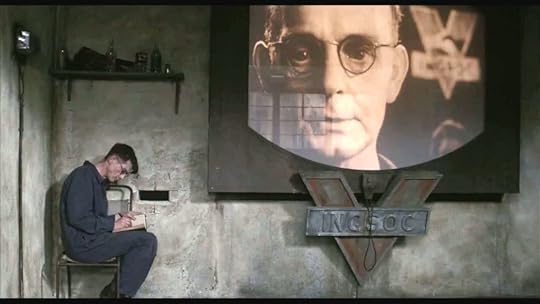
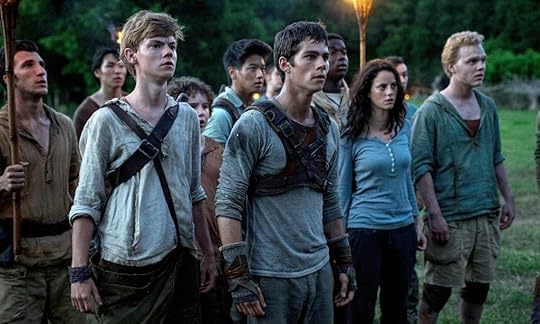
8) The Maze Runner (2014)
A group of teenagers find themselves trapped in a maze with no memory of how they got there but must band together to find a way out.
9) I am Legend (2007)
The lone survivor of a plague that has wiped out most of humanity, struggles to find a cure in his abandoned hometown of New York city.
10) A.I – Artificial Intelligence (2001)
A highly advanced robotic boy dreams of becoming a real boy to regain the love of his human mother.
————————————————-
 This list was compiled by Olivia Brennan, freelance writer, blogger and assistant script editor: I work as a Freelance Writer, Blogger & Assistant Script Editor. Check out my blog HERE or Facebook Page The Final Frontier. Feel free to follow me on twitter as @LivSFB and say hi!
November 3, 2016
Book Versus Film: 8 Reasons DIVERGENT Works As Both
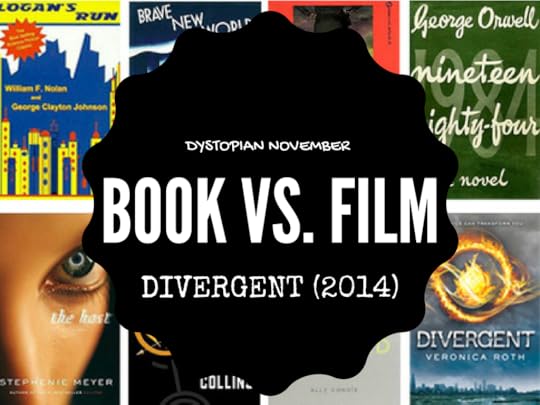
THE STORY
DIVERGENT is set in a future world where society has been divided into five distinct factions. But Tris will never fit into any one group – she is Divergent, and what makes her different makes her dangerous.
Targeted by a faction leader determined to eliminate all Divergents, Tris turn to the one person she believes she can trust: Four, an instructor for the militant Dauntless faction, and a man full of dark secrets. Together, Tris and Four uncover a mind-bending conspiracy that will put their courage to the ultimate test and forever link their destinies.
As dystopian YA goes, Divergent is probably my favourite. I love how Roth has ‘translated’ very sophisticated themes of belonging, being and psyche for teenagers into her system of factions. The notions of five ‘types’ of people – Abnegation (the selfless); Erudite (the knowledge seekers); Amity (the warm); Candour (honesty) and Dauntless (the brave) is an inspired way to show young people that putting yourself into pigeonholes is NOT necessarily the best way to go. After all, who wants to be only ONE of these things?? Yet in the context of this story, it makes perfect sense that a society would try and rebuild itself in this way … and why it would go hopelessly wrong.
Now, on to my SPOILERIFIC comparison of the book and the film …
THE BOOK
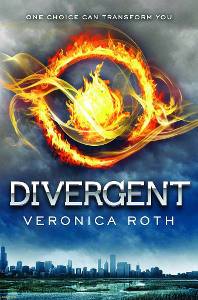 What I loved about Divergent as a book was its adherence to telling the story via solid action all the way through. From the opening, with Tris’ mother cutting her hair, through to her blood on the coals at The Choosing Ceremony; or jumping from the trains with the rest of The Dauntless, Divergent is relentlessly visual throughout.
What’s more, Tris is not your ‘average’ teen, either. She admits she can be selfish and sometimes out for number one. She is not admired for her poise or beauty, because she doesn’t have any: I get the impression she is plain, nothing special to look at, though it’s her open personality that draws others to her, like Christina. Also, though Tris may be an outsider, the fact she is Abnegation too marks her out as a ‘do-gooder’ (the others’ derogatory name for her is ‘Stiff’), rather than the customary ‘freak’.
Her relationship with Four is authentic, with a ‘will they, won’t they’ aspect not built out of mind games, but realistic misunderstandings. We all know Four is divergent too really, but it’s inevitable, rather than predictable. The moment when they clasp hands during the march of Dauntless on Abnegation is brilliant.
Tris admits her fears, rather than lives in denial. She is open and honest with the reader about both how much she hates antagonist Peter, but fears him as well: he features in her fear landscapes more than once, yet throughout the book she never lets him get one over on her.
Her relationship with her friends is well-rounded: she goes from loving the company of Christina, Will and Al, through to feeling hurt, scolded and even betrayed by them. In these cases she hangs out with the Dauntless-born like Uriah and discovers she may have more in common with them, which leads nicely into Tris’ discovery her mother was Dauntless-born, too. It’s brilliant that it’s her mother, not her father, who tries to rescue Tris from Dauntless when Erudite sets them on the Abnegation.
Overall, Divergent is a five star read for me. You can read my Goodreads review, HERE.
THE MOVIE
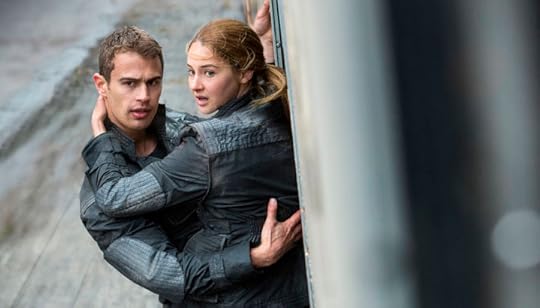
First things first, DIVERGENT overall is an extremely faithful adaptation. This is common for very popular properties, where audiences just won’t stand for too many deviations from the plot or characters. Happily, because of DIVERGENT’s relentlessly visual pace in the book, it mostly translates well to the screen. (Critics were rather unanimous in panning the film, but since audiences – the important ones – apparently mostly liked it, I don’t think we have to worry about that).
Rather than list what makes it through then, it’s easier to say what was different:
1) Tris is roughly how I imagined her, though she is not blonde like in the book. This is Hollywood, after all: Shailene Woodley is not unattractive, but she is not the drop dead gorgeous type either and they do a good job of making her unremarkable, especially when she’s in her Abnegation clothes. We don’t have access to her thoughts like the book, so certain things need spelling out: unlike the book, Eric cuts her from Dauntless after Tris’ disastrous first fight with Peter. In the movie, she decides not to accept and runs after the train, clambering on. Impressed by her chutzpah, Eric gives her one more chance.
2) The faction system is explained very well. Unlike the book that dripfeeds the worldbuilding, movie audiences demand to know where they “are” in the story world immediately. There’s a very short voiceover courtesy of Tris (which is reprised at the end) and we see all the factions in action, which is the obvious and dramatically satisfying choice. Most usefully, we see Tris as a child running in her grey abnegation clothes after Dauntless, planting the idea she has always liked the look of Dauntless. I didn’t really get the feel of this in the book from Tris, so her choice at The choosing Ceremony seemed quite random to me.
3) Jeanine, the Erudite leader, is played upfront. This was an excellent decision as she comes in very late in the book. This works fine there, but screenwriting has different conventions: if Jeanine is to be the biggest problem for Tris (which she is), she needs to be set up so she can pay off later. What I thought the movie did better than the book here was making Jeanine seem almost reasonable, especially trying to make friends with Tris (“Can I count on you?”), then by talking of her reasons for wanting Erudite in charge, trying to make out she is only doing what is ‘needed’. In the book, their reasons seem much more selfish.
4) Four is perfect. He is played by Theo James and is not an actor I recognise but he was the perfect choice: he ‘looks’ just like I imagined him when reading the book. He’s more of an overt mentor in the film than in the book, taking Tris specifically into his fear landscape to train her. Besides being troubled and a loner, he never once comes off as dangerous or bad for Tris, which I really like.
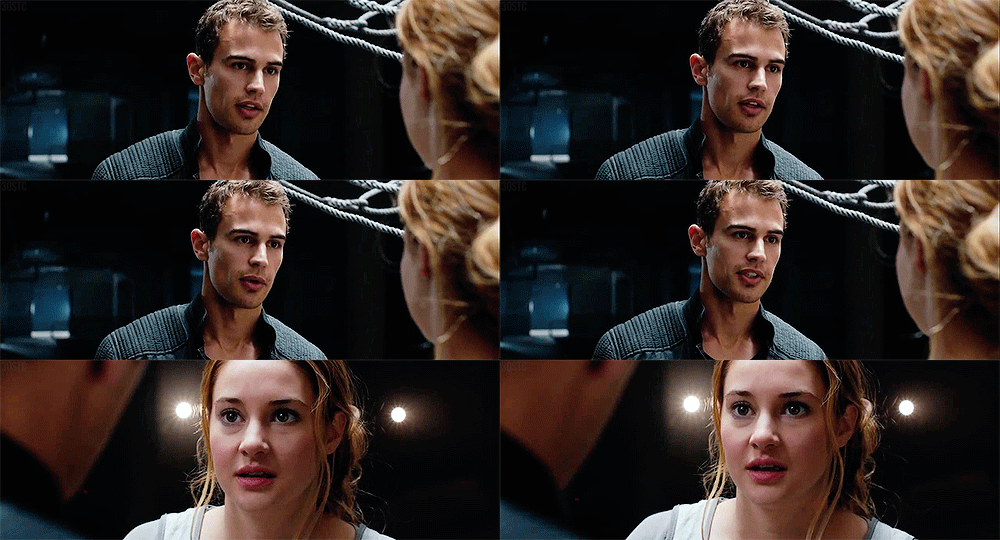
5) Eric – hate him! (Which is good). Eric is played by Jai Courtney and again, a perfect casting choice. He’s arrogant and has lots of swagger. His place in the narrative is played up in the movie, just as Jeanine’s is – not surprising, given they were want more meatier parts for stars like him and Kate Winslet. As a result, the grudge match between Eric and Four is played up and this works especially well during the Capture The Flag sequence. It’s a shame we lose Eric’s backstory with the Erudite here as it means we don’t really know why he’s going along with it, but then we figure he’s an arsehole who wants power so it all works out.
6) Peter is not as much a problem to Tris in the film as in the book. I think this was a good decision overall (this needed to happen to ‘make room’ for the other antagonistic force, Jeanine), though it does mean Tris does not appear as vulnerable, or as stoic (as when she cleans Edward’s blood top in the dorm).
7) Al takes a backseat. This means his betrayal and subsequent suicide lack impact in my opinion, which is a shame. Uriah’s part is also cut right back. That said, Tris having to kill Will works well and the addition of Christina being one of the zombie soldiers on the TV screens in the control room was inspired. You can’t have every little thing in an adapted movie, especially when it comes to secondary characters, so swings and roundabouts.
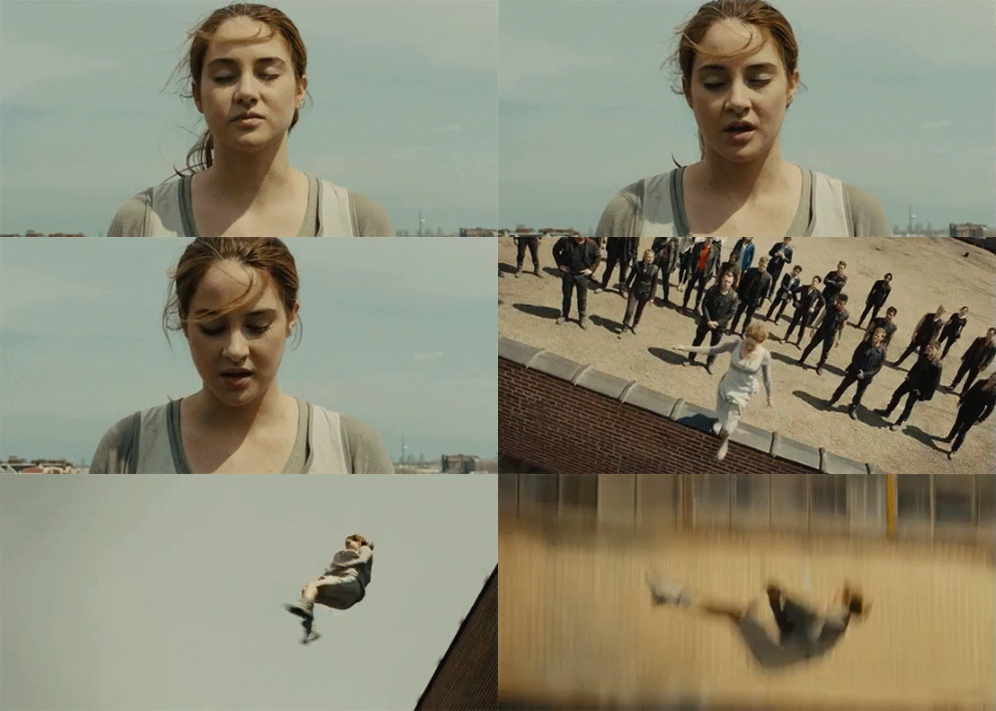
8) The ending is SO MUCH better in the movie! The ending deviates rather considerably from the source material and I think it’s much better for it. In the book, Tris fights her way back to the control room and finds only Four, his mind taken over by Jeanine’s zombie serum, guarding the simulation. YEAH RIGHT! Who starts a plan for societal domination and only leaves a newly-brain-fried minion watching over the computer?? And apparently there isn’t Dropbox in the future either, cos they steal the hard drive and there are no back ups! WTAF.
It was the ONE element of the story I wasn’t keen on, so I was delighted to see they fix this in the movie. Here, Tris gets back to the control room, tries to rescue Four and he beats her as he does in the book. But in comparison, Jeanine and her other Erudite leaders are there too. Like in the book, Tris turns the gun on herself, but she tells Four she loves him and that it’s okay, ‘waking’ him up. They then take on the rest of the baddies in the control room and use Jeanine’s zombie serum against her, so she’ll turn the simulation off and wipe the whole thing. YAY!
CONCLUDING
Okay, the movie wasn’t the best ever adaptation I’ve seen and it was a shame Tris came across as less complex. But ultimately, critics be damned. It was nice to see newcomers in the roles instead of established stars, the set pieces worked well and there was some good action. Divergent had everything I wanted as a movie, just like the book did.
Which did you prefer – DIVERGENT as a book, or a film? Or did you like both? Let us know in the comments!
Lucy V. Hay's Blog

- Lucy V. Hay's profile
- 174 followers

