Michael May's Blog, page 94
October 5, 2017
Jamaica Inn (1939)

Who's In It: Maureen O'Hara (1939's The Hunchback of Notre Dame, The Black Swan, Rio Grande), Charles Laughton (The Old Dark House, Island of Lost Souls, 1939's The Hunchback of Notre Dame), and Robert Newton (Disney's Treasure Island, Blackbeard the Pirate).
What It's About: A young woman (O'Hara) moves in with her aunt (Marie Ney) and uncle (Leslie Banks) in their remote, coastal inn and discovers that the place is the headquarters to a ruthless gang of land pirates.
How It Is: I talked about this one at length on Mystery Movie Night recently, but the short version is that I'm very fond of this gothic romance/spy thriller. I'm still looking for a print where I can understand all the dialogue, but I like the story enough that I'm willing to struggle through that even with the lousy print I've got.
I'm a big fan of gothic romance anyway, but the sea elements make this one extra cool for me. And I love the sense of place in the inn itself. It's full of nooks and crannies, but I understand where they all are in relation to each other and it's fun to explore. Charles Laughton is delightfully over-the-top as Sir Humphrey and it's great to see a very young Robert Newton in a heroic role as a British spy who's infiltrated the gang. Newton's not especially memorable if you don't already know him as the future Long John Silver, but I got a kick out of him anyway.
Rating: Three-and-a-half out of five intrepid, gothic heroines.


October 4, 2017
Guest Post | The Darker Drink: Pseudonymous Saint
By GW Thomas
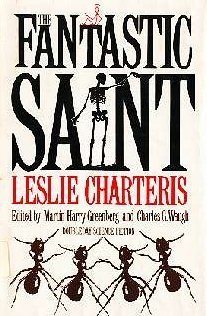 The Saint series by Leslie Charteris is known for its highly adventurous flare. In fact, Charteris really created the James Bond film feel. If you read Ian Fleming, you find a Bond who is morose, cold, and rather unappealing. The flamboyant spy with the quips and one-liners is Simon Templar with the more realistic backdrop of Fleming to support it.
One can argue that neither the Saint nor 007 is particularly "realistic." Criminals do not defy the police as Templar does Inspector Veal. Spies do not stand out as playboys and rock stars. If there is anything George Smiley can tell us, it is that these characters are fiction's equivalent of comic book heroes. Which is alright. They serve a different purpose than John le Carre's cold, depressing truth. They make us laugh and dream of fast cars and faster women. They embody the fourteen-year-old's zest for life and all its possibilities.
It shouldn't be a big stretch for a superman of Simon Templar's stripe to have adventures that are just a little less believable. Even fantastic. Which he did do on a number of occasions. These stories were collected in The Fantastic Saint (1982), edited by Martin Harry Greenberg and Charles G Waugh. The book includes "The Newdick Helicopter," "The Gold Standard," "The Man Who Loved Ants," "The Questing Tycoon," "The Darker Drink," and "The Convenient Monster." The book acknowledges that the second Saint novel, The Saint Closes the Case (1930), is similarly fantastic, but too long to include. Among the stories gathered were four tales that actually appeared in SF magazines; three reprinted in Fantasy & Science Fiction. This shouldn't be too surprising since F&SF was created by Francis J McComas and the mystery/SF guru Anthony Boucher. The more surprising one is "The Darker Drink" that was the Saint's only SF pulp appearance in October 1947's Thrilling Wonder Stories.
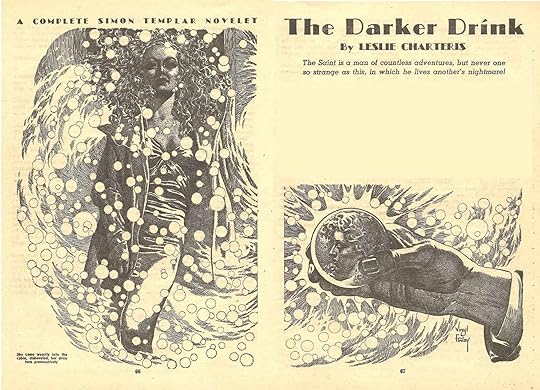 "The Darker Drink" begins with Simon Templar alone in a cabin, frying trout for his supper. Suddenly a stranger comes to his door - pursued by three men - and begs Simon to help him. To convince the Saint, the man shows him a crystal that contains the image of the most beautiful woman in existence, Dawn. The man, Big Bill Holbrook, claims he is really bank clerk Andrew Faulks, a man dreaming the entire thing from his sleep in Glendale, California.
The Saint thwarts the thugs, meets and kisses the girl, and makes Big Bill jealous, but nothing really makes any sense. The girl can't remember her past. Everybody keeps calling the Saint the same three nicknames, in exactly the same order, until finally the thugs' big boss, the very fat Selden Appopoulis, faces off with Templar. The shootout does not go the way it usually does with the Saint and the Happy Highwayman falls to the floor with a bullet hole in his chest. Except he wakes up and none of it seems to have happened. Simon still has the gem in his pocket, so he can't quite believe it was all a dream. When he gets to Glendale he finds out Andrew Faulks had slipped into a coma, but died at the exact time Templar was shot. Even the gem has disappeared from his pocket. In the end it all really had been a dream of a dying man.
This story offers little we haven't seen before in dream stories. The shock at the end isn't particularly good. What makes this story fun is two other things. One, Charteris keeps you guessing even though you know some explanation will be forthcoming. Secondly, and much more rewarding, is that the author has fun with himself and his formula. All the plot elements are familiar Saint material: the man in need of help, the beautiful girl, the vicious thugs; the shoot out. Without the fantastic element, it could easily pass for one of the duller radio episodes. The author pokes fun at himself when Simon Templar notes to himself that "this sounds like one of those stories that fellow Charteris might write." This will be doubly so when we consider the true authorship of the story. For Charteris didn't write it.
 The actual authorship of these "fantastic" Saint stories has been the subject of some educated guessing. It is a well-known fact that Harry Harrison wrote Vendetta For a Saint (1964) and that all the novels after 1963 were not written by Charteris. Most were written by Lee Fleming and revised by Charteris. "The King of the Beggars" (1948) was written by Henry Kuttner from an old radio script. So who wrote "The Darker Drink?"
At first, some thought it was Harrison or Theodore Sturgeon, but this was not the case. The best guess these days is that is was Astounding Science Fiction alumnus Cleve Cartmill. Cartmill is best remembered as the author of "Deadline," a tale about nuclear weapons before the devices were common knowledge. The story drew a visit from the FBI that had Cartmill and editor John W Campbell in the hot seat until they could prove that they had been writing about nuclear technology in science fiction for years. And that if they suddenly stopped, the Nazis might get suspicious. Cartmill is also suspected as the author of the story in which the Saint meets the Loch Ness Monster: "The Convenient Monster."
"The Darker Drink" never received a television rendering, so we can't look at how Roger Moore might have played out this weird scenario. The closest we can get is "The Convenient Monster" (the only story from The Fantastic Saint to be televised) that appeared on November 4, 1966. In this color episode, the monster is never shown; only implied. If "The Darker Drink" had been produced, it would have been easy enough to recreate, since no monsters or special effects were needed. The confusing atmosphere might have been intriguing in a good director's hand, but I don't think the producers would have contemplated a scene in which Simon Templar is shot dead (even in a dream). The TV Saint always wins. This story was perhaps the closest he ever came to failing that motto.
GW Thomas has appeared in over 400 different books, magazines and ezines including The Writer, Writer's Digest, Black October Magazine and Contact. His website is gwthomas.org. He is editor of Dark Worlds magazine.
 The Saint series by Leslie Charteris is known for its highly adventurous flare. In fact, Charteris really created the James Bond film feel. If you read Ian Fleming, you find a Bond who is morose, cold, and rather unappealing. The flamboyant spy with the quips and one-liners is Simon Templar with the more realistic backdrop of Fleming to support it.
One can argue that neither the Saint nor 007 is particularly "realistic." Criminals do not defy the police as Templar does Inspector Veal. Spies do not stand out as playboys and rock stars. If there is anything George Smiley can tell us, it is that these characters are fiction's equivalent of comic book heroes. Which is alright. They serve a different purpose than John le Carre's cold, depressing truth. They make us laugh and dream of fast cars and faster women. They embody the fourteen-year-old's zest for life and all its possibilities.
It shouldn't be a big stretch for a superman of Simon Templar's stripe to have adventures that are just a little less believable. Even fantastic. Which he did do on a number of occasions. These stories were collected in The Fantastic Saint (1982), edited by Martin Harry Greenberg and Charles G Waugh. The book includes "The Newdick Helicopter," "The Gold Standard," "The Man Who Loved Ants," "The Questing Tycoon," "The Darker Drink," and "The Convenient Monster." The book acknowledges that the second Saint novel, The Saint Closes the Case (1930), is similarly fantastic, but too long to include. Among the stories gathered were four tales that actually appeared in SF magazines; three reprinted in Fantasy & Science Fiction. This shouldn't be too surprising since F&SF was created by Francis J McComas and the mystery/SF guru Anthony Boucher. The more surprising one is "The Darker Drink" that was the Saint's only SF pulp appearance in October 1947's Thrilling Wonder Stories.
 "The Darker Drink" begins with Simon Templar alone in a cabin, frying trout for his supper. Suddenly a stranger comes to his door - pursued by three men - and begs Simon to help him. To convince the Saint, the man shows him a crystal that contains the image of the most beautiful woman in existence, Dawn. The man, Big Bill Holbrook, claims he is really bank clerk Andrew Faulks, a man dreaming the entire thing from his sleep in Glendale, California.
The Saint thwarts the thugs, meets and kisses the girl, and makes Big Bill jealous, but nothing really makes any sense. The girl can't remember her past. Everybody keeps calling the Saint the same three nicknames, in exactly the same order, until finally the thugs' big boss, the very fat Selden Appopoulis, faces off with Templar. The shootout does not go the way it usually does with the Saint and the Happy Highwayman falls to the floor with a bullet hole in his chest. Except he wakes up and none of it seems to have happened. Simon still has the gem in his pocket, so he can't quite believe it was all a dream. When he gets to Glendale he finds out Andrew Faulks had slipped into a coma, but died at the exact time Templar was shot. Even the gem has disappeared from his pocket. In the end it all really had been a dream of a dying man.
This story offers little we haven't seen before in dream stories. The shock at the end isn't particularly good. What makes this story fun is two other things. One, Charteris keeps you guessing even though you know some explanation will be forthcoming. Secondly, and much more rewarding, is that the author has fun with himself and his formula. All the plot elements are familiar Saint material: the man in need of help, the beautiful girl, the vicious thugs; the shoot out. Without the fantastic element, it could easily pass for one of the duller radio episodes. The author pokes fun at himself when Simon Templar notes to himself that "this sounds like one of those stories that fellow Charteris might write." This will be doubly so when we consider the true authorship of the story. For Charteris didn't write it.
 The actual authorship of these "fantastic" Saint stories has been the subject of some educated guessing. It is a well-known fact that Harry Harrison wrote Vendetta For a Saint (1964) and that all the novels after 1963 were not written by Charteris. Most were written by Lee Fleming and revised by Charteris. "The King of the Beggars" (1948) was written by Henry Kuttner from an old radio script. So who wrote "The Darker Drink?"
At first, some thought it was Harrison or Theodore Sturgeon, but this was not the case. The best guess these days is that is was Astounding Science Fiction alumnus Cleve Cartmill. Cartmill is best remembered as the author of "Deadline," a tale about nuclear weapons before the devices were common knowledge. The story drew a visit from the FBI that had Cartmill and editor John W Campbell in the hot seat until they could prove that they had been writing about nuclear technology in science fiction for years. And that if they suddenly stopped, the Nazis might get suspicious. Cartmill is also suspected as the author of the story in which the Saint meets the Loch Ness Monster: "The Convenient Monster."
"The Darker Drink" never received a television rendering, so we can't look at how Roger Moore might have played out this weird scenario. The closest we can get is "The Convenient Monster" (the only story from The Fantastic Saint to be televised) that appeared on November 4, 1966. In this color episode, the monster is never shown; only implied. If "The Darker Drink" had been produced, it would have been easy enough to recreate, since no monsters or special effects were needed. The confusing atmosphere might have been intriguing in a good director's hand, but I don't think the producers would have contemplated a scene in which Simon Templar is shot dead (even in a dream). The TV Saint always wins. This story was perhaps the closest he ever came to failing that motto.
GW Thomas has appeared in over 400 different books, magazines and ezines including The Writer, Writer's Digest, Black October Magazine and Contact. His website is gwthomas.org. He is editor of Dark Worlds magazine.
The Walking Dead (1936)

Who’s In It: Boris Karloff (Frankenstein, The Man They Could Not Hang) and Edmund Gwenn (1947's Miracle on 34th Street)
What It’s About: John Ellman (Karloff) is executed for a murder he didn't commit, but is raised from the dead by scientists (Marguerite Churchill and Warren Hull) who knew he was innocent, but were too cowardly to come forward during his trial. That's when the people who framed Ellman start dying.
How It Is: People sure liked bringing Karloff back to life in the '30s. The Walking Dead is no Frankenstein, but it compares favorably to The Man They Could Not Hang. At least in terms of sheer filmmaking. It's a good-looking movie and I like that Karloff's character isn't so much a figure of blind vengeance as he is a symbol of poetic justice. The film spends some time building him into a sympathetic character and doesn't waste that goodwill by turning him into a homicidal maniac. He doesn't so much murder his victims as he does just sort of harbinger their deaths. That's a refreshing change from how these kinds of stories typically go.
On the other hand though, if I want cheesy, pulpy fun, I'm going with The Man They Could Not Hang, even though its a far inferior production.
Rating: Three-and-a-half out of five Santa scientists (Gwenn).


October 3, 2017
Introducing Planetary Union Network: The Orville Fan Podcast

If you've had a chance to listen to the most recent episode of N3rd World, you know that I've fallen in love with The Orville. Go check that out to hear my full thoughts, but the short version is that when I first heard about the show, I wrote it off as not for me. And when the early reviews came out, I felt justified in my dismissing it. Nobody seemed to like the show. But then it finally premiered and the fans got a chance to see it.
Fan response has been very different from the professional critics and one of the loudest of those fans was my pal and N3rd World co-host Dan Taylor. He got me curious about it, so I caught up last week and now I'm totally hooked. I joined Dan and his co-host Joe Quickle on their Planetary Union Podcast this week to talk about The Orville Episode 4: "If the Stars Should Appear."
They were slumming by having me on. Their first couple of guests were people who've actually appeared on the show: Patrick Cox (Justin the Ogre) and Brett Rickaby (the spiny-headed alien from Episode 2). And they've got other awesome people from the show coming later. What I have that those folks don't have though is availability to be there every week, so when Dan and Joe graciously offered me a regular spot on PUN after we recorded, I jumped at it. If you're an Orville fan, you should definitely check out the show. It's gonna be a good one.

The Mask of Fu Manchu (1932)

Who’s In It: Boris Karloff (Frankenstein) and Myrna Loy (The Thin Man)
What It’s About: Nayland Smith (Lewis Stone) tries to steal the treasure of Genghis Khan before Fu Manchu can get it and use it to recruit a world-conquering army.
How It Is: You gotta know going in that a Fu Manchu movie is going to be super racist, even before you consider all the white actors in yellowface. The Sax Rohmer novels were speaking directly to and capitalizing off British fears about Southeast Asia, so the very concept is that the West is under attack by the East and that white people are perfectly justified in doing whatever they need to do to protect themselves. Even with that basic understanding though, The Mask of Fu Manchu is uncomfortable to watch. It's summed up in a final scene where the white heroes encounter a Chinese servant and are afraid of him until he reveals himself to be an idiot. That's the only kind of Chinese person these characters are comfortable with.
It gets labeled as a horror movie because of Karloff, I guess. And I suppose that for Westerners at the time, the Fu Manchu stories did represent something that they were truly terrified of. But it's not a scary movie. It's really just a treasure-hunting adventure with a colorful supervillain. And unfortunately, it's only a mediocre one of those.
I do like that the damsel in distress is actually a dude in distress (Charles Starrett). And the sets and props around Fu Manchu's palace and the treasure are pretty fun. But none of the acting is good and Karen Morley is especially horrible as the daughter of one of Nayland Smith's companions. A very simple plot and just the ugliness of the overall tone drag it down and make me never want to watch it again.
Rating: Two-and-a-half out of five warlord swords.


October 2, 2017
N3rd World | The Orville vs Star Trek: Discovery


On the most recent episode of N3rd World, Dan and Ron and I are joined by the awesome Brandon J Carr to compare and contrast Seth McFarlane's The Orville with Star Trek: Discovery.

The Phantom Carriage (1921)

Who’s In It: Victor Sjöström, who also wrote the adapted screenplay (from Selma Lagerlöf's novel) and directed the film.
What It’s About: A cruelly selfish, deadbeat dad (Sjöström) receives encouragement to turn his life around. But will he heed the warnings in time to avoid becoming the next driver of Death's carriage?
How It Is: Like The Penalty, The Phantom Carriage is another disappointing "horror" movie. It's got a great hook: that the last person who dies on New Year's Eve has to drive Death's carriage for the next year and transport souls to their final destinations. But instead of focusing on the dread around that, it's a morality tale about Sjöström's character and a dying woman (Astrid Holm) who desperately wants to help him.
It's well acted, but it's also melodramatic and the same story could easily have been told without the "supernatural" elements.
Rating: Two out of five ghostly coachmen.


October 1, 2017
Mystery Movie Night | Jamaica Inn (1939), Rebecca (1940), and The Birds (1963)

Michael, Dave, and David are joined by Kay ( Hyperspace Theories , Fangirlblog.com) to talk over a trio of Alfred Hitchcock movies with a second connection.
00:02:00 - Review of Jamaica Inn
00:12:52 - Review of Rebecca
00:32:22 - Review of The Birds
00:55:19 - Guessing the Connection

The Penalty (1920)

Who’s In It: Lon Chaney (The Hunchback of Notre Dame, The Phantom of the Opera)
What It’s About: A young boy's legs are unnecessarily amputated by a rookie surgeon whose mentor covers up the incident. When the boy grows up, he becomes a criminal mastermind with a plot for revenge on the two doctors and the person they love most.
How It Is: I'm disappointed that The Penalty isn't scarier. Chaney plays a frightening character, but the movie isn't so much about the horror that he perpetrates as it is about the suspense of what he might possibly do. And since most of his intended victims aren't that likable, even the suspense is limited.
Blizzard's (Chaney) scheme is focused on a woman (Claire Adams) who's the daughter of one of Blizzard's former doctors (Charles Clary) and the girlfriend of the other (Kenneth Harlan). I like her, but she's the only character in the movie that I do care anything about. She wants to be a sculptor and she's quite good, but her father and boyfriend are so unsupportive and awful to her that I'd root for their downfall even if they hadn't been responsible for the loss of Chaney's legs.
There's another character who I liked for a while - a female police officer (Ethel Grey Terry) who goes undercover in Chaney's organization - but her story goes weird places that I didn't want to follow.
On top of all that, at some point the movie quits being even suspenseful and just turns into melodrama about the morality of what everyone has done or is doing. That's where it loses me completely.
Rating: Two out of five evil geniuses.


September 27, 2017
Hellbent for Letterbox | Barquero (1970)

Pax and I continue our love affair with Lee Van Cleef by talking about this Spaghetti-inspired, American-made thriller co-starring Warren Oates, Forrest Tucker, Kerwin Mathews, Mariette Hartley, and Marie Gomez. And in "Whatchoo Been Westernin'?": DC Comics' Jonah Hex/Yosemite Sam Special and the Billy the Kid episode of Brad Meltzer's Decoded.