Michael May's Blog, page 181
September 4, 2013
Tarzan 101 | Edgar Rice Burroughs, Incorporated

Celebrating Tarzan's 101st anniversary by walking through Scott Tracy Griffin's Tarzan: The Centennial Celebration.
Burroughs was a savvy businessman as well as a talented author. In 1923 he incorporated himself, gave stock to his family members, and started drawing a salary from the new company. He set up shop on Ventura Boulevard and the Spanish-style bungalow is still the headquarters of the corporation today. I got the photo above from the Black Gate site, which includes a report on Ryan Harvey's visit to ERB, Inc. earlier this year. Harvey's post is full of great information and well worth reading.
It was through ERB, Inc. that Burroughs eventually made his film deals and even published his own books. The endeavor was successful enough to get Burroughs and his family through the Great Depression with his finances intact.
During Burroughs' lifetime, the company had two full-time secretaries. Burroughs hired Ralph Rothmund in 1927 and added Mildred Bernard Jensen in 1931. The company's been run by Burroughs' family since Rothmund retired in 1963.
Though Burroughs died in 1950 (his ashes are buried beneath the mulberry tree in the photo, though a walnut tree was there at the time of his death), his company still manages the licenses for films, books, comics, toys, and everything else based on his work.


September 3, 2013
Much as Batman hates to take human life...

A couple of things about this Man Monsters story from Batman #1 (by Bill Finger, Bob Kane, and Jerry Robinson):
First, it was originally intended as a Detective Comics story. At the end of Detective 37, a panel showed Batman facing a couple of giants and declared that "Next month, huge, terrifying Man-Monsters stalk the streets." What next month actually brought, however, was the Sensational Character Find of 1940: Robin, the Boy Wonder. DC bumped the Man Monsters story, so it ended up in Batman #1, which - like the Superman solo series - was an anthology comic in its early days. The Man Monsters story also featured the return of Hugo Strange, who created the beasts to use as a distraction while his henchmen robbed banks.
The second thing worth pointing out in the Man Monsters story is this:

First of all, Batman has never shown any reluctance for taking human life in his stories so far. In fact, he punches Hugo Strange out of a tower window less than an hour before this scene takes place and follows it up by lassoing one of the Man Monsters around its neck and hanging it from the Batwing.
Secondly, if Batman did hate killing, why mount a machine gun on the Batwing? Clearly Batman has no issues at all with taking human life, but he apparently feels the need to justify it to himself. Which makes me wonder some more about Robin's influence on him.
This story was obviously written before Robin's introduction, but its publication after Robin adds an interesting element. Is Batman starting to feel remorse over killing so many bad guys? Does the responsibility of raising Robin make him rethink his tactics? It hasn't changed his behavior yet, but this may be the first step in that direction.

September 2, 2013
The grim jester called... The Joker!

When people talk about whether or not Batman should ever kill, the discussion inevitably comes around to the Joker, a homicidal maniac who continually breaks out of custody to murder again and again. The government is helpless to stop him, so the only way for someone to end his terror is to end his life.
Batman seems tailor-made for the job. He's outside the law, has a supposedly unquenchable thirst for vengeance, and has experienced in very close, personal ways the Joker's capacity for murder. He knows without doubt that this is an unrepentant person incapable of rehabilitation who will only be stopped by being killed. That Batman's "code" prevents him from doing what needs to be done is frankly a massive impediment to suspending disbelief about the dark knight and his world.
One way of relieving this untenable tension is to ease off on the Joker's murderous impulses. I like the Silver Age Joker who was more interested in pulling off capers with panache than spreading terror, but that's not exactly true to the character's Golden Age roots. As presented in Batman #1 (by Bill Finger, Bob Kane, and Jerry Robinson), the Joker is definitely interested in showing off, but he's just as into murder. The original Joker isn't a fun character, he's a horrifying madman.
He's also a massive hit and his creators seem to know it. He appears in two stories in Batman #1; jailed at the end of the first one and... well, we'll look later at what happens in the next. But I'm curious to see how the Golden Age storytellers kept the Joker around before Batman's "code" created an easy, ridiculous out.

September 1, 2013
While it still is... Happy Edgar Rice Burroughs Day!

It's been a busy weekend and I almost didn't get to this, but this year of all years I shouldn't miss honoring Edgar Rice Burroughs on his birthday. He would've been 138 today.
Gree-ah!

August 31, 2013
Batman, Robin, and 'the path of righteousness'

Detective Comics #38 (by Bill Finger, Bob Kane, and Jerry Robinson) is famous for being the first appearance of Robin, the Boy Wonder. Young Dick Grayson is usually credited with having a lightening effect on Batman's grim quest for vengeance against all criminals, and there's evidence from this issue that the boy's impact was immediate, though very limited at first.
After Batman agrees to train the boy, the two of them take a crime-fighting oath that includes the words, "never to swerve from the path of righteousness." That feels like an important addition to Batman's mission. It's not enough just to make criminals pay for their misdeeds, Batman also begins to see the importance of maintaining a personal code. He doesn't define "righteousness," but that he even includes it as a concept may be significant.

Eventually, "righteousness" may include a prohibition on taking lives, but not right away. In fact, Batman and Robin's ultimate plan for avenging the death of Robin's parents involves entrapping the main bad guy and photographing him as he murders one of his men. Not only do Batman and Robin not try to save the henchman (Batman implies that the thug is the one directly responsible for the Graysons' deaths, but presents no evidence of it), they manipulate the mob boss in order to make sure that the henchman is killed.
Batman may see the need to raise Dick more morally than the way Bruce Wayne developed, but it's not an easy or quick transition.

Saturday Matinee | Queen of the Amazons (1947)

Who's in it?: Robert Lowery (Batman in the 1949 Batman and Robin serial), Patricia Morrison (Tarzan and the Huntress, Song of the Thin Man), J.E. Bromberg (The Mark of Zorro, Son of Dracula), and John Miljan (The Ten Commandments).
What's it about?: A woman (Morrison) leads a safari into Africa to learn the whereabouts of her fiance who disappeared on an earlier expedition. But will she still want to marry her man after spending so much time with Gary the jungle guide (Lowery)? And will her man want to marry her after so much time among the Amazon women he's been living with?
How is it?: Pretty dreadful. There are some outdoor shots of the cast, but way too much of the movie is just them standing on generic sets and commenting on action going on in stock footage. The story moves from India to Africa for no other reason than the filmmakers' having footage from both places they wanted to use.
None of the characters have any depth and none of the actors have any chemistry, so the movie's only redeeming qualities are its jungle setting in general, the Amazons concept, and a half-baked mystery about a murderous ivory poacher who may have infiltrated one of the safaris. Jungles and Amazons go a long way with me though, and mystery plots are always welcome. It was also fun to see Lowery in a different role, since I like him as Batman.
Grade: C-


August 30, 2013
Shadow of the Bat

I was tempted to use the first panel of Detective Comics #37 (by Bill Finger, Bob Kane, and Jerry Robinson) in which Batman gets lost in the country and stops at a farmhouse for directions. It's pretty funny, but it's not fair to the rest of the story, which is a really good mystery.
Batman uses intelligence and good detective work to uncover a gang of spies, then his physical skills and fearsome presence to bring them down. The panel above is a great example of how spooky and intimidating Batman can be when he wants to.


August 29, 2013
Batman, Hero of the People

Batman may still be wanted by the police, but public perception of him changes after he defeats Hugo Strange in Detective Comics #36 (by Bill Finger, Bob Kane, and introducing Jerry Robinson to the series).
A couple of notes: The Monk from Detective 31 and 32 may be Batman's first supervillain, but Hugo Strange is the earliest who lasted and became a permanent part of Batman's rogue gallery. Strange was designed to be a major bad guy from the get go. Batman already knows who he is in this story and refers to him as "the most dangerous man" and "the greatest organizer of crime in the world." Clearly he was meant to be Moriarty to Batman's Sherlock Holmes.
Strange's infamy works in Batman's favor when word spreads that he defeated the villain. The people of Gotham are now on Batman's side and I have to imagine that some of the cops' views on him have likely changed as well.
The problem is that - legally speaking - Batman's still a murderer. I haven't kept a strict count, but I'm pretty sure that he's either directly killed or allowed someone to die in every story since his first appearance. It this one, he's found standing over a dead body and the police assume he's the killer. That - and Batman's having to clear his name by bringing in Strange - is a standard mystery trope, but it's especially appropriate in this series given Batman's past actions.
Still, nice to see that his reputation is changing a little and that the citizens of Gotham at least appreciate what he's trying to do. I can feel my own attitude about him start to change as well. He may have started his mission in a selfish place - and his methods may not be as effective as Superman's - but he's still a force for positive change and it's impossible to dislike that.

10 Greatest Giant Robots of All Time
Because Siskoid and I often share a brain, we both disqualified giant robots from our Top 10 Giant Monsters lists last week. Which means that we're back with lists of our huge, mechanical friends this week.
I know a few others who are also planning to join in for our second, big, blogging crossover, so I'll update this post as I see those. Anyone can participate, so just let me know and I'll be sure to link to you.
Here's my list. No special rules this time; I'll explain any caveats in the entries below.
10. Martian Tripods (War of the Worlds)
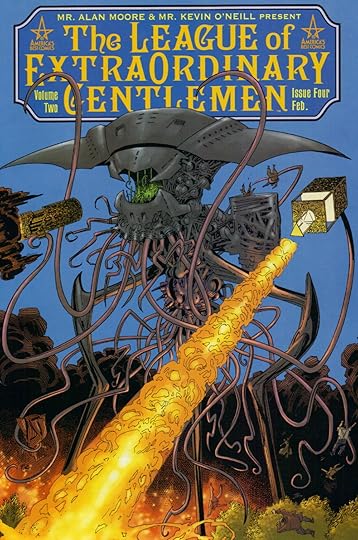
My first caveat is that I'm accepting pilot-driven mechs as "giant robots." It's not technically accurate, but since they're visually indistinguishable from actual robots, that's good enough for me. The Martian war machines from H.G. Wells' War of the Worlds are the grand-daddies of this concept and are super scary besides. Love them.
9. Warbox (DC Comics)
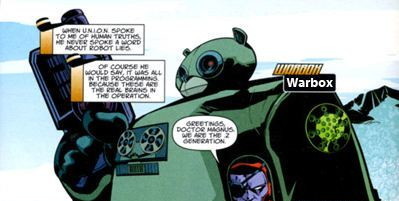
The only reason Warbox is so low on my list is because he's only had one, brief appearance in Metal Men (V.3) #2. On the other hand, he looks like a teddy bear and has a reel-to-reel tape player on his chest. It kind of hurts me not to have him higher.
8. Mechani-Kong (King Kong Escapes)
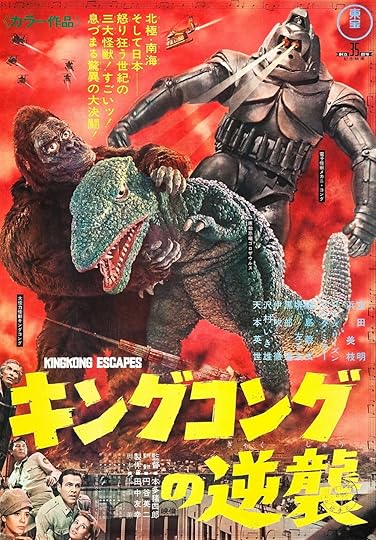
It's a horrible movie, but just look at that giant robotic gorilla shooting lasers out of his eyes and tell me you don't love him.
7. Mechagodzilla
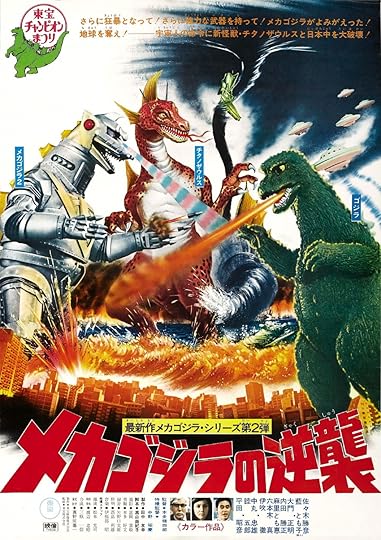
I haven't yet seen any of the Toho films with giant robots like Mechagodzilla, Mecha King Ghidorah, or Jet Jaguar, so it's hard for me to love them as much as I should. I'll lump Ultraman into that same category and heck, Voltron and every anime ever made too. I have a lot of learning to do.
But Mechagodzilla is such a cultural icon with such a great look that I feel like I know him even though my entire experience with him has been in the recent Godzilla comics from IDW.
6. Grurk (It Came!)
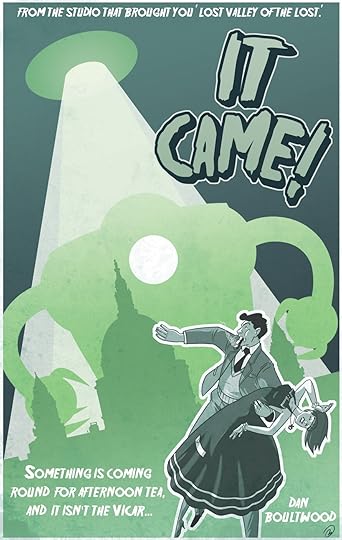
It's name probably isn't actually Grurk, but that's what it always says, which is part of its charm. I probably shouldn't include it until the It Came! mini-series is done and I can think about it as a complete story, but it goes to show how much I loved that first issue that I want to honor it here.
5. Gallaxhar's giant robot probe (Monsters vs. Aliens)
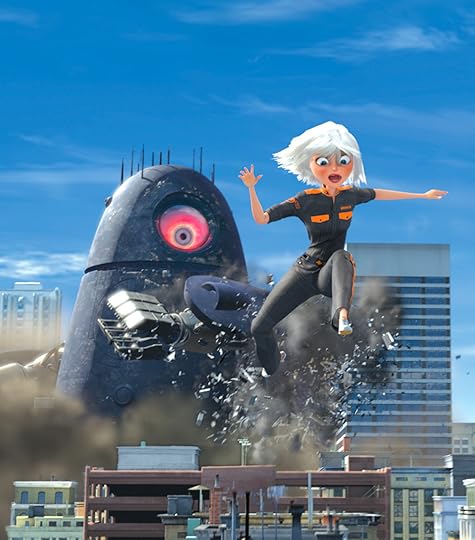
I should have figured out how to work Susan (Ginormica) or Insectosaurus into last week's list. I love Monsters vs. Aliens and its giant robot is spectacular and funny.
4. Sentinels (X-Men)
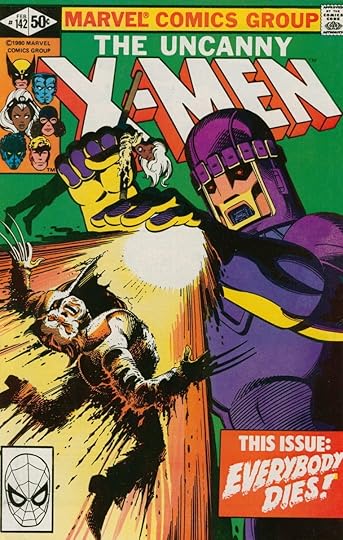
An important part of my childhood and the X-Men's world in general. One of the few X-Men villains that still give me a thrill when they show up.
3. Experimental Prototype Robot K1 (Doctor Who)
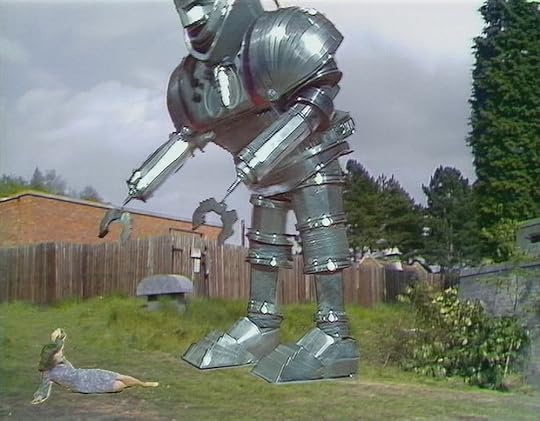
Not only was Tom Baker my first Doctor, his first episode, "Robot" was my first episode too. So as crap as those special effects are, this giant machine is a major part of what hooked me about Doctor Who.
2. Archer (Kill All Monsters)
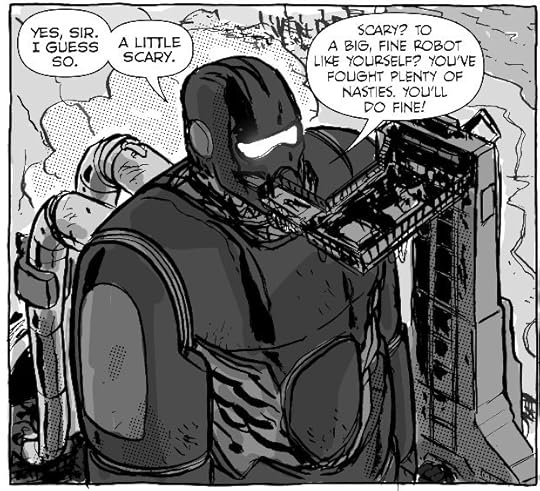
I feel like I need to apologize again for not only including one of my own creations (with artist Jason Copland, of course), but for putting him really high on my list. But where I'm fond of the some of the visual aspects of the creatures we created for Kill All Monsters, I'm genuinely in love with the characters. I hope you'll forgive me the indulgence.
I like all the Bots for different reasons, but I have a special place in my heart for poor Archer who so much wants to fit in as part of the Kill Team, but is having a difficult time because the human members are (perhaps justifiably) scared of him.
1. The Iron Giant (The Iron Giant)
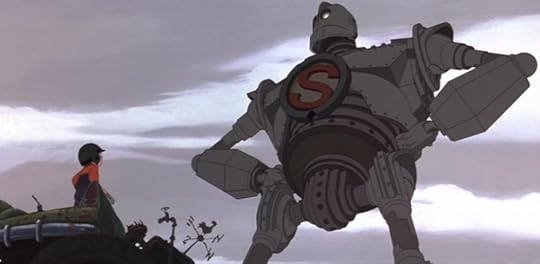
I usually have a live-and-let-live attitude about these lists, but this is one of the rare occasions where there is absolutely a right answer. Number One has to be the Iron Giant. Has. To be.
I know a few others who are also planning to join in for our second, big, blogging crossover, so I'll update this post as I see those. Anyone can participate, so just let me know and I'll be sure to link to you.
Here's my list. No special rules this time; I'll explain any caveats in the entries below.
10. Martian Tripods (War of the Worlds)

My first caveat is that I'm accepting pilot-driven mechs as "giant robots." It's not technically accurate, but since they're visually indistinguishable from actual robots, that's good enough for me. The Martian war machines from H.G. Wells' War of the Worlds are the grand-daddies of this concept and are super scary besides. Love them.
9. Warbox (DC Comics)

The only reason Warbox is so low on my list is because he's only had one, brief appearance in Metal Men (V.3) #2. On the other hand, he looks like a teddy bear and has a reel-to-reel tape player on his chest. It kind of hurts me not to have him higher.
8. Mechani-Kong (King Kong Escapes)

It's a horrible movie, but just look at that giant robotic gorilla shooting lasers out of his eyes and tell me you don't love him.
7. Mechagodzilla

I haven't yet seen any of the Toho films with giant robots like Mechagodzilla, Mecha King Ghidorah, or Jet Jaguar, so it's hard for me to love them as much as I should. I'll lump Ultraman into that same category and heck, Voltron and every anime ever made too. I have a lot of learning to do.
But Mechagodzilla is such a cultural icon with such a great look that I feel like I know him even though my entire experience with him has been in the recent Godzilla comics from IDW.
6. Grurk (It Came!)

It's name probably isn't actually Grurk, but that's what it always says, which is part of its charm. I probably shouldn't include it until the It Came! mini-series is done and I can think about it as a complete story, but it goes to show how much I loved that first issue that I want to honor it here.
5. Gallaxhar's giant robot probe (Monsters vs. Aliens)

I should have figured out how to work Susan (Ginormica) or Insectosaurus into last week's list. I love Monsters vs. Aliens and its giant robot is spectacular and funny.
4. Sentinels (X-Men)

An important part of my childhood and the X-Men's world in general. One of the few X-Men villains that still give me a thrill when they show up.
3. Experimental Prototype Robot K1 (Doctor Who)

Not only was Tom Baker my first Doctor, his first episode, "Robot" was my first episode too. So as crap as those special effects are, this giant machine is a major part of what hooked me about Doctor Who.
2. Archer (Kill All Monsters)

I feel like I need to apologize again for not only including one of my own creations (with artist Jason Copland, of course), but for putting him really high on my list. But where I'm fond of the some of the visual aspects of the creatures we created for Kill All Monsters, I'm genuinely in love with the characters. I hope you'll forgive me the indulgence.
I like all the Bots for different reasons, but I have a special place in my heart for poor Archer who so much wants to fit in as part of the Kill Team, but is having a difficult time because the human members are (perhaps justifiably) scared of him.
1. The Iron Giant (The Iron Giant)

I usually have a live-and-let-live attitude about these lists, but this is one of the rare occasions where there is absolutely a right answer. Number One has to be the Iron Giant. Has. To be.