Michael May's Blog, page 179
September 23, 2013


September 21, 2013
Godzilla hates cephalopods

By Mu Pan. As usual, click to kaiju-size it, but also click the artist's link to see even closer details. This one's especially stunning and powerful since - like all great Godzilla art - it's metaphorical. The rest of Mu Pan's work is worth checking out as well.

She Gods of Shark Reef (1958)

Who's in it?: Don Durant (Johnny Ringo), Lisa Montell (World Without End), and Bill Cord (who pretty much just did this and some TV work).
What's it about?: A former Navy man (Cord) helps his gunrunning brother (Durant) escape the law in the South Pacific, but the two of them are stranded on a tropical island inhabited solely by women. Unfortunately, the local shark god may not be to happy about their arrival.
How is it?: I've been eager to see this one from the title alone, but sadly - though not surprisingly - Roger Corman's film doesn't live up to its potential. Corman often had great ideas, but his breakneck speed and lack of money always meant slapping them together as clumsily as possible.
That said, I didn't hate it, which is again not surprising. With Corman films I'm used to looking past the shoddy production to the story at its core and I usually like what I find. That means that I'm imaging a much better movie than the one that I'm watching - an exercise that likely doesn't work for everyone - but it's how I relate to Corman's stuff and it works for me.
With She Gods, there's some nice drama between the two brothers and the island women. Chris is the good brother who comes to the rescue of his criminal sibling, Lee, out of loyalty. The difference between their worldviews creates tension, especially when they learn that the island women are pearl divers. And then, to complicate matters more, Chris falls in love with one of them, Mahia (Montell).
None of this is groundbreaking storytelling, but it's a classic plot and though the movie has many flaws, the actors are competent and the setting is interesting. Faint praise, I know, but what I'm saying is that She Gods of Shark Reef - while undeserving of its awesome title - is a pleasant-enough amusement that wins extra points from me with its tropical island location and an at least functional plot.
Grade: C+


September 20, 2013
Sisters hate cephalopods

By Vinicius Menezes.
By the way, I'm going to switch things up for a while and change Everyone Hates Cephalopods from a weekly feature to something I just do every once in a while when I find something cool. That means I'm going to burn through a big backlog of images for a couple of weeks and then cephalopod-hating will be more sporadic. Just trying to simplify things.

Does Lois suspect?

Superman let his secret identity slip in Action Comics #17, but he's more careful about it in Action #18 (also by Jerry Siegel and Joe Shuster). When he's attacked by a crooked journalist named Gene Powers, Clark pretends to cower and stumble and then "accidentally" knock the guy out. I'm not sure that Lois is convinced by the act though. Could this be the beginning of her suspicion about him?
Incidentally, the social injustice Superman fights this issue is yellow journalism, something that as a reporter, Superman is extraordinarily qualified to combat and comment on. In this story, it takes the form of a tabloid paper that's not only scandal-mongering, but also blackmailing a local politician with faked photos that the tabloid cooked up itself.
Superman uncovers the plot and prevents the distribution of the false story, while destroying the tabloid's business in the process. That's the kind of thing we look for in a series called Action Comics, but I was pleased to see that Superman's campaign for the truth didn't end there. He did some strong work as Clark, too.

One final thought: it's interesting to me that there always has to be a bona fide crook behind all of these social injustices. It can't just be a sensationalist newspaper; there also has to be deception and blackmail. It can't just be the rich getting richer off the poor; there has to be an actual swindle taking place. It can't just be a gambling problem; the gambling has to be crooked and there has to be government corruption supporting it. The unsubtlety is probably to eliminate confusion for Action's young readers, but I'd love to read stories where the injustice itself is the villain and not some mastermind behind it.
Unless that mastermind is the Ultra-Humanite, of course.

September 19, 2013
Humanite no more?

Three things I noticed in Action Comics #17 (by Jerry Siegel and Joe Shuster):
1. Superman's leadership
While rescuing a passenger ship that caught fire, Superman doesn't just put out the fire himself, but organizes the crew and passengers so that they can save themselves. This is about the same time that Lois gave Superman her "inspire ordinary mortals" speech in the daily newspaper strips and this an early example of Superman's putting that idea into practice. I like to think that's not a coincidence.

2. Your secret identity is slipping.
Clark's investigation of the fire leads him to the company that owns the ship. When the manager's assistant tells Clark that the manager is out, Clark not only doesn't believe him, he forces his way into the office with what appears to be a feat of superhuman strength. This also lines up with events in the newspaper strip from around that same time where the line between Superman and Clark became a lot more relaxed.

3. Humanite no more
Fortunately for me, the Ultra-Humanite is behind the ship line's woes. Curiously, Siegel tries a new nickname on the villain, dropping the "Humanite" from not only in dialogue, but in narrative captions as well. The change wouldn't stick.
By the way, not only does Superman not catch "Ultra" at the end of this issue, he never even encounters the villain. The best he can do is shut down the mad scientist's current operation.

September 18, 2013
Tarzan 101 | Authorized Sequels

Celebrating Tarzan's 101st anniversary by walking through Scott Tracy Griffin's Tarzan: The Centennial Celebration.
There have been countless unauthorized stories and fanfictions about Tarzan over the decades, but Edgar Rice Burroughs, Inc. has put its stamp of approval on only ten novels so far featuring the ape man written by someone other than Burroughs. Griffin actually only mentions nine, but another has been published since Griffin's book and I've included it below.
Tarzan and the Valley of Gold by Fritz Leiber (1966)
The first authorized, non-Burroughs Tarzan book was actually the novelization of the Mike Henry movie, Tarzan and the Valley of Gold. Like any good novelization, Hugo-winner Leiber (Fafhrd and the Gray Mouser) included several elements from Clare Huggaker's original script that didn't make it into the movie, including a carwash fight and using submachinegun bolos to bring down a helicopter.
Tarzan Alive by Philip José Farmer (1972)
An Adventureblog reader emailed to ask if I would consider doing a separate blog post on Tarzan Alive, that's how important this book is to Tarzan fans. I'm looking for an angle of attack on that, but in the meantime, Tarzan Alive (subtitled: "The Definitive Biography of Lord Greystoke") was written by another Hugo-winner (multiple times, in addition to a couple of Nebulas, a Locas, and various Lifetime Achievements).
Farmer's best known works are his World of Tiers and Riverworld series, but he's probably most famous for his Wold Newton theory, the idea that all the greatest adventure heroes (from Captain Blood and Sherlock Holmes to James Bond and Nero Wolfe) not only live in the same universe, but are mostly related to each other. Farmer first presented that idea in Tarzan Alive and continued it in Doc Savage: His Apocalyptic Life.
Tarzan Alive is written as if Tarzan was an actual, historical person whom Burroughs fictionalized in order to protect the ape man's privacy. Farmer takes the role of a biographer who looks into other branches of the Clayton family tree while also exploring the factual possibility of Burroughs' ideas.
Bunduki by J.T. Edson (1975)
Edson was mostly known for Westerns when he approached ERB, Inc. about using Tarzan in one of his novels. A fan of crossovers and Farmer's Wold Newton idea, Edson loved including historical (Wyatt Earp, for instance) and other people's fictional characters (hello, Marshal Dillon) in his stories. He also created a complicated genealogy that connected many of his own characters, including James Allenvale "Bunduki" Gunn, cousin of the hero of Edson's Rockabye Country series.
Bunduki also happens to be married to Dawn Drummond-Clayton, Tarzan's great-granddaughter and the grandniece of Bulldog Drummond. Bunduki met Dawn when his parents were killed in the Mau Mau Uprising (an historical conflict that took place in Kenya in the '50s) and he was adopted by Tarzan and Jane. During the novel, Bunduki and Dawn are abducted by aliens and taken to the world of Zillikian, located on the other side of the sun in the same orbit as Earth.
Edson wrote four more novels in the series (Bunduki and Dawn, Sacrifice for the Quagga God, Fearless Master of the Jungle, and the unpublished Amazons of Zillikian) as well as four short story prequels set on Earth, but his ERB, Inc. contracted having ended, he left out any references to Tarzan in them.
Tarzan: The Lost Adventure by Joe Lansdale (1995)
The only book on this list that I've read (so far), The Lost Adventure was originally serialized by Dark Horse Comics in four volumes. Based on an unfinished manuscript by Burroughs, the editions had covers by Arthur Suydam and interior illustrations by Thomas Yeates, Charles Vess, Gary Gianni, and Michael Kaluta.
Lansdale (Bubba Ho-Tep) didn't just finish Burroughs' story, but rewrote it in his own voice. That said, it's got an authentic Burroughs feel to it with two groups invading the jungle to look for a lost city. The good group is led by a professor and his daughter, and there's an evil group of deserters from the French Foreign Legion. Jad-bal-ja and Nkima also make appearances.
The whole story has since been collected in one volume.
Tarzan: The Epic Adventures by R.A. Salvatore (1996)
Salvatore (TSR's Forgotten Realms series) wrote the novelization of the pilot for the Tarzan: The Epic Adventures TV show. The pilot itself was a loose retelling of Burroughs' The Return of Tarzan mixed with a trip to Pellucidar.
The Dark Heart of Time by Philip José Farmer (1999)
Not a sequel to Tarzan Alive, Farmer's second Tarzan book is all about Burroughs' fictional character. It's set between Tarzan the Untamed and Tarzan the Terrible and reveals additional details about Tarzan's search for Jane in those books.
Though this was his only other official Tarzan novel, Farmer also wrote unauthorized stories in which Tarzan met Sherlock Holmes ("The Adventure of the Peerless Peer") and Doc Savage (the Nine trilogy: A Feast Unknown, Lord of the Trees, and The Mad Goblin).
Another unauthorized book, the time travel story called Time's Last Gift, references the Wold Newton universe while also serving as a prequel to Farmer's trilogy about prehistoric Opar (Hadon of Ancient Opar, Flight to Opar, and The Song of Kwasin).
Tarzan: The Greystoke Legacy by Andy Briggs (2011)
I know Briggs as the writer on the last couple of issues of the comics adaptation of Kong: King of Skull Island, but I'm curious about his authorized reboot of the Tarzan legend for the Young Adult audience. I talked briefly with him about it when it was announced a couple of years ago, but haven't gotten around to reading it yet. In The Greystoke Legacy, he reimagines Tarzan as a modern teenager stranded in the jungle. With a strong environmental theme, the book recasts Jane as the daughter of the boss at an illegal logging camp.
Tarzan: The Jungle Warrior by Andy Briggs (2012)
The sequel to Greystoke Legacy has young Jane digging into Tarzan's past while the ape boy tracks Nikolas Rokoff, a hunter who's poached a baby gorilla.
Jane: The Woman Who Loved Tarzan by Robin Maxwell (2012)
Maxwell (The Secret Diary of Anne Boleyn) is best known for her historical novels, but she turned her research to early Twentieth Century Africa for this retelling of Tarzan's story from Jane's perspective.
Tarzan: The Savage Lands by Andy Briggs (2013)
The third in Brigg's YA series introduces Opar and La to the updated series.

September 17, 2013
Superman and the doldrums of social justice

Continuing his defense of the oppressed, Superman takes on gambling rings in Action Comics #16 (by Jerry Siegel and Joe Shuster).
My first reaction was to be bored with it and impatient for more Ultra-Humanite or the introduction of Lex Luthor. There are only so many Superman vs. social injustice stories that I want to read. That makes me kind of sad about myself, because I really love that Superman spent the early part of his career focused entirely on sticking up for the needy. But is that enough to drive a whole series, indefinitely? If I'm an example of the average reader, the answer is "no."
I guess that's why I love the two Ultra-Humanite stories so far. They start off as social justice stories, but then there's a big, nasty supervillain behind them. Even that would get dull though if Siegel and Shuster made it a monthly formula.
I'm starting to see why the Golden Age Superman eventually morphed into the whackadoo Silver Age Superman. I prefer the idea of the Golden Age version, but when I'm skimming forward in the series for signs of more exciting villains, I realize why things needed to change.

Hand-Held Thunder: The History of the Blaster [Guest Post]
It's always a pleasure when G.W. Thomas sends in a guest post, not only because I get to share it with you, but also because I always learn something new. Thanks again to G.W. for this history of ray guns and blasters in scifi literature and film. -- Michael
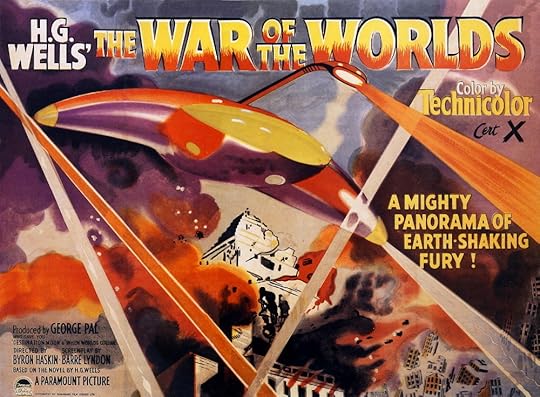
Martian Heat Ray
It made sense when Science Fiction went to the stars that the brave men and women who plumbed the depths of space would need weapons suited to their new environment. A firearm requiring oxygen or air pressure would not work in the vacuum of space, nor could an adventurer lost on a distant planet find ammunition for a conventional gun. As with so many of Science Fiction's standard props, it fell to H. G. Wells to arm the enemies of Man with such a weapon in The War of the Worlds (1898):
Garrett P. Serviss can take credit for inventing "The Distintegrator" in his "Thomas Edison's Conquest of Mars" (1898), America's answer to H. G. Wells:
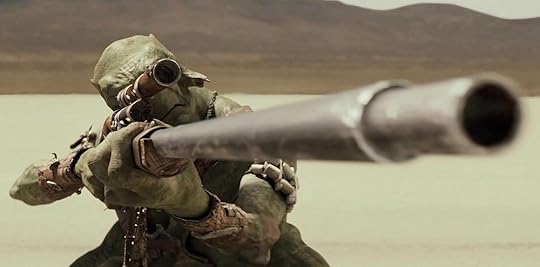
Barsoomian Radium Gun
While Serviss and Wells slugged it out in fiction, in the real world, Nikola Tesla was working on the idea of actual direct-energy weapons as early as 1900. In his The Art of Projecting Concentrated Non-dispersive Energy through the Natural Media he discourses on charged particle beams. Still, fiction was slow to follow.
The first big writer to consider what a personal sized space weapon might be was Edgar Rice Burroughs in his maiden flight as a writer, "Under the Moons of Mars" (All-Story, serialization beginning February 1912). ERB realized that Martians would not necessarily have the same weaponry as Earthmen and came up with the "Radium" rifle:
Despite the range, most of the fighting on Mars takes place with swords. So much for logic. Still, it paved the way for other writers to think outside the box.
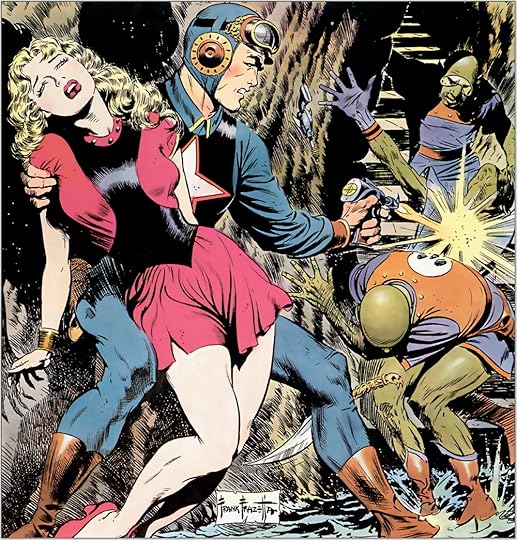
Buck Rogers
The term "blaster" was coined in April 1925 in Weird Tales (Amazing Stories and Astounding did not yet exist!) in "When the Green Star Waned" by the obscure Nictzin Dyalhis:
Another Weird Tales alumnus was Edmond Hamilton who wrote most the SF in the magazine. He had the Blue Ray of Death in "Across Space" (Weird Tales, September 1926) and the Cold Ray in "The Atomic Conquerors" (Weird Tales, February 1927) and the De-Atomizing Ray in "Crashing Suns" (Weird Tales, August 1928).
Buck Rogers, who was still Anthony Rogers when he appeared in "Armageddon 2419" (Amazing Stories, August 1928) by Philip Francis Nowlan, found the future Americans at war with invading Asians and using rocket launchers called Rocket guns and the following:
In the same issue, in an equally monumental tale, The Skylark of Space by E. E. Doc Smith and Lee Hawkins Garby goes back to the Burroughs' method:
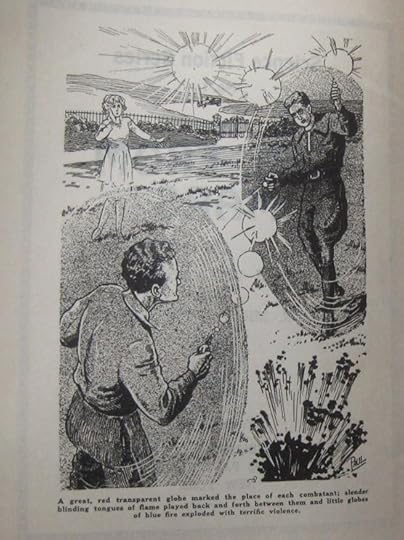
"The Girl from Mars"
Hugo Gernsback published "The Girl From Mars" by Jack Williamson and Miles J. Breuer in a pamphlet in 1929. This was the one thing he published in between owning Amazing Stories and his new set of magazines which included Wonder Stories. This tale features three Martians raised on Earth, children sent in capsules like Superman would be in the comics four years later. The two males fight a super-hero proportioned battle for the female using an array of weird weaponry most the size of a coin:
"The Crystal Ray" by Raymond Z. Gallun (Air Wonder Stories, November 1929) features another racist war between America and the Yellow Menace. America survives with a final desperate weapon, the Blue Ray:
Brigands of the Moon
In Amazing Stories, November 1930, it was John W. Campbell, still writer, not yet all-important editor, who really figured out how such a weapon would actually work in "Solarite":
1931 seems to be an important year for ray guns. At Teck's Amazing Stories, April 1931 Nat Schachner and Arthur Leo Zagat came up with the Disruptor in "The Emperor of the Stars". That same month in Hugo Gernsback's Wonder Stories, The Annihilation Beam appeared in Leslie F. Stone's in "The Conquest of Gola," and Clark Ashton Smith had his Zero Ray in "An Adventure in Futurity". Jack Williamson offers another form of weapon, the Matter Annihilation Ray in "Twelve Hours to Live" (Wonder Stories, August 1931).
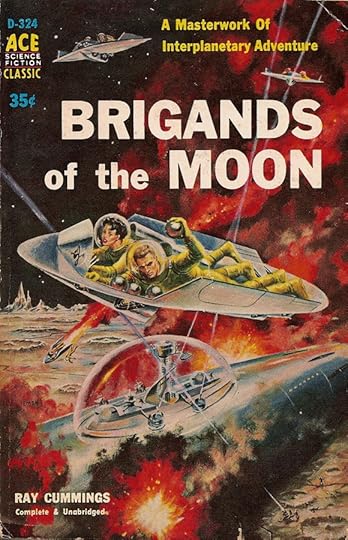
In wasn't any different over at the Clayton Astounding. Ray Cummings must have had Wells in mind when he created the pencil heat ray in Brigands of the Moon (Astounding, March 1931) :
Flash. Ah-ahhh.
Of all the spacemen to appear in the Clayton Astounding, Hawk Carse was certainly the most famous. In "Hawk Carse" (Astounding, November 1931) he is described as "... Hawk Carse the adventurer, he of the spitting ray-gun and the phenomenal draw, of the reckless space ship maneuverings..." In the story there is little or no explanation of how a ray gun works for by this time none was necessary. The Hawk Carse stories were modeled on the Western and how the gun worked was no longer important, only that the hero was lightning fast. The ray gun had arrived.
C. L. Moore's Northwest Smith in his first appearance "Shambleau" (Weird Tales, November 1933) shows he knows his way around a weapon in the opening scene:
By 1934 in Triplanetary (Amazing Stories, January-April 1934), E. E. Doc Smith replaced his X-Plosive with the "Standish", a beam weapon of immense power. Smith would later coined the word "Super-Weapon" in "What a Course!" (Thrilling Wonder Stories, June 1939:
Pew! Pew!
Disappointing as Buck Roger's initial weaponry in the Pulps, he didn't really get going until he became a comic strip character in January 1929, leaving Earth for outer space. Once out there, Buck's futuristic weapon inspired the generations that followed. The XZ-31 Rocket Pistol appeared at the February 1934 American Toy Fair and sold for 50 cents.
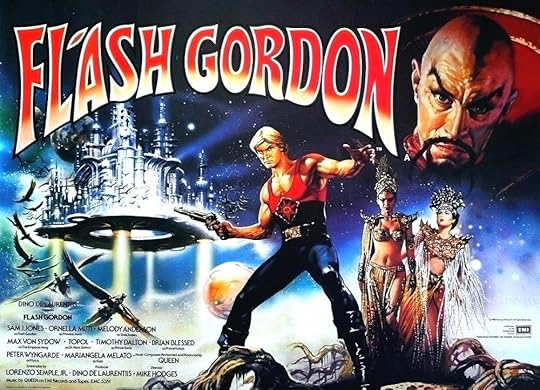
And of course, right on Buck's tracks came Flash Gordon in January 7, 1934. With Buster Crabbe playing him in the serials in 1936, everyone now knew what a space gun was supposed to look like.
The events of 1945 and the bombing of Hiroshima and Nagasaki mark the end of fun, futuristic weapons. The real thing had arrived and they weren't so fun. For a while Science Fiction focused on bombardments as everyone worried that the Russians would fill the skies with death. But TV gave us new men in silver underwear and the ray gun became the province of Children's entertainment or the stuff of jokes such as Chuck Jones's brilliant "Duck Dodgers in the 24 and 1/2 century" (Warner Bros., 1953). Daffy whips out his Disintegrator Pistol and pulls the trigger. The gun, of course, disintegrates. But eventually TV shows like Lost in Space, Star Trek, Space 1999, and of course Star Wars would bring these glittering hand-held weapons back into our consciousness. Call it a ray gun, call it a blaster, it doesn't matter. As Han Solo says, perhaps erroneously: "Hokey religions and ancient weapons are no match for a good blaster at your side, kid."
Additional resources:
Kurogawa's Virtual Ray Gun Exhibition
Technovelgy's Weapons in Science Fiction
G. W. Thomas has appeared in over 400 different books, magazines and ezines including The Writer, Writer's Digest, Black October Magazine and Contact. His website is gwthomas.org. He is editor of Dark Worlds magazine.

Martian Heat Ray
It made sense when Science Fiction went to the stars that the brave men and women who plumbed the depths of space would need weapons suited to their new environment. A firearm requiring oxygen or air pressure would not work in the vacuum of space, nor could an adventurer lost on a distant planet find ammunition for a conventional gun. As with so many of Science Fiction's standard props, it fell to H. G. Wells to arm the enemies of Man with such a weapon in The War of the Worlds (1898):
It is still a matter of wonder how the Martians are able to slay men so swiftly and so silently. Many think that in some way they are able to generate an intense heat in a chamber of practically absolute non-conductivity. This intense heat they project in a parallel beam against any object they choose, by means of a polished parabolic mirror of unknown composition, much as the parabolic mirror of a lighthouse projects a beam of light. But no one has absolutely proved these details. However it is done, it is certain that a beam of heat is the essence of the matter. Heat, and invisible, instead of visible, light. Whatever is combustible flashes into flame at its touch, lead runs like water, it softens iron, cracks and melts glass, and when it falls upon water, incontinently that explodes into steam.
Garrett P. Serviss can take credit for inventing "The Distintegrator" in his "Thomas Edison's Conquest of Mars" (1898), America's answer to H. G. Wells:
Another soft whirr in the instrument, a momentary flash of light close around it, and, behold, the crow had turned from black to white!
"Its feathers are gone," said the inventor; "they have been dissipated into their constituent atoms. Now, we will finish the crow."
Instantly there was another adjustment of the index, another outshooting of vibratory force, a rapid up and down motion of the index to include a certain range of vibrations, and the crow itself was gone—vanished in empty space! There was the bare twig on which a moment before it had stood. Behind, in the sky, was the white cloud against which its black form had been sharply outlined, but there was no more crow.

Barsoomian Radium Gun
While Serviss and Wells slugged it out in fiction, in the real world, Nikola Tesla was working on the idea of actual direct-energy weapons as early as 1900. In his The Art of Projecting Concentrated Non-dispersive Energy through the Natural Media he discourses on charged particle beams. Still, fiction was slow to follow.
The first big writer to consider what a personal sized space weapon might be was Edgar Rice Burroughs in his maiden flight as a writer, "Under the Moons of Mars" (All-Story, serialization beginning February 1912). ERB realized that Martians would not necessarily have the same weaponry as Earthmen and came up with the "Radium" rifle:
These rifles were of a white metal stocked with wood, which I learned later was a very light and intensely hard growth much prized on Mars, and entirely unknown to us denizens of Earth. The metal of the barrel is an alloy composed principally of aluminum and steel which they have learned to temper to a hardness far exceeding that of the steel with which we are familiar. The weight of these rifles is comparatively little, and with the small caliber, explosive, radium projectiles which they use, and the great length of the barrel, they are deadly in the extreme and at ranges which would be unthinkable on Earth. The theoretic effective radius of this rifle is three hundred miles, but the best they can do in actual service when equipped with their wireless finders and sighters is but a trifle over two hundred miles.
Despite the range, most of the fighting on Mars takes place with swords. So much for logic. Still, it paved the way for other writers to think outside the box.

Buck Rogers
The term "blaster" was coined in April 1925 in Weird Tales (Amazing Stories and Astounding did not yet exist!) in "When the Green Star Waned" by the obscure Nictzin Dyalhis:
"Well, it was for me that, in obedience to Hul Jok's imperative command, I was holding my Blastor pointing ahead of me..."
Another Weird Tales alumnus was Edmond Hamilton who wrote most the SF in the magazine. He had the Blue Ray of Death in "Across Space" (Weird Tales, September 1926) and the Cold Ray in "The Atomic Conquerors" (Weird Tales, February 1927) and the De-Atomizing Ray in "Crashing Suns" (Weird Tales, August 1928).
Buck Rogers, who was still Anthony Rogers when he appeared in "Armageddon 2419" (Amazing Stories, August 1928) by Philip Francis Nowlan, found the future Americans at war with invading Asians and using rocket launchers called Rocket guns and the following:
I took the weapon from his grasp and examined it hurriedly. It was not unlike the automatic pistol to which I was accustomed, except that it apparently fired with a button instead of a trigger. I inserted several fresh rounds of ammunition into its magazine from my companion's belt, as rapidly as I could, for I soon heard, near us, the suppressed conversation of his pursuers.
In the same issue, in an equally monumental tale, The Skylark of Space by E. E. Doc Smith and Lee Hawkins Garby goes back to the Burroughs' method:
They found that the X-plosive came fully up to expectations. The smallest charge they had prepared, fired by Crane at a great stump a full hundred yards away from the bare, flat-topped knoll that had afforded them a landing-place, tore it bodily from the ground and reduced it to splinters, while the force of the explosion made the two men stagger...The pistol cracked, and when the bullet reached its destination the great stone was obliterated in a vast ball of flame.

"The Girl from Mars"
Hugo Gernsback published "The Girl From Mars" by Jack Williamson and Miles J. Breuer in a pamphlet in 1929. This was the one thing he published in between owning Amazing Stories and his new set of magazines which included Wonder Stories. This tale features three Martians raised on Earth, children sent in capsules like Superman would be in the comics four years later. The two males fight a super-hero proportioned battle for the female using an array of weird weaponry most the size of a coin:
The ultramundane man thrust a hand into his pocket and pulled out one of Worrell's little instruments. I did not see the shape of the thing, but as he clasped it in his hand, a vague green fire flowed out of it and flashed across to Fred. What that force was, I do not know - some form of electric energy, or of ions, perhaps. The green radiance condensed about my son. His brave advance was abruptly checked. An expression of agony came over his face. He tottered and began a scream that ended in a rattling sob. For a moment his body was outlined sharply in the curdling green incandescence. Mason relaxed his grip of the tiny device and calmly returned it to his pocket as my son, burned and distorted, fell heavily to the floor.
"The Crystal Ray" by Raymond Z. Gallun (Air Wonder Stories, November 1929) features another racist war between America and the Yellow Menace. America survives with a final desperate weapon, the Blue Ray:
From the bow of one of America's ships a faint beam of bluish light stabbed out and struck an enemy craft, sweeping it from stem to stern! It passed through the vessel as though she had been made of glass, instead of thousands of tons of metal. Immediately the dreadnaught began to blunder oddly as though completely out of control. What had happened to her occupants? A grim smile passed over Pelton's lips, for he knew!

Brigands of the Moon
In Amazing Stories, November 1930, it was John W. Campbell, still writer, not yet all-important editor, who really figured out how such a weapon would actually work in "Solarite":
“Imagine what would happen if we directed this against the side of a mountain—the entire mass of rock would at once fly off at unimaginable speed, crashing ahead with terrific power, as all the molecules suddenly moved in the same direction. Nothing in all the Universe could hold together against it! It's a disintegration ray of a sort—a ray that will tear, or crush, for we can either make one half move away from the other—or we can reverse the power, and make one half drive toward the other with all the terrific power of its molecules! It is omnipotent—hmmm—” Arcot paused, narrowing his eyes in thought. It has one limitation. Will it reach far in the air? In vacuum it should have an infinite range—in the atmosphere all the molecules of the air will be affected, and it will cause a terrific blast of icy wind, a gale at temperatures far below zero! This will be even more effective here on Venus!
1931 seems to be an important year for ray guns. At Teck's Amazing Stories, April 1931 Nat Schachner and Arthur Leo Zagat came up with the Disruptor in "The Emperor of the Stars". That same month in Hugo Gernsback's Wonder Stories, The Annihilation Beam appeared in Leslie F. Stone's in "The Conquest of Gola," and Clark Ashton Smith had his Zero Ray in "An Adventure in Futurity". Jack Williamson offers another form of weapon, the Matter Annihilation Ray in "Twelve Hours to Live" (Wonder Stories, August 1931).
In wasn't any different over at the Clayton Astounding. Ray Cummings must have had Wells in mind when he created the pencil heat ray in Brigands of the Moon (Astounding, March 1931) :
My pencil ray was in my hand and I pressed its switch. The tiny heat ray stabbed through the air, but I missed. The figure stumbled but did not fall. I saw a bare gray arm come from the cloak, flung up to maintain its balance. Or perhaps my pencil ray had seared his arm...

Flash. Ah-ahhh.
Of all the spacemen to appear in the Clayton Astounding, Hawk Carse was certainly the most famous. In "Hawk Carse" (Astounding, November 1931) he is described as "... Hawk Carse the adventurer, he of the spitting ray-gun and the phenomenal draw, of the reckless space ship maneuverings..." In the story there is little or no explanation of how a ray gun works for by this time none was necessary. The Hawk Carse stories were modeled on the Western and how the gun worked was no longer important, only that the hero was lightning fast. The ray gun had arrived.
C. L. Moore's Northwest Smith in his first appearance "Shambleau" (Weird Tales, November 1933) shows he knows his way around a weapon in the opening scene:
"Smith, lounging negligently against the wall, arms folded and gun-hand draped over his left forearm, looked incapable of swift motion, but at the leader’s first forward step the pistol swept in a practiced half-circle and the dazzle of blue-white heat leaping from its muzzle seared an arc in the slag pavement at his feet..."
By 1934 in Triplanetary (Amazing Stories, January-April 1934), E. E. Doc Smith replaced his X-Plosive with the "Standish", a beam weapon of immense power. Smith would later coined the word "Super-Weapon" in "What a Course!" (Thrilling Wonder Stories, June 1939:
Going up to a blank wall, he manipulated an almost invisible dial set flush with it surface, swung a heavy door aside, and lifted out the Standish - a fearsome weapon. Squat, huge, and heavy, it resembled somewhat an overgrown machine rifle, but one possessing a thick, short telescope, with several opaque condensing lenses and parabolic reflectors...He set his peculiar weapon down, unfolded its three massive legs, crouched down behind it, and threw in a switch. Dull red beams of frightful intensity shot from the reflectors and sparks, almost of lightening proportions, leaped from the shielding screen under their impact.

Pew! Pew!
Disappointing as Buck Roger's initial weaponry in the Pulps, he didn't really get going until he became a comic strip character in January 1929, leaving Earth for outer space. Once out there, Buck's futuristic weapon inspired the generations that followed. The XZ-31 Rocket Pistol appeared at the February 1934 American Toy Fair and sold for 50 cents.
And of course, right on Buck's tracks came Flash Gordon in January 7, 1934. With Buster Crabbe playing him in the serials in 1936, everyone now knew what a space gun was supposed to look like.
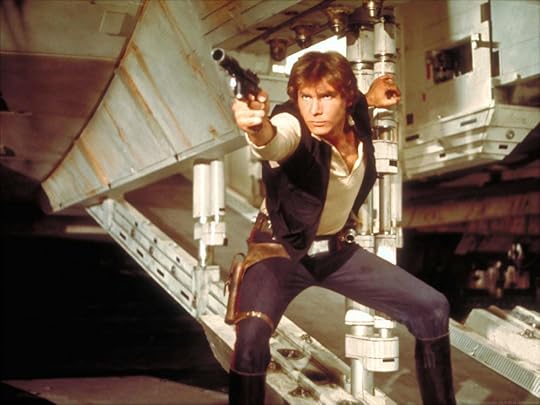
The events of 1945 and the bombing of Hiroshima and Nagasaki mark the end of fun, futuristic weapons. The real thing had arrived and they weren't so fun. For a while Science Fiction focused on bombardments as everyone worried that the Russians would fill the skies with death. But TV gave us new men in silver underwear and the ray gun became the province of Children's entertainment or the stuff of jokes such as Chuck Jones's brilliant "Duck Dodgers in the 24 and 1/2 century" (Warner Bros., 1953). Daffy whips out his Disintegrator Pistol and pulls the trigger. The gun, of course, disintegrates. But eventually TV shows like Lost in Space, Star Trek, Space 1999, and of course Star Wars would bring these glittering hand-held weapons back into our consciousness. Call it a ray gun, call it a blaster, it doesn't matter. As Han Solo says, perhaps erroneously: "Hokey religions and ancient weapons are no match for a good blaster at your side, kid."
Additional resources:
Kurogawa's Virtual Ray Gun Exhibition
Technovelgy's Weapons in Science Fiction
G. W. Thomas has appeared in over 400 different books, magazines and ezines including The Writer, Writer's Digest, Black October Magazine and Contact. His website is gwthomas.org. He is editor of Dark Worlds magazine.
September 16, 2013
Katy Perry, Queen of the Jungle
I fully support any endeavor in which Katy Perry swings through the jungle, makes a spear out of high heels, and paints an elephant's toenails. The song's growing on me too.