Amanda Meredith's Blog: Writer's Ramblings, page 7
March 7, 2014
Guest Posts!
I was invited to do a guest post on some fellow author's blogs. One interviewed me (a first for me as an author!) and the other asked for a post about really any topic I could think of. So I wrote a post about writing through tragedy and hard times. I don't know why I never posted the link here on my blog for everyone to be able to find them but better late than never! So here they are:
Matt Ewens - Author Interview
Alana Munro - Guest Post
Warning: Some portions of the the guest post on Alana's Blog may cause some tears so have the tissues handy!
Matt Ewens - Author Interview
Alana Munro - Guest Post
Warning: Some portions of the the guest post on Alana's Blog may cause some tears so have the tissues handy!


March 6, 2014
Favorite Books and Quotes That Inspire Greatness - Thursdays with the Author - March 6, 2014
Favorite Books and Quotes That Inspire Greatness
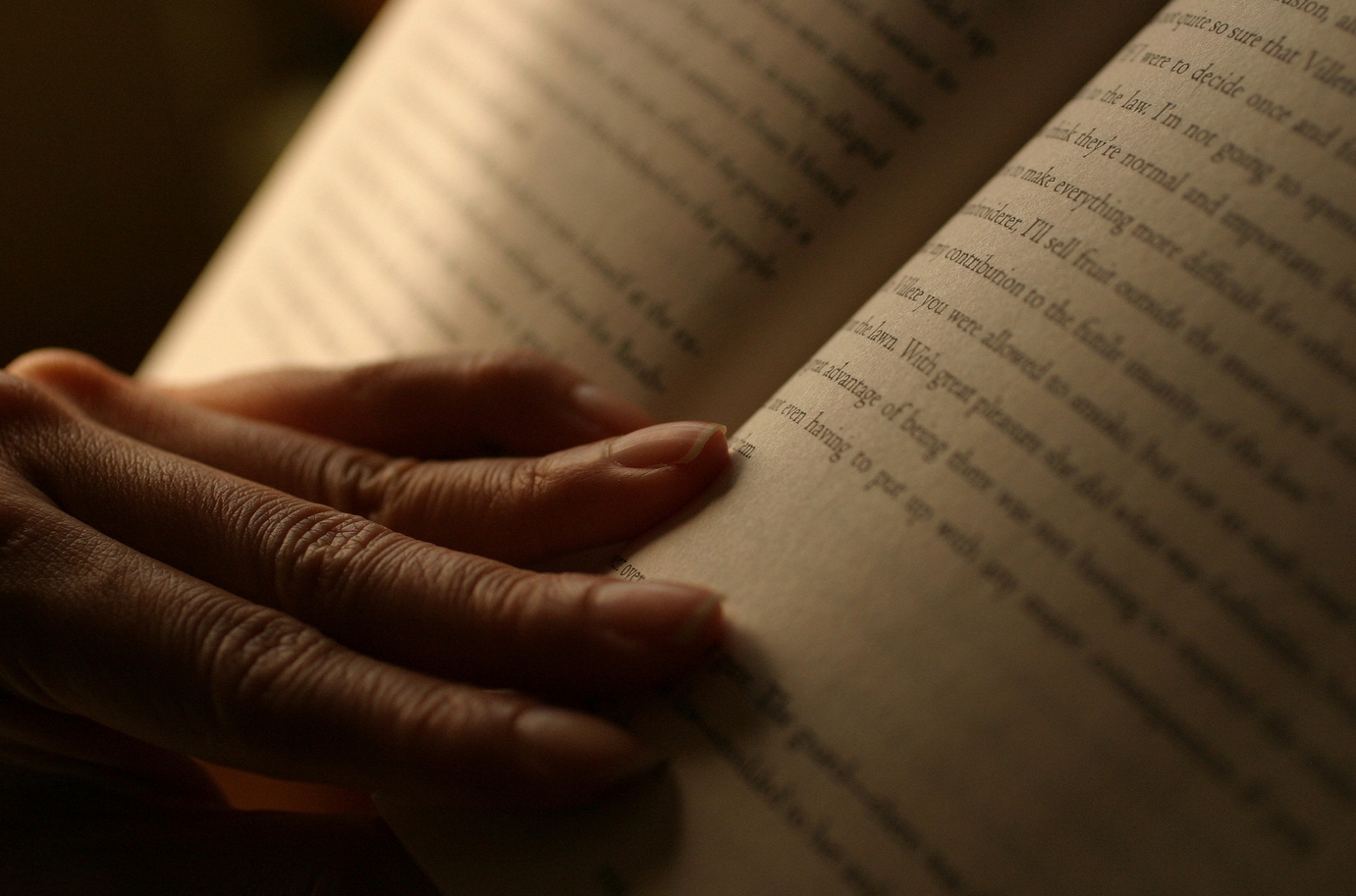
We all have a favorite book, or books. Ones that we can read over and over without getting sick of. Characters we never get bored with, love stories that stay fresh no matter how many times we read them, words that inspire every time we whisper them in our minds. These are the things that makes a book great. Books that stay on our minds have the power to live with us long after we first turn those precious pages. Their words inspire us, shock us, make us laugh, bring us to tears, get us angry, fill us joy. The very things the author wishes every reader will do when reading their words. Every one of my favorite books have quotes that stick with me, that constantly pop into my head.
Below, I will be posting a list of my all-time favorite books and my favorite quotes from them. As you read them, think of your own favorites and why they qualify for that prestigious position. Look at those quotes, not just as a reader, but as a writer. Your goal should be to write such unforgettable words as well! I'd love to hear your favorites and quotes, so feel free to post them in the comments below!
The Harry Potter Series - JK Rowling
(Sorcerer's Stone, Chamber of Secrets, Prisoner of Azkaban, Goblet of Fire, Order of the Phoenix, Half Blood Prince, Deathly Hallows)
Why:
The Harry Potter series took us from childhood wonder to the tough decisions of adulthood. The series was rather dark from the get-go (a great evil you-know-what is trying to kill him every book) and get's darker with each book. Pretty heavy stuff for children and teens. But it wasn't all doom and gloom. JK Rowling expertly layers the series with hope, love, perseverance, dedication, loyalty and unyielding friendship that makes the series some of the greatest books every written. I've reread the entire series multiple times and get something new every time.
Quotes:
"It does not do to dwell on dreams and forget to live, remember that."
"'The truth.' Dumbledore sighed. 'It is a beautiful and terrible thing, and should therefore be treated with great caution.'"
"'There are all kinds of courage,' said Dumbledore, smiling. 'It takes a great deal of bravery to stand up to our enemies, but just as much to stand up to our friends.'"
"It is our choices, Harry, that show what we truly are, far more than our abilities."
"You fail to recognize that it matters not what someone is born, but what they grow to be!"
"Numbing the pain for a while will make it worse when you finally feel it."
"If you want to know what a man's like, take a good look at how he treats his inferiors, not his equals."
"Have you any idea how much tyrants fear the people they oppress? All of them realize that, one day, amongst their many victims, there is sure to be one that rises against them and strikes back!"
"The true master does not run away from Death. He accepts that he must die and knows that there are far, far worse things in the living world than dying."
"Do not pity the dead, Harry. Pity the living, and, above all those who live without love."
Twilight Saga - Stephanie Meyer
(Twilight, New Moon, Eclipse, Breaking Dawn)
Why: Forget the movies for a second, especially since the books are ALWAYS better than Hollywood's version. Forget that the whole series seems to rotate around a girl that is so transfixed on one guy that she is willing to die for him. The unconditional and unstoppable love in this series is really what has me. First Bella's love for Edward then the love for their child that she's also willing to die for. Some favorite themes for this young adult novel? 1) They didn't have sex until they were married 2) Friends stood up to their families for what was right 3) Abortion wasn't an option, though her life was at risk. All very good morals that young people need to have more examples of in today's world. Despite Bella's desperate need to have Edward in her life (it really borders on crazy chick at the end of the first novel), I've read all these books multiple times and still feel her pain and anguish (over losing Edward) and Edward's unyielding devotion to her.
Quotes:
“I like the night. Without the dark, we'd never see the stars.”
“About three things I was absolutely positive. First, Edward was a vampire. Second, there was a part of him-and I didn’t know how potent that part might be-that thirsted for my blood. And third, I was unconditionally and irrevocably in love with him.”
“Surely it was a good way to die, in the place of someone else, someone I loved.”
“The right thing isn't always real obvious. Sometimes the right thing for one person is the wrong thing for someone else. So...good luck figuring that out.”
"Forbidden to remember, terrified to forget; it was a hard line to walk."
"One thing I truly knew — knew it in the pit of my stomach, in the center of my bones, knew it from the crown of my head to the soles of my feet, knew it deep in my empty chest — was how love gave someone the power to break you. I'd been broken beyond repair."
“The way you move - you orient yourself around him without even thinking about it. When he moves, even a little bit, you adjust your position at the same time. Like magnets...or gravity. You're like a satellite, or something. I've never seen anything like it.
“You could run from someone you feared, you could try to fight someone you hated. All my reactions were geared toward those kinds of killers – the monsters, the enemies. When you loved the one who was killing you, it left you no options. How could you run, how could you fight, when doing so would hurt that beloved one? If your life was all you had to give your beloved, how could you not give it? If it was someone you truly loved?”
Pride and Prejudice - Jane Austen
Why:Even though it was written over a hundred years ago, the story of love, and the struggle it can be to attain it, still applies today. Pride and Prejudice is a inspiration to many of today's romance writers. It's also one of the most realistic portrayals of what a dysfunctional but loving family is. Which is quite hilarious to read. ;)
Quotes:
“I declare after all there is no enjoyment like reading! How much sooner one tires of any thing than of a book! -- When I have a house of my own, I shall be miserable if I have not an excellent library.”
“I am the happiest creature in the world. Perhaps other people have said so before, but not one with such justice. I am happier even than Jane; she only smiles, I laugh.”
“There is, I believe, in every disposition a tendency to some particular evil, a natural defect, which not even the best education can overcome."
"And your defect is a propensity to hate everybody."
"And yours," he replied with a smile, "is wilfully to misunderstand them.”
"An unhappy alternative is before you, Elizabeth. From this day you must be a stranger to one of your parents. Your mother will never see you again if you do not marry Mr. Collins, and I will never see you again if you do."
"In vain I have struggled. It will not do. My feelings will not be repressed. You must allow me to tell you how ardently I admire and love you."
"You must learn some of my philosophy. Think only of the past as its remembrance gives you pleasure."
"I cannot fix on the hour, or the look, or the words, which laid the foundation. It is too long ago. I was in the middle before I knew that I had begun."
Inheritance Cycle - Christopher Paolini
(Eragon, Eldest, Brisingr, Inheritance)
Why: This coming-of-age trilogy takes us on an epic journey in the beautiful fantasy world of Alagaesia. I've always been a fan of dragon fantasy books, ever since falling in love with Anne MacCaffrey's Dragon Riders of Pern books when I was a pre-teen. The Inheritance Cycle is like a cross between Ann McCaffrey's books and Tolkein's Lord of the Rings books. Epic, amazing, creative, full of twists and turns and lessons learned. I've reread this entire series at least five times since the last book came out... that's how much I love them.
Quotes:
“When you teach them-teach them not to fear. Fear is good in small amounts, but when it is a constant, pounding companion, it cuts away at who you are and makes it hard to do what you know is right.”
“It's impossible to go through life unscathed. Nor should you want to. By the hurts we accumulate, we measure both our follies and our accomplishments.”
“You cannot learn what you are made of if you rely on anyone or anything else to help you.”
“Let go of your worries and focus only on the task at hand. The future will be what it will, and fretting about it will only make your fears more likely to come true."
“I am not who I was, but I know who I am.”
Dragon Riders of Pern - Anne McCaffrey
(20+ books)
Why:
I loved every one of the Pern books from Anne McCaffrey, though reading them as a pre-teen/teen, a few of them had content not exactly suited for YA. But the science fiction/fantasy, the love for dragons that the first book created, the description of such an amazing place, had me hooked. I reread many of the books throughout junior high and high school. Written in the 60's and 70's, though that fact isn't obvious as you're reading. Great story-telling. Each book can stand on it's own and fits in the entire series perfectly.
Quotes:
"Children's voices - even those who couldn't carry the tune - are always appealing"
"Were not ballads constructed to inform? To teach those who could not read and write? So that the young Pernese, whether he be dragonman, Lord, or holder, might learn his duty toward Pern and rehearse Pern’s bright history?"
"Sometimes secrets are the only thing some people can truly call their own."
"Some people who have perfectly good eyes only see what they want."
"Today is the mother of tomorrow."
"Worlds are lost or worlds are saved, from those dangers dragon-braved."
"He would hurt you! He would own you! You are mine, and I am yours, and no one comes between us!"
“When bad fortune occurs, the unresourceful, unimaginative man looks about him to attach the blame to someone else; the resolute accepts misfortune and endeavors to survive, mature, and improve because of it.”
The Silver Wolf - Alice Borchardt
Why:
For being a romance writer/reader, I have an absolute fascination with fantasy type novels. The Silver Wolf is about a young girl hiding a secret, that she is a shape shifter. But that secret in ancient Rome, when the pope's power is on the rise, is a death sentence. Coupled with having desgustingly evil family members that want to sell her to the highest bidder, the story is tinged with heartbreak, saddness and suspense. But the young heroine is stronger than even she knew and the journey she takes is a great one. I've re-read this book multiple times and it still has not lost the power to move me. :)
Quotes:
"I don’t plan to love him. I plan to survive him.”
"Love is eternal. That is its terror and its final beauty. Love never ends. The joy may go out of it, and, in time, even the pain may end. But it lingers like a living thing and follows you every moment of your life."
“Death alone gives meaning to life, and you will never fully live until you know you must die. And make your peace with that knowledge.”
"I was born of darkness. My father's eyes closed before mine opened. I am not of this world or the other, and I have the right to be what I am."
“We are all animals," Regeane said. "No more, no less.”
“Without love," she said, "we are as the painted images on glass widows of a church are without the sun, only shadows. Love illumines our lives. When its rays cease to shine into our days, we are nothing.”
“Women have the power of life and death. We, after all, give birth and the fate of humanity is in our hands. That's why men try so hard to rule us, my dear.”
“My father told me that if a man is the head of a house, the woman is its heart. And a man without a heart is no more than a corpse.”
February 27, 2014
Passing on books to Your Children - Thursday's with the Author -February 27, 2014
What we teach our children lives on long after we are gone. There are many things we teach them, from tying their shoes, brushing their teeth, saying please and thank you, riding a bike to driving a car, how to be self-sufficient, etc. As parents, we can easily lose track of how many things we actually teach our children.
But in today's world of eReader, tablets, 24 hour information, and ever-evolving technology, are we missing out on some of the most important lessons?
Like teaching your children to love the written word. Today, we don't even have to read to our children. eBook stores are full of audio books. Bookstores are full of children's stories complete with an audio CD. Cartoons are on at least three TV channels 24 hours a day. Children haven't changed. They still soak up the world around them the same way they have been for hundreds of years. But the world around them has changed. The way we parent has changed.
We don't even have to teach our children to read anymore. They learn it all in school now. We don't have to read to them either. We just turn on our tablet or phones and click the reading app that tells the story for them. Not like most of us would have time anyway. Most parents work all day, come home and scramble to make dinner, get the kids working on their homework, bath and bedtime rituals, and luckily an hour or so of alone time to try and catch up on housework. That doesn't even include extracurricular activities and sports.
But we HAVE to make time for instilling a love of the written word in the next generation of children. It doesn't even have to be YOUR children (if you don't have any). Grandchildren, nieces and nephews, cousins, neighbors, school kids. Today's children are LOSING the art of story telling and it's up to US to save it. I'm not just talking about just reading them books. Writing their own stories, making ones up, you making them up. A love for a world that's not their own. Feeding their creativity and imaginations. Don't say you don't have the time. MAKE the time. Don't say you don't read well out loud. KIDS DON'T CARE. Don't say your kids don't have any books they like. FIND SOME!
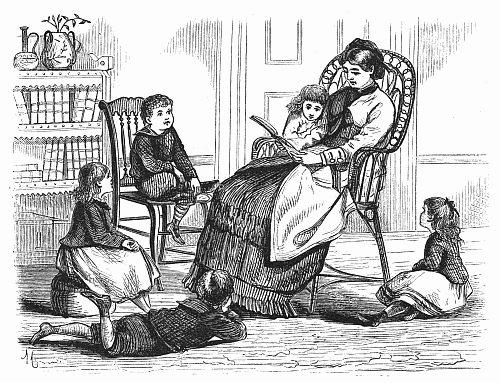
Here's some tips to help your kids fall in love with the written word. These can work from babies and some all the way to pre-teens and teenagers. It's NEVER too late to start.
1) Reading at bedtime.
This will be a time-crunch for most of us. Deal with it. From the earliest age, this is one of the best habits you can make with your children at bedtime. Here's some things to try:
A) Dress up as a character from the book for story time
B) Use different voices for different characters
C) Get the whole family involved in acting out the story
D) As your kids get older, have THEM start reading to YOU
2) Make up/Tell stories
A) I have a few standard fairy-tales that I like to tell my kids like Goldilocks and the Three Bears, The Three Little Pigs and Three Billy Goats Gruff. I embellish them, change them and do crazy voices every time I tell them. Sometimes my kids give me a topic to start with and I make up a story on the fly from there. I'll post one such story below.
3) Let your KIDS make up the stories.
This can be tougher, depending on the age of the kids. Sometimes you have to give them a starting theme or help them along. Another thing we do is popcorn stories. Each person says a line in the story and it 'popcorns' to the next person for the next line. Stories can get crazy and hilarious this way. My 9 year old son likes to inject Minecraft subjects and fart jokes on his turn and my 6 year old daughter always uses princesses and ponies. When it popcorns back to mom or dad, it's a good chance to reign in the crazy and try to get the story back on track. Regardless of what they come up with, they are using their minds and being creative so let them!
4) Get the books your kids like!
If your 5 year old is infatuated with tigers, get tiger books! If your 7 year old son loves dinosaurs, get dinosaur books. If your pre-teen is dealing with sibling issues, get the Diary of a Wimpy Kid books. If your daughter loves the color pink, try the Pinkalicious books. If they have books they will love, they will literally devour them. Let your bank account take a hit on this one, it'll pay off!
5) Take your kids to story-hour or the reading program at your local library.
Reading programs are usually summer events but story-hours typically go year round. Not only will your kids be encouraged to read, they will be hanging out with other kids, the same age, that are just as excited about reading.
6) Go to author signings for children's authors.
You might have to make a drive to a bigger city for this but it's an awesome experience for your kids. Not only will they score a new, autographed book, they will be able to meet the author, ask questions, and live the general excitement that a book signing always is. James Dean and Eric Litwin, creators of the amazing Pete the Cat series, are my most highly recommended book signing you should try to attend. So far they stick mostly to Atlanta, GA area, so this might be impossible for you. All the Pete the Cat books have a song with them and it is preformed during a reading at their book signings. They also have videos of these songs on Youtube.
7) Have your kids WRITE their stories.
You will waste a million pieces of paper. You will inwardly cringe at the grammar and spelling mistakes. You'll have to hold in your sigh at the complete lack of plot and utter nonsense they write. But you WILL smile and laugh. You WILL tell them they wrote an amazing story. You WILL be immensely proud of them. Because you actually will! If your little one is too young to write, write it for them as they tell you the story. Let them draw all the pictures. Keep their adorable, chaotic stories in your keepsake box because you will pull them out when your children are all grown up and cry tears of joy as you reread them.
8) Go to the bookstore with your children, find the children's section and let them explore the wonder that is children's literature.
Most stores have story sessions on the weekends. Plan your trip during these times for an even better experience. Don't ever go and NOT let them buy at least one book so plan with your checkbook accordingly.
9) Make your kids read the book before they ever see the movie.
This one mostly goes for teens/preteens (Twilight, Divergent, etc) but is also good for younger kids (The Lorax, Wizard of Oz). There are SO many movies out that started from books. Your kids will never know what they're missing if they don't read the literature that inspired the Hollywood creation before they see it.
10) Let your children see YOU reading or writing. And loving it.
Nothing is going to teach them to love books and writing more than watching you be the perfect example!
So there you go! Try a few, try them all, just try! Reading and writing, and LOVING it, is one of the most important things the next generations will learn. Out of them will be our next great author, they will write the next books we can't put down, they will be the brightest and most creative imaginations in our world. Be a part of making that a reality we all live in. :)
Here's a story I made up for my kids a few months back after a torturous few weeks of my 6 year old daughter trying to pull a tooth. As soon as it came out, they were begging for a story about it.
Once upon a time there was a beautiful warrior princess known as Aubree the Fair. Not long after her sixth birthday, the young princess faced a challenge that would prove her strength and virtue.
The princess had a loose tooth and no matter how much wiggling she did, no matter how much help the King and Queen offered, the tooth refused to budge.
Princess Aubree knew she had to be brave and do everything she could to remove the vile baby tooth so her new, grown-up tooth could take its rightful place in her mouth. So enlisting the help of her trusty lion stuffed animal, Princess Aubree sat down with a magical paper towel, determined to win the ultimate battle of willpower against tooth.
Using all of her mighty strength, Princess Aubree wrestled with the stubbornly set tooth. Her muscles quivered, her hands shook from effort. Tears sprang to her blue eyes and a slight sob caught in her throat. She closed her eyes, forcing her mind to focus, and yanked with all her might.
When she opened her eyes, the tooth , the origin of the epic battle, the source of all her frustration, lay in her hands. With a shout of triumph, she held the tooth up for the kingdom to see.
The King and Queen praised her fortitude. The young Prince admired her bravery. Nobles from the far reaches of the realm paid homage to her valor. "Princess Aubree, Vanquisher of Baby Teeth!" they shouted.
That night, the Good Fairy honored the young princess for conquering the evil tooth. "For standing defiant and true in the face of great adversity, I reward thee, Aubree the Fair and Brave, with a coin of good fortune," the Good Fairy declared.
Aubree The Fair stayed ever vigilant, knowing that she had won the battle but the war against her baby teeth was far from over.
The End
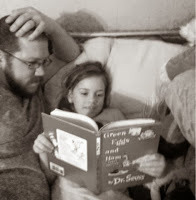
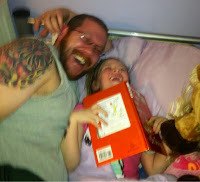
And for a personal touch, here's a few pictures of my hubby reading to my youngest. He HATES getting his picture taken and will probably equally hate that I put it on the world-wide-web for all to see, but I wanted to show you all how much fun it can be reading to your children. (Sorry for the blurry shot, I had to make it quick to get away with it!)
Our daughter is learning to read so she typically starts the story by herself and we finish when she's ready to stop. Green Eggs and Ham gets rather long-winded about half-way through, so that's usually when Mommy or Daddy take over. (And side-note, my hubby really dislikes reading out loud and isn't generally a big reader at all, so it's a step out of his comfort zone to do this for his kids.)
But in today's world of eReader, tablets, 24 hour information, and ever-evolving technology, are we missing out on some of the most important lessons?
Like teaching your children to love the written word. Today, we don't even have to read to our children. eBook stores are full of audio books. Bookstores are full of children's stories complete with an audio CD. Cartoons are on at least three TV channels 24 hours a day. Children haven't changed. They still soak up the world around them the same way they have been for hundreds of years. But the world around them has changed. The way we parent has changed.
We don't even have to teach our children to read anymore. They learn it all in school now. We don't have to read to them either. We just turn on our tablet or phones and click the reading app that tells the story for them. Not like most of us would have time anyway. Most parents work all day, come home and scramble to make dinner, get the kids working on their homework, bath and bedtime rituals, and luckily an hour or so of alone time to try and catch up on housework. That doesn't even include extracurricular activities and sports.
But we HAVE to make time for instilling a love of the written word in the next generation of children. It doesn't even have to be YOUR children (if you don't have any). Grandchildren, nieces and nephews, cousins, neighbors, school kids. Today's children are LOSING the art of story telling and it's up to US to save it. I'm not just talking about just reading them books. Writing their own stories, making ones up, you making them up. A love for a world that's not their own. Feeding their creativity and imaginations. Don't say you don't have the time. MAKE the time. Don't say you don't read well out loud. KIDS DON'T CARE. Don't say your kids don't have any books they like. FIND SOME!
Here's some tips to help your kids fall in love with the written word. These can work from babies and some all the way to pre-teens and teenagers. It's NEVER too late to start.
1) Reading at bedtime.
This will be a time-crunch for most of us. Deal with it. From the earliest age, this is one of the best habits you can make with your children at bedtime. Here's some things to try:
A) Dress up as a character from the book for story time
B) Use different voices for different characters
C) Get the whole family involved in acting out the story
D) As your kids get older, have THEM start reading to YOU
2) Make up/Tell stories
A) I have a few standard fairy-tales that I like to tell my kids like Goldilocks and the Three Bears, The Three Little Pigs and Three Billy Goats Gruff. I embellish them, change them and do crazy voices every time I tell them. Sometimes my kids give me a topic to start with and I make up a story on the fly from there. I'll post one such story below.
3) Let your KIDS make up the stories.
This can be tougher, depending on the age of the kids. Sometimes you have to give them a starting theme or help them along. Another thing we do is popcorn stories. Each person says a line in the story and it 'popcorns' to the next person for the next line. Stories can get crazy and hilarious this way. My 9 year old son likes to inject Minecraft subjects and fart jokes on his turn and my 6 year old daughter always uses princesses and ponies. When it popcorns back to mom or dad, it's a good chance to reign in the crazy and try to get the story back on track. Regardless of what they come up with, they are using their minds and being creative so let them!
4) Get the books your kids like!
If your 5 year old is infatuated with tigers, get tiger books! If your 7 year old son loves dinosaurs, get dinosaur books. If your pre-teen is dealing with sibling issues, get the Diary of a Wimpy Kid books. If your daughter loves the color pink, try the Pinkalicious books. If they have books they will love, they will literally devour them. Let your bank account take a hit on this one, it'll pay off!
5) Take your kids to story-hour or the reading program at your local library.
Reading programs are usually summer events but story-hours typically go year round. Not only will your kids be encouraged to read, they will be hanging out with other kids, the same age, that are just as excited about reading.
6) Go to author signings for children's authors.
You might have to make a drive to a bigger city for this but it's an awesome experience for your kids. Not only will they score a new, autographed book, they will be able to meet the author, ask questions, and live the general excitement that a book signing always is. James Dean and Eric Litwin, creators of the amazing Pete the Cat series, are my most highly recommended book signing you should try to attend. So far they stick mostly to Atlanta, GA area, so this might be impossible for you. All the Pete the Cat books have a song with them and it is preformed during a reading at their book signings. They also have videos of these songs on Youtube.
7) Have your kids WRITE their stories.
You will waste a million pieces of paper. You will inwardly cringe at the grammar and spelling mistakes. You'll have to hold in your sigh at the complete lack of plot and utter nonsense they write. But you WILL smile and laugh. You WILL tell them they wrote an amazing story. You WILL be immensely proud of them. Because you actually will! If your little one is too young to write, write it for them as they tell you the story. Let them draw all the pictures. Keep their adorable, chaotic stories in your keepsake box because you will pull them out when your children are all grown up and cry tears of joy as you reread them.
8) Go to the bookstore with your children, find the children's section and let them explore the wonder that is children's literature.
Most stores have story sessions on the weekends. Plan your trip during these times for an even better experience. Don't ever go and NOT let them buy at least one book so plan with your checkbook accordingly.
9) Make your kids read the book before they ever see the movie.
This one mostly goes for teens/preteens (Twilight, Divergent, etc) but is also good for younger kids (The Lorax, Wizard of Oz). There are SO many movies out that started from books. Your kids will never know what they're missing if they don't read the literature that inspired the Hollywood creation before they see it.
10) Let your children see YOU reading or writing. And loving it.
Nothing is going to teach them to love books and writing more than watching you be the perfect example!
So there you go! Try a few, try them all, just try! Reading and writing, and LOVING it, is one of the most important things the next generations will learn. Out of them will be our next great author, they will write the next books we can't put down, they will be the brightest and most creative imaginations in our world. Be a part of making that a reality we all live in. :)
Here's a story I made up for my kids a few months back after a torturous few weeks of my 6 year old daughter trying to pull a tooth. As soon as it came out, they were begging for a story about it.
Once upon a time there was a beautiful warrior princess known as Aubree the Fair. Not long after her sixth birthday, the young princess faced a challenge that would prove her strength and virtue.
The princess had a loose tooth and no matter how much wiggling she did, no matter how much help the King and Queen offered, the tooth refused to budge.
Princess Aubree knew she had to be brave and do everything she could to remove the vile baby tooth so her new, grown-up tooth could take its rightful place in her mouth. So enlisting the help of her trusty lion stuffed animal, Princess Aubree sat down with a magical paper towel, determined to win the ultimate battle of willpower against tooth.
Using all of her mighty strength, Princess Aubree wrestled with the stubbornly set tooth. Her muscles quivered, her hands shook from effort. Tears sprang to her blue eyes and a slight sob caught in her throat. She closed her eyes, forcing her mind to focus, and yanked with all her might.
When she opened her eyes, the tooth , the origin of the epic battle, the source of all her frustration, lay in her hands. With a shout of triumph, she held the tooth up for the kingdom to see.
The King and Queen praised her fortitude. The young Prince admired her bravery. Nobles from the far reaches of the realm paid homage to her valor. "Princess Aubree, Vanquisher of Baby Teeth!" they shouted.
That night, the Good Fairy honored the young princess for conquering the evil tooth. "For standing defiant and true in the face of great adversity, I reward thee, Aubree the Fair and Brave, with a coin of good fortune," the Good Fairy declared.
Aubree The Fair stayed ever vigilant, knowing that she had won the battle but the war against her baby teeth was far from over.
The End
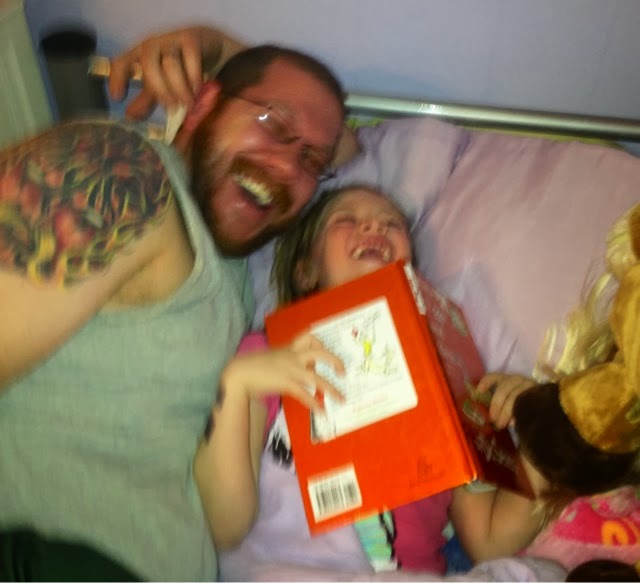
And for a personal touch, here's a few pictures of my hubby reading to my youngest. He HATES getting his picture taken and will probably equally hate that I put it on the world-wide-web for all to see, but I wanted to show you all how much fun it can be reading to your children. (Sorry for the blurry shot, I had to make it quick to get away with it!)
Our daughter is learning to read so she typically starts the story by herself and we finish when she's ready to stop. Green Eggs and Ham gets rather long-winded about half-way through, so that's usually when Mommy or Daddy take over. (And side-note, my hubby really dislikes reading out loud and isn't generally a big reader at all, so it's a step out of his comfort zone to do this for his kids.)

February 26, 2014
What I know To Be True - A Writer's Perspective - February 19, 2014-Thursdays with the Author
What I know To Be True - A Writer's Perspective
I've been a published author for 7 months now and a writer since I first learned to scrawl letters on a page (my handwriting hasn't actually improved much since then). I've learned a lot of 'truths' in my 28 (yes, I know that's not a big number) years. Some were learned fairly easily, others, painfully hard. So today's blog post will be sharing those truths. Maybe it will spare someone from having to learn the hard way themselves. Maybe you'll find a common learning experience and be able to share a smile or laugh while reading it.
1) If writing is in your blood, you'll never lose the passion for it. I knew I wanted to become a published author in high school, particularly my senior year. I loved to write. After taking a creative writing class that year, my inspiration took off like a rocket and by the time I graduated, I had a binder full of ideas, stories, poetry, song lyrics, and the first rough (very rough) drafts of a few novels. Fast forward another year or so and I was married and we had a new baby. Life got crazy. I still found time to write: I cranked out the second draft of Dark Mountains while on bed rest and recuperating from the birth of my son. But between those first milestones, and the birth of our second child 4 years later, writing, or at least the strong desire I publish, was put on the back burner. Though my time for writing was drastically reduced, I still managed to write with the same passion I'd always felt: long and winding emails, Christmas newsletters, detailed Facebook posts, stories for my children, etc. Once my kids started school and I had more time, I found that I hadn't lost my 'writing edge'. I had merely added experiences I could flavor my writing with.
2) Nothing should come before your family. Even your writing. I firmly believe this can be said for any career. Family: your spouse and children, should never be put on the back burner. They are the most important things in your life and should always remain so. They will also provide you with a plethora of ideas to inject into your writing.
3) You will never have enough time to write. Even if you have a set amount of hours every day with minimal distractions, you will still find you've run out of time. You'll be in the middle of writing an amazing chapter and life suddenly rings a bell signaling you've got to stop. It could be your kids needing dinner, your spouse ready to go out, a realization that it's after midnight and you have to get up before six the next day. The list goes on. Try to write down your most important ideas so you don't lose them but don't try to keep going. Remember #2? There are more important things than cranking out another 1000 words.
3) Life is hard - Use it!I'm sure we all realize this. No matter what our ages, no matter where we come from, life is hard. It likes to kick us when we are down. Hard. Someone gets cancer. You husband loses his job. You miscarry a baby. A beloved family member passes. And the list goes on... And on... And on... Well, you get the point. Tragedy, pain, grief, hardship. Use those feelings. Write through the pain. Your characters shouldn't be one dimensional. They have the same problems we do, so write about them!
4) Life also rocks - Use it too!There's just as much good as there is bad in life. Sometimes they seem unevenly matched. For grief there is also new life. For pain there is also joy. For hardship there is also relief. All these things, the pull and push of life, can make us better writers... If we don't shy away from using what life hands us.
5) Your children will amaze you AND annoy you. Sometimes one right after the other. Sometimes at the same time. Sometimes a lot of one and only a bit of the other. But regardless of how many times they weigh on either, you will thank whatever God you believe in, for giving them to you. You can also use this in your writing. Even characters that are children have to be more than one dimensional. And if you write children's or YA, you will have large amount of inspiration to pull from.
6) Letting something get under your skin is a bad idea. A bad review. No reviews. An editor that sends back your manuscript with so much red ink it looks like it's covered in blood. The fiftieth rejection letter from an agent. A cover that keeps getting rejected by the self-publishing program. Not being able to get copyright for use of a picture or name. A negative comment in your blog. Etc. These things will piss you off. They might even make you cry. Or yell. Sometimes they will make you do something very stupid like ranting on a public forum where everyone can see. Letting these negative things keep bugging you makes the original problem bigger than it ever was. Have your cry, yell it out and move on. You'll only raise your blood pressure or have a heart attack if you dwell on it.
7) Don't write to get rich. For a few reasons. The most obvious being that there's a very slim chance you will actually make money writing, let alone a lot of money. The less obvious, but more important reason, is your motivation. If making money is your motivation, you had better try being a stock broker instead if a writer. Too many authors (that usually start out amazing), begin churning out story after story (that sound more and more like the same thing only with different characters), or stretching out stories that should have ended a few books before, just to make more money. If you aren't writing because you love writing, you shouldn't BE writing. Money can't go with you when you die but great written words will live on long after you are gone.

I've been a published author for 7 months now and a writer since I first learned to scrawl letters on a page (my handwriting hasn't actually improved much since then). I've learned a lot of 'truths' in my 28 (yes, I know that's not a big number) years. Some were learned fairly easily, others, painfully hard. So today's blog post will be sharing those truths. Maybe it will spare someone from having to learn the hard way themselves. Maybe you'll find a common learning experience and be able to share a smile or laugh while reading it.
1) If writing is in your blood, you'll never lose the passion for it. I knew I wanted to become a published author in high school, particularly my senior year. I loved to write. After taking a creative writing class that year, my inspiration took off like a rocket and by the time I graduated, I had a binder full of ideas, stories, poetry, song lyrics, and the first rough (very rough) drafts of a few novels. Fast forward another year or so and I was married and we had a new baby. Life got crazy. I still found time to write: I cranked out the second draft of Dark Mountains while on bed rest and recuperating from the birth of my son. But between those first milestones, and the birth of our second child 4 years later, writing, or at least the strong desire I publish, was put on the back burner. Though my time for writing was drastically reduced, I still managed to write with the same passion I'd always felt: long and winding emails, Christmas newsletters, detailed Facebook posts, stories for my children, etc. Once my kids started school and I had more time, I found that I hadn't lost my 'writing edge'. I had merely added experiences I could flavor my writing with.
2) Nothing should come before your family. Even your writing. I firmly believe this can be said for any career. Family: your spouse and children, should never be put on the back burner. They are the most important things in your life and should always remain so. They will also provide you with a plethora of ideas to inject into your writing.
3) You will never have enough time to write. Even if you have a set amount of hours every day with minimal distractions, you will still find you've run out of time. You'll be in the middle of writing an amazing chapter and life suddenly rings a bell signaling you've got to stop. It could be your kids needing dinner, your spouse ready to go out, a realization that it's after midnight and you have to get up before six the next day. The list goes on. Try to write down your most important ideas so you don't lose them but don't try to keep going. Remember #2? There are more important things than cranking out another 1000 words.
3) Life is hard - Use it!I'm sure we all realize this. No matter what our ages, no matter where we come from, life is hard. It likes to kick us when we are down. Hard. Someone gets cancer. You husband loses his job. You miscarry a baby. A beloved family member passes. And the list goes on... And on... And on... Well, you get the point. Tragedy, pain, grief, hardship. Use those feelings. Write through the pain. Your characters shouldn't be one dimensional. They have the same problems we do, so write about them!
4) Life also rocks - Use it too!There's just as much good as there is bad in life. Sometimes they seem unevenly matched. For grief there is also new life. For pain there is also joy. For hardship there is also relief. All these things, the pull and push of life, can make us better writers... If we don't shy away from using what life hands us.
5) Your children will amaze you AND annoy you. Sometimes one right after the other. Sometimes at the same time. Sometimes a lot of one and only a bit of the other. But regardless of how many times they weigh on either, you will thank whatever God you believe in, for giving them to you. You can also use this in your writing. Even characters that are children have to be more than one dimensional. And if you write children's or YA, you will have large amount of inspiration to pull from.
6) Letting something get under your skin is a bad idea. A bad review. No reviews. An editor that sends back your manuscript with so much red ink it looks like it's covered in blood. The fiftieth rejection letter from an agent. A cover that keeps getting rejected by the self-publishing program. Not being able to get copyright for use of a picture or name. A negative comment in your blog. Etc. These things will piss you off. They might even make you cry. Or yell. Sometimes they will make you do something very stupid like ranting on a public forum where everyone can see. Letting these negative things keep bugging you makes the original problem bigger than it ever was. Have your cry, yell it out and move on. You'll only raise your blood pressure or have a heart attack if you dwell on it.
7) Don't write to get rich. For a few reasons. The most obvious being that there's a very slim chance you will actually make money writing, let alone a lot of money. The less obvious, but more important reason, is your motivation. If making money is your motivation, you had better try being a stock broker instead if a writer. Too many authors (that usually start out amazing), begin churning out story after story (that sound more and more like the same thing only with different characters), or stretching out stories that should have ended a few books before, just to make more money. If you aren't writing because you love writing, you shouldn't BE writing. Money can't go with you when you die but great written words will live on long after you are gone.
February 19, 2014
What I know To Be True - A Writer's Perspective - February 19, 2014
-Thursdays with the Author
What I know To Be True - A Writer's Perspective
I've been a published author for 7 months now and a writer since I first learned to scrawl letters on a page (my handwriting hasn't actually improved much since then). I've learned a lot of 'truths' in my 28 (yes, I know that's not a big number) years. Some were learned fairly easily, others, painfully hard. So today's blog post will be sharing those truths. Maybe it will spare someone from having I learn the hard way themselves. Maybe you'll find a common learning experience and be able to share a smile or laugh while reading it.
1) If writing is in your blood, you'll never lose the passion for it. I knew I wated to become a published author in high school, particularly my senior year. I loved to write. After taking a creative writing class that year, my inspiration took off like a rocket and by the time I graduated, I had a binder full of ideas, stories, poetry, song lyrics, and the first rough (very rough) drafts of a few novels. Fast forward another year or so and I was married and we had a new baby. Life got crazy. I still found time to write: I cranked out the second draft of Dark Mountains while on bed rest and recuperating from the birth of my son. But between those first milestones, and the birth of our second child 4 years later, writing, or at least the strong desire I publish, was put on the back burner. Though my time for writing was drastically reduced, I still managed to write with the same passion I'd always felt: long and winding emails, Christmas newsletters, detailed Facebook posts, stories for my children, etc. Once my kids started school and I had more time, I found that I hadn't lost my 'writing edge'. I had merely added experiences I could flavor my writing with.
2) Nothing should come before your family. Even you writing. I firmly believe this can be said for any career. Family: your spouse and children, should never be put on the back burner. They are the most important things in your life and should always remain so. They will also provide you with a plethora of ideas to inject into your writing.
3) You will never have enough time to write. Even if you have a set amount of hours every day with minimal distractions, you will still find you've run out of time. You'll be in the middle of writing an amazing chapter and life suddenly rings a bell signaling you've got to stop. It could be your kids needing dinner, your spouse ready to go out, a realization that it's after midnight and you have to get up before six the next day. The list goes on. Try to write down your most important ideas so you don't lose them but don't try to keep going. Remember #2? There are more important things than cranking out another 1000 words.
3) Life is hard - Use it!I'm sure we all realize this. No matter what our ages, no matter where we come from, life is hard. It likes to kick us when we are down. Hard. Someone gets cancer. You husband loses his job. You miscarry a baby. A beloved family membe passes. And the list goes on... And on... And on... Well, you get the point. Tragedy, pain, grief, hardship. Use those feelings. Write through the pain. Your characters shouldn't be one dimensional. They have the same problems we do, so write about them!
4) Life also rocks - Use it too!There's just as much good as there is bad in life. Sometimes they seem unevenly matched. For grief there is also new life. For pain there is also joy. For hardship there is also relief. All these things, the pull and push of life, can make us better writers... If we don't shy away from using what life hands us.
5) Your children will amaze you AND annoy you. Sometimes one right after the other. Sometimes at the same time. Sometimes a lot of one and only a bit of the other. But regardless of how many times they weigh on either, you will thank whatever God you believe in, for giving them to you. You can also use this in your writing. Even characters that are children have to be more than one dimensional. And if you write children's or YA, you will have large amount of inspiration to pull from.
6) Letting something get under your skin is a bad idea. A bad review. No reviews. And editor that sends back you manuscript with so much red ink it looks like it's covered in blood. The fiftieth rejection letter from an agent. A cover that keeps getting rejected by the self-publishing program. Not being able to get copyright for a use of a picture or name. A negative comment in your blog. Etc. These things will piss you off. They might even make you cry. Or yell. Sometimes they will make you do something very stupid like ranting on a public forum where everyone can see. Letting these negative things keep bugging you makes the original problem bigger than it ever was. Have your cry, yell it out and move on. You'll only raise your blood pressure or have a heart attack if you dwell on it.
7) Don't write to get rich. For a few reasons. The most obvious being that there's a very slim chance you will actually make a lot of money writing. The less obvious, but more important reason, is your motivation. If making money I your motivation, you had better try being a stock broker instead if a writer. Too many authors (that usually start out amazing), begin churning out story after story (that sound more and more like the same thing only with different characters), or stretching out stories that should have ended a few books before, just to make more money. If you aren't writing because you love writing, you shouldn't BE writing. Money can't go with you when you die but great written words will live long after you are gone.
I've been a published author for 7 months now and a writer since I first learned to scrawl letters on a page (my handwriting hasn't actually improved much since then). I've learned a lot of 'truths' in my 28 (yes, I know that's not a big number) years. Some were learned fairly easily, others, painfully hard. So today's blog post will be sharing those truths. Maybe it will spare someone from having I learn the hard way themselves. Maybe you'll find a common learning experience and be able to share a smile or laugh while reading it.
1) If writing is in your blood, you'll never lose the passion for it. I knew I wated to become a published author in high school, particularly my senior year. I loved to write. After taking a creative writing class that year, my inspiration took off like a rocket and by the time I graduated, I had a binder full of ideas, stories, poetry, song lyrics, and the first rough (very rough) drafts of a few novels. Fast forward another year or so and I was married and we had a new baby. Life got crazy. I still found time to write: I cranked out the second draft of Dark Mountains while on bed rest and recuperating from the birth of my son. But between those first milestones, and the birth of our second child 4 years later, writing, or at least the strong desire I publish, was put on the back burner. Though my time for writing was drastically reduced, I still managed to write with the same passion I'd always felt: long and winding emails, Christmas newsletters, detailed Facebook posts, stories for my children, etc. Once my kids started school and I had more time, I found that I hadn't lost my 'writing edge'. I had merely added experiences I could flavor my writing with.
2) Nothing should come before your family. Even you writing. I firmly believe this can be said for any career. Family: your spouse and children, should never be put on the back burner. They are the most important things in your life and should always remain so. They will also provide you with a plethora of ideas to inject into your writing.
3) You will never have enough time to write. Even if you have a set amount of hours every day with minimal distractions, you will still find you've run out of time. You'll be in the middle of writing an amazing chapter and life suddenly rings a bell signaling you've got to stop. It could be your kids needing dinner, your spouse ready to go out, a realization that it's after midnight and you have to get up before six the next day. The list goes on. Try to write down your most important ideas so you don't lose them but don't try to keep going. Remember #2? There are more important things than cranking out another 1000 words.
3) Life is hard - Use it!I'm sure we all realize this. No matter what our ages, no matter where we come from, life is hard. It likes to kick us when we are down. Hard. Someone gets cancer. You husband loses his job. You miscarry a baby. A beloved family membe passes. And the list goes on... And on... And on... Well, you get the point. Tragedy, pain, grief, hardship. Use those feelings. Write through the pain. Your characters shouldn't be one dimensional. They have the same problems we do, so write about them!
4) Life also rocks - Use it too!There's just as much good as there is bad in life. Sometimes they seem unevenly matched. For grief there is also new life. For pain there is also joy. For hardship there is also relief. All these things, the pull and push of life, can make us better writers... If we don't shy away from using what life hands us.
5) Your children will amaze you AND annoy you. Sometimes one right after the other. Sometimes at the same time. Sometimes a lot of one and only a bit of the other. But regardless of how many times they weigh on either, you will thank whatever God you believe in, for giving them to you. You can also use this in your writing. Even characters that are children have to be more than one dimensional. And if you write children's or YA, you will have large amount of inspiration to pull from.
6) Letting something get under your skin is a bad idea. A bad review. No reviews. And editor that sends back you manuscript with so much red ink it looks like it's covered in blood. The fiftieth rejection letter from an agent. A cover that keeps getting rejected by the self-publishing program. Not being able to get copyright for a use of a picture or name. A negative comment in your blog. Etc. These things will piss you off. They might even make you cry. Or yell. Sometimes they will make you do something very stupid like ranting on a public forum where everyone can see. Letting these negative things keep bugging you makes the original problem bigger than it ever was. Have your cry, yell it out and move on. You'll only raise your blood pressure or have a heart attack if you dwell on it.
7) Don't write to get rich. For a few reasons. The most obvious being that there's a very slim chance you will actually make a lot of money writing. The less obvious, but more important reason, is your motivation. If making money I your motivation, you had better try being a stock broker instead if a writer. Too many authors (that usually start out amazing), begin churning out story after story (that sound more and more like the same thing only with different characters), or stretching out stories that should have ended a few books before, just to make more money. If you aren't writing because you love writing, you shouldn't BE writing. Money can't go with you when you die but great written words will live long after you are gone.
February 13, 2014
Writing Reviews - The Good, The Bad, and The 'Meh' - February 13, 2013 - Thursdays with the Author
Writing Reviews - The Good, The Bad, and The 'Meh'
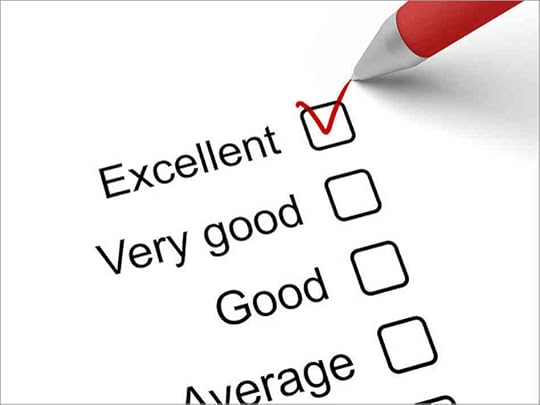
I recently won and ARC (advanced reader copy) for a new book and wanted to give the author a good review since I had won the book in a contest. But as I started reading, I could immediately see it was going to be a problem. You see, I really didn't like the book. I had emailed the author after reading the prologue and the first chapter to tell her I really liked what I had read so far. Because I did. Until I started chapter 2.
I'm one of those readers that will ALWAYS finish what I start. Even if I don't like it. I definitely don't want to be someone that quits on a book if I don't like the first line. You never know when a book will get going. This book was one of those. There were multiple times in the first half of the novel that I simply wanted to put it down and not finish but I trudged on. Thankfully it picked up a bit for me halfway trough but I finished the book with a 'meh' type feeling. Not the best feeling for leaving a great review.
(Tip for Authors here: Your first line should be good, don't misunderstand. So should the first parts of your novel. Most readers will give up on a book if they don't like the beginning. I choose to read a book in its entirety but readers like me are few and far between. So make sure your book 'pops' from beginning to end.)
This particular book was a fantasy romance, written (I believe) for YA/NA. I couldn't find a reference to the actual genre on any of the author's websites, so I went by impression. I read fantasy occasionally, some of my favorites being Anne McCaffrey, Christopher Paolini, JRR Tolkien, CS Lewis, etc., so it's not exactly out of my normal romance genre reading. The world building was well done, description of characters and environment were great as well. But the just-past-puberty dialog by the 20-something characters was a major turn off. And the info that was really unnecessary for the overall plot in the book. The beginning was riddled with not-needed information that really bored me as a reader and did not affect the story-line in any way. This book was nearly 600 pages so it would've probably been better if such things were removed before printing. No one really enjoys reading a five pound book. Then there was the fact that I found over 10 typos (and this book is traditionally published), which really bothered me. Are you starting to see why I didn't like the book?
So I emailed the author my thoughts and the typos I found instead of posting anything publicly. I made sure I mentioned that I hoped she didn't take my thoughts too hard because I know as an author myself, you can't please everybody. As I've mentioned in my Handling Negative Feedback post, every reader had their own personality and likes/dislikes, so every reader that tries your book might not like it.
But as a reader, we have to be completely honest when reviewing a book. As an author who's had to hear negative reviews for my own work, giving a bad review felt just as bad as getting one. Normally, anything I publicly review, has only been for books I really liked. My personal policy is if I really, really liked a book, I need to leave a review, on Amazon, Goodreads, Shelfari, etc. If I didn't like a book, especially if it was for reasons the author could fix, I try to contact the author personally. Does this mean you should to? That decision is completely up to you. I can tell you as an author, I'd much rather get a private message about someones' dislikes so I at least have the opportunity to fix it. Remember: A review effects the sales of a book. That is a fact. So you should think very carefully about posting your review (good or bad) for all the world to see. What you say has the potential to make or break an author's book. On the same hand, no reviews are just as damaging to an author. If a book has no reviews, the chances that someone looks at it, sees that no one has bothered to review it and still buys it are slim. Not leaving a review at all can literally kill an author's sales. It may seem like extra work (as a reader) but you could honestly be changing someones' life by leaving a review.
Here's some tips for leaving reviews (good or bad):
1) Start your review with a general summaryBook NameAuthor NameGenreRating (stars - see #4)Cover (see #9)
2) Start with what you liked first. Unless you didn't like anything. Then there would be no point. But if you did, tell the author and potential readers. Certain characters, personalities, plot lines, etc. If you liked it, say it, then explain why. Be Specific. Remember, good reviews have the power to make an author's book. As a reader (even a not so picky reader, since I know what it feels like from both sides), I tend to check out reviews before purchasing a book. If all I see are bad reviews, I tend not to buy it. If there's an even mix and the book sounds like something I'd like, I'll give it a try. If the majority of reviews are positive, I won't think twice.
3) What you didn't like. This part could be very small or very large. Be specific. Maybe the author didn't realize there was something wrong with what bothered you. Maybe they'll read your review and go back and fix it. Maybe they won't. By having a 'didn't like' section in your review, you're helping other readers as well as the author. You're helping the author fix potential bombshells with your honesty. You're helping other readers avoid wasting their hard-earned money on a sub-par product. Remember: You can always delete a review if the author fixes the problems and you change your opinion.
An author isn't going to like getting a negative review. He/she has their blood, sweat, and tears, not to mention a large chunk of time, invested into their novel. Hearing something negative about it will not feel good. But we (authors) have to learn how to accept it, learn from it, and move on. If everyone critiqued our work like our mothers would (great job honey! I loved it) we'd have a lot more horrible books on the market. Telling an author you liked something when you really didn't will only cause problems for the author in the long run.
Here's an example of a 'bad' review from my first book on the UK amazon site:
"I read the sample to this book and it sounded like a good read. Unfortunately it was the best bit! Not worth buying in my opinion - sorry"
She gave me 3/5 starts, which by my count (see # 4), is an average review. Did this review make me angry? No. A little disappointed? Yeah. I want my readers to like my books and it's a pretty sucky feeling when they don't. But here's why I was disappointed.
The reader didn't tell me why she didn't like it. She liked the sample, which was the first few chapters in this book, and the blurb, enough to purchase the book. But she didn't like anything else? What was so different about the rest of the novel from the beginning that made her change her mind? Why wasn't it worth buying? Was it too expensive for the length? Or was it so horrible after the first few chapters that it wasn't worth the money? At least she said sorry and left me 3 stars, instead of worse, but she didn't need to apologize. I want my readers to be honest about how they feel. But I would like to know why they feel that way. Maybe it was a problem I could have fixed. Maybe I could have adjusted the price. Maybe the Americanized dialogue was too confusing for her to understand and I could have put in a disclaimer about the Southern American dialect, or a glossary. But I'll never know because she didn't tell me.
4) Be honest with your rating. Most sites have a 5 star rating system and YES you can half-star your review. If the rating system doesn't let you pick a half in your review, write it IN your review. For example: Click the 3 star but write that it's a solid 3.5 in the body of the review. Or round up if you're feeling very nice with a 4 star and mention it's a 3.5 in the body.
Most people consider 0-2 stars a bad rating. 2.5-3.5 would be an average review. 3.5-5 would be a positive rating. 3.5 starts is positive? Yes. At least, most author's should think so. If a reader gives you anything over 3 stars with their review, you should be insanely happy. The going guess I've been hearing in the writing communities is that you should consider yourself blessed if you get even 1 review for every 500 books sold. That's a very painful statistic to hear as an author when reviews are what controls the sale of your book.
5) Be thoughtful. This is more than just being specific. Being thoughtful goes even deeper than that. One of the ways an author improves their writing is by listening to feedback and critiques. If there's something wrong with their book, they want to know! But getting a review that says: "Loved the book. Can't wait for what he/she comes up with next." is not a good review to receive. Don't get me wrong, the author will love that you left a review at all but by only saying a few short words, you aren't teaching to author anything, and you aren't telling the potential readers WHY the book was so great. Was it the ease of dialogue that made it seem like you could actually hear the conversation? Was it the detailed explanations that made you feel like you could reach out and touch the scenery? Was it the amazingly creative sex scenes that made you want to take your husband to bed and try what you read about? Was it the harrowing love story that made your heart clench and tears spring to your eyes? Was it the sadistic bad guy that made you wish he was real just so you could be the one to make him face justice? Did the non-stop pace have you reading until the wee hours of the morning just because you couldn't stand putting the book down? THOSE are the details the author and reader need to know. Those thoughts that made you love the book are the ones that will get someone else to give it a try. Those thoughts will encourage the author to write another story with the same skill that made you fall in love with their writing.
Here's an example from a great review left for my first book on Amazon's US site:
""Are you always going to take care of me, Cole?"
"Always"
Dark Mountains was a free read I was able to pick up from Amazon. Despite my TBR list being obscenely long, something about the blurb drew me in and I read this book in one sitting. Dark Mountains is the story of two children, Cole and Libby, who meet as very young children instantly becoming best friends. That friendship continues through their childhood and beyond eventually growing into more. Cole becomes Libby's lifeline as she lives with a tragic and violent home life. As Libby and Cole become adults, the danger to Libby doesn't end.
Cole makes a wonderful hero with his steadfast friendship to Libby and his desire to protect and comfort her. Although I usually read romances with a lot more steam, I enjoyed Dark Mountains for everything it was...Sweet, moving, well-written. Dark Mountains probably won't be the next breakout book you hear about but it was a lovely read and all the more likable for the simplistic and straightforward style it was written in. A sweet, solid 3.5 read. Just a side note, the generic cover does not do justice to this book and I'd recommend a new one."
A couple things this reviewer did that were awesome: A) She actually clicked 4 stars (since amazon doesn't let you have half stars) but mentioned it was a solid 3.5 in her review. She was being honest but also helping the book's average review by rounding up her star rating. B) She mentions that she reads a different sort of romance (steamy) but still liked the story. C) She gives you a summary of the characters/story-line D) She hits on what she really liked about the book E) She mentions what she didn't like: the generic cover. And it was a generic cover. Once I realized my readers thought it was, I redesigned and republished with a new, better looking cover.
Here's another review (5 star) from Amazon:
"My parents were born and raised and are now buried in Kentucky and I have a brother who still lives there so I have spent my entire life visiting various relatives in Kentucky and my roots are there but this author fooled me. She was born in Bay City, Texas and was raised in a small town in Central Illinois but as I read this book I would have sworn that she was born and raised in Kentucky. She was spot on in her portrayal of people who made their living in Kentucky coal mines and in her portrayal of the way of life of people who live in the South.
Also as I read this book I was hoping that someone would put the bad guy out of his misery. I just wasn't sure who I wanted to have the honors. He actually hurt everyone with whom he came in contact so the line of people who wanted him dead was pretty long but I just wanted to make sure that whoever finally kills him does not end up in prison for doing the world a favor. I make no apology for wanting this man dead. I was raised in the country and when we saw a venomous snake or a rabid dog we had one way of handling it...we killed it before it could kill us. This man was worse than a venomous snake or a rabid dog because if you can stay out of the way of the snake or the dog they do not come looking for you in order to kill you. The same cannot be said of this poor specimen of humanity. No one could stay out of his way because he definitely WOULD come looking for you.
There were parts of this book that were very sad. (Keep the tissues handy.) There were parts of it that made me wonder why something was not done to rid the world of the bad guy years ago. There were parts of the book that made me cry and parts that made me cheer. Significantly, when I finished this book I had no desire to rush right into another book because the characters and storyline in Dark Mountains will keep me thinking about them for a long time... This is an excellent book and one I highly recommend."
Here's what she did right: A) She mentions the accurate portrayal of an area that the author is clearly NOT from. As authors, we need to DO OUR RESEARCH and get it right when describing places, people, language, ways-of-life, etc. from the places we are writing about. B) She is thoughtful with what she liked. The bad guy was so bad and so realistic that it was one of the key things she remembered after reading. She also mentions that this book make her cry and cheer. You want your books to effect the readers emotions. She also mentions that she kept thinking about the book long after she had finished it.
6) Decide HOW you want to write your reviewA review can be as long or short as you want. You can write a detailed paragraph of your likes and dislikes. You can write a chapter by chapter summary. No matter what the length of your review just remember to be specific and thoughtful.
7) Decide if you want to put your contact info in your reviewThis one is completely up to you. Most sites give you the option of hiding your personal information. But I can tell you, as an author, there have been MANY times I've wanted to write a reviewer to say thank you, send a free copy of my next book, or let them know I fixed what they didn't like. On the other side of the coin, this puts you at risk for getting a nasty email from an author that hasn't learned how to handle a negative review. So putting your contact information in your review can be a pain. But a majority of authors have leaned that a negative review is just as important as a positive one so the odds of getting a nasty message isn't super high. I would have wanted to message the woman who left the negative review on the UK site (See # 3) to try and get more specific answers as to why she didn't like it.
8) Feel free to add quotes from the bookAs an author, I literally squeal and do a little happy dance when a reviewer liked a specific dialogue or section enough to actually quote it in their review. If they remember it well enough to quote it, the author has done their job. :)
9) Have a section for the technical aspects of the bookA good book isn't just made with what's inside it. There's 2 ways of going about this:
eBook Is the thumbnail easy to see and read? Is the cover eye catching? Are there page breaks where there shouldn't be? Do all the chapter headings link back to the Table of Contents and all the links there take you to the subsequent chapters? Do all the hyperlinks work? Is the price too high/low for the quality of the book?
PrintIs the cover eye catching, easy to read, etc? Is the font and text size easy to read? Are there extra pages where there shouldn't be? Is the Table of Contents needed/not needed? Is there a glossary needed and is it in the right place? Is the book size too big/small? Are the pages hard to turn (paper type)? Are there page numbers and page headings/are they where they're supposed to be? Is the price too high/low for the quality of the book?
Knowing these things are just as important as how you liked the actual book. I've had reviewers that said they loved the book but hated the cover which spurred me to design a better one. I've also reviewed print books that had the character reading something and the font was very hard to read. Authors need to know these things.
10) Make the reader (of the review) aware of any spoilersIf you're going to talk about something that happened in the book that would ruin the surprise for the reader, make sure you notify them if there will be any 'spoilers' at the beginning of your review. If you don't want to 'spoil' it, just be general with what you discuss, avoiding any specific plot details that would give it away.
11) Don't Be a Troll (jerk)
Don't bother leaving a review if you're going to be nasty or judgmental. Most readers and authors can see when someone is being a (American term here) troll. Someone is homophobic and didn't realize your book had a homosexual relationship in it and spews all kinds of hatred on your review. Someone is a liberal democrat and your book was obviously written from a conservative republican standpoint and they fill their review with crazy political rhetoric. A character in your book decides to terminate a pregnancy and you get hateful reviews about your 'murderous' attitude. Your book has sex in it and someone read it not realizing it and they fill the review with 'so disappointed' and 'disgusted' type sentences.
Those are trolls. Readers should be smart enough to read a blurb, a genre description and even other reviews, and know what they're getting into when they purchase a book. A romance will probably have sex in it. A contemporary fiction will probably have foul language or sensitive topics. A fantasy will probably have references to magic, etc. As an author, we have to expect that some people will not be smart enough to realize that and will leave a scalding review after their should-have-been-obvious discovery. As a reader, we have to see those reviews for what they are: trolls being ridiculous.
Here's an example of a 2 star, troll review from my first book on Amazon US:
"This book started out fine and then the profanity began. I do not read books that use the Lord's name in vain. No need for profanity for a book to be good. Sexual content should be implied, not explained. In my opinion, from what I did read, the book may have been a good story but I just stick to more family friendly reads. Did not finish this book"
I think it's pretty obvious why I would classify this review as a troll review but I'll give you the reasons anyway. A) The reader had a problem with profanity. Even though this book is classified clearly as an adult contemporary romance/romantic suspense. As I mentioned above, as a reader, we have to be aware of what we are purchasing. If you don't like bad language, you should probably stick with inspirational novels and children's books. B) She brings out the religion card. As a reviewer AND a reader, don't even put this card in your deck. There are THOUSANDS of religions around the world and just because you believe one, doesn't mean everyone else has to as well. If you can't remain objective about another person's beliefs or lack thereof, then you probably shouldn't be reading fiction. C) She is offended by the explained sex scenes. In a romance novel. This goes with letter A. Stick with inspirational and children's books then. D) 'Did Not Finish This Book' I'd say if you can't finish a book, you shouldn't be writing review. At the very least, you should be contacting the author personally so he/she has a chance to fix it. Especially if it's because of multiple typos or really bad writing (you usually only see those with self-published works). If you are writing your review based on your personal beliefs and sense of morality, make sure you aren't sounding like a troll before you post your review, because you probably are sounding like a troll.
12) Write the ReviewThis one's pretty self-explanatory! Get out there and write! :)
I recently won and ARC (advanced reader copy) for a new book and wanted to give the author a good review since I had won the book in a contest. But as I started reading, I could immediately see it was going to be a problem. You see, I really didn't like the book. I had emailed the author after reading the prologue and the first chapter to tell her I really liked what I had read so far. Because I did. Until I started chapter 2.
I'm one of those readers that will ALWAYS finish what I start. Even if I don't like it. I definitely don't want to be someone that quits on a book if I don't like the first line. You never know when a book will get going. This book was one of those. There were multiple times in the first half of the novel that I simply wanted to put it down and not finish but I trudged on. Thankfully it picked up a bit for me halfway trough but I finished the book with a 'meh' type feeling. Not the best feeling for leaving a great review.
(Tip for Authors here: Your first line should be good, don't misunderstand. So should the first parts of your novel. Most readers will give up on a book if they don't like the beginning. I choose to read a book in its entirety but readers like me are few and far between. So make sure your book 'pops' from beginning to end.)
This particular book was a fantasy romance, written (I believe) for YA/NA. I couldn't find a reference to the actual genre on any of the author's websites, so I went by impression. I read fantasy occasionally, some of my favorites being Anne McCaffrey, Christopher Paolini, JRR Tolkien, CS Lewis, etc., so it's not exactly out of my normal romance genre reading. The world building was well done, description of characters and environment were great as well. But the just-past-puberty dialog by the 20-something characters was a major turn off. And the info that was really unnecessary for the overall plot in the book. The beginning was riddled with not-needed information that really bored me as a reader and did not affect the story-line in any way. This book was nearly 600 pages so it would've probably been better if such things were removed before printing. No one really enjoys reading a five pound book. Then there was the fact that I found over 10 typos (and this book is traditionally published), which really bothered me. Are you starting to see why I didn't like the book?
So I emailed the author my thoughts and the typos I found instead of posting anything publicly. I made sure I mentioned that I hoped she didn't take my thoughts too hard because I know as an author myself, you can't please everybody. As I've mentioned in my Handling Negative Feedback post, every reader had their own personality and likes/dislikes, so every reader that tries your book might not like it.
But as a reader, we have to be completely honest when reviewing a book. As an author who's had to hear negative reviews for my own work, giving a bad review felt just as bad as getting one. Normally, anything I publicly review, has only been for books I really liked. My personal policy is if I really, really liked a book, I need to leave a review, on Amazon, Goodreads, Shelfari, etc. If I didn't like a book, especially if it was for reasons the author could fix, I try to contact the author personally. Does this mean you should to? That decision is completely up to you. I can tell you as an author, I'd much rather get a private message about someones' dislikes so I at least have the opportunity to fix it. Remember: A review effects the sales of a book. That is a fact. So you should think very carefully about posting your review (good or bad) for all the world to see. What you say has the potential to make or break an author's book. On the same hand, no reviews are just as damaging to an author. If a book has no reviews, the chances that someone looks at it, sees that no one has bothered to review it and still buys it are slim. Not leaving a review at all can literally kill an author's sales. It may seem like extra work (as a reader) but you could honestly be changing someones' life by leaving a review.
Here's some tips for leaving reviews (good or bad):
1) Start your review with a general summaryBook NameAuthor NameGenreRating (stars - see #4)Cover (see #9)
2) Start with what you liked first. Unless you didn't like anything. Then there would be no point. But if you did, tell the author and potential readers. Certain characters, personalities, plot lines, etc. If you liked it, say it, then explain why. Be Specific. Remember, good reviews have the power to make an author's book. As a reader (even a not so picky reader, since I know what it feels like from both sides), I tend to check out reviews before purchasing a book. If all I see are bad reviews, I tend not to buy it. If there's an even mix and the book sounds like something I'd like, I'll give it a try. If the majority of reviews are positive, I won't think twice.
3) What you didn't like. This part could be very small or very large. Be specific. Maybe the author didn't realize there was something wrong with what bothered you. Maybe they'll read your review and go back and fix it. Maybe they won't. By having a 'didn't like' section in your review, you're helping other readers as well as the author. You're helping the author fix potential bombshells with your honesty. You're helping other readers avoid wasting their hard-earned money on a sub-par product. Remember: You can always delete a review if the author fixes the problems and you change your opinion.
An author isn't going to like getting a negative review. He/she has their blood, sweat, and tears, not to mention a large chunk of time, invested into their novel. Hearing something negative about it will not feel good. But we (authors) have to learn how to accept it, learn from it, and move on. If everyone critiqued our work like our mothers would (great job honey! I loved it) we'd have a lot more horrible books on the market. Telling an author you liked something when you really didn't will only cause problems for the author in the long run.
Here's an example of a 'bad' review from my first book on the UK amazon site:
"I read the sample to this book and it sounded like a good read. Unfortunately it was the best bit! Not worth buying in my opinion - sorry"
She gave me 3/5 starts, which by my count (see # 4), is an average review. Did this review make me angry? No. A little disappointed? Yeah. I want my readers to like my books and it's a pretty sucky feeling when they don't. But here's why I was disappointed.
The reader didn't tell me why she didn't like it. She liked the sample, which was the first few chapters in this book, and the blurb, enough to purchase the book. But she didn't like anything else? What was so different about the rest of the novel from the beginning that made her change her mind? Why wasn't it worth buying? Was it too expensive for the length? Or was it so horrible after the first few chapters that it wasn't worth the money? At least she said sorry and left me 3 stars, instead of worse, but she didn't need to apologize. I want my readers to be honest about how they feel. But I would like to know why they feel that way. Maybe it was a problem I could have fixed. Maybe I could have adjusted the price. Maybe the Americanized dialogue was too confusing for her to understand and I could have put in a disclaimer about the Southern American dialect, or a glossary. But I'll never know because she didn't tell me.
4) Be honest with your rating. Most sites have a 5 star rating system and YES you can half-star your review. If the rating system doesn't let you pick a half in your review, write it IN your review. For example: Click the 3 star but write that it's a solid 3.5 in the body of the review. Or round up if you're feeling very nice with a 4 star and mention it's a 3.5 in the body.
Most people consider 0-2 stars a bad rating. 2.5-3.5 would be an average review. 3.5-5 would be a positive rating. 3.5 starts is positive? Yes. At least, most author's should think so. If a reader gives you anything over 3 stars with their review, you should be insanely happy. The going guess I've been hearing in the writing communities is that you should consider yourself blessed if you get even 1 review for every 500 books sold. That's a very painful statistic to hear as an author when reviews are what controls the sale of your book.
5) Be thoughtful. This is more than just being specific. Being thoughtful goes even deeper than that. One of the ways an author improves their writing is by listening to feedback and critiques. If there's something wrong with their book, they want to know! But getting a review that says: "Loved the book. Can't wait for what he/she comes up with next." is not a good review to receive. Don't get me wrong, the author will love that you left a review at all but by only saying a few short words, you aren't teaching to author anything, and you aren't telling the potential readers WHY the book was so great. Was it the ease of dialogue that made it seem like you could actually hear the conversation? Was it the detailed explanations that made you feel like you could reach out and touch the scenery? Was it the amazingly creative sex scenes that made you want to take your husband to bed and try what you read about? Was it the harrowing love story that made your heart clench and tears spring to your eyes? Was it the sadistic bad guy that made you wish he was real just so you could be the one to make him face justice? Did the non-stop pace have you reading until the wee hours of the morning just because you couldn't stand putting the book down? THOSE are the details the author and reader need to know. Those thoughts that made you love the book are the ones that will get someone else to give it a try. Those thoughts will encourage the author to write another story with the same skill that made you fall in love with their writing.
Here's an example from a great review left for my first book on Amazon's US site:
""Are you always going to take care of me, Cole?"
"Always"
Dark Mountains was a free read I was able to pick up from Amazon. Despite my TBR list being obscenely long, something about the blurb drew me in and I read this book in one sitting. Dark Mountains is the story of two children, Cole and Libby, who meet as very young children instantly becoming best friends. That friendship continues through their childhood and beyond eventually growing into more. Cole becomes Libby's lifeline as she lives with a tragic and violent home life. As Libby and Cole become adults, the danger to Libby doesn't end.
Cole makes a wonderful hero with his steadfast friendship to Libby and his desire to protect and comfort her. Although I usually read romances with a lot more steam, I enjoyed Dark Mountains for everything it was...Sweet, moving, well-written. Dark Mountains probably won't be the next breakout book you hear about but it was a lovely read and all the more likable for the simplistic and straightforward style it was written in. A sweet, solid 3.5 read. Just a side note, the generic cover does not do justice to this book and I'd recommend a new one."
A couple things this reviewer did that were awesome: A) She actually clicked 4 stars (since amazon doesn't let you have half stars) but mentioned it was a solid 3.5 in her review. She was being honest but also helping the book's average review by rounding up her star rating. B) She mentions that she reads a different sort of romance (steamy) but still liked the story. C) She gives you a summary of the characters/story-line D) She hits on what she really liked about the book E) She mentions what she didn't like: the generic cover. And it was a generic cover. Once I realized my readers thought it was, I redesigned and republished with a new, better looking cover.
Here's another review (5 star) from Amazon:
"My parents were born and raised and are now buried in Kentucky and I have a brother who still lives there so I have spent my entire life visiting various relatives in Kentucky and my roots are there but this author fooled me. She was born in Bay City, Texas and was raised in a small town in Central Illinois but as I read this book I would have sworn that she was born and raised in Kentucky. She was spot on in her portrayal of people who made their living in Kentucky coal mines and in her portrayal of the way of life of people who live in the South.
Also as I read this book I was hoping that someone would put the bad guy out of his misery. I just wasn't sure who I wanted to have the honors. He actually hurt everyone with whom he came in contact so the line of people who wanted him dead was pretty long but I just wanted to make sure that whoever finally kills him does not end up in prison for doing the world a favor. I make no apology for wanting this man dead. I was raised in the country and when we saw a venomous snake or a rabid dog we had one way of handling it...we killed it before it could kill us. This man was worse than a venomous snake or a rabid dog because if you can stay out of the way of the snake or the dog they do not come looking for you in order to kill you. The same cannot be said of this poor specimen of humanity. No one could stay out of his way because he definitely WOULD come looking for you.
There were parts of this book that were very sad. (Keep the tissues handy.) There were parts of it that made me wonder why something was not done to rid the world of the bad guy years ago. There were parts of the book that made me cry and parts that made me cheer. Significantly, when I finished this book I had no desire to rush right into another book because the characters and storyline in Dark Mountains will keep me thinking about them for a long time... This is an excellent book and one I highly recommend."
Here's what she did right: A) She mentions the accurate portrayal of an area that the author is clearly NOT from. As authors, we need to DO OUR RESEARCH and get it right when describing places, people, language, ways-of-life, etc. from the places we are writing about. B) She is thoughtful with what she liked. The bad guy was so bad and so realistic that it was one of the key things she remembered after reading. She also mentions that this book make her cry and cheer. You want your books to effect the readers emotions. She also mentions that she kept thinking about the book long after she had finished it.
6) Decide HOW you want to write your reviewA review can be as long or short as you want. You can write a detailed paragraph of your likes and dislikes. You can write a chapter by chapter summary. No matter what the length of your review just remember to be specific and thoughtful.
7) Decide if you want to put your contact info in your reviewThis one is completely up to you. Most sites give you the option of hiding your personal information. But I can tell you, as an author, there have been MANY times I've wanted to write a reviewer to say thank you, send a free copy of my next book, or let them know I fixed what they didn't like. On the other side of the coin, this puts you at risk for getting a nasty email from an author that hasn't learned how to handle a negative review. So putting your contact information in your review can be a pain. But a majority of authors have leaned that a negative review is just as important as a positive one so the odds of getting a nasty message isn't super high. I would have wanted to message the woman who left the negative review on the UK site (See # 3) to try and get more specific answers as to why she didn't like it.
8) Feel free to add quotes from the bookAs an author, I literally squeal and do a little happy dance when a reviewer liked a specific dialogue or section enough to actually quote it in their review. If they remember it well enough to quote it, the author has done their job. :)
9) Have a section for the technical aspects of the bookA good book isn't just made with what's inside it. There's 2 ways of going about this:
eBook Is the thumbnail easy to see and read? Is the cover eye catching? Are there page breaks where there shouldn't be? Do all the chapter headings link back to the Table of Contents and all the links there take you to the subsequent chapters? Do all the hyperlinks work? Is the price too high/low for the quality of the book?
PrintIs the cover eye catching, easy to read, etc? Is the font and text size easy to read? Are there extra pages where there shouldn't be? Is the Table of Contents needed/not needed? Is there a glossary needed and is it in the right place? Is the book size too big/small? Are the pages hard to turn (paper type)? Are there page numbers and page headings/are they where they're supposed to be? Is the price too high/low for the quality of the book?
Knowing these things are just as important as how you liked the actual book. I've had reviewers that said they loved the book but hated the cover which spurred me to design a better one. I've also reviewed print books that had the character reading something and the font was very hard to read. Authors need to know these things.
10) Make the reader (of the review) aware of any spoilersIf you're going to talk about something that happened in the book that would ruin the surprise for the reader, make sure you notify them if there will be any 'spoilers' at the beginning of your review. If you don't want to 'spoil' it, just be general with what you discuss, avoiding any specific plot details that would give it away.
11) Don't Be a Troll (jerk)
Don't bother leaving a review if you're going to be nasty or judgmental. Most readers and authors can see when someone is being a (American term here) troll. Someone is homophobic and didn't realize your book had a homosexual relationship in it and spews all kinds of hatred on your review. Someone is a liberal democrat and your book was obviously written from a conservative republican standpoint and they fill their review with crazy political rhetoric. A character in your book decides to terminate a pregnancy and you get hateful reviews about your 'murderous' attitude. Your book has sex in it and someone read it not realizing it and they fill the review with 'so disappointed' and 'disgusted' type sentences.
Those are trolls. Readers should be smart enough to read a blurb, a genre description and even other reviews, and know what they're getting into when they purchase a book. A romance will probably have sex in it. A contemporary fiction will probably have foul language or sensitive topics. A fantasy will probably have references to magic, etc. As an author, we have to expect that some people will not be smart enough to realize that and will leave a scalding review after their should-have-been-obvious discovery. As a reader, we have to see those reviews for what they are: trolls being ridiculous.
Here's an example of a 2 star, troll review from my first book on Amazon US:
"This book started out fine and then the profanity began. I do not read books that use the Lord's name in vain. No need for profanity for a book to be good. Sexual content should be implied, not explained. In my opinion, from what I did read, the book may have been a good story but I just stick to more family friendly reads. Did not finish this book"
I think it's pretty obvious why I would classify this review as a troll review but I'll give you the reasons anyway. A) The reader had a problem with profanity. Even though this book is classified clearly as an adult contemporary romance/romantic suspense. As I mentioned above, as a reader, we have to be aware of what we are purchasing. If you don't like bad language, you should probably stick with inspirational novels and children's books. B) She brings out the religion card. As a reviewer AND a reader, don't even put this card in your deck. There are THOUSANDS of religions around the world and just because you believe one, doesn't mean everyone else has to as well. If you can't remain objective about another person's beliefs or lack thereof, then you probably shouldn't be reading fiction. C) She is offended by the explained sex scenes. In a romance novel. This goes with letter A. Stick with inspirational and children's books then. D) 'Did Not Finish This Book' I'd say if you can't finish a book, you shouldn't be writing review. At the very least, you should be contacting the author personally so he/she has a chance to fix it. Especially if it's because of multiple typos or really bad writing (you usually only see those with self-published works). If you are writing your review based on your personal beliefs and sense of morality, make sure you aren't sounding like a troll before you post your review, because you probably are sounding like a troll.
12) Write the ReviewThis one's pretty self-explanatory! Get out there and write! :)
February 6, 2014
If My Books Were Movies -Thursdays with the Author - February 6, 2013
If My Books Were Movies, Who Would I Cast?
Unless you've been living on an alien planet the past few years, you have seen the explosion of Hollywood movies that started from a book. Harry Potter, Hunger Games, Pride and Prejudice, Chronicles of Narnia, Twilight, etc. Even comic books have had their share of action with the Marvel superhero movies like Iron Man, Captain America, and the Avengers. Hollywood seems to have realized that the written word not only creates millions of fans, but fans that will come back to the same story over and over again. They see the dollar signs. The fans see another way to enjoy their favorite characters and story lines.
Recently we've seen newer book to movie editions including Percy Jackson and the Sea of Monsters, Divergent, 50 Shades of Grey, and more. Fans of the books wait with baited breath to see which celebrity actor will play the characters they have come to love.
It had me thinking about the characters in my own books. What if Hollywood decided to make a movie based on the worlds I created? It's a far chance, okay, an extremely far chance but stranger things have happened. 50 Shades was written by a self-published author. Okay, I'm really stretching here but a girl can dream right?
Regardless of my far-fetched dreams, I began to think about who would play the characters of my books in a movie version. I mean, I know what they look like right? After all, I wrote them! That got me thinking even harder. What if I didn't explain my characters well enough to grasp what they'd look like in person? We've all seen movies where we were disappointed that the main character was nothing like what we imagined (in looks and personality) based on what we read. So I went through my books (published and works in progress) to make sure I had a firm grasp on what my characters looked like in my head so you, the reader, would be able to see them as well. Then came the fun part. Finding celebrities that resembled my characters, or at least as closely as possible, when finding pictures on the web. :)
It's a good idea as a writer, especially before you really start writing your book, to have a good idea of who your characters are. What they look like. What kind of personality they have. Different quirks and mannerisms they have. If you can find a picture of someone (it doesn't have to be a celebrity) that looks like them, print a picture, or have one available that you can look at from time to time. It helps to have a visual cue when creating a person from scratch to make sure you don't forget any of the subtle details you can use to describe them while writing.
So here goes... my list of celebrities that could play my characters.
Dark Mountains - Available at Amazon
Coporal Colton (Cole) Andrews: A small-town boy turned soldier, Cole Andrews spends most of his life trying to protect Libby from an abusive and dangerous father. After 9/11 he joins the Marines and fights another evil half-way across the world. After he nearly dies in Iraq, Cole returns to Kentucky to heal and start a life with Libby. This humble hero would be played by Chris Evans (before the bulk from Captain America) like in this photo:
Elizabeth (Libby) Michaels: A young woman struggling to free herself abusive past while starting a life with the boy she loves would be played by Natalie Portman (sans the shaved head look) like in this photo:
Irish Treasures Saga
This 4-book series has a plethora of characters that have a presence in every book. Each book has its own central characters though, and this is who I'd imagine playing them:
Irish Strength - Available at Amazon
Morgan MacQuill - This new mom has a lot on her plate: from fleeing an abusive husband, meeting a family she never knew existed, moving to another country and finding out she's a witch. To top it off, she meets her neighbor, Quinn, who happens to a glorified hottie, and together they have to fight a monster that is bent on world destruction! I imagine Hillary Duff playing this capable heroine and looking good while kicking evil's butt.
Quinn MacGreen - This guy has it all: amazing powers, good looks, an Irish castle he's restoring and a job he loves (which just so happens to be a veterinarian). His life is perfect until his new neighbor arrives from America. Although Quinn knows they are destined for each other, he fights falling in love with his scared but gorgeous neighbor. But when an ancient Celtic monster returns to destroy everything he holds dear, they must work together to save the world. I imagine Chris Hemsworth could play the part well (minus the Thor hair), wearing a lab coat and holding an adorable puppy in his arms.
Irish Heart - coming in June 2014
Brigid MacQuill - The heartbroken (literally and figuratively) Irish healer may seem petite and fragile but her resilience nearly matches her loyalty to her family. She's willing to fight and sacrifice everything she has to protect those she loves, and when it's her turn to face the ancient evil threatening Ireland, she rises to the occassion. I imagine Ginnifer Goodwin playing her only with a coppery red hair and deep green eyes.
Dermot Callaghan - This heartbreaker left Ireland and the girl he loved, for six years before he figured out that he was running away from where he belonged. He returns, battle-scarred and weary, and has to fight alongside Brigid as she faces her greatest challenge yet. I imagine Hugh Jackman would play him nicely (though he needs to be a bit younger) and would have to wear some very drastic makeup to mimic the scars Dermot receives from an explosion in Iraq.
Irish Sight - coming in January 2015

Maggie MacGreen - For the woman who can normally see everything before it happens, Maggie is thrown for a loop when she finds a man, half-dead, on the beach near her cottage. Turns out the man is a witch and a key character in the ongoing war against an ancient Celtic monster. This Irish beauty has to work through her own insecurities to stand by the handsome sailor she's falling in love with. I imagine this character being played by the stunning Isla Fisher (with the attitude that she really doesn't know how gorgeous she is).
 Breandan MacKeet - Finding out that his parents aren't his parents at all was just the first of many surprises for Breandan. Learning of his real mother's rape by a monster and his resulting birth, nearly broke him. When his boat sinks in the Atlantic ocean, Breandan wakes up to a beautiful redhead and no memory of who he is. Maggie helps him piece together his past and fights alongside him as the monster that created him, attempts to destroy his world. I imagine this brooding and guilt-ridden character to be played by the super sexy Gerard Butler (the only additions I'd make to this otherwise perfect man would be stormy grey eyes and a scar from his lip to his nose)
Irish Truth - coming in June 2015
 Erin Whitney - This gypsy beauty arrives in Ireland, the homeland her ancestors fled over 3000 years ago. Not realizing that she's the most important key in fighting the ancient evil that's been trying to destroy the world for four years, she comes to Ireland at the invitation of her university room-mate, Maggie MacGreen. Erin is a story-teller and wants to write a book based on the lives of Morgan and Quinn MacGreen, who gained fame a few years before when they stopped an international serial killer. She meets the surly and sexy Ian MacQuill and sparks fly between them. I imagine this character played by the vivacious and regal Julianna Margulies.
 Ian MacQuill - This cool and brooding barrister is used to denying things. He denied the power he was born with for over ten years, he can certainly deny his attraction to the dark and mysterious Erin Whitney. But when a deadly foe from his past, the very reason he turned from his power to begin with, returns and teams up with the ultimate mythical monster, Ian must let go of his past and his guilt and embrace who he really is. I imagine this forlorn hero played by Karl Urban (with bright green eyes like his twin, Brigid) sans the perpetual scowl from Judge Dredd.
Fomori - Throughout the saga, the ultimate, evil bad-guy is a Celtic monster returning to Ireland after being exiled by Celtic gods over 3000 years ago. A sea-dweller, the monster's true form is a cross between a lizard and a man; grotesque and deformed. As the ultimate shapeshifter, the Fomori often changes forms to an extremely handsome, olive-skinned man. He may look like a total hottie, but this guy is not someone you would want to mess with. This truly evil baddie would be played by Omar Borkan Al Gala only with bright red eyes and black teeth (he's a super-bad-guy, so he needs to keep the creep-tacular level high!)

Unless you've been living on an alien planet the past few years, you have seen the explosion of Hollywood movies that started from a book. Harry Potter, Hunger Games, Pride and Prejudice, Chronicles of Narnia, Twilight, etc. Even comic books have had their share of action with the Marvel superhero movies like Iron Man, Captain America, and the Avengers. Hollywood seems to have realized that the written word not only creates millions of fans, but fans that will come back to the same story over and over again. They see the dollar signs. The fans see another way to enjoy their favorite characters and story lines.
Recently we've seen newer book to movie editions including Percy Jackson and the Sea of Monsters, Divergent, 50 Shades of Grey, and more. Fans of the books wait with baited breath to see which celebrity actor will play the characters they have come to love.
It had me thinking about the characters in my own books. What if Hollywood decided to make a movie based on the worlds I created? It's a far chance, okay, an extremely far chance but stranger things have happened. 50 Shades was written by a self-published author. Okay, I'm really stretching here but a girl can dream right?
Regardless of my far-fetched dreams, I began to think about who would play the characters of my books in a movie version. I mean, I know what they look like right? After all, I wrote them! That got me thinking even harder. What if I didn't explain my characters well enough to grasp what they'd look like in person? We've all seen movies where we were disappointed that the main character was nothing like what we imagined (in looks and personality) based on what we read. So I went through my books (published and works in progress) to make sure I had a firm grasp on what my characters looked like in my head so you, the reader, would be able to see them as well. Then came the fun part. Finding celebrities that resembled my characters, or at least as closely as possible, when finding pictures on the web. :)
It's a good idea as a writer, especially before you really start writing your book, to have a good idea of who your characters are. What they look like. What kind of personality they have. Different quirks and mannerisms they have. If you can find a picture of someone (it doesn't have to be a celebrity) that looks like them, print a picture, or have one available that you can look at from time to time. It helps to have a visual cue when creating a person from scratch to make sure you don't forget any of the subtle details you can use to describe them while writing.
So here goes... my list of celebrities that could play my characters.

Dark Mountains - Available at Amazon
Coporal Colton (Cole) Andrews: A small-town boy turned soldier, Cole Andrews spends most of his life trying to protect Libby from an abusive and dangerous father. After 9/11 he joins the Marines and fights another evil half-way across the world. After he nearly dies in Iraq, Cole returns to Kentucky to heal and start a life with Libby. This humble hero would be played by Chris Evans (before the bulk from Captain America) like in this photo:

Elizabeth (Libby) Michaels: A young woman struggling to free herself abusive past while starting a life with the boy she loves would be played by Natalie Portman (sans the shaved head look) like in this photo:
Irish Treasures Saga
This 4-book series has a plethora of characters that have a presence in every book. Each book has its own central characters though, and this is who I'd imagine playing them:

Irish Strength - Available at Amazon
Morgan MacQuill - This new mom has a lot on her plate: from fleeing an abusive husband, meeting a family she never knew existed, moving to another country and finding out she's a witch. To top it off, she meets her neighbor, Quinn, who happens to a glorified hottie, and together they have to fight a monster that is bent on world destruction! I imagine Hillary Duff playing this capable heroine and looking good while kicking evil's butt.

Quinn MacGreen - This guy has it all: amazing powers, good looks, an Irish castle he's restoring and a job he loves (which just so happens to be a veterinarian). His life is perfect until his new neighbor arrives from America. Although Quinn knows they are destined for each other, he fights falling in love with his scared but gorgeous neighbor. But when an ancient Celtic monster returns to destroy everything he holds dear, they must work together to save the world. I imagine Chris Hemsworth could play the part well (minus the Thor hair), wearing a lab coat and holding an adorable puppy in his arms.

Irish Heart - coming in June 2014
Brigid MacQuill - The heartbroken (literally and figuratively) Irish healer may seem petite and fragile but her resilience nearly matches her loyalty to her family. She's willing to fight and sacrifice everything she has to protect those she loves, and when it's her turn to face the ancient evil threatening Ireland, she rises to the occassion. I imagine Ginnifer Goodwin playing her only with a coppery red hair and deep green eyes.

Dermot Callaghan - This heartbreaker left Ireland and the girl he loved, for six years before he figured out that he was running away from where he belonged. He returns, battle-scarred and weary, and has to fight alongside Brigid as she faces her greatest challenge yet. I imagine Hugh Jackman would play him nicely (though he needs to be a bit younger) and would have to wear some very drastic makeup to mimic the scars Dermot receives from an explosion in Iraq.
Irish Sight - coming in January 2015
Maggie MacGreen - For the woman who can normally see everything before it happens, Maggie is thrown for a loop when she finds a man, half-dead, on the beach near her cottage. Turns out the man is a witch and a key character in the ongoing war against an ancient Celtic monster. This Irish beauty has to work through her own insecurities to stand by the handsome sailor she's falling in love with. I imagine this character being played by the stunning Isla Fisher (with the attitude that she really doesn't know how gorgeous she is).
 Breandan MacKeet - Finding out that his parents aren't his parents at all was just the first of many surprises for Breandan. Learning of his real mother's rape by a monster and his resulting birth, nearly broke him. When his boat sinks in the Atlantic ocean, Breandan wakes up to a beautiful redhead and no memory of who he is. Maggie helps him piece together his past and fights alongside him as the monster that created him, attempts to destroy his world. I imagine this brooding and guilt-ridden character to be played by the super sexy Gerard Butler (the only additions I'd make to this otherwise perfect man would be stormy grey eyes and a scar from his lip to his nose)
Irish Truth - coming in June 2015
 Erin Whitney - This gypsy beauty arrives in Ireland, the homeland her ancestors fled over 3000 years ago. Not realizing that she's the most important key in fighting the ancient evil that's been trying to destroy the world for four years, she comes to Ireland at the invitation of her university room-mate, Maggie MacGreen. Erin is a story-teller and wants to write a book based on the lives of Morgan and Quinn MacGreen, who gained fame a few years before when they stopped an international serial killer. She meets the surly and sexy Ian MacQuill and sparks fly between them. I imagine this character played by the vivacious and regal Julianna Margulies.
 Ian MacQuill - This cool and brooding barrister is used to denying things. He denied the power he was born with for over ten years, he can certainly deny his attraction to the dark and mysterious Erin Whitney. But when a deadly foe from his past, the very reason he turned from his power to begin with, returns and teams up with the ultimate mythical monster, Ian must let go of his past and his guilt and embrace who he really is. I imagine this forlorn hero played by Karl Urban (with bright green eyes like his twin, Brigid) sans the perpetual scowl from Judge Dredd.
 Fomori - Throughout the saga, the ultimate, evil bad-guy is a Celtic monster returning to Ireland after being exiled by Celtic gods over 3000 years ago. A sea-dweller, the monster's true form is a cross between a lizard and a man; grotesque and deformed. As the ultimate shapeshifter, the Fomori often changes forms to an extremely handsome, olive-skinned man. He may look like a total hottie, but this guy is not someone you would want to mess with. This truly evil baddie would be played by Omar Borkan Al Gala only with bright red eyes and black teeth (he's a super-bad-guy, so he needs to keep the creep-tacular level high!)

January 30, 2014
Don't Jump the Bandwagon... Unless You Can Write a Better Wagon -Thursday, January 30, 2014 - Thursdays with the Author
We all see the shelves at our local bookstores lined with copycat books made to mimic our favorite series.
First there was Harry Potter and the young wizard/magic books that indunuated shelves after its success.
Then there was Twilight and all the millions of vampire books that followed. There's even a story going around that Shades of Grey started out as a Twilight fan fiction with an erotic twist but changed to the Shades we know today after the idea gained support.
Now there are hundreds of Shades of Grey knockoff books, some with titles that are way too similar.
Next came the Hunger Games and the plethora of dystopian novels that have followed blindly onto the shelves after it.
But story ideas aren't the only bandwagons that get hopped in the world of publishing. Politics and pop culture also get copied.
One more recent example: I just finished the first book in Rick Riordan's House of Hades series (you know the ones that follow Percy Jackson and the Olympians). It was a good read but something irked me.
SPOILER HERE.
A minor god talks about how he fell in love with a mortal man and became jealous of another god's attention on the same man. Then one of the main charcters is forced to admit that he had a crush on Percy Jackson and still loves him.
Let me point out here that I have NO problem with same sex couples/relationships. I have no problem reading about them either.
My problem is when a writer decides they have to add it to a storyline, where it had never previously been mentioned (in over 10 books now) for no obvious reason. Added to the fact that this specific character had never hinted or shown any other signs of being attracted to the same sex.
Yes I know that's possible. People that haven't come out about their sexuality tend to hide it very well from others.
But this seemed very out of place. The author tried to explain it in but I still read it with a feeling that it didn't belong. It seemed very obvious to me (though I will admit that I could be reading too much into it) that this particular storyline was injected so far into the series to try and gain more readers from that specific group of people. A bandwagon hopper.
END SPOILER
A few authors can hop the bandwagon and make a good go at taking the reins. The Divergent Series does a good job of making the dystopian craze their own.
I understand the appeal, especially in the YA/middle grade genres. These kids like a book and they will sink every penny they have into merchandise, books, movies, you name it. For an author it probably looks like a gold mine.
But are we really doing readers, especially young, impressionable ones, a favor by churning out book after book on the same topics with differently named characters? Are we helping the creative minds of other human beings by putting sub-par writing on the shelves just to make an easier buck?
As an author, if you really feel passionate about a subject, even if it would be jumping on the proverbial bandwagon to write it, then by all means. Jump. Jump like the Dauntless off a train in Divergent. Dive in like Katniss for the cornucopia in Catching Fire. Throw on the sorting hat like Harry in the Sorcerer's Stone.
Ju st make sure you can write it better.
Write it so well, so original, that you create your own bandwagon.
Don't steal storylines and love triangles. Don't use the same plot lines and problems. Create your own world, your own rules, your own charcters.
You just might create your own name for yourself.
First there was Harry Potter and the young wizard/magic books that indunuated shelves after its success.
Then there was Twilight and all the millions of vampire books that followed. There's even a story going around that Shades of Grey started out as a Twilight fan fiction with an erotic twist but changed to the Shades we know today after the idea gained support.
Now there are hundreds of Shades of Grey knockoff books, some with titles that are way too similar.
Next came the Hunger Games and the plethora of dystopian novels that have followed blindly onto the shelves after it.

But story ideas aren't the only bandwagons that get hopped in the world of publishing. Politics and pop culture also get copied.
One more recent example: I just finished the first book in Rick Riordan's House of Hades series (you know the ones that follow Percy Jackson and the Olympians). It was a good read but something irked me.
SPOILER HERE.
A minor god talks about how he fell in love with a mortal man and became jealous of another god's attention on the same man. Then one of the main charcters is forced to admit that he had a crush on Percy Jackson and still loves him.
Let me point out here that I have NO problem with same sex couples/relationships. I have no problem reading about them either.
My problem is when a writer decides they have to add it to a storyline, where it had never previously been mentioned (in over 10 books now) for no obvious reason. Added to the fact that this specific character had never hinted or shown any other signs of being attracted to the same sex.
Yes I know that's possible. People that haven't come out about their sexuality tend to hide it very well from others.
But this seemed very out of place. The author tried to explain it in but I still read it with a feeling that it didn't belong. It seemed very obvious to me (though I will admit that I could be reading too much into it) that this particular storyline was injected so far into the series to try and gain more readers from that specific group of people. A bandwagon hopper.
END SPOILER
A few authors can hop the bandwagon and make a good go at taking the reins. The Divergent Series does a good job of making the dystopian craze their own.
I understand the appeal, especially in the YA/middle grade genres. These kids like a book and they will sink every penny they have into merchandise, books, movies, you name it. For an author it probably looks like a gold mine.
But are we really doing readers, especially young, impressionable ones, a favor by churning out book after book on the same topics with differently named characters? Are we helping the creative minds of other human beings by putting sub-par writing on the shelves just to make an easier buck?
As an author, if you really feel passionate about a subject, even if it would be jumping on the proverbial bandwagon to write it, then by all means. Jump. Jump like the Dauntless off a train in Divergent. Dive in like Katniss for the cornucopia in Catching Fire. Throw on the sorting hat like Harry in the Sorcerer's Stone.
Ju st make sure you can write it better.
Write it so well, so original, that you create your own bandwagon.
Don't steal storylines and love triangles. Don't use the same plot lines and problems. Create your own world, your own rules, your own charcters.
You just might create your own name for yourself.
Don't Jump the Bandwagon... Unless You Can Write a Better Wagon -
Thursday, January 30, 2014 - Thursdays with the Author
We all see the shelves at our local bookstores lined with copycat books made to mimic our favorite series.
First there was Harry Potter and the young wizard/magic books that indunuated shelves after its success.
Then there was Twilight and all the millions of vampire books that followed. There's even a story going around that Shades of Grey started out as a Twilight fan fiction with an erotic twist but changed to the Shades we know today after the idea gained support.
Now there are hundreds of Shades of Grey knockoff books, some with titles that are way too similar.
Next came the Hunger Games and the plethora of dystopian novels that have followed blindly onto the shelves after it.
But story ideas aren't the only bandwagons that get hopped in the world of publishing. Politics and pop culture also get copied.
One more recent example: I just finished the first book in Rick Riordan's House of Hades series (you know the ones that follow Percy Jackson and the Olympians). It was a good read but something irked me.
SPOILER HERE.
A minor god talks about how he fell in love with a mortal man and became jealous of another god's attention on the same man. Then one of the main charcters is forced to admit that he had a crush on Percy Jackson and still loves him.
Let me point out here that I have NO problem with same sex couples/relationships. I have no problem reading about them either.
My problem is when a writer decides they have to add it to a storyline, where it had never previously been mentioned (in over 10 books now) for no obvious reason. Added to the fact that this specific character had never hinted or shown any other signs of being attracted to the same sex.
Yes I know that's possible. People that haven't come out about their sexuality tend to hide it very well from others.
But this seemed very out of place. The author tried to explain it in but I still read it with a feeling that it didn't belong. It seemed very obvious to me (though I will admit that I could be reading too much into it) that this particular storyline was injected so far into the series to try and gain more readers from that specific group of people. A bandwagon hopper.
END SPOILER
A few authors can hop the bandwagon and make a good go at taking the reins. The Divergent Series does a good job of making the dystopian craze their own.
I understand the appeal, especially in the YA/middle grade genres. These kids like a book and they will sink every penny they have into merchandise, books, movies, you name it. For an author it probably looks like a gold mine.
But are we really doing readers, especially young, impressionable ones, a favor by churning out book after book on the same topics with differently named characters? Are we helping the creative minds of other human beings by putting sub-par writing on the shelves just to make an easier buck?
As an author, if you really feel passionate about a subject, even if it would be jumping on the proverbial bandwagon to write it, then by all means. Jump. Jump like the Dauntless off a train in Divergent. Dive in like Katniss for the cornucopia in Catching Fire. Throw on the sorting hat like Harry in the Sorcerer's Stone.
Ju st make sure you can write it better.
Write it so well, so original, that you create your own bandwagon.
Don't steal storylines and love triangles. Don't use the same plot lines and problems. Create your own world, your own rules, your own charcters.
You just might create your own name for yourself.
First there was Harry Potter and the young wizard/magic books that indunuated shelves after its success.
Then there was Twilight and all the millions of vampire books that followed. There's even a story going around that Shades of Grey started out as a Twilight fan fiction with an erotic twist but changed to the Shades we know today after the idea gained support.
Now there are hundreds of Shades of Grey knockoff books, some with titles that are way too similar.
Next came the Hunger Games and the plethora of dystopian novels that have followed blindly onto the shelves after it.
But story ideas aren't the only bandwagons that get hopped in the world of publishing. Politics and pop culture also get copied.
One more recent example: I just finished the first book in Rick Riordan's House of Hades series (you know the ones that follow Percy Jackson and the Olympians). It was a good read but something irked me.
SPOILER HERE.
A minor god talks about how he fell in love with a mortal man and became jealous of another god's attention on the same man. Then one of the main charcters is forced to admit that he had a crush on Percy Jackson and still loves him.
Let me point out here that I have NO problem with same sex couples/relationships. I have no problem reading about them either.
My problem is when a writer decides they have to add it to a storyline, where it had never previously been mentioned (in over 10 books now) for no obvious reason. Added to the fact that this specific character had never hinted or shown any other signs of being attracted to the same sex.
Yes I know that's possible. People that haven't come out about their sexuality tend to hide it very well from others.
But this seemed very out of place. The author tried to explain it in but I still read it with a feeling that it didn't belong. It seemed very obvious to me (though I will admit that I could be reading too much into it) that this particular storyline was injected so far into the series to try and gain more readers from that specific group of people. A bandwagon hopper.
END SPOILER
A few authors can hop the bandwagon and make a good go at taking the reins. The Divergent Series does a good job of making the dystopian craze their own.
I understand the appeal, especially in the YA/middle grade genres. These kids like a book and they will sink every penny they have into merchandise, books, movies, you name it. For an author it probably looks like a gold mine.
But are we really doing readers, especially young, impressionable ones, a favor by churning out book after book on the same topics with differently named characters? Are we helping the creative minds of other human beings by putting sub-par writing on the shelves just to make an easier buck?
As an author, if you really feel passionate about a subject, even if it would be jumping on the proverbial bandwagon to write it, then by all means. Jump. Jump like the Dauntless off a train in Divergent. Dive in like Katniss for the cornucopia in Catching Fire. Throw on the sorting hat like Harry in the Sorcerer's Stone.
Ju st make sure you can write it better.
Write it so well, so original, that you create your own bandwagon.
Don't steal storylines and love triangles. Don't use the same plot lines and problems. Create your own world, your own rules, your own charcters.
You just might create your own name for yourself.
January 23, 2014
5 Steps to Not Losing Your Work - Thursdays with the Author - January 23, 2014
5 Steps to Not Losing Your Work
 This title may seem obvious to most but a lot of new authors and writers don't realize how easy it is to lose their work. My PC crashed recently and the only way to repair it was to have it basically wiped clean and put back into factory condition. Which meant all my novels, rough drafts, cover art, pictures, etc. would be lost. Permanently. Thankfully, I had already learned this painful lesson six years ago when my first computer crashed and I lost all my work. So I've come up with some tips for writers to avoid learning the same lesson the hard way.
1) Have your work/pictures/etc. on multiple devices. The first time I had a PC die, it was my only device that I used for writing. The books I had been working on were saved to the hard drive and no where else. I had to dig through my keepsake boxes and find the first hand-written drafts and re-write them all. Though this was a saving grace, I still lost all the work I'd put into it between the first draft and computer crash. This time around, I had all my work on my laptop (and saved in multiple places - see #2) as well, so even though my PC died, I still had my work.
2) Save your work in lots of places. A PC, a laptop, a zip/flash drive, Google Drive, email a copy to yourself, save it on an extra hard drive, have a printed copy, etc. Cover ALL your bases. It may seem a bit of overkill but you'll be glad you did if your PC crashes, you switch to your laptop, then spill your drink on it, your kid flushes the flash drive down the toilet, etc. You NEVER know what will happen so it's best that you save your work in multiple places.
3) Have a hand-written draft. This one is surprising. A lot of writers don't even bother with hand written drafts/notes anymore. They have their computers, laptops, smartphones, etc. But technology can't be trusted... electronics can break. Having a hand-written draft gives you the last resort if all else fails for preserving your work.
4) Save, Save, Save. Set your auto save timer to every 2 minutes, seriously. Or if you don't have an auto save, hit the save button every few minutes. You never know when you'll accidentally lose your work, thanks to children hitting the keyboard, power outages, automatic updates, etc. If you're saving often, the chances of you losing something major drastically lessens.
5) When working, save multiple copies of your work. Just imagine: You're working on formatting a manuscript for publishing. Your auto save is on. You've been trying to add some formatting that's giving you a headache and all of a sudden, your text disappears. Then the undo button doesn't work. So you try opening the document again but the auto save just so happened to save right after you lost everything. Sound epic? It certainly is. Depending on what the age of your program is, things like that don't happen often anymore. But it CAN happen. Before you start working, save multiple copies with different file names so if the epic failure does happen, you have your original copy, safe and sound.
These may seem like 'duh' tips to most authors but they're usually 'duh' because we've all been there at some point in our writing careers. Hopefully these tips will help someone who hasn't learned yet, so they never have to learn the hard way.
Writer's Ramblings
Author News, Advice, Tips, and Resources for Writers and Sharing of General Awesomeness!
- Amanda Meredith's profile
- 15 followers