
Janine Robinson's Blog, page 6
August 8, 2016
Beyond Essays—Learn Secrets to Paying for College!

Most of you landed here in Essay Hell looking for advice on how to write your college application essays.
And you are definitely at the right place!
This post, however, I’m skipping the essay talk and offering something equally valuable:
The Best Insider Resource on How to Pay for Your Dream College!
I’m no expert on this. Essays are my thing.
But my husband and I have put our own two (big) kids through excellent colleges now (Hurrah!!) and learned a few things along the way.
We started saving early through our 529 plans.
We ignored the peer pressure to push our kids toward prestige colleges at the expense of all our sanity.
We learned about the amazing liberal arts colleges in our country that can cost as much as state universities.
But looking back, I sure wish I had known my friend, Lynn O’Shaughnessy, before we started the process.
I am confident we could have saved potentially tens of thousands of dollars based on all the wise advice, tips and ideas she shares with readers of her College Solution blog, and through her incredible The College Cost Lab online course.
Do yourself a favor, get your name on her email list to learn about her online class!
Even though we are both former journalists who wrote for top newspapers in southern California, Lynn and I met after our paths crossed in the crazy world of college admissions.
Lynn is now the leading expert on guiding families through the bewildering world of financing a college education.
Like nailing your college application essay, the trick to keeping your shirt while paying for college is doing your homework.
The more you know, the less you will make costly mistakes. And learn the secrets to saving.
I love that Lynn likes to debunk a lot of the college financial myths to help parents stay sane and solvent. Like all good journalists, she’s a truth seeker, and loves to share what she learns and knows.
I wanted to introduce you to some of her wisdom here.
She generously is allowing me to share her most recent post, which explains that confusing process of figuring out if you qualify for financial aid. I’m also including some links to other helpful posts below.

By Lynn O’Shaughnessy
10 Things You Need to Know About Expected Family Contributions
July 28, 2016
One of the biggest questions that parents with college-bound children puzzle with is if their child has a chance for financial aid.
This is more confusing than you might think because at some schools a family could qualify for need-based aid if they make $200,000 a year and at another school, the ceiling for aid could be $70,000.
The first step that you should take when grappling with this issue is to obtain your Expected Family Contribution. You should do this before seriously exploring your teenager’s college options.
10 EFC Tips
Here is a summary of what you should know about this important figure:
No.1:
An Expected Family Contribution is a dollar figure that represents what financial aid formulas believe a family should be able to pay for one year of a child’s college education.
No. 2:
The EFC for the average American household with an AGI of $50,000 will usually range from $3,000 to $4,000. There is no cap on EFCs so some very wealthy families will have EFCs that exceed the cost of an expensive private university.
No. 3:
It’s best to get a ballpark idea of what a family’s EFC will be as early as a child’s freshman year in high school. Obtaining a preliminary EFC will give parents a rough idea of the minimum amount that they would be expected to pay for college.
No. 4:
Families with household incomes of $60,000 to $80,000 and above typically find that they do not qualify for need-based aid at state universities, but they may qualify for need-based aid at private schools. Determining if a student would be eligible for need-based aid requires subtracting the EFC from a school’s cost of attendance.
This affluent family’s EFC exceeds the price of the state school so the student wouldn’t qualify for need-based aid
In this scenario, the student would be eligible for up to $25,000 in need-based aid from the private college because the price of this institution is far more expensive and exceeds the family’s EFC.
No. 5:
Families, who discover that they have a high EFC and aren’t eligible for need-based financial aid, should look for schools that provide merit scholarships that are given regardless of need. Most schools fall into this category.
If an EFC is modest, families should search for schools that provide excellent need-based assistance. Far fewer schools fit into this category.
No. 6:
Families will usually have to pay more for college than their EFC indicates they can afford because most schools do not meet 100% of a student’s demonstrated financial need. Consequently, it’s important to identify the most generous colleges that would consider a child an attractive candidate.
No. 7:
Parents can obtain their Expected Family Contribution by using the College Board’s EFC Calculator. Here is what the calculator home page looks like:

You will need to use figures from your income tax return and your latest non-retirement investment account statements including checking and savings accounts and any accounts and income that your child has.
With this calculator, parents will want to obtain their EFC using the federal and institutional formulas. The calculator will produce one EFC using the federal methodology that is linked to the Free Application for Federal Student Aid.
The calculator will also produce an EFC using the institutional methodology, which is linked to the CSS/Financial Aid PROFILE. The vast majority of private and public colleges and universities only use the FAFSA while 229 mostly private, selective schools also use the PROFILE.
No. 8:
After completing the FAFSA, a student will receive his/her official federal EFC via an electronic document called theStudent Aid Report. The SAR will include the family’s EFC near the top of the report and also provide all the information that the family included on the FAFSA. Parents should check for accuracy.
PROFILE filers will not receive an EFC from the College Board, which owns and operates this financial aid application. Institutions that use the PROFILE customize their aid applications by choosing from hundreds of different questions so you will end up with a different EFC for each school. Parents should ask each PROFILE school for their EFC if the institutions do not include this important dollar figure on their children’s financial aid awards.
No 9:
Unfortunately, many schools don’t include a family’s EFC on their financial aid awards. Some institutions suggest that including the EFC on their aid letters will confuse families. More likely, schools don’t want to share EFC figures with families because they can then determine if the package is stingy.
Once a family has their EFC and the financial aid package, compare the EFC with what a school is offering. Let’s say that the cost of a school after deducting institutional grants is $39,000 and the EFC is $28,000. That means there is an $11,000 gap between what the EFC suggests that a family can pay and what the school wants to charge your client. Based on this knowledge, a family can appeal the award.
No. 10:
Plug new numbers into the EFC calculator if a family’s financial situation changes due to such things as a divorce, separation, death, disability, job loss or the care of an elderly parent.
Learn More…
If you’d like to dive much deeper into how to cut the cost of college, please sign up to be notified when I have more information about the next launch of my popular online course – The College Cost Lab. I’ll be launching my best class ever in September!
Here are some other awesome posts by Lynne:
Is Trophy School Worth The Price?
Stop Fixating on These Colleges
Good luck! If you are still interested in posts about college essays, check out the related posts below and the index of helpful posts in the right sidebar.
The post Beyond Essays—Learn Secrets to Paying for College! appeared first on Essay Hell.


July 29, 2016
Are You a Hillary with your College Application Essay?

As I’ve been watching the Democratic national convention this past week, I realized how much election speeches are like college application essays.
Both are sales pitches. Both candidates and college applicants want something—badly!
Candidates want votes. You want to get admitted.
Candidates make their case through speeches.
Collegebound students make their case through college application essays.
Both these speeches and essays use the first person (I, me, us…), they both use a familiar “voice,” and they both have a singular objective.
Here are some of the other common goals that make them effective:
To be likable.
You won’t get votes or accepted if others don’t like you. It’s that simple.
To prove you are confident and capable.
You must demonstrate that you can get the job done—whether it’s running a country or excelling in your target college or university.
To showcase your character.
Voters and admissions counselors need to know what you value in order to choose you over others.
To be human.
Candidates and collegebound students are almost faceless until you get to know them. Candidates need to get past their slogans and voting record. Collegebound students need to get past their grades, test scores and list of activities.
To get attention and be memorable.
It doesn’t matter how great you are if no one cares what you have to say. No one knows that better than politicians. Collegebound students need to learn how to differentiate themselves from the competition, and do it in a way that’s not gimmicky, offensive or boastful (anyone come to mind?).
What’s the best way to meet all 5 of these goals?
Get personal and share real-life stories from your background!
Like politicians, some students have an easier time with this in their college application essays than others.
Take Hillary Clinton.
As a former First Lady, former state senator and former Secretary of State, she is more “qualified” to run this country than either her husband, former President Bill Clinton, and President Obama (Obama actually said about her in his recent speech at the convention.).
Yet she has had a difficult time getting people to connect with her, to trust her, to like her.
Why?
It’s hard for Hillary to get personal.
In her speech last night accepting the nomination, she even acknowledged this limitation:
“The truth is, through all these years of public service, the ‘service’ part has always come easier to me than the ‘public’ part,” Mrs. Clinton said. “I get it that some people just don’t know what to make of me.”
(Notice how that confession in itself made her that much more likable!)
So, I ask you: Are you a Hillary?
Are you a student who has been serious and dedicated to your school work, and spent countless hours giving back through community service and other volunteering activities? Are you smart, hard-working, ambitious and passionate about your values and goals?
Yet at the same time, do you find it challenging to open up about yourself and your feelings? If given a choice, are you more comfortable behind the spotlight? Does it feel unnatural to admit your flaws or weaknesses?
Yes?
Then you might be a Hillary (I’m not talking politics here; this is all about personality types).
But did Hillary let that hold her back?
No. She acknowledges her weaknesses and is working on them.
She’s trying to be more open and share details about her personal life and background.
The smartest thing she did in her speech was share personal stories.
You can use these same tools in your college application essays to make them more effective.
If you trust your real-life stories and your personal background to power your essay, it will naturally make you more accessible and likable.
Like Hillary and other political candidates, you need to use your college application essays to connect with others.
You can be super bright, done all the right test-prep, AP classes and extracurriculars. But if you don’t learn how to reveal your personal side, it’s impossible for colleges and universities to know who you are.
Being open and vulnerable may not come naturally for you. It’s certainly doesn’t for Hillary.
But like her, you can learn how.
Below are links to my best posts to coach you to write a college application essay that is personal, and will help you achieve all five of the goals I listed above that make an essay (and campaign speech) effective: be likable, show confidence and character, be human and grab the reader’s attention.
The Secret to a Killer College Application Essay
How to Write a College Application in 3 Steps
#Selfie: 5 Ways It’s Like Your College Application Essay
What Makes a College Application Essay Great?
Good luck!
The post Are You a Hillary with your College Application Essay? appeared first on Essay Hell.
July 28, 2016
Start Your UC Personal Insight Question Essays for 2016-17 Now!

Want to Go To College In California?
Get Your Application in ASAP!!
This year marks my 30th year living in California.
I love this state! I moved here from across the country to join my future husband in 1986, and never looked back.
The people are welcoming and forward-minded (for the most part), the dramatic natural beauty of ocean, mountains and dessert is everywhere, and the weather is near-perfect.
Also, California’s public educational system is unsurpassed, from the network of community colleges to the Cal States to its world-class research and learning universities, like Berkeley and UCLA.
I completely understand why so many of the students I work with on college application essays—including those from California or other states or even other countries—shoot for one or more UCs in their list of target schools.
Trouble is, the number of applicants keeps growing, making it more competitive and difficult to get accepted.
More than 206,000 students applied to attend the University of California as undergraduates in fall 2016, a jump of 6.4 percent over fall 2015 and the 12th consecutive year of record-breaking high numbers of applicants.
As with other college applications, the University of California required essays (which they now call Personal Insight Questions) are the one place you have the power to stand out from the competition.
With the thousands of essays each UC has to read, it’s hard to imagine how these essays count in who they accept. But most of the admissions departments reportedly use some type of rubrics to evaluate them, and take them very seriously.
I encourage students not to worry too much about how much these count in the application process. You simply don’t know. Concentrate on making each Personal Insight Question essay count as much as possible.
This week, The University of California announced its application will go live August 1, 2016. (That’s just a couple days away!)
If you haven’t started on your essays yet, it’s time! Use this link to find the application.
The 2016-17 Essay Prompt(s): The prompts are all-new this year. Students choose to respond to 4 of 8 Personal Insight Questions. Each short Personal Insight Question essay must be less than 350 words.
Check out my handy info page that features links to my posts that offer tips and strategies on all 8 of the Personal Insight Questions. This has EVERYTHING you need to get cranking on these essays, and nail them!
I also wrote 21 Tips for the UC Personal Insight Questions that you can quickly skim through and learn how to make them stand out and effective.
Deadline: Students can submit their applications between Nov. 1 to 30. The deadline is November 30. They typically receive the admission decision by end of March. Get it in as early as you can. Why not be the first in line?
Questions: Students can call the application center at (800) 207-1710 (within the U.S.) or (310) 513-2715 (outside the U.S.) during normal business hours, or e-mail ucinfo@applyucsupport.net.
Check out this brand new video produced by the admissions folks at the University of California to help you write your responses to each Personal Insight Question:
Here are the UC Personal Insight Questions, if you want to see what you get to write about (click the blue to read the related post on each Personal Insight Question):
Describe an example of your leadership experience in which you have positively influenced others, helped resolve disputes, or contributed to group efforts over time.
Every person has a creative side, and it can be expressed in many ways: problem solving, original and innovative thinking, and artistically, to name a few. Describe how you express your creative side.
What would you say is your greatest talent or skill? How have you developed and demonstrated that talent over time?
Describe how you have taken advantage of a significant educational opportunity or worked to overcome an educational barrier you have faced.
Describe the most significant challenge you have faced and the steps you have taken to overcome this challenge. How has this challenge affected your academic achievement?
Describe your favorite academic subject and explain how it has influenced you.
What have you done to make your school or your community a better place?
What is the one thing that you think sets you apart from other candidates applying to the University of California?
So what are you waiting for?
If you are serious about going to college in California, this is your ticket!
Good luck!
The post Start Your UC Personal Insight Question Essays for 2016-17 Now! appeared first on Essay Hell.
July 18, 2016
Defining Qualities Rock College Application Essays!

Some of my tutoring students skim through a college application essay prompt (such as the five options for The Common Application essay requirement), and in a flash, find one that speaks to them.
Others come armed with a long list of topic ideas they have been toying with for weeks.
But most, I would say more than 80 percent, have no clue where to start.
And it’s a terrible feeling.
“There’s nothing special about me,” is the common refrain from these glum and anxious rising seniors.
“I’m just normal and boring,” they say.
I listen for a bit. And try to assure them they will find an awesome topic (because they all do!).
Once they calm down, I introduce them to my sure-fire topic finding bag of tricks.
I almost always start by looking for what I call their “defining qualities.” Sometimes I throw in their “defining characteristics” and “core values” as well.
Why does this work?
If you start brainstorming your topic ideas around one of your defining qualities, you automatically direct your essay writing process in the right direction, on many levels.
And your essay will be focused and help you stand out from the competition!

Here Are 5 Reasons Why Defining Qualities
are The Best Place to Start
If you start with ONE defining quality, your college application will…
Have a sharp FOCUS!
By directing your brainstorming around ONE of your defining qualities, you effectively focus your topic. Instead of trying to write about many parts of your wonderful self, and risking an overly broad and dull essay, you pick one to concentrate everything around.
With this one move, you catapult your essay topic over and beyond the thousands of boring essays where students try to pack in too many ideas and information about themselves.
Feature engaging STORIES!
Once you pick ONE defining quality to write about, you have a starting point to brainstorm real-life experiences and min-stories you can use to illustrate that quality. Stories are the best way to power narrative style personal essays.
If you generate these real-life examples from ONE defining quality, you make sure you share only stories, experiences and moments that support your overarching point, instead of random ones that are all over the place.
Will be about YOU! If you showcase only ONE defining quality in your essay, you are making certain that your essay will be about you, even if you include or mention other people from you life in that essay. A common mistake students make with these essays is to use a real-life story about someone else, and their essay ends up being too much about that other person instead of themselves.
The whole point of a personal statement essay is for the college to get to know YOU, and not your grandma or teacher or tutoring student. Stick with your ONE defining quality, and you won’t need to worry too much about this pitfall.
Your stories will be RELEVANT!
If you start brainstorming real-life stories around your ONE defining quality, you are 100 percent guaranteed to find good ones. Think about it: If you picked ONE defining quality that is a big part of what make you unique and special, then can’t help but have had experiences and moments in your past that happened to you that were somehow related to that quality.
So trust that picking only ONE quality will yield plenty of terrific ideas and experiences you can use in your essay to share, explain, analyze and reflect upon.
Your essay will be PERSONAL!
If you write about a defining quality, yous essay has the best chance possible of being highly personal. I believe personal essays are most effective because they engage and connect with readers, and are the most memorable. This is everything you want in a college application essay.
Writing about ONE defining quality makes an essay personal because that quality is one that helps define you—meaning it plays a big role in making you who you are. What’s more personal than that? And the little moments and experiences you use to illustrate that quality will be equally personal. Hurrah!!
So that should be a strong enough case to convince you to start by coming up with a list of your defining qualities or characteristics.
This entire blog has helpful posts to teach you how to spin that quality into a killer essay! So does my writing guide, Escape Essay Hell!, and my online essay writing course.
Even almost all the sample essays written by former students in my collection, called Heavenly Essays, started with their defining qualities.
So what are you waiting for? Stop all your worrying and get started!
Find Your Defining Qualities and Characteristics in this post!
Still confused or have any questions? Ask away in the comments section. I love to hear from you!
The post Defining Qualities Rock College Application Essays! appeared first on Essay Hell.
July 17, 2016
Don’t Write Sucky Supplemental Essays!

No doubt about it.
Supplemental essays are the nasty little vexation of the college application process. (And you thought the Common App essay was a pain!)
I suggest students first tackle writing their core essay for The Common Application, or other applications that require a longer, personal-statement type of essay.
Get that out of the way first. It’s the hardest and most important.
But it’s never too early to start knocking off those pesky shorter essays, known as supplemental essays.
Many colleges and universities have already released the prompts for their required supplemental essays for 2016-17.
First, collect a list of all the supplemental essays you need to answer in one place (find the prompts for the supplemental essays required by each of your target schools on their web sites or on The Common Application.).
Look for ones that ask for common topics or themes, even though the actual questions might vary.

Generally, supplemental essays fall into three categories:
The prompts that are asked the most often by many schools. These include those that ask:
a. Why are you a fit for our college or university?
b. Tell us about your intended major or field of study.
c. Write about one of your extracurricular interests, or an academic interest, or a talent/accomplishment/passion/goal, etc.
d. Tell us about your “world,” or cultural background, family, community, neighborhood, etc.
The other common type of supps ask more specific questions, and often provide a famous quote or statement and ask you to respond to it.
Here’s an example from Tufts University 2016-17 supps:
“There is a Quaker saying: ‘Let your life speak.’ Describe the environment in which you were raised – your family, home, neighborhood, or community – and how it influenced the person you are today. (200–250 words)
The new kid on the supp block are the prompts that are “out-of-the-box” and are trying to get students to showcase their imagination, personality and creativity.
Some examples: a. Where’s Waldo? b. Create a class c. What’s your favorite word? d. What is square one?
If you want to get super organized, sort your list of supplemental essays into these 3 categories to help identify commonalities and overlapping questions.
This should help you see how you can use similar ideas, experiences, details, topics and answers for your short essay responses.
You will likely find the most crossover in supps in the category No. 1 since those are the most common supp questions.
But you might be surprised how you can reuse from all three categories. (Notice how the Tufts prompts about that Quaker quote actually is asking you about your “world” or community. This topic also is one of the most common prompts for supplemental essays from the first No. 1 group. See how they overlap?)
The idea is that you make your life easier by recycling your best ideas in these supps. It’s totally kosher to repeat answers and themes because each college or university has their own separate supplemental essays and does not see or care about what you send to the others.
For example, if you had a unique experience where you learned something important, chances are you can mine that experience to help answer more than one supplemental essay.

The key is to identify what lessons you gleaned from that experience, and zero in on specific examples that you can share in your supplemental essay about it.
It wouldn’t hurt to take time to brainstorm and collect ideas and experiences on a piece of paper or computer file that you can develop and refer back to when working on these supplemental essays. Maybe pull out your resume or any other list of your activities and accomplishments to spark ideas.
You will start to see how certain experiences and activities line up with the different supplemental essay prompts.
HAVE SOME IDEA OF YOUR FUTURE MAJOR?
Say, for example, you are interested in science, and at this point, think you might want to study marine biology.
Great! This self-knowledge should help you answer questions from No. 1, such as what you intend to study and why you are a fit at a certain school.
The trick is to identify details from past, related experiences that first inspired your interest in this subject, as well as research details from your target schools that would help you develop that interest further.
Also, if you are asked to write about an extracurricular or academic activity or interest or talent or accomplishment, start by brainstorming any experiences related to your interest in science and specifically marine biology.

NO IDEA WHAT YOU WANT TO STUDY?
If you are a student who still has no clue really what you want to major in or study in college, don’t worry! You are in the majority of college-bound kids.
What I recommend for you is to focus more on your defining qualities and core values and brainstorm related experiences to help you find details to help answer those same prompts in No. 1. (Find your defining qualities HERE.)
Instead of lining up your responses based on a specific interest, you will use a quality or value to identify related moments or experiences that illustrate them.
For example, if you are telling a college why it’s perfect for you, talk about one specific core value you hold and explain how and why you developed it (using specific details from your past), and how and why (also using details) that target school has programs, course, facilities, etc. that would help you continue to develop it.
A more specific example of this?
Say one of your defining qualities is being innovative. Think of “times” and experiences from your past when you have used this quality, such as the time you helped run a fundraiser for orphaned iguanas at your school, or the time you interned at a hospital and helped adapt a wheelchair for a blind patient.
You can then talk about these specific experiences to answer all sorts of prompts, including the Why You at Our School? (because your target school also encourages innovation…) to talk about an accomplishment (recount one of these “times” you did something innovative) to tell us about your “world” (talk about the wheelchair in that hospital “world” or community).
I know this is a lot to take in. (Keep breathing! This will make more sense once you get started.)
To simplify, brainstorm two lists to spur ideas for these supplemental essays:
1. list of interesting activities/experiences/moments…
2. shorts list of core values and defining personal qualities
From there, start to dig up those KEY details and specific experiences that will give you something interesting and original to include in your supplemental essays other than the typical, over-general dribble.
All you need is one juicy detail to make all the difference. Why? They are so short!! (And most students don’t do this.)
ONE MORE BRAINSTORM TIP FOR SUPPLEMENTAL ESSAYS
Okay, I have one more nifty tip for you on these supplemental essays.
For almost any of these prompts, even the most “crazy” ones, this works wonders:
Read the prompt and think of what you general answer would be. Then think some more to find something specific that happened to you that was related in some way to your general answer.
Chances are that thing that happened involved some type of problem (challenge, obstacle, change, failure, setback, accident, etc.). It doesn’t have to be a huge crises. Any little, related problem will do.
Think about what you learned from handling that problem.
See if you can use that life lesson in your supplemental essay. Chances are that incident or experience can work as a specific example of a larger point you make about yourself in that essay. And it will make your essay more personal, which you want!
The big secret to bumping up a generic supplemental essay is to include details and specific examples. Of course, you will probably have to include some broad, sweeping statements, but make sure to pop in those smaller details to prove or support your points.
NEED AN EXAMPLE?
The “Why Do You Fit?” Supplemental Essay Prompt: Don’t just say how you love the team spirit at your target school. Tell them how you have a collection of over 30 over their sports team’s hats, including a vintage one that you only take off at church.
The Extracurricular Supplemental Essay Prompt: Don’t tell them how you are a talented piano player and have won many awards. Talk about the time you slipped off the bench during a competition, but jumped right back without losing a beat (and what you learned from that experience.)
The “What’s Your Major?” Supplemental Essay Prompt: Don’t just tell them you want to study marine biology because you love dolphins and are worried about global warming. Describe the time during your summer job at the community pool where you practiced holding your breath so you could earn your deep sea diving certificate and someday work for Green Peace.
I bet you have even better real-life example and moments than those I shared here. And remember, be on alert for ways you can re-use these “times” and details to answer different prompts.
You will be surprised how this overwhelming task can be contained with this type of brainstorming for specific moments and experiences.
Not only will you get your arms around these annoying little supplemental essays, you will nail them!
Just give it a try.
Good luck!
Still confused? That’s ok. Just let me know you questions in the comments. (There are NO dumb questions!)
Here’s another post on How to Write Short Essays that you might find helpful as well!
The post Don’t Write Sucky Supplemental Essays! appeared first on Essay Hell.
July 15, 2016
Random Questions (and Answers) About College Application Essays

Got a Burning Question
About Your College Application Essay?
(Leave it in the Comments!)
After working with students like you for nearly a decade now, I’ve heard a lot of questions about these cursed essays.
And you are so smart to ask them.
How else can you figure out what is expected of you and how to write them?
Here’s a list of some of the most common ones I’ve heard over the years, and my answers.
I give both the short answer, and a link or explanation as well if you want to know more.
Please shoot me any questions you have that I missed in the comments section below, and I’m happy to answer it and include it in this list.

Here they are, in no particular order:
Do you use “you” in the essay?
No.
In general, you write your college application essay and supplemental essay using the first person: I, me, us, we…Avoid “you” as much as possible. There’s no federal law against it. Mainly my preference, and most other editors. (Save it for sales pitches, and blogs, ha ha.)
Click to learn more about essay basics.
What tense do you write these in?
The past. (I walked to the car. I wrote my essay. I won the race.)
Even when it seems like the present tense works, do your best to shift everything you write in these essays into the past tense. It almost always sounds better.
Click to learn more about finding your essay voice.
Should you try to sound smart?
No, that always backfires. Avoid using long SAT words, and stick to common, everyday language. Write more like you talk. Just tell your story and share your ideas, explanations and insights using simple, direct language. These are not for your English teachers or grades. The point is to express yourself in an engaging and natural way.
Click to learn more about how to stay humble.
Is a narrative-style essay one long story?
No. In a narrative-style essay you share an experience or experiences to illustrate something about yourself, such as a defining quality, characteristic or core value. Yes, the best personal essays include short stories about moments or incidents, but most of the important part of your essay is how you explain what they meant to you.
Click to learn the difference between a story and an anecdote.
How do you write about yourself and not come across as braggy or full of yourself?
Carefully. Get out your stories and ideas, and then go back and read them to hear how you sound. If you start by sharing some type of problem you have faced, this will help you avoid crossing the line into sounding arrogant or entitled. Also, have someone else read your essay to make sure you hit the right, humble tone.
Click to learn how to walk the line to hit the right tone in your essay.
Are there any topics to avoid no matter what?
No.
But some topics require more effort than others to make them unique and effective. You can write a phenomenal essay about almost anything, from your oversized thumb to your mom’s drinking problem. Be aware that overdone topics many (thousands) students write about a lot are more challenging use to set yourself apart. Examples: mission trips, volunteering, tutoring, sports, injuries, etc. But it can be done—just takes more effort.
Click to learn more on topics to avoid.
Can you write about someone else?
Yes and No.
No.
You must make the essay about you. Colleges don’t care about your grandfather, best friend or dog unless they have affected who you are in a big way.
Yes.
You can include others in your essay, but it’s critical you make sure that essay and what you have to say is almost all about you.
Can you start with a question or quote?
There are no set rules, but in my opinion it’s best to avoid gimmicky first lines. Sometimes they can work, but I don’t remember the last time I saw a good one. And if you are using any dialogue in your essay (to craft your introductory anecdote, which I think work great!), try to work it into the paragraph and don’t have it as your first line. This is just a pet peeve of mine.
Click to learn how to start an essay with an anecdote.
How important is word count?
It’s huge! The school has told you what they expect of you by giving you a word requirement. There’s absolutely no reason you should stick to it. In general, I think it’s best to try to take advantage of all the words you are allowed. Just don’t go over or have an essay that’s so under the word count it looked as though you couldn’t come up with enough to say.
Does it need a title?
I’ve never seen a college application essay prompts that asked for a title, so I don’t think they are necessary. In my opinion, they are nice to have if you can think of a snappy one. Otherwise, skip it.
Click to learn how to write a title for your essay.
When’s the best time to start?
Now! Get these done and out of your way, especially the core essays for The Common Application. You probably have a lot of shorter, supplemental essays to write as well. So get cranking! If possible, have these done before you start your senior year, which is going to super busy and fun!
Is it worth it to buy an essay or have someone else write it for you?
This may sound enticing, but you would be a fool to have someone else write your essay. No one write an authentic essay about you than you, and colleges see right through generic essays written by companies. Not to mention it’s totally unethical.
Click to learn why you should always write your own essay.
Should you let others read your drafts or final essay?
I think it’s almost always a good idea to get another set of eyes on your essay. You can get invaluable feedback about whether your essay is engaging at the start, captures something about what sets your apart and is free of errors. Just be careful who you hand it over to, and let them know in advance what you want out of them.
Click to learn how to find help for your essays.
Do you like it when parents get involved in the essay writing?
Depends on the parents.
I believe parents who do their homework and spend some time understanding what makes a great essay these days (slice-of-life essays!), they can be invaluable. They can help you brainstorm your defining qualities/characteristics, and remember interesting and entertaining moments from your past like no one else.
However, if you have parents who want to effectively write your essay for you, then no, that is not helpful and actually can really hurt your end result.
Click to learn how to manage your parents.
Do need huge personal tragedy to write powerful essay?
No.
But if you have had a challenging or even devastating experience in your past, it can’t help but have been defining of who you are, and shaped how you think, feel and value. Topics about illness, death, accidents, family crises have resulted in excellent essays.
However, you can write equally powerful and effective essays about almost any topic. So if you have an intense topic, consider writing about it. If not, keep brainstorming and you will find lots of other awesome ideas.
Click to learn how to find a topic for your essay.
Do you need to have done something no one else has done to have a great topic?
You don’t need to be super human to write a standout essay. You don’t need to be president of the school body, or scored a winning goal in the state soccer championship or been an Eagle Scout. In fact, these are great accomplishments, but they make yawner essays.
Mundane (everyday) topics are your best bet!
Click to learn more about mundane topics.
Good luck!
Remember, if you have a question I haven’t answered, please leave it in the comments and I will give it my best shot!
The post Random Questions (and Answers) About College Application Essays appeared first on Essay Hell.
Random Questions (and Answers) About College Application Essays
Got a Burning Question
About Your College Application Essay?
(Leave it in the Comments!)
After working with students like you for nearly a decade now, I’ve heard a lot of questions about these cursed essays.
And you are so smart to ask them.
How else can you figure out what is expected of you and how to write them?
Here’s a list of some of the most common ones I’ve heard over the years, and my answers.
I give both the short answer, and a link or explanation as well if you want to know more.
Please shoot me any questions you have that I missed in the comments section below, and I’m happy to answer it and include it in this list.
Here Are My Random Questions and Answers
In No Particular Order
Can you use “you” in the essay?
Of course you could, but please don’t.
In general, write your college application essay and supplemental essay using the first person: I, me, us, we…Avoid “you” (which is used in second-person point of view) as much as possible. This is my preference, and most editors I know. Save “you” for sales pitches, and blogs, ha ha. These essays are personal and casual in nature, but shifting into second-person moves too far into the reader’s personal space.
Click to learn more about essay basics.
Do you use the five-paragraph format for these essays?
NO!
This is one of the most important things to understand about college application essays: They are very different from the five-paragraph, formal, academic essays you wrote in English class.
Instead, most core college application essays (such as The Common Application essay) or personal statements are personal essays that use a narrative style, which means they share experiences and use stories to reveal something central about you to the reader. Your style and structure is more casual, you don’t start with a thesis statement and you don’t need to stick to a set number of paragraphs.
Click here to learn more about the style of college application essays.
What tense do you write these in?
The past. (I walked to the car. I wrote my essay. I won the race.)
Even when it seems like the present tense works, do your best to shift everything you write in these essays into the past tense. It almost always sounds better. Trust me on this.
Click to learn more about finding your essay voice.
Should you try to sound smart?
No, that always backfires. Avoid using long SAT words, and stick to common, everyday language. Write more like you talk. Just tell your story and share your ideas, explanations and insights using simple, direct language (in the past tense). These are not for your English teachers or grades. The point is to express yourself in an engaging and natural way.
Click to learn more about how to stay humble.
Is a narrative-style essay one long story?
No. In a narrative-style essay you share an experience or experiences to illustrate something about yourself, such as a defining quality, characteristic or core value. Yes, the best personal essays include short stories about moments or incidents, but MOST of your essay is where you explain what they meant to you and learned from them.
Click to learn the difference between a story and an anecdote.
How do you write about yourself and not come across as arrogant or full of yourself?
Carefully. Get out your stories and ideas, and then go back and read them to hear how you sound. If you start by sharing some type of problem you have faced, this will help you avoid crossing the line into sounding conceited or entitled. Problems are humbling. Also, have someone else read your essay to make sure you hit the right, humble tone.
Click to learn how to walk the line to hit the right tone in your essay.
Are there any topics to avoid no matter what?
No.
But some topics require more effort than others to be unique and effective. You can write a phenomenal essay about almost anything, from your oversized thumb to your mom’s drinking problem. Be aware that overdone topics that many students write about a lot are more challenging to use to set yourself apart. Examples: mission trips, volunteering, tutoring, sports, injuries, etc. But it can be done—just takes more effort.
Click to learn more on topics to avoid.
Can you write about someone else?
Yes and No.
No.
You must make the essay about you. Colleges don’t care about your grandfather, best friend or dog unless they have affected who you are in a big way.
Yes.
You can include others in your essay, but it’s critical you make sure that essay and what you have to say is almost all about YOU.
Can you start with a question or quote?
There are no set rules, but in my opinion it’s best to avoid gimmicky first lines. Sometimes they can work, but I don’t remember the last time I saw a good one. And if you are using any dialogue in your essay (to craft your introductory anecdote, which I think work great!), try to work it into the paragraph and don’t have it as your first line. This is just a pet peeve of mine.
And steer clear of including quotes by famous people to support your points. Instead, make your own points, and support them with your ideas, insights and opinions. In these essays, what you think and why counts the most!
Click to learn how to start an essay with an anecdote.
How important is word count?
It’s huge! The school has told you what they expect of you by giving you a word requirement. There’s absolutely no reason you shouldn’t stick to it. In general, I think it’s best to try to take advantage of all the words you are allowed. Just don’t go over, or have an essay that’s so far under the word count it looked as though you couldn’t come up with enough to say.
Does it need a title?
I’ve never seen a college application essay prompt that asked for a title, so I don’t think they are necessary. In my opinion, they are nice to have if you can think of a snappy one. Otherwise, skip it.
Click to learn how to write a title for your essay.
When’s the best time to start?
Now! Get these done and out of your way, especially the core essays for The Common Application. You probably have a lot of shorter, supplemental essays to write as well. So get cranking! If possible, have these done before you start your senior year, which is going to super busy and fun!
Is it worth it to buy an essay or have someone else write it for you?
This may sound enticing, but you would be a fool to have someone else write your essay. No one can write an authentic essay about you than you, and colleges see right through generic essays written by companies. Not to mention it’s totally unethical. The point of these essays is to help colleges find students who are right for their schools. If someone else wrote your essay, that’s not going to work out very well for you.
Click to learn why you should always write your own essay.
Should you let others read your drafts or final essay?
I think it’s almost always a good idea to get another set of eyes on your essay. You can get invaluable feedback about whether your essay is engaging at the start, captures something about what sets your apart and is free of errors. Just be careful who you hand it over to, and let them know in advance what you want out of them.
Click to learn how to find help for your essays.
Do you like it when parents get involved in the essay writing?
Depends on the parents.
I believe parents who do their homework and spend some time understanding what makes a great essay these days (slice-of-life essays!), they can be invaluable. They can help you brainstorm your defining qualities/characteristics, and remember interesting and entertaining moments from your past like no one else.
However, if you have parents who want to effectively write your essay for you, then no, that is not helpful and actually can really hurt your end result. Also, beware of parents who want you to write only about your impressive accomplishments and feats, and make your writing more formal and academic. Many just don’t know any better. It’s up to you to fend them off with good information (point them to this blog!)
Click to learn how to manage your parents.
Do you need a personal tragedy to write a poignant, powerful essay?
No.
But if you have had a challenging or even devastating experience in your past, it can’t help but have been defining of who you are, and shaped how you think, feel and value. Topics about illness, death, accidents, family crises have resulted in excellent essays.
However, you can write equally powerful and effective essays about almost any topic. So if you have an intense topic, consider writing about it. If not, keep brainstorming and you will find lots of other awesome ideas.
Click to learn how to find a topic for your essay.
Do you need to have done something no one else has done to have a great topic?
You don’t need to be super human to write a standout essay. You don’t need to be president of the school body, or scored a winning goal in the state soccer championship or been an Eagle Scout. In fact, these are great accomplishments, but they make yawner essays.
Mundane (everyday) topics are your best bet!
Click to learn more about mundane topics.
Do you ever use third-person point of view in a narrative-style college application essay?
Yes.
Because narrative-style essays typically start with you sharing something that happened to you, most use the first person to relay that experience or moment (Example: I fell into the lake.) However, much of your essay will go onto explain what that experience meant to you and what you learned. When you share your ideas, insights and opinions, there are times your writing can shift into the third person to have more force.
Example:
First person: I believe helping others is the best way to learn life skills.
Third person: Helping others is the best way to learn life skills.
You can use “I believe” and “I think” statements, but if you want to sound more definite, shift into third person and state it as thought it was fact.
Good luck!
Remember, if you have a question I haven’t answered, please leave it in the comments and I will give it my best shot!
The post Random Questions (and Answers) About College Application Essays appeared first on Essay Hell.
June 28, 2016
How to Write the Cappex Essays

It’s been a big year for changes in the college admissions scene.
I wrote this guest column about many of them in my local newspaper, The Laguna Beach Independent, this week.
About the same time this was published, yet another college application system entered the admissions picture. It’s call the Cappex Application, and you can learn about it in this article. It’s supposed to “launch” in September.
The appeal of Cappex, apparently, is that is seeks to streamline and simplify the application process, and only includes one required essay, and no supplemental essays. That can’t be a bad thing, right?
At this point, I would mainly stick with the Common Application to apply to your target colleges that use it (more than 600 colleges!). If you opt to apply through the Cappex, I have some tips on how to write the required and optional Cappex essays.

The prompts for 2016-17 Cappex essays will be:
Required Essay: Tell us a story about yourself that is key to understanding who you are. This could be a moment when you changed, grew, or made a difference or an everyday moment that reveals something people count on you for (600 words or less)
Optional Essay: The goal of this application is to reflect your unique interests, experiences, capabilities, and pursuits. To this end, is there anything else that you’d like to express?
I LOVE these Cappex essays (prompts), especially the required one. It is asking for a classic personal statement, which is an essay that is meant to showcase something fundamental about what makes you, you.
NOTE: The prompt for this Cappex required essay is very similar to Prompt 1 for the Common Application essays. Chances are you could use the same topic, or even exact essay, for both applications, given a few tweaks to make sure they line up with the prompts.
Also, in my opinion, whenever you are asked for an optional essay, I believe you would be foolish not to write one.
It’s really just another opportunity to show your targeted schools what you are all about. Why wouldn’t you leap at that? (I know, more work. But hey, remember what you want here—to get into your dream school!)
To start brainstorming ideas for the required essay, let’s begin by breaking down the prompt so we understand exactly what they want to know about you in this essay:
They state right out that they want a story, right? Love that!
They offer two choices on what to write about:
a moment when you “changed, grew or made a difference”
an everyday moment that “reveals something people count on you for.”
So start thinking about “times” or experiences in your past (think high school years in general; don’t go back to toddlerhood) to look for these types of moments.
For Number 1, if you think about times you faced some type of problem(s), chances are that will help you identify an experience where you faced a challenge of some type and “changed, grew or made a difference” in the process of dealing with it.
For Number 2, I would spend a few minutes thinking of some of your core qualities that “people count on you for.” These could be anything from being punctual, reliable and honest to fair, assertive and funny.
Then try to think of “times” from your past where you used that quality to help others deal with any type of problem, whether it was a challenge, a mistake, misunderstanding, setback, change, failure, etc.
Once you come up with a “moment” that illustrates a time you changed, grew, made a difference or helped others in some way, you are ready to write your essay.
What I would suggest would be to start your essay by describing that “moment” or what happened in a succinct paragraph or two that recreates it. These are often called “anecdotes,” and it’s worth reading up on how to craft them.
Then you provide some background or context to that moment to help the reader understand what led up to it and why it’s important.
The rest of your essay will share how you dealt with what happened, how you handled or managed the problem from that “moment.” Then go deeper and start to analyze, reflect on, explain why that moment mattered to you, and what you learned from it and dealing with it.
Before you know it, you will have a rough draft.
I didn’t find any information about word counts yet for these Cappex essays, but I would stick to around 500 words for each essay, and keep checking the Cappex web site for more details.
I would strongly suggest that you read my post called How to Write a College Application Essay in 3 Steps to learn more on how to use this approach to write your personal statement for your Cappex essay.
As far as the Optional Cappex Essay, I would suggest you read Common App: Prompt 1, which is almost the same as this Optional Essay prompt, and can get you started brainstorming and provide ideas on how to write about a topic you want to share about yourself.
Please let me know if you have any questions about these Cappex essays in the Comments section. I LOVE to answer comments!
Good luck!
The post How to Write the Cappex Essays appeared first on Essay Hell.
June 9, 2016
Strategies for the New UC Transfer Essays 2016-17

Students Must Write Four, All-New Short Transfer Essays
to Apply to University of California
If you want to transfer to any of the University of California schools, you need to write four short essays.
The UC changed the required essays this year (2016-17), and calls the new prompts “Personal Insight Questions.”
All but one of the four short essay prompts are almost the same as required for incoming freshmen: You have seven prompts to choose from to write three of your essays.
The fourth essay is a required prompt and specifically addresses your reasons for transferring.
The four essays are on the short side: no more than 350 words each. That’s usually only a couple paragraphs.
The UC admissions stresses that all four of these short essays will be considered equally.
HOW TO START THE UC TRANSFER ESSAYS
I have written separate posts on my ideas, tips and strategies on ways to address the 7 “Personal Insight Questions” (essay prompts) that you have to choose from to write 3 of your UC transfer essays. Find links to these helpful posts at the bottom of this post.
Before you do anything else, however, I would advise that you start by reading the instructions from the UC Admissions for transfer students explaining all about the new Personal Insight Questions on this page of their web site. Notice that they also include this worksheet guide for transfer applicants, which you should also read closely for ideas on how to address these prompts.
Also, check out these Writing Tips from the UC for these transfer essays!

MAKE A PLAN FOR YOUR UC TRANSFER ESSAYS
Since there are four essays, try to pick topics that complement each other and don’t say the same thing. As you brainstorm ideas, think of the four as one unit that showcases why you are prepared to transfer into a UC.
If you don’t know where to start, consider starting with the one Personal Insight Question (prompt) about your intended major, which is required.
And then identify three other prompts from the 7 other Personal Insight Questions that will let you expand on your personal background and educational experiences so far.
Look for Personal Insight Questions (essay prompts) that would allow you to expand on themes related to your intended field of study and educational goals. (This will make more sense once you review all the prompts.)

The One Required Question for UC Transfer Essays
“Please describe how you have prepared for your intended major, including your readiness to succeed in your upper-division courses once you enroll at the university.”
Things to consider: How did your interest in your major develop? Do you have any experience related to your major outside the classroom — such as volunteer work, internships and employment, or participation in student organizations and activities? If you haven’t had experience in the field, consider including experience in the classroom. This may include working with faculty or doing research projects.
If you’re applying to multiple campuses with a different major at each campus, think about approaching the topic from a broader perspective, or find a common thread among the majors you’ve chosen.
Those three paragraphs are all part of the official “Personal Insight Question” that is required for UC transfer applicants. As you can see, the UC is working hard to make sure you give the information about you that they want.
Based on their “Things to Consider,” start with what first interested you in your major
How did your interest develop? You could start your essay with a specific example of a moment or experience that first sparked your interest in this field.
Then brainstorm specific examples to illustrate how you developed this interest, what you learned in the process, and how they helped prepare you to study this major.
As the UC suggested, first look for activities and experiences outside the classroom to include. If you didn’t have any there, brainstorm ones inside the classroom. (You can infer here that they find outside experiences potentially more relevant, interesting or important; although it certainly depends on the specific activities and experiences.)
The trick to writing shorter essays is to look for specific moments, incidents or experiences that you can use to illustrate a larger point you are making. This helps give your essay a sharp focus, instead of trying to cram too many points into a short piece of writing.
If you want to make a point about how you are prepared for your major, make sure to support it with specific examples from your past.
Another way to give a focus to this essay would be to showcase a defining quality or characteristic that has helped you prepare so far with this major, and which you believe will help you once you transfer and continue your studies.
Strategies for Writing About Each of the 7 New UC Essay Prompts (Transfer students pick 3 to write about)
Here are my ideas and tips on ways you could think about the 7 essay prompts to get started.
NOTE: Since you are writing about these topics for your transfer essays, it wouldn’t hurt to find ways to include how they related to your intended major, whether it’s your leadership experience, creative side, volunteer work or that “one thing that sets you apart” from other applicants.
Click on the prompt and it will link to an entire post on that Personal Insight Question:
Describe an example of your leadership experience in which you have positively influenced others, helped resolve disputes, or contributed to group efforts over time.
Every person has a creative side, and it can be expressed in many ways: problem solving, original and innovative thinking, and artistically, to name a few. Describe how you express your creative side.
What would you say is your greatest talent or skill? How have you developed and demonstrated that talent over time?
Describe how you have taken advantage of a significant educational opportunity or worked to overcome an educational barrier you have faced.
Describe the most significant challenge you have faced and the steps you have taken to overcome this challenge. How has this challenge affected your academic achievement?
What have you done to make your school or your community a better place?
What is the one thing that you think sets you apart from other candidates applying to the University of California?
You also might find my tutorial How to Write a Short Essay helpful, since each of these essays needs to be less than 350 words each.
Good luck!
The post Strategies for the New UC Transfer Essays 2016-17 appeared first on Essay Hell.
June 7, 2016
How to Find a Killer Topic

The first step to writing a winning college application essay is to find that perfect topic.
This is the most important step, and often the hardest.
Once you land on one, you are ready to roll.
Things fall in place.
You map out a simple outline, sit down and crank.
One way to spot a killer topic is how it makes you feel.
If it’s spot on, you will be eager and almost excited to write about it.
Trying to write about a lackluster topic can be torture.
Sometimes it doesn’t hurt to give a tepid topic a run.
Every once in a while a topic that sounded just ok at first can develop into an awesome essay.
It’s far easier, and more fun, however, to spend time brainstorming one you can get fired up about.
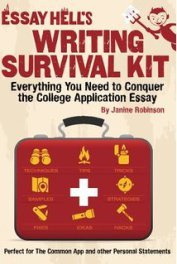
In my writing guide, The Writing Survival Kit, I share “chunks” of advice on how to use narrative writing techniques, tips and strategies to craft “slice-of-life” essays.
Chapter One, called Packing the Basics, features my best ideas on finding a great topic.
In the next few days, I will share six “chunks” of information from this chapter to help you get going on your own essays. Here’s the first one:
Pick a Killer Topic
Finding a unique and compelling topic is perhaps the most important piece of an effective essay. It is worth spending time brainstorming. Start early!
There are entire blogs and books about this process, but here are some of the best tips to get you started:
Look for a “defining quality” or personal characteristic that you can showcase in your essay. Examples: logical, inquisitive, creative, competitive, leader…Find Your Defining Qualities and Characteristics
Mundane topics often work best: These are topics from everyday life: singing karaoke, dog sitting, designing T-shirts, riding busses, etc. Check out examples of mundane topics in the essays in Chapter 11: Being Slow; Dunkin Donuts; Christmas tree farm and Lucid Dreaming. More on mundane topics.
 Don’t try to impress: You don’t need to feature your greatest achievement, experience or talent.
Avoid laundry lists: Focus on making one main point about yourself thoroughly instead of listing accomplishments. How to Write Short Essays (Slideshare Tutorial)
Show your grit, which is your ability to confront daunting obstacles with raw determination. Look for topics that involved problems. Got Grit? Then Show It!
These sample essays from Chapter 11 display grit: Sample Essays for College Applications
Hope you find these tips helpful! Stay tuned for the next “chunk” of advice on discovering your best topics!
Once you are ready to write, check out How to Write a Common Application Essay in 3 Steps.
Good luck!
The post How to Find a Killer Topic appeared first on Essay Hell.



![[image error]](http://i0.wp.com/www.essayhell.com/wp-content/uploads/2016/07/tumblr_noryaglJ8I1ted1sho1_1280.jpg)