Janine Robinson's Blog, page 4
July 20, 2017
Do Parents Help or Hurt College Application Essays?

Helicopter Parents Aren’t All Bad
(They Just Need to Know When to Drop In)
I received an email from a mom recently inquiring about my tutoring services for her college-bound daughter.
In her email, she included a story about their family history that she thought might make a good topic for an essay. It was mainly about the grandfather’s immigration “coming to America” experiences and the Holocaust.
While it sounded interesting, it didn’t seem that relevant or exciting to me–at least for the purposes of an essay that’s supposed to focus mainly on the student.
At the end of her story, the mom ended with this line: “My daughter’s response: ‘I read that if your parents think it is a good idea…it probably isn’t!’ LOL!”

OUCH!
Simply that this mom had a sense of humor about her rejected attempts at helping showed me that this mother-daughter team will be fine.
Of course parents want to support their kids. They can’t help it; it’s part of the job.
That funny quote from the daughter isn’t necessarily true, but it’s not that far off.
Why?
Because many parents haven’t done their own homework yet on what makes up a great essay, and especially a stellar topic.
RELATED: Learn What Makes a College Application Essay Great
If her daughter had written her essay all about her grandfather, it would have been a hands-down dud. Above all, these essays need to be almost exclusively about the student.
Other people can play a role in some essays, but only if it had something to do with what the student was trying to showcase about their own life, values and experiences.
Many parents also share another potentially harmful misconception about effective essays and their topics: They think they need to be impressive.
Don’t you want to write about that award you won at the science fair?
Why wouldn’t you include that you are an Eagle Scout?
What about that trip to China where you travelled for a month with your church and built a school for orphans?

Sorry, Mom and Dad. Those are truly impressive feats and experiences, and can play a role in the college admissions game. They simply don’t translate into effective topics for these essays.
Still eager to help? (Hang in there with me now…)
First, spend some time learning what makes a great college essay.
Another excellent way that you can be of help–assuming you are on a speaking basis with your kid and they want your help—is to brainstorm past experiences with them.
The best essays include real-life experiences, often simple memorable moments, incidents and “times,” from the past that students can share to illustrate what they have learned, how they think, what they value and their unique personality.
This is your big chance. No one knows these often funny, poignant, surprising, heart-breaking, silly, unbelievable, ironic, everyday moments like YOU guys!
If your student is smart, he or she will engage your help at some point in their search for a great topic, especially these life moments from their past.
(Students reading this: Pay attention here. This works for you as well. If you want your parents off your back, throw them a bone: Give them a role. Ask for their help brainstorming moments from your past. No one knows YOU or those stories better!)
This is your opening to help—and in a huge way. These little mini-stories can literally make or break a personal essay.
They often start with: “Remember the time you…?”

Before you get too excited, here’s another tip: The best stories are not about your kid’s shining moments of success and victory.
In fact, the opposite is true. If you truly want to help, you will help them remember those often mundane moments of “times” when things actually went a bit sideways, went wrong, ended poorly, were embarrassing, and hurt.
RELATED: Learn more about When Your Problem is a Good Thing
Why in the world would your brainy, hard-working, competent, loving kid want to start a college application essay about a simple time when something bad, or challenging, disappointing, or humiliating happened?
Three Reasons Off the Top of My Head
It will be interesting because something happened. When things are rosy, nothing happens and it’s boring. You want to engage those glassy-eyed admissions officers!
It will show your student at a low moment and will help make she or he naturally relatable. We have all been there. Connect with your audience. Likable is good! Etc.
The student can then quickly shift into sharing how they felt (good stuff!), how they handled or managed that problem (which will reveal their personality) and what they learned (you want lots of this in an essay!).
Are we good now?
So do your homework, then wait for an opening. Tread gently. These are not your essays.
If you are lucky enough to have a truly wise kid, chances are at some point they will solicit your help.
Then, JUMP IN!! It can even be fun sitting down together and going through those families stories and memories.
All you need is one good one!
Good luck!
The post Do Parents Help or Hurt College Application Essays? appeared first on Essay Hell.


July 13, 2017
New Essay Requirements for ApplyTexas and University of Texas for Fall 2018

UT Austin Essays Just Got Easier!
If you are applying to be an incoming freshmen to the University of Texas at Austin for Fall 2018, I believe this is a piece of good news for you.
The application essays you need to write have changed from writing three longer essays (Topics A, B, and C) to one long essay (Topic A) and three supplements, which they call “short answers.”
To address Topic A, you need to write one personal statement type of essay about your background for the prompt they call Topic A. There is no stated word length, but a good range is around 500 words.
For the three short answers, you will write no more than 300 words each on Career Plans, Academics and Leadership.
You can read all about the changes and new prompts on the ApplyTexas web site.
Here is the exact prompt for Topic A:
What was the environment in which you were raised? Describe your family, home, neighborhood or community, and explain how it has shaped you as a person.
Read THIS POST for my advice and writing strategies on how to write about your background (“the environment in which you were raised”) and address this prompt.
Here are the 3 New Short Answer Prompts and Tips
(This is all directly from the ApplyTexas web site)
Short Answer 1: Career Plans
If you could have any career, what would it be? Why? Describe any activities you are involved in, life experiences you’ve had, or even classes you’ve taken that have helped you identify this professional path.
Tips to consider: This is an opportunity to describe your academic and future professional interests. You may not yet be 100% certain about what you want to do, but is there a particular field that you think you want to work in, or a certain path you want to pursue after college? How have your interests and experiences influenced your choice of majors or your plans to explore in college?
Short Answer 2: Academics
Do you believe your academic record (transcript information and test scores) provide an accurate representation of you as a student? Why or why not?
Tips to consider: Feel free to address anything you want the Office of Admissions to know about your academic record so that we can consider this information when we review your application. You can discuss your academic work, class rank, GPA, individual course grades, test scores, and/or the classes that you took or the classes that were available to you. You can also describe how special circumstances and/or your school, community, and family environments impacted your high school performance.
Short Answer 3: Leadership
How do you show leadership in your life? How do you see yourself being a leader at UT Austin?
Tips to consider: Leadership can be demonstrated by positions you hold as an officer in a club or organization, but other types of leadership are important too. Leaders can emerge in various situations at any given time, including outside of the school experience. Please share a brief description of the type of leadership qualities you possess, from school and non-school related experiences, including demonstrations of leadership in your job, your community, or within your family responsibilities, and then share how you hope to demonstrate leadership as a member of our campus community.
GOOD LUCK!
The post New Essay Requirements for ApplyTexas and University of Texas for Fall 2018 appeared first on Essay Hell.
June 14, 2017
Want to Go To University of Texas? Get This Book!
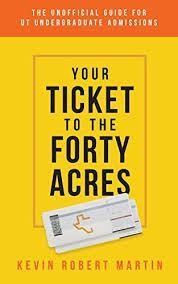
The Ultimate Insider’s Guide
to UT Admissions
Get it FREE Now on Amazon!
My friend, Kevin Martin, just published this guide, Your Ticket to the Forty Acres: The Unofficial Guide for UT Undergraduate Admissions, on Amazon (Kindle) to help students quickly figure out what they need to do to game the admissions scene at the University of Texas, especially its Austin campus.
What I love about this book is that Kevin was a first-gen student who graduated top of his class, and then went on to to work for their admissions department as a counselor.
So he has experienced both sides of the process.
In the book, Kevin shares his personal experience and stories as well as advice and tips on figuring out what you need to increase your chances of getting accepted.
The best news?
You can download this book
for FREE through Saturday, June 17!
Just go to Amazon and get your copy—and then do your homework.
This is from the review I left for his book on Amazon:
“Unlike many guides for gaming the college admissions industry, Kevin has his priorities straight: It’s all about finding the right fit.
And this book offers everything you need to give it your personal best shot, from his insights on the psychology of the process to deciphering the actual algorithms used for deciding who gets in.”
Kevin also was kind enough to let me share with you some of his best advice on the University of Texas essays.

Kevin Martin
Here’s an excerpt from his book on how to brainstorm and write about what’s known as Essay A:
18 Questions
to Help Guide
Your Apply Texas Essay A
The English Department professor who conducted our UT-Austin essay review training would say, “Think of a college essay prompt not as box to trap students but as an invitation to write.”
It is up to the student to define what they want to write. Many essay prompts are broad, and Apply Texas Essay A is no exception.
“What was the environment in which you were raised? Describe your family, home, neighborhood, or community, and explain how it has shaped you as a person.”
Colleges and universities note a trend that primary and secondary school teachers have observed for decades.
A student’s home life heavily influences their ability to succeed or fail.
UT wants to learn about important people in your life, organizations that impact you, or the atmosphere of your household or high school.
I hear students say, “I don’t have anything interesting to discuss. My home life is boring, suburban, and predictable.”
Remember, you’re not writing your autobiography. You’re submitting at most 650 words making one or two observations.
If you’re having trouble getting started, consider asking yourself some of these questions to narrow down the prompt:
Were you raised in a household that encouraged reading?
What food did your parents put on the table?
Do you eat dinner together each night?
Do your parents support your interests and curiosities?
Do they attend your sports games or choir concerts?
Do you play outside?
What do your parents do for work, and does this inform your future goals?
Do you feel pressure to excel in the classroom?
Where does that pressure come from?
What are your days like before and after school, on the weekends, and in the summers?
Do you have any siblings who have influenced you?
What about grandparents?
Is there one memory or experience that sticks out among the rest?
What does your family do over the holidays?
Have you taken a memorable vacation?
What are your friends like?
Are your parents divorced?
How do you think living in Austin or attending UT will differ from your current environment?
Kevin Robert Martin, former UT-Austin admissions counselor, Founder of Tex Admissions, and author of Your Ticket to the Forty Acres: The Unofficial Guide for UT Undergraduate Admissions
Want more help on your University of Texas essays? Check out my helpful post:
3 New Prompts for University of Texas
Good luck, Y’all!
The post Want to Go To University of Texas? Get This Book! appeared first on Essay Hell.
June 6, 2017
Cultural Backgrounds Fuel Standout College App Essays

Everyone Has a Cultural Background
Yours Could Make an Awesome
College App Essay Topic!
I love working with students from all over the world.
I’m always surprised, however, how many of these students overlook their rich backgrounds when brainstorming topics for their college application essays.
There have been several reasons for this.
Many international students seem to believe that colleges wouldn’t be interested in their country of birth, and the related customs, food, traditions, etc.
These same students also believe they need to appear “Americanized” in order to be attractive to their target schools in the U.S.
They are wrong and wrong.
I also have worked with students born in the United States who are reluctant to feature their ethnic heritage because it wasn’t white and waspy.
Others are so immersed everyday in their cultural backgrounds that they don’t even recognize how special they are—or that they even have them.
Sometimes your “culture” is so close to you that it’s hard to see.

For example, I had to convince some students by the Texas border in the Rio Grande Valley, which is almost entirely hispanic, that they had incredible cultural topics to feature in their essays, from Mexican myths and sayings to speciality breakfast tacos sold at their local convenience stores, called the Q-taco.
They were too close to these cultural treasures to understand that others outside their community would find them of interest.
The trick is to find your unique cultural bubble. Sometimes you have several!
Even students from “white” backgrounds who feel they don’t have distinctive “ethnic” cultural heritage often overlook their own rich cultural surroundings. (Examples: surf culture; “redneck” culture; “preppie” culture; military culture; hippie culture; city culture)
Culture is everywhere.
It’s kind of like a mini-world with its own set of traditions, food, clothing, beliefs, etc. One good place to explore yours is to think about the background of your parents and grandparents.
In personal statements, you are looking for examples in your life of what has shaped or defined you, and your values.
Often, these cultural backgrounds have played a powerful role, and also are distinctive and fascinating—so take advantage of that in your essays!
Not to mention that many schools are seeking “diversity” for their student body make-up: How will they know what you have to contribute if you don’t help them understand your upbringing?
Different is good!
Students who have any type of ethnic and cultural background are the lucky ones: They have something unique and often colorful to write about right out the door with these essay topics!

Advice for International Students
I have four pieces of advice for international students.
You are lucky since your cultural background is a given: It’s usually first defined by the country you live in—which is naturally “different” than the U.S.
Embrace and celebrate that in your essay!
Often, as you know, there are various cultures within your country. The more specific you can be about writing about your culture, the more relevant and meaningful your points will be.
My Four Tips:
1. Take the time to familiarize yourself with the type and style of essays that are most effective at most colleges and universities in the U.S. If you are writing a personal statement essay (such as The Common Application core essay), you want to write a personal essay that features real-life experiences to showcase your personality and character.
RELATED: Learn How to Write a Personal Essay
I’m not an expert in the required essays at colleges and universities outside the U.S., but the prompts and sample essays I have read from places in Great Britain, Scotland, Germany and other countries have often sought more formal, academic essays. If these are the type of essays you are used to writing, take the time to learn about writing a narrative-style personal essay. There’s a big difference.
2. When looking for a topic for your personal essay, consider the customs, traditions, (physical and emotional) environment, food, dress and other parts of your family background and lifestyle that were unique to your country, or particular region or community.
These can make terrific topics, especially if you can share related experiences and reveal how they helped you define your core qualities or values.
Not only are these culturally related experiences fresh and interesting (especially to the Americans reading your essays), they are also full of personal stories, color and details that can enliven your essays.

3. I believe that when admissions folks at college and universities notice that you are an international student, they will be on the lookout for evidence that you have what it takes to live far away from home.
To me, that means they want to see that you are independent, determined, resilient and have grit. If you can showcase these qualities in your college application essays, I think you could give yourself an edge.
RELATED: How to Show Your Grit
4. Although it might not seem fair, but I also think when colleges see that you are from a country outside the U.S., especially one where English is not the main language, admissions folks will look more critically at the mechanics of your writing.
Always have someone with a strong command of English review your essays, and make sure you nail the spelling, grammar, and punctuation. Also, ask them to help you make sure to use more everyday language, and “write like you talk,” so you aren’t too formal and stiff in your style, and don’t use idioms incorrectly (a tip-off that English is a second language).

Advice For Everyone Else
Find your culture, no matter where you come from.
Often, you are so surrounded by it that it can be hard to see.
Once you recognize your cultural background, it’s important to avoid making cliche observations about it in your essay.
For example, if you are from such giant countries as China or India, you will need to carve out a smaller piece of your culture within your country.
HOT TIP: Pick one specific tradition or experience related to your cultural background to feature in your essay, instead of trying to write about too much. (The Q-taco; henna; Pho your grandma taught you to make; roping cows; braiding hair; ghost stories; picking berries; your strange name…)
That will help you avoid the overdone and cliche.
Always look for ways to find the unexpected within your culture.
What would readers be surprised to learn about your culture? Look for things that bust their assumptions.

Examples:
I’m from India, but I’m not Hindu. Instead, I’m …
I’m from a Native American tribe, but I don’t own any indigenous costumes or dance. Instead, I …
I’m from Texas but I hate bbq. Instead, I …
My dad is from Guatemala and my mom from Mexico, but I don’t speak Spanish. Instead, I …
I’m from California, but I’ve never been to the beach. Instead, I …
You get the drift.
As you know, many cultures come with stereotypes and generalizations, and even racism and prejudice.
Exploring these patterns and issues can lead to great essays topics, especially if you have had to deal with them.
Read my post on why Problems Make Great Essays.
Let the reader see and feel what it has felt like to grow up in your unique culture, and then share what you have learned from it, both the good and the bad.
I’m confident you will end up with a personal, compelling and meaningful essay, no matter what planet you are from!

The post Cultural Backgrounds Fuel Standout College App Essays appeared first on Essay Hell.
Cultural Backgrounds Are College Application Essay Kryptonite
Everyone Has a Cultural Background
Yours Could Make an Awesome
College App Essay Topic!
I love working with students from all over the world.
I’m always surprised, however, how many of these students overlook their rich backgrounds when brainstorming topics for their college application essays.
There have been several reasons for this.
Many international students seem to believe that colleges wouldn’t be interested in their country of birth, and the related customs, food, traditions, etc.
These same students also believe they need to appear “Americanized” in order to be attractive to their target schools in the U.S.
They are wrong and wrong.
I also have worked with students born in the United States who are reluctant to feature their ethnic heritage because it wasn’t white and waspy.
Others are so entrenched in their cultural backgrounds that they don’t even recognize how special they are—or that they even have them.
Sometimes your “culture” is so close to you that it’s hard to see.
For example, I had to convince some students by the Texas border in the Rio Grande Valley, which is almost entirely hispanic, that they had incredible cultural topics to feature in their essays, from Mexican myths and sayings to speciality breakfast tacos sold at their local convenience stores, called the Q-taco.
They were too close to these cultural treasures to understand that others outside their community would find them of interest.
The trick is to find your unique cultural bubble. Sometimes you have several!
Even students from “white” backgrounds who feel they don’t have distinctive “ethnic” cultural heritage often overlook their own rich cultural surroundings. (Examples: surf culture; “redneck” culture; “preppie” culture; military culture; hippie culture; city culture)
Culture is everywhere.
It’s kind of like a mini-world with its own set of traditions, food, clothing, beliefs, etc. One good place to explore yours is to think about the background of your parents and grandparents.
In personal statements, you are looking for examples in your life of what has shaped or defined you, and your values.
Often, these cultural backgrounds have played a powerful role, and also are distinctive and fascinating—so take advantage of that in your essays!
Not to mention that many schools are seeking “diversity” for their student body make-up, and how will they know what you have to contribute if you don’t help them understand your upbringing?
Students who have any type of cultural background are the lucky ones: They have something unique to write about right out the door with these essay topics!
Advice for International Students
I have four pieces of advice for international students.
You are lucky since your cultural background is a given: it’s the country you live in.
Often, as you know, there are various cultures within your country. The more specific you can be about writing about your culture, the more relevant and meaningful your points will be.
1. Take the time to familiarize yourself with the type and style of essays that are most effective at most colleges and universities in the U.S. If you are writing a personal statement essay (such as The Common Application core essay), you want to write a personal essay that features real-life experiences to showcase your personality and character.
RELATED: Learn How to Write a Personal Essay
I’m not an expert in the required essays at colleges and universities outside the U.S., but the prompts and sample essays I have read from places in Great Britain and Europe and other countries have often sought more formal, academic essays. If these are the type of essays you are used to writing, take the time to learn about writing a narrative-style personal essay.
2. When looking for a topic for your personal essay, consider the customs, traditions, (physical and emotional) environment, food and other parts of your family background and lifestyle that were unique to your country, or particular region or community.
These can make terrific topics, especially if you can share related experiences and reveal how they helped you define your core qualities or values.
Not only are these culturally related experiences unique (especially to the Americans reading your essays), they are also full of stories, color and details that can enliven your essays.
3. I believe that when admissions folks at college and universities notice that you are an international student, they will be on the lookout for evidence that you have what it takes to live far away from home.
To me, that means they want to see that you are independent, determined, resilient and have grit. If you can showcase these qualities in your college application essays, I think you could give yourself an edge.
RELATED: How to Show Your Grit
4. Although it might not seem fair, but I also think when colleges see that you are from a country outside the U.S., especially one where English is not the main language, admissions folks will look more critically at the mechanics of your writing.
Always have someone with a strong command of English review your essays, and make sure you nail the spelling, grammar, and punctuation. Also, ask them to help you make sure to use more everyday language, and “write like you talk,” so you aren’t too formal and stiff in your style, and don’t use idioms incorrectly (a tip-off that English is a second language).
Advice For Everyone Else
Find your culture, no matter where you come from.
Often, you are so surrounded by it that it can be hard to see.
Once you recognize your cultural background, it’s important to avoid making cliche observations about it in your essay.
For example, if you are from such giant countries as China or India, you will need to carve out a smaller piece of your culture within your country.
HOT TIP: Pick one specific tradition or experience related to your cultural background to feature in your essay, instead of trying to write about too much. (The Q-taco; henna; Pho your grandma taught you to make; roping cows; braiding hair; ghost stories; picking berries; your weird name…)
That will help you avoid the overdone and cliche.
Always look for ways to find the unexpected within your culture.
What would readers be surprised to learn about your culture? Look for thing that bust their assumptions.
Examples:
I’m from India, but I’m not Hindu.
I’m from a Native American tribe, but I don’t own any indigenous costumes or dance.
I’m from Texas but I hate bbq.
My dad is from Guatemala and my mom from Mexico, but I don’t speak Spanish.
I’m from California, but I’ve never been to the beach.
You get the drift.
As you know, many cultures come with stereotypes and generalizations, and even racism and prejudice.
Exploring these patterns and issues can lead to great essays topics, especially if you have had to deal with them.
Read my post on why Problems Make Great Essays.
Let the reader see and feel what it has felt like to grow up in your unique culture, and then share what you have learned from it, both the good and the bad.
I’m confident you will end up with a personal, compelling and meaningful essay, no matter what planet you are from!
The post Cultural Backgrounds Are College Application Essay Kryptonite appeared first on Essay Hell.
June 1, 2017
How To Give College Admissions Officials Essays They Want
Colleges Love Your Stories
Especially Those That Seem Almost Ordinary!
I’ve read several news articles in recent weeks featuring college admissions officials sharing what they liked about college application essays they read over the last year.
This feedback can be invaluable for students just starting to think about their essays and brainstorming topic ideas.
The admissions staffers at some of the best schools in the nation talked about the types of topics they enjoyed, and why they found them effective in learning more about the student applicants, and connecting with them (and admitting them!).
What the articles didn’t include, however, were ideas on exactly how you can find your own unique topics, and craft them into engaging and meaningful essays.
But don’t despair!
I have loads of tips and useful advice on how to not only find these awesome types of topics, but how to find your real-life stories and use those to power your essays—just like these bright students.
I’ve extracted some of the feedback from 3 of the top colleges featured in a U.S. News article on Top College Officials Share Notes on Great College Application Essays, and will share the parts of their best feedback, along with links where you can learn to write your own.

1. Williams College
“Abigail Conyers, admission counselor, Williams College, No. 1 National Liberal Arts College
Make connections: One stellar essay Conyers read this past year was about language. The applicant wanted to study languages and neuroscience at Williams. He talked in his essay about how he developed a love of language through sharing stories with his grandmother, who developed dementia. To help understand her disease, he joined a neuroscience lab.
He wanted to continue to study how the brain processes language and potentially come to understand dementia more deeply.”
Tip: Notice how how the student didn’t just write about how much he loved languages. Instead, he used his real-life experiences of sharing stories with his grandmother to SHOW the reader what inspired his passion.
HOW YOU CAN DO THIS: Learn to Find Your Stories
2. Johns Hopkins
“Ellen Kim, dean of undergraduate admissions, Johns Hopkins University, No. 10 National University
Don’t try to guess what admissions officers want to hear: One notable admission essay Kim read described a student’s role reading the morning announcements – applicants can read the full sample on Hopkins website. The applicant described why he took the job and what he tried to achieve in those few minutes at the beginning of each school day.
While there may be nothing remarkable about reading the morning announcements, it gave school officials an idea of his personality beyond his achievements. Kim got a sense of how the applicant responds when he’s excited and who he was in his community.”
Tip: Notice that the writer’s topic was not something impressive, but something everyday and simple? I call those “mundane” topics and they often make the best essays, hands down.
HOW YOU CAN DO THIS: A Lesson in Mundane Topics
3. Middlebury University
“Sam Prouty, senior assistant director of admissions, Middlebury College, tied for No. 4 National Liberal Arts College
Be true to yourself: Some college essays are really funny, says Prouty. He read one this past year about a student who collects Pez dispensers – the student even has storage units for the collection. The essay offered a hilarious take on people’s odd reactions every time the student unveiled this passion. It was not only the content, but the way the student wrote about the subject that caught Prouty’s attention.
‘This process is not one in which that we want to see evidence that you are just like everybody else. It’s the opposite. We want to get to know your quirks and your individual personality traits,’ he says. ‘If you are funny you should be funny, if you are not funny, you probably shouldn’t try, but if you have a story to tell, then tell us that story.’ ”
Tip: Writing about something as everyday as candy also falls into that magic topic camp of the mundane. Also, the student apparently featured real-life moments (“a hilarious take on people’s odd reactions”) in his essay, which were entertaining and brought the piece to life.
Turning real-life moments and incidents into “anecdotes” is one of the most powerful writing devices you can use to power your essay. Take the time to learn how to do this with your stories!
HOW YOU CAN DO THIS: Learn how to turn your own real-life moments into engaging “hooks” for your essays.
I strongly encourage you to read the entire U.S. News article to see the other examples from schools, such as Swarthmore, CalTech and Dartmouth. See for yourself how the topics that made the biggest impression on the admissions staffers were those that used everyday topics, including Legos (even though that is way overused!), working behind the scenes in drama and being a sensitive “Bro.” (Learning topics other students wrote about is a great way to inspire your own ideas!)

Still not convinced that everyday topics can get you into your dream school? Read how one Girl Got Into Yale After Writing About Papa John’s Pizza.
In all of these essays and topics, the students were about to reveal both their personality and character. This is the magic combination of a winning essay. Learn more about this in Start Your Personal Statement the Right Way.
Ready to find your own unique topic? Read more on my Five Top Topic Tips!
You got this! Good luck!
The post How To Give College Admissions Officials Essays They Want appeared first on Essay Hell.
May 25, 2017
My Best Writing Tip for Improving College Application Essays

In One Word: Focus!
I’ve been reading college application essays for the last decade.
I’m probably into the thousands by now.
Looking back, I have identified the most common flaw in many of them.
They are too general.
Which make them borrrrrrringggggg.
Many students end up with generic essays because they try to say too much about themselves in their allotted 500 to 650 or however many required words.
This happens the most when their essay topic is too broad.
I believe we all make these mistakes in writing because we fear that we will error on leaving out something important.
So we try to work in as much information as we can.
More is better, right?
These colleges and universities want to learn as much about us as possible, yes?
Nope.
What happens when we cover too much ground about ourselves in our college application essays is that we end up not saying much of anything meaningful.
Our most interesting points about ourselves get diluted because we try to cover too many.

WRITING TIP TO FOCUS YOUR ESSAY
Here’s my tip for avoiding generic, dull essays: Get specific.
The best way I have found to narrow an essay topic into one that is more focused and meaningful is to brainstorm ONE PART of yourself to showcase in your essay, instead of cramming in everything great you can think of about yourself.
I have a nifty post on exactly how to do that by learning how to Find Your Defining Qualities.
If you are just starting your college application essay writing adventure, this is the time to read and discover your defining qualities and characteristics.
You can also rein in your topic by framing it around one of your core values, which you can find in this post: Find Your Core Values to Rock Your Essay.
If you sharpen your essay topics right at the start, you have already greatly improved the chances of your essay being more interesting and relevant—and more effective in its role to help differentiate you from other applicants.
So instead of writing about how you are a natural leader in your community and go into all the activities and lessons you have learned, find a way to write about a smaller piece of your leadership experiences.
Try to find a quality or core value that you have developed as a leader and make your case for how you learned about it.
Are you a leader because you like to be at the head of the pack and a role model?
Are you a leader because you like to bring people together and build consensus?
Are you a leader even though you are more of an introvert?
If you can narrow the main point you want to make about yourself in your essay, you will end up going deeper and revealing more about yourself when you explain how you got that way.
Trust that it’s better to say more about one part of yourself than trying to explain everything you can think of.
Here’s a great post to get you started: How to Write Your Essay in 3 Easy Steps
You got this!
If you happen to live near Laguna Beach, California, I’m holding essay writing boot camps this summer. Learn more.
The post My Best Writing Tip for Improving College Application Essays appeared first on Essay Hell.
April 19, 2017
3 Fixes for Cliche College Application Essay Topics

Should You Write About a Cliche Topic
for Your College Application Essay?
If you are just starting brainstorming ideas for your college application essays, one of the first pieces of advice you might stumble upon is to avoid “cliche” topics.
I always warn my students about these often over-used topics:
Death of loved ones
Sports (especially injuries and victories/losses)
Band
Mission trips (volunteering)
Tutoring (especially special needs kids)
Travel (family trips)
RELATED: College Application Essay Topics to Avoid
The main reason to avoid them is that droves of other students have already written about these topics, so they aren’t as effective at helping you differentiate yourself from other applicants.
HOWEVER…
I have seen numerous college application essays—and some of the best ones, in fact—on these exact red-flagged topics.
While it’s helpful and important to recognize potentially cliche topics, you can still write a brilliant essay about them.
As I like to say about ALL college essay topics, it’s what you have to say about them that matters the most.
The challenge with cliche topics is that often students tend to say the same thing about them, which only makes them worse.
For example, if you write about the loss of a loved one, and you mainly share how terrible it made you feel and how it made you now appreciate all your living loved ones, and you include only general observations like that, your essay would fail to rise above its cliche classification.
If you could find something unique, different or original to say about your experience losing a loved one, you could elevate your essay beyond the cliche pile.
And that’s the trick: Finding a way to make your cliche topic unique.
Here Are Three Ways to Fix a Cliche Topic

1. Find a unique angle about the cliche topic
If you are kicking around writing about one of these red-flagged topics, which many other students are also writing about, you must find your own ANGLE.
An “angle” in writing means the point you want to make about your topic in your essay.
If you can find a unique or unusual point to make about a cliche topic, or how you relate somehow to this topic, your essay could go from predictable and dull to fresh and surprising.
For example, one student wrote about the sport of crew.
His essay was excellent because he found a unique point to make about crew, which reflected on how it shaped his character.
His essay made the point that crew taught him how to find his “crazy” side from the intense physical and especially mental challenges, and then apply that energy to other endeavors.
If he had simply written about one race that he won, or lost, his essay would have been more cliche.
Or if he wrote about how he learned that hard work paid off, or something generic like that, it would have been cliche.
Instead, he featured this unusual point or “angle” about almost going crazy. And that made all the difference.
Related: Read the Actual Sample Essay About Crew and Being Crazy

2. Give it a twist
A twist is similar to an angle, but it’s more about what happened in your essay than your unique point you want to make about it (the “angle”).
To find a twist, look for a way to find something unexpected that involved you and your topic.
Maybe you learned something from dealing with it that surprised you.
One former student wrote about taking a family trip in a large camper with lots of siblings for half her summer that she dreaded. But then she discovered some unexpected pleasures and lessons along the way—mainly about herself.
Another student wrote about not getting her typical starring role in the school musical, and how she learned the value of being a supportive actress and person.
RELATED: Find the Twist in Your College App Essay

3. Make the cliche topic itself more specific
If you can make the cliche topic itself more specific—a topic within a topic—often you will make it more original and different.
For instance, if you want to write about sports, and pick football or basketball or running, those are especially challenging to find new things to write about them since they are so popular.
(And admissions officers have probably read many essays about those popular sports for the same reason.)
It’s not impossible to write about the more popular sports, especially if you apply Tips #1 or #2 to the topic. But know it won’t be easy.
If you participate in a sport that is unique in itself, however, such as pole-vaulting, bobsledding, yo-yo-ing, karate, fencing, or other less popular sports, it could be easier to write an essay that doesn’t express the same old stories about winning the state championship or injuring an ACL.
Or maybe you have a physical feature that should have kept you from excelling at that sport (your twist), such as being under 5′ and being a basketball star, or a girl playing football (sadly this is still pretty uncommon), or water polo and having to learn to swim. (You get my drift.)
Again, it’s what you have to say about it.
If you want to write about your mission trip to Africa, make sure to find something specific and unique that happened to you while on that trip, and focus on that and what you learned (as opposed to writing about just the trip itself).
Often, if you can think of something that happened to you related to your cliche topic that is different, unique or unusual, that could set it apart from other essays on the same topic.

Do the Extra Work if You Pick a Cliche Topic
The main reason these cliche topics often make lousy essays is that students say the same general, predictable things about them.
If you can find something different or unique to share about them—either about what happened to you or what you learned—they are no longer cliche.
You mainly need to dig deeper with your ideas and stories, and get more creative and insightful about your personal experience.
So don’t cross these off your topic brainstorm list—yet.
Just know they will require extra work to make your essays awesome.
RELATED: How to Write Your College App Essay in 3 Easy Steps
The post 3 Fixes for Cliche College Application Essay Topics appeared first on Essay Hell.
April 13, 2017
Should You Gamble on Your College Application Essay?

Can a Risky College Application Essay
Get You Into the Ivies?
Maybe…
This time of year, a flurry of stories hit the national media about students who get into all the Ivy League schools (plus Stanford).
The stories always include scrutiny and speculation about their college application essays.
I have to admit that I’m kind of a sucker for these articles.
There’s such unpredictability with who gets into what schools.
Everyone is looking for clues as to what works and what doesn’t–especially with the essays.
Can you blame them?
Often, the risk-takers seemed to prevail.
Over the last month we’ve had Ziad and his #BlackLifeMatters essay; the Quadruplet’s package deal; and first-gen Cassandra Hsiao’s piece on her broken English.
Does this mean you should take a risk with your essay?
The reality is what works for others most likely won’t work for you.
In fact, it could backfire.
So how do you know?
(For the record, I don’t believe the ivies are the end-all in getting a stellar education. But if you are obsessed, read on…)

Ziad and the Quadruplets Took a Creative Risk With Their Essays–And Won!
I loved the article about the quadruplets who teamed up on their applications–and essays–and got into Yale and Harvard–as a package deal.
This was clearly a calculated risk that paid off big time.
“In a clever stroke, the four brothers wrote essays that can be read separately, yet are meant to be read together, like four pieces of a puzzle. Each piece is charming and winning on its own, but together, they are even better, and college admissions officers everywhere seemed to agree and were unwilling to pull them apart.” From the New York Times article.
This shows me that colleges and schools can be open-minded to creative admissions approaches, but only if there already are solid reasons they want those students.
Just this week, an American-Muslim teen who fights for social justice named Ziad Ahmed made headlines after getting accepted to Stanford University using a college application essay that included only the same hashtag phrase #BlackLivesMatter a hundred times.
A controversial essay about a controversial subject.
And he got in.
What does that say about these essays?
What does it say about crazy-competitive colleges, such as Stanford?
Some college admissions industry pundits were handwringing, saying this out-of-the-box essay proved the essays don’t matter.
I say hog wash.
To me, it shows that taking a risk can pay off with these essays, mainly because so many of them say the same thing in the same way, and college admissions officers can’t help jumping at otherwise exemplary students who find a unique way to express themselves.
Should you take such a risk?
Should you write an essay and only include one phrase 100 times?
Heck no!
It worked for Ziad because he is the one and only Ziad, and this one and only essay perfectly reflected something unique and fundamental about him.
You aren’t Ziad, so it won’t work for you.
And keep in mind that his essay also somehow perfectly complemented everything else he showed Stanford about himself in his application, and I’m guessing that was a pretty impressive package.
If you decide to take a risk with your essay, it must be consistent with who you are and accurately reflect your individuality and also be consistent with your entire application.

Your Risk Should Reflect You
Copying the risk someone else took will not work.
Other risk-takers can inspire and give you ideas, yes.
But what you decide to write in your essays must come from your authentic self.
If they don’t, they could hurt you. That’s the last thing you want.
Remember, colleges use these essays to round out their picture of you from your complete applications.
If you are a more conservative, head-down, follow-the-rules kind of student, perhaps your essay should reflect that style when it comes to your topic. And be more conventional.
If you are bold and idealistic, and have a whacky side, it might make sense to do something out there, like Ziad’s topic.
(Personally, I think Ziad’s piece was more of a stunt than an essay. The risk, I believe, should be more in your topic and what you have to say about it. Avoid gimmicks!)
Over the last decade, I’ve seen all types of topics help get students accepted.
There was the boy who wrote about stealing a baby goat.
And getting caught by the cops.
He even ended it saying he would do it all over again. What? (He included larger life lessons, so his
irreverent ending worked.)
He got into NYU.

I’ve seen students write essays on topics that are often red-flagged as cliche or overdone—such as the death of a parent or a sports injury or a mission trip—land their dream schools.
I believe if the topic is true to what that student wants to showcase, and enhances their admissions self-portrait, almost anything goes.
Some students have faced horrendous hardship in their lives, which has helped define who they are.
Often, it’s a great idea for them to write about those personal challenges.
Others have yet to face many intense personal crises or challenges.
I advise these students to brainstorm more everyday topics. (One student just told me she got into all her target schools, including Harvard and Stanford, and her topic was tying her shoes.)
In the past, I had to work hard to convince students and parents that writing about “mundane” topics was NOT taking a risk.
I believe recent feedback indicating that these types of essays are effective has confirmed their power.

For example, last “season’s” college application essay poster child, Brittany Stinson, who got into all the ivies, wrote her essay about her love for Costco. And she even credited this blog for inspiring her to feature such an everyday topic! (Read my Q&A on How Brittany Stinson Wrote Her Costco Essay.)
This season, another brilliant student, Cassandra Hsiao from here in Orange County, California, got into all the ivies with her essay on an “everyday” topic–her struggle learning English.
I also believe that getting into a bundle of top colleges, even all the ivies, does not necessarily prove the student’s essay was exemplary.
Many times a schools decided they wanted a student based on other qualifications and attributes, and the essay played no role.
You never know.
I probably was in the minority, but I thought the essay written by Kwasi Enin, another brilliant and talented student who got into all the ivies in 2015, wasn’t that hot. In fact, I thought it was on the dull side.
As you can see, it’s almost impossible to figure out how much the essay mattered in all these celebrity acceptances.
For some, it probably tipped the scale in the student’s favor. For others, it might not have mattered at all.
All you can do is write your best essay, really.
Should YOU Take a Risk with Your Essay?
If you are considering taking a risk with your essay topic, however, think hard about why you are doing that.
What do you have to gain?
What do you have to lose?
If you are going to a super competitive college, and know you have outstanding stats, maybe it makes sense to step out of the box a bit in an effort to make an impression.
Remember, all of the students who got into multiple ivies had off-the-charts stats, such as near perfect test scores and grades.
Maybe you know your grades and test scores and other application information are solid but a bit underwhelming, and you take a risk on a topic that can showcase your personal qualities to give yourself an advantage.
Do your due diligence and research your target schools so you have some idea of what type of student they are looking for, and try to line up the tone and topic that best shows why you are a fit.
If you don’t want to mess around gaming the whole process, stick to finding a topic that highlights what makes you tick, and trust that will help you best land where you belong.
I like that approach the best, frankly, no matter what college or university you want to attend.
THIS PAGE has my best posts to learn exactly how you can find your own unique topic and ace your essay, risk or no risk.
Go with what works best for YOU!
The post Should You Gamble on Your College Application Essay? appeared first on Essay Hell.
April 6, 2017
College Application Essay Workshops in Laguna Beach this Summer!

Weekend Essay Writing Boot Camps
in Laguna Beach
I will be offering three, two-part essay workshops this summer in my hometown of Laguna Beach on how to write awesome college application essays.
The workshops, which will be 90 minutes each on Saturday morning and Sunday afternoon, will be held at our coastal town’s wonderful community center, on Third Street, called the Suzi Q, located in the heart of our downtown.
The boot camps will include everything from understanding what makes an effective essay to how to brainstorm unique topics to editing and polishing drafts.
The essay workshops will teach students how to craft personal statement essays that will be perfect for the Common Application and other core essays, as well as writing admissions essays for the University of California and other colleges and universities.

Students will also learn tips on how to answer the most common supplemental essay prompts, such as why they are a “fit” for their target schools or writing about their extracurricular activities.
I will focus on helping students learn to identify and share their real-life experiences to spin into essays that reveal who they are, how they learn and what they value.
My goal with these essay workshops is to help students find topics and learn how to craft narrative style essays to give them more confidence in handling these stressful essays. Stories rock college application essays!
All students of my essay workshops will receive free digital copies of my popular writing guides, all available on Amazon.
Dates for the three weekend workshops (students only need attend ONE weekend workshop):
June 24 and 25
July 22 and 23
August 26 and 27
Times will be Saturday from 10 a.m. to 11:30 a.m. and Sunday from noon to 1:30 p.m.
Cost: $150 per weekend boot camp. These workshops are intended for collegebound high school students.
Registration for my essay workshops through the City of Laguna Beach starts May 1. To learn more and/or sign up, go here: www.lagunabeachcity.net. Click on the Recreation Department to find my workshops.
If you have any questions about these essay workshops, or how to enroll, feel free to email me (Janine Robinson) at:
EssayHell@gmail.com.
Please help me spread the word! Thanks!
The post College Application Essay Workshops in Laguna Beach this Summer! appeared first on Essay Hell.