Janine Robinson's Blog, page 5
March 21, 2017
Start Your Personal Statement the Right Way

Ready to write your personal statement essay?
It can be for your Common Application essay, or other university or college prompts, or transfers, or medical or law school, or even scholarship applications.
To start, always read the prompt.
If it asks you to write something fundamental about yourself (such as all seven of the Common App prompts), then they want a personal statement essay from you.
The next step is to start brainstorming.
You want to find a topic for your personal statement that will help the reader (college admissions officers) get a take on what you are all about, what makes you tick.
Before you start fishing around your past for topic ideas, it helps to know what you are looking for.
I’ve narrowed it down to two important, if not key, components of effective personal statements.

Character and Personality.
There’s potential crossover in these two concepts, since each defines some part of your individuality.
At the same time, they are distinct and critical to helping convey who you are to your target schools.
The beauty of featuring both your character and personality in your essay is that it will help you balance the portrait you are painting of yourself through language.
Character tends to be more serious, deep and analytical while personality usually is lighter, creative and entertaining.
In both life and personal statement essays, balance is usually a good thing.
Here’s how I define character and personality, and why you need to find ways to convey and express them BOTH in your personal statement.

Character in Personal Statements
Character is what helps you stand out in the world through your “mental and moral” qualities.
I call them your core values, or on a more personal level, your defining qualities and characteristics.
The best personal statements capture and convey the writer’s character because schools need to understand what you value, how you think and what you believe.
When you are brainstorming topic ideas for your personal statement, first identify a single core quality that captures or expresses something about your character.
For example, integrity, persistence, creativity, humility, empathy, wonder, etc. It should be something that you value above almost all else.
Pick one. Yes, just one. (This makes sure you don’t try to say too much in your essay, and end up on the dull side.)
These qualities are pretty universal, so writing about them can be tough to set yourself apart from other students, many of whom hold similar values.
So how do you showcase your all-important character in your personal statement and distinguish yourself from others at the same time?

Personality in Personal Statements
That’s where personality comes into play.
Personality is not universal.
Only one person on the planet has your personality: YOU.
Personality is how you–and only you–express or demonstrate your character on a daily basis.
It’s your unique personal style of expression in the world.
If you can figure out a way (a topic!) to highlight BOTH your character and your personality in your personal statement, you will nail it. Hands down.
But how do you that, and still craft an essay that is interesting to read?
It’s actually pretty simple. And time to start that brainstorming process.
What you need is a real-life experience or incident that you can share in your personal statement that shows you–and your personality and character–in action.
I’ve written many super helpful posts on exactly how to find those moments or experiences and spin them into killer personal statements—and showcase BOTH your character and personality at the same time.
I share many writing tricks and tips on how to identify those magic moments, as well as how to make sure your essay is focused and engaging.
If this approach makes sense to you, I would advise you to spend a few more minutes and read these posts.
How to Write a College Application in 3 Easy Steps
Find Your Defining Qualities and Characteristics
The Secret to a Killer College Application Essay
If you want to keep going and learning more about how to write a personal statement, there are blue links to more posts in the ones you just checked out.
This may be all you need to get you well on your way.
If you want more help, in the form of more in-depth, step-by-step instruction, check out my writing guide, Escape Essay Hell!, and/or my online essay writing course.
I also highly encourage you to check out some sample essays to see the type of personal statement essay these resources will help you write. (Notice how they all showcase the student’s character and personality.)

Character and Personality
Checklist for Your Personal Statement
Once you crank out a rough draft, here are some questions to ask about what you have written to check if you have captured and expressed both your character and your personality:
Do you feature a moment or experience that reveals one of your defining qualities or characteristics?
Do you share some type of problem (challenge, obstacle, failure, set-back, etc.) from your life that allows you to explain how you thought about it and what you learned in dealing with it?
Do you include how you felt during whatever moment or experience you shared, and explain the specific steps you took to handle it? (
Can you identify the main core quality, characteristic or value that you essay is about?
Can you write in one sentence or phrase what your unique style is in handling the problem you shared?
Did you include what you learned about yourself and the world from the experience/problem you shared?
Good luck with your personal statement essay!

The post Start Your Personal Statement the Right Way appeared first on Essay Hell.


March 10, 2017
Hot Tips for new Common Application Prompt 6

3 HOT TIPS
for
Common App Prompt 6
In a previous post, I warned about the possible pitfalls of writing about the new Common Application prompt 6.
My main concern was that in writing about one of your passions — a “topic, idea or concept — you will need to make sure to craft a personal essay that is mainly about YOU!
As opposed to one that is only about the “topic, idea or concept” that you pick to write about.
Read about how to write an essay about the new Common Application prompt 6 that is engaging and personal, instead of academic and dull, in this post: Common Application Prompt 6: Be Warned.
Then come back to learn three other hot tips on how to write about this tricky prompt.
The New Common Application Prompt 6
6. Describe a topic, idea, or concept you find so engaging that it makes you lose all track of time. Why does it captivate you? What or who do you turn to when you want to learn more?
Tip One for new Common Application Prompt 6: FOCUS
When deciding what to write about for the new Common Application prompt 6, first select ONE specific topic, idea or concept.
Don’t be tempted to expand your essay into writing about one idea and one concept. That will only make it more general. And generic essays can be boring.
The key is to be specific about the topic or idea or concept you are passionate about.
Do not try to cram in all your favorite ideas or concepts. That would be a disaster!
In fact, once you pick one of the these, see if you can make your essay topic even more specific.
For example, if you decide to write about your passion for the idea of social media.
Wow, that’s a cool topic, but sooooo big.
You will need to narrow it down. Pick one part of social media that captivates you, and then try to narrow it again.
Maybe you are obsessed with the idea of lucid dreaming, which is when you can control your dreams.
Again, find something specific about this idea to give your essay a stronger focus.
One way to focus or zero in on any broad “topic, idea of concept” is to find a personal experience you have had with it.
Also, the more specific your topic, idea or concept, the better you can expand upon how it affected you, related experiences and what you think and learned about it.

Tip Two for new Common Application Prompt 6: Don’t Impress
To write a killer essay for the new Common Application Prompt 6, you do not need to pick a topic, idea or concept that is impressive in nature, such as quantum physics or artificial intelligence or genetic mapping.
Of course, you can pick one of those, but it’s not necessary to craft an effective essay.
In fact, often the more everyday “mundane” topics, ideas or concepts end up being more interesting and powerful.
The trick to an awesome essay about the new Common Application Prompt 6 is not always your topic (idea of concept), but what you say about it.
An idea could be some business you started in high school, or a simple concept such as being a “lifelong learner” or “healthy eating” or “what causes the northern lights?”
Look for topics, ideas or concepts that are in your everyday life.
The closer they are to your normal activities, the better chance the topic, idea or concept will be more personal to you.
And that’s exactly what you want!

Tip Three for new Common Application Essay prompt 6: Answer the ENTIRE prompt
Most of your essay about the new Common Application essay prompt 6 will be about why you are so “captivated” by it, or why you are so passionate about it.
However, note the last question in the prompt: What or who do you turn to when you want to learn more?
Make sure to address this and explain somewhere in the essay how you learned more about the “topic, idea or concept” you are writing about.
Was there someone who first introduced you to your topic, idea or concept?
Did you research your topic, idea or concept on the Internet, or go to the library to find books, or attend a lecture?
Simply include at least a sentence or two to show the colleges how you handle your curiosity about whatever topic, idea or concept you write about to answer the new Common Application prompt 6.
So that’s it. Good luck!
The post Hot Tips for new Common Application Prompt 6 appeared first on Essay Hell.
February 18, 2017
Common Application Prompt 6: Be Warned!

Big Red Flag on this New
Common Application Prompt 6!
The Common Application added two new prompts for 2017-18.
Now students can choose from seven prompts (instead of five) to inspire their personal statement “Common App” essay.
The seventh new Common Application prompt basically allows you to write about anything you want, and you can learn more about it and the new prompts in New Common Application Prompts for 2017-18.
The other prompt, the new Common Application Prompt 6, essentially asks you to write about one of your intellectual passions.
The New Common Application Prompt 6
6. Describe a topic, idea, or concept you find so engaging that it makes you lose all track of time. Why does it captivate you? What or who do you turn to when you want to learn more?
I like Common Application prompt 6 because it gives you a chance to highlight your heady side (how you think).
Because it has a more science-related theme and is new, I believe many students will be attracted to it.
However, I believe there could be a potential pitfall in writing an essay about one of your intellectual passions.
No matter how much you love any “topic, idea or concept,” it can still be challenging to write about it in a way that is interesting and compelling.
It’s not impossible, but can be tricky.
First, there’s the trap of writing an essay that is more like an academic essay instead of a personal statement because the topic itself is “intellectual”.
It’s critical to make sure whatever “topic, idea or concept” you write for Common Application prompt 6 about allows you to make most of the essay about YOU. As opposed to a report-like essay simply about whatever topic, idea or concept you decide to write about.
For example, if you want to write about the “topic” of climate change (because you feel passionately about that topic), try not to make your essay a piece only about what it is, why it’s a concern and why it fascinates you.
Instead, search for a way to the topic more personal in your essay.; to personalize your topic. The goal is to use your topic, idea or concept to showcase your “intellectual curiosity.”
This just means how you think and learn.

How to Personalize Common Application Essay Prompt 6
Two Hot Tips for Common Application prompt 6: Include a story and a problem (usually these go together anyway).
Look for a personal story to illustrate the main point you want to make about whatever topic, idea or concept you write about.
(Don’t believe the Common Application folks are looking for real-life stories in these essays? They state it directly on their web site announcing their new essay prompts: The goal of these (essay prompt) revisions is to help all applicants, regardless of background or access to counseling, see themselves and their stories within the prompts.)
Find a real-life experience or moment that happened to you to illustrate either what inspired your interest or is related to your interest in this topic. That way, the essay naturally shifts to being more about you than simply the topic.
One idea would be to start your essay recreating one of the moments that you “lost track of time” or were “captivated” by you topic, idea or concept” because you were so engaged in learning more about the topic, concept or idea you are writing about.
Then you can go onto explain why it “captivates” you so much (ie, why you love it so much), and share how you sought to learn more.

Here’s a red flag for Common Application Essay prompt 6:
If you simply answer each of the questions in this prompt, you will have a potentially bland explanation of why the “topic, idea or concept” excites you.
You will only “tell” us about it and how you learned more about it. Good chance this won’t reveal a lot about you and how you think (reason, analyze, etc.) and what you value—your “intellectual curiosity.”
That is why it’s helpful to work in some type of challenge/problem/obstacle related to your topic, idea or concept so you create a platform in your essay to share your intellectual curiosity beyond a general explanation.
Ideally, you want to show your critical thinking, reasoning, analytical ability and insights in action in a personal statement and your essay for Common Application prompt 6.
Just because whatever topic, idea or concept you chose to write about is fascinating, both on it’s own and to you personally, does not necessarily mean your essay will be equally compelling. It’s up to you to find a way to feature your own personality as it relates to the topic, idea or concept to make your essay meaningful.

How to Inject a Problem in Common Application Prompt 6
to Create Interest
Another way to inject interest into an essay about what turns you on intellectually is to think of a “time” that you faced any type of obstacle (which is a type of problem) learning more about the “topic, concept or idea” you are writing about. Or any “time” where your passion or pursuit of learning more caused you some type of problem or challenge.
By introducing a problem or obstacle related to your passion or curiosity in a certain topic, concept or idea, you can then go onto explain how you handled that issue and what you learned from it.
(When you share what happened with that problem or obstacle, you will naturally tell a little story. Bingo! You will have both an engaging personal story and an interesting problem to feature in your essay.)
I know this sounds hard, but I guarantee that using some type of problem related to your topic, idea or concept will juice up your essay in a natural way, and help you work in more about yourself and how you think, feel and learn.
What you don’t want is an essay that goes…
When I learned about the concept of quantum physics in high school, I was hooked. It was so complex and interesting, and made me think in ways I never did before. I went home and read as much as I could on the Internet and checked out books from the library to learn as much as I could….
Your fascination of quantum physics could be a good topic, but you would need to make it personal. The writing above was too general, and didn’t reveal anything about the writer’s personality or character.
Notice how there was nothing personal or specific. No story and no problem.
Quantum physics is fascinating, but why did it hook YOU? That’s where you need to inject something about your background or experience that shows the reader more about your interest.
After you include a story the relates to the topic, idea or concept you are passionate about, and how you pursued learning more about it, don’t stop there.
Shift into what you learned from that pursuit to dig deeper into your intellectual curiosity.
Here are a few questions you could ask related to your topic, idea or concept:
Did you learn anything you never expected to learn about it, or YOURSELF?
Share both the good and the bad about what you learned. (Nothing is black and white.)
Did you learn any life lessons from delving into your topic, concept or idea (something you learned about YOURSELF)?
Why does what YOU learned about your topic, idea or concept matter–to you, to others and to the world?
Did learning about this topic, concept or idea lead you to other ideas or passions in your life?
While trying to learn more about your topic, concept or idea, what did you learn about YOURSELF and how you think and learn?
Looking back at your exploration of this topic, concept or idea, what did you learn about what YOU value most in your life?
Are you still learning about this topic, idea or concept? Is so, why is that good, too?
For college admission counselors, English teachers, parents and educational counselors who have worked with the Common Application prompts in the past:
This new Common Application prompt 6 reminds me of the old Common App prompt: “Describe a place or environment where you are perfectly content.”
It was ditched by The Common Application folks last year, purportedly because it failed to inspire strong personal statements. Word on the street among admissions counselors and college application essay wonks like myself (and based on what I saw with my students) was that it prompted dull and often sappy essays.
I believe this new Common Application prompt 6 has the same potential pitfalls.
Instead of describing a place, it asks about a “topic, idea or concept.” Instead of being “perfectly content” there, it should make you “lose all track of time.” Same ideas. Same pitfall.
People like to say, oh yay, a positive prompt like this Common Application prompt 6 because it doesn’t directly ask the students to include some type of problem or “bad thing”.
But there’s a good reason for soliciting problems in essays. (Notice almost all the other prompts include some type of problem, in the form of obstacles, stories, setback, challenge, failure, problem, question, etc.)
There’s good reason for this: When students wrote about their blissful places, the essays were often terrible because they were boring.
Why?
It’s hard to write an essay about what you love if nothing happens. I love the library, or I love visiting my grandparents or I love hiking in the woods. Those are great things to love, but if all you write about is how much you love them and why, chances are the essay isn’t all that compelling.
What makes essays interesting are stories. Something has to happen. And for something to happen, something has to go sideways—a problem.
If you knocked over a shelf of books onto the head librarian, or your grandparents home flooded during a hurricane or you came face-to-face with a mama bear on your hike, then your essay could be interesting.
Why? Because we suddenly feel for you and want to know how you handled the problem and what happened. This is why real-life stories are so powerful and the best college admissions essays include them.
My guess is that Common Application prompt 6 will inspire a lot of dull essays for the same reason as the old “perfectly content” one: It asks students to write about something they love.
It will be up to counselors, teachers and parents to help students push themselves with this essay prompt to make sure something happens, that it includes not only reflection and thinking but an experience or moment.
This is a generalization, but I believe the very students who will want to write about Common Application prompt 6 are the same ones who will need to be encouraged and coached to make sure to not let it get too scientific or weighed down in esoteric or technical language or theme.
These are often the same students (those who are interested in chemistry, gaming, engineering, technology, physics, computer science, etc.) who need that extra push to find ways to make their essay readable, personal and non-academic.
The magic bullet?
Find a juicy problem (a personal experience) that related to whatever topic, idea or concept you write about!
Once you have a little story, you are on your way to an excellent essay.
Here’s a sample outline that is intended to help you get started and make sure to address the questions in the prompt. There are many ways to approach your essay, so use this if it makes sense and feel free to take it in any direction you want.
Here’s a Sample Outline for Common Application Essay Prompt 6
Start by sharing a moment, incident or experience that illustrates something about (or is related to, or an example of) the topic, idea or concept you are writing about. Try to include some type of problem (an obstacle, challenge, mistake, setback, etc.) This is called an “anecdote.” (1 to 2 paragraphs)
Back story: Now provide some background or context for that moment, incident or experience and explain more about your topic, idea or concept. Include your main point: Why you love it so much.
Share more about your experience with this topic, idea or concept using other real-life examples that further support your main point (Why you love it so much). If you included some type of “problem” related to your topic, idea of concept, explain how you handled it.
Go onto share the steps you took to learn more about your topic, idea or concept. If you included a problem, this is where you can go into the step you took to deal with it—and then share what you learned. Include how you thought about it, how you felt, who you worked with, etc.
MOST IMPORTANT: Reflect (look back) on this experience related to your topic, idea or concept and describe what you learned—not just about the topic, idea or concept–but what you learned about yourself (how you learn, what you value, etc.)
Link back to the start of your essay and give a status update on that problem or moment you described at the start of your essay. Then restate the main point that you learned about your topic,idea or concept and about YOURSELF. End with how you expect to apply what you learned in your future dream and goals.
Please don’t let all my warning scare you off this prompt if it speaks to you.
I will be writing a follow-up post with more tips and brainstorming ideas for Common Application Prompt 6 in upcoming weeks. To make sure you don’t miss it, follow my blog by leaving your email via Sumome pop-up invite or in field on right sidebar.
Good luck!
The post Common Application Prompt 6: Be Warned! appeared first on Essay Hell.
February 12, 2017
Launching My New Essay Guide with Amazon Giveaway!
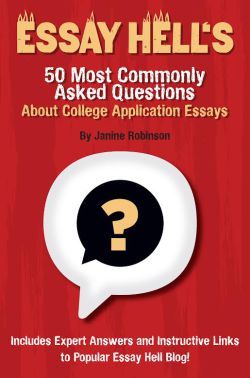
GET IT FOR FREE FOR LIMITED TIME!
I’m introducing my hot-off-the-press writing guide, “Essay Hell’s 50 Most Commonly Asked Questions about College Application Essays” by giving it away for the next 5 days on Amazon.
Starting tomorrow, February 13, just go to its sales page on Amazon and you can download the Kindle version for free.
I designed this guide for students, parents, teachers and counselors who want quick and easy answers to the questions I have fielded the most during my decade working with these dreaded college application essays.
Not only do I include simple answers for each of the 50 questions, I also include clickable links to related posts from this blog to provide even more in depth explanations, advice and tips.
Sample questions include:
Who reads these essays?
What are admissions experts looking for?
Does the word count matter?
Should I include a real-life story?
Should I use the past tense?
Do I need an impressive topic?
Can I write about sex, religion, politics, etc?
Who should I let read my essay?
Do I need a title?
The idea with this short digital guide is to put the best information that I’ve amassed on this blog over the years at your fingertips.
Everything you need to know to learn about what makes an effective college application essay, and how to write your own using a narrative style that draws off your real-life experiences is here at Essay Hell. But it’s spread out among about 300 separate Essay Hell blog posts.
I try to make it accessible with my indexing, but it can be challenging to find exactly what you need when you need it—which is usually NOW!
Right?
That’s why I wrote and recommend this new digital guide (Essay Hell’s 50 Most Commonly Asked Questions about College Application Essays) as a way to give yourself a quickie crash course on writing college application essays that is efficient and accessible. With the essay writing FAQs and related blog links, you can target exactly what piece of the process you need to learn about, and go from there.
Maybe you are just starting and need to learn about finding hot topics. Or you have a draft written and need some help on how to self-edit. It could be you just need to confirm some of the basic mechanics of these essays.
With this guide, you can go to the question that matches your own, and then continue to learn about that answer by clicking on the related links in this blog.

HOW DO YOU LEARN BEST?
Everyone learns in their own way.
If you want to learn step-by-step how to brainstorm a topic, and then learn how to craft a personal statement style essay using narrative writing techniques, then my other most popular guide, Escape Essay Hell!, might suit you the best (It’s available as Kindle and paperback).
But if you like to zip around your computer, tablet or phone depending on what you need and when, these 50 Commonly Asked Questions and the related blog post links could be your ticket. Especially if you are a student and love working via the Internet. (It’s only available via Kindle.)
If you check it out, please consider leaving a review on its Amazon page. You don’t need to have bought it there to leave a star rating and short review. These as so helpful in giving it prominence among the other zillion college admissions guides and getting out the word. (I thank you in advance!)
Also, if you find errors or links that don’t work, PLEASE let me know and I can fix them almost instantly since it’s a digital book.
Hope you like it and find it helpful!
I also have my other book promo going: If you leave a review on any of my writing guides, including this one on the 50 Most Commonly Asked Questions, I will happily send you any of my other ones for free. Just email me to let you know you left a review: EssayHell@gmail.com.
Thanks for your support!
Janine Robinson
The post Launching My New Essay Guide with Amazon Giveaway! appeared first on Essay Hell.
February 7, 2017
New Common Application Prompts for 2017-18

New Common Application Prompts for 2017-18:
TOPIC OF CHOICE IS BACK!!
Great news for you college-bound juniors who are just starting to think about your college application essays.
If you need to write your personal statement essay for The Common Application, they just made it a lot easier.
Instead of having to pick one topic from their list of suggested 5 prompts, you can now WRITE ABOUT ANYTHING YOU WANT.
This is great news!
They used to have this option, but for some reason canned it several years ago. Everyone revolted, and thankfully, they responded this year by reinstating the “Topic of Choice” option in their new 7th prompt.
To bring you up to speed on these new Common Application Prompts, last year they had 5 prompts to pick from to write your main essay for The Common Application. Now they changed some of the previous prompts (just minor tweaks), and added 2 news ones you can pick from as well.
The seventh of the seven new Common Application prompts is this:
7. Share an essay on any topic of your choice. It can be one you’ve already written, one that responds to a different prompt, or one of your own design. [New]
It basically means you can write about any topic you want.
How to Think About These New Common Application Prompts
Here’s my advice if you are just starting this process:
First, read though all seven of the new Common Application prompts (read them below).
What you are looking for is one that sparks an idea for a topic that you want to write about.
Remember, you are looking for a topic you can write about that will help you showcase what differentiates you (sets you apart) from the other applicants.
You want a topic that will help you write an essay that is interesting to read (especially at the start to grab their attention!); that is highly personal so they care about what you have to say; that shows them how you think, learn and value; and above all, makes you come across as likable and someone they would want at their college.
Sound impossible?
Don’t worry.
It’s not that hard once you learn how to write a narrative (story-telling) style essay about yourself.
This blog is packed with advice and tips on exactly how to pull this off–without losing your mind.
The trick is to first find that awesome topic.
That’s why it’s so great that the new Common Application prompts now give you the space to brainstorm, explore and land the perfect topic–and not be limited to only their ideas.
Again, if the other new Common Application prompts inspire a great idea, then go for it. (I like how they have tweaked the old prompts and made them even more thought-provoking and inspirational.)
Sometimes, facing a huge blank canvas can be intimidating.
If you want to start from scratch to brainstorm your perfect topic, start with my post How to Write a College Application Essay in 3 Steps.
I also recommend my short and easy writing guide, Escape Essay Hell, that is a 10- step guide to finding that perfect topic and cranking out an effective personal statement essay—perfect for The Common Application.
Here are some other posts that can help you get started under my Jumpstart Your Essay tab.
So trust me on this: You got lucky with these new Common Application Prompts!
These changes, especially the addition of the Topic of Choice Prompt 7, are in your favor.
You have plenty of time to learn what makes a great essay, and how to write your own.
It’s all here.
Good luck!
Here are the new Common Application prompts for 2016-17 (the words in italics are the changes/additions from last year):
2017-2018 Common Application Essay Prompts
1. Some students have a background, identity, interest, or talent that is so meaningful they believe their application would be incomplete without it. If this sounds like you, then please share your story. [No change]
2. The lessons we take from obstacles we encounter can be fundamental to later success. Recount a time when you faced a challenge, setback, or failure. How did it affect you, and what did you learn from the experience? [Revised]
3. Reflect on a time when you questioned or challenged a belief or idea. What prompted your thinking? What was the outcome? [Revised]
4. Describe a problem you’ve solved or a problem you’d like to solve. It can be an intellectual challenge, a research query, an ethical dilemma – anything that is of personal importance, no matter the scale. Explain its significance to you and what steps you took or could be taken to identify a solution. [No change]
5. Discuss an accomplishment, event, or realization that sparked a period of personal growth and a new understanding of yourself or others. [Revised]
6. Describe a topic, idea, or concept you find so engaging that it makes you lose all track of time. Why does it captivate you? What or who do you turn to when you want to learn more? [New]
7. Share an essay on any topic of your choice. It can be one you’ve already written, one that responds to a different prompt, or one of your own design. [New]
I will be updating those and writing more advice on how to approach the all-new prompt #6 in coming weeks.
So stay tuned!
The post New Common Application Prompts for 2017-18 appeared first on Essay Hell.
December 12, 2016
Essay Hell Writing Tips Make the Tabloids!

A friendly reporter from the popular daily tabloid newspaper, Metro, contacted me a couple weeks ago. She was writing a piece for the New York edition on college admissions, and wanted to feature some of my college application essay writing tips. (It’s actually a legit newspaper that boasts 18 million daily readers internationally!)
I love getting out the word about my writing advice. So I shared what I thought were four of my most helpful ideas and tips with her.
I don’t know if you have ever been interviewed and then had your comments published, but it’s always somewhat of a shock when you read them in print.
Did I really say that?
I don’t remember using those words?
That’s totally out of context and not what I meant at all!
Those are the types of typical reactions.
You would think as a former journalist, I wouldn’t find my own words in print shocking.
But maybe I’m even worse than most sources. Pickier, perhaps?

I spent at least 15 years working as a reporter for major newspapers, both on staff and freelancing. Like most reporters, I did my best to capture as accurately and fairly as possible what my sources told me and what I chose to quote.
And I have to admit, I had little patience when they came back and complained. Don’t they get that I had a word limit and was on deadline?
Nothing like being on the other side of the fence. Haha.
Anyway, this Metro writer, Lakshmi Gandhi, did a fine job.
Yes, I would change some of my points, if I could, and tweak a few others. But overall, this is what I told her over the phone.
To me, it’s just another lesson in the power of language.
How each word matters. And why it’s critical to proofread like mad.
Now, more than ever, truth matters.
Same goes for your college application essays.
If you are still working on essays for 2017 applications, I hope you find my tips helpful.
I was tempted to share the article here and add my little two-cents and qualifying comments, to get it exactly how I wanted it.
But I’m trying to resist my inner perfectionist and let it stand as is.
The tips are solid. Lakshmi did an impressive job of packing in a lot of my best advice in a short piece. And I bet she was on a deadline.
Here it is, uncensored by me:
4 tips for writing a college application essay that really shines
by LAKSHMI GANDHI
Essay Hell founder Janine Robinson knows how to make your application stand out.
There’s a reason Janine Robinson named her site devoted to guiding students through the college essay application process Essay Hell.
“It’s the most dreaded piece of writing people do in their lifetimes,” says Robinson, a former journalist and English teacher who now coaches students. “There’s so much riding on it, but no one has taught students how to write this kind of essay.”
We asked Robinson for her advice on creating an essay that shines.
Get a little personal
It may surprise people, but Robinson says the best students often write the worst college essays. “Students might not understand that these essays are supposed to be personal, and not the formal essays they are used to,” Robinson explains. “You should ditch that five-paragraph formula and avoid using words like ‘nevertheless’ and ‘furthermore.’”
Instead, students should think of how they want to introduce themselves to admissions officers. “The voice should be familiar,” Robinson says.
2. Tell a good story
Many students Robinson works with worry that their lives aren’t interesting enough to write about. “They think they need to impress the reader by having a topic that’s about something like how they climbed Mount Whitney,” she says. “But the best essays I’ve read have been about mundane topics. Students really do have a lot to talk about.”
For example, have you been babysitting since you were in middle school? Are you a huge music fan? Those are perfectly good topics to write about in your essay. “I tell students to just think about what they do on a Saturday,” Robinson explains.
3. Show some personality
A common mistake students make is writing essays that are too general and devoid of any personality. “Being boring is like death to an effective college essay,” says Robinson. “Pick one quality or descriptor that you want to highlight in your essay. Then your essay will have a sharp focus because you are showcasing that quality.
4. Highlight a conflict
We don’t mean you have to write about a family tragedy or a catastrophic event in your life. “One trick is to find something that has happened to you and think about how it included a problem you had to solve,” says Robinson. The problem could be as simple as you overcoming a personal phobia, like a fear of heights, or getting a driver’s license after lots of practice. “I had one student who wrote about how he dealt with his excessive body hair,” she recalls. “It was a killer essay.”
Read the entire story, 4 Tips for Writing A College Application Essay, on the Metro web page.
The post Essay Hell Writing Tips Make the Tabloids! appeared first on Essay Hell.
October 26, 2016
24 Top FAQs About College Application Essays

Top Burning Questions
About
College Application Essays
In my previous post, I shared 20 of the Most Common Questions about Writing College Application Essays.
Now I’m sharing 24 more.
I wrote these FAQ answers for a new web site, called Schoolwise, that collected these questions from public online forums, such as Reddit and Quora. You can find the answers there only if you enter the right question on their site.
So I wanted to share all the FAQs about College Application Essays and my answers, along with related links to posts I wrote with even more tips and advice, in one place here as well.
24 More Commonly Asked Questions
about College Admissions Essays
How far back should I go in tracing my background?
When writing about experiences from your past, it’s best to stick to your high school years in general (for Common Application and incoming freshmen). That way, you make sure that any moments, incidents, activities or “times” that you include are relevant and timely. It’s okay to mention details from earlier days to support points you want to make, but use those sparingly because that was a long time ago and not as powerful as more recent examples.
Learn more: How to Answer Prompt 1 for Common Application
How much of the information already in my application should I repeat?
Ideally, try to include information and topics in your essay that college admissions officers would not have already learned about you in other parts of your application. This is your best opportunity to showcase something additional and meaningful that goes beyond your test scores, grades and lists of extracurricular activities. Why tell them something they already know?
However, you might need to mention specifics from your application if you are going to write your essay about a topic related to your extracurricular activities or academics, and that’s fine—just make sure your essay tells the reader a lot more than simply what you did.
Learn more: Write Your Essay in Three Easy Steps
Should I include or explain negative experiences?
You should definitely consider writing about negative experiences from your past, because chances are these involved problems. Problems are essay gold because you can share something that happened to you that is interesting and engaging (bad stuff simply is more interesting to read about), and then explain what you learned from handling it.
If you do share a negative experience—and these often make the best essays—you must quickly include how you found something positive from handling or solving it. If you don’t include the upside, your essay will be downer, which you don’t want.
You must share the negative experience, however, so we know how far you came and what you learned by working through it.
Learn more: Tips on Topics to Avoid
Should I call attention to a low (or high) G.P.A.?
Essays are often an excellent opportunity for students to explain blips in their academic record. In general, let high G.P.A.s stand for themselves—if you call attention to them you can slip into sounding full of yourself. It’s crucial to maintain a humble tone in your essay, no matter how brilliant you are.
If you had a dip in your grades, you could write your essay to explain what obstacles got in your way, but make sure to include how you handled or managed those and either recovered or are on your way.
Don’t waste your essay explaining average grades. Instead, focus on writing an essay that showcases your individuality and character, and leave your grades out of it. Only consider writing your essay about grades if they crashed at some point. You are not writing an excuse for your poor performance; just giving an explanation. Also, share your plan to keep them upward bound.
Learn more: 5 Tips for “Do This; Not That” in Topics
How “personal” should I be?
The best college application essays are highly personal. Students who share their struggles, low-points and feelings connect with their readers, and are memorable.
However, there is a line. The best rule is: When in doubt, leave it out. The last thing you want to do in your essay is to offend your reader.
There’s no need to include things that are gross or offensive. Often it’s all about how you say it. The more sensational something is, the fewer details you need to get across your point. Red flag topics to handle with care are religion, politics, sex, illness and death.
Instead of saying, “The kid barfed green puke all over me.” Say something like, “The kid couldn’t keep down his dinner.”
If you can’t tell the difference, ask advice from someone you trust.
Learn more: TMI in College Application Essays
How do you fit everything important in 650 words?
The reason essays have a word count is to help students focus their essay on making one central point about themselves. If you write your draft, and you exceed the count, go back and edit it down. Never go over!
Cut out the big chunks you don’t need to support your point first, then sentences and finally individual words. Look for parts that don’t support your larger point, or sentences you already said and don’t need. Shorter is almost always better.
Instead of aiming to include everything about yourself in the essay, pick one main point to showcase, such as one of your core defining qualities, characteristics or a core value.
Learn more: The Ultimate Editing Checklist
What do college admissions officers say I should write about?
College admissions officers first want you to respond their prompts. After that, they are looking for essays that tell them something about your that they wouldn’t learn from other parts of your application.
They also are looking to put a face on your application. The essay is the only part of the application where you can share your personality (your individuality) and character (what you care about).
They are looking for essays that help them differentiate you from other applicants. So look for ways to show how you are different from other students, and why that matters.
Learn more: College Admissions Officers Want Stories
How personal should the personal essay be?
The best essays are always highly personal. The best way to get personal is to share some type of problem you faced (mistake, challenge, obstacle, flaw, phobia, setback, life change, failure, etc.) and include how it affected you and made you feel.
When you are open and vulnerable in your essay, you will connect with your reader. They will feel your pain and be on your side. This does not mean you complain or whine. Instead, share some of your feelings when you wrestled or handled a problem. Include a sentence on what went through your head, or what inspired you to address a problem. Be honest and direct. We are all more likable when we share our low points rather than our high points.
Learn more: How to Get Personal in Your Essay
Do college application essays need MIA format?
There is no set format for these essays, since most require students to copy and paste them into web site applications, which can often lose any special formatting.
In general, write them in the first-person and stick with the past tense. Indent paragraphs and use standard punctuation, grammar and other rules of the English language.
The style is less formal, however, so you can relax some of the rules if it helps you set a more familiar, conversational tone, such as using contractions or phrases. Write more like you talk, but don’t get sloppy.
More FAQS about College Application Essays
Learn more: Forget the 5-Paragraph Essay
30. Does a college application essay need a title?
You can include a title with your essay, but it’s not required. Only use one if it adds something to the piece. A snappy title can help an essay be more memorable or stand out. But if you can’t think of one, leave it out.
Learn more: Should You Title Your Essay?
How to conclude college application essay?
These essays are more casual than academic essays that you wrote in English class. You do not need a formal conclusion that restates your main point, or to wrap it up in a neat bow at the end.
However, there are ways to give your essay a satisfying and memorable conclusion.
One of the best ways to give a narrative, slice-of-life essay a sense of continuity is to find a way to link back to what you started with in your introduction. If you started by sharing something that happened to you, touch back to that incident and bring the reader up to date.
Also, try to share how you intend to apply whatever you say you learned in your essay toward your future college and career goals. It never hurts to end with a broad, upbeat statement.
Learn more: How to End Your Essay
How to organize college application essay?
These essays have a looser format than typical academic essays your wrote for English class. Do not use the old five-paragraph style if possible. Even though these personal essays are less structured, it still helps to have a simple outline to organize how you want to present your ideas.
One way to structure a personal essay is to decide what quality, characteristic about yourself you want to showcase. Then find examples from your life that illustrate it. Start by sharing a moment or experience that is an example of your quality, characteristic or value, and then spend the rest of the essay explaining what it meant to you—what you learned and how you changed in any way.
Learn more: How to Structure a College Application Essay
How to make college application essay stand out?
The best way to stand out with your essay is to try to find a topic that is unusual or unexpected. Writing about things you have done to impress colleges does not work, and in fact backfires, since those essays are usually very boring and a turn-off.
Instead, look for topics that are everyday or “mundane,” and find real-life stories where something happened to you to engage your reader. Brainstorm moments or “times” related to your hobbies, passions, jobs, family, background and interests for topics.
It’s often not what you write about, but what you have to say about it that makes the most difference in these essays. Try to find a way to tell target schools something they wouldn’t learn about you in other parts of your application.
The best trick to finding a topic that is interesting and sets you apart is to share times you faced some type of problem, especially one that was highly personal or challenging or unusual.
Learn more: Podcast on How to Stand Out with Your Essay
What should college application essay be about?
The essays needs to be about you. Period. You can include other people in your essay if they had an impact on your topic, but you must make sure that most of what you say and share is about you.
The best way to make sure your essay is about you is to choose a defining quality or characteristic about yourself to showcase in your essay.
Then share real-life moments or experiences that illustrate why you are that way, and what you learned about yourself and why it matters. If you stick to writing about one quality or characteristic, your topic can’t wander too far away from being all about you.
Learn more: How to Find a Killer Topic for Your College Application Essay
Who reads college application essays?
Usually, a small group of adults who are part of a school’s admissions committee read college application essays. The committee is comprised of admissions officers, who are staff (usually from the admissions department), professors or current or former students.
They can come from all types of ages and background. It’s best to think of them as basic people who are tasked with finding students they believe will contribute to the college or university.
Most will tell you they are looking for the “right fit,” so it’s in your best interest to help them by writing an essay that helps them understand your personality and character.
Learn more: Watch an Admissions Committee in Action
Which common app essay to write?
You can pick from five prompts (essay questions) to write about you’re the Common Application core essay for incoming freshmen. Read through all five and see if one grabs your interest or if you feel you have something to say about it.
Generally, the first prompt is considered the most open-ended and most personal essays that include anything about a student’s background, identity, interest or talent would work. Notice they are also asking for a story, which always make these essays more interesting and meaningful.
Prompts 2 and 4 both ask students to write about problems (a failure in Prompt 2 or any imaginable type of problem in Prompt 4), which are the easiest to craft into a personal essay. Share the problem, and then go onto how you handled it and what you learned and you will have a solid essay.
Remember, these are just prompts and intended to “prompt” ideas and you are not expected to directly answer them, but write an essay that responds to it.
Learn more: Strategies for All 5 Common App Prompts
Which common app essay topic is best?
The best essay topic is the one that allows you to share something interesting and meaningful about yourself. There is no one topic that works for all students.
If you can find a topic that is unusual or unexpected, that could help make your essay more interesting and memorable. But the most important part of writing about any topic is what you have to say about it—what you learned, how you felt, what you thought and how you changed.
Learn more: Strategies for All 5 Common App Prompts
Should I be specific in my essay?
Yes, you should be specific in key parts of your essay to give it both a strong focus and interest.
When deciding what to write about yourself in your essay, it helps to be specific about what part of yourself you want to showcase (as opposed to trying to cram in everything about yourself.) Instead of writing about all your accomplishment or talents, try to think of one of your defining qualities or characteristics and write your essay about that.
Also, when you make general points in your essay, back them up with specific examples to add interest and clarity.
Learn more: Defining Qualities Bring Focus to Essays
College Applications: How do universities ensure that the essays they receive don’t have any kind of plagiarism?
College admissions officers have keen radar on essays that were not written by students. They have read hundreds and even thousands of essays, and can usually detect when someone else has written an essay for a student. Never buy essays since these are usually poorly written and colleges can tell they were not original.
When admissions officer suspect plagiarism, it’s not hard to use to Google to check the source.
If you don’t write your own essay or copy what others have written, you will only hurt yourself in the long run, since colleges use these essays to make sure they are the right place for you.
Learn more: Why You Shouldn’t Even Think of Cheating on Your Essay
40. Serious or Funny Essay?
Both serious and funny essay can be effective. It depends on your topic and what you want to say about yourself.
You can even be both serious and funny in the same essay. For instance, you can start your essay with an entertaining story about something that happened to you, but then explain what it meant and share serious insight, opinions and lessons learned.
What you don’t want is to try to write a funny essay, like a comedy sketch. Instead, share the funny thing that happened in a direct way and let the humor stand on its own.
In general, the subject of what you are talking about will determine whether your essay is serious or funny, or a little of both.
Learn more: 5 Ways to Blow Your Essay
41. What is most important part of an essay?
This is a hard question because an effective college application essays needs to accomplish several goals, and different parts have separate roles. First, the essay must engage the reader at the start, so it’s imperative that the introduction is compelling. Second, the essay must reveal something unique about the writer, so it must have a sharp focus and share something about the writer’s personality. Third, the essay needs to show the writer’s character, so it needs to express their values, how they learn and what they care about. The best way to do all three is to share a personal experience and then explain what it meant to you.
Learn more: http://www.essayhell.com/2014/04/what-makes-a-college-application-essay-great/
42. Should I write an analytical essay?
Your essay should be a personal essay, which typically also includes some type of analysis or examination of how you feel, think and learn. A stricly analytical essay has a more formal style and structure and would be too academic to work as an effective college application essay. The best personal essays are narrative (storytelling) in style, and start with students sharing a real-life experience and then explaining what it meant—through analysis of the event, what they learned, how they thought about it, what they valued and why it all mattered in the larger sense. The best college application essays also include personal reflection (sharing ideas, insights, realizations, questions, etc.).
Learn more: http://www.essayhell.com/2016/07/random-questions-answers-college-application-essays/
43. Should my essay be narrative?
The best style and format for an effective college application essay is narrative. This means the writer shares a personal experience and uses that to reveal something unique about themselves (their personality), as well as how they learn, what they care about and what the life lesson mattered (their character.) Narrative essays are not one, long story; rather, they take one moment or incident and use that to illustrate something about themselves that will help colleges differentiate them among other applicants. The single moment or incident is often used at the start (an “anecdote”) as the introduction and is only a paragraph or two long. The rest of the essay is used to explain what it meant to the writer.
Learn more: http://www.essayhell.com/2011/08/jumpstart-your-personal-statement-in-6-simple-steps/
44. How do I end my essay on a positive note?
It’s always best to leave the reader on an upbeat note, no matter how intense or negative other parts of the essay were up to that point. Many essays share experiences that were challenging or problematic, but it’s imperative that the student also quickly show how they handled those issues and turned them into learning experiences. The best way to leave on a positive note is to share how you intend to apply what you learned from an experience in your future goals. Use your last sentence or two to shift into the future and share how you intend to use your newfound knowledge toward your dreams.
Learn more: http://www.essayhell.com/2013/09/jumping-to-conclusions-how-to-end-your-essay/
Hope you found these FAQs about College Application Essays helpful. Read the first 20 Most Commonly Asked Questions about College Applications if you want to learn more.
If you have a burning question I haven’t answered here, please ask away in the comments section below and I will do my best to answer it.
Good luck!
The post 24 Top FAQs About College Application Essays appeared first on Essay Hell.
October 25, 2016
The Most Common Questions about College Application Essays

FAQ | College Application Essays
A new company that wants to help students ace their college applications set out to find the most commonly asked questions related to college application essays.
They also recruited me and several other essay experts to answer them.
I’m sharing below 20 of the most common questions about college application essays that I answered, along with links to longer explanations and related helpful information:
The company, called GoSchoolwise, culled these most common questions about college application essays from public forums (such as Reddit, Quora, etc) over the last five years. They did not include questions that were school or date specific; stuck to the general ones.
You can find the most common questions about college application essays that I answered, and all the others, at GoSchoolwise, which also has other helpful features for college applicants.
Here are the first 20 most common questions about college application essays I’m sharing (they are not ranked by popularity or any particular order):
1. What are some tips to write college admission essays?
The list of essay-writing tips is long, but some of the best are: start early; include a real-life story, engage the reader at the start, focus on one-point about yourself, don’t try to impress, lose the 5-paragraph essay format, write in a more casual and familiar style, everyday topics work the best, don’t list accomplishments and activities, show your grit by sharing a problem you faced, and above all, make it personal and mainly about you.
Learn more: What Makes a College Application Essay Great?
2. How do I write college admission essays?
Start by reading the prompts to understand what they want you to write about. Then decide what you want to showcase about yourself in your response. Remember, the goal is to demonstrate your writing ability, but more than that to show your target schools something unique or unexpected about yourself that they would not have learned from other parts of your application. Try to find a topic that will help you stand out from other students. It doesn’t have to be impressive; just something interesting about yourself.
Learn more: How to Write a College Application Essay in 3 Steps
3. How to start college application essay?
Always start by reviewing the prompts, or questions. But remember, these are mainly to help you find a topic you can use to showcase something about yourself, and what sets you apart from other applicants. Brainstorm ideas for topics, and look for real-life moments or mini-stories (“times”) from your recent past that you can share to illustrate a unique quality, characteristic, talent, or core value.
Learn more: How to Jumpstart Your College Application Essay
4. How bad is it to make up stuff for the college app essay?
Don’t waste your time making up things for your college application essay. First, this is totally unethical—it’s lying. Second, you will only hurt yourself since the whole point of these essays is to help colleges and universities decide if their school is the best place for you. If you give them phony information, they cannot help you find the best fit for your learning needs and goals. Third, college admissions folks have read hundreds of essays, and they have great radar at spotting bogus essays. Do yourself a favor and trust that writing in your most authentic teenage voice and words will be better than anything you could make up. Often, it the little imperfections, confessions and flaws that make you the most likable to schools. The truth always works the best. Trust it.
Learn more: Why You Shouldn’t Even Think of Cheating on Your College Application Essay
Potential ways to address the “Why Major” essays?
One of the best ways to write about your selected field of study is to share one specific incident or moment that first inspired your interest in your intended major. Then continue by describing activities and experiences from high school (both academic and outside school; clubs, jobs, etc.) that furthered or deepened your interest in this major. Also, explain why you believe this major or field of study has meaning to you on a personal level, as well as value to the world in general.
Learn more: How to Write the UC Transfer Essay: Why This Major?
Is using humor a good idea in the common App essays?
Some of the best college application essays include real-life stories that are entertaining or amusing, often because the student shared some type of problem or challenge they faced, and what happened included something on the funny side. Who doesn’t like a good laugh? However, don’t try to write something funny or a comedy sketch. There’s a big difference!
That usually backfires. If you share an incident or event that happened to you to showcase something specific about your personality or character, and it happens to be funny, go for it. (It’s often funny when we share times we messed up.) Just write it straight and let the story and humor speak for itself. Look for real-life incidents or problems that included something unexpected, and you will often find them comical.
Learn more: How to Find Your Essay Voice
7. Is talking about moving in your essay too cliche of a topic?
Students have written about moving quite a bit in these essays, mainly because the change in schools and friends affected them. However, like other often overdone topics, such as playing sports, going on mission trips and working with special needs students, writing about moving can be cliche because so many students have had these experiences.
You can still write about a move, but you need to look harder to make sure you include life lessons that aren’t predictable. It’s not what you write about, but what you have to say about it.
With a move, you need to say more than how it was hard making new friends and fitting in. There needs to be something else that challenged and changed you on some level. Look for something you never expected to happen or affect you from the move to help set your essay beyond the cliché.
Learn more: Hottest Topic Tips
8. Is it appropriate to write about religion in essays?
Like writing about other hot-button topics such as death, illness and politics, it can be tricky to write about religion in an essay. However, if your religion or something related to your spiritual beliefs has been defining for you, you could write a powerful essay.
Make sure the essay is not just about your religion, or a long explanation about the dogma, or uses too much religious jargon. Instead, consider writing about a personal challenge, and working in how your religion helped you handle it. Make sure the essay highlights something about your personality as well as what you believe. If you grew up in an extreme religion that you left, that could be an excellent topic since it shows how you learned to think for yourself.
Learn more: Cliché Essay Topics That Are Red-Flagged
9. Is an essay about politics a good topic?
Politics is often on the list of “red flag” topics not to write about. That doesn’t mean you can’t write an excellent essay that somehow involved politics, however.
Do not write an essay about only your political beliefs. The essay needs to be about you, not politics. If you have a specific experience, event or incident that happened that you want to share to showcase something about what makes you unique, and it happens to involve something political (like interning for a local politician or working on a campaign), that could make a great essay. No matter what you write about, never make partisan statements where you take a side because the last thing you want to do is offend or anger a college admissions officer who does not share your political beliefs. Example: “I love Obama” or “Trump is my hero.” You can include what you learned working in a political arena, but keep your political opinions neutral or far in the background.
Learn more: Find a Great Topic!
The next 10 most common questions about college application essays
10. Importance of stories in a college essay?
Stories are your best friend when writing a college application essay, especially a personal statement. There’s no better way to “show” the reader something about yourself than by sharing something that happened to you.
Above all, stories are interesting and make the best “grabbers” or “hooks” for the introduction of these essays. Nothing draws in a reader than “a time” something happened. If you start with a real-life story, your introduction will be specific and engaging, as opposed to a general opening statement that is dull.
Stories are the best way to share an example of a larger point you are making about yourself. For example, instead of explaining how you are creative (or any personal quality or characteristic) in your essay, share a real-life story about a moment, incident or “time” you did something creative. See the difference?
Learn more: Why Admissions Officials Want Stories in Essays
11. Is it ok to include expletives in the college essay?
Swearing is offensive. In general, you want to use real-life, everyday language in your essays. However, there’s no need to use actual expletives. If you share a story where someone swore, and it’s essential to conveying the power of the moment, find a different way to let the reader know.
Example: My dad was so angry with me that he let out a string of curse words under his breath.
You can use “mild” swear words, such as hell or damn if you are quoting someone, but only use them if it enhances what you have to say. Bottom line: if you think a word is offensive, don’t use it.
Learn more: TMI in College Application Essays
12. How to think of college essay topics?
The trick to a great topic is to find one that helps you showcase one of your defining qualities or characteristics. (This makes sure your essay is focused and interesting, and not too general and dull.)
Then brainstorm moments, incidents or experiences from your recent past that illustrates that quality or characteristic.
Another way to discover awesome topics is to look for “times” you faced any type of problem. These experiences often make ideal topics to showcase how you handle problems, what you learned and what that matters.
These problems don’t need to be catastrophes, although those can work, too. Problems come in many shapes and sizes, such as challenges, mistakes, failures, set-backs, changes, flaws, phobias, etc. Trust that “mundane” or everyday topics can make terrific topics—it’s all about what you have to say about them.
Sample topics: washing cars, obsession with karaoke, scooping ice-cream, riding public busses, having five older sisters, dealing with dad’s alcoholism, having big feet, etc.
Learn more: 5 Top Tips on Finding Topics for College Admissions Essays
To write or not to write about disability?
Writing about a disability is a natural topic for a college application essay, because often these are highly defining. How could being blind, or using a wheelchair, or having severe dyslexia not shape who you are in some way?
The key to writing about a disability is to share how it has challenged you (and feature a moment or incident that helps the reader understand what it’s like to be you), but also spend most of essay talking about what you have learned about yourself, others and the world by dealing with it.
The key to making sure your essay is not cliché when writing about a potentially common topic is to look for life lessons that were unexpected.
Learn more: Essay Writing Topics to Avoid
Contractions in a college essay?
When you write about yourself in your college essays, it’s natural to have contractions. The best college applications are not black and white. People (You!) are more complicated than that, and when you share your experiences and what you have learned, these lessons are often complicated and enter into the gray.
College and universities actually welcome students who have learned to think in deeper and more abstract terms, who know that not everything is all good or all bad. The point of these essays is to take a look at what you care about and why, and it’s normal to examine these ideas from many angles. No one expects you to have all the answers; they just want to hear how you think about things and what you value and why.
Learn more: Why Best Essays Have Touch of Gray
What do colleges look for in an essay?
One of the main things colleges use essays for is to help the admissions officers differentiate students from each other. Without essays, they only have colorless test scores, grades and lists of activities to get a sense of the applicants. So you want to find something to write about yourself that will stand out from the crowd.
Above all, the colleges are trying to determine whether you are the right “fit” for their school, and to do that they need to get a picture of your personality and character. They want to see that you can write, that you are interesting, that you value thinking and learning (called “intellectual vitality”), that you have grit (raw determination), and above all, that you are likable.
Learn more: Learn What Admissions Officers Want in Essays
16, Is it okay to write a common app essay about a time I experienced failure because I slacked off?
You can write an essay about times that your grades slipped or you slacked off for a time in high school as long as you make it clear that you have recovered. These can make strong essays because they can help explain lower grades or other blips in your academic record.
However, you must not make excuses for your slacking, but instead provide an explanation (illness in the family, your own depression, bullying, a move, etc.). Spend the majority of your essay talking about how you got yourself back on track and what you learned from that experience that will make you all the stronger in the future.
Learn more: How to Write About Failure
17. Just how important are the application essays?
Most college and universities say these essays are very important in the admissions process, although it’s impossible on an individual level to know what part they played in acceptances and rejections.
Most admissions officers say the essays are often the only tool they have to get a sense of the applicant’s personality and character—to “put a face” on the application.
Especially at the most competitive schools, where almost all the applicants have near-perfect grades, test scores and extracurricular lists, these essays often end up as one of the deciding factors.
Students should not try to worry how much they matter, and instead write the best essay they can to help them differentiate themselves from the competition and give their target schools a clear sense of their individuality.
Learn more: Learn What Admissions Officers Want in Essays
Can I write a college essay bluntly?
You should write your college application using a casual, familiar tone and voice. One tip is to try to write more like you talk, using everyday language as opposed to the more formal tone of academic essays (don’t try to force in long, SAT vocabulary words!).
Share your personal stories to illustrate what you want to showcase about yourself to your target schools, and then explain what you learned in the process. You can be direct and candid about your experiences and how you felt during them.
Steer clear of overly flowery writing or slipping into that “trying to sound smart” voice of typical English papers. Stick to the truth, be candid and get out your thoughts. Then go back and edit them to strike the right flow and tone.
Learn more: How to Find Your Essay Writing Voice
Why [X college]? Essay Question
The prompt for essay supplements that asks about why you are a fit for their school, or why you want to go there, or anything that asks about why they should admit you, is one of the most common prompts colleges and universities ask students.
Don’t waste your time telling the school how great it is or how much you love it. The key to answering this prompt is to make a case for how that school can help you meet your educational and personal goals. To do that, do some research (scour their web sites) to learn specific details about what that school has to offer—such as courses, programs, internships, study abroad, clubs, professors, facilities—that will support your interests, field of study or major.
Learn more: How to Answer “Why College X”
Writing about mental illness in college essay?
If you deal with a mental illness, such as depression, anxiety, OCD, anorexia, etc., you can write a powerful essay about this for your college application. However, you need to make sure that you make it clear that your mental illness has not stopped you from being a productive and balanced person.
You can share the challenges of your illness in your essay so the reader understands how hard it has been, but you need to spend most of your essay explaining how you have learned to handle it or manage it, and not let it stop you from your academic, social or other activities and goals. In fact, you most likely can include how dealing with this mental illness has made you even stronger and prepared you for college.
Learn more: Essay Writing Topics to Avoid
STAY TUNED FOR 20+ MORE NEXT!
(These and future most common questions about college application essays will be available under my new FAQ tab on my web site.)
Got your own questions? Just ask in the comments section and I will do my best to answer it for you asap!
The post The Most Common Questions about College Application Essays appeared first on Essay Hell.
September 12, 2016
UC Shares Videos on Personal Insight Questions
As you probably know, the University of California changed its required essay prompts for 2016-17.
Instead of writing two longer personal statement essays, you now chose from eight prompts (which they call Personal Insight Questions) and write four short essays, each under 350 words. (For incoming freshmen; transfer students have similar, yet slightly different requirement.)
The University of California recently shared several videos intended to help students understand what is expected from these new Personal Insight Questions prompts.
If I were applying, I would definitely watch these short videos. They certainly cover the basics.
Why wouldn’t you want to know exactly what the UCs say they are looking for?
That said, I found the actual advice pretty generic.
I believe the main goal of these videos is to try to boost the confidence of applicants, especially those who for whatever reason are not confident in their writing ability.
These videos seemed all about helping students not stress too much over these essays.
The UC admissions officers, essay reviewers, students, and others interviewed said things like, “Tell your story,” and “Be concise,” and “Proofread,” and “Allow plenty of time.”
While these are all helpful tips on the Personal Insight Questions—and it’s nice that they are so encouraging (“You got this.”)—I believe the best way to help students not stress over writing assignments is to give them specific writing instruction and ideas on how to approach these short essays.
Check out the videos and maybe you will be ready to dive in.
If you still want some more ideas and strategies on how to think and write about these Personal Insight Questions, check out my posts (click blue link to read more):
Everything You Need to Know About the Personal Insight Questions
and
21 Tips for UC Personal Insight Questions
The videos ask you to tell your stories. My posts teach you how to do that.
Good luck!
(Let me know what you think about these Personal Insight Questions videos in the comments section below, or if you have any specific questions.)
The post UC Shares Videos on Personal Insight Questions appeared first on Essay Hell.
August 10, 2016
Essay Writing Cheat Sheet for Stuck Students

I’m always trying to find ways to help students quickly come up with topic ideas and a path to cranking out their college application essays.
Typically, I advise them to start with their defining qualities or characteristics, and then find real-life stories or moments to illustrate one of these, and go from there.
(Use How to Write Your Common Application Essay in 3 Steps for that approach. It’s also spelled out in greater detail in my popular writing guide, Escape Essay Hell!, available on Amazon.)
There are many ways to find unique topics. I wrote this Cheat Sheet Slideshare (a glorified Powerpoint below) to help students who are feeling stuck and aren’t excited about my “defining qualities approach.”
In this short-and-sweet Slideshare, I encourage students to first root around their past (stick to high school years) for something that happened to them—an experience, interaction, moment or “time.”
And then I step them through developing that mini-story (anecdote) into an essay that also helps them showcase their character—what they think, believe and care about. This is the heart of a great college application essay.
If you are feeling stuck in your essay writing, give this a shot.
You still focus your essay on one defining quality or characteristic, but you come at it from a different angle.
It might be a lot simpler than you think!
(Make sure to click on the little boxes in the Slideshare that bring you to more detailed tips and advice on my blog!)
Good luck! And let me know in comments if you have questions.
Write Your College Application Essay in 3 Easy Steps de Janine Robinson
The post Essay Writing Cheat Sheet for Stuck Students appeared first on Essay Hell.