Amy Susan Crohn's Blog
January 29, 2016
At what price...
The FDA issues a strong risk advisory against a medicine I've been taking for almost five years. My doctors won't prescribe it anymore and they have no alternate suggestions. Since the medicine helps me digest food that I can't normally process due to gastroparesis, I'm stuck - literally. And I'm scared.
It's easy to understand the physicians' concerns about liability since the medicine can, according to the FDA, cause cardiac issues; however, the drug is available in other developed countries. Are we, in the U.S. to be deprived of this right? Is this "big pharma" running the show? Is it more lucrative for them to have those of us who rely on this drug end up in the hospital and, potentially, dehydrated, at the brink of starvation, and in need of radical surgery?
Here are my options:
1) Stop the medicine cold turkey and wait until I am sufficiently impacted and in enough pain to be admitted for emergency treatment.
2) Find and try supplements (pills, teas, oils, balms) from thousands of "natural" stores or websites that are eager to fill this gap.
3) Risk buying the drug from another country that only accepts e-checks.
4) Begin a purely liquid diet to see if I can manage it myself.
In the past few weeks, I've adopted a rudimentary combination that includes substituting the medicine with an organic supplement pill, edible oil and a custom herbal tea blend. I risked the purchase from New Zealand by supplying them with both my routing and account numbers from a personal checking account where it will take up to three weeks to get the darn, non-FDA approved pills. And, I am gradually switching to an all-liquid diet. But, I'm angry. I can't eat and I can't poop. If this is TMI, you haven't been reading my blog very long because I share everything to try to help others.
Lastly, I've also found a supplier of medical marijuana that I am now using for the joint pain from Lupus and my high anxiety that is attributable to constantly performing triage on myself every single day and trying to manage physical and cognitive medical problems WITHOUT all my doctors communicating with one another. It's exhausting. But you know that already.
The price tag so far for all the crap I've bought and tried this past month including my "regular" prescriptions is nearly $1000 and I don't know what, if anything will work. But the toll it takes on me is much, much higher. If another doctor fails to return my phone call, I'll, I'll .... do nothing or go to sleep. I've been a professional patient for 20 years now due to Stage IV Lymphoma and Lupus. Harsh chemotherapy is certainly the gift that keeps on giving!
There's one final possible solution discovered by someone in my online gastroparesis support group that I find hilarious. Eat sugar free Gummy Bears available on Amazon.com. If you read the reviews, you will laugh yourself silly. One of my fellow GP sufferers is actually going to try eating them rather than force-drink the gallon of medicinal liquid provided for a colonoscopy that we literally can't stomach.
At least there's a light at the end of the tunnel - pun intended - and it's possible that it will be gummy bears to the rescue!
 Sugar Free Gummy Bears from Amazon.com
It's easy to understand the physicians' concerns about liability since the medicine can, according to the FDA, cause cardiac issues; however, the drug is available in other developed countries. Are we, in the U.S. to be deprived of this right? Is this "big pharma" running the show? Is it more lucrative for them to have those of us who rely on this drug end up in the hospital and, potentially, dehydrated, at the brink of starvation, and in need of radical surgery?
Here are my options:
1) Stop the medicine cold turkey and wait until I am sufficiently impacted and in enough pain to be admitted for emergency treatment.
2) Find and try supplements (pills, teas, oils, balms) from thousands of "natural" stores or websites that are eager to fill this gap.
3) Risk buying the drug from another country that only accepts e-checks.
4) Begin a purely liquid diet to see if I can manage it myself.
In the past few weeks, I've adopted a rudimentary combination that includes substituting the medicine with an organic supplement pill, edible oil and a custom herbal tea blend. I risked the purchase from New Zealand by supplying them with both my routing and account numbers from a personal checking account where it will take up to three weeks to get the darn, non-FDA approved pills. And, I am gradually switching to an all-liquid diet. But, I'm angry. I can't eat and I can't poop. If this is TMI, you haven't been reading my blog very long because I share everything to try to help others.
Lastly, I've also found a supplier of medical marijuana that I am now using for the joint pain from Lupus and my high anxiety that is attributable to constantly performing triage on myself every single day and trying to manage physical and cognitive medical problems WITHOUT all my doctors communicating with one another. It's exhausting. But you know that already.
The price tag so far for all the crap I've bought and tried this past month including my "regular" prescriptions is nearly $1000 and I don't know what, if anything will work. But the toll it takes on me is much, much higher. If another doctor fails to return my phone call, I'll, I'll .... do nothing or go to sleep. I've been a professional patient for 20 years now due to Stage IV Lymphoma and Lupus. Harsh chemotherapy is certainly the gift that keeps on giving!
There's one final possible solution discovered by someone in my online gastroparesis support group that I find hilarious. Eat sugar free Gummy Bears available on Amazon.com. If you read the reviews, you will laugh yourself silly. One of my fellow GP sufferers is actually going to try eating them rather than force-drink the gallon of medicinal liquid provided for a colonoscopy that we literally can't stomach.
At least there's a light at the end of the tunnel - pun intended - and it's possible that it will be gummy bears to the rescue!
 Sugar Free Gummy Bears from Amazon.com

January 5, 2016
The Hail Mary pass...
I did it. I threw the Hail Mary - that long, forward pass thrown by football quarterbacks close to the end zone as possible while the clock runs out.
I threw it as far as I could; from New York to South Carolina where I've landed on both feet in the end zone and, quite possibly, scored the winning touchdown. A whole lifetime of trauma, illness, tragedy, and top-heavy responsibility led me here and it's been a very, very long journey.
And, I won't know until I know.
Nearly 20 years ago I was asking God to throw the Hail Mary as I succumbed to cancer and Lupus in one tremendous and episodic journey to the other side. He (and thus, I) prevailed to see many other days raising my children, nurturing my marriage, playing with friends and working as a writer. You can read more in my book, DYING TO LIVE: Running backwards through cancer, Lupus and chronic illness.
And now I'm exhausted because I have finally given myself permission to rest, relax and rejuvenate. At 55, I want to just be... And after many years of locale research and extended stays, it is sunny, warm South Carolina that affords me that opportunity. It's where all the hard work and hand-holding my husband and I did for each other, our children, our extended family, and strangers seems satisfied.
Yet I find myself already filling out a volunteer application for nearby Brookgreen Gardens. !!!???
I come from a long line of doers - people who do for others yet neglect themselves. The only thing I've truly neglected is my health and it needs tending; my body tells me so. So since arriving here nearly a week ago and rejoicing in my new home and environment, I am listless and unable to do much but sleep, eat, and watch television. Yet, I am at peace far away from family and friends who I miss. Plus, I am blessed by two sons who are carving their own way in the world. I am here by choice and surrounded by the love, hope and grace that emanates from within me. Yup, simply from me.
What comes next is anyone's guess and I'll wait for it all to arrive. If it's weekly bike riding thanks to an electric-powered bike, walks on the beach or in the warm rain, meals out with my husband, meeting new friends, escaping with the dog and, perhaps, tending a garden even though I've always had a black thumb, I will smile and hum along with whatever tune is playing.
If it's illness yet again, I will face it with dignity and courage and choice; that is, my choice if I want to get treatment or fold into my own harmony and spirit with all the beauty that is around me and the memories that sustain me.
Godspeed in 2016...

I threw it as far as I could; from New York to South Carolina where I've landed on both feet in the end zone and, quite possibly, scored the winning touchdown. A whole lifetime of trauma, illness, tragedy, and top-heavy responsibility led me here and it's been a very, very long journey.
And, I won't know until I know.
Nearly 20 years ago I was asking God to throw the Hail Mary as I succumbed to cancer and Lupus in one tremendous and episodic journey to the other side. He (and thus, I) prevailed to see many other days raising my children, nurturing my marriage, playing with friends and working as a writer. You can read more in my book, DYING TO LIVE: Running backwards through cancer, Lupus and chronic illness.
And now I'm exhausted because I have finally given myself permission to rest, relax and rejuvenate. At 55, I want to just be... And after many years of locale research and extended stays, it is sunny, warm South Carolina that affords me that opportunity. It's where all the hard work and hand-holding my husband and I did for each other, our children, our extended family, and strangers seems satisfied.
Yet I find myself already filling out a volunteer application for nearby Brookgreen Gardens. !!!???
I come from a long line of doers - people who do for others yet neglect themselves. The only thing I've truly neglected is my health and it needs tending; my body tells me so. So since arriving here nearly a week ago and rejoicing in my new home and environment, I am listless and unable to do much but sleep, eat, and watch television. Yet, I am at peace far away from family and friends who I miss. Plus, I am blessed by two sons who are carving their own way in the world. I am here by choice and surrounded by the love, hope and grace that emanates from within me. Yup, simply from me.
What comes next is anyone's guess and I'll wait for it all to arrive. If it's weekly bike riding thanks to an electric-powered bike, walks on the beach or in the warm rain, meals out with my husband, meeting new friends, escaping with the dog and, perhaps, tending a garden even though I've always had a black thumb, I will smile and hum along with whatever tune is playing.
If it's illness yet again, I will face it with dignity and courage and choice; that is, my choice if I want to get treatment or fold into my own harmony and spirit with all the beauty that is around me and the memories that sustain me.
Godspeed in 2016...

November 1, 2015
Wheeling and Healing...
Exhilarating! For a couple of hours, I was a child again forgetting that it's been 20 years since I rode a bike, due to cancer, Lupus, and chronic illness. I found that sweet spot that makes you never want to leave. I was flying!
After being 'forbidden' by my husband and children to get a motorcycle or scooter in my new hometown of Murrells Inlet, South Carolina, I stumbled upon a store that rents and sells electric bikes. Pedego of Myrtle Beach. The shop's wonderfully knowledgeable, friendly and patient owner, Aaron, guided me through the process of trial and error as I visited the store a few times and, finally, a 12-mile ride yesterday through Market Commons, Myrtle Beach State Park, and nature trails I didn't know existed.
I was pedaling and I was exercising and I was using the throttle when my legs got tired - zooming up to 20 miles per hour with the wind rushing through my hair and the glee rising in my heart. We six newbies, on rented bikes, became fast friends as we caught up time and again with each other and our two guides. Up and down, across and through we went calling "Hellos" and "Good mornings" to passerby and residents while ringing our little bells to let people know we were coming.
It was joyful. It was exactly what I was looking for - a reconnect to my soul and spirit from before traumatic illness; a pathway to yet another 'new normal' as I regain opportunity to physically do more in a warmer climate and on flatter topography. Those of us with chronic ailments mourn every time we lose an ability or activity we loved. Riding the Pedego electric bike yesterday may have been simply a joy-ride for some but, for me, it was a very long-awaited triumph. And the fact that it will help contain or correct my various diseases and rely less on medication is huge. HUGE!
I can't say enough about the bike and the shop that have literally handed me back a piece of my life that I thought was lost forever. In fact, according to owner, Aaron, most Pedego enthusiasts are those 55 or older who have some sort of medical issue including but not limited to knee, back or joint problems, excess weight, pulmonary restrictions, and, even, depression. This is not just a bike, it's a lifestyle as Pedego owners gather every week in Aaron's shop to talk, share, learn, and ride.
As I laughed and pumped my fist and shouted out "woo hoo" on my ride, I was so pleased to find the bike able and stable on uneven, rocky, sandy or pocked ground. I soared through the ride and, while I am a bit tired today, my joints hurt less and I slept more soundly. I can't wait until next time!

After being 'forbidden' by my husband and children to get a motorcycle or scooter in my new hometown of Murrells Inlet, South Carolina, I stumbled upon a store that rents and sells electric bikes. Pedego of Myrtle Beach. The shop's wonderfully knowledgeable, friendly and patient owner, Aaron, guided me through the process of trial and error as I visited the store a few times and, finally, a 12-mile ride yesterday through Market Commons, Myrtle Beach State Park, and nature trails I didn't know existed.
I was pedaling and I was exercising and I was using the throttle when my legs got tired - zooming up to 20 miles per hour with the wind rushing through my hair and the glee rising in my heart. We six newbies, on rented bikes, became fast friends as we caught up time and again with each other and our two guides. Up and down, across and through we went calling "Hellos" and "Good mornings" to passerby and residents while ringing our little bells to let people know we were coming.
It was joyful. It was exactly what I was looking for - a reconnect to my soul and spirit from before traumatic illness; a pathway to yet another 'new normal' as I regain opportunity to physically do more in a warmer climate and on flatter topography. Those of us with chronic ailments mourn every time we lose an ability or activity we loved. Riding the Pedego electric bike yesterday may have been simply a joy-ride for some but, for me, it was a very long-awaited triumph. And the fact that it will help contain or correct my various diseases and rely less on medication is huge. HUGE!
I can't say enough about the bike and the shop that have literally handed me back a piece of my life that I thought was lost forever. In fact, according to owner, Aaron, most Pedego enthusiasts are those 55 or older who have some sort of medical issue including but not limited to knee, back or joint problems, excess weight, pulmonary restrictions, and, even, depression. This is not just a bike, it's a lifestyle as Pedego owners gather every week in Aaron's shop to talk, share, learn, and ride.
As I laughed and pumped my fist and shouted out "woo hoo" on my ride, I was so pleased to find the bike able and stable on uneven, rocky, sandy or pocked ground. I soared through the ride and, while I am a bit tired today, my joints hurt less and I slept more soundly. I can't wait until next time!

October 15, 2015
Chapter IV: Settlement of my Soul
If I try to separate my life into Chapters, I get four:
Birth to Young adultWork, Marriage and ChildrenCancer, Lupus and Chronic IllnessSettlement of my SoulAstonished as I am that I still live and reach goals I never thought possible, it is this Chapter, number four, that is the most intriguing. It's the latter third of my life. All the things and people and places I grasped at and for the past 55 years has led me to reconciliation of my soul's desire.
It's unusual yet so very, very gratifying. What did I yearn for as a child besides a pony? What actions or activities made my heart sing? How many life lessons have I learned? Where am I going from here?
Moving from my native New York to a southern state where the air is warmer, cleaner and the ocean is nearby nourishes my soul. Having access to nature and wildlife of all kinds - including alligators - continually surprises me. Squirrels' tails are less bushy here since they don't need the warmth from the extra hair so now they really look like rats with tails. Poinsettia plants grow naturally here, a discovery I made by accident as a green plant slowly turned red last winter and I had an "aha" moment. The bark of the many different types of palm trees reminds me of the hardness or softness of people. The storms are just part of the day.
I have time to explore, gaze, or reason. I get to think uninterrupted. I have found my "final resting place," a phrase that disturbs some of my friends and family. After all the hub-bub of a very rich yet difficult life, I get to ask myself: "What did I enjoy doing most when I had the time to do it?" The answers are coming to me slowly but surely and I will do everything in my power to honor my soul's desire.
While it sounds trite, it is my life and I am blessed to be able to live it regardless of the physical encumbrances I bear and the emotional scars from the tragedies I've endured. You've been reading my "book" for awhile now. Everything stems from my soul and each day gives me another opportunity to give it its due.

Birth to Young adultWork, Marriage and ChildrenCancer, Lupus and Chronic IllnessSettlement of my SoulAstonished as I am that I still live and reach goals I never thought possible, it is this Chapter, number four, that is the most intriguing. It's the latter third of my life. All the things and people and places I grasped at and for the past 55 years has led me to reconciliation of my soul's desire.
It's unusual yet so very, very gratifying. What did I yearn for as a child besides a pony? What actions or activities made my heart sing? How many life lessons have I learned? Where am I going from here?
Moving from my native New York to a southern state where the air is warmer, cleaner and the ocean is nearby nourishes my soul. Having access to nature and wildlife of all kinds - including alligators - continually surprises me. Squirrels' tails are less bushy here since they don't need the warmth from the extra hair so now they really look like rats with tails. Poinsettia plants grow naturally here, a discovery I made by accident as a green plant slowly turned red last winter and I had an "aha" moment. The bark of the many different types of palm trees reminds me of the hardness or softness of people. The storms are just part of the day.
I have time to explore, gaze, or reason. I get to think uninterrupted. I have found my "final resting place," a phrase that disturbs some of my friends and family. After all the hub-bub of a very rich yet difficult life, I get to ask myself: "What did I enjoy doing most when I had the time to do it?" The answers are coming to me slowly but surely and I will do everything in my power to honor my soul's desire.
While it sounds trite, it is my life and I am blessed to be able to live it regardless of the physical encumbrances I bear and the emotional scars from the tragedies I've endured. You've been reading my "book" for awhile now. Everything stems from my soul and each day gives me another opportunity to give it its due.

July 26, 2015
Moving on...
It's been quite awhile since I've written a blog post because as one of my favorite quotes says:
“Sometimes you have to kind of die inside in order to rise from your own ashes and believe in yourself and love yourself to become a new person.” ― Gerard Way, musician
Oh, how many times have I done this? At least five or six and counting...
These past couple of months have been a time of deep reflection. Regardless of the chronic illness and grief I endure every day, I'm pondering just 'regular' things like the empty nest, buying a home in my beloved Murrells Inlet, South Carolina and adapting to a 'new normal' with health challenges all over again.
I've been referring to the new house as "my final resting place," for it is the last house or residence I will ever purchase and it is the place where I know I will live out the rest of my days. It's a dream come true and one I thought I might never see. Certainly my doctors in the late 1990s all the way up to today didn't think I would still be here...living...dreaming...attempting another huge change in my life even though I'm sick and fraught with loss.
Yes, you can live with chronic illness or disabilities and grief for people who have died before you or all that you have lost due to continual adaptation. Those of us who do must always remain vigilant but we can not let the cancers, the autoimmune disorders, the tragedies and the various odd ailments that strike us out of the blue as a result of chemotherapy or medications or, simply, stress ever, ever derail us. I still reach out and talk to those who are dealing with often fatal disease or a sudden death in the family but it is my choice and it is private. The lessons I learned can't really be taught. Or can they?
All those wonderful sayings that scroll by us on Facebook or other social media tell us that life is to be lived in moments. Three near death experiences 18 years ago, the loss of many loved ones including my brother to suicide shouldn't have had to teach that to me. But if you still need to learn this lesson, my book DYING TO LIVE: Running backwards through cancer, Lupus and chronic illness may help. A revised version should be published in 2016.
I'm no yogi and I'm no psychic. I'm just a regular person dealing with irregular bumps in the road. And I know I'm not alone.

“Sometimes you have to kind of die inside in order to rise from your own ashes and believe in yourself and love yourself to become a new person.” ― Gerard Way, musician
Oh, how many times have I done this? At least five or six and counting...
These past couple of months have been a time of deep reflection. Regardless of the chronic illness and grief I endure every day, I'm pondering just 'regular' things like the empty nest, buying a home in my beloved Murrells Inlet, South Carolina and adapting to a 'new normal' with health challenges all over again.
I've been referring to the new house as "my final resting place," for it is the last house or residence I will ever purchase and it is the place where I know I will live out the rest of my days. It's a dream come true and one I thought I might never see. Certainly my doctors in the late 1990s all the way up to today didn't think I would still be here...living...dreaming...attempting another huge change in my life even though I'm sick and fraught with loss.
Yes, you can live with chronic illness or disabilities and grief for people who have died before you or all that you have lost due to continual adaptation. Those of us who do must always remain vigilant but we can not let the cancers, the autoimmune disorders, the tragedies and the various odd ailments that strike us out of the blue as a result of chemotherapy or medications or, simply, stress ever, ever derail us. I still reach out and talk to those who are dealing with often fatal disease or a sudden death in the family but it is my choice and it is private. The lessons I learned can't really be taught. Or can they?
All those wonderful sayings that scroll by us on Facebook or other social media tell us that life is to be lived in moments. Three near death experiences 18 years ago, the loss of many loved ones including my brother to suicide shouldn't have had to teach that to me. But if you still need to learn this lesson, my book DYING TO LIVE: Running backwards through cancer, Lupus and chronic illness may help. A revised version should be published in 2016.
I'm no yogi and I'm no psychic. I'm just a regular person dealing with irregular bumps in the road. And I know I'm not alone.

May 11, 2015
Throwaway days...
No, I don't mean trash, although getting rid of one item a day to declutter our houses is probably a good idea. I'm talking about those days where those of us with chronic illness have to stay in bed or on the couch or in the recliner and miss out - a throwaway day.
The throwaway day is gone forever and we have many of them; typically after exerting ourselves the day or two before and that includes any events where we might have had fun! It's a constant balancing act.
On my throwaway days, I am usually in bed, in pain, exhausted, and with various symptoms from either my Lupus, Sjrogens, gastroparesis, fibromyalgia, or all of them. Pick a poison for there is no rationale. Could I have a virus? Sure. Could I be getting stomach bug? I guess so, but, most likely, it's just one of those days that go down the rabbit hole for no apparent reason except my chronic ailments.
I hate them.
Yeah. I'll say it again. I HATE THEM. But that doesn't make me stop wishing for a better day tomorrow and getting myself up and out again. I'm always optimistic yet cautionary as I move about my days. Monitoring myself is difficult when there are so many things going on 'behind the scenes.' But I do it anyway for I have life to live, people to see, places to go, and so many things I want to do.
I still haven't scheduled the camera test - the one where I fast for nearly 24 hours and then swallow a big pill with a little camera in it to scope out my small intestines. I'm scared. There are a certain percentage of people whose cameras get stuck and have to be removed surgically. With everything that's happened to me, I fear I will be THAT one.
But I will do it. I always do and I'll hope the results give me better answers to manage day-to-day.
Please don't throw away your days if you don't have to. Bank them for me and others with chronic illness. We will gladly take them off your hands.

The throwaway day is gone forever and we have many of them; typically after exerting ourselves the day or two before and that includes any events where we might have had fun! It's a constant balancing act.
On my throwaway days, I am usually in bed, in pain, exhausted, and with various symptoms from either my Lupus, Sjrogens, gastroparesis, fibromyalgia, or all of them. Pick a poison for there is no rationale. Could I have a virus? Sure. Could I be getting stomach bug? I guess so, but, most likely, it's just one of those days that go down the rabbit hole for no apparent reason except my chronic ailments.
I hate them.
Yeah. I'll say it again. I HATE THEM. But that doesn't make me stop wishing for a better day tomorrow and getting myself up and out again. I'm always optimistic yet cautionary as I move about my days. Monitoring myself is difficult when there are so many things going on 'behind the scenes.' But I do it anyway for I have life to live, people to see, places to go, and so many things I want to do.
I still haven't scheduled the camera test - the one where I fast for nearly 24 hours and then swallow a big pill with a little camera in it to scope out my small intestines. I'm scared. There are a certain percentage of people whose cameras get stuck and have to be removed surgically. With everything that's happened to me, I fear I will be THAT one.
But I will do it. I always do and I'll hope the results give me better answers to manage day-to-day.
Please don't throw away your days if you don't have to. Bank them for me and others with chronic illness. We will gladly take them off your hands.

April 20, 2015
Why cry?
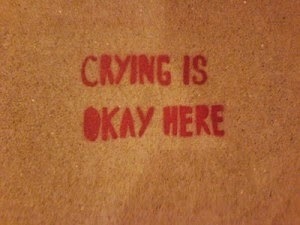
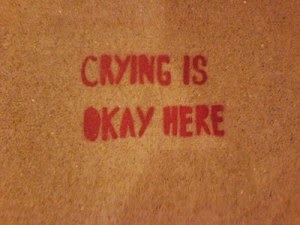
Why cry? It's normal and healing, right? It releases toxins in the body. It cleanses our soul and releases stress, anxiety, anger and sadness. It's normal.
Perhaps we don't cry enough, being taught that it is a sign of weakness. But we also cry at happy events when our emotions are triggered to new heights. Some of us cry when we laugh long and hard. I know I do and I don't know where it's coming from.
According to an article in Psychology Today crying can be extremely healing with one caveat: If we self-criticize while crying our eyes out, it does no good at all. That's why we all know some people who cry and cry and cry and never get any better. They are telling themselves negative messages like:
"I'm a loser and that's why I didn't get the job.""My boyfriend left me because I'm fat and stupid.""I don't deserve to have any friends.""I'm just too sensitive."
Instead, the article reminds us, "speak only kind words to yourself" when you're crying such as
“I’m sorry” and “I’m with you” and “I love you." We don't say these things to make us stop crying we say them to be compassionate to ourselves.
What a concept! Be compassionate to ourselves.
So many of us are empathetic with others, we forget to do the same when we need it. We berate and negate our feelings and stop crying, especially in public.
The scientific community is studying our tears. In a research project completed by Lauren Blysma, a PhD student at the University of South Florida in Tampa, she and her colleagues describe what we should and shouldn't do around someone who is in crying mode.
Be aware that if you do nothing, you can make the crier feel worse.Try to do something supportive. What that is depends on the situation and how well you know the person, For example, hugging someone you aren't very close with might not be appropriate, while simply listening in an empathetic way would be suitable.Don't assume you know how to comfort them. 'The less intimate the relationship, the more it is appropriate to begin by asking how you can help and be supportive.Know that criers who tear up in a very large group generally feel more uncomfortable than those who cry in front of one or two people they're familiar with. But even in a large group, the criers welcome support from those they didn't know well.I've participated in drum circles and find them so empowering and healing. How about we form a circle of tears and just let it all out! We can drum at the same time if we want but it's a different kind of "sweat lodge," don't you think? We expel the bad through good old fashioned crying and it's not as hard to build and bear like a traditional and viable Native American sweat lodge.
Who's with me?
Perhaps we don't cry enough, being taught that it is a sign of weakness. But we also cry at happy events when our emotions are triggered to new heights. Some of us cry when we laugh long and hard. I know I do and I don't know where it's coming from.
According to an article in Psychology Today crying can be extremely healing with one caveat: If we self-criticize while crying our eyes out, it does no good at all. That's why we all know some people who cry and cry and cry and never get any better. They are telling themselves negative messages like:
"I'm a loser and that's why I didn't get the job.""My boyfriend left me because I'm fat and stupid.""I don't deserve to have any friends.""I'm just too sensitive."
Instead, the article reminds us, "speak only kind words to yourself" when you're crying such as
“I’m sorry” and “I’m with you” and “I love you." We don't say these things to make us stop crying we say them to be compassionate to ourselves.
What a concept! Be compassionate to ourselves.
So many of us are empathetic with others, we forget to do the same when we need it. We berate and negate our feelings and stop crying, especially in public.
The scientific community is studying our tears. In a research project completed by Lauren Blysma, a PhD student at the University of South Florida in Tampa, she and her colleagues describe what we should and shouldn't do around someone who is in crying mode.
Be aware that if you do nothing, you can make the crier feel worse.Try to do something supportive. What that is depends on the situation and how well you know the person, For example, hugging someone you aren't very close with might not be appropriate, while simply listening in an empathetic way would be suitable.Don't assume you know how to comfort them. 'The less intimate the relationship, the more it is appropriate to begin by asking how you can help and be supportive.Know that criers who tear up in a very large group generally feel more uncomfortable than those who cry in front of one or two people they're familiar with. But even in a large group, the criers welcome support from those they didn't know well.I've participated in drum circles and find them so empowering and healing. How about we form a circle of tears and just let it all out! We can drum at the same time if we want but it's a different kind of "sweat lodge," don't you think? We expel the bad through good old fashioned crying and it's not as hard to build and bear like a traditional and viable Native American sweat lodge.
Who's with me?
April 13, 2015
Tangled webs...
Oh what a tangled web we weave, When first we practise to deceive!Sir Walter Scott, Marmion, Canto vi. Stanza 17.Scottish author (1771 - 1832)
Most often mistakenly attributed to William Shakespeare, the above quote is one that makes so much sense in such a lyrical way, I used it so often in my household when I suspected my children were lying that they would yell: "Stop it!" Lies can certainly catch you dead in your tracks. And when a habitual liar becomes older and somewhat forgetful, they can't keep their lies or their truths straight.
Be honest, we say; then you can never get caught in a lie. But it's easier said than done when 'white lies' are so prevalent and doctors do not want to disappoint their patients. Did I say 'doctors?'
According to an article in The Huffington Post, here are some lies doctors tell their patients:
"I've seen this hundreds of times."
This one may be said by your doctor as they try to not raise their eyebrows or shake their head in dismay at the huge, scary lesion you are presenting in the office. What they're really saying, though, is maybe they've seen this in "How To Stump The Doctor" articles in journals
"This is the best day ever."
You should know that this is standard doctor talk for, "Holy crap. Can one more thing go wrong with this day before I can get out of here?" If you hear [a doctor] say "This is the best day ever," know that [he/she has] plastered on a game face just to make it through the day, people. The best thing to do when you hear this phrase is to just nod understandingly. Seriously.
"Everything's going to be all right."
Now, when [doctors] say this, [they] don't really mean to lie. In fact, in [their] hearts, [they] hope and pray that this is true. [They] want to believe it in [their] core. [They] usually say this after [they] have been the bearer of bad news: a pathology report that reads cancer; an X-ray that shows a problem; an unusual reaction to a medication. [They] believe it when [they] tell you that it's going to be all right. [They] really do. But sometimes [they] have no way of knowing.
"I'll be done here in 20 minutes."
This is the common time frame used by the surgeon in the OR. This lie is spoken to the nurse who hasn't had a break in four hours and wonders how much longer her bladder can wait. It's a lie spoken to the supervising nurse who wonders if she needs to call in the night shift of technicians and nurses so the surgery can be finished safely. This lie is also told to the anesthesiologist who wants to know how much more sedation the patient needs to tolerate the procedure. The truth is: Finishing surgery is like driving in Friday traffic at 5 o'clock. [Surgeons] hope they'll be done in 20 minutes. [They] think [they] might. [They're] telling the Surgery Gods that [they], too, have a full bladder and an empty belly. But [they] are kinda just hoping. And praying.
"I'll send a note to your referring doctor tonight."
This lie is sort of like the one we all tell ourselves, "I'm going to eat more vegetables. Starting now." Instead, [doctors] are so tired and hungry when [they] get home that [they] have a cold bowl of cereal because [they're] too spent to throw a bag of veggies in the microwave. [They] have the best of intentions to send that letter to your doctor. And it will get done eventually. Honest. But give [them] about a week. OK, two.
"This won't hurt a bit."
Oops. Sorry. It does hurt. A little more than "a bit." But if [your doctor] told you it would hurt like hell, would it be any better for you? Doctors don't think so. That's why [they] all keep saying this. What [doctors] should probably say is the real truth: "This won't hurt me a bit."
"You're making progress."
The truth is, maybe you are. And maybe you aren't. What [your doctor] really means is, "Thank goodness you're not backsliding." [Doctors] mean that, despite the disease, despite your continued smoking, despite the serious injury you had, there is a light at the end of the tunnel. [They] can see it, even if you can't. The lie, though, is necessary because [they] thought you'd be out of the tunnel by now.
"My patients need me."
Hmmm. I'll bet you're surprised at this one. It's kinda true. As the article's author, a doctor herself, states: "We need you, dear patients. We need you to remind us of why we all went into medicine in the first place. We need you to remind us of our beloved grandmother, our great uncle, our second grade teacher. We need to be able to love you and show you compassion with all our heart. We need the connection that comes with true healing."*
* * * Interesting stuff, no? I had an almost hilarious session with my therapist the other day where she couldn't stop fidgeting and turning her fan on and off and talking fast, etc. Finally, we figured out that she had indulged in her first cup of caffeinated coffee in 25 years and she literally couldn't sit still. She didn't remember what I said. She didn't remember what she said; but because I recognize that she is human and we have a good relationship, she actually made my day. We laughed and joked and I realized how very like me she is - good days, bad days, and all that happens in between.
What can we learn from this? We need 'keepers,' those doctors or therapists who keep grounded in what is the human condition. We need less lying and more honesty but we can forgive the occasional lie or gaffe if the human doctor before us is in tumult of his/her own. What we can not forgive is a medical practitioner who is patronizing or arrogant and lies just for the sake of it.
The last thing my longtime doctor said to me before I was diagnosed with Stage 4B Hodgkins Lymphoma and Lupus was: "You're a normal 36-year-old woman. Go live your life." He lied. He missed the diagnoses. His radar was completely off that day, week, month. And just three weeks later when I died and was brought back to life, he asked to be involved with my care. I told him to go to hell. Some lies are just too big to be forgiven.
Nowadays I tell all my treating doctors not to tell me what they are going to do to me. For example, if they're going to stick the big needle in my back, just go ahead and do it. I don't need a pre-warning because then I tense up. I wear music headphones when procedures are going on. I don't want to chit chat with the attendings or nurses or anyone - I want to go to my zone out place. In clinical terms, I disassociate. It protects my psyche and I don't have to watch out for any tangled spiderwebs.

*Credit: Starla Fitch, MD, is a practicing oculoplastic surgeon. Dr. Fitch is also an author, professional speaker, and certified life coach. She has a passion to help those in the medical field suffering from burnout. Her new book, Remedy for Burnout: 7 Prescriptions Doctors Use to Find Meaning in Medicine, is now available.
Most often mistakenly attributed to William Shakespeare, the above quote is one that makes so much sense in such a lyrical way, I used it so often in my household when I suspected my children were lying that they would yell: "Stop it!" Lies can certainly catch you dead in your tracks. And when a habitual liar becomes older and somewhat forgetful, they can't keep their lies or their truths straight.
Be honest, we say; then you can never get caught in a lie. But it's easier said than done when 'white lies' are so prevalent and doctors do not want to disappoint their patients. Did I say 'doctors?'
According to an article in The Huffington Post, here are some lies doctors tell their patients:
"I've seen this hundreds of times."
This one may be said by your doctor as they try to not raise their eyebrows or shake their head in dismay at the huge, scary lesion you are presenting in the office. What they're really saying, though, is maybe they've seen this in "How To Stump The Doctor" articles in journals
"This is the best day ever."
You should know that this is standard doctor talk for, "Holy crap. Can one more thing go wrong with this day before I can get out of here?" If you hear [a doctor] say "This is the best day ever," know that [he/she has] plastered on a game face just to make it through the day, people. The best thing to do when you hear this phrase is to just nod understandingly. Seriously.
"Everything's going to be all right."
Now, when [doctors] say this, [they] don't really mean to lie. In fact, in [their] hearts, [they] hope and pray that this is true. [They] want to believe it in [their] core. [They] usually say this after [they] have been the bearer of bad news: a pathology report that reads cancer; an X-ray that shows a problem; an unusual reaction to a medication. [They] believe it when [they] tell you that it's going to be all right. [They] really do. But sometimes [they] have no way of knowing.
"I'll be done here in 20 minutes."
This is the common time frame used by the surgeon in the OR. This lie is spoken to the nurse who hasn't had a break in four hours and wonders how much longer her bladder can wait. It's a lie spoken to the supervising nurse who wonders if she needs to call in the night shift of technicians and nurses so the surgery can be finished safely. This lie is also told to the anesthesiologist who wants to know how much more sedation the patient needs to tolerate the procedure. The truth is: Finishing surgery is like driving in Friday traffic at 5 o'clock. [Surgeons] hope they'll be done in 20 minutes. [They] think [they] might. [They're] telling the Surgery Gods that [they], too, have a full bladder and an empty belly. But [they] are kinda just hoping. And praying.
"I'll send a note to your referring doctor tonight."
This lie is sort of like the one we all tell ourselves, "I'm going to eat more vegetables. Starting now." Instead, [doctors] are so tired and hungry when [they] get home that [they] have a cold bowl of cereal because [they're] too spent to throw a bag of veggies in the microwave. [They] have the best of intentions to send that letter to your doctor. And it will get done eventually. Honest. But give [them] about a week. OK, two.
"This won't hurt a bit."
Oops. Sorry. It does hurt. A little more than "a bit." But if [your doctor] told you it would hurt like hell, would it be any better for you? Doctors don't think so. That's why [they] all keep saying this. What [doctors] should probably say is the real truth: "This won't hurt me a bit."
"You're making progress."
The truth is, maybe you are. And maybe you aren't. What [your doctor] really means is, "Thank goodness you're not backsliding." [Doctors] mean that, despite the disease, despite your continued smoking, despite the serious injury you had, there is a light at the end of the tunnel. [They] can see it, even if you can't. The lie, though, is necessary because [they] thought you'd be out of the tunnel by now.
"My patients need me."
Hmmm. I'll bet you're surprised at this one. It's kinda true. As the article's author, a doctor herself, states: "We need you, dear patients. We need you to remind us of why we all went into medicine in the first place. We need you to remind us of our beloved grandmother, our great uncle, our second grade teacher. We need to be able to love you and show you compassion with all our heart. We need the connection that comes with true healing."*
* * * Interesting stuff, no? I had an almost hilarious session with my therapist the other day where she couldn't stop fidgeting and turning her fan on and off and talking fast, etc. Finally, we figured out that she had indulged in her first cup of caffeinated coffee in 25 years and she literally couldn't sit still. She didn't remember what I said. She didn't remember what she said; but because I recognize that she is human and we have a good relationship, she actually made my day. We laughed and joked and I realized how very like me she is - good days, bad days, and all that happens in between.
What can we learn from this? We need 'keepers,' those doctors or therapists who keep grounded in what is the human condition. We need less lying and more honesty but we can forgive the occasional lie or gaffe if the human doctor before us is in tumult of his/her own. What we can not forgive is a medical practitioner who is patronizing or arrogant and lies just for the sake of it.
The last thing my longtime doctor said to me before I was diagnosed with Stage 4B Hodgkins Lymphoma and Lupus was: "You're a normal 36-year-old woman. Go live your life." He lied. He missed the diagnoses. His radar was completely off that day, week, month. And just three weeks later when I died and was brought back to life, he asked to be involved with my care. I told him to go to hell. Some lies are just too big to be forgiven.
Nowadays I tell all my treating doctors not to tell me what they are going to do to me. For example, if they're going to stick the big needle in my back, just go ahead and do it. I don't need a pre-warning because then I tense up. I wear music headphones when procedures are going on. I don't want to chit chat with the attendings or nurses or anyone - I want to go to my zone out place. In clinical terms, I disassociate. It protects my psyche and I don't have to watch out for any tangled spiderwebs.
*Credit: Starla Fitch, MD, is a practicing oculoplastic surgeon. Dr. Fitch is also an author, professional speaker, and certified life coach. She has a passion to help those in the medical field suffering from burnout. Her new book, Remedy for Burnout: 7 Prescriptions Doctors Use to Find Meaning in Medicine, is now available.
March 26, 2015
Lost in space...
"Danger, Will Robinson. Danger!" I wish I had Robot from the sixties television show Lost in Space to warn me when danger was near, like when I'm going to get smacked in the back of the head with yet another medical emergency.
Since I've been a 'professional patient' for 18 years, you would think I could easily recognize warning signs. Nope. It's always like an earthquake; a shattering of what I thought was a body working well.
It's like being lost in space ... surrounded by blackness, grabbing at stars or comets or flying objects that aren't within my reach. I think of George Clooney in Gravity letting himself come loose from the spaceship and slip, sliding away. It's somewhat beautiful yet scary as hell.
Last week I was hospitalized for internal bleeding. The source is as yet unknown and further testing is scheduled. I also found out yesterday that in addition to having Lupus and gastroparesis, I have Sjrogen's Syndrome. I'm still trying to wrap my head around that one.
So while the doctors toss out names of tests, medicines and supplements, I shut down. When family and friends wish me well or offer comfort, I shut down. I can no longer hide my disappointment in my ongoing poor health. I was once vital. Now I am idle.
Chronic illness is a creepy, crawly thing that should come with warnings all over it yet there is still so much we do not know, particularly about autoimmune disease. To read that Sjrogen's is tied to lymphoma made me gasp, Of course I suffered the stage 4B cancer years before I found out I have Sjrogen's but there it is - in black and white for me to comprehend
Today, I just can't. Call it a pity party or whatever you choose. I feel badly for myself and angry at my body. Floating off in outer space looks pretty good right now.

Since I've been a 'professional patient' for 18 years, you would think I could easily recognize warning signs. Nope. It's always like an earthquake; a shattering of what I thought was a body working well.
It's like being lost in space ... surrounded by blackness, grabbing at stars or comets or flying objects that aren't within my reach. I think of George Clooney in Gravity letting himself come loose from the spaceship and slip, sliding away. It's somewhat beautiful yet scary as hell.
Last week I was hospitalized for internal bleeding. The source is as yet unknown and further testing is scheduled. I also found out yesterday that in addition to having Lupus and gastroparesis, I have Sjrogen's Syndrome. I'm still trying to wrap my head around that one.
So while the doctors toss out names of tests, medicines and supplements, I shut down. When family and friends wish me well or offer comfort, I shut down. I can no longer hide my disappointment in my ongoing poor health. I was once vital. Now I am idle.
Chronic illness is a creepy, crawly thing that should come with warnings all over it yet there is still so much we do not know, particularly about autoimmune disease. To read that Sjrogen's is tied to lymphoma made me gasp, Of course I suffered the stage 4B cancer years before I found out I have Sjrogen's but there it is - in black and white for me to comprehend
Today, I just can't. Call it a pity party or whatever you choose. I feel badly for myself and angry at my body. Floating off in outer space looks pretty good right now.

March 18, 2015
Whatchoo talkin' about?
Fifteen years after The Adverse Childhood Experiences (ACE) Study was first published revealing that childhood maltreatment can lead to adult physical illness, it is still being knocked around as if it may not hold water.
This flies in the face of the evidence most recently presented by What Shapes Health? a National Public Radio (NPR) series that explores social and environmental factors that affect health throughout life. The NPR series is inspired, in part, by findings in a poll released on March 2, 2015 by NPR, the Robert Wood Johnson Foundation and the Harvard T.H. Chan School of Public Health.
In NPR's article, Can Family Secrets Make You Sick? Megan Gunnar, a developmental psychologist at the University of Minnesota who, for more than 30 years, has been studying the ways children respond to stressful experiences says: "This is how nature protects us." We all become adapted to living in "the kinds of environments we're born into." Thus, she adds, (stressful or traumatic events) "reshape the biology of the child"
And if you have scary, traumatic experiences when you're small, Gunnar says, your stress response system may, in some cases, be programmed to overreact, influencing the way your mind and body work together. Research in animals and people suggests that the part of the mind that scientists call "executive function" — thought, judgment, self-control — seems to be most affected, she says.
"I thought that people would flock to this information, and be knocking on our doors, saying, 'Tell us more. We want to use it.' And the initial reaction was really — silence," says Dr. Rob Anda, epidemiologist and co-developer of the ACE study.
"Just the sheer scale of the suffering — it was really disturbing to me," Anda remembers. "I actually remember being in my study and I wept."
He wept. I wept when I learned about The ACE Study while researching my book, DYING TO LIVE: Running backwards through cancer, Lupus and chronic illness. There was an 'aha' moment when I took the ACE test. I scored an 8 out of 10 making me extremely likely to develop serious illness as an adult. Ya think? Stage 4B Lymphoma? Lupus? Gastroparesis? Depression? Anxiety? Oh yeah.
And then came the part where Anda found out what happened to all those people when they grew up: "Very dramatic increases in pretty much every one of the major public health problems that we'd included in the study," he says. Cancer, addiction, diabetes and stroke (just to name a few) occurred more often among people with high ACE scores.
Now, not everyone who'd had a rough childhood developed a serious illness, of course. But, according to the findings, adults who had four or more "yeses" to the ACE questions were, in general, twice as likely to have heart disease, compared to people whose ACE score was zero. Women with five or more "yeses" were at least four times as likely to have depression as those with no ACE points.
"Over time, especially when you're young, experiences of neglect and abuse and stress impair those circuits," Gunnar says. "You're less able to tell yourself not to eat the ice cream, or smoke the cigarette, or have that additional drink. You're less capable of regulating your own behavior. And that seems to be terribly important for linking early experiences with later health outcomes."
I'm convinced of the accuracy of the results of these studies.
I am living proof.
Please spread the word.

This flies in the face of the evidence most recently presented by What Shapes Health? a National Public Radio (NPR) series that explores social and environmental factors that affect health throughout life. The NPR series is inspired, in part, by findings in a poll released on March 2, 2015 by NPR, the Robert Wood Johnson Foundation and the Harvard T.H. Chan School of Public Health.
In NPR's article, Can Family Secrets Make You Sick? Megan Gunnar, a developmental psychologist at the University of Minnesota who, for more than 30 years, has been studying the ways children respond to stressful experiences says: "This is how nature protects us." We all become adapted to living in "the kinds of environments we're born into." Thus, she adds, (stressful or traumatic events) "reshape the biology of the child"
And if you have scary, traumatic experiences when you're small, Gunnar says, your stress response system may, in some cases, be programmed to overreact, influencing the way your mind and body work together. Research in animals and people suggests that the part of the mind that scientists call "executive function" — thought, judgment, self-control — seems to be most affected, she says.
"I thought that people would flock to this information, and be knocking on our doors, saying, 'Tell us more. We want to use it.' And the initial reaction was really — silence," says Dr. Rob Anda, epidemiologist and co-developer of the ACE study.
"Just the sheer scale of the suffering — it was really disturbing to me," Anda remembers. "I actually remember being in my study and I wept."
He wept. I wept when I learned about The ACE Study while researching my book, DYING TO LIVE: Running backwards through cancer, Lupus and chronic illness. There was an 'aha' moment when I took the ACE test. I scored an 8 out of 10 making me extremely likely to develop serious illness as an adult. Ya think? Stage 4B Lymphoma? Lupus? Gastroparesis? Depression? Anxiety? Oh yeah.
And then came the part where Anda found out what happened to all those people when they grew up: "Very dramatic increases in pretty much every one of the major public health problems that we'd included in the study," he says. Cancer, addiction, diabetes and stroke (just to name a few) occurred more often among people with high ACE scores.
Now, not everyone who'd had a rough childhood developed a serious illness, of course. But, according to the findings, adults who had four or more "yeses" to the ACE questions were, in general, twice as likely to have heart disease, compared to people whose ACE score was zero. Women with five or more "yeses" were at least four times as likely to have depression as those with no ACE points.
"Over time, especially when you're young, experiences of neglect and abuse and stress impair those circuits," Gunnar says. "You're less able to tell yourself not to eat the ice cream, or smoke the cigarette, or have that additional drink. You're less capable of regulating your own behavior. And that seems to be terribly important for linking early experiences with later health outcomes."
I'm convinced of the accuracy of the results of these studies.
I am living proof.
Please spread the word.