Amy Susan Crohn's Blog, page 4
April 8, 2014
National Child Abuse Awareness Month
April is National Child Abuse Awareness Month. Even though I think every month should be child abuse awareness month, it's fitting that this Thursday, April 10, I will be sworn in as a Court Appointed Special Advocate (CASA) for children in foster care in New York. I will take an oath to:
"...watch over and advocate for abused and neglected children, to make sure they don’t get lost in the overburdened legal and social service system or languish in inappropriate group or foster homes. (I will) stay with each case until it is closed and the child is placed in a safe, permanent home. For many abused children, (I) will be the one constant adult presence in their lives."
It's a daunting task and one that I will take very seriously. The training has been superb through the Mental Health Association of Westchester County, New York that has the contract to oversee the CASA program. Even though I was a foster mother once and my adopted son is now 20-years-old, there was/is much for me to learn. I'm also glad to report that a lot has changed since a 19-pound, malnourished, filthy two-year-old boy was dropped on my doorstep. The case worker said: "Here ya go," as he handed him off and the little guy promptly crawled over and ate the cat's food.
I knew I was in for a ride.
With all its ups and downs as we wound our way through the Family Court system that existed in the late 1990's and early 2000's we learned one thing: Somebody, anybody has to be an advocate for the child in care. There were no CASAs then and I could have sorely used one. Suffice it to say, we survived, he thrived, and we adopted this beautiful boy in 2002 when he was seven-years-old.
A funny thing happened on the way to the conclusion, however. In late 1996, I was diagnosed with
Stage IVB cancer and Lupus. After my initial biopsy, I suffered severe complications and ended up with an emergency tracheotomy and weeks of hospitalization. The first thing I painfully wrote to communicate with my husband while I was wired and strapped down in intensive care was: "What about Brett? Lawyer?"
In my most fragile state, I could only think about the one in my orbit who was even more fragile - my foster son who'd only been living with us a little over a year. I was afraid he would be taken away. It wasn't until my husband made the proper telephone calls and assured me that they could not take him because I was ill did I relax into the two diseases that were threatening to kill me and vow to fight like a cougar to get back to all three of my boys - my husband, my biological son, and my foster son.
And what a blessing he was! Not afraid to scramble up on me in my wounded state and hug and kiss me even though I looked very scary, this delightful yet formerly-neglected boy came to heal me as I would heal him. Eighteen years later, our bond is very strong and I believe we were brought together for reasons only a higher being can know. You can read much more about our story in my book DYING TO LIVE: Running backwards through cancer, Lupus, and chronic illness.
Finally, according to Jane LeMond-Alvarez of The Children's Wall of Tears, three million cases of child abuse are reported each year in the United States and at least three children die every day at the hands of an abuser.
As a CASA, I will be working to heal the scars of children who live through the abuse or neglect; who put one foot in front of the other each day as they survive precariously in uncertain homes waiting for their parents to get better or to be released for adoption.
I will be eminently proud to help carry them in my arms and speak volumes on their behalf.

"...watch over and advocate for abused and neglected children, to make sure they don’t get lost in the overburdened legal and social service system or languish in inappropriate group or foster homes. (I will) stay with each case until it is closed and the child is placed in a safe, permanent home. For many abused children, (I) will be the one constant adult presence in their lives."
It's a daunting task and one that I will take very seriously. The training has been superb through the Mental Health Association of Westchester County, New York that has the contract to oversee the CASA program. Even though I was a foster mother once and my adopted son is now 20-years-old, there was/is much for me to learn. I'm also glad to report that a lot has changed since a 19-pound, malnourished, filthy two-year-old boy was dropped on my doorstep. The case worker said: "Here ya go," as he handed him off and the little guy promptly crawled over and ate the cat's food.
I knew I was in for a ride.
With all its ups and downs as we wound our way through the Family Court system that existed in the late 1990's and early 2000's we learned one thing: Somebody, anybody has to be an advocate for the child in care. There were no CASAs then and I could have sorely used one. Suffice it to say, we survived, he thrived, and we adopted this beautiful boy in 2002 when he was seven-years-old.
A funny thing happened on the way to the conclusion, however. In late 1996, I was diagnosed with
Stage IVB cancer and Lupus. After my initial biopsy, I suffered severe complications and ended up with an emergency tracheotomy and weeks of hospitalization. The first thing I painfully wrote to communicate with my husband while I was wired and strapped down in intensive care was: "What about Brett? Lawyer?"
In my most fragile state, I could only think about the one in my orbit who was even more fragile - my foster son who'd only been living with us a little over a year. I was afraid he would be taken away. It wasn't until my husband made the proper telephone calls and assured me that they could not take him because I was ill did I relax into the two diseases that were threatening to kill me and vow to fight like a cougar to get back to all three of my boys - my husband, my biological son, and my foster son.
And what a blessing he was! Not afraid to scramble up on me in my wounded state and hug and kiss me even though I looked very scary, this delightful yet formerly-neglected boy came to heal me as I would heal him. Eighteen years later, our bond is very strong and I believe we were brought together for reasons only a higher being can know. You can read much more about our story in my book DYING TO LIVE: Running backwards through cancer, Lupus, and chronic illness.
Finally, according to Jane LeMond-Alvarez of The Children's Wall of Tears, three million cases of child abuse are reported each year in the United States and at least three children die every day at the hands of an abuser.
As a CASA, I will be working to heal the scars of children who live through the abuse or neglect; who put one foot in front of the other each day as they survive precariously in uncertain homes waiting for their parents to get better or to be released for adoption.
I will be eminently proud to help carry them in my arms and speak volumes on their behalf.


March 27, 2014
SPEAK UP!
I am angry. It takes a lot for me to get angry but an experience I had this past weekend at my brother's heartwarming memorial art exhibition at Hyde Park Library in Hyde Park, New York has me uncoiled.
Amid the bittersweet beauty of the paintings brightly lit and hung with care; the tears, hugs and laughter among friends and family (including new friends brought in by the library), one gentleman stepped forward to speak to me. He had known my brother, although not closely, he said. He spent part of the last two weeks of my brother's life with him. They rode together in my brother's car discussing the difficulties my brother was having. They spoke of my brother's lessening options about housing, healthcare, travel, depression and my brother clearly stated that one of his choices would be to end his life. No one in my brother's close circle of friends or family had any inkling that this was something he was considering.
Tears sprung to my eyes as he recounted this conversation and mumbled about how he wasn't so close to my brother and didn't know who to call or what he should do. I called my sister over to continue the conversation and I bowed out. I wanted to hit him. I wanted to scream. I wanted to ask him why he didn't say something to anyone?
According to the MAYO Clinic and other suicide prevention sites, if one speaks of suicide they must be taken seriously. Speak up even if you might lose the friendship because you will save a life.
If you believe someone is in danger of committing suicide or has made a suicide attempt:
Don't leave the person alone.Call 911 or your local emergency number right away. Or, if you think you can do so safely, take the person to the nearest hospital emergency room yourself.Try to find out if he or she is under the influence of alcohol or drugs or may have taken an overdose.Tell a family member or friend right away what's going on.If a friend or family member talks or behaves in a way that makes you believe he or she might commit suicide, don't try to handle the situation without help — get help from a trained professional as quickly as possible. The person may need to be hospitalized until the suicidal crisis has passed.Furthermore, taking action is always the best choice.
"When someone says he or she is thinking about suicide, or says things that sound as if the person is considering suicide, it can be very upsetting. You may not be sure what to do to help, whether you should take talk of suicide seriously, or if your intervention might make the situation worse. Taking action is always the best choice."
There are suicide hotlines everywhere; such as the National Suicide Prevention Lifeline. The telephone number is: 1-800-273-8255
I know this chap had no ill intentions. Perhaps he felt uncomfortable since he didn't know my brother very well and wasn't sure who to call. Maybe he wasn't even getting the story right since he seems to have told my sister and I two different versions. So, all I can say to those of you who may find yourself in a similar situation, please err on the side of caution. That person's family will be forever indebted to you.
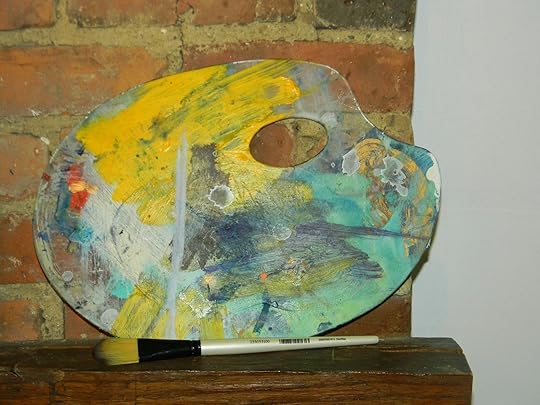 Steve Crohn's Paint Palette.
Amid the bittersweet beauty of the paintings brightly lit and hung with care; the tears, hugs and laughter among friends and family (including new friends brought in by the library), one gentleman stepped forward to speak to me. He had known my brother, although not closely, he said. He spent part of the last two weeks of my brother's life with him. They rode together in my brother's car discussing the difficulties my brother was having. They spoke of my brother's lessening options about housing, healthcare, travel, depression and my brother clearly stated that one of his choices would be to end his life. No one in my brother's close circle of friends or family had any inkling that this was something he was considering.
Tears sprung to my eyes as he recounted this conversation and mumbled about how he wasn't so close to my brother and didn't know who to call or what he should do. I called my sister over to continue the conversation and I bowed out. I wanted to hit him. I wanted to scream. I wanted to ask him why he didn't say something to anyone?
According to the MAYO Clinic and other suicide prevention sites, if one speaks of suicide they must be taken seriously. Speak up even if you might lose the friendship because you will save a life.
If you believe someone is in danger of committing suicide or has made a suicide attempt:
Don't leave the person alone.Call 911 or your local emergency number right away. Or, if you think you can do so safely, take the person to the nearest hospital emergency room yourself.Try to find out if he or she is under the influence of alcohol or drugs or may have taken an overdose.Tell a family member or friend right away what's going on.If a friend or family member talks or behaves in a way that makes you believe he or she might commit suicide, don't try to handle the situation without help — get help from a trained professional as quickly as possible. The person may need to be hospitalized until the suicidal crisis has passed.Furthermore, taking action is always the best choice.
"When someone says he or she is thinking about suicide, or says things that sound as if the person is considering suicide, it can be very upsetting. You may not be sure what to do to help, whether you should take talk of suicide seriously, or if your intervention might make the situation worse. Taking action is always the best choice."
There are suicide hotlines everywhere; such as the National Suicide Prevention Lifeline. The telephone number is: 1-800-273-8255
I know this chap had no ill intentions. Perhaps he felt uncomfortable since he didn't know my brother very well and wasn't sure who to call. Maybe he wasn't even getting the story right since he seems to have told my sister and I two different versions. So, all I can say to those of you who may find yourself in a similar situation, please err on the side of caution. That person's family will be forever indebted to you.
 Steve Crohn's Paint Palette.
 March 17, 2014
Boundaries with Hair
I had a dream. Since it was the second time in as many weeks that I had this same dream, I found it disturbing enough for me to Google dream interpretation to try to understand what it meant.
In the dream, I had my childhood very long hair hanging over my face yet I was bald on the top of my head - ghastly white bald. I was leaning over so others could see this strange occurrence.
So, here's what the interpreter site said:
"To dream of hair covering your face suggests an emotional anxiety in the company of others and particularly in intimate relationships. Looking out from behind a veil of hair in a dream shows that you may be keeping your true feelings hidden as you have a deep fear of rejection in close relationships."
Well, that pretty much nails it.
Since my brother's death nearly seven months ago, I lost my 'rock' - the intensely close relationship that grounded me. And in my brain-addled opinion, by taking his life, he ultimately rejected me. At least this is how I have been feeling about it all and it is spilling over into my intimate relationships with my husband and close friends.
It further explains:
"To dream of hair falling out indicates extreme fears may be running unchecked in your emotional body. There is a strong message here to examine your inner world before stress manifests itself from uneasiness. If the loss of hair in a dream is random and in clumps, a fear of death is lurking and needs to be addressed so as to improve your general demeanor."
Fear of death? Absolutely, but not mine. I am scared that other loved ones will start falling away; abandon me. Ah, the crux of my whole childhood, my book, and my life - abandonment.
At the same time during this experimental healing time I've had to revisit certain boundaries in relationships. Are these real relationships where I actually receive something rather than just giving away too much of me? Am I 'rescuing' people because it makes me feel good? Where do I begin and end in each of my close relationships?
Perhaps the fear- and anxiety-invoking hair also represents my need to establish some healthful boundaries that, according to one anonymous Facebook post, "are like Energy Doors that help us manage the flow of energy in our life. At times it's useful to keep the door open in order to invite in and receive the blessings from others and our environment. At other times, we need to keep the door shut for our own sense of security, nourishment and well-being."
Well, yes again.
I get it. I've been so busy these past months with grief, the business affairs of my brother including being the spokesperson for newspaper and magazine writers, planning and managing upcoming memorial art exhibitions, promotion of my own DYING TO LIVE, the Court Appointed Special Advocate (CASA) training, and visiting my doctors, that I've unknowingly created boundaries. Sure, I can say they've been erected due to lack of time, but I believe they are also sorely needed to help me heal. I may have offended some but I know those that are true to me will understand my fakakta process. By isolating myself and focusing on my grief process, my physical health, and my work, I've set up some walls while I fumble around and try to rebuild my inner core, my Statue, as described in my memoir.
I peek over the walls every now and then and I've even walked out around the barriers from time to time in ways both big and small, like fumbling around in storage units organizing nearly a thousand pieces of my brother's art or saying 'yes' to a book signing event. But I've set some boundaries, and as hackneyed as it may sound, it's normal. Phew!
Now if I can just have a good hair day!
 Artist: Alice Mason. #Boundaries #TheSoulfulWoman
In the dream, I had my childhood very long hair hanging over my face yet I was bald on the top of my head - ghastly white bald. I was leaning over so others could see this strange occurrence.
So, here's what the interpreter site said:
"To dream of hair covering your face suggests an emotional anxiety in the company of others and particularly in intimate relationships. Looking out from behind a veil of hair in a dream shows that you may be keeping your true feelings hidden as you have a deep fear of rejection in close relationships."
Well, that pretty much nails it.
Since my brother's death nearly seven months ago, I lost my 'rock' - the intensely close relationship that grounded me. And in my brain-addled opinion, by taking his life, he ultimately rejected me. At least this is how I have been feeling about it all and it is spilling over into my intimate relationships with my husband and close friends.
It further explains:
"To dream of hair falling out indicates extreme fears may be running unchecked in your emotional body. There is a strong message here to examine your inner world before stress manifests itself from uneasiness. If the loss of hair in a dream is random and in clumps, a fear of death is lurking and needs to be addressed so as to improve your general demeanor."
Fear of death? Absolutely, but not mine. I am scared that other loved ones will start falling away; abandon me. Ah, the crux of my whole childhood, my book, and my life - abandonment.
At the same time during this experimental healing time I've had to revisit certain boundaries in relationships. Are these real relationships where I actually receive something rather than just giving away too much of me? Am I 'rescuing' people because it makes me feel good? Where do I begin and end in each of my close relationships?
Perhaps the fear- and anxiety-invoking hair also represents my need to establish some healthful boundaries that, according to one anonymous Facebook post, "are like Energy Doors that help us manage the flow of energy in our life. At times it's useful to keep the door open in order to invite in and receive the blessings from others and our environment. At other times, we need to keep the door shut for our own sense of security, nourishment and well-being."
Well, yes again.
I get it. I've been so busy these past months with grief, the business affairs of my brother including being the spokesperson for newspaper and magazine writers, planning and managing upcoming memorial art exhibitions, promotion of my own DYING TO LIVE, the Court Appointed Special Advocate (CASA) training, and visiting my doctors, that I've unknowingly created boundaries. Sure, I can say they've been erected due to lack of time, but I believe they are also sorely needed to help me heal. I may have offended some but I know those that are true to me will understand my fakakta process. By isolating myself and focusing on my grief process, my physical health, and my work, I've set up some walls while I fumble around and try to rebuild my inner core, my Statue, as described in my memoir.
I peek over the walls every now and then and I've even walked out around the barriers from time to time in ways both big and small, like fumbling around in storage units organizing nearly a thousand pieces of my brother's art or saying 'yes' to a book signing event. But I've set some boundaries, and as hackneyed as it may sound, it's normal. Phew!
Now if I can just have a good hair day!
 Artist: Alice Mason. #Boundaries #TheSoulfulWoman
March 5, 2014
Patient Satisfaction A Law in 2014 - Part 2
In my last blog post, I revealed that many are not aware of one part of the United States Federal Affordable Care Act that enforces patient satisfaction as a factor for physician payments; at least starting with Medicare and Medicaid. It's a "pay for performance" law, according to the Centers for Medicare and Medicaid Services (CMS), a federal governing body established under the The Patient Protection and Affordable Care Act (PPACA). Publicly, we all know it as Obamacare and the patient protection section was to be enforced beginning January 1, 2014.
To re-summarize: "Quality, pay for performance, and hospital value based purchasing (HVBP) are synonymous terms which are used to indicate that in the future, healthcare hospital reimbursements will be linked to patient outcomes."
As I explained, the one and only site I could find that the government is using to collect this data about hospital performance and patient satisfaction is RateHospitals.com where patients can "report and rate their hospital experiences." The site says it "is dedicated to improving the quality of healthcare in the United States (and) provides an opportunity for patients to express their opinions regarding their hospital stay."
My question was: Who funds and manages this site? So, I sent a little email (see last blog post) and this is the totally inadequate yet telling response I got:
Hello Ms. Crohn
We are a private organization. Please e mail a link to your blog, for us to read. We welcome your input and thoughts and suggestions.
Thank you
RateHospitals
Hmmmm. They want to know more about me before they spill any beans? I'm afraid to do it. Seriously, if I give them my information is it going to raise a red flag over my family and me? Am I going to start running into glitches in my personal health care odyssey? I'm not answering them so I've hit a dead end here.
I spent some more time on their site and, at first, couldn't find New York (it was mistakenly alphabetized and came after the "O" states rather than the "M" states. Then I was happy to see some statistics. For example, my community hospital had a near 70 per cent satisfaction rate. Other local hospitals fared about the same except for Westchester Medical Center in Valhalla, New York that has always accepted low income and indigent patients. Their satisfaction rate was less than 50 per cent.
Interestingly, while that medical center is partly funded by taxpayer monies (its land, etc.), it recently announced that it would not accept ANY of the insurances under the Health Care Exchange. Take that, patients! You can't come to the this fully-equipped, state-of-the-art medical and trauma center in the tri-state New York area anymore unless you can pay for it yourself or have private insurance.
Well, I've hit a roadblock or a blockhead or both because the information is extremely difficult to find. I asked two of my doctors if they heard about this part of the law and while they both said they had, they also said they had no structure in place to comply. I'll try to talk to the president of one of the hospitals in coming weeks to get more clarity on this issue.
So, I must conclude that millions of taxpayer dollars have been used to fund a patient satisfaction component of the ACA but it ain't working even though it's been in a pilot phase for a few years. And I'll keep waiting for a doctor or hospital representative to ask me to fill out a patient satisfaction survey and I'll report on it when and if I ever do.
Disturbing, to say the least.
To re-summarize: "Quality, pay for performance, and hospital value based purchasing (HVBP) are synonymous terms which are used to indicate that in the future, healthcare hospital reimbursements will be linked to patient outcomes."
As I explained, the one and only site I could find that the government is using to collect this data about hospital performance and patient satisfaction is RateHospitals.com where patients can "report and rate their hospital experiences." The site says it "is dedicated to improving the quality of healthcare in the United States (and) provides an opportunity for patients to express their opinions regarding their hospital stay."
My question was: Who funds and manages this site? So, I sent a little email (see last blog post) and this is the totally inadequate yet telling response I got:
Hello Ms. Crohn
We are a private organization. Please e mail a link to your blog, for us to read. We welcome your input and thoughts and suggestions.
Thank you
RateHospitals
Hmmmm. They want to know more about me before they spill any beans? I'm afraid to do it. Seriously, if I give them my information is it going to raise a red flag over my family and me? Am I going to start running into glitches in my personal health care odyssey? I'm not answering them so I've hit a dead end here.
I spent some more time on their site and, at first, couldn't find New York (it was mistakenly alphabetized and came after the "O" states rather than the "M" states. Then I was happy to see some statistics. For example, my community hospital had a near 70 per cent satisfaction rate. Other local hospitals fared about the same except for Westchester Medical Center in Valhalla, New York that has always accepted low income and indigent patients. Their satisfaction rate was less than 50 per cent.
Interestingly, while that medical center is partly funded by taxpayer monies (its land, etc.), it recently announced that it would not accept ANY of the insurances under the Health Care Exchange. Take that, patients! You can't come to the this fully-equipped, state-of-the-art medical and trauma center in the tri-state New York area anymore unless you can pay for it yourself or have private insurance.
Well, I've hit a roadblock or a blockhead or both because the information is extremely difficult to find. I asked two of my doctors if they heard about this part of the law and while they both said they had, they also said they had no structure in place to comply. I'll try to talk to the president of one of the hospitals in coming weeks to get more clarity on this issue.
So, I must conclude that millions of taxpayer dollars have been used to fund a patient satisfaction component of the ACA but it ain't working even though it's been in a pilot phase for a few years. And I'll keep waiting for a doctor or hospital representative to ask me to fill out a patient satisfaction survey and I'll report on it when and if I ever do.
Disturbing, to say the least.

February 19, 2014
Patient Satisfaction A Law in 2014 - Part I
I'm into my semi-yearly round of medical specialists and tests. At least this year I've agreed to do it since I have taken breaks when I've felt overcooked by the health care community. In no particular order, they include my trusted doctors in rheumatology, gastroenterology, oncology, ophthalmology, and gynecology - my 'ologists.' They and their welcoming staff greet me with hugs and an inquiring: "Where've you been?" They pepper me with dozens of other questions, take blood, give me shots, order tests, and I dutifully try to answer and comply.
I'm a good patient. I bring my updated medications list and medical history along with all the names and telephone numbers of my physicians in both New York and South Carolina. And I have finally found that I am happy with the doctors that work with me. My patient satisfaction level is high.
Why is that so important?
One unsung part of the United States Federal Affordable Care Act enforces patient satisfaction as a factor for physician payments, at least starting with Medicare and Medicaid. It's a "pay for performance" law, according to the Centers for Medicare and Medicaid Services (CMS), a federal governing body established under the The Patient Protection and Affordable Care Act (PPACA). Publicly, we all know it as Obamacare and the patient protection section is to be enforced beginning January 1, 2014.
To summarize: "Quality, pay for performance, and hospital value based purchasing (HVBP) are synonymous terms which are used to indicate that in the future, healthcare hospital reimbursements will be linked to patient outcomes."
Well, whattya know? I have not been a proponent of the ACA, worried that it will turn into a single-payer 'entitlement' system that will benefit the very rich and the very poor rather than the vast middle class. But if what I'm reading in all these documents issued by these highly-acronymed agencies, we patients just might have an impact on the bottom line of healthcare delivery.
That's if we choose to participate because none of my doctors or hospitals except one have ever asked me to fill out a patient satisfaction survey and it was voluntary. The one and only site I can find thus far that the government is using to collect this data about hospital performance and patient satisfaction is RateHospitals.com where patients can "report and rate their hospital experiences." The site says it "is dedicated to improving the quality of healthcare in the United States (and) provides an opportunity for patients to express their opinions regarding their hospital stay."
Furthermore, the site states: "The patient experience is becoming increasingly recognized as a critical component in modern healthcare. The Federal Government has allocated over one billion dollars to reward hospitals across the country which perform well in Patient Satisfaction and Patient Clinical Outcomes."
Reward hospitals with higher reimbursements based on how well they satisfy patients? Really?
My first question is: Who funds and manages this site? I have to do a little journalistic research to find out since it is not a readily-available piece of information; in fact, it is hidden on the actual site. There will be a Part II to this blog entry as I continue to study what I'm reading and make some inquiries.
Today, I sent this email to the only contact information provided on the site:
Hello, I am attempting to learn if your company is under contract by the U.S. government or was developed as a private company to meet some of the demands of the ACA with respect to patient satisfaction. I write a blog about health issues (mostly my own) and would like to understand more how this part of the law works and if your company is the only one providing the government with this information collected from patients or if hospitals and doctors' offices must do so themselves.
Thank you for your kind consideration.
In the meantime, I tried the site and this was my experience:
To register and sign in, I had to use one of my social media accounts. I received an email with a temporary password and I changed it.I selected my local hospital and I expected a survey to appear. It did not; just the name and address of the hospital along with a map link. Along the left side of the page was a list of specialties. I selected a specialty thinking that might bring up the survey. It did not.There was also a list of links to general health care-related articles, none of which would lead me to who was the site administrator or owner. I refreshed the page and was greeted with nearly a blank screen; just the name and address of the hospital with the map link again and the list on the left. The CMS says I should see this:
"RateHospitals.com is a recently developed website which allows patients to rate the experience of their hospital visit. Patients can browse over seven thousand hospitals in the United States, and click on the hospital they visited. After selecting “reviews,” they can then rate their hospital experience according to the following categories: 1) nursing communication, 2) doctor communication, 3) pain management, 4) communication of medications, 5) cleanliness and quietness of the hospital environment, and 6) overall rating of the hospital stay. Patients are also provided the opportunity to add any comments they wish, and share them through email or social media."
We can gossip, too!
"On the hospital page, the visitor can also open up the “gossip” section, and read and post information pertinent to the hospital. Awards and accolades given to the hospital might be seen in this section. The visitor to the site is also provided with demographics about the hospital, as well as a map. Comments and pages on the website can be shared through e mail, or through a variety of social media including Facebook and Twitter, which is supported by this site."
I saw none of this; therefore, I must conclude - at this juncture anyway - the SITE does NOT deliver!
Sound familiar?
Now, I'm just a frustrated patient who can't provide my input and help change reimbursement rates to hospitals and doctors based on my own patient satisfaction; exactly what the PPACA is saying we must do now by starting to use this particular web site. Since 2010, however, doctors and hospitals were already aware of what was coming down the pike. To explain the almost inexplicable:
"The Hospital Consumer Assessment of Healthcare Providers and Systems (HCAHPS) survey judges performance in the calculation of the value based incentive payment in the Hospital Value-Based Purchasing (HVBP) program, beginning with hospital discharges in October 2012. The HVBP Total Performance Score (TPS) for 2013 has two components: The Clinical Process of Care, which accounts for 70% of the TPS and the Patient Experience of Care, which accounts for 30% of the TPS, and which is based on HCAHPS. The reduction of hospital revenue, based on performance, may be 1.0% in 2013, 1.25% in 2014, 1.5% in 2015, 1.75% in 2016, and 2% for 2017 and subsequent years. For the year 2013, this represent(ed) $1 billion at stake." https://data.medicare.gov/Hospital-Compare/Hospital-Value-Based-Purchasing-HVBP-Total-Perform/ypbt-wvdk
I'm not done with this inquiry and I will ask the doctors I am seeing in the next two weeks what they know of the Law and how they are enforcing the mandate that they meet a certain patient satisfaction standard. I will also ask them if they understand that the law, as written, states that their Medicare and Medicaid reimbursement rates will be reduced by from one to two per cent if they do not comply and meet the standards. Sounds like an awfully small figure until you click on some of those links and see how many thousands of hospitals and physicians will be involved.
Diving into the data. Stay tuned...

I'm a good patient. I bring my updated medications list and medical history along with all the names and telephone numbers of my physicians in both New York and South Carolina. And I have finally found that I am happy with the doctors that work with me. My patient satisfaction level is high.
Why is that so important?
One unsung part of the United States Federal Affordable Care Act enforces patient satisfaction as a factor for physician payments, at least starting with Medicare and Medicaid. It's a "pay for performance" law, according to the Centers for Medicare and Medicaid Services (CMS), a federal governing body established under the The Patient Protection and Affordable Care Act (PPACA). Publicly, we all know it as Obamacare and the patient protection section is to be enforced beginning January 1, 2014.
To summarize: "Quality, pay for performance, and hospital value based purchasing (HVBP) are synonymous terms which are used to indicate that in the future, healthcare hospital reimbursements will be linked to patient outcomes."
Well, whattya know? I have not been a proponent of the ACA, worried that it will turn into a single-payer 'entitlement' system that will benefit the very rich and the very poor rather than the vast middle class. But if what I'm reading in all these documents issued by these highly-acronymed agencies, we patients just might have an impact on the bottom line of healthcare delivery.
That's if we choose to participate because none of my doctors or hospitals except one have ever asked me to fill out a patient satisfaction survey and it was voluntary. The one and only site I can find thus far that the government is using to collect this data about hospital performance and patient satisfaction is RateHospitals.com where patients can "report and rate their hospital experiences." The site says it "is dedicated to improving the quality of healthcare in the United States (and) provides an opportunity for patients to express their opinions regarding their hospital stay."
Furthermore, the site states: "The patient experience is becoming increasingly recognized as a critical component in modern healthcare. The Federal Government has allocated over one billion dollars to reward hospitals across the country which perform well in Patient Satisfaction and Patient Clinical Outcomes."
Reward hospitals with higher reimbursements based on how well they satisfy patients? Really?
My first question is: Who funds and manages this site? I have to do a little journalistic research to find out since it is not a readily-available piece of information; in fact, it is hidden on the actual site. There will be a Part II to this blog entry as I continue to study what I'm reading and make some inquiries.
Today, I sent this email to the only contact information provided on the site:
Hello, I am attempting to learn if your company is under contract by the U.S. government or was developed as a private company to meet some of the demands of the ACA with respect to patient satisfaction. I write a blog about health issues (mostly my own) and would like to understand more how this part of the law works and if your company is the only one providing the government with this information collected from patients or if hospitals and doctors' offices must do so themselves.
Thank you for your kind consideration.
In the meantime, I tried the site and this was my experience:
To register and sign in, I had to use one of my social media accounts. I received an email with a temporary password and I changed it.I selected my local hospital and I expected a survey to appear. It did not; just the name and address of the hospital along with a map link. Along the left side of the page was a list of specialties. I selected a specialty thinking that might bring up the survey. It did not.There was also a list of links to general health care-related articles, none of which would lead me to who was the site administrator or owner. I refreshed the page and was greeted with nearly a blank screen; just the name and address of the hospital with the map link again and the list on the left. The CMS says I should see this:
"RateHospitals.com is a recently developed website which allows patients to rate the experience of their hospital visit. Patients can browse over seven thousand hospitals in the United States, and click on the hospital they visited. After selecting “reviews,” they can then rate their hospital experience according to the following categories: 1) nursing communication, 2) doctor communication, 3) pain management, 4) communication of medications, 5) cleanliness and quietness of the hospital environment, and 6) overall rating of the hospital stay. Patients are also provided the opportunity to add any comments they wish, and share them through email or social media."
We can gossip, too!
"On the hospital page, the visitor can also open up the “gossip” section, and read and post information pertinent to the hospital. Awards and accolades given to the hospital might be seen in this section. The visitor to the site is also provided with demographics about the hospital, as well as a map. Comments and pages on the website can be shared through e mail, or through a variety of social media including Facebook and Twitter, which is supported by this site."
I saw none of this; therefore, I must conclude - at this juncture anyway - the SITE does NOT deliver!
Sound familiar?
Now, I'm just a frustrated patient who can't provide my input and help change reimbursement rates to hospitals and doctors based on my own patient satisfaction; exactly what the PPACA is saying we must do now by starting to use this particular web site. Since 2010, however, doctors and hospitals were already aware of what was coming down the pike. To explain the almost inexplicable:
"The Hospital Consumer Assessment of Healthcare Providers and Systems (HCAHPS) survey judges performance in the calculation of the value based incentive payment in the Hospital Value-Based Purchasing (HVBP) program, beginning with hospital discharges in October 2012. The HVBP Total Performance Score (TPS) for 2013 has two components: The Clinical Process of Care, which accounts for 70% of the TPS and the Patient Experience of Care, which accounts for 30% of the TPS, and which is based on HCAHPS. The reduction of hospital revenue, based on performance, may be 1.0% in 2013, 1.25% in 2014, 1.5% in 2015, 1.75% in 2016, and 2% for 2017 and subsequent years. For the year 2013, this represent(ed) $1 billion at stake." https://data.medicare.gov/Hospital-Compare/Hospital-Value-Based-Purchasing-HVBP-Total-Perform/ypbt-wvdk
I'm not done with this inquiry and I will ask the doctors I am seeing in the next two weeks what they know of the Law and how they are enforcing the mandate that they meet a certain patient satisfaction standard. I will also ask them if they understand that the law, as written, states that their Medicare and Medicaid reimbursement rates will be reduced by from one to two per cent if they do not comply and meet the standards. Sounds like an awfully small figure until you click on some of those links and see how many thousands of hospitals and physicians will be involved.
Diving into the data. Stay tuned...

February 6, 2014
Let the Children Speak
Recently, I was connected to another child advocate whose voice and messages are compelling. I do not know how Brett A. Scudder accomplishes ALL the goals and objectives, including coming to the aid of those who are suicidal he lays out in his mission statement, but I know I want to remain in his orbit to improve societal conditions overall and see how he effects change in and around the New York City area and beyond.
This particular post he shared struck a chord and I asked if he would agree to be a Guest Blogger. I hope you enjoy his commentary as much as I did and find reason to listen to the children, even the smallest of children, so we can protect their interests as well as the safety of their parents and caregivers.
(I placed certain sections in bold.)
GUEST BLOGGER: Brett A. Scudder of the New York Humanitarians Network "NYHN", NYC Community Activists Network, and SISFI's Abuse & Suicide First Aid Response and Wellness Centers “ASFARWC”
"Got a distress call from a 29y/o single mom going through real challenges with her mom that's affecting her 7y/o son. For the 2 1/2hrs we were on the phone she cried deeply expressing her not wanting to live, not wanting to wake up, being so tired, frustrated and disappointed with her mom and questioning the evil mindset she has and is dishing out on her and her son because they are now living with her. This triggered the issues of the suicide of her brother and challenges she faced because her brother took his life because she was ill and he felt that he couldn't take care of her nor watch her suffer like that. For the entire 2 1/2hrs I spoke only a few times to remind her to breathe as she opened up.
"She offloaded some deep, painful and hurting things and while she cried, her 7y/o son watched and listened as she tried to find balance in all the madness. After a while he figured it was time to step in so he walked up to here and I heard this, 'Mommy, why are you stressing so much, huh. You don't have to be so stressed. We don't have to stay here. We can leave and go somewhere else so you don't have to stress and cry so much. Mommy, please stop crying and let's go.'
"My eyes opened wide, ears perked up, I held my breath and my heart stopped beating, I was silent, intrigued, mesmerized and listened attentively to his every word as now he was right next to her talk and I could hear him clearly. I envisioned the look on his face while saying that and it just burned my heart, burned to know that at 7y/o he had to witness and experience seeing his mother break down like that. She had always been very careful of not breaking down in front of him but this time it was too much, too much for her heart and mind to handle and she just open the flood gates and let the tears flow.
"She tried telling him she wasn't crying and that she was ok but unbeknown to her, she was so caught up in the emotional breakdown she didn't realize what was happening to her and how she was reacting. I finally got her to calm down and relax enough to have a conversation with him so they both could breathe. She was so worn out she was tired but couldn't find sleep. I sent her one of my favorite 3hrs Zen/Spa instrumentals for them to lie down to and rest. I told her to keep me posted as the night progressed if she still wasn't able to sleep. She had to be at work a few hours later but managed to get some rest from what she text me when she got to work.
"The message in all this is, as adults and parents, when going through life’s challenges, stressors or traumatizing circumstances, our children are aware of, understand (to some extent) and are sometimes present during them, and what affects us affects them as well. They see, hear, know and understand more than we give them credit for (because of their age), especially the children who we believe don’t understand or can handle things. We misunderstand that age doesn’t limit intellect and so even at their young ages some of them truly do know and understand more than we know because we talk and act around them knowingly and unknowingly at times and they learn quickly. It’s not for them to be able to handle things, it’s for us to communicate with them so they understand the level that applies to them and being able to cope with and overcome the impacts.
"Too many of our youth are living the hurt, pain and suffering we as adults and parents face because we bring it to them, or we are around them while being impacted by challenges and our attitude, behavior and methods of dealing with and coping (or not) does impact them and we must recognize that. In most cases they don’t get emotional support to deal with the impacts of seeing a parent (especially a mother) go through their challenges and so they internalize the emotions which in far too many cases manifests into anger, violence, abuse and hatred of others and self and other behavioral issues. Yet, unchecked, we get angry and upset at them for their behavioral issues not realizing that we may very well have been the cause of the issues and now we're compounding it on them even more.
"This is a very serious issue and I can’t talk about it enough so let’s keep talking about it and helping ourselves and our children to effectively deal with life’s challenges because sometimes it’s not by our own doing that they happen but by those we allow in our lives.
"Be prudent in how you act and speak around children.
"I didn’t tell her that when she called I was on my way to the emergency room because I wasn’t feeling well so I couldn’t take her call or talk with her. I pretty much stopped in my tracks when I heard the distress in her voice so she could talk about what was happening. This way I would be able to see if it could wait for me to get checked out first. While she talked, I stood outside so as not to lose the call or have too much distractions. Thank God I was very well layered up for being out there so it was ok. I spent the night in the ER under observation and came home the next morning. No one ever plans for life challenges to hit us but when it does, the most important and life-saving thing one can have and hope for us someone willing to listen and take time to do so effectively.
"This is why I take my work so seriously because I know that at any breath a call can come in and it may be someone one step away from a life threatening situation and I must be ready to effectively react and respond to be that lifeline. If I told you how many suicidal cases I have and have worked with you’d be amazed. I LOVE my life, work and ministry of Love. I wouldn’t want to be anywhere or doing anything else than this. One Love."
* * *
As you know, I often write about The Adverse Childhood Experiences Study that proves negative childhood experiences can impact adult physical illness. My book describes my own traumatic experience and how my early childhood may have resulted in the terrible auto-immune diseases I suffer as an adult, including a bout with Stage 4B cancer.
Thank you, Brett, for being such a dedicated advocate for so many. Specifically, I thank you for your work on behalf of all our children.
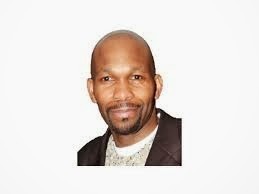 Brett A. Scudder
This particular post he shared struck a chord and I asked if he would agree to be a Guest Blogger. I hope you enjoy his commentary as much as I did and find reason to listen to the children, even the smallest of children, so we can protect their interests as well as the safety of their parents and caregivers.
(I placed certain sections in bold.)
GUEST BLOGGER: Brett A. Scudder of the New York Humanitarians Network "NYHN", NYC Community Activists Network, and SISFI's Abuse & Suicide First Aid Response and Wellness Centers “ASFARWC”
"Got a distress call from a 29y/o single mom going through real challenges with her mom that's affecting her 7y/o son. For the 2 1/2hrs we were on the phone she cried deeply expressing her not wanting to live, not wanting to wake up, being so tired, frustrated and disappointed with her mom and questioning the evil mindset she has and is dishing out on her and her son because they are now living with her. This triggered the issues of the suicide of her brother and challenges she faced because her brother took his life because she was ill and he felt that he couldn't take care of her nor watch her suffer like that. For the entire 2 1/2hrs I spoke only a few times to remind her to breathe as she opened up.
"She offloaded some deep, painful and hurting things and while she cried, her 7y/o son watched and listened as she tried to find balance in all the madness. After a while he figured it was time to step in so he walked up to here and I heard this, 'Mommy, why are you stressing so much, huh. You don't have to be so stressed. We don't have to stay here. We can leave and go somewhere else so you don't have to stress and cry so much. Mommy, please stop crying and let's go.'
"My eyes opened wide, ears perked up, I held my breath and my heart stopped beating, I was silent, intrigued, mesmerized and listened attentively to his every word as now he was right next to her talk and I could hear him clearly. I envisioned the look on his face while saying that and it just burned my heart, burned to know that at 7y/o he had to witness and experience seeing his mother break down like that. She had always been very careful of not breaking down in front of him but this time it was too much, too much for her heart and mind to handle and she just open the flood gates and let the tears flow.
"She tried telling him she wasn't crying and that she was ok but unbeknown to her, she was so caught up in the emotional breakdown she didn't realize what was happening to her and how she was reacting. I finally got her to calm down and relax enough to have a conversation with him so they both could breathe. She was so worn out she was tired but couldn't find sleep. I sent her one of my favorite 3hrs Zen/Spa instrumentals for them to lie down to and rest. I told her to keep me posted as the night progressed if she still wasn't able to sleep. She had to be at work a few hours later but managed to get some rest from what she text me when she got to work.
"The message in all this is, as adults and parents, when going through life’s challenges, stressors or traumatizing circumstances, our children are aware of, understand (to some extent) and are sometimes present during them, and what affects us affects them as well. They see, hear, know and understand more than we give them credit for (because of their age), especially the children who we believe don’t understand or can handle things. We misunderstand that age doesn’t limit intellect and so even at their young ages some of them truly do know and understand more than we know because we talk and act around them knowingly and unknowingly at times and they learn quickly. It’s not for them to be able to handle things, it’s for us to communicate with them so they understand the level that applies to them and being able to cope with and overcome the impacts.
"Too many of our youth are living the hurt, pain and suffering we as adults and parents face because we bring it to them, or we are around them while being impacted by challenges and our attitude, behavior and methods of dealing with and coping (or not) does impact them and we must recognize that. In most cases they don’t get emotional support to deal with the impacts of seeing a parent (especially a mother) go through their challenges and so they internalize the emotions which in far too many cases manifests into anger, violence, abuse and hatred of others and self and other behavioral issues. Yet, unchecked, we get angry and upset at them for their behavioral issues not realizing that we may very well have been the cause of the issues and now we're compounding it on them even more.
"This is a very serious issue and I can’t talk about it enough so let’s keep talking about it and helping ourselves and our children to effectively deal with life’s challenges because sometimes it’s not by our own doing that they happen but by those we allow in our lives.
"Be prudent in how you act and speak around children.
"I didn’t tell her that when she called I was on my way to the emergency room because I wasn’t feeling well so I couldn’t take her call or talk with her. I pretty much stopped in my tracks when I heard the distress in her voice so she could talk about what was happening. This way I would be able to see if it could wait for me to get checked out first. While she talked, I stood outside so as not to lose the call or have too much distractions. Thank God I was very well layered up for being out there so it was ok. I spent the night in the ER under observation and came home the next morning. No one ever plans for life challenges to hit us but when it does, the most important and life-saving thing one can have and hope for us someone willing to listen and take time to do so effectively.
"This is why I take my work so seriously because I know that at any breath a call can come in and it may be someone one step away from a life threatening situation and I must be ready to effectively react and respond to be that lifeline. If I told you how many suicidal cases I have and have worked with you’d be amazed. I LOVE my life, work and ministry of Love. I wouldn’t want to be anywhere or doing anything else than this. One Love."
* * *
As you know, I often write about The Adverse Childhood Experiences Study that proves negative childhood experiences can impact adult physical illness. My book describes my own traumatic experience and how my early childhood may have resulted in the terrible auto-immune diseases I suffer as an adult, including a bout with Stage 4B cancer.
Thank you, Brett, for being such a dedicated advocate for so many. Specifically, I thank you for your work on behalf of all our children.
 Brett A. Scudder
February 4, 2014
The Family Geek
It's okay with me that I wouldn't qualify to join the brainy characters on the television sitcom The Big Bang Theory (although a recent silly Facebook test tagged me as a 'Bernadette') but I have held a role in my family for many years that was self-imposed. I am the family geek.
I think it started in 1984 when, working at a local chapter of The American Heart Association, the first personal computers arrived in big heavy boxes and nobody on staff was willing to tear them open and set them up. I took the challenge and was so proud when that first, green glowing C prompt appeared. At 24 I could hear the Hallejuia chorus.
Personal computers have been my life since I started working as a newspaper reporter in 1980 and found writing on deadline exhilirating and next-to-impossible without my PC. My typing speed went to a phenomenal 95 words per minute but I was writing! Glory be! I still bowed down to the newsroom geeks who could 'magically' retrieve a vanished story. I was so intriqued when my painstakingly written news story had gone *poof* from my seat, they were always able to dig it up somewhere. A few years later, while working for TIME, Inc. always at warp speed on deadline, my PC actually starting smoking! All that helped then was a handy fire extinguisher. And all I could worry about while the techhies sprayed it with foam was where had my files gone?
So, it was no surprise that when computers came home, I was elected (or self-elected) to set them up and manage their insides. As they got more and more sophisticated, I had help from a local master geek and am proud to say I recently learned how to use an Apple MAC. I have rudimentary knowledge but enough that it is making me rethink my PC-only stance and consider getting a MAC myself.
How my very moderate tech savvy extended to our in-home phones, printers, televisions, and other electronic devices, I have no idea. I guess it's because I will read the instructions and wait on hold for tech support, as needed. And, I have the time due to my chronic illnesses that keep me home a lot. Finally, I hate outdated tech products so I try to stay ahead of the curve as often as my pocketbook will allow.
Except for one area of mystery - the darn cell phone. Planned obsolescence has gone too far with cell phones, in my opinion. No sooner do you buy one and it's a goner with no support from any vendor. We started with walkie-talkie type phones with our children, then earned flip phones that got smaller and smaller, and now have smart phones that are larger than our pockets, closer in size to iPads or Kindles or Nooks - really just mini computers. The mystery is: Why do I still get butt calls?
My husband remains the carpenter, plumber, mechanic, electrician, and all-around fix-it guy, but when it comes to electronics I am proud to say - as the only female in my family - that the 'go
-to-gal' is me.
Ain't no small feat, if I might say so myself.
I think it started in 1984 when, working at a local chapter of The American Heart Association, the first personal computers arrived in big heavy boxes and nobody on staff was willing to tear them open and set them up. I took the challenge and was so proud when that first, green glowing C prompt appeared. At 24 I could hear the Hallejuia chorus.
Personal computers have been my life since I started working as a newspaper reporter in 1980 and found writing on deadline exhilirating and next-to-impossible without my PC. My typing speed went to a phenomenal 95 words per minute but I was writing! Glory be! I still bowed down to the newsroom geeks who could 'magically' retrieve a vanished story. I was so intriqued when my painstakingly written news story had gone *poof* from my seat, they were always able to dig it up somewhere. A few years later, while working for TIME, Inc. always at warp speed on deadline, my PC actually starting smoking! All that helped then was a handy fire extinguisher. And all I could worry about while the techhies sprayed it with foam was where had my files gone?
So, it was no surprise that when computers came home, I was elected (or self-elected) to set them up and manage their insides. As they got more and more sophisticated, I had help from a local master geek and am proud to say I recently learned how to use an Apple MAC. I have rudimentary knowledge but enough that it is making me rethink my PC-only stance and consider getting a MAC myself.
How my very moderate tech savvy extended to our in-home phones, printers, televisions, and other electronic devices, I have no idea. I guess it's because I will read the instructions and wait on hold for tech support, as needed. And, I have the time due to my chronic illnesses that keep me home a lot. Finally, I hate outdated tech products so I try to stay ahead of the curve as often as my pocketbook will allow.
Except for one area of mystery - the darn cell phone. Planned obsolescence has gone too far with cell phones, in my opinion. No sooner do you buy one and it's a goner with no support from any vendor. We started with walkie-talkie type phones with our children, then earned flip phones that got smaller and smaller, and now have smart phones that are larger than our pockets, closer in size to iPads or Kindles or Nooks - really just mini computers. The mystery is: Why do I still get butt calls?
My husband remains the carpenter, plumber, mechanic, electrician, and all-around fix-it guy, but when it comes to electronics I am proud to say - as the only female in my family - that the 'go
-to-gal' is me.
Ain't no small feat, if I might say so myself.

January 27, 2014
When the Survivor Needs Help to Survive
Everyone knows me as a survivor and relies on me for guidance. It's a role I selected naturally and honestly after a two-pronged, near-fatal battle with cancer and Lupus in the late 1990s followed by post-traumatic stress disorder, depression and continuing chronic illness. Add early childhood maltreatment as evidenced by the National Centers for Disease Control and Prevention 20-year Adverse Childhood Effects Study that links childhood trauma to long-term health and social consequences and it's a miracle I stand upright.
So it's no surprise that this survivor needs help to survive now and then; particularly after her beloved brother commits suicide six months prior and sends her into a tailspin. I know all the right things to do but mind over matter is easier than it sounds, even for a 'survivor' like me who inspires others to keep on keeping on. In fact, a friend recently told me I need to read my own book; but I simply think I need to add a Survivor's Survival Kit to the second edition.
Perhaps I can fashion such a kit out of the the essentials the United States Government says we need in case of an emergency:
WATER: Yup. Stay hydrated to replace all the tears. One gallon of water per day for every day I cry for more than one hour.
FOOD: Proteins are best to keep up my strength and colorful fruits make me smile but carbohydrates, especially cake and cookies, are permitted. They make me feel better, even if only for a short while. All should be non-perishable in case I don't get out of bed.
BATTERY-POWERED OR HAND CRANK RADIO: Ha, ha, ha! Nope. I'll take my chances with my laptop so I can see how all the happy, pretty people are living their care-free lives. I will also get briefly elevated or further saddened by all the sentimental viral posts I must see or watch plus the funny ones that do make me crack a smile here and there.
FLASHLIGHT AND EXTRA BATTERIES: Okay. I'll have that, too, for when I can't sleep and I need to read under the covers.
FIRST AID KIT: Ideally, mine will be filled with a Peach Bellini, a card from a friend, an amethyst crystal that belonged to my brother, and all my medications so I don't have to worry about refills EVER.
WHISTLE TO SIGNAL FOR HELP: My dog knows my whistle and curls up next to me when I am sad or suffering.
DUST MASK: This will help keep visitors away. They will think I have a disease.
DUCT TAPE: This is used to cover the mouths of all those asking for my advice. I'm sorry I can't help you right now. SHUT UP!
MOIST TOWELETTES: The closest I get to a shower some days.
WRENCH OR PLIERS: To throw at things when I'm angry.
MANUAL CAN OPENER: Also good for throwing.
LOCAL MAPS: I'm not going anywhere so I don't think I need these in my survival kit. If I did go somewhere, it would be a place as yet unknown to me or others.
CELL PHONE WITH SOLAR CHARGER: Do they really make those things? And if everyone is in survival mode, will we all have them? I doubt it so who would I be calling? In my opinion, also good for throwing.
OTHER: This is a random category I have added. It holds many boxes of tissues, cream for my sore nose, English breakfast tea, a personal chef, Bananagrams, stupid television, books, and, most importantly, the will to live.
That's my kit! What do you think? Have any things you can add? Right now, though, I'm going to watch Let's Make A Deal. Comedian Wayne Brady as the host can always brighten my day.

So it's no surprise that this survivor needs help to survive now and then; particularly after her beloved brother commits suicide six months prior and sends her into a tailspin. I know all the right things to do but mind over matter is easier than it sounds, even for a 'survivor' like me who inspires others to keep on keeping on. In fact, a friend recently told me I need to read my own book; but I simply think I need to add a Survivor's Survival Kit to the second edition.
Perhaps I can fashion such a kit out of the the essentials the United States Government says we need in case of an emergency:
WATER: Yup. Stay hydrated to replace all the tears. One gallon of water per day for every day I cry for more than one hour.
FOOD: Proteins are best to keep up my strength and colorful fruits make me smile but carbohydrates, especially cake and cookies, are permitted. They make me feel better, even if only for a short while. All should be non-perishable in case I don't get out of bed.
BATTERY-POWERED OR HAND CRANK RADIO: Ha, ha, ha! Nope. I'll take my chances with my laptop so I can see how all the happy, pretty people are living their care-free lives. I will also get briefly elevated or further saddened by all the sentimental viral posts I must see or watch plus the funny ones that do make me crack a smile here and there.
FLASHLIGHT AND EXTRA BATTERIES: Okay. I'll have that, too, for when I can't sleep and I need to read under the covers.
FIRST AID KIT: Ideally, mine will be filled with a Peach Bellini, a card from a friend, an amethyst crystal that belonged to my brother, and all my medications so I don't have to worry about refills EVER.
WHISTLE TO SIGNAL FOR HELP: My dog knows my whistle and curls up next to me when I am sad or suffering.
DUST MASK: This will help keep visitors away. They will think I have a disease.
DUCT TAPE: This is used to cover the mouths of all those asking for my advice. I'm sorry I can't help you right now. SHUT UP!
MOIST TOWELETTES: The closest I get to a shower some days.
WRENCH OR PLIERS: To throw at things when I'm angry.
MANUAL CAN OPENER: Also good for throwing.
LOCAL MAPS: I'm not going anywhere so I don't think I need these in my survival kit. If I did go somewhere, it would be a place as yet unknown to me or others.
CELL PHONE WITH SOLAR CHARGER: Do they really make those things? And if everyone is in survival mode, will we all have them? I doubt it so who would I be calling? In my opinion, also good for throwing.
OTHER: This is a random category I have added. It holds many boxes of tissues, cream for my sore nose, English breakfast tea, a personal chef, Bananagrams, stupid television, books, and, most importantly, the will to live.
That's my kit! What do you think? Have any things you can add? Right now, though, I'm going to watch Let's Make A Deal. Comedian Wayne Brady as the host can always brighten my day.

January 10, 2014
What the Dead Do
It's been four months since losing my brother to suicide and I have just spent an amazing week with my eldest sister - she and I alone. Because she is 18 years older than me and our brother was 14 years older than me, I did not have much 'we' time with my sister over my lifetime. She married young and started raising a family while I was still learning the alphabet. My brother, however, seemed ever-present and a companion in good times and bad. His loss, as readers of this blog know, has been particularly hard on me.
Yesterday, my sister and I went on the Silent Cities tour at Brookgreen Gardens in Murrells Inlet, South Carolina where I own a condo. Besides being bounced around like balls in a Bingo barrel, we didn't fully realize where we were headed for the two-hour-tour. We visited cemeteries in this 4000-acre plus plantation, gardens, and sculpture fantasia - one erected by the original European owners in the 1700s and another cobbled together on owner-donated scrub land by the African slaves who had worked the richest rice plantation in America pre- and post-Civil War.
Some of the Africans were enslaved when born and free when they died. Many were children in both. Understandably, the customs of each were vastly different, mainly due to economics. The European-Americans erected large rectangular monuments using marble and lengthy engravings about how one lived and died. The slaves would mark a loved one's grave with a shell or a rock or a hardened bag of cement. Some fashioned headstones and engraved them using a nail. Particularly touching was a child's grave with ancient toys placed all around it; untouched as is the custom. Anything placed on a slave grave stays at the gravesite and Brookgreen staff make sure to honor this tradition.
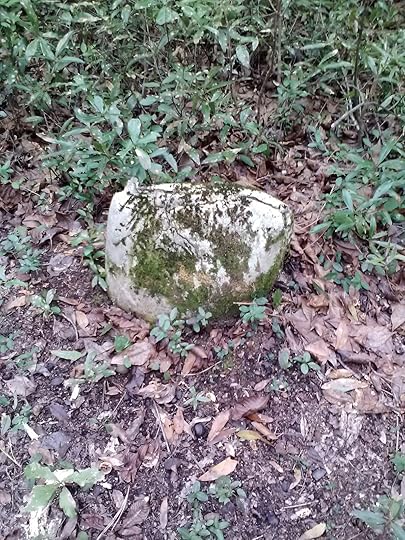 A slave grave marker created using a bag of cement. So stepping lightly among the barely visible 'head' stones and the larger more prominent ones, I realized that my sister and I were visiting cemeteries on the date our father died in 2002, January 9th. I thought about this and teared up thinking how ironic it was that we were there on this day and, also, visiting the Silent Cities while still seriously mourning our brother.
Because of an enigma that occurred on the day he died, our sign that my brother is near is a soaring eagle so we kept looking for one to no avail. However, on the way out, we were struck by the beauty of an eagle sculpture crafted to appear in flight. There was our eagle.
Finally, I realized that our father and brother were busy arranging all of this - bringing my sister and I together, closer than ever before. We vowed to repeat a trip yearly. This never would have came about if our brother hadn't passed away.
The dead do things we don't expect. Thank you, Daddy. Thank you, Steve.
* * *
I would be remiss if I didn't mention my two other living siblings who I love dearly and grew up with in an unusually blended household as described in my book DYING TO LIVE: Running backwards through cancer, Lupus and chronic illness. I always know they are there for me and I treasure our times together past and present.
Yesterday, my sister and I went on the Silent Cities tour at Brookgreen Gardens in Murrells Inlet, South Carolina where I own a condo. Besides being bounced around like balls in a Bingo barrel, we didn't fully realize where we were headed for the two-hour-tour. We visited cemeteries in this 4000-acre plus plantation, gardens, and sculpture fantasia - one erected by the original European owners in the 1700s and another cobbled together on owner-donated scrub land by the African slaves who had worked the richest rice plantation in America pre- and post-Civil War.
Some of the Africans were enslaved when born and free when they died. Many were children in both. Understandably, the customs of each were vastly different, mainly due to economics. The European-Americans erected large rectangular monuments using marble and lengthy engravings about how one lived and died. The slaves would mark a loved one's grave with a shell or a rock or a hardened bag of cement. Some fashioned headstones and engraved them using a nail. Particularly touching was a child's grave with ancient toys placed all around it; untouched as is the custom. Anything placed on a slave grave stays at the gravesite and Brookgreen staff make sure to honor this tradition.
 A slave grave marker created using a bag of cement. So stepping lightly among the barely visible 'head' stones and the larger more prominent ones, I realized that my sister and I were visiting cemeteries on the date our father died in 2002, January 9th. I thought about this and teared up thinking how ironic it was that we were there on this day and, also, visiting the Silent Cities while still seriously mourning our brother.
Because of an enigma that occurred on the day he died, our sign that my brother is near is a soaring eagle so we kept looking for one to no avail. However, on the way out, we were struck by the beauty of an eagle sculpture crafted to appear in flight. There was our eagle.
Finally, I realized that our father and brother were busy arranging all of this - bringing my sister and I together, closer than ever before. We vowed to repeat a trip yearly. This never would have came about if our brother hadn't passed away.
The dead do things we don't expect. Thank you, Daddy. Thank you, Steve.
* * *
I would be remiss if I didn't mention my two other living siblings who I love dearly and grew up with in an unusually blended household as described in my book DYING TO LIVE: Running backwards through cancer, Lupus and chronic illness. I always know they are there for me and I treasure our times together past and present.
December 23, 2013
Christmas Step-In-Time?
Is the Christmas spirit here in time to spare me my grief over the loss of my brother to suicide four months ago? To file away years of Christmas memories that are near and dear? To say 'enough' and create new memories; change things up so my heart can be open to reinventing myself after yet another trauma?
I'm doing my best yet I feel, like most 'survivors' of disease, trauma, or loss, that it might be impossible.
The movie Saving Mr. Banks about P. L. Travers, the author of the Mary Poppins series, sheds light on this difficult topic. Expecting a lighthearted film about Walt Disney and 'Mrs. Travers,' as she insists she be called, I was proven wrong yet not disappointed.
[SPOILER ALERT]
An early childhood filled with turmoil and loss, left the very grown-up Mrs. Travers (nee Helen Lyndon Goff) unable to part with her imaginary world except as she wrote it. She was unable to give the gift of her pretend paradise to the rest of us on film a la Disney's vision for nearly 20 years and Disney never earned authorization for any of her subsequent books. Ultimately, she did but was none too pleased with the results.
You see, Helen Goff retreated into a world of fantasy (enabled and encouraged by her charismatic yet alcoholic father) as a balm to harsher realties. So, too, did Disney in his own way, according to the movie. Yet Disney chose to change his real life experiences with his fanciful mind, creating characters and rewriting history to cope. That, he explains to Mrs. Travers, is how to escape the awfulness of her youth and turn it into something wonderful. I was awestruck by the concept.
[END ALERT]
As a lifelong writer, I penned non-fiction works; first for newspapers and magazines and then for corporate clients and, finally, in a memoir about dealing with near-fatal and chronic illness. I haven't descended (or ascended) into a world of fantasy - yet. I have started fiction novels but have preferred to pour out my heart in truth. Maybe it's time to stop. Maybe it's time to turn my attention towards characters and situations I can control with happy outcomes. I simply do not know.
At this Christmas crossroads, I find myself longing for my fantastical brother who, like Disney, could make up a world with a few paintbrush strokes as well as silly songs and stories. Imagining the end he chose for himself is nearly as unbearable as it is unacceptable. I know I have to deal.
Step In Time is one of the most favorite and beloved songs from the 1964 movie version of Mary Poppins. It's refrain: "Never need a reason, never need a rhyme..." embodies living with joy; without a care in the world. It's a song I danced around and around with my children when they were young. It's a song that fills you with hope and the 'happies,' as my children called it.
And it's a song I can choose to play over and over in my head to make this Christmas new and fresh and imagine my brother, like carefree Bert, doing the dance atop the clouds.
Merry Christmas...
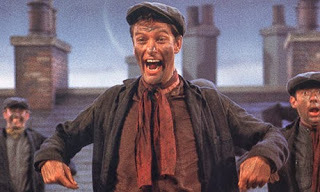 Dick Van Dyke in Mary Poppins; 1964
I'm doing my best yet I feel, like most 'survivors' of disease, trauma, or loss, that it might be impossible.
The movie Saving Mr. Banks about P. L. Travers, the author of the Mary Poppins series, sheds light on this difficult topic. Expecting a lighthearted film about Walt Disney and 'Mrs. Travers,' as she insists she be called, I was proven wrong yet not disappointed.
[SPOILER ALERT]
An early childhood filled with turmoil and loss, left the very grown-up Mrs. Travers (nee Helen Lyndon Goff) unable to part with her imaginary world except as she wrote it. She was unable to give the gift of her pretend paradise to the rest of us on film a la Disney's vision for nearly 20 years and Disney never earned authorization for any of her subsequent books. Ultimately, she did but was none too pleased with the results.
You see, Helen Goff retreated into a world of fantasy (enabled and encouraged by her charismatic yet alcoholic father) as a balm to harsher realties. So, too, did Disney in his own way, according to the movie. Yet Disney chose to change his real life experiences with his fanciful mind, creating characters and rewriting history to cope. That, he explains to Mrs. Travers, is how to escape the awfulness of her youth and turn it into something wonderful. I was awestruck by the concept.
[END ALERT]
As a lifelong writer, I penned non-fiction works; first for newspapers and magazines and then for corporate clients and, finally, in a memoir about dealing with near-fatal and chronic illness. I haven't descended (or ascended) into a world of fantasy - yet. I have started fiction novels but have preferred to pour out my heart in truth. Maybe it's time to stop. Maybe it's time to turn my attention towards characters and situations I can control with happy outcomes. I simply do not know.
At this Christmas crossroads, I find myself longing for my fantastical brother who, like Disney, could make up a world with a few paintbrush strokes as well as silly songs and stories. Imagining the end he chose for himself is nearly as unbearable as it is unacceptable. I know I have to deal.
Step In Time is one of the most favorite and beloved songs from the 1964 movie version of Mary Poppins. It's refrain: "Never need a reason, never need a rhyme..." embodies living with joy; without a care in the world. It's a song I danced around and around with my children when they were young. It's a song that fills you with hope and the 'happies,' as my children called it.
And it's a song I can choose to play over and over in my head to make this Christmas new and fresh and imagine my brother, like carefree Bert, doing the dance atop the clouds.
Merry Christmas...
 Dick Van Dyke in Mary Poppins; 1964