Matthew C. Mitchell's Blog, page 71
March 8, 2017
Goods Books about the Books of Kings
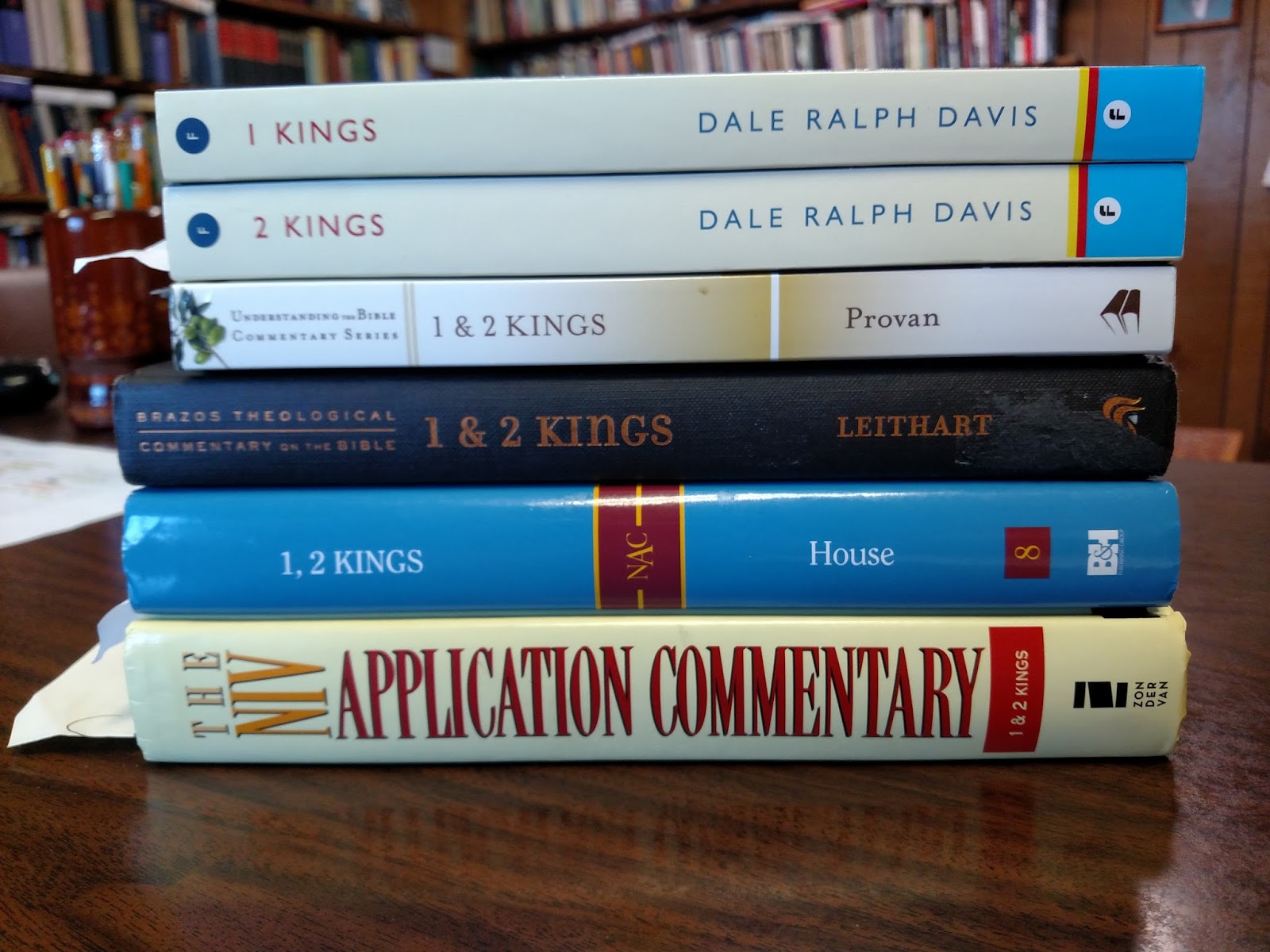 I'm going to miss these guys.
They were my constant companions for the last year as we studied the Books of Kings in the Old Testament.
I recommend each of these commentaries for their unique contribution:
Dale Ralph Davis, 1 Kings: The Wisdom and the Folly & 2 Kings: The Power and the Fury.
Dale Davis writes my favorite commentaries for help in preaching Old Testament narrative books. He is an bona fide OT scholar and it shows, but his commentaries are edited versions of his sermons on through these books, so they are pastoral and practical, as well.
Iain W. Provan, 1-2 Kings (NIBC)
Provan is a master of concision and always sees something that the other commentators miss. His book forms the basis for the notes in the ESV Study Bible.
Peter Leithart, 1-2 Kings (Brazos TCOTB)
Leithart is good for opening up maximal possibilities. I don't pick up everything he lays down, but he makes fascinating connections between various themes, words, characters, and other items across the testaments.
Paul R. House, 1-2 Kings (NAC Vol. 8)
If I was only allowed one commentary on 1-2 Kings, I would probably buy this one because House does it all in solid workmanlike prose. He's not as fun to read as Davis, but he really gets the job done. I always checked everything I planned to say on Sundays against the discussion in this book.
August H. Konkel, 1-2 Kings (NIVAC)
I've had Konkel's commentary the longest of the set. I used it to teach the youth boys' class the books of kings a few years ago, and it served me well. As with others in this series, there is a major emphasis in each section on application to life.


March 5, 2017
Jesus Paid It All
 All four messages from the short series on the finished work of Christ back in March of 2016.
1. Jesus Paid It All - Isaiah 53
2. What If Jesus Had Not Paid It All? - John 19:30
3. Freed from Debt - 1 Peter 2:24
4. Brought Back from the Dead - Hebrews 13:20-21
The King of King in the Books of Kings
 All 30 messages in this sermon series that ran from April 3, 2016 to March 5, 2017.
01. Who Will Be King?
02. The Wisdom of the King
03. The Temple of the King
04. The Incomparable King of the Temple
05. A Breathtaking King
06. The Turned King and the Torn Kingdom
07. The Two Kings and the Tearing of the Kingdom
08. The Word of the LORD
09. In the Eyes of the LORD
10. The LORD Lives
11. The LORD Is God!
12. The LORD Is Still God.
13. “You Will Know that I am the LORD”
14. "Thus Saith the LORD!"
15. What the LORD Says
16. Is There No God in Israel?
17. Where Is the God of Elijah?
18. How NOT To Relate to God
19. God of Wonders
20. No God in the All the World Except in Israel
21. LORD, Open Our Eyes!
22. "If the LORD Should Open the Floodgates of Heaven"
23. "I Will Avenge the Blood of My Servants"
24. "Long Live the King!"
25. God Is Good Even When the King Is Bad
26. “Good Kings, Bad Kings, Good Things, Bad Things”
27. The Last King of Israel
28. "You Alone, O LORD, Are God"
29. "I Have Found the Book of the Law"
30. The Table of the King
[Matt's Messages] "The Table of the King"
 “The Table of the King”
The King of Kings in the Books of Kings
March 5, 2017 :: 2 Kings 23:31-25:30
We’ve been in the Books of Kings now for 30 messages. On and off now for 11 months from the beginning of April 2016 to the beginning of March 2017.
And all of that time, the Books of Kings have been particularly repetitive.
There is a broken record playing throughout the Books of Kings and the song is not, for the most part, a happy one.
This book is, after all, a tragedy.
Today, we’re going to read the ending, and it is NOT a happy one.
In fact, I think it would be easy to argue that these chapters chronicle the saddest event in Israel’s history between the Fall of Genesis 3 and the trial of Jesus Christ.
These are the worst days of the nation of Israel in the Old Testament.
These are the days when the southern kingdom, called Judah, went into exile, “went into captivity away from her land” (2 Kings 25:21).
This tragic day has been coming for a very long time.
If you think about it, ever since Abraham was given the promises of offspring, land, and blessing, the story of Israel was on the rise.
In 2003, we began studying that Big Story of the Old Testament. And in Genesis, we saw the promises be fulfilled slowly but surely.
Offspring. Blessing. And Land.
In Exodus, the people grew and grew. And the LORD blessed them.
And then in Numbers, they marched to the Promised Land.
And God promised them that if they obeyed the Law, if they were a thumbs-up people, He would continue to bless them. And they would possess the Land.
And then in Joshua they actually began to possess the land.
But then the downward spiral began. The book of Judges.
There were bright spots along the way like Ruth and Boaz and even Samuel.
But they were never quite what they ought to be.
And the threat of exile began to gather like storm clouds on the horizon.
God gave them a king after His own heart in David.
And then David’s son was given wisdom and a glorious golden kingdom.
That was the highpoint of the fulfillment of all of the promises so far.
But then it began to unravel.
The kingdom was torn in two. Everything we’ve read now for the last year.
And the two kingdoms went up and down. The northern kingdom much faster than the southern kingdom. But both of them failing to keep the covenant.
Always, God has a remnant. He’s always at work caring for His people. We saw that in Elijah and Elisha and every thumbs-up king.
But the slide has been ever downward. And now we’ve reached the bottom.
Last week, we read about one of those bright spots along the way. Godly King Josiah who led a biblical reformation in Judah.
But even his biblical godliness was not enough to stem the tide of what was to come.
And now he’s dead, and his son Jehoahaz has become king. In less than 25 years from Josiah’s death, Judah will have run through 4 bad kings, and the whole nation will be destroyed.
This is that sad story.
The title of today’s message is “The Table of the King,” but I’m not going to explain it until the very end.
Hang with me, and I’ll explain it when we get there.
I don’t think you’ll be surprised by what we learn today of what we can apply to our lives.
I have four headings that I want to tell this story under and they should all be very familiar for those who have tracked with me throughout this sermon series. They are all things we’ve talked about again and again and again throughout the Books of Kings.
Here’s the first one:
#1. THE EYES OF THE LORD.
What matters most is in any given situation is God’s evaluation of it.
We’ve seen this phrase again and again. “The eyes of the LORD.” It appears here in verse 32. Let’s start in verse 31. 2 Kings 23:31.
“Jehoahaz was twenty-three years old when he became king, and he reigned in Jerusalem three months. His mother's name was Hamutal daughter of Jeremiah; she was from Libnah. [Thumbs-up or thumbs-down?] He did evil in the eyes of the LORD, just as his fathers had done.”
How many times have we asked the question, “Thumbs up or thumbs down?” over the last year?
Like a broken record! Unfortunately, the rest of these kings of Judah are all thumbs-down. No more good ones.
This one only makes it 3 months.
And why is he thumbs-down?
It’s not because he wasn’t smart.
It’s not because he wasn’t politically savvy.
It’s not because he didn’t have good ideas about how to run a big organization.
It’s not because he lacked royal skills.
It’s because (v.32), “He did evil in the eyes of the LORD.”
That’s why he’s thumbs down.
His great-grandpa Manasseh ruled for 55 years. He must have been pretty good at the king thing.
But he was thumbs-down, too.
Because he didn’t do his one job in the eyes of the LORD. He had just one job, and he didn’t do it.
It’s what God thinks about you or me or about anything that is the most important thing.
It doesn’t matter what the world thinks.
It doesn’t matter what our friends think.
It doesn’t matter what our co-workers think.
It doesn’t matter what our family thinks.
It doesn’t even really matter what we think.
Like it matters what God thinks!
What really matters in life is how things stand in the eyes of the LORD.
If we truly get that, we will live very differently. Amen?
What if all you cared about ultimately was the Lord’s opinion?
And you lived for Him and Him alone?
That’s how Jesus lived. He wasn’t controlled by anything but bringing glory to His Father whom He loved.
Remember, when these kings are at their best, they remind us of King Jesus.
But not Jehoahaz. He did evil in the eyes of the LORD, just as his fathers had done.
Not his daddy. King Josiah had been two thumbs-up.
But Jehoahaz went the way of so many of the rest of his forefathers and continued their thumbs-down ways. V.33
“Pharaoh Neco put him in chains at Riblah in the land of Hamath so that he might not reign in Jerusalem, and he imposed on Judah a levy of a hundred talents of silver and a talent of gold. Pharaoh Neco made Eliakim son of Josiah king in place of his father Josiah and changed Eliakim's name to Jehoiakim. But he took Jehoahaz and carried him off to Egypt, and there he died.”
Here’s where it’s gotten to–the king of Egypt is deciding who will be the king of Judah!
Jehoahaz is out, and his brother renamed Jehoiakim is in.
And he’s a real stinker.
If you want to know how bad Jehoiakim was, then read the book of Jeremiah. Jeremiah is prophesying during this time period.
Jehoiakim is living under Neco’s thumb and levies a great big tax on the people, but he still finds enough money in the budget to build a big palace for himself. And he kills prophets. And he tears up the word of God and burns it in a fire to keep himself warm.
He’s nothing like his dad. V.35
“Jehoiakim paid Pharaoh Neco the silver and gold he demanded. In order to do so, he taxed the land and exacted the silver and gold from the people of the land according to their assessments. Jehoiakim was twenty-five years old when he became king, and he reigned in Jerusalem eleven years. His mother's name was Zebidah daughter of Pedaiah; she was from Rumah. And he did evil in the eyes of the LORD, just as his fathers had done.”
Now, here’s the second thing we’re going to see. I’d be willing to bet that some of you could nail if I gave you a second.
Here it is:
#2. THE WORD OF THE LORD.
How many times have we seen that?
God has promised some things.
God has said some things.
And those things will happen. For certain. You can count on it.
Chapter 24, verse 1.
“During Jehoiakim's reign, Nebuchadnezzar king of Babylon invaded the land, and Jehoiakim became his vassal for three years. But then he changed his mind and rebelled against Nebuchadnezzar. The LORD sent Babylonian, Aramean, Moabite and Ammonite raiders against him. He sent them to destroy Judah, in accordance with the word of the LORD proclaimed by his servants the prophets.”
This is just what God had said.
God has promised that Judah will be destroyed, and He will see to it that it happens just as he said.
By the way, this is when Daniel and his friends get taken into captivity in Babylon.
Daniel, Hananiah, Mishael and Azariah. Or as they were also called “Shadrach; Meshach, and Abednego.”
Taken into captivity during the failed reign of King Jehoiakim.
Things got really bad.
But it wasn’t because Nebuchadnezzar was so powerful.
It’s because the LORD had threatened (which is a kind of promise) that this would happen. V.3
“Surely these things happened to Judah according to the LORD's command, in order to remove them from his presence because of the sins of Manasseh and all he had done, including the shedding of innocent blood. For he had filled Jerusalem with innocent blood, and the LORD was not willing to forgive.”
They had reached the limit of God’s longsuffering patience.
And He had to keep His promises.
Because God is faithful.
All of those things that God said He would do in Deuteronomy, if the nation forsook Him and broke the covenant? He had to do those things or He wouldn’t have been faithful to His end of the covenant!
See, we should be glad that God keeps His threats, because it’s another proof that God is faithful to keep His promises.
One of the biggest themes that runs through the whole Old Testament, we’ve seen it again and again, is that God always keeps His promises.
He doesn’t ever say, “I know I promised that but J/K. I was just kidding.”
And if He never carried out His threats, it would bring His faithfulness into dubiety.
So it’s good news for us. But it was bad news for Jehoiakim and Judah. V.5
“As for the other events of Jehoiakim's reign, and all he did, are they not written in the book of the annals of the kings of Judah? Jehoiakim rested with his fathers. And Jehoiachin his son succeeded him as king.” v.7
“The king of Egypt did not march out from his own country again, because the king of Babylon had taken all his territory, from the Wadi of Egypt to the Euphrates River.”
By the way, that’s called the “Battle of Carchemish.” You might have heard about it in your world history classes. It was kind of a big deal.
Egypt never recovered from that. Nebuchadnezzar was now the big dog of the whole region. V.8
“Jehoiachin was eighteen years old when he became king, and he reigned in Jerusalem three months. His mother's name was Nehushta daughter of Elnathan; she was from Jerusalem. He did evil in the eyes of the LORD, just as his father had done.
At that time the officers of Nebuchadnezzar king of Babylon advanced on Jerusalem and laid siege to it, and Nebuchadnezzar himself came up to the city while his officers were besieging it.
Jehoiachin king of Judah, his mother, his attendants, his nobles and his officials all surrendered to him. In the eighth year of the reign of the king of Babylon, he took Jehoiachin prisoner.”
By the way, this is when the prophet Ezekiel was taken into captivity himself.
He begins his ministry in the fifth year of Jehoiachin’s exile (Ez. 1:2).
You see how all of the Bible is coming together and fits together?
Why did all of these bad things happen to them? Was it random chance? V.13
“As the LORD had declared [it’s because of the word of the LORD], Nebuchadnezzar removed all the treasures from the temple of the LORD and from the royal palace, and took away all the gold articles that Solomon king of Israel had made for the temple of the LORD.
[Do you remember all of that gold? It’s gone.]
He carried into exile all Jerusalem: all the officers and fighting men, and all the craftsmen and artisans–a total of ten thousand. Only the poorest people of the land were left.
Nebuchadnezzar took Jehoiachin captive to Babylon. [Remember that. We’ll come back to that.] He also took from Jerusalem to Babylon the king's mother, his wives, his officials and the leading men of the land. The king of Babylon also deported to Babylon the entire force of seven thousand fighting men, strong and fit for war, and a thousand craftsmen and artisans.”
And now he makes the decision about who the king of Judah will be. The king of Babylon decides who will be the king of Judah. V.17
“He made Mattaniah, Jehoiachin's uncle, king in his place and changed his name to Zedekiah. Zedekiah was twenty-one years old when he became king, and he reigned in Jerusalem eleven years. His mother's name was Hamutal daughter of Jeremiah; she was from Libnah. [Last one. Ready? Thumbs up or thumbs down?] He did evil in the eyes of the LORD, just as Jehoiakim had done. It was because of the LORD's anger that all this happened to Jerusalem and Judah, and in the end he thrust them from his presence.”
#3. THE ANGER OF THE LORD.
All of this did not happen because Babylon was so great.
It happened because God was so angry.
Righteously, justly, perfectly, virtuously angry.
We have trouble with that because our anger goes so wrong so often.
We’re not that familiar with righteous anger.
But God does anger perfectly.
And this was His perfect righteous anger at work.
Now, you need to know that Zedekiah was a wimpy king. He was one of those put a finger to the wind to decide what to do kind of guys.
He was evil like Jehoiakim or Manasseh, but he was evil because he just did what he thought was politically expedient, not what was righteous.
For example the last sentence of verse 20, “Now Zedekiah rebelled against the king of Babylon.”
That sounds good! But if you read the book of Jeremiah, you find out that that’s the exact opposite of what God had told Zedekiah to do through the prophet.
God had told them to submit to Babylon, so of course, Zedekiah does the opposite!
And now the flood of judgment comes. Because of the anger of the LORD. Chapter 25.
“So in the ninth year of Zedekiah's reign, on the tenth day of the tenth month, Nebuchadnezzar king of Babylon marched against Jerusalem with his whole army. He encamped outside the city and built siege works all around it. The city was kept under siege until the eleventh year of King Zedekiah. [That’s two years. And there is no last second rescue by the angel of the LORD.]
By the ninth day of the fourth month the famine in the city had become so severe that there was no food for the people to eat. Then the city wall was broken through, and the whole army fled at night through the gate between the two walls near the king's garden, though the Babylonians were surrounding the city. They fled toward the Arabah, but the Babylonian army pursued the king and overtook him in the plains of Jericho. All his soldiers were separated from him and scattered, and he was captured. He was taken to the king of Babylon at Riblah, where sentence was pronounced on him.
They killed the sons of Zedekiah before his eyes. Then they put out his eyes, bound him with bronze shackles and took him to Babylon. [Last thing he ever saw.]
On the seventh day of the fifth month, in the nineteenth year of Nebuchadnezzar king of Babylon, Nebuzaradan commander of the imperial guard, an official of the king of Babylon, came to Jerusalem.
He set fire to the temple of the LORD, the royal palace and all the houses of Jerusalem. Every important building he burned down.”
Remember when they built that temple?
And all that it stood for? The very presence of God?
They are being thrust out of His presence.
He’s left town, and they are being forced out, too. V.10
“The whole Babylonian army, under the commander of the imperial guard, broke down the walls around Jerusalem. Nebuzaradan the commander of the guard carried into exile the people who remained in the city, along with the rest of the populace and those who had gone over to the king of Babylon. But the commander left behind some of the poorest people of the land to work the vineyards and fields.
[They dismantled the temple.]
The Babylonians broke up the bronze pillars, the movable stands and the bronze Sea that were at the temple of the LORD and they carried the bronze to Babylon. They also took away the pots, shovels, wick trimmers, dishes and all the bronze articles used in the temple service. The commander of the imperial guard took away the censers and sprinkling bowls–all that were made of pure gold or silver.
The bronze from the two pillars, the Sea and the movable stands, which Solomon had made for the temple of the LORD, was more than could be weighed. Each pillar was twenty-seven feet high. The bronze capital on top of one pillar was four and a half feet high and was decorated with a network and pomegranates of bronze all around. The other pillar, with its network, was similar.”
Remember when they built that? The gold, the silver, the bronze.
It’s all gone. It’s all undone.
You feel like there should be some judgment to come on Babylon for this.
(And there will be. The book of Habbakuk tells us there will be.)
But this is judgment on Judah. And it’s devastating. V.18
“The commander of the guard took as prisoners Seraiah the chief priest, Zephaniah the priest next in rank and the three doorkeepers. Of those still in the city, he took the officer in charge of the fighting men and five royal advisers. He also took the secretary who was chief officer in charge of conscripting the people of the land and sixty of his men who were found in the city. [What did he do with them?] Nebuzaradan the commander took them all and brought them to the king of Babylon at Riblah. There at Riblah, in the land of Hamath, the king had them executed. So Judah went into captivity, away from her land.”
That is one of the saddest sentences in the whole Old Testament.
This afternoon, you should read the book of Lamentations to see how Israel felt at this very moment.
There’s a whole book in your Bible just to record how sad they were about this event.
We are missing what God has to say to us if we don’t feel some of the sorrow of this tragic moment.
“So Judah went into captivity, away from her land.” V.22
“Nebuchadnezzar king of Babylon appointed Gedaliah son of Ahikam, the son of Shaphan, to be over the people he had left behind in Judah. [He’s not a king. He’s a governor. And he’s not a son of David. There is now no son of David on the throne in Judah.]
When all the army officers and their men heard that the king of Babylon had appointed Gedaliah as governor, they came to Gedaliah at Mizpah–Ishmael son of Nethaniah, Johanan son of Kareah, Seraiah son of Tanhumeth the Netophathite, Jaazaniah the son of the Maacathite, and their men. Gedaliah took an oath to reassure them and their men. ‘Do not be afraid of the Babylonian officials,’ he said. ‘Settle down in the land and serve the king of Babylon, and it will go well with you.’
[That’s the message that Jeremiah sent to them as well. V.25]
In the seventh month, however, Ishmael son of Nethaniah, the son of Elishama, who was of royal blood, came with ten men and assassinated Gedaliah and also the men of Judah and the Babylonians who were with him at Mizpah. At this, all the people from the least to the greatest, together with the army officers, fled to Egypt for fear of the Babylonians.”
Everything has fallen apart.
The worst thing ever has happened.
God has, in His righteous anger, destroyed the temple, destroyed Jerusalem, and sent Judah into exile.
If you want to know more about this, read the last few chapters of Jeremiah and all of Lamentations. Because you really feel just how terrible these events truly are.
The anger of the LORD.
But we’ve got one more. And it’s just a little glimmer of light, but on a dark day, a little glimmer shines bright.
#4. THE GRACE OF THE LORD. Look at verse 27.
“In the thirty-seventh year of the exile of Jehoiachin king of Judah [remember him?], in the year Evil-Merodach became king of Babylon [Nebuchadnezzar’s son], he released Jehoiachin from prison on the twenty-seventh day of the twelfth month. He spoke kindly to him and gave him a seat of honor higher than those of the other kings who were with him in Babylon. So Jehoiachin put aside his prison clothes and for the rest of his life ate regularly at the king's table. Day by day the king gave Jehoiachin a regular allowance as long as he lived.”
That’s where I get the title for today’s message. V.29, “The King’s Table.”
One the one hand, it’s a table of dishonor and defeat.
Jehoiachin is in exile and has no power or authority in Judah.
He lives off of the king of Babylon’s table.
But I also think there is ray of hope here, too.
Because of how he’s treated. This guy has been in exile for 37 years and living as a prisoner.
He actually outlives Nebuchadnezzar.
It’s weird to think about it, but Daniel is at work in this kingdom as an official this whole time.
And his king is in prison this whole time. And until 37 years after he was sent into exile, he is called up, given new clothes and treated, kind of royally.
He’s a Son of David who is treated as the rightful king.
I think there’s some grace here.
I don’t think you’re supposed to get all excited about it. Because the main thing we should be feeling at the end of 2 Kings is sadness and sorrow and lamentation.
But seeing this old king, this thumbs-down king, being given a seat of honor and provision at this king’s table, makes me think that God is still at work.
God is still keeping His promises, including the promise of Davidic King.
God is still being kind and gentle and not giving everything that His wayward people deserve.
God is still showing mercy and kindness and steadfast love.
Do you see that there?
And you know what I’m going to say next.
It also reminds me of a much greater King and His table.
The table that we are going to eat at right now.
Because when these kings have been at their best, they have reminded us of Jesus.
But when they have been at their worst (and they have been at their worst!), they remind us of why we need Jesus.
It’s because of the eyes of the LORD that we need Jesus.
We have been evaluated and found wanting.
It’s because of the word of the LORD that we need Jesus.
God has promised to punish sin.
It’s because of the anger of the LORD that we need Jesus.
Because “the wrath of God is being revealed from heaven against all the godlessness and wickedness of men who suppress the truth by their wickedness...” (Romans 1:18).
What happened to the temple and to Jerusalem is a shadow, a picture, of the judgment to come.
The anger of God poured out on the disobedient.
That’s why we need Jesus.
And that’s why He came.
This Table represents the Cross.
Where the King of Glory took on our sin.
He was forsaken. He was condemned.
In our place.
Jesus absorbed the righteous wrath of God.
And He turned the ultimate tragedy into an ultimate victory.
For all who will put their faith in Him.
This is the Table of the King of Kings.
Hallelujah, What A Savior!
***
Messages in this Series:
01. Who Will Be King?
02. The Wisdom of the King
03. The Temple of the King
04. The Incomparable King of the Temple
05. A Breathtaking King
06. The Turned King and the Torn Kingdom
07. The Two Kings and the Tearing of the Kingdom
08. The Word of the LORD
09. In the Eyes of the LORD
10. The LORD Lives
11. The LORD Is God!
12. The LORD Is Still God.
13. “You Will Know that I am the LORD”
14. "Thus Saith the LORD!"
15. What the LORD Says
16. Is There No God in Israel?
17. Where Is the God of Elijah?
18. How NOT To Relate to God
19. God of Wonders
20. No God in the All the World Except in Israel
21. LORD, Open Our Eyes!
22. "If the LORD Should Open the Floodgates of Heaven"
23. "I Will Avenge the Blood of My Servants"
24. "Long Live the King!"
25. God Is Good Even When the King Is Bad
26. “Good Kings, Bad Kings, Good Things, Bad Things”
27. The Last King of Israel
28. "You Alone, O LORD, Are God"
29. "I Have Found the Book of the Law"
March 4, 2017

March 3, 2017
The Shack Movie - Resource Round-Up
 "The Shack" movie comes out this weekend, an adaptation of the uber-popular book The Shack by William P. Young. A whole lot of people are talking about it online right now.
I read the book in 2009 and registered my cautions and concerns about it then, and today, as none of my concerns have gone away, my cautions also remain. Set your discernment-level to "high" if you chose to watch this one.
Here are some of the best things I've read about the book (and a few about the movie):
1. Pastor and author Timothy Keller wrote about it in 2010. He says, "At the heart of the book is a noble effort—to help modern people understand why God allows suffering, using a narrative form." I agree that this is the driving purpose of the book, and I know that many have resonated with that part of the book and comforted by it. However, Keller goes on to caution:
Anyone who is strongly influenced by the imaginative world of The Shack will be totally unprepared for the far more multi-dimensional and complex God that you actually meet when you read the Bible. . . . The God of The Shack has none of the balance and complexity of the Biblical God. Half a God is not God at all.2. Blogger and author Tim Challies wrote a thorough review of the theology of the book in 2008 that has been read by many. His conclusion:
Because of the sheer volume of error and because of the importance of the doctrines reinvented by the author, I would encourage Christians, and especially young Christians, to decline this invitation to meet with God in The Shack. It is not worth reading for the story and certainly not worth reading for the theology.Tim also has written recently on his concerns about watching any movie where God is portrayed in human form, especially God the Father and God the Spirit. While I don't share his concerns in the same way, I thought his follow-up article about the differences between Aslan of Narnia and "Papa" of The Shack had a lot of merit to it.
3. Author Randy Alcorn, who also writes fiction to teach theology and has met with the author, urges discernment about watching the movie (and previously wrote about concerns about the book's content).
4. Plugged In and World Magazine both posted reviews which try to provide balancing opinions. In its typical skewering satirical fashion, The Babylon Bee was a little less balanced.
5. David Mathis of Desiring God compares and contrasts The Shack with the biblical book of Job. I think this is a wonderful comparison to make because the book is not primarily about the Trinity (though it is definitely teaching a poor theology proper, too) so much as it is about suffering. I'm with Mathis in finding the Book of Job's answer much more satisfying than Young's, even if it does not conform to my wishes.
6. My all-time favorite review of The Shack book is actually five reviews at once by Fred Sanders, one of the smartest theologians we have in current evangelicalism. He adopts five different personas to attack The Shack from different directions, some with his tongue firmly placed in his cheek. It's fun to read out loud. For example, Sanders' Haiku artist puts it this way:
Eugene PetersonSaid it was good as Bunyan.He must have meant Paul.
We’ve all got a shack:That dark place deep inside usWhere we keep our crap.
“I’m thinking that birdProbably understands thatBetter than I do” (p. 98)
That Jewish guy saidPapa baked me some cookies‘Cuz she is so sweet.
Whose problem is itThat I feel weird with this GodLike Aunt Jemima?
Wacky TrinityIs not what you expectedAnd that’s the whole point.
“I’m sorry, but thoseAre just words to me. They don’tMake much sense,” Mack shrugged. (p. 98)
My copy was freeBut I almost lost my mindInside of the Shack.
All of that to say, read and watch with discernment. And if you don't know how to do that, give this book and its movie a pass. There's a lot better stuff out there for you to ingest.
February 26, 2017
[Matt's Messages] “I Have Found the Book of the Law”
 “I Have Found the Book of the Law”
The King of Kings in the Books of Kings
February 26, 2017 :: 2 Kings 21:1-23:30
It seems to me that unless there is a big surprise that I don’t know about, next week will be our last Sunday in the Books of Kings. This is our 29th message in this series tracking through the Books of the Kings of Israel and Judah and next week, Lord-willing, will be our 30th and last.
We’ve been calling the series, “The King of Kings in the Books of Kings” because even as we’ve learned a lot about Old Testament history, we’ve learned even more about our unchanging God.
The kings go up and down. They are good and bad. They are thumbs up and thumbs down. But our God never changes. He is the same yesterday, today, and forever.
And His fingerprints are all over this book.
His heart is all over this book.
We’ve learned that when the kings are at their best, they remind us of King Jesus.
And when the kings are at their worst, they remind us why we need King Jesus.
Today, we’re going to see both kinds of kings ruling in Judah. Both thumbs up an thumbs down, hopefully, they both lead us to know our unchanging King better.
In 2 Kings chapter 21, our focus is on the king of the southern kingdom of Judah.
Who is the corresponding king in the north, in Israel?
There is no king in Israel. Because there is no Israel! They have been taken away into exile. It’s the saddest thing.
That’s one of the most striking things about verse 1. There is no mention of the other kingdom as this new king begins his reign. All of the other kings had that. But there is no king in the north when Manasseh begins his reign.
The son of godly Hezekiah (that learned about last week). 2 Kings chapter 21, verse 1.
“Manasseh was twelve years old when he became king, and he reigned in Jerusalem fifty-five years. His mother's name was Hephzibah.”
Thumbs-up or thumbs-down?
Two thumbs down.
Nothing like his daddy. V.2
“He did evil in the eyes of the LORD, following the detestable practices of the nations the LORD had driven out before the Israelites. He rebuilt the high places his father Hezekiah had destroyed [get that?!; he also erected altars to Baal [Baal again? And in the South?!] and made an Asherah pole, as Ahab king of Israel had done [Manassah is the Ahab of the South]. He bowed down to all the starry hosts and worshiped them.
He built altars in the temple of the LORD, of which the LORD had said, ‘In Jerusalem I will put my Name.’ In both courts of the temple of the LORD, he built altars to all the starry hosts.
He sacrificed his own son in the fire, practiced sorcery and divination, and consulted mediums and spiritists. He did much evil in the eyes of the LORD, provoking him to anger.
He took the carved Asherah pole he had made and put it in the temple, of which the LORD had said to David and to his son Solomon, ‘In this temple and in Jerusalem, which I have chosen out of all the tribes of Israel, I will put my Name forever. [In the temple!] I will not again make the feet of the Israelites wander from the land I gave their forefathers, if only they will be careful to do everything I commanded them and will keep the whole Law that my servant Moses gave them.’
[I almost titled this message, “if only.”]
But the people did not listen. Manasseh led them astray, so that they did more evil than the nations the LORD had destroyed before the Israelites [the Canaanites, the Hittites, the Perrizites, all of those “bad-ites.”.
The LORD said through his servants the prophets: ‘Manasseh king of Judah has committed these detestable sins. He has done more evil than the Amorites who preceded him and has led Judah into sin with his idols.
Therefore this is what the LORD, the God of Israel, says: I am going to bring such disaster on Jerusalem and Judah that the ears of everyone who hears of it will tingle.”
We’ve reached the beginning of the end for the Southern Kingdom.
Hezekiah had been mostly good. At least one and three quarters thumbs up, but his son Manasseh (a descendent of David) took the kingdom down. And made it like Israel had been. And, in some ways, even worse.
And so God announces through the prophets that Judah will face judgment.
“The ears of everyone who hears of it will tingle.” v.13
“I will stretch out over Jerusalem the measuring line used against Samaria and the plumb line used against the house of Ahab. [They were measured and found wanting. And I’m going to use the same standard with the South.] I will wipe out Jerusalem as one wipes a dish, wiping it and turning it upside down [and shaking the contents into the compost pile].
I will forsake the remnant of my inheritance and hand them over to their enemies. They will be looted and plundered by all their foes, because they have done evil in my eyes and have provoked me to anger from the day their forefathers came out of Egypt until this day.’
[This has been coming for a long time. God has been soooooo patient. Soooo longsuffering. But it’s been coming. Inevitably coming.]
Moreover, Manasseh also shed so much innocent blood that he filled Jerusalem from end to end–besides the sin that he had caused Judah to commit, so that they did evil in the eyes of the LORD.
As for the other events of Manasseh's reign, and all he did, including the sin he committed [you can’t tell his story without it], are they not written in the book of the annals of the kings of Judah? Manasseh rested with his fathers and was buried in his palace garden, the garden of Uzza. And Amon his son succeeded him as king.”
It’s interesting to find out in the book of 2 Chronicles (chp. 33) that Manasseh actually repented and changed in his later years. And if you study it, you find out more about God’s grace.
But the national damage was already done. The author of Kings wants us to know that Judah’s judgment is coming. It is right and just because of their wickedness and it is certainly on the way.
What has happened to Israel is now bound to happen to Judah.
How long did Manasseh reign?
55 years! That’s the longest of any of these reigns.
And maybe the worst. Certainly the worst in the south.
55 years of that kind of unfaithfulness, of forsaking the Lord, must be answered.
Manasseh’s son takes over when he dies. Unfortunately, he is a chip off the old block. V.19
“Amon was twenty-two years old when he became king, and he reigned in Jerusalem two years. His mother's name was Meshullemeth daughter of Haruz; she was from Jotbah. [Two thumbs down.] He did evil in the eyes of the LORD, as his father Manasseh had done. He walked in all the ways of his father; he worshiped the idols his father had worshiped, and bowed down to them.
He forsook the LORD, the God of his fathers, and did not walk in the way of the LORD. Amon's officials conspired against him and assassinated the king in his palace. Then the people of the land killed all who had plotted against King Amon, and they made Josiah his son king in his place. As for the other events of Amon's reign, and what he did, are they not written in the book of the annals of the kings of Judah? He was buried in his grave in the garden of Uzza. And Josiah his son succeeded him as king.”
I always think, what would it be like to become the king knowing that your father had been so wicked? Amon probably wasn’t the oldest son. His older brother was probably sacrificed by his dad. He gets the job after his dad reigns for 55 years.
And he dies after just two.
And his eight year old son gets the job from there. Chapter 22, verse 1.
“Josiah was eight years old when he became king, and he reigned in Jerusalem thirty-one years. His mother's name was Jedidah daughter of Adaiah; she was from Bozkath.
[Thumbs up or thumbs down?]
He did what was right in the eyes of the LORD and walked in all the ways of his father David, not turning aside to the right or to the left.
[Two thumbs up! And it was during his reign that they had a biblical revival. V.3]
In the eighteenth year of his reign, King Josiah sent the secretary, Shaphan son of Azaliah, the son of Meshullam, to the temple of the LORD. He said: ‘Go up to Hilkiah the high priest and have him get ready the money that has been brought into the temple of the LORD, which the doorkeepers have collected from the people.
Have them entrust it to the men appointed to supervise the work on the temple. And have these men pay the workers who repair the temple of the LORD–the carpenters, the builders and the masons. Also have them purchase timber and dressed stone to repair the temple. But they need not account for the money entrusted to them, because they are acting faithfully.’”
You get the picture?
Josiah wants to be a faithful king. 2 Chronicles makes it clear that he starts out making reforms earlier than this. And one of the things he wants is a restored temple.
So he’s taken a collection and he’s sending money to the faithful contractors who are repairing and restoring things at the temple where his grandpa Manasseh had installed wickedness.
And then something really big happens! V.8
“Hilkiah the high priest said to Shaphan the secretary, ‘I have found the Book of the Law in the temple of the LORD.’”
In case you’re wondering, that’s the title of today’s message: “I Have Found the Book of the Law.”
Most evangelical scholars believe that this was the book of Deuteronomy.
At least a piece of Deuteronomy and maybe the whole Torah. We don’t know.
But Hilkiah, the high priest, has uncovered the Book of the Law. A portion of Holy Scripture.
Where has it been?
It’s been in the temple, but it’s been hidden. It’s been lost. It’s been buried.
For how long?
We don’t know. I’d say that it’s good guess that 57 years, at least, have gone by, without referencing it very much.
Amon ruled 2 years. Manasseh ruled 55.
That’s a long time to go without reading your Bible!
I just can’t imagine.
“Hilkiah the high priest said to Shaphan the secretary, ‘I have found the Book of the Law in the temple of the LORD.’ He gave it to Shaphan, who read it.”
Now what? Time to take it to the king. V.9
“Then Shaphan the secretary went to the king and reported to him: ‘Your officials have paid out the money that was in the temple of the LORD and have entrusted it to the workers and supervisors at the temple.’ [Just like you said.] Then Shaphan the secretary informed the king, ‘Hilkiah the priest has given me a book.’ [That’s an understatement!] And Shaphan read from it in the presence of the king.
When the king heard the words of the Book of the Law, he tore his robes. He gave these orders to Hilkiah the priest, Ahikam son of Shaphan, Acbor son of Micaiah, Shaphan the secretary and Asaiah the king's attendant: ‘Go and inquire of the LORD for me and for the people and for all Judah about what is written in this book that has been found. Great is the LORD's anger that burns against us because our fathers have not obeyed the words of this book; they have not acted in accordance with all that is written there concerning us.’”
Do you see what a turning point this is?
Do you feel the urgency that the king feels?
What has he read?
He’s read what the king was supposed to do.
He’s read what the kingdom was supposed to be like.
He’s read about the promises of God.
He’s read about the threats of God.
Do you remember the first time you heard the Word of the Lord?
Do you remember the first time that the Word of the Lord broke in on your conscience?
That you felt it like a fire?
I probably don’t. I grew up in church and regularly heard the word of the Lord.
I can’t imagine 55 years without the Bible!
I can’t imagine a few days without the Bible!
But I can remember times when the Word of Lord became real and strong and fresh to me.
One time when I was a kid, I remember a message given by an evangelist named Earl Bailey, and I felt the sinfulness of sin.
I didn’t tear my robes, but almost.
And there have been many other times when God met me in the Word.
How about you?
King Josiah sent a delegation to the nearest prophetess to find out more of what this means.
He understands better than ever before that Judah and Jerusalem are in trouble. How bad is it going to be? V.14
“Hilkiah the priest, Ahikam, Acbor, Shaphan and Asaiah went to speak to the prophetess Huldah, who was the wife of Shallum son of Tikvah, the son of Harhas, keeper of the wardrobe. She lived in Jerusalem, in the Second District.”
By the way, she’s probably the aunt of the prophet Jeremiah who had just begun his ministry. This is also the time period for Nahum and Habbakuk and Zephaniah.
But it’s Huldah who gives the word. V.15
“She said to them, ‘This is what the LORD, the God of Israel, says: Tell the man who sent you to me, 'This is what the LORD says: I am going to bring disaster on this place and its people, according to everything written in the book the king of Judah has read. Because they have forsaken me and burned incense to other gods and provoked me to anger by all the idols their hands have made, my anger will burn against this place and will not be quenched.'
Tell the king of Judah, who sent you to inquire of the LORD, 'This is what the LORD, the God of Israel, says concerning the words you heard: Because your heart was responsive [soft] and you humbled yourself before the LORD when you heard what I have spoken against this place and its people, that they would become accursed and laid waste, and because you tore your robes and wept in my presence, I have heard you, declares the LORD. Therefore I will gather you to your fathers, and you will be buried in peace [before this trouble]. Your eyes will not see all the disaster I am going to bring on this place.'’ So they took her answer back to the king.”
It’s going to be bad.
Judah and Jerusalem have incurred the wrath of God and are going to suffer disaster.
It will happen. It is certain and sure.
Josiah will not see it because he’s two thumbs up. His heart was soft and responsive, and he humbled himself. But the nation will not escape.
I’ve got three points for you this morning, and they are all about how we relate to the Word of God. Three applications about the Book.
#1. READ THE BOOK.
That’s what Manasseh and Amon failed to do.
And what Hilkiah, Shaphan, and Josiah did so well.
And they didn’t just read it to get the information. They read it with hearts ready to receive the Word of the Lord. That verse 19 says it all.
“Your heart was responsive and you humbled yourself before the LORD....”
Is that how you and I come to this Word?
Isaiah 66:2 is our next hide the word verse. It says, “This is the one I esteem: he who is humble and contrite in spirit, and trembles at my word.”
Do you want the esteem of the Lord. The “attaboy,” the “good job?”
Then humble yourself, repent, and tremble at His word.
Read it.
That’s what Josiah does to the whole nation. He gathers everybody together (in chapter 23) and reads the whole thing to them. Chapter 23, verse 1.
“Then the king called together all the elders of Judah and Jerusalem. He went up to the temple of the LORD with the men of Judah, the people of Jerusalem, the priests and the prophets–all the people from the least to the greatest. He read in their hearing all the words of the Book of the Covenant, which had been found in the temple of the LORD.
[Can you imagine? 57 years with nothing like it. Really, very few things like it since King David and King Solomon’s early years.]
The king stood by the pillar and renewed the covenant in the presence of the LORD–to follow the LORD and keep his commands, regulations and decrees with all his heart and all his soul, thus confirming the words of the covenant written in this book. Then all the people pledged themselves to the covenant.”
Read the book.
Do you own a Bible in a readable version in your language?
Do you know where it is?
Do you have a plan to read it today and tomorrow and the next day?
This is the Word of Lord!
Don’t let familiarity with it breed contempt.
Don’t start tomorrow. Start now.
Read it.
There’s lots of ways to get into the Book. It doesn’t have to be a Bible reading plan, like we’ve got back there. Though those are great!
And you don’t have to read the plan all at once. I like to read the One Year Bible every year.
But Heather just takes one of those reading plans and reads a little bit each day. And every few years, she grabs another one.
There isn’t a wrong way to do it. But there are lots of wrong ways to NOT to do it.
Do it. Read the book.
And don’t just read it. Do what it says.
#2. HEED THE BOOK.
Did you see what Josiah said he was going to do? V.3
“To follow the LORD and keep His commands, regulations, and decrees with all his heart and all his soul.”
That’s obedience.
That’s not just lip service. That’s not just talking the talk, it’s the walking the walk.
It’s not just being a hearer of the word only but a do-er of the word.
Heed the book.
And that’s exactly what Josiah did. V.4
“The king ordered Hilkiah the high priest, the priests next in rank and the doorkeepers to remove from the temple of the LORD all the articles made for Baal and Asherah and all the starry hosts. He burned them outside Jerusalem in the fields of the Kidron Valley and took the ashes to Bethel. He did away with the pagan priests appointed by the kings of Judah to burn incense on the high places of the towns of Judah and on those around Jerusalem– those who burned incense to Baal, to the sun and moon, to the constellations and to all the starry hosts.
He took the Asherah pole from the temple of the LORD to the Kidron Valley outside Jerusalem and burned it there. He ground it to powder and scattered the dust over the graves of the common people. He also tore down the quarters of the male shrine prostitutes, which were in the temple of the LORD and where women did weaving for Asherah.
Josiah brought all the priests from the towns of Judah and desecrated the high places, from Geba to Beersheba, where the priests had burned incense. He broke down the shrines at the gates–at the entrance to the Gate of Joshua, the city governor, which is on the left of the city gate.
Although the priests of the high places did not serve at the altar of the LORD in Jerusalem, they ate unleavened bread with their fellow priests. He desecrated Topheth, which was in the Valley of Ben Hinnom, so no one could use it to sacrifice his son or daughter in the fire to Molech.
He removed from the entrance to the temple of the LORD the horses that the kings of Judah had dedicated to the sun. They were in the court near the room of an official named Nathan-Melech. Josiah then burned the chariots dedicated to the sun.
He pulled down the altars the kings of Judah had erected on the roof near the upper room of Ahaz, and the altars Manasseh had built in the two courts of the temple of the LORD. He removed them from there, smashed them to pieces and threw the rubble into the Kidron Valley.
The king also desecrated the high places that were east of Jerusalem on the south of the Hill of Corruption [like poisoning the well so it couldn’t be used again]–the ones Solomon king of Israel had built for Ashtoreth the vile goddess of the Sidonians, for Chemosh the vile god of Moab, and for Molech the detestable god of the people of Ammon.
[Can you believe they’ve been there that long?!]
Josiah smashed the sacred stones and cut down the Asherah poles and covered the sites with human bones. Even the altar at Bethel, the high place made by Jeroboam son of Nebat, who had caused Israel to sin–even that altar and high place he demolished. [He’s headed north into what had been the northern kingdom] He burned the high place and ground it to powder, and burned the Asherah pole also.
Then Josiah looked around, and when he saw the tombs that were there on the hillside, he had the bones removed from them and burned on the altar to defile it, in accordance with the word of the LORD proclaimed by the man of God who foretold these things.
[Do you remember that story? It was message #8 in this series!]
The king asked, ‘What is that tombstone I see?’ The men of the city said, ‘It marks the tomb of the man of God who came from Judah and pronounced against the altar of Bethel the very things you have done to it.’ [1 Kings chapter 13! 300 years ago!]
‘Leave it alone,’ he said. ‘Don't let anyone disturb his bones.’ So they spared his bones and those of the prophet who had come from Samaria.
[The Word of the LORD has come true 300 years later. Just as God had said. V.19]
Just as he had done at Bethel, Josiah removed and defiled all the shrines at the high places that the kings of Israel had built in the towns of Samaria that had provoked the LORD to anger [in the north!].
Josiah slaughtered all the priests of those high places on the altars and burned human bones on them. Then he went back to Jerusalem.”
That’s what it means to heed the book.
It means to take God’s Word seriously and to seriously obey it.
Now, there’s a part of me that thinks that all of this should have been a no-brainer to King Josiah. You shouldn’t need to rediscover the Book of Law to know that these idols all need smashed. Duh!
But obviously he did need it.
It was when he was directly confronted by the Word of God that Josiah got serious about obedience.
And I wonder....what in my life would be obvious to Josiah? What would he say, “That’s a no-brainer, Matt. That needs to go. Now!”
What about you?
In what areas are you failing to obey the Word of God?
You probably aren’t living like Manasseh. You wouldn’t want to be here on a Sunday if you were.
But Josiah had been trying to clean up his act and his nation.
And he’s just now getting to smashing the idols.
Some of those idols have been sitting there unnoticed and tolerated for a very long time. Over 300 years for some of them.
What sins are you letting sit around unnoticed and tolerated in your own life that need to get smashed?
What is the Book saying to you?
Heed it.
Josiah was reading his Bible and realizing what they should have been doing all along. V.21
“The king gave this order to all the people: ‘Celebrate the Passover to the LORD your God, as it is written in this Book of the Covenant.’ Not since the days of the judges who led Israel, nor throughout the days of the kings of Israel and the kings of Judah, had any such Passover been observed. [Biggest in a long time.] But in the eighteenth year of King Josiah, this Passover was celebrated to the LORD in Jerusalem.
Furthermore, Josiah got rid of the mediums and spiritists, the household gods, the idols and all the other detestable things seen in Judah and Jerusalem. This he did to fulfill the requirements of the law written in the book that Hilkiah the priest had discovered in the temple of the LORD.”
What did the Passover celebrate?
The salvation of God’s people.
Their rescue from the bondage of Egypt.
And their being passed over by the angel of death because of the blood on the doorposts.
And for Christians, every time we think about the Passover, we’re always reminded of a our even greater Rescue!
Our salvation because of Jesus’ blood shed on the Cross. The perfect Lamb without spot or blemish.
We need reminded because we have failed to keep the Law ourselves and we need forgiveness. We need rescue. We need salvation.
Remember, we can’t get to God on our own.
We can’t get there by obeying the Word. By heeding the Word.
We are too far gone for that.
But we can heed the word by believing the gospel of grace.
Don’t get me wrong today. Don’t walk away today thinking that what God expects from you is to earn His favor by obeying His Word.
The Passover reminded the Israelites that God had saved them.
The Cross reminds us that God has saved us by grace through faith, not from ourselves, not by our works, BUT FOR good works.
So that now by faith we can begin heed the Book.
And even....
#3. BLEED THE BOOK.
And by that, I don’t mean literally. I mean so live out what we are reading here that it just comes out of us naturally.
Do you know what I mean? Like verse 25.
“Neither before nor after Josiah was there a king like him who turned to the LORD as he did–with all his heart and with all his soul and with all his strength, in accordance with all the Law of Moses.”
This guy was the real deal.
There had been great kings before, but not a king that was as Word-Centered as Josiah.
He was the King most characterized by the Bible.
Do you know who John Bunyan is? Not Paul Bunyan, but John Bunyan.
What book did John Bunyan write?
The Pilgrim’s Progress.
I think that that is still the number one best-selling book after the Bible of all time.
Pastor Charles Spurgeon said of John Bunyan:
“Prick him anywhere; and you will find that his blood is Bibline, the very essence of the Bible flows from him. He cannot speak without quoting a text, for his soul is full of the Word of God.”
We need to be so full of the Bible that it comes out of us all of the time!
My prayer is our blood at Lanse Free Church would be “Bibline.”
And that if anyone pricks us, that the Word of God would come out of us. If anyone even gets around us, that the Word of God would come out of us. That we would “bleed the book.”
That we would be Josiah-type Christians.
Obeying the Word with all of our heart and with all of our soul and with all of our strength. Holding nothing back.
Is that your prayer with me? I hope so.
The sad thing is that it was too late for Judah.
It was not enough.
Josiah knew that already.
He was told by Huldah that it was coming and for sure.
And he still led the nation to read the book, heed the book, and bleed the book.
Why?
Because it was the right thing to do!
We don’t read, heed, and bleed just to stay out of discipline!
We don’t obey just to keep from getting swatted.
We obey because God has saved us. Because God is our Father. Because Christ is our Savior. Because the Spirit lives within us.
Because it’s the right thing to do!
Even if it’s not enough to save the nation from judgment.
And it wasn’t.
God is merciful to Josiah and it doesn’t happen during his lifetime, but it was still coming. V.26
“Nevertheless, the LORD did not turn away from the heat of his fierce anger, which burned against Judah because of all that Manasseh had done to provoke him to anger. [Manasseh was the tipping point, the point of no return.] So the LORD said, ‘I will remove Judah also from my presence as I removed Israel, and I will reject Jerusalem, the city I chose, and this temple, about which I said, 'There shall my Name be.'’
As for the other events of Josiah's reign, and all he did, are they not written in the book of the annals of the kings of Judah? While Josiah was king, Pharaoh Neco king of Egypt went up to the Euphrates River to help the king of Assyria. King Josiah marched out to meet him in battle, but Neco faced him and killed him at Megiddo. Josiah's servants brought his body in a chariot from Megiddo to Jerusalem and buried him in his own tomb. And the people of the land took Jehoahaz son of Josiah and anointed him and made him king in place of his father.”
You can see how the LORD feels about this judgment. It wasn’t Plan A.
It wasn’t what He wanted in His revealed will.
He chose this city. Now He’s going to reject it.
He put His name on this people. Now, He’s going to remove it.
It won’t be long until they go into exile.
Remember, the Books of Kings are a tragedy.
It doesn’t end well.
There are high points in the story, for sure.
King Josiah is a particularly high point.
Because they recovered the Book of the Law. They read it. They obeyed it. They didn’t turn from it to the right or the left under Josiah leadership.
What a good picture of Jesus Josiah was in that respect!
“With all of his heart, with all of his soul and with all of his strength.”
But bigger story running is that God always keeps His promises, including His threats, and the Manassehs and the Amons and all of the nation’s idolatries are catching up with them now.
The good news is that next week’s chapters while being the end of the Books of Kings are not the end of the story.
Because this story points to the Bigger Story of God’s forever King, the Lord Jesus Christ.
And let me tell you a secret. I’ve read the end of the book, and King Jesus wins.
***
Messages in this Series:
01. Who Will Be King?
02. The Wisdom of the King
03. The Temple of the King
04. The Incomparable King of the Temple
05. A Breathtaking King
06. The Turned King and the Torn Kingdom
07. The Two Kings and the Tearing of the Kingdom
08. The Word of the LORD
09. In the Eyes of the LORD
10. The LORD Lives
11. The LORD Is God!
12. The LORD Is Still God.
13. “You Will Know that I am the LORD”
14. "Thus Saith the LORD!"
15. What the LORD Says
16. Is There No God in Israel?
17. Where Is the God of Elijah?
18. How NOT To Relate to God
19. God of Wonders
20. No God in the All the World Except in Israel
21. LORD, Open Our Eyes!
22. "If the LORD Should Open the Floodgates of Heaven"
23. "I Will Avenge the Blood of My Servants"
24. "Long Live the King!"
25. God Is Good Even When the King Is Bad
26. “Good Kings, Bad Kings, Good Things, Bad Things”
27. The Last King of Israel
28. "You Alone, O LORD, Are God"
February 25, 2017

February 19, 2017
[Matt's Messages] “You Alone, O LORD, Are God.”
 “You Alone, O LORD, Are God.”
The King of Kings in the Books of Kings
February 19, 2017 :: 2 Kings 18:1-20:21
It’s been a few weeks since were in our study of the Books of Kings which we have been calling “The King of Kings in the Books of Kings.” And since it’s been 3 or 4 weeks, you might have forgotten where we are in the story.
We’re almost to the very end of the Books of Kings. We have, including today, no more than 4 messages left to go to work our way through each one of the Kings of Israel and Judah. Only eight chapters to go. And we’ll have done the whole thing in just 31 sermons.
Now, I know that we’re starting to get tired of these kings. They have been, with very few exceptions, a broken record of boring badness. (Try saying that three times fast.)
But hang with me. Because there are some really good stories left to tell, and this morning’s is one of the best of them.
It’s about King Hezekiah of Judah.
Last time we were in 2 Kings, we read about the last king of the northern kingdom of Israel, Hoshea. He was a pretty good king for an Israelite king. Two thumbs down, but not nearly as bad as most of his predecessors.
But regardless, the northern kingdom of Israel had been invaded and conquered and sent into exile by the great world power of Assyria.
Because of their unfaithfulness, Israel is no more.
It’s a sad sad story.
But now our attention, our focus, shifts to the southern kingdom of Judah.
Judah has been slipping, but they have not yet slipped as Israel had.
And now they get a new king. King Hezekiah.
Before we begin reading chapter 18, I want to tell you the name of this sermon. I didn’t have it when Marilynn sent the bulletins to print. I knew that we were going to do chapters 18, 19, and 20, but I didn’t know what to call it.
Here’s the title. It’s a quote taken from chapter 19 where Hezekiah prays. He says, “You Alone, O LORD, Are God.”
And he says something like that twice in chapter 19, and I was really surprised to see that it’s one of the only times in the Bible when that exact phrase is used of God. In fact, there are just handful of passages like it that say that the LORD is God alone.
Such an important lesson to learn! And it’s at the very center of the story.
So, we’ll see that more clearly when we get to that dramatic part of the story.
Are you ready? 2 Kings 18, verse 1.
“In the third year of Hoshea son of Elah king of Israel, Hezekiah son of Ahaz king of Judah began to reign. He was twenty-five years old when he became king, and he reigned in Jerusalem twenty-nine years. His mother's name was Abijah daughter of Zechariah.”
And you know the next thing.
Thumbs up or thumbs down?
Hezekiah is two (count them) two thumbs up! V.3
“He did what was right in the eyes of the LORD, just as his father David had done.”
[That is huge, by the way, that is said of no other king of Judah. “He did what was right in the eyes of the LORD, just as his father David had done.’ Tell me about it.]
He removed the high places, smashed the sacred stones and cut down the Asherah poles. He broke into pieces the bronze snake Moses had made, for up to that time the Israelites had been burning incense to it. (It was called Nehushtan.)
[Isn’t that interesting? Remember that old snake on a pole from Numbers 21? They had kept it around, and it had turned into an idol. Hezekiah got right of it.]
Hezekiah trusted in the LORD, the God of Israel. There was no one like him among all the kings of Judah, either before him or after him. He held fast to the LORD and did not cease to follow him; he kept the commands the LORD had given Moses.
And the LORD was with him; he was successful in whatever he undertook. He rebelled against the king of Assyria and did not serve him. From watchtower to fortified city, he defeated the Philistines, as far as Gaza and its territory.”
Point number one.
“You Alone, O Lord, Are God:”
#1. WHO DESIRES OUR FAITHFULNESS.
Here he is! He’s finally here.
This is the king that we’ve been waiting for.
This guy is two thumbs up.
He seems like a second David.
There are only two kings who the Bible tells us defeated the Philistines like this. David and Hezekiah.
How many times have we said that these kings had “just one job.”
Well, Hezekiah got it. And he did it faithfully.
There was never a king like him among all the kings of Judah since the split, either before or after him.
And here was his secret. V.5
“Hezekiah trusted in the LORD.”
Verse 6, “He held fast to the LORD and did not cease to follow him.”
That’s trust and obey.
That word “held fast” in verse 6 is the same word as what we call “cleaving” when a man and woman get married. They leave and then they cleave. They stick to one another.
They grab and hold on.
“He held fast to the LORD and did not cease to follow him.”
And that’s there to remind us what God has been looking for all along.
Faithfulness.
What a breath of fresh air, huh?!
And see the blessing that goes with it? V.7
“And the LORD was with him; he was successful in whatever he undertook. [Like the fruitful tree of Psalm 1.] He rebelled against the king of Assyria and did not serve him [like his foolish daddy Ahaz had done]. From watchtower to fortified city, he defeated the Philistines, as far as Gaza and its territory.”
God greatly desires our faithfulness.
But author reminds us that the northern kingdom had done just the opposite. V.9
“In King Hezekiah's fourth year, which was the seventh year of Hoshea son of Elah king of Israel, Shalmaneser king of Assyria marched against Samaria and laid siege to it. [This is what we learned about last time.] At the end of three years the Assyrians took it. So Samaria was captured in Hezekiah's sixth year, which was the ninth year of Hoshea king of Israel. The king of Assyria deported Israel to Assyria and settled them in Halah, in Gozan on the Habor River and in towns of the Medes. This happened because they had not obeyed the LORD their God, but had violated his covenant [unfaithfulness]–all that Moses the servant of the LORD commanded. They neither listened to the commands nor carried them out.”
They were unfaithful.
And the LORD is on the lookout for faithfulness.
When He looks at you, does He see it?
I’m not asking if you are perfect. I know you are not.
(And, spoilers, neither is Hezekiah.)
But I am asking if you trust and obey the LORD.
Because that’s the way to be happy in Jesus.
That’s what the Lord is seeking–hearts that are whole towards Him.
Now, just because you are holy doesn’t mean you will escape suffering.
In fact, the often the opposite. Just because Hezekiah was a faithful king, doesn’t mean that his kingdom would get off without trials.
They had plenty. And the biggest one had the name of Sennacherib the newest king of Assyria. V.13
“In the fourteenth year of King Hezekiah's reign, Sennacherib king of Assyria attacked all the fortified cities of Judah and captured them. [Uh oh.] So Hezekiah king of Judah sent this message to the king of Assyria at Lachish: ‘I have done wrong. Withdraw from me, and I will pay whatever you demand of me.’ The king of Assyria exacted from Hezekiah king of Judah three hundred talents of silver and thirty talents of gold. So Hezekiah gave him all the silver that was found in the temple of the LORD and in the treasuries of the royal palace. At this time Hezekiah king of Judah stripped off the gold with which he had covered the doors and doorposts of the temple of the LORD, and gave it to the king of Assyria.”
So he’s not perfect. Just because you’re two thumbs-up doesn’t mean that you’re perfect.
Here, Hezekiah goes back on his previous approach of rebelling against Assyria and tries, like his father did, to appease Assyria. He tries to pay them off.
But that trick never works. At least for long. V.17
“The king of Assyria sent his supreme commander, his chief officer and his field commander with a large army, from Lachish to King Hezekiah at Jerusalem. They came up to Jerusalem and stopped at the aqueduct of the Upper Pool, on the road to the Washerman's Field.”
Now, stop there for just a second because I want to say these cool words. The Hebrew that is translated “supreme commander, chief officer, and field commander” is literally, “Tartan, Rabsaris, and Rabshakeh.” And I always loved those words, especially Rabshakeh.
If you’re looking for a good wifi password, I think Rabshakeh would be a good one.
John, can we change the wifi password here at church to Rabshakeh?
I don’t know, maybe we shouldn’t have an Assyrian field commander as our wifi password.
But we’re not exactly sure what these words mean. They are obviously the top dogs of the Assyrian army. And they are here to deal directly with the king and talk him into surrender. V.18
“They called for the king; and Eliakim son of Hilkiah the palace administrator, Shebna the secretary, and Joah son of Asaph the recorder went out to them. The field commander [Rabshakeh] said to them, ‘Tell Hezekiah: ‘'This is what the great king, the king of Assyria, says: On what are you basing this confidence of yours? You say you have strategy and military strength–but you speak only empty words. On whom are you depending, that you rebel against me? [Give up!] Look now, you are depending on Egypt [I’ll bet], that splintered reed of a staff, which pierces a man's hand and wounds him if he leans on it! Such is Pharaoh king of Egypt to all who depend on him. [Give up!] And if you say to me, ‘We are depending on the LORD our God’–isn't he the one whose high places and altars Hezekiah removed, saying to Judah and Jerusalem, ‘You must worship before this altar in Jerusalem’? [I think he’s got the story a little mixed up.]
‘'Come now, make a bargain with my master, the king of Assyria: I will give you two thousand horses–if you can put riders on them! [Your little paltry army hiding there behind the walls!] How can you repulse one officer of the least of my master's officials, even though you are depending on Egypt for chariots and horsemen? [Give up!]
Furthermore, have I come to attack and destroy this place without word from the LORD? The LORD himself told me to march against this country and destroy it.'’ [Which isn’t true, but it sure sounds strong.]
Then Eliakim son of Hilkiah, and Shebna and Joah said to the field commander, ‘Please speak to your servants in Aramaic, since we understand it. Don't speak to us in Hebrew in the hearing of the people on the wall.’”
But the commander replied [even louder I’ll bet], ‘Was it only to your master and you that my master sent me to say these things, and not to the men sitting on the wall–who, like you, will have to eat their own filth and drink their own urine?’ [Give up! He’s trying to demoralize the troops. Or even start a mutiny.]
Then the commander stood and called out in Hebrew: ‘Hear the word of the great king, the king of Assyria! This is what the king says: Do not let Hezekiah deceive you. He cannot deliver you from my hand. Do not let Hezekiah persuade you to trust in the LORD when he says, 'The LORD will surely deliver us; this city will not be given into the hand of the king of Assyria.' ‘Do not listen to Hezekiah.
This is what the king of Assyria says: Make peace with me and come out to me. Then every one of you will eat from his own vine and fig tree and drink water from his own cistern, until I come and take you to a land like your own, a land of grain and new wine, a land of bread and vineyards, a land of olive trees and honey. Choose life and not death! ‘Do not listen to Hezekiah, for he is misleading you when he says, 'The LORD will deliver us.' [Give up!]
...And then he goes too far...
Has the god of any nation ever delivered his land from the hand of the king of Assyria? Where are the gods of Hamath and Arpad? Where are the gods of Sepharvaim, Hena and Ivvah? Have they rescued Samaria from my hand? Who of all the gods of these countries has been able to save his land from me? How then can the LORD deliver Jerusalem from my hand?’”
He sounds like a politician, doesn’t he? Promising them the moon (don’t read the fine print about having to move to another land. We have a word for that. It’s called “exile”).
But he goes too far when he says that the LORD would be unable to deliver Jerusalem.
Hezekiah may not be able to deliver them.
But I doubt that the LORD is going to let that one go by for very long! V.36
“But the people remained silent and said nothing in reply, because the king had commanded, ‘Do not answer him.’ Then Eliakim son of Hilkiah the palace administrator, Shebna the secretary and Joah son of Asaph the recorder went to Hezekiah, with their clothes torn, and told him what the field commander had said. [Chapter 19]
When King Hezekiah heard this, he tore his clothes and put on sackcloth and went into the temple of the LORD. [Where he should have been before instead of raiding the silver, he should have been praying.]
He sent Eliakim the palace administrator, Shebna the secretary and the leading priests, all wearing sackcloth, to the prophet Isaiah son of Amoz.
[Yes, THAT Isaiah. This whole story is also told, by the way, in the book of Isaiah, as well. V.3]
They told him, ‘This is what Hezekiah says: This day is a day of distress and rebuke and disgrace, as when children come to the point of birth and there is no strength to deliver them. It may be that the LORD your God will hear all the words of the field commander, whom his master, the king of Assyria, has sent to ridicule the living God, and that he will rebuke him for the words the LORD your God has heard. Therefore pray for the remnant that still survives.’
When King Hezekiah's officials came to Isaiah, Isaiah said to them, ‘Tell your master, 'This is what the LORD says: Do not be afraid of what you have heard–those words with which the underlings of the king of Assyria have blasphemed me. Listen! I am going to put such a spirit in him that when he hears a certain report, he will return to his own country, and there I will have him cut down with the sword.'’ [God has got this one.]
When the field commander heard that the king of Assyria had left Lachish, he withdrew and found the king fighting against Libnah. Now Sennacherib received a report that Tirhakah, the Cushite king of Egypt, was marching out to fight against him. So he again sent messengers to Hezekiah with this word [“Last chance, man.”]
‘Say to Hezekiah king of Judah: Do not let the god you depend on deceive you when he says, 'Jerusalem will not be handed over to the king of Assyria.' Surely you have heard what the kings of Assyria have done to all the countries, destroying them completely. And will you be delivered?
[He’s just digging his grave, isn’t he?]
Did the gods of the nations that were destroyed by my forefathers deliver them: the gods of Gozan, Haran, Rezeph and the people of Eden who were in Tel Assar? Where is the king of Hamath, the king of Arpad, the king of the city of Sepharvaim, or of Hena or Ivvah?’
Hezekiah received the letter from the messengers and read it. Then he went up to the temple of the LORD and spread it out before the LORD. And Hezekiah prayed to the LORD: ‘O LORD, God of Israel, enthroned between the cherubim, [here it is] you alone are God over all the kingdoms of the earth. You have made heaven and earth.
Give ear, O LORD, and hear; open your eyes, O LORD, and see; listen to the words Sennacherib has sent to insult the living God. It is true, O LORD, that the Assyrian kings have laid waste these nations and their lands. They have thrown their gods into the fire and destroyed them, for they were not gods but only wood and stone, fashioned by men's hands.
Now, O LORD our God, deliver us from his hand, so that all kingdoms on earth may know that you alone, O LORD, are God.’”
This is why Hezekiah is two thumbs up.
He doesn’t always get it right, but when he gets it right, he’s like David or Solomon.
Remember what Solomon said that the king should do if the kingdom got attacked?
This very thing right here. Lay that out before the LORD.
And remind the LORD that He alone is God.
And that our eyes are on Him.
“You alone, O LORD, are God.”
#2. WHO BROOKS NO RIVALS.
Those other gods who failed weren’t gods at all.
You alone are God.
And we are looking at you.
We are praying to you.
We are trusting you.
And the LORD was listening. V.20
“Then Isaiah son of Amoz sent a message to Hezekiah: ‘This is what the LORD, the God of Israel, says: I have heard your prayer concerning Sennacherib king of Assyria. This is the word that the LORD has spoken against him: ‘'The Virgin Daughter of Zion despises you and mocks you. The Daughter of Jerusalem tosses her head as you flee.
[See, two can play at this game of taunting the enemy. And the last to speak is the one who will win.]
Who is it you have insulted and blasphemed? Against whom have you raised your voice and lifted your eyes in pride? Against the Holy One of Israel!
By your messengers you have heaped insults on the Lord. And you have said, ‘With my many chariots I have ascended the heights of the mountains, the utmost heights of Lebanon. I have cut down its tallest cedars, the choicest of its pines. I have reached its remotest parts, the finest of its forests. I have dug wells in foreign lands and drunk the water there. With the soles of my feet I have dried up all the streams of Egypt.’”
You think you’re God!
But you couldn’t have done even any of that without me. It’s actually a part of my plan. V.25
‘'Have you not heard? Long ago I ordained it. In days of old I planned it; now I have brought it to pass, that you have turned fortified cities into piles of stone. Their people, drained of power, are dismayed and put to shame. They are like plants in the field, like tender green shoots, like grass sprouting on the roof, scorched before it grows up.
[But you won’t be doing that to me.]
‘'But I know where you stay and when you come and go and how you rage against me. Because you rage against me and your insolence has reached my ears, I will put my hook in your nose and my bit in your mouth, and I will make you return by the way you came.'
[You will be my slave, O Sennacherib.]
‘This will be the sign for you, O Hezekiah: ‘This year you will eat what grows by itself, and the second year what springs from that. But in the third year sow and reap, plant vineyards and eat their fruit. [In a few years, this will all be just a bad memory.] Once more a remnant of the house of Judah will take root below and bear fruit above.
For out of Jerusalem will come a remnant, and out of Mount Zion a band of survivors. The zeal of the LORD Almighty will accomplish this. Therefore this is what the LORD says concerning the king of Assyria: ‘He will not enter this city or shoot an arrow here. He will not come before it with shield or build a siege ramp against it. By the way that he came he will return; he will not enter this city, declares the LORD. I will defend this city and save it, for my sake and for the sake of David my servant.’”
It sure didn’t seem like it.
I mean there were hundreds of thousands of soldiers camp outside of the walls of Jerusalem.
If you had been there, this promise would have seemed impossible.
But you can hear in Isaiah’s words what God was thinking.
He was thinking, “I am God alone.”
Isaiah 42:8, “I am the LORD; that is my name! I will not give my glory to another or my praise to idols.”
Or foreign rulers who think they are god.
Why does God want our faithfulness?
Because He is worthy of it.
He’s not insecure. Some people think that God is insecure, that’s why he keeps demanding faithfulness and praise.
But it’s really because God is that worthy. That trustworthy. That unique and wonderful that anything else than supreme worship is so far beneath Him that it’s a failure.
The LORD brooks no rivals.
He wants to be first in our hearts.
And why shouldn’t He be?
Look at who Hezekiah said He is. He is over all the kingdoms of the earth. He MADE heaven and earth!
Think about that.
The LORD made heaven and earth.
Everything you see is from His mind. His design. His power in bringing into existence.
You and I are His creation.
That’s why it’s sin to worship the creation rather than the Creator.
Because He made all of this.
And He deserves the glory.
One of the chief applications of this entire story is to call our hearts to worship God alone because He alone is worthy of our worship.
He is zealous for His glory.
It didn’t seem like there was any possibility of Hezekiah and Jerusalem getting out of this bind.
Hezekiah is tearing his robes. He is saying that life is like stillbirth.
It’s that bad.
But Yahweh say (v.34) that for His own sake (His glory) and for the sake of David His servant (and His covenant promises to him), he will defend and deliver this city.
Are you ready for it? Last point. Number three.
“You Alone, O LORD, Are God”
#3. WHO RESCUES HIS PEOPLE. V.35
“That night the angel of the LORD went out and put to death a hundred and eighty-five thousand men in the Assyrian camp. When the people got up the next morning–there were all the dead bodies! So Sennacherib king of Assyria broke camp and withdrew. He returned to Nineveh and stayed there. One day, while he was worshiping in the temple of his god Nisroch, his sons Adrammelech and Sharezer cut him down with the sword, and they escaped to the land of Ararat. And Esarhaddon his son succeeded him as king.”
The LORD brooks no rivals, keeps all of His promises and threats and in the process rescues His people.
Can you imagine what it must have been like to wake up that morning and see all of the corpses?
185,000 men.
In one night.
It’s like a second Passover, isn’t it?
The angel of the LORD passing through and killing all of those men.
And in the process, saving His people.
You know that’s amazing, and it shows God’s heart for rescuing His people.
But we know of a greater rescue that God has enacted.
At the Cross!
There was a greater enemy there. Sin was a greater enemy than Assyria ever was.
But God dealt with it in a powerful way by putting sin on the shoulders of Jesus Christ.
The Bibles says at the Cross, “God made him who had no sin to be sin for us, so that in him we might become the righteousness of God.”
Hallelujah, what a Savior!
How powerful He was to kill those enemies.
How powerful He was to raise Jesus from the dead for our justification.
The LORD delights to rescue His people.
In chapter 20, he rescues King Hezekiah from an illness. Chapter 20, verse 1.
“In those days Hezekiah became ill and was at the point of death. [If I’m reading it right, thi is actually flashback to right around when Sennacherib attacks.] The prophet Isaiah son of Amoz went to him and said, ‘This is what the LORD says: Put your house in order, because you are going to die; you will not recover.’
Hezekiah turned his face to the wall and prayed to the LORD, ‘Remember, O LORD, how I have walked before you faithfully and with wholehearted devotion and have done what is good in your eyes.’ [I’ve been faithful. I’m a two-thumbs up king. Please remember that as you decide what to do with me.] And Hezekiah wept bitterly.
Before Isaiah had left the middle court, the word of the LORD came to him: [With mercy.] ‘Go back and tell Hezekiah, the leader of my people, 'This is what the LORD, the God of your father David, says: I have heard your prayer and seen your tears; I will heal you. On the third day from now you will go up to the temple of the LORD.
I will add fifteen years to your life. And I will deliver you and this city from the hand of the king of Assyria. I will defend this city for my sake and for the sake of my servant David.'’
That’s the same thing He said in verse 34 of the last chapter.
He loves to rescue His people. V.7
“Then Isaiah said, ‘Prepare a poultice of figs.’ They did so and applied it to the boil, and he recovered. Hezekiah had asked Isaiah, ‘What will be the sign that the LORD will heal me and that I will go up to the temple of the LORD on the third day from now?’ [When I’m ceremonially clean again.] Isaiah answered, ‘This is the LORD's sign to you that the LORD will do what he has promised: Shall the shadow go forward ten steps, or shall it go back ten steps?’
[It’s a test. It’s like the test that was given Jehoash with the three arrows? Hezekiah pass the test. He asks God to do something big.]
‘It is a simple matter for the shadow to go forward ten steps,’ said Hezekiah. ‘Rather, have it go back ten steps.’ Then the prophet Isaiah called upon the LORD, and the LORD made the shadow go back the ten steps it had gone down on the stairway of Ahaz.”
The LORD delights to deliver His people.
If they will trust Him.
However. This story doesn’t end as happily as it began.
Hezekiah has been two thumbs up. But he still did something really stupid.
And his nation was still really on the decline. V.12
“At that time Merodach-Baladan son of Baladan king of Babylon sent Hezekiah letters and a gift, because he had heard of Hezekiah's illness. Hezekiah received the messengers and showed them all that was in his storehouses–the silver, the gold, the spices and the fine oil– his armory and everything found among his treasures. There was nothing in his palace or in all his kingdom that Hezekiah did not show them. [This was a mistake.]
Then Isaiah the prophet went to King Hezekiah and asked, ‘What did those men say, and where did they come from?’ ‘From a distant land,’ Hezekiah replied. ‘They came from [a little place called, uh...] Babylon.’
The prophet asked, ‘What did they see in your palace?’ ‘They saw everything in my palace,’ Hezekiah said. ‘There is nothing among my treasures that I did not show them.’
[I was real proud of them. It was kind of like when Solomon showed his splendor to the queen of Sheba. Though, probably not really. I was impressed that this bigger kingdom was interested in my little kingdom. That’s different, isn’t it. Sorry.]
Then Isaiah said to Hezekiah, ‘Hear the word of the LORD: The time will surely come when everything in your palace, and all that your fathers have stored up until this day, will be carried off to Babylon. Nothing will be left, says the LORD. And some of your descendants, your own flesh and blood, that will be born to you, will be taken away, and they will become eunuchs in the palace of the king of Babylon.’
[Assyria will soon pass away. And they will not take you into captivity. But Babylon will. V.19]
‘The word of the LORD you have spoken is good,’ Hezekiah replied. For he thought, ‘Will there not be peace and security in my lifetime?’ As for the other events of Hezekiah's reign, all his achievements and how he made the pool and the tunnel by which he brought water into the city, are they not written in the book of the annals of the kings of Judah? Hezekiah rested with his fathers. And Manasseh his son succeeded him as king.”
It turns out that Hezekiah was not the second coming of David after all.
He might have been two thumbs-up. Maybe one of those thumbs kind of turned a little half-way down there at this point.
I think he’s happy that the LORD is going to be merciful for his lifetime.
It’s not that he’s unhappy that later on it’ll be bad for them.
But at least, the LORD is showing him and Judah some mercy.
But he’s pretty short-sighted, isn’t he?
“At least it’ll be okay during my lifetime.”
When the kings of Judah are at their best, they remind us of Jesus.
Faithful to the end.
But when the kings of Judah are at their worst, they remind us of why we need Jesus.
Great David’s greater Son.
Who never failed.
Who never flubbed.
Who never fumbled or fouled out.
A God who rescues His people.
***
Messages in this Series:
01. Who Will Be King?
02. The Wisdom of the King
03. The Temple of the King
04. The Incomparable King of the Temple
05. A Breathtaking King
06. The Turned King and the Torn Kingdom
07. The Two Kings and the Tearing of the Kingdom
08. The Word of the LORD
09. In the Eyes of the LORD
10. The LORD Lives
11. The LORD Is God!
12. The LORD Is Still God.
13. “You Will Know that I am the LORD”
14. "Thus Saith the LORD!"
15. What the LORD Says
16. Is There No God in Israel?
17. Where Is the God of Elijah?
18. How NOT To Relate to God
19. God of Wonders
20. No God in the All the World Except in Israel
21. LORD, Open Our Eyes!
22. "If the LORD Should Open the Floodgates of Heaven"
23. "I Will Avenge the Blood of My Servants"
24. "Long Live the King!"
25. God Is Good Even When the King Is Bad
26. “Good Kings, Bad Kings, Good Things, Bad Things”
27. The Last King of Israel