Matthew C. Mitchell's Blog, page 68
June 11, 2017
[Matt's Messages] "Preaching the Faith He Once Tried to Destroy”
 “Preaching the Faith He Once Tried to Destroy”
Galatians: The Truth of the Gospel
June 11, 2017 :: Galatians 1:11-24
The name of our series is “The Truth of the Gospel” because that was the very thing at stake.
The truth of the gospel.
What was the good news?
Paul had started these churches based on his own understanding of the gospel and some troublemakers had infiltrated the churches in this region and begun to lead the Christians astray.
They were teaching them a different gospel, one which was no gospel at all.
And is that a big deal or a small deal?
It’s a very big deal!
Paul pulls out some of his strongest words to try to stop the spread of this false teaching.
He breaks the glass and pulls the alarm.
He goes so far as to say (v.8), “[If even he Paul] or an angel from heaven should preach a gospel other than the one [they had] preached to [them], let him be eternally condemned!”
There is only one true unchanging gospel, good news, that can save sinners.
And we must get it right.
Did you ever hear a message and get it wrong?
“I thought you said, ‘Turn right.’”
“I thought you said, ‘Delete the file.’”
“I thought you said, ‘I love you.’”
“You’re saying that I didn’t get it right?”
“That I believed the wrong thing?”
And that’s just a misunderstanding.
Has anyone ever given you the wrong information on purpose?
And led you astray?
These agitators, these troublemakers, were teaching the churches in Galatia the wrong things about the gospel. And it threatened to destroy them.
That’s why Paul is writing this letter.
The truth of the gospel is at stake.
Paul hasn’t even told us what the false teaching is yet. But he’s already torn into them for swallowing it.
And he’s still not going to directly tackle the false teaching yet in chapter one. Instead, he establishes here, more fully, his credentials to speak to this issue.
Now, it’s easy to get lost in this part of Galatians.
Because Paul is very personal here, and he’s telling his personal story.
Paul loves to tell his story of coming to faith in Jesus Christ.
It shows up first in Acts chapter 9. Do you remember that? When he gets knocked off of his horse in a blinding light and there is the risen Jesus talking to him?
That’s when Luke tells the story. But Paul tells it again in Acts 22 and Acts 26, and he refers to it again and again throughout his letters.
Paul tells his story again here. And it’s really wonderful. Paul has had a major turnaround. He is now “Preaching the Faith He Once Tried to Destroy.”
But...don’t miss the main point that Paul is trying to make here.
Paul is trying to make the point that his gospel, the good news that he is preaching and contending for, is the right one, and it is not man-made.
Look at verse 11.
“I want you to know, brothers, that the gospel I preached is not something that man made up. I did not receive it from any man, nor was I taught it; rather, I received it by revelation from Jesus Christ.”
That’s the main point.
And he’s going to be making that point far into chapter 2. Next week will be part two of Paul making that same point. That his gospel is not something he received from any mere mortal. It’s not something of human origin.
It’s not even something true that he got from the other apostles.
Paul got his gospel straight from Jesus.
I almost titled this sermon, “The Inhuman Gospel.”
But I don’t mean that it’s brutal or cruel. I mean that it’s un-human.
It is divine.
Paul has been making that point ever since verse 1, hasn’t he?
Remember how he started his letter? “Paul, an apostle–sent not from men nor by man, but by Jesus Christ and God the Father, who raised him from the dead.”
Why is Paul making such a big deal out of this?
Well, I think that his opponents were probably attacking him on this point.
They were probably saying something like, “Oh, well, Paul got his gospel in Jerusalem from the other apostles, and he’s, frankly, gotten it wrong. He’s mistaken, and he’s probably made up some of the bits. And he’s missing some key elements of the Law for Christians today. He’s just not quite trustworthy. Nice guy, but his gospel is a little lacking.”
I think that’s why Paul is so strong on this point.
He says (v.12), “I did not receive [the gospel] from any man, nor was I taught it; rather, I received it by revelation from Jesus Christ.”
That’s obviously important.
Now, he’s not saying that he never learned anything from any other Christian. Paul tells us in other places that he certainly did learn aspects of the truth from other believers.
But he wasn’t dependent upon them for the gospel of grace.
He got the gospel of grace straight from the horse’s mouth, so to speak.
He got it directly from Jesus Himself.
And for the next several paragraphs, he intends to prove it.
And he starts way back before he was a Christian. V.13
“For you have heard of my previous way of life in Judaism, how intensely I persecuted the church of God and tried to destroy it.”
Funny way to start, isn’t it?
To prove that you have the true gospel, most of us wouldn’t think to start with how much we persecuted the church of God.
But that’s exactly where Paul starts.
Here’s why: It must have been God.
God is the only satisfying explanation for the conversion of Paul.
Because Paul didn’t have any doubts!
Paul wasn’t searching for something to believe in.
He already had something to believe in. And he was believing in it with his whole heart. V.14
“I was advancing in Judaism beyond many Jews of my own age and was extremely zealous for the traditions of my fathers.”
Saul of Tarsus was an up and coming leader in Judaism. He was a zealous Pharisee.
If you looked up “Pharisee” in the dictionary, they had a picture there of Paul. [Not really, but you know what I mean.]
This is what he says about his former way of life in Philippians chapter 3.
“...circumcised on the eighth day, of the people of Israel, of the tribe of Benjamin, a Hebrew of Hebrews; in regard to the law, a Pharisee; as for zeal, persecuting the church; as for legalistic righteousness, faultless.”
He had no doubts that what he was doing was right.
And what was he doing?
He was trying to destroy the church of Jesus Christ.
He stood there and held the cloaks of those who killed Stephen. And he said, “Yeah. That’s right. That’s good.” He did.
And then he began to throw Christians in jail.
And then he threatened to kill them.
The Bible says that he “was breathing out murderous threats against the Lord’s disciples.”
He’s the person they were praying would not find them when they were worshiping.
You know how we pray for the persecuted church?
In your prayer guide, top of page 7. “Pray for Christians throughout the world that are experiencing persecution for their faith, especially those who are under the threat of militant and extremist [toss in Judaism there]. Pray for faithfulness in their witness, protection from attack, and for God to be glorified.”
Saul of Tarsus was the guy they were praying against when they prayed like that.
“Lord, please stop Saul! Protect us from Saul! If we get caught by Saul please keep us faithful. Don’t let us be killed by Saul, Lord.”
“...how intensely I persecuted the church of God and tried to destroy it...”
But God.
But God had other plans.
God had a plan to change Paul’s direction 180 degrees.
The most unlikely convert would become the greatest missionary. V.15
“But when God, who set me apart from birth and called me by his grace, was pleased to reveal his Son in me so that I might preach him among the Gentiles...” Stop there in the middle of his thought.
Paul is going to make his point again, but he’s making it by pointing out that it is all God. It’s all God that Paul is a Christian in the first place. And all God that Paul is an apostle, as well.
Look what he says about his conversion. Up till now, it was all what he had done. He had persecuted the church, he had advanced in Judaism, he was zealous for the traditions.
But now it’s all about what God has done. V.15
God set him apart from birth. Ha! Even before Paul knew anything, God had a plan.
And He called him by his grace. ... There’s that word again. Remember what Paul prayed for them in verse 3? “Grace and peace.”
It’s not what we do. It’s what God has done in Jesus.
It’s FREE!
God set him apart. God called him by His grace. And He also (v.16), “was pleased to reveal His Son in [Paul].”
Now the Greek there could mean, “reveal His Son TO Paul” which He certainly did.
The Risen Jesus appeared to Him!
Or it could mean “reveal His Son THROUGH Paul” which the next phrase totally teaches. “So that I might preach him among the Gentiles.”
But I think it’s translated “in” here because it’s most likely.
And what it means is that God did a work INSIDE of Paul to believe.
God turned on tall of the lights in Paul so that he might see Jesus as the Son of God and God the Son and His own Savior giving Him the gift of salvation through grace and not from anything Paul did on his own.
“God was pleased to reveal his Son in me....”
You see there is no other explanation for Paul’s conversion.
He was going one direction one day and the next day he was going in a completely opposite direction.
And that’s proof that his gospel is not from men!
And Paul says, not only that, but he didn’t, after his conversion, make his way to Jerusalem to get his gospel confirmed and go to the apostolic seminary of Peter, James, and John. V.16
“[But when God had saved me through Jesus] so that I might preaching him among the Gentiles, I did not consult any man!”
“...nor did I go up to Jerusalem to see those who were apostles before I was, but I went immediately into Arabia and later returned to Damascus.”
Do you see what he’s saying?
He didn’t get any marching orders from Peter or James or anybody, except Jesus.
He headed out into Arabia, the next door kingdom.
We don’t know anything about that time in his life. It’s not in the book of Acts.
Maybe he studied his Bible for 3 years. Probably he did that and he preached the gospel of Jesus Christ to the Gentiles in Arabia.
We don’t know what he did.
But we know what he didn’t do.
He didn’t go to Jerusalem.
He was independent. And his gospel was from God. V.18
“Then after three years, I went up to Jerusalem to get acquainted with Peter and stayed with him fifteen days [one day over two weeks]. I saw none of the other apostles–only James, the Lord's brother. I assure you before God that what I am writing you is no lie.”
Do you see how serious this is?
“Before God,” he says.
Yes, he did go to meet Peter and the apostles. He only met with 2 apostles this time, Peter and James. And they only spent two weeks and a day together. And it was after he had believed in Jesus for three years.
Do you see what he’s saying?
He’s saying that he did not get the gospel from Jerusalem. Not even from these apostles who had the gospel, too!
He got his gospel from Jesus.
I think this time that he’s talk about was the time in Acts 9 when the folks in Jerusalem were afraid to meet with Paul.
They thought it was all just an act.
“He’s just doing that to find out where we are and then he’ll kill us.”
So Barnabas goes with him and makes the introductions.
“No, see, He’s seen Jesus. He’s met Jesus personally. And he’s changed!”
Paul says, “I assure you before God that what I am writing you is no lie.”
Do you believe him?
Do you think Paul was a liar?
Do you think Paul was crazy?
Or do you think that Paul had met the risen Jesus?
I know that it’s not the resurrection itself, but get into the mind of this man, and you will see copies evidence for Christianity.
Because only God can truly explain what happened to Paul. V.21
“Later I went to Syria and Cilicia. [But I still didn’t hang around Jerusalem and Judea.] I was personally unknown to the churches of Judea that are in Christ. [I just wasn’t down there.] They only heard the report: ‘The man who formerly persecuted us is now preaching the faith he once tried to destroy.’ And they praised God because of me.”
That’s as far as we’re going to go this week.
Let me draw out some applications from this passage. I’ve got two major points for our lives today.
#1. BELIEVE IN PAUL’S GOSPEL.
That’s what Paul wants you to do.
That’s Paul’s main point.
He’s telling you his story including all of his various movements those first several years to give you confidence in his telling of the good news of Jesus Christ, in the gospel of grace.
You can trust him.
He didn’t make this stuff up.
And that other stuff? That stuff that those troublemakers are trying to teach you?
That’s not the gospel!
Same message as last week.
Don’t believe another gospel.
Don’t abandon the gospel that you have been taught in Paul’s letters.
This is the right stuff.
It comes from God.
Do you believe that?
Paul is laying this all out for the Galatians to establish his credentials, to establish his bona fides, not to puff himself up, but to just lay out the bare facts.
“I assure you before God that what I am writing to you is no lie.”
Believe Paul’s gospel.
Remember what he said the gospel was in verse 4?
“[Jesus] gave himself for our sins to rescue us from the present evil age.”
It’s a gift! Salvation is free. It’s a gift. It is by grace and not by works.
Because Jesus gave Himself for our sins to rescue us.
We don’t have to rescue ourselves!
“I assure you before God that what I am writing to you is no lie.”
Believe Paul’s gospel, and you will be saved.
And don’t depart from Paul’s gospel. Because it’s the only way to be saved.
#2. REJOICE IN PAUL’S TRANSFORMATION.
Here’s why.
Because it means that the gospel came to you and me!
Imagine if verse 16 never happened.
What if God had not revealed His Son in Paul so that Paul might preach Jesus among the Gentiles?
What if the gospel had not come to the Gentiles?
Do you know any Gentiles?
Raise your hand if you are a Gentile!
Praise God for Paul’s transformation.
That “the man who formerly persecuted us is now preaching the faith he once tried to destroy!”
Where would we be without it?
But even deeper, we rejoice in Paul’s transformation because it shows that Christianity is real and that God is in the business of changing people.
Including the worst people that we know.
Think about this. The next Billy Graham may right now be a member of ISIS.
The next Greg Laurie right now may be a member of Boko Haram.
God is in the business of changing lives!
The person you know who is the most anti-Christian may soon be your brother in Christ and in a short amount of time a pastor or a missionary or an elder or a Sunday School teacher or a Family Bible Week leader.
The gospel changes people.
Grace changes people.
Jesus Christ changes people.
And including you and me.
I mean if God can change Saul of Tarsus to be the apostle Paul of Jesus Christ, then I think he can do something with little old me.
Take heart! Rejoice in the transformation of the apostle Paul.
Because it says that there is hope for the transformation of you and me.
By God’s amazing grace.
“‘The man who formerly persecuted us is now preaching the faith he once tried to destroy.’ [Wow!] And they praised God because of [what He’d done in] me.”
***
Messages in this Series
01. To the Churches in Galatia
02. Turning to a Different Gospel


June 10, 2017

June 4, 2017
[Matt's Messages] "Turning to a Different Gospel"
 “Turning to a Different Gospel”
Galatians: The Truth of the Gospel
June 4, 2017 :: Galatians 1:6-10
Our brand new series is called “The Truth of the Gospel” because the Galatians were in danger of losing the truth of the gospel.
The apostle Paul wrote this letter, the oldest letter we have from Paul, to the churches in the region of Galatia out of concern that they were departing from the truth of gospel of grace, the gospel of Jesus Christ.
Last week, we said that Galatians is a tornado warning. Something was going dreadfully wrong in these churches, and Paul broken the glass and set off the alarm system.
We only made it five verses in last week, but we were already confronted with Paul’s credentials as a divinely authorized representative of God Himself, his prayer that these Christians would experience grace and peace, and a reminder of what the gospel is–the good news that Jesus Christ gave himself for our sins to rescue us from the present evil age–and an exclamation of unending worship.
That’s just the first five verses.
And, we said this last week, Paul doesn’t take a breath and he doesn’t do what he does in all of his other letters–give thanks for the recipients. He just goes right to work and sounds the warning bell.
Paul uses some of his strongest words in the book of Galatians. These are near the top.
But they are not “over the top.”
Paul uses strong language because the situation warrants it.
These people were in danger of losing the truth of the gospel, and Paul wanted to do whatever it took to show the danger they were in.
When is it appropriate to yell at your kids?
When they can’t see the edge of the cliff they are quickly backing towards, right?
“Stop!
Stop right now!”
Paul is afraid that these Galatians were headed over the edge.
Look at verse 6. He is just shocked.
“I am astonished that you are so quickly deserting the one who called you by the grace of Christ and are turning to a different gospel–which is really no gospel at all.”
Paul is amazed. He is shocked. He is scandalized.
He almost can’t believe what has happened.
That is not just rhetoric. That’s how he feels.
He can’t believe that these folks are so quickly deserting God and the gospel.
I mean, he was just there! Paul has very recently planted these churches. He had given them the gospel, got them started and headed back home.
But already, false teachers had crept in and lured them into [title] leaving God and “turning to a different gospel.”
Do you see how serious this is?
Paul is just 6 verses into his letter and he is in full rebuke mode.
Paul sees that these churches are abandoning God (v.6) “deserting the one who called you,” (That’s not Paul, that’s God!) and defecting from the truth of the gospel.
Specifically, the gospel of grace. Did you catch that word in verse 6?
“I am astonished that you are so quickly deserting the one who called you by [or in] the grace of Christ and are turning to a different gospel...”
Remember, last week, what Paul wanted for them? What was his prayer and is our prayer for each other every day of this series, “Grace and peace to you from God our Father and the Lord Jesus Christ.”
Grace!
Grace is so good!
Unmerited favor. Blessings that you have not earned.
A gift from God. That’s grace.
And these Galatians are deserting (they are turncoats, they are defecting) from the one who called [them] into “the grace of Christ.”
They are leaving “Graceland” and turning to a different land, a different gospel.
Shocking!
Are you shocked by that?
Why would any one want to leave the grace of Christ?
I have just two points of application this morning. One big major one which you can already tell is the main point of this passage and this entire book, and another smaller point to end on.
And it struck me as I was preparing that both points of application are especially appropriate for our graduates on Graduation Sunday.
They are for all of us, but I can see how they are particularly for them.
So, Johnathan, Jordan, Roye, Jessica, and Noah, listen up.
Here’s point #1.
#1. DON’T TURN TO A DIFFERENT GOSPEL. STICK TO THE ONE TRUE GOSPEL.
If you have hung around this church for any length of time, you know that we are all about the gospel.
Gospel, gospel, gospel.
I hope you’ve heard it week in and week out.
That’s what we are about.
That’s what we’ve been trying to pass on to you for however long you’ve been a part of us.
The gospel.
Gospel means “good news.”
The good news of Jesus Christ and the salvation He won for us through his death and resurrection. The salvation He gives to us as a gift of His grace.
A gift.
Not something we have earned. Not something we have worked for and is due to us.
Not something that is owed to us because of any of our good works or achievements.
Just a gift of God’s grace.
That’s the gospel we’ve been preaching, and it’s the gospel that Paul was preaching.
But these folks were turning away from it to a different gospel.
Now, it doesn’t say here very much about what that different gospel was. We’re going to see more about that in the next few weeks and months. But we’ll learn pretty quickly that it involved adding in our human works to the basis of our justification. This different gospel included the works of the law especially the act of circumcision as a necessary component of the gospel (see 2:3-5, 5:2-6, 6:12-13).
Not just grace. Not just Jesus. Not Christ alone. But something else added in. Something we do.
That’s a different gospel. And it’s totally dangerous. It’s the edge of the cliff.
That’s why Paul starts yelling.
Stop! Don’t turn to a different gospel! Stick to the one true gospel!
Why?
Well, for one (v.7) any other gospel is not really a gospel at all.
That’s not good news!
It’s not good news to say that Jesus’ death was not enough.
That we have to do our bit to help things along.
That we have to take up and take on the Law of Moses upon our backs, as well.
That’s not good news!
That’s “really no gospel at all.”
You see, we’re not talking about mere difference of opinion.
This is not just a debate on some minor issues.
When it’s a minor issue, Paul hardly cares at all.
Remember in the book of Philippians there are some other Christians who are preaching the gospel in competition with Paul’s preaching?
Like they set up a church across town and want to compete for market share. See how many people come to our church instead of yours.
What does Paul say about that. Well, he calls a spade a spade. He doesn’t like it because their motives are bad. But what’s he say? “Oh well. No big whup! At least they are preaching the gospel. And if they’re doing that, I don’t care.”
How different between Philippians chapter 1 and Galatians chapter 1!!!!
And it’s not because Paul is schizophrenic. It’s because of the gospel.
This is a big deal because it’s a different gospel. V.7
“Evidently some people are throwing you [Galatians] into confusion and are trying to pervert the gospel of Christ.”
That’s what’s going on.
Some folks have moved into the territory and are selling a distorted gospel.
It’s close, but it’s altered. They’ve changed it so that it’s not the same as what Paul preached.
And it’s throwing the Galatians for a loop.
Throwing them into confusion. Troubling them. Disturbing their...peace.
Who are these people?
This paragraph doesn’t say, but we’ll learn more soon. It looks like they are Jews who teach faith in Jesus as Messiah but also teach works of the law as our necessary contribution to our justification.
Whatever they are teaching, it’s a perversion. It’s a perversion of the gospel.
There will be any number of people in the world who will fall into the “some people” category of verse 7 in your life.
Some people.
Friends. Teachers. Professors. People on social media.
Who are trying to sell you a different gospel.
It happens every single day.
People you like. People you trust. People you think should know. Authorities in your life.
Peddling a false gospel. Throwing people into confusion and trying to pervert the gospel of Christ.
And some of the worst are the religious leaders.
The pastors. The elders. The church leaders who have a distorted gospel that they are pushing.
The prosperity preachers on the television.
Johnathan, Jordan, Roye, Jessica, and Noah, be careful whom you listen to.
Because these “some people” are still out there.
They are crafty.
You know false teachers don’t always look like false teachers.
They are friendly. They have big smiles. They are popular with others.
They have smooth words. Their teaching has a veneer of plausibility.
Most of them don’t say, “Hey, I’m from Satan. Believe my false gospel!”
What they say makes sense.
The question is, is it true?
Because this is really important.
Eternal life is on the line.
Look how Paul ups the ante in verse 8.
“But even if we or an angel from heaven should preach a gospel other than the one we preached to you, let him be eternally condemned!”
Yes, that’s what he said.
He says that if someone preaches a different gospel, let them go to hell.
Let them be anathema. Let them be accursed. Let them be destroyed.
If you are peddling a gospel that is not the one about grace, then what you deserve is eternal condemnation.
And that goes for Paul, too.
Did you catch that? Look at verse 8 again.
“But even if we [Paul and his team] or an angel from heaven [Gabriel, Michael, anybody] should preach a gospel other than the one we preached to you, let him be eternally condemned!”
The point is not who is doing the preaching. The point is what is being preached.
Paul preached the good stuff when he was with them.
If he changes now and preaches something distorted, then he should be damned.
Yes, those are strong words.
But that just shows how important this whole thing is.
Here’s how important Paul thinks it is.
He repeats himself. V.9
“As we have already said, so now I say again: If anybody is preaching to you a gospel other than what you accepted, let him be eternally condemned!”
There is only one true gospel.
There is only one way to be saved.
Jesus said, “I am the way and the truth and the life. No one comes to the Father except through me” (John 14:6).
Peter said, “Salvation is found in no one else [than Jesus], for there is no other name under heaven given to men by which we must be saved” (Acts 4:12).
Paul said in Ephesians, “For it is by grace you have been saved, through faith–and this not from yourselves, it is the gift of God–not by works, so that no one can boast” (Ephesians 2:8-9).
There is only one true gospel, and it is a gospel of grace alone through faith alone in Christ alone.
And may no one try to change it!
Friends, this is love.
We don’t like it when people talk like this.
But Paul loves the Galatians, and he wants them to understand how important the gospel is.
So he pulls out the strongest words in his toolbox and goes to work.
Don’t turn to a different gospel. It won’t save you.
Don’t graduate from the gospel!
Stick to the one true gospel of grace in Jesus Christ.
What does this mean in practical terms?
Well, it means you’ve got to know the gospel.
And it means that you’ve got to believe the gospel.
And it means you’ve got preserve the gospel.
And it means you’ve got to preach the gospel and share it with others.
Do you know the gospel?
Could you explain the good news about Jesus Christ to someone else?
And get it right?
Have you come to believe the gospel yourself?
Do you have questions about it?
I would love to talk with anyone here about your questions about the gospel.
That’s why I’m here!
You’ve got doubts. You’ve got questions. You’ve got things you’re wondering about.
I am so encouraged by what I’m hearing from our young adults link group.
Johnathan, Jordan, Roye, Jessica, and Noah, you guys ought to be going to that group.
They are studying, Know WHY You Believe.
Last week, the question was, “Is Christianity Rational?”
So many people think at the gospel means kissing your brains goodbye.
No way.
Christianity is for rational people, thinking people.
This week, the discussion is “Is There a God?”
Gotta wrap your mind around that.
The gospel starts with God.
And the point of the gospel is reconciling us back to God!
Through what Jesus did for us on the Cross.
Have you put your faith in Christ and Christ alone?
Stick to the one true gospel.
Don’t let people distort it for you.
Not even Pastor Matt Mitchell.
If I start to get this wrong, don’t listen to me.
Next week will be 19 years that I’ve been the main preacher here at Lanse Free Church. We’re going to begin our 20th year next week. Finishing our second decade.
But if I preach a gospel other than what Paul preached to the Galatians, let me be eternally condemned!
Believe me. I don’t want to be accursed.
And neither do you. Don’t turn to a different gospel. Stick to the one true one.
#2. DON’T TRY TO PLEASE OTHER PEOPLE. STRIVE TO PLEASE THE ONE TRUE GOD.
This is a minor point. It’s not about salvation. But it’s important, nonetheless.
See what Paul says in verse 10?
“Am I now trying to win the approval of men, or of God? Or am I trying to please men? If I were still trying to please men, I would not be a servant of Christ.”
Do you follow his logic?
He doesn’t sound like he’s trying please men with all of his talk of eternal condemnation.
But some people were probably accusing him of playing both sides. Just telling people what they wanted to hear.
When he was with Jews, he talked Jewish and even had his friend Timothy circumcised.
When he was with Gentiles, he didn’t talk that way. He only talked about grace. That’s what they wanted to hear.
But Paul says, “No. I’m the same both places. I don’t tell people what they want to hear. I tell them what they need to hear.
I used to try to please men. You know how? I worked so hard at being a good Jew. I progressed in Judaism like no one’s business.
But I’m not on that merry-go-round any longer. I am not a servant of what other people want. I’m a servant of Christ and Christ alone.”
Do you see his point?
He’s going to say more about that in the next section, but the point is clear.
Paul is a not people pleaser.
He is God-pleaser. At least, he wants to be.
And the same should be true of us today.
Pleasing other people and living for their approval is a dead-end street.
It’s a treadmill with no end.
It’s a big black hole to get sucked into.
It’s slavery.
And it’s so easy to get trapped by it.
How much of our behavior every day is motivated by what people will think about us? How much of what we say and do on social media is?
Johnathan, Jordan, Roye, Jessica, Noah, this is big.
Listen to this.
Don’t live to please other people.
That doesn’t mean ignore them and their preferences, but you can’t be ruled by the opinions of your friends (or anybody else). Don’t live to please them.
Live to love them! But don’t live to please them. Don’t let them control you.
But! Don’t try to please yourself either.
That’s a dead-end, too.
“Don’t follow your heart!”
“Follow your heart” comes from Disney not from the Bible.
Don’t live to please yourself.
Live to please God.
Live your life to hear Jesus say some day to you, “Well done, my good and faithful servant. Enter into the joy of your Master.”
And what pleases God most?
Our faith! “Without faith it is impossible to please God, because anyone who comes to him must believe that he exists and that he rewards those who earnestly seek him” (Hebrews 11:6).
You will please God the most by placing your faith and trust in Jesus alone.
And then obedience flows right out of that.
Don’t try to please other people. Strive to please the one true God.
***
Messages in this Series
01. To the Churches in Galatia
June 3, 2017

May 31, 2017
[Matt's Messages] "To the Churches in Galatia"
 “To the Churches in Galatia”
The Truth of the Gospel – Galatians 2017
May 28, 2017 :: Galatians 1:1-5
The Epistle to the Galatians...FINALLY!
I know that I’ve been promising it for several weeks, and not delivering. But we are here today!
I still don’t feel ready. If I hadn’t told Marilynn to put it on the back of your bulletin, I might have pulled up again and taken more time to study.
Galatians a short book, but it’s a challenging one. And it’s important to get it right.
I’m going to call our sermon series on Galatians, which I expect to run at least until Fall, “The Truth of the Gospel.”
That’s a phrase that the apostle Paul uses a number of times in this book to describe the message of the good news of Jesus Christ and how important it is.
This letter was written because the truth of the gospel was in danger of being lost.
And if the truth of the gospel was ultimately lost, the results would be unbelievably tragic.
That’s why Paul has taken up his pen.
And that’s one of the reasons why we need to read it today.
You might be wondering why I picked the book of Galatians as our next Bible book to study together.
There are a lot of reasons why I think God has this book for us next.
One is simply that we’ve spent a lot of time in Old Testament together. It’s time to return to the New Testament for a while.
I know that some of you were hoping we’d go back to the Books of Kings again soon (just kidding), but I do think we need us some good New Testament teaching. Some grace upon grace in our Lord Jesus Christ.
And this book is full of grace. High octane grace.
Another reason is that I wanted to reinforce what we learned in the book of Romans in 2014, 15, and 16. Do you remember what we learned in Romans together about justification?
It’s really important.
Well, Galatians is sometimes called, “The Little Romans” because it’s so short but it covers similar ground. It was written for a different group of people in a different situation, but it covers similar teaching in a few short, power-packed chapters.
Another thing I wanted to do was to fill in for us a little more of the connections between the book of Acts and the letters of Paul.
Do you remember when we did the book of Acts back in 2011? The years are piling up since then, and I want to tie what we were learning there together with what we’re learning now.
Another big reason I was drawn to Galatians was its connection with the Reformation in the history of the church.
This year is our 125th anniversary as a local church, and it is also the 500th anniversary of the rediscovery of the gospel that historians call the Protestant Reformation.
And Galatians was the book that probably had the biggest impact on Martin Luther and the rest of the Reformers in the 16th century. Maybe Romans, but definitely Galatians was used powerfully to rediscover, recapture, and restate the gospel of grace once again to reform the church.
Galatians was Martin Luther’s favorite book of the Bible.
He loved it. He once said that he was married to it.
You know that joke kids say?
“I love pizza.” “Why don’t you marry it?”
Well, Luther felt like he had married the Book of Galatians. He called this book his “Katherine.” Which was the name of his wife.
I don’t feel married to this book yet. It’s not my “Heather.”
But I know that Galatians is good and glorious and worthy of our attention.
To be honest, I’ve been intimidated by this letter. And that’s partly right. Because it’s a thunderously powerful book. It is challenging at points to interpret.
But just because I’m intimidated by it doesn’t mean that we shouldn’t read it together.
In fact, it means we should read it together!
So another one of the reasons why we’re studying this now is so that I get over my fears, and we get into the potent message of this epistle.
But here’s the biggest reason of them all:
This is God’s Word. And I want what this little book teaches for our church family.
I want the gospel.
I want the truth of gospel for our church family.
I want us to be able to recognize and repudiate every threat there is to the gospel.
I don’t want us to lose the gospel.
I want us to know the gospel backwards and forwards and spot every counterfeit as it comes our way.
I want us to live our lives in accordance with the truth of gospel.
We can say we believe the gospel and live in such a way that denies the truth of gospel. We’re going to see that one of the apostles was doing just that!
I want us to finish with the gospel. Not just start with it. But finish with it.
And I want to understand the implications of the truth of gospel.
Which means freedom and fruit.
Some people call Galatians the “Freedom Letter” because of how often Paul uses the word “free.”
And that’s our middle name, right? Lanse Free Church?
Because of the truth of the gospel we are free.
And we need to understand that.
And not just freedom but fruit. Our Wednesday night prayer group is spending the next two months on two verses in Galatians chapter 5.
The fruit of the Spirit is love, joy, peace, and ... we’ll find out the rest as we go.
This book is full of glorious gospel truth that has the power to change our lives forever.
That’s why we’re studying it. Sound good?
Alright. We’re not going to get very far this morning.
I just want us to put our toes in the water of chapter 1.
Just the first 5 verses.
In verse 6, Paul really takes off. He doesn’t have very much opening material.
But that’s all we’re going to take time for this morning. Just verses 1 through 5.
Just 5 verses, but so much there!
You can tell that this is a letter. Letters in this time period began with the author of the letter and then the recipients and some kind of a greeting.
This one does, too.
Kind of like some email programs. The top field is who is sending it. From what address do you want this to go out. The next field is whom it is sent to. And then in the subject line or the body of the email you put a greeting. “Hey there!” “Greetings!” “Good day to you.” “Hope you are doing well.” “We miss you here.” Or whatever.
That’s pretty much what you have here, except that every line of it is dripping with a deeper meaning with spiritual significance.
Paul doesn’t throw away his words. He doesn’t just throw some words out there buckshot. He aims every one of his words with rifle precision.
And every one is worth studying.
So it’s Paul and his spiritual family (verses 1 and 2) writing to “the churches in Galatia” (v.2) and then the greeting in verses 3, 4, and 5.
Here’s an outline of what we’re going to see in these first five verses. And I’m going to have an application point for each item.
Author, Prayer, Gospel.
The author is the Apostle Paul.
But that’s not all that he says about himself. Look again at verse 1.
“Paul, an apostle–sent not from men nor by man, but by Jesus Christ and God the Father, who raised him from the dead...”
Do you see how much is in there?
He doesn’t just say, “This letter is by Paul.”
He’s got a lot more crammed in there, and that’s for a reason.
You see, we’re going to learn in the next few weeks that Paul was and Paul’s gospel was under attack.
Some false teachers had infiltrated the churches in Galatia and they were undermining what Paul had taught the Galatians about the truth of the gospel.
And they were throwing suspicion on the credentials and qualifications of Paul.
Did you ever have that happen to you?
“Who taught you that? Oh, Pastor Matt, did, eh? Well, who is he? What does he know? Where did he get his facts. I understand he went to Moody and Trinity and Westinster. Those schools are a little flaky, I think. I wouldn’t trust everything he says.”
And that’s probably true! But they were apparently saying it about Paul.
“Who is this Paul guy? Where did he get his take on things? Where did he go to school? Who authorized his message?”
Here’s what Paul says, “I am an apostle. And nobody sent me, but God.”
An apostle is an authorized representative.
Somebody who is sent from another person and authorized to speak for him.
And Paul says that he is an apostle sent but (note the negations), “not from men nor by man.”
His apostleship is not by mere human origin.
It is divine. His apostleship is by divine origin.
He has been sent directly by God.
Now, that does not mean that there aren’t human beings who are behind him and supporting him. The church at Antioch, we learned back in the book of Acts, was in some ways his sending church. They prayed and supported and sent.
But they didn’t give him his message. And they didn’t give him his calling.
He isn’t the authorized representative of the church of Antioch.
He is an authorized representative of (v.1) “Jesus Christ and God the Father who raised him from the dead!”
Here’s our first application point for this book.
#1. LISTEN UP!
Paul is going out of his way to say that what he has to say is from God.
These are not just his thoughts and opinions.
He is not just speaking out of his own ideas.
He is writing as an apostle sent by Jesus Christ Himself...and God the Father who raised Jesus from the dead!
Are you listening yet?
In this letter, Paul is going to use some really really really strong language.
He’s very concerned about the situation in Galatia.
And he’s going to sound the alarm.
We’ll see that next week. You might be surprised how strong he gets with his language. It’s because he thinks the problem warrants it.
One author says, “The book of Galatians is a tornado warning” (Timothy George).
Like that siren in Winburne that goes off if a tornado is approaching (or there’s a fire). It’s strong stuff. I’m glad I’m not standing there at the fire station when it goes off.
Paul is saying here that the Galatians need to listen.
He is not an imposter.
He is not just some guy with an opinion.
He is an apostle sent, not by any human, but by Jesus Christ and God the Father who raised Jesus from the dead.
He’s trying to get their attention.
Now, I’d like to spend some time talking about Paul’s conversion on the Damascus Road and his call to ministry. And I’d like to talk about how Jesus Christ and God the Father are equals here. There’s Trinity language here.
But I also want to get all the way to verse 5 and not get stuck in verse 1 this week, so we’ll keep going.
But notice the resurrection.
The most important event in human history. Jesus came back from the dead, raised by His Father.
And that changes everything.
The resurrection changes everything.
And there is no turning back to way things were.
We’re going to see that some of these false teachers were trying to turn back the clock to before Jesus and His resurrection.
But now that the resurrection has happened, everything has changed.
And if the God who brought back Jesus from the dead has personally sent Paul as his authorized representative to share a message, we better listen up.
We better put our ears on. Amen?
That’s why we are taking this book so seriously. Because it’s a word from God!
V.2 “and all the brothers with me.”
Paul wasn’t alone when he wrote this letter. And even though these brothers and sisters around him were not sending him or authorizing his message, they agreed with it, too. He isn’t alone with this message. Even if he alone is the apostle composing it.
V.2 “To the churches in Galatia.”
Now, that’s the title of our message. And it reminds us that this is a letter from a real person to real people.
There is a little debate about which Galatians these are. There were people of the ethnicity of Galatia that lived in the Northern part of the province of Galatia.
By the way, Galatia isn’t a city. It’s a region.
Like saying, “Central Pennsylvania.”
That’s not a city, it’s an area.
And there were folks who were ethnic Galatians in northern Galatia.
But most biblical scholars believe that this was written to the churches that Paul established on his first missionary journey through Southern Galatia.
Remember this map from the book of Acts?
Places and routes from Paul’s first missionary journey? Acts chapter 13 and 14?
Starting in Antioch, going to Cyprus, then eventually to Pisidian Antioch, Iconium, Lystra, Derbe. Do you remember those names?
Those are cities in Galatia.
And there were churches there that Paul established.
These were his children in the faith.
And he cares deeply about them.
But he doesn’t praise them.
He doesn’t thank God for them.
He doesn’t tell them what he thanks God for when he thinks about them.
Did you ever notice that Paul normally does that?
In his letters, Philippians, Colossians, Thessalonians, right after the part where he says their name, he normally tells them how thankful he is for them.
Now, this is probably the oldest of Paul’s letters. It’s one of the first documents of the early church. Written between 47-49 AD. Long before the gospels were written!
So he isn’t necessarily breaking his usual pattern. Because he hasn’t set that pattern yet that we know of.
But he sure does skip any thanksgiving!
There is a problem here with these churches.
Things are not as they should be.
These churches that Paul established are in danger and potentially have lost their way.
He does not give thanks for them.
But he does tell them what he wants for them. What he prays for them. V.3
“Grace and peace to you from God our Father and the Lord Jesus Christ...”
Grace and peace.
That’s what Paul wants for them.
In a second, he’s going to turn on the tornado alarm, but the point is not disturb their peace but to seek their peace.
Grace and peace.
Those were normal, standard greetings in Paul’s day.
Especially “Grace” for the Gentiles. “Grace! Charis.”
And “Peace” for the Jews. “Peace. Shalom.”
Somebody sent me an email this week that signed off, “Pax.” The Latin for peace.
But Paul means so much more by these words than, “Hello. Hope you’re having a good day.”
He means, GRACE and PEACE.
He means the gospel of grace and the peace that comes from it.
These are not just little insignificant words. These are the deepest prayers of Paul for these people whom he loves.
Here’s application #2. RECEIVE GRACE AND PEACE.
And pray for it for it, too, for others.
Grace is unmerited favor. Unearned blessing.
Spiritual benefit given to you as a present, a gift.
Grace is one of the most important themes in Galatians.
We’re going to talk about it just about every week we are in this book together.
God’s free gift. That’s grace.
And when you have that grace, you have peace.
Peace with God, peace with others, and inner peace all flow out of grace.
Each one of Paul’s letters starts with a mention of those two things.
Grace and peace.
One commentator writes, “‘Grace and peace’ are a succinct summary of the entire Christian message...Grace is God’s unmerited goodwill freely given and decisively effective in the saving work of Jesus Christ. Peace...on the other hand, denotes a state of wholeness and freedom that the grace of God brings” (Timothy George, Galatians, pg. 85).
Grace and peace.
That’s why we are reading this book together this Summer.
Because I want grace and peace for you and me.
That’s going to be my prayer for you every day this Summer.
“Grace and peace.”
Will you make that your prayer for this church as we work our way through Galatians together?
“Grace and peace.”
And from where? Not from ourselves. Not from our families, or our government, or our jobs.
“Grace and peace to you from God our Father and the Lord Jesus Christ...”
There they are again. He’s switched the order from verse 1, but it’s the same two persons working together. God OUR Father (notice the “our” like in the Lord’s Prayer) and God the Son, the Lord Jesus Christ.
And look what he says that Jesus did! V.4
“[Jesus] gave himself for our sins to rescue us from the present evil age,”
There is so much there! It’s the gospel, right?
Jesus gave Himself.
He sacrificed Himself.
He chose death. He chose the Cross.
Remember all that stuff we read in Psalm 22?
“My God, my God, why have you forsaken me?”
He chose that!
We won’t get to my favorite verse in the book of Galatians for a few weeks, but it’s chapter 2, verse 20.
Paul just can’t get over how Jesus loved him.
He says, “I have been crucified with Christ and I no longer live, but Christ lives in me. The life I live in the body, I live by faith in the Son of God, [catch this] who loved me and gave himself for me.”
That’s where grace and peace come from!
They don’t come from hard work and effort.
They come from knowing the love of Jesus Christ.
The sacrificial love of Jesus Christ on the Cross.
V.4, “[Jesus] gave himself for our sins.”
He’s talking about the Cross.
Why did Jesus have to die like that?
I was talking to a pastor last night who was asked by an attender at their church why the Cross had to be so drastic. Why couldn’t the salvation we have be a little less dramatic, a little less bloody, a little less deathish?
And I don’t know all of the answers to that, but one thing I do know is that my sin is that ugly, that corrupted, that putrid and offensive to a holy God that it took the sacrificial death of Jesus Christ to pay for it.
And to rescue me.
V.4 “[Jesus] gave himself for our sins to rescue us...”
We couldn’t do it on our own.
We needed a break out. We needed a rescue mission.
And Jesus volunteered.
Tomorrow is Memorial Day when we who are Americans remember those servicemen and women who fought and died for our protection and for the freedoms we enjoy in this country.
We are thankful for all of the ways we were rescued by their sacrifices.
And their sacrifices are a kind of echo, a reverberation of the greatest sacrifice ever made in the greatest rescue operation ever launched.
Jesus came to die and rescue us from present evil age.
The Jews of this day divided up history into the present age and the age to come.
And when Jesus died, He broke the power of the sin, He broke the power of the world, and He gave us a new freedom to live as citizens of the age to come.
We who are Christians have been busted out of the power of this world.
We still live here, but we are not longer enslaved to this world.
We are no longer enslaved to sin.
We have been busted out. Our Exodus has come, and we’re on the road to the Promised Land!
So, don’t go back!
That’s what the threat is here. We’re going to see it next week.
Don’t go back.
The penalty of sin has been paid.
The power of sin has been broken.
Someday, even the presence of sin will be no more.
Because of what Jesus has done.
He gave Himself for our sins to rescue us from the present evil age...
And He did it (v.5) “according to the will of our God and Father.”
They worked in perfect tandem.
Isn’t it interesting how often God has been called a Father in Galatians and we’re only 4 verses in?
Here it says that the Father willed the sacrifice of His own son.
That’s what Isaiah 53 says, right? “...it was the LORD's will to crush him and cause him to suffer...” for our sins.
How terrible for the Father!
“God so loved the world that he gave his one and only Son, that whoever believes in him shall not perish but have eternal life.”
This is the gospel.
This is the truth of the gospel.
It’s at the center of everything, and it changes everything!
And it’s where you and I can find grace and peace.
#3. GLORIFY THE LORD FOREVER. V.5
“...to whom be glory for ever and ever. Amen.”
Paul hasn’t even started the letter yet.
But he’s already praising God.
He can’t help himself.
He feels these things so deeply.
He sees these things so clearly.
He can’t help but praise the Lord for what Jesus did for us.
“To [Him] be glory for ever and ever. Amen.”
Do you feel that?
Do you agree with it?
Do you feel that amen?
Sometimes the best application of a Scripture passage is simply to worship God and thank Him for what He has done.
Let’s do that. Let’s sing hymn #345 about the amazing blessings of knowing God through Jesus Christ.
And let’s not stop singing and worshiping God.
Let’s bring Him the glory forever and ever.
May 27, 2017

May 21, 2017
[Matt's Messages] "Going Public"
 “Going Public”*
 A Baptismal Message for Jamie Johnston
May 21, 2017 :: 2 Corinthians 5:17
In just a few moments, Jamie Johnston is going to go public with her faith in Jesus Christ.
Because that’s one of the things that baptism means and does.
Baptism is a public declaration of faith in Jesus Christ, a statement to the world that the one being baptized believes in Jesus and has been saved from their sins by Jesus and what Jesus did for them on the Cross. And they are now publicly identifying themselves as a follower of Jesus.
Going public.
It’s kind of like when an athlete signs onto a team. You know what I’m saying? They have one of those signing ceremonies? College athletes. Professional athletes.
They sit behind that desk and they sign on the dotted line. Everybody’s smiling.
And then maybe they get a team jersey and they hold it up for the camera.
It’s a press conference.
And that’s the moment when they publicly join the team.
The military does something like that, too. They take an oath.
There’s a ceremony. They raise their right hand.
And they join up. They, too, get an uniform.
Or like a wedding ceremony.
The bride and groom stand before witnesses and they exchange promises and, n our culture, they exchange rings.
They go public with their covenant with one another.
Everybody might have known already that they loved one another and were committed to one another, but this ceremony makes it official.
And water baptism, for the Christian, has a very similar effect.
Baptism is the God-ordained way of going public with your faith.
Baptism is the God-ordained way of identifying yourself with Jesus Christ.
And that’s what Jamie is doing this morning and our church family is pleased to be a part of.
Now, there are other good ways of going public with your faith.
You can walk an aisle at an evangelistic meeting.
You can post something on your social media account about your love for Jesus.
You can stick a bumper sticker on your car or take out a billboard!
But water baptism is not just a good way of going public with your faith, it’s God’s good way of going public with your faith.
Read the book of Acts. The pattern is clear. The gospel gets preached. People believe and get saved. And then they get baptized.
The gospel gets preached. People believe and get saved. And then they get baptized.
Over and over again.
Followers of Jesus Christ go public with their faith through water baptism.
Now, water baptism is just a picture. It is an outward symbol of an inner reality.
I often liken it to a wedding ring. This gold band on my finger does not make me married to Heather Joy. Our public ceremony didn’t make me married to Heather Joy.
My covenantal relationship with Heather Joy makes me married to her (Praise the Lord!), and this ring symbolizes our marriage to the watching world.
It says, “I am hers. And she is mine. We are on the same team. We are the team. Exclusively.”
Water baptism is a public symbol, as well.
It doesn’t DO anything by itself (it’s not magic), but it SAYS lots of things.
And I think that this little verse shows us at least two.
2 Corinthians 5:17
“Therefore, if anyone is in Christ, he is a new creation; the old has gone, the new has come!”
Now, you can tell from the word “therefore” that this verse is part of a larger context, a larger argument. Paul is actually talking about ministry in this section. And this verse fits into that larger argument as an explanation of how Paul goes about his apostolic ministry.
But we don’t have time this morning to develop the larger argument. We’ve got a dunking to do here!
So we’ll save that for another day. Here we’re just going to look at this one sentence and see what it tells us about being a Christian (and therefore what Christian baptism signifies, what it says to the world).
“If anyone is in Christ, he is a new creation; the old has gone, the new has come!”
#1. BAPTISM IS GOING PUBLIC ABOUT BEING “IN CHRIST.”
“In Christ.”
“In Christ” is the Apostle Paul’s favorite phrase to describe what it means to be a Christian. At least 80 times in Paul’s letters, Paul uses the phrase, “in Christ.”
“In Christ” is the Apostle Paul’s shorthand description of being identified with Christ. Our position in Christ, the benefits and blessings of being in Christ, the inclusion we have in Christ’s righteousness, Christ’s standing with the Father, Christ’s holiness, and so on.
“In Christ” is Paul’s way of signifying our UNION WITH CHRIST in His death and resurrection. Our vital, living union with Christ.
Remember Romans 6 when Paul says, “Don’t you know that all of us who were baptized into Christ Jesus were baptized into His death? We were therefore buried with him through baptism into death in order that, just as Christ was raised from the dead through the glory of the Father, we too may live a new life.”
Baptism signifies being “In Christ.”
Are you in Christ? Have you been joined to Jesus Christ by faith? Have you trusted in Jesus Christ alone for the forgiveness of your sins and the gaining of eternal life?
Are you in vital union with Jesus Christ? Are you “in Christ?”
There is no more important question to have answered!
Jamie has answered that question. In a few moments, she will share the story she shared in her baptism interview. That she has come to believe the Gospel of Jesus Christ and is now “in Christ.” And going public about it in baptism.
How about you? Are you “in Christ?”
There is no more important question to have answered!
You are either in Christ or OUTSIDE of Christ.
And that is the scariest place to be in the whole universe.
If you are in Christ, have you gone public with your faith through water baptism?
That’s what water baptism portrays, being in Christ.
Going down in the water symbolizes your union with Christ in His death and burial. Coming up out of the water symbolizes your union with Christ in His resurrection.
Baptism is a God-given picture that signifies to the world that you are in Christ.
And 2 Corinthians 5:17 says, “If anyone is in Christ, he is a new creation; the old has gone, the new has come!”
#2. BAPTISM IS GOING PUBLIC ABOUT BEING “A NEW CREATION.”
In all real Christians, God has done a new work of creation!
And just as God created everything we see and feel and touch and smell in this creation, He has also done a work of New Creation–He has brought about a decisive change inside of the new Christian.
We often call that new work of creation: regeneration. Being “born again.” Being given new spiritual life, a new heart, a new life–fit for the world to come.
Water baptism symbolizes a “New Creation.”
“The old has gone, the new has come!”
Now, that almost sounds like a new Christian is not at all like they used to be. They are perfect, they never sin, they have arrived, the old has gone[!], the new has come[!]. If that’s true, then Jamie is not ready yet to be baptized because she is not perfect yet. And neither is her pastor!
But I don’t think that’s what he’s saying. Paul knows that Christians have not yet arrived. He says that very thing about himself in multiple places.
What Paul is saying is that something new has happened that is decisive for this person.
Being “in Christ” means that God has started something dramatic and unstoppable in this person’s heart and made them a New Creation. And the Old Slave-Driver of Sin and the Old Required Allegiance to the Prince of this World are out in their penalty and position and power in our lives. And the new master of righteousness and allegiance to the true Lord of the universe has begun.
That’s what Christian baptism signifies.
I like how the New Living Translation puts it. It paraphrases v.17 like this, “What this means is that those who become Christians become new persons. They are not the same anymore, for the old life is gone. A new life has begun!”
And that’s why people should get baptized sooner rather than later in their Christian life. Baptism is not for mature Christians. It’s for new Christians.
Christians that have become a New Creation.
Christian baptism is going public about being In Christ and being a New Creation.
And this is God’s work. V.18 begins, “All this is from God.”
God is the One who includes us IN CHRIST through our faith.
God is the One who creates a NEW CREATION in us that says good-bye to the old and in with the new.
And our response to God’s work is to live it out.
We are to believe that we are “In Christ” with all of the blessings and benefits and privileges that go along with that.
And we are to live as New Creations. We are to live new lives.
In the first few centuries of the Christian Church, baptismal candidates did this very dramatically.
Here’s what the book The Mark of the Jesus says about baptism in the early church:
When...the time for baptism...arrived, the candidate would be called upon to renounce the Devil and all his pomp. Facing westward, the direction in which the sun went down, he would exclaim, ‘I renounce thee, O Satan, and all they works!’Then he would deliberately spit three times in the direction of darkness, signifying a complete break with the power of evil and all their former claim on his life. Next, turning towards the sunrise, he would say, ‘And I embrace Thee, O Lord Jesus Christ!’ This would be followed by immersion... (The Mark of Jesus, pg. 33-34).The old has gone, the new has come!
That’s going public!
That’s what Jamie is about to do. She is spitting in Satan’s face and symbolizing through her baptism that she is in Christ a, new Creation.
Again, Jamie’s baptism does not make her a Christian.
I see lots of people wearing black and gold jerseys. That does not make them a Pittsburgh Steeler, right?
Just putting on the jersey doesn’t put you on the team.
But if you are on the team, you put on the jersey.
If you are married, you put on the ring.
If you are a Christian, you go public with Christianity and tell the world that you identify with Jesus.
“I am His and He is mine.
He has saved me through His death and resurrection.
And now I’m telling the world by getting baptized.”
There is a little word in the Greek of verse 17 that doesn’t get translated into the English of the NIV. I think it’s there in the exclamation mark at the end of the sentence.
But the old King James has an English word for it and the English Standard Version has it, too.
It’s the word, “Behold.”
Behold.
Look!
“If anyone is in Christ, he is a new creation; the old has gone, [LOOK!] the new has come!”
It’s right there to see.
It’s real.
It’s public.
Look what God has done.
****
* The title of this message reflects my great debt to Bobby Jamieson's book Going Public: Why Baptism Is Required for Church Membership which I found really helpful for thinking about the ordinance of baptism. While ultimately unpersuaded by his thesis in regards to baptism and membership (and sticking to an EFCA approach to this practice), I was significantly sharpened in my theology and practice of baptism. I highly recommend it and will use this language of "going public" from here on.
May 20, 2017

May 19, 2017
How Does Sanctification Work?
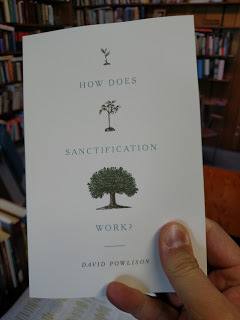 David Powlison has had an enormous influence on me.
 He's one of those teachers (in articles and books as well as live in class) who get counted on one hand as having an outsized impact on my thinking about how the Bible relates to life.
There are 52 items on my blog that I've tagged with his name, but most of the rest of my posts could legitimately have the same marking--since I first read the Journal of Biblical Counseling, David has been shaping the way I read my Bible, counsel others, and grow in Christ myself.
So when one of my favoritist teachers writes a book on his topic of expertise, I get my hands on a copy immediately!
In How Does Sanctification Work?, David uses his characteristic wisdom to unravel the various biblical strands that form the rope of sanctification (promises, commands, influences, etc.). The table of contents shows the questions he answers along the way (ex. "Is There One Key to Sanctification?") and how he ends with several chapters of case studies to show, not just tell, what he has to teach.
I've heard David lecture on these things before, and over the years, I've been greatly influenced by the teaching in chapter 3, "Truth Unbalanced and Rebalanced" where he gives this core premise, "Ministry 'unbalances' truth of the sake of relevance; theology 'rebalances' truth for the sake of comprehensiveness." Give the chapter a read to see what he means by that, but I can testify that it's really helpful for orienting your preaching, counseling, and discipling ministry.
In other words, this is a great book by a great teacher, and if you want to understand the biblical doctrine of sanctification better, you should read it.
Here are a few videos on this topic from CCEF:
Why Pursuing Sanctification Is More Than Just Remembering Justification from CCEF on Vimeo.
Is Sanctification Complex or Simple? (David Powlison; CCEF) from Desiring God on Vimeo.
May 16, 2017
"Death Comes for the Deconstructionist" Book Review
 Death Comes for the Deconstructionist by Daniel Taylor
My rating: 5 of 5 stars
I absolutely loved reading this novel.
Death Comes to the Deconstructionist combines all kinds of things I love: detective fiction, first-person narratives of a complex inner life, page-turning stories written in a minor-key, the clash of big ideas, subtleties, literary allusions, unexpected juxtapositions, and the beautiful craftsmanship of good wordsmithing.
Daniel Taylor's writing is kind of like Flannery O'Conner meets Dorothy Sayers meets Leif Enger with a touch of Lewis's Surprised by Joy. Or something. It's hard to describe--which is often a mark of a book I really love.
This book is not for everyone (there are some very dark parts, though carefully executed), but I'm glad that I followed John Piper's recommendation in this article and borrowed a copy through our wonderful inter-library loan. I'm thinking about buying my own copy so that I can re-read it whenever I want.