Matthew C. Mitchell's Blog, page 69
May 14, 2017
[Matt's Messages] "Songs of Joy"
 “Songs of Joy”
Mother's Day
May 14, 2017
Psalm 126
Psalm 126 is one of my favorites. It’s one of the Psalms of Ascent, the songs that the Israelite pilgrims would sing as they made their way up to Jerusalem for the high holy days of Jewish worship in Old Testament times.
It’s really beautiful, and it instills hope in anyone who reads it with a heart of faith.
One of my Old Testament professors from Trinity Evangelical Divinity School says, “If we dwell thoughtfully in the atmosphere of Psalm 126 for long, we cannot remain disheartened. We will find in it a tonic for our tired arms, legs, and souls, for that is why God put this psalm in his Bible” (Ray Ortlund, When God Comes to Church, pg. 125).
Doesn’t that sound good? Not as good as this psalm sounds!
The language of Psalm 126 is just so stunningly beautiful and spiritually refreshing.
One of the things I love the most about this psalm is that it looks both backwards and forwards. It looks back on what God has done and it looks forward to what God will do.
And I think that followers of Jesus Christ need to have that kind of a perspective, both always looking backward and always looking forward. Because God has always been faithful in the past and always will be in the future, forever.
And that’s one of the reasons why I picked this psalm for this Mother’s Day.
Because Christian mothers need to have that same perspective, too.
I know that whenever I talk with my Heather about what I should say to Moms on Mother’s Day, her answer is always some variation of, “Keep on going! You can do it, Mom. Don’t quit. Don’t slow down. Keep going. God is faithful. There’s a harvest coming.”
And that’s the message of Psalm 126.
The phrase that psalmist repeats again and again is “songs of joy,” “songs of joy,” “songs of joy.”
The English Standard Version has an even stronger translation. It says, “Shouts of joy!” “Shouts of joy!” “Shouts of joy!”
The idea is unbridled exclamations of gladness.
Kind of like some of you when your team does something tremendous on the field or on the court or on the track.
Woohoo!
It’s an awesome feeling that must be made verbal.
Yes! Yes! Yes! Yes! Yes! Yes! Yes! Yes!
Hallelujah!
Hallelujah!
Hallelujah!
Oh!
Songs of joy. I know that doesn’t even capture it.
I remember the feelings Heather and I had when she gave birth to each of our children here today. Those were “songs of joy” days.
And I see the joyful looks on the faces of these two couples today. Briana and Jeremy, Mary Beth and Jim. Big ear-to-ear grins.
And songs of joy.
Life can be like that as God blesses.
But life is not always like that. Is it?
Life is not always a bed of pink roses.
Life is not always continuous songs of joy on constant repeat.
Not if we are being honest.
And the Bible is always honest with us.
Sometimes life is really hard. And painful. And difficult and uncomfortable. And it’s sad. And it hurts.
That’s true for everybody, and it’s definitely true for mothers.
Mothers live with heartache. It’s just part of the job.
And it’s true for all of us. Life can be really tough.
And Psalm 126 gives us a pattern for our prayers during those hard times.
It falls neatly into two parts, verses 1 through 3 which I think look backwards and verses 4 through 6 which look forward.
And both parts talk about “songs of joy.”
#1. THANK GOD FOR SONGS OF JOY IN THE PAST.
Look again at verse 1.
“When the LORD brought back the captives to Zion, we were like men who dreamed.”
Isn’t that beautiful?
Now, we don’t know what situation the psalmist is referring to in verse 1, but we do know that it was a really good thing.
The old NIV translates it, “when the LORD brought back the captives to Zion.” So it could be describing a return from exile. Maybe even the return from the Babylonian exile.
But the new NIV (2011), translates the words in verse 1 the same way both of them translate the words in verse 4, “when the LORD restored the fortunes of Zion.” And that’s how the ESV translates it as well.
The point is that there was this massive reversal of the situation for good.
It doesn’t mean fortune as in luck. It means the situation, the state of affairs, the position.
When God brought the amazing turnaround, “we were like men who dreamed.”
I love that. It seemed to good to be true. We were deliriously happy (cf. Derek Kidner).
We just woke up and our dreams had come true!
That’s how good it was.
When this turnaround happened to these Israelites, they thought they must have been dreaming. And it made them so incredibly happy. V.2
“Our mouths were filled with laughter, our tongues with songs of joy.”
It doesn’t just say, “They laughed.” Or “They sang.”
“Our mouths were filled with laughter, our tongues with songs of joy.”
Shouts of joy.
We were so incredibly happy we had to make some noise about it.
Have you ever been so happy, you just had to make noise?
I’ll bet you have.
And they were so joyful the world had to take notice. V.2 again.
“Our mouths were filled with laughter, our tongues with songs of joy. Then it was said among the nations, ‘The LORD has done great things for them.’”
Others, outsiders, the world, had to admit that God had been good to them.
It was undeniable.
And the psalmist says. V.3
Yes! “The LORD has done great things for us, and we are filled with joy.”
We are so glad because we are so blessed.
You see how the psalmist looks backwards?
We’re going to see in just the next verse that this is not how things are right now.
Things are not happy for the nation of Israel when the psalmist writes this.
But he remembers!
He remembers how good God has been to them, and he gives thanks.
I love how we don’t know exactly what this psalm was about in history because it makes it easy to translate it right into our lives today.
What great things has God done for you that you can remember and thank Him for?
For some of you, it was the awesome mother that God gave to you. And the upbringing and nurture that she provided.
For some of you, it was the children that God gave to you. And the minutes and hours and days and years that you have shared with them.
For the Christians in this room, the greatest thing is our salvation.
Don’t just think about physical blessings and material turnarounds.
Think about the reversal of fortune, the change in your circumstances that God effected when He rescued you from the dominion of darkness and brought you into the kingdom of the Son he loves (Col 1:12)!
Think about how you felt when you got saved. And the songs of joy.
Victory in Jesus my Savior forever!
And so many other ways that God has blessed you and me.
Think about them.
Remember them.
And thank God for them!
He has made me glad.
He has made me glad.
I will rejoice for He has made glad!
“The LORD has done great things for us, and we are filled with joy.”
Except so often we aren’t.
So often we look around and we see the things that are bad and feel the things that hurt. And we long for things to change.
Maybe you have lost your Mom.
Or maybe you never had a good relationship with her.
Maybe you wanted to have kids, but the Lord never gave them to you.
Maybe your children are wayward or estranged from you.
Or whatever difficult situation you face right now.
Whatever difficult situation you face right now!
We don’t know exactly what the problem was for Israel when the psalmist wrote Psalm 126, but we know that he longed for things to be the way they used to be. V.4
“Restore our fortunes, O LORD, like streams in the Negev.”
He’s saying, “Do it again.”
Have you thrown a little child into the air and caught them?
It’s so much fun. Jeremy and Jim, you are in for a treat.
Because they just get this big eyed look on their face and giggle.
And then your arms get tired, and you put them down, and what happens?
They raise up their arms, and said, “Again, Daddy! Do it again!”
That’s what the psalmist is saying to the LORD in verse 4.
“Do it again!”
“You did it before. I know you can do it once more.”
“Do it again!”
“Restore our fortunes, O LORD, like streams in the Negev.”
The Negev is a arid wilderness in the Southern part of Israel. It’s a very dry and desert like. But maybe once a year, maybe at Springtime, it will get a hard rain and spring to life.
Just out of nowhere.
“Do it again!”
“Restore our fortunes, O LORD, like streams in the Negev.”
Turn this “parched life” (cf. Leslie Allen) into a garden.
Bring your life-giving grace into our situation.
You can do it. Suddenly rush in with your rain and restore us to blessing.
Please!
#2. TRUST GOD FOR SONGS OF JOY IN THE FUTURE.
And that begins with asking.
“Lord, do it again. Bring the great turnaround.”
And that could be something physical or more importantly something spiritual.
“Bring me personal revival, Lord.
Revive us again.”
It’s because the psalmist is thankful for the songs of joy in the past that he can ask and expect songs of joy in the future.
And he does expect it. Look at how confident he is. V.5.
“Those who sow in tears will reap with songs of joy. He who goes out weeping, carrying seed to sow, will [most certainly] return with songs of joy, carrying sheaves with him.”
He doesn’t just ask, he expects God to act.
He doesn’t just assume that all of God’s blessings are back there in the past.
He knows with a heart of faith that the best is yet to come.
He’s certain, he’s trusting, because that’s how his God is and that’s how his God works.
The metaphor in verses 5 and 6 is an agrarian metaphor, a figure of speech from the world of agriculture and farming.
First you sow, then later you reap.
What’s interesting here is that the psalmist is sure that the reaping will come.
In the world of agriculture, that’s not always guaranteed.
But the psalmist trusts God and expects God to provide for the Israelites songs of joy.
Just as sure as God brings the seasons, springtime and harvest.
There will be a reaping of songs of joy.
But there will also be tears.
Did you see that in verses 5 and 6?
The sorrow?
“Those who sow in tears will reap with songs of joy. He who goes out weeping, carrying seed to sow, will return with songs of joy, carrying sheaves with him.”
This is not some slappy-dappy Polyanna happy, happy, happy here.
There will be tears.
But do it anyway.
The point of verses 5 and 6 is that because you expect God to work, to answer your prayers, you keep on going. You keep on sowing.
My Hebrew professor puts it this way, “The idea built into the Hebrew [of verse 6] is difficult to translate neatly into English, but the idea is something like this: ‘The one who faithfully, persistently, diligently, goes forth into the field weeping, carrying his bag of seed, shall with infallible necessity come again with a shout of joy, bringing his sheaves with him. The continual going out with tears is matched by the certainty of an abundant harvest coming back in” (Ray Ortlund, When God Comes to Church, pg. 141).
Don’t stop. Keep going. Even through the tears.
My wife has told me that a good number of our family dinners have been seasoned by her tears. They drop off of her face into the soup.
She doesn’t feel like making dinner. She’s sad about whatever.
But she keeps on going. She keeps putting one foot in front of the other.
She keeps on sowing.
And she expects a big harvest.
“Songs of joy.”
Little tiny seeds turn into great big sheaves.
Big honking bundles of blessings.
Trust God for those future songs of joy and keep on sowing until they come.
My friend Blair Murray always saw evangelism in verses 5 and 6.
Because we sow the word, right?
In Jesus’ parable, the seed is the Word of God, and we’re supposed to sow it, sow it, sow it.
And therefore we expect to come home with converts, with new disciples.
I think that’s a legitimate application of these verses.
That’s one thing that we can be faithfully sowing into the fields of the world.
But it’s just one of the ways that we sow spiritually.
This is talking about everyday faithfulness.
Everyday, ordinary, obedience.
Doing the next thing.
It applies to mothers.
Motherhood is hard and often sad.
Sow anyway. Sow in tears!
Do the next thing. Cook, clean, feed, train, wipe, teach, forgive, dress, undress, spank, coach, coax, lift, push, pull, and carry. And then REPEAT!
Keep sowing. Sow in tears if you have to. Prayers, parent-teacher conferences, little league games, soccer tournaments, doctors appointments, bills, bills, bills.
Do the next thing. Keep going.
Carry your seed out there and sow it.
Even through your tears.
And expect God to work.
Expect there to be songs of joy to come.
Sheaves!
But this is not just for mothers. It’s for all of us.
In few weeks, we’ll see it again in Galatians 6:9 which says, “Let us not become weary in doing good, for at the proper time we will reap a harvest if we do not give up.”
It might feel a little bit like death.
When our Lord Jesus did it, He sowed himself. He Himself was the seed going into the ground, but He came back up with a new glorious body, and we are His sheaves!
It’s worth it, friends.
Trust God for the songs of joy in your future.
Keep going, even through the tears.
Don’t get me wrong.
I’m not saying that every prayer of our hearts will be answered in the way we want it.
Not every wayward child, for example, will come home.
God has not promised that.
But He has promised good for His children.
He has promised a bountiful harvest for those who trust Him and keep on sowing their seeds of faith and obedience.
“He who goes out weeping, carrying seed to sow, will return with songs of joy, carrying sheaves with him.”


May 13, 2017

May 7, 2017
[Matt's Messages] "Where Stands It Written?"
 “Where Stands It Written?”
Gospel Roots (1892-2017)
May 7, 2017 :: Acts 17:11
Today’s message is the next message in our Gospel Roots sermon series which looks back over the foundational values and practices and principles that undergird and nourish who we are today. The root system that our church has grown up out of.
This is the fifth message. It looks like we’re going to do one each month this year. In The first and most foundational was the gospel itself: Jesus Christ and Him Crucified. The gospel of Jesus Christ is the reason we are here.
The second was about singing the gospel together. Worship.
The third was about sharing the gospel with lost people. Evangelism.
The fourth message was about being a praying church. Devoting ourselves to prayer, being watchful and thankful.
And today’s message is about building our church on the Word of God, the Bible.
Here’s the title for today’s message:
“Var står det skrivet?”
Wait a second. Maybe you can’t read that.
Let’s use Google Translate and see what that Swedish phrase means in English:
“Where Stands It Written?”
Has anybody ever heard that phrase?
That was one of the watchwords of the founding of the Free Church movement in Europe and in the United States.
“Where Stands It Written?”
What do the Scriptures say?
That’s what it means.
Do you know very much about the history of the Free Church even before Lanse Free Church?
Our forebears in the faith came from Scandinavia, the countries which had followed Martin Luther in the Reformation, especially for us here, Sweden.
This year marks the 500th anniversary of the Protestant Reformation when Martin Luther nailed up his 95 Theses to the church door at Wittenburg.
He was called to account for his teachings which were a rediscovery of the gospel of grace. We’ll talk about that more in the coming months as we dive into the book of Galatians.
When Luther was called before the leaders at Worms, he was asked to recant his teaching, but he had come to believe that he was teaching the gospel in accordance with the Scriptures.
And even though everybody in authority at that time disagreed with him and it was dangerous to preach what he was preaching he said this in what has become known as his “Here I Stand” speech:
Unless I am convinced by the testimony of the Holy Scriptures or by evident reason–for I can believe neither pope nor councils alone, as it is clear that they have erred repeatedly and contradicted themselves–I consider myself convicted by the testimony of Holy Scripture, which is my basis; my conscience is captive to the Word of God. Thus I cannot and will not recant, because acting against one's conscience is neither safe nor sound. God help me. Amen.He took his stand on the Scriptures.
And the Protestant Reformation exploded all over Europe. And one of their rallying cries was, “Sola Scriptura.”
Scripture alone is the supreme authority for Christians.
And the Scandinavian countries adopted Lutheranism.
However, they did not let everybody read the Bible for themselves. I know; it’s hard to imagine. But they didn’t want everybody to make their own choices about the Bible. They wanted to maintain state control of the churches and have the pastors teach an authorized version of the Bible and keep everybody together on the same page.
But some of the believers started to read the Bible for themselves and gather to read the Bible for themselves together. A network of small Bible studies sprang up in Norway, Denmark, and Sweden. They were the Lay Bible Readers Movement. And they experienced revival and they grew.
And this was their watchword: “Var står det skrivet?”
Where stands it written? Where did you get that? Show me that in the Bible.
And then those Swedes immigrated to America. Our church was founded by immigrants. And they didn’t speak English.
They spoke Swedish, at least at first.
And some of those old Swedes settled in Lanse, Pennsylvania to work in the coal mines.
And a few of them gathered together and formed a church.
The history that Bea Johnson wrote for us says, “Most of the services were conducted in the homes of A.J. Palmquist. There was no permanent pastor, but the various members of the fellowship conducted the services. The records tell us that Alexander Gustafson was a gifted speaker, and he did a great deal of the ‘preaching.’”
Preaching the Word of God.
Here’s our artifact for today. It’s probably the oldest thing in the room.
One of the oldest things in the building.
It’s a Bible owned by the church in Swedish dated January, 1911. It’s 106 years old.
It’s a really cool thing to hold it.
And our forefathers in this church put their finger on the pages of this book, and said to one another, “Var står det skrivet?” “Show me where it’s written.”
And for the first 60 years of our church, the preaching was in the Swedish.
Some people get mad that immigrants take their time to learn the central language of their new country. Well, I’m sure that many of our forefathers learned some English to communicate with their neighbors, but when they went to church for the first 60 years, the preaching was in Swedish, the language of their hearts.
The Bible down there on the Communion Table was given to the church in 1952, that’s the year that the preaching switched consistently to English, 65 years ago.
It was given in memory of Mrs. Jennie Swanson, and it is a King James Version in the Old English, 1611. How many here cut your teeth on the King James Version of the Bible? Amen!
Many of you have copious amounts of Scripture memorized in the King James Version.“For God so loved the world, that he gave his only begotten Son, that whosoever believeth in him should not perish, but have everlasting life.” Right?
And there are a lot more Bibles here in this room. The Pew Bibles were bought about 18 years ago. They are in the version that I cut my teeth on, the New International Version, copyright 1984.
And there’s a lot of those in this room. That’s what I tend to preach from every week.
But there are a lot of versions in this room.
What other versions do we have.
NASB? I think that was the favorite of Pastor Curry, my predecessor. We learned at district conference that a lot of the pastors in our district use that one every week.
ESV. That’s my wife’s favorite. It’s really good. I like the ESV Study Bible.
The updated NIV 2011 version. That’s another good one. We tend to give that one away to our high school graduates.
Any others?
I remember Marie Wertz used to carry the NEB.
There’s a new one out called the CSB. The Christian Standard Bible. And they have a new Study Bible. I want to get it. It looks really good, too.
And some of you have your Bible on your phones, right?
It’s not just turn in your Bible. Turn on your Bible. And there are so many versions that you can access through your phone, now.
The point is not to get everyone to use the same translation.
The point is to get everyone looking at the Scriptures.
And saying, “Where Stands It Written?”
Because that question doesn’t come first from Lanse, and it doesn’t come first from Sweden, and it doesn’t come first from Martin Luther.
It’s a Bible question. It’s a question they were asking in Bible times, and rightly so.
It was the question that the Bereans were asking in our passage for today.
Acts chapter 17. The apostle Paul and his team had just been to Thessalonica where they had founded a church to whom Paul would later write the letters of 1 and 2 Thessalonians.
But their preaching was stirring up trouble, so Paul had to leave town. Let’s start in verse 10.
“As soon as it was night, the brothers sent Paul and Silas away to Berea. On arriving there, they went to the Jewish synagogue. Now the Bereans were of more noble character than the Thessalonians, for they received the message with great eagerness and examined the Scriptures every day to see if what Paul said was true.”
You see where I’m going with this, right?
The Bereans were of more noble character than the Thessalonians. Not because they were better people or more holy, but they were excited and careful about receiving the word.
They asked the question, “Where Stands It Written?”
These folks were Bible people through and through.
I’ve only got two points this morning, and they are very simple, but they are for all of us:
#1. RECEIVE THE MESSAGE WITH GREAT EAGERNESS.
Receive the message (literally, the Word) with great eagerness.
That’s what the Bereans did. They were so happy to hear God’s word.
They were hungry for it.
Are you hungry for the Word?
One of my favorite Bible verses is Jeremiah 15:16. It says, “When your words came, I ate them; they were my joy and my heart's delight, for I bear your name, O LORD God Almighty.”
Is that how we take in God’s Word?
I had the hardest time writing this message because I care so deeply about this. This is my life. This is what I’ve staked my life on and is my life’s work–studying and preaching and teaching and counseling out of God’s Word.
For 19 years now, I’ve been studying this book during the week to share it with you on Sundays.
And I believe every single word of it.
Top to bottom.
I don’t understand every single word of it. But I believe it. Every jot and tittle.
I believe that “All Scripture is God-breathed and is useful for teaching, rebuking, correcting and training in righteousness, so that [we] may be thoroughly equipped for every good work” (2 Timothy 3:16-17).
I’ve preached all the way through Genesis, Exodus, Numbers, Joshua, Judges, Ruth, 1 Samuel, 2 Samuel, The Books of Kings, Hosea, Mark, Luke, John, Acts, Romans, Ephesians, Philippians (twice! That was the first one I preached through in 1998 and then did it again in 2004), Colossians, 1 Timothy, Titus, James, 1 Peter, 1 John.
And I’ve preached messages from many of the rest of them.
I hope to preach every single verse of the Bible in my pastoral ministry here at some point, if the Lord gives me the opportunity.
Because this is a church that is eager for the Word.
That is our history and our heritage and I hope it’s our heart today.
How many of you started coming here in large part because of the preaching ministry and the dedication to God’s Word? Whether it was Jack Kelly or me or whomever?
I remember after I preached my candidating message in April of 1998, we had a church family meal back that hallway.
Anybody remember what my sermon was on that candidating weekend? Extra points if you do.
It was the book of Habbakuk in the Old Testament.
I picked that one because it was probably my best one at the time, but I also wanted to know if you guys really wanted the Bible or just jokes and inspirational stories.
I figured I’d give you a Minor Prophet and see what happens.
And I remember sitting with a young family at a table back there in the Fellowship Hall and the dad said to me, “You’ve got to come here and teach us that. The rest of that. What happened next? That’s what we need.”
He was receiving the message with great eagerness.
And I just wanted to come and give this church the Word of God.
This is a church that is dedicated to the Bible.
We have Family Bible Week.
We have Family Bible Night.
We have Link Group Bible studies.
We have Bible at our Prayer Meeting.
We have Sunday School Classes that study the Bible.
Our current classes are going through the whole story of the Bible from Genesis to Revelation in 3 years. And then we’ll probably start over again!
Our children’s church teaches the little ones the Bible.
We give away “Our Daily Bread”–Bible.
We have Bibles out there on the table. We buy them and sell them at cost so that everybody has one.
We do the “Hide the Word” Bible memory verses as a church.
The B-I-B-L-E is the book for us!
And the point is not to have a Bible and have it just sit there or even to memorize it.
The Muslims memorize their Qurans and they revere them, but they don’t have them translated into heart languages and they don’t try that hard to understand them. At least the normal everyday Muslims. They leave that to the professionals. The imans, the scholars.
But not in Christianity. In Christianity, the point is not the physical book but the words and the truth that they convey.
The Bible is for everybody. The Christians Scriptures are for everybody to receive with eagerness and to teach each other.
Colossians 3:16, “Let the word of Christ dwell in you richly as you teach and admonish one another with all wisdom.”
Not just the professional leaders. Not just the pastors. One another.
Are we receiving the Word with great eagerness?
One of the highlights of my year is teaching the Adult Bible Class at Family Bible Week.
Because what I like to teach is not just the Bible but how to study the Bible for yourself.
And the students come so eager to learn.
So we’ve learned that the Bible is a library, not just a book, with different kinds of books inside of it. We’ve learned about Proverbs, and Psalms, and Narratives, and Gospels, and Epistles, and Law, and this last year even Apocalyptic Literature!
There is so much to learn in these pages.
This is where the power is.
Wally Kephart likes to say, “God didn’t promise to bless our words. He promised to bless His word.”
That’s right. And there is so much blessing here!
“Like newborn babies, crave pure spiritual milk, so that by it you may grow up in your salvation, now that you have tasted that the Lord is good” (1 Peter 2:2-3).
Receive the message with great eagerness.
Verse 12 tells us that many of them became believers at that point.
“Many of the Jews believed, as did also a number of prominent Greek women and many Greek men.”
Praise the Lord! They received the message of the gospel and it changed their lives forever.
Do you need to receive the message for the very first time?
The most basic and central message of the Bible is that “God so loved the world that he gave his one and only Son, that whoever believes in him shall not perish but have eternal life.”
Have you received that message with great eagerness?
Because those that receive Him, those that believe in His name, He gives the right to become children of God (John 1:12)!
I invite you to receive Him right now.
Are we hungry for the Word of God?
Are we reading our Bibles?
Remember the sermon on King Josiah back in February, when they found the Book of Law that had been lost?
We said, Read Your Bible, Heed Your Bible, Bleed Your Bible.
Are you doing that?
When was the last time you did something because your Bible told you to?
I wonder how many sermons have been preached from the Bible here at Lanse Free Church?
I’m sure it’s over 7,000 when you add up Sunday mornings and Sunday nights and special occasions.
I have preached a least 800 sermons here myself over the last 19 years. (I have posted almost 600 just since 2005 on my blog!)
What difference is it making?
Are we in our Bibles and are our Bibles in us?
Here’s number two and last.
#3. EXAMINE THE SCRIPTURES EVERY DAY.
To see for yourself.
To double check.
Look at verse 11 again.
“Now the Bereans were of more noble character than the Thessalonians, for they received the message with great eagerness and examined the Scriptures every day to see if what Paul said was true.”
I love that.
If they had to do that with Paul, how much more should you be checking up on me?
“Where Stands It Written, Pastor Matt?”
Show me.
That’s why I preach the way I do.
Did you ever notice how I’m always trying to get you to open your Bibles and I’m always trying to tell you what to look at in them?
What are some of my favorite sounds at church?
The sounds of babies crying.
And the sounds of the whole church singing, especially voices only.
And the sound of pages turning in your Bibles.
“Turn in your Bibles with me please to the book of Acts chapter 17. Pew Bible page #1097. Look at verse 11. Look at verse 11.”
I don’t want you to believe things just because Pastor Matt says to.
I want you to examine the Scriptures every day to see if what Pastor Matt said was true.
“Where stands it written?”
“Show me in the Bible, and I’ll change my mind.”
I almost didn’t preach this message today because Daniel Stanley did it last week.
“Do your best to present yourself to God as one approved, a workman who does not need to be ashamed and who correctly handles the word of truth” (2 Timothy 2:15).
The first initials of that is where they got the word AWANA"Approved Workmen Are Not Ashamed.” And our church had an AWANA program, too.
We’ve all got to study the Bible for ourselves and continually ask the question, “Where stands it written?”
And that means that sometimes we’re going to disagree.
We’re going to come to different conclusions.
Because we’re fallen and limited and come from different starting places.
And that’s frustrating when that happens.
But the Free Church has had a good approach to that problem, too.
One of key leaders in the middle of the 20th century was called Arnold Theodore Olson. The chapel at Trinity is named after him. I never got to meet him, but I saw him there before he died.
Dr. Olson coined a phrase called, “The Significance of Silence,” and the point of that is that there will be times when we disagree with each other on secondary matters.
As long as we agree on the essentials of the gospel, then we speak together with one voice. But on a number of secondary matters, we have silence. Not that we don’t talk about those things together and even argue about them and debate them and sharpen one another. But we are silent on the matter as a whole association of churches. We don’t speak with one voice about those secondary things.
The best way I’ve heard it described is that in the Free Church we “Major on the Majors and Minor on the Minors” instead of “Majoring on the Minors.”
And Dr. Olson in his book talked about differences among Free Church people in the areas like baptism, the Lord’s Supper, Calvinism vs. Arminianism, and the finer points of eschatology.
We have our views and we keep talking about them and we keep comparing them from Scripture to Scripture asking, “Where Stands It Written,” but we don’t fight over them or divide over them. We stick together standing on the gospel.
I love THAT about our family of churches, as well.
We have a sense of biblical priorities and proportions.
We don’t just keep examining the Scriptures and receiving them with great eagerness, we also glean from them what is most important and what is secondary or even tertiary or even fairly insignificant.
If I preach something up here that you disagree with, I’m good with that if you are getting your disagreement from the Bible itself.
I don’t want a cult of little Matt Mitchell clones running around town, parroting what I say whether they know where it comes from or not.
I want a church family of men and women and boys and girls that know their Bibles.
They examine them every single day!
And they think for themselves about what they see there.
What is the most recent thing that you have discovered from your own reading of the Bible?
What is the thing that you have learned most recently from the Word of God that has made a difference in your heart and life?
You won’t be changed if you don’t read it or memorize it or listen to it.
Examine the Scriptures every day.
And you’ll be a Berean.
And you'll be a Lanse Free Church person.
And you’ll see more and more of Jesus and Him Crucified.
Because Jesus said when he was fighting with the Pharisees:
“You diligently study the Scriptures because you think that by them you possess eternal life. These are the Scriptures that testify about me.”
Jesus is the whole point of the Bible.
He is where the Old Testament is going and what the New Testament is proclaiming.
And He is what we celebrate at this Table together. Jesus Christ and Him Crucified.
***
Previous Messages in This Series:
01. Jesus Christ and Him Crucified
02. Sing!
03. Lost and Found
04. The Church That Prays Together

May 6, 2017

April 29, 2017

April 28, 2017
Rejoice with me! 험담을 멈추라 is here.
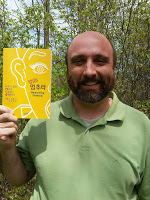 험담을 멈추라
I can't say it or even read it, but I know it's the Korean version of Resisting Gossip: Winning the War of the Wagging Tongue !
This translation is almost 3 years in the making, so it's a real treat to hold in my hands. I can tell that the good folks from CLC Korea put a lot of time and effort into producing this paperback. It has great layout, graphics, and design and has a high quality cover.
Rejoice with me!
April 23, 2017
[Matt's Messages] "The Church That Prays Together"
 “The Church That Prays Together”
Gospel Roots (1892-2017)
April 23, 2017 :: Colossians 4:2
This is the fourth message in our ongoing “Gospel Roots” sermon series where we are revisiting and recommitting to some of our foundational values that have shaped and defined us as a church family throughout the years.
The first message was the gospel itself: Jesus Christ and Him Crucified. The Person and Work of Christ is what saves us, draws us together, and provides our very purpose for existence as a church.
The second message was about something we’ve done every week together for the last 125 years–we’ve sung together. We sing the gospel. We don’t just say it, we sing it, to God in thanksgiving and to each other to remind ourselves of Jesus Christ and His Crucified.
The third message was about sharing that gospel with lost people. Not just singing about it, but sharing it. Our God is conducting a massive search and rescue mission, and for 125 years, we have been a part of His search and rescue team, reaching lost people with the gospel of Jesus Christ.
Today, I want to focus on another thing that our church has done over and over again for 125 years. And it’s something that we’ve done, not just on Sunday mornings or at special outreaches, but many more times during the week. And that is to pray together.
I took my title for today from that old line about the family, “The family that prays together, stays together.”
Well, if that proverb is generally true then it equally applies to church families. “The Church Family that Prays Together, Stays Together.”
And this church family has been praying together for one hundred and twenty-five years. This church has been built on and sustained by prayer.
Look with me at Colossians chapter 4, verse 2.
These are Paul’s instructions “to the holy and faithful brothers in Christ at Colosse...” (Col 1:2).
Here’s one of the key things that Paul says this church really ought to do. Ready?
“Devote yourselves to prayer, being watchful and thankful.”
#1. DEVOTE OURSELVES TO PRAYER.
I’m so thankful to be the pastor of a praying church.
Lanse Free Church has earned a reputation as a church family that prays.
This is not something for which I take any credit whatsoever. I try to encourage it and promote it and keep it going, but I inherited a church family that was already living out Colossians 4:2 long before I ever came along.
I’m trying to use artifacts from our church history in each of these Gospel Roots messages.
It’s harder to find artifacts that point to prayer over the last 125 years.
Not because this church hasn’t prayed, but praying isn’t something you normally take pictures of!
Prayer is generally a quiet thing. Even when it’s in full swing, it can go unnoticed. It doesn’t call attention to itself.
But prayer is a powerful thing whether it’s noticed or not.
Yesterday, I made a list of this church’s current prayer ministries.
Can you name them?
There’s the Prayer Meeting, of course. Wednesday nights at 7pm. I asked Vera yesterday when they started that ministry. And she said that she’s been attending this church for about 76 years and they had those prayer meetings before she started coming. So perhaps for the whole 125 years! That’s a lot of prayer meetings!
For a while there, we had them on Tuesday nights so that people could go to Prayer Meeting one night and serve in Kids for the Christ on Wednesdays. But most of the time, it’s been a Wednesday night ministry.
Sometimes we have a short Bible study, but we always take time to pray.
What else? What other prayer ministries do we have?
A few years ago, Wally Kephart started the Harvest Prayer Time which is a special prayer meeting early on Saturday mornings on the last Saturday of the month where we pray for lost people. That’s putting together our last message and this message.
And Paul does that, too. Look at verse 3. “And pray for us, too, that God may open a door for our message, so that we may proclaim the mystery of Christ, for which I am in chains. Pray that I may proclaim it clearly, as I should.”
That’s what we are praying for at our Harvest Prayer Time. The next one is this Saturday at 7am in the Prayer Room.
Yes, and we have a Prayer Room! It’s the first door on your left down the hallway to your left as you go out of the auditorium. We have a room in this building devoted to being devoted to prayer!
There are people in our community who have dropped by the church in the middle of the week just to use the Prayer Room.
That’s where we have Prayer Meeting each Wednesday.
And there are people in the Prayer Room every single Sunday morning after church.
You see that in your bulletin each week, right? And often I mention it at the end of the service. ...
Could I have the couples who serve in the Prayer Room stand right now?
I know you don’t want to. That’s what I mean by prayer is a quiet thing that doesn’t draw attention to itself.
Thank you for serving in the Prayer Room each Sunday. Confidentially praying with anybody about anything. I know that a number of you have gone in there for prayer on Sundays. And I hope for many more.
What other prayer ministries do we have? We’re just getting started.
The prayer chain, right?
For many years it was just a phone chain. You called Ruth Murray and she called two people who called two people, and we got the word out.
And then a number of years ago, Marilynn Kristofits volunteered to create an email prayer chain. This was like 16, 17 years ago. Long long before she became our administrative assistant in the church office, Marilynn has been volunteering to collect your prayer requests and get them out to the rest of the church.
So that we can devote ourselves to prayer.
What else? The blue prayer cards in the pew racks. The prayer guide here in your bulletin.
Here’s an artifact for you. This is the church bulletin for April 19, 1998.
And on the inside it says, “Welcome, Matt and Heather Mitchell.”
That was 19 years ago this last week when we were here to candidate.
It’s interesting how similar it is to our bulletins today.
Guess who was going to do nursery the next Sunday? Ruth Murray.
Guess who was going to do Children’s Church? Darla Kyler.
Guess what else is in the bulletin?
Well, the church is now accepting bids for mowing the cemetery. There is an Open House at Miracle Mountain Ranch.
And there is a call for prayer requests. It says, “There is a Prayer Request Box on the table in the foyer. Anyone who has a prayer item that you would like to have the Wednesday evening prayer group pray for, please put your request in the box.”
And there’s a list of “prayer of concerns” including an upcoming Ladies’ Retreat and this one, “Pray for the Mitchell’s as they spend time with us and for a safe trip home.” Heather and me, long before Robin. Thank you for praying!
Here’s another artifact from 19 years ago. It’s a letter from Donna Weatherly to me with her perspective on the church that I was praying about coming to pastor. Donna was on the search committee for a new pastor. She writes, “The past few years there has been an increasing humility and unity manifested by greater dependence on the Lord in prayer. Seeing a dependence on prayer is probably the most encouraging thing to me. We all fail in this area–but there is no question that we see this as vital for any life and growth in our church.”
That was one of the things that drew us to come here and be your pastor.
Remember this book? It had swept through our church around that same time. Especially with it’s workbook. Experiencing God taught our church family to devote ourselves to prayer and to look for God at work in our lives.
Here’s another place we pray. We pray right here. Every Sunday.
Opening prayer, closing prayer, prayer before the sermon, prayer after the message, prayer with the offering, worship in prayer.
We actually have the “guys with mics” most Sundays who go around the room collecting your prayer requests.
You know, I’ve never been a part of another church that does that.
I’ve been at churches that have a pastoral prayer where the pastor prays through a list of things that have been turned in before. But taking these prayer requests and praises on a Sunday morning “from the floor” is pretty unique in my limited experience.
I’ve been in Sunday evening services like that. And at small church plants like that.
Every Sunday is a prayer meeting here!
And then there are special times of prayer.
Back to School Sunday–when we pray for the students, teachers, and administration.
Baby dedications, praying for our graduates.
Commissionings, when we pray for missions teams or when someone moves away or heads into military service, and we’re sending them off with prayer.
Here’s a picture of people praying here at Lanse Free Church. This one hangs in my office. It’s pretty fuzzy, but I’m glad it exists. It’s the prayer for me at my installation as your pastor, July 26, 1998. I’m on my knees, and Heather is holding my hand. And Alan Fisch, Charlie Weaver, Wally Kephart, Superintendent Leroy Glover, guest speaker Steve Kemp, and my friend Blair Murray have their hands on me and they are all praying for me as I take up the weighty responsibility of being your shepherd.
And that includes me praying for you.
These are a set of prayer cards from one of my recent Pastoral Prayer Retreats.
You tell me what you need prayed for, and I take these on a long walk and lift up each request to the Lord.
I know that I have a lot to learn about praying for my flock.
But I’ve come a long way.
If you have asked me to pray for something, and then I forgot to do it, I’m sorry.
I know that I’ve bungled some prayer requests in the past. I’ve forgotten them or gotten the details wrong or passed them on at the wrong time.
I think I’ve gotten a lot better at it, but it’s a learning process. Thank you for your patience with me.
One thing we learned a number of years ago was “10 Second Prayers.” Do you remember that?
In July of 2004, Bob Bakke came from the EFCA national office and did a seminar with us on “Becoming a Praying Church.”
And one of the biggest things I took away from that seminar was that prayer can be very short and very simple. Just take 10 seconds RIGHT NOW and pray about that problem, about that need.
I learned to say, “Can we pray about that right now?”
I love to pray with you as your go out the door on Sunday mornings.
And you don’t have to pray with me for 10 seconds. Anybody can do that.
Over the back of the pew. In the foyer. On the Ark Park.
In the parking lot.
I wonder how many prayers have been offered up in that parking lot as people go out to their cars, maybe after a meeting.
There’s a lot of prayer that goes on in our ministry teams and committees.
Your elders have been praying through the list of families that attend the church for the last two years. We take copious amount of time at every elders’ meeting to pray for you by name.
And I know that the Missions Ministry Team prays, the Deaconesses pray, the Facilities Team prays, and so on and so on.
Our Link Groups pray. I think we pray at our Link Group on some Sunday nights as much as or more than we do at Prayer Meeting on Wednesdays.
The Youth Boys pray on Wednesday nights. They take requests and they do the praying. I’m sure that happens in Kids for Christ and ABC Kids, too.
This is a prayer saturated church.
We devote ourselves to prayer.
I’m sure that I haven’t listed them all.
The Pastoral Prayer Team. Where I send you my needs and you pray for me.
I’m so humbled to know that some of you pray for me every single day.
Bea Johnson used to pray for me every single day.
Blair Murray prayed for me every single day.
I know that a number of you pray for me every day and especially on Saturdays when I’m writing these messages. Thank you! Thank you!
As you can tell, this devoting ourselves to prayer can look different at different times.
125 years ago, they didn’t have the email prayer chain coming to their phones.
Neither did the Colossian church. But they still devoted themselves to prayer.
That word “devoted” in verse 2 is a very strong word.
It's a word that was used for people who joined the military and DEVOTED themselves to the service. It was a word that was used of a boat that was ALWAYS at the ready for someone to use. It’s a discipline word. Disciplined prayer.
Constant. Steadfast. Faithful. Staunch. Devoted prayer.
Praying and not giving up. Like Zeke Pipher talked about a month ago.
Not just a casual attachment to prayer but a devotion to prayer.
That’s not easy to do. Prayer can be hard work. It takes effort and commitment.
Especially in our distracting world. I don’t know about you, but I have trouble with focus when I’m praying.
The best book I’ve ever read on the subject of prayer is by Paul Miller. Our Link Group studied it together a few years ago.
It’s called, A Praying Life: Connecting with God in a Distracting World . Life-changing for me. I totally recommend it.
Verse 2 is a call to commitment.
“Devote yourselves to prayer.”
That’s what the early church did. This same word is used of the apostles in Acts 1:14 and 6:4 and the church as a whole in Acts 2:42, “They devoted themselves to the apostles' teaching and to the fellowship, to the breaking of bread and to prayer.” [See also Romans 12:12!]
And it’s what churches are supposed to do today.
We are supposed to devote ourselves to prayer.
What are we supposed to pray for?
Well, anything and everything, I think. Missionaries, ministries, other churches.
But especially for each other.
Look down at verse 12. I think it’s a model for us.
Paul sends the greetings of his friend Epaphras who was probably from Colosse himself. V.12
“Epaphras, who is one of you and a servant of Christ Jesus, sends greetings. He is always wrestling in prayer for you, that you may stand firm in all the will of God, mature and fully assured.”
I love that. I absolutely love that.
How many of you were High School wrestlers? Did that require any energy? Was that just a walk in the park? Or was that hard work? Did that take devotion?
Epaphras was a Prayer Wrestler. V.13 calls it “hard work.”
We talk about prayer warriors, but Epaphras was a Prayer Wrestler.
And who did he pray for? He prayed for the rest of the church.
And I’m sure he prayed for their health, success, safety, decision-making, and relationships. But he also focused on their hearts. V.12 again.
“He is always wrestling in prayer for you, that you may stand firm in all the will of God, mature and fully assured.”
Are we praying that for each other?
Ephesians 6:18, “[P]ray in the Spirit on all occasions with all kinds of prayers and requests. With this in mind, be alert and always keep on praying for all the saints.”
God is calling us to become Prayer Wrestlers for the body of Christ.
How are you and I doing at being devoted to prayer?
I’ve listed what we’ve done in the past, but we never want to live in the past.
We are thankful for the past but we live in the present.
“Devote yourselves to prayer, being watchful and thankful.”
What do you need to do to be devoted to prayer?
What do you need to do to kick it up a notch?
I know some of what I need to do. What do you need to do?
What’s your plan?
“Devote yourselves to prayer, being watchful and thankful.”
#2. BEING WATCHFUL.
What’s that mean “being watchful?”
I used to think it meant, look for answers to your prayers.
And that could be right.
Be on the lookout, be watchful for answered prayers.
Especially if your prayers are for open doors to share the gospel. Because if they came along, you need to snatch them up.
But this word “watchful” is often used in two other ways in your New Testament.
One is being watchful or vigilant against temptation.
Like when Jesus said to the disciples, “"Watch and pray so that you will not fall into temptation. The spirit is willing, but the body is weak.”
So as we pray, we are not just diligent but vigilant.
That very well could be.
The other way that “watchful” is used is watching for the return of Christ.
That’s another historical value of this church–believing in and living in light of the return of Jesus Christ.
Perhaps this is a call to pray as part of being watchful for Christ’s return.
Which is a reminder that time is short, so we better stay busy praying.
Don’t get too comfortable and forget to pray.
What does Paul say in Philippians 4 “The Lord is near. [Then what, so what?] Do not be anxious about anything, but in everything, by prayer and petition, with thanksgiving, present your requests to God. And the peace of God, which transcends all understanding, will guard your hearts and your minds in Christ Jesus” (vv.5b-7).
Watch and pray.
Pray and watch.
Watch and pray.
#3. BEING THANKFUL.
This one is more obvious. We should always be thankful as we pray.
Because God is always answering our prayers!
Not always how we’d like Him to or when we’d like Him to, but always perfectly and on time.
God loves to answer our prayers.
This October, we’re going to give everybody a chance to share some favorite stories of God’s work at and through Lanse Free Church.
And if I were a betting man, I would bet that a lot of those stories will be stories of answered prayer.
God has been so faithful to us.
He loves to answer our prayers.
He always has, and He always will.
Here’s one last artifact.
This is a post office receipt dated February 14, 1998.
I’ve told this story before, but it’s good one.
This was the receipt for the package of materials I sent to Wallace Kephart, Morrisdale PA 16848. And I sent it Express Mail.
Do you know the difference between Priority Mail and Express Mail?
The difference is like $10!
I paid $15 to send it.
The funny part of the story is that Wally had told me that he was going away in February and to not worry about sending my resume, doctrinal statement, cassette tape with a sample sermon and so on, all that fast. Because it might not get there before he left.
So, I was at the Post Office to mail this. And Heather was in Iowa visiting a friend.
And she felt the Lord prompting her to pray that I would buy the right amount of postage.
She has never prayed for postage before and never prayed about postage since.
But that day she did.
And when I was at the Post Office counter in Zion, Illinois, the lady behind the desk asked, “Did you want to send it Priority or Express?”
And as a broke seminary student, I should have said, “Priority,” but I said, “Express.”
And if I remember the story right, the package got to Wally on a Sunday afternoon. Does anybody else get mail on a Sunday afternoon?
And he made copies of it and passed it out to the search committee and then went on vacation for two weeks.
For those two weeks, my packet of information was the only information that the search committee had to look at for any of the candidates.
So if you’re looking for someone to blame, blame Heather’s prayer life!
Of course, the Lord could have used anything and redirected anything for His own purposes.
But He loves to answer prayer.
And you all prayed for me. And we prayed for you.
And here we are today.
Thank you, Lord! Thank you, Lord!
We are thankful.
And we will stay thankful.
And we will stay watchful.
And we will devote ourselves to prayer.
Let’s do it again.
***
Previous Messages in This Series:
01. Jesus Christ and Him Crucified
02. Sing!
03. Lost and Found
April 22, 2017

April 21, 2017
Keeping Gossip Out of Prayer Requests - CareLeader
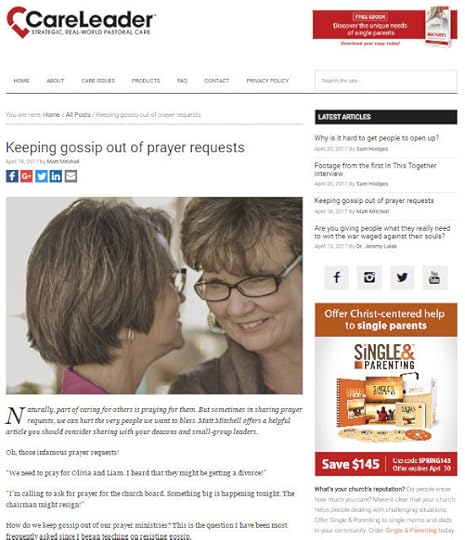
The good folks at CareLeader have republished my article on gossip and prayer ministry. May the Lord use it to help praying folks be more vigilant, discerning, and loving.
Check out their website for lots of helpful articles and other resources for providing care for the people in your church. I've been especially helped by their GriefShare resources including the book Grieving with Hope .
April 16, 2017
[Matt's Messages] "Forsaken No Longer"
 “Forsaken No Longer”
Resurrection Sunday
April 16, 2017 :: Psalm 22
Christ Is Risen!
He Is Risen Indeed!
Or in the words we’ve been using recently, “Christ Is Forsaken No Longer. He Is Forsaken No Longer Indeed.”
For the last several weeks, we’ve been studying Psalm 22 together as a church family.
By the way, if you are guest with us this morning, or a newcomer, welcome! You are catching the tail end of our sermon series, but you’ve got here in time for the big victorious ending!
Can I just say, please come back next week and the next week after that if you can? If you’re visiting from out of state or another church, I understand. Don’t come back next week. But I’ve noticed that some people only come on like Christmas or Easter?
And we are so glad you do come at those times. But we want to invite you to come on other Sundays, as well. There is a lot more to this Christianity thing than just two Sundays a year.
Some of you might have expected baptisms today because we often have them on Resurrection Sunday. I love it when we do! But that’s not the only Sunday that we can do baptisms. I actually expect more baptisms in the next few weeks. I’ve been teaching a class, and they are almost ready to go! So you never know when something like that might happen.
And every week, we open the Bible together and see amazing things.
So, I want to invite you to worship with us again next week and the week after that and the week after that.
Have you found Psalm 22?
Psalm 22 starts out incredibly depressing.
It’s a sad song of anguish and abandonment and excruciating pain.
Last week, we saw that it was on the lips of Jesus when He was crucified on the cross.
The first words of Psalm 22 were some of Jesus’ last words before He died. It starts out, “My God, my God, why have you forsaken me?”
A cry of dereliction.
A cry of pain.
A anguished cry of torment that was originally written by David to express his affliction but was so much more experienced by our Lord Jesus Christ.
What David merely tasted, Jesus swallowed whole.
“My God, my God, why have you forsaken me?”
On the Cross, Jesus was experiencing that question as no one ever had or ever will.
And we saw last week that it went further than just that verse. Jesus fulfilled the whole psalm. It was written a thousand years before Jesus was even born, but it predicted how Jesus would suffer, down to many of the details!
His groaning.
His being scorned and mocked.
The wagging of the heads of those around him.
Being surrounded by his enemies.
Their casting lots for his clothing.
Even down to verse 16, “They have pierced my hands and my feet.”
Jesus lived out Psalm 22 to the extreme.
Jesus was godforsaken on that Cross.
The Bible says that Jesus “became sin” for us on that Cross.
And you know how God feels about sin.
He experienced the righteous wrath of God for our sins in His body on the Tree.
Or in the words of Isaiah 53,
“[Jesus] was pierced for our transgressions, he was crushed for our iniquities; the punishment that brought us peace was upon him, and by his wounds we are healed. We all, like sheep, have gone astray, each of us has turned to his own way; and the LORD has laid on him the iniquity of us all.”
“My God, my God, why have you forsaken me?”
But Jesus did not stay forsaken.
That’s what we celebrate today.
Not just that He was forsaken, but that He did not stay forsaken for long.
And Psalm 22 predicted that, as well.
We often miss that. At least I do. When I read Psalm 22, I almost tremble to think of what Jesus did for us on the Cross. But that’s just the first two thirds of the psalm.
In verse 22, the psalm really changes. It really takes a big turn and then it gets big and expansive and joyful and glorious as it heads down the last stretch.
I think we often forget to read to the end.
What are some of your favorite comebacks of all time?
Your favorite turnarounds, reversals, returns from behind?
I know that a bunch of you are sports fans, and that’s where your mind immediately goes.
So maybe you go to Penn State Football. November 6, 2010 Penn State versus Northwestern. A 21 point comeback. Biggest of Joe Paterno’s career as coach of the Nittany Lions.
Or maybe you go to Pittsburgh Steeler Football. December 15, 1985. Against the Buffalo Bills. Again, a 21 point comeback. Only happened 3 times in Steeler history. That day, plus against the Ravens in 1997, and the Chicago Cardinals in 1953!
Or maybe your sport is wrestling. And you are thinking about Penn State’s NWCA Dual Championship just this year. They came back from a 13-0 deficit to win win 27-13.
Or maybe you’re thinking of the Chicago Cubs and their game 7 of this last year’s world series. And how that was comeback to win the world series after 106 years of never winning the world series.
Or maybe you’re like me and not into sports at all and would have to look up all of games on Google to even know they were ever played!
Whether you are into sports or not, we all have comebacks that we love.
Maybe it’s the twisty ending of your favorite movie when it seems like the hero has lost for the last time, and then (wonder of wonders!) they come back and beat the bad guys.
Or that video game that you love to play. Remember that time you came back from so far behind and beat your brother? Or beat your sister?
Or maybe it was someone who came back from cancer.
Or from the brink of divorce.
Or from bankruptcy.
They were headed for the falls, and they somehow beat back the current and survived.
What’s your favorite comeback?
What if we love comebacks so much because at the very center of history is the greatest comeback ever?
Jesus came back from being forsaken by God.
Jesus came back from the dead.
David anticipated his comeback in verses 22 through 31.
Life was terrible, and he was crying out to God to rescue him.
But he believed that God was going to save him, so he planned in advance to praise him. V.22 again.
“I will declare your name to my brothers; in the congregation I will praise you. You who fear the LORD, praise him! All you descendants of Jacob, honor him! Revere him, all you descendants of Israel! [Why?] For he has not despised or disdained the suffering of the afflicted one; he has not hidden his face from him but has listened to his cry for help.”
David expected to be answered. To be saved.
He did not believe that he would remain forsaken forever.
That God would answer his cry for help.
And the same is true for Jesus.
He just had to die first.
Jesus did everything bigger than David.
David felt like he was dying.
Jesus died.
David believed that God would restore him.
Jesus was restored from the dead.
David felt forsaken.
Jesus was forsaken, but is forsaken no longer.
The resurrection was the greatest comeback of all human history.
And it is historical.
The resurrection actually happened.
Jesus came back from the dead, not in some metaphorical or analogical way. Not in some mythical way. Like just a great story.
But really. Truly. Jesus was dead. Flatlined. No brain activity. His body had become a corpse.
But three days later, He was alive again.
If you don’t believe that yet, I challenge you to review the evidence.
Read a good book about it like The Case for Christ by Lee Strobel which, I understand, has been made into a big movie in theaters right now.
It’s not just a story, not just a fairy tale.
It’s history.
And it’s the greatest comeback of all history.
#1. IN THE RESURRECTION, JESUS IS FORSAKEN NO LONGER.
You know, I believe that Jesus had the whole of Psalm 22 on His mind when He was the Cross, not just the first verse.
I wonder if he didn’t quote the whole thing down the very end. From “forsaken” to “I will declare your name to my brothers; in the congregation I will praise you.”
You know the early church saw Jesus in these verses at the end of Psalm 22 and not just at the beginning.
Verse 22 is quoted word for word in Hebrews chapter 2, verse 12.
“I will declare your name to my brothers; in the congregation I will praise you.”
And the author of Hebrews says, “That’s Jesus! That’s Jesus saying that.”
And the only way He can say it, is if Jesus has risen from the dead.
And He has.
He is forsaken no longer.
And because He is forsaken no longer.
We are never forsaken.
#2. BECAUSE OF THE RESURRECTION WE ARE NEVER FORSAKEN.
God says to His children who have put their faith in Jesus, “Never will I leave you; never will I forsake you.” That’s Hebrews chapter 13:5.
And it’s all because of the resurrection.
Think about what Psalm 22 predicts.
It predicts that we will become the brothers and sisters of Christ. V.22 again.
“I will declare your name to my brothers.”
According to Hebrews 2, that’s Jesus saying that.
Who are Jesus’ brothers?
It’s you and me.
Do you know that Jesus never called his disciples “brothers” until after the resurrection? He called them by name, He called them His children, His disciples, His flock, etc.
But it wasn’t until Mary ran into Him in the garden that He said this. John 20, verse 17, “Go instead to my brothers and tell them, ‘I am returning to my Father and your Father, to my God and your God.’”
Isn’t that interesting?
The resurrection makes us the brothers and sisters of Jesus.
By adoption and by new birth.
And if you are the spiritual brother of Jesus, you will never be forsaken!
Read Romans chapter 8 sometime to see how secure and loved are the children of God!
Nothing can separate us from the love of God which is in Christ Jesus our Lord!
Because He is Risen, We are Never forsaken.
“Brothers!”
And it’s more than just that. We are satisfied forever. Look at verse 25.
“From you comes the theme of my praise in the great assembly; before those who fear you will I fulfill my vows. The poor will eat and be satisfied; they who seek the LORD will praise him–may your hearts live forever!”
The poor there in verse 26 could be translated “afflicted” or “meek.” They are the ones who know that they are needy.
Jesus said, “Blessed are the poor in spirit, for theirs is the kingdom of heaven.”
Do you know that you are needy?
Jesus says that those who come to Him will be satisfied. And their hearts will live forever.
Do you see how the kingdom comes here? This psalm goes so big. Bigger than David could have ever imagined. V.27
“All the ends of the earth will remember and turn to the LORD [even the people in Pennyslvania?!], and all the families of the nations will bow down before him, for dominion belongs to the LORD and he rules over the nations.
All the rich of the earth will feast and worship; all who go down to the dust will kneel before him–those who cannot keep themselves alive. [Everybody] Posterity will serve him; future generations will be told about the Lord. They will proclaim his righteousness to a people yet unborn–for he has done it.”
You know what that sounds like to me?
It sounds like Philippians chapter 2.
Jesus “being found in appearance as a man, he humbled himself and became obedient to death–even death on a cross! Therefore God exalted him to the highest place and gave him the name that is above every name, that at the name of Jesus every knee should bow, in heaven and on earth and under the earth, and every tongue confess that Jesus Christ is Lord, to the glory of God the Father.”
Forever and ever and ever!
Because of the resurrection, we will never be forsaken and we will enjoy Jesus forever. Kingdom come!
All glory be to Christ our king!
All glory be to Christ!
His rule and reign will ever sing,
All glory be to Christ!
So, how should we respond to the greatest comeback ever?
Three things.
#1. REPENT.
Look at verse 27, what we are suppose to do.
“All the ends of the earth will remember and TURN to the LORD.”
Another word for that is to repent.
Jesus has come back to the dead, and He is calling for our allegiance to Him.
He doesn’t just want us to nod our heads and say, “What’s up. Welcome back, Jesus.”
He wants us to say, “I turn from our sin and trust in You. I want to become your follower. Please take me as your own.”
Don’t wait for this.
Don’t wait until Jesus completes His comeback.
When He comes back from heaven, there will be no second chances. Now is the time to turn to Him and be saved.
Repent.
If you forsake Jesus, you will be forsaken.
But Jesus says, “If you come to me, I will never drive you away” (John 6:37).
His arms are open wide.
Repent and come to Jesus.
#2. PRAISE!
Isn’t that the theme of this last third of Psalm 22?
V.22 “I will praise you.”
V.23 “Praise Him! Honor Him! Revere Him!”
V.25 “The theme of my praise...”
V.26 “They will praise Him....”
V.27 “Bow down before Him.”
Jesus is alive and that changes everything.
Including our worship.
We are never forsaken!
We have every reason to praise God!
We don’t sing enough.
We don’t praise enough.
We can’t praise enough for what Jesus has done.
In His suffering and death, Jesus has brought unbelievable blessing to everyone of His children. So we sing and praise and revere and worship Him.
And we tell others.
#3. PROCLAIM.
Look at verse 30 again.
“Posterity will serve him; future generations will be told about the Lord. [Who is going to do the telling? That’s our job. We’re the future generations!] They will proclaim his righteousness to a people yet unborn–for he has done it.”
It is finished. And it’s our job to tell other people.
Who do you need to tell this week that Jesus is no longer forsaken and therefore anyone who comes to Him in faith will never be forsaken?
They won’t know on their own.
It’s our job to get the word out.
In past years, we’ve had a baptism at this point in the service.
Somebody has gotten up and praised Jesus’ name in the assembly.
I think it’s appropriate for us to end this service today planning to be that person this week in somebody else’s life.
Whom could you proclaim it to?
Jesus planned to get up on that Resurrection Sunday morning and declare God’s faithfulness to Him even after being forsaken for us.
We should plan to get up tomorrow and go declare God’s faithfulness to us because we will never be forsaken.
Messages in this Series
1. Godforsaken: David
2. Godforsaken: Jesus