Dory Codington's Blog, page 5
October 21, 2013
Cardinal Points Giveaway at Goodreads.com Update.
It was a successful giveaway with 1123 people interested in winning Cardinal Points from Goodreads. They picked the ten this morning and the books were mailed USPS this afternoon. Because the story begins at the Boston Tea Party, I wanted to have the mailing out on the 240th anniversary of that event. And please if you do read the book, either because you won it or was kind enough to have bought it, write a review at Goodreads and @ Amazon.
The people chosen were from 8 states and one from Quebec. Because my stories are based strongly in American history, I am especially interested in how other members of the Anglo world feel about them.


Cardinal Points Giveaway at Goodreads.com
I will be doing a giveaway of 10 copies of Cardinal Points through Goodreads. The giveaway runs from October 21 through midnight on December the date of the Boston Tea Party. The destruction of the tea as it was called until many years later. All countries that were part of the Empire in 1773 are included in the giveaway. They are (today’s names) UK, US and Canada. So tell your friends to give it a try. Certainly they will all be autographed. Here is a chance to journey through the past. And please if you do win a copy, write a review at Goodreads and Amazon is you would be so kind.
October 8, 2013
James Townsend and Sons
For anyone who needs to buy things that could have been from the eighteenth century let me recommend James Townsend and Sons. They really have some wonderful things: cooking pots and utensils, fire making, clothing etc. Much of their stuff concerns the backwoods, so much of what you see on their site is not what you would see in the fine homes of the Eastern seaboard. –Remember the frontier moved west as civilization pushed at it. For what you might see in Boston or Charleston, imagine transfer wear tea pots with flowers and pretty scenes, fine pewter and silver. Maybe not uses on Saturdays but for company and Sunday dinner.
For recipes and very interesting cooking direction the James Townsend folks have a youtube channel called Savouring the Past. This video for for a Christmas mince pie. John, picture below, does all the cooking. At their site they also sell dvds on firestarting and beer making.

September 2, 2013
Nina considers her day while sitting in a rose garden.
 The day had been hot and long, certainly she was not used to dancing, not used to being touched. Nina assumed that in most places dancers were gloved even on hot days, but for the last three years no one had bought new gloves. There were simply none available since the non-importation agreements – made with such passion in town meeting. Now here they were at a wedding — bare-handed. Non-importation agreements were fine until there was something one needed, like gloves.
Nina slipped back out of the long windows toward the rose garden. She found a bench in the flowers and gratefully sat. Her legs felt weak, she felt flushed and her heart was beating in a most uncomfortable manner. She blamed the dancing, but sitting there in the warm June sun, she grudgingly admitted that Alex, her intrepid rescuer, was the culprit. She had sworn off men so many years ago. Vowed never to marry again. She assured herself she was safe because of her short marriage, and that there was no time or room in her life for such discomfort – physical or emotional. It was good she would leave, and that he would go back to Cambridge. Chances were, this time she really would never see him again.
She concentrated on the beautiful garden. In the warm dry weather the flowers had bloomed early and now waited, suspended in glorious splendor, their petals so far open they nearly drooped. A few had already stopped trying to hold on, and masses of color littered the nearby ground. It was clear from the empty stems, that those flowers that had been fresh and pretty this morning, had been cut for the ceremony, or the party here at the house. She scooped a handful of pale purple and yellow petals into her hands and breathed in the heady scent.
Roses reminded her of that day John and his sisters had taken them all out to hear the latest preacher, a red Indian with a booming voice. They had sat near the host’s house and their rose garden, facing into the field – along with hundreds of other people. It was so unlike her father’s church. There had been no mention of theology, or of readings or careful translation of the bible, such as he and other ministers did. No this man preached of finding Jesus through one’s heart not one’s head. It had seemed alien at the time, but spoke to her now with so many changes whirling around her.
She had been proud that day when her young husband left to fight for Great Britain and the King against their Catholic enemy, the French. She realized after his death that she had never really understood, her heart had not understood that he should go and fight in a war which had ended in Europe and for which the treaty had already been signed.
It was different this time. This unnatural civil war, as the newspapers called it, seemed inevitable. Just as she had moved from her parent’s home; forge her own life, with marriage, child, and an early widowhood, so America was ready to be accepted as a full member of the Empire with rights equal to all Englishmen. That Parliament did not agree, would not grant them membership or a vote, even though the colonies were important members of the mercantile world and consumers of British made goods, rankled.
She wasn’t sure how she felt about Alex flirting with her, making her feel things she would rather ignore, but she could not help be proud that someone who was a friend of sorts, was engaged in routing the British Army out of Boston.
July 21, 2013
The Ant and the Faneuil Hall Grasshopper
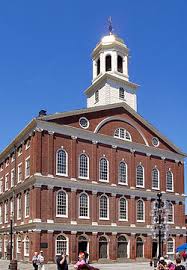
I don’t want to dispute almost three hundred years of consensus history… Oh yes I do. There is an agreement that the grasshopper atop Peter Faneuil’s Market was chosen because he wanted the success of Gresham’s Bank in London to rub off on his market that he built for the town of Boston.
Gresham’s family crest included a grasshopper and this was incorporated into the sign above the
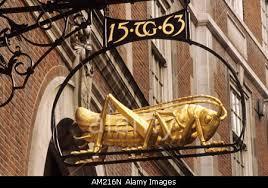
goldsmith shop, that later became a bank. Peter who inherited his uncle’s ships and shops, might very well have been influenced by this lovely London insect. But to discover whether not this is true, one must unravel Peter himself.
Peter Faneuil was born in 1700 into a merchant family. His brother became a landowner and farmer in Brighton and plays no part in Peter’s life. As a merchant, Peter imported Madiera, and other consumables. In the eighteenth century this meant fabrics, china, silver, carpets and foods like cheeses and nuts. This made him a very rich man, especially when he inherited his uncle’s money. There is a theory about his uncle’s insisting Peter not marry or he would not inherit, but I suspect that Peter’s not marrying came from other inclinations.
When Peter was in his early twenties he helped a duelist escape from the watch. The men did not know it, but the victim died of blood loss and cold on Boston Common, while Peter took the perpetrator to New York on his ship. Today we would call Peter a party boy, and he would have hung out with the Kardishians or the Kennedy’s, other rich kids who did not have to work for their money, though might occasionally do something for society like build a marketplace. For which I commend him by the way. In those days they probably called him a fop.
Recently I had occasion to research the school curricula used in the eighteenth century, and discovered that although all boys learned some Latin, only those who could afford to stay in school past the sixth grade would have studied Greek. Peter would have been one of those schoolboys, and among the things he would have read were Aesop’s Fables. Included in those fables is the Ant and the Grasshopper. Briefly, the any works and works while the grasshopper fiddles the summer away. It ends poorly for the grasshopper, but it is possible that young Peter did not read to the end of the story, or maybe he did, because he was ill with heart problems and died in 1742 the year the marketplace was opened.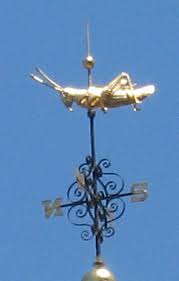
I like to think that the golden grasshopper might be Peter Faneuil, high above his marketplace watching all the hardworking men and women selling their wares. But maybe hundreds of years of consensus history was right.
By the way the weathervane was designed by Shem Drowne in 1742.
June 28, 2013
A Coal-Chute Victory
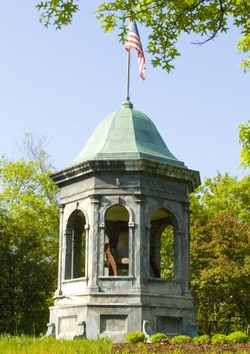
Bell at center of Newton Corner, now at Turnpike Exit 17.
I live in an old house in Newton Corner. The village label, Newton Corner, is actually incorrect, it’s Newton, plain and simple. But, folks in the other villages, West Newton, Newtonville, Newton Centre, don’t want there to be a ‘Newton’ so we obligingly tack on the word corner. The Corner part of it comes from a bar. A tavern run by a fellow named Angier. The spot where he had this tavern was a major crossroad from north, south, east and west and came to be known as Angier’s Corner. I guess after taverns were no longer the most important landmarks in town, the name was changed to Newton’s Corner and in time Newton Corner. The post office, and tax collector just call it Newton.
As I said, it is an old house (by American standards), built around 1820, somewhere on Washington or Richardson Streets. In 1890 a decision was made to lower the train tracks on the Boston-Worcester-Albany line that parallels today’s Massachusetts turnpike, and residents were allowed to move their houses a few blocks north. That’s how my house ended up catty-cornered on its lot, and slightly crooked on its foundation.
The house used to be a side by side two-family with coal stoves in the diningroom and livingroom of each. These would heat the bedrooms upstairs as well. To accommodate this coal a long chute was built down the center of the basement.
The chute had two walls about a foot apart, with openings to shovel out the coal to bring up to the stoves. I’m not sure how the coal was delivered, but I imagine through one of the basement windows. When we bought the house in 1986, one of the first things we did was to take down this double wall that divided the basement, so along with the asbestos-covered pipes we removed from down there, and the tar and paint we scraped off to the stairs, we cut the old wood and swept up coal and lead paint. On one piece of the wall was an interesting chalk picture. The word Victory with the Morse code for V colored within that letter. It is the only thing we saved from that project.
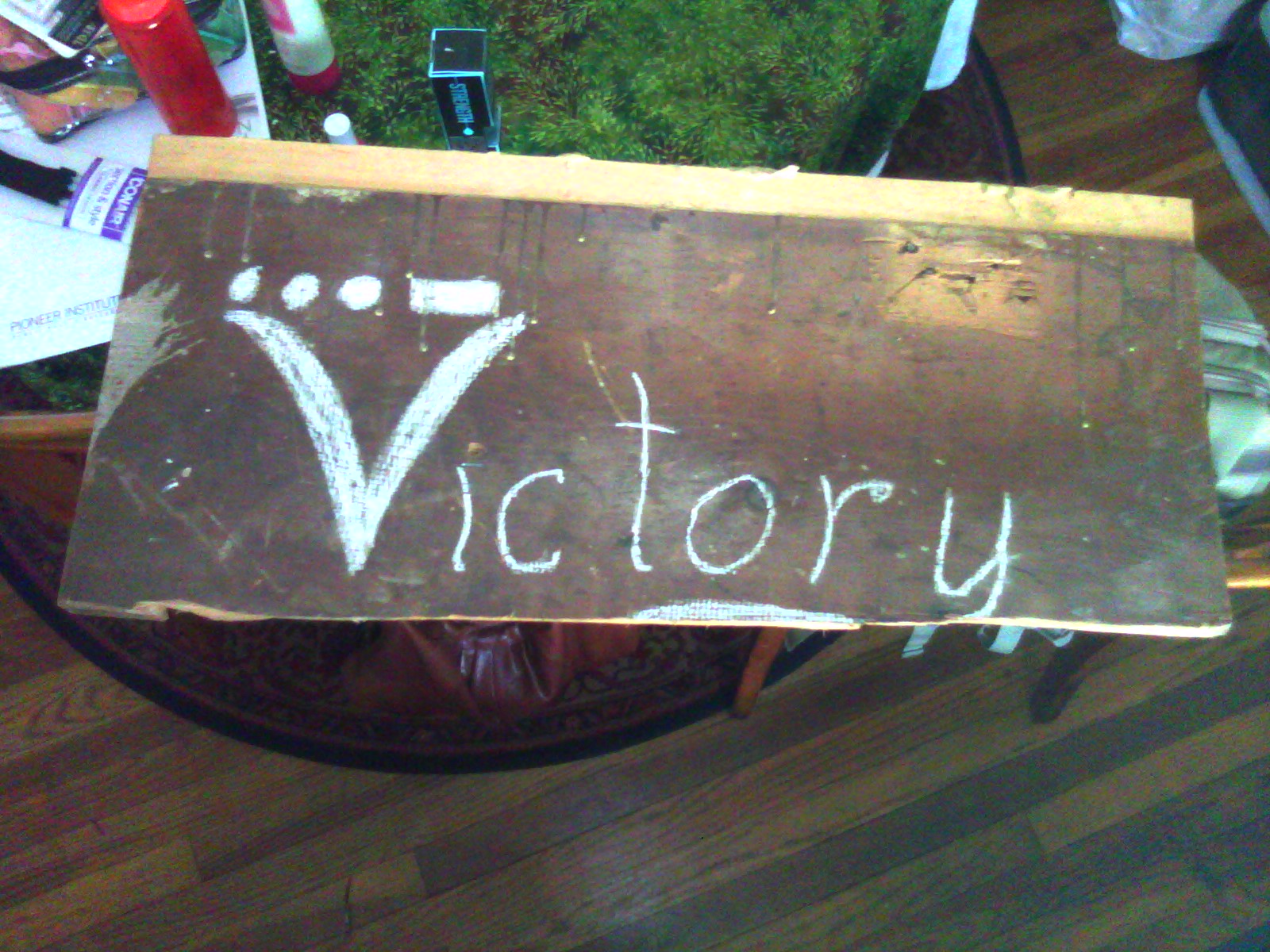
Victory on basement wallboard
Here is how I imagine the Victory came to be:
The basement windows had been painted black since December 8, 1941, but Jimmy didn’t mind. Not only was he safe from Germans and Japanese who might want to bomb a town where so many MIT engineers lived, but the neighbors wouldn’t know when he was up all night working on his ham radio. He’d been twelve when the war started; there were days when he hoped it would last long enough for him to join, but not when his mother got that frightened and worried look in her eye.
Now he was fifteen, almost sixteen, and had come to believe that the war had gone on long enough. His father had introduced him to ham radio, before he left for Europe, when he was ten. And there wasn’t an afternoon that he wasn’t buying parts for that radio or tinkering with it somehow. Nights were when he would listen to transmissions from vessels off the nearby coast and pass on interesting things to radio partners further inland.
That was how our Jimmy came to be listening one night in April 1945. The news wasn’t public yet, he probably got it two or three minutes before NBC, CBS or ABC broadcast it, but when it came over his ham radio in the little two-family in Newton Corner, Jimmy picked up a piece of chalk, the only thing he had at hand, and quickly wrote the word that came across his radio… ‘Victory’. Then Jimmy ran upstairs to wake his mother.
June 16, 2013
Meanwhile on the Other Side of the Pond
So while Massachusetts was being settled, in the first half of the seventeenth century, London was the center of our Empire and the center of mercantile trade. A new display at the Museum of London shows a jewelers hoard that was abandoned around 1640. The work is amazing, and the stones fabulous. There were good reasons for leaving England, and in time it worked out, but the contrast is amazing. Read about this find at: http://www.thehistoryblog.com/archives/date/2013/06/04 Over time I will go into more detail about daily life on this edge of the empire in those early days.
June 13, 2013
Book Signing Event
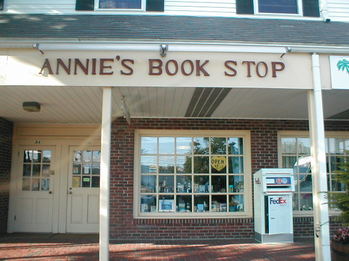 I am having my first book signing at Annie’s Book Stop at 85 River St. in Waltham on June 20 at 5:30. We will be serving wine and crackers. Do come, I will be wearing my version of an eighteenth century gown, I don’t promise absolute accuracy, I’m saving that for the books. Of course I’ll have copies of Cardinal Points, but even if you are only curious about Edge Of Empire/ World Turned Upside Down, come by and chat.
June 7, 2013
Delicious History
This is a letter I wrote explaining how the Edge of Empire books came to be.
Dear Reader:
Cardinal Points, and the other Edge of Empire novels, were born when, as a Park Guide for Boston National Historical Park on the Freedom Trail, I began to wonder what it might have been like to be a young woman in Boston during and after the Destruction of the Tea on December 16, 1773.
I would walk from the North End back to the Visitor Center on Devonshire St, seeing Boston of the Eighteenth Century and contemplating the changes that occurred at the imposition of the Parliamentary Acts we call the Insufferable Acts. For my heroine Oona, a young woman who cannot leave the town as so many others have done, these are immediate and personal.
Using my academic background, and my love of adventure and romance novels, I set out to create what one reader has called: “delicious history.”
Remember: in a world turned upside down, the only thing right – may be love.
May 25, 2013
Edge of Empire: The Books
Well both books are published now, so it seems time to say something about them. I got a wonderful comment from one of my early readers, who called Cardinal Points, “delicious history.” That’s nice because it was precisely what I was going for.
Cardinal Points is a fictional, historical romance that takes place in Boston during and just after the ‘Boston Tea Party.” We recall this event as the great anti-tax revolt that started the American Revolution, and in myth it was just that. But, what I wondered, did the Intolerable Acts mean to those who bore the brunt of Parliament’s Anger against Boston? Those left behind while John Hancock, Sam Adams, and Paul Revere left the town to escape British occupation and live elsewhere? I thought about that often while giving tours for Boston National Historic Park on the Freedom Trail, which I did for two summers. And I created Oona and Jason, and the novel Cardinal Points to let their story explain what it might have been like to live in Boston at that time. For instance, did you know that no printing presses were destroyed by the occupying army? I didn’t want to come out and tell you, so I let Oona experience the surprise of that, or that no one wanted to serve as a judge? Parliament had ruled that all judges were now to be appointed by the King or his representative and suddenly no one volunteered to sit. Turned out the King was easier to ignore than the neighbors with the hot pot of tar and the bucket of feathers. I won’t give away their romance or the many plot twists, but it does get pretty involved and occasionally steamy.
Finally after numerous Intolerable situations, Oona and Jason are reunited and leave Boston together for points north.
 And now Fate and Fair Winds has been published. I don’t have copies yet, so the link is to Amazon, that will change eventually. Fate and Fair Winds begins about seven months after the end of Cardinal Points and involves Jason’s younger brother John and young Rebecca Willent, in their story of intrigues and romance. Rebecca is a young girl wondering what the Declaration of Independence means in her life. They meet only weeks after the signing of that document in July of 1776. While John was traveling through the colonies to gain some understanding of the Americans.
When Howe’s Army moved into Philadelphia, for their winter quarters from October 1777 to June 1778, they meet again. This time John wears his red uniform to announce his dedication and willingness to fight for his King. Rebecca makes no such announcement, but has been collecting information for George Washington and the Americans. It turns out that they are opposed by a third and more evilly potent force whom they must fight together.
It was interesting to compare the occupation of the two colonial cities. (Boston wasn’t called city until years later, see earlier post on town government.) Parliament was mad at Boston, but not at Philadelphia and the experiences of the residents and the occupiers in the two places were very different.
A third book in the Edge of Empire series is being written. Alewife takes place outside of Boston and begins at the Battle of Bunker’s Hill, or rather the end of the battle. It was a battle where both sides claimed victory – the Americans retreated when they ran out of powder and shot, but the British lost 1,054 (226 dead and 828 wounded), many of them officers. A British wit in London quipped, “We certainly are victorious, but if we have eight more such victories there will be nobody left to bring the news of them.”
Alex is among the American line, and then sent off to find supplies for the growing army in Cambridge. At a shipyard south of Boston, he meets a young widow trying to find barrels for the beer she brews at the Hammer and Wheel, a tavern at the Lower Falls of the Charles River in Newton. Do to a errant barrel, careening out of control and toward her, they meet as Alex pulls her to safety and falls backwards as his injured leg gives out.
She is, he admits, a man’s dream. Soft in all the right places when she fell into his arms, a pretty face, and she smells of hops, brewer’s yeast and ale. But nothing is ever that easy, is it?