
Rachel E. Pollock's Blog: La Bricoleuse aggregate and more..., page 25
May 2, 2018
Complex armor projects
The capstone project to this semester's graduate-level craft class, Masks & Armor, is the creation of a complex piece of armor. The students propose projects based upon various factors--what their concentration is in school, what media they might want to explore more fully, an area of historical or cultural interest, etc. Here are the results of this semester's final presentations:
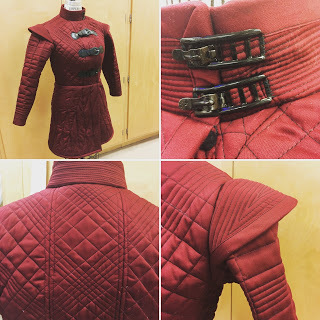 Quilted body armor for a female fighter, by first year grad Cami Huebert
 Couture-inspired banded leather piece by first year grad Jane Reichard
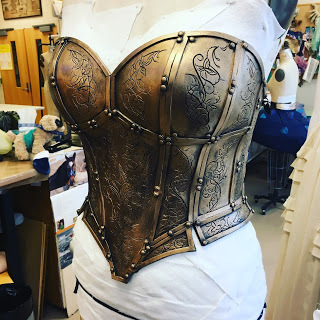 "Brass" breastplate (made of microcell foam) by second year grad Sam Reckford
 Detail shot of tooled/dyed leather body armor by second year grad Danielle Soldat, after a Chinese artifact in the collection of the Met
Such a good semester, such excellent work!
 Quilted body armor for a female fighter, by first year grad Cami Huebert
  Couture-inspired banded leather piece by first year grad Jane Reichard
 "Brass" breastplate (made of microcell foam) by second year grad Sam Reckford
  Detail shot of tooled/dyed leather body armor by second year grad Danielle Soldat, after a Chinese artifact in the collection of the Met
Such a good semester, such excellent work!


April 25, 2018
Complex Mask projects
In the interest of getting somewhat caught-up on my graduate students' class projects this past semester (and ideally, at some point, the fall as well), I have some images of their complex mask projects! Behold:
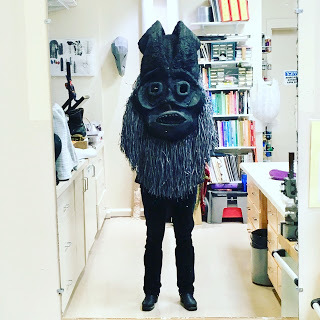
Carnival mask inspired by Nigerian masquerade research imagery, by second-year grad student Danielle Soldat
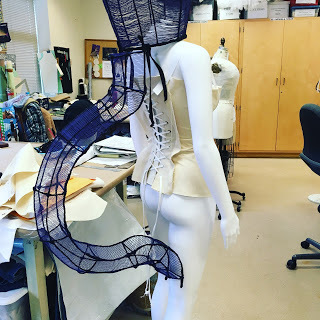 Wire-frame headdress with hinged "tail" element inspired by an art photo, by first-year grad Cami Huebert
(The scale of this was too big to fit well in my phone's square photography format!)
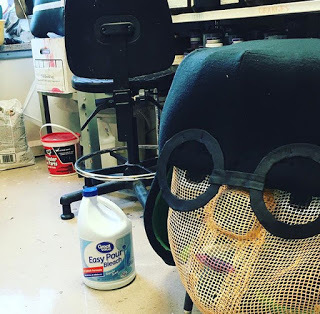 Bighead walkaround of "Edna Mode" from The Incredibles, made from urethane foam and veraform thermoplastic by first-year grad Jane Reichard
(Bleach gallon for scale.)
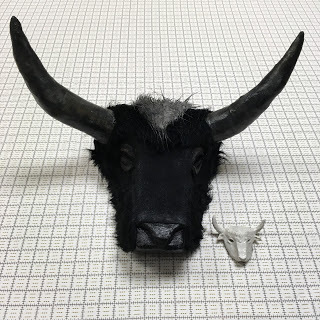 Realistic yak mask (left) and maquette (right), made from buckram, plaster cloth, polymer clay, faux fur, and maché by second-year grad Samantha Reckford
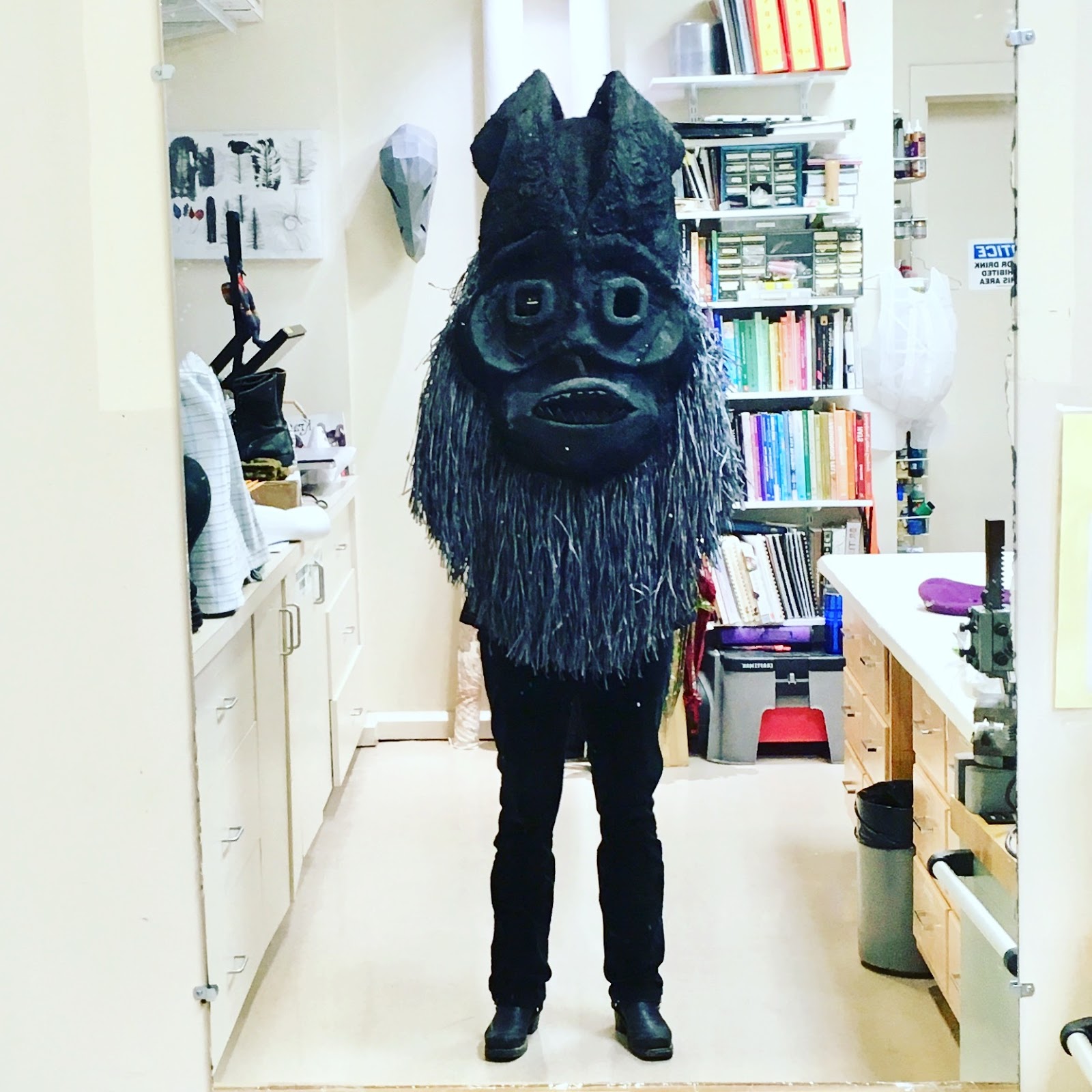
Carnival mask inspired by Nigerian masquerade research imagery, by second-year grad student Danielle Soldat
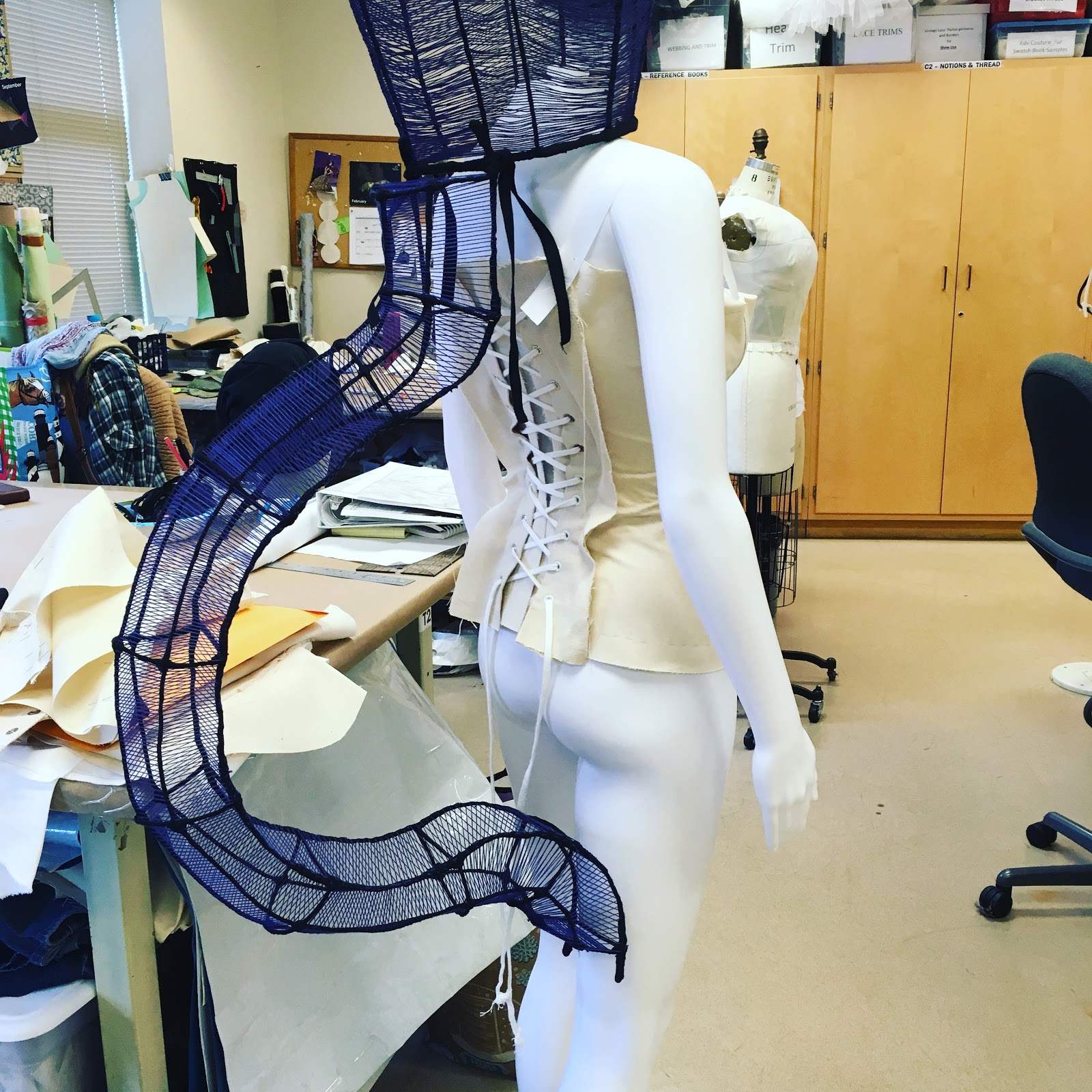 Wire-frame headdress with hinged "tail" element inspired by an art photo, by first-year grad Cami Huebert
(The scale of this was too big to fit well in my phone's square photography format!)
 Bighead walkaround of "Edna Mode" from The Incredibles, made from urethane foam and veraform thermoplastic by first-year grad Jane Reichard
(Bleach gallon for scale.)
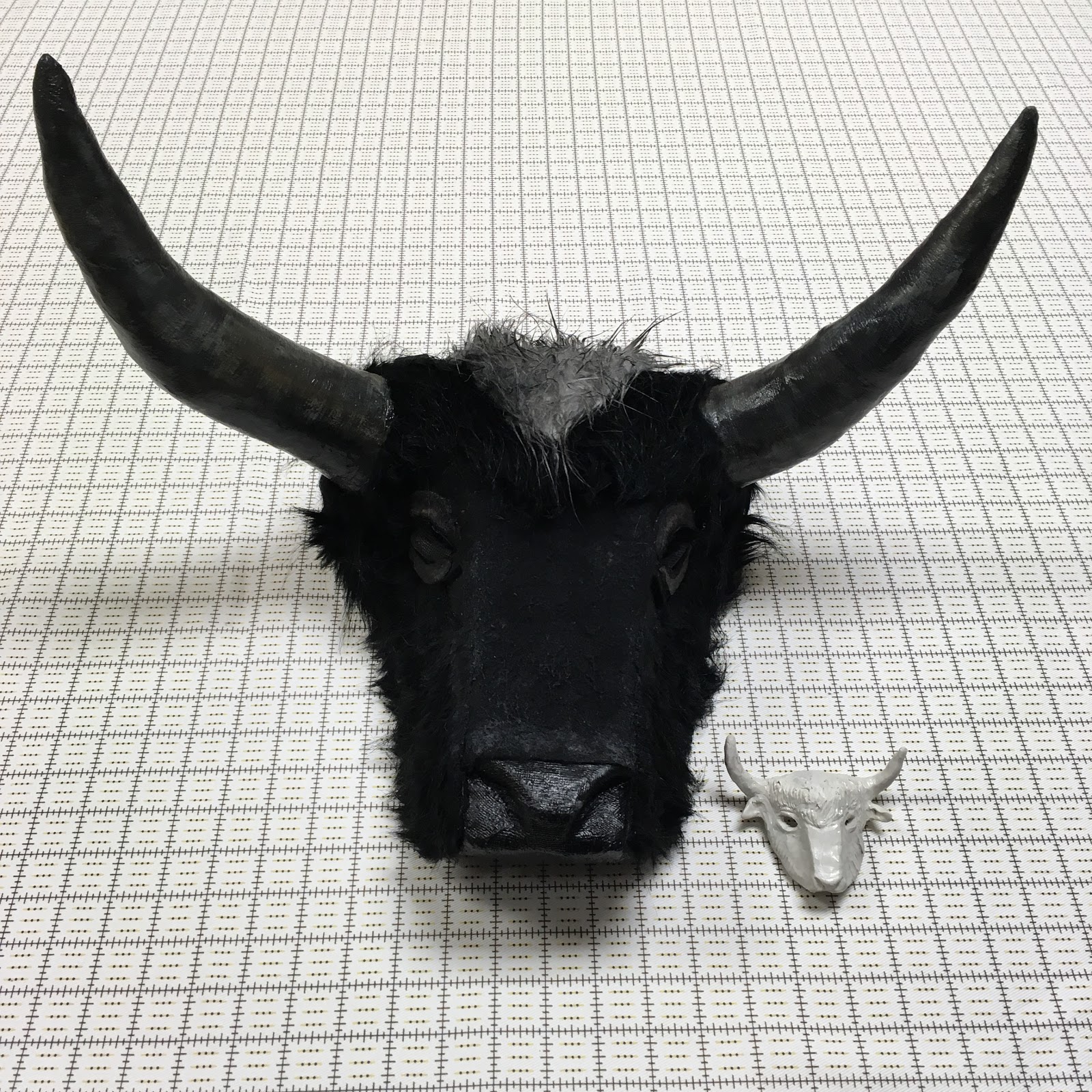 Realistic yak mask (left) and maquette (right), made from buckram, plaster cloth, polymer clay, faux fur, and maché by second-year grad Samantha Reckford
April 17, 2018
Simple Armor Projects from my graduate students
What with the blog on hiatus for the year, I've missed out on sharing my graduate students' projects in posts on here. (Those who follow me on Instagram have caught them there though, since it's a lot quicker to just IG a pic than write up a formal post.) I'm hoping to remedy that retroactively and get some of their work up here, starting with the projects they presented today: simple armor!
The crafts class i'm teaching this semester is--you guessed it--Masks & Armor. The other class i'm carrying this semester is a new one, Digital Technologies for Costume Production, and because ALL my Masks & Armor students are also enrolled in Digital Tech, we're really seeing significant crossover in materials, equipment use, and applications.
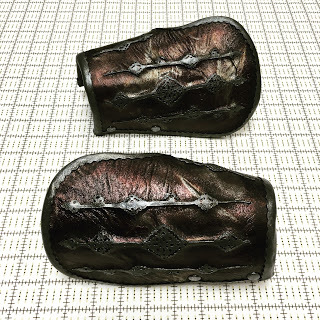 These bracers by second-year grad Danielle Soldat are made from a combination of buckram, foam, and leather, and embellished with laser-cut leather motifs taken from an artifact in the collection of the Metropolitan.
 These fantastical scale-mail pauldrons by first-year grad Jane Reichard are laser-cut and etched acrylic shapes crocheted together with sturdy cord.
 This lovely gorget by second-year grad Sam Reckford is made from Wonderflex thermoplastic, felt, nylon cord, shellac, and various adhesives and paints.
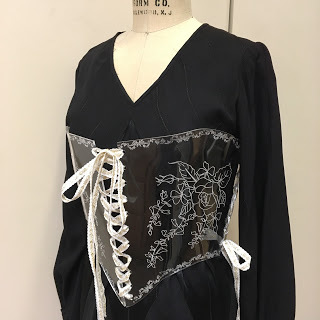 First-year grad Cami Huebert laser cut and etched this floral-motif "glass corset" from sheets of acrylic heat-bent into shape.
Great work, eh? Super proud of these students' projects!
The crafts class i'm teaching this semester is--you guessed it--Masks & Armor. The other class i'm carrying this semester is a new one, Digital Technologies for Costume Production, and because ALL my Masks & Armor students are also enrolled in Digital Tech, we're really seeing significant crossover in materials, equipment use, and applications.
 These bracers by second-year grad Danielle Soldat are made from a combination of buckram, foam, and leather, and embellished with laser-cut leather motifs taken from an artifact in the collection of the Metropolitan.
 These fantastical scale-mail pauldrons by first-year grad Jane Reichard are laser-cut and etched acrylic shapes crocheted together with sturdy cord.
  This lovely gorget by second-year grad Sam Reckford is made from Wonderflex thermoplastic, felt, nylon cord, shellac, and various adhesives and paints.
  First-year grad Cami Huebert laser cut and etched this floral-motif "glass corset" from sheets of acrylic heat-bent into shape.
 Great work, eh? Super proud of these students' projects!
April 12, 2018
Frankenstein's Monster for the Museum of Science Fiction
I'm (tentatively) resuming this blog now that my year of a doubled teaching load is concluding--it looks like I'll have a bit more time for it once again and I have some cool things worth writing about! The first of these is an exhibit we've been involved with for the Museum of Science Fiction, for their upcoming Escape Velocity conference May 25-27, at which a bicentennial celebration of Mary Shelley's Frankenstein will be held.
We were initially contacted about working on the Creature himself (as the monster is known in the novel). The sculpture/SFX studio Tom Spina Designs had signed on to produce the head and the hands of the display, but we here at the UNC-Chapel Hill department of dramatic art were asked to develop a display mannequin from those pieces and create his clothing.
Because this needed to be a pack-and-travel display, we decided to modify a department store mannequin for the Creature's body, since those are designed to be easily dis- and re-assembled.
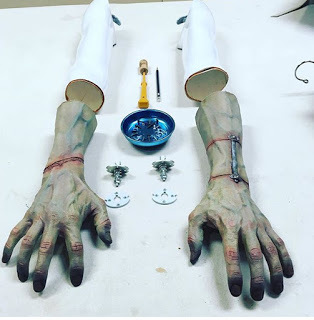
Above are the hands created by the artists at Tom Spina Designs, and the hardware I installed to mount them on those modified mannequin arms you see at the top of the pic.
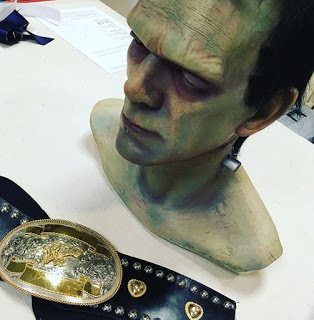
The incredibly realistic head, also by Tom Spina Designs, sitting on my table before I mounted it in the shoulders of our form. He seems like he's puzzled by that disco-wrestler belt which appeared in this season's Tartuffe, right?

I neglected to get a full-length shot of the mannequin itself when we cut the neck out and seated the head in the opening, but here's a process shot of the suture/scar sculpt conducted by pre-med undergraduate Olga Prokunina.
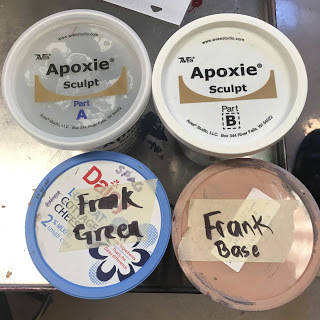
Olga used a product called Apoxie Sculpt (a two part moldable clay), gesso, China silk maché, and her knowledge of anatomy to inform the look of the body's ribcage & suture seams (shown with two of the paints used for his body).

We worked with UNC-CH English professors Laurie Langbauer and Jeanne Moskai and their students to determine the nature of the clothing the Creature would have worn as denoted in the text of the novel itself--salvaged clothing of the period like fall-front breeches and a cutaway coat. Costume production graduate students Michelle Bentley and Jane Reichard then produced the garments you see above, which were subsequently aged/distressed by me in our dye/paint facility.
Next up, I had to paint Olga's grotesque torso sculpt to fit in with the extant head and hands, a multilayered process involving more gesso and many layers of paint!
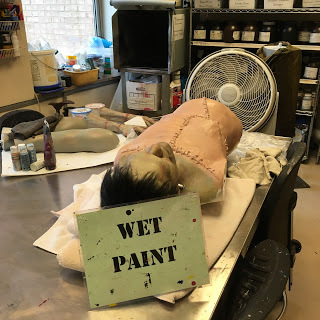 Spa day for the Creature, apparently. A base coat of a warm tone which will be overwashed with lots of dead and cold tones...
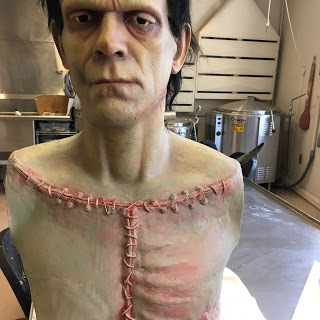
Above: the point at which I added seepage and painful shades to the sutures, staples, and seams. I appreciate how Olga used not only her knowledge of anatomy but also sewing in this part of the sculpt--those drag lines at right are what happens when you sew a seam unevenly. In the novel, Victor Frankenstein bemoans his poor stitching as a defect of the Creature's construction.

Detail shot of the gross sunken ribs on one side of his body.
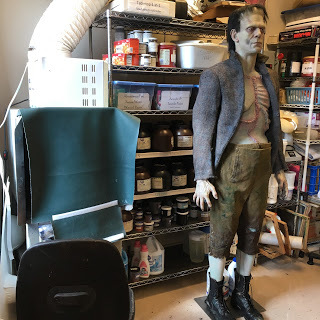
And here he is, the full-length shot of the completed Creature!
We were initially contacted about working on the Creature himself (as the monster is known in the novel). The sculpture/SFX studio Tom Spina Designs had signed on to produce the head and the hands of the display, but we here at the UNC-Chapel Hill department of dramatic art were asked to develop a display mannequin from those pieces and create his clothing.
Because this needed to be a pack-and-travel display, we decided to modify a department store mannequin for the Creature's body, since those are designed to be easily dis- and re-assembled.

Above are the hands created by the artists at Tom Spina Designs, and the hardware I installed to mount them on those modified mannequin arms you see at the top of the pic.

The incredibly realistic head, also by Tom Spina Designs, sitting on my table before I mounted it in the shoulders of our form. He seems like he's puzzled by that disco-wrestler belt which appeared in this season's Tartuffe, right?

I neglected to get a full-length shot of the mannequin itself when we cut the neck out and seated the head in the opening, but here's a process shot of the suture/scar sculpt conducted by pre-med undergraduate Olga Prokunina.

Olga used a product called Apoxie Sculpt (a two part moldable clay), gesso, China silk maché, and her knowledge of anatomy to inform the look of the body's ribcage & suture seams (shown with two of the paints used for his body).

We worked with UNC-CH English professors Laurie Langbauer and Jeanne Moskai and their students to determine the nature of the clothing the Creature would have worn as denoted in the text of the novel itself--salvaged clothing of the period like fall-front breeches and a cutaway coat. Costume production graduate students Michelle Bentley and Jane Reichard then produced the garments you see above, which were subsequently aged/distressed by me in our dye/paint facility.
Next up, I had to paint Olga's grotesque torso sculpt to fit in with the extant head and hands, a multilayered process involving more gesso and many layers of paint!
 Spa day for the Creature, apparently. A base coat of a warm tone which will be overwashed with lots of dead and cold tones...
Above: the point at which I added seepage and painful shades to the sutures, staples, and seams. I appreciate how Olga used not only her knowledge of anatomy but also sewing in this part of the sculpt--those drag lines at right are what happens when you sew a seam unevenly. In the novel, Victor Frankenstein bemoans his poor stitching as a defect of the Creature's construction.

Detail shot of the gross sunken ribs on one side of his body.

And here he is, the full-length shot of the completed Creature!
April 2, 2018
Altering a bra for better fit and support
On Twitter, a protracted discussion of the fit and durability of ready-to-wear commercially-made brassieres arose in the comments to someone's exasperated complaint about the fact that all modern bras pretty much fit poorly, regardless of size or material used. Because of the significant positive response to my threaded contribution on bra alteration suggestions, I'm writing up the gist of my thoughts/methods.
First, know that I significantly alter every bra I buy before wearing it in public. (For reference, I wear a 34F--narrow ribcage/large bust--and I've found that Freya brand bras fit me best.) Also, please note that a well-fit bra is a complex structural garment which requires customization for most all body types in order to fit and function at its best, & at present this level of sophisticated structure isn’t found inexpensively/ready-to-wear.
How am I qualified to write this post? I taught a graduate level course in structural undergarment construction last semester, in the costume production MFA program at the University of North Carolina at Chapel Hill. Our graduates typically go on to successful careers as costumers for Broadway, opera, ballet, and A-List film talent. On the bustline front, one of our alumni is Dolly Parton's personal draper, so yeah.
Some of these alterations will be outside the realm of possibility for those who don't own a sewing machine, but some are things you can do with a little determination and a needle and thread.
First up, I stabilize the straps, which is something anyone who can sew a strong sturdy tack by hand could accomplish. Few people have enough monthly deviation in breast size to need adjustable straps. (Sliders just allow a readymade bra to "fit" a wider range of buyers.) Stable straps = better support. Adjust the sliders to where you need them to be, then safety-pin them. Wear the bra for a day or so and see if you have the right length, then stitch it to stabilize.
Second, almost all bra bands need reinforcement. Stability in the band is a major element of fit. How I stabilize the band depends on the bra--sometimes I stitch a stronger piece of elastic in with a serpentine stitch (by machine, domestic machines often have this option on the specialty stitch dial), sometimes I flatline the whole bra band with girdle mesh, either by machine or strong whipstitch by hand. Sometimes I do both. We stock girdle mesh as a standard material at my workplace, but you can buy it by the yard from specialty fabric stores, or cannibalize a girdle for it.
Next, I machine-stitch concentric arcs into the underside of the cups to give more stability and lift. I do 6 rows (see pic) but a smaller cup may only need 3, 4, or 5 rows. These rows of stitches are 1/4”-ish apart following the curve of the underwire, like in these pics:
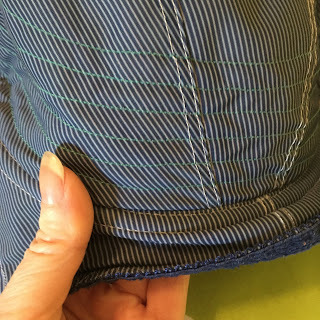
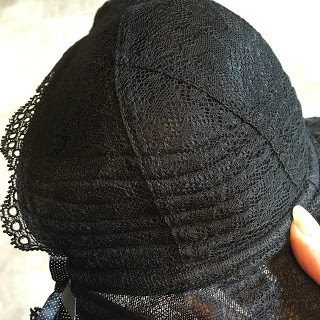
You might recognize this kind of spiral/concentric stitched cup structure from 1950s bullet-bras and contemporary pin-up photoshoots. That's because this kind of stitching helps buttress the breast for lift and shaping. Nobody has torpedo-boobs naturally, but concentric/spiral stitching on a torpedo-shaped cup helped 1950s women achieve those shapes. You can use that to your advantage for helping a modern bra cup keep its shape, too.
And lastly! Another way to help stability in the band is to add a bone to the side seam. Plastic, Rigilene, spiral steel, flat steel, depends on the size of the bust which is best. As someone with a narrow ribcage and large bust (34F, remember?), I get the best result from 1/2" flat steel bones. This might seem like it will make your bra uncomfortable, but the more structure an undergarment has, the more comfortable and supported I feel. Caveat: I spent ten years of my life wearing a corset to work five hours a day, so YMMV.
And now, textbooks! Want to read some reference titles? Beverly Johnson’s The Bra Maker's Manual and Ann Haggar’s Pattern Cutting for Lingerie, Beachwear, and Leisurewear are the two most relevant to this discussion, and two of the required texts for my class.
Hope this was helpful, and if you have any other recommended bra alterations you like to do, please drop a comment!
First, know that I significantly alter every bra I buy before wearing it in public. (For reference, I wear a 34F--narrow ribcage/large bust--and I've found that Freya brand bras fit me best.) Also, please note that a well-fit bra is a complex structural garment which requires customization for most all body types in order to fit and function at its best, & at present this level of sophisticated structure isn’t found inexpensively/ready-to-wear.
How am I qualified to write this post? I taught a graduate level course in structural undergarment construction last semester, in the costume production MFA program at the University of North Carolina at Chapel Hill. Our graduates typically go on to successful careers as costumers for Broadway, opera, ballet, and A-List film talent. On the bustline front, one of our alumni is Dolly Parton's personal draper, so yeah.
Some of these alterations will be outside the realm of possibility for those who don't own a sewing machine, but some are things you can do with a little determination and a needle and thread.
First up, I stabilize the straps, which is something anyone who can sew a strong sturdy tack by hand could accomplish. Few people have enough monthly deviation in breast size to need adjustable straps. (Sliders just allow a readymade bra to "fit" a wider range of buyers.) Stable straps = better support. Adjust the sliders to where you need them to be, then safety-pin them. Wear the bra for a day or so and see if you have the right length, then stitch it to stabilize.
Second, almost all bra bands need reinforcement. Stability in the band is a major element of fit. How I stabilize the band depends on the bra--sometimes I stitch a stronger piece of elastic in with a serpentine stitch (by machine, domestic machines often have this option on the specialty stitch dial), sometimes I flatline the whole bra band with girdle mesh, either by machine or strong whipstitch by hand. Sometimes I do both. We stock girdle mesh as a standard material at my workplace, but you can buy it by the yard from specialty fabric stores, or cannibalize a girdle for it.
Next, I machine-stitch concentric arcs into the underside of the cups to give more stability and lift. I do 6 rows (see pic) but a smaller cup may only need 3, 4, or 5 rows. These rows of stitches are 1/4”-ish apart following the curve of the underwire, like in these pics:


You might recognize this kind of spiral/concentric stitched cup structure from 1950s bullet-bras and contemporary pin-up photoshoots. That's because this kind of stitching helps buttress the breast for lift and shaping. Nobody has torpedo-boobs naturally, but concentric/spiral stitching on a torpedo-shaped cup helped 1950s women achieve those shapes. You can use that to your advantage for helping a modern bra cup keep its shape, too.
And lastly! Another way to help stability in the band is to add a bone to the side seam. Plastic, Rigilene, spiral steel, flat steel, depends on the size of the bust which is best. As someone with a narrow ribcage and large bust (34F, remember?), I get the best result from 1/2" flat steel bones. This might seem like it will make your bra uncomfortable, but the more structure an undergarment has, the more comfortable and supported I feel. Caveat: I spent ten years of my life wearing a corset to work five hours a day, so YMMV.
And now, textbooks! Want to read some reference titles? Beverly Johnson’s The Bra Maker's Manual and Ann Haggar’s Pattern Cutting for Lingerie, Beachwear, and Leisurewear are the two most relevant to this discussion, and two of the required texts for my class.
Hope this was helpful, and if you have any other recommended bra alterations you like to do, please drop a comment!
January 23, 2018
Book Review: 3D Printing Basics for Entertainment Design by Anne E. McMills

This blog is still on hiatus, officially, until after the 2018 spring semester; but i had to pop in with this speedy book review!
Full disclosure: my graduate students and I are quoted extensively in this book, particularly in the costume production chapter. That said, this is an excellent resource for getting a handle on what 3D printing technology can be in the wide range of entertainment design applications.
The book explains the technology, discusses the merits of various models of printers, talks through the process of creating/obtaining a printable file, and troubleshoots issues with substandard results. It then goes on to document a wide range of applications for all areas of design and production, from the obvious areas of costumes/sets/props/puppets to uses in lights/sound/projections as well as exhibit design, maquettes, and more!
Accessible language, extensive sources and contributors, copious full-color photography on quality paper. A great overall reference book for even the technophobe!
December 24, 2017
Great Books of 2017!
...by which i mean my favorites of the books i read in 2017, not necessarily books which came out in the past year. I stopped journaling about these as a year-end tradition once i joined Goodreads, but I miss the kind of comprehensive view that this sort of post gave me, in terms of my year's worth of reading, so i'm reviving it.
I read 113 books (and counting) this year, a total which doesn't include drafts of my own novels in revision, drafts of colleagues' unpublished novels, and as-yet-unpublished new play scripts which the theater is considering for future seasons. This year included more Young Adult novels than I typically read (ten), and it's the first year that i got to read an ARC of a book by one of my graduate school classmates which is forthcoming in 2018 (Bryan Camp's CITY OF LOST FORTUNES which is ***** y'all). I read 26 nonfiction books, four novellas, six published plays and two collections of short stories, with everything else being novels.
I decided to pick my top five novels for adults which are currently available for purchase or library borrowing, and here they are:
THE LESSONS by Naomi Alderman
I absolutely loved this book. It turned out to be what I wished The Secret History had been, upon rereading it 20 years after the first time I read it. I loved that book to distraction when I first read it. The way life has changed me in the interim, unfolded such that this book is now what that book was then.
PEOPLE OF THE BOOK by Geraldine Brooks
I absolutely loved this book too. Loved it. It's the kind of story i tend to really enjoy--an object serves as the plot device for which many different historical stories are told because the obeject figures into them all (in this case, a book). And, it's loosely based on several actual historical events which happened in the existence of the actual book in question (the Sarajevo Haggadah). NGL, i literally cried, like five or six times in the course of this thing, because some of the stuff that happens is either so sad or so emotional, but that should be part of why you read it, if you read it. It's hard, like life, but beautiful, too. Like life.
WHITE TEARS by Hari Kunzru
I'm not sure i can do a review of this book justice. I feel like i will be thinking about it, and about the experience of reading it, for a long time. I can't think of a book i have read that scared the shit out of me in quite the way this one did; the supernatural blurred-reality parts are so well done, i just can't even process HOW Kunzru did it. The sociological aspects and commentary-on-race-in-the-garb-of-fiction sucked me right in. The wankity audiophile stuff got my nerd antennae quivering. I dunno. This is a book i kind of wish were required reading for all white dudes in the US. I don't know if i think it would be a brilliant audiobook, or if that would just defang it. Depends, ironically, on the production and the reader(s).
PACHINKO by Min Jin Lee
Okay, I cried on the very last page. This is not a perfect book, and it is not a short book, but I think everyone in America should read it. Probably everyone everywhere, but specifically America right now. A family saga set in Japan among Koreans living there through most of the 20th century. Somehow it is both tempestuous and serene.
AUTONOMOUS by Annalee Newitz
I should've packed extra pants because I've peed all mine in the reading of this. Absolutely, absolutely, absolutely loved this book in every possible way. It pushed all the freako-futurism buttons of my favorite Neal Stephenson novels, and tripped the mindfuck switches of my favorite China Mievilles. There are a lot of ethical quandaries to wade through in terms of personhood, artificial intelligence, and the autonomy of robots. There are also some interesting explorations of gender theory in a post-human world. If that sounds appealing to you, read it ASAP.
I read 113 books (and counting) this year, a total which doesn't include drafts of my own novels in revision, drafts of colleagues' unpublished novels, and as-yet-unpublished new play scripts which the theater is considering for future seasons. This year included more Young Adult novels than I typically read (ten), and it's the first year that i got to read an ARC of a book by one of my graduate school classmates which is forthcoming in 2018 (Bryan Camp's CITY OF LOST FORTUNES which is ***** y'all). I read 26 nonfiction books, four novellas, six published plays and two collections of short stories, with everything else being novels.
I decided to pick my top five novels for adults which are currently available for purchase or library borrowing, and here they are:
THE LESSONS by Naomi Alderman
I absolutely loved this book. It turned out to be what I wished The Secret History had been, upon rereading it 20 years after the first time I read it. I loved that book to distraction when I first read it. The way life has changed me in the interim, unfolded such that this book is now what that book was then.
PEOPLE OF THE BOOK by Geraldine Brooks
I absolutely loved this book too. Loved it. It's the kind of story i tend to really enjoy--an object serves as the plot device for which many different historical stories are told because the obeject figures into them all (in this case, a book). And, it's loosely based on several actual historical events which happened in the existence of the actual book in question (the Sarajevo Haggadah). NGL, i literally cried, like five or six times in the course of this thing, because some of the stuff that happens is either so sad or so emotional, but that should be part of why you read it, if you read it. It's hard, like life, but beautiful, too. Like life.
WHITE TEARS by Hari Kunzru
I'm not sure i can do a review of this book justice. I feel like i will be thinking about it, and about the experience of reading it, for a long time. I can't think of a book i have read that scared the shit out of me in quite the way this one did; the supernatural blurred-reality parts are so well done, i just can't even process HOW Kunzru did it. The sociological aspects and commentary-on-race-in-the-garb-of-fiction sucked me right in. The wankity audiophile stuff got my nerd antennae quivering. I dunno. This is a book i kind of wish were required reading for all white dudes in the US. I don't know if i think it would be a brilliant audiobook, or if that would just defang it. Depends, ironically, on the production and the reader(s).
PACHINKO by Min Jin Lee
Okay, I cried on the very last page. This is not a perfect book, and it is not a short book, but I think everyone in America should read it. Probably everyone everywhere, but specifically America right now. A family saga set in Japan among Koreans living there through most of the 20th century. Somehow it is both tempestuous and serene.
AUTONOMOUS by Annalee Newitz
I should've packed extra pants because I've peed all mine in the reading of this. Absolutely, absolutely, absolutely loved this book in every possible way. It pushed all the freako-futurism buttons of my favorite Neal Stephenson novels, and tripped the mindfuck switches of my favorite China Mievilles. There are a lot of ethical quandaries to wade through in terms of personhood, artificial intelligence, and the autonomy of robots. There are also some interesting explorations of gender theory in a post-human world. If that sounds appealing to you, read it ASAP.
September 18, 2017
Temporary hiatus
I hate to have to announce this, but it's become clear to me that i need to place La Bricoleuse on a temporary hiatus. We're undergoing some changes at my workplace which, among other things, has meant my teaching load has doubled, and until that changes, I don't see myself having time to write the posts i have typically written in this blog.
I hope that i'll still be able to share at least some book reviews and such, but for the foreseeable future, I don't want to promise regular content which I no longer have time to generate. You can still follow me on Facebook and Instagram, where I do still share relevant links and images; i still make all the cool stuff (and so do my graduate students), we just won't have time for me to write them up for a while.
I hope that i'll still be able to share at least some book reviews and such, but for the foreseeable future, I don't want to promise regular content which I no longer have time to generate. You can still follow me on Facebook and Instagram, where I do still share relevant links and images; i still make all the cool stuff (and so do my graduate students), we just won't have time for me to write them up for a while.
June 11, 2017
EXHIBIT REVIEW: Inside Her Clothes at the Goldstein Museum of Design, St. Paul, MN
Yesterday I visited the Goldstein Museum of Design on the St. Paul campus of the University of Minnesota. Their current exhibit (through September 3, 2017) is called Inside Her Clothes, featuring selections from their fashion/clothing collection exhibited inside-out, or arranged with the garment open so you can see the interior. I'll cut to the chase: it's fantastic, and if you can at all get there to check it out, go.
It's set up in a dedicated gallery similar in size to the one at the Museum at FIT--not as huge as the exhibits mounted by the Met, but nothing to sneeze at. There are thirty-two garments on display with a wealth of information about each one. There is no admission charge so even if you are strapped for cash you can go; there's a donations box by the door if you want to give them something, and merchandise like notecards, too.
I took a lot of photographs, but I think you'll find that the images only serve to make you want to go see the exhibit in person, so you could focus on whatever details interested you most, and for most of these pieces, get as close to them (without touching) as you like.
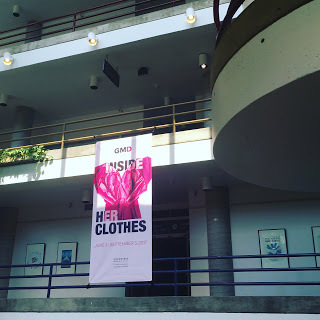 The Goldstein Museum is housed within the department of design at McNeal Hall on the UMN-St. Paul campus. I took the bus there, but it seemed like there was nearby parking, too, since it's summer. Once the fall semester starts that might change but right now the campus is a ghostly wasteland of solitude. I only saw three other people while i was there, and one of them was the docent.
 I know you can't really read this, but i wanted to show readers what the information imparted is like throughout the gallery. There are blocks of info like this on the walls near each thematic section at a fairly large font size, and withing the pink box are vocabulary definitions describing sewing terms that visitors not well-versed in garment construction might wonder about, like "selvedge" or "dart" or "felled seam."
 This image gives you a good idea what the displays are like as a whole. At right is a full-size photograph on the back wall of the gown on a form as it is was intended to be worn. On the center and left are the two pieces displayed separately so that, in this case, visitors can observe how the underskirt has been cut and pieced to feature the rich smocked silk fabric at center front where the polonaise opens to expose it, and the rest of the skirt which is normally hidden by the overgarment has been cut from a plain but sturdy canvas.
 For this display, at the rear is a surviving (but damaged) wool paisley shawl from the early 19th century, and in the foreground a 1920s jacket cut from a similar shawl which the maker must have inherited or found in a resale shop. This one is part of that "Sustainability" section in which the examples displayed show aspects of reuse and what we'd now call "upcycling."
 This impeccably preserved 1890s bodice is on the form with its front opening folded back, so you can see how its various interior closures work. You can make out the stabilizing waist-tape here, as well as buttons, hooks, and bars. The little white circles are numbered buttons which correspond to detail information posted along with a photo of the bodice when closed properly.
 This is a 1950s Dior gown shown open up the center back to reveal the interior boning on the seams and such, but what i find so fascinating about it is the fabric design inverted on the interior. Looked like a double-faced sateen but i couldn't touch it so i don't know.
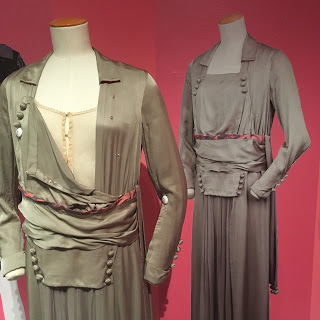 Even this relaxed-looking late-1910s gown has an interior support structure, as eveidenced by the open closure revealing the light muslin underlining/chemise.
 Tailored Balenciaga jacket with that extreme hipspring, and at left is the jacket lying open so you can see the hip padding and layered canvas machine-stitched in rows to create the shape.
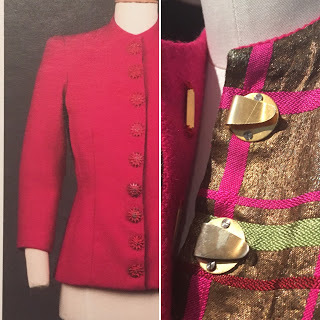 Schaiparelli shocking pink tailored jacket, and the secret to such a sleek front placket: ornamental "buttons" backed with these huge hooks and bars. And look at that secretly-zany lining!
 Look at this wee petticoat for a tiny, tiny child! There was some speculation about whether the number of tucks were designed to be let out as the child grew taller to prolong the life of the garment.
 Beautiful embroidery on this 1920s shift dress cut in two pieces, selvedge to selvedge. The display had a cutting diagram for this gown (there's a second iteration on display as well, from another maker/donor), which was made without a pattern, drafting directly onto the fabric.
 Beautifully preserved lingerie dress covered in fine embroidery, lacework, French handsewing, etc.
That's not nearly all of what was on display--i couldn't get good photos of the bias gowns with unusual closures/cutting methods, for example--so again, if you can find a way to go check out this exhibit before it closes, do so. It's well worth your time.
It's set up in a dedicated gallery similar in size to the one at the Museum at FIT--not as huge as the exhibits mounted by the Met, but nothing to sneeze at. There are thirty-two garments on display with a wealth of information about each one. There is no admission charge so even if you are strapped for cash you can go; there's a donations box by the door if you want to give them something, and merchandise like notecards, too.
I took a lot of photographs, but I think you'll find that the images only serve to make you want to go see the exhibit in person, so you could focus on whatever details interested you most, and for most of these pieces, get as close to them (without touching) as you like.
 The Goldstein Museum is housed within the department of design at McNeal Hall on the UMN-St. Paul campus. I took the bus there, but it seemed like there was nearby parking, too, since it's summer. Once the fall semester starts that might change but right now the campus is a ghostly wasteland of solitude. I only saw three other people while i was there, and one of them was the docent.
 I know you can't really read this, but i wanted to show readers what the information imparted is like throughout the gallery. There are blocks of info like this on the walls near each thematic section at a fairly large font size, and withing the pink box are vocabulary definitions describing sewing terms that visitors not well-versed in garment construction might wonder about, like "selvedge" or "dart" or "felled seam."
  This image gives you a good idea what the displays are like as a whole. At right is a full-size photograph on the back wall of the gown on a form as it is was intended to be worn. On the center and left are the two pieces displayed separately so that, in this case, visitors can observe how the underskirt has been cut and pieced to feature the rich smocked silk fabric at center front where the polonaise opens to expose it, and the rest of the skirt which is normally hidden by the overgarment has been cut from a plain but sturdy canvas.
 For this display, at the rear is a surviving (but damaged) wool paisley shawl from the early 19th century, and in the foreground a 1920s jacket cut from a similar shawl which the maker must have inherited or found in a resale shop. This one is part of that "Sustainability" section in which the examples displayed show aspects of reuse and what we'd now call "upcycling."
 This impeccably preserved 1890s bodice is on the form with its front opening folded back, so you can see how its various interior closures work. You can make out the stabilizing waist-tape here, as well as buttons, hooks, and bars. The little white circles are numbered buttons which correspond to detail information posted along with a photo of the bodice when closed properly.
 This is a 1950s Dior gown shown open up the center back to reveal the interior boning on the seams and such, but what i find so fascinating about it is the fabric design inverted on the interior. Looked like a double-faced sateen but i couldn't touch it so i don't know.
 Even this relaxed-looking late-1910s gown has an interior support structure, as eveidenced by the open closure revealing the light muslin underlining/chemise.
 Tailored Balenciaga jacket with that extreme hipspring, and at left is the jacket lying open so you can see the hip padding and layered canvas machine-stitched in rows to create the shape.
 Schaiparelli shocking pink tailored jacket, and the secret to such a sleek front placket: ornamental "buttons" backed with these huge hooks and bars. And look at that secretly-zany lining!
 Look at this wee petticoat for a tiny, tiny child! There was some speculation about whether the number of tucks were designed to be let out as the child grew taller to prolong the life of the garment.
 Beautiful embroidery on this 1920s shift dress cut in two pieces, selvedge to selvedge. The display had a cutting diagram for this gown (there's a second iteration on display as well, from another maker/donor), which was made without a pattern, drafting directly onto the fabric.
 Beautifully preserved lingerie dress covered in fine embroidery, lacework, French handsewing, etc.
 That's not nearly all of what was on display--i couldn't get good photos of the bias gowns with unusual closures/cutting methods, for example--so again, if you can find a way to go check out this exhibit before it closes, do so. It's well worth your time.
May 31, 2017
Sprout Pattern hack! Make any tee a Concord tee
It should be clear by now that I really, really love the Concord tee pattern from Sprout Patterns/Cashmerette. I have never in my life had a tee shirt that fit so well. Mass-produced tees are always so baggy and boxy and just generally not flattering. They're fine for painting the house in or working in the yard, but even "girly" tees just make me feel frumpy because the armscyes are always all baggy and weird across the front of the body. Not so with the Concord because it's been patterned for--shocker--boobs. So, the fit, the fit! In fact, i said to myself, "I wish all my tee shirts fit like this..." And then i thought, well, couldn't they? So i gave it a shot.
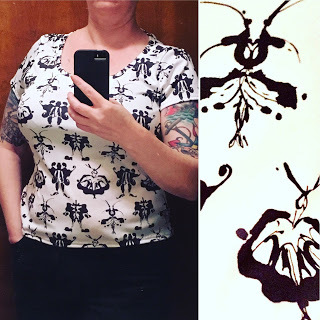 This is a Concord tee from Sprout patterns in an inkblot print that one of my surface design students made several years ago. After i cut the pattern out, i decided to concurrently use it as a template to recut a favorite tee shirt of mine from the production of Mike Wiley's The Parchman Hour at PlayMakers Repertory Company back in 2011.
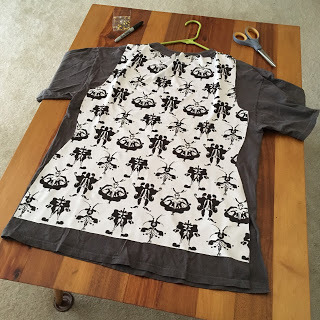 Here i've laid out the back piece of the Concord tee on the shapeless Parchman Hour tee.
This image makes it pretty clear what's different about the fit of the Concord compared to standard tees--the shaping in the armscyes and side seams is key!
So, i basically just used the extant pieces as pattern pieces, transferring the notches to the newly-cut-down seams. I retained the old shirt's shoulder seams and neckband finish. I could have used the old shirt's sleeves as raw material & cut them down using the Concord sleeves as a pattern, but instead i used some of the surplus fabric from an earlier Sprout pattern to make cute contrast sleeves in a fun print ("Jazz Fusion" by some random person on Spoonflower). Pretty psyched about the possibility of using up the extra fabric you get along with a Sprout pattern to do similar mods like this one in future.
Now i have a customized iteration of a Parchman Hour tee, and it fits a million times better, too!
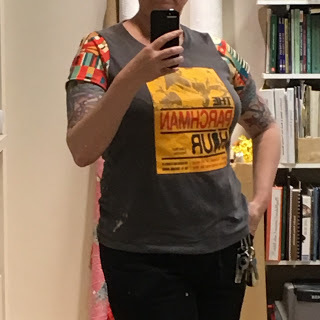
Incidentally, it's really cool to see where that play has gone in ther intervening years. UNC and PlayMakers helped the playwright, Mike Wiley, to develop it, first staging a student production as a partnership between UNC and Duke students (the play ran on both campuses, and then toured to several theatres and community centers in NC, even playing some shows in Alabama near Parchman). Then we did the professional premiere at PRC from which I got this shirt.
It has gone on to run at Cape Fear Regional Theatre in Fayetteville, NC, Lee Street Theatre in Salisbury, NC, and the Guthrie Theatre in Minneapolis, MN. Now it's set to go up at Norfolk's Virginia Stage in the fall. Really, i wish every theatre in the nation would mount this show. It remains one of my favorite productions i've ever been part of.
 This is a Concord tee from Sprout patterns in an inkblot print that one of my surface design students made several years ago. After i cut the pattern out, i decided to concurrently use it as a template to recut a favorite tee shirt of mine from the production of Mike Wiley's The Parchman Hour at PlayMakers Repertory Company back in 2011.
 Here i've laid out the back piece of the Concord tee on the shapeless Parchman Hour tee.
This image makes it pretty clear what's different about the fit of the Concord compared to standard tees--the shaping in the armscyes and side seams is key!
So, i basically just used the extant pieces as pattern pieces, transferring the notches to the newly-cut-down seams. I retained the old shirt's shoulder seams and neckband finish. I could have used the old shirt's sleeves as raw material & cut them down using the Concord sleeves as a pattern, but instead i used some of the surplus fabric from an earlier Sprout pattern to make cute contrast sleeves in a fun print ("Jazz Fusion" by some random person on Spoonflower). Pretty psyched about the possibility of using up the extra fabric you get along with a Sprout pattern to do similar mods like this one in future.
Now i have a customized iteration of a Parchman Hour tee, and it fits a million times better, too!

Incidentally, it's really cool to see where that play has gone in ther intervening years. UNC and PlayMakers helped the playwright, Mike Wiley, to develop it, first staging a student production as a partnership between UNC and Duke students (the play ran on both campuses, and then toured to several theatres and community centers in NC, even playing some shows in Alabama near Parchman). Then we did the professional premiere at PRC from which I got this shirt.
It has gone on to run at Cape Fear Regional Theatre in Fayetteville, NC, Lee Street Theatre in Salisbury, NC, and the Guthrie Theatre in Minneapolis, MN. Now it's set to go up at Norfolk's Virginia Stage in the fall. Really, i wish every theatre in the nation would mount this show. It remains one of my favorite productions i've ever been part of.
La Bricoleuse aggregate and more...

I may crosspost from a couple different blogs on here.
Right now, this space streams the RSS feed from La Bricoleuse, the blog of technical writing on costume craft artisanship that i've written since ...more
Right now, this space streams the RSS feed from La Bricoleuse, the blog of technical writing on costume craft artisanship that i've written since ...more
- Rachel E. Pollock's profile
- 80 followers

