
Rachel E. Pollock's Blog: La Bricoleuse aggregate and more..., page 19
January 28, 2020
A look at the costumes for Everybody at PlayMakers Repertory Company
Everybody is a contemporary reimagining of the medieval morality play, Everyman. We recently opened this show at PlayMakers Repertory Company and the particular challenges of this production provided us with a lot of interesting projects in the costume shop!
The central challenge of the show is that the casting is determined by lottery at the beginning of every show--the entire cast play Somebodies until character of God draws a name for the performer to play Everybody; the rest of the casting is determined by that chance assignment. This means all the actors need to know the whole show, because they won't know who they are playing until the show has already started. This also means the the costumes need to fit several different people!
Luckily, costume designer McKay Coble took that into consideration when she conceived the show, so many of the characters wear easily-switchable items to indicate who they are--Strength wears a helmet on an adjustable hardhat mount, Love wears a cape-like robe, etc. In terms of show assignments for our costume production graduate students, the show wound up essentially 90% craftwork. Since we endeavor to provide our grad students with portfolio-worthy assignments on the professional shows, this did NOT mean that I directed a team of grad student assistants--we all got workloads chosen with each student's strengths in mind--that meant that each of them received an assignment for which they were responsible for all elements--millinery, surface design, draping, whatever the design required.
Take a peek:
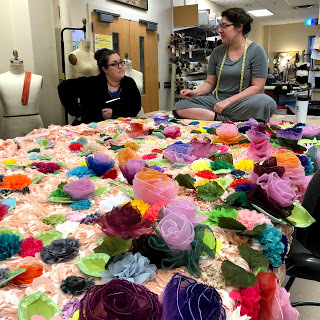 PRC wardrobe supervisor Amy Evans talks with draper Cami Huebert about how best to care for the elaborate floral robe worn by the character of Love, who would always be played by the same performer. This robe has hundreds of handmade fabric flowers sewn on to create a bower/flower garden effect.
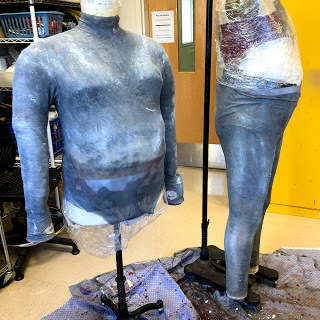 For the character of Death, McKay wanted the actor to look like he was coated with ash.Here you see the power net leotard and tights made by draper Erin Rodgers and first hand Sherry Wu with the first coat of textile paint applied. They had to pad the forms to replicate the actor's body shape (Death is always played by the same performer).
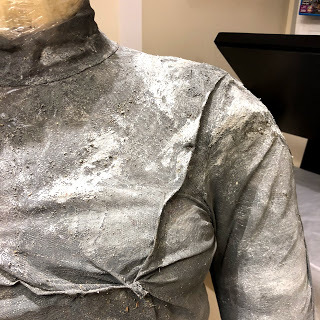 In tech, the bodysuit "grew" as the gritty ash effect inhibited the elasticity of the power net to recover from stretch as much as it otherwise would, so McKay requested that Erin and Sherry use this to advantage in creating these disturbing scarification effects around a sculptured nipple. Definitely an example of "if you can't fix it, feature it!"
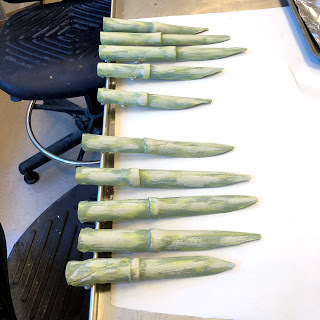 "Bamboo" finger spikes from Wonderflex, painted by draper Erin Rodgers.
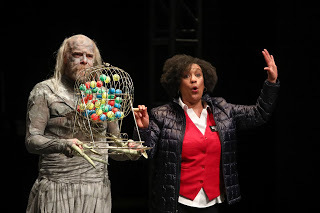 David Adamson as Death, Kathryn Hunter-Williams as God, photo by Huthphoto
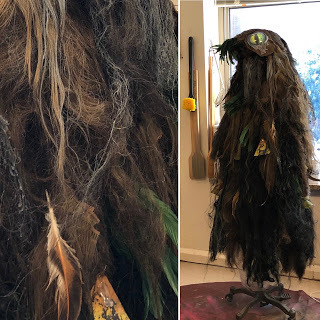 The character of Evil wound up as a collaboration between myself and costume director Triffin Morris. This role is played by two different performers depending on the Everybody assignment, and the character walks on spring stilts with forearm-braced crutches. McKay wanted it to look like a huge hairball in a shower drain--slimy, matted, gross fur/hair/feathers/fungus.
Because the stilt choreography took a while to settle on, and the character concept changed several times, we decided to start with a brown fur costume from our stock. This costume began as a bear-fur coat for an undergraduate production several years ago, then got reworked into last season's Woodchuck in Bewilderness, and is now enjoying its third (and final) life on the stage as Evil.
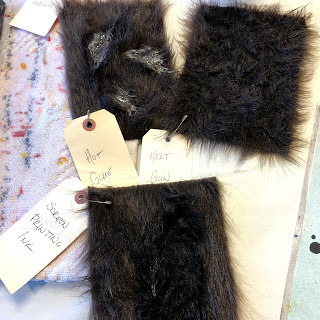 Some slime samples I made for McKay to look at.
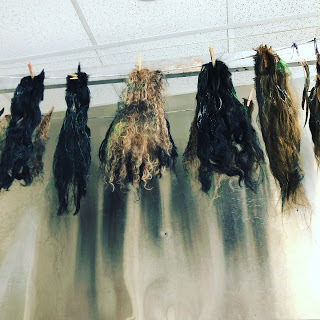 Wardrobe supervisor Amy Evans used this as an excuse to cull our wig stock--these are bits of deaccessioned wigs cut into clumps and "slimed." These were placed all over the fur base costume and stitched into place with the help of our undergraduate shop assistants and Cami Huebert (who captained the flower robe trimming in much the same way).
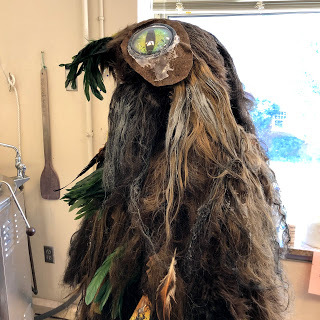 The hood has a large Fosshape "cranium" inside it to keep the shape on the performer's head. The eyes (of which Evil has four) are some pieces of Halloween decor that McKay bought this past fall with this costume in mind. The eye slime is hot glue smeared like sparkle.
I'll end this post here, but there will need to at least be a Part Two, if not more!
The central challenge of the show is that the casting is determined by lottery at the beginning of every show--the entire cast play Somebodies until character of God draws a name for the performer to play Everybody; the rest of the casting is determined by that chance assignment. This means all the actors need to know the whole show, because they won't know who they are playing until the show has already started. This also means the the costumes need to fit several different people!
Luckily, costume designer McKay Coble took that into consideration when she conceived the show, so many of the characters wear easily-switchable items to indicate who they are--Strength wears a helmet on an adjustable hardhat mount, Love wears a cape-like robe, etc. In terms of show assignments for our costume production graduate students, the show wound up essentially 90% craftwork. Since we endeavor to provide our grad students with portfolio-worthy assignments on the professional shows, this did NOT mean that I directed a team of grad student assistants--we all got workloads chosen with each student's strengths in mind--that meant that each of them received an assignment for which they were responsible for all elements--millinery, surface design, draping, whatever the design required.
Take a peek:
 PRC wardrobe supervisor Amy Evans talks with draper Cami Huebert about how best to care for the elaborate floral robe worn by the character of Love, who would always be played by the same performer. This robe has hundreds of handmade fabric flowers sewn on to create a bower/flower garden effect.
 For the character of Death, McKay wanted the actor to look like he was coated with ash.Here you see the power net leotard and tights made by draper Erin Rodgers and first hand Sherry Wu with the first coat of textile paint applied. They had to pad the forms to replicate the actor's body shape (Death is always played by the same performer).
 In tech, the bodysuit "grew" as the gritty ash effect inhibited the elasticity of the power net to recover from stretch as much as it otherwise would, so McKay requested that Erin and Sherry use this to advantage in creating these disturbing scarification effects around a sculptured nipple. Definitely an example of "if you can't fix it, feature it!"
 "Bamboo" finger spikes from Wonderflex, painted by draper Erin Rodgers.
 David Adamson as Death, Kathryn Hunter-Williams as God, photo by Huthphoto
 The character of Evil wound up as a collaboration between myself and costume director Triffin Morris. This role is played by two different performers depending on the Everybody assignment, and the character walks on spring stilts with forearm-braced crutches. McKay wanted it to look like a huge hairball in a shower drain--slimy, matted, gross fur/hair/feathers/fungus.
Because the stilt choreography took a while to settle on, and the character concept changed several times, we decided to start with a brown fur costume from our stock. This costume began as a bear-fur coat for an undergraduate production several years ago, then got reworked into last season's Woodchuck in Bewilderness, and is now enjoying its third (and final) life on the stage as Evil.
 Some slime samples I made for McKay to look at.
 Wardrobe supervisor Amy Evans used this as an excuse to cull our wig stock--these are bits of deaccessioned wigs cut into clumps and "slimed." These were placed all over the fur base costume and stitched into place with the help of our undergraduate shop assistants and Cami Huebert (who captained the flower robe trimming in much the same way).
 The hood has a large Fosshape "cranium" inside it to keep the shape on the performer's head. The eyes (of which Evil has four) are some pieces of Halloween decor that McKay bought this past fall with this costume in mind. The eye slime is hot glue smeared like sparkle.
I'll end this post here, but there will need to at least be a Part Two, if not more!


January 24, 2020
Review: custom dress pants by The Red Thread Collection
 Front, side, and a detail shot of the front pocket zipper and stitched "crease"
 I've been served an ad for The Red Thread Collection several times on Instagram and the company's claims struck me as either super exciting or maybe too good to be true: send them three selfies and receive a bespoke garment drafted to fit you perfectly...WITH POCKETS?!
Because they have an option to pay only the shipping and return the item if it doesn't fit well, I decided to give it a try. $4.99 was a decent price for the opportunity to test it out (and then write about it in this blog, of course). So, I checked out their styles--of which there are only a few classic pieces--and chose the Essential Ankle Pant.
Like most consumers of off-the-rack fashion, pants are a fit challenge. Historically, when I find a brand that fits well through the hips and thighs, I buy several pairs and then make alterations to the waist and hem. If the pants have inadequate/shallow or false pockets, I put in the size of pockets I need. Because I've been sewing since middle school, that's not a huge hardship for me, but if I weren't a trained stitcher/patternmaker, I would either need to rely upon an alterations shop or would have to just wear poorly-fitting clothes. I wondered: has garment-making technology advanced enough that the folks at Red Thread could change that for the non-sewist?
When I placed my order, I had to answer a series of questions before sending in my selfies, about how ready-to-wear pants tend to fit me poorly (tight in the thighs? baggy in the seat? long/short-waisted? etc). I then sent them three photos of myself (front, side, back) and a fourth image of the room I was standing in for the pix in but without me in it. Then, I provided my height and that's it. Seven days later, my pants arrived. (See above photo.)
Because they make the pants from a knit material with significant stretch, they have a fairly wide window of tolerance in terms of fit, and these pants do in fact fit me well. I can definitely recommend the style and the customization experience--if you see a garment on their site that you like, give it a try.
For myself, I'm torn, because the pants ARE the best-fitting most flattering dress pants i've ever owned, but at the same time, because i do physical labor for the better part of my job (standing over a dye vat, operating industrial machinery, etc.), i don't really wear dress pants very often (mostly cords/jeans). If i had a corporate job or waited tables in a nice restaurant, i can see myself owning five pairs of these pants. As it is, I'm keeping the pants because I do have occasional need for nice dress pants, but they aren't my new everyday pant. I still need to find work pants that fit or continue to alter off-the-rack ones.
I did not receive any payment or incentive from The Red Thread Collection to write this review. I did so because there was a discussion about the feasibility of the company's claims on a professional costumers' forum and wanted to see for myself if the claims were true.
January 18, 2020
Interview: Tricia Camacho of Creative Costume Academy
 Main stage bird dancers at Las Vegas' Electric Daisy Carnival,costumes made by Tricia Camacho/The Patterned Seamstress
 I've got a new interview to share with Tricia Camacho, a professional costume maker who has just launched online patternmaking classes under the name Creative Costume Academy.
I'm so excited for this post because Tricia has such a successful career in international live entertainment, and she also came to it on a path different from the one so many of my own students took. Tricia is proof that you don't need a BFA in theatre and an MFA in costume design/production in order to have a wildly successful career at the top level! And her online academy affords that opportunity to others who may not have the desire or the means for a long slog in academia.
In the interest of full disclosure though, Tricia IS a former student of mine--through the continuing education program at UNC-Chapel Hill, she audited my "Digital Technologies in Costume Production" class a couple of years ago, and she also took our "Couture Methods" class from former graduate costume production program head Judy Adamson. (Tricia heard about us from alumnus Randy Handley when they both worked together out in Las Vegas.) In addition to her new series of classes, she makes costumes for clients like Blue Man Group through her studio The Patterned Seamstress.
Here's our interview:
What is the Creative Costume Academy?
The Creative Costume Academy (CCA) is an online school for learning the principles of pattern making and more advanced sewing techniques. We are still in the beginning stages of the school, but I do have ideas for expansion into more detailed pattern and sewing classes if there is a desire.
Who are your students? Meaning, how much knowledge about sewing do prospective students need, is there a minimum age, etc.
CCA is for the stitcher, sewist, or maker who is ready to take their creativity to the next level by diving into understanding pattern manipulation or working with more complicated materials such as stretch fabrics and foam. There is no minimum age, but the students that will get the most out of these classes will have at least a basic understanding of sewing and have some experience using purchased patterns. These classes are to provide the tools and principles to enable the students to make their own designs and creations building from the basics.
What can students expect from a CCA class? (Meaning, lecture videos vs written content, downloadable files, etc.)
CCA classes are instructional videos with follow-along written content. There are downloadable tools and a print out book with step-by-step instruction of how to do all of the exercises we will be doing together in the class. I give away my resource and book lists for acquiring specialized tools and materials. There is a complementary video for each exercise explaining how to lay out your new pattern, cut it out of fabric and how to sew it together. I am available, as your instructor, to answer any questions via email or chat through the Teachable.com site. There will also be periodic live Q & A sessions that all of the students will be invited to join to ask more direct questions. Through these live sessions and being able to see what others may be struggling with, I believe we create a community where we can all inspire and help each other.
I find the whole concept of the CCA exciting, in that I've often wished I had a resource just like it to recommend to young people interested in this field, who have the (mistaken) impression that they must spend seven years in academia to get their MFA. Now, I can recommend they check out your class offerings!
What is the Patterned Seamstress, and how do you balance the work you do under that name with running the CCA?
The Patterned Seamstress (TPS) is my costume build shop. We build costumes for large theatrical productions (such as Cirque Du Soleil and Blue Man Group) in my home studio and ship out to my clients. I also, at times, travel to help shows open for short term tours. TPS has built the reputation to be able to handle very challenging builds and has the ability to solve problems quickly to help support the needs of a show opening where variables can be unknown. I can balance TPS work with CCA by the very nature of the industry. We do have periods of insanely busy times with The Patterned Seamstress, but the beauty of the online element of the CCA classes, they can be taken when ever it is convenient for the student! The class is completely self-paced. I will offer live classes and bonuses when we are not in these busy times to get the most out of both with the flexible time lines. The work I do with The Patterned Seamstress helps me to continue to learn tricks and tips that I can pass on to my students in CCA. I feel like they really support each other.
How did you get your start in professional costume making?
When I discovered costuming was the path I wanted to investigate as a career, I started by volunteering at local theaters and civic light operas to see what skills I needed to focus on to succeed in the business. I got my first professional job when I was in my first few years of school at Knott's Berry Farm in California for the show Snoopy Rocks! on Ice. From there, I did a summer at The Utah Shakespeare Festival, in Cedar City Utah. I met several friends that summer that quickly turned into more job opportunities. I was on tour for 2 years before I landed in Las Vegas. Living in Las Vegas for 11 years, I honed my skills for working with stretch fabrics for the purpose of acrobat and synchronized swimming performance. I also had the opportunity to work with some talented people who shared their stretch pattern knowledge with me and I soaked up as much as I could!
What sort of educational background do you have in costume production?
I have a unique education experience. I am somewhat of an impatient person and I like to get right into applying what I am learning in the most practical sense. I started with volunteering at the local theaters and worked with costume designers to see what I needed to focus on learning for my chosen profession. I then found an excellent teacher at Fullerton Junior College where I completed a Costume Design Certificate program that focused solely on Fashion and Theatre classes. It was at Fullerton, I realized my knack for and love of pattern making. I loved all of the different methods that made creating my designs so much faster and more efficient. My teacher suggested that I continue onto a Technical School to further my technical pattern knowledge. After a summer in Utah, I completed a semester at LA Trade Technical College. I had some intense pattern classes and really fine-tuned my pattern knowledge. I left the 2 year program early when I was offered a show touring job, which was an opportunity I felt I could not pass up at the time. It was my intention to go back to school, but when I landed in Las Vegas, my options were limited. Still having the desire to continue my pattern learning, I studied books and methods on my own and spent time outside of working hours with our on-site pattern maker who shared with me her Belgian unitard drafts and other various pattern techniques. One day, while scrolling online for some pattern inspiration, I stumbled across this amazing Japanese pattern genius, Shingo Sato, who developed his own beautifully intense pattern methods he named, Transformation Reconstruction. I took an online class to learn his techniques where I pushed my pattern knowledge a little more into the fashion Avant-garde world of patterns and met talented fashion designers all over the world. This was an intense, inspirational experience and really was what planted the seed for the option of teaching pattern techniques in the online space. After moving to North Carolina in 2016, I took the advice of a friend to reach out to UNC Chapel Hill's MFA costume production program to audit their Costume Couture Methods and Digital Technologies in Costume Construction classes. I learned so much from both classes and would love to learn more about their program. As you can see, there is no one program that I can contribute to my education, but I do have a strong thirst to learn about my favorite subject and don't think I will ever stop attempting to learn more about my craft.
Tell us about a recent Patterned Seamstress project you enjoyed working on and if you can share a photo, please do!
I do have one client we have worked with for several years that is always challenging, but a lot of fun. For the last 4 years I have made costumes for the main stage dancers at Las Vegas' Electric Daisy Carnival by the company Insomniac. This is a 3 day electronic dance festival that kicks off in Vegas then travels to cities around the world hosting similar events. I usually work with the coordinator to come up with a design for her girls. There is typically a theme or design proposal, then we dream up the details. This last year, the theme was birds. The challenge with these kinds of projects is to make something like a bird look sexy, colorful and fun to fit in with the atmosphere. Because of the enormity of the stage and audience, there is always a focus on pushing the envelope and making them "larger than life". The other challenge posed with this company is that the same six girls will not travel with the show to every city, so they have to be somewhat adjustable and also be easy to clean and travel. For this particular bird look, we were not allowed to use real feathers. We achieved the look using frayed chiffon of multiple colors and the bodies were made out of stretch fabrics with detachable parts. It was a lot of work, but I was happy with the end result.
 bird dancers minus the birds What advice do you have for someone in high school or college who wants to pursue a career in this industry?
My best advice for a young person looking to pursue a career in this industry is to immerse yourself into this world as much as you possibly can. Watch shows, go to events, volunteer your time, study on your own, and probably my best advice I can offer is to take every opportunity that is presented to learn about the things that interest you. Work ethic, willingness to learn, and networking has helped me the most to succeed in my career.
What is your favorite tool in your costume workroom and why?
Oh! What a hard question! I have so many favorite tools! I would have to say my most used tools and the things that I believe have helped me the most are my rotary cutter and full table cutting mats. Being left handed, scissors were always a bit of a trick to get used to and be accurate when doing large amounts of cutting. With the rotary and large mats, I can cut things out quickly and accurately. Time is money and it is the number one thing that saves me time!Tricia, thanks so much for your contribution to my interview series here on La Bricoleuse. I love sharing the stories of professionals in this field and the many paths we all can take to achieve success in professional costume production!
 Tricia's bird dancer costume onstage!
 December 30, 2019
Exhibit/Book Review: Deeds Not Words

Deeds Not Words: Celebrating 100 Years of Women's Suffrage is the book i'm reviewing, but know first that it's a catalogue for a traveling exhibit of quilts created by contemporary textile artists in celebration of the centennial of the 19th Amendment to the US Constitution. The exhibit kicks off at the National Quilt Museum in Paducah, KY on April 3 where it will be on view through June 9th, 2020. I couldn't find a schedule for where it'll go from there, but the notes in the book say that it'll travel through 2012, and since several contributing artists are involved with other quilt museums around the country and the whole thing is sponsored in part by equilter.com, keep your eyes open for dates near you.
The book is a comprehensive catalogue of the exhibit which includes full-color photographs of all 28 quilts which comprise it as well as other supplementary images (photographs, source documents, etc). Two essays on the history of suffrage and how racism impacted the movement start off the book, followed by an image of each quilt, an artist's statement about their work, and a detailed biography of the quilter.
There are also a couple of appendices of note that apply to quilts in the exhibition. One quilt addresses the concept of "first ladies"--the first woman to achieve various honors/positions/awards.The quilt includes portraits of dozens of women (like Sally Ride, the first female astronaut) and Appendix A names them all and offers brief biographical facts about each. Another quilt celebrates the unsung heroes of African American suffrage, and Appendix B cites names/bios of all of these women.
This is a beautifully produced "coffee table"-style art book in and of itself and though I have not yet had the pleasure to attend the exhibition, I enjoyed seeing and reading about the featured quilts. Highly recommended!
I was given an advance copy of this title by NetGalley in exchange for an honest review.
December 23, 2019
Book review: Super Arduino

Have you wanted to learn about the Arduino microcontroller but feel overwhelmed by the wealth of information out there? Do you get excited AND intimidated by the idea of programmable circuitry for wearable projects that light up, play sounds, or move? This book is a fantastic introduction!
In a series of progressively more challenging projects, the author (an engineer and grade school teacher) explains in clear concise terms how you can write the programs to power cool things like light-up disco shoes and a robotic undulating shark tail mounted on a belt!
As a theatrical costumer, I knew immediately how the topics covered in this book could be adapted and modified for applications in my industry. Highly recommended title for makers across the age range. I think a precocious 12-year-old could do most of these projects with adult supervision, but the book isn't "just for kids." I would recommend it to my own graduate students, and in fact, were I teaching our course entitled "Digital Technologies for Costume Production" I might use it as a supplementary text for an Arduino project.
I received an advance copy of this book from #NetGalley in exchange for an honest review.
December 12, 2019
Class projects: Footwear!
My graduate students in the costume accessories class presented their footwear projects today. This unit covers the various ways we can create either period styles or fantasy footwear looks.
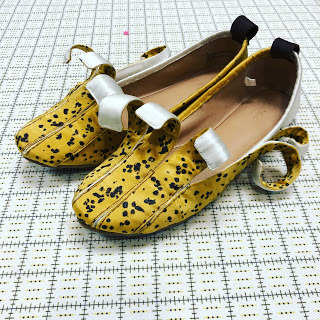 Second year grad Lauren Woods created these banana shoes for her complex shoes.
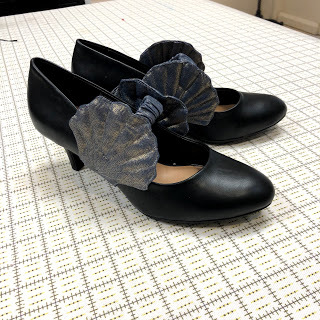 She also turned these pumps into shell-adorned Maryjanes.
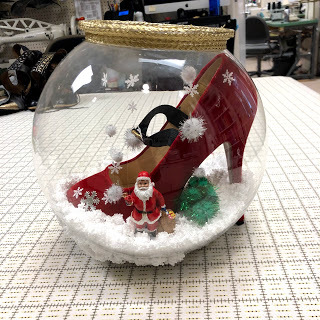 First year grad Alex Hagman created these snow globe Christmas themed platforms.
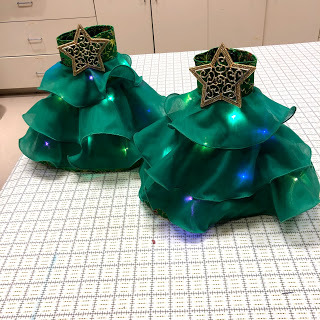 She also made Christmas tree spats with integrated lights.
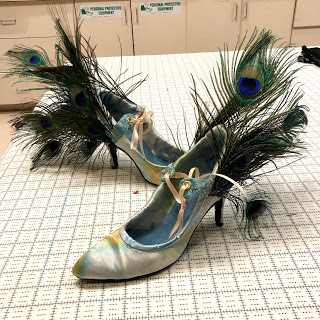 First year grad Sherry Wu created these peacock-themed heels for her complex shoe project.
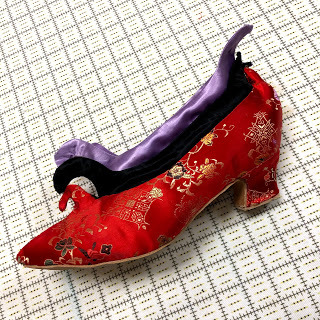 Second year grad Ellen Cornette created these "three layer shoes" for her complex shoe project.
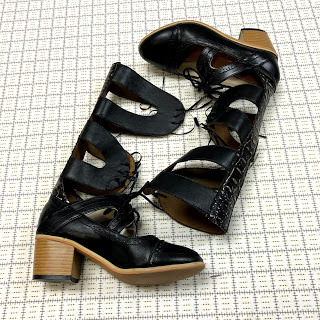 Second year grad Erin Rodgers extended these shoes into boots for her complex shoe project.
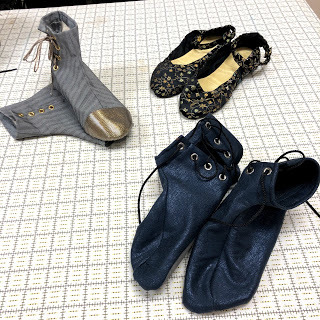 Turn-shoe projects from top left:Gold-toe regency boots by Erin RodgersBlack/gold brocade ankle-strap flats by Sherry WuMetallic ultra suede acrobat boots by Ellen Cornette
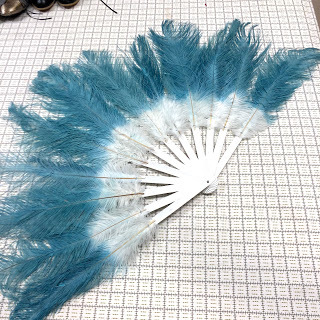 Surprise bonus: Lauren Woods also presented her ombre-dyed ostrich feather burlesque fan!
This has been such a great class!
Second year grad Lauren Woods created these banana shoes for her complex shoes.She also turned these pumps into shell-adorned Maryjanes. First year grad Alex Hagman created these snow globe Christmas themed platforms.
 She also made Christmas tree spats with integrated lights.
 First year grad Sherry Wu created these peacock-themed heels for her complex shoe project.
 Second year grad Ellen Cornette created these "three layer shoes" for her complex shoe project.
 Second year grad Erin Rodgers extended these shoes into boots for her complex shoe project.
 Turn-shoe projects from top left:Gold-toe regency boots by Erin RodgersBlack/gold brocade ankle-strap flats by Sherry WuMetallic ultra suede acrobat boots by Ellen Cornette
  Surprise bonus: Lauren Woods also presented her ombre-dyed ostrich feather burlesque fan!
This has been such a great class!
December 8, 2019
Book Review: 3D Printing and Maker Lab for Kids

Okay, it's only obliquely topical I suppose, in that this blog is not remotely about fun activities for children. However, many professional costumers are also parents, and as we incorporate 3D fabrication technologies into our process more and more, it's fun to consider sharing those activities with our children.
And in fact, I think this book could actually be great for adults who want to learn about 3D fabrication but have no idea where to start, or who find technology intimidating. The language and subjects covered are not "dumbed down" for the intended audience. The projects are simple and straightforward yet also potentially useful (like a coat hook, a hair comb, a ball/socket phone/camera holder). The drafting software is freeware (Tinkercad and Sketchup) and the author covers filesharing sites like Thingiverse.
The book is structured like a class workbook, with drafting/printing projects and subsequent questions on theoretical changes to the outcomes (answer key in the back of the book). There's also a glossary to look up any unfamiliar terminology. The diagrams and illustrations are clear and colorful; science teachers could use this as a textbook or lab manual, in fact.
Highly recommended for those of all ages who want to learn about 3D modeling/fabricating. No experience necessary!
I received a copy of this book from NetGalley in exchange for an honest review.
December 2, 2019
Book review: Mending Life by Nina and Sonya Montenegro
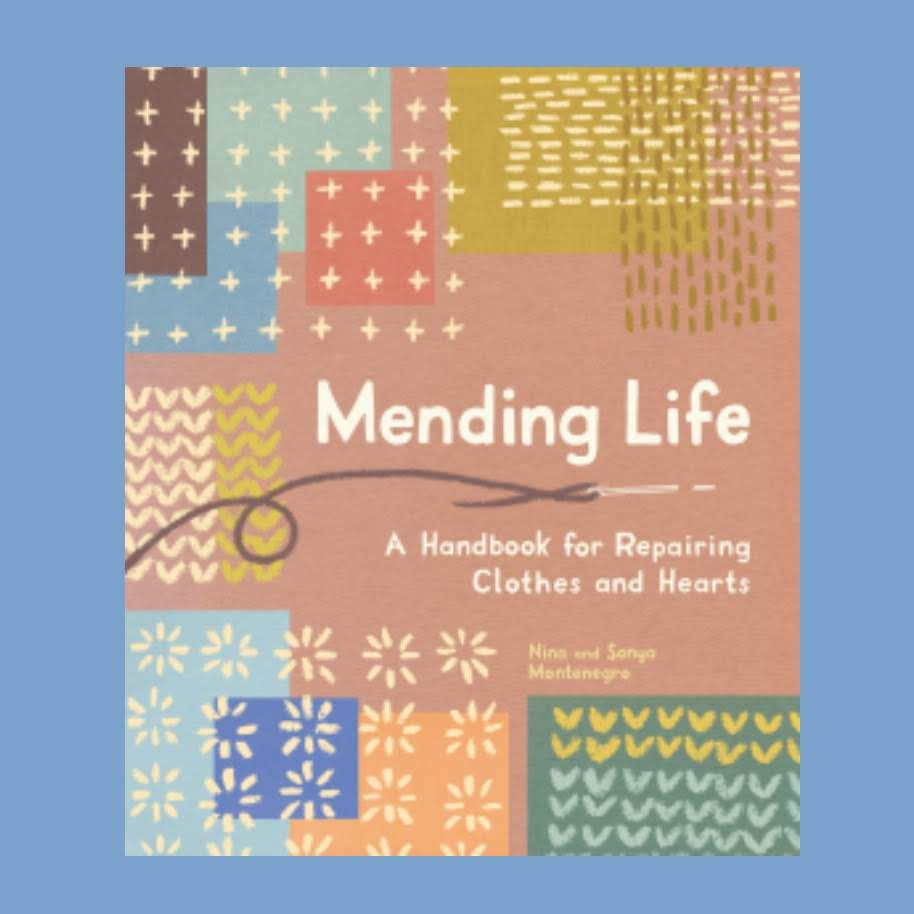
Mending Life: A Handbook for Repairing Clothes and Hearts by Nina and Sonya Montenegro is a charming and useful little book on a wide range of needlecraft techniques to mend damaged clothing items. Her clear, concise explanations of techniques like patching, darning, and sashiko. This book is great for anyone rethinking fast fashion and the unsustainable disposability of contemporary clothing
Montenegro presumes no sewing expertise whatsoever on the part of the reader. She literally describes and diagrams how to thread a needle, several ways to knot the thread, and several useful stitches for mending both wovens and knits. She includes a list of mending tools you'll need if you decide to take up the "mending life" seriously--darning eggs, glove darners, etc.--but she also discusses ways to work around not having those specialized items.
Interspersed among the practical techniques/diagrams are sweet, peaceful illustrations of stitchers mending various garments and philosophical musings on how positive the act of mending garments can be on one's psyche. This book has no new information for an experienced sewist in terms of the how of mending/darning/patching, but even a seasoned seamster/mender may find something new and uplifting in the introspective portions.
I received an ARC of this book from NetGalley in exchange for an honest review.
November 28, 2019
Book review: Seasonal Plant Dyes by Alicia Hall

This is my second recent review of a new book on natural dyes! The first was The Wild Dyer by Abigail Booth, reviewed at this link.
I'll reiterate the point with which I opened that prior review: in the field of theatrical costume production, there's not much focus on natural dyes. Costume designers are devoted to color control, and when I'm asked to dye something for a show, I'm given a Pantone color or fabric swatch to which I must color-match. Color control can be difficult with any dyestuff, but natural dyes require significant experience to exert the level of control the theatrical discipline requires. That said, I can envision conceptual productions or theater companies for whom natural dyeing was a conscious choice on behalf of the creative team or the organization itself.
The book is basically divided in two parts: the first six chapters on the methodology of harvesting and using plants as dyes, then the final four chapters using the cycle of the seasons as an organizational structure to cover what plants to use when. (This is another good reason why natural dyes are not used much in theatrical production--we often don't have time to wait for the cycle of the seasons to provide the supplies for the proper color! A designer would have to decide to restrict their design to the palette of a given season.)
I love the way this book is structured. In order to fully understand how to use the dyes in a given season to make the accompanying project, those first six chapters are must-reads. They cover how to harvest plants for maximum color yield, how to choose fabrics with a fiber content with which the dyes can react, what tools you'll need, and various dye processes and recipe additions such as lemon juice or vinegar (acids) and chalk or wood ash (alkalis).
This book is more of a gardener's perspective at natural dyes, whereas the prior title i reviewed (The Wild Dyer) was more of a forager/cook's point of view.
I received an ARC of this book from NetGalley in exchange for an honest review.
November 22, 2019
Multiples for RAGTIME at PlayMakers Repertory Company
A fresh take on the musical Ragtime is opening this Saturday at PlayMakers Repertory Company, so I thought a post on some of the craftwork might be fun! The show, written to be set in 1906, has historically been produced with opulent period costumes for its wealthy/celebrity characters and historically appropriate workwear for its lower-income characters. So, when the season was announced, I thought I'd be making a bunch of elaborate hats and doing a lot of distressing and aging of clothes. Boy, was I mistaken!
Costume designer Lux Haac has envisioned a contemporary urban landscape in terms of the clothes--all up-to-the-minute 2019 fashions from trendy retailers like Urban Outfitters. I found myself blocking a couple of Brooklyn-hipster fedoras (one velour felt, one raffia straw), but mostly my labor went towards two big projects: the branded Ford hats for Henry Ford's ominously-rousing number, and a whole host of highly-specific t-shirt graphics in transfer vinyl.
Let's start by talking about the Ford hats:
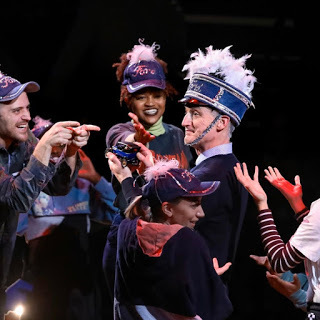 Ray Dooley as Henry Ford with ensemble
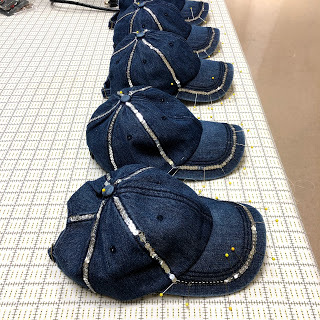
Lux wanted the twelve-person chorus to have a fantastical version of factory-worker hats--denim ball caps adorned with sequins, Swarovski crystals, and ostrich feather plumes. The majority of the show is played very realistically, so when theatrical moments happen, there's some sort of absurdity in the look of the clothes to clue the audience into the presence of falsehood, fantasy, and subtext.
The silver sequin schlung is machined along the seamlines of the caps and hand-stitched (not glued!) along the visor for security during the choreography. The image above shows the first batch of caps set up for hand sewing of that visor trim.
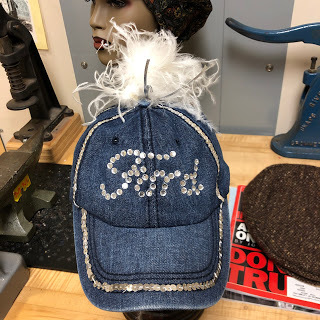
The Ford logo requires 51 hand-placed Swarovski crystals. Due to size variation, some needed 52 or 53! That's over 600 crystals just in the logo alone for this number. The pompons on top of each hat are curly ostrich with thin streamers of silver braid integrated in.
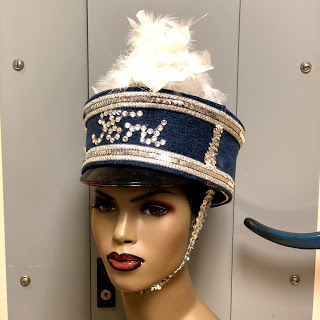 And then there's the bandleader's hat with its lurex/chandelle plumage on top!
I made this whole number worth of hats with the help of three undergraduate assistants.
The tee shirt graphics were created with the help of the technicians at the UNC campus makerspace and the digital vinyl cutter. We had to bring our own heat-transfer vinyl and our own vector file, and the graphics got cut in an afternoon. Lux created the design she wanted in Adobe Illustrator and we converted them to an .svg file for running the cuts.
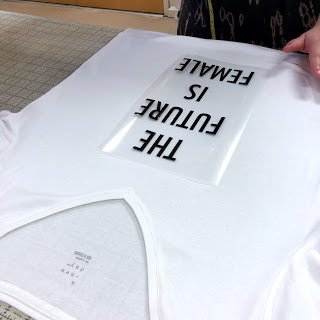 This was the simplest cut, both in terms of the time it took for the machine (seconds) and the time it took for someone to weed out the negative space before heat-pressing onto the shirt.
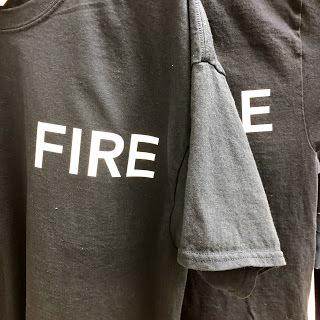 We had six firemen shirts to make, with this FIRE logo on both the front pocket and huge across the back. Because the cut was to be done in white vinyl, Lux performed some Illustrator Tetris to lay them out in tandem with another white vinyl cut...
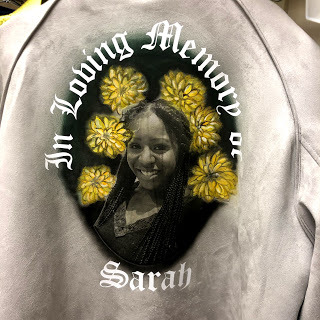 ...the letters on this memorial jacket-back design. This was a team effort with Lux herself--I created the photo transfer on inkjet transfer paper, then Lux airbrushed the flowers and cameo design, then I applied the heat-set vinyl cuts. BIG SPOILER: Coalhouse wears this tribute to Sarah after her death.
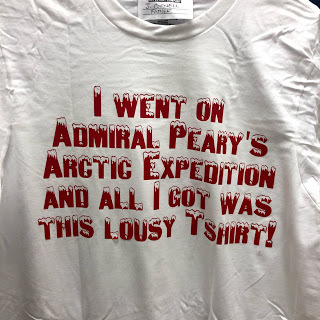 The vinyl cutter tech at the makerspace said this complex file was the longest cut he'd run--it took almost 15 minutes! Then it took almost an hour for one of our graduate students to weed the negative space before applying to the shirt.
Ragtime opens this Saturday and runs for the next two weeks, Tuesday through Sunday.
Costume designer Lux Haac has envisioned a contemporary urban landscape in terms of the clothes--all up-to-the-minute 2019 fashions from trendy retailers like Urban Outfitters. I found myself blocking a couple of Brooklyn-hipster fedoras (one velour felt, one raffia straw), but mostly my labor went towards two big projects: the branded Ford hats for Henry Ford's ominously-rousing number, and a whole host of highly-specific t-shirt graphics in transfer vinyl.
Let's start by talking about the Ford hats:
 Ray Dooley as Henry Ford with ensemble
Lux wanted the twelve-person chorus to have a fantastical version of factory-worker hats--denim ball caps adorned with sequins, Swarovski crystals, and ostrich feather plumes. The majority of the show is played very realistically, so when theatrical moments happen, there's some sort of absurdity in the look of the clothes to clue the audience into the presence of falsehood, fantasy, and subtext.
The silver sequin schlung is machined along the seamlines of the caps and hand-stitched (not glued!) along the visor for security during the choreography. The image above shows the first batch of caps set up for hand sewing of that visor trim.

The Ford logo requires 51 hand-placed Swarovski crystals. Due to size variation, some needed 52 or 53! That's over 600 crystals just in the logo alone for this number. The pompons on top of each hat are curly ostrich with thin streamers of silver braid integrated in.
 And then there's the bandleader's hat with its lurex/chandelle plumage on top!
I made this whole number worth of hats with the help of three undergraduate assistants.
The tee shirt graphics were created with the help of the technicians at the UNC campus makerspace and the digital vinyl cutter. We had to bring our own heat-transfer vinyl and our own vector file, and the graphics got cut in an afternoon. Lux created the design she wanted in Adobe Illustrator and we converted them to an .svg file for running the cuts.
 This was the simplest cut, both in terms of the time it took for the machine (seconds) and the time it took for someone to weed out the negative space before heat-pressing onto the shirt.
 We had six firemen shirts to make, with this FIRE logo on both the front pocket and huge across the back. Because the cut was to be done in white vinyl, Lux performed some Illustrator Tetris to lay them out in tandem with another white vinyl cut...
 ...the letters on this memorial jacket-back design. This was a team effort with Lux herself--I created the photo transfer on inkjet transfer paper, then Lux airbrushed the flowers and cameo design, then I applied the heat-set vinyl cuts. BIG SPOILER: Coalhouse wears this tribute to Sarah after her death.
 The vinyl cutter tech at the makerspace said this complex file was the longest cut he'd run--it took almost 15 minutes! Then it took almost an hour for one of our graduate students to weed the negative space before applying to the shirt.
Ragtime opens this Saturday and runs for the next two weeks, Tuesday through Sunday.
La Bricoleuse aggregate and more...

I may crosspost from a couple different blogs on here.
Right now, this space streams the RSS feed from La Bricoleuse, the blog of technical writing on costume craft artisanship that i've written since ...more
Right now, this space streams the RSS feed from La Bricoleuse, the blog of technical writing on costume craft artisanship that i've written since ...more
- Rachel E. Pollock's profile
- 80 followers

