
Rachel E. Pollock's Blog: La Bricoleuse aggregate and more..., page 16
January 24, 2021
Review: ThredUp digital vintage clothing superstore
I've read several threads in professional theatrical costume fora about the fashion waste generated by shows set in the present--they don't require a team of skilled drapers/tailors/stitchers to create the clothes from scratch, they get shopped online and often overshopped. You buy a bunch of options, fit the performers, and sometimes you've missed the window for returns so the "inexpensive" pants have actually cost the price of all five options purchased. The propensity for programming contemporary work in regional theatre means most costume stocks are swimming in nearly-brand-new clothes which may never be used again.
If your activewear/jeans/trendy-modern bins are overflowing in your costume stock, ThredUP could be one way to thin out your stock of contemporary clothing.
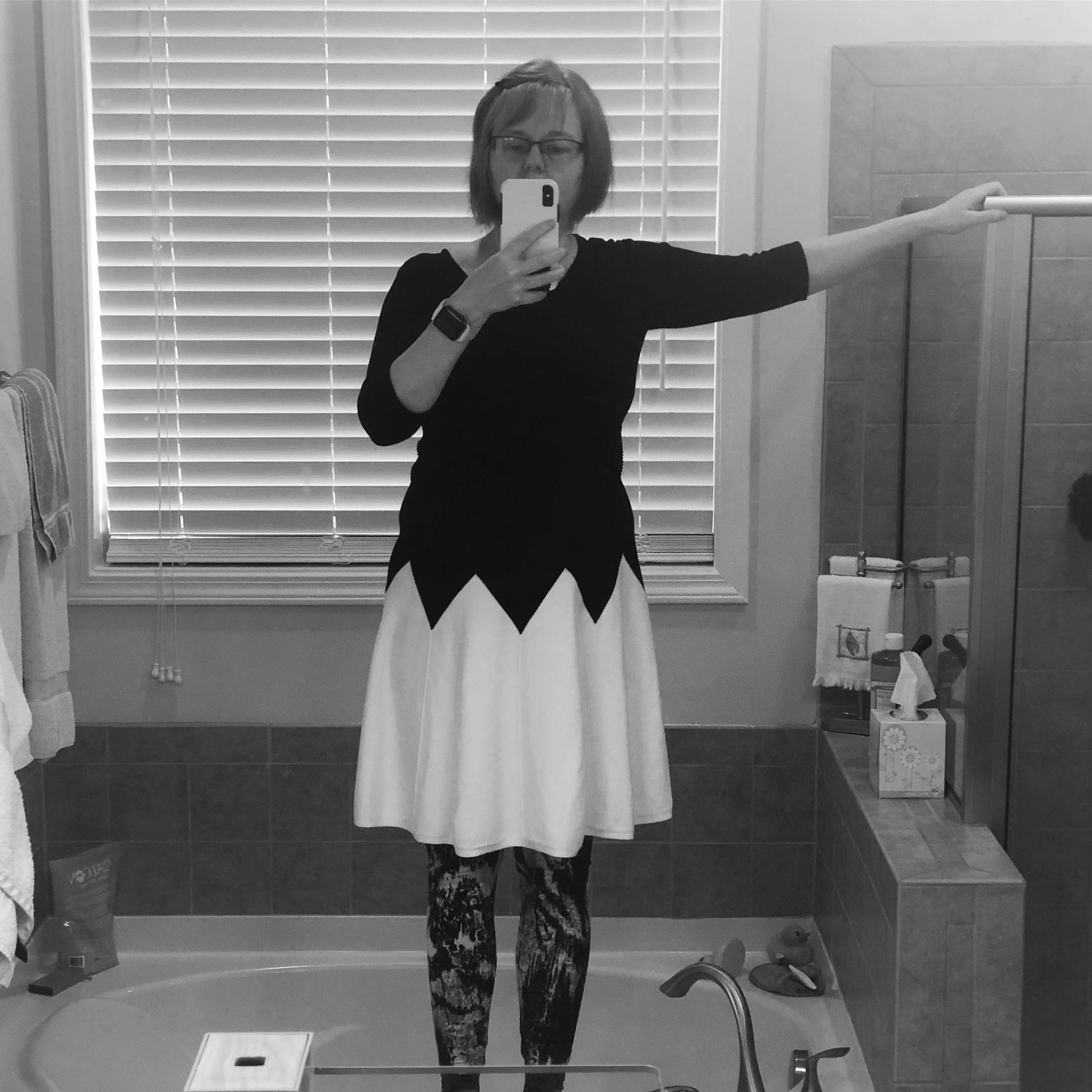 This dress was my first ThredUP purchase.
There's been a lot of talk about eschewing fast fashion and how to disrupt the wastefulness inherent in the current fashion industry. There's no doubt, it's a huge drain on resources, source of environmental pollution, exploiter/abuser of its workforce, and producer of waste. But what can we--any one solitary person among us--do?
I don't believe there will be a single solution to this issue but rather a constellation of processes and practices, and everyone's initiatives will be different. One person might commit themself to buying no new clothing for an entire year while another might pare down their existing wardrobe to a capsule wardrobe. Another might choose to wear the same outfit every day, while another might commit to the #MeMade challenge, wearing only clothing they've made.
One idea to reduce fashion industry waste and contribute to reuse might be a costume shop manager who set up a ThredUP account for their theatre, shipping gently used contemporary clothing still in good condition to the company in exchange for credit, then shopping contemporary costume pieces from ThredUP's vast inventory using that credit.
What are some other suggestions you have for how a theatrical costume shop might push back against "fast fashion" in a meaningful way?


October 9, 2020
Book Review: The Sandalmaking Workshop
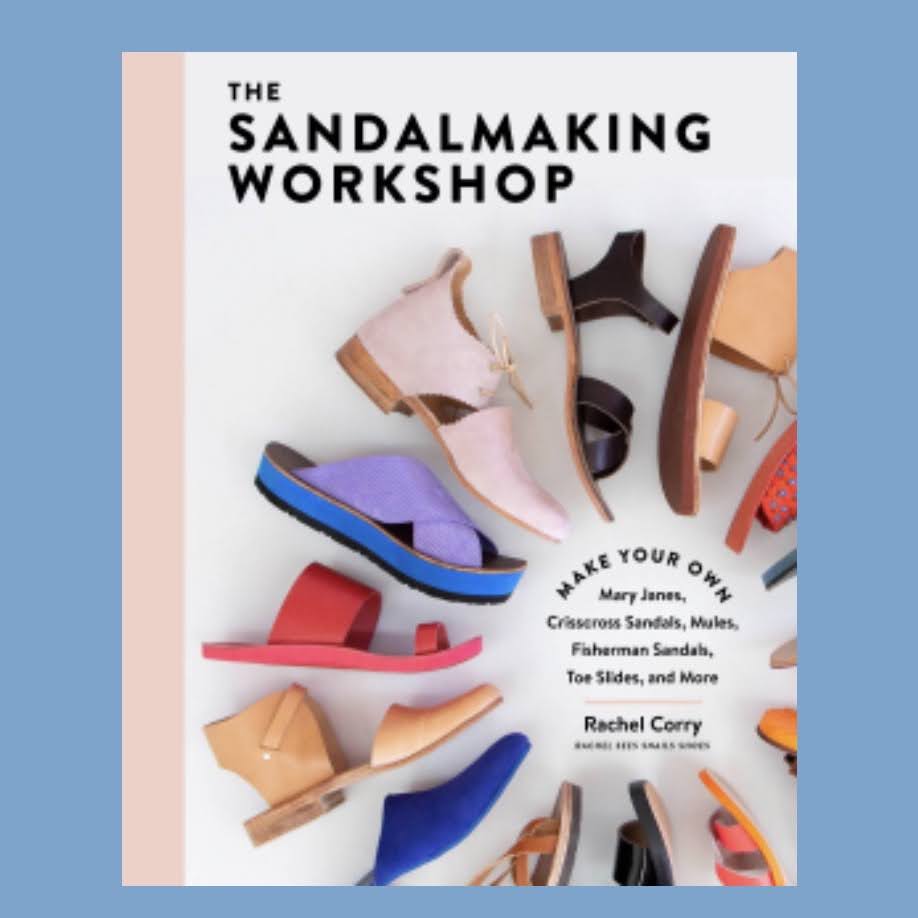
Let me begin by saying that I highly recommend The Sandalmaking Workshop by Rachel Corry. I'm truly thrilled that this book exists. Corry takes the reader through the process of shoe-making and explains what tools and materials you need in concise terms with clear photos. She then includes directions/images for 14 sandal and shoe styles as projects the reader can make.
Corry demystifies one of the last remaining handcrafts that tend to intimidate modern makers, and it's not that there aren't books out there on shoemaking already, but nearly all of them are out of print, use archaic language and poor safety protocol due to the time in which they were written predating OSHA, and include poor quality photos (if any).
I teach a shoemaking/altering unit in one of my classes and i'll be adding this book as a reference text for that course.
I received an ARC of this book from NetGalley in exchange for an honest review.
September 6, 2020
Book Review: The Paid Artist
I've read several books in the same vein as The Paid Artist: How to Make Your Art Into a Business by John Endris, but this isn't just another cookie-cutter title on the topic
This book is coming out at a time in which many of us who are working artists are seeing the institutions which have supported and/or employed us in the past fall apart in the face of COVID-19. Many of us are rethinking our dependency upon those organizations and reimagining what a world would look like in which we might be compensated equitably for our art.
John Endris lays out strategies and explains terminology which will help achieve that goal. He demystifies the math of calculating how to make one's art profitable and offers tips and templates for things like writing a business plan for your art career. He's got examples that apply to all different disciplines--painters, illustrators, writers, musicians, performers/actors, etc.
Unfortunately for me, a theatrical costumer, I'm not sure much of what he lays out is applicable to the collaborative art of theatre. We can all disperse into our correlating disciplines--set carpenters can work for contractors, stitchers can do bridal alterations or sewn product manufacture, electricians can find work in the commercial sphere--but I'm not sure applying the advice in this book works for artistic groups like a theatre company. But, that's my problem and doesn't reflect poorly on the book. And, the book is useful for folx that need to pivot into something like selling on Etsy or similar.
I'll recommend this book to my MFA students, particularly those graduating in the midst of this economic crisis. Many of them do start their own businesses and this is a great reference specific to launching an artistic business.
I received an ARC of this book from NetGalley in exchange for an honest review.
August 26, 2020
Subscribe to my new YouTube channel!

I've made the leap into YouTubing, and it only took a pandemic to get me there. But seriously...
Since I've spent the summer digitizing my millinery class for remote delivery this fall, i decided to launch a YouTube channel with short clips on hatmaking topics, in order to help others who might benefit from content from a fellow professional they trust (or maybe that's my hubris), and also to share the knowledge with folx looking to acquire new skills. Eventually the goal is to broaden the scope to include all sorts of costume crafts, but this semester I'll be adding new millinery content each week. If you're so inclined, please subscribe!
August 23, 2020
Video: Madame Sheeta’s Esparterie
I had the pleasure of presenting a session at FrockCon, an online costuming convention held August 8. My presentation concerned the life of Ada Riddle, aka "Madame Sheeta," a successful West End milliner who survived the London Blitz and taught millinery at trade schools all over southern England. When she passed away, her estate included a trove of the rarest of millinery materials: esparterie...
I recorded the Zoom and you can watch it here on YouTube:
July 23, 2020
The Edwardian Project with Isabella SaintOnge
Isabella received a grant to support a research initiative she's calling The Edwardian Project. She spent time in spring semester sewing a wardrobe of Edwardian clothing for herself, and this semester she's spending several weeks wearing the garments of a working-class turn-of-the-century woman while she goes about her daily life. She's documenting all this on her YouTube channel and Instagram feed.
Here's one of her videos, in which she unboxes a trove of donated antique clothing:
If this kind of thing interests you, give her a follow!
June 4, 2020
Birthday Giveaway: Masks for Milliners!
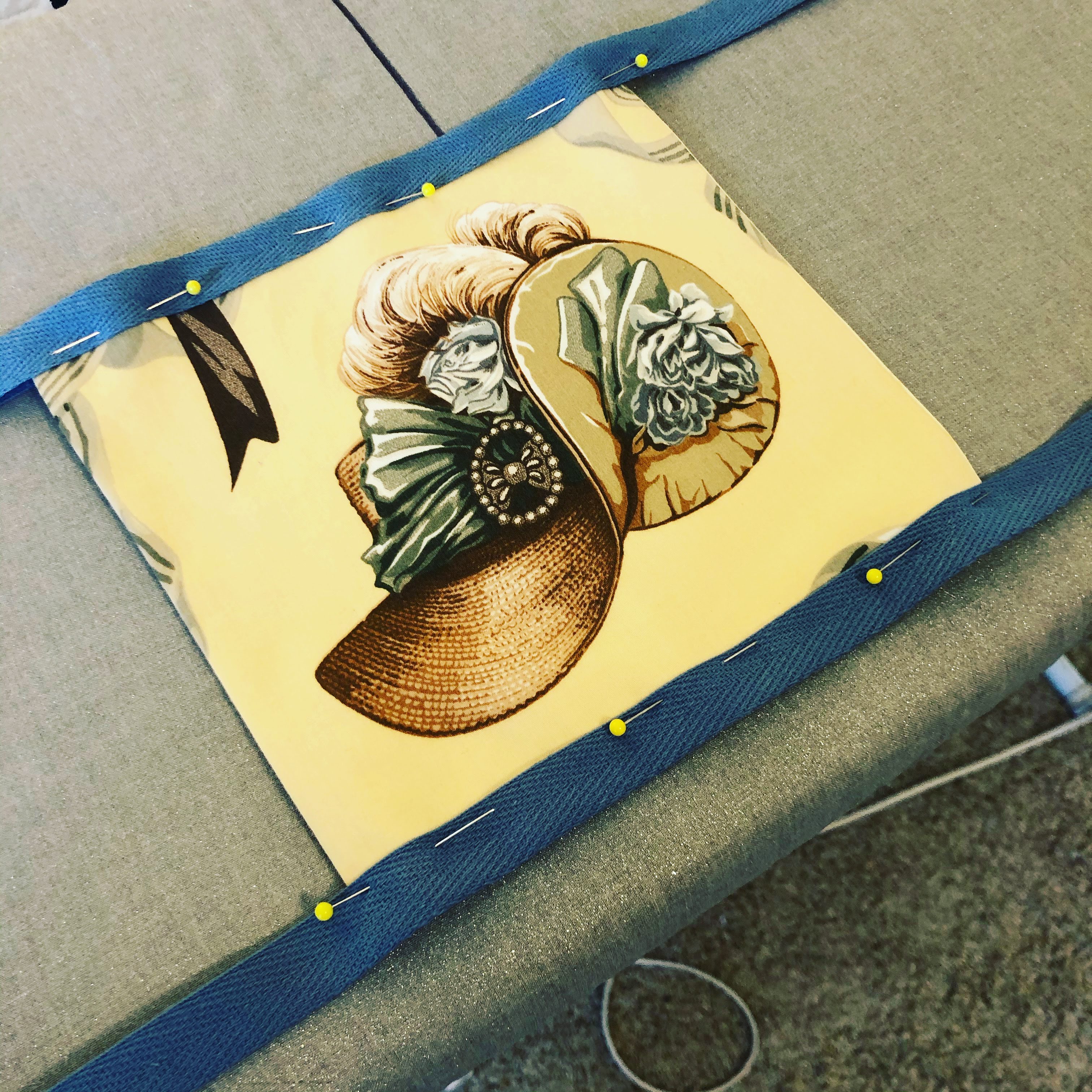
I found this fantastic polished cotton fabric printed with historical millinery designs and decided to use it in a promotional giveaway to celebrate my upcoming birthday.
I've made it into masks, since that's our requisite accessory in these pandemic times.
The masks are made from two layers of woven cotton fabric with blue cotton twill-tape ties. They're the pleated surgical mask style, as that allows for the full hat image to be visible when worn. (They do not have a nose wire--you can easily add one yourself if you like.)
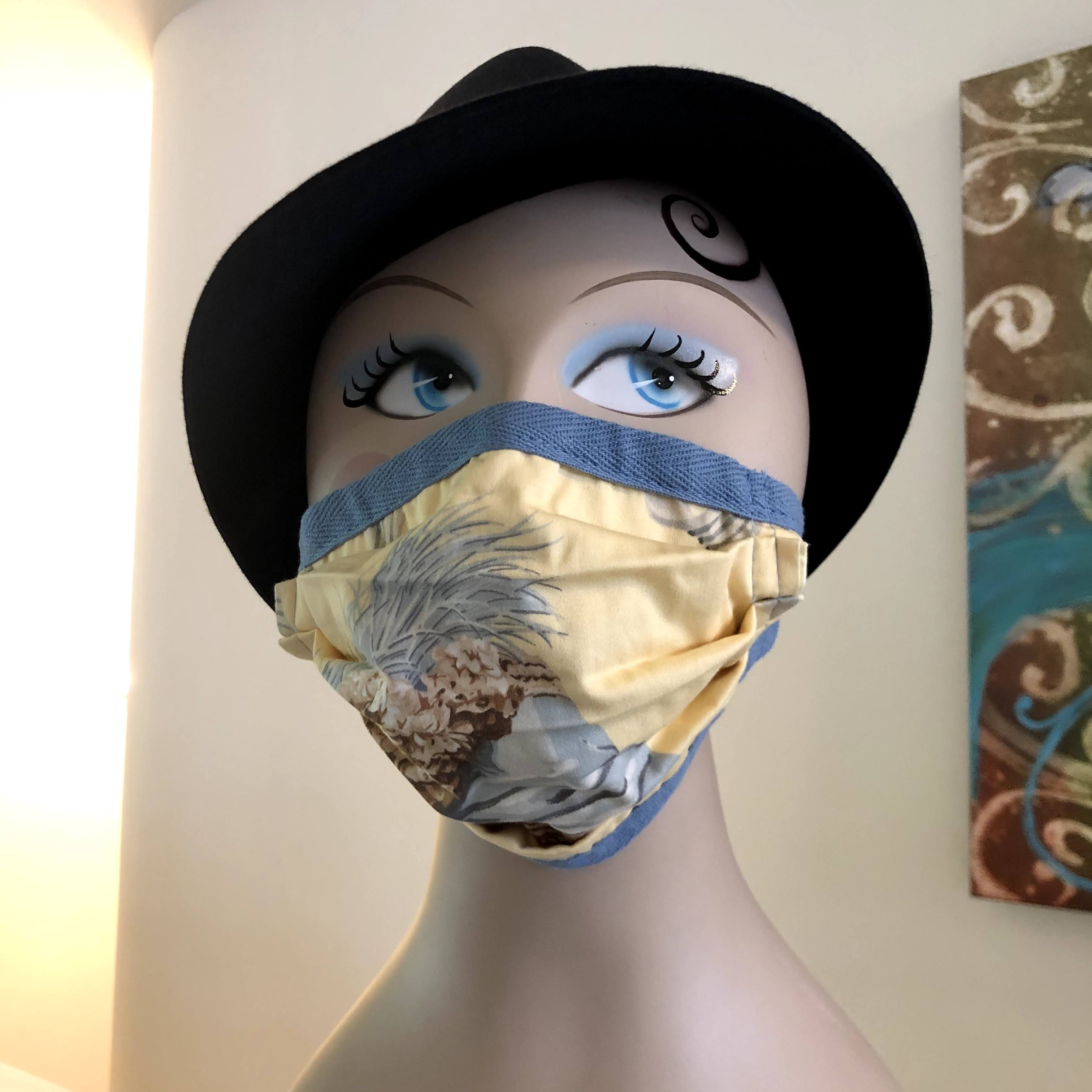
One of my display heads modeling a mask, along with a smart navy fedora from a vintage block.
Here's how to enter:
Follow me on Facebook, Instagram, and/or Twitter.Leave a comment on the contest announcement post on Facebook, Instagram, and/or Twitter, in which you tag two friends who might find La Bricoleuse content of interest.On my birthday, Tuesday June 9th, I'll choose five winners, each of whom will receive a set of five masks with five different historical hat designs.
Costume makers and designers, milliners, historical reenactors, or just folks who like the imagery--all are welcome to enter the giveaway! Open internationally!
Due to the limited quantity of fabric, I regret that winners will not be able to choose which five designs they receive.
Disclaimer: these masks do not conform to specifications from any medical or government agency for PPE to protect against COVID-19. They are intended to serve as the "cloth face coverings" recommended or required by many state and local health departments during this time of pandemic.
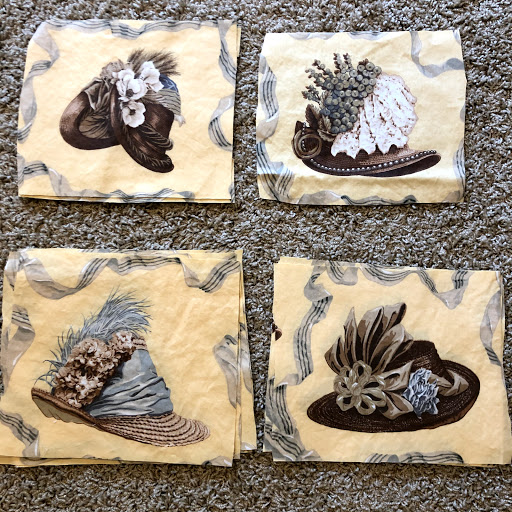
Four of the eight hat designs
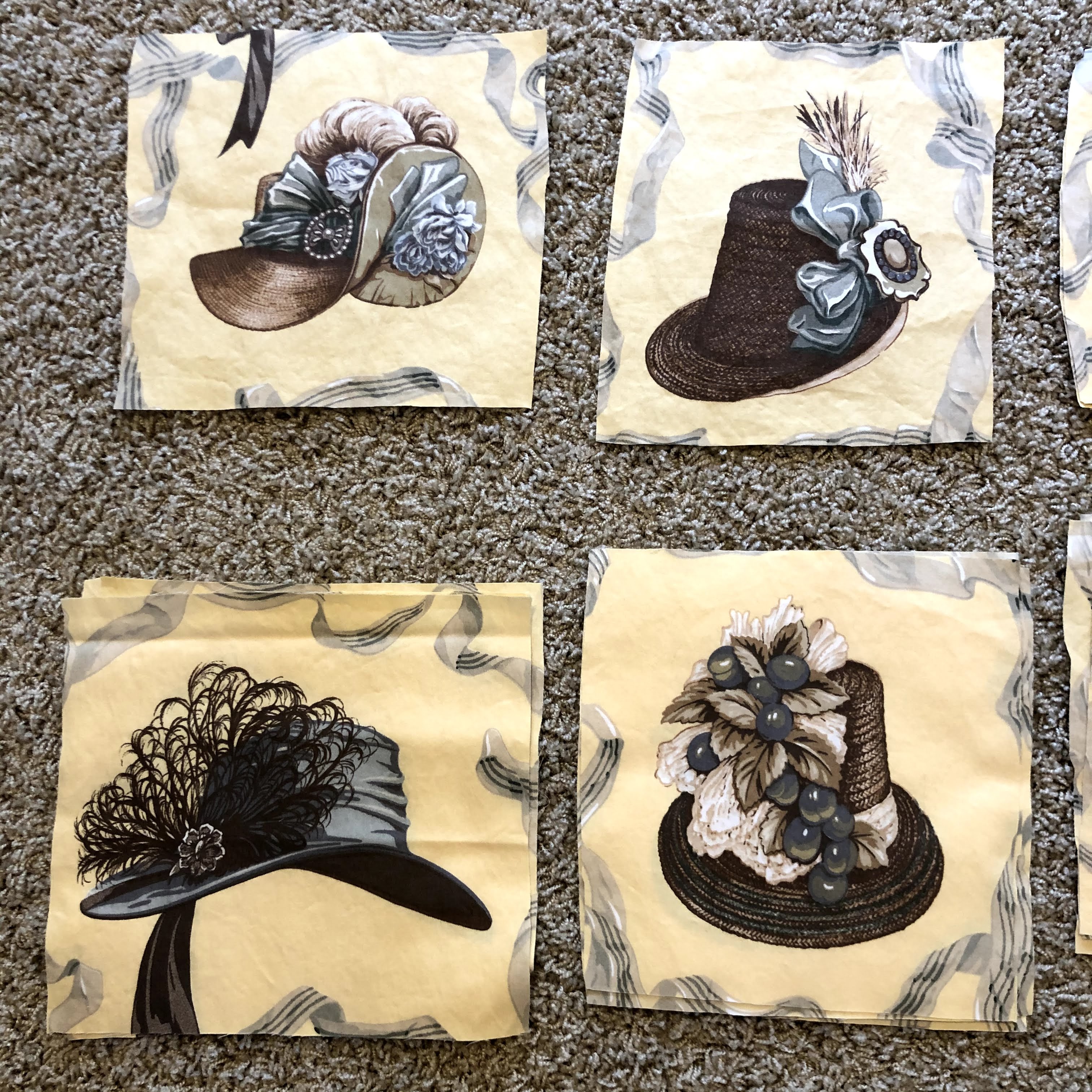 The other four designs!
 Due to slight variations in panel width/height, each set of masks will accommodate faces wide, narrow, long, and short.
Thank you for taking part in my birthday giveaway, and good luck!
June 1, 2020
Conference Report: ReDressing the Narrative, Week Two
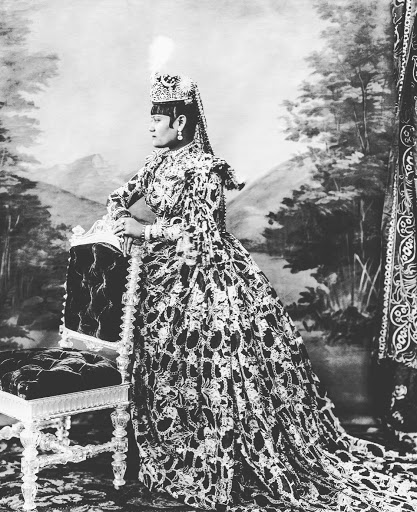
Maharani Bahurani Devi Rana of Nepal, 1908Photo by Dirgha Man Chitrakar
On Thursday afternoon (May 28) between the official conference weekends, I hosted my own Zoom discussion, "Period Pattternmaking Paradigm Shift," which looked at other lenses through which we might approach teaching period patternmaking beyond the current "chronology of Western fashion" structure that has dominated such classes from their beginnings. Because of scheduling difficulties in the midst of pandemic, not everyone who wanted to attend was able to, so I took copious notes.
You can read the meeting minutes/discussion notes as well as find a list of books recommended during the session in this Google Doc.
You can access my Prezi from our discussion here, if you'd like to use it as a guide to facilitate a similar discussion with colleagues.
You can also scroll through this Pinterest board of inspiration images.
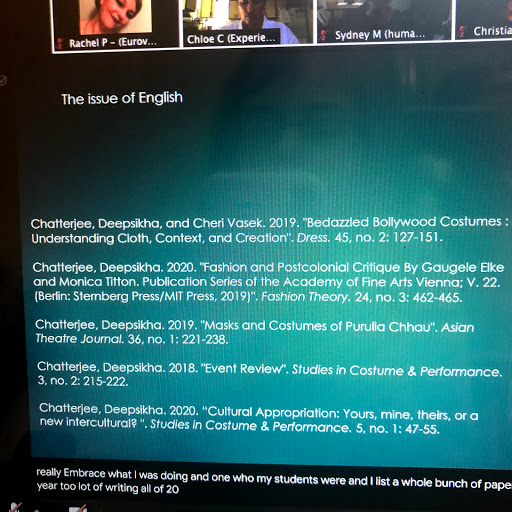
A slide from Deepsikha Chatterjee's lecture citing her recent publications which I'd like to track down and read.
On the third"official" day of the conference (May 30), I attended two Zoom lectures, "My Bookshelf is Dated" by Christianne Myers (challenging scholars to keep up to date on recently published academic work in their field rather than relying on the books they collected/inherited/thrifted in graduate school) and Deepsikha Chatterjee's "How to Decolonize Your Syllabus."
Chatterjee's lecture was particularly interesting because she addressed how, as an Indian-born scholar who came to the US for her own graduate study, she first had to "decolonize herself," as she realized that her own education in India came from a system developed under colonial rule. Then she discussed ways in which costume history professors could step outside the colonial/imperial/"Western" paradigm, including teaching thematically instead of chronologically, examining perspectives of power, including consideration of the Global South, and addressing the historical hegemony of binary gender.
For various personal reasons, I was unable to attend the breakout discussion group that third day (mine would have been about strategies for teaching studio/construction classes remotely).
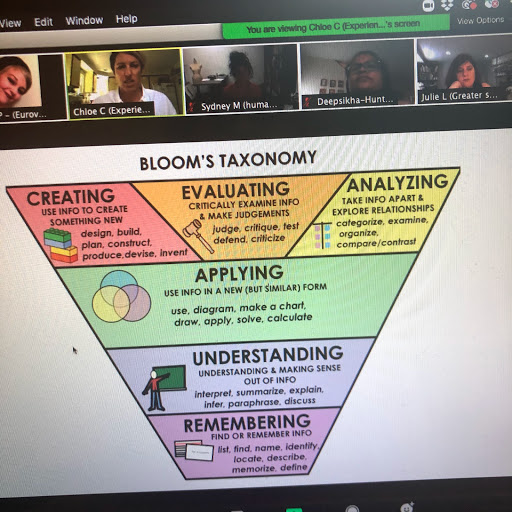
A slide from Chloe Chapin's welcome-back lecture, on simple to complex teaching/learning goals.
I did make it to the sessions on May 31, the final day of the conference. The organizers all spoke about how they felt approaching the end of this unprecedented "meeting of the minds" in our field, and then they split us out into 5-person discussion groups randomly generated by the Zoom app. My group talked about various things, including how we might engage meaningfully in interdisciplinary studies, how overwhelmed we felt by all kinds of mind-blowing revelations/propositions, and also we acknowledged how stressed and scared we all were for the future of theatrical costume in a post-COVID world. We brainstormed about other fields which could use our expertise (fashion, video games, TV/film) and we shared our schools' plans (or lack thereof) for the fall.
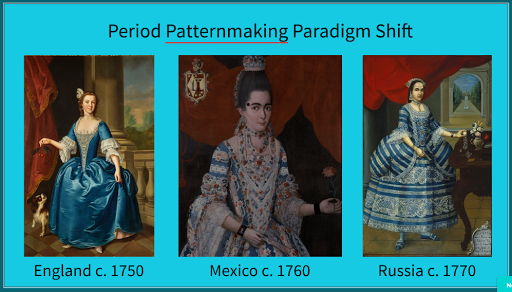
My slide contribution, showing the same basic elements of silhouette, drastically different choices in textiles/trimmings, across three decades of the 18th century at various locations around the world (L to R: England, Mexico, Russia).
The conference concluded with the group creation of a slide show, with everyone contributing a single slide summing up something about their conference experience. As soon as that slide show is distributed to participants, I'll share a link on this blog.
Before I conclude, I'd like to address how--by and large--this was one of the more accessible conferences i've attended. Since it was held online, attendees with mobility issues didn't have to stress about whether they would have problems with ramps, door opening buttons, accessible restrooms. The lectures I attended all included captioning, and participants were encouraged to include pronouns in their Zoom name if so inclined.
My one disappointment concerned accessibility challenges in some of the slide shows. I have poor vision and often the contrast between the text and the background was not high enough for me to read the notes on the slides--grey text on a white screen is tough, especially at 11pt. I found the white text on a dark background in Deepsikha Chatterjee's lecture the most discernable. But, this is a minor quibble.
All in all, it was a shaka buku of a conference. Although i don't personally teach our costume history or period patternmaking classes, the experience of attending is something I'll not soon forget, and I intend to "report back" to my colleagues at the university who do teach relevant courses.
May 31, 2020
Conference Report: ReDressing the Narrative, Week One
The conference was initially intended to be a one-day workshop for 25 participants but when it became clear that the pandemic would make an in-person event for traveling scholars impossible, the planning committee reconceived the event as an online event spanning four days over the course of two weeks and encouraging participants to create their own peripheral programming--lectures, discussion groups, and panels via Zoom. Over 70 attendees were able to participate in the virtual event.
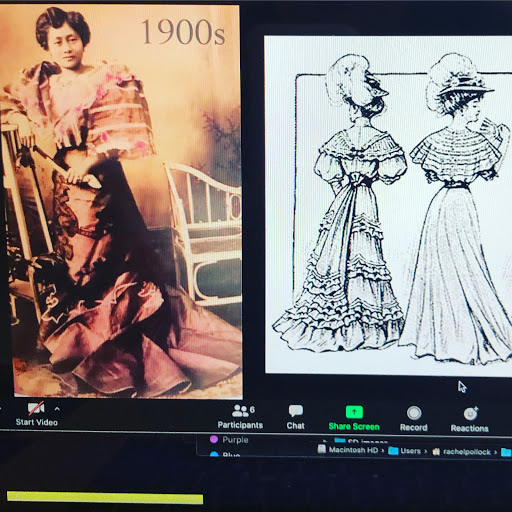
Crop from Raven Ong's lecture on how Filipina fashion incorporated elements of European style.Left is a photo of a Filipina woman, right is a European fashion illustration, 1900s.
In addition to the main programming, I got involved with several of the peripheral events. My first was a Zoom discussion, "Inclusive Teaching Strategies," led by Lia Hansen of Vanguard University. We began by identifying many different populations we might consider in terms of inclusive teaching, from race/class/gender to differently-abled students to those for whom English is not their primary language, etc. Many aspects of theatre have traditionally been taught in American schools from an affluent white male perspective and we brainstormed ways to expand the focus to consider diverse viewpoints and experiences. We also discussed the creation of agender measurement sheets with a space for a performer's pronouns.

One simple suggestion was to de-gender labeling of findings.Instead of "male" and "female" snaps, use "prong" and "divot."
My next session was a fantastic lecture by Raven Ong of Central Connecticut State University, "Filipiniana: Fabric and Silhouettes in the Transnational Journey." Ong gave a brief overview of Filipino history and the social oppression put in place by the islands' Spanish colonizers beginning in the 16th century.
He spoke a bit about the development of what's now considered traditional Filipino dress and showed juxtapositions of Filipina portraiture and European fashion plates to illustrate how the shapes popular in Europe were reimagined by the Filipina women with what garments and textiles they were allowed to wear and were comfortable in their tropical island nation. Many of the fabric names were familiar to me as materials commonly used in millinery--piña (pineapple cloth), abaca, sinamay.
I particularly enjoyed seeing the pattern shape and pleating construction technique for the signature Filipina fashion detail, the butterfly sleeve (worn most famously by Imelda Marcos).
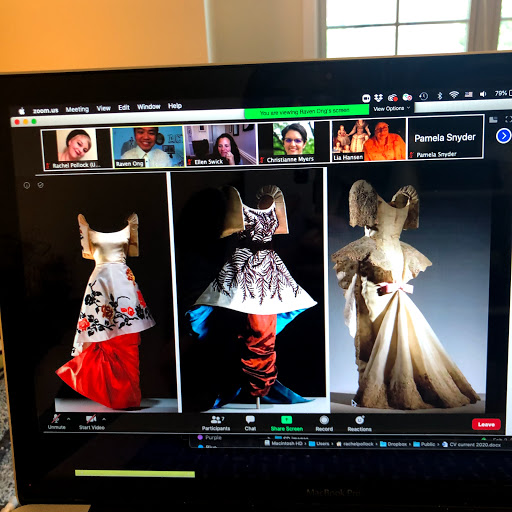 Filipina gowns of the 1950s showing the influnce of Charles James and Dior
Look for the second post in this report, in which I'll talk about the second week of the conference and its final weekend worth of lectures and breakout groups!
May 24, 2020
3D printed bias tape makers!
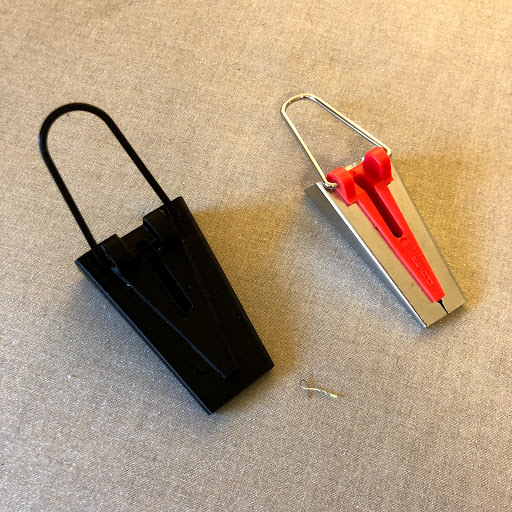
3D printed bias tape maker at leftMass-manufactured metal/plastic bias tape maker at right
When the shortages of PPE began to get press back in March, like so many other costumers caught without work due to theatre closings, the PlayMakers Repertory Company costumers began sewing masks, surgical caps and other stitched fabric PPE. We got a bit of press notice for donating a number of masks in adult and childrens sizes to the Inter-Faith Council for Social Service here in the Raleigh-Durham area.
Our colleague in the scene shop, Kyle Spens, read about our humanitarian sewing efforts and wanted to help out. Although he couldn't sew, Kyle has a 3D printer and asked whether there was any way that could be of use. He brainstormed with one of us and began by printing the "Ear Savers" accessories for healthcare workers. Maybe a week later one of the graduate students mentioned the need for bias tape makers to help create the style of mask with fabric ties and wondered whether Kyle could print those. Turns out there are many designs for them on the Thingiverse filesharing forum.
Kyle offered to print bias tape makers for any of us who needed them, in any size. I had a set of bias tape makers, but unfortunately not one in the 1" size I needed, so I took him up on the offer. I honestly didn't have high hopes for it, as some of the designs i'd seen for them on Thingiverse looked like they were designed by someone who understood the basic concept but didn't actually use them.
I was pleasantly surprised when I picked mine up from a bin on Kyle's porch: it was basically just like my Dritz tape makers, but all plastic! (See above photo.) You have to be careful about getting the iron or its jetting steam too close to the tool since it's made of thermoplastic and can deform, and the fact that the pull loop is not metal makes it more fragile than a traditional metal tool, but if you adjust your usage to accommodate its properties, the 3D print tool works great!
If you have access to a printer and need a bias tape maker, the file Kyle used is here:
https://www.thingiverse.com/thing:2368323
Two thumbs up from La Bricoleuse!
La Bricoleuse aggregate and more...

Right now, this space streams the RSS feed from La Bricoleuse, the blog of technical writing on costume craft artisanship that i've written since ...more
- Rachel E. Pollock's profile
- 80 followers

