
Deepanjana Pal's Blog, page 3
December 23, 2020
Filed Under Why: The Bride of Habaek
Certain things in the world defy explanation, like yawning; that saffron sheep in the family who loves biriyani and BJP in equal measure; and the fact that I’ve watched almost every episode of The Bride of Habaek.
There are K-dramas that are genuinely good and then there are dramas that are endearing and enjoyable despite being outlandish and/or kitschy. The Bride of Habaek is neither. It’s awful and I have a niggling suspicion that director Kim Byung-Soo knew this, which is why he tried to distract us from said awfulness by including random shots of shirtless Nam Joo-Hyuk. This, for instance, is one of his early scenes:
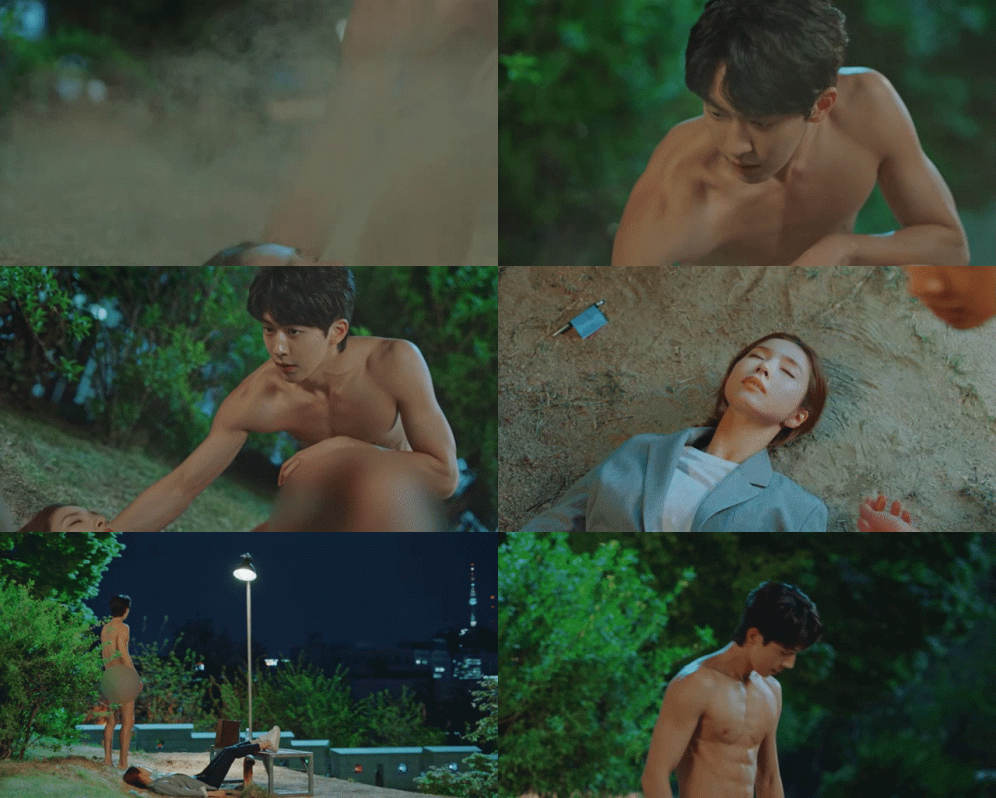
Reader, I’m here for it. Would I have preferred for The Bride of Habaek to have a coherent plot and good acting in addition to shots of Nam Joo-Hyuk’s bare torso? Yes. But it’s 2020. If there was ever a year to scale down expectations, it is this one.
Let me try to give you a sense of the plot.
According to The Bride of Habaek, there’s the world humans live in and on the other side is the world of the fail whale, I mean, gods.
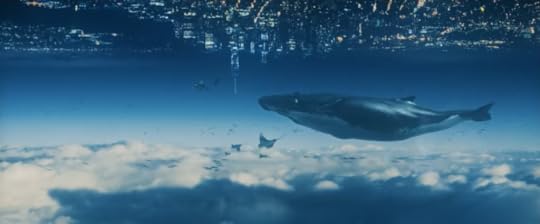 Inception is so passé
The divine realm is made up of the Earth Kingdom, Sky Kingdom and Water Kingdom. The lord of the Water Kingdom is the emperor of the divine world and the king of kings. A new king must ascend the throne when the red tide appears (pretty sure writer Joon Yoon Jung came up with this while PMS-ing or in her period) and wouldn’t you know it, a red tide comes rushing in minutes into the first episode of The Bride of Habaek. Which means it’s time for a new king, i.e. the ascension of Ha-Baek (Nam Joo-Hyuk in a two-toned wig, smoky-eye make-up and an outfit that would make Maganlal Dresswala feel emotional), who is killing time by sitting for a portrait. As one should when one is that pretty.
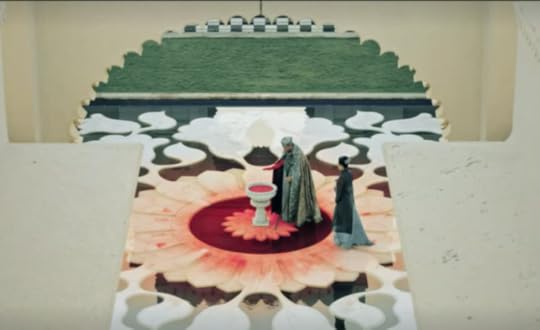 You see what I mean about the red tide and periods?
Much of The Bride of Habaek is pivoted upon the idea that there is only one purpose to Ha-Baek’s existence and that is to be the king. If he doesn’t fulfil this destiny, then not only would he not exist, but even the memory of him would disappear. And Ha-Baek knows this. Everything he does is informed by his awareness of being a superior being who is extraordinarily gifted because he’s the designated king.
However, before Ha-Baek can can sit pretty on his divine throne, he has a quest to fulfil. Ha-Baek must go down to the human realm and collect three special stones, which are helpfully scattered in Korea rather than across the world, thus saving the soon-to-be king of the gods the trials of air travel. To help him out, he can take one helper from the divine realm and on earth, he is entitled to assistance from one particular human who belongs to a family that is cursed to serve as “divine servants”.
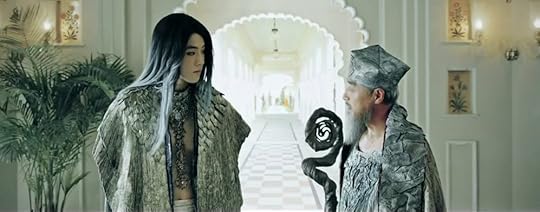 Apparently, the land of water is actually a five-star hotel in Rajasthan
Ha-Baek doesn’t just land on earth, but with impeccable aim, he lands slap bang into Yoon So-Ah (Shin Se-Kyung) and knocks her out. Because what is love if it doesn’t hit you (literally) like a bolt from the blue? Did I mention Ha-Baek has lost all his clothes in the process of travelling from the Water Kingdom to Earth? Well, he has (see the GIF above). That’s not all he’s lost. He’s lost his attendant Nam Soo-Ri (Park Kyu-Sun); the map that showed him where the three stones are; and all his powers. Fortunately, Nam Soo-Ri finds him and the duo set up camp in a bouncy castle in a public park in Seoul.
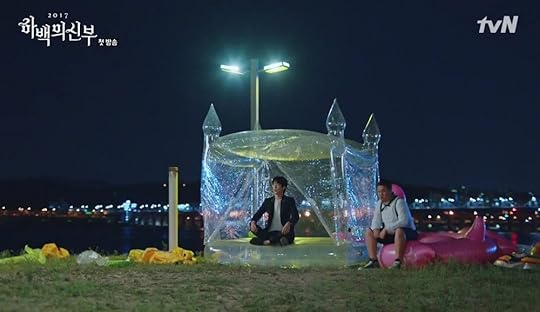
This, incidentally, is the part of the show that comes close to making sense and it’s genuinely amusing to see Ha-Baek strut his stuff in Seoul, thinking he’s being godly when all he is, in fact, is a homeless person with delusions of grandeur. What also makes sense is that So-Ah, who is the divine servant and a psychiatrist, is struggling to run her private practice since the first time we see her, she makes cock-a-doodle-doo noises while attempting to treat a patient. So-Ah’s ambition in life is to make enough money — AS A PSYCHIATRIST — to emigrate to Vanuatu of all places. This would sound insane except for the fact that she’s standing next to Ha-Baek, who (when he isn’t bathing on So-Ah’s terrace) is looking for three stones that are in the care of God of Winds Bir-Yeom, a river goddess named Moo-Ra and another dude (who we’ll later discover has been frenziedly gardening and weeding his way through Korea). Vanuatu sounds positively mundane in comparison. Also, So-Ah’s best friend is a shrink and yoga-loving occult enthusiast whose office looks like this:
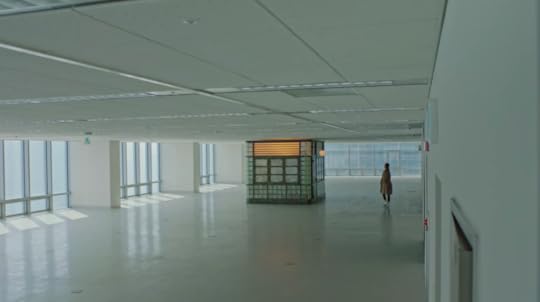 Maybe there’s a coded message about Seoul’s commercial real estate sector in here. Or maybe it’s just a container-sized office in the middle of an empty floor, in an empty building, where you can get either a session with a psychiatrist or a consultation with a fortune teller. Hashtag: Women who multi-task.
 In the middle of all this are the following:
a minor god who goes around sparking hunger (for food) in people by smooching them a crackling love story between Moo-Ra and Bir-Yeum, complete with an inflatable dollgodly politicking and bickering between Bir-Yeum and Ha-Baek, side effects of which include a gigantic hole in a bridgea sub-plot involving So-Ah’s father whom So-Ah resented because he opened their home to orphans and So-Ah felt neglectedanother sub-plot involving an attempted suicide by So-Ah, which she survived because someone dragged her out of the river into which she had jumpedyet another sub-plot involving a demi-god who escaped the divine realm where he was imprisoned and is living in disguise in the mortal realma fourth sub-plot involving the minor detail that the lord of the Earth Kingdom is lost.
The whole business of the stones is forgotten in no time, especially since we have more important things like two love stories and lots of random melodrama on which to focus. There’s a feeble attempt at setting up a love triangle between Ha-Baek, So-Ah and Hoo-Ye (Im Joo-Hwan). On paper, this is quite a twist since it pits Ha-Baek the homeless lunatic against Hoo-Ye the smooth, successful businessman. On screen, it’s a damp squib. Even though Nam Joo-Hyuk doesn’t exhibit much by way of acting chops as Ha-Baek and his on-screen chemistry with Shin Se-Kyung blinks on and off like Airtel’s network in Mumbai, there’s never any doubt that Hoo-Ye is a second lead and therefore doomed to singlehood (as is the fate of most second leads in K-dramas). Of course, there are second leads who steal the show — like Kim Seon-Ho in the wretched Start-Up — but before the audience can decide if it’s interested in Hoo-Ye, the show loses interest in him. One second it looks like Hoo-Ye might be Ha-Baek’s nemesis; next thing we know, he’s nowhere to be seen. This is a shame because Im Joo-Hwan is a cutie and Hoo-Ye, the bastard child of a god, is one of the most interesting characters in The Bride of Habaek. I particularly liked the detail that Hoo-Ye is — SPOILER — the god of fire, which places him in direct opposition to Ha-Baek. Also, Hoo-Ye’s pretty damn good at agriculture, which seems to be writer Jung Yoon Jung’s way of showing that he is able to channel his rage and trauma into something that’s literally productive.
I have only vague recollections of what actually happened in the middle episodes of The Bride of Habaek because I basically sped through most of it, but I recall there was a lot of weeping, some jumping into the Han river, a fair amount of gardening and some domestic scenes involving cooking and cleaning in which Ha-Baek turns out to be quite the house husband. Shin Se-Kyung was such a delight to watch in Rookie Historian Goo Hae-Ryung but as So-Ah, she’s completely forgettable. Part of the problem is that the script allows her exactly two expressions: she’s either wide-eyed or weeping. This is more than what Nam Joo-Hyuk manages — a pout for all seasons — but at least he makes the effort of flashing his torso and there’s a lot I’ll forgive him for the single-minded focus he displays during the staircase kiss. (At some point, I think I’m going to have to write an essay on the kiss in K-dramas, but I feel I need to do a little more research before attempting that one.)
There’s more crackle and and pop between Bir-Yeum (a delicious Gong Myung) and Moo-Ra (Krystal) than in So-Ah and Ha-Baek’s anodyne romance. Bir-Yeum has a boyish recklessness about him which contrasts with Moo-Ra’s mature composure (K-drama’s championing of romances between more mature women and younger men is another thing that I will, hopefully, eventually, write an ode to). But there are brief moments when Bir-Yeum’s breezy (see what I did there?) behaviour gives way to something darker, more desperate and grown-up as he reaches for Moo-Ra, who he knows is in love with Ha-Baek.
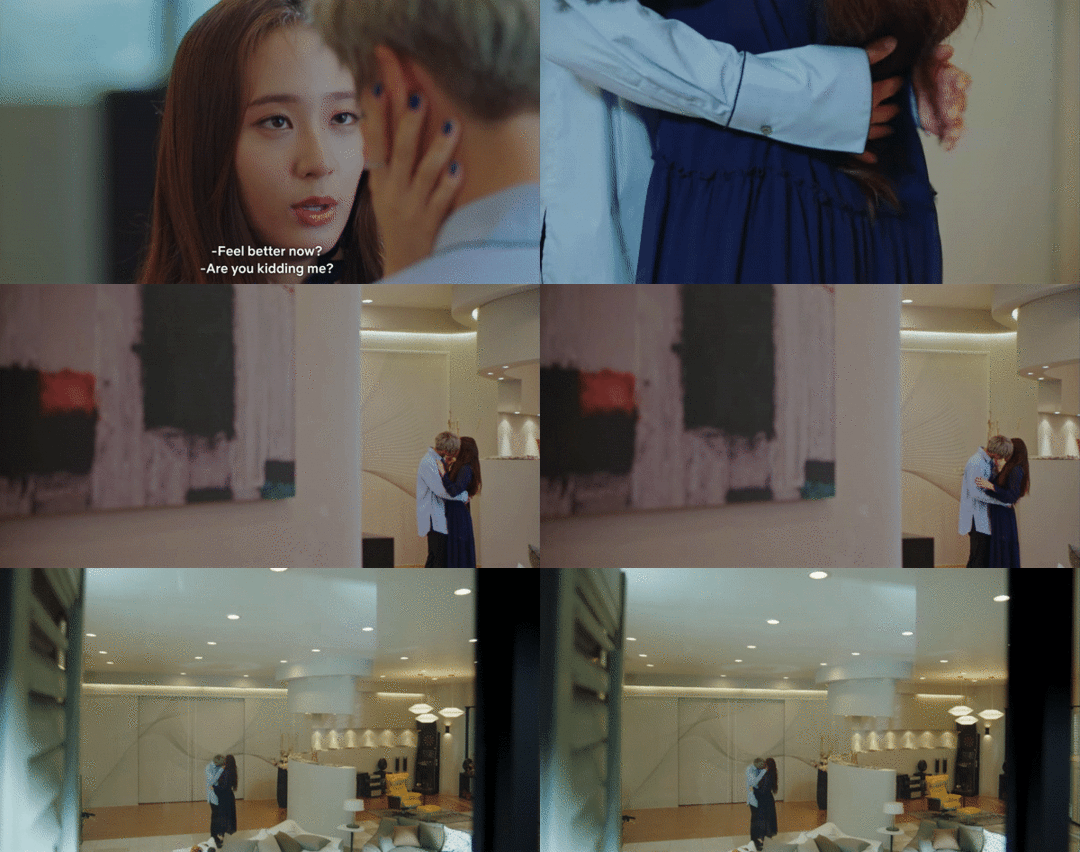 My female gaze is fixated on what Bir-Yeum and his hands.
So yes, this is a ridonkulous drama and its clumsy storytelling makes a mess of the few good ideas nestled in the plot. Had the script relied more on showing us what happened rather than lazily getting characters to recap past incidents as awkward and bland monologues, The Bride of Habaek would have been served better. Had the drama focused on its plot and sub-plots rather than Nam Joo-Hyuk and Gong Myung’s muscled torsos, we could have got interesting examinations of ideas like grace, father figures, vulnerability, failure and rebuilding oneself; the tangled relationship between societal expectations and personal goals. Instead, we have weeping women, abandoned sub-plots and hastily-tied loose ends.
Still, for all its awfulness, here’s something that struck me while watching the finale of The Bride of Habaek — for all the flexing that the male characters do over the drama’s 16 episodes, ultimately the priority for both the show and the men in it is the happiness of the women characters.
The last episode of The Bride of Habaek is particularly tiresome because of the copious weeping and the nonsense that parades as logic. In short: So-Ah’s father saved her life when she’d tried to kill herself, but he drowned in the process. Since he had a divine tablet in his possession, his body is perfectly preserved and unbudge-able at the bottom of Han river. So-Ah is determined to get her father out and give him a proper burial, so Ha-Baek gives her “his grace” (by kissing her when she doesn’t want to be kissed. Don’t ask). The graceless Ha-Baek now is doomed to live the mortal life because he no longer has the power to go back to the divine realm, which also means he won’t become king. The choice he has made when he smashed his face into So-Ah’s was that he would perish, but So-Ah would be able to live a full and happy life. Also, So-Ah now has magical lung power, so she dives into the Han’s depths and retrieves both her father and the tablet.
So far, so nonsensical.
It turns out that the divine tablet has the power to grant the divine servant their deepest wish. Everyone (including So-Ah) expects So-Ah to use the tablet’s powers to save Ha-Baek by wishing he becomes the king of the divine realm. Doing so would fit in with a traditional stereotype of the woman who sacrifices herself for her lover. Her decision prioritises what Ha-Baek needs as well as what is seen as the greater good. “I will put things back to normal,” So-Ah say. I’ve no idea if the original Korean word actually makes a reference to that which is the norm, but the English “normal” is perfect for what So-Ah is doing — restoring the order and hierarchy that gives a social group (in this case comprising gods and humans) their identity.
Just at the moment when So-Ah is about to make her wish, the high priest shows up and says Ha-Baek doesn’t need So-Ah’s sacrifice. Instead, So-Ah should use the wish she has for “something more valuable”. That “more valuable” thing is So-Ah’s happiness. Her final wish is that Ha-Baek set aside kingship and instead live with her for as long as she’s alive. “You can go back and be a good king after I die,” she says, effectively privileging the individual, and their ridiculous, transgressive romance over the expectations and demands of the collective. And of course Ha-Baek obeys this command.
Try to think of a legend or a fairy tale in which a king is a hero for giving up his kingship because the woman he loves demanded his companionship. Usually, such women are considered selfish villains because they hold their own happiness to be more important than the function the king or hero performs for society. Heroines are usually cautioned and expected to be the opposite of such women, but for all its standardised conventions and clichés, this is not true of K-drama. The privilege that So-Ah enjoys in The Bride of Habaek is normal for K-drama (based on what I’ve seen, obviously) and it’s easy to lose sight of how radical this is as an idea because the genre is also obsessed with upholding impossible conventions of beauty and body types (though arguably, these are as unrealistic for men as they are for women. Still, somehow the actresses often seem more…starved than the actors). Perhaps it’s because the writers of K-dramas are predominantly women or maybe there’s an alchemy in modern South Korean society that hasn’t happened elsewhere. Whatever the reason, in drama after drama, the priority is the woman and even as the heroes do their bit to be dashing and alpha, they ultimately step aside graciously and let women have the last word.
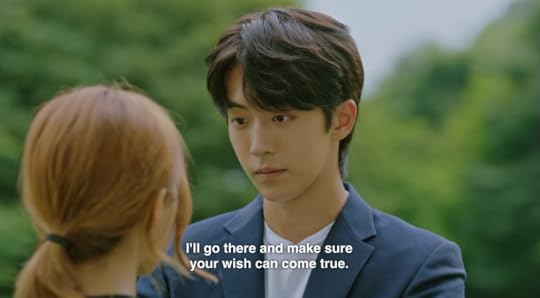
In The Bride of Habaek, it’s not just that Ha-Baek follows So-Ah’s lead and does what she wants (rather than what he thinks is good for her), but also that So-Ah is encouraged to articulate her desire (by the high priest, no less). What So-Ah wants is important; her desire is valuable, and she shouldn’t feel ashamed to speak up — that’s what the finale of this absurd and terrible drama is telling its audience.
Come to think of it, maybe it’s not such a bad thing that I watched this one till the not-so-bitter end.


December 17, 2020
K-drama: 20 for 2020
When the hashtag #DecemberDramas popped up on my Twitter feed, I thought it might be fun to make a quick list of the Korean dramas that I’ve watched this year since these shows have brought me so much joy in the past months.
It turns out that including the ones that I’ve abandoned after a few episodes and two that I will definitely finish watching before the year ends, my K-drama tally is 20. Which is insane because each show is around 16 to 20 episodes and each episode is (at the very least) an hour long. Also, did I mention that I started watching this genre in September?
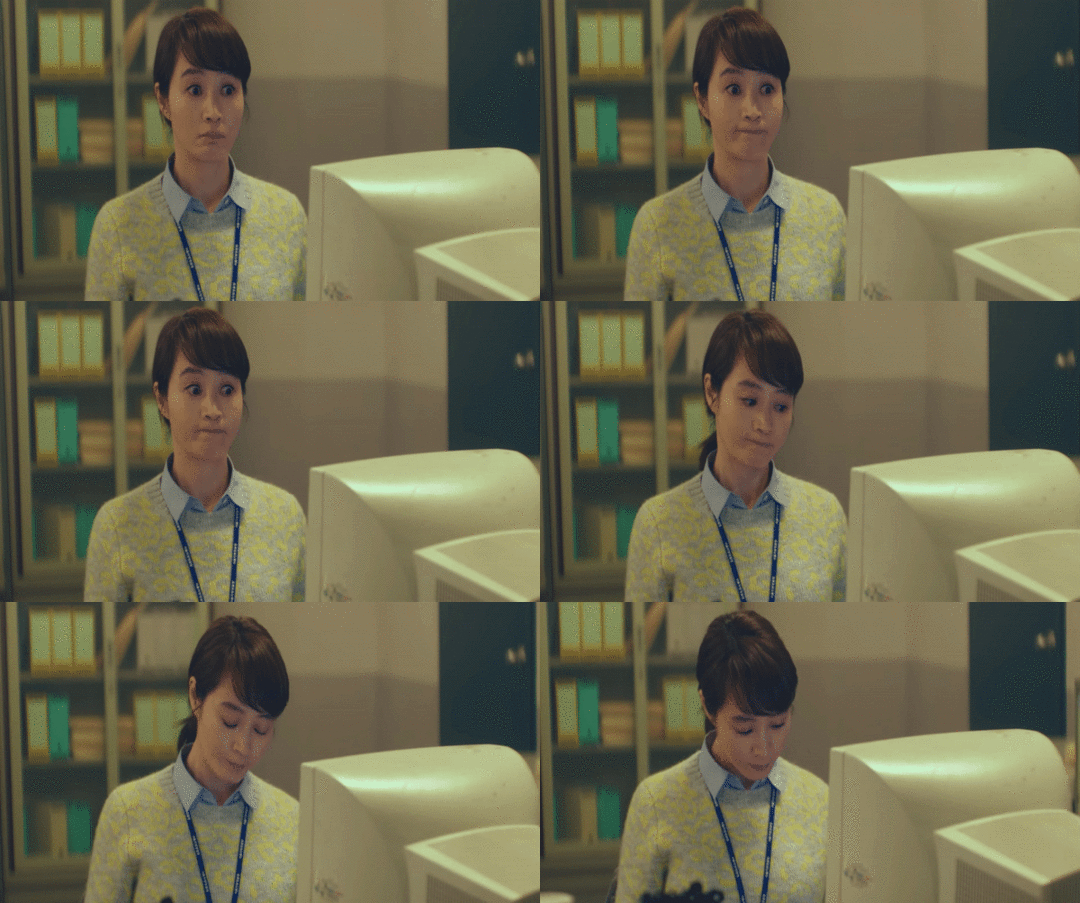
The last couple of years have been very good for K-dramas and the advantage of discovering these shows late is that I could make the most of my insomnia by binge-watching, rather than having to wait for new episodes (like I’m having to do now with The Uncanny Counter, Mr Queen and True Beauty, all of which are immensely enjoyable so far. Particularly Mr Queen).
Since they’re unabashedly commercial, K-drama doesn’t necessarily get respect despite the diverse and sizeable fan following that the genre commands. I think the general reaction is to look down on them because the shows are escapist and popular, which is terribly short-sighted because a lot of the shows are very well-written and almost all of them — even the dodgy ones — are good at sucking you into their world. These shows are filled with formulaic set pieces, melodrama and clichés. Technically, they’re the equivalent of your average soap opera, but not only do K-dramas beat their Indian counterparts hollow in terms of how glossy they look, the shows are more ambitious and accomplished in their storytelling. The writers and directors don’t use the fact that they’re making soaps as an excuse to be unimaginative. They have fun with the genre’s tropes and invest intelligence into the way they’re unfolding the story to the viewer. In subtle ways, many of the shows offer alternatives to dominant social norms and rattle the cage of patriarchy, nudging the audience to imagine a very different (and more progressive) society from the one that’s around them. This is as true of the crappy K-dramas I’ve watched, as it is for the ones that have my heart.
So over the next couple of days, I’m going to bombard this blog with posts about the K-dramas I’ve watched. (For those of you who follow this blog and don’t give two hoots about K-drama, my apologies.)
First up: these are the shows that I abandoned, in the order that I abandoned them.
My ID is Gangnam Beauty
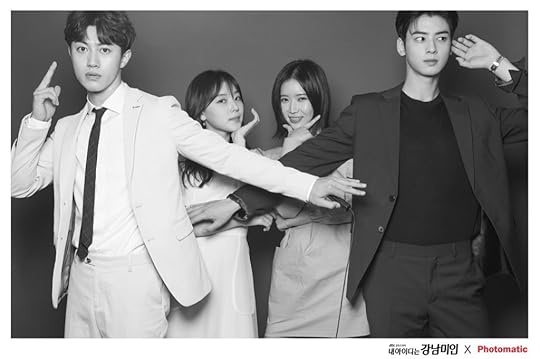
I clicked on this show out of pure, guilty lust, having lost a little bit of my heart to Cha Eun-Woo after watching Rookie Historian Goo Hae-Ryung (which is the first K-drama I watched and which remains my favourite romance so far). That said, even for someone not tumbling on a hormonal spin by Eun-Woo’s poreless, milky white beauty, MIGB has an interesting premise. A young woman, Kang Mi-Rae, is crippled by insecurity for being ugly because she’s viciously bullied in school. Before going to college, she decides to have extensive plastic surgery, in the hope that a new face will mean a new beginning for her. The post-surgery face is beautiful, but being pretty comes with its own set of anxieties, especially since Mi-Rae realises the feeling of insecurity is not simply skin deep.
Especially for a Korean audience — South Korea is considered to be the plastic surgery capital of the world — this plot must have resonated deeply. At the same time, the show’s emphasis on how Mi-rae struggles despite her new face goes against the standard narrative of plastic surgery leading to a more confident personality. All of which sounds well and good, but MIGB was terrible. Practically everyone’s acting is awful; the characters are annoying; and the show’s pace is painfully slow (even if you’re watching at 1.5x the regular speed). And if all this wasn’t irritating enough, the show is full of placement ads for diet pills and drinks. While telling its audience to look beyond physical beauty.
Props to Im Soo-Hyang for playing Kang Mirae, since it meant that the actress was opening herself up to scrutiny and effectively encouraging audiences to think about the surgeries/ cosmetic procedures she may have had, but that doesn’t make her Mi-Rae any less simpering or idiotic. Plus, it seemed as though whatever self-esteem Mi-Rae had was rooted in men finding her attractive. Charming.
Hwarang: The Poet Warrior Youth
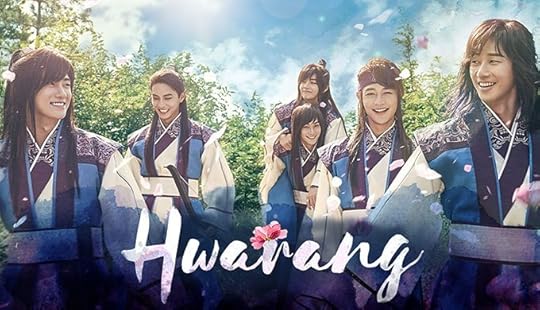
One of the most attractive aspects of K-drama is that while there is one clear male (and female) lead, a show’s writers ensure that the audience has multiple gorgeous men (and women) at whom one can direct a heart-eyed stare. If a show’s worthiness was based solely on the number of ogle-worthy men in its cast, Hwarang would be on top of the pile. Think forest bathing, but with cute boys instead of trees. Please understand how bad a show has to be for a straight woman to abandon it despite these charms.
Set in the Silla kingdom of ancient Korea, Hwarang is about a group of young men who are brought together to create an elite group of warriors, cutting across existing class hierarchy. Unfortunately, the story is more plot holes than plot. Add to that a female lead who exists only to weep, and you have a show that is 24k disappointment.
At some point, maybe I’ll write a monograph on heroes in Indian popular entertainment and their counterparts in K-drama, but for now, let me just limit myself to saying this — I’ve become very interested in how masculinity and masculine ideals are imagined and updated in K-drama (especially since the historicals are all set in eras that were violently sexist and misogynist). Given this interest, I plodded through a fair number of episodes of Hwarang. But the show’s plot is a mess to the point of being boring; the acting is regrettable; and the idea that a king gets his legitimacy from the army (the Hwarang are basically the special forces of ancient Korea) does not sit well with me at all.
Record of Youth

Park Bo-Gum (from the utterly charming Reply 1988) and Park So-Dam (of Parasite fame) as the lead pair? Sold! Record of Youth started off well. Bo-Gum’s Hye-Joon and Hae-Hyo (Byeon Woo-Seok) have been friends since childhood and their relationship has remained close despite both of them choosing to become actors. Hae-Hyo is more successful (largely because his influential and pushy mother). Hye-Joon, on the other hand, is more talented but struggling because the doors just refuse to open for him. Rubbing salt on his sore wounds is Hye-Joon’s unsupportive family. Add to this mix Jung-Ha (Park So-Dam), a young woman who gave up her stable office job to follow her dream of being a make-up artist.
In the first few episodes, Record of Youth offered a charming slice of posh and middle-class Seoul life. There are a lot of interesting portrayals of masculinity — Hye-Joon’s father feels toxic and traditional while his grandfather is a sweetheart and more modern. The competition and camaraderie between Hae-Hyo, Hye-Joon and another one of their friends is well done in the early episodes. But halfway into the series, the writing fell apart. Park So-Dam is utterly wasted as Jung-Ha, who gets little attention from the script since Record of Youth has eyes only for Hye-Joon. Plus there’s no chemistry between the lead pair.
It’s worth noting that Record of Youth does have a gay character (a fashion designer), which (from what I’ve seen) is unusual for K-dramas, but it’s disappointing that the depiction is so riddled with homophobia. The designer shown as a predator and all our sympathies and bias are supposed to be towards Hye-Joon whom the designer wants to ensnare. This is not surprising. Who wouldn’t want to ensnare Park Bo-Gum? Yet the poor fashion designer comes across as some sort of salacious villain because he’s attracted to Hye-Joon. Meh.
What’s Wrong with Secretary Kim?
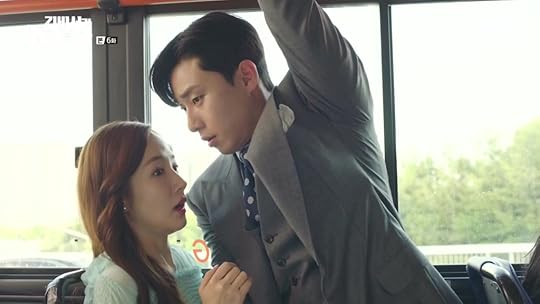
Park Min-Young was just so cute in the adorable (and very flawed) Her Private Life that when Netflix dangled What’s Wrong With Secretary Kim? before me, I took the bait. For most part, What’s Wrong … is an old-fashioned Mills & Boon — arrogant but dashing millionaire gent is shocked when his ever-reliable secretary says she wants to quit. After some banter and faux pas, they tumble into each other’s arms (naturally). What’s Wrong … is not a show you watch because you’re consumed with suspense to find out what happened in the end. You watch it for the comforting pleasure of watching a familiar, predictable love story.
If there’s one thing that I can confirm as someone who has devoured their share of paperback romances, it is possible for a clever writer to make these idiotic formulaic stories enjoyable. A key element to making these stereotypes engaging is the heroine. She must reflect whatever is considered strong in their particular time. For instance, the old stereotype of the blend-with-wallpaper secretary came out of a social context when suffering in silence and supporting The Man was considered an ideal example of feminine strength. Later, in the ’80s, that shape-shifted into the secretary who is super efficient and organised because that ability to juggle everything expertly was seen as strength in women. By and large, What’s Wrong … fails to update the secretary’s character. There were flashes of irreverence in Park Min-Young’s Kim Mi-So, but for most part, she seemed like one of the fictional secretaries from the ’80s, rather than someone from 2018.
The real fail in the show’s writing, though, comes in the second half. Since the boringly conventional romance couldn’t be stretched over 16-odd hours, the writers added a set of twists that include (in no specific order):
child kidnapping
dissociative identity disorder
infidelity, and
suicide.
In short, What’s Wrong … becomes completely bonkers.
The sub-plots are among my favourite features of a K-drama because I’m constantly amazed by the insanely dramatic stuff that will be introduced about two-thirds into the story. Like, for instance, in What’s Wrong… there’s a backstory that involves a woman going around kidnapping children. Not to mention the bizarre twist that informs us that two brothers as children swapped identities, and everyone else — from doctors to parents — thought the most sensible response to this was to say, “Ok. So from today Young-Joon is Sung-Yeon and Sung-Yeon is Young-Joon. Cool cool.”
The highlight of What’s Wrong … was that a couple of the kisses in the show were decidedly racier than the chaste pressing of lips that’s the norm in these shows. If I hadn’t seen other K-dramas with better written heroines and more interesting dynamics with their heroes, maybe I wouldn’t have been bored by this one…?
My Country: The New Age
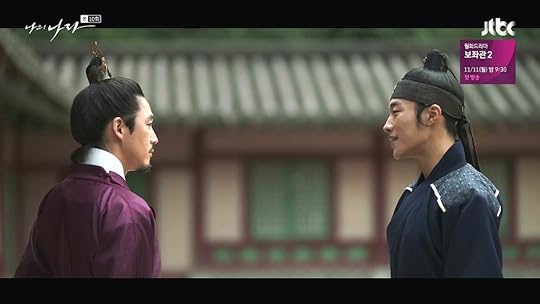
This show actually has some gorgeous artwork, but I’m using this picture because the real reason to persist with it is just how flat-out gorgeous Jang Hyuk and Woo Do-Hwan are. I dithered about putting My Country among the shows I’ve abandoned because I think I might go back and finish watching it at some point. Since that point isn’t likely to show up this year, it’s only fair to include the show among those abandoned even though whatever I’ve seen of it was quite good.
Although I’ve ended up watching more shows set in the modern era, I’m partial to the sageuks (historical shows) in K-drama because I love seeing how the writers reimagine the past in them (particularly in the fusion sageuks, which are set in the past but include a smattering of contemporary, modern ideas). My Country is set in the Goryeo kingdom, which preceded the state of Joseon. A lot of the sageuks I’ve seen are set in Joseon and I suspect that period is popular with writers because it was considered one of the golden ages of Korean culture. The time that My Country is set in is steeped in violence and mayhem; the storm before the calm, as it were. Against a backdrop of chaos and brutality, we see the friendship between two young men, Seo-Hwi and Seon-Ho. There is of course a heroine and a romantic triangle (K-drama’s favourite shape), but the real love story of My Country is between Seo-Hwi and Seon-Ho. Not only do they have way more chemistry than the heterosexual couple in the show, their relationship follows the arc of conventional star-crossed lovers who are repeatedly forced apart and brought together by circumstances.
My Country stands out for how overwhelmingly masculine it is. Not only are most of the women characters forgettable (they either disappear or die abruptly), the men strut about doing conventionally manly things — being violent, politicking, grabbing power, surviving impossible odds, etc. And in case of Woo Do-Hwan and Jang Hyuk, they do all this while flaunting some seriously sensual long hair. I think one reason I lost interest in the show is Seo-Hwi. He’s an utterly boring character with very little complexity, and much of the show revolves around him. Also, My Country is so testosterone-fuelled, it felt vaguely exhausting to binge-watch and monotonous after a point. As far as I’m concerned, feisty heroines over artistically blood-spattered men, any damn day.
That said, I wouldn’t be surprised if I returned to this show. If that happens, it’ll be for sensual pleasures like the earring dangling against the cliffhanger that is Jang Hyuk’s jawline and Woo Do-Hwan rocking that 1970s’ fringe in 1st century AD. Also, will someone please write a paper on Bang-won and his fan, contrasting it with the fan language of ladies in the 18th century (with photos and GIFs, naturally)? Do your thing, internet.
Perhaps a year later, I will look back at these posts while a single tear nostalgically dribbles down my wrinkled cheek. (It’ll be really sad if I find that my three-month haul from 2020 stands undefeated at the end of 2021.) For now though, I find myself smiling fondly even as I remember the shows that made me cringe or eye-roll or both. Thank the gods for K-drama. Without these shows, maybe I’d have had more sleep this year, but there would definitely have been less joy and beauty in my life had I not found the refuge of the K-drama-shaped rabbit hole.
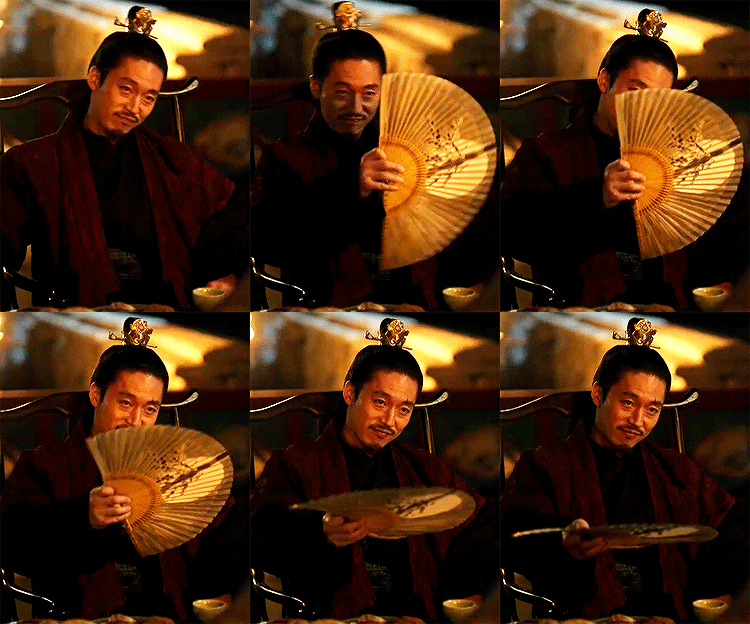 Bang-won + fan
 (from My Country: The New Age)
December 1, 2020
Ms Mean Machine: The Undoing/ Hyena
So The Undoing is awful and no amount of gorgeous cinematography by Anthony Dod Mantle can obscure this fact. At six episodes, it’s five episodes too long with atrocious acting from Hugh Grant and a turgid script from David E. Kelley. The Undoing is supposed to be a story about how Nicole Kidman’s character managed to outwit a high-functioning psychopath. Instead we’ve got a show that is partly an Architectural Digest photo spread, partly a salute to Kidman’s cosmetology team and entirely a bore. It’s obvious right from early on that only one person could have committed the murder and no matter how many times director Susanna Bier attempts to distract the audience by dangling Matilda de Angelis in various stages of undress* before the camera, it comes as no surprise that the murder was in fact committed by the chap who was accused of it in the first place. I haven’t read the novel that The Undoing is adapted from, but just on the basis of plot, I’d like to humbly submit, I’ve written a better whodunit.
The only bit of The Undoing that I did find interesting was Noma Dumezweni as the lawyer Haley Fitzgerald. Dumezweni, with her steel-wrapped-in-velvet voice and unblinking gaze, is stellar as the attorney who has no hesitation playing dirty if it will help her win the case for her client. She reminded me a little of Jung Geum-Ja from the Korean drama, Hyena, who is also a lawyer with few scruples and oodles of charisma. Only Geum-Ja is the protagonist of Hyena while Haley is a member of the supporting cast.
It takes a certain audacity to write a show around a character who is charismatic, abrasive, unethical and unlikeable. I suspect it takes something more than audacity to make that character a woman and write a story that makes the audience root for her despite the lead not asking for forgiveness for her immoral behaviour. To think it was K-drama that did this, rather than an HBO show.
[image error]Noma Dumewezni in The Undoing (the cinematography really is stunning in this show)
“People hire me to create muck,” Hayley says to a client in The Undoing. “Muck up the state’s case so that they can’t meet their burden.” There’s not a hint of apology or defensiveness in her face or her voice. At that moment, Hayley feels chilling, reliable, dangerous and a shelter from the storm, all at the same time. In her stillness and composure is the assurance that this woman can handle whatever may be thrown at her in a courtroom. Which is why it’s so disappointing to see her flustered, sputtering and unravelling in the last episode of the show. It just doesn’t add up to Hayley’s menacing cool in earlier scenes. After all, she’s a woman who remained mostly unflappable even when faced out of the blue with a murder weapon that could incriminate her client.
Focused as the script of The Undoing is on its stars (Kidman and Grant), it lets Hayley into the story relatively late and then sidelines her. The Undoing might have been a much more tense and gripping show if we’d followed Hayley around, watching her try to figure out what happened, what evidence she needs to suppress (and how) as well as who she needs to bring on the witness stand in order to get the jury to declare her client not guilty. But Hayley, with her steely immorality, is a secondary character. To place such a character at the centre of a show would be too much of a risk.
Hyena‘s writer, Kim Roo Ri (a woman, just FYI) takes that risk. Geum-Ja has no moral compass to speak of — from knife fights to honeytrapping someone, she’ll do whatever it takes to reach her goal. Additionally, Kim makes Geum-Ja an older woman. She’s played by Kim Hye Soo, who is 50 years old in life and 41 in the show (which is, from what I can tell, practically ancient in the context of K-drama, which is fixated upon youth and youngness like most forms of popular entertainment). On top of that, Kim gives Geum-Ja a love interest who is almost a decade younger than her and a colleague.
[image error]
In the course of the show, Geum-Ja goes up men, patriarchs and patriarchal structures. While she has her vulnerable moments, Geum-Ja is never weak and in her viciousness, she’s unparalleled. She’s close to the bottom of the social pyramid in a rigidly hierarchical society, and she’s determined to scramble to the top. Barring a few scenes, Kim Hye Soo aces this role. I can’t imagine any actress in Hollywood or Bollywood agreeing to do a part of an anti-heroine like Geum-Ja, let alone execute it with the flair that Kim Hye Soo does. With Ju Ji Hoon (who is delicious, very good and very occasionally ridiculous), she makes Hyena work. While watching it, I struggled with a lot of scenes in Hyena — aside from somewhat implausible details, it’s frequently high-strung and overdone; as though the show is compensating for its edgy plot by packaging it in a campy aesthetic. Often, it felt as though the story and the characters were being swamped by the over-the-top tone that the show’s directors chose. But the fact is that the excess doesn’t overwhelm Hyena‘s story. Months later, the ridiculous bits of the show are a blur, but not Geum-Ja with her gritted jaw and glinting eyes.
Compared to the six episodes of The Undoing, Kim tells Geum-Ja’s story over 16 hour-long episodes. It’s a lot of time and storytelling space, which is only a luxury if you can handle this sort of sprawl. Most of the K-dramas I’ve seen struggle with this and Hyena isn’t without its weak spots. But it’s worth remembering just how adventurous and genuinely bold this show is. Kim, like every other K-drama writer, was writing for regular, cable TV, rather than a (relative) prestige project like an HBO show. She had to include a host of tropes and write in twists and turns that will hold a mass audience’s attention — all of which she did without flattening out Geum-Ja’s complexity or pushing her towards socially-acceptable behaviour.
Meanwhile, David E. Kelley couldn’t keep Hazel from unravelling in a matter of about four episodes.
[image error]
*If any of you have ever wondered how the male gaze can be deployed by a female director, then look no further than how atrociously Bier films and treats the character of Elena Alves, played by de Angelis. Within moments of her first appearance on screen, she’s mostly topless because ostensibly she needs to feed her baby, but actually because Bier would like you to ogle at her. The next time we see her, she’s naked. Then she’s wearing a plunging neckline. Along the way, she gets to kiss both Grant and Kidman and there are a few sex scenes thrown in, here and there. And of course she ultimately gets bludgeoned to death so that she’s literally defaced and reduced to sexy body that is on display again and again and again. A+ for gratuitous violence and nudity. Well done, Ms Bier.
November 15, 2020
Soumitra Chatterjee 1935-2020
An edited version of this obituary was published in today’s Hindustan Times. All photos used below are not mine and nicked off Twitter (if you own any of these and would like me to take them down, please let me know).
Legendary actor, poet, essayist and dramatist Soumitra Chatterjee passed away on November 15, in Kolkata, following complications from Covid-19. He was 85. Chatterjee, a cancer survivor, had been admitted to Bellevue Nursing Home on October 6 and his condition started worsening from October 9, when he was put on oxygen support. Since then, he had been in critical condition. Chatterjee passed away on Sunday afternoon. He is survived by his wife, daughter, son and extended family.
An icon of Bengali cinema and theatre, Chatterjee was best known for being a favourite of celebrated filmmaker Satyajit Ray. Ray cast Chatterjee in 14 films, including Apur Sansar, Charulata, Devi, Ghare Baire and the Feluda series. The two would remain close friends for more than 30 years, with Ray saying of Chatterjee, “I will have faith in Soumitra till the last day of my creative life.” With 2020 being Ray’s birth centenary year, the timing of Chatterjee’s passing is a fittingly poignant coda to the two men’s legendary friendship.
In the course of his career, Chatterjee would become one of the biggest stars of Tollywood (as the Bengali commercial film industry is nicknamed) and also work with the most respected directors in Bengali cinema, including auteurs like Ray, Mrinal Sen, Tapan Sinha and Rituparno Ghosh. Chatterjee was known for the realism of his performances and being a scene-stealer. His distinctive voice, perfect diction and the complexity he brought to his roles have been mainstays of the Bengali cultural scene for over 50 years. Even a cameo by Chatterjee or a voiceover of his would be enough to make audiences sit up and take notice.
Born on January 19, 1935, Chatterjee spent his early years in Krishnanagar, in Nadia district, before his family moved to Calcutta. Both his parents were teachers and bibliophiles, imbibing in him a love of reading and culture from a young age. Chatterjee studied literature at City College, in Calcutta, and was an undergraduate student when he watched a performance by thespian Sisir Bhaduri. Enchanted by Bhaduri’s acting, Chatterjee decided to become a theatre actor. The love for the stage would stay with him over the decades and Chatterjee would in later years direct some memorable adaptations like Tiktiki (from Anthony Shaffer’s Sleuth) and Raja Lear (from William Shakespeare’s King Lear).
As far as the young Chatterjee was concerned, theatre was art while films were just show business, but his opinion changed in 1955 after he saw Ray’s Pather Panchali. “The days and nights that followed were about nothing but Pather Panchali,” Chatterjee would write in his memoir, The Master and I (translated by Arunava Sinha). In 1957, when Chatterjee was working as an announcer in All India Radio, a friend introduced Chatterjee to Ray. Ray would later say that it was meeting Chatterjee that convinced him to make Apur Sansar, the last part of the Apu trilogy and the first of 14 films in which Ray would cast Chatterjee.
One of Chatterjee’s most cherished memories of his debut film was seeing the poster that Ray had designed, featuring Chatterjee. In an interview with Amitava Nag, Chatterjee said*, “When Limelight was released in Kolkata, there was a big poster of Charlie Chaplin in Chowringhee. That poster was made by Manik-da [Ray]. When Apur Sansar was released… there was another poster made by Manik-da: the bearded face of Apu. I can’t explain how thrilled I felt when I saw that poster for the first time – as if I had achieved something really big.”
[image error]Satyajit Ray, sketching Soumitra Chatterjee
Under Ray’s direction, Chatterjee would embody some of Bengali cinema’s most iconic characters, like the sensitive Amal from Charulata and the detective Felu-da. For many, Chatterjee will first and foremost be Amal from Charulata, which was based on one of Chatterjee’s favourite texts by Tagore, Nastaneer (The Broken Nest). “I had to change my Bengali handwriting for good. There were many sequences showing Amal writing,” said Chatterjee*. “Manik-da felt that since the story was written by Tagore, the setting had to reflect an earlier period … so he collected and consulted a lot of texts of the pre-Tagore era, and showed me how the alphabets would be. … I diligently practised it for the next six months,” the actor told Nag, offering a glimpse into the detailing that both Ray and Chatterjee invested into their work.
Chatterjee shone in other filmmakers’ works too, delivering notable performances in films like Mrinal Sen’s Akash Kusum and Wheel Chair by Tapan Sinha. At a time when Bengali cinema — commercial and non-mainstream — could boast of talented actors like Madhabi Mukherjee, Sabitri Chatterjee, Utpal Dutt and Rabi Ghosh, Chatterjee stood out not just for his electric dialogue delivery, which was born out of his theatre experience, but also for the subtleties that Chatterjee brought to his body language while playing a role.
In the 1960s, Chatterjee became the first to challenge actor Uttam Kumar’s domination of the Bengali box office. While the early films had earned him critical acclaim, mainstream audiences woke up to Chatterjee’s charms when he played the anti-hero Mayurbahan in Sinha’s Jhinder Bandi (an adaptation of The Prisoner of Zenda). Kumar had the heroic double role in the film, but it was Chatterjee’s bad-boy angularity that made pulses flutter.
Directed by Tapan Sinha, Jhinder Bandi was a lavish production for its time, with an all-star cast that included Kumar, Arundhati Mukherjee and Chatterjee as an anti-hero. “This was my first film with Uttam Kumar. He was already a very successful actor. … What I learnt that day [watching Kumar shoot] was that when I am giving a shot it is mine and no one else’s – neither the cameraman’s nor the director’s. To give the perfect shot I feel I have the right to go to any length and even cancel a shot myself,” recalled Chatterjee*.
Kumar and Chatterjee worked together in a number of films and developed a deep friendship, despite their professional rivalry. Chatterjee steadily established himself as what came to be known as “a thinking man’s hero”, taking on roles that posed different kinds of challenges; like the dance sequence in Teen Bhubaner Paare, which will forever occupy cult status among fans of Bengali cinema. The film had no dance director, so Chatterjee (who had actually learnt ballroom dancing in the past from veteran dance trainer Bob Das) did the choreography. Another iconic Chatterjee moment was with actor Suchitra Sen who ripped his kurta in a scene in Saat Paake Badha. At a success party for the film, Sen teasingly came up to Chatterjee and grabbed him by his kurta, as if she was about to recreate that scene. It made for a fantastic set of photographs and set tongues wagging in Kolkata.
[image error]
[image error]Soumitra Chatterjee and Suchitra Sen
With films like Saat Paake Badha, Parineeta and Teen Bhubaner Paare, Chatterjee became a commercially bankable star who was equally at ease in non-mainstream projects. By the 1970s, Chatterjee was at the height of his commercial career, with no real competition in sight. Films like Baksa Badal and Basanta Bilap established him as a beloved romantic lead. Remembering the shooting of Basanta Bilap, director Dinen Gupta recalled an anecdote involving Chatterjee and actor Anup Kumar. “I was in the middle of a take… and suddenly noticed that Anup had climbed onto Soumitra’s lap to apply colour on him. I pulled Anup up, saying, ‘Why on earth are you on his lap?’ Anup replied coolly, ‘What else can I do? … Soumitra is too tall and I am so short,’” said Gupta*.
As the years rolled on, there was no pause in Chatterjee’s working life. He consistently drew audiences to cinemas even as he grew older and was cast in cameos and supporting roles. In later years, Chatterjee made no secret of being disappointed by the quality of cinema being produced in Bengal and the work offered to him. However, he would also point out that acting was a profession and since this was his source of livelihood, he didn’t have the luxury of a retirement. Chatterjee spoke frankly about his experiences in Bengali film and theatre in interviews, and wrote numerous essays and articles on contemporary Bengali culture. Many of these offered candid critique and perspective, drawing upon his own experiences but also a wealth of reading that marked him out to be among those actors who were genuinely erudite.
Chatterjee also made no secret of his Leftist leanings and was often critical of the political establishment at the state and Centre. Most recently, Chatterjee was among those celebrities who joined the popular protests on the Citizenship Amendment Act of 2019, which dissidents have argued is discriminatory towards certain communities, including Muslims and Tibetan refugees.
Despite all the critical acclaim, Chatterjee only won awards for his acting when he was well past his prime. He was awarded the Padma Bhushan in 2004; the Dadasaheb Phalke Award in 2012; and France’s Legion d’Honneur in 2018. Throughout his career, he steered clear of Hindi and other film industries, effectively cementing himself as an ideal of both Bengali masculinity and intellectualism through his on and off-screen personae.
[image error]Shashi Kapoor, Jennifer Kendall, Madhur Jaffrey and Soumitra Chatterjee (L to R) at Berlinale in 1975
Alongside his unrelenting shooting schedule, Chatterjee maintained a steady writing career, with books of poetry, plays and essays. Not even a cancer diagnosis could slow him down, but it did make Chatterjee keenly aware of his mortality. In recent years, he’d invariably mention the polymath and Nobel Peace Prize recipient Albert Schweitzer, whose controversial legacy includes humanitarian work in Africa as well as allegations of racism. Chatterjee focused his attention on Schweitzer’s determination to give back to society and work for the betterment of the underprivileged. In a 2017 interview to Scroll, Chatterjee said, “If things were conducive, I would have ideally given up everything, like Albert Schweitzer, and served in a labour camp. But I cannot do that. But then I realised, if I can at least bring joy to people’s lives, even if for a few hours, that is also service in some way.”
Acting in films; reciting and writing poetry; performing in and directing plays; editing a literary magazine; dabbling in painting — Chatterjee was a force of culture in Bengal, and all the more beloved because he chose Kolkata and its Coffee House culture over Mumbai and Bollywood. In the hearts of fans and cinephiles, he was and will remain the quintessential Bengali.
*Quote from Beyond Apu: 20 Favourite Film Roles of Soumitra Chatterjee, by Amitava Nag (Harper Collins).
November 13, 2020
Kolkata
My relationship with this wretched city doesn’t get any simpler and yet, it makes for good photographs.
[image error]Soar, November 2020
Weather-wise, October was mostly filthy. It was humid in Kolkata. Walk two steps and sweat trickled into a crease of skin that you didn’t realise you had. And then Durga Puja landed upon us and it was as though a switch flipped. Suddenly, the mornings were cool, the sunlight was softer, and in the evening, there was a breeze. This festival was always about change in season and it’s eerie — but also comforting — to realise that even as the climate changes catastrophically, the festival continues to fulfil its function of being a marker.
It’s been years since I spent Puja in Kolkata. The festivities were supposed to be muted this year, courtesy Covid-19, and just before Panchami (when the Pujas begin for Bengalis), the High Court ordered that people would not be allowed inside pandals. Most people I know were convinced that this was a ridiculous directive from the court — “As if a court order can keep the Bengali from standing before Ma Dugga!” — but in the insensitivity index, this order was a distant second to the expectation that there would be no food at Durga Puja venues. Food is central to the Bengali existence. We are a people who encountered vegetables like kochu (taro root) and fought the good fight to develop recipes that turn these insane vegetables into something edible. What’s a court order?
We went out to see Durga Pujas twice. On both occasions, we stepped out after midnight. Despite this and the minor detail of a pandemic, there were crowds not around the idols but at the food stalls. “Listen, they’re only doing betki kabiraji here. My sources tell me that they’ve started moton (mutton) kabiraji in Behala,” yelled someone even while they ordered four fish kabirajis. The time? 12.35am. A cousin who works as a police officer in North Kolkata told me that when faced with the choice of lock-up or one more phuchka, most people picked phuchkas. Constables who reported to her had carted off more than one person into lock-up, carrying their precious phuchka. What about the phuchka-seller, I asked her. Was he in lock-up too? “No, he was wearing a mask,” said my cousin.
Unsurprisingly, there’s been a considerable spike in reported cases of Covid-19 in West Bengal and Kolkata since Durga Puja.
This year, the Durga Puja idols showed Durga wearing surgical masks and doctors’ white coat. Many a Mahisasura was given a coronavirus-shaped head. For the idols to have references to the year’s talking points is nothing new, but this year, the idols aren’t just about commentary. The ones that show Doctor Durga and Coronasura manifest a desperate hope. The idol that got the most eyeballs was one that showed Durga and her family as migrant workers. They stood in a pandal that didn’t have the sophisticated finishing for which Kolkata pandals are famous. (I still remember the first Puja I’d seen in Kolkata. One pandal in north Kolkata was inspired by Rajasthani Rajput architecture and I could not believe that what I was looking at was a temporary structure made of bamboo and cheap cotton, rather than history and stone.) The mother goddess and her family stood in a pandal made of bamboo poles and flapping pieces of jute. It could have been any incomplete construction site in Behala, but it was Kolkata’s most celebrated Puja site.
My favourite though was the idol at Badamtola, near Kalighat.
[image error]Badamtola, designed by Snehasish Maity. Idol fabricator: Purnendu Dey.
Three Puja committees collaborated to create a Puja that would make a film nerd’s heart go pitter patter. You turned left into a (relatively) narrow lane and there, on your right, was the facade of a crumbling, once-grand house whose steps led up to this Durga, inspired by Satyajit Ray’s Pather Panchali. A little further down the lane, the next Puja committee had used the existing buildings to recreate scenes from Aparajito. It was spectacular and the only way you could tell any part of the building wasn’t fabricated was if you spotted a resident standing at the window or veranda of the grand old houses on the street. The last one in this trilogy was, of course, Apur Sansar. It was the last memorable of the three.
The Pather Panchali-inspired Puja is one of the most beautiful idols I’ve ever seen. I loved the spartan simplicity of it — a grey, grimy facade; Durga in her gamchha sari; Apu looking up at her. For a country riddled with grief, death and economic slowdown, this was so perfectly relevant and yet strangely uplifting. The idol was a reminder that even in these terrible times, there is still beauty.
Ray lingered at the fringes of this stay. When we drove off to see Sarat Chandra Chattopadhyay’s house, kaash phool (which is actually a kind of grass, despite being called a flower in Bengali) were everywhere. They seemed to burst out of the concrete at signals once we left the city. They bobbed near petrol pumps, restaurants whose shutters were down and of course, on the banks of the Rupnarayan river. When he built the house, Chattopadhyay had positioned it to be almost on the river so that he’d be able to see its rushing waters from the balcony (which has some gorgeous tiling that my mother is sure he brought down from Burma). Now, the river has veered away, but it’s still just a short walk away. In the October heat, there was nothing pleasant about walking alongside the river in the middle of the day, but it was still beautiful.
[image error]Rupnarayan, October 2020
[image error]En route, October 2020
By the time it was my last day in Kolkata, I was feeling restless. I felt as though I’d wasted too much time. The city has been a muse and lady love to many, but I’m not one of them. When I’m in Kolkata, I’m a shatter-pattern of myself. It always takes me by surprise when I’m able to find something beautiful in it or when it transforms itself in my eyes and hands to become something striking.
[image error]Curve, 2020
[image error]Men at work, 2020
October 16, 2020
Wild Card
This just may be the best business card in the history of business cards. Bravo, Percy! The neglected married women and young parties of your time and place were lucky to have you.
[image error]
[image error]
October 14, 2020
On Medusa
Artist Luciano Garbati’s Medusa With the Head of Perseus stands directly across from New York County Criminal Court, facing the courthouse that pronounced film producer Harvey Weinstein a sex offender. The press release would have us know that the seven-foot sculpture “inverts the narrative of Medusa, portraying her in a moment of somberly empowered self-defense”.
[image error][image error]
I don’t mean to be harsh, but this is tosh. Just because a woman is holding a sword and a man’s head does not mean she’s empowered. Also, I’m not sure why she had to be naked (beyond the whole providing “public porn” bit, as art critic Jerry Saltz put it). A seven-foot tall, skinny-enough-to-have-a-thigh-gap, body-hair-less, naked woman; striking a pose like she’s at the end of the runway — Gabrati’s Medusa is an epitome of the shallowness of our global culture. She makes for a striking picture, but beyond that, the only narrative she embodies is one that idealises and lionises skinny white women.
As activist Wagatwe Wanjuki wrote in her thread on Twitter, “#MeToo was started by a Black woman, but a sculpture of a European character by a dude is the commentary that gets centred? … a sculpture of a naked rape victim leading to jokes about her pubic hair only makes me more suspicious of this iconography’s cultural impact. … that work just feels like a man’s fantasy of a rape victim”.
Right now, the biggest plus in favour of Gabrati’s Medusa is that the head of Perseus seems to be modelled on the artist’s own face. (Medusa is not modelled on a real woman, his press representative had clarified. What a shocker.) If a man is going to make you an object of the patriarchal gaze, then the least he can do is give you his decapitated head.
Even though Gabrati’s Medusa is a gigantic nude, there’s something sanitised about the image she presents. See Cellini’s Perseus with the Head of Medusa, which Gabrati was responding to originally when he made his sculpture in 2008, and you can see Medusa’s body at his feet, spilling gore out of the hacked neck. Perseus’s own body is taut with tension, showing the effort that it’s taking him to hold up the head. Whether or not he intended this, Cellini’s sculpture is a statement of Medusa’s power as much as it is of Perseus’s heroism. Perseus has weapons and gifts from the gods, his every muscle is tense. Medusa, on the other hand, is unarmed. Her bare, mutilated body offers a reminder that Perseus needed a whole lot of help to defeat Medusa.
Also, I giggle delightedly at the fact that Cellini had his sculpture installed at the precise spot where Medusa’s head would be opposite Michelangelo’s David. Sure, the decision was spurred by arty male ego, but the net result is that for almost 500 years, Medusa’s furious, feminine gaze has petrified the classical epitome of masculinity.
Perhaps the most disappointing part of Gabrati’s installation is that it adds so little to the story of Medusa, which has been repeatedly recast over centuries to reflect the ideas and conflicts of the storytellers’ times. This sculpture at best makes for a decent photo-op, but there’s nothing to look at closely. It has little by way of detailing, which means there’s little sense of a story. This Medusa is just an object. Also, the stories of Medusa’s slaying are complex and rich with symbolism. When Gabrati inverts the myth by having her cut off Perseus’s head, it’s not a simple reversal. Medusa’s gaze had power and if anything, when it was transformed into the Gorgoneion — the hideous face that wards off enemies — it became more powerful. To turn Perseus’s head into the Gorgoneion is to rob Medusa of both her power and erase her story.
Medusa’s head as a Gorgoneion can be found in art from around 800 BCE. These depictions suggest Medusa was a talismanic god, like Bes of ancient Egypt or the Mesopotamian Pazuzu. For a long time, this head wasn’t recognisably feminine as the Gorgoneion is now. It was more of a fusion of genders, with features that were suggestively pubic and penile (and also hideous). There’s nothing sexy about the early Medusa, who would become more and more feminine when faced with the Hellenic male hero, Perseus.
As Hellenic culture became more dominant, Gorgoneion became a talisman. Its older origins are lost to us now because what has survived is the story of how this symbol was effectively created by Perseus, the mortal son of Zeus, when he beheaded Medusa. Now Medusa starts to get a backstory; possibly to establish her as a worthy adversary and to assimilate this older divinity into the Olympian world order.
In Hesiod’s Theogony, written around 6th century BCE, we’re told that Medusa is one of the many children born of the incestuous union between the pre-Olympian sea god and goddess, Phorcys and Ceto. This is when Medusa gets two sisters, Euryale and Stheino. Together, they are the Gorgons and Medusa — the one who has survived centuries in retelling — is the only mortal one in the trio.
Apropos nothing: Medusa means “guardian”. Euryale means “the one who roams far” and Stheino means “the strong”. Oddly pleasant names for a triad of monstrous women, if you ask me.
In Theogony, the Gorgons live beyond the ocean, “in the frontier land towards Night”. Clearly it’s not that far from the ocean, because Poseidon found her and “lay with her in a soft meadow amid spring flowers”. Unlike later versions of the Poseidon-Medusa relationship, this one seems romantic and consensual enough (leaving aside the minor detail of this being a serious case of “daddy issues” given her father is a primordial god of the sea). Hesiod does not explain why Perseus cut off Medusa’s head. We’re only told that he does so, and that from her beheaded body sprang forth Pegasus and the giant Chrysaor.
A century later, in the stories of Perseus and Medusa that are found in ancient Greek art and plays, Athena is added to the mix as Perseus’s guide. Just as she helps Odysseus and Herakles and Orestes, the patron goddess of heroes helps Perseus. It’s one of those curious twists of culture that at this time, most Greek societies didn’t grant much by way of rights or personhood to women. And yet, to be heroes, the men needed the blessing and help of a decidedly female (and asexual) Athena.
The version of Medusa that is perhaps best known today comes from the Roman poet Ovid. The Metamorphoses, written in 8th century CE, gives us an origin story for Medusa that is very different from Hesiod’s. Ovid’s Medusa “once had her charms”, particularly golden ringlets that drew “a rival crowd of envious lovers” to her. Medusa catches the eye of Neptune, who “seiz’d and rifl’d the young, blushing maid” in chaste Minerva’s temple. Minerva — allegedly a “bashful goddess” — turns away when Neptune rapes Medusa and later, the goddess lashes out at Medusa by transforming the young woman’s golden curls into hissing snakes. Medusa’s changed appearance is so terrifying that she can turn a man to stone just by locking her eyes on him.
As Ovid tells it, Athena/ Minerva punishes Medusa for desecrating the goddess’s space (really, the girl should know better than to be raped in a temple. So rude). The disfiguring that Medusa suffers is both an attempt to explain the ugliness of the Gorgoneion and reflect the idea that a rape reduces a woman to a mutilated other. Yet, if you think about it, Athena/Minerva’s actions help to make Medusa more powerful as a rape survivor than she was as a virginal maid, which is particularly interesting when you keep in mind Athena/ Minerva was a virgin goddess, in a society that saw virginity as a virtue. Unlike so many of the mortal heroines in Greek myths, Medusa does not remain silent after she’s been raped. She may be seen as hideous, but she is also stronger and louder than ever — largely because Athena/ Minerva’s ‘punishment’. Now, not even the male gods dare stand in the line of her sight.
Athena/ Minerva’s relationship with Medusa as Ovid imagined it remained curious. On one hand, Perseus is only able to outwit Medusa because of Athena/ Minerva’s help, but afterwards, he also has to surrender Medusa’s head to Athena/ Minerva as a votive. Athena doesn’t destroy Medusa’s head. In fact, she seems to put a fair amount of effort into preserving as much of Medusa as she can. She collects Medusa’s blood (which can both heal and kill) as well as a lock of her hair (which, technically, would be part of a snake?). Medusa’s head, Athena/Minerva places on Zeus’s aegis, turning the dead woman’s head into the immortal Gorgoneion (which is fitting for someone whose name meant “guardian”).
To an enemy, the head is a terrifying sight that establishes Zeus’s dominance over everything that Medusa embodied (eg. power, femininity). The aegis with the Gorgoneion is a statement of Zeus’s omnipotence. But think of it from an Olympian point of view. With her head on Zeus’s aegis, the gods can never forget the threat Medusa posed and the power she continues to exude even in death. It’s almost like Athena made sure Medusa would not be erased. Also, let’s take a moment to appreciate Athena’s move — the aegis of Zeus, a serial rapist, has on it the head of a rape survivor. Protecting even the gods from evil is the rage of a mortal woman who had been violated.
I wonder if Ovid realised what he’d done when he wrote Medusa’s story in The Metamorphoses.
The fact that Perseus was the one tasked with beheading Medusa is also interesting because he’s the product of an extremely weird one-night stand. Perseus’s mother Danae was imprisoned in an underground tomb because her father was told by an oracle that he would be killed by his grandson. Zeus appeared before Danae as “golden rain” and hey presto! Danae gave birth to Perseus. Exactly how Danae felt about this rain dance, we are not told. What we do know is that her father put Danae and infant Perseus in a box and chucked them into the sea.
Mother and son didn’t drown because Zeus asked Poseidon to calm the waters (that’s what passes for loving, fatherly behaviour in ancient Greek myths). Poseidon — Medusa’s (to-be?) rapist — nudged the box to the island of Seriphos where Perseus and Danae were able to sneak in a few peaceful years. Unfortunately, Danae’s troubles were not over. King Polydectes of Seriphos decided he wanted Danae as his wife. That she didn’t want him as her husband was an irrelevant detail to Polydectes.
Patriarchy being what it is, the question of what would happen to Danae was finally decided by a gent who had nothing to do with her (Polydectes) and her barely-of-age son, Perseus. Polydectes told Perseus he would leave Danae alone if Perseus could bring him the head of Medusa. For some reason, Perseus figured that the best way to protect his mother from a sleazebag was by leaving her alone with said sleazebag on an island, while he, Perseus, traipsed around the world, looking for the Gorgons. Needless to say, Polydectes went after Danae while Perseus was off being a hero. When the young man returned to Seriphos (with Medusa’s head), he discovered Danae had taken refuge in a temple.
For Medusa, child of the pre-Olympian gods, the temple is where she is violated. For Danae, it is a sanctuary. Yet, ultimately, Danae is saved, not by Perseus or Zeus or any other man; but by Medusa. It’s Medusa’s head that turns Polydectes (and his courtiers) into stone. Even in death, she is a guardian.
The point of all this is not that there’s one story of Medusa, but rather to question how we’re adding to or changing Medusa today. What do she and the Gorgoneion stand for (beyond being Versace’s logo)? If Gabrati had titled his sculpture Medusa With the Head of Poseidon, that may have been interesting and perhaps even reflective of the debates and conflicts we’re grappling with as women today. As it stands now, Gabrati’s sculpture takes away more from Medusa than it adds. She gets a sword, but she’s been robbed of her power.
September 25, 2020
11.39am, Saturday
I don’t want to jinx it, but I think I’ll be blogging more. Sigh. I probably jinxed it just by writing that sentence.
It’s been two weeks in Kolkata and I can now confirm, quarantining at home is hard. Part of the challenge lies in logistics — you need a room with its own bathroom; someone has to literally serve you your every meal etc — and soon enough, your head starts buzzing with questions that may or may not be ridiculous (eg. do potentially-dangerous aerosols crawl out of your room each time you open the door to take or put out your tray of food if you’ve taken your mask off while inside?). However, more difficult than the logistics of creating a temporary quarantine studio is tucking yourself away like a dirty secret. Even if my parents hadn’t looked like they were puppies I’d kicked when I said I’d lock myself up for 10 days, it just felt so wrong to not even be able to see them while in the same house. Ultimately, I settled for almost-round-the-clock mask-wearing, distancing and semi-isolation, which still felt stupid but better to feel stupid than sick.
The most unsettling part of all this is how sprightly I felt. It was like my brain was humming in my head. I even started to write something (the lockdown has been anything but productive on the writing front). My PMS has felt manageable (I’ve only snarled once and haven’t needed to prop whatever’s left of my sanity with sugar and comfort food). As much as I love my parents, I don’t think they’re the reason making my brain whistle while it works. Sure, it doesn’t hurt to have two human cartoons make heart-eyes at the sight of my masked face, but I think what my head is primarily responding to is the simple, rushing relief of not being in the same room, doing the same routine. There’s a change and even if the change is actually just exchanging one set of four walls and two windows for another, it feels like the loop has been broken.
[image error]From my parents’ terrace.
[image error]Ngl, it really bothers me that the cloud didn’t arrange itself in a straight line.
In the time that I’ve been here, new Covid-19 hotspots have developed in Bombay (one of them is Bandra). Everyone’s keeping their fingers crossed that the numbers are plateauing. This is our best-case scenario — a constant count of approximately 80,000 new cases and 1,000 deaths each day. Six months into the pandemic, I still don’t know how to process these numbers and understand what they actually mean for all of us.
Today, at KEM Hospital in Mumbai, three out of the 13 people who have signed up to be part of the human trial, will get the first shot of the Oxford University-AstraZeneca developed Covishield vaccine. A few days ago, someone sent me a message saying, “Since you love silver linings, consider this: Covid-19 might be our last chance to slow down the pace at which we’re devastating the environment.” The same day, I chanced upon a tweet that read, “I can’t wait until there’s a readily available COVID vaccine and we can all just get back to enjoying the final 50 years of this planet being inhabitable”. (These coincidences don’t feel uncanny anymore. I think we’re all resigned to the fact that our phones are spying on us. What was a little chilling was to see this right after reading a chapter in a book about a woman who made falcon caps. True, I was reading the book on the Kindle, but the damned thing has been on airplane mode for the past two weeks.)
Leaving aside the worries about whether the vaccine works and what “adverse events” may follow from it, watching how resistant all of us have been to change has been fascinating. We don’t want to wear masks; we want local trains to start, offices and schools and universities to open; we want more planes in the skies and boots on the ground. All this to avoid facing up to the reality that we do need to change the way we live and work. Meanwhile, even as so many of us attempt to keep things static, enormous changes have been wrought in so many areas. In India, practically every institution other than the executive has been crippled or dismantled. On paper, we are a democracy, but Parliament has been reduced to a pathetic joke with question hour being suspended and laws like the contentious Farm Bills and amendments to the FCRA being pushed through by brute majority. The judiciary offers neither relief nor resistance and its politicisation is obvious now. Laws are being used by policing agencies to victimise and harass innocents. Police reports are full of fudged facts and fiction. We’re told there is no data of healthcare workers who have died of Covid-19 during the pandemic. Neither is there data on migrant labour, their deaths and the jobs they lost.
“This is worse than the Emergency,” a friend wrote to me recently. They’re right. This history will be harder to write, wrapped as it is under non-facts, conspiracy theories, fears and hate. Unlike the Emergency that was imposed by Indira Gandhi, this one doesn’t have a clean starting point. Did it fall apart in after the elections of 2014 or 2018? Was the last straw the judiciary? Was the first straw the press? There is no data. Silver lining: at least we’ll have our stories.
[image error]detail from 1.10pm, by Prajakta Potnis
“It might not happen for a long time,
but one day you run your fingers through the
sand again, scoop a fistful out,
and pat it into a new floor. You can believe in
anything, so why not believe
this will last? The seashell rafter like eyes in the
gloaming.
I’m here to tell you the tide will never stop
coming in.
I’m here to tell you whatever you build will be
ruined, so make it beautiful.”
~ Spoiler by Hala Alyan (in The New Yorker)
September 17, 2020
Small pleasures
Yesterday in Parliament, the Ministry of Home Affairs submitted a written reply that said, “No infiltration has been reported along the India-China border during last six months”. Officials from the ministry would have us know that “infiltration” is not the same as “incursion” or “transgression”. It is also, evidently, not the same as 20 Indian soldiers dying in Galwan valley following a ‘skirmish’ with the Chinese army.
Sure, it’s shocking that the government is reacting pretty much like a tantrummy toddler, but it’s also disappointing that this is the best fiction that our government can come up with. This is India, the land of myths and folk tales; of Booker Prize winners and Bollywood films — and “no infiltration” is the best we can come up with? Come. on.
As a critic and an author, I feel the need to point out that the narrative pitched in Parliament is neither logically coherent nor ridonkulous enough to be emotionally satisfying. Leaving aside the minor detail of dead soldiers and the pan-Indian anxiety that we’ll need to apply for Chinese visas if we ever want to see Ladakh again, if there were no infiltrations then why has the government been banning Chinese-owned apps like TikTok? Why have the ruling party’s workers been calling for a boycott of Chinese products? (Helpfully, they issued these calls to action using phones manufactured by Chinese companies.) Most importantly, this story is just not entertaining. If you’re going to sell the nation a nonsensical story, then at least make it fun. Like JP Dutta’s Border.
[image error]
[image error]
[image error]
[image error]
Ah the 1990s. Don’t you miss those days when jingoism wasn’t steeped in toxicity, self-loathing and denial? When we could look at man-shaped puffs of testosterone and laugh instead of thinking of lynch mobs?
Fun has been hard to come by since the current government came to power (barring the occasional CC-flavoured respite). Whatever little was left of the stuff has been sucked out by the pandemic. Now, fun survives in carefully-constructed bubbles, like viral videos and old films — all temporary escapes from the real world that we’re trying to keep three to six feet away. In the age of the internet, laughter isn’t only something you hear, but also some thing you manifest through emojis, GIFs and letters. I see the “haha”s and crying-tears-of-laughter emojis and wonder how many of those were typed by straight-faced people who haven’t cracked even a smile in days.
Trapped in a stress-response limbo, we need the catharsis that laughter brings, even if that laughter is edged with desperation. Even if laughter at its sweetest is now menacing. Six months into the pandemic, we know that Covid-19 spreads most effectively through aerosol transmission. Which means you don’t need to sanitise packages and groceries because surface transmission is not worth losing sleep over. Unfortunately, what it does mean is that if you’re a carrier and you’re not wearing a mask, you’re spreading the virus by simply breathing or breaking out in laughter.
Maybe the onset of Covid-19 will eventually be documented as something that blindsided us, but in the present, it seems painfully obvious that the infection is something that we’ve walked up to, rather than something that came at us out of nowhere. This particular strain of the coronavirus seems to have reached us through bats, because as humans we’re expanding relentlessly, irresponsibly and inconsiderately into habitats of other species. Not just that, the symptoms of this illness seem to be crafted to reflect the toxicity of our times.
Both Covid-19 and the politics of hate are in the air, vitiating the atmosphere we live in to the point of being lethal to many. Both infect people insidiously, with most not showing symptoms but passing it on through what comes out of their mouth. Symptoms of both include being raised to a fever pitch. In the worst cases, everything in the patient’s body turns against itself. Both Covid-19 and our toxic public discourse leave people fatigued to the point where simple, everyday routines feel impossibly taxing. One study has found that the infection can spread between subjects (in this case hamsters, because apparently are the “the best animals in which to study a coronavirus spread) that are in separate cages but in the same room, which to me sounds like all of us in India today. Whether it’s Covid-19 or the politics of hate, the only way to heal or prevent the infection is by isolating yourself.
It turns out that Sars-Cov-2, the virus that causes Covid-19, is actually rather fragile and doesn’t last particularly long in the open air without a host (which is why surface transmission isn’t worrying experts as much as aerosol transmission). I’d like to believe the toxicity that infects our society and politics today is as fragile as the virus. Even though both Covid-19 and the politics of hate seem undefeatable challenges right now, perhaps they are in fact vulnerable and prone to self-destruct. We can only hope.
If there is one thing that we do know for certain, it is that this pandemic is rewiring our brain. Chronic stress — which is what we’re going through now and will be going through for many months ahead — can in extreme cases kill cells in the hippocampus, which raises the risk of dementia and long-term depression. But at the same time, it’s possible that this will cause neurons to form new pathways in the brain because we as a species do have a thing for adapting to changing circumstances. Covid-19 has challenged our brain like nothing has in recent times and this might just force a change in the way we think — not because of some high-falutin’ ideal of a better world, but because we want to survive.
[image error]
I took a flight out after what feels like a lifetime and at the airport, there were two people who were wearing dishwashing gloves as part of their informal protective gear. I, with my latex-gloved hands and fingers made of sweat, raised a salute to them. The flight was to Kolkata, which naturally meant that most of us had multiple packets of food to tide us through the two-plus hours of waiting. A family of four had two meals in the time between checking in and boarding the flight. My heart felt fuller just watching them eat. So what if there’s a pandemic and the country is going to hell? We Bengalis will not lose sight of the small pleasures of life, like travel dabbas with luchi-aloo dom and sandesh. In fact, we’ll focus on it and assault any dangerous aerosols with an aromatic barrage of perfectly-roasted garam masala, tomatoes and green chilli.
It’s these little things that keep us going these days. The fates are cruel, the systems are crueller and everything is going to hell. In circumstances like these, you can’t really hope for big miracles. (Some do. Someone I know consumes YouTube videos in which astrologers talk about the journeys of planets and how these travels will impact our futures. For instance, one astrologer has said the pandemic will wane by September 23 because Jupiter will have moved. Here’s hoping, bruh.) Instead of holding out for big miracles, maybe we should reorient towards finding hope and beauty in details.
Our brain tends to lay distinct memories on the basis of physical locations, which it’s struggled to do during lockdown because the location has stayed the same. But perhaps, by the same token, the brain is learning to notice the tiny differences and the impact they make. As neuroscientist David Eagleman put it: “what this year has done is force us all off the path of least resistance.”
Some time ago, I stepped out of the house after what felt like forever (about two weeks at a stretch). I was walking home when an elderly gentleman stopped me.
“Excuse me?” the gentleman said, in English. “I’m selling puri-bhaji —”
“I’m sorry,” I said and rushed into my building as though my not acknowledging this elderly man would somehow erase the fact that he had clearly fallen on hard times and was forced to sell food on Mumbai streets.
At the time, I didn’t understand why I didn’t listen to him. It didn’t make sense to me that I didn’t buy some of the food he was selling. When in these past six months, had I lost my capacity for simple kindness? I think I know now what my brain was doing when it shut down the empathetic response — it was processing my stupid, desperate effort to maintain a distance between the reality of this pandemic and my own individual reality.
I realised as the lift took me up to my floor that somewhere along the way, I’d lost empathy for those suffering the various impacts of Covid-19 and reduced myself to feeling sympathetic. Sympathy is easier. It allows you to remain removed and see the victim as someone different from yourself. Empathy demands I find common ground and acknowledge that it’s just random chance that I didn’t fall ill with Covid-19, lose my job in this contracting economy and grapple with the loss of one of my own succumbing to the infection. (All of which have happened to people I know, but not those who are among my nearest and dearest.) To remember the once- or twice-removed victims and survivors as part of my world would mean acknowledging I’m vulnerable; that I might lose the ones I call my own; that it’s just dumb luck that I haven’t.
Once the lift reached my floor, I forced myself to go back down, but the old man was no longer at the spot where I’d met him. I roamed around the lanes for a few minutes, but he seemed to have disappeared. A small part of me wondered whether I wasn’t seeing him because I didn’t want to acknowledge my own casual, unnecessary unkindness. I walked slower, I looked closer, but I couldn’t find him.
I spent the remaining hours of the day hating myself and looking for things to blame for my loss of grace. The next day, I went for a walk in the evening. I didn’t have a podcast or music to listen to and I kept my phone in my bag. Without distractions, I roamed around my neighbourhood. I didn’t look up at the sky, but looked down (and successfully avoided multiple encounters with dog poop — posh Bandra, you really need to clean after your pets — and one dead rat). The people on the streets reminded me of beads scattered when the string of a necklace snaps.
[image error]
Since then, I’ve made it a point to make sure I step out at least once a week. I keep my phone away for most of the walk and I consciously remind myself that if I see someone whom I can help in any way, I will. I try to make eye contact with people. I listen in on conversations that patter past. Among the everyday banalities — “Did you hear about…?” “That video!” “We just got here…” — there are always fragments that feel hopeful. Exchanging crinkled eyes and invisible smiles with strangers. A family, sitting on the pavement, playing a little game they’ve devised. The couple who sneak a kiss in the shadowed corridor between two streetlights. A group of delivery guys playing board games on the back of a bike. A young woman giving thanks to Spanish K-pop fans for their translations of live sessions in Korean. Someone buying extra food for a family in need and promising to be back at this spot in two days, to restock supplies.
The path to the sea is made up of fragments of kindness and joy. Most of these don’t seem important. It’s unlikely that patiently listening to your friend or daughter go on about a K-pop idol’s impossibly-perfect skin is going to have a ripple effect that will bring us any closer to world peace. But somehow, for all its flimsiness, in that silly conversation is a reminder that we’re more than bodies that are creased in daylight and crumpling in the dark. The scattered beads might just be a pattern.
These days, I don’t go to the bandstand anymore. I’m sick of being chased by the police and witnessing the satisfaction that the police officer feels at being able to deny us a little beauty. Instead, I walk past the neatly-paved stretch of the bandstand and arrive at a grubby little patch that the cops don’t care about. In the time before lockdown, the place smelled of dried fish and refuse. Empty bottles of cheap booze were everywhere, along with plastic bags and broken flip-flops. Now, the old garbage seems to have vanished and each evening, there is a congregation of friends, lovers and solo seekers of sunsets. For a few minutes, all of us stare at the sky.
Despite being at the same spot and under the same sky, the sunset feels new and different each time. On the days that the sky is in the mood for pyrotechnics, I fill my phone with pictures that will later feel confusing because they look so similar and seem to be almost interchangeable with the ones I took earlier. (This year’s sunsets have been spectacular.) But they don’t feel the same when I’m standing there, on that rocky outcrop, staring at a sky infused with magic and colour. Each sunset feels charged with hope — not because it’s beautiful, but because all of us standing here haven’t lost sight of beauty. For all that these days are taking away from us, we’ve still held on to our sense of wonder. That feels like the closest to grace that we can get right now.
On my way back, I often close my eyes for a fraction longer than a blink while waiting to cross the street near my house. The colours of the sunset fill my eyes-wide-shut world. Invariably, I find myself breathing out slowly when that happens. Then I open my eyes, adjust to the duller, darker world before me; and scurry home to go through the photos I’ve taken. They never do the skies justice, but they do remind me of the people I walked past and those with whom I shared a few moments. The jewel-coloured skies remind me that I’m still capable of feeling something other than rage, despair and sadness. They give me hope that I’ll be capable of kindness the next time.
[image error]
[image error]
September 5, 2020
Messages
Last night, at 3.05am, I woke up to the sound of an explosion. I know it was 3.05am because within moments of registering I was awake because of a noise that still seemed to be making the walls of my room vibrate, I looked up “bomb blast Mumbai” on Google and Twitter. Just to be doubly sure that China hadn’t found its way to our Western coast from Ladakh, to bomb Carter Road sea face — it’s 2020. Anything can happen — I double checked, but “bomb blast Bandra” on my phone’s window yielded no explanations. However, the other window by my bed did.
Without warning, the whole room lit up for a second and a thick, white whip of lightning struck the sky. And then it came — thunder. To call what I heard last night ‘a clap of thunder’ is ridiculous. This was an eruption of sound, a sonic volcano that made every nerve in the body twang. The window panes rattled, the walls seemed to brace themselves. It was like thunder had got drunk and been let loose upon the sky.
First came the impossibly deep and loud crack and boom. Then, a low rumble as thunder rippled across the cloudy sky, chasing the shining edge of lightning. As the sound of thunder rippled away from me, I imagined lightning and thunder gathering to crack open the sky over someone else’s sleep. For a few moments, there was nothing but the white noise of rain. And then they returned — lightning that ripped the sky to pieces, thunder that exploded like a bomb.
From my window, which looks on to other windows, I saw people waking up as I had. One, two, three, more… dark windows lit up, as though a sequence had been fired on an electric board. Some windows stayed dark. Through one, I thought I could see the faint blue glow of a phone’s screen. Silhouettes appeared in some windows as a few people peered out. Were they afraid? Awestruck? Did they think of old texts from different faiths that spoke of worshipping thunder, of god speaking through the natural elements? Did they remember songs from old Bollywood films that incorporated thunder into their tunes?
[image error] Nicked from journalist Jigar Shah’s twitter.
Watching the shadowy forms in the windows facing mine, I wrote on my phone, “The curious intimacy of living in a congested city, where strangers become witness to intimate, solitary moments.”
Another brilliant strike of lightning, another explosion of thunder.
I thought to myself that standing here, looking at the sky, these windows, these shadows, waiting for lightning, bracing for thunder — this was magic. I looked up. It was as though the sky had dipped lower so that the old gods could roar their fury at us.
“It’s only rain,” someone says to someone else, their yell reduced to a whisper by the storm around us.
And then, it was over. The thunder kept rolling away. The lightning disappeared. The sky returned to a dull darkness. All that drama and the end-of-the-world feels … for 20 minutes. If that thunder-and-lightning extravaganza was a message from the gods, then them gods are even more easily distracted than we internet-addled mortals are.
Yet, for all its briefness, it was beautiful. For those few minutes, if you were awake, you also felt like every cell in your body crackling with the quiet, still energy of a bubble that refuses to pop. You noticed things. You felt things. You breathed deeper. The headache receded, the body felt light, the heart hummed.
(And then you realised it was 3.30 in the morning and you have to be on a call in less than six hours.)
(Or you just slept through it all.)
Unrelated to any of this, I gave a talk on beauty in Raja Ravi Varma’s paintings, which is now available on YouTube. It’s much longer than 20 minutes.
Deepanjana Pal's Blog

- Deepanjana Pal's profile
- 34 followers

