
Filed Under Why: The Bride of Habaek
Certain things in the world defy explanation, like yawning; that saffron sheep in the family who loves biriyani and BJP in equal measure; and the fact that I’ve watched almost every episode of The Bride of Habaek.
There are K-dramas that are genuinely good and then there are dramas that are endearing and enjoyable despite being outlandish and/or kitschy. The Bride of Habaek is neither. It’s awful and I have a niggling suspicion that director Kim Byung-Soo knew this, which is why he tried to distract us from said awfulness by including random shots of shirtless Nam Joo-Hyuk. This, for instance, is one of his early scenes:
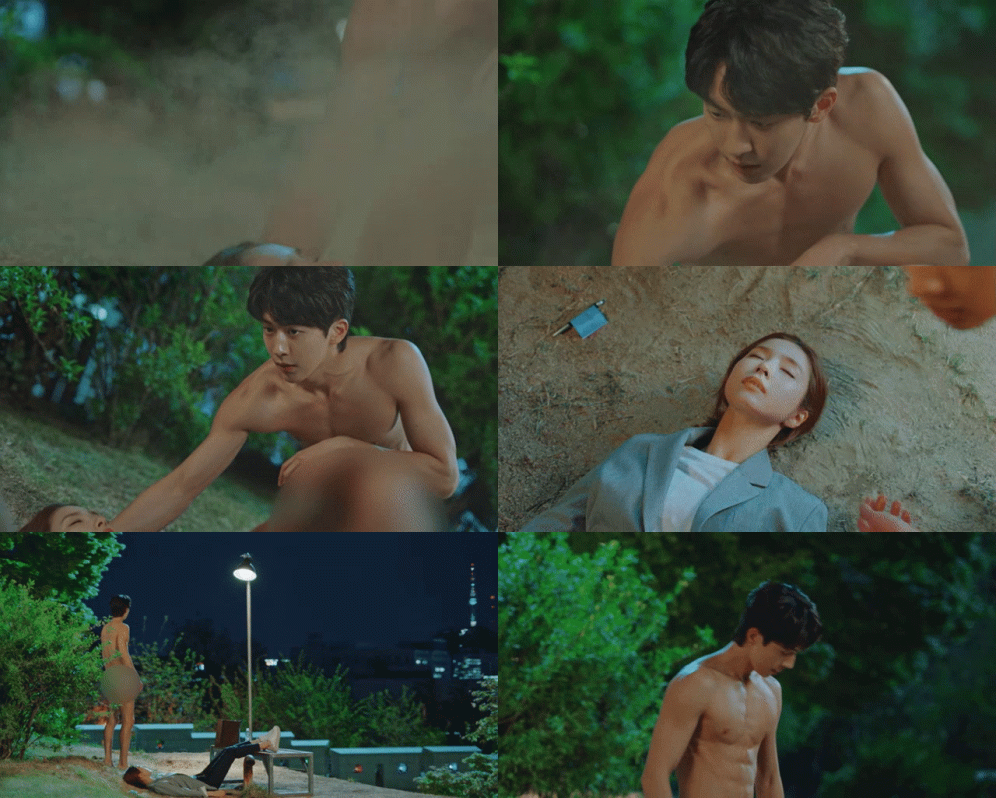
Reader, I’m here for it. Would I have preferred for The Bride of Habaek to have a coherent plot and good acting in addition to shots of Nam Joo-Hyuk’s bare torso? Yes. But it’s 2020. If there was ever a year to scale down expectations, it is this one.
Let me try to give you a sense of the plot.
According to The Bride of Habaek, there’s the world humans live in and on the other side is the world of the fail whale, I mean, gods.
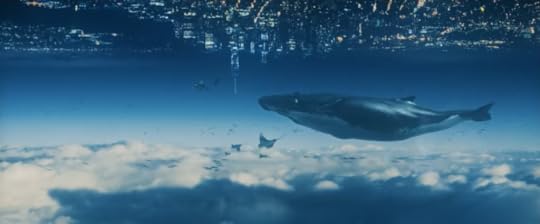 Inception is so passé
The divine realm is made up of the Earth Kingdom, Sky Kingdom and Water Kingdom. The lord of the Water Kingdom is the emperor of the divine world and the king of kings. A new king must ascend the throne when the red tide appears (pretty sure writer Joon Yoon Jung came up with this while PMS-ing or in her period) and wouldn’t you know it, a red tide comes rushing in minutes into the first episode of The Bride of Habaek. Which means it’s time for a new king, i.e. the ascension of Ha-Baek (Nam Joo-Hyuk in a two-toned wig, smoky-eye make-up and an outfit that would make Maganlal Dresswala feel emotional), who is killing time by sitting for a portrait. As one should when one is that pretty.
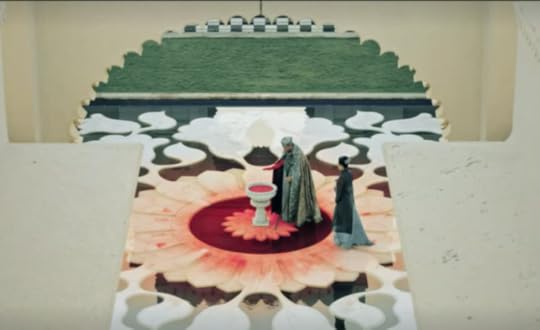 You see what I mean about the red tide and periods?
Much of The Bride of Habaek is pivoted upon the idea that there is only one purpose to Ha-Baek’s existence and that is to be the king. If he doesn’t fulfil this destiny, then not only would he not exist, but even the memory of him would disappear. And Ha-Baek knows this. Everything he does is informed by his awareness of being a superior being who is extraordinarily gifted because he’s the designated king.
However, before Ha-Baek can can sit pretty on his divine throne, he has a quest to fulfil. Ha-Baek must go down to the human realm and collect three special stones, which are helpfully scattered in Korea rather than across the world, thus saving the soon-to-be king of the gods the trials of air travel. To help him out, he can take one helper from the divine realm and on earth, he is entitled to assistance from one particular human who belongs to a family that is cursed to serve as “divine servants”.
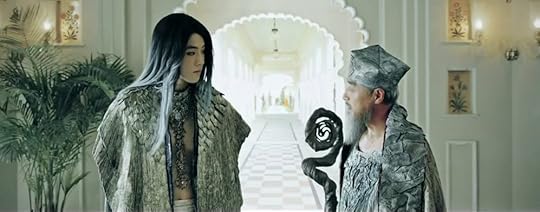 Apparently, the land of water is actually a five-star hotel in Rajasthan
Ha-Baek doesn’t just land on earth, but with impeccable aim, he lands slap bang into Yoon So-Ah (Shin Se-Kyung) and knocks her out. Because what is love if it doesn’t hit you (literally) like a bolt from the blue? Did I mention Ha-Baek has lost all his clothes in the process of travelling from the Water Kingdom to Earth? Well, he has (see the GIF above). That’s not all he’s lost. He’s lost his attendant Nam Soo-Ri (Park Kyu-Sun); the map that showed him where the three stones are; and all his powers. Fortunately, Nam Soo-Ri finds him and the duo set up camp in a bouncy castle in a public park in Seoul.
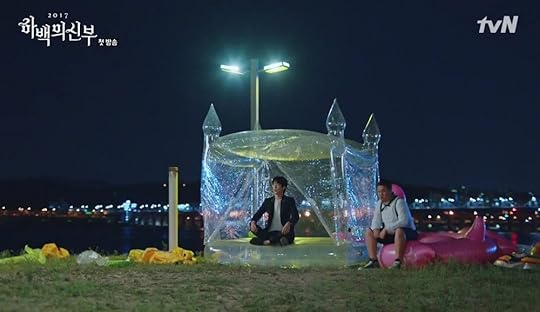
This, incidentally, is the part of the show that comes close to making sense and it’s genuinely amusing to see Ha-Baek strut his stuff in Seoul, thinking he’s being godly when all he is, in fact, is a homeless person with delusions of grandeur. What also makes sense is that So-Ah, who is the divine servant and a psychiatrist, is struggling to run her private practice since the first time we see her, she makes cock-a-doodle-doo noises while attempting to treat a patient. So-Ah’s ambition in life is to make enough money — AS A PSYCHIATRIST — to emigrate to Vanuatu of all places. This would sound insane except for the fact that she’s standing next to Ha-Baek, who (when he isn’t bathing on So-Ah’s terrace) is looking for three stones that are in the care of God of Winds Bir-Yeom, a river goddess named Moo-Ra and another dude (who we’ll later discover has been frenziedly gardening and weeding his way through Korea). Vanuatu sounds positively mundane in comparison. Also, So-Ah’s best friend is a shrink and yoga-loving occult enthusiast whose office looks like this:
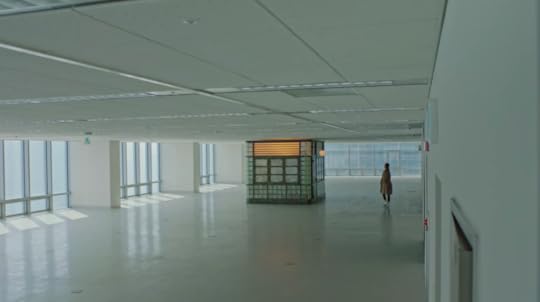 Maybe there’s a coded message about Seoul’s commercial real estate sector in here. Or maybe it’s just a container-sized office in the middle of an empty floor, in an empty building, where you can get either a session with a psychiatrist or a consultation with a fortune teller. Hashtag: Women who multi-task.
 In the middle of all this are the following:
a minor god who goes around sparking hunger (for food) in people by smooching them a crackling love story between Moo-Ra and Bir-Yeum, complete with an inflatable dollgodly politicking and bickering between Bir-Yeum and Ha-Baek, side effects of which include a gigantic hole in a bridgea sub-plot involving So-Ah’s father whom So-Ah resented because he opened their home to orphans and So-Ah felt neglectedanother sub-plot involving an attempted suicide by So-Ah, which she survived because someone dragged her out of the river into which she had jumpedyet another sub-plot involving a demi-god who escaped the divine realm where he was imprisoned and is living in disguise in the mortal realma fourth sub-plot involving the minor detail that the lord of the Earth Kingdom is lost.
The whole business of the stones is forgotten in no time, especially since we have more important things like two love stories and lots of random melodrama on which to focus. There’s a feeble attempt at setting up a love triangle between Ha-Baek, So-Ah and Hoo-Ye (Im Joo-Hwan). On paper, this is quite a twist since it pits Ha-Baek the homeless lunatic against Hoo-Ye the smooth, successful businessman. On screen, it’s a damp squib. Even though Nam Joo-Hyuk doesn’t exhibit much by way of acting chops as Ha-Baek and his on-screen chemistry with Shin Se-Kyung blinks on and off like Airtel’s network in Mumbai, there’s never any doubt that Hoo-Ye is a second lead and therefore doomed to singlehood (as is the fate of most second leads in K-dramas). Of course, there are second leads who steal the show — like Kim Seon-Ho in the wretched Start-Up — but before the audience can decide if it’s interested in Hoo-Ye, the show loses interest in him. One second it looks like Hoo-Ye might be Ha-Baek’s nemesis; next thing we know, he’s nowhere to be seen. This is a shame because Im Joo-Hwan is a cutie and Hoo-Ye, the bastard child of a god, is one of the most interesting characters in The Bride of Habaek. I particularly liked the detail that Hoo-Ye is — SPOILER — the god of fire, which places him in direct opposition to Ha-Baek. Also, Hoo-Ye’s pretty damn good at agriculture, which seems to be writer Jung Yoon Jung’s way of showing that he is able to channel his rage and trauma into something that’s literally productive.
I have only vague recollections of what actually happened in the middle episodes of The Bride of Habaek because I basically sped through most of it, but I recall there was a lot of weeping, some jumping into the Han river, a fair amount of gardening and some domestic scenes involving cooking and cleaning in which Ha-Baek turns out to be quite the house husband. Shin Se-Kyung was such a delight to watch in Rookie Historian Goo Hae-Ryung but as So-Ah, she’s completely forgettable. Part of the problem is that the script allows her exactly two expressions: she’s either wide-eyed or weeping. This is more than what Nam Joo-Hyuk manages — a pout for all seasons — but at least he makes the effort of flashing his torso and there’s a lot I’ll forgive him for the single-minded focus he displays during the staircase kiss. (At some point, I think I’m going to have to write an essay on the kiss in K-dramas, but I feel I need to do a little more research before attempting that one.)
There’s more crackle and and pop between Bir-Yeum (a delicious Gong Myung) and Moo-Ra (Krystal) than in So-Ah and Ha-Baek’s anodyne romance. Bir-Yeum has a boyish recklessness about him which contrasts with Moo-Ra’s mature composure (K-drama’s championing of romances between more mature women and younger men is another thing that I will, hopefully, eventually, write an ode to). But there are brief moments when Bir-Yeum’s breezy (see what I did there?) behaviour gives way to something darker, more desperate and grown-up as he reaches for Moo-Ra, who he knows is in love with Ha-Baek.
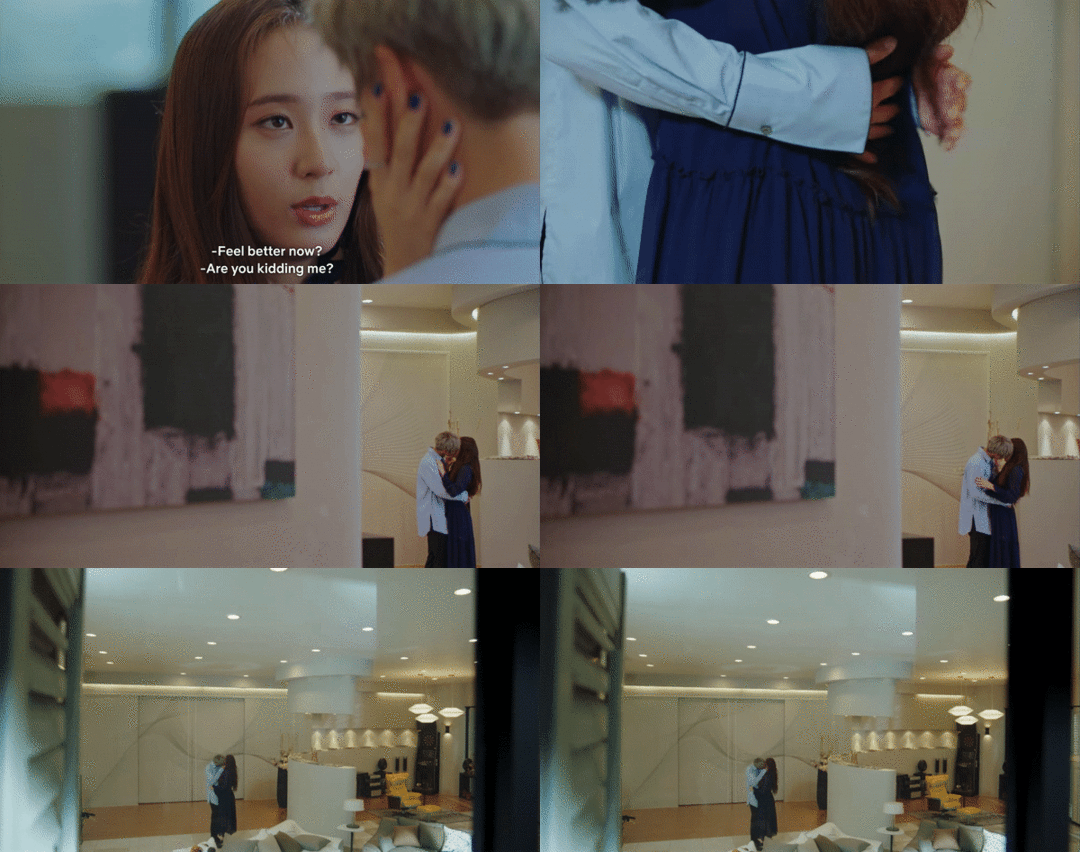 My female gaze is fixated on what Bir-Yeum and his hands.
So yes, this is a ridonkulous drama and its clumsy storytelling makes a mess of the few good ideas nestled in the plot. Had the script relied more on showing us what happened rather than lazily getting characters to recap past incidents as awkward and bland monologues, The Bride of Habaek would have been served better. Had the drama focused on its plot and sub-plots rather than Nam Joo-Hyuk and Gong Myung’s muscled torsos, we could have got interesting examinations of ideas like grace, father figures, vulnerability, failure and rebuilding oneself; the tangled relationship between societal expectations and personal goals. Instead, we have weeping women, abandoned sub-plots and hastily-tied loose ends.
Still, for all its awfulness, here’s something that struck me while watching the finale of The Bride of Habaek — for all the flexing that the male characters do over the drama’s 16 episodes, ultimately the priority for both the show and the men in it is the happiness of the women characters.
The last episode of The Bride of Habaek is particularly tiresome because of the copious weeping and the nonsense that parades as logic. In short: So-Ah’s father saved her life when she’d tried to kill herself, but he drowned in the process. Since he had a divine tablet in his possession, his body is perfectly preserved and unbudge-able at the bottom of Han river. So-Ah is determined to get her father out and give him a proper burial, so Ha-Baek gives her “his grace” (by kissing her when she doesn’t want to be kissed. Don’t ask). The graceless Ha-Baek now is doomed to live the mortal life because he no longer has the power to go back to the divine realm, which also means he won’t become king. The choice he has made when he smashed his face into So-Ah’s was that he would perish, but So-Ah would be able to live a full and happy life. Also, So-Ah now has magical lung power, so she dives into the Han’s depths and retrieves both her father and the tablet.
So far, so nonsensical.
It turns out that the divine tablet has the power to grant the divine servant their deepest wish. Everyone (including So-Ah) expects So-Ah to use the tablet’s powers to save Ha-Baek by wishing he becomes the king of the divine realm. Doing so would fit in with a traditional stereotype of the woman who sacrifices herself for her lover. Her decision prioritises what Ha-Baek needs as well as what is seen as the greater good. “I will put things back to normal,” So-Ah say. I’ve no idea if the original Korean word actually makes a reference to that which is the norm, but the English “normal” is perfect for what So-Ah is doing — restoring the order and hierarchy that gives a social group (in this case comprising gods and humans) their identity.
Just at the moment when So-Ah is about to make her wish, the high priest shows up and says Ha-Baek doesn’t need So-Ah’s sacrifice. Instead, So-Ah should use the wish she has for “something more valuable”. That “more valuable” thing is So-Ah’s happiness. Her final wish is that Ha-Baek set aside kingship and instead live with her for as long as she’s alive. “You can go back and be a good king after I die,” she says, effectively privileging the individual, and their ridiculous, transgressive romance over the expectations and demands of the collective. And of course Ha-Baek obeys this command.
Try to think of a legend or a fairy tale in which a king is a hero for giving up his kingship because the woman he loves demanded his companionship. Usually, such women are considered selfish villains because they hold their own happiness to be more important than the function the king or hero performs for society. Heroines are usually cautioned and expected to be the opposite of such women, but for all its standardised conventions and clichés, this is not true of K-drama. The privilege that So-Ah enjoys in The Bride of Habaek is normal for K-drama (based on what I’ve seen, obviously) and it’s easy to lose sight of how radical this is as an idea because the genre is also obsessed with upholding impossible conventions of beauty and body types (though arguably, these are as unrealistic for men as they are for women. Still, somehow the actresses often seem more…starved than the actors). Perhaps it’s because the writers of K-dramas are predominantly women or maybe there’s an alchemy in modern South Korean society that hasn’t happened elsewhere. Whatever the reason, in drama after drama, the priority is the woman and even as the heroes do their bit to be dashing and alpha, they ultimately step aside graciously and let women have the last word.
In The Bride of Habaek, it’s not just that Ha-Baek follows So-Ah’s lead and does what she wants (rather than what he thinks is good for her), but also that So-Ah is encouraged to articulate her desire (by the high priest, no less). What So-Ah wants is important; her desire is valuable, and she shouldn’t feel ashamed to speak up — that’s what the finale of this absurd and terrible drama is telling its audience.
Come to think of it, maybe it’s not such a bad thing that I watched this one till the not-so-bitter end.


Deepanjana Pal's Blog

- Deepanjana Pal's profile
- 34 followers

