M.L. Chesley's Blog, page 24
May 12, 2014
Fantasy Flash Fiction...
It's Monday! I know, nothing to be happy about, but here is something to help boost your creative minds for the week.
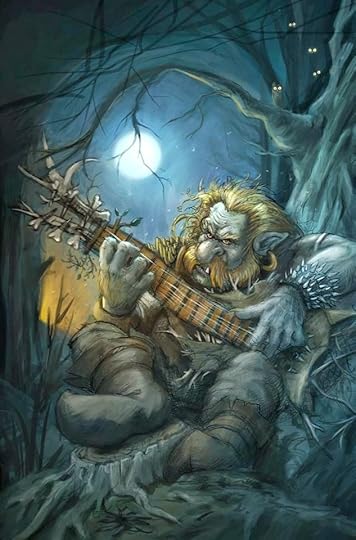 ~Artwork by Steve BolducThere wasn't much more Urnf could do these nights. Shunned from his brothers, chased out of human cities by torches and swords, he decided it was best to find some other hobby. Pickings had been slim for adventurers in need of something to slay, or even to hire him for muscle. Sighing heavily as he came to terms with getting older, Urnf plucked the catgut strings on his guitar. The music, such as it was, made even the bravest of nighttime creatures flee, seeking some other place in the forest for the night.
 ~Artwork by Steve BolducThere wasn't much more Urnf could do these nights. Shunned from his brothers, chased out of human cities by torches and swords, he decided it was best to find some other hobby. Pickings had been slim for adventurers in need of something to slay, or even to hire him for muscle. Sighing heavily as he came to terms with getting older, Urnf plucked the catgut strings on his guitar. The music, such as it was, made even the bravest of nighttime creatures flee, seeking some other place in the forest for the night.

May 5, 2014
Just A Little Something Extra...
Well, now that the April A-Z Blog Challenge is over, I can share some things with you. April tends to take up a lot of my creativity and time, so extra posts were just out of the question.
Over on Facebook, I was invited to be an Admin on "The Fantasy Tavern" page. One thing I have really enjoyed doing over there is adding fantasy artwork with a short 'caption'.
By caption, I mean flash fiction. Some of the artwork was pulled from wallpaper sites, I have yet to research the artist. But if the artist is known, I will list it.
So I thought I would share some of them with you now that the A-Z is over. Enjoy!
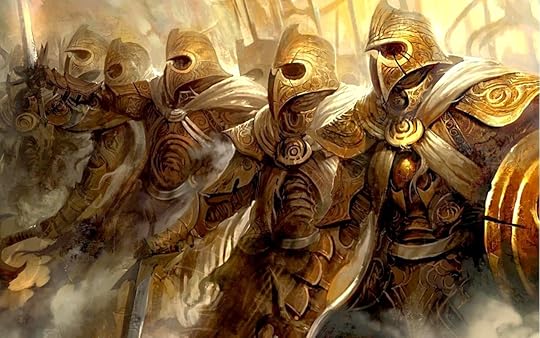
"They stood like stoic statues, forming the line, the barrier the enemy would have to break through. They were the King's Protectors. If they fell, so would the King, and none of them wanted that shame and disgrace tainting their families while they passed on into the Afterlife."
Over on Facebook, I was invited to be an Admin on "The Fantasy Tavern" page. One thing I have really enjoyed doing over there is adding fantasy artwork with a short 'caption'.
By caption, I mean flash fiction. Some of the artwork was pulled from wallpaper sites, I have yet to research the artist. But if the artist is known, I will list it.
So I thought I would share some of them with you now that the A-Z is over. Enjoy!

"They stood like stoic statues, forming the line, the barrier the enemy would have to break through. They were the King's Protectors. If they fell, so would the King, and none of them wanted that shame and disgrace tainting their families while they passed on into the Afterlife."
April 30, 2014
Z Is For Zweihander...
Well, it's the last day. I made it! Maybe not with enough armor components, but certainly with weapons. I'm fascinated by medieval history. I love writing fantasy, because I stick to that era and mix in my own imaginative details. I hope you've enjoyed my Medieval Weapons and Armor from A to Z posts!
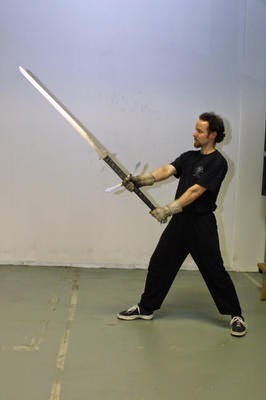 ZweihanderZweihander - (German for "two hander") is a two-handed sword primarily of the Renaissance. It is a true two-handed sword because wielding it requires two hands, unlike other large swords that also can be used with one.
The Zweihänder swords develop from the longsword of the Late Middle Ages and became a hallmark weapon of the German Landsknechte from the time of Maximilian I (d. 1519) and during the Italian Wars of 1494–1559. The Goliath Fechtbuch (1510) shows an intermediate form between longsword and Zweihänder.
These swords represent the final stage in the trend of increasing size that started in the 14th century. In its developed form, the Zweihänder has acquired the characteristics of a polearm rather than a sword. Consequently, it is not carried in a sheath but across the shoulder like a halberd. By the second half of the 16th century, these swords had largely ceased to have a practical application, but they continued to see ceremonial or representative use well into the 17th century. Some ceremonial zweihänder, called "bearing-swords" or "parade-swords" (Paratschwert) were much larger and weighed about 10 pounds.
If I saw someone coming at me with that sword, I don't know if I would turn tail and run due to the size and the strength needed to wield it, or stay and fight because they'd be slow! Hope you all ended the challenge on a high note. And congratulations to you for completing the month!
 ZweihanderZweihander - (German for "two hander") is a two-handed sword primarily of the Renaissance. It is a true two-handed sword because wielding it requires two hands, unlike other large swords that also can be used with one.
The Zweihänder swords develop from the longsword of the Late Middle Ages and became a hallmark weapon of the German Landsknechte from the time of Maximilian I (d. 1519) and during the Italian Wars of 1494–1559. The Goliath Fechtbuch (1510) shows an intermediate form between longsword and Zweihänder.
These swords represent the final stage in the trend of increasing size that started in the 14th century. In its developed form, the Zweihänder has acquired the characteristics of a polearm rather than a sword. Consequently, it is not carried in a sheath but across the shoulder like a halberd. By the second half of the 16th century, these swords had largely ceased to have a practical application, but they continued to see ceremonial or representative use well into the 17th century. Some ceremonial zweihänder, called "bearing-swords" or "parade-swords" (Paratschwert) were much larger and weighed about 10 pounds.
If I saw someone coming at me with that sword, I don't know if I would turn tail and run due to the size and the strength needed to wield it, or stay and fight because they'd be slow! Hope you all ended the challenge on a high note. And congratulations to you for completing the month!
April 29, 2014
Y Is For Yumi...
Well, here we are in the last two days. I have been unable to find armor components that begin with X, Y or Z, but I have found weapons to finish out the challenge. So here we go with Y!
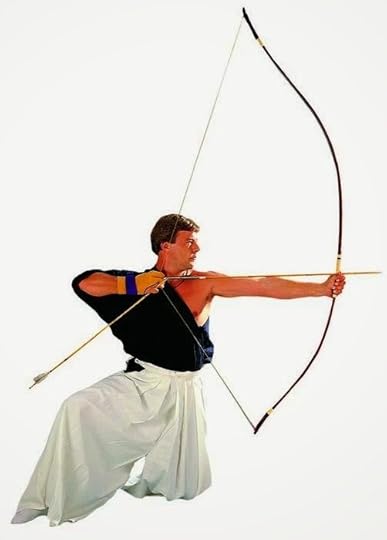 YumiYumi - is the term for Japanese bows, and includes the longer daikyū and the shorter hankyū used in the practice of kyūdō, or Japanese archery. The yumi was an important weapon of the samurai warrior during the feudal period of Japan.
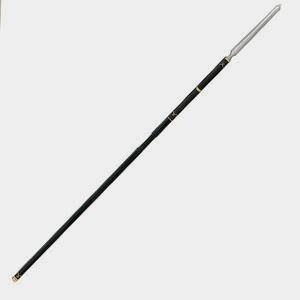 YariYari - is the term for one of the traditionally made Japanese blades in the form of a spear, or more specifically, the straight-headed spear.
All right! That's it for today. I will see you all tomorrow for the final post and letter of the challenge.
 YumiYumi - is the term for Japanese bows, and includes the longer daikyū and the shorter hankyū used in the practice of kyūdō, or Japanese archery. The yumi was an important weapon of the samurai warrior during the feudal period of Japan.
 YariYari - is the term for one of the traditionally made Japanese blades in the form of a spear, or more specifically, the straight-headed spear.
All right! That's it for today. I will see you all tomorrow for the final post and letter of the challenge.
April 28, 2014
X Is For Xiphos...
Well, I certainly did my best to find some sort of armor component to represent the letter 'X' for today. Don't think any such thing exists. At least not in my scope of research, but I do have a weapon for you! Happy blogging and see you all tomorrow!
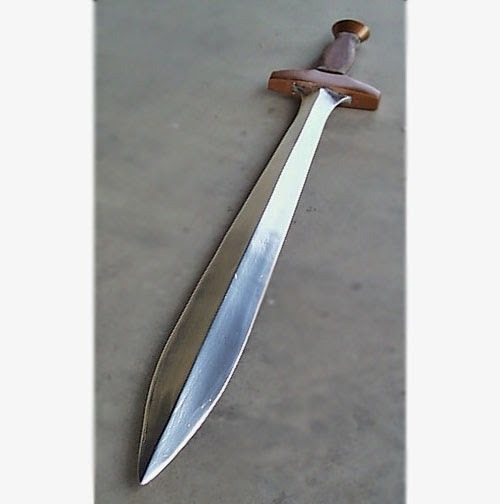 Xiphos
Xiphos - is a double-edged, single-hand sword used by the ancient Greeks. It was a secondary battlefield weapon for the Greek armies after the spear or javelin. The classic blade was generally about 50–60 cm long, although the Spartans supposedly started to use blades as short as 30 cm around the era of the Greco-Persian Wars. The xiphos sometimes has a midrib, or is diamond or lenticular in cross-section. It was generally hung from a baldric under the left arm. The xiphos was generally used only when the spear was discarded for close combat. Very few xiphoi seem to have survived.
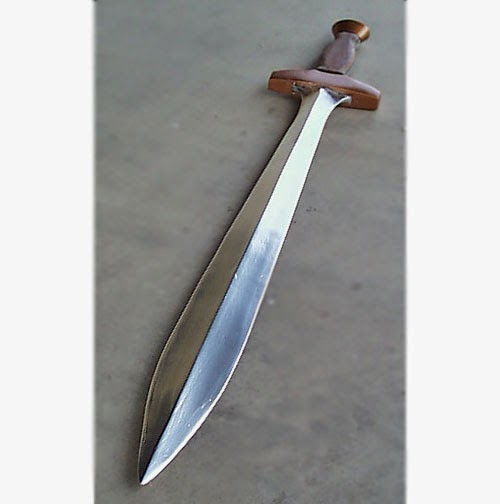 Xiphos
Xiphos - is a double-edged, single-hand sword used by the ancient Greeks. It was a secondary battlefield weapon for the Greek armies after the spear or javelin. The classic blade was generally about 50–60 cm long, although the Spartans supposedly started to use blades as short as 30 cm around the era of the Greco-Persian Wars. The xiphos sometimes has a midrib, or is diamond or lenticular in cross-section. It was generally hung from a baldric under the left arm. The xiphos was generally used only when the spear was discarded for close combat. Very few xiphoi seem to have survived.
April 26, 2014
W Is For White Armor...
Wow! W... already. This month seems to go by faster when I do the A to Z challenge. Very zippy. Okay, here we go!
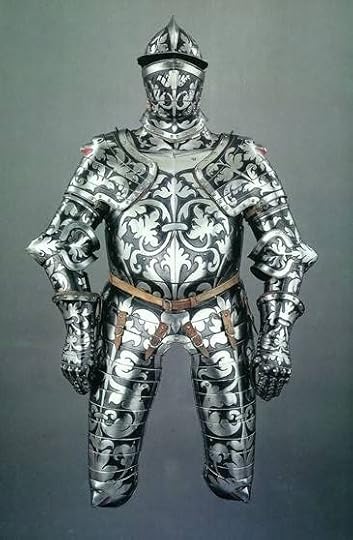 An example of Black and White armorWhite armour - or alwyte armour, was a form of plate armour worn in the Late Middle Ages characterized by full-body steel plate without a surcoat. Around 1420 the surcoat, or "coat of arms" as it was known in England, began to disappear, in favour of uncovered plate. Areas not covered by plate were protected by mail sewn to the gambeson underneath. Black and white armour is a different term, for late 16th and 17th century armour that uses a contrast between highly burnished "white" and unpolished "black" areas for decorative effect in large bold patterns over the armour.
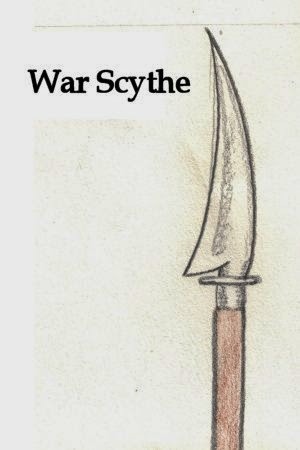 War ScytheWar Scythe - A war scythe is a kind of improvised pole weapon, similar to a fauchard, usually created from standard scythes.The blade of the scythe is transformed so as to extend upright from the pole, thus forming an infantry weapon practical both in offensive actions against infantry and as a defensive measure against enemy cavalry.
All right, that's it for today. I will see you all on Monday!
 An example of Black and White armorWhite armour - or alwyte armour, was a form of plate armour worn in the Late Middle Ages characterized by full-body steel plate without a surcoat. Around 1420 the surcoat, or "coat of arms" as it was known in England, began to disappear, in favour of uncovered plate. Areas not covered by plate were protected by mail sewn to the gambeson underneath. Black and white armour is a different term, for late 16th and 17th century armour that uses a contrast between highly burnished "white" and unpolished "black" areas for decorative effect in large bold patterns over the armour.
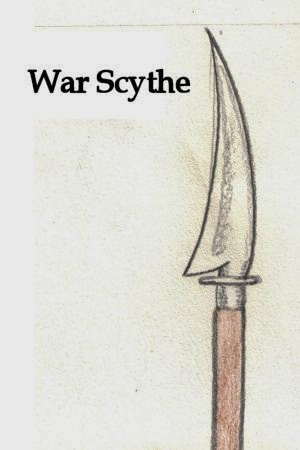 War ScytheWar Scythe - A war scythe is a kind of improvised pole weapon, similar to a fauchard, usually created from standard scythes.The blade of the scythe is transformed so as to extend upright from the pole, thus forming an infantry weapon practical both in offensive actions against infantry and as a defensive measure against enemy cavalry.
All right, that's it for today. I will see you all on Monday!
April 25, 2014
V Is For Vambrace...
Today's corresponding letter is 'V'! For Vendetta... no, just kidding. It's for Vambrace, today.
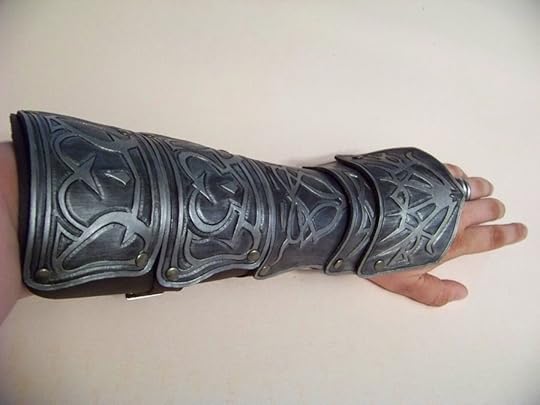 VambraceVambrace - Forearm guard. May be solid metal or splints of metal attached to a leather backing. Developed in antiquity but named in the 14th century. Vambrace may also sometimes refer to parts of armour that together cover the lower and upper arms.
Voulge - A
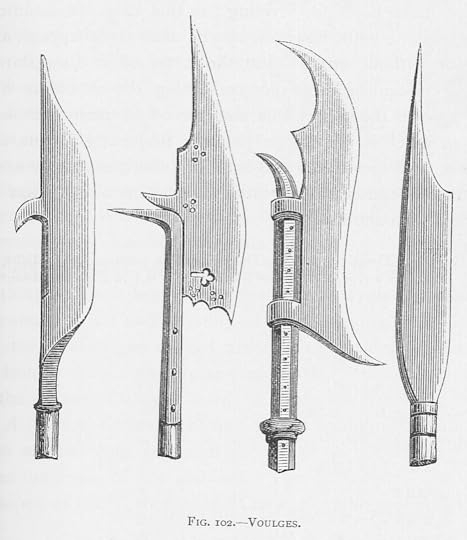 Voulgevoulge (occasionally called a pole cleaver) is a type of polearm that existed alongside the similar glaive in medieval Europe. Superficially, a voulge might strongly resemble a glaive, but there are some notable differences in construction. First, the attachment of the voulge blade to the shaft was usually done by binding the lower two thirds of the blade to the side of the pole; the glaive would often have a socket built into the blade itself and was mounted on top of the pole. In addition, while both had curved blades, that of the voulge was broad and meant for hacking, while that of the glaive was narrow and meant more for cutting. A voulge thus looks something like a squashed bardiche, or just a meat cleaver attached to a long pole.
That's it! We're getting down to the wire (and difficult letters) now! Happy blogging and see you tomorrow!
 VambraceVambrace - Forearm guard. May be solid metal or splints of metal attached to a leather backing. Developed in antiquity but named in the 14th century. Vambrace may also sometimes refer to parts of armour that together cover the lower and upper arms.
Voulge - A
 Voulgevoulge (occasionally called a pole cleaver) is a type of polearm that existed alongside the similar glaive in medieval Europe. Superficially, a voulge might strongly resemble a glaive, but there are some notable differences in construction. First, the attachment of the voulge blade to the shaft was usually done by binding the lower two thirds of the blade to the side of the pole; the glaive would often have a socket built into the blade itself and was mounted on top of the pole. In addition, while both had curved blades, that of the voulge was broad and meant for hacking, while that of the glaive was narrow and meant more for cutting. A voulge thus looks something like a squashed bardiche, or just a meat cleaver attached to a long pole.
That's it! We're getting down to the wire (and difficult letters) now! Happy blogging and see you tomorrow!
April 24, 2014
U Is For Umbo...
Well. Today's corresponding letter is a bit tough, I'll say that much. But I do have something for you!
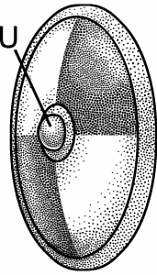 UmboUmbo - Shield boss that covers the hand as it holds the grip.
Unfortunately, that's about it, but it does cover both the armor and weapon aspects I have been aiming for. Shields protected the fighters, and if you lost your sword, you certainly had a nice rounded piece of metal with which to bash your opponent.
Happy blogging, all! I'll see you tomorrow.
 UmboUmbo - Shield boss that covers the hand as it holds the grip.
Unfortunately, that's about it, but it does cover both the armor and weapon aspects I have been aiming for. Shields protected the fighters, and if you lost your sword, you certainly had a nice rounded piece of metal with which to bash your opponent.
Happy blogging, all! I'll see you tomorrow.
April 23, 2014
T Is For Tassets...
Well, we're getting down to the wire here, folks. I'm so glad you've all enjoyed my A to Z posts so far. Sadly, you don't get a lot of my wit and snark because I'm getting my info off of Wikipedia... I'll have to make up for it all at a later date. Lucky you!
So today we have T's! Here we go!
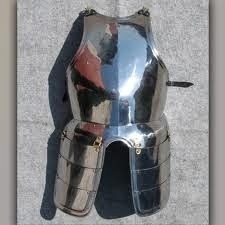 TassetsTassets - Tassets are a piece of plate armour designed to protect the upper legs. They take the form of separate plates hanging from the breastplate or faulds. They may be made from a single piece or segmented. The segmented style of tassets connected by sliding rivets produced during the 16th century is also known as almain rivets.
There isn't much else in the way of armor and weapons that start with a 'T', but this is my favorite weapon:
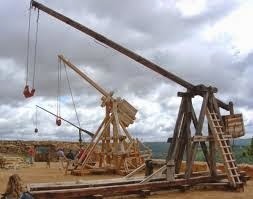 TrebuchetTrebuchet - A type of catapult that was used as a siege engine in the Middle Ages. It is sometimes called a counterweight trebuchet or counterpoise trebuchet, to distinguish it from an earlier weapon called the traction trebuchet, which employed pulling men working the mechanism.
The counterweight trebuchet appeared in both Christian and Muslim lands around the Mediterranean in the 12th century. It could fling projectiles weighing up to 350 pounds (160 kg) at or into enemy fortifications. Its use continued into the 15th century, well after the introduction of gunpowder.
I think of siege weapons and I get all kinds of warm fuzzies inside. I think I was born in the wrong time period. I would have been a terror! All right, see you all tomorrow!
So today we have T's! Here we go!
 TassetsTassets - Tassets are a piece of plate armour designed to protect the upper legs. They take the form of separate plates hanging from the breastplate or faulds. They may be made from a single piece or segmented. The segmented style of tassets connected by sliding rivets produced during the 16th century is also known as almain rivets.
There isn't much else in the way of armor and weapons that start with a 'T', but this is my favorite weapon:
 TrebuchetTrebuchet - A type of catapult that was used as a siege engine in the Middle Ages. It is sometimes called a counterweight trebuchet or counterpoise trebuchet, to distinguish it from an earlier weapon called the traction trebuchet, which employed pulling men working the mechanism.
 The counterweight trebuchet appeared in both Christian and Muslim lands around the Mediterranean in the 12th century. It could fling projectiles weighing up to 350 pounds (160 kg) at or into enemy fortifications. Its use continued into the 15th century, well after the introduction of gunpowder.
I think of siege weapons and I get all kinds of warm fuzzies inside. I think I was born in the wrong time period. I would have been a terror! All right, see you all tomorrow!
April 22, 2014
S Is For Sabaton...
All right! S it is! And I'm trying to find other armor parts that have yet to be covered. There are only so many helms I can post about and trust me, there are a lot of variations of helms!
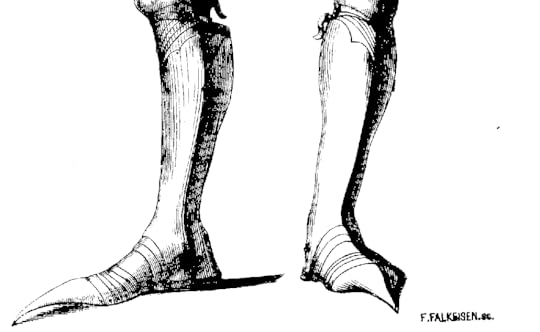 SabatonSabaton - Covers the foot, often mail or plate. Fourteenth and fifteenth century sabatons typically end in a tapered point well past the actual toes of the wearer's foot, following fashionable shoe shapes of the fourteenth century. Sabatons of the first half of sixteenth century end at the tip of the toe and may be wider than the actual foot.
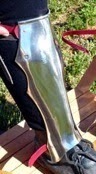 SchynbaldsSchynbalds - These were an early experiment in plate armour for the lower leg. Schynbalds were metal plates strapped over chausses. Each schynbald was a single piece of steel that covered the front and outside of the shin. Schynbalds did not enclose the lower leg: hence, they were not true greaves. Schynbalds first appeared during the late thirteenth century and remained in use during the fourteenth and fifteenth centuries.
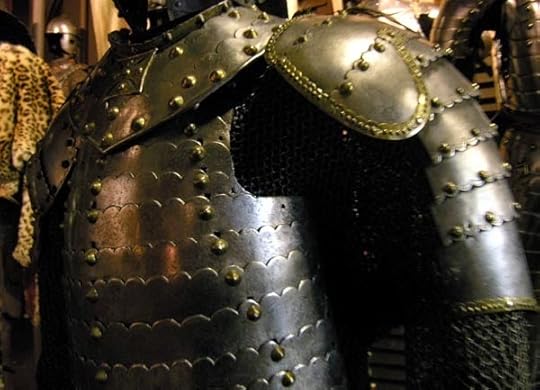
Spaulders - Are pieces of armour in a harness of plate armour. Typically, they are a single plate of steel or iron covering the shoulder with bands (lames) joined by straps of leather or rivets.
 Spaulders
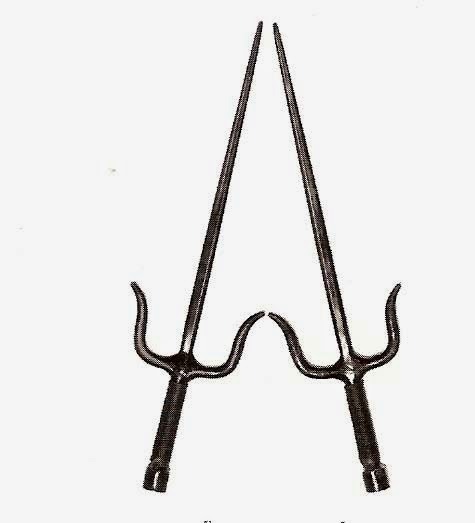
Sai - Is a traditional weapon used in the Okinawan martial arts. The basic form of the weapon is that of a pointed, prong shaped metal baton, with two curved prongs called yoku projecting from the handle. Sai are generally used in pairs.
 Sai
Sai
Shuriken - is a traditional Japanese concealed weapon that was generally used for throwing, and sometimes stabbing or slashing. Shuriken is the name given to any small-bladed object, while shaken is traditionally used to indicate the well-known "throwing star".
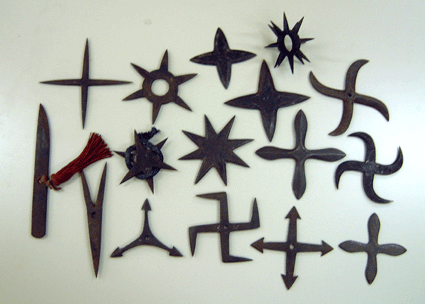 ShurikenThey are sharpened hand-held blades made from a variety of everyday items, such as needles, nails, and knives, as well as coins, washers, and other flat plates of metal.
And that's it for today! See you tomorrow!
 SabatonSabaton - Covers the foot, often mail or plate. Fourteenth and fifteenth century sabatons typically end in a tapered point well past the actual toes of the wearer's foot, following fashionable shoe shapes of the fourteenth century. Sabatons of the first half of sixteenth century end at the tip of the toe and may be wider than the actual foot.
 SchynbaldsSchynbalds - These were an early experiment in plate armour for the lower leg. Schynbalds were metal plates strapped over chausses. Each schynbald was a single piece of steel that covered the front and outside of the shin. Schynbalds did not enclose the lower leg: hence, they were not true greaves. Schynbalds first appeared during the late thirteenth century and remained in use during the fourteenth and fifteenth centuries.
Spaulders - Are pieces of armour in a harness of plate armour. Typically, they are a single plate of steel or iron covering the shoulder with bands (lames) joined by straps of leather or rivets.
 Spaulders
Sai - Is a traditional weapon used in the Okinawan martial arts. The basic form of the weapon is that of a pointed, prong shaped metal baton, with two curved prongs called yoku projecting from the handle. Sai are generally used in pairs.
 Sai
SaiShuriken - is a traditional Japanese concealed weapon that was generally used for throwing, and sometimes stabbing or slashing. Shuriken is the name given to any small-bladed object, while shaken is traditionally used to indicate the well-known "throwing star".
 ShurikenThey are sharpened hand-held blades made from a variety of everyday items, such as needles, nails, and knives, as well as coins, washers, and other flat plates of metal.
And that's it for today! See you tomorrow!