M.L. Chesley's Blog, page 25
April 21, 2014
Why I've Been Distracto Girl...
Yes, I've been seriously distracted these past few weeks. I am trying to make sure I get my daily posts out, so in truth, this has really been a challenge for me!
But I do want to share with you what has been keeping me from remembering posts, as well as working on revisions. Hubby got laid off from work again, and I'm trying to help bring in some supplemental income, so I am doing jewelry again. Now that my hands allow it, I'm finding it very therapeutic.
So here are some of the things I've been working on:
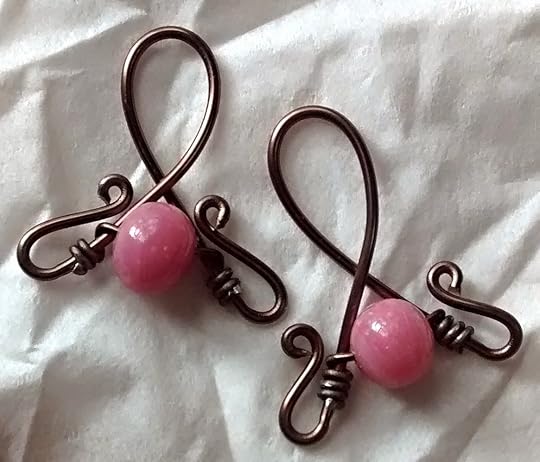 EarringsI have wire wrapped earrings. Lots of different colors in this style. Some are dark brown wire, others are silver.
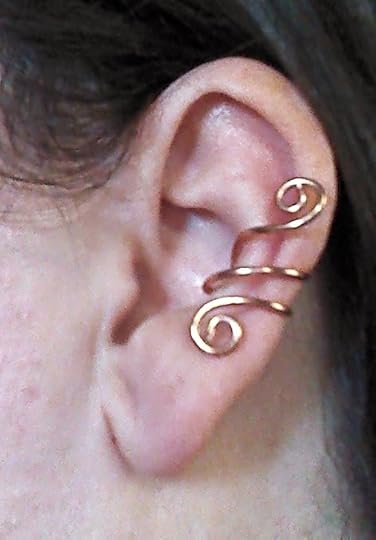 Ear CuffsI've also been working on ear cuffs. These are pretty simple, done in copper. But I do have some I'm working on that will have dangly bits. (Ha!) I also have some plans to make earrings attached to the cuffs.
I've made a lot of pendants. Lots of wire wrapped ones, chain mail ones.
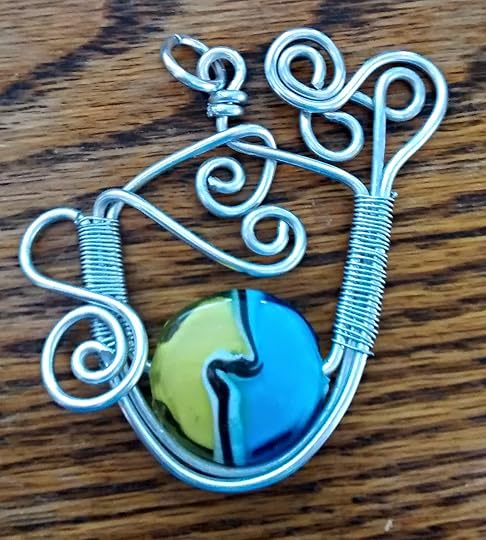 PendantsSome are pretty extravagant, some are simple. I've even put dice in spiral cages for necklaces and keychains. I spoke to a guy here, locally, that owns a game shop and he's willing to sell stuff on consignment. I can't wait to bring in some of my inventory!
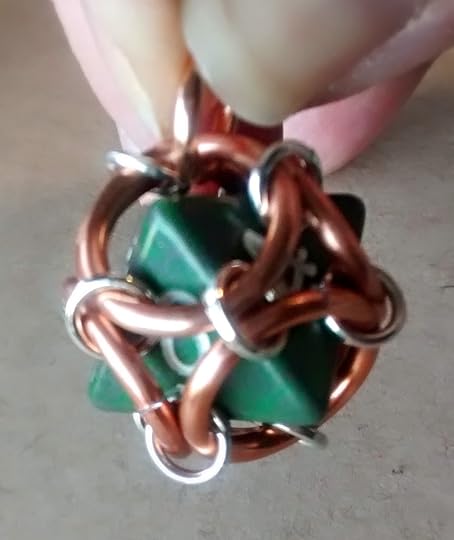 Chain mail dice pendants/keychainsI've made rings, bracelets. I have my Fairy Potion bottles and my mana and health potion earrings and necklaces. So yeah, I've been a busy girl. If you want to drop by my Facebook page, you can see everything there. I'm working on opening an Etsy store soon. Wish me luck!
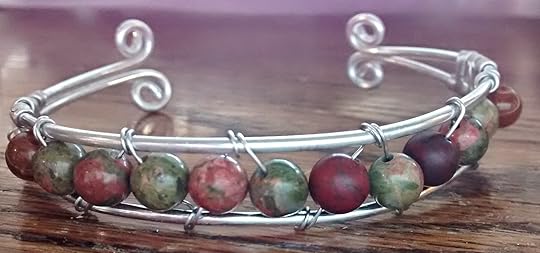 Bracelets
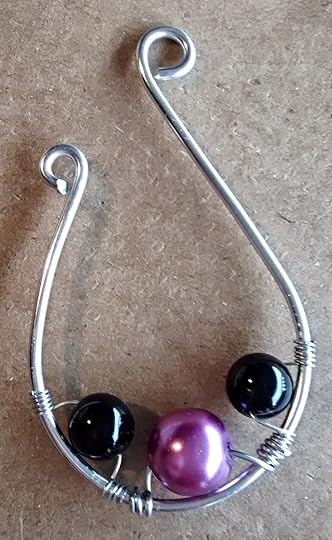 More pendants
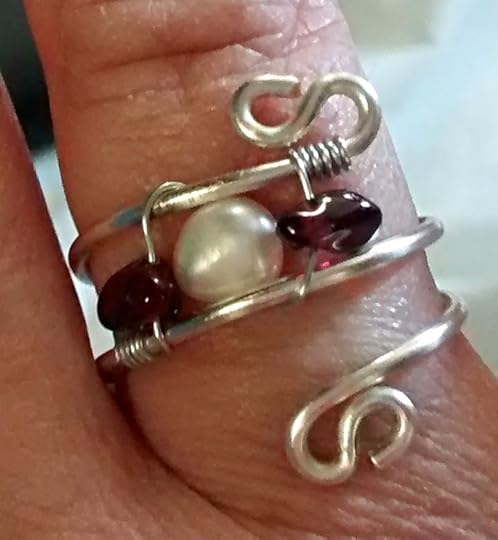 Rings
Rings
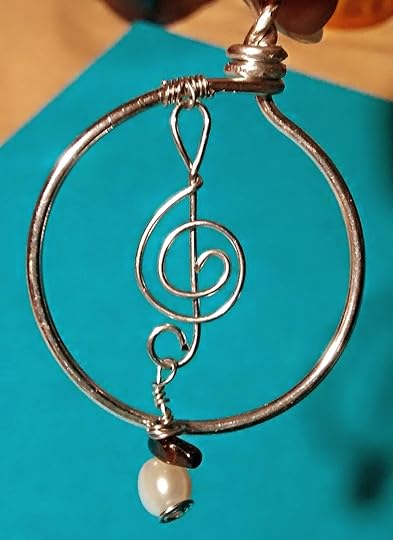 Even more pendants
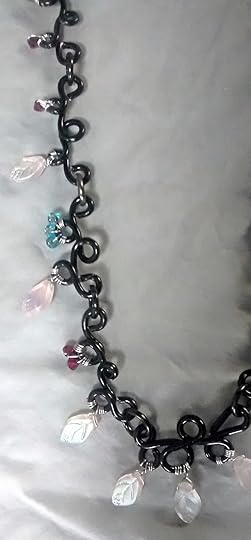 Wire wrapped necklaces
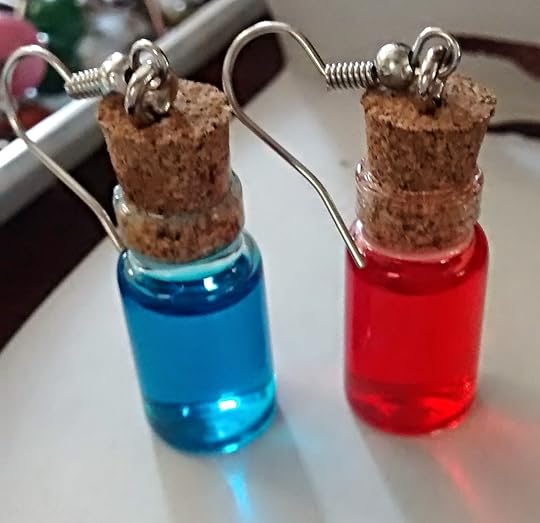 Mana and health potion earrings/necklaces
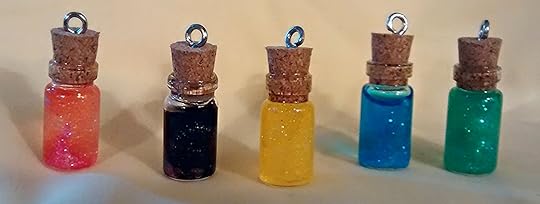 Fairy potion bottles
But I do want to share with you what has been keeping me from remembering posts, as well as working on revisions. Hubby got laid off from work again, and I'm trying to help bring in some supplemental income, so I am doing jewelry again. Now that my hands allow it, I'm finding it very therapeutic.
So here are some of the things I've been working on:
 EarringsI have wire wrapped earrings. Lots of different colors in this style. Some are dark brown wire, others are silver.
 Ear CuffsI've also been working on ear cuffs. These are pretty simple, done in copper. But I do have some I'm working on that will have dangly bits. (Ha!) I also have some plans to make earrings attached to the cuffs.
 I've made a lot of pendants. Lots of wire wrapped ones, chain mail ones.
 PendantsSome are pretty extravagant, some are simple. I've even put dice in spiral cages for necklaces and keychains. I spoke to a guy here, locally, that owns a game shop and he's willing to sell stuff on consignment. I can't wait to bring in some of my inventory!
 Chain mail dice pendants/keychainsI've made rings, bracelets. I have my Fairy Potion bottles and my mana and health potion earrings and necklaces. So yeah, I've been a busy girl. If you want to drop by my Facebook page, you can see everything there. I'm working on opening an Etsy store soon. Wish me luck!
 Bracelets
 More pendants
 Rings
Rings Even more pendants
 Wire wrapped necklaces
 Mana and health potion earrings/necklaces
 Fairy potion bottles

R Is For Rondel...
Oh my gosh... I've been so caught up in my jewelry making these past few weeks, I'm spacing everything else! Sorry for the tardiness of some of my posts.
At any rate, let's get on with the A to Z!
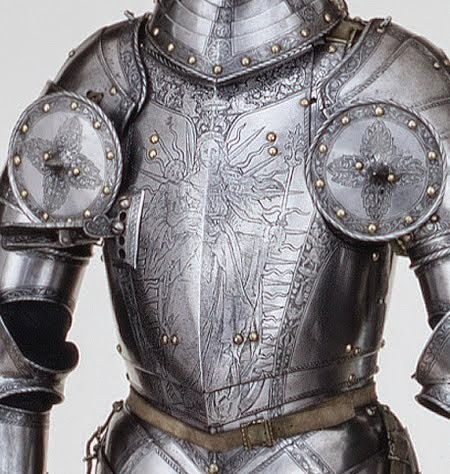 Rondel
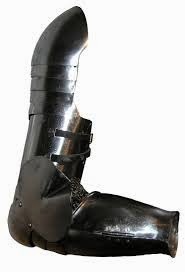 RerebraceRondel - Any circular plate. Rondels protecting various areas may have particular names, such as a besagew protecting the shoulder joint. I'm sure you've read about some of these in fantasy. More often than not, Rondels will have a house sigil and they'll be attached to the shoulder, holding up a cloak.
Rerebrace - Plate that covers the section of upper arm from elbow to area covered by shoulder armour.
Rondel Dagger - Then we have the rondel dagger or roundel dagger was a type of stiff-bladed dagger in Europe in the late Middle Ages (from the 14th century onwards), used by a variety of people from merchants to knights. It was worn at the waist and might be used as a utility tool, or worn into battle or a jousting tournament as a side-arm. Rondel daggers were ideal in battle for puncturing chain mail, and although they would not have been able to punch through plate armour, they could be forced between the joints in a suit of armour and helmets. This was often the only way in which a heavily armoured knight could be killed.
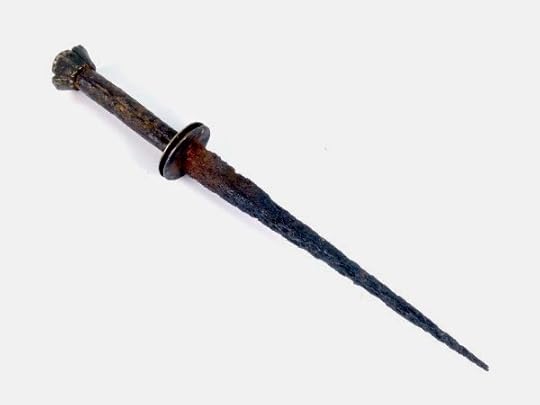 Rondel Dagger
Happy blogging to you all! I'll see you tomorrow.
At any rate, let's get on with the A to Z!
 Rondel
 RerebraceRondel - Any circular plate. Rondels protecting various areas may have particular names, such as a besagew protecting the shoulder joint. I'm sure you've read about some of these in fantasy. More often than not, Rondels will have a house sigil and they'll be attached to the shoulder, holding up a cloak.
Rerebrace - Plate that covers the section of upper arm from elbow to area covered by shoulder armour.
Rondel Dagger - Then we have the rondel dagger or roundel dagger was a type of stiff-bladed dagger in Europe in the late Middle Ages (from the 14th century onwards), used by a variety of people from merchants to knights. It was worn at the waist and might be used as a utility tool, or worn into battle or a jousting tournament as a side-arm. Rondel daggers were ideal in battle for puncturing chain mail, and although they would not have been able to punch through plate armour, they could be forced between the joints in a suit of armour and helmets. This was often the only way in which a heavily armoured knight could be killed.
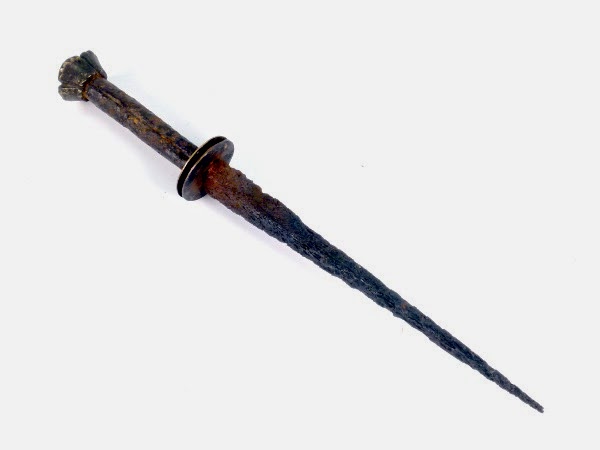 Rondel Dagger
Happy blogging to you all! I'll see you tomorrow.
April 19, 2014
Q Is For Quarrel...
Quarrel, no, not the fight. But it is used in fighting.
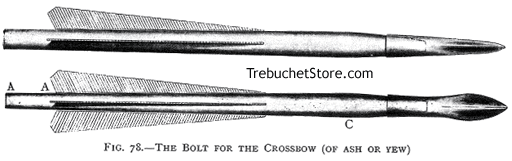 QuarrelQuarrel ~ short square headed bolt or arrow used in a crossbow.
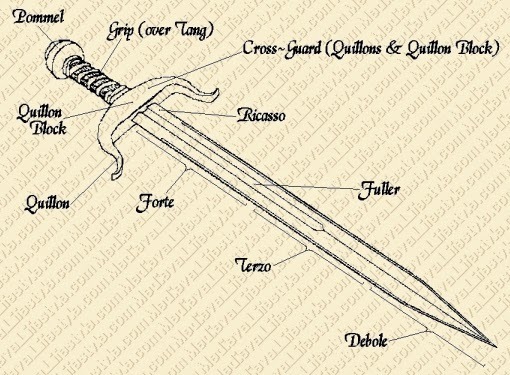 QuillonQuillon ~ cross guard on a sword. This term was not used until the sixteenth century so is inappropriate when describing swords prior to around 1530. The original cross guard, or simply cross, is usually used prior to that date.
 Quintain
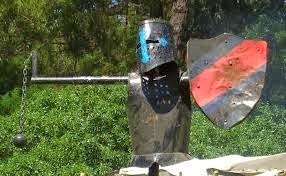
 QuarterstaffQuintain ~ dummy with a shield mounted on a post. Used in combat training.
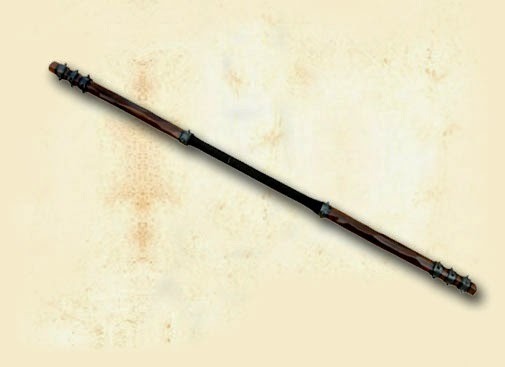
Quarterstaff ~ A quarterstaff (plural quarterstaves), also short staff or simply staff is a traditional European pole weapon and a technique of stick fighting, especially as in use in England during the Early Modern period. The term is generally accepted to refer to a shaft of hardwood from 6 to 9 feet (1.8 to 2.7 m) long, sometimes with a metal tip, ferrule, or spike at one or both ends. The term "short staff" compares this to the "long staff" based on the pike with a length in excess of 11 to 12 feet (3.4 to 3.7 m).
Wow, I'm amazed at what I came up with for Q, how about you?
 QuarrelQuarrel ~ short square headed bolt or arrow used in a crossbow.
 QuillonQuillon ~ cross guard on a sword. This term was not used until the sixteenth century so is inappropriate when describing swords prior to around 1530. The original cross guard, or simply cross, is usually used prior to that date.
 Quintain
 QuarterstaffQuintain ~ dummy with a shield mounted on a post. Used in combat training.
Quarterstaff ~ A quarterstaff (plural quarterstaves), also short staff or simply staff is a traditional European pole weapon and a technique of stick fighting, especially as in use in England during the Early Modern period. The term is generally accepted to refer to a shaft of hardwood from 6 to 9 feet (1.8 to 2.7 m) long, sometimes with a metal tip, ferrule, or spike at one or both ends. The term "short staff" compares this to the "long staff" based on the pike with a length in excess of 11 to 12 feet (3.4 to 3.7 m).
Wow, I'm amazed at what I came up with for Q, how about you?
April 18, 2014
P Is For Pixane...
 PixanePixane ~ A mail collar. In common with a gorget, it is not like a modern shirt collar. Rather, it is a circle with a hole for the neck to fit through. It covers the shoulders, breast and upper back, perhaps like an extremely small poncho.
 Plackart
Plackart ~ Extra layer of armour to cover the belly.
Pauldron ~ Cover the shoulder (with a dome shaped piece called a shoulder cop), armpit and sometimes the back and chest.
 PauldronPoleyn ~ Plate that covers the knee, appeared early in the transition from mail to plate, later articulated to connect with the cuisses and schynbald or greave. Often with fins or rondel to cover gaps.
 PoleynPoniard ~ Poignard, or poniard, (Fr.), refers to a long, lightweight thrusting knife with a continuously tapering, acutely pointed blade and crossguard, historically worn by the upper class, noblemen, or the knighthood. Similar in design to a parrying dagger, the poignard emerged during the Middle Ages and was used during the Renaissance in Western Europe, particularly in France, Switzerland, and Italy.
 Poniard
Pernach ~
 PernachA pernach (Russian: перна́ч, Ukrainian: пірна́ч, Polish: piernacz) is a type of flanged mace originating in the 12th century in the region of Kievan Rus' and later widely used throughout Europe. The name comes from the Slavic word перо (pero) meaning feather, referring to a type of pernach resembling an arrow with feathering. Among a variety of similar weapons developed in 12th-century Persian- and Turkic-dominated areas, the pernach became pre-eminent, being capable of penetrating plate armour and plate mail.
All right, that's it for today, see you tomorrow!
April 17, 2014
O Is For Onager...
Well, I've searched high and low for armor components beginning with the letter 'O' and have come up with zero.
There is a medieval weapon, however, and that is the onager.
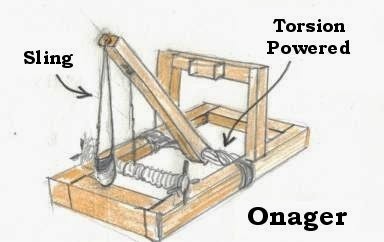 OnagerThe onager was a Roman siege engine that is a type of ballista that uses a torsional force, generally from twisted rope, to store energy for the shot. The onager consisted of a large frame placed on the ground to whose front end a vertical frame of solid timber was rigidly fixed. A vertical spoke that passed through a rope bundle fastened to the frame had a sling attached which contained a projectile.
To fire it, the spoke or arm was forced down, against the tension of twisted ropes or other springs, by a windlass, and then suddenly released. As the sling swung outwards, one end would release, as with a staff-sling, and the projectile would be hurled forward. The arm would then be caught by a padded beam or bed, when it could be winched back again.
That will have to do for this letter. See you all tomorrow!
There is a medieval weapon, however, and that is the onager.
 OnagerThe onager was a Roman siege engine that is a type of ballista that uses a torsional force, generally from twisted rope, to store energy for the shot. The onager consisted of a large frame placed on the ground to whose front end a vertical frame of solid timber was rigidly fixed. A vertical spoke that passed through a rope bundle fastened to the frame had a sling attached which contained a projectile.
To fire it, the spoke or arm was forced down, against the tension of twisted ropes or other springs, by a windlass, and then suddenly released. As the sling swung outwards, one end would release, as with a staff-sling, and the projectile would be hurled forward. The arm would then be caught by a padded beam or bed, when it could be winched back again.
That will have to do for this letter. See you all tomorrow!
N Is For Nasal Helmet...
Sorry for my absence yesterday. Had a couple things come up. So today, you get two posts! Yesterday's and today's. So here we go!
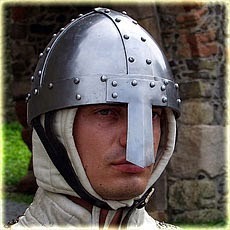 Nasal HelmThe nasal helmet was a type of combat helmet characterised by the possession of a projecting bar covering the nose and thus protecting the centre of the face; it was of Western European origins and was used from the Early Middle Ages until the High Middle Ages.
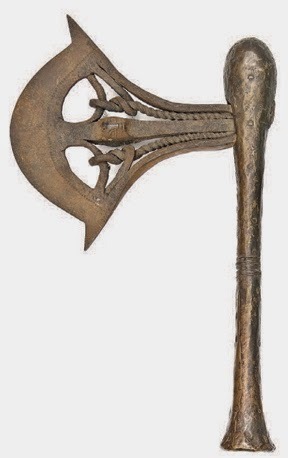 Nzappa zapThe Nzappa zap (also referred to as zappozap, kasuyu) is a traditional weapon from the Democratic Republic of the Congo similar to an axe or hatchet. It has an ornate wrought-iron blade connected to a club-like wooden handle, often clad in copper, bronze or brass. In practice, it is used much like the American tomahawk, both thrown for short distances and as a melee weapon in hand-to-hand combat. It differs from the usual axe style, in that the blade mounts to looping prongs that affix to the shaft.
Happy blogging and see you tomorrow!
 Nasal HelmThe nasal helmet was a type of combat helmet characterised by the possession of a projecting bar covering the nose and thus protecting the centre of the face; it was of Western European origins and was used from the Early Middle Ages until the High Middle Ages.
 Nzappa zapThe Nzappa zap (also referred to as zappozap, kasuyu) is a traditional weapon from the Democratic Republic of the Congo similar to an axe or hatchet. It has an ornate wrought-iron blade connected to a club-like wooden handle, often clad in copper, bronze or brass. In practice, it is used much like the American tomahawk, both thrown for short distances and as a melee weapon in hand-to-hand combat. It differs from the usual axe style, in that the blade mounts to looping prongs that affix to the shaft.
Happy blogging and see you tomorrow!
April 15, 2014
M Is For Morion...
 MorionMorion ~ A morion is a type of open helmet used from the middle 16th and early 17th centuries, usually having a flat brim and a crest from front to back. It was introduced in the middle of the 16th century, contemporaneous with the exploration of north, central, and southern America. Explorers like Hernando de Soto and Coronado may have used them for their foot soldiers in the 1540s.
 MantlesMantle ~ short lengths of cloth, usually in the livery colours, hung from the torse on the helmet as an aid to identification. This is usually shown as torn and ripped in battle when displayed in heraldry.
 Mercygiver Misericorde ~ Mercygiver: A misericorde was a long, narrow knife, used in medieval times to deliver the death stroke (the mercy stroke, hence the name of the blade, derived from the Latin misericordia, "act of mercy") to a seriously wounded knight. The blade was thin enough so that it could strike through the gaps between armour plates. This weapon was used to dispatch knights who had received mortal wounds, which were not always quickly fatal in the age of bladed combat; it could also be used as a means of killing an active adversary, as during a grappling struggle. The blade could be pushed through the visor or eye holes in the helm with the aim of piercing the brain, or thrust through holes or weak points in plate armor, such as under the arm, with the aim of piercing the heart. The weapon was known from the 12th century and has appeared in the armaments of Germany, Persia, and England.
 MangonelMangonel ~ a type of catapult or siege engine used in the medieval period to throw projectiles at a castle's walls. The exact meaning of the term is debatable, and several possibilities have been suggested. Mangonel may also be indirectly referring to the mangon, a French hard stone found in the south of France. It may have been a name for counterweight artillery (trebuchets), possibly either a men-assisted fixed-counterweight type, or one with a particular type of frame.
Happy blogging! See you tomorrow.
April 14, 2014
L Is For Lame...
I do not think it is pronounced lame, as in a horse with a hurt leg. But we can figure that out later!
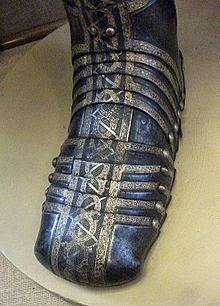 Sample of LameLame ~ Band of steel plate, put together so that several bands can articulate on various areas like around the thighs, shoulders or waist. Such pieces are named for the number of bands, for instance, a fauld of four lame.
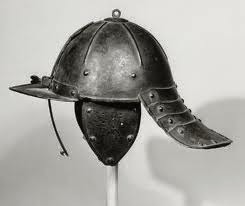 Lobster tail PotLobster-tail pot ~ This is a type of post-Renaissance helm popular in Europe, especially for cavalry and officers, from c. 1600; it was derived from an Ottoman Turkish helmet type. The helmet gradually fell out of use in most of Europe in the late 17th century; however, the Austrian heavy cavalry retained it for some campaigns as late as the 1780s.
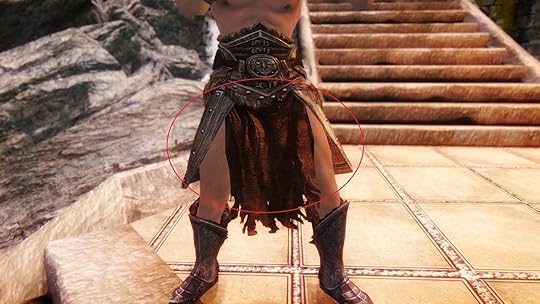 Loin guard. Hopefully made of sturdier stuff.Loin guard ~ Typically covered, well, the loins. I don't think this one needs much explanation!
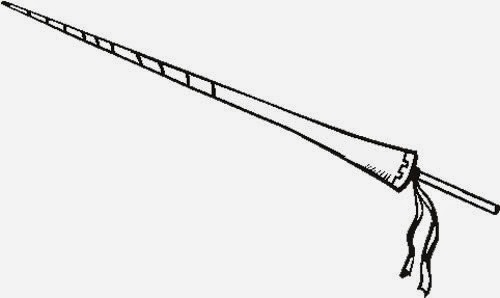 LanceLance ~ The lance is a pole weapon or spear designed to be used by a mounted warrior. During the periods of Classical and Medieval warfare it evolved into being the leading weapon in cavalry charges, and was unsuited for throwing or for repeated thrusting, unlike similar weapons of the spear/javelin/pike family typically used by infantry. Lances were often equipped with a vamplate – a small circular plate to prevent the hand sliding up the shaft upon impact. ("It's called a lance. Helloooo.")
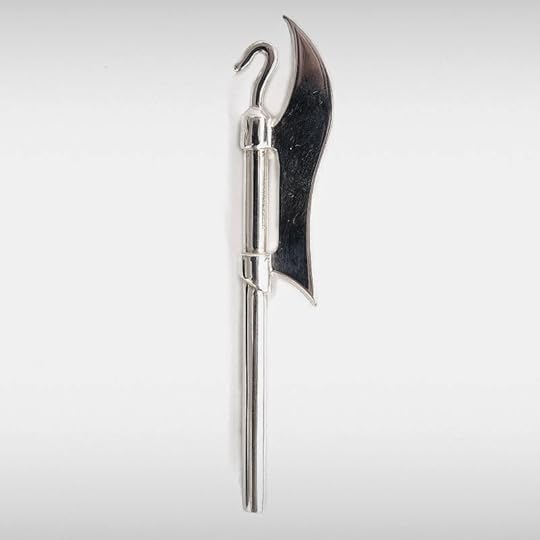 Lochaber AxeLochaber axe ~ The Lochaber axe is a type of halberd. The weapon was employed by the Scottish highlanders. The axe itself is similar to tools used with crops, such as the scythe, which is designed for reaping. The hook on the back bears a passing resemblance to a shepherd's crook, although within agriculture a smaller hook such as this may have been used in order to lift and carry tied bundles of a harvested crop or pull down tree branches. Early Lochaber axes, like the billhook, served a dual purpose as both building instruments and farming tools.
So there we have our armor parts and weapons for the day! Have a great Monday and see you tomorrow!
 Sample of LameLame ~ Band of steel plate, put together so that several bands can articulate on various areas like around the thighs, shoulders or waist. Such pieces are named for the number of bands, for instance, a fauld of four lame.
 Lobster tail PotLobster-tail pot ~ This is a type of post-Renaissance helm popular in Europe, especially for cavalry and officers, from c. 1600; it was derived from an Ottoman Turkish helmet type. The helmet gradually fell out of use in most of Europe in the late 17th century; however, the Austrian heavy cavalry retained it for some campaigns as late as the 1780s.
 Loin guard. Hopefully made of sturdier stuff.Loin guard ~ Typically covered, well, the loins. I don't think this one needs much explanation!
 LanceLance ~ The lance is a pole weapon or spear designed to be used by a mounted warrior. During the periods of Classical and Medieval warfare it evolved into being the leading weapon in cavalry charges, and was unsuited for throwing or for repeated thrusting, unlike similar weapons of the spear/javelin/pike family typically used by infantry. Lances were often equipped with a vamplate – a small circular plate to prevent the hand sliding up the shaft upon impact. ("It's called a lance. Helloooo.")
 Lochaber AxeLochaber axe ~ The Lochaber axe is a type of halberd. The weapon was employed by the Scottish highlanders. The axe itself is similar to tools used with crops, such as the scythe, which is designed for reaping. The hook on the back bears a passing resemblance to a shepherd's crook, although within agriculture a smaller hook such as this may have been used in order to lift and carry tied bundles of a harvested crop or pull down tree branches. Early Lochaber axes, like the billhook, served a dual purpose as both building instruments and farming tools.
So there we have our armor parts and weapons for the day! Have a great Monday and see you tomorrow!
April 12, 2014
K Is For Kettle Hat...
Whoops! Sorry so late, folks. It's been one of those weeks. But this isn't a time for complaining, it's the A- Z!
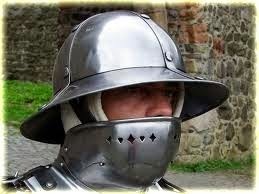 Kettle HatKettle hat - light weight, open-faced helmet, having a conical crown and wide brim.
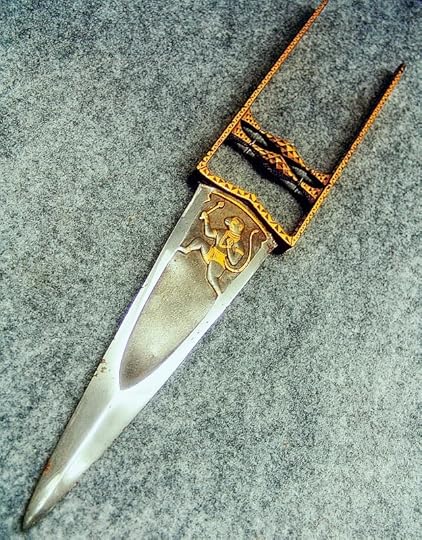 Katar Katar - is a type of push dagger from South Asia. The weapon is characterized by its H-shaped horizontal hand grip which results in the blade sitting above the user's knuckles. Unique to South Asia, it is the most famous and characteristic of Indian daggers. Ceremonial katar were also used in worship.
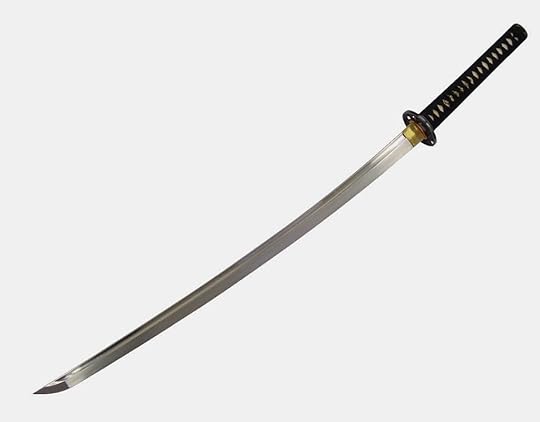 KatanaKatana - Historically, katana were one of the traditionally made Japanese swords that were used in feudal Japan, also commonly referred to as a "samurai sword". The katana is characterized by its distinctive appearance: a curved, slender, single-edged blade with a circular or squared guard and long grip to accommodate two hands.
So there are your weapons and armor for the day. Personally, I like the Katar. I love the Katana as well, but in my writing, I have an assassin who would use a katar. Wicked. Happy blogging!
 Kettle HatKettle hat - light weight, open-faced helmet, having a conical crown and wide brim.
 Katar Katar - is a type of push dagger from South Asia. The weapon is characterized by its H-shaped horizontal hand grip which results in the blade sitting above the user's knuckles. Unique to South Asia, it is the most famous and characteristic of Indian daggers. Ceremonial katar were also used in worship.
 KatanaKatana - Historically, katana were one of the traditionally made Japanese swords that were used in feudal Japan, also commonly referred to as a "samurai sword". The katana is characterized by its distinctive appearance: a curved, slender, single-edged blade with a circular or squared guard and long grip to accommodate two hands.
So there are your weapons and armor for the day. Personally, I like the Katar. I love the Katana as well, but in my writing, I have an assassin who would use a katar. Wicked. Happy blogging!
April 11, 2014
J Is For Jupon...
 JuponJupon ~ A type of sleeveless surcoat worn over the armor in the 14th century.
 JackJack ~A defensive coat, either of several layers or quilted leather or linen, often reinforced with metal studs or small plates
 As for weapons, well, what's a war without ships?
Junk ~ A junk is an ancient Chinese sailing vessel/ship design still in use today. Junks were developed during the Song Dynasty (960-1129) and were used as seagoing vessels as early as the 2nd century CE. They evolved in the later dynasties, and were used throughout Asia for extensive ocean voyages. They were found, and in lesser numbers are still found, throughout South-East Asia and India, but primarily in China, perhaps most famously in Hong Kong. Found more broadly today is a growing number of modern recreational junk-rigged sailboats.
 Junk
JunkAnd due to the limited number of 'J' items, I bring you a 'J' related, medieval sport:
 JoustingJousting ~ Jousting emerged in the High Middle Ages based on the military use of the lance by heavy cavalry. It transformed into a specialised sport during the Late Middle Ages, and remained popular with the nobility both in England and Germany throughout the whole of the 16th century (while in France, it was discontinued after the death of king Henry II in an accident in 1559).