M.L. Chesley's Blog, page 26
April 10, 2014
I Is For Ingots...
Okay, so what do Ingots have to do with medieval armor and weaponry?
Well, without Ingots, those things couldn't be made.
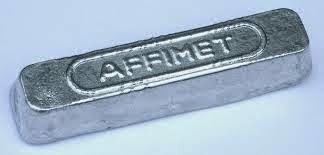 IngotIngot ~ An ingot is a material, usually metal, that is cast into a shape suitable for further processing. Ingots require a second procedure of shaping, such as cold/hot working, cutting or milling to produce a useful final product. Additionally ingots (of less common materials) can be used as currency, or as a currency reserve as with gold bars.
Hope all is going well for the rest of the A-Z Challengers! I try to hop around to as many blogs as I can. And seeing as I didn't sign up right away, I'm at the bottom of the list. So if you are going through the list to visit, start from the bottom tomorrow!
Happy Blogging!
Well, without Ingots, those things couldn't be made.
 IngotIngot ~ An ingot is a material, usually metal, that is cast into a shape suitable for further processing. Ingots require a second procedure of shaping, such as cold/hot working, cutting or milling to produce a useful final product. Additionally ingots (of less common materials) can be used as currency, or as a currency reserve as with gold bars.
Hope all is going well for the rest of the A-Z Challengers! I try to hop around to as many blogs as I can. And seeing as I didn't sign up right away, I'm at the bottom of the list. So if you are going through the list to visit, start from the bottom tomorrow!
Happy Blogging!


April 9, 2014
H Is For Hauberk...
Well, today's armor should be rather well known. Most people know what a Hauberk is, even if they don't read a lot of fantasy.
Then again, I could be wrong.
So here are the entries for today's letter:
 Hauberk
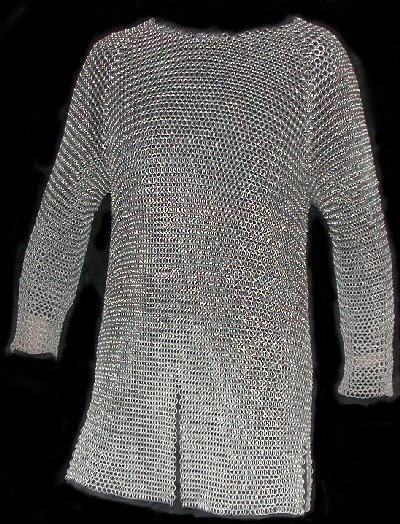
Hauberk ~ Mail shirt with sleeves reaching to the mid-thigh.
 HounskullHounskull ~ This one isn't so well known: A hounskull was a form of steel helmet worn in Europe in the Middle Ages, almost invariably by knights and other mounted men-at-arms, from the middle of the 14th century until approximately 1420. It offered extensive protection for the wearer's face at the cost of some visibility, but its distinctive visor could be raised or lowered at will.
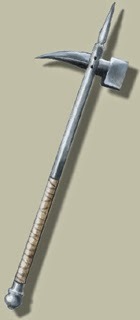 Horseman's PickHorseman's Pick ~ The horseman's pick was a weapon used by cavalry during the Middle Ages in Europe. This was a type of war hammer that had a very long spike on the reverse of the hammer head. Usually, this spike was slightly curved downwards, much like a miner's pickaxe. The term is sometimes used interchangeably with war hammer. A metal-made horseman's pick called "nadziak" was one of the main weapons of the famous Polish winged hussars. A weapon of late make, the horseman's pick was developed by the English and used by their heavy Billmen, a unit of heavy infantry. It was used with great success during the Hundred Years War. A use of the horseman's pick was to tear men from their mounts.
 Halberd
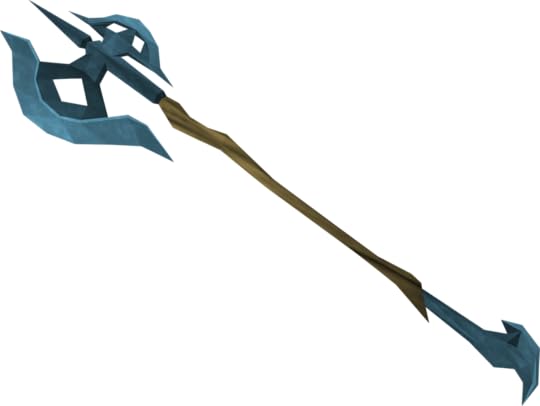
Halberd ~ A halberd (also called halbard, halbert or Swiss voulge) is a two-handed pole weapon that came to prominent use during the 14th and 15th centuries.
So that is your lesson for the day in medieval weapons and armor. I hope this sheds some light on what's been used AND gives you an idea of things not frequently used. Happy blogging!
Then again, I could be wrong.
So here are the entries for today's letter:
 Hauberk
Hauberk ~ Mail shirt with sleeves reaching to the mid-thigh.
 HounskullHounskull ~ This one isn't so well known: A hounskull was a form of steel helmet worn in Europe in the Middle Ages, almost invariably by knights and other mounted men-at-arms, from the middle of the 14th century until approximately 1420. It offered extensive protection for the wearer's face at the cost of some visibility, but its distinctive visor could be raised or lowered at will.
 Horseman's PickHorseman's Pick ~ The horseman's pick was a weapon used by cavalry during the Middle Ages in Europe. This was a type of war hammer that had a very long spike on the reverse of the hammer head. Usually, this spike was slightly curved downwards, much like a miner's pickaxe. The term is sometimes used interchangeably with war hammer. A metal-made horseman's pick called "nadziak" was one of the main weapons of the famous Polish winged hussars. A weapon of late make, the horseman's pick was developed by the English and used by their heavy Billmen, a unit of heavy infantry. It was used with great success during the Hundred Years War. A use of the horseman's pick was to tear men from their mounts.
 Halberd
Halberd ~ A halberd (also called halbard, halbert or Swiss voulge) is a two-handed pole weapon that came to prominent use during the 14th and 15th centuries.
So that is your lesson for the day in medieval weapons and armor. I hope this sheds some light on what's been used AND gives you an idea of things not frequently used. Happy blogging!
April 8, 2014
G Is For Gorget...
Today's letter is G. I have a couple of armor components for you and a weapon.
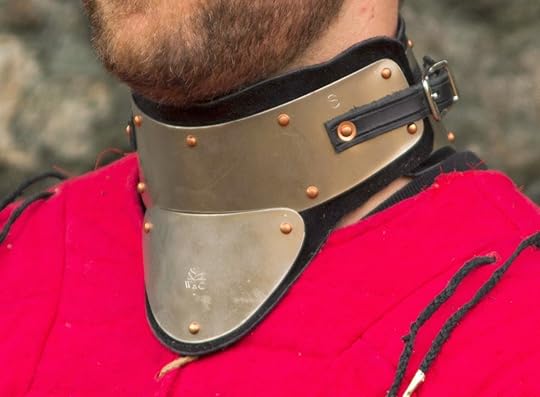 GorgetGorget ~ Steel collar to protect the neck and cover the neck opening in a complete cuirass. Quite unlike a modern shirt collar in that as well as covering the front and back of the neck it also covers part of the clavicles and sternum and a like area on the back.
 Gardbrace Gardbrace ~ they are the extra plate that covers the front of the shoulder, worn over top of a pauldron.
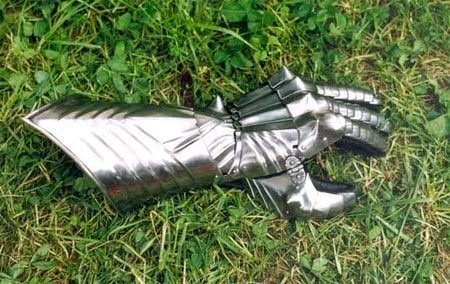 GauntletGauntlet ~ Gloves that cover from the fingers to the forearms, made from many materials.
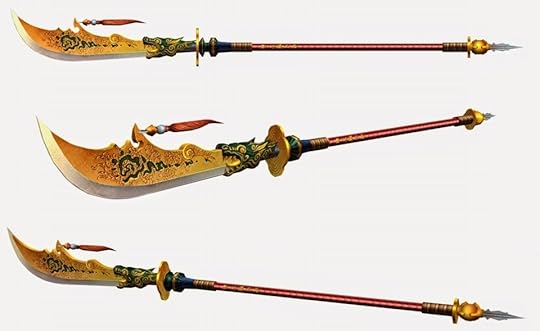 GlaiveGlaive ~ is a European polearm weapon, consisting of a single-edged blade on the end of a pole. It is similar to the Japanese naginata (naginata!!! I love these) and the Chinese guandao.
Typically, the blade was around 45 cm (18 inches) long, on the end of a pole 2 m (6 or 7 feet) long, and the blade was affixed in a socket-shaft configuration similar to an axe head, rather than having a tang like a sword or naginata. Occasionally glaive blades were created with a small hook on the reverse side to better catch riders. Such blades are called glaive-guisarmes.
According to the 1599 treatise Paradoxes of Defence by the English gentleman George Silver, the glaive is used in the same general manner as the quarterstaff, half pike, bill, halberd, voulge, or partisan. Silver rates this class of polearms above all other individual hand-to-hand combat weapons.
Happy blogging and see you tomorrow!
 GorgetGorget ~ Steel collar to protect the neck and cover the neck opening in a complete cuirass. Quite unlike a modern shirt collar in that as well as covering the front and back of the neck it also covers part of the clavicles and sternum and a like area on the back.
 Gardbrace Gardbrace ~ they are the extra plate that covers the front of the shoulder, worn over top of a pauldron.
 GauntletGauntlet ~ Gloves that cover from the fingers to the forearms, made from many materials.
 GlaiveGlaive ~ is a European polearm weapon, consisting of a single-edged blade on the end of a pole. It is similar to the Japanese naginata (naginata!!! I love these) and the Chinese guandao.
Typically, the blade was around 45 cm (18 inches) long, on the end of a pole 2 m (6 or 7 feet) long, and the blade was affixed in a socket-shaft configuration similar to an axe head, rather than having a tang like a sword or naginata. Occasionally glaive blades were created with a small hook on the reverse side to better catch riders. Such blades are called glaive-guisarmes.
According to the 1599 treatise Paradoxes of Defence by the English gentleman George Silver, the glaive is used in the same general manner as the quarterstaff, half pike, bill, halberd, voulge, or partisan. Silver rates this class of polearms above all other individual hand-to-hand combat weapons.
Happy blogging and see you tomorrow!
April 7, 2014
F Is For Fauld...
For the April A - Z Blog Challenge, I'm trying to help you visualize some of the components in medieval armor and weaponry. Talk about a challenge! But if you read or write Sword and Sorcery fantasy, you gotta know this stuff! There are times when I am reading and I can't quite picture what they're talking about, so I have to look it up. Kind of a chore, but I want to know these things. Also, everything listed here was pulled from Wikipedia. So on with our post!
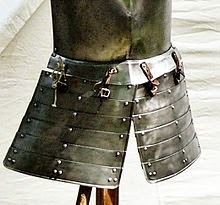 FauldFauld ~ Faulds are a piece of plate armour worn below a breastplate to protect the waist and hips. They take the form of bands of metal surrounding both legs, potentially surrounding the entire hips in a form similar to a skirt.
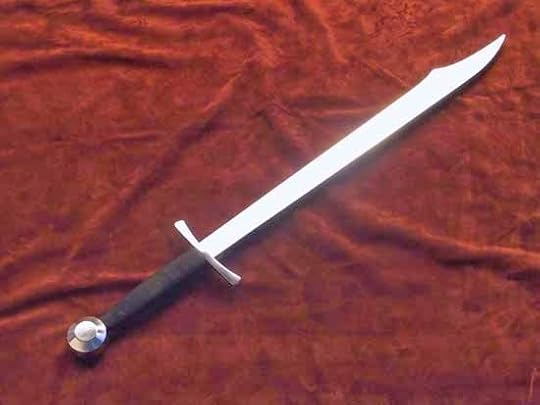 FalchionFalchion ~ is a one-handed, single-edged sword of European origin, whose design is reminiscent of the Persian scimitar and the Chinese dao. (Don't confuse this with the Dou!)
The weapon combined the weight and power of an axe with the versatility of a sword. Falchions are found in different forms from around the 11th century up to and including the sixteenth century. In some versions the falchion looks rather like the scramasax and later the sabre, and in some versions the form is irregular or like a machete with a crossguard.
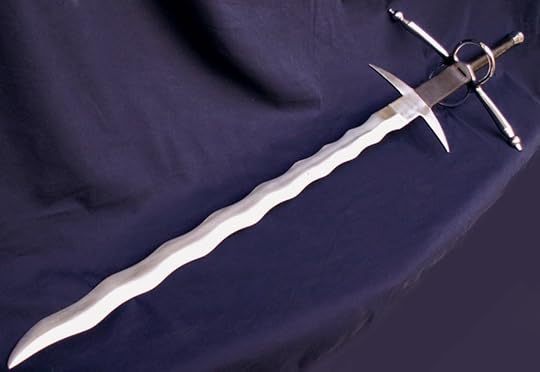 FlambergeFlamberge ~ a flame-bladed sword or wave-bladed sword has a characteristically undulating style of blade. The wave in the blade is often considered to contribute a flame-like quality to the appearance of a sword. While largely decorative, some attributes of the waved blade were useful in combat. The two most flame-bladed swords are rapiers or zweihänders, although there have been other sword types with flame-blades.
There. Hope that helps figure some more stuff out! See you all tomorrow.
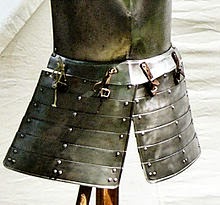 FauldFauld ~ Faulds are a piece of plate armour worn below a breastplate to protect the waist and hips. They take the form of bands of metal surrounding both legs, potentially surrounding the entire hips in a form similar to a skirt.
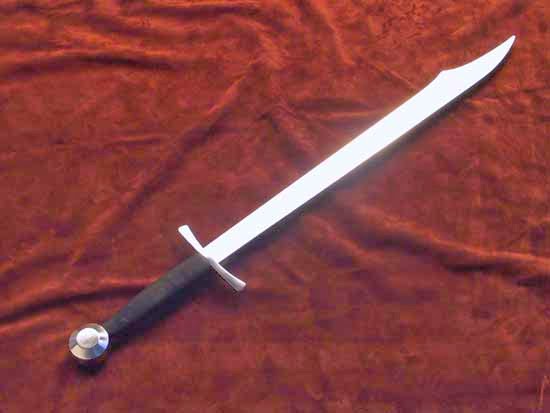 FalchionFalchion ~ is a one-handed, single-edged sword of European origin, whose design is reminiscent of the Persian scimitar and the Chinese dao. (Don't confuse this with the Dou!)
The weapon combined the weight and power of an axe with the versatility of a sword. Falchions are found in different forms from around the 11th century up to and including the sixteenth century. In some versions the falchion looks rather like the scramasax and later the sabre, and in some versions the form is irregular or like a machete with a crossguard.
 FlambergeFlamberge ~ a flame-bladed sword or wave-bladed sword has a characteristically undulating style of blade. The wave in the blade is often considered to contribute a flame-like quality to the appearance of a sword. While largely decorative, some attributes of the waved blade were useful in combat. The two most flame-bladed swords are rapiers or zweihänders, although there have been other sword types with flame-blades.
There. Hope that helps figure some more stuff out! See you all tomorrow.
April 5, 2014
E Is For Ear Dagger...
Yes, there is such a thing as an Ear Dagger. No, sadly, it is not hidden behind the ear for when you need to use your female assassin wiles to kill the next in line for the throne and you whip out your dagger from behind your ear and stick it in his jugular...
Ahem.
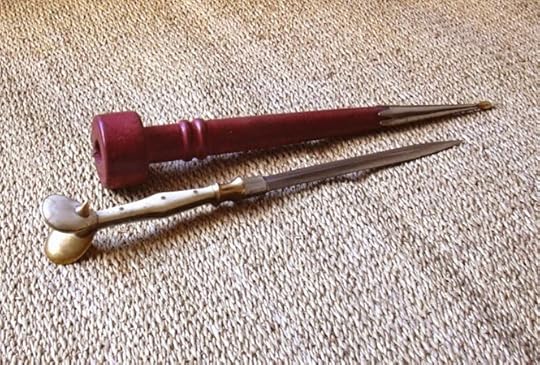 Ear Dagger. Notice the shape of the pommel.No, an ear dagger is a relatively rare and exotic form of dagger that was used during the late Middle Ages and Renaissance. It is so named because the pommel of the dagger has a very distinctive shape, in some cases like a human ear. Ear daggers frequently have a single sharpened edge that ends in an acute point. It is thought that the ear dagger was introduced to Europe from Spain, where it presumably originated from the Moors.
 Enclosed Helm.And if you thought the Armet was a difficult looking helm to fight in, try the Enclosed Helmet ~ In the late 12th century, early 13th century, an enclosed helm was the primitive version of the great helm, used in Western Europe. Only those of Knightly stature used the enclosed helmets. Despite their restrictions of sight and hearing, they were the best protection from couched lances and archers. But this too evolved into something more constructive later on.
And sadly, I didn't have time to look up any weapons starting with 'E', and there were none readily available on my current list. So we'll have to skip it this time.
Happy blogging! I hope to get around to some blogs this weekend. I've been a busy girl this week.
Ahem.
 Ear Dagger. Notice the shape of the pommel.No, an ear dagger is a relatively rare and exotic form of dagger that was used during the late Middle Ages and Renaissance. It is so named because the pommel of the dagger has a very distinctive shape, in some cases like a human ear. Ear daggers frequently have a single sharpened edge that ends in an acute point. It is thought that the ear dagger was introduced to Europe from Spain, where it presumably originated from the Moors.
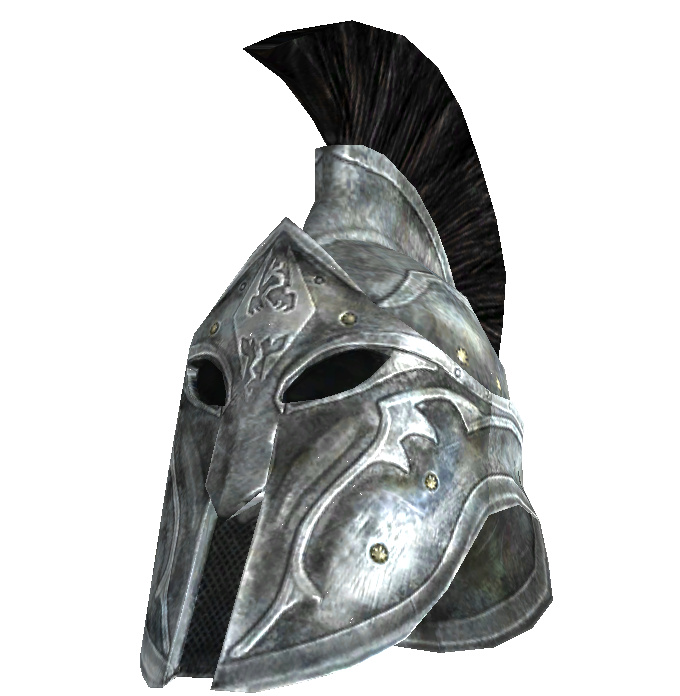 Enclosed Helm.And if you thought the Armet was a difficult looking helm to fight in, try the Enclosed Helmet ~ In the late 12th century, early 13th century, an enclosed helm was the primitive version of the great helm, used in Western Europe. Only those of Knightly stature used the enclosed helmets. Despite their restrictions of sight and hearing, they were the best protection from couched lances and archers. But this too evolved into something more constructive later on.
And sadly, I didn't have time to look up any weapons starting with 'E', and there were none readily available on my current list. So we'll have to skip it this time.
Happy blogging! I hope to get around to some blogs this weekend. I've been a busy girl this week.
April 4, 2014
D Is For Do...
 A hairdo!No, not that kind of 'do'.
 This kind of Do:
 Do or Dou
During the Heian period 794 to 1185 the Japanese cuirass evolved into the more familiar style of armour worn by the samurai known as the dou or do.
Also under our 'D' category is Doublet:
 Doublet A doublet is a man's snug-fitting buttoned jacket that is shaped and fitted to the man's body. Worn in Western Europe from the Middle Ages through to the mid-17th century. The doublet was hip length or waist length and worn over the shirt or drawers. Until the end of the 15th century the doublet was worn under another layer of clothing such as a gown, mantle, or overtunic. Originally it was a mere stitched and quilted lining ("doubling"), worn under a hauberk or cuirass to prevent bruising and chafing.
 A dirk
And we also have our weapon, the dirk. A dirk is a long thrusting dagger. Historically, it was a personal weapon of officers engaged in naval hand-to-hand combat during the Age of Sail, as well as the personal sidearm of the officers of Scottish Highland regiments, and Japanese naval officers. And just to let you know, THIS is something a pirate would carry. Happy blogging, everyone and I will see you tomorrow.
April 3, 2014
C Is For Coif...
 chain-mail coif
Yes, coif. Pronounced 'koif'. Basically a chain-mail hood. Coifs were usually worn underneath the plate armor and helm. So if you lost or removed your helm, technically, your head would still be protected by the chain hood underneath.
And since I don't have much in the way of 'C' words, I will add 'Cuirass', pronounced kwi-rass. (Honestly, I always thought of 'cure-ass'. Ha!)
 Cuirass A cuirass covers the breast, not the back, however the name is sometimes used to describe the breast- and backplates together. Developed in antiquity but became common in the 14th century with the reintroduction of plate armour, later sometimes two pieces overlapping for top and bottom. Whether of one piece or two, breastplate is sometimes used to literally describe the section that covers the breast.
 Caltrop Now, A-Z will not cover JUST armor, so I am going to sprinkle some weaponry throughout. Today's 'C' word weapon is Caltrop. Pronounced 'kal-trep', these little puppies were pretty brutal for being so small. Seriously, they were used as early as 331 B. C., known to the Romans as 'tribulus' or 'jagged iron'. While these little beasties could render a horse useless, I have always pictured a thief using them in fantasy. Right? Little guy, being chased by guards, has a strange leather box on his belt that opens on the top or bottom. At a crucial point in the chase, he unlatches the bottom part and caltrops spill over the ground. A guard wearing a THIN BOOT runs over said caltrop and... "Ow! Ow! OW!!".
You get it.
Alright, I'll see you all around the A-Zhood!
April 2, 2014
B Is For Brigandine...
Today's letter is brought to you by... well, you know.
B. Today, B is for Brigandine. Armor, that is.
For most of you who read and write fantasy, some of this stuff will be easily recognizable. For some, it won't. But since I am a fantasy author AND reader, I figured this just might help put an image in your brain the next time you come across a description of armor or weaponry you can't instantly recall.
So what is Brigandine armor?
 Brigandine Armor
Well, from the 12th to the 16th century, brigandine armor was a cloth garment, usually canvas or leather, with steel plates riveted to it. These were refinements of earlier coats of plate. The 12th century version had larger plates than the 14th century version. The 15th century version opened in the front. Brigandine was commonly worn over gambesons and mail shirts, eventually being worn from archers to knights. The simplicity of brigandine armor allowed the common soldier to do his own repairs without having to pay a skilled blacksmith. *(Information from Wikipedia.)*
It's also the day for Insecure Writer's Support Group. On that front, I can't say I have any 'B' related insecurities, but I am Busy!
Ideas have been flowing, I'm making jewelry and all I can offer up to anyone else in the same situation is keep focused. I know. The 'F' word! Lol!
But focus is what has been helping me. And I'm not usually a focused kind of girl. I'm ADD girl, honestly, when it comes to a lot of stuff. I can't stay focused, but let me tell ya, these days, it has been hard work to remain focused! I even try to make lists of what it is I need to do the next day. THAT is how focused I'm becoming. I may not feel like staying focused, but in order to get all this done, I have to be. So stay focused and take things one day at a time!
Happy blogging, everyone!
B. Today, B is for Brigandine. Armor, that is.
For most of you who read and write fantasy, some of this stuff will be easily recognizable. For some, it won't. But since I am a fantasy author AND reader, I figured this just might help put an image in your brain the next time you come across a description of armor or weaponry you can't instantly recall.
So what is Brigandine armor?
 Brigandine Armor
Well, from the 12th to the 16th century, brigandine armor was a cloth garment, usually canvas or leather, with steel plates riveted to it. These were refinements of earlier coats of plate. The 12th century version had larger plates than the 14th century version. The 15th century version opened in the front. Brigandine was commonly worn over gambesons and mail shirts, eventually being worn from archers to knights. The simplicity of brigandine armor allowed the common soldier to do his own repairs without having to pay a skilled blacksmith. *(Information from Wikipedia.)*
It's also the day for Insecure Writer's Support Group. On that front, I can't say I have any 'B' related insecurities, but I am Busy!
Ideas have been flowing, I'm making jewelry and all I can offer up to anyone else in the same situation is keep focused. I know. The 'F' word! Lol!
But focus is what has been helping me. And I'm not usually a focused kind of girl. I'm ADD girl, honestly, when it comes to a lot of stuff. I can't stay focused, but let me tell ya, these days, it has been hard work to remain focused! I even try to make lists of what it is I need to do the next day. THAT is how focused I'm becoming. I may not feel like staying focused, but in order to get all this done, I have to be. So stay focused and take things one day at a time!
Happy blogging, everyone!
April 1, 2014
A Is For Arsenal...
Welcome to the April A-Z Blogging Challenge!
I'm sort of prepared for this. I signed up late. (Was transferring computers into a more conducive writing area...) And I sort of have a theme.
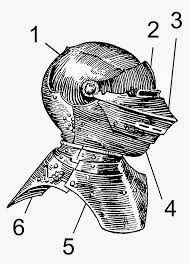 Medieval ArmetSo, if you will join me in my trek through medieval armor and weaponry, I will do my best to make it through the month! But please note: all the info I have gathered on the weaponry and armor is from Wikipedia.
So for today, we have 'A'.
Armet ~ This is a type of helmet developed in the 15th century. It encompasses the entire head, but has hinges near the cheeks to expose the face. Later variations of this had a visor. This type of helmet was typically used in Italy, France, Spain, England, and the low countries. (Found on Wikipedia)
Aventail ~ Detachable mail usually hung from a helmet to cover the neck and shoulders. This used to be riveted right to the helmet, but later on became detachable. These often served as replacements for a full coif. The earlier versions of aventails were around the 1300’s, in Western Europe. By the 15th century, they replaced the coifs completely.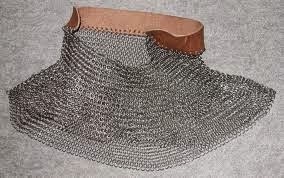 Medieval Aventail
So you might be asking yourself, why this theme? Well, honestly, I'm a fantasy writer. And if you have ever read fantasy, I mean Sword and Sorcery fantasy, sometimes they throw in all sorts of armor and weapon descriptions that leave you going, "Huh???".
So hopefully, this will shed some light on some of those things. Plus, I am the Queen of Useless Trivia, so I thought I'd share. Happy blogging!!
I'm sort of prepared for this. I signed up late. (Was transferring computers into a more conducive writing area...) And I sort of have a theme.
 Medieval ArmetSo, if you will join me in my trek through medieval armor and weaponry, I will do my best to make it through the month! But please note: all the info I have gathered on the weaponry and armor is from Wikipedia.
So for today, we have 'A'.
Armet ~ This is a type of helmet developed in the 15th century. It encompasses the entire head, but has hinges near the cheeks to expose the face. Later variations of this had a visor. This type of helmet was typically used in Italy, France, Spain, England, and the low countries. (Found on Wikipedia)
Aventail ~ Detachable mail usually hung from a helmet to cover the neck and shoulders. This used to be riveted right to the helmet, but later on became detachable. These often served as replacements for a full coif. The earlier versions of aventails were around the 1300’s, in Western Europe. By the 15th century, they replaced the coifs completely.
 Medieval Aventail
So you might be asking yourself, why this theme? Well, honestly, I'm a fantasy writer. And if you have ever read fantasy, I mean Sword and Sorcery fantasy, sometimes they throw in all sorts of armor and weapon descriptions that leave you going, "Huh???".
So hopefully, this will shed some light on some of those things. Plus, I am the Queen of Useless Trivia, so I thought I'd share. Happy blogging!!
March 29, 2014
Book Review: Young Love Lost by Doug Burris
Title: Young Love Lost
Author: Doug Burris
ASIN: B00HP5A8FU
File Size: 356 KB
Print Length: 249 Pages

Purchase: Amazon. Barnes and Noble.
About the Book (From Amazon):
Where does innocence go?
While vacationing on the beach at Emerald Isle, North Carolina, high school student David Jennings meets an intriguing girl. Mary Roberts ignites feelings that stay with him even after they both return to their homes. Summer after summer, they reunite, building on the love that started to bloom from the first day.
Not only does David discover romance, but he also learns what “family” can mean. The loving Roberts family is in stark contrast to the Jennings. David is the only child of Roy, an ex-Marine and rigid cop, and secretive Sarah. As the young couple explores their future, the family secrets unravel—until tragic events manage to both bring together and divide the two families.
My Thoughts:
About halfway through this book, I was about to put it down. I was right at 56% and for me to remember that is a big deal. So what changed my mind? It finally got GOOD.
This book has a slow start, for me at least, I won't lie. It's about two families who vacation in the same spot, year after year, only this time, the two kids finally meet. David learns what families are really like, as he has grown up with his military/trooper father who likes things done a certain way. He likes order and stability. And his mother, the one who wants more out of life, but isn't allowed to get it and wouldn't know where to start if she tried.
Mary seems to have the perfect family, but David learns about her brother's shady past and problems, so he gets that not all families are perfect.
The two of them hit it off right from the start. It's a very sweet story and I liked it a lot, but by the 56% mark, I was ready to put it down.
When I say it finally got GOOD, I mean, the story finally picked up the pace and we were thrown into some action. I don't know if the author dragged out the beginning intentionally or not, but by the time we got down to what the story was really all about, it moved along quickly. It was very well written, the characters were well developed, almost too well developed at times. The flow was, after the 56% mark, quick and smooth.
What I mean by 'too well developed' was the redundancy of some of the inner dialogue of the characters. I would say about half of that could have been cut out and people would still love this story and feel they got their money's worth.
My Rating:
3 and 1/2 Skull and Crossbones.
Author: Doug Burris
ASIN: B00HP5A8FU
File Size: 356 KB
Print Length: 249 Pages

Purchase: Amazon. Barnes and Noble.
About the Book (From Amazon):
Where does innocence go?
While vacationing on the beach at Emerald Isle, North Carolina, high school student David Jennings meets an intriguing girl. Mary Roberts ignites feelings that stay with him even after they both return to their homes. Summer after summer, they reunite, building on the love that started to bloom from the first day.
Not only does David discover romance, but he also learns what “family” can mean. The loving Roberts family is in stark contrast to the Jennings. David is the only child of Roy, an ex-Marine and rigid cop, and secretive Sarah. As the young couple explores their future, the family secrets unravel—until tragic events manage to both bring together and divide the two families.
My Thoughts:
About halfway through this book, I was about to put it down. I was right at 56% and for me to remember that is a big deal. So what changed my mind? It finally got GOOD.
This book has a slow start, for me at least, I won't lie. It's about two families who vacation in the same spot, year after year, only this time, the two kids finally meet. David learns what families are really like, as he has grown up with his military/trooper father who likes things done a certain way. He likes order and stability. And his mother, the one who wants more out of life, but isn't allowed to get it and wouldn't know where to start if she tried.
Mary seems to have the perfect family, but David learns about her brother's shady past and problems, so he gets that not all families are perfect.
The two of them hit it off right from the start. It's a very sweet story and I liked it a lot, but by the 56% mark, I was ready to put it down.
When I say it finally got GOOD, I mean, the story finally picked up the pace and we were thrown into some action. I don't know if the author dragged out the beginning intentionally or not, but by the time we got down to what the story was really all about, it moved along quickly. It was very well written, the characters were well developed, almost too well developed at times. The flow was, after the 56% mark, quick and smooth.
What I mean by 'too well developed' was the redundancy of some of the inner dialogue of the characters. I would say about half of that could have been cut out and people would still love this story and feel they got their money's worth.
My Rating:
3 and 1/2 Skull and Crossbones.