Z Is For Zweihander...
Well, it's the last day. I made it! Maybe not with enough armor components, but certainly with weapons. I'm fascinated by medieval history. I love writing fantasy, because I stick to that era and mix in my own imaginative details. I hope you've enjoyed my Medieval Weapons and Armor from A to Z posts!
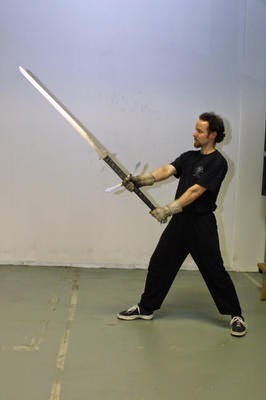 ZweihanderZweihander - (German for "two hander") is a two-handed sword primarily of the Renaissance. It is a true two-handed sword because wielding it requires two hands, unlike other large swords that also can be used with one.
The Zweihänder swords develop from the longsword of the Late Middle Ages and became a hallmark weapon of the German Landsknechte from the time of Maximilian I (d. 1519) and during the Italian Wars of 1494–1559. The Goliath Fechtbuch (1510) shows an intermediate form between longsword and Zweihänder.
These swords represent the final stage in the trend of increasing size that started in the 14th century. In its developed form, the Zweihänder has acquired the characteristics of a polearm rather than a sword. Consequently, it is not carried in a sheath but across the shoulder like a halberd. By the second half of the 16th century, these swords had largely ceased to have a practical application, but they continued to see ceremonial or representative use well into the 17th century. Some ceremonial zweihänder, called "bearing-swords" or "parade-swords" (Paratschwert) were much larger and weighed about 10 pounds.
If I saw someone coming at me with that sword, I don't know if I would turn tail and run due to the size and the strength needed to wield it, or stay and fight because they'd be slow! Hope you all ended the challenge on a high note. And congratulations to you for completing the month!
 ZweihanderZweihander - (German for "two hander") is a two-handed sword primarily of the Renaissance. It is a true two-handed sword because wielding it requires two hands, unlike other large swords that also can be used with one.
The Zweihänder swords develop from the longsword of the Late Middle Ages and became a hallmark weapon of the German Landsknechte from the time of Maximilian I (d. 1519) and during the Italian Wars of 1494–1559. The Goliath Fechtbuch (1510) shows an intermediate form between longsword and Zweihänder.
These swords represent the final stage in the trend of increasing size that started in the 14th century. In its developed form, the Zweihänder has acquired the characteristics of a polearm rather than a sword. Consequently, it is not carried in a sheath but across the shoulder like a halberd. By the second half of the 16th century, these swords had largely ceased to have a practical application, but they continued to see ceremonial or representative use well into the 17th century. Some ceremonial zweihänder, called "bearing-swords" or "parade-swords" (Paratschwert) were much larger and weighed about 10 pounds.
If I saw someone coming at me with that sword, I don't know if I would turn tail and run due to the size and the strength needed to wield it, or stay and fight because they'd be slow! Hope you all ended the challenge on a high note. And congratulations to you for completing the month!


date newest »
newest »
message 1:
by
Stan
(new)
Jun 12, 2016 07:03AM
 I wouldn't count on it being slow, there are many you tube videos under montante and spadone that show the use of the two-handed sword that are very informative.
reply
|
flag