
Jason M. Hough's Blog, page 7
May 20, 2013
A few bits 'o news
Some things have happened in the last week that I wanted to share!
First off, THE DARWIN ELEVATOR has received a starred review in Library Journal!
Unfortunately I can't post it as the electronic version is behind a paywall, so I'll just say that this is great news and I'm flattered. There's more reviews in the pipe that I can't talk about yet, suffice to say I'm bubbling with excitement.
Second, here's the final UK cover for DARWIN, courtesy of Titan Books:
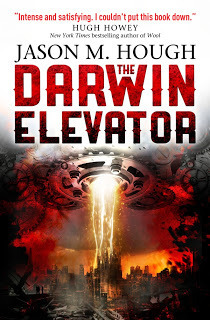 UK Cover for The Darwin Elevator
Titan Books
I love the different style compared to North America. It's sort of fascinating to me how the same material can receive such diverse treatment depending on the market. Incidentally, for you UK readers, DARWIN will be out there on July 26th - four whole days before the North American release. Imagine the gloating opportunities!
Finally, I've posted the first chapter of DARWIN on my website for your reading pleasure. Enjoy!
There's more good stuff to come...
First off, THE DARWIN ELEVATOR has received a starred review in Library Journal!
Unfortunately I can't post it as the electronic version is behind a paywall, so I'll just say that this is great news and I'm flattered. There's more reviews in the pipe that I can't talk about yet, suffice to say I'm bubbling with excitement.
Second, here's the final UK cover for DARWIN, courtesy of Titan Books:
 UK Cover for The Darwin Elevator
Titan Books
I love the different style compared to North America. It's sort of fascinating to me how the same material can receive such diverse treatment depending on the market. Incidentally, for you UK readers, DARWIN will be out there on July 26th - four whole days before the North American release. Imagine the gloating opportunities!
Finally, I've posted the first chapter of DARWIN on my website for your reading pleasure. Enjoy!
There's more good stuff to come...


May 3, 2013
What happened yesterday?
For the writers out there, here's a tip on character building I wanted to share.
Chances are your story is going involve a calamitous change to the life of your main characters, or depending on the scale of your story perhaps everyone is about to have a serious problem that needs solving.
One thing I did before I started writing DARWIN was to jot down, from each character's perspective, what they did from wake-up to bedtime the day before the book begins. This proved immensely valuable to me in understanding who these people were and what their lives are like. Plus, and somewhat unexpectedly, it helped me flesh out a ton of details about the world they live in. Until that point I'd mentally treated worldbuilding and character development as two separate tasks.
Originally I'd intended to write up their "typical day", but it occurred to me that specifically choosing the day before the story begins would pay higher dividends in the book itself. What happened yesterday is still on the mind, still relevant, still being talked about. Even if the opener of the book changes later on (for DARWIN it did, in fact), exercise still yields plenty of useful details for your characters and their world.
Stories often yank their characters from their ordinary life and into the extraordinary. Your understanding of what ordinary is will help your ability to think as your characters do. Because often, perhaps all the time, a person's first instinct when faced with change is to find a way back to normalcy, to comfort. Change can be scary as hell. We just want things to be how they were, even if we know that's impossible.
Give it a shot if you like. You could write this up as a full blown scene, a diary entry, whatever works for you. In my case it was just quick bullet lists, no more than a page long each.
Standard disclaimer for any writing advice: There's no rules, only tools. Do what works for you.
Chances are your story is going involve a calamitous change to the life of your main characters, or depending on the scale of your story perhaps everyone is about to have a serious problem that needs solving.
One thing I did before I started writing DARWIN was to jot down, from each character's perspective, what they did from wake-up to bedtime the day before the book begins. This proved immensely valuable to me in understanding who these people were and what their lives are like. Plus, and somewhat unexpectedly, it helped me flesh out a ton of details about the world they live in. Until that point I'd mentally treated worldbuilding and character development as two separate tasks.
Originally I'd intended to write up their "typical day", but it occurred to me that specifically choosing the day before the story begins would pay higher dividends in the book itself. What happened yesterday is still on the mind, still relevant, still being talked about. Even if the opener of the book changes later on (for DARWIN it did, in fact), exercise still yields plenty of useful details for your characters and their world.
Stories often yank their characters from their ordinary life and into the extraordinary. Your understanding of what ordinary is will help your ability to think as your characters do. Because often, perhaps all the time, a person's first instinct when faced with change is to find a way back to normalcy, to comfort. Change can be scary as hell. We just want things to be how they were, even if we know that's impossible.
Give it a shot if you like. You could write this up as a full blown scene, a diary entry, whatever works for you. In my case it was just quick bullet lists, no more than a page long each.
Standard disclaimer for any writing advice: There's no rules, only tools. Do what works for you.
April 29, 2013
Publishers Weekly reviews THE DARWIN ELEVATOR
"Impressive first installment of a planned trilogy". Here's the full review (from the April 29th 2013 issue):
The Darwin Elevator
Jason M. Hough. Del Rey, $9.99 mass market (496p) ISBN 978-0-345-53712-6
In this impressive first installment of a planned trilogy, mysterious aliens plant the lower end of a space elevator deep into Darwin, on the northwestern coast of Australia. Five years later, a virus breaks out, leaving Earth denuded of all but scattered remnants of feral “subhumans.” Proximity to the elevator provides immunity for human survivors living in Darwin and along the elevator itself. A small number of those survivors are naturally immune to the virus, including Skyler Luiken, a Han Solo–like aircraft captain who scours the infected Earth for salvageable bits of civilization. The credible dystopian setting is peopled with sympathetic and improbably beautiful heroes and heroines who are forced by circumstance to take arms against a power-hungry prefect and a corporate tycoon willing to betray his planet for personal gain. Newcomer Hough displays a talent for imaginative plotting and realistic dialogue, and the brisk pacing and cliffhanger ending will keep readers enthralled and eagerly awaiting the next installment. Agent: Sara Megibow, Nelson Literary Agency. (Aug.)
April 12, 2013
The Future of Humans and AI
SF Signal has included me in another Mind Meld, this time about AI. Have a look!
March 11, 2013
Game review: Artemis
This weekend at ConDor I finally had the chance to try out Artemis, the Spaceship Bridge Simulator.
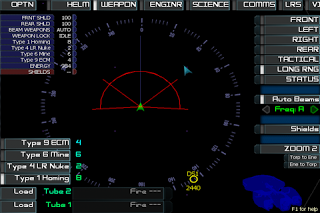 Weapons control view
I've wanted a gaming experience like this for decades, only heightened by the disappointing Star Trek: Bridge Commander in 2002 which left so much to be desired.
The setup of Artemis is simple: Five people take on the various roles of a starship bridge. Each player gets their own screen with a unique set of capabilities. One player, though, has no capabilities -- they act as captain, and simply make the decisions for the other players to carry out. The only information the captain gets is what the players tell him or her, or decide to put up on the main screen.
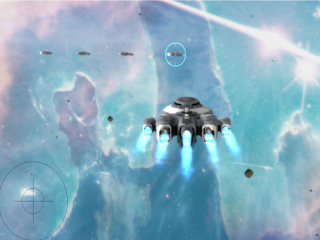 View of the ship in flight - often what the Captain is seeing on the main screen
In the game I joined we had a 3-person crew: science officer (me), pilot, and weapons. The empty seats should have been a communications officer and an engineering officer, which are probably the only two roles you can safely skip (though things would go much better with these people present). Our mission was to protect four space stations at all costs.
As science officer my radar-like screen focused on a very broad view of the space around us. My job was to keep tabs on all the ships, asteroids, space stations, and other crap in our general area.
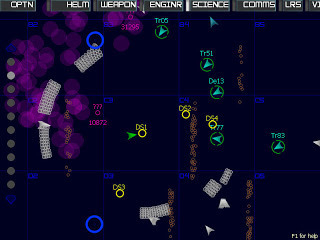 Science officer's view
Hostile ships were coming in from various points on the map and driving in toward four space stations which we had to protect. I would scan the enemies and offer advice on which targets we should we worried about, what heading our pilot needed to fly in to intercept, and as we moved in close enough I could acquire more detailed scans. This information I relayed to our weapons officer who could then fine tune his targeting. And by relayed, I mean I had to say, or even shout, the information.
That's the great things about Artemis: the party game aspect of it. It was designed from the beginning to be played by people in the same room together.
My bridgemates were all very much into the role-playing aspect of it, doing our best during the lulls to call out important ship information or compliment each other on particularly savvy operational feats. When battle happened, which was often, it was exhilarating and just as chaotic as you'd expect. We were all shouting over each other as carefully laid plans went haywire for the dumbest reasons: we forgot to put the shields up, we overshot the enemy, we ran out of ammo before the battle was done, and so on. The more we played, the more we started working together. I can't help but think Artemis would make a great team-building experience for people who work together. In Artemis you live and die by two things: strong decision making and clear communication. To that end I think it's somewhat brave and brilliant that the designers put no person-to-person communication into the game itself, forcing you to actually talk out loud to relay information. You cannot, for example, send a private text to the weapons officer letting him know what frequency to set the beam weapons to. Though that information is only relevant to weapons, deciding when, if, and how loudly to relay the info is all part of the game. You may blurt it out just as the captain is issuing the order to get the hell out of there, for example.
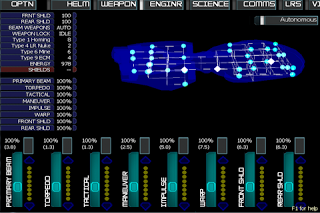 Engineering, which shows damage and other critical info
Which brings me to another realization. I could argue that this game is really a simulation of a made-for-TV spaceship bridge (and it's pretty obvious which TV show they modelled it after). Although we were having a ton of fun playing, the game made it abundantly obvious that this sort of bridge setup would be woefully disastrous if used in the real world. The decisions for what information each player can and cannot see are extremely arbitrary and done purely to encourage the type of teamwork I mentioned earlier. And that's okay! But by the same token, it really started the gears turning in my head about what a more realistic setup might be. Fodder for future stories, to be sure.
All in all, Artemis is a ton of fun. The trick of course, much like any board game or good pen-n-paper RPG, is finding the right players and then actually getting together to enjoy it. I'll definitely be looking into local player groups I could join, and keeping my eyes open for Artemis games at any convention I attend.
I'll leave you with this video of Wil Wheaton, John Scalzi and others playing Artemis in front of a live audience.
 Weapons control view
I've wanted a gaming experience like this for decades, only heightened by the disappointing Star Trek: Bridge Commander in 2002 which left so much to be desired.
The setup of Artemis is simple: Five people take on the various roles of a starship bridge. Each player gets their own screen with a unique set of capabilities. One player, though, has no capabilities -- they act as captain, and simply make the decisions for the other players to carry out. The only information the captain gets is what the players tell him or her, or decide to put up on the main screen.
 View of the ship in flight - often what the Captain is seeing on the main screen
In the game I joined we had a 3-person crew: science officer (me), pilot, and weapons. The empty seats should have been a communications officer and an engineering officer, which are probably the only two roles you can safely skip (though things would go much better with these people present). Our mission was to protect four space stations at all costs.
As science officer my radar-like screen focused on a very broad view of the space around us. My job was to keep tabs on all the ships, asteroids, space stations, and other crap in our general area.
 Science officer's view
Hostile ships were coming in from various points on the map and driving in toward four space stations which we had to protect. I would scan the enemies and offer advice on which targets we should we worried about, what heading our pilot needed to fly in to intercept, and as we moved in close enough I could acquire more detailed scans. This information I relayed to our weapons officer who could then fine tune his targeting. And by relayed, I mean I had to say, or even shout, the information.
That's the great things about Artemis: the party game aspect of it. It was designed from the beginning to be played by people in the same room together.
My bridgemates were all very much into the role-playing aspect of it, doing our best during the lulls to call out important ship information or compliment each other on particularly savvy operational feats. When battle happened, which was often, it was exhilarating and just as chaotic as you'd expect. We were all shouting over each other as carefully laid plans went haywire for the dumbest reasons: we forgot to put the shields up, we overshot the enemy, we ran out of ammo before the battle was done, and so on. The more we played, the more we started working together. I can't help but think Artemis would make a great team-building experience for people who work together. In Artemis you live and die by two things: strong decision making and clear communication. To that end I think it's somewhat brave and brilliant that the designers put no person-to-person communication into the game itself, forcing you to actually talk out loud to relay information. You cannot, for example, send a private text to the weapons officer letting him know what frequency to set the beam weapons to. Though that information is only relevant to weapons, deciding when, if, and how loudly to relay the info is all part of the game. You may blurt it out just as the captain is issuing the order to get the hell out of there, for example.
 Engineering, which shows damage and other critical info
Which brings me to another realization. I could argue that this game is really a simulation of a made-for-TV spaceship bridge (and it's pretty obvious which TV show they modelled it after). Although we were having a ton of fun playing, the game made it abundantly obvious that this sort of bridge setup would be woefully disastrous if used in the real world. The decisions for what information each player can and cannot see are extremely arbitrary and done purely to encourage the type of teamwork I mentioned earlier. And that's okay! But by the same token, it really started the gears turning in my head about what a more realistic setup might be. Fodder for future stories, to be sure.
All in all, Artemis is a ton of fun. The trick of course, much like any board game or good pen-n-paper RPG, is finding the right players and then actually getting together to enjoy it. I'll definitely be looking into local player groups I could join, and keeping my eyes open for Artemis games at any convention I attend.
I'll leave you with this video of Wil Wheaton, John Scalzi and others playing Artemis in front of a live audience.
February 1, 2013
Tentative 2013 Con Schedule
Here's a list of the conventions I plan to attend this year:
ConDor (San Diego) - March 8-10San Diego Comic-Con (San Diego, DARWIN will launch here) - July 18-21WorldCon 2013 (San Antonio, Book 2 launch) - August 29-September 2New York Comic-Con - (New York, Book 3 launch) October 10-13Conjecture - (San Diego) October 18-20World Fantasy (London) - October 31-November 3
Any panel schedules and what-not I'll post as I have them. If you're at one of these events be sure to say hi!
ConDor (San Diego) - March 8-10San Diego Comic-Con (San Diego, DARWIN will launch here) - July 18-21WorldCon 2013 (San Antonio, Book 2 launch) - August 29-September 2New York Comic-Con - (New York, Book 3 launch) October 10-13Conjecture - (San Diego) October 18-20World Fantasy (London) - October 31-November 3
Any panel schedules and what-not I'll post as I have them. If you're at one of these events be sure to say hi!
January 9, 2013
An early review
Dustin Hansen, creative director at EA and one of my earliest "fans" on Twitter, has posted an early review of THE DARWIN ELEVATOR.
Thanks, Dustin!
Thanks, Dustin!
December 29, 2012
Storytelling in Videogames
There's a great "Mind Meld" style interview over on SF Signal talking about the current state of storytelling in video games. I've got a contribution in there, along with Myke Cole, Kameron Hurley, William C. Dietz, and many others. Have a look!
November 12, 2012
Cover reveal for THE DARWIN ELEVATOR
Well, if you got here from my main website you've already seen it. But for anyone else, behold!
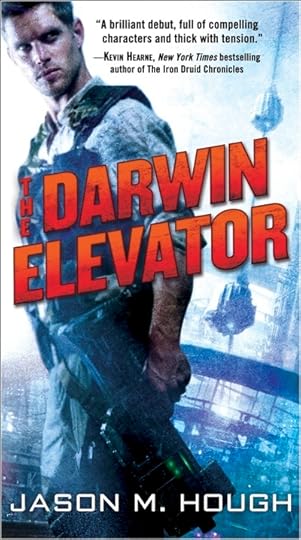
Credit for the painting goes to the amazing Christian McGrath, who will also be doing the covers for books two and three. We'll reveal those in January, along with titles.
I'm very pleased with how it came out. The image manages to capture the grit as well as the wonder, Skyler looks suitably bad-ass, and the title treatment gives a nice hint that the book is a hell of a lot of fun, too (if I do say so myself), in contrast to the seriousness of the image.
Sometime after the new year my editor and I will be co-writing a blog post about how the covers came to be. It's been a fun and fascinating process.
I must also thank the awesome Kevin Hearne for his gracious blurb, and all the kind words he sent me privately. If you haven't read his Iron Druid books, you're missing out.
Here's the full quote:
That seems like a good place to end. More soon!

Credit for the painting goes to the amazing Christian McGrath, who will also be doing the covers for books two and three. We'll reveal those in January, along with titles.
I'm very pleased with how it came out. The image manages to capture the grit as well as the wonder, Skyler looks suitably bad-ass, and the title treatment gives a nice hint that the book is a hell of a lot of fun, too (if I do say so myself), in contrast to the seriousness of the image.
Sometime after the new year my editor and I will be co-writing a blog post about how the covers came to be. It's been a fun and fascinating process.
I must also thank the awesome Kevin Hearne for his gracious blurb, and all the kind words he sent me privately. If you haven't read his Iron Druid books, you're missing out.
Here's the full quote:
"The best part about alien stories is their mystery, and Jason M. Hough understands that like no other. Full of compelling characters and thick with tension, THE DARWIN ELEVATOR delivers both despair and hope along with a gigantic dose of wonder. It's a brilliant debut and Hough can take my money whenever he writes anything from now on."
- Kevin Hearne, New York Times bestselling author of the Iron Druid Chronicles
That seems like a good place to end. More soon!
September 4, 2012
Liftport Kickstarter
A few weeks ago I attended the 2012 Space Elevator Conference in Seattle and met Michael Laine, who heads up the Liftport Group.
Michael setup a Kickstarter campaign to secure funds for some basic space elevator research. His group is interested in the concept of an elevator on the moon, not Earth, which could be used to allow soft-landing of ships and cargo on the moon's surface, and fling ships and cargo at high speed into the outer solar system with minimal fuel.
The campaign's initial goal of just $8000 was quickly met, and has since exploded to almost ten times that (thanks in part to David Brin mentioning it during an NPR interview). This of course earned a lot of attention from the press (the headlines they've come up with are cringe-worthy, but that's typical).
Why such a small goal? One thing Michael understands is the need to take baby steps in order to accomplish the larger goal, and basic research is needed in many areas. And while most of the speakers at the conference also understand this, their approach seems entirely focused on securing government or university research grants. From what I've gleaned, Michael is something of a trailblazer and the use of Kickstarter to fund research certainly qualifies. Congrats, Michael, on your success!
Michael setup a Kickstarter campaign to secure funds for some basic space elevator research. His group is interested in the concept of an elevator on the moon, not Earth, which could be used to allow soft-landing of ships and cargo on the moon's surface, and fling ships and cargo at high speed into the outer solar system with minimal fuel.
The campaign's initial goal of just $8000 was quickly met, and has since exploded to almost ten times that (thanks in part to David Brin mentioning it during an NPR interview). This of course earned a lot of attention from the press (the headlines they've come up with are cringe-worthy, but that's typical).
Why such a small goal? One thing Michael understands is the need to take baby steps in order to accomplish the larger goal, and basic research is needed in many areas. And while most of the speakers at the conference also understand this, their approach seems entirely focused on securing government or university research grants. From what I've gleaned, Michael is something of a trailblazer and the use of Kickstarter to fund research certainly qualifies. Congrats, Michael, on your success!


