
Jason M. Hough's Blog, page 4
June 3, 2014
Phoenix Comicon!
Here's my complete schedule for Phoenix Comicon, coming up this weekend. Complete as in: what their website says plus other activities --
Signings:Friday June 6th at 5:30pm, booth 640 (Del Rey)Saturday June 7th at 4:30pm, booth 640 (Del Rey)Sunday June 8th at 10:30am, booth 640 (Del Rey)
Panels:Improbable Dystopias? : A look at dystopian fiction-what makes some worlds believable, and others not? Join our panelists as they explore these questions. Panelists: Janni Lee Simner, Jason Hough, Laini Taylor, Pierce Brown, Seanan McGuire/Mira GrantWhen: Fri, 10:30–11:30AM Room: North 131The Taco Council : The Taco Council convenes to give its mandates and rulings for 2014. Really, hang out with some awesome authors while they hang out with each other. Panelists: Brian McClellan, Chuck Wendig, Delilah S. Dawson, Jason Hough, Kevin Hearne, Leanna Renee Hieber, Sam SykesWhen: Fri, 3:00–4:00PM Room: North 127abUsing Zombies or Something Like Them : Authors who make use of zombies or creatures like them discuss their take on the creatures. Panelists: David Wellington, Jason Hough, Joseph Nassise, Seanan McGuire/Mira Grant, Tom Leveen, Weston OchseWhen: Sat, 10:30–11:30AM Room: North 126bcClose to Home: Stories of the Solar System : Join authors Pierce Brown and Jason Hough as they chat with astronomers Phil Plait and Patrick Young about our solar system and how it inspired their work. Panelists: Jason Hough, Patrick Young, Phil Plait, Pierce BrownWhen: Sat, 12:00–1:00PM Room: North 127abWorldbuilding: Economics : Or who pays for all those horses and rockets anyway? A crucial part of building a credible world is to create a believable working economy. Join some of our author guests as they share their secrets for doing just that. Panelists: Jason Hough, L.E. Modesitt Jr, Pierce Brown, Scott LynchWhen: Sat, 3:00–4:00PM Room: North 126bcDrinks With Authors : Join our author guests for a glass or two in an informal setting. There will be door prizes and other giveaways from our participating publishers. Panelists: Kevin Hearne, Myke Cole, Sam Sykes & many othersWhen: Sat, 8:00–11:00PM Room: Renaissance Salon 5-8
Pretty much any other time I'll be at Table 2423 (shared with Django Wexler).
Signings:Friday June 6th at 5:30pm, booth 640 (Del Rey)Saturday June 7th at 4:30pm, booth 640 (Del Rey)Sunday June 8th at 10:30am, booth 640 (Del Rey)
Panels:Improbable Dystopias? : A look at dystopian fiction-what makes some worlds believable, and others not? Join our panelists as they explore these questions. Panelists: Janni Lee Simner, Jason Hough, Laini Taylor, Pierce Brown, Seanan McGuire/Mira GrantWhen: Fri, 10:30–11:30AM Room: North 131The Taco Council : The Taco Council convenes to give its mandates and rulings for 2014. Really, hang out with some awesome authors while they hang out with each other. Panelists: Brian McClellan, Chuck Wendig, Delilah S. Dawson, Jason Hough, Kevin Hearne, Leanna Renee Hieber, Sam SykesWhen: Fri, 3:00–4:00PM Room: North 127abUsing Zombies or Something Like Them : Authors who make use of zombies or creatures like them discuss their take on the creatures. Panelists: David Wellington, Jason Hough, Joseph Nassise, Seanan McGuire/Mira Grant, Tom Leveen, Weston OchseWhen: Sat, 10:30–11:30AM Room: North 126bcClose to Home: Stories of the Solar System : Join authors Pierce Brown and Jason Hough as they chat with astronomers Phil Plait and Patrick Young about our solar system and how it inspired their work. Panelists: Jason Hough, Patrick Young, Phil Plait, Pierce BrownWhen: Sat, 12:00–1:00PM Room: North 127abWorldbuilding: Economics : Or who pays for all those horses and rockets anyway? A crucial part of building a credible world is to create a believable working economy. Join some of our author guests as they share their secrets for doing just that. Panelists: Jason Hough, L.E. Modesitt Jr, Pierce Brown, Scott LynchWhen: Sat, 3:00–4:00PM Room: North 126bcDrinks With Authors : Join our author guests for a glass or two in an informal setting. There will be door prizes and other giveaways from our participating publishers. Panelists: Kevin Hearne, Myke Cole, Sam Sykes & many othersWhen: Sat, 8:00–11:00PM Room: Renaissance Salon 5-8
Pretty much any other time I'll be at Table 2423 (shared with Django Wexler).


May 4, 2014
Book vs. Films: "For Your Eyes Only"
This is a bit of a bit of a departure from the first seven entries in this series, because For Your Eyes Only is not a Bond novel, but rather a collection of short stories.
The five stories included therein were made into four films, with varying success and faithfulness to the source.Here's the breakdown:
From a View to a Kill: Nice, tidy little story where Bond investigates the murder of a signal dispatch rider in France. It's a fairly simple tale, and one where Bond is saved in the end by the woman he's been flirting with throughout. All in all, nothing particularly special. It does contain the types of things you'd never see in a Bond film -- for example, Bond sitting dressed in camouflage in a tree all night just to try and catch the killer returning to the scene of the crime.
Bond also rides the same dispatch route (with an empty mail bag) in order to try and lure the murderer to come after him. It's a very cool scene. Unfortunately nothing remotely like it was included in the film. Actually nothing in the film could be described as a "cool scene".
The film in fact has only one tie to the story: its title A View to a Kill. It's a terrible movie that even an extremely psychopathic Christopher Walken and a Duran Duran title track couldn't save.
For Your Eyes Only: A fairly straightforward story where Bond is sent by M to kill some unpleasant men who are hiding in America. They murdered some old friends of M's in Jamaica, but for a variety of reasons are above the law now. Bond agrees to go and do this as a personal favor, but when he gets there the daughter of the murdered couple is also on-site to accomplish the same task. They team up, and Bond actually plays second fiddle to her bow-and-arrow slaying of the main boss. It's a nice little story, satisfying but not particularly compelling.The story is more or less adapted as-is for the film, albeit reduced to a single moment in a much larger caper. As such, the simplicity of the story is largely lost in the much grander moments of the film. More on that below.
One thing to note: if I'm not mistaken, the scene towards the end where Bond and Melina are dragged along a reef behind a boat is lifted almost exactly from the novel Thunderball. I'm curious now if the film version of Thunderball includes the same scene. It seems odd they would reuse it. We'll find out in the next blog entry. According to Wikipedia, the producers lifted elements from three other Bond novels to stitch this plot together, and it shows. It's sort of a James Bond sample platter. You have to hand it to Sheena Easton, and curse her name to the sky above. It's been a week since I watched it and that infuriatingly catchy theme song refuses to get out of my skull.
Quantum of Solace: Quite an odd departure, here. This is in fact not a Bond story at all. Bond is having an after-dinner conversation with the Governor of the Bahamas, and the man tells him the story a local couple that started out fairy tale perfect, and ended in a rather ruthless and messy divorce. The explanation of the name, quantum of solace, is pretty neat. It refers to the theory the Governor has that a couple can remain together through anything as long as there is a minimum level of common decency, a quantum of solace, afforded each. Once either stops holding that for their partner, the relationship will die. Bond is not involved in this story at all, he simply hears it told, which is an interesting literary mechanism.As the film shares only the title, I'll not even attempt to compare them. It's funny how this film is considered bad by so many, sandwiched between the great Casino Royale (which I loved) and Skyfall (which I didn't care for, but seems to be popular among fans). The thing is, compared to most of the earlier films, even this weak entry into the Daniel Craig era is practically a masterpiece. If anything it says a lot about how far we've come in the cinematic arts. The pace, the production quality, plus the lack of shtick that plagues earlier Bond films, all make for a much more enjoyable experience. It has nothing to do with the short story of course, but then in this case that makes sense since the story had nothing to do with Bond. The title is cool, though, and I'm glad they used it.
Risico: This story chronicles Bond going after an Italian drug smuggler only to find that the informant who originally put him onto the trail is the one smuggling drugs. The man Bond is after ends up helping Bond track down the original informant.It's told more or less exactly as written during the second half of the film For Your Eyes Only, and this disjointed use of two unrelated short stories contributes a lot to the film's rather vague plot. In fact, near the end of the movie when Bond and Melina descend in a submarine to find a crashed ship I was finally reminded what the hell their goal was the whole time. In the space of just 90 minutes I'd already forgotten the opening setup. In a weird way it reminded me of playing Dungeons and Dragons where, after weeks of Friday night games that led us from adventure to adventure, we'd suddenly come to the awkward moment when nobody save the DM could remember what the hell we were supposed to be doing. If this movie suffers from anything, it's the lack of occasional reminder as to what Bond's mission is. I will admit I was perhaps confused because the grander mission in the film's plot was not the same as either of the short stories. Still...The movie did have some great scenes. In particular the climb up to the mountaintop base was well filmed and very tense. It also had some amazing groaners, chief among them the "chat" Bond has with Margaret Thatcher at the end, during which I wanted to hide behind my pillow out of embarrassment for all involved. Oh, and holy crap did the music suck!
One last thing on this: Roger Moore was quoted as saying that Quantum of Solace (the film) was good but the cuts were too vague, the story too hard to follow. He should know, I guess, given that's the main problem that plagues most (if not all) of his Bond films. No fault of Moore's, mind you, but I found it interesting that he would remark on this of all things.
The Hildebrand Rarity: Bond is in the Seychelles, with a week to kill before his boat arrives to take him back to civilization (ahhh, travel in 1959!). He ends up going along on a wealthy man's expedition to find a rare fish (where the title comes from). You'd think Bond would stumble into some much larger evil plot, but no, this really is just a short story that involves an abusive husband who gets his due in rather spectacular fashion, with Bond in the middle of the argument but plays almost zero part in the resolution.
Some aspects of this story were woven into the 1989 film License to Kill, the second and last entry of the unpopular Timothy Dalton era. I guess they thought the title wasn't bad-ass enough? The film is forgettable, and the elements borrowed from this story were minor.
What did we learn from all this? Well, the main thing in my mind is that the movie producers were definitely scraping the bottom of the barrel when they started using these stories as the basis for Bond movies. Not that there's anything wrong with the stories per say, but none on their own provide enough material to adapt as is. They must have been either culturally (in the sense that fans demanded it) or legally bound to use Fleming-penned material in the Bond movies. In the case of Quantum of Solace, which came out after there'd been a handful of non-Fleming Bond films released, it seems they simply liked the title. I can't think of any other literary property so completely tapped for adaptation that such a bottom trawling occurred. Anyone?
Next up, Thunderball... the novel, the film, and the second attempt at the film, Never Say Never Again.
The five stories included therein were made into four films, with varying success and faithfulness to the source.Here's the breakdown:
From a View to a Kill: Nice, tidy little story where Bond investigates the murder of a signal dispatch rider in France. It's a fairly simple tale, and one where Bond is saved in the end by the woman he's been flirting with throughout. All in all, nothing particularly special. It does contain the types of things you'd never see in a Bond film -- for example, Bond sitting dressed in camouflage in a tree all night just to try and catch the killer returning to the scene of the crime.
Bond also rides the same dispatch route (with an empty mail bag) in order to try and lure the murderer to come after him. It's a very cool scene. Unfortunately nothing remotely like it was included in the film. Actually nothing in the film could be described as a "cool scene".
The film in fact has only one tie to the story: its title A View to a Kill. It's a terrible movie that even an extremely psychopathic Christopher Walken and a Duran Duran title track couldn't save.
For Your Eyes Only: A fairly straightforward story where Bond is sent by M to kill some unpleasant men who are hiding in America. They murdered some old friends of M's in Jamaica, but for a variety of reasons are above the law now. Bond agrees to go and do this as a personal favor, but when he gets there the daughter of the murdered couple is also on-site to accomplish the same task. They team up, and Bond actually plays second fiddle to her bow-and-arrow slaying of the main boss. It's a nice little story, satisfying but not particularly compelling.The story is more or less adapted as-is for the film, albeit reduced to a single moment in a much larger caper. As such, the simplicity of the story is largely lost in the much grander moments of the film. More on that below.
One thing to note: if I'm not mistaken, the scene towards the end where Bond and Melina are dragged along a reef behind a boat is lifted almost exactly from the novel Thunderball. I'm curious now if the film version of Thunderball includes the same scene. It seems odd they would reuse it. We'll find out in the next blog entry. According to Wikipedia, the producers lifted elements from three other Bond novels to stitch this plot together, and it shows. It's sort of a James Bond sample platter. You have to hand it to Sheena Easton, and curse her name to the sky above. It's been a week since I watched it and that infuriatingly catchy theme song refuses to get out of my skull.
Quantum of Solace: Quite an odd departure, here. This is in fact not a Bond story at all. Bond is having an after-dinner conversation with the Governor of the Bahamas, and the man tells him the story a local couple that started out fairy tale perfect, and ended in a rather ruthless and messy divorce. The explanation of the name, quantum of solace, is pretty neat. It refers to the theory the Governor has that a couple can remain together through anything as long as there is a minimum level of common decency, a quantum of solace, afforded each. Once either stops holding that for their partner, the relationship will die. Bond is not involved in this story at all, he simply hears it told, which is an interesting literary mechanism.As the film shares only the title, I'll not even attempt to compare them. It's funny how this film is considered bad by so many, sandwiched between the great Casino Royale (which I loved) and Skyfall (which I didn't care for, but seems to be popular among fans). The thing is, compared to most of the earlier films, even this weak entry into the Daniel Craig era is practically a masterpiece. If anything it says a lot about how far we've come in the cinematic arts. The pace, the production quality, plus the lack of shtick that plagues earlier Bond films, all make for a much more enjoyable experience. It has nothing to do with the short story of course, but then in this case that makes sense since the story had nothing to do with Bond. The title is cool, though, and I'm glad they used it.
Risico: This story chronicles Bond going after an Italian drug smuggler only to find that the informant who originally put him onto the trail is the one smuggling drugs. The man Bond is after ends up helping Bond track down the original informant.It's told more or less exactly as written during the second half of the film For Your Eyes Only, and this disjointed use of two unrelated short stories contributes a lot to the film's rather vague plot. In fact, near the end of the movie when Bond and Melina descend in a submarine to find a crashed ship I was finally reminded what the hell their goal was the whole time. In the space of just 90 minutes I'd already forgotten the opening setup. In a weird way it reminded me of playing Dungeons and Dragons where, after weeks of Friday night games that led us from adventure to adventure, we'd suddenly come to the awkward moment when nobody save the DM could remember what the hell we were supposed to be doing. If this movie suffers from anything, it's the lack of occasional reminder as to what Bond's mission is. I will admit I was perhaps confused because the grander mission in the film's plot was not the same as either of the short stories. Still...The movie did have some great scenes. In particular the climb up to the mountaintop base was well filmed and very tense. It also had some amazing groaners, chief among them the "chat" Bond has with Margaret Thatcher at the end, during which I wanted to hide behind my pillow out of embarrassment for all involved. Oh, and holy crap did the music suck!
One last thing on this: Roger Moore was quoted as saying that Quantum of Solace (the film) was good but the cuts were too vague, the story too hard to follow. He should know, I guess, given that's the main problem that plagues most (if not all) of his Bond films. No fault of Moore's, mind you, but I found it interesting that he would remark on this of all things.
The Hildebrand Rarity: Bond is in the Seychelles, with a week to kill before his boat arrives to take him back to civilization (ahhh, travel in 1959!). He ends up going along on a wealthy man's expedition to find a rare fish (where the title comes from). You'd think Bond would stumble into some much larger evil plot, but no, this really is just a short story that involves an abusive husband who gets his due in rather spectacular fashion, with Bond in the middle of the argument but plays almost zero part in the resolution.
Some aspects of this story were woven into the 1989 film License to Kill, the second and last entry of the unpopular Timothy Dalton era. I guess they thought the title wasn't bad-ass enough? The film is forgettable, and the elements borrowed from this story were minor.
What did we learn from all this? Well, the main thing in my mind is that the movie producers were definitely scraping the bottom of the barrel when they started using these stories as the basis for Bond movies. Not that there's anything wrong with the stories per say, but none on their own provide enough material to adapt as is. They must have been either culturally (in the sense that fans demanded it) or legally bound to use Fleming-penned material in the Bond movies. In the case of Quantum of Solace, which came out after there'd been a handful of non-Fleming Bond films released, it seems they simply liked the title. I can't think of any other literary property so completely tapped for adaptation that such a bottom trawling occurred. Anyone?
Next up, Thunderball... the novel, the film, and the second attempt at the film, Never Say Never Again.
Book vs. Films - "For Your Eyes Only"
This is a bit of a bit of a departure from the first seven entries in this series, because For Your Eyes Only is not a Bond novel, but rather a collection of short stories.
The five stories included therein were made into four films, with varying success and faithfulness to the source.Here's the breakdown:
From a View to a Kill: Nice, tidy little story where Bond investigates the murder of a signal dispatch rider in France. It's a fairly simple tale, and one where Bond is saved in the end by the woman he's been flirting with throughout. All in all, nothing particularly special. It does contain the types of things you'd never see in a Bond film -- for example, Bond sitting dressed in camouflage in a tree all night just to try and catch the killer returning to the scene of the crime.
Bond also rides the same dispatch route (with an empty mail bag) in order to try and lure the murderer to come after him. It's a very cool scene. Unfortunately nothing remotely like it was included in the film. Actually nothing in the film could be described as a "cool scene".
The film in fact has only one tie to the story: its title A View to a Kill. It's a terrible movie that even an extremely psychopathic Christopher Walken and a Duran Duran title track couldn't save.
For Your Eyes Only: A fairly straightforward story where Bond is sent by M to kill some unpleasant men who are hiding in America. They murdered some old friends of M's in Jamaica, but for a variety of reasons are above the law now. Bond agrees to go and do this as a personal favor, but when he gets there the daughter of the murdered couple is also on-site to accomplish the same task. They team up, and Bond actually plays second fiddle to her bow-and-arrow slaying of the main boss. It's a nice little story, satisfying but not particularly compelling.The story is more or less adapted as-is for the film, albeit reduced to a single moment in a much larger caper. As such, the simplicity of the story is largely lost in the much grander moments of the film. More on that below.
One thing to note: if I'm not mistaken, the scene towards the end where Bond and Melina are dragged along a reef behind a boat is lifted almost exactly from the novel Thunderball. I'm curious now if the film version of Thunderball includes the same scene. It seems odd they would reuse it. We'll find out in the next blog entry. According to Wikipedia, the producers lifted elements from three other Bond novels to stitch this plot together, and it shows. It's sort of a James Bond sample platter. You have to hand it to Sheena Easton, and curse her name to the sky above. It's been a week since I watched it and that infuriatingly catchy theme song refuses to get out of my skull.
Quantum of Solace: Quite an odd departure, here. This is in fact not a Bond story at all. Bond is having an after-dinner conversation with the Governor of the Bahamas, and the man tells him the story a local couple that started out fairy tale perfect, and ended in a rather ruthless and messy divorce. The explanation of the name, quantum of solace, is pretty neat. It refers to the theory the Governor has that a couple can remain together through anything as long as there is a minimum level of common decency, a quantum of solace, afforded each. Once either stops holding that for their partner, the relationship will die. Bond is not involved in this story at all, he simply hears it told, which is an interesting literary mechanism.As the film shares only the title, I'll not even attempt to compare them. It's funny how this film is considered bad by so many, sandwiched between the great Casino Royale (which I loved) and Skyfall (which I didn't care for, but seems to be popular among fans). The thing is, compared to most of the earlier films, even this weak entry into the Daniel Craig era is practically a masterpiece. If anything it says a lot about how far we've come in the cinematic arts. The pace, the production quality, plus the lack of shtick that plagues earlier Bond films, all make for a much more enjoyable experience. It has nothing to do with the short story of course, but then in this case that makes sense since the story had nothing to do with Bond. The title is cool, though, and I'm glad they used it.
Risico: This story chronicles Bond going after an Italian drug smuggler only to find that the informant who originally put him onto the trail is the one smuggling drugs. The man Bond is after ends up helping Bond track down the original informant.It's told more or less exactly as written during the second half of the film For Your Eyes Only, and this disjointed use of two unrelated short stories contributes a lot to the film's rather vague plot. In fact, near the end of the movie when Bond and Melina descend in a submarine to find a crashed ship I was finally reminded what the hell their goal was the whole time. In the space of just 90 minutes I'd already forgotten the opening setup. In a weird way it reminded me of playing Dungeons and Dragons where, after weeks of Friday night games that led us from adventure to adventure, we'd suddenly come to the awkward moment when nobody save the DM could remember what the hell we were supposed to be doing. If this movie suffers from anything, it's the lack of occasional reminder as to what Bond's mission is. I will admit I was perhaps confused because the grander mission in the film's plot was not the same as either of the short stories. Still...The movie did have some great scenes. In particular the climb up to the mountaintop base was well filmed and very tense. It also had some amazing groaners, chief among them the "chat" Bond has with Margaret Thatcher at the end, during which I wanted to hide behind my pillow out of embarrassment for all involved. Oh, and holy crap did the music suck!
One last thing on this: Roger Moore was quoted as saying that Quantum of Solace (the film) was good but the cuts were too vague, the story too hard to follow. He should know, I guess, given that's the main problem that plagues most (if not all) of his Bond films. No fault of Moore's, mind you, but I found it interesting that he would remark on this of all things.
The Hildebrand Rarity: Bond is in the Seychelles, with a week to kill before his boat arrives to take him back to civilization (ahhh, travel in 1959!). He ends up going along on a wealthy man's expedition to find a rare fish (where the title comes from). You'd think Bond would stumble into some much larger evil plot, but no, this really is just a short story that involves an abusive husband who gets his due in rather spectacular fashion, with Bond in the middle of the argument but plays almost zero part in the resolution.
Some aspects of this story were woven into the 1989 film License to Kill, the second and last entry of the unpopular Timothy Dalton era. I guess they thought the title wasn't bad-ass enough? The film is forgettable, and the elements borrowed from this story were minor.
What did we learn from all this? Well, the main thing in my mind is that the movie producers were definitely scraping the bottom of the barrel when they started using these stories as the basis for Bond movies. Not that there's anything wrong with the stories per say, but none on their own provide enough material to adapt as is. They must have been either culturally (in the sense that fans demanded it) or legally bound to use Fleming-penned material in the Bond movies. In the case of Quantum of Solace, which came out after there'd been a handful of non-Fleming Bond films released, it seems they simply liked the title. I can't think of any other literary property so completely tapped for adaptation that such a bottom trawling occurred. Anyone?
Next up, Thunderball... the novel, the film, and the second attempt at the film, Never Say Never Again.
The five stories included therein were made into four films, with varying success and faithfulness to the source.Here's the breakdown:
From a View to a Kill: Nice, tidy little story where Bond investigates the murder of a signal dispatch rider in France. It's a fairly simple tale, and one where Bond is saved in the end by the woman he's been flirting with throughout. All in all, nothing particularly special. It does contain the types of things you'd never see in a Bond film -- for example, Bond sitting dressed in camouflage in a tree all night just to try and catch the killer returning to the scene of the crime.
Bond also rides the same dispatch route (with an empty mail bag) in order to try and lure the murderer to come after him. It's a very cool scene. Unfortunately nothing remotely like it was included in the film. Actually nothing in the film could be described as a "cool scene".
The film in fact has only one tie to the story: its title A View to a Kill. It's a terrible movie that even an extremely psychopathic Christopher Walken and a Duran Duran title track couldn't save.
For Your Eyes Only: A fairly straightforward story where Bond is sent by M to kill some unpleasant men who are hiding in America. They murdered some old friends of M's in Jamaica, but for a variety of reasons are above the law now. Bond agrees to go and do this as a personal favor, but when he gets there the daughter of the murdered couple is also on-site to accomplish the same task. They team up, and Bond actually plays second fiddle to her bow-and-arrow slaying of the main boss. It's a nice little story, satisfying but not particularly compelling.The story is more or less adapted as-is for the film, albeit reduced to a single moment in a much larger caper. As such, the simplicity of the story is largely lost in the much grander moments of the film. More on that below.
One thing to note: if I'm not mistaken, the scene towards the end where Bond and Melina are dragged along a reef behind a boat is lifted almost exactly from the novel Thunderball. I'm curious now if the film version of Thunderball includes the same scene. It seems odd they would reuse it. We'll find out in the next blog entry. According to Wikipedia, the producers lifted elements from three other Bond novels to stitch this plot together, and it shows. It's sort of a James Bond sample platter. You have to hand it to Sheena Easton, and curse her name to the sky above. It's been a week since I watched it and that infuriatingly catchy theme song refuses to get out of my skull.
Quantum of Solace: Quite an odd departure, here. This is in fact not a Bond story at all. Bond is having an after-dinner conversation with the Governor of the Bahamas, and the man tells him the story a local couple that started out fairy tale perfect, and ended in a rather ruthless and messy divorce. The explanation of the name, quantum of solace, is pretty neat. It refers to the theory the Governor has that a couple can remain together through anything as long as there is a minimum level of common decency, a quantum of solace, afforded each. Once either stops holding that for their partner, the relationship will die. Bond is not involved in this story at all, he simply hears it told, which is an interesting literary mechanism.As the film shares only the title, I'll not even attempt to compare them. It's funny how this film is considered bad by so many, sandwiched between the great Casino Royale (which I loved) and Skyfall (which I didn't care for, but seems to be popular among fans). The thing is, compared to most of the earlier films, even this weak entry into the Daniel Craig era is practically a masterpiece. If anything it says a lot about how far we've come in the cinematic arts. The pace, the production quality, plus the lack of shtick that plagues earlier Bond films, all make for a much more enjoyable experience. It has nothing to do with the short story of course, but then in this case that makes sense since the story had nothing to do with Bond. The title is cool, though, and I'm glad they used it.
Risico: This story chronicles Bond going after an Italian drug smuggler only to find that the informant who originally put him onto the trail is the one smuggling drugs. The man Bond is after ends up helping Bond track down the original informant.It's told more or less exactly as written during the second half of the film For Your Eyes Only, and this disjointed use of two unrelated short stories contributes a lot to the film's rather vague plot. In fact, near the end of the movie when Bond and Melina descend in a submarine to find a crashed ship I was finally reminded what the hell their goal was the whole time. In the space of just 90 minutes I'd already forgotten the opening setup. In a weird way it reminded me of playing Dungeons and Dragons where, after weeks of Friday night games that led us from adventure to adventure, we'd suddenly come to the awkward moment when nobody save the DM could remember what the hell we were supposed to be doing. If this movie suffers from anything, it's the lack of occasional reminder as to what Bond's mission is. I will admit I was perhaps confused because the grander mission in the film's plot was not the same as either of the short stories. Still...The movie did have some great scenes. In particular the climb up to the mountaintop base was well filmed and very tense. It also had some amazing groaners, chief among them the "chat" Bond has with Margaret Thatcher at the end, during which I wanted to hide behind my pillow out of embarrassment for all involved. Oh, and holy crap did the music suck!
One last thing on this: Roger Moore was quoted as saying that Quantum of Solace (the film) was good but the cuts were too vague, the story too hard to follow. He should know, I guess, given that's the main problem that plagues most (if not all) of his Bond films. No fault of Moore's, mind you, but I found it interesting that he would remark on this of all things.
The Hildebrand Rarity: Bond is in the Seychelles, with a week to kill before his boat arrives to take him back to civilization (ahhh, travel in 1959!). He ends up going along on a wealthy man's expedition to find a rare fish (where the title comes from). You'd think Bond would stumble into some much larger evil plot, but no, this really is just a short story that involves an abusive husband who gets his due in rather spectacular fashion, with Bond in the middle of the argument but plays almost zero part in the resolution.
Some aspects of this story were woven into the 1989 film License to Kill, the second and last entry of the unpopular Timothy Dalton era. I guess they thought the title wasn't bad-ass enough? The film is forgettable, and the elements borrowed from this story were minor.
What did we learn from all this? Well, the main thing in my mind is that the movie producers were definitely scraping the bottom of the barrel when they started using these stories as the basis for Bond movies. Not that there's anything wrong with the stories per say, but none on their own provide enough material to adapt as is. They must have been either culturally (in the sense that fans demanded it) or legally bound to use Fleming-penned material in the Bond movies. In the case of Quantum of Solace, which came out after there'd been a handful of non-Fleming Bond films released, it seems they simply liked the title. I can't think of any other literary property so completely tapped for adaptation that such a bottom trawling occurred. Anyone?
Next up, Thunderball... the novel, the film, and the second attempt at the film, Never Say Never Again.
April 22, 2014
Book vs. Film: "Goldfinger"
It's the seventh post in this series and I've come to something of a revelation now. I'll share that right away for those not interested in the minutia of Goldfinger's adaptation from novel to screen.
James Bond is, we can all agree, a cultural icon. But probably 98% of the world knows the movie version of the character, and the movie version is not quite the secret agent described in the books. I've pointed out a number of the deviations in these posts, but it's finally dawned on me what an fascinating parallel this is of how history transforms into myth. It's cleansed, it's amplified, it's outright changed to suit the whims of the "historian" (or in this case, the film producers).
Let's take the opening scenes of both versions as an example.
Novel: We start in a bar at the Miami airport. Bond sits alone, drinking. He's a wreck, coming down off the emotional trauma of having to kill a man with his bare hands in an alley in Mexico just hours earlier. He wars with himself over how automatic, how ruthless, his actions had been. And he's basically decided that, thanks to a delayed flight, he's going to get truly drunk for the first time in years just to escape from the memory.
Film: Look at how this opening is translated to screen. We start with a ridiculous looking bird moving across water at night, which then rises to reveal itself as a decoy attached to the top of Bond's SCUBA hood. Because, you know, if you're sneaking into an enemy facility by water at night, being under the surface of said water is just too invisible. You need a bird on your fucking head to really sell it. I digress. Bond is sneaking into a refinery of some sort. He enters a concealed room and lays out some shaped plastic explosive, plants a timer and leaves. We cut to him entering a seedy tavern. He checks his watch, waits one second, and there's a distant fiery explosion. Bond smiles, satisfied even as all the other patrons panic and flee, then he follows the bar's exotic dancer into the back-room for, presumably, a quick after-mission romp.
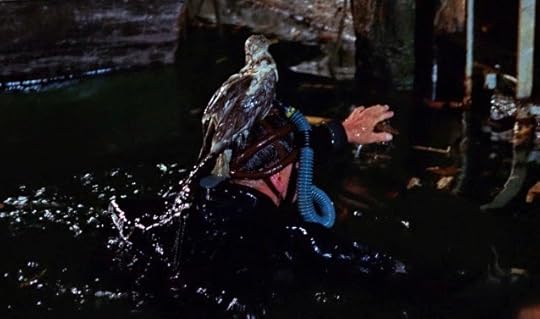 Bird-head Bond
I mean, seriously, you'd never know these two things were related.
Now, I realize Bond is not a historical figure. The point I'm getting at is simply how his character works as an example of what can happen when a story, real or not, is retold. It's why history books are so fraught with inaccuracies, and also why we get the saying "history is written by the victors." With the exception perhaps of Daniel Craig in the latest films, it's hard to imagine the scene as written in the novel making its way onto screen. Such looks into Bond's psyche, on the PTSD-like toll his work takes on him, appear throughout the books. On screen, again perhaps the latest films being a notable exception, Bond is always the slick, sardonic, womanizing soldier most people think of when they think of James Bond. His "real" self, the man as written by Fleming, is largely gone from the public consciousness today, replaced after only one iteration by the caricature we get in the films. For better or worse I'm not interested in right now, I just think it's fascinating to see so clearly how this skewing can happen when we have truly accurate material to compare, something that virtually never happens when studying history. The psychological ramifications are essentially the same, in my view, and so I think it makes an interesting way to study the phenomenon itself.
Right then. To the specifics!
The novel starts with elements of Moonraker and Diamonds are Forever. Once again, Bond's involvement begins with another coincidental meeting. A minor character from Casino Royale recognizes him in that Miami airport and begs Bond to help him figure out how a man named Goldfinger is cheating at cards. Moonraker had a similar setup. This part is fine. What makes it coincidental in a rather unbelievable way is that a month later Bond is put on the case of investigating the gold smuggling antics of, you guessed it, Goldfinger.
In some ways the film improves upon this. Bond is specifically ordered to observe Goldfinger (strangely, he gets those orders from M via Felix Leiter, as if the movie producers were looking for a way to insert the CIA man into the movie). Bond catches Goldfinger at cheating, pretty much exactly as in the book, and then returns to England for his real briefing.
Bond learns then that Goldfinger is somehow smuggling gold out of England. This part is similar to Diamonds are Forever. It must be interesting as an author to reach the point where you can draw on your own works for material to be inspired by (ahem).
So Bond heads to a golf course that Goldfinger mentions frequenting, intending to find out more about the man. In the book we get a lot of detail here about the plan. Bond is going to maintain his cover as an import/export executive who is unhappy in his current job, in hopes of at least earning something of a friendship with Goldfinger, if not an outright job offer. As usual, Fleming has all this stuff well sorted out, and it's great to get so much context and insight. As often happens, the film loses most of this. In fact with Goldfinger I found it extremely frustrating how little background or insight is given to the viewer. Once again Bond seems to just be sort of drifting from one convenient moment to another. There's nothing carefully or cleverly planned about any of it. More fuel on the altered history fire I started above.
The golf scene is very similar in the novel and the film, with two notable differences. In the book, the scene spans multiple chapters and, honestly, just goes on and on. Far more detail about the sport is given than is required. I applaud the filmmakers for tidying this up and simplifying it. However, they don't get a pass because of another change to the Bond character that grates on me now. In some ways it's sort of the opposite of the 'Han shoots first" Star Wars controversy.
You see, in the film Goldfinger is looking for a ball that has gone into the rough. He pretends to find the ball, which is in fact conveniently dropped out of the pant leg of his caddy. Bond knows it's not Goldfinger's ball because he himself is standing on the real one. It's clever and cool and gives a nice exclamation point on Bond's personality. The thing is, in the novel it's Bond's caddy who gets the idea to stand on the ball, and Bond is the one left to be impressed at the clever and rather sinister trick. Again, cast this as if the events were something from history -- accurate in the novel, and then fudged a bit in the film's retelling in order to make the hero seem that much better. A foot soldier's action later attributed to the commander.
A minor note for you car-geeks like me. This marks the first book where Bond drives an Aston Martin. It's a DB3 with some modifications, like reinforced bumpers and a gun hidden below the passenger seat. Note that Bond borrowed the car from the Secret Service's motor pool, to shore up his cover story of being a successful import/export man.
In the novel Bond is captured by Oddjob and placed on a table where a large saw is set in motion toward his naughty bits. Bond refuses to talk, and indeed tries to kill himself simply by holding his breath just to avoid the pain of the sawblade. Inexplicably Bond is not just spared but retained in Goldfinger's service, along with the book's love interest Tilly Masterton. Instead of killing them, Goldfinger puts them in charge of doing his secretarial work during the Ft. Knox heist. I could understand wanting Bond there to assess the other crime bosses, after all he sussed out Goldfinger's card-cheating scheme early on, but I don't see how Goldfinger would trust his answers, much less his work on the papers. Once again, Bond is given long monologue's by the villain on the specifics of the plan "since you're going to die anyway". I would much rather prefer the secret service agent FIND this information rather than be told it so blatantly.
There's another part I have to mention. Bond, and thus Fleming I must assume in this case, has a rather embarrassing diatribe on homosexuality that grates more than any other bit of unpleasantness in the previous books. I'm not sure how much of this can be forgiven due to the era in which it was written. It's bigoted nonsense no matter what year it was written. Some would probably boycott Fleming as a result (if they hadn't already with the racial aspects in earlier books), and I can understand that, but I'm going to soldier on because I'm the forgiving sort, I guess.
Overall this is one of the weaker books in the series. Started off rather good, but loses virtually all its steam when Bond is kept alive by Goldfinger and allowed to sit in on so much of the heist planning.
As for the film, well... on the whole I felt lost early on. There's little explanation given for anything going on. Like the horrid film version of Moonraker, Bond seems to sort of stumble from one convenient clue to the next. Having read the book helped immensely, but if I try to put that knowledge aside it just feels so thin.
I do think there's a few areas the film improves on the book, and that is a rarity so far in this series. There's the aforementioned streamlining of the golf game. Later, Bond actually spies (gasp) on the meeting between Goldfinger and the crime bosses, instead of sitting there as Goldfinger's secretary. The crime bosses, who are basically being invited to participate in the Ft. Knox heist in the book, are actually already working for Goldfinger in the movie, having taken care of various aspects of the prep work without knowing what's really going on. I found this more believable.
There's plenty of flaws, however. First on my mind is that, even though I just finished watching it a few days ago, I cannot for the life of me remember what happened to Tilly Masterton. Maybe I blinked at some point but as far as I can recall she simply disappears when Bond is taken to the US by Goldfinger. In the book Tilly remains Bonds counterpart throughout, but in the film that role shifts to Pussy Galore at this point. That doesn't happen until the very end in the book (and it's lame in both cases, honestly).
Beyond that, the main flaw is simply that Goldfinger would keep Bond alive through all this, and even chain him to the nuclear bomb at the end, leaving one hand free mind you, where Bond can still have one last chance to turn the tables. It's hard to fear these villains as the geniuses they're described as being when they do this sort of thing.
Overall: D+, one of the weaker entires in both the book and the film stables.Book: DFilm: C
Birth of Bond tropes: Finally, the Aston Martin arrives!
The next post will be an interesting one, looking at For Your Eyes Only, which is actually a collection of short stories. Three were "adapted" into films (adapted in quotes because I suspect very little, if any, of the source material was used).
James Bond is, we can all agree, a cultural icon. But probably 98% of the world knows the movie version of the character, and the movie version is not quite the secret agent described in the books. I've pointed out a number of the deviations in these posts, but it's finally dawned on me what an fascinating parallel this is of how history transforms into myth. It's cleansed, it's amplified, it's outright changed to suit the whims of the "historian" (or in this case, the film producers).
Let's take the opening scenes of both versions as an example.
Novel: We start in a bar at the Miami airport. Bond sits alone, drinking. He's a wreck, coming down off the emotional trauma of having to kill a man with his bare hands in an alley in Mexico just hours earlier. He wars with himself over how automatic, how ruthless, his actions had been. And he's basically decided that, thanks to a delayed flight, he's going to get truly drunk for the first time in years just to escape from the memory.
Film: Look at how this opening is translated to screen. We start with a ridiculous looking bird moving across water at night, which then rises to reveal itself as a decoy attached to the top of Bond's SCUBA hood. Because, you know, if you're sneaking into an enemy facility by water at night, being under the surface of said water is just too invisible. You need a bird on your fucking head to really sell it. I digress. Bond is sneaking into a refinery of some sort. He enters a concealed room and lays out some shaped plastic explosive, plants a timer and leaves. We cut to him entering a seedy tavern. He checks his watch, waits one second, and there's a distant fiery explosion. Bond smiles, satisfied even as all the other patrons panic and flee, then he follows the bar's exotic dancer into the back-room for, presumably, a quick after-mission romp.
 Bird-head Bond
I mean, seriously, you'd never know these two things were related.
Now, I realize Bond is not a historical figure. The point I'm getting at is simply how his character works as an example of what can happen when a story, real or not, is retold. It's why history books are so fraught with inaccuracies, and also why we get the saying "history is written by the victors." With the exception perhaps of Daniel Craig in the latest films, it's hard to imagine the scene as written in the novel making its way onto screen. Such looks into Bond's psyche, on the PTSD-like toll his work takes on him, appear throughout the books. On screen, again perhaps the latest films being a notable exception, Bond is always the slick, sardonic, womanizing soldier most people think of when they think of James Bond. His "real" self, the man as written by Fleming, is largely gone from the public consciousness today, replaced after only one iteration by the caricature we get in the films. For better or worse I'm not interested in right now, I just think it's fascinating to see so clearly how this skewing can happen when we have truly accurate material to compare, something that virtually never happens when studying history. The psychological ramifications are essentially the same, in my view, and so I think it makes an interesting way to study the phenomenon itself.
Right then. To the specifics!
The novel starts with elements of Moonraker and Diamonds are Forever. Once again, Bond's involvement begins with another coincidental meeting. A minor character from Casino Royale recognizes him in that Miami airport and begs Bond to help him figure out how a man named Goldfinger is cheating at cards. Moonraker had a similar setup. This part is fine. What makes it coincidental in a rather unbelievable way is that a month later Bond is put on the case of investigating the gold smuggling antics of, you guessed it, Goldfinger.
In some ways the film improves upon this. Bond is specifically ordered to observe Goldfinger (strangely, he gets those orders from M via Felix Leiter, as if the movie producers were looking for a way to insert the CIA man into the movie). Bond catches Goldfinger at cheating, pretty much exactly as in the book, and then returns to England for his real briefing.
Bond learns then that Goldfinger is somehow smuggling gold out of England. This part is similar to Diamonds are Forever. It must be interesting as an author to reach the point where you can draw on your own works for material to be inspired by (ahem).
So Bond heads to a golf course that Goldfinger mentions frequenting, intending to find out more about the man. In the book we get a lot of detail here about the plan. Bond is going to maintain his cover as an import/export executive who is unhappy in his current job, in hopes of at least earning something of a friendship with Goldfinger, if not an outright job offer. As usual, Fleming has all this stuff well sorted out, and it's great to get so much context and insight. As often happens, the film loses most of this. In fact with Goldfinger I found it extremely frustrating how little background or insight is given to the viewer. Once again Bond seems to just be sort of drifting from one convenient moment to another. There's nothing carefully or cleverly planned about any of it. More fuel on the altered history fire I started above.
The golf scene is very similar in the novel and the film, with two notable differences. In the book, the scene spans multiple chapters and, honestly, just goes on and on. Far more detail about the sport is given than is required. I applaud the filmmakers for tidying this up and simplifying it. However, they don't get a pass because of another change to the Bond character that grates on me now. In some ways it's sort of the opposite of the 'Han shoots first" Star Wars controversy.
You see, in the film Goldfinger is looking for a ball that has gone into the rough. He pretends to find the ball, which is in fact conveniently dropped out of the pant leg of his caddy. Bond knows it's not Goldfinger's ball because he himself is standing on the real one. It's clever and cool and gives a nice exclamation point on Bond's personality. The thing is, in the novel it's Bond's caddy who gets the idea to stand on the ball, and Bond is the one left to be impressed at the clever and rather sinister trick. Again, cast this as if the events were something from history -- accurate in the novel, and then fudged a bit in the film's retelling in order to make the hero seem that much better. A foot soldier's action later attributed to the commander.
A minor note for you car-geeks like me. This marks the first book where Bond drives an Aston Martin. It's a DB3 with some modifications, like reinforced bumpers and a gun hidden below the passenger seat. Note that Bond borrowed the car from the Secret Service's motor pool, to shore up his cover story of being a successful import/export man.
In the novel Bond is captured by Oddjob and placed on a table where a large saw is set in motion toward his naughty bits. Bond refuses to talk, and indeed tries to kill himself simply by holding his breath just to avoid the pain of the sawblade. Inexplicably Bond is not just spared but retained in Goldfinger's service, along with the book's love interest Tilly Masterton. Instead of killing them, Goldfinger puts them in charge of doing his secretarial work during the Ft. Knox heist. I could understand wanting Bond there to assess the other crime bosses, after all he sussed out Goldfinger's card-cheating scheme early on, but I don't see how Goldfinger would trust his answers, much less his work on the papers. Once again, Bond is given long monologue's by the villain on the specifics of the plan "since you're going to die anyway". I would much rather prefer the secret service agent FIND this information rather than be told it so blatantly.
There's another part I have to mention. Bond, and thus Fleming I must assume in this case, has a rather embarrassing diatribe on homosexuality that grates more than any other bit of unpleasantness in the previous books. I'm not sure how much of this can be forgiven due to the era in which it was written. It's bigoted nonsense no matter what year it was written. Some would probably boycott Fleming as a result (if they hadn't already with the racial aspects in earlier books), and I can understand that, but I'm going to soldier on because I'm the forgiving sort, I guess.
Overall this is one of the weaker books in the series. Started off rather good, but loses virtually all its steam when Bond is kept alive by Goldfinger and allowed to sit in on so much of the heist planning.
As for the film, well... on the whole I felt lost early on. There's little explanation given for anything going on. Like the horrid film version of Moonraker, Bond seems to sort of stumble from one convenient clue to the next. Having read the book helped immensely, but if I try to put that knowledge aside it just feels so thin.
I do think there's a few areas the film improves on the book, and that is a rarity so far in this series. There's the aforementioned streamlining of the golf game. Later, Bond actually spies (gasp) on the meeting between Goldfinger and the crime bosses, instead of sitting there as Goldfinger's secretary. The crime bosses, who are basically being invited to participate in the Ft. Knox heist in the book, are actually already working for Goldfinger in the movie, having taken care of various aspects of the prep work without knowing what's really going on. I found this more believable.
There's plenty of flaws, however. First on my mind is that, even though I just finished watching it a few days ago, I cannot for the life of me remember what happened to Tilly Masterton. Maybe I blinked at some point but as far as I can recall she simply disappears when Bond is taken to the US by Goldfinger. In the book Tilly remains Bonds counterpart throughout, but in the film that role shifts to Pussy Galore at this point. That doesn't happen until the very end in the book (and it's lame in both cases, honestly).
Beyond that, the main flaw is simply that Goldfinger would keep Bond alive through all this, and even chain him to the nuclear bomb at the end, leaving one hand free mind you, where Bond can still have one last chance to turn the tables. It's hard to fear these villains as the geniuses they're described as being when they do this sort of thing.
Overall: D+, one of the weaker entires in both the book and the film stables.Book: DFilm: C
Birth of Bond tropes: Finally, the Aston Martin arrives!
The next post will be an interesting one, looking at For Your Eyes Only, which is actually a collection of short stories. Three were "adapted" into films (adapted in quotes because I suspect very little, if any, of the source material was used).
April 7, 2014
Book vs. Film: "Dr. No"
While the sixth book in Ian Fleming's series, Dr. No was the first to be adapted for film. In some ways this makes sense. It was the most recently released when they optioned it, and so it was the one the fans were talking about. Besides, the Bond novels are rather self-contained affairs, only very rarely -- and very casually -- referencing past events. As such, I can't really fault them for starting here. The novel serves for as good an introduction to the character as any, especially when you consider the fact that Bond breaks the main 'rule' of a great character: he has no arc. He never changes. Amusing that he's become one of the greatest characters (certainly one of the most iconic and well known).
However, starting with Dr. No did have a somewhat negative effect on the film series in my opinion. After the five previous books, Fleming had to notch things up to keep readers excited. As I've noted in many of the prior articles in this series, this made the earlier books somewhat difficult to adapt, most notably From Russia With Love, which is perhaps the most subdued of the novels and yet followed Dr. No to the screen. It meant they had to tweak the material to keep ahead of what audiences had seen in Dr. No, and of course once the deviations begin, many things start to unravel.
As a novel, No continues to escalate Fleming's trend of disfigured villains. Dr. No has a variety of physical oddities that definitely lean into the absurd side of things. Fleming, deft as ever, somehow manages to explain all this in a believable way. He's very tall. He has mechanical pincers for hands. He has a trait called dextrocardia: his heart is on the right side of his chest, not the left. Bond describes him as "a giant venomous worm wrapped in grey tin-foil."
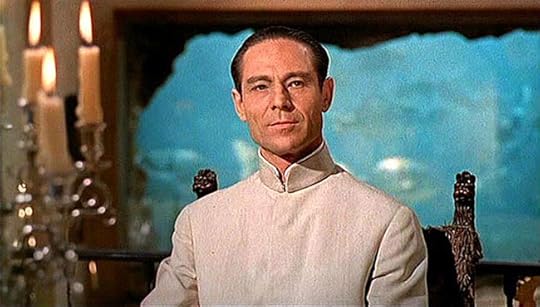 Not much of a worm on screen
The book starts with Bond recovering from the poison Rosa Klebb injected him with at the end of From Russia With Love, which has to be one of the least satisfying conclusions to a cliffhanger ending I've ever read. Like a few of the prior books, No starts with Bond being given an easy task, something to do while recovering from previous difficulties. Bond resents this but follows orders. As you can guess, things don't turn out to be so easy.
The trope of trying to kill Bond in creative ways starts here. There's a deadly centipede left to roam his hotel room. There's a basket of poisoned fruit which Bond notices has needle injection holes just before eating. This is not happening because Dr. No is being dramatic, as the film suggests. It's because No has already had one British agent assassinated (Bond is there to investigate this). No doesn't want Bond snooping around, but knows if he has him shot or something it would only lead to more scrutiny.
Fleming also shows his skill at explaining implausible things with the name, Dr. No. It is an assumed name, but not chosen because it sounds cool or sinister. No studied medicine to learn how to keep himself alive as long as possible and also change his appearance. He chose the same Julius No because Julius was his father's name and No represents that he does not want to be anything like his father.
One subtle but important change between book and film is the obstacle course. Dr. No decides to kill Bond by running him through a carefully devised course designed to inflict pain. It's essentially a ventilation shaft with a bunch of traps, each more nasty than the previous one. Important to note: Bond is escaping by crawling through a ventilation shaft, which is of course a classic trope, but here it's happening on purpose. No tells him about the course, and expects Bond to try getting out rather than just sitting in a cell and dying quietly. No studies pain, and finds putting people through this course is an interesting way to see how far they can get before dying. Bond only barely survives because he stole a steak knife and a lighter before going in. The scene going through the course is extremely well written. It's terrifying and extremely claustrophobic. I'll get to why the film version fails in a minute.
The failing here is that No, after all his talk about wanting to observe Bond's pain tolerance and use his death as another datapoint to help refine the obstacle course, doesn't stick around to watch what happens. It's unbelievable that he would go to all this chatter about being interested in pain and interesting means of killing someone and then not stick around to watch. Worse, he devises a nasty death for Bond's love interest as well, and doesn't even stick around to watch her die, either.
The film version tracks to the book fairly well, and that's a good thing. Sadly, few of the changes made serve to improve upon the book. In fact they suck a lot of the sinister nature right out of it. The geologist Bond meets is in league with Dr. No (instead of simply his snooping secretary). Worse, halfway through the film this man visits Crab Key to check in with his ominous boss. It's a creepy scene, very well filmed, but I found getting this early peek at the Dr.'s lair killed much of the momentum from the scene when Bond finally makes his way there. We already know what Bond is getting into, so everything leading up to it seems a bit of a chore.
Another change is in the general lack of explanation as to how Dr. No came to own Crab Key, and what finally leads to Strangways (the murdered agent Bond is in Jamaica to investigate) snooping around in the first place.
The biggest change, in my view, is the obstacle course. In the book Dr. No goes into great detail about the manner of death he's chosen for Bond. He's created an obstacle course inside his island, and puts captives through it to see how far they can get, tweaking things a little each time. He's genuinely excited to see what Bond can do. So Bond is placed in a cell and begins to crawl through a ventilation duct purpose built for this endeavor, with all sorts of nasty traps along the way, finally ending in an insane fight against a giant squid that somehow comes across quite believable thanks to Fleming's writing style and some excellent narration by Simon Vance (audiobook version, remember). What's so harrowing about this scene is that Bond knows that around every corner Dr. No has devised something more heinous than the last, and yet he has no choice but to keep going.
In the film? Bond is simply placed in a cell. The ventilation duct is a conveniently overlooked escape route. Bond runs into a few of the less dangerous traps seen in the book, and then winds up free and in the heart of No's secret underground base. Ta-da!
The particulars of the two stories diverge from there, and even if the end result is the same, I found the film version a little too convenient, a little too slick. Bond goes through hell in the book. It's a brutal series of chapters. The movie version seems like just a mild inconvenience for him, leading to a rather dull scene at the end where Bond sabotages Dr. No's grand scheme by standing around lamely in the oh-so-convenient disguise of a hazmat suit.
Another change in this part of the film that grated on me is that Bond, during all this craziness, finds and frees Honey. She's tied down on a stone platform, about to be drowned. In the book, she's tied to the mountainside where hordes of crabs are known to come every night. Dr. No explains in great detail how the last woman he tied out there was eaten from the ankles up, and he's curious to see if Honey will last longer. Critically, she escapes on her own, mainly because she is not afraid of the crabs so they don't pay attention to her. Eventually she finds Bond and they work together. The film opts for the "damsel in distress" trope in almost throwaway fashion, and it's a huge let down compared to the book.
Honeychild Rider becomes simply Honey Rider, which perhaps gave a kick-in-the-proverbial-pants to the film series as ever more ludicrous female character names (and the quips that come with them) abound later on. And, of course, in the book Honeychild Rider has a great explanation for her name -- as does Dr. No -- but that is never mentioned here, so viewers are just left to think it's deliberately chosen to sound sexy and/or cool.
Overall the film is one of the more enjoyable in the franchise. Connery is excellent as Bond, and most of the cliche stuff is absent in this first film outing. I enjoyed watching it again after so many years, but having just finished listening to the book the day before, I once again found the book superior, especially where the two diverged.
Book: B+
Film: B
Faithfulness to the Book: B-
Birth of Bond tropes: There's a few places in the film where Bond utters a sardonic one-liner. Audiences must have liked this a lot considering how ridiculous they get with it in later films.
Also, an additional scene is added near the beginning, when we first meet film-Bond. I suppose they did this to establish his character, but it's a bit clumsy. Bond is gambling, high stakes and winning (in the books Bond is a civil servant with the sort of low salary you'd expect - a gambler yes, but only if a mission requires it). Simultaneously he's flirting with a beautiful woman, and they make a date for the next day. Later, after getting his mission briefing from M, Bond returns home to find the woman somehow inside his apartment, dressed only in one of his shirts. He, a top agent of the British Secret Service, seems completely untroubled that this woman has managed to break in to his flat. And of course he ignores M's orders to depart immediately for Jamaica so that he can bed her. It all implies Bond doesn't care about security, and would disregard M's orders simply to get a little last-minute casual sex. I found it a prime example of the movie people not really understanding the character, and unfortunately the whole business sets a precedent for the rest of the movies.
Some trivia: The book started life as a television pitch called "Commander Jamaica", with a main character named James Gunn. Fleming later turned it into this book, originally with the title The Wound Man.
Next up, Goldfinger.
The previous posts in this series, in order:
Casino Royale
Live and Let Die
Moonraker
Diamonds are Forever
From Russia With Love
However, starting with Dr. No did have a somewhat negative effect on the film series in my opinion. After the five previous books, Fleming had to notch things up to keep readers excited. As I've noted in many of the prior articles in this series, this made the earlier books somewhat difficult to adapt, most notably From Russia With Love, which is perhaps the most subdued of the novels and yet followed Dr. No to the screen. It meant they had to tweak the material to keep ahead of what audiences had seen in Dr. No, and of course once the deviations begin, many things start to unravel.
As a novel, No continues to escalate Fleming's trend of disfigured villains. Dr. No has a variety of physical oddities that definitely lean into the absurd side of things. Fleming, deft as ever, somehow manages to explain all this in a believable way. He's very tall. He has mechanical pincers for hands. He has a trait called dextrocardia: his heart is on the right side of his chest, not the left. Bond describes him as "a giant venomous worm wrapped in grey tin-foil."
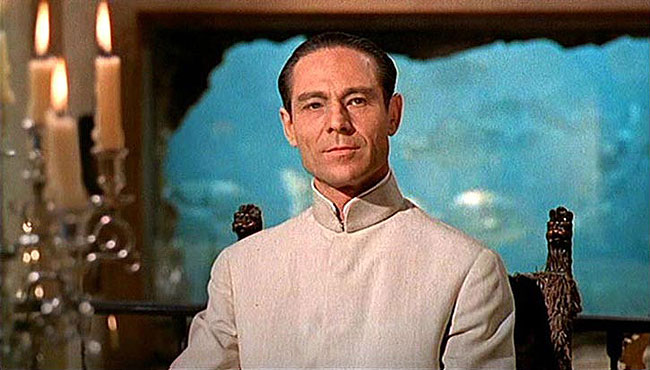 Not much of a worm on screen
The book starts with Bond recovering from the poison Rosa Klebb injected him with at the end of From Russia With Love, which has to be one of the least satisfying conclusions to a cliffhanger ending I've ever read. Like a few of the prior books, No starts with Bond being given an easy task, something to do while recovering from previous difficulties. Bond resents this but follows orders. As you can guess, things don't turn out to be so easy.
The trope of trying to kill Bond in creative ways starts here. There's a deadly centipede left to roam his hotel room. There's a basket of poisoned fruit which Bond notices has needle injection holes just before eating. This is not happening because Dr. No is being dramatic, as the film suggests. It's because No has already had one British agent assassinated (Bond is there to investigate this). No doesn't want Bond snooping around, but knows if he has him shot or something it would only lead to more scrutiny.
Fleming also shows his skill at explaining implausible things with the name, Dr. No. It is an assumed name, but not chosen because it sounds cool or sinister. No studied medicine to learn how to keep himself alive as long as possible and also change his appearance. He chose the same Julius No because Julius was his father's name and No represents that he does not want to be anything like his father.
One subtle but important change between book and film is the obstacle course. Dr. No decides to kill Bond by running him through a carefully devised course designed to inflict pain. It's essentially a ventilation shaft with a bunch of traps, each more nasty than the previous one. Important to note: Bond is escaping by crawling through a ventilation shaft, which is of course a classic trope, but here it's happening on purpose. No tells him about the course, and expects Bond to try getting out rather than just sitting in a cell and dying quietly. No studies pain, and finds putting people through this course is an interesting way to see how far they can get before dying. Bond only barely survives because he stole a steak knife and a lighter before going in. The scene going through the course is extremely well written. It's terrifying and extremely claustrophobic. I'll get to why the film version fails in a minute.
The failing here is that No, after all his talk about wanting to observe Bond's pain tolerance and use his death as another datapoint to help refine the obstacle course, doesn't stick around to watch what happens. It's unbelievable that he would go to all this chatter about being interested in pain and interesting means of killing someone and then not stick around to watch. Worse, he devises a nasty death for Bond's love interest as well, and doesn't even stick around to watch her die, either.
The film version tracks to the book fairly well, and that's a good thing. Sadly, few of the changes made serve to improve upon the book. In fact they suck a lot of the sinister nature right out of it. The geologist Bond meets is in league with Dr. No (instead of simply his snooping secretary). Worse, halfway through the film this man visits Crab Key to check in with his ominous boss. It's a creepy scene, very well filmed, but I found getting this early peek at the Dr.'s lair killed much of the momentum from the scene when Bond finally makes his way there. We already know what Bond is getting into, so everything leading up to it seems a bit of a chore.
Another change is in the general lack of explanation as to how Dr. No came to own Crab Key, and what finally leads to Strangways (the murdered agent Bond is in Jamaica to investigate) snooping around in the first place.
The biggest change, in my view, is the obstacle course. In the book Dr. No goes into great detail about the manner of death he's chosen for Bond. He's created an obstacle course inside his island, and puts captives through it to see how far they can get, tweaking things a little each time. He's genuinely excited to see what Bond can do. So Bond is placed in a cell and begins to crawl through a ventilation duct purpose built for this endeavor, with all sorts of nasty traps along the way, finally ending in an insane fight against a giant squid that somehow comes across quite believable thanks to Fleming's writing style and some excellent narration by Simon Vance (audiobook version, remember). What's so harrowing about this scene is that Bond knows that around every corner Dr. No has devised something more heinous than the last, and yet he has no choice but to keep going.
In the film? Bond is simply placed in a cell. The ventilation duct is a conveniently overlooked escape route. Bond runs into a few of the less dangerous traps seen in the book, and then winds up free and in the heart of No's secret underground base. Ta-da!
The particulars of the two stories diverge from there, and even if the end result is the same, I found the film version a little too convenient, a little too slick. Bond goes through hell in the book. It's a brutal series of chapters. The movie version seems like just a mild inconvenience for him, leading to a rather dull scene at the end where Bond sabotages Dr. No's grand scheme by standing around lamely in the oh-so-convenient disguise of a hazmat suit.
Another change in this part of the film that grated on me is that Bond, during all this craziness, finds and frees Honey. She's tied down on a stone platform, about to be drowned. In the book, she's tied to the mountainside where hordes of crabs are known to come every night. Dr. No explains in great detail how the last woman he tied out there was eaten from the ankles up, and he's curious to see if Honey will last longer. Critically, she escapes on her own, mainly because she is not afraid of the crabs so they don't pay attention to her. Eventually she finds Bond and they work together. The film opts for the "damsel in distress" trope in almost throwaway fashion, and it's a huge let down compared to the book.
Honeychild Rider becomes simply Honey Rider, which perhaps gave a kick-in-the-proverbial-pants to the film series as ever more ludicrous female character names (and the quips that come with them) abound later on. And, of course, in the book Honeychild Rider has a great explanation for her name -- as does Dr. No -- but that is never mentioned here, so viewers are just left to think it's deliberately chosen to sound sexy and/or cool.
Overall the film is one of the more enjoyable in the franchise. Connery is excellent as Bond, and most of the cliche stuff is absent in this first film outing. I enjoyed watching it again after so many years, but having just finished listening to the book the day before, I once again found the book superior, especially where the two diverged.
Book: B+
Film: B
Faithfulness to the Book: B-
Birth of Bond tropes: There's a few places in the film where Bond utters a sardonic one-liner. Audiences must have liked this a lot considering how ridiculous they get with it in later films.
Also, an additional scene is added near the beginning, when we first meet film-Bond. I suppose they did this to establish his character, but it's a bit clumsy. Bond is gambling, high stakes and winning (in the books Bond is a civil servant with the sort of low salary you'd expect - a gambler yes, but only if a mission requires it). Simultaneously he's flirting with a beautiful woman, and they make a date for the next day. Later, after getting his mission briefing from M, Bond returns home to find the woman somehow inside his apartment, dressed only in one of his shirts. He, a top agent of the British Secret Service, seems completely untroubled that this woman has managed to break in to his flat. And of course he ignores M's orders to depart immediately for Jamaica so that he can bed her. It all implies Bond doesn't care about security, and would disregard M's orders simply to get a little last-minute casual sex. I found it a prime example of the movie people not really understanding the character, and unfortunately the whole business sets a precedent for the rest of the movies.
Some trivia: The book started life as a television pitch called "Commander Jamaica", with a main character named James Gunn. Fleming later turned it into this book, originally with the title The Wound Man.
Next up, Goldfinger.
The previous posts in this series, in order:
Casino Royale
Live and Let Die
Moonraker
Diamonds are Forever
From Russia With Love
March 21, 2014
Book vs. Film: "From Russia With Love"
In part--geez, is it 5 already?--part 5 of my Book vs. Film thingy, I'm looking at the 5th book in the James Bond series of novels by Ian Fleming. My previous posts are here.
From Russia With Love, released in 1957, later became the 2nd film in the franchise after Dr. No (which I'll look at next), and the one I've always considered to be the best of the bunch. Top 3, at the very least. The film adaptation was released in 1963, and so far is the most faithful.
But there are differences, and once again I find them a somewhat fascinating glimpse into the minds of those who handled the job of bringing novel to screen.
The book spends a great deal of time up front dealing with SMERSH's chief executioner, Irishmen Donovan Grant. Fleming goes into great detail about the man's sadistic nature, his serial killer mindset, and how he wound up defecting to Russia and rising so high in their intelligence network.
This all eventually leads to a meeting between the top figures in that community, made all the more ominous by Fleming's "author's note" at the outset which explains that the places, people, and descriptions of this event are basically real.
It's interesting after the four previous books to get such an in depth peek at Bond's opponent, and not through the lens of Bond's own spycraft. If there was ever an argument for including chapters from the villain's point of view, certainly this ranks up there. Unfortunately, as we'll see, the promise of these chapters end up fizzling out.
Ultimately SMERSH (the part of the Russian espionage apparatus that deals with eliminating enemy spies -- an actual thing) decides they need to perform a "terrorist act" within the world's intelligence communities. Something bold and yet subtle, to let everyone know just how clever and devious the Russians can be. They posit, quite realistically, that such an action is more to swell pride within Russia's own agents and analysts than to do any real damage to the enemy, but if both can be accomplished all the better. In the end they reach the obvious conclusion, though it didn't feel like a chore getting there: Grant will eliminate Bond, showing the west that their best agent is in fact inferior to Russia's.
The book then veers away from Grant. We don't see him again until near the end, and, all things considered, Bond dispatches him with only a bit of difficulty. Thus all the detail of Grant's abilities and dangerous mind seem something of a let down.
The book ends with Bond going to visit Rosa Klebb at her hotel room in Paris, the room where Grant was supposed to meet her. Klebb is the mastermind behind the Soviet operation. In probably the most clumsy part of the book, Grant very specifically tells Bond precisely when and where he'll be meeting Klebb, down to the hour and the hotel room (along with detailing the rest of the plan -- the usual "let me tell you all about our secrets since you're going to die in a minute" business). That aside, Bond arrives to confront Klebb, but before she can be arrested she kicks Bond in the shin with a poisoned blade affixed to her shoe. Unlike the previous books, this one ends on a cliffhanger, implying the poison may have killed Bond.
Overall the book is pretty good. Not as good as some of the previous novels, but better than Diamonds are Forever. The setup is great, the spycraft all seems reasonably on the up-and-up. My main problem was how anti-climactic the confrontation with Grant ends up being, given how much time is afforded to him in the first part of the book.
As for the film, it tracks very closely to the novel. More than any of the other adaptations so far, in fact. There's three main differences: another silly opening scene, a boat chase toward the end that I feel improves on the books lackluster climax, and a tidier ending overall.
We start with Bond chasing Grant through a garden at night. Grant gets the upper-hand and strangles Bond with a wire pulled from his watch. "OH MY GOD BOND IS DEAD!" screamed no one in any theater anywhere. Bond is revealed to just be some poor bastard wearing a flawless mask, Mission Impossible style (to be fair, three years before Mission Impossible aired). It's tough these days to believe that anyone back then actually gaped in awe at such a hokey trick.
The thing is, the scene serves no point. It's clumsy. It implies that Grant is being trained 24/7 to assassinate Bond, not to simply be a kick-ass assassin. When Klebb arrives later to assess him, it's because they (meaning SPECTRE, not SMERSH as in the book) have just decided to undertake assassinating Bond, and she's off to see if Grant is up to the job he's apparently training for already. She decides he is ready by punching him in the stomach with brass knuckles. No reaction means he's damn tough, and apparently that is all she needs to know. Anyway, I mentioned 'clumsy' earlier. This garden scene isn't in the book. The whole bit with Grant's opponent wearing a Bond mask screams of producer-added cinema shtick. There is no reason for any of this other than earn a little gasp from us, the viewers. Once again, before we can even get to Fleming's intended story, we're in bizzaro farce land. The only bit of this similar is the way Klebb evaluates him with a brass-knuckles punch to the stomach. Luckily, things get back on track right after that.
I've alluded to this before, but I'll state it more clearly here: The films have a very different personality from the novels, even here early on. I don't think it's until the Casino Royale reboot that we finally get a James Bond film that felt close to the spirit of the books. True, the novels lack the depth and finesse of a Le Carre espionage tale, but they are carefully plotted, well researched, tidy affairs.
Both the book and the film do contain the gypsy girl fight, which earns every eyeroll you can throw at it. It's a little more subdued in the book, but not much, and I could have done without it in both mediums. Realistic or not I have no idea. The main problem with it is that it's completely gratuitous.
The boat chase toward the end is not in the book, and for once I think the film was helped by deviating. It's an exciting scene, with the very memorable moment when Bond takes careful aim and shoots the fuel drums he's dumped into the water.
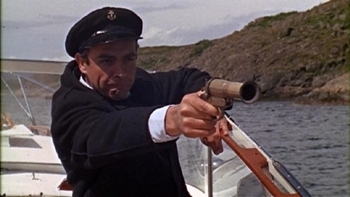 There's something about this half-second bit of the movie I love. The way Connery pauses to really dial-in his aim. It's one of those super subtle moments in a film that you realize later really sell the reality of the situation.
Compared to the horribly cheesy boat chase in Live and Let Die, this one was (for it's era) rather enjoyable and well filmed. Given the lack of action in the book, and the aforementioned anti-climax, this little added bonus was welcome.
There is one difference between book and film I can't quite wrap my head around. In the movie, we constantly see Grant pop up at critical moments and save Bond's life. He's Bond's "guardian angel". This is not in the book at all, and it's another of those producer-added bits of shtick I can't quite understand. It implies Bond needs the help while simultaneously implying the SPECTRE plan is so feeble that the only logical solution is to have Grant follow Bond around at a comically close proximity, all to make sure Bond doesn't die before Grant can kill him on the train. The book does a pretty good job of explaining why they want to kill Bond on the train. The movie makes no such attempt, which makes Grant's constant interventions all the more puzzling.
Last change I'll mention: Bond's briefcase. I watched the movie first this time and, when Q goes over the elaborate briefcase and its myriad of contents I found myself chuckling. No way had this been in the book, considering nothing like it had come in the previous novels. And yet on the re-read, there it is. Virtually identical to the movie version, with the only notable exception being the film version's tear-gas canister that eventually explodes in Grant's face. So it's here, in the 5th book, that the gadgetry aspect first rears its head.
As an adaptation goes, it's hit and miss both in where it decides to be faithful (miss -- the gypsy fight, hit -- the overall mood) and the tweaks (hit -- the boat chase, miss -- Grant killing fake-Bond).
Book: C+
Film: B
Birth of Bond Tropes: Fleming deviates from his disfigured villain's trope here, though I suppose you could argue that Grant is mentally disfigured. The birth of gadgets arrives with this book in the form of Bond's briefcase. It has hidden knives, hidden money, special latches, and a handful of other interesting items tucked within.
Next up: Dr. No!
From Russia With Love, released in 1957, later became the 2nd film in the franchise after Dr. No (which I'll look at next), and the one I've always considered to be the best of the bunch. Top 3, at the very least. The film adaptation was released in 1963, and so far is the most faithful.
But there are differences, and once again I find them a somewhat fascinating glimpse into the minds of those who handled the job of bringing novel to screen.
The book spends a great deal of time up front dealing with SMERSH's chief executioner, Irishmen Donovan Grant. Fleming goes into great detail about the man's sadistic nature, his serial killer mindset, and how he wound up defecting to Russia and rising so high in their intelligence network.
This all eventually leads to a meeting between the top figures in that community, made all the more ominous by Fleming's "author's note" at the outset which explains that the places, people, and descriptions of this event are basically real.
It's interesting after the four previous books to get such an in depth peek at Bond's opponent, and not through the lens of Bond's own spycraft. If there was ever an argument for including chapters from the villain's point of view, certainly this ranks up there. Unfortunately, as we'll see, the promise of these chapters end up fizzling out.
Ultimately SMERSH (the part of the Russian espionage apparatus that deals with eliminating enemy spies -- an actual thing) decides they need to perform a "terrorist act" within the world's intelligence communities. Something bold and yet subtle, to let everyone know just how clever and devious the Russians can be. They posit, quite realistically, that such an action is more to swell pride within Russia's own agents and analysts than to do any real damage to the enemy, but if both can be accomplished all the better. In the end they reach the obvious conclusion, though it didn't feel like a chore getting there: Grant will eliminate Bond, showing the west that their best agent is in fact inferior to Russia's.
The book then veers away from Grant. We don't see him again until near the end, and, all things considered, Bond dispatches him with only a bit of difficulty. Thus all the detail of Grant's abilities and dangerous mind seem something of a let down.
The book ends with Bond going to visit Rosa Klebb at her hotel room in Paris, the room where Grant was supposed to meet her. Klebb is the mastermind behind the Soviet operation. In probably the most clumsy part of the book, Grant very specifically tells Bond precisely when and where he'll be meeting Klebb, down to the hour and the hotel room (along with detailing the rest of the plan -- the usual "let me tell you all about our secrets since you're going to die in a minute" business). That aside, Bond arrives to confront Klebb, but before she can be arrested she kicks Bond in the shin with a poisoned blade affixed to her shoe. Unlike the previous books, this one ends on a cliffhanger, implying the poison may have killed Bond.
Overall the book is pretty good. Not as good as some of the previous novels, but better than Diamonds are Forever. The setup is great, the spycraft all seems reasonably on the up-and-up. My main problem was how anti-climactic the confrontation with Grant ends up being, given how much time is afforded to him in the first part of the book.
As for the film, it tracks very closely to the novel. More than any of the other adaptations so far, in fact. There's three main differences: another silly opening scene, a boat chase toward the end that I feel improves on the books lackluster climax, and a tidier ending overall.
We start with Bond chasing Grant through a garden at night. Grant gets the upper-hand and strangles Bond with a wire pulled from his watch. "OH MY GOD BOND IS DEAD!" screamed no one in any theater anywhere. Bond is revealed to just be some poor bastard wearing a flawless mask, Mission Impossible style (to be fair, three years before Mission Impossible aired). It's tough these days to believe that anyone back then actually gaped in awe at such a hokey trick.
The thing is, the scene serves no point. It's clumsy. It implies that Grant is being trained 24/7 to assassinate Bond, not to simply be a kick-ass assassin. When Klebb arrives later to assess him, it's because they (meaning SPECTRE, not SMERSH as in the book) have just decided to undertake assassinating Bond, and she's off to see if Grant is up to the job he's apparently training for already. She decides he is ready by punching him in the stomach with brass knuckles. No reaction means he's damn tough, and apparently that is all she needs to know. Anyway, I mentioned 'clumsy' earlier. This garden scene isn't in the book. The whole bit with Grant's opponent wearing a Bond mask screams of producer-added cinema shtick. There is no reason for any of this other than earn a little gasp from us, the viewers. Once again, before we can even get to Fleming's intended story, we're in bizzaro farce land. The only bit of this similar is the way Klebb evaluates him with a brass-knuckles punch to the stomach. Luckily, things get back on track right after that.
I've alluded to this before, but I'll state it more clearly here: The films have a very different personality from the novels, even here early on. I don't think it's until the Casino Royale reboot that we finally get a James Bond film that felt close to the spirit of the books. True, the novels lack the depth and finesse of a Le Carre espionage tale, but they are carefully plotted, well researched, tidy affairs.
Both the book and the film do contain the gypsy girl fight, which earns every eyeroll you can throw at it. It's a little more subdued in the book, but not much, and I could have done without it in both mediums. Realistic or not I have no idea. The main problem with it is that it's completely gratuitous.
The boat chase toward the end is not in the book, and for once I think the film was helped by deviating. It's an exciting scene, with the very memorable moment when Bond takes careful aim and shoots the fuel drums he's dumped into the water.
 There's something about this half-second bit of the movie I love. The way Connery pauses to really dial-in his aim. It's one of those super subtle moments in a film that you realize later really sell the reality of the situation.
Compared to the horribly cheesy boat chase in Live and Let Die, this one was (for it's era) rather enjoyable and well filmed. Given the lack of action in the book, and the aforementioned anti-climax, this little added bonus was welcome.
There is one difference between book and film I can't quite wrap my head around. In the movie, we constantly see Grant pop up at critical moments and save Bond's life. He's Bond's "guardian angel". This is not in the book at all, and it's another of those producer-added bits of shtick I can't quite understand. It implies Bond needs the help while simultaneously implying the SPECTRE plan is so feeble that the only logical solution is to have Grant follow Bond around at a comically close proximity, all to make sure Bond doesn't die before Grant can kill him on the train. The book does a pretty good job of explaining why they want to kill Bond on the train. The movie makes no such attempt, which makes Grant's constant interventions all the more puzzling.
Last change I'll mention: Bond's briefcase. I watched the movie first this time and, when Q goes over the elaborate briefcase and its myriad of contents I found myself chuckling. No way had this been in the book, considering nothing like it had come in the previous novels. And yet on the re-read, there it is. Virtually identical to the movie version, with the only notable exception being the film version's tear-gas canister that eventually explodes in Grant's face. So it's here, in the 5th book, that the gadgetry aspect first rears its head.
As an adaptation goes, it's hit and miss both in where it decides to be faithful (miss -- the gypsy fight, hit -- the overall mood) and the tweaks (hit -- the boat chase, miss -- Grant killing fake-Bond).
Book: C+
Film: B
Birth of Bond Tropes: Fleming deviates from his disfigured villain's trope here, though I suppose you could argue that Grant is mentally disfigured. The birth of gadgets arrives with this book in the form of Bond's briefcase. It has hidden knives, hidden money, special latches, and a handful of other interesting items tucked within.
Next up: Dr. No!
March 10, 2014
5 reasons why writers should listen to audiobooks
Listen!
Of all the advice I can give aspiring authors, this is probably the only original bit I've got. Everything else is just me passing on tips I received, but this one... it's purely my own conclusion:
Audiobooks are a dynamite way to improve your writing.
Here's five reasons why:Unlike reading printed text, you can't really skim. You've trained yourself over the years to skip the "boring bits", to the point where you may not even realize you're doing it anymore, or why. And, this may be affecting your own writing. With an audiobook you're forced to hang on every word the author wrote. No eye-wandering past those large wall-of-text description paragraphs. No accidental glimpse at the big reveal in that next big line of dialog. And as a result, you'll gain newfound appreciation for the words themselves. It's about more than just the words, actually. It's also the cadence. The pace. That's not to say these things are absent when reading printed text, it's just that when heard in audio form there's a whole different dimension to it that helps you, the writer, understand and appreciate them. Over time, that extra knowledge will bleed into your own writing. For example I quickly learned how annoying it is when every line of dialog has a "he said" or "she said" after it. It's true these are often 'invisible' in printed form, but a chain of them can really bog down rapid-fire dialog. Recognizing this can lead you to finding better ways to add pauses between the spoken lines.You'll hear the words as you write them. It's often said that reading your own work-in-progress aloud is a great way to find flaws in it. What I've found after years of listening to audiobooks is that I hear the words in my head now as I write. Often, somewhat bizarrely but also quite wonderfully, this is in my favorite narrator's voice. This phenomenon does not quite substitute for an actual read-aloud, but it gets you maybe halfway there and helps you catch problems as you hammer out a draft.You'll read more. Hell, I'd hardly read anything these days if it wasn't for audiobooks. Between my own brisk writing schedule and dealing with two rambunctious young boys at home, often the only quiet time I can get is when I'm driving somewhere. Even in my brief stints I can get an extra book or two read per month this way. If you've got a commute you'll get even more time. There's a secondary bonus to this point, which is that once you've discovered some narrators you really enjoy, you'll seek out their other recordings no matter the genre. Breaking outside your usual genres = good thing!You'll gain new appreciation for a well-delivered reading. I've been to a number of author readings, and to say they vary in quality is an understatement. By no means do I count myself in the good column, far from it, in fact, but I'm getting better. The trick is recognizing this fact. I know very keenly what a bad narrator can do to an otherwise good book. I often think when authors do these readings that they have no idea how much the audience is squirming in their seats. We can't all be M. Todd Gallowglas, but a healthy dose of listening to great narrators reading great books will go a long way toward giving you something to emulate.
Note: 4 and 5 apply to non-aspiring writer types, too. Ahem!
You can find audiobooks at your local library, bookstore, or (of course) online. Some sites have deals where you get a free book for signing up to a trial of their subscription service, and many of these sites have steeply discounted books on sale frequently. I'm not going to call out specifics because monopolies suck, but I'm sure if you poke around you can find an audiobook that suits your preferences and pocketbook. The days of the 50$ 16-CD audiobook seem to be dying, and that's a good thing because it's the main reason most people never paid attention to them in the past, myself included. Most are now priced only slightly higher than the print or ebook equivalent, especially if you're using a subscription service.
Give one a try! If there's a book you really love and reread often, try the audio version and see what new dimensions are added from the experience. Or, you know, give something new a spin.
One tip: If you listen via a specialized audiobook app, there is often the option to increase the playback speed. I find the originally recorded pace is often too lethargic. Some people complain that audiobooks don't hold their attention very well, and I suspect this is why. So try increasing the playback speed. I find a 1.25x rate works well as a blanket rule, but for some narrators even 1.5x is required. Go for a speed where the pace sounds natural to you, not where it sounds like the narrator is speed-talking, otherwise you lose some of the benefits I outlined above.
PS. I hope my homage to Beowulf at the beginning there wasn't too cheeky. It seemed appropriate, even if the famous opening to that poem may have been misinterpreted.
Of all the advice I can give aspiring authors, this is probably the only original bit I've got. Everything else is just me passing on tips I received, but this one... it's purely my own conclusion:
Audiobooks are a dynamite way to improve your writing.
Here's five reasons why:Unlike reading printed text, you can't really skim. You've trained yourself over the years to skip the "boring bits", to the point where you may not even realize you're doing it anymore, or why. And, this may be affecting your own writing. With an audiobook you're forced to hang on every word the author wrote. No eye-wandering past those large wall-of-text description paragraphs. No accidental glimpse at the big reveal in that next big line of dialog. And as a result, you'll gain newfound appreciation for the words themselves. It's about more than just the words, actually. It's also the cadence. The pace. That's not to say these things are absent when reading printed text, it's just that when heard in audio form there's a whole different dimension to it that helps you, the writer, understand and appreciate them. Over time, that extra knowledge will bleed into your own writing. For example I quickly learned how annoying it is when every line of dialog has a "he said" or "she said" after it. It's true these are often 'invisible' in printed form, but a chain of them can really bog down rapid-fire dialog. Recognizing this can lead you to finding better ways to add pauses between the spoken lines.You'll hear the words as you write them. It's often said that reading your own work-in-progress aloud is a great way to find flaws in it. What I've found after years of listening to audiobooks is that I hear the words in my head now as I write. Often, somewhat bizarrely but also quite wonderfully, this is in my favorite narrator's voice. This phenomenon does not quite substitute for an actual read-aloud, but it gets you maybe halfway there and helps you catch problems as you hammer out a draft.You'll read more. Hell, I'd hardly read anything these days if it wasn't for audiobooks. Between my own brisk writing schedule and dealing with two rambunctious young boys at home, often the only quiet time I can get is when I'm driving somewhere. Even in my brief stints I can get an extra book or two read per month this way. If you've got a commute you'll get even more time. There's a secondary bonus to this point, which is that once you've discovered some narrators you really enjoy, you'll seek out their other recordings no matter the genre. Breaking outside your usual genres = good thing!You'll gain new appreciation for a well-delivered reading. I've been to a number of author readings, and to say they vary in quality is an understatement. By no means do I count myself in the good column, far from it, in fact, but I'm getting better. The trick is recognizing this fact. I know very keenly what a bad narrator can do to an otherwise good book. I often think when authors do these readings that they have no idea how much the audience is squirming in their seats. We can't all be M. Todd Gallowglas, but a healthy dose of listening to great narrators reading great books will go a long way toward giving you something to emulate.
Note: 4 and 5 apply to non-aspiring writer types, too. Ahem!
You can find audiobooks at your local library, bookstore, or (of course) online. Some sites have deals where you get a free book for signing up to a trial of their subscription service, and many of these sites have steeply discounted books on sale frequently. I'm not going to call out specifics because monopolies suck, but I'm sure if you poke around you can find an audiobook that suits your preferences and pocketbook. The days of the 50$ 16-CD audiobook seem to be dying, and that's a good thing because it's the main reason most people never paid attention to them in the past, myself included. Most are now priced only slightly higher than the print or ebook equivalent, especially if you're using a subscription service.
Give one a try! If there's a book you really love and reread often, try the audio version and see what new dimensions are added from the experience. Or, you know, give something new a spin.
One tip: If you listen via a specialized audiobook app, there is often the option to increase the playback speed. I find the originally recorded pace is often too lethargic. Some people complain that audiobooks don't hold their attention very well, and I suspect this is why. So try increasing the playback speed. I find a 1.25x rate works well as a blanket rule, but for some narrators even 1.5x is required. Go for a speed where the pace sounds natural to you, not where it sounds like the narrator is speed-talking, otherwise you lose some of the benefits I outlined above.
PS. I hope my homage to Beowulf at the beginning there wasn't too cheeky. It seemed appropriate, even if the famous opening to that poem may have been misinterpreted.
February 15, 2014
Book vs. Film: "Diamonds Are Forever"
This is part 4 in my re-read and re-watch of the James Bond series. Previously I discussed
Casino Royale
(good book, great film),
Live and Let Die
(good book, bad film), and
Mookraker
(great book, awful film).
Now let's look at Diamonds Are Forever, published in 1956. It's the fourth Bond book, and was adapted for the screen in 1971 - the seventh in the film franchise.
First the novel. It's book 4 and Ian Fleming has started to hit his stride. He's comfortable with Bond and the world in which he inhabits. He's also resisting the urge to escalate. This book if anything is a pullback from the stakes involved in Moonraker. Also, whereas Moonraker took place entirely on British soil, Fleming now goes back to a largely US-based story, primarily in New York and Las Vegas.
Bond is tasked with exploring the extents of a diamond smuggling operation that is costing the British Government millions of pounds per year. He's undercover, taking the place of one of the mules who delivers diamonds from England to the US hidden inside golf balls, and he travels with a woman named Tiffany Case who knows the smugglers because she used to deal cards at a Casino they own (still does, really).
On the whole, Fleming remains consistent. This is a competent espionage tale, suffering mostly from a general lack of tension. The stakes were very low. The world is no going to end if Bond fails. In fact, Bond's actual mission was just to try and find out who is behind the diamond operation. It's only because his friends keep getting hurt by the gangsters that Bond is drawn more and more into bringing the whole thing down rather than just filing his report.
After the great novel Moonraker this one was a bit of a let down.
But again there's none of the movie "shtick" most people associate with Bond. It's a fairly serious tale, if a bit light, and for the most part Bond is simply using his wits and intuition, along with help once again from his friend Felix Lieter and a few others. Once again Bond is put through the wringer in terms of physical pain, including a scene we perhaps luckily only hear about after the violence is over as two gangsters nearly kick him to death.
One side note: The chapters set in Las Vegas were interesting to me. It seems people still notice and complain about the same things now as they did way back in 1956.
As for the film. Sigh... It was released in 1971 and marked the end of Connery's reign as Bond. There's a corny opening vignette that borrows some elements from the mud bath scene in the book. Bond thinks he is killing his nemesis Blofeld (who does not appear in the book). After that it starts to track to the book a little, with the notable exception of providing any clear reason for Bond's mission. In the book, diamonds are being smuggled and laundered through some gangsters involved in gambling in the US. Bond is supposed to try and find evidence of who is behind it all by impersonating the man due to take the diamonds from England to New York. In the film, diamonds are being smuggled but not entering back into the market. Bond is supposed to find out who is hoarding them and why.
Very little background info means once again we have almost no idea why Bond is doing what he's doing. No investment, no rationale behind his actions. In other words, it feels clumsy. Scenes strung together, all effort placed on the big moments and none on the glue that holds them together (sounds like many modern video games).
Perhaps the worst bit of shtick is the moon buggy chase. It's not quite as corny as, for example, the Live and Let Die boat chase, but the vehicle chosen and the slapstick driving technique employed by everyone but Bond himself certainly steers this sequence well into farce territory. If you find it funny how Imperial Stormtroopers can't hit anything with their blasters, then you'll really get a chuckle out of Bond's pursuers here. If there's a ditch to be driven into, one of them will find it.
 The dreaded moon buggy
Then there's the voice changing nonsense. And Blofeld's many clones. Blofeld himself is of course as cheesy as can be, stroking his cat while he hatches diabolical schemes. But I rolled my eyes most at the point when Bond simply calls Blofeld up on the phone and, thanks to Q's voice-changing device, Bond perfectly mimics one of Blofeld's henchmen and gets the critical information they all need. Anyone could have made that phone call, no need for the dashing superspy, plus it rendered virtually everything that had happened before that a waste of time.
Another bit that troubled me was how many people, civilians and thugs mind you, instantly knew who James Bond was. Tiffany Case, the diamond smuggler, knows the name instantly like one would know Superman. You can't be much of a spy if you're world famous, I would think.
Lastly I have to mention the gymnast assassin girls. The scene is as lame as it sounds, but what really struck me during this moment is just how far we've come, cinematically, in filming action sequences. It's really quite interesting to compare this slow-paced, poorly choreographed "fight" with the intense and brutal scenes in, say, 2006's Casino Royale. Watching Sean Connery take on these two women I simply felt no urgency. There was no danger to it, no feeling that Bond was really at risk. And this, by the way, has nothing to do with the gender aspect. Every fight scene in the movie feels this way. I really think it is a matter of the cinematography and editing techniques employed at the time.
So let's recap, since this is book vs. film. Once again almost everything bad about the film was not in the book at all:
The moon buggy chaseThe voice changing machineBlofeld, period.Blofeld's plastic surgery clonesGymnast Assassin Girls (GAG for short... ahem)
The book did have one slightly cheesy bit, which was replaced in the film with the 10x more cheesy moon buggy bit:
The steam locomotive chaseI'm starting to find a trend at this point, and it's an interesting one. The movies started with Dr. No, which is in fact the 6th book in the series. Imagine for a moment if Harry Potter's film adventures started with Book 4, Goblet of Fire, but they changed it be the start. You can easily see the conundrum they'd have created for themselves when later they'd inevitably try to film Philosopher's Stone (book 1, and American readers can look up what the Philosopher's Stone is here since we're all too dumb to know). They'd have to take what Rowling wrote as the introduction and modify it probably beyond recognition to align with the new, out-of-order narrative they've created.
Of course, with Bond there's no real concern with a continuous narrative. The novels for the most part stand on their own, with mainly just recurring characters who appear across books. So it's not really a narrative problem with the films, but one of audience expectations. With each film they have to out-do the last one, but since they started with Book 6 (Dr. No), and went basically wherever they felt like after that, by the time they get to the more constrained and subdued early Fleming Novels like Live and Let Die or this one, Diamonds are Forever, they'd screwed themselves and had to throw out almost everything save for general themes and character names.
Book: B-
Film: C-
Birth of Bond Tropes: The book, fourth in the series, continues to build on Fleming's line of disfigured and strange villains (one has a wart on this thumb, so naturally he's constantly sucking his thumb). As for Bond himself: still driving the used Bentley, still using his small Beretta pistol, still not equipped with any fancy gadgets save for a briefcase with a hidden compartment prepared for him by "Q Branch" (no character named "Q" in the books so far).
Next up: Dr. No!
Now let's look at Diamonds Are Forever, published in 1956. It's the fourth Bond book, and was adapted for the screen in 1971 - the seventh in the film franchise.
First the novel. It's book 4 and Ian Fleming has started to hit his stride. He's comfortable with Bond and the world in which he inhabits. He's also resisting the urge to escalate. This book if anything is a pullback from the stakes involved in Moonraker. Also, whereas Moonraker took place entirely on British soil, Fleming now goes back to a largely US-based story, primarily in New York and Las Vegas.
Bond is tasked with exploring the extents of a diamond smuggling operation that is costing the British Government millions of pounds per year. He's undercover, taking the place of one of the mules who delivers diamonds from England to the US hidden inside golf balls, and he travels with a woman named Tiffany Case who knows the smugglers because she used to deal cards at a Casino they own (still does, really).
On the whole, Fleming remains consistent. This is a competent espionage tale, suffering mostly from a general lack of tension. The stakes were very low. The world is no going to end if Bond fails. In fact, Bond's actual mission was just to try and find out who is behind the diamond operation. It's only because his friends keep getting hurt by the gangsters that Bond is drawn more and more into bringing the whole thing down rather than just filing his report.
After the great novel Moonraker this one was a bit of a let down.
But again there's none of the movie "shtick" most people associate with Bond. It's a fairly serious tale, if a bit light, and for the most part Bond is simply using his wits and intuition, along with help once again from his friend Felix Lieter and a few others. Once again Bond is put through the wringer in terms of physical pain, including a scene we perhaps luckily only hear about after the violence is over as two gangsters nearly kick him to death.
One side note: The chapters set in Las Vegas were interesting to me. It seems people still notice and complain about the same things now as they did way back in 1956.
As for the film. Sigh... It was released in 1971 and marked the end of Connery's reign as Bond. There's a corny opening vignette that borrows some elements from the mud bath scene in the book. Bond thinks he is killing his nemesis Blofeld (who does not appear in the book). After that it starts to track to the book a little, with the notable exception of providing any clear reason for Bond's mission. In the book, diamonds are being smuggled and laundered through some gangsters involved in gambling in the US. Bond is supposed to try and find evidence of who is behind it all by impersonating the man due to take the diamonds from England to New York. In the film, diamonds are being smuggled but not entering back into the market. Bond is supposed to find out who is hoarding them and why.
Very little background info means once again we have almost no idea why Bond is doing what he's doing. No investment, no rationale behind his actions. In other words, it feels clumsy. Scenes strung together, all effort placed on the big moments and none on the glue that holds them together (sounds like many modern video games).
Perhaps the worst bit of shtick is the moon buggy chase. It's not quite as corny as, for example, the Live and Let Die boat chase, but the vehicle chosen and the slapstick driving technique employed by everyone but Bond himself certainly steers this sequence well into farce territory. If you find it funny how Imperial Stormtroopers can't hit anything with their blasters, then you'll really get a chuckle out of Bond's pursuers here. If there's a ditch to be driven into, one of them will find it.
 The dreaded moon buggy
Then there's the voice changing nonsense. And Blofeld's many clones. Blofeld himself is of course as cheesy as can be, stroking his cat while he hatches diabolical schemes. But I rolled my eyes most at the point when Bond simply calls Blofeld up on the phone and, thanks to Q's voice-changing device, Bond perfectly mimics one of Blofeld's henchmen and gets the critical information they all need. Anyone could have made that phone call, no need for the dashing superspy, plus it rendered virtually everything that had happened before that a waste of time.
Another bit that troubled me was how many people, civilians and thugs mind you, instantly knew who James Bond was. Tiffany Case, the diamond smuggler, knows the name instantly like one would know Superman. You can't be much of a spy if you're world famous, I would think.
Lastly I have to mention the gymnast assassin girls. The scene is as lame as it sounds, but what really struck me during this moment is just how far we've come, cinematically, in filming action sequences. It's really quite interesting to compare this slow-paced, poorly choreographed "fight" with the intense and brutal scenes in, say, 2006's Casino Royale. Watching Sean Connery take on these two women I simply felt no urgency. There was no danger to it, no feeling that Bond was really at risk. And this, by the way, has nothing to do with the gender aspect. Every fight scene in the movie feels this way. I really think it is a matter of the cinematography and editing techniques employed at the time.
So let's recap, since this is book vs. film. Once again almost everything bad about the film was not in the book at all:
The moon buggy chaseThe voice changing machineBlofeld, period.Blofeld's plastic surgery clonesGymnast Assassin Girls (GAG for short... ahem)
The book did have one slightly cheesy bit, which was replaced in the film with the 10x more cheesy moon buggy bit:
The steam locomotive chaseI'm starting to find a trend at this point, and it's an interesting one. The movies started with Dr. No, which is in fact the 6th book in the series. Imagine for a moment if Harry Potter's film adventures started with Book 4, Goblet of Fire, but they changed it be the start. You can easily see the conundrum they'd have created for themselves when later they'd inevitably try to film Philosopher's Stone (book 1, and American readers can look up what the Philosopher's Stone is here since we're all too dumb to know). They'd have to take what Rowling wrote as the introduction and modify it probably beyond recognition to align with the new, out-of-order narrative they've created.
Of course, with Bond there's no real concern with a continuous narrative. The novels for the most part stand on their own, with mainly just recurring characters who appear across books. So it's not really a narrative problem with the films, but one of audience expectations. With each film they have to out-do the last one, but since they started with Book 6 (Dr. No), and went basically wherever they felt like after that, by the time they get to the more constrained and subdued early Fleming Novels like Live and Let Die or this one, Diamonds are Forever, they'd screwed themselves and had to throw out almost everything save for general themes and character names.
Book: B-
Film: C-
Birth of Bond Tropes: The book, fourth in the series, continues to build on Fleming's line of disfigured and strange villains (one has a wart on this thumb, so naturally he's constantly sucking his thumb). As for Bond himself: still driving the used Bentley, still using his small Beretta pistol, still not equipped with any fancy gadgets save for a briefcase with a hidden compartment prepared for him by "Q Branch" (no character named "Q" in the books so far).
Next up: Dr. No!
January 29, 2014
Book vs. Film: "Moonraker"
--obligatory spoiler alert--
A tale of polar opposites...
This is the third post in this series (part one covered Casino Royale, and part two looked at Live and Let Die). It's actually quite astonishing how different these two works are.
As a novel, Moonraker is wonderful. In fact it may be the best of the Ian Fleming series. The story takes place entirely in England, and starts with Bond going into the field with M on what appears to be a simple undertaking: M believes that millionaire Sir Hugo Drax is cheating at the local card club. He wants Bond to come along and observe the game of bridge and see if he can figure out the truth. Bond, as we learned in both Casino Royale and Live and Let Die, is a very capable gambler. This comes from two facets of his personality: he takes great efforts to understand the games and their odds, and he has good intuition when it comes to taking chances. On top of that, he's good at reading people.
A very brief plot recap (skip if you don't want spoilers): Bond and M decide that Drax is indeed cheating, though he seems to have no motivation to do so being a millionaire and well-respected member of society. Bond decides to cheat the cheater, and through various means manages to swindle an infuriated Drax. One thing we get during all this is a very plausible and interesting backstory to the villain, something that the two previous novels also provided.
Drax owns a company that is working to build England's first nuclear missile for defense (based on real-world activities at the time of its writing). After this card game intrigue, a government overseer at Drax's company is killed, and Bond is sent in to investigate under the guise of being the man's replacement. This all happens in the days before the missile is due to be tested, and the government wants no delays, so Bond has a very real time pressure. There's another agent there already working undercover as Drax's assistant, and she and Bond collaborate to try and figure out what has happened. During all this, and after several attempts to get Bond out of the picture.
Eventually, Bond uncovers the truth: Drax is going to substitute the missile's trajectory that would take it out harmlessly to sea and instead aim it at London, with a real warhead installed.
The ending is fantastic, and I won't spoil too much of it here, suffice to say there's some very memorable scenes, in particular one where Bond and his love interest hide in the tunnels under the missile silo, only to realize this is where the rocket's exhaust plume will channel during launch. The bad guys know this too, so instead of trying to find them they simply cover the exits and wait.
This book marks the first time we see M outside his usual office, and it's quite a joy to be party to the conversation M and Bond have over dinner while they wait for the game of bridge to start. Fleming seems to rise to the challenge of the close and comfortable setting, especially after the jet-setting ways of the previous book.
M being outside his office, by the way, is perhaps the only similarity between this novel and the film called Moonraker. Well, that and the villain's name being Hugo Drax.
It's a fine novel and I highly recommend it if you only desire to read one of the Bond books. Do yourself a favor and go for the audio version read by Simon Vance. He has become James Bond for me like no screen actor could.
Interesting bit of trivia: The novel was originally published in the USA with the title "Too Hot to Handle."
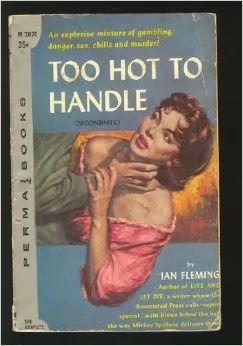
As for the film. Ugh. What a disaster! This is the 11th film in the series, and if I can give it any kind of pass for it's atrociousness it would be this. With ten films behind it, and the series penchant to always go a bit more over the top than the last one, they really didn't have much of a choice but to abandon the rather subdued, tight, psychological novel for a completely farcical alternative.
This movie came out shortly after Star Wars had so captivated the world, and the producers apparently wanted to try and capitalize on that. In fact it wasn't the next book in line for adaptation, but they rushed it ahead and probably read no further than the "Moonraker" title for their inspiration.
So the whole card game business at the beginning, which serves to introduce us to the villain and help us understand the twisted mind Bond will be pitted against, is jettisoned. Instead it starts with the same premise as Thunderball, except instead of stealing a plane laden with warheads, a couple of comically-conveniently hidden bad guys steal a space shuttle on its way from Drax's California factory to England. Yes, Drax is head of a company that is building space shuttles for NASA.
The plane carrying the shuttle crashes during the heist. Later, when the wreckage is found and there's no trace of the shuttle, everyone freaks out and M brings in Bond to investigate. Start with the wreckage, right? No, no. Clearly the best thing to do is go to California and see Drax himself, despite no reason to suspect anything! And Drax, who we learn quickly is a really bad guy (tm), tries to kill Bond twice in the span of 24 hours, while simultaneously allowing him to snoop about (including Bond breaking into Drax's safe). Bond of course survives, and even shoots one of Drax's men while Drax is standing right next to Bond. Bond then hands Drax the gun and walks away with a smug grin.
The film only gets worse. During Bond's "investigation" he happens to spot the name of a glassworks company based in Venice. Naturally, he goes there next. This trend continues throughout the film: Bond just casually uncovering a single clue which he immediately follows up on and is led, perfectly, on a trail right to the heart of the matter.
And, of course, in Venice there's a handful of ridiculous attempts on Bond's life, including having a perfectly timed boat coming down a Venice canal with a machine-gun-armed man lying inside a casket that opens just as the boat is about to pass the one Bond happens to be floating by in.
In Venice Bond finds a secret lab where Drax's scientists are working on some kind of lethal gas. Bond reports this back home and the next day M is on site, along with Q for some reason, as well as the minister of defense. Bond takes them to see the lab, but it's miraculously gone. Replaced with an ornate office and a "surprised" Drax waiting to greet them. Apologies are offered, and Bond looks like an idiot.
Bond is taken off the case for having screwed up so badly. But during his visit he spotted some crates with the name of a Brazilian company, so -- yep -- off to Brazil! Upon landing Bond is taken to a fly hotel room by a gorgeous babe who happens to work for the local secret service office. Naturally he beds her the moment there's a few minutes to spare, then they're off to look into this factory. Jaws appears again (he was in the opening scene, which took place before all this. No explanation given for why he was involved in the two unrelated cases). Jaws tries to kill them, but is thwarted by that unstoppable force of a handful of drunken carnival partiers who dance around him.
Oh, and even though Bond is in Brazil on a (nudge nudge, wink wink) vacation, virtually out of nowhere we find that M, Q, and apparently the entirety of the secret service support infrastructure has relocated here to support Bond's mission.
It gets more and more ridiculous from here, so much so that I feel like I'm wasting my keystrokes explaining it point by point. Suffice to say, the movie is one long string of farcical, over-the-top nonsense. It's a mess of poorly linked scenes that seem to only serve one purpose: put Roger Moore in situations where he can utter one-liners and frolic with gorgeous women. It all ends with a "climax" set in space, on a secret stealthy space station Drax has built behind the world's back. Drax's plan? Launch his lethal gas in pods down to the planet, wait for everyone to die, then repopulate Earth with his own "pure" race. But once Bond and his 3rd (or was it 4th?) love interest sabotage the radar jamming system, NASA notices the place and of course immediately launches a space shuttle of their own filled with space-warriors. The two sides even engage in a big laser gun battle in space, awash quite literally in pew pew pew sound effects. I had to hide behind a pillow during this part, not because of the tension (for none existed) but because I was embarrassed for all involved in this piece of garbage.
And the thing is, I remember liking this movie as a 10 year old kid. I think I must have been its target audience. Now? Honestly, what Austin Powers is to the Bond film franchise, this film is to the Bond book franchise. It's painful, especially if you're a fan of the novels.
Novel: A
Film (on its own): F
Film (faithfulness to the source material): F-
Birth of James Bond tropes: None really. This is the third book in the series (per order of publication), and again keeps in the Fleming style of spy thriller that is believable while glamorous. It's well-paced and builds to a great finale.
As it is the 11th in the film series, I don't think any of the typical tropes associated with Bond started here. If anything they were all simply dead horses being beaten. Again and again and again. It does feature the henchman "Jaws", though I can't recall if this is the first time we meet him.
Next up, Diamonds are Forever.
A tale of polar opposites...
This is the third post in this series (part one covered Casino Royale, and part two looked at Live and Let Die). It's actually quite astonishing how different these two works are.
As a novel, Moonraker is wonderful. In fact it may be the best of the Ian Fleming series. The story takes place entirely in England, and starts with Bond going into the field with M on what appears to be a simple undertaking: M believes that millionaire Sir Hugo Drax is cheating at the local card club. He wants Bond to come along and observe the game of bridge and see if he can figure out the truth. Bond, as we learned in both Casino Royale and Live and Let Die, is a very capable gambler. This comes from two facets of his personality: he takes great efforts to understand the games and their odds, and he has good intuition when it comes to taking chances. On top of that, he's good at reading people.
A very brief plot recap (skip if you don't want spoilers): Bond and M decide that Drax is indeed cheating, though he seems to have no motivation to do so being a millionaire and well-respected member of society. Bond decides to cheat the cheater, and through various means manages to swindle an infuriated Drax. One thing we get during all this is a very plausible and interesting backstory to the villain, something that the two previous novels also provided.
Drax owns a company that is working to build England's first nuclear missile for defense (based on real-world activities at the time of its writing). After this card game intrigue, a government overseer at Drax's company is killed, and Bond is sent in to investigate under the guise of being the man's replacement. This all happens in the days before the missile is due to be tested, and the government wants no delays, so Bond has a very real time pressure. There's another agent there already working undercover as Drax's assistant, and she and Bond collaborate to try and figure out what has happened. During all this, and after several attempts to get Bond out of the picture.
Eventually, Bond uncovers the truth: Drax is going to substitute the missile's trajectory that would take it out harmlessly to sea and instead aim it at London, with a real warhead installed.
The ending is fantastic, and I won't spoil too much of it here, suffice to say there's some very memorable scenes, in particular one where Bond and his love interest hide in the tunnels under the missile silo, only to realize this is where the rocket's exhaust plume will channel during launch. The bad guys know this too, so instead of trying to find them they simply cover the exits and wait.
This book marks the first time we see M outside his usual office, and it's quite a joy to be party to the conversation M and Bond have over dinner while they wait for the game of bridge to start. Fleming seems to rise to the challenge of the close and comfortable setting, especially after the jet-setting ways of the previous book.
M being outside his office, by the way, is perhaps the only similarity between this novel and the film called Moonraker. Well, that and the villain's name being Hugo Drax.
It's a fine novel and I highly recommend it if you only desire to read one of the Bond books. Do yourself a favor and go for the audio version read by Simon Vance. He has become James Bond for me like no screen actor could.
Interesting bit of trivia: The novel was originally published in the USA with the title "Too Hot to Handle."

As for the film. Ugh. What a disaster! This is the 11th film in the series, and if I can give it any kind of pass for it's atrociousness it would be this. With ten films behind it, and the series penchant to always go a bit more over the top than the last one, they really didn't have much of a choice but to abandon the rather subdued, tight, psychological novel for a completely farcical alternative.
This movie came out shortly after Star Wars had so captivated the world, and the producers apparently wanted to try and capitalize on that. In fact it wasn't the next book in line for adaptation, but they rushed it ahead and probably read no further than the "Moonraker" title for their inspiration.
So the whole card game business at the beginning, which serves to introduce us to the villain and help us understand the twisted mind Bond will be pitted against, is jettisoned. Instead it starts with the same premise as Thunderball, except instead of stealing a plane laden with warheads, a couple of comically-conveniently hidden bad guys steal a space shuttle on its way from Drax's California factory to England. Yes, Drax is head of a company that is building space shuttles for NASA.
The plane carrying the shuttle crashes during the heist. Later, when the wreckage is found and there's no trace of the shuttle, everyone freaks out and M brings in Bond to investigate. Start with the wreckage, right? No, no. Clearly the best thing to do is go to California and see Drax himself, despite no reason to suspect anything! And Drax, who we learn quickly is a really bad guy (tm), tries to kill Bond twice in the span of 24 hours, while simultaneously allowing him to snoop about (including Bond breaking into Drax's safe). Bond of course survives, and even shoots one of Drax's men while Drax is standing right next to Bond. Bond then hands Drax the gun and walks away with a smug grin.
The film only gets worse. During Bond's "investigation" he happens to spot the name of a glassworks company based in Venice. Naturally, he goes there next. This trend continues throughout the film: Bond just casually uncovering a single clue which he immediately follows up on and is led, perfectly, on a trail right to the heart of the matter.
And, of course, in Venice there's a handful of ridiculous attempts on Bond's life, including having a perfectly timed boat coming down a Venice canal with a machine-gun-armed man lying inside a casket that opens just as the boat is about to pass the one Bond happens to be floating by in.
In Venice Bond finds a secret lab where Drax's scientists are working on some kind of lethal gas. Bond reports this back home and the next day M is on site, along with Q for some reason, as well as the minister of defense. Bond takes them to see the lab, but it's miraculously gone. Replaced with an ornate office and a "surprised" Drax waiting to greet them. Apologies are offered, and Bond looks like an idiot.
Bond is taken off the case for having screwed up so badly. But during his visit he spotted some crates with the name of a Brazilian company, so -- yep -- off to Brazil! Upon landing Bond is taken to a fly hotel room by a gorgeous babe who happens to work for the local secret service office. Naturally he beds her the moment there's a few minutes to spare, then they're off to look into this factory. Jaws appears again (he was in the opening scene, which took place before all this. No explanation given for why he was involved in the two unrelated cases). Jaws tries to kill them, but is thwarted by that unstoppable force of a handful of drunken carnival partiers who dance around him.
Oh, and even though Bond is in Brazil on a (nudge nudge, wink wink) vacation, virtually out of nowhere we find that M, Q, and apparently the entirety of the secret service support infrastructure has relocated here to support Bond's mission.
It gets more and more ridiculous from here, so much so that I feel like I'm wasting my keystrokes explaining it point by point. Suffice to say, the movie is one long string of farcical, over-the-top nonsense. It's a mess of poorly linked scenes that seem to only serve one purpose: put Roger Moore in situations where he can utter one-liners and frolic with gorgeous women. It all ends with a "climax" set in space, on a secret stealthy space station Drax has built behind the world's back. Drax's plan? Launch his lethal gas in pods down to the planet, wait for everyone to die, then repopulate Earth with his own "pure" race. But once Bond and his 3rd (or was it 4th?) love interest sabotage the radar jamming system, NASA notices the place and of course immediately launches a space shuttle of their own filled with space-warriors. The two sides even engage in a big laser gun battle in space, awash quite literally in pew pew pew sound effects. I had to hide behind a pillow during this part, not because of the tension (for none existed) but because I was embarrassed for all involved in this piece of garbage.
And the thing is, I remember liking this movie as a 10 year old kid. I think I must have been its target audience. Now? Honestly, what Austin Powers is to the Bond film franchise, this film is to the Bond book franchise. It's painful, especially if you're a fan of the novels.
Novel: A
Film (on its own): F
Film (faithfulness to the source material): F-
Birth of James Bond tropes: None really. This is the third book in the series (per order of publication), and again keeps in the Fleming style of spy thriller that is believable while glamorous. It's well-paced and builds to a great finale.
As it is the 11th in the film series, I don't think any of the typical tropes associated with Bond started here. If anything they were all simply dead horses being beaten. Again and again and again. It does feature the henchman "Jaws", though I can't recall if this is the first time we meet him.
Next up, Diamonds are Forever.
January 21, 2014
Book vs. Film: "Live and Let Die"
--obligatory spoiler alert--
What a difference a few decades can make!
In my first of this series I wrote about the differences between the book and (recent) film versions of Casino Royale. Suffice to say that film tracks admirably to the book, and in fact differs mostly by adding a whole first act that sets up the meat of the novel's story quite well. The book and the film are gritty, and for the most part Bond is a character of resourcefulness and instinctual, in-the-moment tactics.
Fleming's second Bond novel, Live and Let Die, carries this forward. Bond finds himself on his way to America to investigate why 16th century British and Spanish gold coins are suddenly flooding the pawn shops of New York. It is known from various sources that a Kingpin of the underworld, going by the nickname Mr. Big (actual name is a mouthful: Buonaparte Ignace Gallia) is the source of this influx, and he is known to have been involved with the Russian spy agencies during WWII (the book was published in 1956 -- worth noting for later discussion of race!). He sits at the head of a wide-ranging criminal network fronted by a number of legitimate businesses, and is also heavily involved in the voodoo culture. In fact he is seen by many in these circles as being the "zombie" of voodoo's most revered spirit. Yes, that's right, this is a zombie novel. Okay, not really, but Mr. Big does dip heavily into this mystique as a means of control.
It's hard to go further without mentioning the racial aspects of this book. And, again, it's worth remembering when it was written, and by whom. Much has been said already on this topic, so head over to Wikipedia if you want to dive deeper into it. At a minimum, modern readers such as myself will no doubt feel uncomfortable, if not outright disgusted, at the constant use of "negro" to describe people of color, and the assertions that certain cultural characteristics, such as the knowledge and respect of voodoo, are absolute across this sector of the population. It's perhaps a testament to how far we've come that this all seems so ridiculous now, and it's also a rather fascinating peek into the times at which the book was written. I doubt reviewers back then even mentioned this sort of thing.
Never the less, it's there and acts like a constant ugly thorn, grating against an otherwise quality spy tale. Though by no means do I advocate ignoring this or giving Fleming a pass, I will say that main affront here comes from the word itself, and if you can simply do a mental substitution for our modern, more culturally sensitive vocabulary, the content itself is fairly benign. And, to Fleming's credit, he dishes out from all sides--Bond himself gets referred to as a "limey" on at least a dozen occasions.
As with Casino Royale, Live and Let Die is a fairly competent spy thriller. Though light compared to something like A Perfect Spy by John le Carré, it does take itself seriously. Other than one rather unbelievable bit of shtick with a restaurant table that descends through the floor into a hidden room, this book is almost devoid of anything Bond film-fanatics associate with the property. For the most part the character motivations and backstories are well conceived, notably the information given about how Mr. Big became Mr. Big, how he has ties to the Soviets, and how he uses superstition and the voodoo culture to control his underlings. Solitaire, Bond's love interest, is simply a woman who has a knack for telling if people are good or bad on a general level. Mr. Big uses her as a lie detector, though she admits to Bond later that her skill is simply in determining character, but she's happy to let Mr. Big think otherwise. If she senses someone is bad she tells Mr. Big they're lying, and so on.
One of the common tropes people associate with Bond (well lampooned in Austin Powers) is the villain's seemingly stupid decision near the end to allow a captured Bond and Solitaire to live until the next morning so that they can be killed in a more interesting fashion than by a simple gunshot. In the book, this is actually well reasoned. Mr. Big has suffered numerous setbacks thanks to Bond, which has greatly tarnished his reputation as infallible amongst those who see him as voodoo royalty. To kill Bond where he's captured, in the bowels of a tunnel system inside a small Island, few would know that Big has bested his foe. So he contrives to have the pair killed the next day, publicly and terribly, to show how much power he has over them, and to regain the supernatural hold he enjoys on his followers.
The film (1972) has no such redeeming quality. In fact, the film, if I may be blunt, is terrible.
It's technically Roger Moore's second foray as Bond (remember, I'm writing these in order of book publication). He, and everyone else involved, were saddled with seven movies already released (the book is #2 in the series). Moore does passably well, but he's simply awash in crappy dialog and absolutely moronic situations. It seems every single thing Bond says in this film has to be a sardonic one-liner, almost all of which fall flat. As far as I can recall, only one of these phrases came from the book ("he disagreed with something that ate him"), and in the book it wasn't even Bond who said it.
Similarly, the film has Bond relying on high-tech (read: bullshit) gadgets, specifically a watch that has some kind of electromagnet in it that can be aimed like a beam and pulls things from dozens of feet away straight to the face of the watch. The book has none of this.
I think the biggest flaws in the movie, however, come from completely stupid and senseless deviations from the book. Mr. Big is not a soviet spy laundering rare gold coins to fund SMERSH operations in the US, instead he's a drug runner, pretty much pure and simple. Instead of the voodoo aspect being just a means to control superstitious followers, in the film they decided to basically make it real. Thus the film version of Solitaire is your stereotypical tarot-card-reading "psychic" who knows everything Bond is doing before he does it -- again, not in the book at all. Worse, while in the book he and Solitaire share an attraction for one another, they actually wait to sleep together until the end. The film version has Bond trick her into sleeping with him by stacking her Tarot deck so that every card is "The Lover". It's the sort of tactic only a complete asshole would resort to, and completely out of character for the man Fleming envisioned.
Of course, they needed a reason for Bond to be in the US taking on a drug-lord, so they concocted this equally stupid backstory that Mr. Big has killed three other agents recently and Bond has come to find out why. From the moment he sets foot on US soil Mr. Big is trying to kill him (in stupid ways -- a snake in the room? Really? And shooting the driver of Bond's car rather than Bond himself? Why?). The difference here is Mr. Big's intelligence as to Bond's whereabouts come largely from Solitaire's divinations and a rather hilariously extensive network of spies on the streets who know where Bond is at all times (it feels like literally everyone Bond meets immediately calls Mr. Big to report that, yes indeed, Bond is going exactly where your Psychic already said he was going). Lacking the Soviet intelligence angle, the only explanation left for Big's flawless operation is voodoo magic, and therefore the movie enters farce territory before the opening vignette is over.
How about that comically over-the-top boat chase, which seems to take half the movie (it really does just go on and on and on)? Not in the book at all. The obnoxious and terribly written Southern Sheriff who runs around trying (with zero success) to stop said boat chase? Not in the book at all. The ridiculous New Orleans funeral procession where a British agent is stabbed and then stuffed into an empty casket through a false bottom (of all methods), after which the hundreds of people in the solemn procession break out into dance? Not in the book, thankfully. I mean seriously the movie starts with this, and it has to be the dumbest murder scene ever filmed. It sets the bar low and then fails to leap it.
There's also the aspect of Bond's second love interest, the CIA double-agent really working for Mr. Big. This character and subplot are not in the book. In fact, in the book it's Solitaire who is with Bond most of the time after she runs from her boss early on. Again, the movie deviates for no good reason, so they needed another woman for Bond to charm, I suppose. It's the very embodiment of a throwaway character, and cast very poorly.
In a way I suppose this is exactly the type of Bond film you'd expect to come from 1972. If there was ever a film that one could point to and say "ugh, look what happened when the movie people got ahold of it", this is it. On second, thought, no, it's not. Because next up is the dreadful, heartbreaking adaptation of Moonraker.
Novel: B
Film (on its own): F
Film (faithfulness to the source material): D-
Birth of James Bond tropes: From the book, once again Bond ends the tale with a leave-of-absence to recuperate and intends to spend it with the woman he saved. As with Casino Royale, the romance is actually fairly realistic, with Bond on the edge of falling in love. It's also the second appearance of Bond's CIA friend, Felix Leiter. Bond is still driving a second-hand Bentley, and living on a government agent's wage.
From the film, I can't recall if the gadgetry started here, but Bond's ridiculous magnetic-beam watch is certainly a prime example of the trope.
Next up--cringe--Moonraker!
What a difference a few decades can make!
In my first of this series I wrote about the differences between the book and (recent) film versions of Casino Royale. Suffice to say that film tracks admirably to the book, and in fact differs mostly by adding a whole first act that sets up the meat of the novel's story quite well. The book and the film are gritty, and for the most part Bond is a character of resourcefulness and instinctual, in-the-moment tactics.
Fleming's second Bond novel, Live and Let Die, carries this forward. Bond finds himself on his way to America to investigate why 16th century British and Spanish gold coins are suddenly flooding the pawn shops of New York. It is known from various sources that a Kingpin of the underworld, going by the nickname Mr. Big (actual name is a mouthful: Buonaparte Ignace Gallia) is the source of this influx, and he is known to have been involved with the Russian spy agencies during WWII (the book was published in 1956 -- worth noting for later discussion of race!). He sits at the head of a wide-ranging criminal network fronted by a number of legitimate businesses, and is also heavily involved in the voodoo culture. In fact he is seen by many in these circles as being the "zombie" of voodoo's most revered spirit. Yes, that's right, this is a zombie novel. Okay, not really, but Mr. Big does dip heavily into this mystique as a means of control.
It's hard to go further without mentioning the racial aspects of this book. And, again, it's worth remembering when it was written, and by whom. Much has been said already on this topic, so head over to Wikipedia if you want to dive deeper into it. At a minimum, modern readers such as myself will no doubt feel uncomfortable, if not outright disgusted, at the constant use of "negro" to describe people of color, and the assertions that certain cultural characteristics, such as the knowledge and respect of voodoo, are absolute across this sector of the population. It's perhaps a testament to how far we've come that this all seems so ridiculous now, and it's also a rather fascinating peek into the times at which the book was written. I doubt reviewers back then even mentioned this sort of thing.
Never the less, it's there and acts like a constant ugly thorn, grating against an otherwise quality spy tale. Though by no means do I advocate ignoring this or giving Fleming a pass, I will say that main affront here comes from the word itself, and if you can simply do a mental substitution for our modern, more culturally sensitive vocabulary, the content itself is fairly benign. And, to Fleming's credit, he dishes out from all sides--Bond himself gets referred to as a "limey" on at least a dozen occasions.
As with Casino Royale, Live and Let Die is a fairly competent spy thriller. Though light compared to something like A Perfect Spy by John le Carré, it does take itself seriously. Other than one rather unbelievable bit of shtick with a restaurant table that descends through the floor into a hidden room, this book is almost devoid of anything Bond film-fanatics associate with the property. For the most part the character motivations and backstories are well conceived, notably the information given about how Mr. Big became Mr. Big, how he has ties to the Soviets, and how he uses superstition and the voodoo culture to control his underlings. Solitaire, Bond's love interest, is simply a woman who has a knack for telling if people are good or bad on a general level. Mr. Big uses her as a lie detector, though she admits to Bond later that her skill is simply in determining character, but she's happy to let Mr. Big think otherwise. If she senses someone is bad she tells Mr. Big they're lying, and so on.
One of the common tropes people associate with Bond (well lampooned in Austin Powers) is the villain's seemingly stupid decision near the end to allow a captured Bond and Solitaire to live until the next morning so that they can be killed in a more interesting fashion than by a simple gunshot. In the book, this is actually well reasoned. Mr. Big has suffered numerous setbacks thanks to Bond, which has greatly tarnished his reputation as infallible amongst those who see him as voodoo royalty. To kill Bond where he's captured, in the bowels of a tunnel system inside a small Island, few would know that Big has bested his foe. So he contrives to have the pair killed the next day, publicly and terribly, to show how much power he has over them, and to regain the supernatural hold he enjoys on his followers.
The film (1972) has no such redeeming quality. In fact, the film, if I may be blunt, is terrible.
It's technically Roger Moore's second foray as Bond (remember, I'm writing these in order of book publication). He, and everyone else involved, were saddled with seven movies already released (the book is #2 in the series). Moore does passably well, but he's simply awash in crappy dialog and absolutely moronic situations. It seems every single thing Bond says in this film has to be a sardonic one-liner, almost all of which fall flat. As far as I can recall, only one of these phrases came from the book ("he disagreed with something that ate him"), and in the book it wasn't even Bond who said it.
Similarly, the film has Bond relying on high-tech (read: bullshit) gadgets, specifically a watch that has some kind of electromagnet in it that can be aimed like a beam and pulls things from dozens of feet away straight to the face of the watch. The book has none of this.
I think the biggest flaws in the movie, however, come from completely stupid and senseless deviations from the book. Mr. Big is not a soviet spy laundering rare gold coins to fund SMERSH operations in the US, instead he's a drug runner, pretty much pure and simple. Instead of the voodoo aspect being just a means to control superstitious followers, in the film they decided to basically make it real. Thus the film version of Solitaire is your stereotypical tarot-card-reading "psychic" who knows everything Bond is doing before he does it -- again, not in the book at all. Worse, while in the book he and Solitaire share an attraction for one another, they actually wait to sleep together until the end. The film version has Bond trick her into sleeping with him by stacking her Tarot deck so that every card is "The Lover". It's the sort of tactic only a complete asshole would resort to, and completely out of character for the man Fleming envisioned.
Of course, they needed a reason for Bond to be in the US taking on a drug-lord, so they concocted this equally stupid backstory that Mr. Big has killed three other agents recently and Bond has come to find out why. From the moment he sets foot on US soil Mr. Big is trying to kill him (in stupid ways -- a snake in the room? Really? And shooting the driver of Bond's car rather than Bond himself? Why?). The difference here is Mr. Big's intelligence as to Bond's whereabouts come largely from Solitaire's divinations and a rather hilariously extensive network of spies on the streets who know where Bond is at all times (it feels like literally everyone Bond meets immediately calls Mr. Big to report that, yes indeed, Bond is going exactly where your Psychic already said he was going). Lacking the Soviet intelligence angle, the only explanation left for Big's flawless operation is voodoo magic, and therefore the movie enters farce territory before the opening vignette is over.
How about that comically over-the-top boat chase, which seems to take half the movie (it really does just go on and on and on)? Not in the book at all. The obnoxious and terribly written Southern Sheriff who runs around trying (with zero success) to stop said boat chase? Not in the book at all. The ridiculous New Orleans funeral procession where a British agent is stabbed and then stuffed into an empty casket through a false bottom (of all methods), after which the hundreds of people in the solemn procession break out into dance? Not in the book, thankfully. I mean seriously the movie starts with this, and it has to be the dumbest murder scene ever filmed. It sets the bar low and then fails to leap it.
There's also the aspect of Bond's second love interest, the CIA double-agent really working for Mr. Big. This character and subplot are not in the book. In fact, in the book it's Solitaire who is with Bond most of the time after she runs from her boss early on. Again, the movie deviates for no good reason, so they needed another woman for Bond to charm, I suppose. It's the very embodiment of a throwaway character, and cast very poorly.
In a way I suppose this is exactly the type of Bond film you'd expect to come from 1972. If there was ever a film that one could point to and say "ugh, look what happened when the movie people got ahold of it", this is it. On second, thought, no, it's not. Because next up is the dreadful, heartbreaking adaptation of Moonraker.
Novel: B
Film (on its own): F
Film (faithfulness to the source material): D-
Birth of James Bond tropes: From the book, once again Bond ends the tale with a leave-of-absence to recuperate and intends to spend it with the woman he saved. As with Casino Royale, the romance is actually fairly realistic, with Bond on the edge of falling in love. It's also the second appearance of Bond's CIA friend, Felix Leiter. Bond is still driving a second-hand Bentley, and living on a government agent's wage.
From the film, I can't recall if the gadgetry started here, but Bond's ridiculous magnetic-beam watch is certainly a prime example of the trope.
Next up--cringe--Moonraker!


