
Jason M. Hough's Blog, page 3
September 15, 2014
Book vs. Film: "The Man with the Golden Gun"
Or, The Man with the Phallic Phallus.
This, the last of the Bond novels, continues Bond's story from You Only Live Twice. Such continuity is rare in the series, but the last three take this approach.
(spoilers ahead...)
Bond has returned home from Japan via Russia, his amnesia gone only to be replaced by Soviet brainwashing. Bond actually tries to assassinate M, but M outwits him and, still holding out hope for the broken man, sends Bond off for shock treatment.
After successful treatment, M gives Bond a mission of little national security importance to try and see if he's still "got it". So he's sent out to kill an infamous assassin named Paco "Pistols" Scaramanga. In the book, Scaramanga uses a gold-plated Colt 45, firing bullets with a gold core because they cause more internal damage. He grew up as a trick shot in the circus, then fled after killing a policeman. On the run, he winds up spending most of his time as a killer for the Spang Brothers of Diamonds are Forever fame - basically the Vegas mob. He's a caricature American gangster, and not especially deep as Fleming villains go. But he does have great sexual prowess. This point gets made frequently.
After a week of travel without success, Bond winds up finding Scaramanga in Jamaica. The Caribbean is comfortable ground for Fleming, who lived there. As such it's easy to see why he chose the location. The movie trades this locale for Southeast Asia -- Thiland and Macau, perhaps to avoid the repetition of returning to Jamaica once again, perhaps because the Cuban situation had changed significantly by the time the film came out (the politics of the region, in the Cold War sense, were very much centered around Cuba at the time the novel was written).
On the topic of Scaramanga: This is one of those occasions where the film improved on the books. Scaramanga is a more interesting character by far in the movie, and comes across as much more of a challenge for Bond to defeat. Unfortunately everything else in the movie is so bad it doesn't really matter.
The plot in the book is rather simple, and relies perhaps more than any other Fleming novel on coincidence. Bond just happens to spot a letter posted for Scaramanga in the airport, detailing where and when the man will have a meeting. Then Bond just happens to bump into Scaramanga at a brothel (Bond is there because he's nostalgic for "old Jamaica" and thinking about buying the place, not realizing what goes on there but not really shocked either). Scaramanga hires bond to be his assistant for this big meeting he's about to have, a trope Fleming also used in Goldfinger (interesting, both "Gold" named books). Felix Leiter just happens to be undercover at the same hotel where the meeting is taking place. And, one of the people coming to the meeting just happens to be a top KGB agent who is out to kill Bond. They say that readers will forgive an author one coincidence, and Fleming is definitely pushing things well past the limit here.
It's a short, mediocre Bond novel adapted into an awful movie.
Film Scaramanga, purported to be this insanely good assassin, lives on an island China has given him, where he's constructed (in addition to an awesome house) a circus-inspired maze. With the help of his sadistic personal assistant, Scaramanga lures other famous assassins to this maze and then "hunts them". The quotes there are important because there's nothing sporting about it. I think the point of this was supposed to be that Scaramanga is pitting his skill against potential rivals, purely to see who is better, but this is rendered completely moot by the fact that the opponent has to go through this crazy, over-the-top circus maze. Scaramanga hides inside, knowing all the secrets, blindspots, and cover points. Then he shoots his opponent when they're at their most confused. How the hell is that a battle of assassin skills? And really, why bother with all that nonsense? None of this was in the book, at all. There's a passing mention of Scaramanga learning to shoot as a trick-shot in the circus, but that's it. As it stands, although everything else that happens points to this man being a top, if not thee top, assassin, the maze bit implies he cannot hope to beat his competition without massive external assistance. For me this killed all the other character building going on.
We see this maze in the opening scene and, inside, at the end of the contraption, is a wax model of James Bond -- telling us in bludgeoning-hammer-fashion that Scaramanga's ultimate rival is 007. I suspect at least 90% of viewers figure out in this opening minute that the movie will end with the real James Bond pretending to be the wax model in order to get the upper hand on Scaramanga. And that is, of course, exactly what happens.
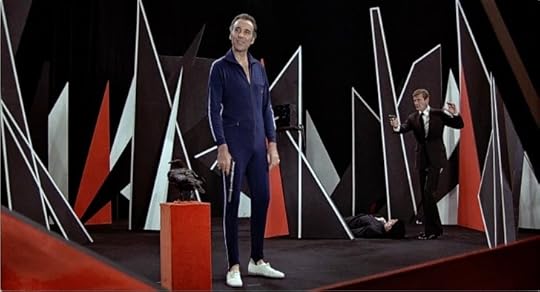 Psychedelic! The kids are into that, right? Right?
The film is one of the weakest in the franchise. A string of concocted situations, loosely connected to one another. Two absolute groaners stand out to me.
Bond is captured by his enemy and specifically ordered killed. They've got him right there, and they have weapons. How do they go about this execution? A bullet in the back of the head? Strangle him? No, no... what they do is put him up for the night in a sumptuous karate dojo, surrounded by beautiful women who cater to his every whim. As morning arrives, Bond is treated to watching some of the warriors spar with each other, and then.. of course, Bond is invited to come out and fight their best man. So that that man can kill Bond. Because that's a slam dunk. No possibility Bond will win! No chance of escape! WAIT, BOND IS A KARATE EXPERT? SHIT! HUH?! HE DOVE THROUGH A PAPER WINDOW AND FLED?! AFTER HIM! WHAT? THE GOOD GUYS WERE WAITING RIGHT OUTSIDE TO PICK HIM UP? THAT LIMEY GENIUS!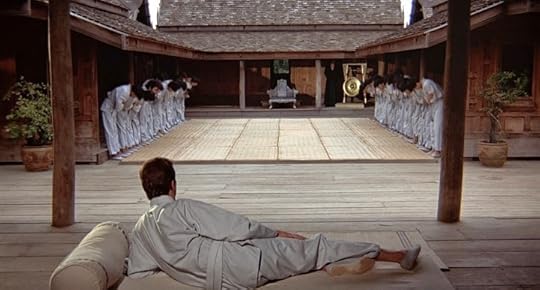 WORST EXECUTION EVERAnd then there's the dreaded Sheriff. Perhaps the worst character in all the movies, Sheriff Redneck (I can't be bothered to look up the actual character name, but this tells you all you need to know) from Live and Let Die makes his triumphant return to the silver screen here. I had forgotten about this fact until he appears--erased it from my mind you might say, and I found myself groaning that he was on screen for 10 seconds to deliver a dumb line. A cameo? Well, okay. I guess I can stomach it. But then he comes back. And doesn't leave. Now he and Bond are in a car together, chasing the enemy. Working together like some buddy cop duo. For endless minutes of sheer cringe-inducing antics. It boggles my mind that someone out there in movieland thought "We need to bring that Sheriff back. And... AND!!!... get him and Bond working together!" Hey guys, for this character, how about less "Live" and more "Let Die"?
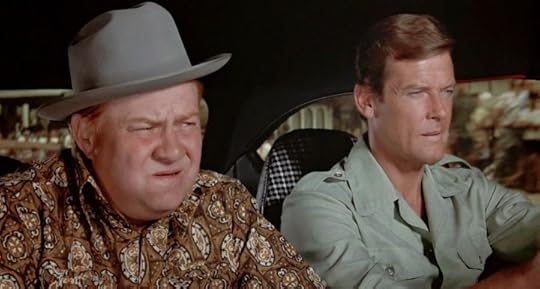 Tonight on ABC, another hilarious episode of Bond and the Redneck!
There are plenty of other problems, but they're more forgivable.
One highlight is the gigantic MI6 field office hidden inside the half-sunken wreck of the Queen Elizabeth. Despite being completely ridiculous as a secret base (I'm well past the point of expecting any actual spycraft to occur in these movies), it's a very cool set.
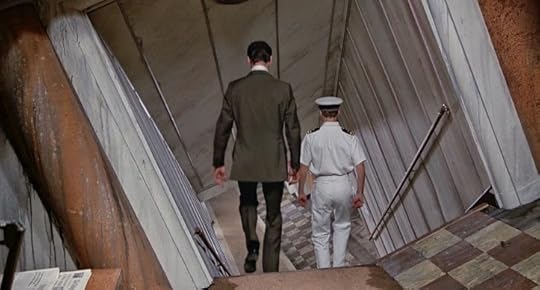 An entire secret base inside a ship listing at 45 degreesAlso, what is it with the filmmakers and their obsession with having M, Q, and Moneypenny showing up in the field where Bond is working? It's like the entire secret service support staff travels with him, and yet Bond always seems surprised to stumble upon them.
In summation, what we have this time 'round is a mediocre book adapted (and I use the term loosely) into a forgettable movie. You can safely put both of these near the bottom of you reading and viewing list.
Book: C-
Film: F+
Faithfulness to the source material: Well he has a gun, and it is gold...
Next up, and the last entry in the series, a short story collection: Octopussy and The Living Daylights
This, the last of the Bond novels, continues Bond's story from You Only Live Twice. Such continuity is rare in the series, but the last three take this approach.
(spoilers ahead...)
Bond has returned home from Japan via Russia, his amnesia gone only to be replaced by Soviet brainwashing. Bond actually tries to assassinate M, but M outwits him and, still holding out hope for the broken man, sends Bond off for shock treatment.
After successful treatment, M gives Bond a mission of little national security importance to try and see if he's still "got it". So he's sent out to kill an infamous assassin named Paco "Pistols" Scaramanga. In the book, Scaramanga uses a gold-plated Colt 45, firing bullets with a gold core because they cause more internal damage. He grew up as a trick shot in the circus, then fled after killing a policeman. On the run, he winds up spending most of his time as a killer for the Spang Brothers of Diamonds are Forever fame - basically the Vegas mob. He's a caricature American gangster, and not especially deep as Fleming villains go. But he does have great sexual prowess. This point gets made frequently.
After a week of travel without success, Bond winds up finding Scaramanga in Jamaica. The Caribbean is comfortable ground for Fleming, who lived there. As such it's easy to see why he chose the location. The movie trades this locale for Southeast Asia -- Thiland and Macau, perhaps to avoid the repetition of returning to Jamaica once again, perhaps because the Cuban situation had changed significantly by the time the film came out (the politics of the region, in the Cold War sense, were very much centered around Cuba at the time the novel was written).
On the topic of Scaramanga: This is one of those occasions where the film improved on the books. Scaramanga is a more interesting character by far in the movie, and comes across as much more of a challenge for Bond to defeat. Unfortunately everything else in the movie is so bad it doesn't really matter.
The plot in the book is rather simple, and relies perhaps more than any other Fleming novel on coincidence. Bond just happens to spot a letter posted for Scaramanga in the airport, detailing where and when the man will have a meeting. Then Bond just happens to bump into Scaramanga at a brothel (Bond is there because he's nostalgic for "old Jamaica" and thinking about buying the place, not realizing what goes on there but not really shocked either). Scaramanga hires bond to be his assistant for this big meeting he's about to have, a trope Fleming also used in Goldfinger (interesting, both "Gold" named books). Felix Leiter just happens to be undercover at the same hotel where the meeting is taking place. And, one of the people coming to the meeting just happens to be a top KGB agent who is out to kill Bond. They say that readers will forgive an author one coincidence, and Fleming is definitely pushing things well past the limit here.
It's a short, mediocre Bond novel adapted into an awful movie.
Film Scaramanga, purported to be this insanely good assassin, lives on an island China has given him, where he's constructed (in addition to an awesome house) a circus-inspired maze. With the help of his sadistic personal assistant, Scaramanga lures other famous assassins to this maze and then "hunts them". The quotes there are important because there's nothing sporting about it. I think the point of this was supposed to be that Scaramanga is pitting his skill against potential rivals, purely to see who is better, but this is rendered completely moot by the fact that the opponent has to go through this crazy, over-the-top circus maze. Scaramanga hides inside, knowing all the secrets, blindspots, and cover points. Then he shoots his opponent when they're at their most confused. How the hell is that a battle of assassin skills? And really, why bother with all that nonsense? None of this was in the book, at all. There's a passing mention of Scaramanga learning to shoot as a trick-shot in the circus, but that's it. As it stands, although everything else that happens points to this man being a top, if not thee top, assassin, the maze bit implies he cannot hope to beat his competition without massive external assistance. For me this killed all the other character building going on.
We see this maze in the opening scene and, inside, at the end of the contraption, is a wax model of James Bond -- telling us in bludgeoning-hammer-fashion that Scaramanga's ultimate rival is 007. I suspect at least 90% of viewers figure out in this opening minute that the movie will end with the real James Bond pretending to be the wax model in order to get the upper hand on Scaramanga. And that is, of course, exactly what happens.
 Psychedelic! The kids are into that, right? Right?
The film is one of the weakest in the franchise. A string of concocted situations, loosely connected to one another. Two absolute groaners stand out to me.
Bond is captured by his enemy and specifically ordered killed. They've got him right there, and they have weapons. How do they go about this execution? A bullet in the back of the head? Strangle him? No, no... what they do is put him up for the night in a sumptuous karate dojo, surrounded by beautiful women who cater to his every whim. As morning arrives, Bond is treated to watching some of the warriors spar with each other, and then.. of course, Bond is invited to come out and fight their best man. So that that man can kill Bond. Because that's a slam dunk. No possibility Bond will win! No chance of escape! WAIT, BOND IS A KARATE EXPERT? SHIT! HUH?! HE DOVE THROUGH A PAPER WINDOW AND FLED?! AFTER HIM! WHAT? THE GOOD GUYS WERE WAITING RIGHT OUTSIDE TO PICK HIM UP? THAT LIMEY GENIUS!
 WORST EXECUTION EVERAnd then there's the dreaded Sheriff. Perhaps the worst character in all the movies, Sheriff Redneck (I can't be bothered to look up the actual character name, but this tells you all you need to know) from Live and Let Die makes his triumphant return to the silver screen here. I had forgotten about this fact until he appears--erased it from my mind you might say, and I found myself groaning that he was on screen for 10 seconds to deliver a dumb line. A cameo? Well, okay. I guess I can stomach it. But then he comes back. And doesn't leave. Now he and Bond are in a car together, chasing the enemy. Working together like some buddy cop duo. For endless minutes of sheer cringe-inducing antics. It boggles my mind that someone out there in movieland thought "We need to bring that Sheriff back. And... AND!!!... get him and Bond working together!" Hey guys, for this character, how about less "Live" and more "Let Die"?
 Tonight on ABC, another hilarious episode of Bond and the Redneck!
There are plenty of other problems, but they're more forgivable.
One highlight is the gigantic MI6 field office hidden inside the half-sunken wreck of the Queen Elizabeth. Despite being completely ridiculous as a secret base (I'm well past the point of expecting any actual spycraft to occur in these movies), it's a very cool set.
 An entire secret base inside a ship listing at 45 degreesAlso, what is it with the filmmakers and their obsession with having M, Q, and Moneypenny showing up in the field where Bond is working? It's like the entire secret service support staff travels with him, and yet Bond always seems surprised to stumble upon them.
In summation, what we have this time 'round is a mediocre book adapted (and I use the term loosely) into a forgettable movie. You can safely put both of these near the bottom of you reading and viewing list.
Book: C-
Film: F+
Faithfulness to the source material: Well he has a gun, and it is gold...
Next up, and the last entry in the series, a short story collection: Octopussy and The Living Daylights


September 5, 2014
Blurb Policy
You can safely skip this post unless you're a writer.
I feel bad having to do this, but I've had something of a flood of requests recently and so I think stating an official policy will be useful. I'm shamelessly stealing the basics for this from John Scalzi.
So, my blurb policy is as such:
I'm very happy to read stuff with an eye toward blurbing it, especially for debut authors......but those requests must come from your editor/publisher or agent, ideally sent to my agent, Sara Megibow. She knows how busy I am, she knows what my deadlines are, and she can also weed out things that might be... inappropriate.
No matter how well you know me, please don't ask me directly. Don't email me your manuscript or send me a printed book in the mail unsolicited. Send it through your publisher, or your agent, and don't tell me it's coming. If I have time, I'll read. If you don't get a blurb back, don't take it personally. The most likely reason, by far, is simply that I don't have time. That's the honest truth.
This is basically standard etiquette for authors. Read Scalzi's post on the topic if you want more insight from someone who gets truly inundated with this sort of thing daily.
If you're a soon-to-be-published author, your editor will likely ask you at some point for a list of authors you think might be willing to blurb. That's the best time and place to drop my name. My advice? Drop a ton of names. One thing you'll learn very quickly is that you need to use a shotgun approach when it comes to this sort of thing. I sought blurbs from all my favorite authors for DARWIN (asking none directly), and you know what? Not a single one of them came through. I'll admit I took this kind of personally at the time, but now that I'm on the other side of things I can see why that's the wrong reaction. And anyway I still wound up with a slew of great blurbs from amazing authors. You will, too. So don't fret, don't take it personally, and please don't put me (or any of the authors you love) in the position where we have to tell you that we're not going to blurb, or even that we couldn't clear our schedule to read your book. It's no fun for anyone.
Right then! Back to fun stuff...
I feel bad having to do this, but I've had something of a flood of requests recently and so I think stating an official policy will be useful. I'm shamelessly stealing the basics for this from John Scalzi.
So, my blurb policy is as such:
I'm very happy to read stuff with an eye toward blurbing it, especially for debut authors......but those requests must come from your editor/publisher or agent, ideally sent to my agent, Sara Megibow. She knows how busy I am, she knows what my deadlines are, and she can also weed out things that might be... inappropriate.
No matter how well you know me, please don't ask me directly. Don't email me your manuscript or send me a printed book in the mail unsolicited. Send it through your publisher, or your agent, and don't tell me it's coming. If I have time, I'll read. If you don't get a blurb back, don't take it personally. The most likely reason, by far, is simply that I don't have time. That's the honest truth.
This is basically standard etiquette for authors. Read Scalzi's post on the topic if you want more insight from someone who gets truly inundated with this sort of thing daily.
If you're a soon-to-be-published author, your editor will likely ask you at some point for a list of authors you think might be willing to blurb. That's the best time and place to drop my name. My advice? Drop a ton of names. One thing you'll learn very quickly is that you need to use a shotgun approach when it comes to this sort of thing. I sought blurbs from all my favorite authors for DARWIN (asking none directly), and you know what? Not a single one of them came through. I'll admit I took this kind of personally at the time, but now that I'm on the other side of things I can see why that's the wrong reaction. And anyway I still wound up with a slew of great blurbs from amazing authors. You will, too. So don't fret, don't take it personally, and please don't put me (or any of the authors you love) in the position where we have to tell you that we're not going to blurb, or even that we couldn't clear our schedule to read your book. It's no fun for anyone.
Right then! Back to fun stuff...
August 31, 2014
Book vs. Film: "You Only Live Twice"
(part of my series comparing the James Bond novels to their film counterparts)
The situation is... complicated.
Fleming wrote this novel as a follow up to On Her Majesty's Secret Service, where Bond finds himself married, and then hours later, tragically, single once again. Worse, the killers -- Blofeld and his right-hand Erma Blount -- get away. At the start of the novel version of Twice he's depressed, distracted, and performing poorly at work and in his private life. He's ready to resign as soon as M asks him too, which Bond is convinced will happen at any moment.
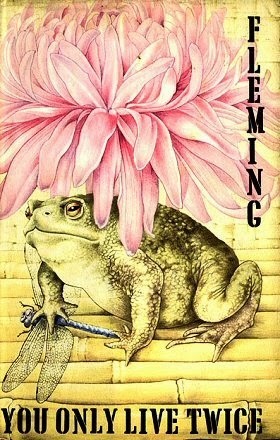 First edition cover, 1964
The movie producers made two choices here that get things off on the wrong foot. First, they decided to produce a movie based on You Only Live Twice before On Her Majesty's Secret Service. Given that these novels feature a rare thing for the series -- plot continuity -- we have a problem. Bond's mindset, and indeed the entire purpose of his mission to Japan, is related to the life situation he's found himself in. And, ultimately, the evil he must face in Twice is the very same evil that killed Bond's spouse.
Well, guess what happens when they film these out of order? That's right. They lose all of that. And how do they make up for this? With crap.
I mean, if you're going to stray from the source material, you should not only have a damn good reason, but also an idea of your own that is, if not equal to the source material, at least in the spirit of it. Right?
Let me talk about the book first. A quick synopsis to set the stage: M sends depressed-Bond on a mission he hopes will revive his spirit. Something tough, but something devoid of action and gunplay. It's a diplomatic mission to try and get the Japanese secret service to share intelligence with the British rather than the CIA. M fears the CIA is filtering the information, or worse, withholding key things.
So Bond heads for Japan, and while much of this portion of the book reads rather slow and cliche, there are plenty of interesting insights as well. Remember that this was written and set in the 60's, perhaps twenty years after the end of WWII. As with all of these novels it amounts to a window into a different era, and different mindsets.
Things get moving when Bond is given a task by the head of Japan's secret service: Go assassinate this rogue ex-pat Swiss botanist for us and we'll start sharing information with your boss.
While much of the rest of the book is good but never great, an equal portion of it is weak but never terrible. The end result is a middle-of-the-pack Bond novel. I can see the desire to amp it up a bit for film.
(spoiler alert!)
The novel ends with Bond taking two vicious wounds to his head, and when he's finally pulled from the water by his love interest, he's lost his memory. Something unexpected happens then, and I found this perhaps the most interesting aspect of the book. Kissy Suzuki, the girl, decides not to tell Bond who he really is or why he's there. Instead she tries to keep him for herself, pretending they're lovers and that the little island she lives on is their entire world. She hides Bond from all the various people that come looking for him. And, somewhat delightfully, she succeeds. She keeps Bond in this fictional life for months. So long, in fact, that M and everyone else has assumed Bond died in the final battle. The book ends with Bond trapped in this idyllic life until he has the first jog to his memory: spotting the word "Vladivostok" in a newspaper clipping Kissy missed (she makes sure he doesn't see anything with English words). The word means something to Bond, and when he finds out it's a city in Russia he wants to go visit it. She reluctantly lets him go.
During all this, M writes an obituary for Bond which is "included in full". I got a huge kick out of this because it's written as if Bond and M are real people, even going to far as to mention that a caricature of Bond was portrayed in a series of novels, and that "if these works had been of higher quality" the Ministry of Defense might have done something about them. Fun to see Fleming could be self deprecating, and doing so in style by having his own character, M, saying bad things about the novels and their author.
Also mentioned is the epitaph chosen for Bond's gravestone, which I thought was actually rather poetic and a great summation of Bond's character:
"I shall not waste my days in trying to prolong them. I shall use my time."
(spoilers end)
As for the film... do I have to?
Okay, fine. But here's the key thing to take away from this: You Only Live Twice is the first of the film adaptations to stray wildly from the book, and we've seen how well that's worked out in almost every previous post in this series.
It starts with this nonsense:
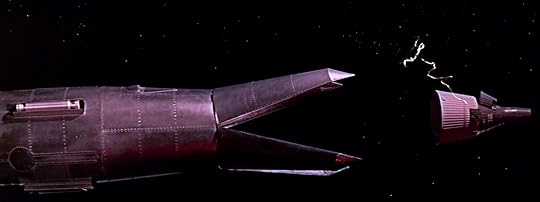
"What the hell is this?" you wonder? Why, it's a mystery rogue spaceship swallowing an American space capsule. Remember: it's the Mid 60's. This stuff was all the rage back then. "How can we work space travel into this story?" the producers must have asked themselves. They'd ask the same question with Moonraker, apparently not learning their lesson the first time around. At least they don't have Bond traveling into space here, but things get damned close to that.
I'll cut to the chase. The gambit is that Blofeld, and therefore SPECTRE, are stealing space ships. First they steal an American one, which the Americans naturally blame the Russians for. Then later they steal a Russian one, because of course the Russians will blame the Americans. Why? Because obviously this will result in a nuclear war! Let me just hammer this home: The evil plot is that Blofeld will develop IN SECRET and entire space program, run out of a fake volcano in Japan, and what he plans to do with his amazing technological accomplishment is hijack American and Russian space capsules... because clearly that will send the two superpowers over the brink of nuclear armageddon. To what end? It's not obvious? Because once they've destroyed each other, SPECTRE will rise to take their places as the de-facto post-apocalyptic worldwide bad-ass regime!
Diabolical! Overly complicated! Very low chance of success! As long as that meddling Bond doesn't catch wind of it...
Equally corny, in my view, is Bond's opening scene that comes right after this. Bond is killed in Hong Kong (while bedding an Asian woman, of course!). There follows an elaborate funeral ending with Bond's burial at sea. His corpse drifts down to the seabed, only to be picked up by a submarine, where he is discovered (try to contain your shock here) to be alive. He makes a now-customary quip and we're off. The death was faked to give Bond adequate cover for going on a mission to Japan. A mission that starts, by the way, with him being fired out of a torpedo tube as a means of getting from the submarine to shore. I can only assume this whole bit of wretched shtick was to give the title some meaning, because the book gets the title from a haiku that Bond writes. (You only live twice. Once when you are born, and once when you look death in the face.)
Surprisingly, some of the corny bits in the movie ARE in the book this time. The ninjas. The idea that Bond can be physically transformed to pass for Japanese. The corny tilting-floor slide trap. All in the novel. None of these things come across quite as cheesy in the book, but they are there. What the movie adds on top of this is the aforementioned fake funeral, the spacecraft hijacking, Bond being launched from a torpedo tube, "rocket guns", and the kicker: Bond, in order to truly pass for Japanese, must be married, leading to a fake wedding to go with the fake funeral. This scene is pointless and just goes on and on and on. It also reduces Kissy Suzuki's rather interesting character into just another woman for Bond to conquer. Gah.
Book: C
Film: D
Faithfulness to the source material: D-
Up next: The Man with the Golden Gun
The situation is... complicated.
Fleming wrote this novel as a follow up to On Her Majesty's Secret Service, where Bond finds himself married, and then hours later, tragically, single once again. Worse, the killers -- Blofeld and his right-hand Erma Blount -- get away. At the start of the novel version of Twice he's depressed, distracted, and performing poorly at work and in his private life. He's ready to resign as soon as M asks him too, which Bond is convinced will happen at any moment.
 First edition cover, 1964
The movie producers made two choices here that get things off on the wrong foot. First, they decided to produce a movie based on You Only Live Twice before On Her Majesty's Secret Service. Given that these novels feature a rare thing for the series -- plot continuity -- we have a problem. Bond's mindset, and indeed the entire purpose of his mission to Japan, is related to the life situation he's found himself in. And, ultimately, the evil he must face in Twice is the very same evil that killed Bond's spouse.
Well, guess what happens when they film these out of order? That's right. They lose all of that. And how do they make up for this? With crap.
I mean, if you're going to stray from the source material, you should not only have a damn good reason, but also an idea of your own that is, if not equal to the source material, at least in the spirit of it. Right?
Let me talk about the book first. A quick synopsis to set the stage: M sends depressed-Bond on a mission he hopes will revive his spirit. Something tough, but something devoid of action and gunplay. It's a diplomatic mission to try and get the Japanese secret service to share intelligence with the British rather than the CIA. M fears the CIA is filtering the information, or worse, withholding key things.
So Bond heads for Japan, and while much of this portion of the book reads rather slow and cliche, there are plenty of interesting insights as well. Remember that this was written and set in the 60's, perhaps twenty years after the end of WWII. As with all of these novels it amounts to a window into a different era, and different mindsets.
Things get moving when Bond is given a task by the head of Japan's secret service: Go assassinate this rogue ex-pat Swiss botanist for us and we'll start sharing information with your boss.
While much of the rest of the book is good but never great, an equal portion of it is weak but never terrible. The end result is a middle-of-the-pack Bond novel. I can see the desire to amp it up a bit for film.
(spoiler alert!)
The novel ends with Bond taking two vicious wounds to his head, and when he's finally pulled from the water by his love interest, he's lost his memory. Something unexpected happens then, and I found this perhaps the most interesting aspect of the book. Kissy Suzuki, the girl, decides not to tell Bond who he really is or why he's there. Instead she tries to keep him for herself, pretending they're lovers and that the little island she lives on is their entire world. She hides Bond from all the various people that come looking for him. And, somewhat delightfully, she succeeds. She keeps Bond in this fictional life for months. So long, in fact, that M and everyone else has assumed Bond died in the final battle. The book ends with Bond trapped in this idyllic life until he has the first jog to his memory: spotting the word "Vladivostok" in a newspaper clipping Kissy missed (she makes sure he doesn't see anything with English words). The word means something to Bond, and when he finds out it's a city in Russia he wants to go visit it. She reluctantly lets him go.
During all this, M writes an obituary for Bond which is "included in full". I got a huge kick out of this because it's written as if Bond and M are real people, even going to far as to mention that a caricature of Bond was portrayed in a series of novels, and that "if these works had been of higher quality" the Ministry of Defense might have done something about them. Fun to see Fleming could be self deprecating, and doing so in style by having his own character, M, saying bad things about the novels and their author.
Also mentioned is the epitaph chosen for Bond's gravestone, which I thought was actually rather poetic and a great summation of Bond's character:
"I shall not waste my days in trying to prolong them. I shall use my time."
(spoilers end)
As for the film... do I have to?
Okay, fine. But here's the key thing to take away from this: You Only Live Twice is the first of the film adaptations to stray wildly from the book, and we've seen how well that's worked out in almost every previous post in this series.
It starts with this nonsense:

"What the hell is this?" you wonder? Why, it's a mystery rogue spaceship swallowing an American space capsule. Remember: it's the Mid 60's. This stuff was all the rage back then. "How can we work space travel into this story?" the producers must have asked themselves. They'd ask the same question with Moonraker, apparently not learning their lesson the first time around. At least they don't have Bond traveling into space here, but things get damned close to that.
I'll cut to the chase. The gambit is that Blofeld, and therefore SPECTRE, are stealing space ships. First they steal an American one, which the Americans naturally blame the Russians for. Then later they steal a Russian one, because of course the Russians will blame the Americans. Why? Because obviously this will result in a nuclear war! Let me just hammer this home: The evil plot is that Blofeld will develop IN SECRET and entire space program, run out of a fake volcano in Japan, and what he plans to do with his amazing technological accomplishment is hijack American and Russian space capsules... because clearly that will send the two superpowers over the brink of nuclear armageddon. To what end? It's not obvious? Because once they've destroyed each other, SPECTRE will rise to take their places as the de-facto post-apocalyptic worldwide bad-ass regime!
Diabolical! Overly complicated! Very low chance of success! As long as that meddling Bond doesn't catch wind of it...
Equally corny, in my view, is Bond's opening scene that comes right after this. Bond is killed in Hong Kong (while bedding an Asian woman, of course!). There follows an elaborate funeral ending with Bond's burial at sea. His corpse drifts down to the seabed, only to be picked up by a submarine, where he is discovered (try to contain your shock here) to be alive. He makes a now-customary quip and we're off. The death was faked to give Bond adequate cover for going on a mission to Japan. A mission that starts, by the way, with him being fired out of a torpedo tube as a means of getting from the submarine to shore. I can only assume this whole bit of wretched shtick was to give the title some meaning, because the book gets the title from a haiku that Bond writes. (You only live twice. Once when you are born, and once when you look death in the face.)
Surprisingly, some of the corny bits in the movie ARE in the book this time. The ninjas. The idea that Bond can be physically transformed to pass for Japanese. The corny tilting-floor slide trap. All in the novel. None of these things come across quite as cheesy in the book, but they are there. What the movie adds on top of this is the aforementioned fake funeral, the spacecraft hijacking, Bond being launched from a torpedo tube, "rocket guns", and the kicker: Bond, in order to truly pass for Japanese, must be married, leading to a fake wedding to go with the fake funeral. This scene is pointless and just goes on and on and on. It also reduces Kissy Suzuki's rather interesting character into just another woman for Bond to conquer. Gah.
Book: C
Film: D
Faithfulness to the source material: D-
Up next: The Man with the Golden Gun
August 17, 2014
Book vs. Film: "On Her Majesty's Secret Service"
(part of my series comparing the James Bond novels to their film counterparts)
On Her Majesty's Secret Service was the first novel to be published after Bond became a film sensation. I don't know if Fleming wrote it before Dr. No's theatrical release, but it stands to reason he was at least in the process of editing it during that time.
If he felt any pressure or influence from the movie, it doesn't show. This book proves to be very consistent with Bond's previous adventures. It revolves around one of the more devious plots in the Bond-villain catalog of devious plots: using hypnotherapy to get unwitting civilians to spread animal and crop diseases.
Surrounding this, Bond is also faced with a devious plot of a different kind: marriage. He's fallen in love with a girl named Tracy, who happens to be the daughter of a major organized crime boss. Her father tries to force Bond into wedlock from the outset as a way to save his reckless daughter's life, but Bond insists she get psychiatric help first. Only then will he consider courting her.
Later, after Bond makes a harrowing (and extremely well written) escape from the villain's lair high in the alps, it's Tracy who magically and coincidentally arrives to save him. I rolled my eyes at this bit of luck, but then Fleming did something that I advise aspiring writers often: turn your coincidences into conspiracies. In this case, Tracy reminds Bond that he'd asked her father to try and discover the location of Ernest Blofeld (the villain Bond is hunting), and that her father had done just that, but couldn't get ahold of Bond to relay the information. Tracy learns the location from her dad, and reasoned that Bond might already be there looking for the man, so she comes in search of him. It's still rather convenient, but at least plausible.
I won't spoil the third act. All in all this is one of the better entries into the Bond series. As an author I keep trying to put myself into Fleming's mindset. With all the hoopla going on over the film Dr. No, it's impressive to me that he was able to keep his cool and write something that seems so naturally at home with the rest of the novels. Perhaps the pressure is counterbalanced by the desire to up one's game, in such a scenario. I'm not sure. I hope to have the good fortune to find out for myself someday.
The film version has the distinction of being the only Bond film to star George Lazenby, who landed the role after Sean Connery's departure. Lazenby serves as a passable as Bond. He's certainly no Connery or Craig, but I would have preferred he stay with the roll in favor of Roger Moore. Unfortunately Lazenby, who was an unknown when cast, decided during filming that he would only do one Bond movie.
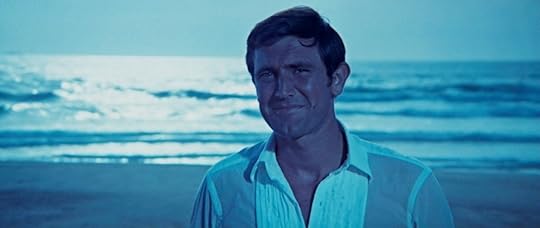 "This never happened to the other fellow," Bond says, then glances knowingly at the camera, punching a Frank-Underwood-sized hole in the fourth wall.From a plot standpoint, it follows the book rather well. However, key elements of the chronology gets mucked with, and I'm not quite sure why. Some of these tweaks had the effect of changing Bond's relationship with Tracy into something more along the lines of a gangster forcing Bond into the deal, rather than a spur-of-the-moment proposal as in the book. It amounts to yet another head-scratching change to Bond's personality, I can only imagine because so much of the impetus for this comes through Bond's internal dialog, whereas in the film the best moment to set this up (I suppose) is when Bond is first approached by the gangster.
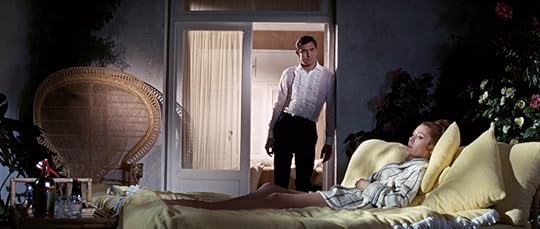 Seinfeld called, he wants his puffy shirt back
Lazenby is a much softer man than Connery. A lot of that cruelty Fleming describes and embodied by Connery is lost, replaced with a bright smile and aloof charm. I would have thought these reasons alone would have been enough to avoid casting him in the first place, but these traits were clearly something the filmmakers eagerly sought given the choice of Roger Moore that came next and lasted so long. If anything Moore takes the character farther in the wrong direction. Nothing against Roger Moore by the way, he was excellent as The Saint. I just think he's miscast as Bond, not to mentioned hampered by the writing and direction.
As a film this is one of the stronger entries. The cinematography is at times excellent. The action sequences, while a bit repetitive, are at least of a much more frenetic pace than the Connery era, and the ski chases are very well filmed (except when Lazenby or Savalas are shot against a green screen). Many scenes are lifted almost exactly from the book, including the final, tragic end.
However, the filmmakers tinker, and once again I'm frustrated by the effect these choices have on the main character. Some examples:
Book: Bond has decided he'll flee from Blofeld's mountaintop lab the next morning. So he spends a lot of time plotting his route, and finding the things he'll need to survive the frigid mountainside. He steals gloves, he cons the headmistress into bringing him some ski goggles, he scopes out the storage room where the snow gear is stored, and so on.Film: The above is reduced to a sudden flight with very little thought or preparation. Bond shifts from careful, calculating spy, to something more like a superhero.Book: Bond is going to enter Blofeld's lab undercover as an expert in heraldry, because Blofeld has submitted paperwork requesting that he be recognized as a Count. So Bond spends a great deal of time studying for this cover, because he's going to need to know what he's talking about.Film: Bond is already an expert in heraldry. He steps right into the role, and seems to just bluff his way through it. He's no studious spy, he's just ridiculously smart. (Curiously, this bites him in the ass, as he makes a mistake that Blofeld catches, thus blowing his cover)Book: As if the above example wasn't enough, when Bond visits M at M's home, his boss (in the novel) is studying some flowers. Bond doesn't know anything about them and it's M who gives him a bit of education.Film: M is studying butterflies, and Bond takes one glance at the specimen currently on the table and rattles off the latin name. Butterfly expert? Of course! He knows everything!Book: Bond throws a knife at a calendar to impress on Draco how deadly he can be. And it's a damn good throw, but he misses the current date by one day. Still, it's good enough to let the man know he's no amateur.Film: Bond misses the day by one. When Draco comments on this, Bond says he always thinks a day ahead.Taken as individual changes, these things are pretty innocent. Perhaps the writers can't see the forest for the trees, however, because when you add them all together (along with a dozen or so others I left out) you get a Bond with superhuman abilities. Which is part of the reason I think the films lack the intensity of the books. I never really believe Bond is in trouble in the movies. Worse, Bond always feels like he's just sort of sliding from one situation to the next (this is at its worst in the Moore films). Literally everything is easy for him. And as a result the detective aspect, the spycraft, is lost almost entirely.
Book: B+Film: B-Faithfulness to the book: B-
Up next: You Only Live Twice
On Her Majesty's Secret Service was the first novel to be published after Bond became a film sensation. I don't know if Fleming wrote it before Dr. No's theatrical release, but it stands to reason he was at least in the process of editing it during that time.
If he felt any pressure or influence from the movie, it doesn't show. This book proves to be very consistent with Bond's previous adventures. It revolves around one of the more devious plots in the Bond-villain catalog of devious plots: using hypnotherapy to get unwitting civilians to spread animal and crop diseases.
Surrounding this, Bond is also faced with a devious plot of a different kind: marriage. He's fallen in love with a girl named Tracy, who happens to be the daughter of a major organized crime boss. Her father tries to force Bond into wedlock from the outset as a way to save his reckless daughter's life, but Bond insists she get psychiatric help first. Only then will he consider courting her.
Later, after Bond makes a harrowing (and extremely well written) escape from the villain's lair high in the alps, it's Tracy who magically and coincidentally arrives to save him. I rolled my eyes at this bit of luck, but then Fleming did something that I advise aspiring writers often: turn your coincidences into conspiracies. In this case, Tracy reminds Bond that he'd asked her father to try and discover the location of Ernest Blofeld (the villain Bond is hunting), and that her father had done just that, but couldn't get ahold of Bond to relay the information. Tracy learns the location from her dad, and reasoned that Bond might already be there looking for the man, so she comes in search of him. It's still rather convenient, but at least plausible.
I won't spoil the third act. All in all this is one of the better entries into the Bond series. As an author I keep trying to put myself into Fleming's mindset. With all the hoopla going on over the film Dr. No, it's impressive to me that he was able to keep his cool and write something that seems so naturally at home with the rest of the novels. Perhaps the pressure is counterbalanced by the desire to up one's game, in such a scenario. I'm not sure. I hope to have the good fortune to find out for myself someday.
The film version has the distinction of being the only Bond film to star George Lazenby, who landed the role after Sean Connery's departure. Lazenby serves as a passable as Bond. He's certainly no Connery or Craig, but I would have preferred he stay with the roll in favor of Roger Moore. Unfortunately Lazenby, who was an unknown when cast, decided during filming that he would only do one Bond movie.
 "This never happened to the other fellow," Bond says, then glances knowingly at the camera, punching a Frank-Underwood-sized hole in the fourth wall.From a plot standpoint, it follows the book rather well. However, key elements of the chronology gets mucked with, and I'm not quite sure why. Some of these tweaks had the effect of changing Bond's relationship with Tracy into something more along the lines of a gangster forcing Bond into the deal, rather than a spur-of-the-moment proposal as in the book. It amounts to yet another head-scratching change to Bond's personality, I can only imagine because so much of the impetus for this comes through Bond's internal dialog, whereas in the film the best moment to set this up (I suppose) is when Bond is first approached by the gangster.Seinfeld called, he wants his puffy shirt back
Lazenby is a much softer man than Connery. A lot of that cruelty Fleming describes and embodied by Connery is lost, replaced with a bright smile and aloof charm. I would have thought these reasons alone would have been enough to avoid casting him in the first place, but these traits were clearly something the filmmakers eagerly sought given the choice of Roger Moore that came next and lasted so long. If anything Moore takes the character farther in the wrong direction. Nothing against Roger Moore by the way, he was excellent as The Saint. I just think he's miscast as Bond, not to mentioned hampered by the writing and direction.
As a film this is one of the stronger entries. The cinematography is at times excellent. The action sequences, while a bit repetitive, are at least of a much more frenetic pace than the Connery era, and the ski chases are very well filmed (except when Lazenby or Savalas are shot against a green screen). Many scenes are lifted almost exactly from the book, including the final, tragic end.
However, the filmmakers tinker, and once again I'm frustrated by the effect these choices have on the main character. Some examples:
Book: Bond has decided he'll flee from Blofeld's mountaintop lab the next morning. So he spends a lot of time plotting his route, and finding the things he'll need to survive the frigid mountainside. He steals gloves, he cons the headmistress into bringing him some ski goggles, he scopes out the storage room where the snow gear is stored, and so on.Film: The above is reduced to a sudden flight with very little thought or preparation. Bond shifts from careful, calculating spy, to something more like a superhero.Book: Bond is going to enter Blofeld's lab undercover as an expert in heraldry, because Blofeld has submitted paperwork requesting that he be recognized as a Count. So Bond spends a great deal of time studying for this cover, because he's going to need to know what he's talking about.Film: Bond is already an expert in heraldry. He steps right into the role, and seems to just bluff his way through it. He's no studious spy, he's just ridiculously smart. (Curiously, this bites him in the ass, as he makes a mistake that Blofeld catches, thus blowing his cover)Book: As if the above example wasn't enough, when Bond visits M at M's home, his boss (in the novel) is studying some flowers. Bond doesn't know anything about them and it's M who gives him a bit of education.Film: M is studying butterflies, and Bond takes one glance at the specimen currently on the table and rattles off the latin name. Butterfly expert? Of course! He knows everything!Book: Bond throws a knife at a calendar to impress on Draco how deadly he can be. And it's a damn good throw, but he misses the current date by one day. Still, it's good enough to let the man know he's no amateur.Film: Bond misses the day by one. When Draco comments on this, Bond says he always thinks a day ahead.Taken as individual changes, these things are pretty innocent. Perhaps the writers can't see the forest for the trees, however, because when you add them all together (along with a dozen or so others I left out) you get a Bond with superhuman abilities. Which is part of the reason I think the films lack the intensity of the books. I never really believe Bond is in trouble in the movies. Worse, Bond always feels like he's just sort of sliding from one situation to the next (this is at its worst in the Moore films). Literally everything is easy for him. And as a result the detective aspect, the spycraft, is lost almost entirely.
Book: B+Film: B-Faithfulness to the book: B-
Up next: You Only Live Twice
August 12, 2014
Book vs. Film: "The Spy Who Loved Me"
(part of my series comparing the James Bond novels to their film counterparts)
Now we come to one of the most interesting Bond novels, because it's not written from James Bond's POV. In fact he's barely even in the book.
Fleming includes a forward, which I'll quote here verbatim:
So what we have here is a first-person novel supposedly written by one Vivienne Michel, who is also the main character and supposedly had an adventure/romance that involved real-life James Bond. Yet we know this is really Ian Fleming writing. Perhaps he just wanted to do something different. Perhaps he wanted to explore a Bond story from another character's POV. I can respect that.
At the very least it's quite a jarring way to start a book, especially the 8th in a series. Critics did not react well from what I understand, and Fleming supposedly only allowed a film to bear the name when promised the book's plot would not be used. Which means this post is sort of dead before it starts, I suppose.
Still, there's some interesting things to discuss.
First off, I listened to the audiobook. All the others are narrated by the insanely talented Simon Vance. This one appropriately gets a female narrator by the name of Nadia May, and she's wonderful. There's a more recent version with a new narrator (one of the actresses from the movies), but I purchased the earlier version and that's okay, I found it to be excellent.
As I mentioned, the novel spends a great deal of time with the protagonist 'Viv'. She details her professional life and her love life, leading to a messy breakup with her German boss and a trip to Switzerland to get an abortion. She leaves for Canada after that, intent on doing a Vespa-powered road trip across the American continent. This is all well and good, and honestly a fine story in its own right. It's also very much a departure for Fleming, however it has very little to do with the rest of the book.
Viv rather quickly she finds herself in a nasty situation, holed up in an upstate New York lodge at the end of vacation season with a couple of gangsters who are there to burn the place down as part of an insurance fraud scheme. She's a captive of these men, until there's a knock at the door and James Bond arrives. Again, this is roughly 2/3's of the way through the book. You can probably guess what happens from here on out, so I'll refrain from further spoilers.
To Fleming's credit, the novel really does read like someone else wrote it. If that is what he'd hoped to accomplish, he succeeded. But on the whole the book actually suffers from Bond's appearance. I would have been much happier if Viv had worked herself out of this ugly situation. She certainly seemed capable, and has the attitude for it, at least in glimpses. The arrival of Bond felt too much like the knight-in-shining-armor moment, and of course adds an element of sexism that the story didn't need. If Bond had never appeared, Viv had solved her own problem, and Fleming had published this under a pen name, it would have been a quite good (if short) crime novel. With the weird addition of James Bond, the book suffers. And as a Bond novel, it's definitely unsatisfying.
As for the film? It has nothing to do with the book. It's a 1977 pile of cheese and you should avoid it. Bleh. The kicker is that, as I mentioned, Fleming specifically said they could only use the title. So in a way I think he deserves some of the blame for the film.
This book was an experiment for Fleming. I find it very interesting that it was released in 1962, the same year that the first film, Dr. No, came out. I can't help but wonder if there was some regret on Fleming's part that he'd tried to do something fresh and different with the books at the same time the Dr. No was setting the world on fire.
Looking back on this series of posts I realize I've been pretty hard on the films. I'm okay with that. The books are better in almost every case, so far. Four more left!
As for the ratings on this one:Book: CFilm: not rated because it has nothing to do with the book (on its own... F)
Next Up: Yet another oddball - On Her Majesty's Secret Service
Now we come to one of the most interesting Bond novels, because it's not written from James Bond's POV. In fact he's barely even in the book.
Fleming includes a forward, which I'll quote here verbatim:
I found what follows lying on my desk one morning. As you will see, it appears to be the first person story of a young woman, evidently beautiful and not unskilled in the arts of love. According to her story, she appears to have been involved, both perilously and romantically, with the same James Bond whose secret service exploits I myself have written from time to time. With the manuscript was a note signed 'Vivienne Michel' assuring me that what she had written was 'purest truth and from the depths of her heart'. I was interested in this view of James Bond, through the wrong end of the telescope so to speak, and after obtaining clearance for certain minor infringements of the Official Secrets Act I have much pleasure in sponsoring its publication.
So what we have here is a first-person novel supposedly written by one Vivienne Michel, who is also the main character and supposedly had an adventure/romance that involved real-life James Bond. Yet we know this is really Ian Fleming writing. Perhaps he just wanted to do something different. Perhaps he wanted to explore a Bond story from another character's POV. I can respect that.
At the very least it's quite a jarring way to start a book, especially the 8th in a series. Critics did not react well from what I understand, and Fleming supposedly only allowed a film to bear the name when promised the book's plot would not be used. Which means this post is sort of dead before it starts, I suppose.
Still, there's some interesting things to discuss.
First off, I listened to the audiobook. All the others are narrated by the insanely talented Simon Vance. This one appropriately gets a female narrator by the name of Nadia May, and she's wonderful. There's a more recent version with a new narrator (one of the actresses from the movies), but I purchased the earlier version and that's okay, I found it to be excellent.
As I mentioned, the novel spends a great deal of time with the protagonist 'Viv'. She details her professional life and her love life, leading to a messy breakup with her German boss and a trip to Switzerland to get an abortion. She leaves for Canada after that, intent on doing a Vespa-powered road trip across the American continent. This is all well and good, and honestly a fine story in its own right. It's also very much a departure for Fleming, however it has very little to do with the rest of the book.
Viv rather quickly she finds herself in a nasty situation, holed up in an upstate New York lodge at the end of vacation season with a couple of gangsters who are there to burn the place down as part of an insurance fraud scheme. She's a captive of these men, until there's a knock at the door and James Bond arrives. Again, this is roughly 2/3's of the way through the book. You can probably guess what happens from here on out, so I'll refrain from further spoilers.
To Fleming's credit, the novel really does read like someone else wrote it. If that is what he'd hoped to accomplish, he succeeded. But on the whole the book actually suffers from Bond's appearance. I would have been much happier if Viv had worked herself out of this ugly situation. She certainly seemed capable, and has the attitude for it, at least in glimpses. The arrival of Bond felt too much like the knight-in-shining-armor moment, and of course adds an element of sexism that the story didn't need. If Bond had never appeared, Viv had solved her own problem, and Fleming had published this under a pen name, it would have been a quite good (if short) crime novel. With the weird addition of James Bond, the book suffers. And as a Bond novel, it's definitely unsatisfying.
As for the film? It has nothing to do with the book. It's a 1977 pile of cheese and you should avoid it. Bleh. The kicker is that, as I mentioned, Fleming specifically said they could only use the title. So in a way I think he deserves some of the blame for the film.
This book was an experiment for Fleming. I find it very interesting that it was released in 1962, the same year that the first film, Dr. No, came out. I can't help but wonder if there was some regret on Fleming's part that he'd tried to do something fresh and different with the books at the same time the Dr. No was setting the world on fire.
Looking back on this series of posts I realize I've been pretty hard on the films. I'm okay with that. The books are better in almost every case, so far. Four more left!
As for the ratings on this one:Book: CFilm: not rated because it has nothing to do with the book (on its own... F)
Next Up: Yet another oddball - On Her Majesty's Secret Service
August 8, 2014
Book vs. Film(s): "Thunderball"
(part of my series comparing the James Bond novels to their film counterparts)
This is an interesting one.
Thunderball (published 1961) is unique* in the Bond universe because it was adapted twice for the silver screen. First as Thunderball (1965), starring Sean Connery, and second as Never Say Never Again (1983), starring... Sean Connery.
* I'm not counting the 1967 Casino Royale comedy. It doesn't exist. Nope. Never heard of it.
Why, you ask, would they choose to remake a Bond film but try to pass it off as a new Bond film? Why not come up with an original story? It's quite simple, really: Lawyers.
Turns out Fleming had some help crafting the story for this one, and one of those collaborating writers battled for years in court to get the right to adapt the novel to screen. He eventually won, and Never Say Never Again is the movie that resulted. It's the only Bond film that falls outside of the Broccoli production team who otherwise enjoy a vice-like grip on the rights to the property. It also lured Sean Connery out of Bond-retirement.
As a kid I never realized this about the film. Watching it now, you still might not realize it. The most glaring indicator is the lack of the classic Bond theme music.
Plot-wise Never Say Never Again tracks pretty closely to the novel, more so than the first film. And while it does have some cheesy moments, the 18 year gap between the two films allows it to benefit from some of the maturation the filmmaking art enjoyed during that stretch.
Klaus Brandauer is awesome as Max Largo. In fact I'd go so far to say he's my favorite film-universe Bond villain. His mannerisms are delightfully creepy without dipping into caricature. Kim Basinger, on the other hand, was not the best casting choice ever made. She's a fine actress in her own right, but for me at least fails to capture Domino's character from the book.
Minor bit of trivia: there's several moments in Never when you can hear the Voight-Kampf Machine sound effects from Blade Runner. What can I say? A geek like me notices such things.
Perhaps the worst part about Never is the silly video game battle, taking place of the Baccarat sequence. In the 80's, 14-year-old me thought this was pretty cool. But now it's just incredibly dated. The only thing salvaging it is Klaus Brandauer's creepy delight in both giving and receiving pain.
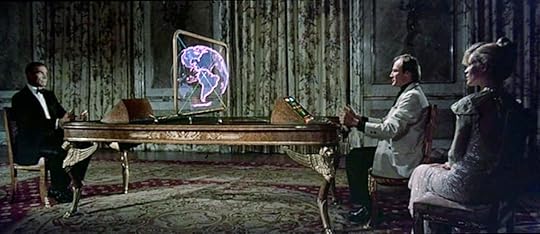
Thunderball, on the other hand, is simply a mediocre film. That is, once you get past the ridiculous opening sequence (A jet pack? Why why WHY?!?!). There's some excellent cinematography and set design, particularly in the SPECTRE headquarters scene early on. However, the film once again amplifies the wrong aspects of Bond as a character. Bond as we know him in the novels is certainly a Man's Man, very much a british Don Draper. It's impossible to argue for, let alone justify, the misogyny present in Flemings's books. I guess I sort of look at it as a lens into a different era, and indeed into a different mindset within that era. The novels are often uncomfortable to read, but personally I don't believe in avoiding works that make me uncomfortable. As an author I find value in getting into a mindset different from my own, and books are the best place to do this.Why the filmmakers decided to ratchet up this aspect is beyond me. As far as I can recall Bond never forces himself on a woman in the novels. But in the early films this happens with disturbing frequency, and Thunderball sadly is no exception.This film suffers in other ways, too. The biggest problem, though, is that everyone feels like they're just going through the motions. There's very little tension, the acting is wooden, and the wide shots make it hard to connect with any of the supporting characters. I often found myself bored, and that is the kiss of death for an action film.
Novel: BFilm attempt #1: DFilm attempt #2: C
Next up, another oddity in the Bond universe: The Spy Who Loved Me.
This is an interesting one.
Thunderball (published 1961) is unique* in the Bond universe because it was adapted twice for the silver screen. First as Thunderball (1965), starring Sean Connery, and second as Never Say Never Again (1983), starring... Sean Connery.
* I'm not counting the 1967 Casino Royale comedy. It doesn't exist. Nope. Never heard of it.
Why, you ask, would they choose to remake a Bond film but try to pass it off as a new Bond film? Why not come up with an original story? It's quite simple, really: Lawyers.
Turns out Fleming had some help crafting the story for this one, and one of those collaborating writers battled for years in court to get the right to adapt the novel to screen. He eventually won, and Never Say Never Again is the movie that resulted. It's the only Bond film that falls outside of the Broccoli production team who otherwise enjoy a vice-like grip on the rights to the property. It also lured Sean Connery out of Bond-retirement.
As a kid I never realized this about the film. Watching it now, you still might not realize it. The most glaring indicator is the lack of the classic Bond theme music.
Plot-wise Never Say Never Again tracks pretty closely to the novel, more so than the first film. And while it does have some cheesy moments, the 18 year gap between the two films allows it to benefit from some of the maturation the filmmaking art enjoyed during that stretch.
Klaus Brandauer is awesome as Max Largo. In fact I'd go so far to say he's my favorite film-universe Bond villain. His mannerisms are delightfully creepy without dipping into caricature. Kim Basinger, on the other hand, was not the best casting choice ever made. She's a fine actress in her own right, but for me at least fails to capture Domino's character from the book.
Minor bit of trivia: there's several moments in Never when you can hear the Voight-Kampf Machine sound effects from Blade Runner. What can I say? A geek like me notices such things.
Perhaps the worst part about Never is the silly video game battle, taking place of the Baccarat sequence. In the 80's, 14-year-old me thought this was pretty cool. But now it's just incredibly dated. The only thing salvaging it is Klaus Brandauer's creepy delight in both giving and receiving pain.

Thunderball, on the other hand, is simply a mediocre film. That is, once you get past the ridiculous opening sequence (A jet pack? Why why WHY?!?!). There's some excellent cinematography and set design, particularly in the SPECTRE headquarters scene early on. However, the film once again amplifies the wrong aspects of Bond as a character. Bond as we know him in the novels is certainly a Man's Man, very much a british Don Draper. It's impossible to argue for, let alone justify, the misogyny present in Flemings's books. I guess I sort of look at it as a lens into a different era, and indeed into a different mindset within that era. The novels are often uncomfortable to read, but personally I don't believe in avoiding works that make me uncomfortable. As an author I find value in getting into a mindset different from my own, and books are the best place to do this.Why the filmmakers decided to ratchet up this aspect is beyond me. As far as I can recall Bond never forces himself on a woman in the novels. But in the early films this happens with disturbing frequency, and Thunderball sadly is no exception.This film suffers in other ways, too. The biggest problem, though, is that everyone feels like they're just going through the motions. There's very little tension, the acting is wooden, and the wide shots make it hard to connect with any of the supporting characters. I often found myself bored, and that is the kiss of death for an action film.
Novel: BFilm attempt #1: DFilm attempt #2: C
Next up, another oddity in the Bond universe: The Spy Who Loved Me.
Book vs. Film(s) - "Thunderball"
(part of my series comparing the James Bond novels to their film counterparts)
This is an interesting one.
Thunderball (published 1961) is unique* in the Bond universe because it was adapted twice for the silver screen. First as Thunderball (1965), starring Sean Connery, and second as Never Say Never Again (1983), starring... Sean Connery.
* I'm not counting the 1967 Casino Royale comedy. It doesn't exist. Nope. Never heard of it.
Why, you ask, would they choose to remake a Bond film but try to pass it off as a new Bond film? Why not come up with an original story? It's quite simple, really: Lawyers.
Turns out Fleming had some help crafting the story for this one, and one of those collaborating writers battled for years in court to get the right to adapt the novel to screen. He eventually won, and Never Say Never Again is the movie that resulted. It's the only Bond film that falls outside of the Broccoli production team who otherwise enjoy a vice-like grip on the rights to the property. It also lured Sean Connery out of Bond-retirement.
As a kid I never realized this about the film. Watching it now, you still might not realize it. The most glaring indicator is the lack of the classic Bond theme music.
Plot-wise Never Say Never Again tracks pretty closely to the novel, more so than the first film. And while it does have some cheesy moments, the 18 year gap between the two films allows it to benefit from some of the maturation the filmmaking art enjoyed during that stretch.
Klaus Brandauer is awesome as Max Largo. In fact I'd go so far to say he's my favorite film-universe Bond villain. His mannerisms are delightfully creepy without dipping into caricature. Kim Basinger, on the other hand, was not the best casting choice ever made. She's a fine actress in her own right, but for me at least fails to capture Domino's character from the book.
Minor bit of trivia: there's several moments in Never when you can hear the Voight-Kampf Machine sound effects from Blade Runner. What can I say? A geek like me notices such things.
Perhaps the worst part about Never is the silly video game battle, taking place of the Baccarat sequence. In the 80's, 14-year-old me thought this was pretty cool. But now it's just incredibly dated. The only thing salvaging it is Klaus Brandauer's creepy delight in both giving and receiving pain.
Thunderball, on the other hand, is simply a mediocre film. That is, once you get past the ridiculous opening sequence (A jet pack? Why why WHY?!?!). There's some excellent cinematography and set design, particularly in the SPECTRE headquarters scene early on. However, the film once again amplifies the wrong aspects of Bond as a character. Bond as we know him in the novels is certainly a Man's Man, very much a british Don Draper. It's impossible to argue for, let alone justify, the misogyny present in Flemings's books. I guess I sort of look at it as a lens into a different era, and indeed into a different mindset within that era. The novels are often uncomfortable to read, but personally I don't believe in avoiding works that make me uncomfortable. As an author I find value in getting into a mindset different from my own, and books are the best place to do this.Why the filmmakers decided to ratchet up this aspect is beyond me. As far as I can recall Bond never forces himself on a woman in the novels. But in the early films this happens with disturbing frequency, and Thunderball sadly is no exception.This film suffers in other ways, too. The biggest problem, though, is that everyone feels like they're just going through the motions. There's very little tension, the acting is wooden, and the wide shots make it hard to connect with any of the supporting characters. I often found myself bored, and that is the kiss of death for an action film.
Novel: BFilm attempt #1: DFilm attempt #2: C
Next up, another oddity in the Bond universe: The Spy Who Loved Me.
This is an interesting one.
Thunderball (published 1961) is unique* in the Bond universe because it was adapted twice for the silver screen. First as Thunderball (1965), starring Sean Connery, and second as Never Say Never Again (1983), starring... Sean Connery.
* I'm not counting the 1967 Casino Royale comedy. It doesn't exist. Nope. Never heard of it.
Why, you ask, would they choose to remake a Bond film but try to pass it off as a new Bond film? Why not come up with an original story? It's quite simple, really: Lawyers.
Turns out Fleming had some help crafting the story for this one, and one of those collaborating writers battled for years in court to get the right to adapt the novel to screen. He eventually won, and Never Say Never Again is the movie that resulted. It's the only Bond film that falls outside of the Broccoli production team who otherwise enjoy a vice-like grip on the rights to the property. It also lured Sean Connery out of Bond-retirement.
As a kid I never realized this about the film. Watching it now, you still might not realize it. The most glaring indicator is the lack of the classic Bond theme music.
Plot-wise Never Say Never Again tracks pretty closely to the novel, more so than the first film. And while it does have some cheesy moments, the 18 year gap between the two films allows it to benefit from some of the maturation the filmmaking art enjoyed during that stretch.
Klaus Brandauer is awesome as Max Largo. In fact I'd go so far to say he's my favorite film-universe Bond villain. His mannerisms are delightfully creepy without dipping into caricature. Kim Basinger, on the other hand, was not the best casting choice ever made. She's a fine actress in her own right, but for me at least fails to capture Domino's character from the book.
Minor bit of trivia: there's several moments in Never when you can hear the Voight-Kampf Machine sound effects from Blade Runner. What can I say? A geek like me notices such things.
Perhaps the worst part about Never is the silly video game battle, taking place of the Baccarat sequence. In the 80's, 14-year-old me thought this was pretty cool. But now it's just incredibly dated. The only thing salvaging it is Klaus Brandauer's creepy delight in both giving and receiving pain.
Thunderball, on the other hand, is simply a mediocre film. That is, once you get past the ridiculous opening sequence (A jet pack? Why why WHY?!?!). There's some excellent cinematography and set design, particularly in the SPECTRE headquarters scene early on. However, the film once again amplifies the wrong aspects of Bond as a character. Bond as we know him in the novels is certainly a Man's Man, very much a british Don Draper. It's impossible to argue for, let alone justify, the misogyny present in Flemings's books. I guess I sort of look at it as a lens into a different era, and indeed into a different mindset within that era. The novels are often uncomfortable to read, but personally I don't believe in avoiding works that make me uncomfortable. As an author I find value in getting into a mindset different from my own, and books are the best place to do this.Why the filmmakers decided to ratchet up this aspect is beyond me. As far as I can recall Bond never forces himself on a woman in the novels. But in the early films this happens with disturbing frequency, and Thunderball sadly is no exception.This film suffers in other ways, too. The biggest problem, though, is that everyone feels like they're just going through the motions. There's very little tension, the acting is wooden, and the wide shots make it hard to connect with any of the supporting characters. I often found myself bored, and that is the kiss of death for an action film.
Novel: BFilm attempt #1: DFilm attempt #2: C
Next up, another oddity in the Bond universe: The Spy Who Loved Me.
August 6, 2014
One Day at Comic Con (a very short story)
A 140 word story for the GISHWHES scavenger huntAs requested by team Quackles Loves Multiple Bison Loves Soups Natural Loves Geekwhes
(If you don't know what any of this means... don't worry, neither do I)
Boba Fett blocked my path. He stood beside Darth Vader, posing for pictures and blocking the already clogged aisle.
I wanted to shout. “Don’t you know who I am? I’m Misha Collins, star of Supernatural!” I’m not, of course. Well, I am. However dressed as the Queen of England in drag no one would know.
I shouldered Boba Fett aside. “Make way for the Queen!” I roared. Laughs from the crowd.
A tentacle suddenly draped across my shoulder. It belonged to the most astounding costume in the convention center: an Elopus. Half elephant, half octopus. “Picture with you?” a gibbering voice asked.
“Sure,” I stammered.
The cosplayer leaned in and snapped a selfie. “Thank you, Misha,” it whispered.
I whirled, surprised. “How did--”
The elephant’s mouth parted. Inside was the actual Queen of England. She winked, turned, and slithered off.
(If you don't know what any of this means... don't worry, neither do I)
July 14, 2014
San Diego Comic-Con 2014!
Here's my final schedule for SDCC. If you're attending be sure to say hello!
Thursday, July 24th at 11am - PANEL: Science Fiction and Fantasy Literature, Room 5ABThursday, July 24th at 1pm - AUTOGRAPH SESSION under the sailsFriday, July 25th at 1pm - SIGNING at Del Rey's booth 1514Saturday, July 26th at 12pm - PANEL: Sci-fi, Robots, and AI, Oh my!, Room 7ABSaturday, July 26th at 2pm - AUTOGRAPH SESSION under the sailsSunday, July 25th at 11am - SIGNING at Del Rey's booth 1514
Thursday, July 24th at 11am - PANEL: Science Fiction and Fantasy Literature, Room 5ABThursday, July 24th at 1pm - AUTOGRAPH SESSION under the sailsFriday, July 25th at 1pm - SIGNING at Del Rey's booth 1514Saturday, July 26th at 12pm - PANEL: Sci-fi, Robots, and AI, Oh my!, Room 7ABSaturday, July 26th at 2pm - AUTOGRAPH SESSION under the sailsSunday, July 25th at 11am - SIGNING at Del Rey's booth 1514
June 26, 2014
Attack on Novel
Yesterday I wrote "the end" on the new book! Woohoo!
This does not, however, mean it is finished. Far from it. But it is a nifty milestone, especially for me, because pounding out the first draft is the part of this job that feels the most like work. It's not especially fun. For me, the real joy comes in the editing process.
Have you ever left a conversation only to later think of something brilliant you should have said? Well, editing is like that, except you get to go back and say it. Every stinkin' time! It's your chance to look at every moment in your novel and ask yourself "is this the coolest goddamn thing that could have happened here? Is there a better way to do this?" You get to meticulously review every line of dialog your characters say and ask yourself, "what would be smarter here? what would have more punch, or more humor, or more heart? What would reveal more about this person?"
I've talked about all this before. Suffice to say, editing is very rewarding to me. And now that I'm about to embark on the process again, I thought I'd share my plan of attack. I have 5 weeks until the manuscript is due, so I've lumped my various tasks into 1-week buckets, each requiring a full pass through the novel.
Week 1: Timeline & Detail capture
Timeline issues - The first task is to go through the whole novel and map it out on a timeline. Without spoiling anything, time is rather critical in this new novel, and I want to make sure every last hour is accounted for. Also, when I'm writing a first draft I will occasionally "forget" what time of day it was supposed to be. I may start a chapter with the sun having just set, but later (remember, it could be days later in terms of my writing) I'll mention they've just eaten lunch and sun is high in the sky. A simplified example, but you get the idea. The more common scenario is that I start a chapter at one time of day, but half-way through writing it I realize it would work better if it occurred at another time. I never derail myself with these decisions. I simply leave a note to go back and fix the previous portion, and move ahead. Read my Scrivener tutorial to get an idea of how I use notes and comments.Glossary - I'll also do a quick pass through the novel this first week and make a list of all my invented words.Character list - Similarly, I want to make a note of every single character, with a quick sketch or bio.Atlas - Again, every place that's mentioned needs to be captured. The point of these last three? Well, it's a good exercise, and will help later when the audiobook narrator has pronunciation questions, but for various reasons this novel is going to require a "world bible". I need to catalog all this stuff, so this is a good time to do it. Plus I can make sure everything is consistent and decide if I want to tweak things (I will).Week 2: Plot & ConsistencyDuring the second week I'll go through all my notes looking for issues with plot or consistency, and work on fixing all of them. Basically, I want to get the story straight before I move on. This is the part where major rewrites occur. It'll probably take more than a week, but that should be okay.Week 3: Character buildingNow that the plot is all fixed up, I'll go back through again with a focus on the characters. Some I'm happier with than others. Those that need love will get a makeover here, with each line of dialog, each introspective thought, and their body language reviewed and improved. I'll also make sure the characters have a solid arc, and ensure their motivations are as clear as is required. One thing I learned when I started working with my editor on THE DARWIN ELEVATOR is that I often breeze past moments of significant emotional impact. "This is a major event, and he just shrugs and moves on?" my editor would comment. So I make sure to look for these sorts of problems now.Week 4: World buildingAt this point the major issues are resolved, and this pass is basically just an additional layering of world detail. Anything that feels ill-defined or simply lacks visual oomph, I'll be plugging in more details. Colors, sounds, smells. Cultural detail. Fashion. All of it. This is not to say these things are absent in the first draft. They just tend to be overly terse or, in many cases, simply lacking in imagination.Week 5: Read-aloud, final proofDuring the last week I'll read the entire book aloud and fix any phrasings that trip me up, as well as correct any errors I find. One trick that helps me during this phase: Using my computer's built-in text to speech function. I often find mistakes or weird phrasings that my own brain corrects subconsciously while I read, or the types of things a spelling/grammar checker would miss.So there's my plan for attacking this draft. I think it'll come out roughly equal to its current word count (I'll cut as much as I add, in other words), which puts the final product at around 115k words. A bit shorter than DARWIN.
Right then! Into the breach!
This does not, however, mean it is finished. Far from it. But it is a nifty milestone, especially for me, because pounding out the first draft is the part of this job that feels the most like work. It's not especially fun. For me, the real joy comes in the editing process.
Have you ever left a conversation only to later think of something brilliant you should have said? Well, editing is like that, except you get to go back and say it. Every stinkin' time! It's your chance to look at every moment in your novel and ask yourself "is this the coolest goddamn thing that could have happened here? Is there a better way to do this?" You get to meticulously review every line of dialog your characters say and ask yourself, "what would be smarter here? what would have more punch, or more humor, or more heart? What would reveal more about this person?"
I've talked about all this before. Suffice to say, editing is very rewarding to me. And now that I'm about to embark on the process again, I thought I'd share my plan of attack. I have 5 weeks until the manuscript is due, so I've lumped my various tasks into 1-week buckets, each requiring a full pass through the novel.
Week 1: Timeline & Detail capture
Timeline issues - The first task is to go through the whole novel and map it out on a timeline. Without spoiling anything, time is rather critical in this new novel, and I want to make sure every last hour is accounted for. Also, when I'm writing a first draft I will occasionally "forget" what time of day it was supposed to be. I may start a chapter with the sun having just set, but later (remember, it could be days later in terms of my writing) I'll mention they've just eaten lunch and sun is high in the sky. A simplified example, but you get the idea. The more common scenario is that I start a chapter at one time of day, but half-way through writing it I realize it would work better if it occurred at another time. I never derail myself with these decisions. I simply leave a note to go back and fix the previous portion, and move ahead. Read my Scrivener tutorial to get an idea of how I use notes and comments.Glossary - I'll also do a quick pass through the novel this first week and make a list of all my invented words.Character list - Similarly, I want to make a note of every single character, with a quick sketch or bio.Atlas - Again, every place that's mentioned needs to be captured. The point of these last three? Well, it's a good exercise, and will help later when the audiobook narrator has pronunciation questions, but for various reasons this novel is going to require a "world bible". I need to catalog all this stuff, so this is a good time to do it. Plus I can make sure everything is consistent and decide if I want to tweak things (I will).Week 2: Plot & ConsistencyDuring the second week I'll go through all my notes looking for issues with plot or consistency, and work on fixing all of them. Basically, I want to get the story straight before I move on. This is the part where major rewrites occur. It'll probably take more than a week, but that should be okay.Week 3: Character buildingNow that the plot is all fixed up, I'll go back through again with a focus on the characters. Some I'm happier with than others. Those that need love will get a makeover here, with each line of dialog, each introspective thought, and their body language reviewed and improved. I'll also make sure the characters have a solid arc, and ensure their motivations are as clear as is required. One thing I learned when I started working with my editor on THE DARWIN ELEVATOR is that I often breeze past moments of significant emotional impact. "This is a major event, and he just shrugs and moves on?" my editor would comment. So I make sure to look for these sorts of problems now.Week 4: World buildingAt this point the major issues are resolved, and this pass is basically just an additional layering of world detail. Anything that feels ill-defined or simply lacks visual oomph, I'll be plugging in more details. Colors, sounds, smells. Cultural detail. Fashion. All of it. This is not to say these things are absent in the first draft. They just tend to be overly terse or, in many cases, simply lacking in imagination.Week 5: Read-aloud, final proofDuring the last week I'll read the entire book aloud and fix any phrasings that trip me up, as well as correct any errors I find. One trick that helps me during this phase: Using my computer's built-in text to speech function. I often find mistakes or weird phrasings that my own brain corrects subconsciously while I read, or the types of things a spelling/grammar checker would miss.So there's my plan for attacking this draft. I think it'll come out roughly equal to its current word count (I'll cut as much as I add, in other words), which puts the final product at around 115k words. A bit shorter than DARWIN.
Right then! Into the breach!


