Bill Cheng's Blog, page 139
January 6, 2013
sagansense:
Ashley Benigno: ‘Let’s not lose the dangerous...

Ashley Benigno: ‘Let’s not lose the dangerous sexiness of physical books’
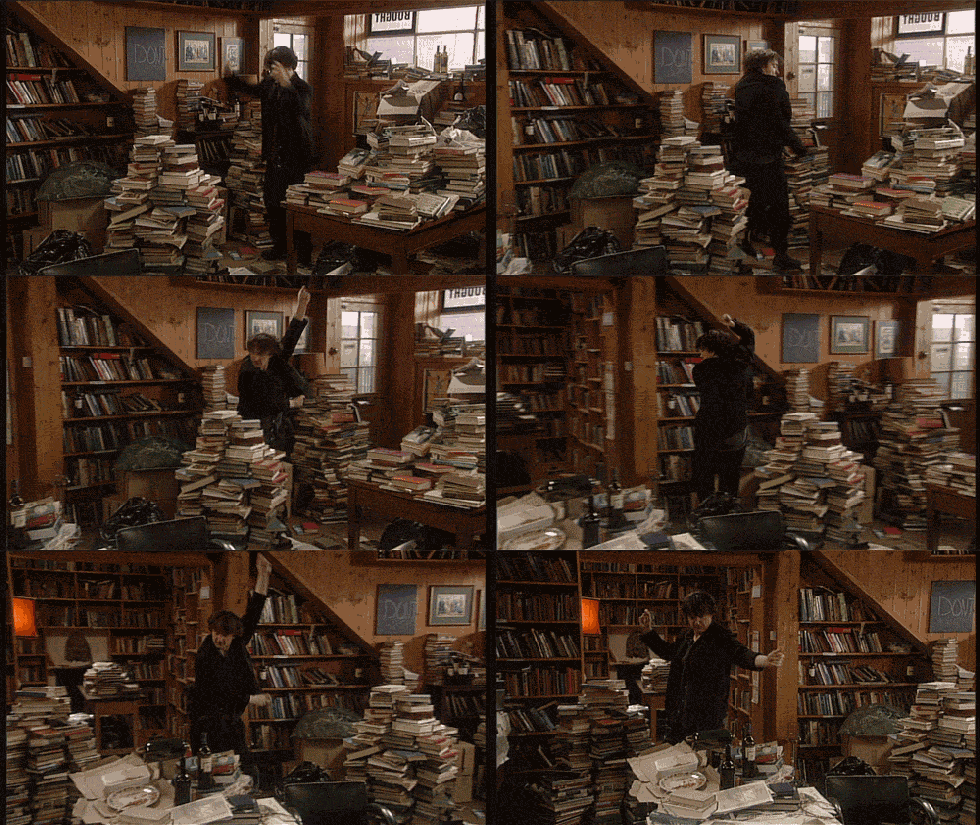
Some moments transcend their immediate context to assume symbolic significance. One of these was provided by New York Police Department officers in November 2011, when they raided the Occupy Wall Street camp in Zuccotti Park and razed the tent library that had grown organically during the protest. More than 5,000 print volumes were thrown in the trash.
The event resonated loudly across social media. Beyond one’s politics or sympathies, this gesture felt like a remix of Fahrenheit 451, Ray Bradbury’s dystopian sci-fi novel of 1953, set in a future American society where books are outlawed and firemen burn any house that contains them.
It was a reminder of how books can provide dangerously beautiful bodies for ideas. Be they erudite tracts or trashy paperbacks, they spread their pages to whoever picks them up. Books make knowledge and culture promiscuous. And like sexy, subversive witches they have been burnt at the stake periodically throughout history.
The bodies of books is not just a metaphor. It is instructive that a natively digital movement such as Occupy, a movement inherently reflective of non-hierarchical network structures, that owes much of its viral spread to active use of online social channels, opted for old-school print as the format of choice for its libraries.
This is no fetishistic eulogy to the printed book. As we fast-track into an era of ebooks, there are both technological and cultural lessons in this example. It acts as a reminder that the printed book is both hardware and software, device and data, bound as one. As opposed to there being only the latter in digital format. It is body versus ghost. And physicality - leaving aside fire, flooding and feisty New York cops - is currently more resilient.
I write this as I look at a few floppy disks that sit silently on top of a pile of Pelican books from the 40s and 50s on my shelves. Speak to an archivist and they will probably estimate the life of any digital platform to be under ten years, while remarking on how hardware and software are continuously changing. And that’s before they’d get on to the issues introduced by digital-rights management to the medium- and long-term longevity of any digital artefact.
Remember when, in 2009, Amazon remotely erased from the Kindles of its customers a couple of books to which it did not have the rights? The whole affair read like a cheap and creepy literary joke, a pulp premonition of a potential future, especially when you consider that the books were George Orwell’s1984 and Animal Farm.
And when, in 2010, Nicholas Negroponte predicted the demise of the printed book by 2015, we needed (and need) to be wary of welcoming such precipitous changes. Not due to some Luddite viewpoint, but because of being digital and recognising we’re still very much shaping this new world of zeroes and ones. We’ve just started exploring its nuances and complexities.
We must be mindful of ebooks becoming like agricultural mono-cultures, capable of delivering increased yields in terms of accessibility, distribution and profits, but also open to diseases to which they have yet to build resistance. We need to remember that print can escape control and roam free.
Be it by tyrannical regimes, bully-boy businesses or the accelerated entropy inherent in the nature of digital, we need to be aware of these potential threats and ensure the bodies of books can continue to provoke, to cavort with our minds in years and generations to come.


January 3, 2013
January 2, 2013
Parchman Farm
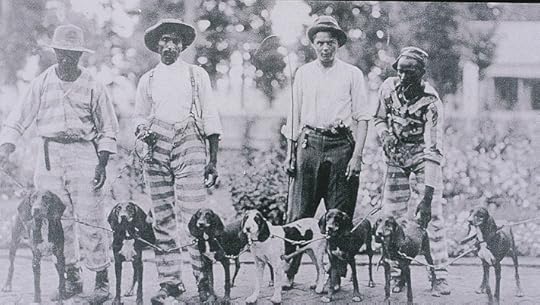
(Parchman Farm “dog boy” trusties and their bloodhounds. Sourced from the University of California, San Diego)
Another photo from my Hunter College research session back in 2009, when I was still putting together a draft of Southern Cross the Dog (Amistad: HarperCollins, May 2013). This is one from Parchman Farm, the oldest men’s maximum security prison in Sunflower County in Mississippi.
Writes historian and folklorist Alan Lomax,
Anything could happen to you; you were at the mercy of lawless men who hated “niggers.” The horrid shadow of this remorseless system, in which so many disappeared, lay over the whole South, carrying a threat that has not entirely vanished.
The prisoners rose in the black hours of morning and ran, at gunpoint, all the way to the fields, sometimes a mile or more, their guards galloping behind on horseback. At work they were divided into squads, with the swiftest worker in the lead. The others were required to keep pace with him, and anyone who did not keep up, no matter what the reason, was sure to receive severe punishment. [Alan Lomax, The Land Where the Blues Began (The New Press, 2002)]
The Farm also housed some of the greatest blues players who ever lived including Bukka White, and Son House.
Neon Magazine reviews Dream of Doctor Bantam
“If you think that the protagonist’s involvement with a cult is an odd direction for the story to take, then you’re right. But this novel is built on odd directions, strangeness, darkness, sudden violence and the wildness of youth. The presentation of the book is similarly intriguing, with punkish, hand-drawn illustrations fronting each of the long sections, and an intermission in the middle. It’s the kind of thing, you get the sense, that Julie herself would have liked.”
This is really gratifying because I don’t know if there’s like any writer/narrative maker type who doesn’t worry about whether or not her fictional creations like her. Vis that panel in Ghost World, William Gaddis’s weird sentimental talk about JR, etc.
January 1, 2013
How to Hunt & Trap by Joseph H. Batty
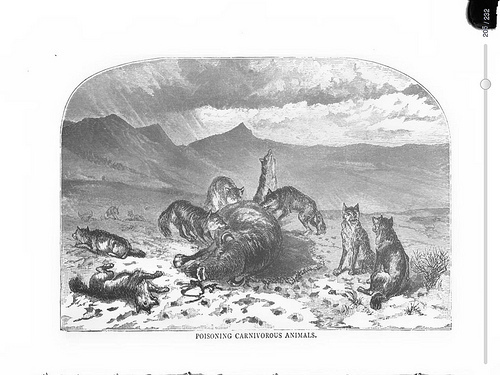
How to Hunt & Trap by Joseph H. Batty was an invaluable resource when I was working on the fur trapping chapters in Southern Cross the Dog (Amistad: HarperCollins, May 2013).
Some excerpts:
The white weasel skin makes the warmest cap for winter wear, and the color will not betray the hunter, while a coon-skin cap will. A hunter wearing one was accidentally killed near our camps. He was trailing a black bear, and raising his head just above a log was mistaken for an animal by a member of his own party.
Modern steel traps are superior to all others for the capture of animals, and several can be set in a few moments when “sign” is found. The Newhouse traps are the best in the market and are made in eight sizes. The O trap is the smallest and is called the rat trap. It is a powerful little arrangement, and when trapping, we have set three to one of any other size.
Many pleasant nights have we spent on the Southern plains, wrapped snugly in blankets, gazing at the myriads of bright stars, and listening to the answering calls of the prairie wolf. On the Northern plains the chorus of the buffalo wolves announce the break of day, and with Old Sol’s first rays they vanish, no one knows where.
You can find the book for free at Google Books here.
December 31, 2012
The Foxfire Fund
I came across Foxfire Magazine while researching the different customs of the South for Southern Cross the Dog. Published twice a year, the magazine records the customs, traditions, and stories of the local peoples of Rabun County, Georgia. To be fair, I didn’t end up using anything for the book itself (as Foxfire pertains particularly to Southern Appalachia) but I wish I had the opportunity.
The magazine is run by a group of high school students from Rabun County High School. Twice a year these students head out into their communities to conduct oral histories.
A student begins by choosing a topic to research or a family member, neighbor, or other local elder to interview. He or she arranges to meet their “contact,” talk with them, and record the interview… Pulling information from the completed transcript, the student writes an article based on the contents of their interview or pulls together information from several interviews. Articles can focus on a specific person’s life or stories, the lore of a specific town or community, details or how-to information on traditional crafts and skills, or any number of other things.
Some of what they come up with is amazing. Here’s an excerpt on slaughtering hogs from Foxfire #1.
“We’d kill hogs on th’ full moon, or just about th’ full moon. While th’ moon was shrinkin’, th’ meat’d shrink. There’d be a lot’a lard an’ grease if it’uz on th’shrinkin of th’moon. If it’uz on th’ new moon, you wouldn’t make much lard, and th’ meat’d swell up when y’cooked it ‘stead’a shrink.”
More snippets from their books and magazines here. The Foxfire Fund, Inc. is a 501(c)(3) not-for-profit organization so consider making a gift.
December 30, 2012
Ancient Microbes Found in Buried Antarctic Lake
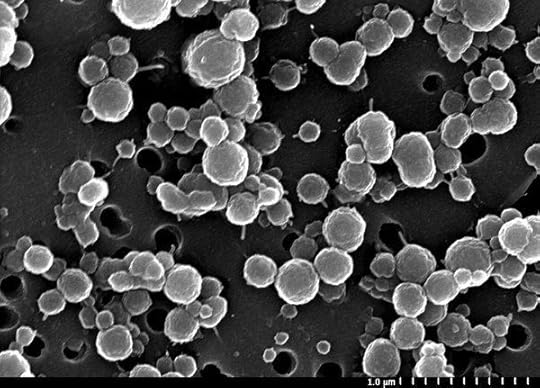
( Electron micrograph of very small and numerous bacterial cells found inhabiting icy brine channels in Antarctica’s Lake Vida. Photo By Christian H. Fritsen, DRI Research Professor, and Clinton Davis DRI graduate student)
Beneath the icy surface of a buried Antarctic lake, in super-salty water devoid of light and oxygen that is also cold enough to freeze seawater, researchers have now discovered that a diverse community of bacteria has survived for millennia.
The findings shed light on the extreme limits at which life can live not just on Earth, but possibly alien worlds, scientists added. [yahoo news]
December 28, 2012
Greenville, MS - 1927
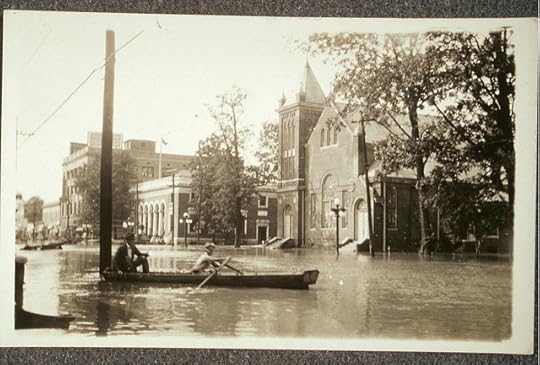
Photo attributed to Brown Studio (Greenville, Miss.) Sourced from the Arthur and Elizabeth Schlesinger Library on the History of Women in America (Radcliffe Institute for Advanced Study, Harvard University) from the collection “Somerville and Howorth family papers, 1850-1983”
Another photo from working on Southern Cross the Dog (Amistad: HarperCollins, May 2013). I first came across this photo during the library research session at Hunter College, where I did my MFA. This is an image of Washington Avenue in Greenville, Mississippi following the Great 1927 Flood.
Twenty-seven thousand square miles were inundated. This was about equal to the combined size of Massachusetts, Connecticut, New Hampshire, and Vermont. By July 1, even as the flood began to recede, 1.5 million acres were under water. The river was 70 miles wide. [National Geographic]
According to inscriptions on the verso of the photograph, the two main structures pictured are the Methodist church and the post office.
Makemake

Artist rendition of the dwarf planet Makemake, credited to the European Southern Observatory. Makemake is one of the icy planets on the Kuiper belt beyond Neptune. Featured on NASA’s December 26th, 2012’s APOD.
Originally designated 2005 FY9, Makemake (pronounced mah-kee-mah-kee) is named after the god of fertility in Rapanui mythology. The Rapanui are the native people of Easter Island in the southeastern Pacific Ocean about 3,600 km off the coast of Chile. He was the chief god of the Tangata manu bird-man cult and was worshiped in the form of sea birds, which were his incarnation. His material symbol was a man with a bird’s head.
“I am partial to fertility gods; Eris, Makemake, and (Haumea) were all discovered as my wife was pregnant with our daughter. I have the distinct memory of feeling this fertile abundance pouring out of the entire universe. Makemake was part of that.” [Mike Brown, member of the planet’s discovery team]
NASA launched the space probe New Horizons on Jan. 19, 2006 on a mission to Pluto and the Kuiper Belt. New Horizons is expected to reach Pluto in July 2015.