Bill Cheng's Blog, page 137
January 18, 2013
theparisreview:
Following up our previous post, here is a...
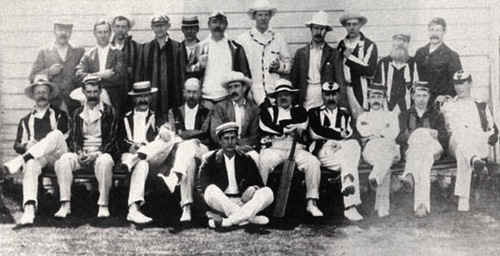
Following up our previous post, here is a photograph of the cricket team that both A. A. Milne and P. G. Wodehouse were members of.
Founded by Peter Pan creator Sir James M. Barrie, some of the other teammates reads off like a roll call of Edwardian England’s most famous authors, including Arthur Conan Doyle, Rudyard Kipling, H. G. Wells, and Jerome K. Jerome. The Allakahbarries (Allah akbar meaning “Heaven help us” in Arabic), played from 1890 until 1913, when World War I brought an end to the team.
[Pictured: Back row from left to right: E. W. Hornung, E. V. Lucas, P. G.Wodehouse, J. C. Smith, G. Charne, Sir Arthur Conan Doyle, Hesketh-Hesketh Prichard, L. D. Luard, C. M. Q. Orchardson, Leonard Charles Nightingale, A. Kinross. Front row from left to right: C. Gascoyne, Shan F. Bullock, G. Hillyard Swinstead, Reginald Blomfield, the Hon. W. J. James, Edwin Austin Abbey, Albert Chevalier Taylor, J. M. Barrie, George Cecil Ives, George Spencer Watson. Sitting on ground: A. E. W. Mason]


sagansense:
Mars Crew Guinea Pigs Suffered Insomnia,...


Mars Crew Guinea Pigs Suffered Insomnia, Lethargy
Most of the crewmembers participating in a 520-day isolation study to simulate a Mars mission suffered from insomnia and other sleep disorders, a condition that left them impaired during their waking hours as well.
The finding indicates that future long-duration space travelers will need specialized lighting to replicate Earth’s day-night cycles as well as other countermeasures to maintain healthy circadian rhythms, say researchers who conducted one of more than 90 investigations in the joint Russian-European Mars500 project.
“The assumption has been with the six-month space station missions that anybody can tolerate them. OK, you have trouble with your sleep or something but you’re only up there six months, it won’t last. If you go on an exploration mission, you’ll adapt. But our study shows that’s not true,” sleep researcher David Dinges, with the University of Pennsylvania’s Perelman School of Medicine, told Discovery News.
“The people did not adapt. In fact, these problems just cumulatively created a greater and greater physiological and behavioral burden on the crewmember,” he said.
Dinges’ subjects were six men — three Russians, two European and one Chinese — who spent 520 days sealed inside a spaceship-like, windowless chamber at the Russian Institute for Biomedical Problems in Moscow for a Mars mission simulation.
“We wanted to get some idea of what will happen when a motivated, high-performing crew is confined in a spacecraft-like environment for a full 17 months, simulating a mission to Mars and back,” Dinges said.
So far, only four people — all Russian — have made spaceflights lasting more than a year. The single longest human spaceflight was a 437-day mission aboard the Russian Mir space by Valery Polyakov, a physician, in 1994 and 1995.
The 520-day ground simulation, which ended on Nov. 4, 2011, showed that four of the six crewmembers suffered from sleep disorders, including one subject who ended up on a 25-hour day and another who split his sleep into two cycles within a 24-hour period. Such disconnects could affect a crew’s ability to work as a team, among other problems, researchers write in a study published last week in the Proceedings of the National Academy of Sciences.
“The differences suggest that some people are more vulnerable than others to the loss of light cues for biological timing and on the effects of confinement on their ability to sleep, or to sleep well. We don’t have an obvious predictor for that,” Dinges said.
Being susceptible to circadian disconnects wouldn’t necessarily eliminate someone from consideration for a Mars missions, he added.
“We’d just make sure they had countermeasures to make sure they maintain their sleep/wake cycle better,” Dinges said.
Further research is needed to assess the impacts of diet and exercise on the crew’s sleep patterns and attentiveness while awake.
“The timing of exercise should not be arbitrary, as it is now, but should be structured to reinforce circadian biology. The same with food. We believe the timing of food and its relationship to bowel and digestion is critical” to maintaining circadian rhythm, Dinges said.
NASA and Russia plan to begin year-long missions on the International Space Station in part to learn more about how extended stays in space impact the human body and performance.
“In the morning you wake up, you’re at work. When you go to sleep, you’re also at work,” said astronaut Scott Kelly, who is slated to begin NASA’s first year-long spaceflight in 2015.
“Imagine being in your office for a whole year and you never get to leave. That is a challenge, it presents its own set of issues, but I think I’m up for it and I look forward to it,” Kelly told reporters at press conference last month.
Mars500 participants wore wrist monitors that relayed information every minute about their movements. Other data came from video feeds and self-assessment tests.
Extra: Mars 500 Virtual 3D Tour
January 17, 2013
jtotheizzoe:
Nabokov on Kafka on Insects
Vladimir Nabokov,...
Nabokov on Kafka on Insects
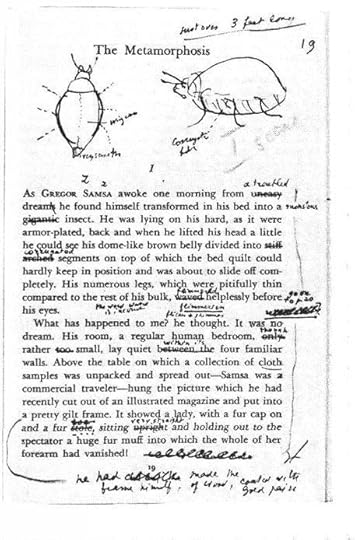
Vladimir Nabokov, celebrated author of Lolita, and other novels, was not merely a writer. Not that being a writer is any sort of a “mere” thing, but go with me here. Nabokov was a professionally-trained entomologist, a lifelong student of insect biology.
He curated Harvard’s butterfly collection, contributing a great deal to the practice of lepidoptery and even getting parts of his work published in our day and age. Nabokov was a fan of Franz Kafka’s The Metamorphosis, the story of Gregor Samsa, who turned into a bug. That’s Nabokov’s teaching copy of Kafka’s book up there, scrawled with notes. Nabokov lectured on Kafka, and using his knowledge of insects he offered a theory as to what kind of bug Gregor may have become (not a cockroach as usually assumed):
Now what exactly is the “vermin” into which poor Gregor, the seedy commercial traveler, is so suddenly transformed? It obviously belongs to the branch of “jointed leggers” (Arthropoda), to which insects, and spiders, and centipedes, and crustaceans belong. If the “numerous little legs” mentioned in the beginning mean more than six legs, then Gregor would not be an insect from a zoological point of view. But I suggest that a man awakening on his back and finding he has as many as six legs vibrating in the air might feel that six was sufficient to be called numerous. We shall therefore assume that Gregor has six legs, that he is an insect.
Next question: what insect? Commentators say cockroach, which of course does not make sense. A cockroach is an insect that is flat in shape with large legs, and Gregor is anything but flat: he is convex on both sides, belly and back, and his legs are small. He approaches a cockroach in only one respect: his coloration is brown. That is all. Apart from this he has a tremendous convex belly divided into segments and a hard rounded back suggestive of wing cases. In beetles these cases conceal flimsy little wings that can be expanded and then may carry the beetle for miles and miles in a blundering flight … He is merely a big beetle.
Nabokov also offered this nice note to the Joes and Janes in the audience:
Curiously enough, Gregor the beetle never found out that he had wings under the hard covering of his back. (This is a very nice observation on my part to be treasured all your lives. Some Gregors, some Joes and Janes, do not know that they have wings.)
Nabokov isn’t the only entomologist who has studied Kafka’s work. Donna Bazzone of St. Michael’s College in Vermont wrote about the impossible biology of an insect the size of Gregor Samsa, based on the study of thousands of insect species:
None could be as big as the “new Gregor.” If the body with its exoskeleton were to scale up to human size, it would be so heavy that even appropriately sized legs and musculature could not support it. Such an insect could not move. Also, because insects do not have a respiratory system with tubes connecting to internal lungs that have large absorptive areas, a giant like Gregor the roach would not be able to get enough oxygen to survive. Furthermore, our circulatory systems are powered by a large muscular heart that sends blood to all cells in the body through an elaborate network of blood vessels. Insects lack such a sophisticated circulatory system, so if you scaled the body to human size, insect blood (containing oxygen and nutrients) wouldn’t be able to reach all cells.
I always knew something bugged me about that story.
Thanks to Open Culture for the Nabokov book link that sent me down this rabbit hole.
This post brings to mind this particular TAL segment. I tip my hat to the late David Rakoff.
theparisreview:
Selections from the John Cheever Journals,...
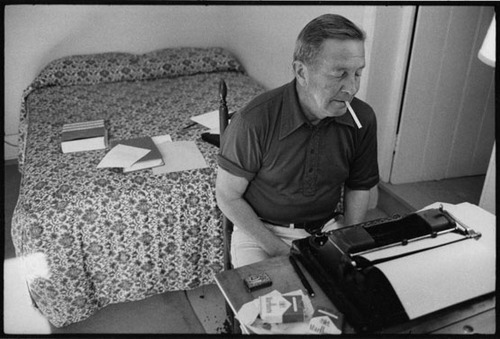
Selections from the John Cheever Journals, 1946–1981
“Reading my own stories is like some intensely unhappy relationship with a mirror. The work is done and to return to it seems idle in the strongest sense of the word—a demeaning sense of time squandered, of letting a splendid afternoon parade across the lawns without doing any work, without participating or celebrating in this parade.”
“I think of George Orwell on walking.”
“Hemingway shot himself yesterday morning. There was a great man. I remember walking down a street in Boston after reading a book of his and finding the color of the sky, the faces of strangers and the smell of the city heightened and dramatized. The most important thing he did for me was to legitimize manly courage, a quality that I had heard, until I came on his work, extolled by scout-masters and others who made it seem a fraud. He put down an immense vision of love and friendship, swallows and the sound of rain. There was never, in my time, anyone to compare with him.”
“That the exploration of candor in writing does not seem to me a universal domain. There are in literature turning points or feats of discovery—Flaubert and Joyce—that seem universal, but sexual candor I think not. It is the mastery of men like Miller, Roth and Mailer that gives their work its power. These seem to be intimate and singular accomplishments. Now that Roth, not without assistance, has opened up the playing fields of masturbation we find the field thronged with incompetents who feel that self-abuse is, in itself, adventurous, comical and visionary. Phil’s self-abuse is brilliant.”
“On my notes for a speech I find that I describe myself as a traveler from the north. That sense of estrangement that seems to me to be perhaps at the heart of literature—that persuasion—quite unspoken as I understand it—that we have seen other worlds than this and will see strange worlds to come.”
“I had a dream that a brilliant reviewer pointed out that there was an excess of lamentation in my work. I had, fleetingly, this morning, a sense of the world, one’s life, one’s friends and lovers as a given. Here it all is, comprehensible, lovely, a sort of paradise. That this will be taken quite as swiftly as it has been given is difficult to remember.”
January 16, 2013
Cradle Robbers: A Study of Infant Abductors by Larry G. Ankrm and Cynthia J. Lent
Infant abductions usually are carried out by women who are not criminally sophisticated. However, the women demonstrate an ability to plan the abduction, convincingly play the role of a hospital employee or other professional, and resort to deadly force if necessary.
Most of these women are living a lie—before, during, and after the abduction. Many have faked a pregnancy, which eventually forces them into a corner. They feel they have no choice but to produce a child by any means necessary. [From a 1995 FBI Law Enforcement Bulletin]
January 15, 2013
My reciting Peter Porter’s The King of the Cats is Dead....
My reciting Peter Porter’s The King of the Cats is Dead. Even after about half a dozen tries, I still managed to flub a line and about two-thirds of the way through my voice gets inexplicably hoarse and phlegmy. Still my best take, though.
In light of my previous post, there’s something exhilarating about sitting inside a poem like this. Obsessing over every word, every part of speech. It’s like a video game speed run— a maddening cycle of trial, failure, and restart until, deep in a brain fog, you burst from the gate with violent speed, gracing past goombas, like lightning homing toward the heavens.
theparisreview:
The two Raymond Chandler sentences that changed...
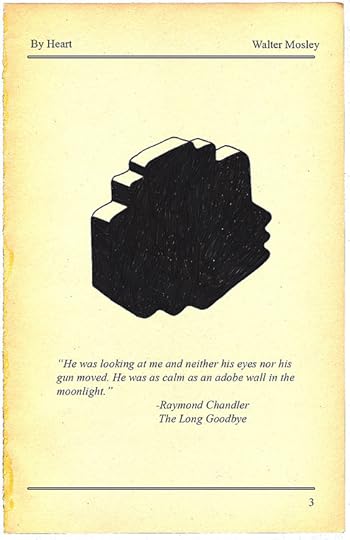
The two Raymond Chandler sentences that changed Walter Mosley’s life. From The Atlantic’s series that shares authors’s favorite passages in literature.
January 14, 2013
Look what showed up yesterday!
Four more months to go

Look what showed up yesterday!
Four more months to go
sagansense:
Aaron Swartz’s Tragic Battle With CopyrightAaron H....
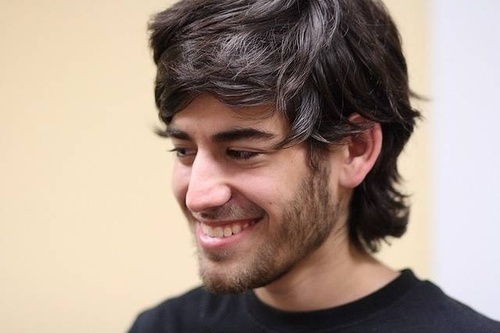

Aaron Swartz’s Tragic Battle With Copyright
Aaron H. Swartz, one of our our most vigorous champions of open access and copyright reform, committed suicide in New York City on Friday at the age of 26.
He was a pioneer and a renegade, part of the team that built Reddit as well as the widely-used RSS protocol. But he first began making headlines for a coding exploit that he undertook in September of 2010, when he used MIT’s servers to scrape and download some two million academic articles stored by the online catalog JSTOR using a program named keepgrabbing.py. Per copyright law, it may have been illegal or, as some argue, “inconsiderate”: these articles were meant only to be available to MIT affiliates, not to the wider world that Swartz believed deserved better access to the world’s information.
MIT didn’t press charges and neither did JSTOR. The government, however, decided to throw the book at Swartz, eventually hitting him with 13 separate charges and threatening to send him to prison for decades. According to his mother, Swartz was depressed about the court case and possibility of years in prison. He’d contemplated suicide in the past and, for unknown reasons, followed through this time.
In July of 2011, Swartz was arrested and indicted for that exploit. In September, the U.S. District Court of Massachusetts piled on additional felony counts, increasing the number of charges from four to 13. They included everything from wire fraud, computer fraud, and reckless damaging JSTOR—the latter justified by the prosecution due to the down time to the database during Swartz’s mass scraping—and the prosecution said that Swartz had “stolen … millions of dollars” worth of “property.” The pending charges carried potential penalties of up to 35 years in prison and $1 million in fines. At the time, he declined Motherboard’s request for an interview. “Afraid I can’t comment on much,” he wrote.
But ITHAKA, the nonprofit organization responsible for JSTOR, reiterated to Motherboard in September that it had settled its civil claims with Swartz and considered the matter “concluded.” One might well wonder why criminal prosecutors were so fervent in their case against Swartz considering ITHAKA’s opting not to pursue the case any further. Many considered Swartz the victim of example-making by the FBI.
Watch: Aaron Swartz Interview
There’s a good chance that Swartz affected how you use the Internet, and how you will use it. Prior to that high profile incident (and another mass download), Swartz had already proven himself as a distinguished technologist and intellectual, having been co-author of the first RSS specification—which may well have brought you to this article—when he was just 14-years-old. He went on to attend Stanford but left after a year, saying that he “didn’t find it a very intellectual atmosphere, since most of the other kids seemed profoundly unconcerned with their studies.”
Instead of finishing college, Swartz founded a company called Infogami that was funded by Y Combinator’s first summer program. Through Y Combinator, he ended up on the team that founded Reddit, and as his friend Cory Doctorow points out, is considered a co-founder by many, even though he’s not officially listed as so. More recently, Swartz joined the fight against SOPA/PIPA by founding the hugely popular online activist organization Demand Progress, and served as a fellow at Harvard’s Center for Ethics.
Aaron was also a also delivered intelligent criticisms of the prevailing online encyclopedia in “Who Writes Wikipedia.” (In 2011, he gave a talk about Wikipedia at the O’Reilly Tools for Change conference.) In 2007, he helped develop the nonprofit Open Library, which seeks to collect information about every book ever published. Artwork he made with the photographer Taryn Simon appeared at the New Museum in 2012. Most recently, he lived in Brooklyn and coded for Avaaz.org.
By all accounts, Swartz is known as a pioneering mind of the Internet freedom movement. Through his own description of events during Reddit’s acquisition, it was obvious that Swartz’s involvement stemmed from a desire to expand upon principles of open access to information and reform to higher education, rather than a predisposition to monetize what was fast becoming a lucrative source of referral traffic for online publishing. This ideology was further outlined by his “Guerrilla Open Access Manifesto,” published in 2008, which sets out Swartz’s philosphy on the open access movement.
Scanning entire libraries but only allowing the folks at Google to read them? Providing scientific articles to those at elite universities in the First World, but not to children in the Global South? It’s outrageous and unacceptable.
It’s difficult to say at this point how Aaron’s legal situation affected his decision to take his own life. Over the years, he made candid admissions of personal battles with depression and he made no secret of his anxiety over the case.
“Go outside and get some fresh air or cuddle with a loved one and you don’t feel any better, only more upset at being unable to feel the joy that everyone else seems to feel. Everything gets colored by the sadness,” he wrote in 2007. When things get worse, “you feel as if streaks of pain are running through your head, you thrash your body, you search for some escape but find none. And this is one of the more moderate forms.”
In a blog post on Saturday, Swartz’s family and his partner, Taren Stinebricker-Kaufmann, wrote, “Aaron’s death is not simply a personal tragedy. It is the product of a criminal justice system rife with intimidation and prosecutorial overreach. Decisions made by officials in the Massachusetts U.S. Attorney’s office and at MIT contributed to his death. The US Attorney’s office pursued an exceptionally harsh array of charges, carrying potentially over 30 years in prison, to punish an alleged crime that had no victims. Meanwhile, unlike JSTOR, MIT refused to stand up for Aaron and its own community’s most cherished principles.”
One thing is patently clear: the open Internet is heartbroken. Few have been able to make sense of the prosecution’s relentless pursuit of Swartz. He had tweaked the government before, during his efforts in 2008 to build a system that would provide Americans with free access to documents related to federal case-law (the current system charges 10 cents per page), a comendable effort that earned him an FBI investigation, though charges were never filed. (A version of the project lives at theinfo.org.) His affiliation with hackers in Cambridge may have made Swartz a person of interest for the authorities eager to convict Bradley Manning, who once visited an MIT hackerspace.
The Internet’s frustration over Swartz’s death echoes indignation over the government’s growing hacker hunt. Cyber security is now one of Washington’s biggest hobgoblins, but in the absence of any real strategy to solve it, the Feds have taken a harsh approach, indicting hackers for data scrapes and handing down draconian sentences in an effort to discourage others.
Lawrence Lessig, the Harvard legal expert who has also condemned copyright law for killing creativity and academic freedom, calls this the “prosecutor as bully” scenario. Lessig, founder of Creative Commons and a friend and long-time defender of Aaron, posted his own reaction to the suicide with that headline, and makes no apologies in drawing a connection to Swartz’s continued legal prosecution:
Aaron had literally done nothing in his life “to make money.” He was fortunate Reddit turned out as it did, but from his work building the RSS standard, to his work architecting Creative Commons, to his work liberating public records, to his work building a free public library, to his work supporting Change Congress / FixCongressFirst / Rootstrikers, and then Demand Progress, Aaron was always and only working for (at least his conception of) the public good. He was brilliant, and funny. A kid genius. A soul, a conscience, the source of a question I have asked myself a million times: What would Aaron think? That person is gone today, driven to the edge by what a decent society would only call bullying…
Fifty years in jail, charges our government. Somehow, we need to get beyond the “I’m right so I’m right to nuke you” ethics that dominates our time. That begins with one word: Shame.
One word, and endless tears.
Just days before his death, Swartz’s vision was vindicated, in a small way. JSTOR announced it would be making thousands of articles—a tiny portion of its database—free to registered users for the first time ever.
image (top): Aaron Swartz (via Flickr)
image (bottom): image 2: Aaron Swartz’s million-member strong Demand Progress was a prominent critic of SOPA
- - - -
Do not take a moment of silence for Aaron Swartz. Create a lifetime of action.
January 13, 2013
Memorize a Poem

I plan on trying this:
The [UK] government wants children to memorise poetry at school…
The challenge was prompted by a government initiative to get children to memorise poems called Poetry By Heart. No doubt the hand of Michael Gove is in there somewhere. The Department for Education has set up a website suggesting 130 poems, ancient and modern, for memorisation, and reciting contests are planned. [Stephen Moss, the Guardian]
When I was in grade school, our class had to memorize Robert Frost’s Stopping by the Woods on a Snowy Evening. If I can recall, I don’t think I did too good a job of it but I’d have the opportunity to redeem myself a few decades later while I was a grad student at Hunter College. We were asked to memorize Philip Larkin’s High Windows, and I remember growling through it at the bar at Donohue’s off 65th Street.
Still today, I can pretty much grope my way through it. It’s a good one, especially on a bright brittle hung-over morning. An incantation to clarify the soul.
Now I know the competition is specifically for ten-to-thirteen-year-olds living in the UK, but lord knows my literary memory could use some exercising. I’ve gone for The King of the Cats is Dead by Peter Porter. Wish me luck.
Meet the challenge at www.poetrybyheart.org.uk