Bill Cheng's Blog, page 136
January 24, 2013
kidsneedscience:
The word gene was first used in English in...
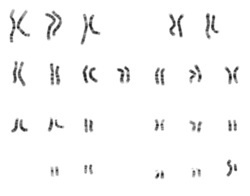
The word gene was first used in English in 1911, derived from the German word Gen, created in 1905 by Danish scientist Wilhelm Ludvig Johannsen (1857-1927) from the Ancient Greek word γενεα (genea) meaning generation or race (of people). The word genome was first used in 1920 by professor of botany Hans Winkler of the University of Hamburg. He patterned the word on the word chromosome, a combination of the Ancient Greek words χρομος (chromos meaning color) and σομος (somos meaning body). Unfortunately he followed the example set by the recently coined words rhizome and biome, both of which took only part of the root suffix for -somos and rendered it -omos. The genome is defined as the entirety or collection of genetic material needed to form an individual. In addition to the word genome, the word gene now forms a part of many more English words: genetic, etc.
Scientists working at the European Bioinformatics Institute recently used the structure of DNA to store data-DNA after all is nothing more than the storage device for all that genetic material. Using the building blocks of DNA, Ewan Birney and Nick Goldman (read about their story by clicking here) converted Shakespeare’s Sonnet 18 and sent the result to a gene sequencing lab. A few weeks later they received a test tube with the newly created DNA which when they sequenced gave back their encoded Sonnet. The sonnet they chose was particularly appropriate:
Shall I compare thee to a summer’s day?
Thou art more lovely and more temperate:
Rough winds do shake the darling buds of May,
And summer’s lease hath all too short a date:
Sometime too hot the eye of heaven shines,
And often is his gold complexion dimm’d;
And every fair from fair sometime declines,
By chance or nature’s changing course untrimm’d;
But thy eternal summer shall not fade
Nor lose possession of that fair thou owest;
Nor shall Death brag thou wander’st in his shade,
When in eternal lines to time thou growest:
So long as men can breathe or eyes can see,
So long lives this and this gives life to thee.
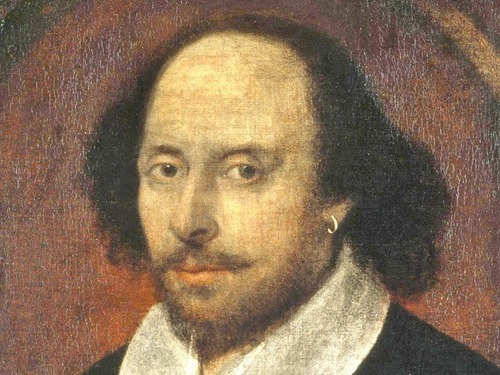
While Shakespeare had three children, they were not terribly prolific, and the gene pool that issued from Shakespeare ended in 1670 with the death of his last grandchild.
Image of the human chromosome (and therefore genome) courtesy National Human Genome Research Institute, released to the public domain.
Image of William Shakespeare also in the public domain.
wow…


colchrishadfield:
Like the sand is being sprayed with icing...
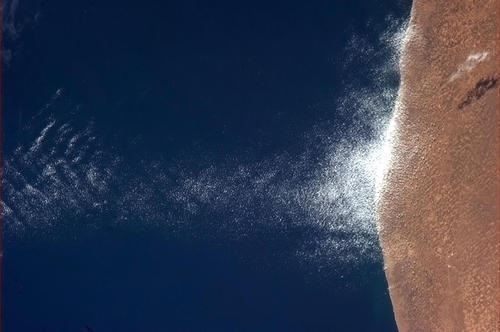
Like the sand is being sprayed with icing sugar. South coast of Pakistan.
We should all aspire to be astronauts. Period.
January 23, 2013
The Talking Dead
From the Millions, Jeffrey Eugenides’s Killer Advice by Todd Hasak-Lowy:
Eugenides explains, writing as if you’re dead, or as if your writing will only appear after you’re dead, will prevent you from following literary fashion, writing for money, censoring your true feelings, etc., because all these things will “suppress the very promptings that got” the writer “writing in the first place.”
…
But there’s a powerful counterargument that challenges Eugenides’s advice as both simplistic and naïve. And perhaps stemming from a bit of bad faith as well. If the writer has any goals whatsoever beyond just creating a story and storing it in the relative privacy of his hard drive, then other factors necessarily come into play. In other words, if someone aims not just to write, but to get published as well, and not just published, but widely read too (not to mention make enough money to justify spending even more time writing in the future), then the situation — process actually — turns into something a good bit more complicated.
…
Here’s what Eugenides should have added by way of closing: the so-called writer has to wear all sorts of hats: writer, reader, editor, negotiator, businessman, self-promoter, etc. And only the first of these hats should never be worn outside one’s private necropolis. The next two have the odd responsibility of communing — patiently, cautiously, and courageously — with the dead self.
theparisreview:
Author Etgar Keret and journalist and editor...
Author Etgar Keret and journalist and editor Dov Alfon have started a new intiative called storyvid, an attempt to create the literary equivalent of a music video. We bring you storyvid’s first production, a four-minute pilot based on Keret’s story “What Do We Have In Our Pockets?” Goran Dukić of Wristcutters: A Love Story (also based on a Keret story) directs. The short was selected to screen in the 2013 Sundance Film Festival, which runs through the end of this week.
AWESOME
theparisreview:
“I know now that the end is surely coming. It...

“I know now that the end is surely coming. It is coming from far away beyond the shadow of a doubt. When it arrives, the last murder will be done. It will be done like a man, in one stroke. Then the burglars will quit. They will drape themselves in black and bring tiger lilies and other ferocious ideas to the place where I lie, and I will rest content. I think my only regret will be that I had but one life to give for my country, because if I had a lot more I would save a couple for myself. In a word, it will be all right. It will be right as rain that never lets up and there will be no more burglary anywhere that I know of.”
—Barton Midwood, from “The Burglars”
Photography Credit Matt Wilson
From the New York Times:
Reviews on Amazon are becoming attack weapons, intended to sink new...

From the New York Times:
Reviews on Amazon are becoming attack weapons, intended to sink new books as soon as they are published.
In the biggest, most overt and most successful of these campaigns, a group of Michael Jackson fans used Facebook and Twitter to solicit negative reviews of a new biography of the singer. They bombarded Amazon with dozens of one-star takedowns, succeeded in getting several favorable notices erased and even took credit for Amazon’s briefly removing the book from sale.
“Books used to die by being ignored, but now they can be killed — and perhaps unjustly killed,” said Trevor Pinch, a Cornell sociologist who has studied Amazon reviews. “In theory, a very good book could be killed by a group of people for malicious reasons.”
…
Mr. Pinch, the Cornell researcher, said he got the sense that “Amazon is hoping that all these problems with positive and negative reviews will go away.” He added: “But as more and more abuses come to light, the overall effect will be a slow undermining of the process. There are so many ways to game the system.”
[Swarming a Book Online, David Streitfield]
To our great electric democracy.
January 22, 2013
Stephen Hawking: ‘I Held A Party For Time-Travellers… But None...

Stephen Hawking: ‘I Held A Party For Time-Travellers… But None Came’
Stephen Hawking recently gave a party - for time travellers.
But while he told plenty of people about the date, sent out invitations and waited patiently for them to arrive, nobody came.
Of course that might have been because he waited until the party was over to send out the invites.
Professor Hawking explained his failed experiment in an interview with various journalists, written up by Ars Technica.
“I have experimental evidence that time travel is not possible,” he said. “I gave a party for time-travellers, but I didn’t send out the invitations until after the party. I sat there a long time, but no one came.”
Hawking has previously spoken about the party, which was ‘held’ on 28th June 2009, and produced a video about the experiment - but due to the laws of causality, no one has retrospectively showed up.
Hawking also said that Einstein’s theories offer the possibility of travelling backwards in time - but “it is likely that warping would trigger a bolt of radiation that would destroy the spaceship and maybe the space-time itself”.
In the interview Hawking was also asked about alien life, and reassuringly said that it isn’t likely aliens are coming to visit.
“I’m discounting claims that UFOs contain aliens. Why would they appear only to cranks and weirdos?” he asked. “Do I believe that there is some government conspiracy to conceal the evidence and keep for themselves the advanced technology the aliens have? If that were the case, they aren’t making much use of it.
“Further evidence that there isn’t any intelligent life within a few hundred light years comes from the fact that SETI, the Search for Extra Terrestrial Life, hasn’t picked up their television quiz shows. It is true that we advertise our presence by our broadcast. But given that we haven’t been visited for four billion years, it isn’t likely that aliens will come any time soon.”
January 21, 2013
"But beyond that, I’ve come to understand why writing and me became such a great fit. It..."
- Richard Blanco, Making a Man out of Me
Skip James
he was dying when they found him, eaten through with testicular cancer. It took his balls and his already bell-high voice stretched into a shimmer. He was a ghost; the D-bass drone of his three-finger picking, the banshee wail of his voice. His playing was corvid feathers— ruffled and sharpened and blading in the wind; a flutter-flap of flesh on steel-string that carried him in a clean melodic line.