Brandon C. Jones's Blog, page 10
November 13, 2014
On Veterans
Herreid, South Dakota has an active American Legion post, including some members who have kept up their involvement for 70 years. At least twice a year, on Memorial Day and Veterans Day, post members put on their uniforms and take part in a ceremony to honor members of American armed forces. This year our program included a video presentation where students honored family members that served. Some families had many generations of men serving, going back to World War I. Most honored soldiers were in the service for only a handful of years, but their experience molded the rest of their lives. They were given a new identity, a new fraternity, and a new status. And all this changed the rest of their lives, no matter where they went or what they did they were veterans.
Being a veteran means something, and in small towns like Herreid it means a little more. Our town mostly shuts down. After the morning program there are displays in the community center showcasing veterans belongings and service. Lastly, people gather to enjoy a fundraising supper. Two days each year are not enough to recognize the cost that people pay in order for our nation to survive, but they are certainly a start.
The Apostle Paul used several military images in his New Testament letters. Thinking like a veteran, Paul gives a military-type charge to a young man named Timothy. These words are likely among the last things Paul ever wrote:
“In the presence of God and of Christ Jesus, who will judge the living and the dead, and in view of his appearing and his kingdom, I give you this charge: Preach the word; be prepared in season and out of season; correct, rebuke and encourage—with great patience and careful instruction. For the time will come when people will not put up with sound doctrine. Instead, to suit their own desires, they will gather around them a great number of teachers to say what their itching ears want to hear. They will turn their ears away from the truth and turn aside to myths. But you, keep your head in all situations, endure hardship, do the work of an evangelist, discharge all the duties of your ministry. For I am already being poured out like a drink offering, and the time for my departure is near. I have fought the good fight, I have finished the race, I have kept the faith. Now there is in store for me the crown of righteousness, which the Lord, the righteous Judge, will award to me on that day—and not only to me, but also to all who have longed for his appearing” (2 Tim 4:1-8 NIV).
I, and countless others, will never know what it is like to be a veteran of armed forces. But we do have the privileges of being a different kind of veteran. Paul is right to compare the Christian life to military life. Both involve chains of command, an enemy, weapons, defenses, training, tactics, duties, honor, service, and rewards. Our duty is to carry out God’s mission of proclaiming the good news of Jesus Christ to our communities near and far. We proclaim by what we say and what we do. We proclaim by how we treat each other as well as our neighbors and especially our enemies.
Our communities may not set aside any days to recognize our roles in God’s church, but the crown Paul talks about will be fine with me. Just like a crown of gold is made out of gold, the crown of righteousness is God’s righteousness—his commitment to do what is right by his promises to his people. Thinking of that crown makes me long for Jesus’ appearing. And that longing puts me in good company. It puts you in good company too.
Being a veteran means something, and in small towns like Herreid it means a little more. Our town mostly shuts down. After the morning program there are displays in the community center showcasing veterans belongings and service. Lastly, people gather to enjoy a fundraising supper. Two days each year are not enough to recognize the cost that people pay in order for our nation to survive, but they are certainly a start.
The Apostle Paul used several military images in his New Testament letters. Thinking like a veteran, Paul gives a military-type charge to a young man named Timothy. These words are likely among the last things Paul ever wrote:
“In the presence of God and of Christ Jesus, who will judge the living and the dead, and in view of his appearing and his kingdom, I give you this charge: Preach the word; be prepared in season and out of season; correct, rebuke and encourage—with great patience and careful instruction. For the time will come when people will not put up with sound doctrine. Instead, to suit their own desires, they will gather around them a great number of teachers to say what their itching ears want to hear. They will turn their ears away from the truth and turn aside to myths. But you, keep your head in all situations, endure hardship, do the work of an evangelist, discharge all the duties of your ministry. For I am already being poured out like a drink offering, and the time for my departure is near. I have fought the good fight, I have finished the race, I have kept the faith. Now there is in store for me the crown of righteousness, which the Lord, the righteous Judge, will award to me on that day—and not only to me, but also to all who have longed for his appearing” (2 Tim 4:1-8 NIV).
I, and countless others, will never know what it is like to be a veteran of armed forces. But we do have the privileges of being a different kind of veteran. Paul is right to compare the Christian life to military life. Both involve chains of command, an enemy, weapons, defenses, training, tactics, duties, honor, service, and rewards. Our duty is to carry out God’s mission of proclaiming the good news of Jesus Christ to our communities near and far. We proclaim by what we say and what we do. We proclaim by how we treat each other as well as our neighbors and especially our enemies.
Our communities may not set aside any days to recognize our roles in God’s church, but the crown Paul talks about will be fine with me. Just like a crown of gold is made out of gold, the crown of righteousness is God’s righteousness—his commitment to do what is right by his promises to his people. Thinking of that crown makes me long for Jesus’ appearing. And that longing puts me in good company. It puts you in good company too.


November 6, 2014
Addicted to the Story
Saturday afternoon I was one of many people who filled the Bismarck Civic Center to watch a live production of two Disney shows. Children were everywhere. Snacks filled the aisles and even some seats. Grossly overpriced toys peppered each section. My wife accused me of sleeping for more than half the show. That, of course, is a gross exaggeration. I slept for about 20% of the show. The room was dark. The air was warm. The seats were comfortable. I have a tendency to get sleepy in such situations, unless I’m gripped by what I am watching. This week I’ve wondered why my reaction to Disney mimics so many Christians’ reactions to the greatest story ever told. A lot of us have forgotten to see ourselves and our neighbors in God’s story of creation, rebellion, redemption, and new creation.
I may have not been compelled by the storylines of Sophia the First or the Neverland Pirates, but my children sure were, especially my youngest daughter. Every wave from the stage was a wave to her. Every character who asked for help received good help from her. Ignoring the fancy riggings to the rafters, in her mind flying characters could really fly with the help of pixie dust. She danced. She clapped. She pointed. She waved. She was gripped by the story playing out in front of her eyes. I enjoyed watching her get caught up in the show, and I knew that as a grown-up I’m not much different than she is, sleepy as I was.
When I first started preaching I was annoyed at the overuse of stories in sermons. I thought that people should pay attention to all the other stuff. But I was wrong, because that’s just not the way God has wired us. We cling to stories more than anything else. The Bible is full of stories. Jesus’ words handed down to us are mostly stories. Years later, after we’ve forgotten almost everything else we’ve seen and heard, it’s the stories we remember best. When we get together with old friends, the stories remain. Stories to be shared. Stories to be cherished. Stories to be re-lived. Stories tell us who we really are, remind us who we were and at their best they even show us what we’d like to become. We are all story addicts. What makes the gospel so great is that it tells us who we really are and who we will really be. The details may not be all there. The timing may not be perfectly clear. But there is nothing to snooze at when it comes to God’s love story headed up in Christ.
Sometimes I wish church members could get a glimpse at what their pastors look at on Sunday mornings. Even better, would be for all of us to get a glimpse at how our unbelieving neighbors see us every day. Are we snoozing through the gospel story as if it is for kids, but not really for us and certainly not for our neighbors? They are addicted to stories too. Just think about what they say in their conversations, what they post on their social media news feeds, etc. The entertainment industry is what it is because all of us love stories. What would it look like for us to love the gospel story even more? I imagine fewer of us would be asleep in the light.
I may have not been compelled by the storylines of Sophia the First or the Neverland Pirates, but my children sure were, especially my youngest daughter. Every wave from the stage was a wave to her. Every character who asked for help received good help from her. Ignoring the fancy riggings to the rafters, in her mind flying characters could really fly with the help of pixie dust. She danced. She clapped. She pointed. She waved. She was gripped by the story playing out in front of her eyes. I enjoyed watching her get caught up in the show, and I knew that as a grown-up I’m not much different than she is, sleepy as I was.
When I first started preaching I was annoyed at the overuse of stories in sermons. I thought that people should pay attention to all the other stuff. But I was wrong, because that’s just not the way God has wired us. We cling to stories more than anything else. The Bible is full of stories. Jesus’ words handed down to us are mostly stories. Years later, after we’ve forgotten almost everything else we’ve seen and heard, it’s the stories we remember best. When we get together with old friends, the stories remain. Stories to be shared. Stories to be cherished. Stories to be re-lived. Stories tell us who we really are, remind us who we were and at their best they even show us what we’d like to become. We are all story addicts. What makes the gospel so great is that it tells us who we really are and who we will really be. The details may not be all there. The timing may not be perfectly clear. But there is nothing to snooze at when it comes to God’s love story headed up in Christ.
Sometimes I wish church members could get a glimpse at what their pastors look at on Sunday mornings. Even better, would be for all of us to get a glimpse at how our unbelieving neighbors see us every day. Are we snoozing through the gospel story as if it is for kids, but not really for us and certainly not for our neighbors? They are addicted to stories too. Just think about what they say in their conversations, what they post on their social media news feeds, etc. The entertainment industry is what it is because all of us love stories. What would it look like for us to love the gospel story even more? I imagine fewer of us would be asleep in the light.
October 30, 2014
On Christian Retirement
Last weekend I attended a series of sessions on church leadership, and one practice that stood out to me was a simple prayer. In the morning say, “Lord Jesus, help me pay attention to where you are at work in my life today.” In the evening say, “Lord Jesus thank you for being at work in _______.” The idea is getting each member of a church to approach the beginning and end of their days by reflecting on God at work. From there perhaps they will reflect on it when gathered weekly with other believers (or more often than that in small groups). From there perhaps they will inject God’s work into their conversations and actions with members of their community at large. God need not be reserved to extraordinary things in our lives, for he has promised to be with us always, even in the mundane.
This past Sunday our church was blessed with a visit from two retired missionaries who served in Japan for 35 years. They no longer are in the routine of visiting churches and speaking, but they welcomed my invitation to join us for a Sunday morning after I met one of them this summer. The husband of the couple is mild-mannered. He was full of experience and wisdom, and I enjoyed hearing him share in a small group about the field of Japan and later in our morning worship service about his testimony.
During that service both he and his wife shared their stories about God at work in their lives. Nothing special in that they were seemingly ordinary people, both from small towns, who were seized by God’s affection and mission. They capped off their presentation with a video that summed up the duration of their 35 years in Japan. They told me the previous night that watching the video is bittersweet for them, because it makes them homesick.
Sunday morning as we played the video I spent half the time watching it. Dozens of people I’d never met popped up in pictures along with these two missionaries slowly aging from young adults to seniors. I spent the other half of the video staring at the couple while they looked longingly at the video, full of nostalgia. Their faces expressed a loss that runs deep as they watched precious memories that now hurt because they are memories, not experiences. These are moments most people avoid on purpose, but they seemed to embrace it for a few minutes.
After the video was over they both stood up and I looked over and saw God at work. This quiet reserved man with few outward emotions had red watery eyes as he looked downward. Missionaries never retire. It’s just that sometimes they have to relocate.
God calls all of us to be his missionaries. Whether we stay in our hometowns, move nearby, or move far away, we are to join God in his mission of proclaiming the good news of his kingdom by our worship, discipleship, and outreach to our communities. None of us are supposed to retire from carrying out God’s mission. I wish none of us actually did.
This past Sunday our church was blessed with a visit from two retired missionaries who served in Japan for 35 years. They no longer are in the routine of visiting churches and speaking, but they welcomed my invitation to join us for a Sunday morning after I met one of them this summer. The husband of the couple is mild-mannered. He was full of experience and wisdom, and I enjoyed hearing him share in a small group about the field of Japan and later in our morning worship service about his testimony.
During that service both he and his wife shared their stories about God at work in their lives. Nothing special in that they were seemingly ordinary people, both from small towns, who were seized by God’s affection and mission. They capped off their presentation with a video that summed up the duration of their 35 years in Japan. They told me the previous night that watching the video is bittersweet for them, because it makes them homesick.
Sunday morning as we played the video I spent half the time watching it. Dozens of people I’d never met popped up in pictures along with these two missionaries slowly aging from young adults to seniors. I spent the other half of the video staring at the couple while they looked longingly at the video, full of nostalgia. Their faces expressed a loss that runs deep as they watched precious memories that now hurt because they are memories, not experiences. These are moments most people avoid on purpose, but they seemed to embrace it for a few minutes.
After the video was over they both stood up and I looked over and saw God at work. This quiet reserved man with few outward emotions had red watery eyes as he looked downward. Missionaries never retire. It’s just that sometimes they have to relocate.
God calls all of us to be his missionaries. Whether we stay in our hometowns, move nearby, or move far away, we are to join God in his mission of proclaiming the good news of his kingdom by our worship, discipleship, and outreach to our communities. None of us are supposed to retire from carrying out God’s mission. I wish none of us actually did.
October 23, 2014
Psalm 90: An angry prayer from an angry man
This past Sunday our boys’ class looked at the Exodus. One of the boys mentioned that Moses is angry. It took me back briefly, but thinking through our passage in Exodus, obviously the boy was right. Moses is an angry man, and God uses him mightily.
The lectionary calendar of Scripture reading for this upcoming Sunday includes Psalm 90, which is introduced as “a prayer of Moses the man of God.” As I have read it this week, I cannot help but think it was written by an angry person.
If you have not read the whole psalm by now, consider these selections: “You [God] turn people back to dust, saying, ‘Return to dust, you mortals” (v. 3); “We are consumed by your anger and terrified by your indignation” (v. 7); “All our days pass away under your wrath; we finish your years with a moan. Our days may come to seventy years, or eighty, if our strength endures; yet the best of them are but trouble and sorrow, for they quickly pass, and we fly away” (vv. 9-10); “Make us glad for as many days as you have afflicted us, for as many years as we have seen trouble” (v. 15). I have found in my preaching and in my prayers that I cannot help but reveal what is in my heart. As much as Moses discusses God’s anger, it is likely there is something angering him.
He does not seem to say what it was that made him mad. Was it after he wished he was never curious about a burning bush? Maybe it was after his wife warded off God from killing their son. Or perhaps it was one of the numerous times he felt all alone as even his siblings questioned his leadership, not to mention his opponents. Might it have been the time he hit a rock to get water for the people, forgetting he was supposed to speak to it this time. Considering what Psalm 90 says about the end of life, I wonder if he wrote it toward the end of his. Those must have been awkward days after God told Moses he would never enter the Promised Land. He would have to settle for merely seeing it from afar. That would have made me angry.
I am glad my prayers are not handed down generation after generation like this prayer of Moses. I have prayed some angry things. I have complained, whined, accused, exasperated, cursed . . . you name it. And, somehow, God takes it. He hears it. He redeems it. He even permits it, giving us examples of the full human experience throughout the pages of the Psalms.
Our experience, especially as God’s people, is not all bad. As much as Moses bemoans aspects of life as a sinner in a fallen world, he does say, “Satisfy us in the morning with your unfailing love, that we may sing for joy and be glad all our days” (v. 14). Indeed, God’s love is unfailing, and that alone is cause for joy and gladness.
I am not sure what Moses thinks about God taking his angry prayer and transforming it to read as God’s own words to his people. There is a chance Moses knew God was speaking through his words as he ends his prayer by saying, “May the favor of the Lord our God rest on us; establish the work of our hands for us—yes, establish the work of our hands” (v. 17). Indeed, God has established Moses’ work. He was not perfect. He was human. And God used him well. It gives me some hope. Maybe it will give you some too.
The lectionary calendar of Scripture reading for this upcoming Sunday includes Psalm 90, which is introduced as “a prayer of Moses the man of God.” As I have read it this week, I cannot help but think it was written by an angry person.
If you have not read the whole psalm by now, consider these selections: “You [God] turn people back to dust, saying, ‘Return to dust, you mortals” (v. 3); “We are consumed by your anger and terrified by your indignation” (v. 7); “All our days pass away under your wrath; we finish your years with a moan. Our days may come to seventy years, or eighty, if our strength endures; yet the best of them are but trouble and sorrow, for they quickly pass, and we fly away” (vv. 9-10); “Make us glad for as many days as you have afflicted us, for as many years as we have seen trouble” (v. 15). I have found in my preaching and in my prayers that I cannot help but reveal what is in my heart. As much as Moses discusses God’s anger, it is likely there is something angering him.
He does not seem to say what it was that made him mad. Was it after he wished he was never curious about a burning bush? Maybe it was after his wife warded off God from killing their son. Or perhaps it was one of the numerous times he felt all alone as even his siblings questioned his leadership, not to mention his opponents. Might it have been the time he hit a rock to get water for the people, forgetting he was supposed to speak to it this time. Considering what Psalm 90 says about the end of life, I wonder if he wrote it toward the end of his. Those must have been awkward days after God told Moses he would never enter the Promised Land. He would have to settle for merely seeing it from afar. That would have made me angry.
I am glad my prayers are not handed down generation after generation like this prayer of Moses. I have prayed some angry things. I have complained, whined, accused, exasperated, cursed . . . you name it. And, somehow, God takes it. He hears it. He redeems it. He even permits it, giving us examples of the full human experience throughout the pages of the Psalms.
Our experience, especially as God’s people, is not all bad. As much as Moses bemoans aspects of life as a sinner in a fallen world, he does say, “Satisfy us in the morning with your unfailing love, that we may sing for joy and be glad all our days” (v. 14). Indeed, God’s love is unfailing, and that alone is cause for joy and gladness.
I am not sure what Moses thinks about God taking his angry prayer and transforming it to read as God’s own words to his people. There is a chance Moses knew God was speaking through his words as he ends his prayer by saying, “May the favor of the Lord our God rest on us; establish the work of our hands for us—yes, establish the work of our hands” (v. 17). Indeed, God has established Moses’ work. He was not perfect. He was human. And God used him well. It gives me some hope. Maybe it will give you some too.
October 16, 2014
Atonement: Making Up for What’s Wrong
I have said things that I did not really mean. I have spoken words of hurt. I have lost my temper, which has resulted in treating people badly. After those moments, I know I have to make things right. I have to make it up in some way. Sometimes a heartfelt apology will do. Other times, a gift or token of remorse helps. With my kids I often need to listen to them and then set aside time to do what they want to do. No matter what, I am always thankful for the opportunity to know of my sins, repent of them, and try to make things right. Once I am dead, there are no more second or third chances.
Scripture reveals that sin brings death: both physical and spiritual. Spiritual death means separation from God, even enmity with him. It means that there is something wrong between us and God and to make matters worse since we’re dead we aren’t even able to do anything about. If things are ever going to be made right, God himself has to make the first move, even though he wasn’t in the wrong. In theology we call God’s first move, atonement, and it focuses completely on Jesus Christ.
The good news of Jesus Christ is that God made the first move by sending his Son to take on our human nature, live a sinless life, and lay down that life so that by dying he undoes the power of death over all of us who were spiritually dead. He did not have to do this, but it was fitting that he did. Humans are valuable. Humans are made in his image. When we rebelled God could have responded by wiping us out, but that would not be fitting of a God who is life itself. He could have just excused sin, but that would have been hard. Rebellion and sin are an affront to God by corrupting and undoing all his good work, but he could not just magically rid it from the world without recognizing its ugliness and its steep penalty and price, and sinful people were so crooked in their thinking and actions that they were unable to make things right on their own. So what was God to do? Athanasius calls this the “divine dilemma” and offers the Incarnation of God the Son as God’s solution.
In theology we make compartments for all the things going on in Jesus Christ. We distinguish his Incarnation from his Obedience, Atonement, Resurrection, and Ascension. We also distinguish how God justifies, sanctifies, and glorifies us in him. As helpful as distinctions can be in trying to grasp the depths of what it means for God to become human, the early church considered all of Christ—all of who he is and all of what he does—to be part of God’s atonement. In other words, when God moved first to make things right between us and him, the answer was Jesus Christ, not just one thing he did.
Where Adam went astray as our representative, Christ did not. We can look to him for what it means to be human from birth to death, to life after death, and even to life after life after death in resurrection. All of Christ reconciles us to God, making us “at one” with God, or as the English word says, we have found at-onement (atonement) with God through Christ. N. T. Wright likes to say that when Jesus wanted to explain what he meant to his people, he did not hand down a lecture, a theory, or a diagram that charted it out. Instead, he repurposed a meal for them to share together. If we want to understand atonement more deeply, there is no better starting place than the Lord’s Table.
Scripture reveals that sin brings death: both physical and spiritual. Spiritual death means separation from God, even enmity with him. It means that there is something wrong between us and God and to make matters worse since we’re dead we aren’t even able to do anything about. If things are ever going to be made right, God himself has to make the first move, even though he wasn’t in the wrong. In theology we call God’s first move, atonement, and it focuses completely on Jesus Christ.
The good news of Jesus Christ is that God made the first move by sending his Son to take on our human nature, live a sinless life, and lay down that life so that by dying he undoes the power of death over all of us who were spiritually dead. He did not have to do this, but it was fitting that he did. Humans are valuable. Humans are made in his image. When we rebelled God could have responded by wiping us out, but that would not be fitting of a God who is life itself. He could have just excused sin, but that would have been hard. Rebellion and sin are an affront to God by corrupting and undoing all his good work, but he could not just magically rid it from the world without recognizing its ugliness and its steep penalty and price, and sinful people were so crooked in their thinking and actions that they were unable to make things right on their own. So what was God to do? Athanasius calls this the “divine dilemma” and offers the Incarnation of God the Son as God’s solution.
In theology we make compartments for all the things going on in Jesus Christ. We distinguish his Incarnation from his Obedience, Atonement, Resurrection, and Ascension. We also distinguish how God justifies, sanctifies, and glorifies us in him. As helpful as distinctions can be in trying to grasp the depths of what it means for God to become human, the early church considered all of Christ—all of who he is and all of what he does—to be part of God’s atonement. In other words, when God moved first to make things right between us and him, the answer was Jesus Christ, not just one thing he did.
Where Adam went astray as our representative, Christ did not. We can look to him for what it means to be human from birth to death, to life after death, and even to life after life after death in resurrection. All of Christ reconciles us to God, making us “at one” with God, or as the English word says, we have found at-onement (atonement) with God through Christ. N. T. Wright likes to say that when Jesus wanted to explain what he meant to his people, he did not hand down a lecture, a theory, or a diagram that charted it out. Instead, he repurposed a meal for them to share together. If we want to understand atonement more deeply, there is no better starting place than the Lord’s Table.
October 9, 2014
I Wish We had All Been Ready: Or Why I Do Not Want to Watch Left Behind
 Last Friday yet another movie based on the book Left Behind was released onto the masses. I have not seen it. I did not see the previous one. I never read any of the books either, but I had a roommate in Bible college who did. I am not bragging or anything. Do not feel bad if you enjoy this storyline. Maybe I would enjoy it too. It is just that I think the whole premise is wrong, and that is hard for me to look past when choosing things I read and watch. Joseph Butler, in his piece entitled “Why I Want to be Left Behind,” shares a problem with Left Behind’s premise. He notes that many of the biblical passages that speak of people being “taken” (e.g. Matt 24:37-41) often refer to people being taken up into judgment like being taken up in the great flood of Noah’s day. Noah’s family members were the ones who were left behind, and that was a lifesaver for them. Good thing they were prepared and ready.
In contrast, the Left Behind story as told in the books and movies of the past twenty years is a possible account of the kinds of things God has revealed about the last days where being left behind after a secret rapture is bad news. Such a story is popular among Christian audiences, as are other resources available about what to make of how and when Jesus will return. Unfortunately, in their quest to figure out the end times, I have found that people can sometimes lose focus of God’s bigger picture.
The Bible’s main story is that of creation, rebellion, redemption, and new creation. The center of that story is the person and work of Christ who took on our humanity and joined it to God, offering God’s people adoption into God’s own family by faith in him and a place in his kingdom on earth. There is one people of God headed up in Christ. There is one promise from Christ that he will return, so his people must be alert and prepared for it. We prepare by proclaiming the good news of God’s kingdom. We do not have to worry about building the kingdom or extending it. Rather, we wait for it, seek it, and declare its coming. We prepare by sharing the gospel with others, by performing deeds in our community, by speaking the truth in love, and by gathering to worship regularly and joyfully.
I am not sure how well we can prepare for Christ’s return by obsessing over the timelines of things that are outside our control and often outside our understanding. With all the talk of eclipses, wars, and the downfall of society, people think the world is primed for Jesus’ return. They have thought that way for centuries; even Paul wondered out loud in his writings if Jesus would return before his death. That’s why the preparation Jesus commands us to follow is timeless. No matter what you read on the Internet, watch on television, or browse on your computer screen, you can always be alert and prepared for Jesus to return by being obedient to him.
Go ahead and watch Nic Cage be a pilot during the rapture. I will not mind, although I hear it is not that great of a movie. Alissa Wilkinson has a helpful follow-up piece to this review that discusses the greater role of Christian movies in today’s economy and culture.
October 2, 2014
An Unnecessary Fall
 The prairies have few trees, and in South Dakota the farther West you travel the fewer trees you come across. Thankfully there are plenty of trees in each town, and I imagine they were planted at the same time the town was formed. This time of year I can see a row of trees out my window and watch them slowly turn from green to red, orange, purple, and then brown. It is a bittersweet sight, for there is much beauty in the colorful array, but the changes also remind me that winter is coming.
Trees make their own food from sunlight and water, so they store up extra food in the summer in order to lie dormant in the winter when both sunlight and usable water are scarce. The lush green color of summer leaves comes from the presence of chlorophyll. When trees stop making their own food they conserve energy by stopping the production of chlorophyll, and the green color fades from the leaf. Once this color is removed underlying colors that were always present in the leaf, such as red, orange, and purple, will appear. Trees also recycle their waste back into the ground, so in order to conserve energy they will just let waste remain in their leaves during the fall, which gives off an overwhelming brown color. Not long after this color transformation happens the leaves will fall off the tree altogether. I am often amazed at how intricate natural life is. Trees know that winter is coming and prepare accordingly, and the beautiful colors are just a byproduct of that process. On the other hand, in our Christian lives there is not a hint of beauty when we choose to starve ourselves from God’s nourishment.
The first Psalm compares godly living to being like a super-evergreen tree that never has to prepare for winter. It says, “Blessed is the one who does not walk in step with the wicked or stand in the way that sinners take or sit in the company of mockers, but whose delight is in the law of the Lord, and who meditates on his law day and night. That person is like a tree planted by streams of water, which yields fruit in season and whose leaf does not wither-whatever they do prospers” (Ps 1:1-3).
Trees go through seasons because their resources dry up, but God’s resources never do! He has revealed himself in his Word, which we can meditate on daily and nightly—if we want to read it and hear it. He has offered to hear our prayers, which we can give him anytime, anyplace, and with any frequency—if we want to speak them. He has placed his Spirit in us as a down payment for resurrection in his kingdom, joining our lives to his own life in Christ; he tells us to walk in his Spirit—if we want to refrain from quenching it through sin and indifference. He has pronounced blessings on his people who are rooted in him, finding nourishment through worship, Word, prayer, and sacrament—if we want to take part regularly in such things.
Despite God’s offer of never-ending resources, too many Christians behave as if their spiritual resources are scarce. They choose to go through seasons, like trees, in which they disconnect from God’s streams of water and let their fruits shrivel and their leaves wither. But it does not have to be that way, for autumn is an unnecessary season in the life of a Christian. If you are going through a season of wilting, take delight today in God’s revelation of himself in his word. Reconnect to the streams of living water in Christ through his Spirit. Offer up prayers to God, especially if you have found yourself wandering over to where wicked people, sinners, and mockers like to be. God is gracious. When you turn back to him, he is always willing to welcome you and fill you with abundant life—an endless summer!
September 25, 2014
Consumed: Is the Church Too Cheap?
When I was a kid my grandparents moved away from Kansas City to a small town called Collins. Their town had a neighborhood market with limited options, so they would often drive to bigger towns for groceries. One place had a supermarket chain with a name I had never heard before: “Consumers.” Now I come across that word quite often, especially when researching trends in the church. Whether intentionally or not, a lot of churches in America have produced consumers rather than mature disciples of Christ.
By definition, a consumer uses something. The word stems from the action of physically consuming something such as food or drink. In the business world consumers are key to success. Every business wants people to consume its product or service instead of that of a competitor, so businesses find a way to offer consumers better value, higher quality, or just come up with better marketing than their opponents. Businesses will do whatever it takes to win over consumers to their brand. All efforts are centered on the consumer herself: her needs, her wants, her tastes, her behaviors, and—most importantly—her money.
When this mindset carries over to the church it is easy to see the harm: people are fickle, and the less spiritually mature they are, the more fickle they are. Depending on life circumstances, people’s needs, wants, tastes, and behaviors can change on a whim. If too many things in a church are geared toward catering to members like they are consumers, it will not be long before the church has lost its center. Discipleship cannot be geared toward pleasing the followers, but rather, pleasing Christ.
Jesus drove many people away with harsh teaching. He said things like, “Whoever wants to be my disciple must deny themselves and take up their cross and follow me” (Matt 16:24). Dietrich Bonhoeffer puts it this way, “When Christ calls a man, he bids him come and die.” Jesus also mentions eternal life, easy burdens, and rich rewards for his followers, but such statements often accompany a cost to his followers. The cost could include moving away from home, straining relationships with loved ones, or foregoing lucrative income. But according to Jesus, the rewards are always worth the cost.
In contrast, a church that asks little of its members will often get little in return. A Christian faith that costs little will also have little rewards. Bonhoeffer refers to this scenario in churches as “cheap grace,” which is “the preaching of forgiveness without requiring repentance, baptism without church discipline, communion without confession, absolution without personal confession. Cheap grace is grace without discipleship, grace without the cross, grace without Jesus Christ, living and incarnate.”
After describing cheap grace, Bonhoeffer says “costly grace is the treasure hidden in the field; for the sake of it a man will gladly go and sell all that he has. It is the pearl of great price to buy which the merchant will sell all his goods. It is the kingly rule of Christ, for whose sake a man will pluck out the eye which causes him to stumble; it is the call of Jesus Christ at which the disciple leaves his nets and follows him. Costly grace is the gospel which must be soughtagain and again, the gift which must be askedfor, the door at which a man must knock. Such grace is costly because it calls us to follow, and it is grace because it calls us to follow Jesus Christ.”
Consumers expect businesses to woo them. They can passively listen to offers and consider them. They can hold out for a better offer, choose a competitor out of spite, or just do nothing at all. Whatever they end up doing or not doing, everything centers on them. On the other hand, Jesus did not come to market to consumers. He called followers instead: followers who actively walked in his steps, followers who left everything behind in order to be with him, followers who gladly did so because they found something better in him.
When you look back at how you have approached your faith, especially your involvement in Christ’s church, would you say you have behaved like a consumer or like a disciple? I am still learning about what it takes to follow. It is not easy. But I know it is worth it.
By definition, a consumer uses something. The word stems from the action of physically consuming something such as food or drink. In the business world consumers are key to success. Every business wants people to consume its product or service instead of that of a competitor, so businesses find a way to offer consumers better value, higher quality, or just come up with better marketing than their opponents. Businesses will do whatever it takes to win over consumers to their brand. All efforts are centered on the consumer herself: her needs, her wants, her tastes, her behaviors, and—most importantly—her money.
When this mindset carries over to the church it is easy to see the harm: people are fickle, and the less spiritually mature they are, the more fickle they are. Depending on life circumstances, people’s needs, wants, tastes, and behaviors can change on a whim. If too many things in a church are geared toward catering to members like they are consumers, it will not be long before the church has lost its center. Discipleship cannot be geared toward pleasing the followers, but rather, pleasing Christ.
Jesus drove many people away with harsh teaching. He said things like, “Whoever wants to be my disciple must deny themselves and take up their cross and follow me” (Matt 16:24). Dietrich Bonhoeffer puts it this way, “When Christ calls a man, he bids him come and die.” Jesus also mentions eternal life, easy burdens, and rich rewards for his followers, but such statements often accompany a cost to his followers. The cost could include moving away from home, straining relationships with loved ones, or foregoing lucrative income. But according to Jesus, the rewards are always worth the cost.
In contrast, a church that asks little of its members will often get little in return. A Christian faith that costs little will also have little rewards. Bonhoeffer refers to this scenario in churches as “cheap grace,” which is “the preaching of forgiveness without requiring repentance, baptism without church discipline, communion without confession, absolution without personal confession. Cheap grace is grace without discipleship, grace without the cross, grace without Jesus Christ, living and incarnate.”
After describing cheap grace, Bonhoeffer says “costly grace is the treasure hidden in the field; for the sake of it a man will gladly go and sell all that he has. It is the pearl of great price to buy which the merchant will sell all his goods. It is the kingly rule of Christ, for whose sake a man will pluck out the eye which causes him to stumble; it is the call of Jesus Christ at which the disciple leaves his nets and follows him. Costly grace is the gospel which must be soughtagain and again, the gift which must be askedfor, the door at which a man must knock. Such grace is costly because it calls us to follow, and it is grace because it calls us to follow Jesus Christ.”
Consumers expect businesses to woo them. They can passively listen to offers and consider them. They can hold out for a better offer, choose a competitor out of spite, or just do nothing at all. Whatever they end up doing or not doing, everything centers on them. On the other hand, Jesus did not come to market to consumers. He called followers instead: followers who actively walked in his steps, followers who left everything behind in order to be with him, followers who gladly did so because they found something better in him.
When you look back at how you have approached your faith, especially your involvement in Christ’s church, would you say you have behaved like a consumer or like a disciple? I am still learning about what it takes to follow. It is not easy. But I know it is worth it.
September 18, 2014
Jesus: God and Man
A lot of my classmates from high school do not share my Christian faith. From time to time I might see discussions on social media about how bad they think religion is, and sometimes how bad in particular the Christian faith is. I often stay out of such things because rambling on the Internet is not as helpful as prayer and love when it comes to sharing my faith with others.
Today, people criticize Christianity mostly for issues that spillover into the public square, such as abortion, capital punishment, and the definition of marriage. Every now and then I also come across criticism about religion and faith in general, such as its supposed blame for every bad thing that ever happened in the world and the notion that religious people need a crutch to lean on to endure life in our big scary world. Our ancient brothers and sisters would probably find this criticism curious, because the one aspect of their faith that received the most mockery back then was the notion that God could become human, even worse was that he became some obscure Jewish vagabond who met an untimely death as a convict of the state.
There is an example of graffiti found in Rome that dates back to at least the third century, if not earlier. It is a cartoon that pictures a human with a donkey’s head being crucified and another man raising his hand to this figure. The inscription reads, “Alexamenos worships [his] god.” Sure, there are expertly written and erudite examples of ancient criticism of the Christian faith, from people like Celsus and others, but this one cartoon captures the early embarrassment Christians often faced: they believed God became human.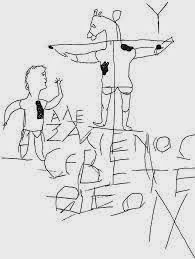 Today that criticism is not leveraged nearly as much, if it all, because people have become used to this idea, even though they dismiss it. Sadly, even people who claim to believe the Christian faith are also indifferent to God becoming human in Jesus Christ. It is no longer the scandal or lifesaver it used to be. It is old news.
Thought it is old news, it is still good news. As Christians we should think once again that it sounds crazy that God, who is Spirit, who has no beginning or end, who transcends our universe, who is all-powerful, who is all-knowing, who is all-wise, took on our physical, finite, blood-filled, and soulful human nature. Not only that, but he took on the form of a servant, was tempted, suffered, and even tasted death for everyone. He displayed faithfulness. He obeyed his Father perfectly. He was a prophet, priest, and king. And as a result of his humiliation, which he did for us, God raised Christ to new life and has exalted him above all things to head up all of us in Christ.
The reason ancient Christians were mocked for this part of their faith was because it was hard for people to reconcile how God could become human. The two just did not seem to go together. If you mix black ink with water you get something that looks grey, but the Christian faith says that the one person Jesus Christ is both God and man, rather than some mixture of the two. It took a few centuries to figure out how the Scriptures explain God became human, but the early church finally laid out a broad understanding of how it can work, even if they could never pinpoint what remains somewhat mysterious. We do well to ponder more and more what the Bible reveals about Jesus. Take some time to read Philippians 2, Colossians 1, and Hebrews 2. Meditate on the gift God has given us in Jesus Christ. He remains our priest, and he knows what it is like to be human, because he still is. And one day he will return and all of us will be changed into his likeness.
Does this all sound a little bizarre? I hope so. There is nothing obvious about the gospel of Jesus Christ, at least not when you really think about it.
Today, people criticize Christianity mostly for issues that spillover into the public square, such as abortion, capital punishment, and the definition of marriage. Every now and then I also come across criticism about religion and faith in general, such as its supposed blame for every bad thing that ever happened in the world and the notion that religious people need a crutch to lean on to endure life in our big scary world. Our ancient brothers and sisters would probably find this criticism curious, because the one aspect of their faith that received the most mockery back then was the notion that God could become human, even worse was that he became some obscure Jewish vagabond who met an untimely death as a convict of the state.
There is an example of graffiti found in Rome that dates back to at least the third century, if not earlier. It is a cartoon that pictures a human with a donkey’s head being crucified and another man raising his hand to this figure. The inscription reads, “Alexamenos worships [his] god.” Sure, there are expertly written and erudite examples of ancient criticism of the Christian faith, from people like Celsus and others, but this one cartoon captures the early embarrassment Christians often faced: they believed God became human.
 Today that criticism is not leveraged nearly as much, if it all, because people have become used to this idea, even though they dismiss it. Sadly, even people who claim to believe the Christian faith are also indifferent to God becoming human in Jesus Christ. It is no longer the scandal or lifesaver it used to be. It is old news.
Thought it is old news, it is still good news. As Christians we should think once again that it sounds crazy that God, who is Spirit, who has no beginning or end, who transcends our universe, who is all-powerful, who is all-knowing, who is all-wise, took on our physical, finite, blood-filled, and soulful human nature. Not only that, but he took on the form of a servant, was tempted, suffered, and even tasted death for everyone. He displayed faithfulness. He obeyed his Father perfectly. He was a prophet, priest, and king. And as a result of his humiliation, which he did for us, God raised Christ to new life and has exalted him above all things to head up all of us in Christ.
The reason ancient Christians were mocked for this part of their faith was because it was hard for people to reconcile how God could become human. The two just did not seem to go together. If you mix black ink with water you get something that looks grey, but the Christian faith says that the one person Jesus Christ is both God and man, rather than some mixture of the two. It took a few centuries to figure out how the Scriptures explain God became human, but the early church finally laid out a broad understanding of how it can work, even if they could never pinpoint what remains somewhat mysterious. We do well to ponder more and more what the Bible reveals about Jesus. Take some time to read Philippians 2, Colossians 1, and Hebrews 2. Meditate on the gift God has given us in Jesus Christ. He remains our priest, and he knows what it is like to be human, because he still is. And one day he will return and all of us will be changed into his likeness.
Does this all sound a little bizarre? I hope so. There is nothing obvious about the gospel of Jesus Christ, at least not when you really think about it.
September 11, 2014
You cannot out-give God: On the gift that keeps on giving and other clichés

Recently, many people who had never heard about Lakewood Church or the Osteens were introduced to them by a video clip in which Victoria Osteen talks about how obedience, worship, and doing good are not for God, but ourselves. God likes it when we are good to ourselves.
A lot of people voiced their opinions about what she said. But Victoria’s comments, although worded poorly, do have a slight hint of truth to them. Namely, what God has prescribed for the world’s good is also for our best as his human creatures. Not only that, but Jesus often mentions rewards, above and beyond plain old human thriving, as a motivation to seek the kingdom of God (e.g. Mark 10:29-31). God is so invested in human thriving and happiness that out of love he gave his only-begotten Son to take on our human nature, join us to himself, and defeat sin, death, and the devil on our behalf. The gospel is certainly about a God who seeks our happiness and is willing to undergo extreme measures to secure it the right way, rooted in him, instead of all the distorted ways sin whispers into our ears.
Where Osteen and several other people on television err is by implying that the results of God’s efforts to head up all things in Christ call for certain prosperity for his true believers today. In other words, you will know you are saved because you will be happy with good health, rich wealth, and ease of life. Such a message sounds more like the fool in Jesus’ parable than someone who is rich toward God (Luke 12:13-21). At its worst, this distorted message convinces people who are physically sick that God has judged them. It tells people who are fiscally poor that their faith is too small (but God may increase it if they send more of their money to the television preacher). It twists what God intended as a righteous motivation for perseverance in him into idolatry under a pious veneer. Instead of understanding that God will always take care of his people, despite hardships they face, this idolatry says to give for one reason only—so you will receive. Sometimes I even hear the phrase “you can’t out-give God” used in this way.
In a sense it is true that we cannot out-give God, for he overflows with life, love, and creativity. One of the foundational aspects of his character is love, and love requires relationships. God created us as a gift. God sent his Son, himself, to us as a gift. God has promised eternal life and a place in his kingdom to us as gifts. Thus, there is no way we could ever out-give God.
God’s giving also never stops. We are his people who enjoy his love and his covenant, and we have inherited an identity as God’s people. Our history has been handed down in the Scriptures in which we read about God’s people constantly receiving from him only for him to give them even more. Dozens of Old Testament passages recount this history vividly, both from God’s perspective and the people’s perspective (e.g. Neh chapter 9). No matter how one views it, we as God’s people will never out-give God. He remains faithful. He remains gracious. He remains loving, because that is who he is.
When it comes to what motivates our behavior, whether it is how we invest our time, money, emotions, or love, we cannot presume God is obligated to repay us with ease in this life. Maybe he will, and Jesus says that to whom much is given much is required, but there is no promise that he will give us much. Just ask the ancients whose forward-looking faith gave them more hope in their futures than their fleeting lives on earth (Heb chapter 11). Likewise, our motivation to follow Christ comes from receiving his grace, confessing our sins, being cleansed with his righteousness, filled with his Spirit, and grateful for being part of his mission of proclaiming the good news of God’s kingdom to our communities near and far. Such discipleship will reap rewards, but they may look quite different than fat bank accounts, adoring applause, and smug postures that we are people "in the know." Certainly something has gone wrong if we think our behavior only matters to our fellow Christians, our social media watchers, or even our pastors, but not our Savior.
Instead, we must have a different perspective, rooted in Christ himself who is the main source of our joy, contentment, and motivation for godly living. If we lay our foundation anywhere else, we will end up disappointed no matter how much money we give to the people we see on television or how often we enter a church building. The greatest gift God ever gave is himself, so let us enjoy him together.