Lucinda Elliot's Blog, page 13
June 27, 2019
Review of the 1993 study ‘The Historical Romance’ by Helen Hughes: Fascinating and Insightful.
[image error]
I have commented in previous posts – some will say ad nauseam – that it is unfortunate that light historical fiction, and historical romance especially, has long been afflicted by a disproportionate focus on the upper class. While this is particuarly so with the genre of Regency Romance, which seems to offer a world largely peopled by aristocrats, it is also largely true of stories set in other eras.
There are many reasons why this should be so. One obvious one is that the writers writers of the early historical romances were themselves from the upper middle class or even the lower echelons of the upper class. In an era of limited public education most authors would invariably come from that sort of background,and their bias would be natural.
‘Baroness Orczy’, author of the 1905 best seller ‘The Scarlet Pimpernel’ was a great believer in arisctocratic superority, while the views of such writers as Sir Arthur Conon Doyle were generally that power was best left in the hands of those who had been raised to wield it.
Another reason for this contentration on the ruling class is, of course, the obvious appeal of writing about the glamourous and remote lifestyles of the powerful. When Georgette Heyer adpated the format of the historical romance of Dumas, Conan Doyle, Weyland and Farnol so as to appeal to a female readership, though regarding herself as true to the tradition of Jane Austen, she in fact wrote about a world far higher in social status than Jane Austen’s gentry. While the most highborn of Jane Austen’s heroes is Mr. Darcy,the untitled grandson of an earl, most of Heyer’s heroes are by contrast earls themselves. Her later followers have taken this further, beocming obsessed with dukes and even the odd prince, to the extent that one might think that every second person to be met with in the Regency UK had a dukedom.
Regency Romance has, of course, no interest in portraying the real Regency UK, with its ruinous extended war with France, its failed harvests, Corn Laws, poverty and social turbulance culminating in the Peterloo Massacre of 1819. The influence of Georgette Heyer and her followers has been such that (unless I am missing something, and I am qite capable of that) there have been no famous writers of serious fiction on the late Georgian/ Regency era since the rise of the Regency Romance. Popular understanding equates the age with the frivolous.
I believe that there will be an eventual move away from this – but it is, like overall improvements in public transport in the UK, a long time coming.
[image error]
Having these particular views, I was delighted to find that Helen Hughes 1993 study ‘The Historical Romance’ had been done on this very topic, investigating the historical romance generally, exploring its upper class bias and consensus based depiction of society, and providng some penetrating insights into the writing of Georgette Heyer and the development of the Regency romance genre.
Here is my Goodreads review:
This traces the genre from its origins with Sir Arthur Conan Doyle and the male adventure novel as typified in such works as his ‘The White Company’ through the writings of such authors as Jeffrey Farnol’s ‘The Broad Highway’ and ‘Baroness’ Orczy’s 1905 best seller ‘The Scarlet Pimpernel’ to the modern change into historical romance as primarily one aimed at a female audience as in Georgette Heyer’s adaption of it.
She makes reference to a Weyman novel that must surely have been an influence on Georgette Heyer, Stanley Weyman’s ‘Stavecrow Farm’ (1905). This book , set shortly after the Peterloo Massacre of 1819, has many of the features that distinguish the later ‘Regency’ (or late Georgian) romances, the unfeeling, contemptuous aristocratic hero, the spirited but innocent and vulnerable heroine rebelling against the artificial constraints placed upon her by society, the run away ingénue, an attempted elopment, the rescue of the heroine by the hero, morally contemptible lower class subversives, and much more.
The only complaint I have to make about this study is an entirely unfair one; I wish the book had been updated to take into account the new developments in the genre that have arisen with the rise of epublishing and the Indie author and the wide availability of older and out of print works online. As it is, as a book published in 1993, it inevitably deals with traditional print publishing only.
I have long been of the opinion that the ‘historical past’ depicted by popular historical romance is in fact, a highly artificial construction, though this is often obsucred by a detailed depiction of certain aspects of historical reality, ie, historically accurate and lengthy depictions of dress and manners, social venues for particular parts of society etc.
[image error]
I have also long argued that unfortunately, the form of popular romance made popular among female readers by Georgette Heyer and continued by the form of current Regency Romance, is also a highly consensus based and upper class biased depiction of UK and European history in particular. This is especially true with regard to the treatment of working class radicalism in the UK or – folllowing on from Dickens and Orczy – the French Revolution.
That being so, I have always found it startling how little attention is paid to the treatment of history in historical romance in the various books I have read analysing romance. For instance, Pamela Regis in her ‘Naural History of the Romance Novel’ seems to see history as oddly static and a wholly uncontentious area.
Therefore, I found it really refreshing to come across Helen Hughes’ analytical approach which accepts nothing as self-explanatory.
It is an excellent study. I cannot do better than give a few quotes from the author.
‘Historical romance thus provides a useful subject for the study of the ways in which an artificial ‘past’ can gain ‘mythical’ signifcance, confirming attitudes or highlighting fears and hopes which arise from the nature of contemporary society.’
‘Even an account of historical ‘reality’ which seems neutral is actually – through selection of ‘facts’ of their interpretation – an ideologically charged construction.’
From Conan Doyle and Orczy through Farnol and Georgette Heyer, there has been an overwhelming emphasis on the ruling class in the historical novel. This goes along with an often nostalgic, if vague, depiction of pre-industrial England. For instance, with Geoffry Farnol:
[image error]
‘Farnol uses the past as a nostalgic frame for a world which never existed in fact: an impossible Old Engalnd’ untouched by the industrial revolution. He is not concerned to depict an accurate picture of pre-industraliszed Britain; his England is simply what the modern world is not, a gentle, countrified background for private adventure.’
He uses, ‘A wealth of picturesque detail, but anything which might suggest poverty, hard work or filth left out…Farnol portrays a world which may contain indididual, private conflicts, but no social conflict. The villagers respect the genry, but do not envy them.’
In historical romance generally, revolt – and particularly the French Revolution – follows from Dickens’ model in ‘A Tale of Two Cities’ in being inchoate, based on a brutal desire for revenge rather than inspired by any thought out ideology and leading inevitably to a bloodbath and failure, unless properly lead by the natural leaders, the ruling class.
However, rebellion against the unjust and oppressive abuse of power by corrupt members of the upper class – if contained and directed by principled and far sighted members of it – is seen as acceptable.
Intriguingly, this depiction of a partial social rebellion as being acceptable, is not only true of the later historical romances, the ones aimed at a female audience from Georgette Heyer’s time onwards, but also encapsulates the relations between the male and female leads. Her heroines are well aware that the restrictions placed on marriageable young girls from moneyed and landed backgrounds by society are unfair, and often stage a minor revolt against them and against the attitude of the domineering, patriarchal hero, but in the end they are prepared to surrender their freedom in exchange for the prize of his true love.
Among other approaches, Helen Hughes discusses Tanya Modleski’s 1982 study ‘Loving with a Vengeance’ on the mechanics by which a woman reader of historical romance is drawn into acceptance of the inevitable plot feature of the heroine ending up in the arms of the hero through a sort of ‘revenge motif’ whereby the reader gains a vicarious feeling of power through this previously impervious male’s increasing emotional vulnerability as regards the heroine.
Well researched, and thought provoking, this book is full of fascinating insights – my short quotes do not in any way do justice to it.
One of these insights Helen Hughes makes, is that a different approach to a given text can give rise to a different interpretation of the plot. She leaves us with this thought:
‘If the mythical quality of an historical setting carries a potent ideological charge, which it clearly does, the ideological element may not always be received uncritically at every reading.’
I do hope not.


June 21, 2019
‘The Peterloo Affair’ is free on Amazon today and tommorow…Also ‘Ravensdale’ free on Amazon.co.uk and Kobo
For those readers interested, my latest novel ‘The Peterloo Affair’ is free on both Amazons today. It’s a love story set about the infamous Peterloo Massacre of 1819, and here is the blurb:
Young Joan Wright knows exactly what she wants: to escape with her friend Marcie from domestic drudgery in her poor village of Lancashire cotton workers, and to make a living using their healing skills. They have sworn to have nothing to do with men.
But when roving, rascally, magnetic Sean McGilroy comes on a visit to his relatives, Joan finds herself attracted to him despite her plans and his bad reputation as a ‘light o’ love’.
Appalled by the poverty all about, McGilroy joins Joan’s father and the local Radicals in organising a protest march to St. Peter’s Field in Manchester to hear the famous Radical orator Henry Hunt.
Joan and Marcie organise a group of women to march with the men. Irresistibly drawn to McGilroy, Joan finds that she must choose between the dreams she has shared with Marcie of independence, or in taking the risk of trusting the beguiling but notoriously fickle McGilroy.
But meanwhile, McGilroy has made powerful enemies among those who have the support of the goverment to surpress the Radicals…
and
…And my novel ‘Ravensdale’ is also free on Amazon.co.uk.
Here is the blurb:
The author is proud to announce that this novel has become her second to win a B.R.A.G medallion for outstanding self-published fiction.
For those who love a satire on the cliches of historical romance, which at the same time draws them into the adventure.
When the group of highwaymen, headed by the disgraced Earl Ravensdale hold up the hoydenish Isabella Murray’s coach, she knocks one of them down and lectures them all on following Robin Hood’s example. In fact, she has been long resisting the urge to escape from her parents’ plans for her advantageous marriage and become one herself.
The rascally Reynaud Ravensdale – otherwise known as the dashing highwayman Mr Fox – is fascinated by her spirit.
He escaped abroad three years back when he fell under suspicion of shooting a friend dead after a quarrel. Rumour has it that his far more respectable cousin was involved. Now, having come back during his father’s last illness, the young Earl has largely lost hope of clearing his name of murder, living as an outlaw as he is, and having sworn to protect someone else who was involved in the quarrel.
Isabella’s ambitious parents are eager to marry her off to Ravensdale’s cousin, the next in line to his title. The totally unromantic Isabella is even ready to elope with her outlaw admirer to escape this fate – on condition that he teaches her how to be a highwaywoman herself.
This hilarious spoof uses vivid characters and lively comedy to bring new life to a theme traditionally favoured by historical novelists – that of the wild young Earl, who, falsely accused of murder by the machinations of a conniving cousin and prejudged by his reputation, takes up life as an outlaw.
‘Ravensdale’ is a fast paced, funny and light hearted read from the writer of ‘That Scoundrel Émile Dubois’, and follows the adventures of Émile Dubois’ equally roguish cousin just prior to the outbreak of the French Revolutionary Wars. It can be read as an independent novel.
[image error]
You can get it free at Kobo free
I understand that if you quote that it is free on Kobo, they will make it free on Amazon.com too, and I hope that readers will do that. As I am only a customer on Amazon.co.uk, I can’t do that, unfortunately…
June 12, 2019
Stonehenge as a Backdrop for Novels
[image error]
Just before Whitsun I went to see Stonehenge, staying a couple of miles away in Amesbury. Oddly, although I have always lived towards the west of the UK, I had never got round to visiting.
It was wonderful weather when we went. I had not expected there to be much atmosphere, given that if you go at a normal hour you are fair way from the stones. Oddly enough, despite the crowds and distance, I could still pick up on one, which I felt must be very intense, both at the rising and setting of the sun. The site is surrounded by grazing, staring sheep, and we saw two leverets dashing across the grass, a sight that made me very happy, hares being so scarce these days. The visitor centre was not as incongruous in the landscape as I had feared.[image error]
I also thought how wonderful the surrounding Wiltshire countryside was. In a truly parochial way, I have always assumed that countryside of Buckinghamshire and Denbighshire as the most beautiful in the UK; Now I thought that the rounded hills of Wiltshire easily rivalled them. I have read that the chalky hills in the surrounding countryside meant that in the Neolithic era, when the whole of the UK was forested, this area was less so, and it was perhaps for this reason that it was used as a site for the monument.
[image error]
It seems to have been a hill fort besides, and there are pits that were thought to have held great totem like structures dating perhaps from 8,000 BC, long before Stonehenge itself was built in 2500 BC in the early Bronze Age. Oddly enough, it was not until the nineteenth century that the great age of the structure was understood. It was blithely dismissed as having been built in the Iron Age, shortly before the Roman occupation. In the Middle Ages, the problem that has always haunted researchers – however those great stones were transported from perhaps as far away as Pembrokeshire in South Wales— was explained by Merlin’s magic.
[image error]
Various theories have been advanced over the centuries as to its original use. Some have thought it a giant astronomical computer, some a religious site, and it is, of course, of great religious significance to Druids for the festival of the summer solstice.
Privately owned after the crown ceased to own the lands, it was once in the possession of the various landowning families, and in fact auctioned by Knight, Frank and Rutley Estate Agents, in Salisbury on 21 September 1915 as ‘Stonehenge with about 30 acres…of adjoining downland’.
[image error]
After the National Trust acquired the monolith and the surrounding countryside, it was freely open to the public until 1977, when the need to protect the site led the organisation to erect the surrounding fence. Old sketches and photographs illustrate how much the site had fallen into decay before the restoration work began.
It seems typical of we British, somehow, that for so many centuries we should have neglected this marvel of antiquity on our doorstep, while overawed by the ruined of Ancient Greece.
It will certainly surprise no-one to read that after visiting Stonehenge and Wiltshire, I have decided to locate the concluding part of the work I am drafting at the moment in Wiltshire, with the final scene played out near Stonehenge – which has long been surrounded by myths about time.
In this, I am just about as unoriginal as I could be, of course. Countless novels have been centred about Stonehenge, particularly historical fantasies, while others have used the monolith as a dramatic backdrop to pivotal scenes or their grand finale, from Thomas Hardy’s ‘Tess of D’Ubervilles’ onwards.
[image error]
Interestingly, it was in Peter Ackroyd’s brilliantly evocative tale of horror, human sacrifice, and time defying synchronicities,‘Hawksmoor’ – which only mentions a trip to Stonehenge in passing – that I found the most riveting description. The antagonist, and in fact satanist Nicholas Dyer, an architect commissioned to build London churches following the 1666 Great Fire of London, goes with Sir Christopher Wren to see the monolith:
‘The latter part of the journey from the entrance to Wiltshire was very rough and abounded with Jolts…and so it was with much relief that we left the Coach at Salisbury and hired two Horses for the road across the Avon to the Plain and Stone-henge. When we came to the edge of this sacred Place, we tethered our Horses to the Posts provided, and then, with the Sunne directly above us, walked over the short grass which continually cropt by the flocks of Sheep) seemed to spring us forward to the great Stones. I stood back a little as Sir Chris. walked on, and I considered the Edifice with steadinesse; there was nothing here to break the Angles of Sight, and as I gazed I opened my Mouth to cry out but my Cry was silent. I was struck by an exstatic Reverie in which all the surface of this place seemed to me Stone, and I became Stone as I joined the Earth which flew on like a Stone through the Firnament. And thus I stood till the Kaw of a Crow roused me; and yet even the call of the black Bird was an Occasion for Terrour, since it was not of this Time. I know not how long a Period I had traversed in my Mind, but Sir Chris. was still within my Sight when my eyes were cleared of Mist…
Then the Rain fell in great Drops, and we sheltered beneath the lintel of one great Stone as it turned from gray to blew and green with the Moisture. And when I leaned my Back against that Stone I felt in the Fabrick the Labour and Agonie of those who had erected it…’
That description of Stonehenge as it must have been in the eighteenth century would be pretty hard to beat.
May 31, 2019
Disappointing Reader Expectations and Pushkin’s ‘The Queen of Spades’
[image error]
Most books about successful novel writing emphasize that above everything, the writer who wants to sell well and avoid bad reviews must at all costs respect the tropes of a genre, and particularly avoid ‘disappointing reader expectations’.
In fact, Chris Fox in his well argued and generally witty book ‘Write to Market’ emphasizes this to the point of going into the specifics of market research, cover design and plot details including even the sex of a spaceship’s pilot.
Besides this, genres are not at all costs to be mixed. He gives some brisk advice in a chapter headed ‘Don’t Get Cute’, citing his own experience.
Market research had already told him that Super Heroes and Alien Conspiracy stories were popular around 2016, and he had the idea of combining features of his two favourite television series, ‘The X Files’ and ‘Heroes’. He joined the themes of alien conspiracy and superheroes in the first novel for a projected series called ‘Project Solaris’, ‘Hero Born’. As both of these are popular sub genres of fantasy, he hoped to draw in readers of both and market a best seller (his first novel had in fact been a best seller, though he modestly ascribes this to a stroke of luck) .
He claims that as it turned out, ‘Hero Born’ failed to attract readers from both genres because the expectations of each group were different and even conflicting. For instance, market research advised him that readers of superhero stories tend to be in their teens and indulging a fantasy of being suddenly special. By contrast, readers of alien conspiracy themes are interested in reading about uncovering a deeper truth, solving a mystery, and putting right an injustice. He argues that the two themes of his novel clashed.
The result was, that his book sold hundreds rather than thousands of copies. His current fans loved it, but it attracted no new ones.
[image error]
For me, and for many other writers, selling in hundreds is fine – it is selling in dribs and drabs of a couple a month that is soul destroying. Chris Fox however, aims to sell thousands in weeks, and disappointing reader expectations is not the way to do that.
All this made me think enviously of writers in previous ages, who may not have had the advantages of internet publishing, but who seemingly did not have to adhere to such rigid demands from readers.
[image error]
When I recently re-read the collection of Pushkin’s prose in the book ‘The Queen of Spades and Other Stories’ (also In this collection is to be found my favourite robber novel, ‘Dubrovsky’ but that is irrelevant here), it occurred to me that this story, phenomenally successful in its day and now of course a renowned classic, almost seems to be designed to wrong foot the reader.
‘The Queen of Spades’ is of course, Pushkin’s most famous piece of prose writing and was the equivalent of a best seller in his own time. Obviously, with so small a reading public, the numbers sold would be insignificant compared to internet sales in the modern age, but not in his. It was an overnight sensation, and the talk of fashionable society – and possibly of unfashionable society as well.
I first read it at twelve – my father had an old edition of this book – and was struck even then by the concise, dry style, even in translation. For instance, there is the famous beginning of the story: –
‘There was a card party at the rooms of Naramov, an officer of the guards. The long winter night had passed unnoticed and it was after four in the morning when the company sat down to supper’.
Apparently, Pushkin used the concise style of the old French masters to perfection.
However, it is not about his style that I want to write in this post – though reading it makes me reflect how I must write more concisely myself – but about how in this classic story Pushkin in fact seems to delight in disappointing those dreaded reader expectations.
For those who haven’t read it, it is about a secret gambling formula which gives inevitable success at cards. It was given to a spoilt young noblewoman by the mysterious Saint- Germain in the 1770’s. She at that time faced the threat of ruin, having lost a massive sum at faro at Versailles. Through using it, she recouped her losses, winning spectacularly, but never played again.
She refused to give the secret to her sons – all determined gamblers – but did once reveal it to another man in desperate circumstances, who also recouped his losses and ceased play from then on.
This story is told at the card party by Tomsky, her grandson, and is overheard by a German officer of the Engineers, Hermann. This man is remarkably careful of his money, having been left only ‘a small independence’ . He does not even touch the interest on his capital, living on his pay. However, so fascinated by cards is he, that he sits up watching others play until the small hours.
Pushkin says of him: – ‘He had strong passions and an ardent imagination, but strength of character preserved him from the customary mistakes of youth’.
[image error]
That he is a very odd character is surely shown by this. This is further reinforced by his obsessive thinking over the story as he wanders about Petersburg the next evening, musing on finding a way of getting the Countess X to reveal her secret to him.
As he sees it, winning her favour and perhaps posing as an admirer might compel her to do so. However, he dismisses this idea on the grounds that ‘She is eighty-seven. She might be dead next week, or the day after tomorrow, even.’
The callousness of this calculation made me start on first reading it, and then laugh at the grim depiction of his coldness.
His wanderings take him to a great house outside which a great many carriages are arriving for some social occasion, which he learns belongs to the Countess X. Dreaming that night of winning enormous wealth through gambling, he returns to patrol outside the Countess’ house, and sees the Countess’ lovely young companion, the unfortunate Lizaveta Ivanovna, whom the Countess has raised as an orphan and treats as a drudge. He looks up at the windows.
‘In one of them he saw a dark head bent over a book or some needlework. The head was raised. Hermann caught sight of a rosy face and a pair of black eyes. The moment decided his fate.’
At twelve, I had read a fair amount of romances and novels of other genres with romantic sub plots, and I knew that men more callous than Hermann were often destined to cast aside their wicked plans as they fell in love with the heroine. This is what I naively assumed would happen here. After all, I knew nothing about Pushkin save that it seemed that he had died young in a duel over his wife, which seemed to me romantic indeed.
I was startled and dismayed when far from falling in love, Hermann remains cold and calculating. He writes Lizaveta love letters (copied, so Pushkin tells us, from a German novel) and gradually persuades her to agree to an assignation with him. She tells him how to get into the house.
Hermann waits for this ‘like a tiger trembling for its prey’. He waits until the staff have retired and the Countess is left alone in her room, and then approaches her. At first, he begs her to reveal her secret to him. When she refuses, he threatens her with a pistol. She dies of fright.
He goes to confess to the horrified Lizaveta.
‘So those passionate letters, those ardent pleas, the bold, determined pursuit had not been inspired by love…It was not she who could satisfy his desires and make him happy! Poor child, she had been nothing but the blind tool of a thief, of the murderer of her aged benefactress! …She wept bitterly in a vain agony of repentance…’
The most sinister developments of the story are yet to come, but I will write no more spoilers, having made the point that this tale does not follow a conventional pattern. The anti-hero remains cold and callous, indifferent to Lizaveta’s appeal:
‘…Neither the poor girl’s tears nor her indescribable charm in her grief touched his hardened soul.’
Reading this at twelve, I was dismayed by the sheer unpleasantness of the anti-hero, who incidentally, is described facetiously by Tomsky to Lizaveta Ivanovna as having ‘the profile of Napolean and the soul of Mephistopheles’. I recall my reader expectations were disappointed in a big way. I did read to the end, and found it a fascinating tale, but at this age found the cynicism in the story rather too much for me, so that it was many years before I read any more Pushkin.
[image error]
Though I was very young when I read the story, I tend to think my expectations of it were typical. I seem to remember reading somewhere that in this story, Pushkin deliberately upends expected tropes, and that most readers would expect some sort of love story between Hermann and Livaveta Ivanovna, even if it was not the main focus of the plot. How far Pushkin deliberately toyed with disappointing these dreaded tropes and reader expectations, it is hard to say. Pushkin was fascinated by innovation in writing, and Hermann has also been described as a character of a new type for Pushkin’s age.
There are all sorts of levels of irony in this story, of course. One is that while it might ostensibly be called a story with a moral that points against becoming obsessed with making easy money through games of chance, Pushkin himself was dangerously drawn by gambling himself. On his death in that infamous duel, the Tsar paid off gambling debts for him amounting to hundreds of thousands of rubles.
Pushkin was, of course, a writer of literary fiction, not genre fiction, though this story might be defined as belonging to the genre of horror, or as a ghost story. By the time he wrote ‘The Queen of Spades’ of course, he was so renowned that he could afford to ignore such incidentals as readers’ tastes.
Have specific requirements for genres become more of a requirement in the current era? I do think readers make more demands for specific tropes for genre fiction, and in pointing this out, Chris Fox is doing a great favour to the writer who aspires to sell more.
But it is surely a hindrance on innovative sorts of writing, and I also wonder; isn’t it by breaking out of the demands of a genre, perhaps creating a new one in the process, that a writer often obtains the greatest success?
Interstingly, various highly successful writers have achieved this in the past, Mary Renault for one, and Anne Rice for another. Perhaps I should not try and speak for advocates of sticking to the tropes of a genre. Still, I suppose they might say that yes, that is true, but those are the ones in several thousand who became world famous, and that perhaps it is best to build a firm readership base before starting to tamper with the boundaries of a genre.
There are, to sum up on a tediously neutral note, there must be arguments either way. Finally, I supose it must depend upon how well you can write for the market (and I would like to emphasize that Chris Fox in no way advocates selling out and writing about what you hate). Some can do it brilliantly; others, I suspect, less so.
May 21, 2019
‘Ferrandino’ the Sequel to Rinaldo Rinaldini – Review.
[image error]
It took me ages to find an English translation of the sequel to ‘Rinaldo Rinaldini Captain of Bandetti’ by Christian August Vulpius. In fact, it wasn’t me who finally tracked it down; it was an obliging colleague on Goodreads, who directed me to the site where it can be downloaded google books
The problem with sequels is often that however much readers who love the first in the series may request one, they are not always a good idea. If some of the main conflicts have been resolved, then colflict has to be introduced artificially.
In this,in fact, Rinaldo Rinaldini’s problem in the first two volumes – how to abandon being a robber captain and lead a good life when his past keeps on catching up with him -has not been resolved.
In the original version, he was stabbed to death by his menor, the Old Man of Fronteja. Vulpius brought him back to life to satisfy public demand, rather like Conan Doyle with Sherlock Holmes.
I read the first two volumes of the novel back in 2013, when I was writing my own robber novel ‘Ravensdale’.
I loved the first book in this series, wholly tacky and gothic as it was in tone.Vulpius strives to reproduce that here, but does not qute come up to it. Grotesque features, such as Rinaldini’s adoring voluntary servant Rosalia’s body being preserved by the Old Man as a skeleton are added, true. Yet, they seem to have been included in the plot in an atempt to capture some of the gothic excitement of the first volume rather than as a necessary part of the plot.
[image error]These skeletal remains of poor Rosalia are in defiance of the rules of time. It is mentioned that the equally devoted Countess, Dianora, has an infant by Rinaldini. From this we may assume that little more than a a couple of years have passed since the events in the last volume, where the unlucky Rosalia died not long before Rinaldini was attacked by the Old Man, to save him from the disgraceof being taken as a robber. Yet we are are asked to believe that her body has decomposed to the extent of being reduced to bones. That is, unless the Old Man has reduced it to this form by some magical process.
There are some more independent women in this novel, besides adoring ones like Rosalia and Dianora. There are a couple of ‘man haters’ who dwell in a castle where Rinaldini stays, and they expose him as the dreaded brigand in a splendidly dramatic ending to one chapter, where he is offered the services of a dancer who has entertained the company:
‘Ferrdanino looked at the girl in silence. She smiled and cast her eyes on the ground. At this moment, the Countess entered the hall, and enquired: “What is the matter here?”
Ferrandino replied ernsetly, “I have engaged this maiden.” The Countess laughed aloud, and said in an undertone, “Whither?”
Ferrnadino without confusion, and very dryly, replied; “To my companions and fellow travellers.”
“Indeed! My cousin must know that.”
The cousin came, and the Countess told her laughing, of Ferrandino’s intention- the cousin turned to the dancer, and said, “You will go with this man?”
“Why not?” replied the other, with great naivite.
“You do not know who he is.”
“Do you then know?” asked Ferrandino, quickly.
“O yes!” replied the cousin, in the same tone.
Ferrandino looked round him in astonishment- the women laughed aloud. The musicians and the dancer left the hall. The cousin took the dancer by the hand, led her to Ferrandino, and said, “There is the bride – Take her to your den.”
Ferrandino stared at her, and would have asked her meaning, when she held a minature before his eyes.He cast a look at it, and trembling violently, started a few steps back.
“Have you,” said the cousin, “read the writing beneath this portrait? – It is the likeness of RINALDO RINALDINI THE ROBBER CHIEF!”
Then, another woman, Serena,who met Rinaldini and fell for him in the earlier novel, jeers at his faithlessness, which was depicted without comment in the first volume:
‘I cannot desire that you should love me better than you have loved the dearest of your mistresses, Aurelia, Rosalia, Olympia, Dianora, Ersilie, and who knows how many more, as you would and will love, even Serafina. You love very inconstantly. Like as the moon loves the earth, sometimes not at all, generally half, and only on a few days with full adhesion.’
[image error]To be fair to Rinaldini, though he has some sort of compulsion to be promiscuous, he does seem to genuinely fall in love with all of these women in turn, and often at the same time.
Oddly enough, we are informed that he at one point writes to Aurelia, whom he never did manage to win after his abduction attempt failed. She unaccountably turned up to be present at the dramatic stabbing in the last volume. We are never told what her connection was with the Old Man. I may have missed something here. I am far from sure that there wasn’t a connection between her uncle and guardian and the Old Man.
[image error]Anyway, Rinaldini somehow has her address.
Sadly, Rinaldini’s devoted henchman Ludovico, one of my favourtie characters, is killed off in this volume, fighting to liberate some oppressed people, a cause which Rinaldini undertakes and at which he is defeated.
My own edition of the first volumes has Rinaldini die at the age of sixty, fighting in the American War of Independence: this is, of course, and amended ending from the original. Oddly enough, an expert on Vulpius writing on JSTOR mentions that Rinaldini is killed fighting in the battle to liberate the Haiduks along with his henchaman, and I am confused about this. Whether in fact, this is Rinaldini’s end in the original novel is a possible explanation. The one available on Goodle Book is obviously a later edition, and perhaps Vulpius once again gave his hero a exculatory ending which he later reversed.
The story ends inconclusively regarding Rinaldini’s love life – we don’t know if he went back to the devoted Dianora, though we do know that the Old Man , who turns out to be a Prince, reveals that he is Rinaldini’s father.
I found that a shame. I preferred him as a goat herd made bad….
May 3, 2019
The Difficulty in Portraying the Truly Good Hero and Heroine – Examples from Classic Novels
The literary critic Graham Handley writes of the difficulty of creating a character who is very good: ‘It is a strange but true fact that the truly good person is difficult to portray convincingly in fiction, and Hester Rose (a sort of secondary heroine in Elizabeth Gaskell’s ‘Sylvia’s Lovers’) may be compared with Diana Morris in ‘Adam Bede’ where there is a similar partial failure of imagination.’
Why this should be so is possibly a question of fashion. These days, we don’t want our protagonists to be too admirable, and the dread spectres of Mary Sue and Gary Stu hover near, whereas in the mid-eighteenth century, Samuel Richardson rose to fame (or infamy) through writing about two Mary Sues and one Gary Stu, namely, Pamela Andrews, Clarissa Harlow and Sir Charles Grandison.
These endless novels were best sellers in that era; people just couldn’t get enough of them. Of course, with ‘Pamela’ there is the issue of whether he drew in the reader with the lure of, ‘Attempted Rape as Titillation Whilst Expressing Every Sort of Moral Abhorrence’ . I tend to agree with Coleridge that he did, possibly unconsciously.
The rape in Clarissa takes place offstage, and not until Volume Six, so a reader would have had to be as patient as s/he was purile to keep on reading that long just for that, even if people did have longer attention spans in previous centuries. Probably the fascination of that saga was the villain Lovelace as much as the heroine, and the depiction of his evil if far fetched machinations.
Clarissa is of course, a far more sophisticated creation than Pamela, who to most modern readers comes across as a prize opportunist hypocrite. I can’t answer for Sir Charles Grandison. I have heard that the character is unbearable, and it is worth reading just for that. I have also heard that in it, a woman actually apologises for preferring God to Sir Charles.
Still, having in recent years ploughed my way through ‘Pamela’, ‘Clarissa’ and ‘Pamela in Her Exulted Condition’ (it seriously is called that!) I don’t think I can stand reading any more of Richardson’s self-serving Puritan morality for a long while.
Both the eponymous heroine of ‘Evelina’ and the hero Lord Orville are extremely virtuous and outstandingly dull. I felt like going to sleep whenever Lord Orville spoke. Fortunately, he does that only occasionally, usually to show a high minded understanding of whatever situation it is in which he is involved.
By contrast, the villain Sir Clement Willoughby (did Jane Austen borrow his name?) provides a great deal of amusement. He spends much of his time, when not involved in rascally plots, in insisting on his deep love for the heroine. Still, never – the cad -does he so much as hint at marriage. At the end he informs Lord Orville that she is not well born enough for him to consider for anything but as a mistress. Lord Orville proposes believing her to be ‘low born’ – but then, he is a hero.
It was left to the genius of Jane Austen to create a hero who insults both the heroine’s face and her family origins.
Charles Darnay and Lucie Manette in Dickens’ ‘A Tale of Two Cities’ are another virtuous and dull hero and heroine in a classic novel. Someone has commented somewhere (I have managed to lose the link) that Darnay is just like an android programmed to do good things – he seems to possess no mental life at all, and whenever he opens his mouth, virtuous platitudes come forth. Lucie Manette is an embodiment of a Domestic Angel.
I have to admit that I dislike that novel, because of the influence it has had in portraying the French Revolution in an entirely negative light, in particular shaping the popular misconception about the number of victims of the Terror.
As George Orwell says: ‘ Though he (Dickens) quotes no figures, he gives the impression of a frenzied massacre lasting for years, whereas in reality the whole of the Terror, so far as the number of deaths goes, was a joke compared with one of Napoleon’s battles. But the bloody knives and the tumbrils rolling to and fro create in (the reader’s) mind a special sinister vision which he has succeeded in passing on to generations of readers. To this day, to the average Englishman, the French Revolution means no more than a pyramid of severed heads. ’
That however, is off topic…
Intriguingly, Charles Darnay does come to life – twice – when he is in danger of death. Both when he is being tried for treason in the UK, and later when he is tried for it in France, he is suddenly there, real and believable.
In fact, I found the scene where Lucie Manette (who doesn’t yet know him) sheds tears because she is forced to give evidence against him, and they gaze at each other through the courtroom and obviously start to fall in love, both evocative and gripping.
Generally, then, I find it hard to think of a truly noble hero or heroine in a classic novel who is both interesting and believable. Readers may have been more fortunate; if so, I’d love to hear of it.
April 19, 2019
‘The Marquis’ by Charles Garvice: ‘incredibly, almost unbelievably, bad’ writing.
[image error]A few years ago, I posted about having found the worst written novel I have ever come across. This was ‘The Outcast of the Family’ by Charles Garvice, a romantic novel published in 1894.
I had first read it at fifteen, when bored by being snowed in at the Vale of Clwyd in North Wales. My mother had come by this as part of a job lot of Victorian articles in an auction, along with other books, some of rather more value, for instance, she also got a complete set of the first edition of Scott’s ‘Waverley Novels’.
The writing style in this book was so purely terrible that it startled me at the time. I had recently read Sax Rohmer’s ‘The Drums of Fu Machu’ with its flat characters, excessive use of exclamation marks, etc, and this struck me as being even worse.
When I re-read it a few years ago, I found it as fascinatingly bad as I had remembered. The plot, which revolves around a wild young viscount who drinks, brawls and dresses as a costermonger, was so purely risible that I borrowed these details, including his talent for music, for my Gothic satire ‘The Villainous Viscount Or The Curse Of The Venns’.
In ‘The Outcast of the Family’ Lord Fayne is cured of being bad by two conversations with the innocent heroine Eva, who looks upon him and his ‘wasted life ‘ with tenderly compassionate eyes.
Why she does not turn such a gaze upon the villain of the piece, Stannard Marshbank – who is even worse- is not explained. Perhaps it is because he has pale eyes and a furtive manner, unlike Lord Fayne, who is built like a Greek god and with the profile of one, and who saves her life in passing when, dressed as a tramp, he stops her bolting horse.
Having declared his love for her, Lord Fayne empties his glass of brandy onto the fire, sells his racehorses, discards his costermonger garb and takes up busking on the country roads as a form of rehabilitation. Apparently after a few weeks ‘he feels a change’ inspired by the country air and the company of ‘simple country folk’.
This is only part of the plot, which involves a murder, for which Lord Fayne is unfairly accused, and the seduction of an innocent, for which he is also wrongly blamed, Lord Fayne’s short career working on a ranch in Uruguay, and his return, ravaged by malaria, to confront Stannard Marshbank – who has meanwhile forced the heroine Eva to agree to marry him – of all his crimes .
When I had read the last page of this melodrama, and stopped laughing, I marvelled at what sort of author could have written such a story in all seriousness.. I investigated Charles Garvice, partly through an article on Wickpedia, and partly through one kindly supplied to me by Laura Sewell Matter, in her delightfully humorous ‘Pursuing the Great Bad Novelist’ (2007). She too, marvelled at his ‘incredibly, almost unbelievably bad’ writing style.
He was the best selling writer of the late Victorian and Edwardian era, writing over 150 books and by 1913 selling over 1.75 million annually.
I have since read several of his other books, and find them all as lurid, as devoted to purple prose and as full of ludicrous melodrama as his critics asserted. However, none of them to my mind was as appalling as ‘The Outcast of the Family’. I thought that stood alone: but now I have found a rival for it.
‘The Marquis’ was in fact, published by Garvice in 1895, a year after ‘The Outcast of the Family’. That it is about a wild, careless aristocrat who becomes a solid citizen through the love of a virtuous young girl is not surprising, as more or less all of his stories are about that. However, the Marquis , who is decidedly mature for a Garvice hero, being about 35, has taken his wildness to an unusual level, and has lived not only as an outcast, like Lord Fayne, but as an outlaw.
In fact, over in Australia, as ‘Gentleman Jack’ he has been the leader of a group of bushrangers, whom it is hinted he joined not in order to make money – as a marquis he hardly needed to – but to keep from their worst violence. Like Valentine in ‘The Two Gentleman of Verona’, he imposes on them a moral code, and the exploits of Gentleman Jack become well known throughout Australia.
In one of their last raids before he stops being their leader, he calls on the isolated dwelling of Professor Graham who lives with his daughter Constance, who has violet eyes and is ‘as graceful as a fawn’ in a glorified hut in the outback. A near neighbour is a man called Rawson Fenton, instantly recognisable as the villain by his evasive glance and the coldness with which Constance treats him. We may be sure that, like all of Charles Garvice’s villains, he kicks dogs as a hobby.
Professor Graham has bought a piece of land on which there are many precious gems, surrounded by rock. He has been seeking of a way of making money by freeing the jewels of the stone, becoming meanwhile deranged and fanatical about the topic. Unknown to Constance, he finds it – and the success drives him mad – just before the bushrangers arrive on a raid. Naturally, their leader, who seems a ‘superior’ sort of man, arranges for the grieving Constance to be escorted to the nearest town. The sneaking Rawson Fenton remains behind. Finding a written copy of the formula, and understanding its meaning, he pockets it. He also finds a ring with a family crest that the lead outlaw has dropped, which he pockets also.
Professor Graham considerately dies some months afterwards. Constance returns to the UK to take up work as a governess. Naturally, Charles Garvice being wholly addicted to improbable co-incidences (or synchronicity, if one wants to judge his use of them generously) she is offered post as governess to the Marquis’ young nephew at Breakspeare Castle in Buckinghamshire. Of course, he returns on the very day she takes up her new post, having wearied both of wandering about the globe and life as an outlaw.
Despite having the Marquis and Constance having met before and not needing glasses, neither recognises the other. To be fair to Constance, she does think, when being shown his portrait earlier by the Marchioness, that his handsome face, with its ‘audacity and recklnessness, an air of ‘devilry’ and wildness’ is familiar. But she has no idea from where.
Naturally, they fall in love. But a sly cousin who stays at the house, Lady Ruth, has her own plans for the Marquis – who incidentally is called the astounding name of Wolf Breakspeare – and joins forces with Rawson Fenton, now returned to the UK to foil matters. Soon, one of Gentleman Jack’s old gang members named Long Ned turns up, too, singularly hard up – but unlike Constance, capable of recognising the Marquis as Gentleman Jack — and given to saying such things as ‘Lor bless you, guv’nor.’ Will he descend to blackmail?
There is a good deal more in the way of a plot, but it really is too ridiculous to repeat, save to say that Rawson Fenton finds out the Marquis’ dark secret and blackmails Constrance into agreeing to accept his proposal.
During the course of the 350 odd pages, Constance ‘reddens and then turns pale’ on more or less on every other one; Ruth constantly looks and speaks sharply; the Marquis is repeatedly masterful and sometimes a dark look passes across his handsome face as he regrets his past ; Rawson Fenton’s face writhes with passion; everyone admires both Constance (save Lady Ruth) and the Marquis (save Rawson Fenton), and the Marchioness constantly ‘speaks placidly’.
This book also contains a cringe making love declaration, in which I reproduce the punctuation exactly :
‘But for you I should have dared that man (Long Ned) to do his worst! But for you, I should have left this house never to return! But I could not –Girl” his hand clutched as if in a wild rage at some weakness that mastered him – “girl, what have you done to me? Ever since I saw you, the night that I returned, you have exerted an influence over me. You have robbed me of my strength of will, the strength I gloried in – the strength which, once gone, renders me weak and helpless! Constance” and he used her hand to draw her to him, “what have you done to me? What is it? Constance, I cannot get you out of my thoughts day and night. Is it that I love you?”
Oh dear: purple prose, anybody? This book truly has to take equal first place with ‘The Outcast of the Family’ as the worst that I have ever read.
Fascinatingly, the hard backed copy that I read, which was a cheap book in the days before paperbacks, has been so well bound, using the old sewing methods, that it has held this dreadful piece of writing together for 124 years.
[image error]
April 4, 2019
Anti-Heroine’s: Part Two Twentieth and Twenty-First Century Novels
[image error]
I wrote in my last post that I have difficulty in finding anti-heroines in both classic and modern novels. I must have been reading the wrong books. Surely an anti-heroine is to be found from amongst all those katana wielding, leather clad female warrior leads? However, as I mentioned, I haven’t read that much modern fantasy, and maybe I keep missing them.
I now recall that I have encountered a couple of versions of the anti-heroine in fantasy.
In The Dan Series Book four ‘Into the Fourth Universe there is the heartless siren Rannie. This woman in fact is, in her own totally heartless way, sometimes on the side of right. Besides running a criminal empire, she is partly out to save the universe; it is just that she doesn’t let scruples about anyone, including the bumbling, hirsute space age detective Magus get in the way. However, she underestimates his dogged persistence…
There is an hilarious confrontation between them at one stage at the novel.
‘“You know the first rule of investigation – never accept a drink off a dame ; it always has a Mickey Finn in it.”
“Not this one; I poured it myself. See.” She took a good swig from the glass.
He tasted it suspiciously. “Seems OK. Ta.” He knocked the pint back in one draught. “Any more? This investigating is thirsty work.”
She poured another for him. “Right; now I suppose I owe you an explanation.”…
His vision blurred. The room shimmered. He felt his senses slipping. “What have you done?” he muttered as he felt his legs giving way. “You said the drink wasn’t drugged…”
“The first one no,” said Rannie, lowering him gently onto a couch. “The second one was. You forgot the first rule of investigation; never ever ever accept a drink from a dame.”
There is also another contender for the title of anti-heroine in this hilarious series, though there is the minor fact that she isn’t human. This is the sex android Kara-Tay, another seemingly heartless siren, who spends a great part of the first novel in the series ‘The Adventures of Dan’ trying to kill off Dan Smith, whom she has abducted to join her in a wild adventure across universes.
Kara-Tay was designed by an man as his sex slave; having escaped from her servitude from her creator, she has no high opinion of males. But she has a shameful secret…
Moving on to an anti-heroine who confined her activities to the deep south of the US here is Margaret Mitchell’s Scarlett O’Hara in the 1936 novel ‘Gone with the Wind’. I read it at sixteen, and never forgot the sweeping impact of the story.
This book always struck me as a ‘guillty pleasure’ type of read, with its swaggering anti-hero to Scarlett’s anti-heroine, the sentimental passages, generally good-looking characters (with a few exceptions, such as the supposedly plain Melanie and the sad Frank Kennedy, that is), detailed descriptions of dresses, balls and feasts and the lifestyle of the plantation families (before they are ruined by the war, of course) and also, on the code of behaviour extolled by the Southern gentlefolk.
Scarlett is notoriously vain, flirtatious and is highly unscrupulous, both in her battle to survive and in her pursuit of the golden haired, suave Ashely Wilkes. She is also, as Rhett Butler points out, barbarically ignorant – she thinks that the Borgias are a family from Georgia, and that her father might have been in the siege of Drogheda – but she is endowed with a wonderful zest for live and will to survive as the society in which she has grown up falls about her ears.
But even at an unpolitical sixteen, my pleasure in this classic anti-heroine was spoiled by my dismay at the racism. It is not just a case of an author depicting the institutionalised racism of the plantation culture. The writer herself often seems to suggest that black people were happier as slaves and that the Klu-Klux-Klan was inspired by gallantry.
[image error]
A less known, but remarkably engaging anti-heroine is the very young and passionate Hélenè in Simone de Beauvoir’s ‘The Blood of Others’ (1945) . A critic described her in this way: ‘Hélène, the little shop girl, wild as a hare with the morality of a pirate…is enchanting’. I found her so too.
She is as determined to have Jean Blomart, the guilt driven intellectual renegade bourgeois turned printer, as Scarlett O’Hara is determined to have Ashley Wilkes. Also, like ‘Gone with the Wind’, the story deals with a desperate war –that fought by the French Resistance in occupied France during World War Two.
However, there the resemblance to ‘Gone with the Wind’ stops. This is a sombre and – for all its human warmth and flashes of humour – essentially serious novel. It is all part of the nature of its achievement of a depth of vision that the opportunistic Hélène becomes heroic, and that Jean Blomart, who was thrown out by his factory owner father for being a violent subversive, should come together with him to forward the aims of the French Resistance.
Another heartless siren anti-heroine is Xenia in Margaret Atwood’s ‘The Robber Bride’ (1993). This woman destroys happiness and snaps up and spits out married or committed men like a crocodile and with about as many scruples. The ending is, in line with much of Atwood’s writing, ambiguous. Throughout, Xenia’s viewpoint and understanding of her victims is incomplete; perhaps she has overestimated her power. I believe some readings depict her as a woman who saves two of the female protagonists from unworthy men (the third allows her lover back after Xenia finishes with him). It doesn’t seem to me that either of the women who loses the said unworthy man is any the better for it. They remain heartbroken.
[image error]
It strikes me that most of these anti-heroines are, in fact, sirens. Their attraction for men is no doubt invaluable for them as they shoulder their way through the world. Hélėne in ‘The Blood of Others’ perhaps the exception; although depicted as very attractive, and although capable of having affairs with men who mean nothing to her, she is not a siren as such; she is too lacking in artifice and finally, hypocrisy. She is too hot blooded.
Many of these sirens come across to the reader as in fact, sexually as well as emotionally cold. Perhaps sexual relations with all men strike them as a tedious chore. This means that they can endure them with gritted teeth with the most unappealing of characters.
In ‘Vanity Fair’ Becky Sharp can apparently endure the thought of marital relations with the rebarbative Sir Pitt Crawley (unfortunately for her his wife dies after she marries his much more physically appealing but untitled youngest son) and is by implication the mistress of the repellent (and possibly diseased) Marquis of Steyne,
Becky Sharp’s appearance is dwelt on very little for a siren; we know she has a slim, curving figure, striking green eyes and sandy hair. Her fascination seem to be in her charm, her playing and singing, her mimicry and her manipulative skill in getting what she wants from men in particular. She has no emotional warmth and one assumes this must be evident to anyone who is either immune to flattery and/or reasonably perceptive.
It would be intriguing to see if there are many other sorts of anti-heroines besides femme fatales, and in fact, there is a wonderful example in the dreadful Miss Bohun in Olivia Manning’s ‘School for Love’ (1951) which I have always regarded as a greatly underestimated minor masterpiece. The story is narrated from the point of view of Felix Latimer, a boy in his early teens and a distant relative of Miss Bohun, who comes to live with her in Jerusalem at the end of World War Two. Gradually, he begins to realise that Miss Bohun is not just sharp tongued and undemonstrative and a member of a religious cult; she is a bitter miser and wholly uncharitable, caring for nobody but herself.
[image error]
Miss Bohun is no femme fatale, though there are strong hints at the end of the novel that she wil marry for money. In appearance, she reminds Felix of a stick insect, and she is so mean that she only owns two dresses and leaves her house unheated in mid winter. She is small minded, insensitive and not very clever, but sly enough to be able to manipulate matters so that she ends up outwitting most of the more intelligent characters, who are hampered with a sense of honour. She has none, but always somehow avoids taking responsibility for her mean betrayals. Horribly smug,she ascribes her victories to God’s especial favour for her.
It is a comment on how well this book is written that all the grim events in the novel are po9rtrayed with a wonderfully dark humour.
This post is too long and I must stop here. But I would be interested to hear of any other anti-heroines readers of this post have encountered.
March 20, 2019
The Anti-Heroine
[image error]
I have often thought, on and off, what a shame it is how few anti-heroines there are in both traditionally published and self published fiction.
Anti -heroes suffer from overpopulation in the fiction world- particularly in romance – but their female equivalents seem thin on the ground.
This anyway, is my experience, but maybe I am looking in the wrong places (anxiously picks up some stones in the garden).
Maybe I haven’t come across them because I don’t read much fantasy and all its sub sections, and possibly that is the genre in which they are most often to be found, with all those katana waving, leather clad female warriors. With all the newly published works on the internet, there must surely be many of these outrageous lead females I have missed. But if so, I keep on missing them, as with the 65 bus when I used to live in South Ealing.
There are, however, some excellent classic ones. I have to start off by saying that to my shame, I have yet to read ‘Madame Bovary’ and ‘Anna Karenina’ whom I believe count as anti-heroines.
However, I have read ‘Vanity Fair’ twice. The selfish, cold, manipulative Becky Sharp is certainly an anti-heroine. I dislike her, because she has almost no warmth of feeling , and is prepared to destroy her only friend Amelia’s happiness and future security for her own gain. This also is part of a mean spirited revenge she takes on Amelia’s fiancé George Osborn, who earlier has prevented her marriage to Amelia’s foolish half-brother Joss.
During the vain George’s honeymoon in Brighton with Amelia, she and her now husband Rawdon Crawley turn up, and while Rawdon Crawley assiduously strives to relieve George of his small inheritance from his mother, Becky flirts with him and soon succeeds in making him infatuated with her, careless on how wretched this will make Amelia, who was the only person who championed her at school.
As, through George’s interference to prevent the Jos engagement, she is still free later to marry the baronet’s son Rawdon Crawley and aim higher up the social ladder, one might think that she would be philosophical about George’s earlier snobbish interference; but it seems that she is not.
In some ways she is carelessly drawn, I suppose as a result of WM Thackeray’s self –conscious masculine inability to see inside the heads of women. For instance, Becky at the beginning of the story is rebellious and resentful. She alarms Amelia by throwing away the dictionary given her by the school as a parting present, and shouts ‘Vive Bonoparte! Vive l’Empereur!’
I rather liked her for this frank defiance, but she soon changes into a sly flaterer. Within hours of going to stay with the Sedley family in Russell Square, she is suddenly expert at hiding her real feelings, and can draw in the fat and foolish Jos.
Vanity Fair is, of course, one of the greatest novels written about the Battle of Waterloo. That is the way in which it has lingered in my imagination, and not through any great interest in its two dimensional anti-heroine. However, Thackeray deserves all credit for creating one, however clumsily.
[image error]
I have to make another shamed confession here; I never finished reading Jane Austen’s ‘Lady Susan’. Jane Austen wrote it when she was very young, and not easily able to handle the subject matter, which is fascinating, being about a widow with a ‘dubious’ character scheming to marry one of a group of eligible young men. I think this is probably why I stopped reading.
I must read it through soon. In Jane Austen’s time, when a novel was abominated unless the author paraded its moral worth, an anti-heroine like the heartless Lady Susan was a theme only the boldest writer would attempt. Perhaps this is why she did not return to it, as she did to the early versions of ‘Sense and Sensibility’ and ‘Pride and Prejudice’.
Another anti-heroine is, of course, Cathy in ‘Wuthering Heights’. She dies ‘not with a bang but a whimper’ fading away after she finds that she cannot have both Edgar Linton and Healthcliff. However surprisngly tame the end of life in this world for Cathy is, she is a highly effective ghost.
Her relationship with the Heathcliff is certainly bizarre. Contrary to what so many readers seem to believe, I would argue that she does not appear to have romantic feelings feelings towards him, though they do seem to have some confusion of identiy. It is difficult to work out what sort of feelings Heathcliff has for Cathy. From some of his comments, he seems to have less divided feelings about his passion for her than she has over hers for him.
In that era, it was, I believe, illegal for a person to marry a foster sibling (there was no formal adoption) whether there was any blood relationship or not, so I am puzzled about why Cathy even mentions marrying Heathcliff in her famous speech about degradation. There’s a good discussion of that, and the incest theme in ‘Wuthering Heights’ here
Apart from her dependency relationship with Heathliff, we really don’t know that much about Cathy. She is wilful and selfish and when in her early teens, loves running about on the moors in all weathers and soon develops a normal amount of teenage vanity.
In these characteristics, she does make a refreshing change from most mid Victorian heroines. However, she is not, for all her wild passions and temper tantrums, a fully realised character. For all her apparent ‘large ego’ if set aside from her torn feelings for both Edgar Linton and Heathcliff, for all her undeniable egotism, she hardly seems to exist at all. Again, I found this disappointing.
I have more I want to write about anti-heroines, including the mid-twentieth century depictions of two in the Hélène in Simone de Beauvoir’s ‘The Blood of Others’ and Scarlett O’Hara, but for now I had better finsih this post with the request that I hope someone reading it can recommend a modern anti-heroine to me.
March 9, 2019
On Re-Reading Hamlet
[image error]I recently re-read ‘Hamlet’ . I hadn’t since studying it for ‘A’ level, more years ago than I care to admit, though I have seen that 1980’s BBC performance, where I thought David Robb’s Laertes was far more sympathetic than David Jacobi’s Hamlet.
While I normally love reading Shakespeare, I can’t say that I enjoyed ‘Hamlet’ much when first I read it, brilliant though I found the dramatic sweep and the breadth of vision of the play.
I was dismayed by the misogyny which pervades it and Hamlet’s brutal treatment of Ophelia. It seemed to me that the eminent critics seemed to think that didn’t matter much, and to concentrate more on the question, say, of whether or not he does delay excessively in carrying out the injunction of the ghost of his father to avenge his murder.
Re-reading it now, I am glad that the approach seems to differ, and the misogny that underlies the thinking in the Danish court is seen as frankly absurd.
In fact, I was very struck by the comment of the critic in the edition I read, that it is almost as if Shakespeare is deliberately emphasizing how women are frequently blamed for situations where they have little or no power.
Alan Sinfield, the co-editor of the late TJB Spencer’s 1980’s Penguin edition of the play, remarks: ‘Misogyny is routine, re-iterated, and active in the plot, as though the play were designed to persuade us of it as a fact’.
It may even be that Shakespeare was exposing a tendency to shift the blame of social problems onto the behaviour of women.
[image error]
Despite my reservations about it, I have always found it a fascinating play. That is hardly surprising, it being one of Shakespeare’s greatest tragedies, written at the height of his powers.
Being by Shakespeare, it goes without saying that what might be in the hands of another playwright a drama with an exciting but shallow revenge theme, cannot avoid being transmuted into an absorbing tale with what have often been called ‘universal themes’.
It becomes an exploration of motivation, frustration, tormented self-doubt, of the corrosive effects of a corrupt world upon youthful love and aspirations, of the morality of the role of the avenger, of the shifting world of alliances and power politics in the treacherous court of Denmark as an analogy of the wider world.
I also found it illuminating that this point is also raised by Alan Sinfield: it largely accounts for the frustration that many have felt when trying to make sense of the seeming inconsistencies in the behaviour of Hamlet and the other characters.
‘Placing too much emphasis on character, many commentators have said, is too expect an early modern play to answer to a critical approach that would suit a nineteenth century novel.’
There are certain inconsistencies in Hamlet’s character as there are in all the supporting ones. Fascinating as they are, I have to agree that full and rounded characterisation was probably not Shakespeare’s main focus of interest.
Least of all is this the case with secondary characters. If we are left feeling confused over what goes on in Hamlet’s head, then we are even more so over that of the rest. Gertrude, for instance, gives us no clue as to how her private discussion with Hamlet – during which he has stabbed to death the eavesdropping Polonius through the arras – has changed her attitude to the King.
In that interview, she raises no objections to her son’s suggestion that she keep away from Claudius’ bed; but whether or not she has kept to this resolve, and how far her relations with Claudius have been changed through Hamlet’s insistence that he is a murderer, we don’t know. She is given no lines that cast light on this.
It could be that those lines have been lost – as I suspect that lines have been lost from the last scenes of ‘All’s Well That Ends Well’, ‘Measure for Measure’, ‘Two Gentleman of Verona’ and others. But it could equally be that Shakespeare lost interest in the marital difficulties that Gertrude must have been left with because they were no longer directly part of Hamlet’s further adventures.
We only know that when Polonius’ son Laertes returns, determined to avenge Polonious’ death, and accompanied by a crowd who are willing to elect him ruler, Gertrude calls them ‘False Danish dogs’.
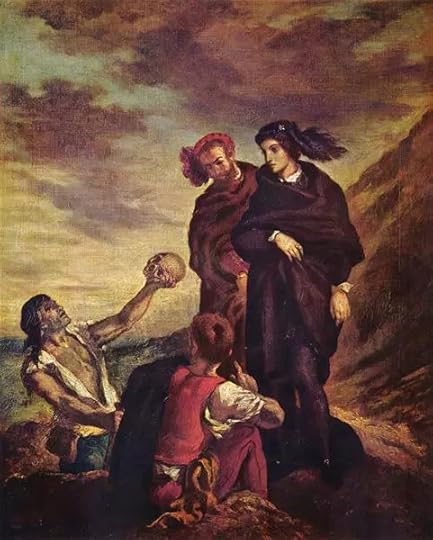
There are various troubling inconsistencies in the time frame (obviously, far less obvious in performance) . We are unsure how long it is since the death of King Hamlet, and how long it is since Claudius married his widow. It seems odd when near the beginning, Hamlet’s great ally Horatio says that he has come to the court from university for the funeral. Yet, this is presumably some weeks later, and yet he has not only not returned to Wittenberg, but Hamlet has seemingly not met him. Perhaps he is too self-effacing to call on the Prince.
This is a minor defect, though even so important a detail as Hamlet’s age is contradicted in the text, though he is often referred to as youthful. And certainly, his attitude of thunderstruck amazement and horror towards Gertrude’s remarriage – before he knows of the murder, that is – makes more sense in a youth in his mid teens than in a man. Of course it is also true that by the standards of Shakespeare’s time, Gertrude’s remarriage to her former brother-in-law is incestuous.
Of course, it is hardly surprising that there are inconsistencies in Shakespeare’s timing and the lines given to various characters, given that there are no definitive texts for any of his plays, only various prompt copies possessed by theatre employees that comprise various ‘folios’ which frequently contradict each other. There may well be missing lines for all the characters which might go a long way to solve the difficulties and inconsistencies to be found in his plots and his characters.
Yet, it is also possible that the missing lines may not explain anything about the motivation of Shakespeare’s creations, for the reasons mentioned above.
To me, the most disturbing thing about this play is the potential happiness lost between Ophelia and Hamlet. In being drawn into the plot of her father Polonius and the King, Ophelia becomes suspect to Hamlet as a spy. He rants wildly at her about women’s sluttish ways and denies he ever said he loved her, despite the passionate notes he has previously sent her.
Later, Polonius is spying behind the arras again when Gertrude and Hamlet have their supposedly private confrontation, and mistaking him for Claudius, Hamlet, who before then has rebuked himself for his delay in carrying out his killing, immediatly stabs him to death.
[image error]
After this, and Hamlet’s subsequent banishment (which he seems to accept despite the fact that it greatly reduces his chance to avenge his father by killing his uncle) Ophelia runs mad and sings about desire and betrayal:
‘Tomorrow is St. Valentine’s day,
All in the morning betime,
And I a maid at your window
To be your Valentine.
Then he up and donned his clothes,
And dupped the chamber door;
Let in the maid, that out a maid
Never departed more.
By Gis and by St. Charity,
Alack and fie for shame!
Young men will do’t if they come to’t,
By Cock, they are to blame.
Quoth she, ‘Before you tumbled me
You promised me to wed.
He answers:
“So would I ha done, by yonder sun,
An thou hast not come to my bed.’
Finally Ophelia falls into a river and drowns.
Hamlet returns to Denmark to witness her funeral. Here, when her brother in his anguish leaps into her grave, her estranged lover (in the old sense) rushes forward, and claims that he loved her more than ‘Forty Thousand Brothers’. He and the outraged Laertes wrestle in the poor girl’s grave.
[image error]
King Claudius sees a way of disposing of his troublesome nephew and heir by exploiting Laertes’ vengeful fury and arranging a duel, with a poisoned sword tip.
By the end of the play, not only Polonius and Ophelia, but Rosencrantz and Guildenstern, Gertrude, Claudius and Hamlet are all dead.
Horatio would like to follow his friend, but Hamlet pleads with him to stay alive to clear his name.
At the end of ‘King Lear’, though the slaughter and waste caused by injustice and selfish ambition has been similarly tragic, I felt that Edgar’s final speech offered a sense of optimism for the future. But despite the youthful energy of Fortinbras as the new ruler, I didn’t have that sense of optimism with Hamlet. I felt, above everything, a sense of weary sadness.
There is a stark grandeur to the story, as in all of Shakespeare’s tragedies. Still, when the play closes, leaving Polonious, Ophelia, Rosencrantz, Guildenstern, Gertrude, Laertes, Claudius and Hamlet dead from the chain of events set in motion by late king’s plea from purgatory to be avenged on his murderer brother, I felt a sense of great futility and a senseless waste of lives.
The demand of the murdered King from purgatory, that his son avenge his murder, has led to this grim scene. Was vengeance for his murder and betrayal by his brother worth this price? I can’t feel that it was.
Critics notoriously argue that there are severe problems with a traditional, pagan revenge drama being set within the Christian era. as I say, my reaction at the end was different from the feeling of carthasis I had on finishing ‘King Lear’.
Yet, perhaps this weary sadness is exactly the effect for which Shakespeare was aiming. This play certainly should be read by those with a vengeful disposition – I am sometimes guilty of that myself – just as ‘King Lear’ should equally be read by those whose judgement is weakened by flattery. That is a fault we all no doubt share.