
Michael Matthews's Blog, page 122
May 21, 2014
MFL Podcast 13: Scott Herman on how to succeed in the fitness industry
In this podcast, I interview Scott Herman and we talk about the key lessons he’s learned about succeeding in the fitness industry.
He started as an ordinary guy pursuing a modeling and actor career and is now a YouTube sensation, BSN sponsored athlete, and successful entrepreneur, so we can all learn something!
You can also find this podcast in iTunes and the Windows Phone Podcasts Store:


What did you think of the podcast? Have any requests or suggestions? Let me know in the comments below!


May 20, 2014
Are You Crazy Enough to Make Things Happen?
You want to make something happen. More money. More muscle. A more meaningful life.
If you’re to have any hope of arriving at your goal, you first need to get into the right mindset. Only then can correct actions follow.
And the mindset you want to cultivate is not one of “reasonable expectations” or Zen-like tranquility. It’s one of craziness. Of genuine desperation.
The great Samurai general Lord Naoshige, whose story and sayings are found in the timeless Hagakure, put it simply:
“The Way of the Samurai is in desperateness. Ten men or more cannot kill such a man. Common sense will not accomplish great things. Simply become insane and desperate.”
Only a crazy person is audacious enough to brave the many obstacles that lie in the way of achievement. Only a truly desperate person can defeat the people that fight back–that don’t want to give up any territory to the new kid on the block.
Lord Naoshige’s words are just as true today as they were 400 years ago.
Modern “common sense” says that you shouldn’t work too hard. That you shouldn’t become too obsessed with a goal. That you should release yourself from the burdens of desire and pursuit and just be thankful for what you have.
These philosophies are quickly embraced by the more “well-adjusted” members of society. You know, the “normal” folk that are, on average, 23 pounds overweight, that watch 34 hours of TV per week, and that have over $100,000 in debt and less than $4,000 in savings.
Well, call me boorish, but I’m not really interested in their advice. Those types of platitudes don’t sound like common sense to me. They sound like admissions of defeat. Justifications for weakness.
I’m of the mind that life is meant to be lived. That it’s an action, not a state of mind. And if we’re going to get into action, we’d better be going somewhere worthwhile. And that only the crazy ones actually make it to the places worth visiting.
What’s crazy?
Crazy is working twice as much as everyone you know. Crazy is waking up at the crack of dawn to get in your workouts. Crazy is practicing that skill for thousands of hours. It’s pursuing that goal that others don’t believe in and taking risks they can’t face.
What’s desperation?
Napoleon said that “death is nothing, but to live defeated is to die every day.” That’s desperation. It’s the feeling that you must not be beaten. That everything is on the line. That only an “all-in” commitment is appropriate and that the only excuse for failure is simply a failure of will.
So, what would you like to make happen? Well, what are you waiting for? The clock is ticking. To quote from the Hagakure again:
“Death seems a long way off. Is this not shallow thinking? It is worthless and is only a joke within a dream…. Insofar as death is always at one’s door, one should make sufficient effort and act quickly.”
It’s time to decide. Are you crazy enough to make things happen? Are you desperate enough to see them through?
Do you agree it takes a bit of craziness to make things happen? Have anything else you’d like to share? Let me know in the comments below!
If you liked this article, then you’ll love this book…If you’d like to know what some of history’s greatest thinkers and achievers can teach you about awakening your inner genius, and how to find, follow, and fulfill your journey to greatness, then you want to read this book today.
(I wrote this book under a pen name simply because I want to keep it, and future books of mine that will have nothing to do with health and fitness, completely separate from my main line of work. But I can still promote it! )
Read this book today and discover what it really takes to find and follow your bliss, and how to use the lessons passed down to us by some of history’s greatest geniuses to systematically rise to top of your fields, activities, and endeavors.
Buy Now
Amazon
Amazon UK
Amazon AU
Amazon CA
Audible Audiobook
BN
iBooks
iBooks Audiobook
Kobo
Google Play
May 19, 2014
Why a Gluten-Free Diet Is Unnecessary and Even Unhealthy
The gluten-free diet is one of the hottest trends right now, and it’s growing into a pretty impressive money-making machine.
In fact, thanks to a perfect storm of mainstream anti-carbohydrate and anti-wheat propaganda and adoration of the Paleo diet, gluten-free dieting seems to be on its way to becoming the next major blockbuster hit.
But when you can buy gluten-free cupcakes, cookies, and even beer, and when just about every mainstream health and fitness magazine is telling us to avoid gluten as if our lives depended on it (in fact that’s what we’re told, in many cases), skepticism is warranted.
And in this case, the skepticism turns into indignation when you look at the facts and realize that the gluten-free trend is, for the most part, just another marketing ploy to make people think they’re reaping health and fitness benefits that simply don’t exist.
Let’s get to it.
What is Gluten, Anyway?
Let’s ask some gluten-free folk!
Lol. Anyway…
Gluten (Latin for glue) is a naturally occurring protein found in wheat products and related species of grains like barley, rye, and spelt. It’s the substance that makes dough resilient and stretchy and it’s also often used as a thickening agent in other foods.
It sounds pretty harmless, right? Well, there’s more the story…
Gluten Causes Celiac Disease in a Very Small Number of People
Gluten is actually comprised of two proteins–gliadin and glutenin. Gliadin molecules aren’t degraded by heat or digestion and when they’re absorbed by the small intestines, they can provoke an autoimmune response in some people.
When this happens, the symptoms felt when gluten is eaten are usually gastrointestinal–bloating, flatulence, and diarrhea, sometimes with smelly stools–but they can also include headache, muscle pain, fatigue, and others. This is because there are some pretty nasty things happening in the body:
Damage to the villi of the small intestine, which are tiny, finger-like projections that line it and absorb nutrients
The autoimmune response flattens the villi and makes them unable to properly absorb nutrients from the food passing by. This damage can remain for many years after gluten is completely eliminated from the diet, resulting in lingering gut inflammation and long-term micronutrient deficiencies.
Inflammation in the gut, which, over time, dramatically increases the risk of disease and even death
In those genetically predisposed to it, the autoimmune problem with gliadin starts as an intolerance but, if the person continues to eat gluten and trigger the autoimmune responses, it eventually turns into a disease known as celiac disease, which is verifiable by the presence of certain antibodies produced in response to gluten and villi damage.
It’s estimated that between .3 and 1.2% of people have celiac disease and many cases go undiagnosed, partially because symptoms can be vague (general fatigue, anxiety, and even other autoimmune disorders, for example) or absent altogether. This is unfortunate because celiac disease is particularly nasty–definitely not something you want to leave untreated, even if it’s currently “silent” (without symptoms).
Now, that’s celiac disease–a rare condition that you probably don’t have. That is, chances gluten doesn’t trigger an all-out war in your gut like it does in celiacs.
What about people that complain about celiac-like symptoms when they eat gluten, though?
You Probably Don’t Have Non-Celiac Gluten Sensitivity
Non-celiac gluten sensitivity is a condition wherein a person experiences celiac-like symptoms when they eat gluten without the antibodies or intestinal damage seen in celiac disease.
There are many “simple” explanations thrown around as to what might be causing the sensitivity, but the research is scant. It’s possible that, in some people with “different” intestinal physiologies (that’s about as specific as we can be at the moment), long-term consumption of gluten can create a gluten sensitivity, but we just don’t know yet.
According to recent research, for every person who has celiac disease, there are probably six or seven people who have a gluten sensitivity, which sounds like a lot, but is only somewhere between 3 and 7% of all people. So chances are you don’t have non-celiac gluten sensitivity, either…even if you think you do.
Further muddying the water is the “nocebo” effect, which is the opposite of the placebo effect: a harmless substance causes harm when taken.
A well-designed study conducted by Monash University and published in 2013 found that in people with self-reported non-celiac gluten sensitivity, gluten only caused negative symptoms when subjects knew they were eating it. When they thought it was something else, they experienced no symptoms.
Furthermore, subjects’ gastroistestinal issues were not improved by reducing the amount of gluten in their diets, but were improved by reducing the amount of fermentable, poorly absorbed, short-chain carbohydrates (FODMAPs) like grains, beans, dairy, and even some fruits.
These findings are in line with other research that indicates that what many people think is a gluten sensitivity is actually a reaction to FODMAPs. That is, it’s not the gluten that causes the issues for these people, but these specific types of carbohydrates that aren’t absorbed by the small intestine and pass into the large intestine, are fermented by bacteria, and create gas, bloating, and discomfort.
In more extreme cases, such as constipation, headache, fatigue, and lethargy, the symptoms often stem from irritable bowel syndrome, not a gluten sensitivity.
So, the bottom line is your body probably deals with gluten just fine, and if you think it doesn’t due to symptoms experienced after eating gluten-containing products, it’s probably not the gluten causing the issues.
That said, if certain gluten-containing foods like wheat and other grains don’t sit well with you–if they give you a stomach ache or diarrhea, make you bloated, gassy or fatigued, etc.–then it makes sense to avoid them, regardless of what’s exactly causing the reaction.
Should We Eat All the Gluten We Want, Then?
If you’re like me and eating gluten doesn’t cause any negative reactions in your body, there’s no reason to follow a gluten-free diet. That said, I still think it’s a good idea to generally keep gluten intake low. Why?
Well, research has demonstrated that, over time, diets high in gluten can cause mucosal changes and damage to intestinal cells in non-celiac people. These effects may be limited to people with certain genetic predispositions and thus not a general problem, but more research is needed to really know.
What we do know is that it may be related to a protein known as zonulin, which controls the opening and closing of the “gates” of the small intestine, allowing certain molecules to pass into the blood while prevent others.
Research has shown that gliadin causes zonulin levels to rise in both celiac and non-celiac people, which means more gliadin proteins get into the blood (as well as other macromolecules that shouldn’t be there). It’s possible that chronically elevated zonulin levels caused by high, regular gluten intake could cause these gates to become dysfunctional, which may be involved in the development of autoimmunity.
Again, this may only become a problem in people genetically predisposed to it, but we just don’t know yet.
So, considering all that, I’d rather play it safe by following a relatively low-gluten diet, which for me is a few gluten-containing meals per week.
I’m sure I could eat more gluten and be fine, but I don’t really have a reason to eat it daily. I’m just not that big of a fan of grains. If I were, though, I would mainly stick to gluten-free options like buckwheat, corn, oats, quinoa, and rice.
A Gluten-Free Diet Isn’t Necessarily a Healthy One
“Gluten-free” is quickly becoming synonymous with “healthy,” and this is simply marketing bullshit.
The reality is a gluten-free diet offers no special health benefits, and ironically, many gluten-free foods are less nutritious, tend to be higher in carbohydrates and fat and lower in protein, and lower in fiber than their gluten-containing counterparts.
This is part of the reason why research has found that people with celiac disease following a gluten-free diet often have micronutrient deficiencies–like a vegan or vegetarian diet, the gluten-free diet just comes with nutritional “blind spots” that must be knowingly compensated for.
Oh and another fun tidbit? Gluten-free foods are, on average, about 242% more expensive than their gluten-containing counterparts. Being unhealthy has never been so pricey!
A Gluten-Free Diet Won’t Help You Lose Weight
The biggest pieces of gluten-free marketing bullshit are the claims about how it will help you lose weight, usually by “unclogging” your body (whatever the hell that means).
Gluten-free dieting does not exempt you from the laws of energy balance, which dictate weight loss and gain. (Click here to tweet this!)
You can get plenty fat on a gluten-free diet, and ironically, the lower fiber content can make it even easier to overeat (fiber induces satiety). In fact, one study found that after 2 years of gluten-free dieting, 81% of celiac disease patients had gained weight and 82% that were already overweight gained additional weight (which is important because these weren’t underweight people coming into a healthy weight). Another similarly designed study found that 27% of initially overweight celiac disease patients gained weight on a gluten-free diet.
The bottom line is you want to lose weight efficiently and effortlessly, you’re going to have to plan or count calories correctly. Simply eliminating gluten or carbohydrates or any other nutritional bogeyman won’t cut it.
What are your thoughts on the gluten-free diet? Have anything else to share? Let me know in the comments below!
How to get lean and build serious muscle and strength, faster than you ever thought possible…
Depending on how you eat, train, and rest, building muscle and losing fat can be incredibly easy or incredibly hard. Unfortunately, most people make many different mistakes that leave them stuck in a rut.
And that’s why I wrote Bigger Leaner Stronger for men, and Thinner Leaner Stronger for women: they lay out EVERYTHING you need to know about diet and training to build muscle and lose fat effectively…
Buy Now
Amazon
Amazon UK
Amazon AU
Amazon CA
Audible Audiobook
BN
iBooks
iBooks Audiobook
Kobo
Google Play
Buy Now
Amazon
Amazon UK
Amazon AU
Amazon CA
Audible Audiobook
BN
iBooks
iBooks Audiobook
Kobo
Google Play
May 17, 2014
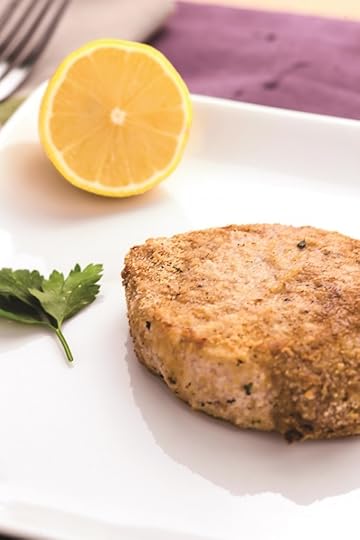
Recipe of the Week: Breaded Parmesan Pork Chop
Pork is a great alternative to chicken–it’s lean and can be prepared in many different ways.
This simple recipe is from my bestselling cookbook The Shredded Chef is one of my favorites–it requires basically no prep and because it’s baked, it has that wonderful moistness and crunchy exterior. It goes great with a side like this baked potato.
Enjoy!
Servings
4
Calories Per Serving
246
Protein Per Serving
41 grams
Carbohydrates Per Serving
9 grams
Fat Per Serving
5 grams
Ingredients
4 boneless pork chops, 1/2 inch thick, trimmed of fat (6 ounces each)
1/4 cup skim milk
1/4 cup fat-free Parmesan cheese, grated
1/4 cup seasoned bread crumbs
1/4 teaspoon salt
1/8 teaspoon pepper
1/4 teaspoon garlic powder
Instructions
Preheat the oven to 375°F.
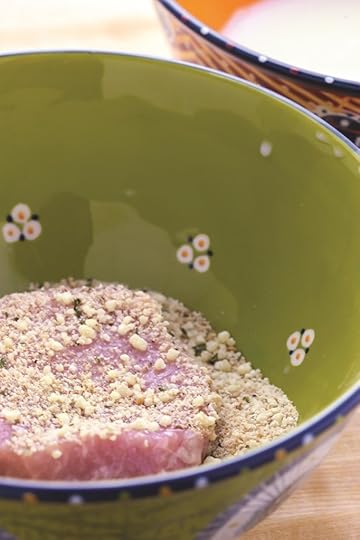
Set up the milk in one bowl and the cheese, bread crumbs, salt, pepper, and garlic powder in another. Dunk the pork chops in the milk, then coat in the bread crumb mixture.
Coat a baking sheet in cooking spray and transfer breaded chops to the sheet. Place in oven and bake for 9 – 11 minutes on each side, or until they reach desired level of doneness
What You Get to Eat
What did you think of this week’s recipe? Let me know in the comments below!
Want more delicious, easy-to-make recipes like this?If you like this recipe, then you’ll love the bestselling cookbook it came from! My own The Shredded Chef!
In this book you’ll find 120 healthy, flavorful recipes specifically designed for athletes that want to build muscle or lose fat. Regardless of your fitness goals, this book has got you covered.
Buy this book now to forever escape the dreadful experience of “dieting” and learn how to cook nutritious, delicious meals that make building muscle and burning fat easy and enjoyable!
Buy Now
Amazon
Amazon UK
Amazon AU
Amazon CA
BN
iBooks
Kobo
Google Play
Vegan and vegetarian dishes are great sources of micronutrients, and even if you’re a meat eater, they’re great for changing things up in your meal plan.
And in my cookbook, Eat Green Get Lean, you’ll find 100 of my favorite vegetarian and vegan dishes, carefully balanced for our high-protein, healthy needs!
Buy this book now to forever escape the dreadful experience of “dieting” and learn how to cook nutritious, delicious vegetarian and vegan meals that make building muscle and burning fat easy and enjoyable!
Buy Now
Amazon
Amazon UK
Amazon AU
Amazon CA
BN
iBooks
Kobo
Google Play

May 16, 2014
Cool Stuff of the Week: Rehband Knee Sleeves, The Mac + Cheese Cookbook, Casablanca, and More…
I’m not ashamed to admit that I’m kind of a sucker for cool stuff. I like nifty gadgets, quirky decoration pieces, nice clothes (and shoes!), good books, and fun games.
In this series of weekly posts, I share whatever currently has my fancy. Maybe some of it will catch yours as well! (Oh and in case you’re wondering, while I do participate in Amazon’s affiliate program, I’m not paid to promote anything.)
VIDEO OF THE WEEK:
AROUND THE WORLD IN 360 DEGREES – 3 YEAR EPIC SELFIE
Damn, what an adventure!
REZVANI BEAST

I’ve never heard of Rezvani, but their Beast is pretty damn impressive.
Part race car and part daily driver, the Beast features a carbon fiber body designed by Samir Sadikhov, who previously created both the Aston Martin DBC and Ferrari Xerzi, as well as 19 inch wheels and aggressively slender headlights.
It comes in two flavors: the 300 model, which starts at $120,000 and packs a turbocharged 2.0L engine pumping out 315bhp and a 0-60 time of 2.9 seconds, or the 500, which starts at $140,000 and is powered by a supercharged 2.4L engine cranking out 500 bhp and a 0-60 time of just 2.7 seconds.
REHBAND KNEE SLEEVE
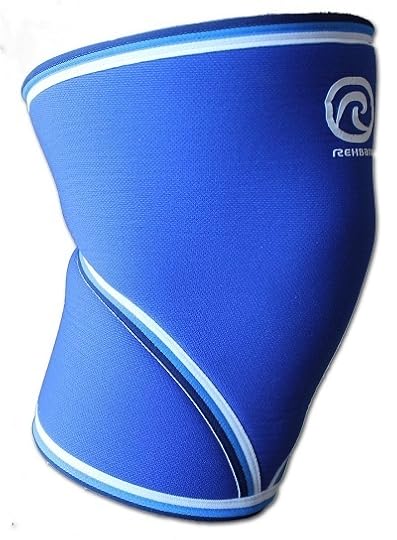
I’ve stayed away from knee wraps because research has shown they increase wear and tear in your knee joints, and recently I looked into knee sleeves and was pleasantly surprised.
Unlike knee wraps, knee sleeves don’t exert nearly as much compression as wraps while providing some joint support and heat retention (warmer tendons and ligaments can stretch easier), which has been shown to reduce knee joint pain and stiffness in people with knee osteoarthritis.
I don’t have any knee problems, but I’ve definitely noticed that my heavy squats and deadlifts have gotten a bit more comfortable since using the sleeves, mainly due to the knee tendons and ligaments staying warm in between sets and the light compression giving support while actually performing the exercises.
Buy Now
Amazon
Amazon UK
STAR WARS LIGHTSABER UMBRELLA

If you like Star Wars and dislike getting rained on, this is for you. And you’ll be happy to know that it’s actually a high-quality piece: it’s sturdy, the canopy is big enough for two people, and the lightsaber is surprisingly well detailed.
Buy Now
Amazon
Amazon UK
LOGITECH CASE+
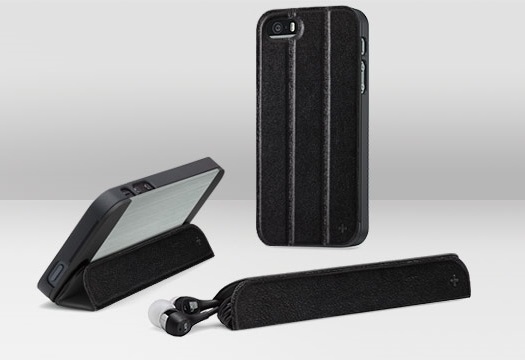
Logitech claims that this is the only iPhone case you’ll ever need, and they make a solid argument. The Case+ not only looks sleek, it’s the most versatile iPhone case I’ve seen:
The back folds into a little stand
The +Drive accessory allows you to mount it to your car dash or windshield
The +Wallet attaches to the back and holds your cash and cards
The +Energy attachment provides you with hours of more battery life
Buy Now
Logitech
BOOK OF THE WEEK:
THE MAC + CHEESE COOKBOOK: 50 SIMPLE RECIPES FROM HOMEROOM, AMERICA’S FAVORITE MAC AND CHEESE RESTAURANT
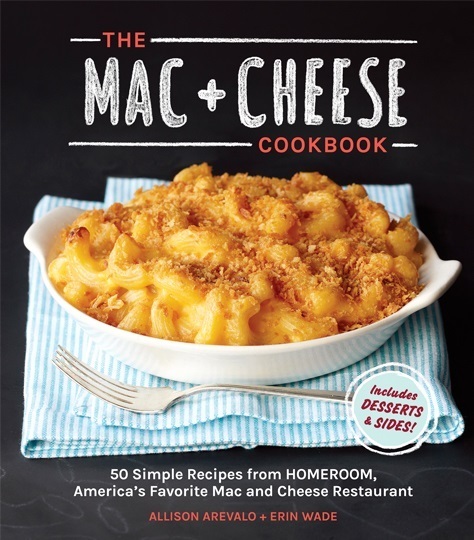
When a restaurant serves nothing but mac and cheese and becomes famous for its incredible recipes, you know it must be good. Well, Homeroom is that restaurant, and their recipes really are exceptional.
Inside you’ll find traditional recipes we all know and love like the Vermont White Cheddar mac and Truffle Mac, but venture into the international section and you’ll find quirky but delightful dishes like Sriracha Mac, Shepherd’s Mac, and even a dessert version that tastes like peanut butter pie.
MOVIE OF THE WEEK:
CASABLANCA

For me, the older a movie is the better the chances are that I’m not going to like it. In many cases, the acting is cheesy, the plot is outlandish or predictable, and the production values are understandably pretty poor by today’s standards.
Casablanca isn’t one of those movies, though. There’s a reason this 1943 film was nominated for eight Oscars and won three (Best Picture, Best Director, Best Screenplay): its characters, plot, and themes are timeless and remain powerful and moving even today, 70 years after its release.
This movie has a bit of everything: comedy, drama, suspense, romance, and even music. The characters are memorable, the plot is perfectly structured and paced, and the dialogue is witty and ahead of its time. Simply put, this is one of those movies everyone should see.
Buy Now
Amazon
Amazon UK
Watch now
Amazon US Instant VideoAmazon UK Instant Video
What do you think of this week’s picks? Have anything you’d like to share? Let me know in the comments below!
May 15, 2014
7 Healthy Lunches for Work That You Can Even Enjoy Cold
Lunch is the bane of many people trying to follow a proper meal plan (especially those working at losing fat), and particularly for those that are on the go.
Restaurant food poses the problem of never really knowing how many calories are in the meal, and many DIY options are less-than-exciting.
Well, in this article I want to give you 7 healthy lunch recipes that you can prepare in your spare time and then stash in a container and keep in the break room fridge if you’re at an office or a meal bag like this from 6 Pack Fitness if you’re on the go.
The first week or two it could feel tough to get the habit going, but once this becomes routine, the feeling of having a healthy lunch on hand instead of zipping through the drive-thru to wolf down a greasy burger and fries in your car will be worth the effort you put into the preparation.
Cottage Cheese & Blackberries on a Bagel
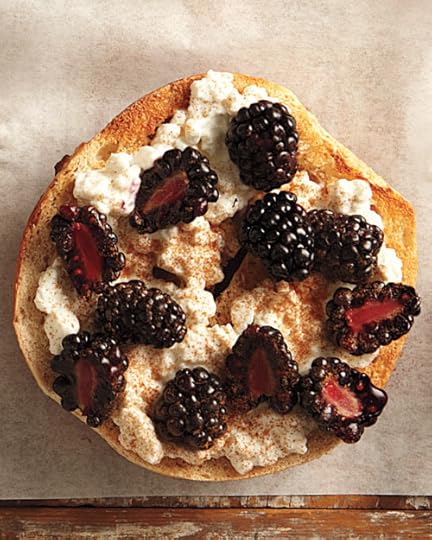
Picture courtesy of Whole Living
Looking for a simple way to get more protein in your diet? Cottage cheese is in any top ten list of sources of whole food proteins, but not everyone enjoys eating it with a spoon.
Add a bagel and berries in the mix, however, and it’s hard not to like the creamy soft cheese. To further mask the flavor, make this a grown-up version of PB&J by spreading on a tablespoon of roasted almond butter before adding the cottage cheese.
Serves 1
Ingredients
1/2 whole-wheat bagel
1/4 cup low-fat cottage cheese
1/3 cup blackberries
Dash of cinnamon
1 tsp. honey (optional)
Instructions
1. Toast one half of a whole-wheat bagel.
2. Top with cottage cheese and blackberries.
3. Finish with a drizzle of honey and dash of cinnamon.
Nutrition Facts (Per Serving)
Calories: 201
Protein: 13 grams
Carbs: 32 grams
Fat: 2 grams
Ginger Pork Lettuce Wrap
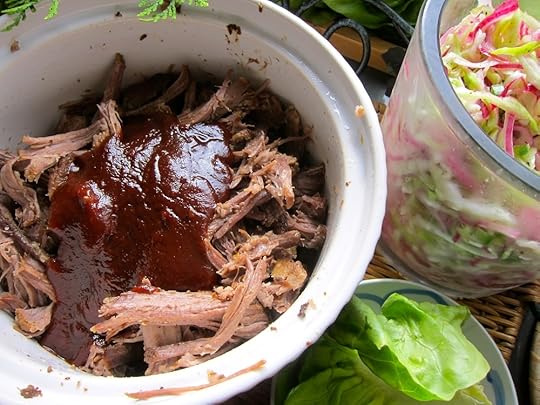
Picture courtesy of Jittery Cook
If you make a pound of meat in the crock pot or Dutch oven, you’ll be eating for days. Repurpose some pulled pork for these quick, protein-packed lunches.
The ultimate way to use up leftovers, this recipe is easy to adapt to any veggies or condiments that you have to use in the fridge. No matter how you make them or where you choose to eat them, don’t forget to bring along plenty of sriracha.
Serves 4
Ingredients
8 large Romaine lettuce leaves
1 lb. pulled pork (about 2 cups)
1/2 cup shredded cabbage
1 cup thinly sliced scallions
1/4 cup fresh grated ginger
3 Tbsp. sesame oil
3/4 tsp. soy sauce
1/4 tsp. sherry vinegar
Salt to taste
Instructions
1. Whisk together scallions, ginger, sesame oil, soy sauce, sherry vinegar, and salt. Pack 1/4 of the sauce in a small, airtight container.
2. In a rectangular airtight container, lay out two lettuce leaves, and top with 1/4 cup of the shredded pork and 1/8 cup cabbage. Cover, and keep in the refrigerator until ready to go. Now you have a lunch ready for one!
3. Repeat for three more servings, or store the rest in the fridge until ready to assemble.
Nutrition Facts (Per Serving)
Calories: 403
Protein: 30 grams
Carbs: 11 grams
Fat: 27 grams
Quinoa Salad with Kale, Feta, Chickpeas & Lemon

Picture courtesy of Kalyn’s Kitchen
This cold salad is delicious on its own, but it also makes a great side dish for leftover chicken. Slice up grilled or baked chicken breast, and place it on top of the to-go bowl for a super satisfying lunch.
Serves 4
Ingredients
Salad:
4 oz. quinoa (about 2/3 cup dry)
4 cups fresh kale, chopped
1 tsp. extra virgin olive oil
1 can garbanzo beans, rinsed
1/2 small red onion, finely diced
3/4 cup crumbled feta
Dressing:
Juice and zest of one lemon
2 Tbsp. white balsamic vinegar (or white wine vinegar)
1 tsp. ground cumin
Salt and pepper to taste
1/4 cup extra virgin olive oil
Instructions
1. Rinse the quinoa under cold water for about 2 minutes, and drain. Heat a large saucepan over medium heat to briefly toast the quinoa, just until it begins to brown.
2. Add 1 1/2 cups of water to the saucepan, and turn the stove to medium-high. Bring to a boil, cover the pot, and cook quinoa for about 15 minutes. Remove from heat, and let stand – still covered – for 5 minutes until all liquid has been absorbed. Fluff quinoa with a fork, and set aside.
3. Heat 1 tsp. olive oil in a large skillet over medium-high heat, and add the chopped kale to the pan. After a minute, flip, and continue cooking for another minute. It will be finished when just starting to wilt; at that time, move it to a large bowl.
4. Blend all salad dressing ingredients together, or shake to combine in a covered container (such as a mason jar).
5. Add garbanzo beans, red onion, and feta to the bowl with the kale. Drizzle the dressing over the top, and mix well to coat.
Nutrition Facts (Per Serving)
Calories: 440
Protein: 14 grams
Carbs: 46 grams
Fat: 22 grams
Roasted Strawberry Rhubarb Yogurt Parfait
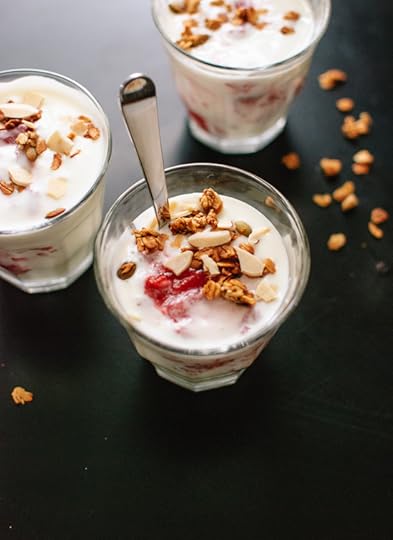
Picture courtesy of Cookie + Kate
Stop before you peel back the top of that fruit-on-the-bottom yogurt. Chances are it’s loaded with carbs. If you want to enjoy yogurt, it’s better make your own parfait and control the amount of sweetener (and thus calories) added.
Yogurt can be dressed up in countless ways, but this simple mix of spring flavors is perfect this time of year. If you need a more filling lunch or snack, bring a baggie of your favorite granola to mix in.
Serves 6
Ingredients
32 oz. nonfat plain Greek yogurt
3 scoops unflavored whey isolate
1 lb. strawberries, diced small
1 lb. rhubarb (about 4 stalks), cut into 1/4” wide pieces
1/4 cup raw honey
Juice of one lemon (2 Tbsp.)
Instructions
1. Preheat the oven to 350°F. Line a baking sheet with parchment paper.
2. Spread the strawberry and rhubarb slices onto the baking sheet, and coat with honey. Bake for 10 minutes, toss to turn, and continue cooking for another 10 to 15 minutes until the pieces are tender.
3. In a medium bowl, mix the strawberries, rhubarb, and lemon juice. Let cool.
4. In a separate bowl, blend together the Greek yogurt and whey protein.
5. Layer the yogurt and fruit together in a portable dish. Cover, and keep in the fridge until ready to take your parfait on the go.
Nutrition Facts (Per Serving)
Calories: 211
Protein: 21 grams
Carbs: 35 grams
Fat: 1 gram
Turkey Meatloaf Muffins
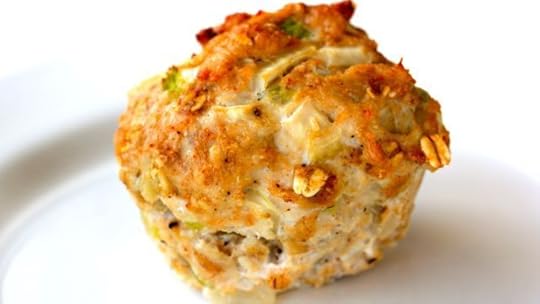
Picture courtesy of Clean & Delicious
These portable meals are full of everything you need midday: ground turkey, egg whites, oats and a little celery for good measure.
If you want to keep lunch simple (and don’t get bored easily), pack two, and you’re good to go. Or, these are great to pair with your favorite snack: a handful of nuts, baby carrots, roasted pumpkin seeds, a side salad, or one ounce of cheese.
Serves 12
Ingredients
2 lbs. ground turkey
3 egg whites
1 cup quick-cooking oats
1/2 tsp. ground cumin
1/2 tsp. dried thyme
2 tsp. ground mustard seeds
2 tsp. black pepper
2 tsp. chipotle pepper
1 tsp. salt
2 Tbsp. garlic powder
1 yellow onion, diced
2 celery stalks, diced
Instructions
1. Preheat the oven to 375°F. Then, either place foil liners in a standard 12-cup muffin pan, or spray with olive oil.
2. In a large bowl, mix all ingredients together using clean hands. Roll the mixture into balls about 2” in diameter, and put each one in a muffin liner.
3. Bake for about a half hour, until the muffins are cooked through and beginning to brown on top.
Nutrition Facts (Per Serving)
Calories: 121
Protein: 20 grams
Carbs: 6 grams
Fat: 2 grams
Prosciutto & Peas Pasta Salad
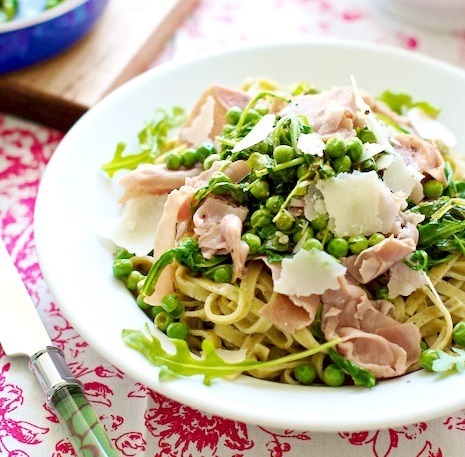
Picture courtesy of Family Fresh Cooking
This dish looks downright fancy, but the hardest thing about making it is cooking the pasta!
It isn’t even difficult to shop for because it requires less than 10 ingredients – and that includes olive oil, salt, pepper, and pasta, which are staples found in any pantry. You can spoil yourself by making this pasta salad for a week of to-go lunches, but you should also keep this make-ahead recipe on hand for when you’re entertaining guests.
Serves 4
Ingredients
4 oz. whole wheat pasta
2 tsp. extra virgin olive oil (garlic-infused, if possible)
3 oz. prosciutto
3 oz. baby peas
1/2 cup arugula
Juice of one lemon (2 Tbsp.)
Sea salt and cracked black pepper, to taste
2 oz. hard cheese shavings, such as Pecorino Romano
Instructions
1. Boil a large pot of salted water, and cook the pasta according to the time on the box. Drain, and set aside.
2. Trim the edges of the prosciutto to remove visible fat, and chop roughly into bite-size pieces.
3. Pour 1 tsp. olive oil into a large skillet, and place over medium-high heat. Cook arugula for a minute or two until the leaves barely begin to wilt. Add the peas and prosciutto until heated through.
4. With the pan off the burner, add the pasta to the pan, and drizzle with remaining oil. Toss with lemon juice, salt, and pepper.
5. Before serving or packing for lunch, garnish with shaved cheese.
Nutrition Facts (Per Serving)
Calories: 228
Protein: 13 grams
Carbs: 23 grams
Fat: 9 grams
Asian Noodle Salad with Baked Tofu
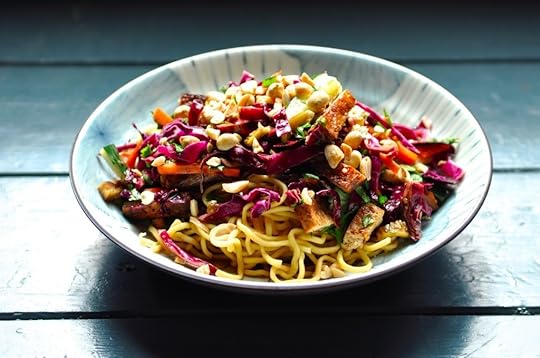
Picture courtesy of Two Blue Lemons
Although this delicious salad can be enjoyed immediately, when the noodles and tofu are slightly warm, it is best after the flavors marry in the fridge overnight – making it perfect for tomorrow’s lunch!
Picky brown bag lunchers might feel the need to pack up the tofu, dressing, and salad separately, but that’s not worth the trouble with this recipe.
Serves 4
Ingredients
Baked Tofu:
16 oz. extra-firm tofu
3 Tbsp. honey
5 Tbsp. soy sauce
1 garlic clove, grated or crushed
1 tsp. fresh ginger, grated
2 Tbsp. rice vinegar
Salad:
1 lb. fresh egg noodles
1/2 cup rice vinegar
3 Tbsp. coconut sugar (or agave)
3 Tbsp. soy sauce
3 garlic cloves, grated or crushed
1/8 tsp. red chili flakes
1 1/2 cups purple cabbage, sliced
1 1/2 cups carrots, thinly sliced or shaved
1 1/2 cups cucumber, thinly sliced or shaved
1 cup cilantro, chopped
1/2 cup roasted peanuts, chopped
Instructions
1. Preheat the oven to 350°F. Place the block of tofu on a baking sheet, and press it with a heavy pot or cast iron skillet to squeeze out the liquid. After 15 to 30 minutes, cube the tofu.
2. Mix up the marinade by whisking together the honey, soy sauce, single garlic clove, grated ginger root, and 2 Tbsp. rice vinegar. Add the tofu to the bowl, and let sit for 10 to 15 minutes. Shake off excess liquid as you remove the tofu to lay it on the baking sheet. Bake for 15 minutes, flip, and remove from the oven after another 15 minutes. Slice into thin strips.
3. To make the salad, boil water in a large pot, and cook the noodles according to the time on the box. As they soften, mix the rice vinegar, coconut sugar, soy sauce, garlic, and chili flakes in a small bowl.
4. Drain the noodles, and mix in a large bowl with the cabbage, carrots, and cucumber. Pour half the dressing over the top, and toss gently to coat. Top with baked tofu, fresh cilantro, and peanut pieces.
Nutrition Facts (Per Serving)
Calories: 523
Protein: 25 grams
Carbs: 65 grams
Fat: 18 grams
What do you think of these healthy lunches for work? Have anything else to share? Let me know in the comments below!
Want more delicious, easy-to-make recipes like these?If you like these recipes, then you’ll love my bestselling cookbook The Shredded Chef!
In this book you’ll find 120 healthy, flavorful recipes specifically designed for athletes that want to build muscle or lose fat. Regardless of your fitness goals, this book has got you covered.
Buy this book now to forever escape the dreadful experience of “dieting” and learn how to cook nutritious, delicious meals that make building muscle and burning fat easy and enjoyable!
Buy Now
Amazon
Amazon UK
Amazon AU
Amazon CA
BN
iBooks
Kobo
Google Play
Vegan and vegetarian dishes are great sources of micronutrients, and even if you’re a meat eater, they’re great for changing things up in your meal plan.
And in my cookbook, Eat Green Get Lean, you’ll find 100 of my favorite vegetarian and vegan dishes, carefully balanced for our high-protein, healthy needs!
Buy this book now to forever escape the dreadful experience of “dieting” and learn how to cook nutritious, delicious vegetarian and vegan meals that make building muscle and burning fat easy and enjoyable!
Buy Now
Amazon
Amazon UK
Amazon AU
Amazon CA
BN
iBooks
Kobo
Google Play
May 14, 2014
MFL Podcast #12: Surprising sauna benefits, micronutrients and performance, and more…
In this podcast, I interview Dr. Rhonda Patrick and we talk about…
Some of the many (and surprising!) benefits of the sauna (1:55)
How to use cardio to recover faster from your workouts (28:45)
How micronutrient intake affects performance (macros aren’t EVERYTHING when it comes to getting fit (33:25)
And more…
You can also find this podcast in iTunes and the Windows Phone Podcasts Store:
ARTICLES RELATED TO THIS PODCAST
Why “Clean Eating” Isn’t the Key to Weight Loss or Muscle Growth
Cardio and Muscle Growth: Friends or Foes?
What did you think of the podcast? Have any requests or suggestions? Let me know in the comments below!
May 13, 2014
5 Powerful Habits That Build Your Self-Confidence
Self-confidence: You either have it or you don’t, right?
Wrong.
Self-confidence is a set of habits. To some people, these habits come naturally. To most of us, however, they don’t. The good news is that these habits are things that anyone can pick up, start doing and begin to boost their confidence… provided they apply them rigorously and regularly.
This isn’t stuff that’s going to work for “some other person.” This is stuff that’s going to work for you, starting today as long as you commit to it. This is what I teach men at The Art of Charm about regular habits they can start doing to begin boosting their confidence.
Hit the Gym
As you get older, the gym becomes less and less optional. You need to stay in shape, especially with regard to your muscles.
More than that, there is a proven correlation between hitting the gym and boosting your self-esteem. Regular exercise makes you feel like you’ve accomplished something (you have), makes you look better over time (and won’t that make you feel better about yourself?), decreases anxiety and negative self-talk (the root of a lot of men’s lack of confidence), and introduces you to new people (some of them will be good-looking ladies!).
Perhaps most importantly, regular exercise is a subtle cue to yourself that you can do it. You can make goals and meet them. It changes your mindset and puts inertia in the direction of doing rather than coasting.
If you take one piece of advice listed here, this should be the one.
Meditate
And if you take two, this should be the other one.
Meditation isn’t a hippy dippy thing. It is for the brain what exercise is for the body. In fact, meditating after a rigorous exercise can be one of the most powerful things that you can do for yourself.
It doesn’t have to be complicated. You just throw on some comfortable clothes (or none at all if that’s your steez), find somewhere quiet to sit and…
That’s really what you’re trying to do when you meditate. Especially in the era of 500 channels on cable, constant smartphone connection to the Internet and the background chatter of modern urban life, taking half an hour every day to sit down, shut up and be silent has an incredibly powerful effect on the way that you think.
No longer do your thoughts just happen. No longer do your insecurities control you. You see thoughts for what they are: Things that just float through your brain. Things that you can entertain or dismiss as you will.
Get comfortable with silence and your brain will no longer seek to fill it with everything you want to think about. And, on a related subject…
Master Your Body
You’ve started doing this by hitting the gym. And, your meditation work will have you more aware of your body. But you’ve got to master it. The simplest way to do that is to work on your posture. Here’s how you do it:
Stand in front of a full-length mirror.
Close your eyes.
Picture a rope pulling the top of your head upward.
Picture a magnet underneath the floor pulling your feet downward.
Let the tension pull you into a tall, perfectly straight posture.
Open your eyes to examine your posture.
Work on the little things, like having your head level and your shoulders square.
When you have perfect posture, close your eyes again.
“Scan” your body. Try and remember what it “feels like” to stand like this.
Now you can call on this posture whenever you want. This is just the basic building block to mastery of your body language at all times. Fewer things are going to help you not just grow confidence, but also project confidence in this way.
Take Chances
Confident people get out there and take chances. They do it on the regular. They know that all meaningful change happens outside their comfort zone. They also know that failure is part of the game.
It’s not that you’re never going to fear failure. Quite the contrary. But just like a boxer who has been in 25 bouts doesn’t have the same feeling in the pit of his stomach before a fight that you might have, so too will you become less crippled by your fear of failure.
If you want safety, hang out on the porch. If you want to live a life worth living, you need to get out there and take chances. Feelings of inadequacy often stem from a sense that we could do more than what we’re doing. If you’re the person who’s always going out there, balls out and doing everything he can to make your life the way you want it to be, how are you going to lack confidence?
If you’ve truly done everything that you can, no one can ever judge you negatively. Not even yourself.
Get With a Crew of Confident People
You might have noticed this, but confident people tend to travel in packs. Rarely will you find one guy or gal out there all by themselves being confident.
Do you have friends who are threatened by your confidence? Then it’s time to get new friends. This doesn’t necessarily mean that you need to have some epic schism with people who were once your best friends. It just means that you need to find friends who are as confident as you are.
There’s an old parable about crabs pulling down any one of their own trying to escape from a pot of boiling water. There’s something to this. But more importantly, when you cultivate new habits, it’s best to be around people who have similar habits to help you reinforce them.
Confident people are often committed to general self-improvement. This makes them ideal companions anyway. What’s more, you probably already know people who are either confident or interested in growing their self-confidence in the same way that you are.
Which brings me to a final point: Vulnerability is a luxury of the confident. Think about it: People who are too afraid to ever be vulnerable are those who have zero self-confidence. It’s all just a facade that they’re afraid is going to come crashing down if they let down their guard for even a second.
What does this have to do with getting with a crew of confident people?
It means that you should talk to the friends you already have and trust first. See if they share your interest in self-improvement. Anyone who hears that and craps all over you isn’t a person you need in your life anyway.
What did you think of this take on how to build self-confidence? Have anything else to share? Let me know in the comments below!
Jordan Harbinger is a Wall Street lawyer turned Social Dynamics expert and coach. He is the co-founder of The Art of Charm, a dating and relationships coaching company. If you’re interested in The Art of Charm residential programs, apply for a strategy call with a coach. You can also interact with Jordan on Facebook or Twitter.

May 12, 2014
How to Count Calories Correctly for Effortless Weight Loss
Like carbohydrates and insulin, calorie counting is under heavy attack these days.
According to some “experts,” losing weight and staying lean isn’t about controlling caloric intake, but controlling the types of foods you eat. Certain foods, they say, “clog” your system and create hormone imbalances that lead to weight gain. Others “clear” the system and result in weight loss.
This is like music to millions of people’s ears who have tried and failed at some weight loss regimen that involved counting calories, or who just don’t want to have to worry about planning or tracking anything they eat.
Well, vilifying calorie counting and telling people they can eat even more than ever and still lose weight sells books and pills, but is it scientifically honest and accurate? Absolutely not.
As you’ll soon see, while you don’t have to count calories to lose weight, correctly tracking and counting calories (and macronutrients, as we’ll discuss) is the most surefire, effortless way to go about it.
First Thing’s First: What is a Calorie?
Ironically, most people that have told me “calorie counting doesn’t” work couldn’t actually define the word. All they knew is counting them didn’t help them lose weigh.
Well, to really understand why calorie counting is still the simplest way to lose weight, and how to do it correctly, you need to know a lot more than that. But let’s start with the simple:
A calorie (also known as a kilocalorie or large calorie) is the amount of energy required to heat up one kilogram of water one degree Celsius.
Calories are nothing more than measurements of stored (potential) energy.
The “calorie counts” of various foods is simply letting you know how much potential energy the foods contain, and some foods are more energy dense than others. For instance, a tablespoon of olive oil has about 100 calories’ worth of energy, whereas a tablespoon of protein powder has about 30 calories’ worth of energy.
In case you’re wondering, the calories contained in food are measured with devices known as calorimeters. There are quite a few varieties of calorimeters, but they all operate on the laws of thermodynamics and involve measuring various heat-related properties of food.
The important thing for you to know is that the calorie isn’t some abstract symbol that may or may not have something to do with weight loss–it’s the objective measurement of a very real, scientifically verifiable reality (food contains energy).
What Your Body Does With Calories
After asking people that swear calorie counting doesn’t work what a calorie actually is (and hear their…interesting…definitions), I usually follow that up with another question: What do you think your body does with calories?
Most people just say they don’t know or think it “stores them as fat.” Well, ironically, “it stores them as fat” is actually kind of correct. But there’s a lot more to it than that.
You see, your body requires a certain amount of energy to stay alive. Every cell in your body needs a steady supply of fuel to do its job, and it must ultimately obtain this fuel from the food we eat.
The 24-hour measurement of how much energy your body uses to perform all basic functions related to staying alive (excluding any and all physical activity) is known as your “basal metabolic rate,” or “BMR.”
(Basal means “forming a base; fundamental,” metabolic means related to the metabolism, which is “the physical and chemical processes in an organism by which it produces, maintains, and destroys material substances, and by which it makes energy available.”)
For instance, I’m 29 years old, 6’2, 189 pounds, and about 7% body fat. Per the Katch McArdle formula, my BMR should be about 2,100 calories per day. That’s how much energy my body should burn every day, excluding any physical activity.
I say “should be” because even if your body composition remains the same, BMR isn’t an absolute–the amount of energy your body uses while at rest can increase or decrease based on long-term dietary and exercise patterns (this is known as “metabolic adaptation,” and is a fascinating subject unto itself).
Nevertheless, a formula like the Katch McArdle will predict most people’s BMR’s with a high degree of accuracy accuracy. If you’d like to check yours, use this calculator.
When you then calculate the approximate amount of additional energy you burn through physical activity, you arrive at your “total daily energy expenditure,” or “TDEE.” This is the grand total of energy that your body burns in a 24-hour period, and it too changes from day to day (some days you move more and some days less).
Where, then, does our body get all this energy it needs? There are two sources:
The food you eat.
Its energy stores, mainly in the form of fat and muscle
Earlier I said that the energy must ultimately come from food we eat. This is because the body’s energy stores (fat and muscle) are themselves created from food we eat–our bodies can’t “fill up” (and thus expand) its fat cells or create muscle proteins without being supplied the “raw materials” found in food, like carbohydrates, dietary fats, and amino acids.
Now, if your body has energy available from food you just ate, it doesn’t need to tap into its own energy (fat) stores. This “fed” state wherein the body runs fully on energy from food can last anywhere from 3 – 6+ hours after you eat, depending on the size and composition of the meal.
Something else happens when you eat food as well: fat storage. Why? Because when you eat a meal, you’re giving your body a large amount of energy (calories) in a short period of time–quite a bit more than it will burn during the time you’re eating. (You could eat several hundred calories in a few minutes while your body has only burned no more than 20 or 30.)
What do you think happens with all those extra calories that aren’t burned off? You got it: a large portion are stored as body fat for later use.
And then what happens once the abundance of food energy have been fully absorbed and burned up? What happens when the energy runs out?
Well, the body must then turn to its energy stores to continue running. That is, it must start breaking down body fat and muscle into molecules the cells can use for energy.
In this way, the body is constantly storing and burning fat every day. Every time you eat a meal, your body burns a bit of energy and stores some fat. And every time it finishes burning and storing the energy from the food you ate, it then switches to using fat as cellular fuel. Back and forth the body goes, 24 hours per day.
Even if you grossly overeat for a day, your body still has periods throughout those 24 hours where it runs out of food energy and thus must burn fat. The amount of fat stored that day will be greater than what it burned, though, and voila, net weight gain for the day.
This hints at what we have to do to reduce the amount of body fat we carry: we have to get our body to burn more fat than it stores every day, week, month, year, etc.
How do we do this? Let’s find out.
What Calories Have to Do With Weight Loss and Gain
As you’ve probably guessed by now, by regulating the amount of energy we give our bodies with food, we can induce weight loss and gain.
If we regularly feed our body more energy than it burns, we will gain weight in the form of body fat (the larger the surplus, the more fat we’ll gain and the quicker we’ll gain it). This is known as creating a “calorie surplus.”
On the flip side, if we regularly feed the body less energy than it burns, we will lose fat (the larger the deficit, the more weight we’ll lose and the faster we’ll lose it, but don’t think that severe calorie restriction is a good idea). This is known is creating a “calorie deficit,” and it’s the key to weight loss.
It doesn’t matter if you count your calories or even where those calories come from (professor Mark Haub lost 27 pounds on a diet of protein shakes, Twinkies, Doritos, Oreos, and Little Debbie snacks. If you keep your body in a negative energy balance over time, your total fat mass will go down. Period.
What is actually happening is the amount of fat your body stores from your daily meals is less than the amount of fat it burns when it doesn’t have food energy to live on. This is all weight loss is: fat stored < fat burned, over time.
When it comes to weight loss, it’s only a numbers game. WHAT you eat doesn’t determine whether you lose weight or not…HOW MUCH does.
Weight loss does NOT require you to only eat certain types of food, avoid other types, combine types in various ways, or any other quackery. It only requires that you regularly feed your body less energy than it burns.
Carbs don’t make you fat (eating excess calories does) and yes, some people’s metabolisms are faster than others, and some do better with calorie deficits than others, but all of our bodies come with the same types of physiological machinery.
So, if that’s the truth and it really is that simple, why do many people have trouble losing weight when they count calories or simply think it doesn’t work?
Why Counting Calories Doesn’t (Seem to) Work for Everyone
I’ve helped thousands of people build muscle and lose fat, and here are the simple reasons why some people struggle with counting calories or think it doesn’t work:
1. They hate the idea of having to plan and track what they eat.
These people usually see meal planning or tracking intake with something like My Fitness Pal a psychological burden or have a lifestyle that involves a lot of unplanned meals prepared by others, which are basically impossible to measure in terms of calories.
On the other hand, these people quickly change their minds when they see how effortless weight loss is when you use calorie counting properly (which we’ll get to in a moment)–no hunger, no cravings, and no crossing your fingers, hoping that this is the diet that finally works.
2. They hate the idea of having to restrict their eating in any way.
Some people just have a strange relationship with food and want to eat what they want when they want and don’t want to feel like a “slave” to the oppressive calorie count.
In my experience, these people are harder to change. They will try anything before finally submitting to the master of energy balance–fad diets, cleanses, weight loss pills, etc.–and often choose the stay fat and wait for the next “metabolic miracle” than count a calorie.
3. They don’t stick to the plan and regularly overeat.
This is, of course, all too common. They have a few extra bites at breakfast. A double portion of dressing at lunch. A little unplanned dessert at dinner.
All these “little” portions of extra calories add up and can easily negate the moderate calorie deficit you’re trying to maintain on a daily basis.
The solution is simple: every single thing that goes into your mouth every day is planned or tracked.
4. They cheat like a competitive eater.
I recommend having a moderate cheat meal every week when you’re dieting. It’s a nice psychological boost and, depending on where you’re at in terms of body fat percentage, it can help keep the weight loss going.
Notice I said cheat MEAL, though. And moderate. Not a cheat DAY or an all-out binge meal, because either can undo some or all of a week’s worth of fat loss (super high-fat meals with alcohol are the absolute worst).
So, when you’re cheating, you can end the day a few hundreds calories above your normal daily intake, but don’t go crazy. If you need to, you can even reduce your carbohydrate and fat intake throughout the day to “save up” calories for the larger meal and thus keep your overall intake for the day in a reasonable range.
5. They calculate their total daily energy expenditure incorrectly.
Unfortunately, this is really easy to do because the activity multipliers of scientific formulas commonly used to calculate TDEEs are just too high. This is something most bodybuilders know but most “laymen” don’t.
For instance, I lift weights 5 times per week for about an hour and do about 25 minutes of HIIT cardio 3 to 4 times per week, and according to the activity multipliers for the Katch McArdle, my TDEE should be around 3,300 calories.
That means that I should be able to eat that amount every day and stay exactly the same. But I can’t. If I eat 3,300 calories per day, I get a little fatter each week. My intake needs to be closer to 2,900 per day for me to not gain fat.
So, when you’re calculating your TDEE, I recommend you use the following multipliers (BMR x activity multiplier)
By 1.2 if you exercise 1-3 hours per week.
By 1.35 if you exercise 4-6 hours per week.
By 1.5 if you exercise 6+ hours per week.
Most bodybuilders don’t go above 1.4 unless they’re particularly active outside of the gym.
6. Their metabolisms need to be fixed.
When many people want to lose weight, they dramatically reduce calorie intake and dramatically increase energy output (through many hours of exercise each week). And while this approach will induce weight loss for a bit, it will ultimately fail. Why?
Because your metabolism adapts to the amount of energy you feed your body. Its goal is to balance energy intake with output–to maintain homeostasis.
When you restrict your calories and feed your body less energy than it burns, your metabolism naturally begins slowing down (burning less energy). The more you restrict your calories, the faster and greater the down-regulation.
Eventually the metabolism slows down enough to match intake with output, and weight loss stalls despite the very low-calorie diet and large amount of exercise. This is usually met with further calorie reduction or more exercise, which only results in more metabolic slowdown, and thus a vicious cycle begins.
This process of dramatically and chronically slowing the metabolic rate down is often referred to as metabolic “adaptation” or even “damage,” and fortunately, as I explain in this article, it can be resolved.
6. They are impatient.
Whenever someone writes me complaining about not losing weight, I always ask for the specifics. Are they not losing any weight? For how long? Are you looking leaner? And the answers are almost always long these lines:
“Well I’ve lost about 1 pound per week but shouldn’t I be losing more?” “I haven’t lost weight in the last 4 days,” “I can’t see my abs yet,” etc.
The points is they’re usually making good progress but have unrealistic standards as to what they want to achieve (often fueled by ridiculous, misleading 2- and 3-month transformations featured on big fitness websites).
The bottom line is if you’re losing about 1 pound per 7 to 10 days, you’re doing great. Keep it up. If your weight is more or less the same after 7 to 10 days, however, you simply need to move more or eat less.
7. They focus too much on the scale.
While the scale moving down is clearly a good indicator, it’s not the final word. Especially not if you’re weightlifting for the first time, because this alone will increase your body weight through muscle growth (yes, it’s possible to build muscle and lose fat simultaneously) and additional glycogen and water storage in the muscles.
If people don’t know this, however, they can be baffled as to why their pants are fitting looser and they’re looking leaner yet their weight has remained exactly the same. All that’s happening is the additional muscle-related weight is “replacing” the weight of the fat lost.
Remember that body composition is the real key here–not just weight. We want to see your muscle mass going up and body fat percentage going down, which is more accurately assessed by the mirror and a waist measurement than a scale.
If, however, the scale, mirror, and waist measurements are all staying the same for 7 to 10 days, then it’s time to change something.
These are the most common reasons people fail or feel like they’re failing with counting calories. Avoid these pitfalls and follow the tips below, and you’ll have tremendous success with it and even find it enjoyable.
How to Count Calories Correctly for Effortless Weight Loss
We’ve covered a lot in this article, so I’m going to keep this section short and to the point. Here’s how you count calories correctly for easy and enjoyable weight loss:
1. Commit to exercising at least 3 times per week.
Ideally you would do both resistance training and cardio (high-intensity interval cardio is my favorite for weight loss purposes) as a part of your program.
2. Determine your TDEE properly.
As discussed earlier, this is your BMR times the appropriate activity multiplier.
3. Create a meal plan that you actually enjoy.
One of the worst things about most mainstream diet methodologies is the amount of restrictions placed on what you can eat and when. And the irony is all those rules are bogus and unnecessary.
So long as your daily caloric intake is set correctly, and your macronutrient ratios are right, WHAT you eat isn’t all that important. Dieting is much more a quantitative game (numbers) than a qualitative one (what you eat).
Yes, I do recommend sticking to healthy, nutritious foods, but you can eat plenty of carbs every day, including some sugar (gasp!) if you want, and do just fine.
Check out my article on meal planning to learn exactly how to do this step correctly.
4. Stick to the plan and adjust as needed.
This is where the rubber meets the road. All the previous steps don’t matter unless you actually stick to your meal plan exactly.
You probably will have to resist some temptations.
You should never feel starved, but you might be hungry here and there
You might have to turn down the dessert because you don’t have the calories for it
You might have to eat a bit less of a certain type of food than you’re used to
You might have to push yourself to do your workout even though you’re tired
You get the idea. Weight loss shouldn’t be grueling, but it does take discipline and persistence. But it’s very straightforward. Take the right actions every day, and you will reach your goal.
And in terms of adjusting either activity or food up or down, you play it by ear.
If you’re not any leaner after 7 to 10 days, something is wrong. Intake is too high or activity is too low.
If you’re getting leaner but you’re feeling lethargic and weak in the gym, you’re probably eating too little or moving too much (this can happen easily if you do too much cardio while dieting).
The important thing to know is there’s no reason to panic. It’s not that calorie counting “isn’t working,” it’s just that something is off in terms of energy intake vs. output, and it can be easily fixed.
What are your thoughts on how to count calories correctly? Have anything else to share? Let me know in the comments below!
How to get lean and build serious muscle and strength, faster than you ever thought possible…
Depending on how you eat, train, and rest, building muscle and losing fat can be incredibly easy or incredibly hard. Unfortunately, most people make many different mistakes that leave them stuck in a rut.
And that’s why I wrote Bigger Leaner Stronger for men, and Thinner Leaner Stronger for women: they lay out EVERYTHING you need to know about diet and training to build muscle and lose fat effectively…
Buy Now
Amazon
Amazon UK
Amazon AU
Amazon CA
Audible Audiobook
BN
iBooks
iBooks Audiobook
Kobo
Google Play
Buy Now
Amazon
Amazon UK
Amazon AU
Amazon CA
Audible Audiobook
BN
iBooks
iBooks Audiobook
Kobo
Google Play
May 10, 2014
Recipe of the Week: Pineapple Chicken
You can never have enough good chicken recipes, and pineapple chicken dishes are definitely in my top 10 favorite types.
This recipe is from my bestselling cookbook The Shredded Chef and it’s really tasty. It’s pretty low-calorie as well, which means you can fit it into just about any type of meal plan.
If you have room for more calories and want to make this dish even better, add 1/2 of a cup of coconut milk. Delicious! Enjoy!
Servings
2
Calories Per Serving
342
Protein Per Serving
40 grams
Carbohydrates Per Serving
35 grams
Fat Per Serving
5 grams
Ingredients
2 boneless, skinless chicken breasts (6 ounces each), rinsed, dried, trimmed of fat, and cut into small cubes
1 teaspoon extra-virgin olive oil
1/4 cup sweet onion, finely chopped
pinch of ground black pepper
1 tablespoon orange juice
1 can (8 ounces) pineapple chunks
1 banana, sliced
1 teaspoon maple syrup

Instructions
Put the oil in a pan and cook the onion on medium-high heat. Add the dash of pepper and cook for 1 minute, until the onion is slightly translucent.
Put the chicken, orange juice, and pineapple with juice into the pan. Bring to a boil and reduce to medium heat.
Add the banana and syrup and cook for 1 – 2 minutes.
Stir it up and reduce the heat to low. Cover it and let it simmer for about 5 – 7 minutes, or until chicken is cooked through.
What You Get to Eat

What did you think of this week’s recipe? Let me know in the comments below!
Want more delicious, easy-to-make recipes like this?If you like this recipe, then you’ll love the bestselling cookbook it came from! My own The Shredded Chef!
In this book you’ll find 120 healthy, flavorful recipes specifically designed for athletes that want to build muscle or lose fat. Regardless of your fitness goals, this book has got you covered.
Buy this book now to forever escape the dreadful experience of “dieting” and learn how to cook nutritious, delicious meals that make building muscle and burning fat easy and enjoyable!
Buy Now
Amazon
Amazon UK
Amazon AU
Amazon CA
BN
iBooks
Kobo
Google Play
Vegan and vegetarian dishes are great sources of micronutrients, and even if you’re a meat eater, they’re great for changing things up in your meal plan.
And in my cookbook, Eat Green Get Lean, you’ll find 100 of my favorite vegetarian and vegan dishes, carefully balanced for our high-protein, healthy needs!
Buy this book now to forever escape the dreadful experience of “dieting” and learn how to cook nutritious, delicious vegetarian and vegan meals that make building muscle and burning fat easy and enjoyable!
Buy Now
Amazon
Amazon UK
Amazon AU
Amazon CA
BN
iBooks
Kobo
Google Play


