
Lori Hatcher's Blog: Refresh Blog, page 58
June 25, 2017
You Gotta Serve Somebody
I don’t usually collect spiritual truth from rock music stars, but Bob Dylan got it right when he sang, “Gotta Serve Somebody.”
 Part of the 1979 album by the same name, the hit song explores that, whether we realize it or not, everyone serves something. Dylan’s song resonated with his listeners, climbing to #24 on the Billboard Magazine Hot 100 singles chart and earning him the Grammy Award for Best Rock Vocal Performance by a Male, but the concept didn’t originate with Dylan.
Second Kings 17:33 explores a similar theme. Describing the Israelites’ faith, it says, “They feared the Lord, yet served their own gods. . .”
King Saul was a prime example of this type of double-mindedness. Consider his leadership during the battle with the Amalekites in First Samuel 15. Because the Amalekites were a particularly wicked nation with a long history of troubling God’s people, God called Saul and the Israelite army to annihilate them. And Saul obeyed – sorta.
He commanded the army to destroy everyone and everything that breathed . . . except . . . the Amalekite king and the best sheep and cattle. I can kinda understand wanting to preserve a few juicy cheeseburgers or rib eye steaks, but I have no idea why he’d want to spare King Agag’s life. In blatant disregard of God’s clear instructions, he kept him alive. When the prophet Samuel questioned him, he lied and blamed it on the soldiers
Saul served God when it benefited him, but when other, more attractive options came along, he served himself instead. His divided loyalty cost him the kingship.
Sadly, many of us suffer from the same kind of double-mindedness. We attend church faithfully when we’re experiencing a trial, but skip church when life’s going well. Or we attend nominally because we’re afraid something bad might happen if we don’t. We fear God, but serve ourselves.
We give to God’s work, but only after all our wants and pleasures are satisfied. We always give something, because we fear God might reverse our fortunes, but sacrificial giving seldom enters our minds. We fear God, but serve our pleasures.
We wear the garb of faith around our Christian brothers and sisters, but put on the cloak of invisibility around everyone else. A little faith is OK, as long as it doesn’t offend anyone, but we never say or do anything to make someone think we’re a fanatic. We fear God, but serve popular opinion.
 Paul David Tripp, in his book, New Morning Mercies, describes it this way: “Whatever commands the love of your heart also shapes the direction of your life . . . Whatever controls the worship of your heart controls your choices, words, emotions, and actions . . . A desire for even a good thing becomes a bad thing when that desire becomes a ruling thing.”
“No one can serve two masters,” Jesus said in Matthew 6:24. “Either he will hate the one and love the other, or he will be devoted to the one and despise the other.”
In God’s kingdom, there should be no half-hearted disciples. “Be hot or be cold,” Revelation 3:16 challenges us. Be all in or all out. Joshua 24:15 makes it clear: “If serving the LORD seems undesirable to you, then choose for yourselves this day whom you will serve.”
And as Bob Dylan says, you “gotta serve somebody.” Who’s it going to be?
Now it’s your turn. As you’ve read today’s devotion, perhaps the Lord has brought to mind an area where you’ve been double-minded or half-hearted. I encourage you to surrender totally to God’s leading. Do whatever you have to do to be all in. Say with Joshua, “As for me and my house, we will serve the Lord.”
May God richly bless you as you step out in faith.
If you're reading by email and can't see Bob Dylan's "Gotta Serve Somebody," CLICK HERE.
If you enjoyed this post, why not subscribe? I'll send you twice-weekly 5-minute devotions to help nourish your soul.
Because women need to connect with God in the craziness of life.
Enter your email address and VALIDATE the Feedburner email sent to your inbox.
Delivered by FeedBurner
If this post was meaningful to you, would you consider sharing it with a friend by clicking on one of the buttons below? Did you know you can receive bi-weekly Hungry for God posts sent directly to your email inbox? Visit http://www.lori-benotweary.blogspot.com and click on the link in the right hand corner to Subscribe Via Email.
Copyright 2012 by Lori Hatcher
 Part of the 1979 album by the same name, the hit song explores that, whether we realize it or not, everyone serves something. Dylan’s song resonated with his listeners, climbing to #24 on the Billboard Magazine Hot 100 singles chart and earning him the Grammy Award for Best Rock Vocal Performance by a Male, but the concept didn’t originate with Dylan.
 Second Kings 17:33 explores a similar theme. Describing the Israelites’ faith, it says, “They feared the Lord, yet served their own gods. . .”
King Saul was a prime example of this type of double-mindedness. Consider his leadership during the battle with the Amalekites in First Samuel 15. Because the Amalekites were a particularly wicked nation with a long history of troubling God’s people, God called Saul and the Israelite army to annihilate them. And Saul obeyed – sorta.
He commanded the army to destroy everyone and everything that breathed . . . except . . . the Amalekite king and the best sheep and cattle. I can kinda understand wanting to preserve a few juicy cheeseburgers or rib eye steaks, but I have no idea why he’d want to spare King Agag’s life. In blatant disregard of God’s clear instructions, he kept him alive. When the prophet Samuel questioned him, he lied and blamed it on the soldiers
Saul served God when it benefited him, but when other, more attractive options came along, he served himself instead. His divided loyalty cost him the kingship.
Sadly, many of us suffer from the same kind of double-mindedness. We attend church faithfully when we’re experiencing a trial, but skip church when life’s going well. Or we attend nominally because we’re afraid something bad might happen if we don’t. We fear God, but serve ourselves.
We give to God’s work, but only after all our wants and pleasures are satisfied. We always give something, because we fear God might reverse our fortunes, but sacrificial giving seldom enters our minds. We fear God, but serve our pleasures.
We wear the garb of faith around our Christian brothers and sisters, but put on the cloak of invisibility around everyone else. A little faith is OK, as long as it doesn’t offend anyone, but we never say or do anything to make someone think we’re a fanatic. We fear God, but serve popular opinion.
 Paul David Tripp, in his book, New Morning Mercies, describes it this way: “Whatever commands the love of your heart also shapes the direction of your life . . . Whatever controls the worship of your heart controls your choices, words, emotions, and actions . . . A desire for even a good thing becomes a bad thing when that desire becomes a ruling thing.”
 “No one can serve two masters,” Jesus said in Matthew 6:24. “Either he will hate the one and love the other, or he will be devoted to the one and despise the other.”
In God’s kingdom, there should be no half-hearted disciples. “Be hot or be cold,” Revelation 3:16 challenges us. Be all in or all out. Joshua 24:15 makes it clear: “If serving the LORD seems undesirable to you, then choose for yourselves this day whom you will serve.”
And as Bob Dylan says, you “gotta serve somebody.” Who’s it going to be?
Now it’s your turn. As you’ve read today’s devotion, perhaps the Lord has brought to mind an area where you’ve been double-minded or half-hearted. I encourage you to surrender totally to God’s leading. Do whatever you have to do to be all in. Say with Joshua, “As for me and my house, we will serve the Lord.”
May God richly bless you as you step out in faith.
If you're reading by email and can't see Bob Dylan's "Gotta Serve Somebody," CLICK HERE.
If you enjoyed this post, why not subscribe? I'll send you twice-weekly 5-minute devotions to help nourish your soul.
Because women need to connect with God in the craziness of life.
Enter your email address and VALIDATE the Feedburner email sent to your inbox.
Delivered by FeedBurner
If this post was meaningful to you, would you consider sharing it with a friend by clicking on one of the buttons below? Did you know you can receive bi-weekly Hungry for God posts sent directly to your email inbox? Visit http://www.lori-benotweary.blogspot.com and click on the link in the right hand corner to Subscribe Via Email.
Copyright 2012 by Lori Hatcher


June 21, 2017
The Best Way to Witness
Many of us struggle with sharing our faith. It’s scary, sometimes awkward, and always heavy with the weight of eternal consequences. We know every conversation about spiritual matters leads to a decision of some sort, and we don’t want to mess it up.
The burden to do it “just right” is sometimes paralyzing. And what does “just right” look like, anyway? Is it filled with Scripture verses and fire and brimstone? Should it follow a formula or a plan? Must it always contain four points and a prayer?
 A story from Acts 3 and 4 gives us a glimpse of what sharing our faith can look like. Let me set the scene: Peter and John were going to the temple to pray. On the way, they met a lame man begging for money. Because the apostles were spiritually sensitive, they recognized the man needed much more than money — he needed to be healed, physically and spiritually.
 “Silver and gold I do not have,” Peter said, “but what I do have I give you: In the name of Jesus Christ of Nazareth, rise up and walk.”
Needless to say, this miraculous healing created quite a stir. The lame man began enthusiastically praising God, causing people to gather. Peter, sensitive to the Holy Spirit, recognized the perfect opportunity for a spiritual conversation.
Let’s look at how he handled this God-given chance to share his faith.
1. He opened the conversation by talking about the man’s miraculous healing.
Each of us, if we’re believers in Christ, has received a miraculous healing. Greater than the lame man’s physical healing, we’ve been healed spiritually. Our souls are no longer dying. Instead of being crippled by our sinful natures, we are free to walk in the power and strength of the Lord. We should begin here when we share our faith with others.
2. He gave Jesus the glory for the transformation.
“Why do you look so intently at us,” Peter said, “as though by our own power or godliness we had made this man walk? . . . (Jesus’) name, through faith in His name, has made this man strong.” Unless they knew us before we came to faith in Christ, most don’t realize what our lives were like before Christ.
Because we like to spotlight the good parts and minimize the bad, we’re tempted to keep quiet about the less-savory aspects of our past. By doing so, we steal God’s glory. Instead, using appropriate discretion, we should share what our lives were like before Christ, giving God all the glory for the transformation only he could accomplish. This is what Peter did when he said, “Don’t look at us – God did this miracle.”
3. He didn’t ignore the elephant in the room – sin.
We tend to shy away from talking about sin. Telling someone they don’t measure up to God’s standards is awkward and scary. We fear they’ll reject us. Maybe call us self-righteous, confrontational, or judgmental. But if we don’t help people realize they’re lost, how will they understand they need a Savior?
If you encountered a person walking down the road engulfed in flames, would you say, “Oh my, you need new clothes. These look awful. Let me take you shopping and see what we can do”? No. You’d scream, “FIRE!” and do everything you could to save them. So it is with those with whom we interact every day. Their lives (spiritual and physical) are in grave danger, and we must care enough to sound the alarm.
Peter did this to the crowd at the temple. “You denied the Holy One . . . and killed the Prince of life . . . yet now, brothers, I know you did it in ignorance.”
4. He pointed them to God.
“Repent, then, and turn to God, so that your sins may be wiped out . . . and that he may send the Christ, who has been appointed for you – even Jesus” (Acts 3:19-20).
If we’re true believers, we know that transformation can only come through Jesus. No amount of self-help, force of will, or self-control can make us good enough to go to heaven. Our good deeds, the Bible says, are “filthy rags.” We need Christ’s righteousness for eternal life, and we need Christ living inside us to live a fruitful, productive, peace-filled, guilt-free life here on earth. "If anyone is in Christ,” 2 Corinthians 5:17 tells us, “he is a new creation; the old has gone, the new has come!”
And so we must connect the dots until they lead our dear ones to the cross.
 The next time an opportunity arises, take a deep breath, ask the Holy Spirit to give you the words, and tell someone about Jesus. Tell them about the miracle he’s done in your life. Describe how sin prevented you from having a relationship with God, but that Jesus paid the penalty for your sin on the cross. Encourage them to repent and turn to God for the life transformation they desperately need.
 What’s the best way to witness? Tell others what Jesus did for you. When the proof of God’s miraculous power is standing right in front of them, it’ll be mighty hard to argue.
“And seeing the man who had been healed standing with them, they could say nothing against it” (Acts. 4:13).
If you enjoyed this post, why not subscribe? I'll send you twice-weekly 5-minute devotions to help nourish your soul.
Because women need to connect with God in the craziness of life.
Enter your email address and VALIDATE the Feedburner email sent to your inbox.
Delivered by FeedBurner

If this post was meaningful to you, would you consider sharing it with a friend by clicking on one of the buttons below? Did you know you can receive bi-weekly Hungry for God posts sent directly to your email inbox? Visit http://www.lori-benotweary.blogspot.com and click on the link in the right hand corner to Subscribe Via Email.
Copyright 2012 by Lori Hatcher
June 18, 2017
What to Do When You Don't Know What to Do
 I thought I was losing my mind.
 I was 18 years old. By all outward appearances, I had the world by the tail. I’d graduated fourth in my class, had a full-tuition scholarship to the college of my choice, and a steady boyfriend. Life was good.
Except it wasn’t.
I became increasingly overwhelmed with the knowledge that I was making crucial life decisions with no wisdom to draw from. What college should I attend? What career should I choose? Who should I date and (eventually) marry? The stakes were high, and the wrong choices would affect the rest of my life.
Unlike many 18 year olds, I knew I didn’t know it all, and the fear of making the wrong decisions overwhelmed and frightened me.
I reached a breaking point one summer morning. Every day for a week I’d awakened, looked in the mirror, and sobbed. I knew I needed help – counseling at the least, but I couldn’t afford it. And heaven forbid admitting to my parents that I was struggling.
Since I couldn’t afford a counselor, I opted to call my pastor instead. Pastors are like counselors, I reasoned. Maybe he can help me. I’d been attending a church for several years. I’d walked the aisle early on, prayed “The Sinner’s Prayer,” and been baptized.
But I was there for all the wrong reasons. On the outside I was a faithful teen in the youth group. On the inside I was still desperately lost.
I don’t know what I planned to tell my pastor that summer afternoon, but I never expected what came out of my mouth. Instead of questions about decision-making, futures, and careers, the dam broke when my pastor asked, “What’s on your mind today?”
Before I knew it, I was a slobbery mess, confessing sins I’d swept under the rug, rationalized, and justified. “I’m living my life my way,” I said between sobs, “and I’ve made a mess of it.”
I’m sure my pastor was confused—after all, he’d seen me walk the aisle, had baptized me, and knew I’d attended every church event for the past two years. But he also knew how to recognize the movement of the Holy Spirit.
“Lori,” he said kindly, “would you like to ask Christ to be Lord of your life?” He knew my sin was only a symptom of an unsurrendered heart. Though I’d been acting like a Christian on the outside, I’d never truly repented and surrendered my life to Christ.
“I’d like that very much.” I don’t remember if he prayed first or I did, but I was all in.
“God, I’ve been living my life my way and doing a terrible job of it. I don’t want to be in charge any more. I want you to be in control. Help me live in a way that pleases you. In Jesus’ name I pray, Amen.”
 Such a simple prayer, but the angels sang that day. The crushing weight I’d been carrying lifted, and my heart soared. I was free. Free from guilt. Free from shame. Free from fear. Free from confusion. Nothing had changed in my immediate circumstances, but I knew with all my heart that God was in control of my life, and everything would be OK.
 Second Corinthians 5:17 says, “Therefore, if anyone is in Christ, he is a new creation; the old has gone, the new has come!” and it was true.
I left my pastor’s office a new person. Things began to change almost immediately. I found myself wanting to read the Bible. I attended church not just to be with my friends, but because I wanted to hear from God and be with God’s people. No one told me that some of the music I’d been listening to and the clothes I’d been wearing weren’t pleasing to God. The Holy Spirit revealed it to me. I willingly and eagerly made changes. I wanted to please God in every area of my life.
And those anxious, agonizing decisions that were overwhelming me? I began to ask God about them. I’d pray, look for his answers in the Bible, and seek the counsel of godly men and women. While I still had anxious moments, I rested securely in the knowledge that God was guiding me, and I had no need to fear.
Scripture calls King David “a man after God’s own heart.” I believe he earned this distinction because he sought the Lord in everything. The phrase inquired of the Lord occurs 15 times in the Old Testament. Eight of these instances describe David’s willingness to seek God’s counsel. Because of this, God guided, blessed, and secured David’s life.
If you’re struggling with a decision or a perplexing situation right now, God can help.
The first step to knowing God’s will is knowing God himself. If you’ve never confessed your sin, repented (been willing change), and accepted what Jesus did to pay for your sin on the cross, now’s the time. You can’t benefit from God’s wisdom until you become his child. (If you’d like more information about how to know for sure you have a relationship with God, CLICK HERE.)
Once that’s settled, you need to do what David did — inquire of the Lord. We do this by praying and reading our Bibles. The Bible contains the answers to every moral decision we’ll ever face. It also contains practical wisdom for almost every other question we encounter. What the Bible doesn’t specifically address, the still, small voice of the Holy Spirit will reveal to you if you seek God with all your heart.
Jim Cymbala, pastor of the Brooklyn Tabernacle, said, “David didn’t assume just because it looked good, he should do it. Not every good thing is God’s thing. Ask God about everything. And when you don’t know what to do, don’t do anything. Just wait.”
“If any of you lacks wisdom, he should ask God, who gives generously to all without finding fault, and it will be given to him,” James 1:5 promises. James 4:8 tells us, “Come near to God and he will come near to you.”
Father, we ask you to lead us, guide us, and provide for us. Protect us from foolish mistakes and our own stubborn, rebellious, independent hearts. As Pastor Cymbala said, we don’t want to go anywhere you don’t want us to go, even if it’s a good place. Help us seek you with all our hearts and please you with our lives. In Jesus’ name we pray, Amen.
If you enjoyed this post, why not subscribe? I'll send you twice-weekly 5-minute devotions to help nourish your soul.
Because women need to connect with God in the craziness of life.
Enter your email address and VALIDATE the Feedburner email sent to your inbox.
Delivered by FeedBurner

If this post was meaningful to you, would you consider sharing it with a friend by clicking on one of the buttons below? Did you know you can receive bi-weekly Hungry for God posts sent directly to your email inbox? Visit http://www.lori-benotweary.blogspot.com and click on the link in the right hand corner to Subscribe Via Email.
Copyright 2012 by Lori Hatcher
June 14, 2017
What Happened on the Mountain -- And Why You Need to Go There Too
Today I’d like to share a deeply personal experience. It happened spontaneously, sneaking up on me like a sudden summer storm. Filled with power and breathtaking beauty, the experience left me wrung out and exhilarated. Like Elijah’s earthquake/wind/fire experience of 1 Kings 19, God spoke to me through the quiet beauty of a mountainside.
But before I get ahead of myself, I’d like to ask you a question:
What is most precious to you?
Your children? Grandchildren? Marriage? Ministry? Business? Job? Home? Relationship? Health? Security? We could list a million things, but we must agree—we all have something or someone that’s precious to us. They’re worth fighting for, investing in, and holding onto.
Yet sometimes we hold on too tightly, and we love too dearly. We love the gifts more than the Giver.
Abraham understood this when God called him to offer his son—his only son—on a mountain top altar. With supernatural faith, he laid what was most precious upon the wood and stone, trusting that the God who could raise the dead would also make good on his promises.
 As I walked the wooded trails at the Billy Graham Training Center at The Cove in Asheville, North Carolina, I noticed a carefully arranged pile of stones sitting on a stump by the path. I recognized it as a modern-day version of the Israelites’ “stones of remembrance.”
 You’ll remember that when God parted the Jordan River to allow the Israelites to cross on dry land into the Promised Land, he commanded men to take up 12 stones from the (now) dry riverbed.
"Set them up as a remembrance,” God said, and “when your children ask you, 'What do these stones mean?' tell them that the flow of the Jordan was cut off before the ark of the covenant of the LORD. . . These stones are to be a memorial to the people of Israel forever” (Josh. 4:6-7).
Studying the stones, I wondered what miraculous deliverance they represented and which pilgrim had left them there.
 Farther down the trail, I took a less-traveled path and stumbled upon an intriguing sign: The Altar. I followed the arrow to a shady grove and a circular enclosure. A stone altar stood in the very center.
 In the silence of the woods, I heard the Lord speak to my heart:
Those burdens you’ve been carrying? Those hopes, fears, dreams, and sorrows? The good things you hope for and the bad things that keep you awake? They’re too heavy for you.
I nodded my head in silent agreement. Then the voice spoke again to my heart.
But they’re not too heavy for me. Why don’t you lay them down?
Lay what’s most precious upon the altar.
Trust me.
I knew the Holy Spirit spoke truth. I also knew, like the children of Israel, that my memory is short and that living sacrifices like to crawl off the altar, so I gathered stones of remembrance to symbolize each precious thing I wanted to surrender to the Lord.
I chose a two-toned stone to represent my marriage—two very different people united into one flesh. I found a knobby stone with lots of texture to symbolize my ministry. A flat white stone reminded me of paper, so I chose it to represent my writing.
I hunted for stones for each of my daughters and their husbands. Two little round rocks reminded me of the white stones my granddaughters like to collect. Finally, by faith, I selected several tiny pebbles to represent my unborn grandchildren.
 Because a sign near the stone wall asked visitors not to enter the enclosed altar area, I chose a tree stump as my holy place. One by one I laid the stones upon my “altar,” calling each beloved’s name as I surrendered them to the Lord.
 With each stone I released, I felt my spirit lighten.
I don’t know what burdens you’re carrying today. Maybe you’re bowed under the weight of a prodigal child or a broken marriage. Perhaps an unfulfilled dream or a hope that’s long in coming has discouraged you. Maybe you’re single and longing for a spouse or barren and deeply desiring a child.
Whatever dream, fear, or desire steals the joy from your days and the sleep from your nights, it’s time to lay it down. Give it to God. Let him carry it. His shoulders are broad, and his arms are strong. You can trust him to do what’s best.
But you must surrender. God is a gentleman. He won’t pry your fingers off your treasure.

It is my prayer that you will find peace and joy in trusting God with what is most precious.
“So Abraham called that place The LORD Will Provide. And to this day it is said, ‘On the mountain of the LORD it will be provided’” (Gen. 22:14).
If you enjoyed this post, why not subscribe? I'll send you twice-weekly 5-minute devotions to help nourish your soul.
Because women need to connect with God in the craziness of life.
Enter your email address and VALIDATE the Feedburner email sent to your inbox.
Delivered by FeedBurner
If this post was meaningful to you, would you consider sharing it with a friend by clicking on one of the buttons below? Did you know you can receive bi-weekly Hungry for God posts sent directly to your email inbox? Visit http://www.lori-benotweary.blogspot.com and click on the link in the right hand corner to Subscribe Via Email.
Copyright 2012 by Lori Hatcher
June 11, 2017
Why You Don't Want to Be a Copy -- More Wisdom from Jim Cymbala
I must confess that I didn't get what I expected when I sat under the teaching of Jim Cymbala, the pastor of the 16,000-member Brooklyn Tabernacle.
 My pastor husband and I were attending a Pastor's Leadership Institute at the Billy Graham Training Center at The Cove recently. Since Cymbala was leading a pastor's seminar, and he's built one of the largest churches in the country, I thought his messages would be filled with "This is how I did it, and you can, too."
In that regard, I was right. He did share how the Lord had led him, and continues to lead him, as he shepherds his flock. What surprised me was the content of his advice. Instead of trendy new ways to reach out culture and innovative, cutting-edge gimmicks, he continually pointed us back to the basics--the foundations of the faith.
His advice for pastors is equally valuable to us as Christians who want to make a difference in the world. Without additional explanation, here are some golden apples from the feast he shared with us. May the Holy Spirit enlighten and apply them to your life.
"When we face a task that's too big for us (and most of life is), we're tempted to ask, 'Who is sufficient for these things?' I answer you, 'God is sufficient.'"
"Lead the people to God and disappear. People don't need you. They need Jesus."
 In regard to denominations, "God doesn't have subgroups in his body. One Lord, one faith, one baptism. We should fellowship with everyone who is a born-again believer."
"Pray, God, help me see people the way you see them. Help me feel the way you feel about them. This will dismiss all prejudice."
"Love always finds a way."
"Whenever you add to or take away from the Gospel, you dilute its power."
"When you love someone, they know it. When you don't, they know that, too."
 "People aren't being converted because we aren't preaching the Gospel. If we preach the Gospel like Paul preached the Gospel, we will win converts."
"Only Jesus can change a person."
"Just because there are counterfeit gospels doesn't mean there isn't a real one. There are counterfeiters because there IS a real thing."
"The Word without the Holy Spirit--that's some dry stuff. The Word with the Holy Spirit? It can really get good."
"If you love them, you will confront them."
"Don't copy someone else. God wants to raise up a voice, not an echo."
And if you need further encouragement, (and who doesn't?), let the Brooklyn Tabernacle's "Chain Breaker," remind you of how Jesus is the only source of true freedom. Be blessed.
If you're reading by email and can't see the the Brooklyn Tabernacle's rendition of "Chain Breaker," Click HERE. If this post was meaningful to you, would you consider sharing it with a friend by clicking on one of the buttons below? Did you know you can receive bi-weekly Hungry for God posts sent directly to your email inbox? Visit http://www.lori-benotweary.blogspot.com and click on the link in the right hand corner to Subscribe Via Email.
Copyright 2012 by Lori Hatcher
 My pastor husband and I were attending a Pastor's Leadership Institute at the Billy Graham Training Center at The Cove recently. Since Cymbala was leading a pastor's seminar, and he's built one of the largest churches in the country, I thought his messages would be filled with "This is how I did it, and you can, too."
In that regard, I was right. He did share how the Lord had led him, and continues to lead him, as he shepherds his flock. What surprised me was the content of his advice. Instead of trendy new ways to reach out culture and innovative, cutting-edge gimmicks, he continually pointed us back to the basics--the foundations of the faith.
His advice for pastors is equally valuable to us as Christians who want to make a difference in the world. Without additional explanation, here are some golden apples from the feast he shared with us. May the Holy Spirit enlighten and apply them to your life.
"When we face a task that's too big for us (and most of life is), we're tempted to ask, 'Who is sufficient for these things?' I answer you, 'God is sufficient.'"
"Lead the people to God and disappear. People don't need you. They need Jesus."
 In regard to denominations, "God doesn't have subgroups in his body. One Lord, one faith, one baptism. We should fellowship with everyone who is a born-again believer."
"Pray, God, help me see people the way you see them. Help me feel the way you feel about them. This will dismiss all prejudice."
"Love always finds a way."
"Whenever you add to or take away from the Gospel, you dilute its power."
"When you love someone, they know it. When you don't, they know that, too."
 "People aren't being converted because we aren't preaching the Gospel. If we preach the Gospel like Paul preached the Gospel, we will win converts."
"Only Jesus can change a person."
"Just because there are counterfeit gospels doesn't mean there isn't a real one. There are counterfeiters because there IS a real thing."
"The Word without the Holy Spirit--that's some dry stuff. The Word with the Holy Spirit? It can really get good."
"If you love them, you will confront them."
"Don't copy someone else. God wants to raise up a voice, not an echo."
And if you need further encouragement, (and who doesn't?), let the Brooklyn Tabernacle's "Chain Breaker," remind you of how Jesus is the only source of true freedom. Be blessed.
If you're reading by email and can't see the the Brooklyn Tabernacle's rendition of "Chain Breaker," Click HERE. If this post was meaningful to you, would you consider sharing it with a friend by clicking on one of the buttons below? Did you know you can receive bi-weekly Hungry for God posts sent directly to your email inbox? Visit http://www.lori-benotweary.blogspot.com and click on the link in the right hand corner to Subscribe Via Email.
Copyright 2012 by Lori Hatcher
June 7, 2017
Wisdom from Jim Cymbala
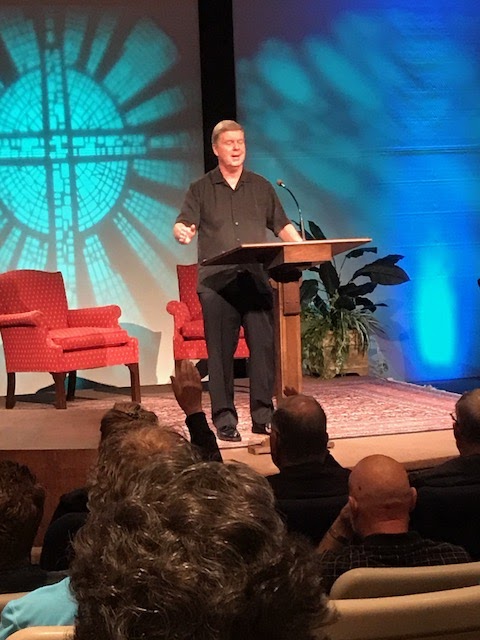 This week my husband and I had the opportunity to sit under the teaching of Jim Cymbala, pastor of the 16,000-member Brooklyn Tabernacle in Brooklyn, New York.
 While I'm confident many blog posts will spring from the wisdom he shared with us, I thought I'd give you an appetizer of sorts, a brain dump of some Cymbala's challenging and convicting words.
Pull up a chair and enjoy the feast.
"We have to be strong in the Lord. Weakness gets us nowhere--except attacked."
Finally, be strong in the Lord and in his mighty power (Eph. 6:10).
"God treasures nothing so much as he treasures faith."
Then he touched their eyes and said, "According to your faith let it be done to you" (Mat. 9:29).
"Feelings are the biggest enemy to faith."
We walk by faith, not by sight (2 Cor. 5:7).
"Faith is understanding God's promises and believing they're true."
"We must live in the Word of God to overcome negative feelings."
Faith comes by hearing, and hearing by the Word of God (Romans 10:17).
God gets to decide what sin is, not us.
Sometimes when God leads us, it's totally illogical.
"For my thoughts are not your thoughts, neither are your ways my ways," says the Lord. (Isa. 55:8)
"Not every good thing is God's thing."
"I don't want to go anywhere God doesn't want me to go, even if it's a good place."
"When you don't know what to do, don't do anything. Just wait."
If you're reading by email and can't see the video, click here to hear the Brooklyn Tabernacle Choir sing "Taste and See."
If you enjoyed this post, why not subscribe? I'll send you twice-weekly 5-minute devotions to help nourish your soul.
Because women need to connect with God in the craziness of life.
Enter your email address and VALIDATE the Feedburner email sent to your inbox.
Delivered by FeedBurner
If this post was meaningful to you, would you consider sharing it with a friend by clicking on one of the buttons below? Did you know you can receive bi-weekly Hungry for God posts sent directly to your email inbox? Visit http://www.lori-benotweary.blogspot.com and click on the link in the right hand corner to Subscribe Via Email.
Copyright 2012 by Lori Hatcher
June 4, 2017
Spender, Saver, or Saver Who Spends?
 Some say there are two types of people in the world—savers and spenders. I disagree. I think there’s a third type—savers who spend.
 Spenders live paycheck to paycheck. Every dollar that appears in their wallet quickly finds an escape hatch and vanishes. Bills that come around once or twice a year, like car insurance and property taxes, always catch spenders by surprise. Even birthdays and Christmas throw them into a panic, despite the fact that these special days come around every year at the same time.
They often use credit to pay bills or make purchases they didn’t plan for, which digs their financial hole even deeper. They give little thought to long-term goals and resent those who have things they don’t. They seldom give to the church or charity, because they can’t afford it.
Savers squirrel away every dollar they don’t need to live on and never buy anything. They’re often frugal to the point of embarrassment. When a genuine need comes along that they have money set aside for, they still panic, because they don’t want to part with their precious hoard. They equate money with security and peace, yet seldom experience either. If they give to charity or the church, they usually do it grudgingly and in a very limited and self-serving way.
Then there are the savers who spend. This group lives frugally, gives generously, and accomplishes long term financial goals. When infrequent or unexpected expenses arise, they have the money to meet the need, because they planned ahead. They make short-term sacrifices to enjoy long term benefits. Most importantly, they value people over stuff and acknowledge that God owns it all, and they are only his stewards.
Like most aspects of the Christian life, a healthy financial perspective finds the balance between the two extremes. The saver who spends lives peacefully in the tension between spending and saving. If you’re stuck at one end of the financial spectrum or the other,
I’d like to I share a few suggestions to help you move toward the middle.
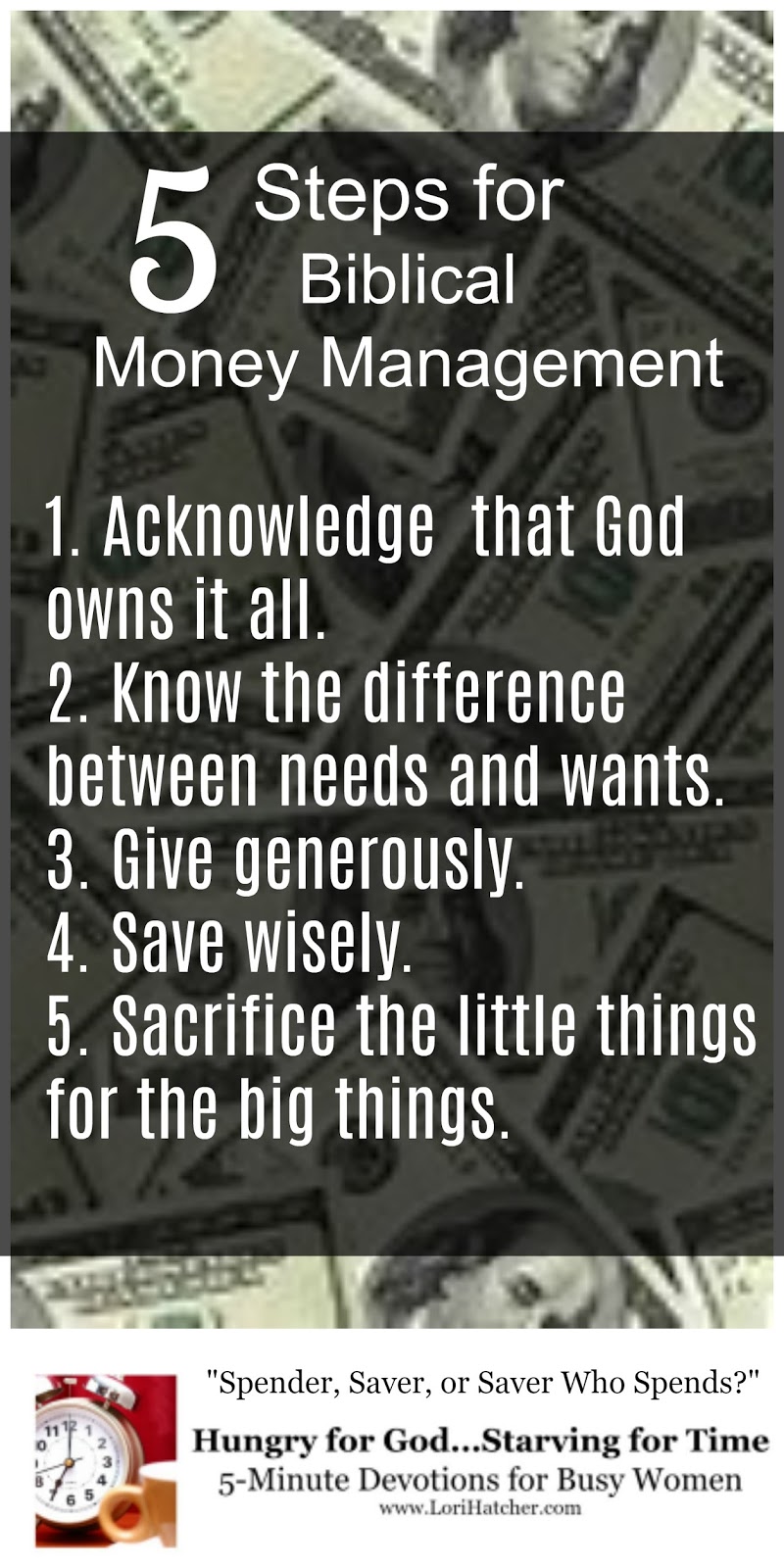 1. Acknowledge that God, not you, owns your money and possessions. We are only stewards. As financial managers, we are to spend and save God’s money according to the principles in his Word. As we do so, he promises to meet our needs, but he may choose not to provide some of our wants if our desires will hinder or harm his greater purposes.
 2. Recognize the difference between needs and wants. Cable TV, a late model car, and mani-pedis are not needs. We can sacrifice these luxuries to help us accomplish long term financial goals like becoming debt free, investing in God’s kingdom, or sending children to college.
3. Give generously when the Lord prompts you. The Philippian church was an impoverished church, yet they gave generously and sacrificially when God moved them. In response, God promised to meet their needs, just as he was using them to help meet others’ needs (Phil. 4:19).
4. Save wisely, not to secure your future, but to rightly manage the resources God has entrusted to you. This includes planning for occasional expenses like the ones mentioned above. Set up saving categories for appliance replacement, car repairs and maintenance, and unemployment. Even if you can only afford to tuck away a nominal amount in each category, regular savings deposits add up and can take the edge off an unexpected expense. Planning also prevents us from using credit, incurring high interest, and further increasing our indebtedness.
5. Sacrifice the little things to enjoy the big things. I know one family that ate out every Friday night. A normal meal would cost their family of four about $50. One of their goals was to take a family cruise when the oldest child graduated from high school. Instead of going into debt to make it happen, they decided to cut back on their restaurant dining, agreeing to go out to eat once a month instead of once a week. They took the extra $150 they’d been spending on meals and put it into a cruise fund.
Mom drew a thermometer on a piece of paper with the target amount they needed at the top. Each month, when Dad made the deposit into the cruise fund, they’d color in a bar on the thermometer. Watching the amount grow was empowering and exciting. It was also a great lesson in delayed gratification. When the time finally came to take their cruise, they enjoyed it guilt free, knowing there was no lingering credit card bill to haunt them for years after.
6. Value people over money. I know a one-income family who has lived frugally all their lives. They are some of the most giving, kingdom-minded people I know. Although their resources are limited, they always donate to students going on mission trips, extend hospitality, and give thoughtful, generous gifts. They understand the purpose of money—to meet our needs and the needs of those who cross our paths. They know God intends for us to be a channel, not a reservoir.
When appropriate, we should willingly release “our” money to help accomplish his purposes in the world. This may include supporting a missionary, sponsoring a Compassion International child, or buying a special birthday gift for a lonely widow in our church. We might have to sacrifice in one area to be able to give in another, but we’ll never regret it. The satisfaction of knowing we’ve touched someone in Jesus’ name is worth much more than the temporary pleasure of self-indulgence.
These suggestions are just a few coins in the bank of life, but I hope they’ll get you thinking. Take a moment to ask yourself, Am I a spender? A saver? Or a saver who spends? Invite God to examine your heart, your spending and saving habits, and your attitude toward money. If he shows you an area that needs adjustment, respond quickly to what he tells you to do.
When God closes the financial books at the end of our lives, he’ll ask us one question: What did you do with the money I entrusted to you?
May our answer will be one that honors and glorifies our Lord.
Now it’s your turn. What’s one way you try to honor God with your resources? Is there an area you’d like to improve on? Leave a comment below and share your thoughts.
If you enjoyed this post, why not subscribe? I'll send you twice-weekly 5-minute devotions to help nourish your soul.
Because women need to connect with God in the craziness of life.
Enter your email address and VALIDATE the Feedburner email sent to your inbox.
Delivered by FeedBurner
If this post was meaningful to you, would you consider sharing it with a friend by clicking on one of the buttons below? Did you know you can receive bi-weekly Hungry for God posts sent directly to your email inbox? Visit http://www.lori-benotweary.blogspot.com and click on the link in the right hand corner to Subscribe Via Email.
Copyright 2012 by Lori Hatcher
June 1, 2017
FIXED LINK! Why We Should Never Stop Applauding Our Nation's Military Families
A sharp-eyed reader noticed that the link for the rest of this article was broken in a previous post, so I'm resenting. You don't want to miss this!
For 30 years my family has lived in the shadow of one of the largest military training bases in the country, Fort Jackson, in Columbia, South Carolina. I've attended church with, lived beside, and educated my children with those who serve in the United States
Army. I've formed deep friendships with women whose husbands have served in Desert Storm, Iraq, and Afghanistan.
 But it wasn't until my daughter married a United States Naval officer that I truly began to understand the deep sacrifices these men, women, and families make on behalf of our country. We should never stop appreciating our military because of what they give and what they give up. . .
To read the rest of this article, "Why We Should Never Stop Appreciating Our Nation's Military's families, CLICK HERE.
If you enjoyed this post, why not subscribe? I'll send you twice-weekly 5-minute devotions to help nourish your soul.
Because women need to connect with God in the craziness of life.
Enter your email address and VALIDATE the Feedburner email sent to your inbox.
Delivered by FeedBurner
If this post was meaningful to you, would you consider sharing it with a friend by clicking on one of the buttons below? Did you know you can receive bi-weekly Hungry for God posts sent directly to your email inbox? Visit http://www.lori-benotweary.blogspot.com and click on the link in the right hand corner to Subscribe Via Email.
Copyright 2012 by Lori Hatcher
For 30 years my family has lived in the shadow of one of the largest military training bases in the country, Fort Jackson, in Columbia, South Carolina. I've attended church with, lived beside, and educated my children with those who serve in the United States
Army. I've formed deep friendships with women whose husbands have served in Desert Storm, Iraq, and Afghanistan.
 But it wasn't until my daughter married a United States Naval officer that I truly began to understand the deep sacrifices these men, women, and families make on behalf of our country. We should never stop appreciating our military because of what they give and what they give up. . .
 To read the rest of this article, "Why We Should Never Stop Appreciating Our Nation's Military's families, CLICK HERE.
If you enjoyed this post, why not subscribe? I'll send you twice-weekly 5-minute devotions to help nourish your soul.
Because women need to connect with God in the craziness of life.
Enter your email address and VALIDATE the Feedburner email sent to your inbox.
Delivered by FeedBurner
If this post was meaningful to you, would you consider sharing it with a friend by clicking on one of the buttons below? Did you know you can receive bi-weekly Hungry for God posts sent directly to your email inbox? Visit http://www.lori-benotweary.blogspot.com and click on the link in the right hand corner to Subscribe Via Email.
Copyright 2012 by Lori Hatcher
May 31, 2017
Why We Should Never Stop Applauding Our Nation's Military Families
For 30 years my family has lived in the shadow of one of the largest military training bases in the country, Fort Jackson, in Columbia, South Carolina. I've attended church with, lived beside, and educated my children with those who serve in the United States
Army. I've formed deep friendships with women whose husbands have served in Desert Storm, Iraq, and Afghanistan.
But it wasn't until my daughter married a United States Naval officer that I truly began to understand the deep sacrifices these men, women, and families make on behalf of our country. We should never stop appreciating our military because of what they give and what they give up. . .
To read the rest of "Why We Should Never Stop Applauding Our Nation's Military Families on Crosswalk.com, CLICK HERE.
If you enjoyed this post, why not subscribe? I'll send you twice-weekly 5-minute devotions to help nourish your soul.
Because women need to connect with God in the craziness of life.
Enter your email address and VALIDATE the Feedburner email sent to your inbox.
Delivered by FeedBurner
If this post was meaningful to you, would you consider sharing it with a friend by clicking on one of the buttons below? Did you know you can receive bi-weekly Hungry for God posts sent directly to your email inbox? Visit http://www.lori-benotweary.blogspot.com and click on the link in the right hand corner to Subscribe Via Email.
Copyright 2012 by Lori Hatcher
Army. I've formed deep friendships with women whose husbands have served in Desert Storm, Iraq, and Afghanistan.
But it wasn't until my daughter married a United States Naval officer that I truly began to understand the deep sacrifices these men, women, and families make on behalf of our country. We should never stop appreciating our military because of what they give and what they give up. . . To read the rest of "Why We Should Never Stop Applauding Our Nation's Military Families on Crosswalk.com, CLICK HERE.
If you enjoyed this post, why not subscribe? I'll send you twice-weekly 5-minute devotions to help nourish your soul.
Because women need to connect with God in the craziness of life.
Enter your email address and VALIDATE the Feedburner email sent to your inbox.
Delivered by FeedBurner
If this post was meaningful to you, would you consider sharing it with a friend by clicking on one of the buttons below? Did you know you can receive bi-weekly Hungry for God posts sent directly to your email inbox? Visit http://www.lori-benotweary.blogspot.com and click on the link in the right hand corner to Subscribe Via Email.
Copyright 2012 by Lori Hatcher
May 28, 2017
What Kind of Friend Are You?
 “Here, Caroline, stand on this so you can reach. That way, I can use the chair.”
 These were not the words I wanted to overhear when I discovered my 3-1/2-year-old granddaughter and her 1-1/2-year old sister playing alone in my office. As I peered around the corner, I had no idea what they were up to.
Friendships, like the one between my two granddaughters, can be positive or negative. The relationship between David and Jonathan, described in 1 Samuel 20, is a classic example of a positive, godly friendship.
The men shared wise counsel, protection, and possessions. First Samuel 18:4 records that Jonathan loved David so much he gave him his robe, tunic, sword, and belt. Men sharing tools and weapons? Now that’s a deep friendship.
Jonathan repeatedly defended David at the risk of angering his father, King Saul, and endangering his own life. Although it would ultimately cost him his position as next in line to the throne, he affirmed David’s calling to the kingship and pledged his loyalty. Most important of all, the men encouraged each other in the faith.
“May the LORD be with you as he has been with my father,” Jonathan said, blessing David (1 Sam. 20:13).
Second Samuel 13 records another, very different story of friendship, this one between King David’s son Amnon and his cousin Jonadab. Scripture tells us that Jonadab was “a very shrewd man.” Now shrewd can be good, but in this case, shrewd was bad.
Amnon had a problem. A big problem. He had a major crush on his half-sister, Tamar. Amnon was so besotted with Tamar that he couldn’t eat or sleep. This obsession began to take a toll on Amnon, to the point where his good friend Jonadab noticed.
“What in the world is wrong with you?” he asked. “You look awful.”
Frustrated and beside himself, Amnon confessed his infatuation with his half-sister. If Jonadab had been a godly friend, he would have called Amnon onto the carpet.
“Are you crazy, Amnon? The sun must have baked that brain of yours. Too many camel rides in the desert. Put that ridiculous notion out of your head, and let’s talk sense for a moment. I know she’s beautiful, but she’s your sister. And have you noticed? She’s your SISTER. And if that’s not reason enough, did I mention that she’s YOUR SISTER????"
Instead, Jonadab failed in his friendship and helped Amnon devise a horrible plan. Playing on his father’s trust and his sister’s kind nature, Amnon lured Tamar into his bedchamber, overpowered her, and raped her.
As quickly as Amnon’s lust had flared, his “love” for Tamar disappeared, and he sent her from his house in disgrace. Tamar never recovered, spending the rest of her life “a desolate woman.”
The tragic events of 2 Samuel 13 describe a friendship that had the power to prevent a horrible, heinous crime. Instead, it set in motion a series of events that left Tamar destroyed, Amnon dead, and Absalom, Tamar’s brother, guilty of murder.
In light of these conflicting stories of friendship, we would be wise to examine what type of friend we are.
Do we demonstrate loyalty, courage, and humility toward our friends? Do we speak up for them even when it costs us something? Are we more concerned about their successes than our own? Do we share sacrificially and generously? Are we brave enough to warn them when we see them walking a destructive path?
Then we are the type of friend with whom God is pleased.
Perhaps, however, we haven’t been a Jonathan-type friend. Maybe we’ve been more like Jonadab.
We’ve dismissed the warning signs that something’s not right. Instead of holding our friend accountable to God’s standards, we’ve looked the other way. Or worse yet, we’ve partnered with them in activities that dishonor others and the Lord. Instead of a rock of refuge, we’ve been a stumbling block.
 My granddaughters' visit and the contrasting stories from 2 Samuel remind me of the joy and the responsibilities of friendship.
 As I peeked around the doorway where the girls were playing, I discovered that big sister Lauren had helped little sister Caroline reach the desktop where she was happily scribbling on a Post It note. Lauren was sitting in front of my antique typewriter happily pecking away. Their friendship and camaraderie was sweet and innocent.
Today is a new day, filled with many opportunities to be a positive force for good in this troubled world. As we interact with the friends God has brought into our lives, may we be quick to “consider how we may spur one another on toward love and good deeds” (Heb. 10:24).
Now it’s your turn. Do you have a special friend who has faithfully encouraged you to make wise decisions and stay true to the faith? Leave a comment below and tell us about them.
For a little musical encouragement, I know you'll enjoy the song, "Prayer for a Friend," by Casting Crowns. If you're reading by email, click here to listen to "Prayer for a Friend."
If you enjoyed this post, why not subscribe? I'll send you twice-weekly 5-minute devotions to help nourish your soul.
Because women need to connect with God in the craziness of life.
Enter your email address and VALIDATE the Feedburner email sent to your inbox.
Delivered by FeedBurner

If this post was meaningful to you, would you consider sharing it with a friend by clicking on one of the buttons below? Did you know you can receive bi-weekly Hungry for God posts sent directly to your email inbox? Visit http://www.lori-benotweary.blogspot.com and click on the link in the right hand corner to Subscribe Via Email.
Copyright 2012 by Lori Hatcher
Refresh Blog

A place to refresh your faith, hope, and prayers with 5-minute weekly posts.
- Lori Hatcher's profile
- 101 followers

