
Lori Hatcher's Blog: Refresh Blog, page 61
March 19, 2017
Following God Even When He Isn't Moving
There’s nothing worse than being stuck.
 We’ve all been there.You’re tooling along in traffic, making good progress toward your destination, when all of a sudden the cars in front of you grind to a halt. All you see is the Red Sea of taillights. Zero to 60 becomes zero to nothing, and the timely arrival you planned vanishes like snow in the South.
Stuck in traffic is one example of being stuck, but sometimes “stuck” looks like more than a minor traffic delay. Sometimes stuck looks like a major train derailment.
Some of us are stuck in a relationship that’s going nowhere. The press of apathy, selfishness, or conflict hinders us from moving forward. Others are stuck in more noble ways—by caring for an aging parent, a sick spouse, or a needy child. Your lives is on hold, and everyone but you seems to be accomplishing something noteworthy or fulfilling. Or maybe you’re stuck professionally in a job where you don’t feel challenged, and no one appreciates you.
Sometimes we’re stuck because of our own poor decisions, but other times we know the hand of God has placed us where we are. No amount of effort, ingenuity, or prayer seems to change things. We’re stuck because the Lord has hemmed us in.
The children of Israel knew what it meant to be stuck. They had escaped Egypt in a blaze of glory, marching boldly away from their captors with God as their rear guard. Through the Red Sea they went, triumphant and heady with victory. Six hundred thousand fighting men strong in addition to women and children. Bible scholars estimate between 2-3 million people may have been following Moses’ leadership.
Then came the wilderness wanderings.
“At the command of the Lord the children of Israel would journey, and at the command of the Lord they would camp. As long as the cloud stayed above the tabernacle they remained encamped. Even when the cloud continued long, many days above the tabernacle, the children of Israel kept the charge of the Lord and did not journey” (Num. 9:18-19).
Some seasons of “stuck” lasted only a few days. Then the cloud would lift, and they’d be on their way. Other seasons lasted longer—a month sometimes. Or a year.
The Israelites made many mistakes on their journey, but, with one exception, they did one thing right—they never moved until God said, “Go.”
I wish I could be more like them. Oh, how I chafe at delays that seem to hinder my progress. I grow impatient with taillights and detours. I see the exit on the horizon, and I want off. Sometimes I go rogue and drive down the emergency lane, only to find myself not only stuck, but lost as well.
Stuck is hard. Lack of forward motion is counter-intuitive and appears fruitless and pointless.
Thankfully God provides a wise example for us to follow in the man Moses. Moses understood what we often forget—that God works equally well in the pauses.
 One day, overwhelmed by the task of leading two million people, he talked with God, "If your Presence does not go with us,” he said, “do not send us up from here” (Ex. 33:15). Moses knew wherever God was—in the going or in the staying—that’s where he wanted to be.
When God advanced, he would follow. When God stopped, he would trust. “At the command of the Lord they remained encamped, and at the command of the Lord they journeyed; they kept the charge of the Lord, at the command of the Lord by the hand of Moses” (Num. 9:23).
It’s during the stuck times that we must ask ourselves, am I willing to follow God, even when he isn’t moving?
Are you?
Father, help me see your hand in the stopping and in the going. Help me trust that you are accomplishing your perfect will for me, even when I cannot see it. I know you can use every circumstance to make me more like Jesus. Help me not get ahead of your good plan for my life. In Jesus name I pray, Amen.
If you enjoyed this post, why not subscribe? I'll send you twice-weekly 5-minute devotions to help nourish your soul.
Because women need to connect with God in the craziness of life.
Enter your email address and VALIDATE the Feedburner email sent to your inbox.
Delivered by FeedBurner
If this post was meaningful to you, would you consider sharing it with a friend by clicking on one of the buttons below? Did you know you can receive bi-weekly Hungry for God posts sent directly to your email inbox? Visit http://www.lori-benotweary.blogspot.com and click on the link in the right hand corner to Subscribe Via Email.
Copyright 2012 by Lori Hatcher
 We’ve all been there.You’re tooling along in traffic, making good progress toward your destination, when all of a sudden the cars in front of you grind to a halt. All you see is the Red Sea of taillights. Zero to 60 becomes zero to nothing, and the timely arrival you planned vanishes like snow in the South.
 Stuck in traffic is one example of being stuck, but sometimes “stuck” looks like more than a minor traffic delay. Sometimes stuck looks like a major train derailment.
Some of us are stuck in a relationship that’s going nowhere. The press of apathy, selfishness, or conflict hinders us from moving forward. Others are stuck in more noble ways—by caring for an aging parent, a sick spouse, or a needy child. Your lives is on hold, and everyone but you seems to be accomplishing something noteworthy or fulfilling. Or maybe you’re stuck professionally in a job where you don’t feel challenged, and no one appreciates you.
Sometimes we’re stuck because of our own poor decisions, but other times we know the hand of God has placed us where we are. No amount of effort, ingenuity, or prayer seems to change things. We’re stuck because the Lord has hemmed us in.
The children of Israel knew what it meant to be stuck. They had escaped Egypt in a blaze of glory, marching boldly away from their captors with God as their rear guard. Through the Red Sea they went, triumphant and heady with victory. Six hundred thousand fighting men strong in addition to women and children. Bible scholars estimate between 2-3 million people may have been following Moses’ leadership.
Then came the wilderness wanderings.
“At the command of the Lord the children of Israel would journey, and at the command of the Lord they would camp. As long as the cloud stayed above the tabernacle they remained encamped. Even when the cloud continued long, many days above the tabernacle, the children of Israel kept the charge of the Lord and did not journey” (Num. 9:18-19).
Some seasons of “stuck” lasted only a few days. Then the cloud would lift, and they’d be on their way. Other seasons lasted longer—a month sometimes. Or a year.
The Israelites made many mistakes on their journey, but, with one exception, they did one thing right—they never moved until God said, “Go.”
I wish I could be more like them. Oh, how I chafe at delays that seem to hinder my progress. I grow impatient with taillights and detours. I see the exit on the horizon, and I want off. Sometimes I go rogue and drive down the emergency lane, only to find myself not only stuck, but lost as well.
Stuck is hard. Lack of forward motion is counter-intuitive and appears fruitless and pointless.
Thankfully God provides a wise example for us to follow in the man Moses. Moses understood what we often forget—that God works equally well in the pauses.
 One day, overwhelmed by the task of leading two million people, he talked with God, "If your Presence does not go with us,” he said, “do not send us up from here” (Ex. 33:15). Moses knew wherever God was—in the going or in the staying—that’s where he wanted to be.
When God advanced, he would follow. When God stopped, he would trust. “At the command of the Lord they remained encamped, and at the command of the Lord they journeyed; they kept the charge of the Lord, at the command of the Lord by the hand of Moses” (Num. 9:23).
It’s during the stuck times that we must ask ourselves, am I willing to follow God, even when he isn’t moving?
Are you?
Father, help me see your hand in the stopping and in the going. Help me trust that you are accomplishing your perfect will for me, even when I cannot see it. I know you can use every circumstance to make me more like Jesus. Help me not get ahead of your good plan for my life. In Jesus name I pray, Amen.
If you enjoyed this post, why not subscribe? I'll send you twice-weekly 5-minute devotions to help nourish your soul.
Because women need to connect with God in the craziness of life.
Enter your email address and VALIDATE the Feedburner email sent to your inbox.
Delivered by FeedBurner
If this post was meaningful to you, would you consider sharing it with a friend by clicking on one of the buttons below? Did you know you can receive bi-weekly Hungry for God posts sent directly to your email inbox? Visit http://www.lori-benotweary.blogspot.com and click on the link in the right hand corner to Subscribe Via Email.
Copyright 2012 by Lori Hatcher


March 15, 2017
Does It Matter How Much Faith You Have?
Have you ever wondered if your lack of unwavering faith has hindered your prayers? I have.
 Especially when I’ve prayed really hard about something. I read verses like Matthew 21:22, “If you believe, you will receive whatever you ask for in prayer,” and it's easy to assume that because I haven’t received what I asked for, I must not have believed enough.
A little story in Mark 9 addresses this question.
Here’s the scene: a man has brought his epileptic, demon-possessed son to Jesus’ disciples for healing. When Jesus arrives, he discovers that the disciples have been unable to heal the boy. Seeing Jesus, the father asks, “'. . . if you can do anything, take pity on us and help us.’
"'If you can?’ said Jesus. ‘Everything is possible for him who believes.’
“Immediately the boy's father exclaimed, "’ I do believe; help me overcome my unbelief!’” With that response, Jesus commanded the demon to leave and healed the man’s son.
Jesus’ miraculous answer despite the father’s wobbly faith reminds me that I don’t have to have unshakable faith for God to answer my prayers. Here’s why:
The father did several things “right.” Here are two of them:
1. He brought his son to Jesus. This demonstrates he believed Jesus was able to heal him. That his faith wasn’t perfect and unshakable is evident by his words, “If you can do anything.” He’s not 100 percent sure, maybe he’s even grasping at straws, but he has some faith in Jesus.
2. He moved from less faith to more. When Jesus challenged his “If” clause with truth, “Everything is possible for him who believes,” he moved into an even greater faith decision:
“I do believe; help me overcome my unbelief!” He declared his desire to trust Jesus wholeheartedly while honestly acknowledging that he still doubts.
We know Jesus was OK with his hopeful but afraid-to-be-disappointed faith because of his response—he healed the man’s son.
 We can learn a few things from this man:
1. When we have a need, the only place to run is to Jesus.
2. We don’t have to know the outcome to be able to trust God with it.
3. We can be honest with him about our struggle to believe. (He knows anyway.)
4. We can ask God to give us more faith and help our unbelief.
5. We can trust God, regardless of the outcome.
The faith life is a long journey of small steps. Every time I trust God with something, my faith grows, and it becomes easier to trust him with the next thing. I don’t know if I’ll ever reach the point where I can trust God without even a smidgen of doubt, but every faith step I take in his direction brings me closer to that ideal. One day, like the centurion in Luke 9, I hope to amaze Jesus with my faith.
Now it’s your turn. What stands out most to you in the Luke 9 story? Of the five lessons listed above, which is the most challenging for you? Leave a comment below and share your thoughts.
If you enjoyed this post, why not subscribe? I'll send you twice-weekly 5-minute devotions to help nourish your soul.
Because women need to connect with God in the craziness of life.
Enter your email address and VALIDATE the Feedburner email sent to your inbox.
Delivered by FeedBurner
If this post was meaningful to you, would you consider sharing it with a friend by clicking on one of the buttons below? Did you know you can receive bi-weekly Hungry for God posts sent directly to your email inbox? Visit http://www.lori-benotweary.blogspot.com and click on the link in the right hand corner to Subscribe Via Email.
Copyright 2012 by Lori Hatcher
 Especially when I’ve prayed really hard about something. I read verses like Matthew 21:22, “If you believe, you will receive whatever you ask for in prayer,” and it's easy to assume that because I haven’t received what I asked for, I must not have believed enough.
A little story in Mark 9 addresses this question.
Here’s the scene: a man has brought his epileptic, demon-possessed son to Jesus’ disciples for healing. When Jesus arrives, he discovers that the disciples have been unable to heal the boy. Seeing Jesus, the father asks, “'. . . if you can do anything, take pity on us and help us.’
"'If you can?’ said Jesus. ‘Everything is possible for him who believes.’
“Immediately the boy's father exclaimed, "’ I do believe; help me overcome my unbelief!’” With that response, Jesus commanded the demon to leave and healed the man’s son.
Jesus’ miraculous answer despite the father’s wobbly faith reminds me that I don’t have to have unshakable faith for God to answer my prayers. Here’s why:
The father did several things “right.” Here are two of them:
1. He brought his son to Jesus. This demonstrates he believed Jesus was able to heal him. That his faith wasn’t perfect and unshakable is evident by his words, “If you can do anything.” He’s not 100 percent sure, maybe he’s even grasping at straws, but he has some faith in Jesus.
2. He moved from less faith to more. When Jesus challenged his “If” clause with truth, “Everything is possible for him who believes,” he moved into an even greater faith decision:
“I do believe; help me overcome my unbelief!” He declared his desire to trust Jesus wholeheartedly while honestly acknowledging that he still doubts.
We know Jesus was OK with his hopeful but afraid-to-be-disappointed faith because of his response—he healed the man’s son.
 We can learn a few things from this man:
1. When we have a need, the only place to run is to Jesus.
2. We don’t have to know the outcome to be able to trust God with it.
3. We can be honest with him about our struggle to believe. (He knows anyway.)
4. We can ask God to give us more faith and help our unbelief.
5. We can trust God, regardless of the outcome.
The faith life is a long journey of small steps. Every time I trust God with something, my faith grows, and it becomes easier to trust him with the next thing. I don’t know if I’ll ever reach the point where I can trust God without even a smidgen of doubt, but every faith step I take in his direction brings me closer to that ideal. One day, like the centurion in Luke 9, I hope to amaze Jesus with my faith.
Now it’s your turn. What stands out most to you in the Luke 9 story? Of the five lessons listed above, which is the most challenging for you? Leave a comment below and share your thoughts.
If you enjoyed this post, why not subscribe? I'll send you twice-weekly 5-minute devotions to help nourish your soul.
Because women need to connect with God in the craziness of life.
Enter your email address and VALIDATE the Feedburner email sent to your inbox.
Delivered by FeedBurner
If this post was meaningful to you, would you consider sharing it with a friend by clicking on one of the buttons below? Did you know you can receive bi-weekly Hungry for God posts sent directly to your email inbox? Visit http://www.lori-benotweary.blogspot.com and click on the link in the right hand corner to Subscribe Via Email.
Copyright 2012 by Lori Hatcher
Does It Matter How Much Faith I Have?
Have you ever wondered if your lack of unwavering faith has hindered your prayers? I have.
Especially when I’ve prayed really hard about something. I read verses like Matthew 21:22, “If you believe, you will receive whatever you ask for in prayer,” and it's easy to assume that because I haven’t received what I asked for, I must not have believed enough.
A little story in Mark 9 addresses this question.
Here’s the scene: a man has brought his epileptic, demon-possessed son to Jesus’ disciples for healing. When Jesus arrives, he discovers that the disciples have been unable to heal the boy. Seeing Jesus, the father asks, “'. . . if you can do anything, take pity on us and help us.’
"'If you can?’ said Jesus. ‘Everything is possible for him who believes.’
“Immediately the boy's father exclaimed, "’ I do believe; help me overcome my unbelief!’” With that response, Jesus commanded the demon to leave and healed the man’s son.
Jesus’ miraculous answer despite the father’s wobbly faith reminds me that I don’t have to have unshakable faith for God to answer my prayers. Here’s why:
The father did several things “right.” Here are two of them:
1. He brought his son to Jesus. This demonstrates he believed Jesus was able to heal him. That his faith wasn’t perfect and unshakable is evident by his words, “If you can do anything.” He’s not 100 percent sure, maybe he’s even grasping at straws, but he has some faith in Jesus.
2. He moved from less faith to more. When Jesus challenged his “If” clause with truth, “Everything is possible for him who believes,” he moved into an even greater faith decision:
“I do believe; help me overcome my unbelief!” He declared his desire to trust Jesus wholeheartedly while honestly acknowledging that he still doubts.
We know Jesus was OK with his hopeful but afraid-to-be-disappointed faith because of his response—he healed the man’s son.
We can learn a few things from this man:
1. When we have a need, the only place to run is to Jesus.
2. We don’t have to know the outcome to be able to trust God with it.
3. We can be honest with him about our struggle to believe. (He knows anyway.)
4. We can ask God to give us more faith and help our unbelief.
5. We can trust God, regardless of the outcome.
The faith life is a long journey of small steps. Every time I trust God with something, my faith grows, and it becomes easier to trust him with the next thing. I don’t know if I’ll ever reach the point where I can trust God without even a smidgen of doubt, but every faith step I take in his direction brings me closer to that ideal. One day, like the centurion in Luke 9, I hope to amaze Jesus with my faith.
Now it’s your turn. What stands out most to you in the Luke 9 story? Of the five lessons listed above, which is the most challenging for you? Leave a comment below and share your thoughts.
If you enjoyed this post, why not subscribe? I'll send you twice-weekly 5-minute devotions to help nourish your soul.
Because women need to connect with God in the craziness of life.
Enter your email address and VALIDATE the Feedburner email sent to your inbox.
Delivered by FeedBurner
If this post was meaningful to you, would you consider sharing it with a friend by clicking on one of the buttons below? Did you know you can receive bi-weekly Hungry for God posts sent directly to your email inbox? Visit http://www.lori-benotweary.blogspot.com and click on the link in the right hand corner to Subscribe Via Email.
Copyright 2012 by Lori Hatcher
Especially when I’ve prayed really hard about something. I read verses like Matthew 21:22, “If you believe, you will receive whatever you ask for in prayer,” and it's easy to assume that because I haven’t received what I asked for, I must not have believed enough.A little story in Mark 9 addresses this question.
Here’s the scene: a man has brought his epileptic, demon-possessed son to Jesus’ disciples for healing. When Jesus arrives, he discovers that the disciples have been unable to heal the boy. Seeing Jesus, the father asks, “'. . . if you can do anything, take pity on us and help us.’
"'If you can?’ said Jesus. ‘Everything is possible for him who believes.’
“Immediately the boy's father exclaimed, "’ I do believe; help me overcome my unbelief!’” With that response, Jesus commanded the demon to leave and healed the man’s son.
Jesus’ miraculous answer despite the father’s wobbly faith reminds me that I don’t have to have unshakable faith for God to answer my prayers. Here’s why:
The father did several things “right.” Here are two of them:
1. He brought his son to Jesus. This demonstrates he believed Jesus was able to heal him. That his faith wasn’t perfect and unshakable is evident by his words, “If you can do anything.” He’s not 100 percent sure, maybe he’s even grasping at straws, but he has some faith in Jesus.
2. He moved from less faith to more. When Jesus challenged his “If” clause with truth, “Everything is possible for him who believes,” he moved into an even greater faith decision:
“I do believe; help me overcome my unbelief!” He declared his desire to trust Jesus wholeheartedly while honestly acknowledging that he still doubts.
We know Jesus was OK with his hopeful but afraid-to-be-disappointed faith because of his response—he healed the man’s son.
We can learn a few things from this man:1. When we have a need, the only place to run is to Jesus.
2. We don’t have to know the outcome to be able to trust God with it.
3. We can be honest with him about our struggle to believe. (He knows anyway.)
4. We can ask God to give us more faith and help our unbelief.
5. We can trust God, regardless of the outcome.
The faith life is a long journey of small steps. Every time I trust God with something, my faith grows, and it becomes easier to trust him with the next thing. I don’t know if I’ll ever reach the point where I can trust God without even a smidgen of doubt, but every faith step I take in his direction brings me closer to that ideal. One day, like the centurion in Luke 9, I hope to amaze Jesus with my faith.
Now it’s your turn. What stands out most to you in the Luke 9 story? Of the five lessons listed above, which is the most challenging for you? Leave a comment below and share your thoughts.
If you enjoyed this post, why not subscribe? I'll send you twice-weekly 5-minute devotions to help nourish your soul.
Because women need to connect with God in the craziness of life.
Enter your email address and VALIDATE the Feedburner email sent to your inbox.
Delivered by FeedBurner
If this post was meaningful to you, would you consider sharing it with a friend by clicking on one of the buttons below? Did you know you can receive bi-weekly Hungry for God posts sent directly to your email inbox? Visit http://www.lori-benotweary.blogspot.com and click on the link in the right hand corner to Subscribe Via Email.
Copyright 2012 by Lori Hatcher
March 12, 2017
7 Signs God Is Calling You, Part II
 It’s undeniable—that gentle (or not-so-gentle) tug on your heart. You think God might be calling you to do something, but you’re not sure. How can you be certain it’s God calling you and not one of your own crazy ideas?
In my last blog post, I shared four signs God is calling you. If you missed that post, click here to read "7 Signs God Is Calling You, Part I."
Today I'd like to share three more signs God is calling you:
5. God will provide what you need.
Moses was concerned that Pharaoh and the Israelites wouldn’t believe God had sent him. In response to his concern, God gave him what he needed to accomplish his mission—his rod—and instructions in how to use it.
One year I sensed God was calling me to attend a writers conference. It was expensive and would involve rescheduling two days of patients and losing two days of income.
Shortly after I began to pray about it, my coworker asked me if I could work two extra days for her. Guess when? The week before the writers conference.
“And if you’d like me to work for you so you can have a few days off, I’d be glad to,” she said.
Well Lord, you’ve removed two of three obstacles preventing me from attending the conference. The only problem that remains is the $800 conference fee.
Shortly after I prayed, I received an unexpected check—for $800. God had shown me clearly that I was to attend the writers conference that year.
 6. God will bring others along to help you.
God called Moses to a monumental task—to face the leader of one of the most powerful nations on earth and demand the release of more than a million people. It’s not surprising that he doubted his ability. Even after God gave him a healthy pep talk, Moses continued to protest. God graciously dealt with his lack of faith by sending his brother Aaron to help him.
"I will help both of you speak and will teach you what to do,” God said (Ex. 4:15).
It’s noteworthy that after the first encounter with Pharaoh, Moses no longer needed to hide behind his older brother. He became a bold, powerful orator who faithfully championed the cause of his fellow Israelites.
Our family mission trip is a perfect example of how God brought others alongside us to make up for what we were lacking. My husband and I felt comfortable teaching and leading Bible studies, but when the missionaries with whom we’d be ministering asked if our team could make some home repairs, we knew we were out of our league. Our coworker, Mike, however, was especially handy with tools. His wife, Mandy, has the gift of organization, and together we were able to preach, teach, and give our missionary friends’ kitchen a much-needed face lift.
7. God will reassure you about (but not remove) your inadequacies.
Moses was scared to death. He felt woefully unprepared for the monumental task God was calling him to. He was a poor speaker, and he lacked self-confidence. God, however, made it perfectly clear that his power would be behind Moses’ calling.
"Who gave man his mouth?” God said. “Who makes him deaf or mute? Who gives him sight or makes him blind? Is it not I, the LORD? Now go; I will help you speak and will teach you what to say" (Ex. 4:11-12).
When God calls us to do something for him, he seldom waits until we’re polished and perfect. If he did, we’d be tempted to trust in our own abilities instead of seeking his power and enabling. The apostle Paul explained it this way,
“But we have this treasure in jars of clay to show that this all-surpassing power is from God and not from us” (2 Cor. 4:7).
On our mission trip, we were asked to counsel couples struggling with marital challenges. My husband and I felt woefully inadequate, but we stepped out in faith, asking God to speak through us. During one of our sessions, a man and his wife committed their lives to Christ. Today, seven years later, they are still together and serving God in their local church. We are amazed at how God didn’t remove our inadequacies, he worked in spite of them.
I hope this list of ways God confirms his calling will help you the next time you sense him speaking to you. It isn’t all-inclusive, nor are you likely to experience all seven. It does, however, attempt to explain the gracious way God reveals his will and then confirms it.
If you sense God calling you to do something, I encourage you to claim the promise of Jeremiah 29:13:
“You will seek me and find me when you seek me with all your heart.”
Prayer: Father, I don’t know what your will for me is, but I believe you will make it clear. Help me step out in faith and obedience, knowing that you will walk with me every step of the way. Use me for your glory, Amen.
Now it’s your turn. How have you seen God confirm what you suspected he was calling you to do? Leave a comment below and join the conversation.
If you enjoyed this post, why not subscribe? I'll send you twice-weekly 5-minute devotions to help nourish your soul.
Because women need to connect with God in the craziness of life.
Enter your email address and VALIDATE the Feedburner email sent to your inbox.
Delivered by FeedBurner
If this post was meaningful to you, would you consider sharing it with a friend by clicking on one of the buttons below? Did you know you can receive bi-weekly Hungry for God posts sent directly to your email inbox? Visit http://www.lori-benotweary.blogspot.com and click on the link in the right hand corner to Subscribe Via Email.
Copyright 2012 by Lori Hatcher
March 8, 2017
7 Signs God Is Calling You, Part I
It’s undeniable—that gentle (or not-so-gentle) tug on your heart. You think God might be calling you to do something, but you’re not sure. How can you be certain it’s really God calling you and not one of your own crazy ideas?
It’s a mysterious thing, this faith life. It doesn’t come with specific instructions, yet believers down through the ages have followed God with confidence and faith. Unlike Food Network’s step-by-step instructions for how to make lasagna, God’s direction is usually a little less straightforward.
The Bible does, however, provide classic examples of how God reveals his will to his followers. We can learn from the historic exchanges on the pages of Scripture and apply the principles to our own lives. Because of this, we can obey God with the same faith and confidence that guided the biblical heroes of the faith.
Moses’ historic “Burning Bush” experience of Exodus 3 and 4 is a great example of how God reveals his will to his people. And while most of us are unlikely to have a literal burning bush appear in front of us, if we take the pyrotechnic element out of the picture, we can still find much guidance from Moses’ encounter with God.
Here are seven signs of God’s direction, four today, and three in the next post:
 1. God will get your attention in a significant way.
He used a burning bush to catch Moses’ eye, but he may get yours in an equally noteworthy but less flammable way. Maybe you attend a concert and the artist shares a story about sex trafficking. The statistics shock you, and you’ve thought of little else since. Maybe you read an article about how local schools are struggling to find readers for their at risk students, and you’re wondering if you’re supposed to volunteer. Or maybe you’ve noticed your pastor’s wife seems overwhelmed and discouraged, and you feel moved to help. Whatever method God uses, he will get your attention.
2. God will often repeat himself.
In Moses’ case, God repeated himself by calling Moses' name twice from the bush. Your call probably won’t be audible, but the sense that God is speaking to you will usually return again and again. I’ve heard it said that being convicted by the Holy Spirit is like being nibbled to death by a duck, and I agree—it’s relentless.
When my husband and I began to sense God was calling us to take a family mission trip, the idea just wouldn’t go away. Shortly after we began talking about it, we received a letter from missionary friends in Mexico describing how one of their supporting families had just spent a week ministering with them. The experience was so positive that they wanted to invite other families to come.
A final repeating nudge came when my husband shared what we were thinking with another family, and they said they’d had a similar sense that God was calling them to do a short-term mission trip. I’m thankful God repeated his call several times in several ways, or we might have missed the opportunity for a life-changing mission experience.
3. God will assure you of his presence.
When God called Moses to go to Egypt and announce himself as God’s appointed deliverer, Moses balked.
“Who am I, that I should go to Pharaoh and bring the Israelites out of Egypt?" he asked.
“I will certainly be with you,” God said.
It's been my experience that when God calls us, he also reassures us that he will go with us. This confirmation can come in different ways. You might read a verse of Scripture that speaks perfectly into our situation. Or hear a word of promise in a Christian song, or read a Bible verse on a billboard or a bumper sticker. Your pastor may preach a message that has nothing to do with what you’re sensing, yet one of the verses will shine like a spotlight in your heart. However he chooses to do it, God will give you confidence that he will walk with you every step of the way as you obey his calling.
 4. God will give you the first step.
As you seek God’s face and try to discern his will, God will reveal Step 1. For Moses, it was, “So now, go. I am sending you to Pharaoh to bring my people the Israelites out of Egypt" (v. 10). God later laid out a series of steps for Moses to follow, but he seldom does this for us. I suspect if he did, we’d be too scared to take the first step. Instead, he usually shows us the first thing he wants us to do. Then, as we obey, he reveals the next one, and the next one, and the next one.
When I first sensed the Lord calling me to write professionally, I had no idea how to go about it. Then I received an email from a writer friend telling me about a new Christian writers group. I attended the inaugural meeting, which set into motion a series of steps that led to the publication of my first devotional book, Joy in the Journey. God didn’t show me every step that first day, but as I obeyed what he told me to do, he gave me direction for the next step.
These are four of the seven signs God is calling you. In my next post, I'll share three more signs. If you haven't yet subscribed to Hungry for God, now is a great time. I'd hate for you to miss a single post.
If you enjoyed this post, why not subscribe? I'll send you twice-weekly 5-minute devotions to help nourish your soul.
Because women need to connect with God in the craziness of life.
Enter your email address and VALIDATE the Feedburner email sent to your inbox.
Delivered by FeedBurner
If this post was meaningful to you, would you consider sharing it with a friend by clicking on one of the buttons below? Did you know you can receive bi-weekly Hungry for God posts sent directly to your email inbox? Visit http://www.lori-benotweary.blogspot.com and click on the link in the right hand corner to Subscribe Via Email.
Copyright 2012 by Lori Hatcher
It’s a mysterious thing, this faith life. It doesn’t come with specific instructions, yet believers down through the ages have followed God with confidence and faith. Unlike Food Network’s step-by-step instructions for how to make lasagna, God’s direction is usually a little less straightforward.
The Bible does, however, provide classic examples of how God reveals his will to his followers. We can learn from the historic exchanges on the pages of Scripture and apply the principles to our own lives. Because of this, we can obey God with the same faith and confidence that guided the biblical heroes of the faith.
Moses’ historic “Burning Bush” experience of Exodus 3 and 4 is a great example of how God reveals his will to his people. And while most of us are unlikely to have a literal burning bush appear in front of us, if we take the pyrotechnic element out of the picture, we can still find much guidance from Moses’ encounter with God.
Here are seven signs of God’s direction, four today, and three in the next post:
 1. God will get your attention in a significant way.
 He used a burning bush to catch Moses’ eye, but he may get yours in an equally noteworthy but less flammable way. Maybe you attend a concert and the artist shares a story about sex trafficking. The statistics shock you, and you’ve thought of little else since. Maybe you read an article about how local schools are struggling to find readers for their at risk students, and you’re wondering if you’re supposed to volunteer. Or maybe you’ve noticed your pastor’s wife seems overwhelmed and discouraged, and you feel moved to help. Whatever method God uses, he will get your attention.
2. God will often repeat himself.
In Moses’ case, God repeated himself by calling Moses' name twice from the bush. Your call probably won’t be audible, but the sense that God is speaking to you will usually return again and again. I’ve heard it said that being convicted by the Holy Spirit is like being nibbled to death by a duck, and I agree—it’s relentless.
When my husband and I began to sense God was calling us to take a family mission trip, the idea just wouldn’t go away. Shortly after we began talking about it, we received a letter from missionary friends in Mexico describing how one of their supporting families had just spent a week ministering with them. The experience was so positive that they wanted to invite other families to come.
A final repeating nudge came when my husband shared what we were thinking with another family, and they said they’d had a similar sense that God was calling them to do a short-term mission trip. I’m thankful God repeated his call several times in several ways, or we might have missed the opportunity for a life-changing mission experience.
3. God will assure you of his presence.
When God called Moses to go to Egypt and announce himself as God’s appointed deliverer, Moses balked.
“Who am I, that I should go to Pharaoh and bring the Israelites out of Egypt?" he asked.
“I will certainly be with you,” God said.
It's been my experience that when God calls us, he also reassures us that he will go with us. This confirmation can come in different ways. You might read a verse of Scripture that speaks perfectly into our situation. Or hear a word of promise in a Christian song, or read a Bible verse on a billboard or a bumper sticker. Your pastor may preach a message that has nothing to do with what you’re sensing, yet one of the verses will shine like a spotlight in your heart. However he chooses to do it, God will give you confidence that he will walk with you every step of the way as you obey his calling.
 4. God will give you the first step.
As you seek God’s face and try to discern his will, God will reveal Step 1. For Moses, it was, “So now, go. I am sending you to Pharaoh to bring my people the Israelites out of Egypt" (v. 10). God later laid out a series of steps for Moses to follow, but he seldom does this for us. I suspect if he did, we’d be too scared to take the first step. Instead, he usually shows us the first thing he wants us to do. Then, as we obey, he reveals the next one, and the next one, and the next one.
When I first sensed the Lord calling me to write professionally, I had no idea how to go about it. Then I received an email from a writer friend telling me about a new Christian writers group. I attended the inaugural meeting, which set into motion a series of steps that led to the publication of my first devotional book, Joy in the Journey. God didn’t show me every step that first day, but as I obeyed what he told me to do, he gave me direction for the next step.
These are four of the seven signs God is calling you. In my next post, I'll share three more signs. If you haven't yet subscribed to Hungry for God, now is a great time. I'd hate for you to miss a single post.
If you enjoyed this post, why not subscribe? I'll send you twice-weekly 5-minute devotions to help nourish your soul.
Because women need to connect with God in the craziness of life.
Enter your email address and VALIDATE the Feedburner email sent to your inbox.
Delivered by FeedBurner
If this post was meaningful to you, would you consider sharing it with a friend by clicking on one of the buttons below? Did you know you can receive bi-weekly Hungry for God posts sent directly to your email inbox? Visit http://www.lori-benotweary.blogspot.com and click on the link in the right hand corner to Subscribe Via Email.
Copyright 2012 by Lori Hatcher
March 5, 2017
Please Stop Bashing the Church
 Almost every day I see a social media post about what’s wrong with the church. College students are leaving by the thousands. Young adults say the church has damaged them forever. People are hurt, they’re never coming back, and they want everyone within their social media circles to leave with them. I hear you. I feel what you feel. I’ve lived some of the stories you’ve lived. But I will never leave the church. And neither should you. As kindly as possible, I have one thing to say:
 Stop bashing the church.
I’ve been a Christian for more than 30 years. I’ve attended large churches, small churches, and medium-sized churches. My husband and I have been members, lay leaders, and staff.
Between the two of us, we’ve served in every volunteer position imaginable, from janitor to Sunday school teacher, nursery worker to youth minister. We’ve scrubbed toilets, tables, and toddlers, and prayed, played, and paid. We’ve invested our time, money, and energy into this thing called the church, and we love it. We believe in it, and we plan to serve it until we die.
Here are five good reasons why:
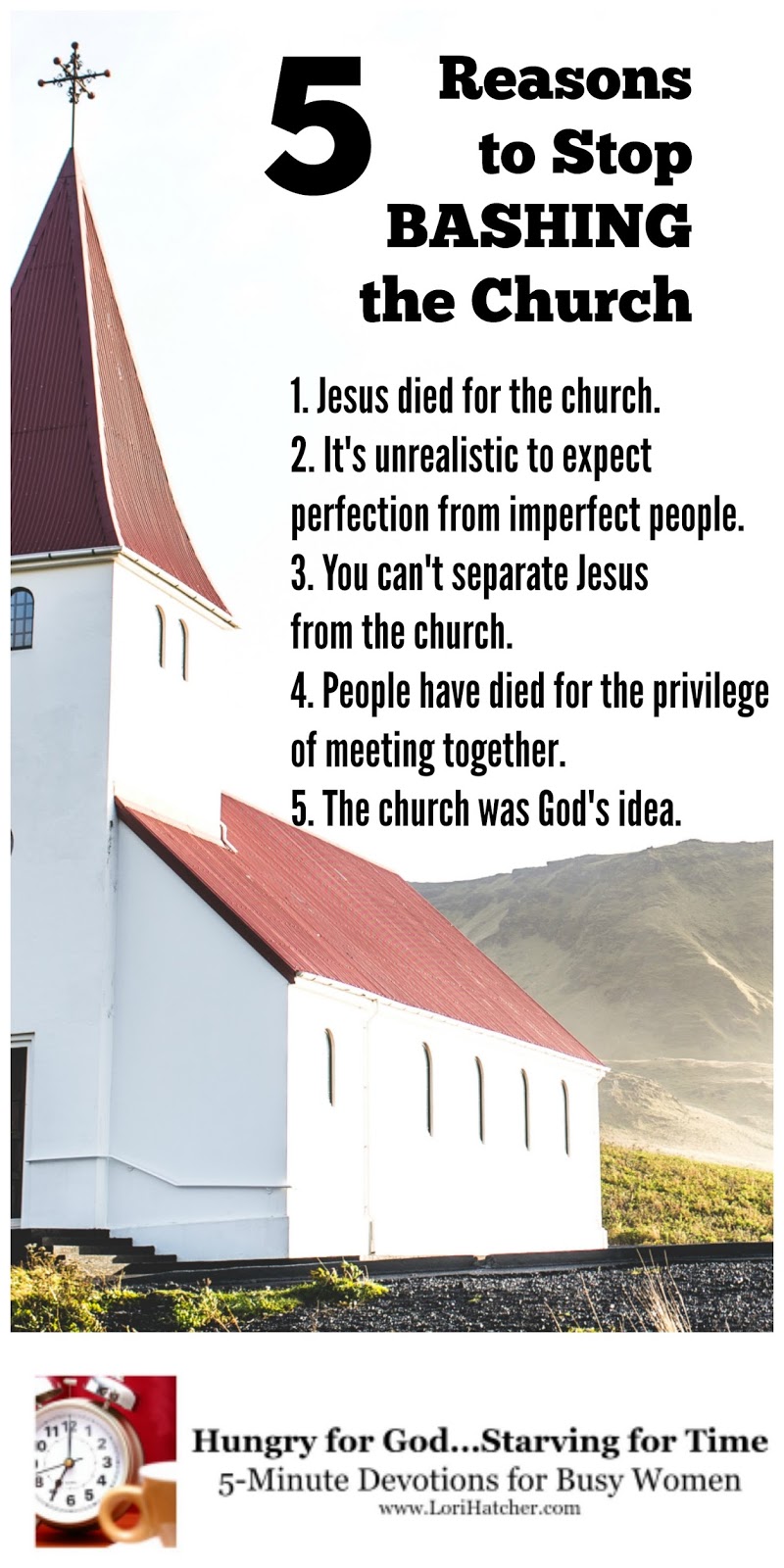 1. Because Jesus Christ loved the church and gave himself for it (Eph. 5:25). He didn't love online communities, parachurch organizations, or social clubs. He loved the church—so much that He died for it. In my opinion, that's reason enough to stop bashing it.
 2. Because churches are made up of imperfect people like you and me. Immature, selfish, inconsiderate, and sometimes rude. Loving, caring, sacrificial, and sometimes beautiful. We are flawed and frail, but little by little, God is changing us and making us more like Jesus. You wouldn’t leave a hospital because there were sick people in it, and you shouldn’t leave the church because there are sinners in it. Sick people go to a hospital because they’re sick, and sinners go to a church because they’re sinful. The transforming power of Jesus is the only hope we have for change, and Jesus does his best work through the church.
3. You cannot separate Jesus from the church. When Jesus left the earth, he told his disciples to remain in Jerusalem until he sent the Holy Spirit. Then he instructed his apostles to evangelize and plant churches in Jerusalem, Judea, Samaria, and the uttermost parts of the earth. Through divine inspiration he gave them instructions for church government, discipline, and worship so they could do everything “decently and in order” (1 Cor. 14:40). The book of Acts is a glorious testimony of how Christ sent disciples everywhere to establish local congregations of believers, complete with leadership and governments.
4. People have died for the privilege of meeting together to worship God. Our forefathers dedicated their lives to birth a nation that granted its citizens the freedom to attend church. Generations of brave men and women have died on foreign battlefields to defend our religious freedoms and protect our country from godless attacks. Believers in China, Saudi Arabia, India, and South Korea risk their lives daily to meet together to worship and study the Scriptures. To forsake the free exercise of our right to assemble as a church is a slap in the face to those who long for and died for this privilege.
5. The church was God’s idea. Jesus told Peter, “... you are Peter, and on this rock I will build my church” (Mat. 16:18). He promised to sustain and protect it, “and the gates of Hades will not overcome it.” Through salvation Christ initiated believers into a universal church, but he also placed them in local churches. As in the book of Acts, he continues to grow the church. “And the Lord added to the church daily such as should be saved” (Acts 2:47).
I know atrocities have been committed through the ages in the name of God and the church. Some churches have strayed from the tenets of Scripture and morphed into cultic caricatures as far from the true church as cardboard façades are to marble mansions. Ministers and churches have neglected their duties, betrayed their members’ trust, and abused their power. Congregants have wounded their sisters and brothers with cruel actions diametrically opposed to the teachings of Scripture.
Much wrong has been done in and through the church, but thousands of good, pure, sacrificial, and lovely acts have also been done. These actions trump and triumph over Satan’s pitiful attempts to misuse, malign, and misrepresent the Bride of Christ.
We need the church (Acts. 12:5, Heb. 10:24-25). Now more than ever, in a culture increasingly hostile to people of faith, we need each other. Persecution is coming, and like the unsuspecting lamb is vulnerable to a wolf’s attack when it wanders from the flock, so are we dangerously unprotected from Satan’s schemes when we forsake our flock and go it alone.
The church is vital to help us grow in our faith, hold us accountable, pray for us, and help us in our time of need. If you've ever experienced the love of a local church during a time of tragedy, sickness, or loss, you know there is no greater expression of God's care on earth than that of a body of believers rallying around its own.
In our 30+ years as believers, local churches have support us when my husband lost his job, counseled us when our family struggled, and comforted when we experienced the deaths of two sisters, a brother, and a grandmother, all in the same year.
But not only do we need the church, the church needs us (1 Cor. 12:28). God could easily do his work on earth by himself, but he chooses to let us be part of it. By serving others through a local church, we participate in the work he's doing in the world. As we spend our time, money, and energy serving others, God blesses us in ways we could never imagine. Best of all, we become the hands and feet of Jesus.
Is there a lot wrong with the church? Yup. But there’s also a lot wrong with us. Until we reach perfection (which won’t happen on this earth), can we legitimately hold a body of similarly imperfect believers to a standard we can never hope to attain?
If you attend a local church that loves God deeply, serves God sacrificially, and shares God liberally, rejoice. If you attend a church that falls short of Christ’s plan for his body, extend grace, forgive as you’ve been forgiven, and look for ways to make it better. And if you honestly feel there’s too much wrong in your local congregation to redeem, find another place to worship. God’s people are everywhere, and they’ll be glad to welcome you in.
But whether you choose to stay or choose to go,
please, stop bashing the church.
This article first appeared on Crosswalk.com, June 1, 2016.
If you enjoyed this post, why not subscribe? I'll send you twice-weekly 5-minute devotions to help nourish your soul.
Because women need to connect with God in the craziness of life.
Enter your email address and VALIDATE the Feedburner email sent to your inbox.
Delivered by FeedBurner
If this post was meaningful to you, would you consider sharing it with a friend by clicking on one of the buttons below? Did you know you can receive bi-weekly Hungry for God posts sent directly to your email inbox? Visit http://www.lori-benotweary.blogspot.com and click on the link in the right hand corner to Subscribe Via Email.
Copyright 2012 by Lori Hatcher
March 1, 2017
4 Simple Steps to Banish Fear
 One day, you’re going to encounter a situation that takes your breath away. And not in a good way.
 In a fear-filled, oh-my-gosh-what-am-I-going-to-do, I’m so AFRAID way. Your heart will race, your mind will swirl with scary thoughts, and you’ll become paralyzed as you imagine the worst possible scenario. And you’ll probably cry from the sheer terror of what might happen.
Many different scenarios can inspire this type of fear:
A job loss.
A health crisis.
A wayward child.
A suicidal friend.
A struggling marriage.
Are you frightened yet?
Each of these situations, at some point in my life, have scared the beejeebies out of me. Thankfully, God cares when we’re scared. He cares so much so that he planted a tiny, 10-word verse smack dab in the middle of the Bible just for us scaredy cats:
“When I am afraid, I will trust in you.”
Psalm 56:3 is one of the first verses I taught my children when they were afraid to go to sleep or hesitant to try something new. I don’t know if they remember it now that they’re adults, but I certainly do. Psalm 56:3 effectively cuts through the thoughts that try to kidnap my faith and replace it with fear.
As I’m learning to battle fear, I’ve identified 4 Steps to Take When You Are Afraid:
1. Take your fear to God.
“When I am afraid, I will trust in you” (Psalm 56:3).
“Don’t be afraid, just believe” (Mark 5:36).
It’s easy to go to our spouse, our friends, or our Facebook page when something frightens us, but the first place we should go is to God. Only God has the power to change our situation and give us strength to go through it. Only he can still the waves of fear that threaten to capsize our faith boats. Friends and family are great support, but running to them shouldn’t be our first response.
2. Pray.
“Do not be anxious about anything, but in everything, by prayer and petition, with thanksgiving, present your requests to God, and the peace which transcends all understanding, will guard your hearts and your minds in Christ Jesus.” (Phil. 4:6).
Tell God how you feel. He already knows, but somehow, the physical act of telling God what we’re frightened of (especially if we pray aloud) brings it out of the darkness and into the light. Prayer reminds us we’re not in this alone, and that we have a powerful ally on our side.
3. Search God’s Word for promises or truths to claim.
Specific Bible verses provide a focal point for our thoughts and an anchor to steady us when rough emotional seas buffet our faith. Before you search your Bible or online Bible resource, pray and ask God to lead you to just the right verse or passage to claim. Then write it on sticky notes all over the house and commit it to memory. These Scriptures can become life preservers in the tossing seas of our trial.
Here are a few of my favorites:
About finances: “And my God will meet all your needs according to his glorious riches in Christ Jesus” (Phil. 4:19).
About health: “Heal me, O LORD, and I will be healed; save me and I will be saved, for you are the one I praise” (Jer. 17:14).
About a wayward child: “I will give them an undivided heart and put a new spirit in them; I will remove from them their heart of stone and give them a heart of flesh” (Eze. 11:19).
About a struggling friend: “He heals the brokenhearted and binds up their wounds” (Psa. 147:3).
About a failing marriage: “Nothing is too hard for God” (Luke 1:47).
4. Enlist a trusted friend to pray with you.
Battling fear is spiritual warfare, and spiritual warfare is exhausting. Remember the story of Moses leading the children of Israel into battle against the Amalekites in Exodus 17? He stood on a high hill overlooking the battlefield and held his staff aloft to encourage his soldiers. As the battle continued, Moses’ arms grew weary, and his staff drooped. Aaron and Hur came to his rescue and supported his hands until the battle was over and the Israelites had won the victory.
We all need friends like Aaron and Hur to support us as we battle fear. The simple act of praying with someone divides the load and doubles the spiritual energy, thus enabling us to press on to victory.
Fear is a natural response when something threatens us or someone we love. For all the energy and effort it consumes however, it seldom accomplishes anything constructive. Taking our fears to God, praying, claiming God’s promises, and enlisting a praying friend are supernatural responses. They are, as 2 Corinthians 10:4 describes, “mighty through God to the pulling down of strong holds.” They are also a means to invite God to quiet our minds and remove our fears.
Listen to his promise: "You will keep in perfect peace, him whose mind is steadfast, because he trusts in you” (Isa. 26:3).
While we may have to repeat these steps multiple times to gain victory over fear, we can find that “peace that surpasses understanding.” God honors the honest prayers of his children and uses them to accomplish his will on the earth.
If that’s not enough to banish our fears, I don’t know what will.
If you enjoyed this post, why not subscribe? I'll send you twice-weekly 5-minute devotions to help nourish your soul.
Because women need to connect with God in the craziness of life.
Enter your email address and VALIDATE the Feedburner email sent to your inbox.
Delivered by FeedBurner
If this post was meaningful to you, would you consider sharing it with a friend by clicking on one of the buttons below? Did you know you can receive bi-weekly Hungry for God posts sent directly to your email inbox? Visit http://www.lori-benotweary.blogspot.com and click on the link in the right hand corner to Subscribe Via Email.
Copyright 2012 by Lori Hatcher
February 26, 2017
A Sweet Tip for Resolving Conflict
A Pennsylvania farm wife used a batch of cinnamon rolls to teach me a valuable tip for handling conflict.
Grandma Shick made the best cinnamon rolls ever. Each layer of soft dough contained just the right mix of sugar and cinnamon. And the warm, melted icing? Pass the insulin; I’m headed straight for a happy diabetic coma.
One day after eating myself into cinnamon roll heaven, I asked Grandma Shick if she’d share her recipe. She looked at me, puzzled. “Well, I don’t really have a recipe,” she said. “But the next time I make them, I guess I could try to measure things and write it down.”
True to her word, three months later an envelope arrived in my mailbox with handwritten directions for making her heavenly pastries. I couldn’t wait to try the recipe*.
 Determined that my cinnamon rolls were going to taste as good as Grandma Shick’s, I followed each step exactly. Scald the milk and butter. Cool to lukewarm. Proof the yeast. Slowly add flour. Stir gently, then knead. Before long I had a plump ball of dough that vaguely resembled a baby’s squishy bottom.
Mmmm, I couldn’t wait to taste those delicious cinnamon rolls.
The next step read, Let it rest for 10 minutes before rolling. Let it rest? Why?
The dough was soft, and I was impatient, so I decided to skip that part and go straight to rolling the dough. I floured the surface and my rolling pin, turned the dough out onto the counter, and started rolling.
 But the dough wouldn’t cooperate. It had seemed soft and malleable in the bowl, but when I flopped it onto the counter, it was springy and stiff. Every time I’d roll a corner flat, the dough would spring back into a lump as soon as I lifted the rolling pin. I rolled; it sprung. I tugged; it tore. I flattened; it puffed back up. The harder I rolled, the faster it returned to its original shape.
In frustration, I finally flung the rolling pin aside. “I give up. You win.” Washing my hands of the flour, I left the kitchen in disgust.
Ten minutes later I had talked myself into trying it one more time. After all, I had a lot of ingredients tied up in that lump of dough. I pushed my sleeves up past my elbows and picked up the rolling pin. I was prepared to wrestle that dough into submission.
 Surprisingly, like a toddler after a much-needed nap, the dough was well behaved and compliant. With a few gentle strokes of the rolling pin, I had a 12x18 square of smooth yeasty goodness stretched across my counter. I brushed it with butter, sprinkled it with sugar and cinnamon, and rolled it up, slicing it into pieces and tucking it into a pan to rise once more.
I thought about this experience the other day, especially the instruction I skipped: Let it rest for 10 minutes before rolling. This helpful advice doesn’t just apply to the days we wrestle with bread dough, however. It’s also helpful when we wrestle with people.
I have a low tolerance for conflict. I hate the strained silences, uncomfortable exchanges, and bad feelings that accompany interpersonal upsets. When I know something’s amiss between me and someone I care about, I want to get the problem out into the open, talk through it, and arrive at a solution. Then we can all be happy again.
This isn’t always the best approach, however. Sometimes my terrier-on-a-pant-leg style hinders rather than helps. Sometimes, like with my cinnamon roll dough, I’d be better off letting it rest a bit before I tackle it.
Taking a rest in the midst of a conflict is helpful for several reasons:
1. It allows some of the intense emotions to abate, leaving room for more rational thinking.
2. It enables both parties to take a step back for a fresh look at the situation.
3. It can help one or both of you realize the issue really isn’t worth fighting about.
4. It can prevent you from saying things in the heat of the moment that you’ll regret later.
5. It gives you time to pray about the matter, asking God to show you if you’re at fault in any way.
Bible teacher Chip Ingram suggests that if you agree to table the discussion, or, as Grandma Shick’s recipe suggests, “let it rest,” that you set a time, preferably within the next 24-48 hours, when you will talk about it. This prevents couples from sweeping conflict under the run and never addressing the issues.
All my life I’ve heard people quote Ephesians 4:2, “Do not let the sun go down while you are still angry,” as a warning that you’re unwise if you go to sleep before you’ve settled an argument. It’s been my experience, however, that arguments often become bigger and uglier the more tired we become. To persevere in “settling” a volatile issue when one or both parties are exhausted guarantees no one gets any sleep, and the situation will be even worse in the morning.
 My cinnamon rolls turned out beautiful when I finally let them rest. I think many of our conflicts can also resolve beautifully if we let them “rest” long enough to take control of our emotions, gain a more rational perspective, and decide if the issue is worth discussing. Best of all, a “rest” allows us prayerfully to seek God about the conflict, ask for his insight, and obey what he tells us to do.
Now it’s your turn. Has there been a time in your life when allowing a matter to rest for a time helped you arrive at a better resolution? What are the dangers of letting a matter rest without agreeing to revisit it at a better time? Leave a comment below and share your thoughts. If you’re reading by email, CLICK HERE to visit Hungry for God online, scroll to the bottom of the post, and leave a comment there.
5 ways taking a rest in the midst of a #conflict is helpful. Lori Hatcher on Hungry for God #faith (Click to Tweet)
How #conflict and cinnamon rolls both turn out better after a rest. @Lori Hatcher shares 5 reasons. #faith #relationships (Click to Tweet)
* Some have asked me to share Grandma Shick's cinnamon roll recipe. Sadly, I lost it when my recipe book fell into a pot of oil one day when I was cooking :(.
If you enjoyed this post, why not subscribe? I'll send you twice-weekly 5-minute devotions to help nourish your soul.
Because women need to connect with God in the craziness of life.
Enter your email address and VALIDATE the Feedburner email sent to your inbox.
Delivered by FeedBurner
If this post was meaningful to you, would you consider sharing it with a friend by clicking on one of the buttons below? Did you know you can receive bi-weekly Hungry for God posts sent directly to your email inbox? Visit http://www.lori-benotweary.blogspot.com and click on the link in the right hand corner to Subscribe Via Email.
Copyright 2012 by Lori Hatcher
Grandma Shick made the best cinnamon rolls ever. Each layer of soft dough contained just the right mix of sugar and cinnamon. And the warm, melted icing? Pass the insulin; I’m headed straight for a happy diabetic coma.
One day after eating myself into cinnamon roll heaven, I asked Grandma Shick if she’d share her recipe. She looked at me, puzzled. “Well, I don’t really have a recipe,” she said. “But the next time I make them, I guess I could try to measure things and write it down.”
True to her word, three months later an envelope arrived in my mailbox with handwritten directions for making her heavenly pastries. I couldn’t wait to try the recipe*.
 Determined that my cinnamon rolls were going to taste as good as Grandma Shick’s, I followed each step exactly. Scald the milk and butter. Cool to lukewarm. Proof the yeast. Slowly add flour. Stir gently, then knead. Before long I had a plump ball of dough that vaguely resembled a baby’s squishy bottom.
 Mmmm, I couldn’t wait to taste those delicious cinnamon rolls.
The next step read, Let it rest for 10 minutes before rolling. Let it rest? Why?
The dough was soft, and I was impatient, so I decided to skip that part and go straight to rolling the dough. I floured the surface and my rolling pin, turned the dough out onto the counter, and started rolling.
 But the dough wouldn’t cooperate. It had seemed soft and malleable in the bowl, but when I flopped it onto the counter, it was springy and stiff. Every time I’d roll a corner flat, the dough would spring back into a lump as soon as I lifted the rolling pin. I rolled; it sprung. I tugged; it tore. I flattened; it puffed back up. The harder I rolled, the faster it returned to its original shape.
 In frustration, I finally flung the rolling pin aside. “I give up. You win.” Washing my hands of the flour, I left the kitchen in disgust.
Ten minutes later I had talked myself into trying it one more time. After all, I had a lot of ingredients tied up in that lump of dough. I pushed my sleeves up past my elbows and picked up the rolling pin. I was prepared to wrestle that dough into submission.
 Surprisingly, like a toddler after a much-needed nap, the dough was well behaved and compliant. With a few gentle strokes of the rolling pin, I had a 12x18 square of smooth yeasty goodness stretched across my counter. I brushed it with butter, sprinkled it with sugar and cinnamon, and rolled it up, slicing it into pieces and tucking it into a pan to rise once more.
 I thought about this experience the other day, especially the instruction I skipped: Let it rest for 10 minutes before rolling. This helpful advice doesn’t just apply to the days we wrestle with bread dough, however. It’s also helpful when we wrestle with people.
I have a low tolerance for conflict. I hate the strained silences, uncomfortable exchanges, and bad feelings that accompany interpersonal upsets. When I know something’s amiss between me and someone I care about, I want to get the problem out into the open, talk through it, and arrive at a solution. Then we can all be happy again.
This isn’t always the best approach, however. Sometimes my terrier-on-a-pant-leg style hinders rather than helps. Sometimes, like with my cinnamon roll dough, I’d be better off letting it rest a bit before I tackle it.
Taking a rest in the midst of a conflict is helpful for several reasons:
1. It allows some of the intense emotions to abate, leaving room for more rational thinking.
2. It enables both parties to take a step back for a fresh look at the situation.
3. It can help one or both of you realize the issue really isn’t worth fighting about.
4. It can prevent you from saying things in the heat of the moment that you’ll regret later.
5. It gives you time to pray about the matter, asking God to show you if you’re at fault in any way.
Bible teacher Chip Ingram suggests that if you agree to table the discussion, or, as Grandma Shick’s recipe suggests, “let it rest,” that you set a time, preferably within the next 24-48 hours, when you will talk about it. This prevents couples from sweeping conflict under the run and never addressing the issues.
All my life I’ve heard people quote Ephesians 4:2, “Do not let the sun go down while you are still angry,” as a warning that you’re unwise if you go to sleep before you’ve settled an argument. It’s been my experience, however, that arguments often become bigger and uglier the more tired we become. To persevere in “settling” a volatile issue when one or both parties are exhausted guarantees no one gets any sleep, and the situation will be even worse in the morning.
 My cinnamon rolls turned out beautiful when I finally let them rest. I think many of our conflicts can also resolve beautifully if we let them “rest” long enough to take control of our emotions, gain a more rational perspective, and decide if the issue is worth discussing. Best of all, a “rest” allows us prayerfully to seek God about the conflict, ask for his insight, and obey what he tells us to do.
 Now it’s your turn. Has there been a time in your life when allowing a matter to rest for a time helped you arrive at a better resolution? What are the dangers of letting a matter rest without agreeing to revisit it at a better time? Leave a comment below and share your thoughts. If you’re reading by email, CLICK HERE to visit Hungry for God online, scroll to the bottom of the post, and leave a comment there.
5 ways taking a rest in the midst of a #conflict is helpful. Lori Hatcher on Hungry for God #faith (Click to Tweet)
How #conflict and cinnamon rolls both turn out better after a rest. @Lori Hatcher shares 5 reasons. #faith #relationships (Click to Tweet)
* Some have asked me to share Grandma Shick's cinnamon roll recipe. Sadly, I lost it when my recipe book fell into a pot of oil one day when I was cooking :(.
If you enjoyed this post, why not subscribe? I'll send you twice-weekly 5-minute devotions to help nourish your soul.
Because women need to connect with God in the craziness of life.
Enter your email address and VALIDATE the Feedburner email sent to your inbox.
Delivered by FeedBurner

If this post was meaningful to you, would you consider sharing it with a friend by clicking on one of the buttons below? Did you know you can receive bi-weekly Hungry for God posts sent directly to your email inbox? Visit http://www.lori-benotweary.blogspot.com and click on the link in the right hand corner to Subscribe Via Email.
Copyright 2012 by Lori Hatcher
February 22, 2017
When You're Too Busy to Rest - A Lesson from Exodus and Chick Fil A
 We are driven people. Every day we feel the press to do more, be more, and check off one more box on our To Do lists.
 We awaken overwhelmed and stumble into bed exhausted, mentally scrolling through the list for the next day. Our work overflows into our nights and weekends, and even when we’re not working, we’re not resting either. There’s always one more thing calling us.
Sadly, this relentless press even threatens our time with the Lord. Sunday, a sacred day set aside to worship God, spend time with family, and rest (in that order), isn’t sacred any longer.
The Lord knows our propensity toward overwork and under rest. He even tucked a special clause regarding rest into his instructions to the Israelites all the way back in Exodus 34:23:
“Three times a year all your men are to appear before the Sovereign LORD, the God of Israel. I will drive out nations before you and enlarge your territory, and no one will covet your land when you go up three times each year to appear before the LORD your God.”
Do you see it? “. . . no one will covet your land when you go up three times each year to appear before the LORD your God.” God is saying, “Don’t worry that your livelihood is going to suffer because you take time off to worship me. I’ll protect and care for it. I’ll watch over it when you do the right thing.”
I needed to read this. Perhaps you do too. Sometimes the press of deadlines and the pile of work deceive me into thinking that I don’t have time for worship. That I don’t have the luxury of a day off. That time digging in the dirt with my grandchildren or having dinner with friends is frivolous and presumptuous.
 The truth is that God established a priority list we would do well to heed. It reads something like this:
 1. Spend time with me first. Read your Bible every day. Pray. Worship with other believers.
2. Don’t neglect your family.
3. Work hard. Six days if necessary, but save the seventh one for me.
In our culture, businesses like Hobby Lobby and Chick Fil A demonstrate that you can have well-ordered biblical priorities and succeed. They get it. They work hard six days a week, then they take the day off—to worship God, spend time with family, and rest. They believe God’s promise that he’ll watch over their possessions as they honor him.
Chick Fil A’s commitment to honor the Sabbath day and keep it holy hasn’t hurt their business one iota. Last year the Atlanta-based chain opened its 2,000th store. Since its founder, Truett Cathy, opened his first diner in 1946, Chick Fil A has become one of the industry’s most acclaimed brands.
If you feel like you’re too busy and are afraid to take a day off to honor the Lord, spend time with family, and rest, I hope the promise of Exodus 34:23 will change your thinking. Claim it. Act on it. And watch God work. If you need a bit more persuasion, check out Psalm 127:2:
“In vain you rise early and stay up late, toiling for food to eat—for he grants sleep to those he loves.”
Now it’s your turn. What’s your greatest struggle in the quest to balance time with God, family, work, and rest? Leave a comment below and join the conversation. If you’re reading by email, CLICK HERE to visit Hungry for God online, scroll to the bottom of the post, and leave a comment.
Feeling #overloaded? #Stressed? Here's a surprising tip from Lori Hatcher #faith #family (Click to Tweet).
If you enjoyed this post, why not subscribe? I'll send you twice-weekly 5-minute devotions to help nourish your soul.
Because women need to connect with God in the craziness of life.
Enter your email address and VALIDATE the Feedburner email sent to your inbox.
Delivered by FeedBurner
If this post was meaningful to you, would you consider sharing it with a friend by clicking on one of the buttons below? Did you know you can receive bi-weekly Hungry for God posts sent directly to your email inbox? Visit http://www.lori-benotweary.blogspot.com and click on the link in the right hand corner to Subscribe Via Email.
Copyright 2012 by Lori Hatcher
February 19, 2017
A Word from God to Those Who Want to Quit
Normally I try to write blog posts that apply to everyone, but not today. Today I’m talking to a specific group of people.
 If you feel like you cannot live another day in a loveless marriage, I’m talking to you.
If you feel like you’re holding on by your financial fingernails, I’m talking to you.
If you feel like you cannot pray another prayer for a sick loved one, a wayward child, or a hardhearted spouse, I’m talking to you.
If you feel like you’re the only one doing what’s right while the rest of the world rides the bullet train to destruction, I’m talking to you.
If you feel like you’re the only one committed to remain sexually pure, I’m talking to you.
The rest of you may leave the room.
For those who remain, here’s what the Lord wants to say to you today: You cannot quit.
Why?
 Because Christians don’t quit.
Christians persevere under suffering.
Christians remain faithful during dark times.
Christians pray even when nothing happens.
Christians keep believing even when everyone else gives up.
They say with Job, “Even though he slay me, I will continue to trust in him.”
They say with Shadrach, Meschach, and Abednego, “Our God is able . . . but even if he doesn’t, we will not bow.”
They say with Jacob, “I will not let you go until you bless me.”
They say with Stephen, “Forgive them, Lord, for they know not what they do.”
They say with Jesus, “Into your hands I commit my spirit.”
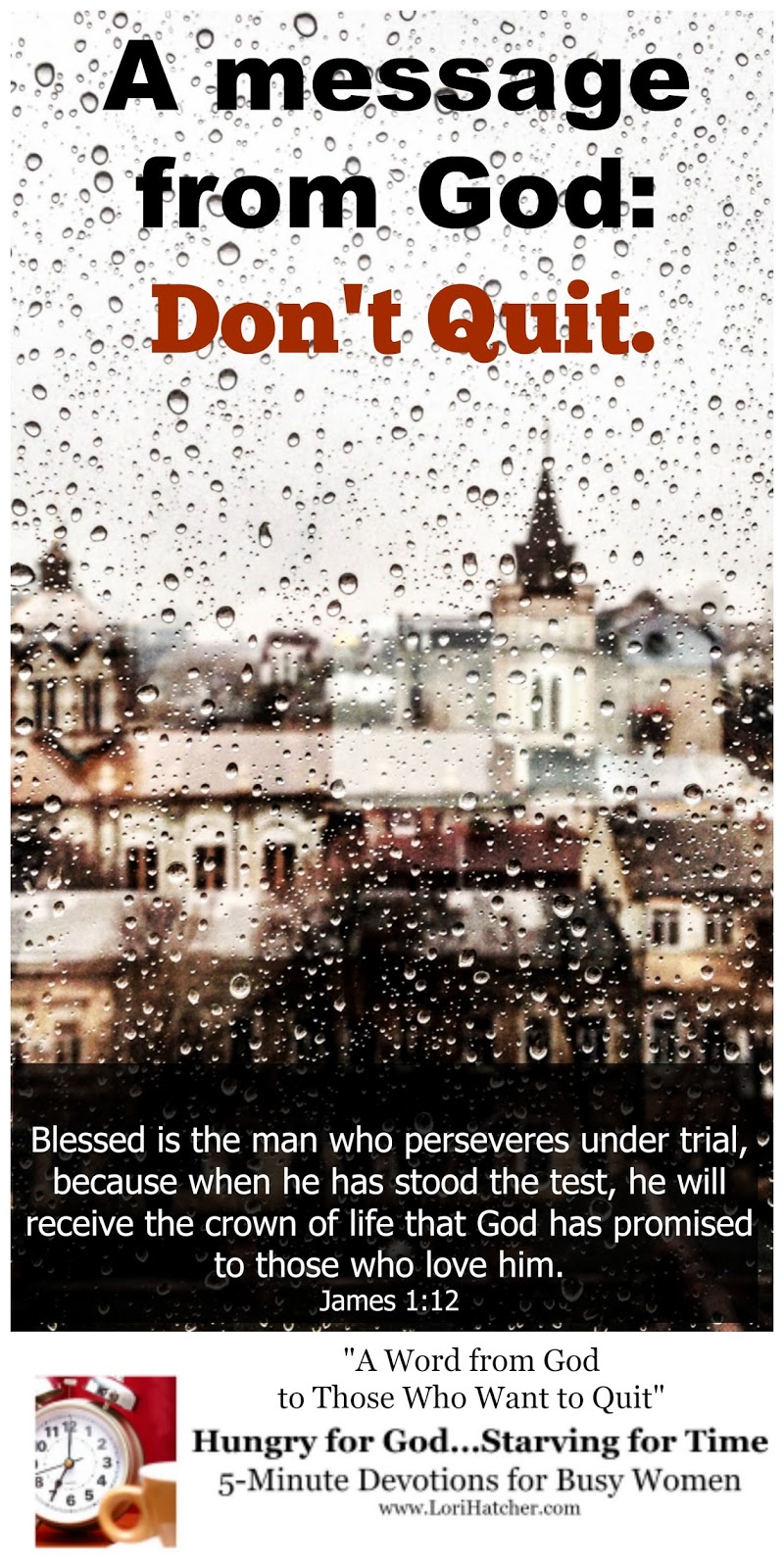
Your flesh wants to quit, but the Spirit of Christ that lives inside you will give you the ability to hold on. And not just hold on, but be victorious. When you are weak, Jesus will be strong in you. When you think you can’t take another step, pray another prayer, or survive another day, you will, because Christ will strengthen you. And when you get through this—and you will—your faith will be stronger, your testimony will shine, and you will receive the crown of life that God promises to those who persevere under trial (Jas. 1:12).
Dear friend, don’t quit. One day very soon, it will be worth it all.
Now it's your turn. When have you encountered a situation where you wanted to quit but you didn't?What happened when you persevered?
If you're reading by email and can't see the video, click HERE to see Mandisa's "You're an Overcomer."
If you enjoyed this post, why not subscribe? I'll send you twice-weekly 5-minute devotions to help nourish your soul.
Because women need to connect with God in the craziness of life.
Enter your email address and VALIDATE the Feedburner email sent to your inbox.
Delivered by FeedBurner
If this post was meaningful to you, would you consider sharing it with a friend by clicking on one of the buttons below? Did you know you can receive bi-weekly Hungry for God posts sent directly to your email inbox? Visit http://www.lori-benotweary.blogspot.com and click on the link in the right hand corner to Subscribe Via Email.
Copyright 2012 by Lori Hatcher
 If you feel like you cannot live another day in a loveless marriage, I’m talking to you.
If you feel like you’re holding on by your financial fingernails, I’m talking to you.
If you feel like you cannot pray another prayer for a sick loved one, a wayward child, or a hardhearted spouse, I’m talking to you.
If you feel like you’re the only one doing what’s right while the rest of the world rides the bullet train to destruction, I’m talking to you.
If you feel like you’re the only one committed to remain sexually pure, I’m talking to you.
The rest of you may leave the room.
For those who remain, here’s what the Lord wants to say to you today: You cannot quit.
Why?
 Because Christians don’t quit.
Christians persevere under suffering.
Christians remain faithful during dark times.
Christians pray even when nothing happens.
Christians keep believing even when everyone else gives up.
They say with Job, “Even though he slay me, I will continue to trust in him.”
They say with Shadrach, Meschach, and Abednego, “Our God is able . . . but even if he doesn’t, we will not bow.”
They say with Jacob, “I will not let you go until you bless me.”
They say with Stephen, “Forgive them, Lord, for they know not what they do.”
They say with Jesus, “Into your hands I commit my spirit.”
Your flesh wants to quit, but the Spirit of Christ that lives inside you will give you the ability to hold on. And not just hold on, but be victorious. When you are weak, Jesus will be strong in you. When you think you can’t take another step, pray another prayer, or survive another day, you will, because Christ will strengthen you. And when you get through this—and you will—your faith will be stronger, your testimony will shine, and you will receive the crown of life that God promises to those who persevere under trial (Jas. 1:12).
Dear friend, don’t quit. One day very soon, it will be worth it all.
Now it's your turn. When have you encountered a situation where you wanted to quit but you didn't?What happened when you persevered?
If you're reading by email and can't see the video, click HERE to see Mandisa's "You're an Overcomer."
If you enjoyed this post, why not subscribe? I'll send you twice-weekly 5-minute devotions to help nourish your soul.
Because women need to connect with God in the craziness of life.
Enter your email address and VALIDATE the Feedburner email sent to your inbox.
Delivered by FeedBurner
If this post was meaningful to you, would you consider sharing it with a friend by clicking on one of the buttons below? Did you know you can receive bi-weekly Hungry for God posts sent directly to your email inbox? Visit http://www.lori-benotweary.blogspot.com and click on the link in the right hand corner to Subscribe Via Email.
Copyright 2012 by Lori Hatcher
Refresh Blog

A place to refresh your faith, hope, and prayers with 5-minute weekly posts.
- Lori Hatcher's profile
- 101 followers

