
Jerome R. Corsi's Blog, page 353
May 21, 2013
State Dept. 'leaking false info to smear whistleblower'

Victoria Toensing and Gregory Hicks during the May 8 hearing of the House Oversight and Government Reform Committee on the Benghazi attack
The State Department has been leaking to reporters false information to discredit Benghazi whistleblower Gregory Hicks, charged his legal counsel, Victoria Toensing, in an interview with WND.
Hicks, who testified May 8 before the House Oversight and Government Reform Committee, is the former State Department deputy chief of mission who was in Libya at the time of the Benghazi attack.
Toensing told WND the State Department has been telling reporters that U.S. Ambassador Christopher Stevens could not reach Hicks by telephone on the night he was killed in the terrorist attack, Sept. 11, 2012, because Hicks was relaxing, watching television, and did not have his telephone with him.
“This is a total fabrication,” Toensing charged. “Telephone reception in Libya is notoriously unreliable. Sometimes you just don’t get your calls. And besides, the record will show Hicks reached Stevens by telephone within five or 10 minutes at the most after Stevens first telephoned him.”
Toensing said several reporters, whom she declined to identify, have called her to ask if the story about Hicks being AWOL at the time of the Benghazi attack was true.
“I have reason to believe the reporters calling me got their information from sources within the State Department,” Toensing added.
At WND’s urging, Toensing identified one reporter she believed had been leaking false information about her client.
“The State Department correspondent from CBS, Margaret Brennan, called me and asked if it was true my client had a history of ‘yelling at people’ within the State Department,” Toensing explained.
“Mr. Hicks is so mild-mannered I cannot imagine him yelling at anyone,” Toensing said she explained to Manning, adding that any such information the reporter obtained from State Department insiders speaking off the record should be disregarded.
After leaving voice mail messages, WND was unable to contact Brennan for comment.
Toensing told WND she believes the State Department’s motivation for spreading false information about her client is not only to discredit him but to deter others.
“The State Department is spreading this malicious information not only because they want to ruin my client’s career, but also because they want to make to make Mr. Hicks an example so no one else comes forward,” she said.
“The State Department goal is to show what they can do to people, how easy it is to ruin their careers by spreading false information.”
‘Hicks responded promptly’
According to the testimony Hicks gave the House Oversight and Government Reform Committee, he was in his villa relaxing, watching a television show, at 9:45 p.m. local time on Sept. 11, 2012, but he had his telephone with him.
He noted the time because Regional Security Officer John Martinec came into his villa yelling that the consulate was under attack.
“And I stood up and reached for my phone because I had an inkling or thought that perhaps the ambassador had tried to call me to relay the same message,” Hicks testified. “And I found two missed calls on the phone, one from the ambassador’s phone and one from a phone number I didn’t recognize.”
Hicks told the House committee that he punched the phone number he did not recognize and immediately got the ambassador on the other end. That is when Hicks testified Ambassador Stevens told him, “Greg we’re under attack.”
Toensing told WND Hicks reached Stevens by phone at approximately 9:50 p.m. local time, less than 10 minutes after he missed the call from Stevens.
Hicks continued his testimony to note that after reaching Stevens by phone, he walked to the Tactical Operations Center, where he tried both of the numbers, the unknown number and the ambassador’s number, only to get no response.
That’s when John Martinec was on the phone in Benghazi with Alec Henderson, the regional security officer at the Benghazi compound.
Hicks said Martinec explained the unknown number belonged to Scott Wickland, Stevens’ personal escort for the night.
At approximately 10 p.m., Hicks called the operations center at the State Department in Washington, D.C., to report the attack, according to his testimony to the House committee.
According to the State Department background briefing on the Benghazi attack issued Oct. 9, 2012, the first indication the U.S. personnel at the Benghazi compound had that they were under attack was at 9:40 p.m. local time, when the agent in the Tactical Operations Center and the agents in Building C of the Benghazi compound heard loud noises from the front gate, as well as gunfire and an explosion.
The State Department timeline indicates that there was only 15 minutes between the start of the Benghazi attack at 9:45 p.m. local time and the time Hicks called the State Department in Washington, to inform the D.C. staff that the Benghazi compound was under attack.
The timeline is consistent with Toensing’s insistence that, at most, five to 10 minutes passed between the phone call from Stevens that Hicks missed and the phone call Hicks made to Stevens, connecting with the ambassador when Hicks left his villa and went to the Tactical Operation Center at the U.S. Embassy in Tripoli.


May 19, 2013
Benghazi 'cover-up to protect Hillary'
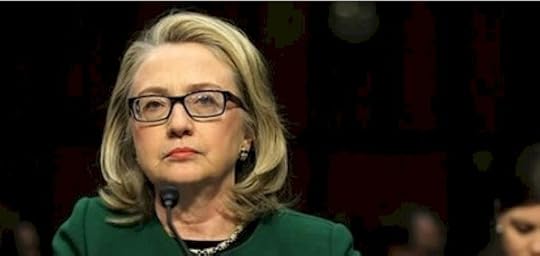
Former U.S. Secretary of State Hillary Clinton
Ambassador Christopher Stevens was in Benghazi on Sept. 11, 2012, the day he died in a terrorist attack, because Secretary of State Hillary Clinton ordered him there, according to an exclusive statement given to WND by the attorney representing Gregory Hicks, the former State Department deputy chief of mission and chargé d’affairs who was in Libya at the time of the attack.
Victoria Toensing, legal counsel to Hicks, told WND that Hillary Clinton had given Stevens direct instructions to prepare the CIA compound in Benghazi to be upgraded to the status of a U.S. diplomatic mission and Stevens, in complying with Clinton’s wishes, was in Benghazi the first time he had the opportunity to do so, cognizant of the need to visit the site before the end of the fiscal year, on Sept. 30, 2012.
“Stevens was in Benghazi because Clinton told him to go there,” Toensing explained.
Hicks’ attorney also charged the Accountability Review Board, or ARB, headed by Ambassador Thomas Pickering and Admiral Michael Mullen, was a cover-up designed to contain blame for the Benghazi terror attack at a level below Secretary of State Hillary Clinton in the State Department.
On page 34 of its unclassified final report, the ARB stated: “The Ambassador chose to travel to Benghazi that week, independent of Washington, as per standard practice.”
This, Toensing charged, is a complete misrepresentation of the truth despite the attempt of her client, Gregory Hicks, to explain in his testimony to the ARB that Stevens went to Benghazi on Clinton’s specific and go to Benghazi before Sept. 30, 2012, to establish Benghazi as a permanent State Department facility.
Why was Stevens in Benghazi?
The sworn testimony Hicks gave the House Oversight and Government Reform Committee on May 8, 2012, supports Toensing’s contention that Stevens was in Benghazi on Sept. 11, 2012, because Clinton had ordered him to go there and he was running out of time to comply with her request.
Under questioning from Rep. Lankford, R-Okla., Hicks explained: “According to [Ambassador] Chris [Stevens], Secretary Clinton wanted Benghazi converted into a permanent constituent post. Timing for this decision was important. Chris needed to report before Sept. 30, the end of the fiscal year, on the physical and the political and security environment in Benghazi to support an action memo to convert Benghazi from a temporary facility to a permanent facility.”
Hicks explained the directive came from the State Department Office of Near Eastern Affairs, headed by Acting Assistant Secretary Beth Jones, that funds were available to be transferred to Benghazi from a State Department fund set aside for Iraq available, provided the funds transfer had been obligated by September 30.
He further testified that in May 2012, during his exit with Secretary Clinton following his being sworn in as U.S. Ambassador for Libya, Stevens promised he would give a priority to making sure the U.S. facility at Benghazi was transformed into a permanent constituent post.
Under further questioning directed by Rep. Tony Cardenas, D-Calif., Hicks explained Stevens further delayed his trip to Benghazi because of security concerns expressed by State Department Regional Security Officer John Martinek.
“The two planning meetings we had with the ambassador about his trip to Benghazi, the RSO John Martinek raised serious concerns about his travel,” Hicks explained. “Because of those concerns, the ambassador adjusted his plans for that trip.”
Hicks detailed in response to Martinek’s concerns, Stevens mad three modifications to his plan to visit Benghazi in September 2012.
“First, he agreed he would go in a low-profile way and his trip would not be announced in advance,” Hicks continued. “We would not do any planning of meetings until right before he went. And second, he eventually decided to shorten his trip. He had initially planned to go on October 8, he went on the 10th instead to narrow the time frame he would be in Benghazi. The third step he took was the one public event that he planned would take place at the very end of his trip, just before he left.”
Hicks also explained Stevens wanted to make a symbolic gesture to the people of Benghazi that the United States “stood behind their dream of establishing a new democracy.”
Additionally, he wanted to have the Benghazi complex upgraded to a permanent constituent post, so Secretary Clinton could make this announcement in her planned visit to Libya before the end of 2012.
Hicks told the committee Stevens did listen to advice, but he was very determined and committed to doing his job.
“He went there [to Benghazi] to do his job,” Hicks testified. “He felt he had a political imperative to go to Benghazi to represent the United States there in order to move the project to make the Benghazi consulate a permanent constituent post.”
Toward the end of the hearing, the chairman, Rep. Darrell Issa, R-Calif., asked Hicks to summarize his testimony on why Stevens went to Benghazi.
“At least one of the reasons Ambassador Stevens was in Benghazi was to further the Secretary’s wish that that post become a permanent constituent post and that he was also there because we understood the Secretary intended to visit Tripoli later in the year,” Hicks reiterated. “We hoped that she would be able to announce to the Libyan people the establishment of a permanent constituent post in Benghazi at that time.”
Hicks emphasized that the State Department was aware of increased risks posed by Islamic extremists in eastern Libya and that Stevens was aware the Benghazi compound did not meet State Department security requirements.
Still, despite the security risk, Stevens was determined to comply with Clinton’s wishes to visit Benghazi prior to her planned visit to Libya.
The ARB report a ‘cover-up,’ attorney charges
The unclassified ARB final report on page 18 states: “Ambassador Stevens was scheduled to remain in Benghazi until September 14, and his visit was timed in part to fill the staffing gaps between TDY [Temporary Duty Assignment] principal officers as well as to open an American Corner at a local school and to reconnect with local contacts.”
Hicks testified to the House oversight committee that in direct contrast to this ARB claim, the State Department in Washington was fully aware of the plans Stevens made to go to Benghazi, the reasons he was going there, and his planned activity while there.
“The ARB unclassified final report was incomplete in that the reason for Stevens being in Benghazi was known to Hicks, but the ARB ignored the testimony Hicks gave on this point,” Toensing further explained to WND.
Hicks elaborated on this point by commenting to the House oversight committee that when he told the ARB the reason Stevens went to Benghazi, Ambassador Pickering looked visibly upset and asked, “Does the 7th Floor [where the office of Secretary of State Clinton is located] know about this?”
Toensing also explained to WND no stenographer was present at the ARB to record the testimony of witnesses, so no verbatim transcript could be made of each witness testimony; instead, the ARB took merely took notes of witness testimony.
She further objected the ARB never permitted Hicks to review the notes regarding his testimony so he could suggest corrections and point out any omissions; nor did the ARB allow Hicks to review the notes taken of his testimony and sign off on their accuracy.
“Everybody is missing that the ARB is a big story here,” Toensing said, explaining she was turned down or canceled on more than one network television interview, including ABC and CNN, when producers learned she wanted to expose ARB deficiencies. “The ARB not only omitted the reason Stevens went to Benghazi, when my client had explained to the ARB the reasons, the ARB actually put in a false statement regarding why Stevens was there the night of the attack.”
Toward the conclusion of the House hearing on May 8, Hicks and Eric Nordsrtom, the State Department regional security officer in Libya during the attack, both argued the ARB had assigned blame for the Benghazi tragedy to lower-level State Department officers when they realized Secretary Clinton was fully involved in the decision to send Stevens to Benghazi despite the security concerns.
“The most obvious deficiency in the ARB report was Secretary Clinton was never interviewed for the investigation,” Toensing said.
In an editorial Toensing wrote that was published by the Weekly Standard on May 12, she elaborated on this point: “She [Clinton] is mentioned only once in the [ARB] report, as the person who convened the Board. If, as Clinton herself has said, she took full responsibility for what happened in Benghazi, her decisions and decision-making process are materially relevant for investigating what happened before and during the night of September 11, 2012, and preventing what went wrong from ever happening again.”
May 16, 2013
Anti-Obama filmmaker charges harassment by IRS
NEW YORK – Amid disclosures of IRS harassment of conservatives, the maker of the controversial film “Dreams from My Real Father” now suspects he was the victim of tag-team harassment by the IRS and a leftist journalist apparently working in concert to intimidate him and his investors.
WND previously reported director Joel Gilbert was concerned a journalist investigating his documentary used information that could only have been obtained by hacking into his company’s bank account.
Gilbert now believes the confidential information supplied to the journalist could have come from a continuing IRS audit initiated in early 2012, possibly in retaliation for Gilbert’s documentary arguing Frank Marshall Davis is the president’s biological father, not the Kenyan Barack Obama.
Gilbert says the IRS in Los Angeles may have provided confidential information on his corporate financing to Seth Rosenfeld, a San Francisco-based reporter affiliated with the Soros-funded Center for Investigative Reporting. Rosenfeld, in turn, used the guise of writing a story as an excuse to telephone and confront Gilbert’s financial backers with details of their financial transactions recorded in Gilbert’s corporate bank accounts.
In an email to WND, Rosenfeld denied the IRS was the source of his information identifying Gilbert’s customers and investors and providing specification of their financial transactions as recorded in Gilbert’s corporate bank account.
In responding to questions posed by WND, Rosenfeld declined to disclose how he came to possess the detailed financial information he exhibited when telephoning Gilbert and various Gilbert customers and investors claiming he was researching a story.
Gilbert told WND he is meeting with legal counsel later this week to determine if he has a cause of civil or criminal legal action against the IRS and/or Rosenfeld.
IRS audit
In early 2012, the IRS reopened Gilbert’s 2009 tax return and denied all of his business expenses, even though they were well documented.
To resolve the issue, Gilbert’s accountant met the IRS auditor in Los Angeles.
“To our shock, the IRS agent who met with my accountant had a printout of the home page of the “Dreams from My Real Father” official film website on her desk,” Gilbert told WND.
Despite Gilbert resubmitting the 2009 expenses, the IRS has still not closed the case, with the next meeting between Gilbert’s account and the IRS set for next week.
The IRS spokesman in Los Angeles did not respond to a WND request for comment.
How did journalist know?
Gilbert began to suspect the IRS had distributed his information to left-leaning journalists when Rosenfeld telephoned him Oct. 26, 2012, near the end of the presidential campaign, and began citing specific deposits from Gilbert’s corporate bank account, asking Gilbert to explain the purpose of the deposits.
Rosenfeld is listed on the Center for Investigative Reporting website as a “correspondent,” suggesting he does not have a staff position with the organization.
The Center for Investigative Reporting did not respond to a WND request for comment.
“I was so shocked that Rosenfeld had my confidential bank information that I asked him to send me an email detailing his questions and hung up,” Gilbert said. “Not surprisingly, Rosenfeld never sent me the email I asked for.”
Next, Gilbert told WND, Rosenfeld called one of Gilbert’s corporation’s limited partners on his private telephone number, fraudulently introduced himself as being with the Romney campaign and asked for a campaign donation.
“When my business partner said he wasn’t interested, Rosenfeld admitted to being a reporter and began citing my partner’s confidential bank wiring history sending funds to my corporate account,” Gilbert explained. “My partner hung up on him.”
Next, Rosenfeld called the elderly mother of a Gilbert customer who had purchased a large number of “Dreams from My Real Father” DVDs and paid for them by check.
“Rosenfeld tricked the woman into giving out her son’s home phone number by pretending to be an old friend,” Gilbert continued. “When Rosenfeld called the customer, he cited the amount of the check and asked the customer about his political opinions. Not being satisfied at this, Rosenfeld asked if my customer could identify by name any others he knew had made similar large purchases of my DVD.”
Gilbert told WND he has documented that Rosenfeld contacted several of his customers on their private unlisted phone numbers, citing for them various payments or wire transfers to Gilbert’s corporate account. Rosenfeld asked the customers for their political opinions and whether or not the customers had made any campaign contributions to Republicans, including to presidential candidate Mitt Romney.

Joel Gilbert
Gilbert told WND he now believes an IRS leak was the likely source of Rosenfeld’s information.
He also believes Rosenfeld’s phone calls, armed with specific records regarding customer transactions in Gilbert’s corporate banking account, has damaged his business.
“My private banking information was used to intimidate investors and purchasers of ‘Dreams from My Real Father,’ Gilbert told WND. “I could no longer in good conscience seek out new investors knowing that their transactions could not be kept private. I will be meeting with my attorneys this week in Los Angeles to discuss legal options and recourse.”
Reporter responds
“It is true that as a freelance journalist I was researching a story about people who anonymously funded the distribution of the Joel Gilbert film that attacks President Obama, claims his election is a part of a vast communist conspiracy and displays pornographic photos of his mother,” Rosenfeld emailed WND in response to a request for comment.
Rosenfeld denied that he misrepresented himself or engaged in any improper or illegal conduct.
“I spoke with Gilbert twice on the phone and at his request sent him an email seeking his reply to my inquiry,” Rosenfeld continued. “He declined to comment in our phone conversations, did not call me back and did not respond to my email.”
Rosenfeld said he again sought comment from Gilbert by phone and email and never got a response.
Rosenfeld denied that he received any information concerning Gilbert’s corporate accounts from the IRS.
He also denied representing himself as being associated with the Romney campaign, and he denied asking any of Gilbert’s contacts for contributions to the Romney campaign.
Gilbert rejoined Rosenfeld’s charges, arguing that Rosenfeld’s negative characterization of “Dreams from My Real Father” raised the question of whether Rosenfeld had actually viewed the DVD.
“The response further reinforces my concern that Rosenfeld was recruited to do the dirty work, to intimidate me from continuing to market the firm, for political purposes on behalf of higher powers,” Gilbert said.
Gilbert told WND that he and the customers and investors Rosenfeld contacted have documented all phone calls and conversations for presentation in any legal proceedings that may occur.
“Rosenfeld and those who provided him with my private bank information should come clean now, because the story will only get bigger if they do not,” Gilbert threatened.
‘Political harassment’
Gilbert believes the IRS and Rosenfeld targeted him for political reasons.
“Why didn’t Rosenfeld publish anything from his investigations into my film and my investors?” Gilbert asked.
“I believe I was targeted because ‘Dreams from My Real Father’ exposes Obama as a pathological liar,” he said. “Obama intentionally obscured a deeply disturbing family background in order to hide a Marxist agenda, completely incompatible with American values. It was an unacceptable manipulation of the electorate and unquestionably the biggest scandal in American history.”
He also believes the IRS and Rosenfeld may have been working together to intimidate investors and discredit his film by identifying him as a Republican Party operative.
“The fact that the IRS targeted me and Rosenfeld subsequently made his phone calls suggests to me they were working in concert, both equally afraid of the information in my film becoming public knowledge,” Gilbert charged.
“President Obama is not the son of a Kenyan goat herder who stands above politics. I demonstrated in my documentary that Obama is the child of Communist Party USA member and Soviet Agent Frank Marshall Davis. I also presented compelling evidence that Davis indoctrinated Obama into his Marxist ideology during his formative years.”
Gilbert believes Rosenfeld was not being sincere in his representation that he was writing an article but that his true intent was intimidation.
“The use of the Internal Revenue Service to intimidate Americans is criminal,” Gilbert asserted. “A conspiracy to deny the First Amendment rights of free speech to Americans is criminal.”
Gilbert’s documentary “Dreams from My Real Father” has been available at the WND Superstore since it was produced and also on Amazon.com and Netflix.
During the presidential campaign, WND reported Gilbert mailed more than 3 million free copies of the documentary to voters in swing states.
Fox News reported in May 2012 that the Center for Investigative Journalism has received close to $1 million from the George Soros-funded Open Society Foundation.
Gilbert is also producer of the 2012 award winning documentary “Atomic Jihad: Ahmadinejad’s Coming War and Obama’s Politics of Defeat.”
Rosenfeld is the author of the 2012 book “Subversives: The FBI’s War on Student Radicals, and Reagan’s Rise to Power.” In the book, he objects to what he characterizes as Ronald Reagan’s involvement for political purposes in a covert war the FBI waged in the 1960s against anti-war student radicals.
Note: There is a poll embedded within this post, please visit the site to participate in this post's poll.
May 14, 2013
Stevens killed to avenge U.S. drone strike?
The attack Sept. 11, 2012, attack that killed the U.S. ambassador to Libya and three other Americans took place one day after al-Qaida chief Ayman al-Zawahiri called for retaliation for a U.S. drone strike that killed a top Libyan al-Qaida leader.
WND reported Nov. 4, 2012, that the Benghazi terrorist attack was organized by Libyan terrorist groups in response to Zawahiri’s request to avenge the U.S. drone killing in Pakistan’s Waziristan tribal area on June 4, 2012, of Libyan al-Qaida leader Abu Yahya al-Libi.
The New York Times reported Libi had a $1 million bounty on his head and was “a virtual ambassador for global jihad” who used frequent video appearances to boast of his escape from a U.S. military detention center at Bagram Air Base outside Kabul, Afghanistan, in 2005.
Internationally, news sources noted that Libi was considered a global propaganda mastermind and that his death represented the greatest blow to al-Qaida since U.S. Navy SEALs killed Osama bin Laden in Pakistan in May 2011.
In August 2011, a CIA drone strike killed Libi’s predecessor, Atiyah Abd al-Rahman, also a Libyan. At the time of his death, Rahman was acting as al-Qaida chief of operations.
Despite the video in which Zawahiri called for retaliatory attacks on U.S. facilities in the Middle East, the U.S. State Department and the CIA appear to have been caught flat-footed and unprepared for the Benghazi attack.
WND reported Monday the personal effects of Stevens are in the possession of an Islamic terrorist currently at large in Libya, according to WND’s Libyan exile sources.
‘The Lion of Knowledge and Jihad’
The Zawahiri video released to coincide with the anniversary of the 9/11 attacks was his 13th statement in 2012, titled “The Lion of Knowledge and Jihad: Martyrdom of al-Sheikh Abu Yaha al-Libi. The 42-minute video confirmed Libi was killed in a drone strike in Pakistan’s Waziristan tribal area on June 4, 2012, and called for revenge attacks, especially in Libya.
On Sept. 15, 2012, an Agence France-Presse report cited al-Qaida claims that the attack on the U.S. consulate in Benghazi was in revenge for the killing of Libi, according to monitoring by the Search for International Terrorist Entities (SITE) Intelligence Group.
“The killing of Sheikh Abu Yahya only increased the enthusiasm and determination of the sons of (Libyan independence hero) Omar al-Mokhtar to take revenge upon those who attack our Prophet,” said Al-Qaida in the Arabian Peninsula in a statement quoted by SITE.
The AFP report, published by the Tribune in Pakistan, quoted Mohammad al-Megaryef, the head of Libya’s national assembly, who said the attack on the U.S. facility in Benghazi was planned and “meticulously executed.”
Al-Qaida leader calls for revenge
On Sept. 11, 2012, the day of the Benghazi attack, Rob Crilly, reporting from Islamabad, Pakistan, for the Telegraph of London, published a clip from the 42-minute video Zawahiri video, which was released during the Islamic holy month of Ramadan to coincide with the 9/11 attacks.
“I proudly announce to the Muslim uuma and to the Mujahideen … the news of the martyrdom of the lion of Libya Sheik Hassan Mohammed Qaed,” Zawahiri said in the video, referring to Libi by his birth name, rather than his nom de guerre.
The public record shows that after Zawahiri’s video was released calling for revenge, several attacks were on-going in the hours before the Benghazi attack, which began around 9:45 p.m. local time.
U.S. under attack
In his testimony before the House Oversight and Government Reform Committee in Washington last week, Gregory Hicks, former deputy chief of mission to Libya, made clear he sent a text message to Ambassador Chris Stevens in Benghazi early in the day on Sept. 11, 2012, warning Stevens that the U.S. Embassy in Cairo was under attack.
“As I remember, Sept. 11, 2012, it was a routine day at our embassy, and until we saw the news about Cairo – and I remember sending a text message to Ambassador Stevens saying, ‘Chris, are you aware of what’s going on in Cairo?’ and he said ‘No,’” Hicks testified. “So I told him that the embassy – in another text – that the embassy had been stormed, and they were trying to tear down our flag. And he said, ‘Thanks very much.’ And, you know, then I went on with business.”
Hicks’ testimony suggests that the State Department had not made him aware of a possible connection between the attack on the U.S. Embassy in Cairo and the Zawahiri video calling for revenge.
Yet in the week of the attack, anti-U.S. demonstrations and riots broke out against in Tunisia outside the U.S. Embassy as well as in Yemen, Pakistan, Jordan and India.
‘The Innocence of Muslims’
On Sept. 13, 2012, the New York Times published a report datelined Sana, Yemen, that echoed the Obama administration narrative: “Deadly outrage in the Arab world over an American-made video insulting Islam’s founder spread to at least half a dozen places across the Middle East on Thursday and threatened to draw in Afghanistan, two days after assailants in Libya killed four American diplomatic personnel, including the ambassador, and caused a foreign policy clash in the United States.”
The film in question was a crudely produced 14-minute “trailer” called “The Innocence of Muslims,” made by Egyptian-born Coptic Christian Nakoula Basseley Nakoula, a U.S. resident. The trailer was dubbed into Arabic and posted on YouTube in September 2012.
An article published in a New York Times online blog by Robert Mackay and Liam Stack on Sept. 11, 2012, hours before the Benghazi attack, with the title, “Obscure Film Mocking Muslim Prophet Sparks Anti-U.S. Protests in Egypt and Libya” featured the offensive film trailer.
The U.S. Embassy in Cairo tweeted a curious response to the Mackay/Stack piece, posted at 5:29 p.m., Sept. 11, 2012, also hours before the Benghazi attack curiously read: “Sorry, but neither breaches of our compound or angry messages will dissuade us from defending freedom of speech AND criticizing bigotry.”
The Wall Street Journal on Sept. 12, 2012, in an article authored by Matt Bradley and Dion Nissenbaum, entitled “U.S. Missions Stormed in Libya, Egypt,” advanced the Obama administration narrative in the wake of the Benghazi attack, with the article apparently written before the news fully broke that Ambassador Stevens and three other Americans had died in the attack
“In Benghazi, Libya, several gunmen from an Islamic group, Ansar al Sharia, attacked the consulate with rocket-propelled grenades to protest the film, a deputy interior minister for the Benghazi region told the Al-Jazeera network,” the Wall Street Journal article read. “A government brigade evacuated the consulate, after which militants set it on fire, said the minister, Wanees Sharef. One State Department officer was killed in the attack on Benghazi, Secretary of State Clinton said.”
A terrorist attack ‘from the get-go’
By Sept. 12, 2012, problems with the narrative blaming the Benghazi attack on the anti-Islamic movie began to surface once reporters learned video of the attack showed well-armed Islamic assailants besieging the CIA compound.
Hicks told the House panel last week that the U.S. Embassy in Tripoli immediately realized the attack in Benghazi was an organized terrorist attack, not a protest against the movie trailer.
Hicks testified the last words he heard Ambassador Stevens speak, via telephone, was: “Greg, we are under attack.”
In his pre-testimony interviews with the staff of the House Oversight and Government Reform Committee, Hicks said everyone in the U.S. mission in Benghazi thought the attack was an act of terror “from the get-go.”.
Hicks was asked: “Did you ever have any indication that there was a protest, a popular protest, outside the mission in Benghazi?”
Hicks responded, “No.”
He added that for there “to have been a demonstration on Chris Stevens’ front door and him to not have reported it is unbelievable.”
Libyan al-Qaida led Benghazi attack
WND reported in October that Abdul Hakem Belhaj, the head of al-Qaida in Libya, led the Benghazi attack with the backing of Mohammad Abdullah Aqil, the wealthy owner of a Mercedes car dealership in Tripoli who is reputed to be a principal funder of al-Qaida in Libya.
Under Muammar Gadhafi’s rule, Aqil worked with Abdullah Sanusi of Gadhafi’s secret service, providing the financing to implement logistics that were aimed to carry out assassinations of anti-Gaddhafi Libyan expatriates living in France, Lebanon, Egypt and Greece.
After falling out of favor with Gadhafi, Aqil was put in prison for six months, during which time he turned against Gadhafi.
After Gadhafi was killed, Aqil began working closely in Libya with Abdul Hakem Belhaj, the chief al-Qaida operative that reliable Libyan expatriate sources have identified to WND as the person most responsible for organizing and directing the terrorist attack that killed Stevens.
In 1992, after the Mujahideen took Kabul, Belhaj traveled across the Middle East and Eastern Europe, before returning to Libya to form the Libyan Islamic Fighting Group (LIFG), which failed to overthrow Gadhafi in two decades of fighting.
When President Obama and Secretary of State Hillary Clinton expressed support for the Libyan revolution and engaged with NATO in military action against Libyan military forces loyal to Gadhafi, Belhaj became the leader of the Misrata revolutionaries who ultimately captured Tripoli and ousted Gadhafi.
After Gadhafi was deposed and murdered, Aqil reportedly applied his wealth to assisting Belhaj in supplying vehicles and military equipment for Libyan revolutionaries and al-Qaida terrorists opposed to the regime imposed on Libya by the U.S. and NATO.
Ian Black, Middle East editor for the Guardian of London, in an article titled “The Libyan Islamic Fighting Group – from al-Qaida to the Arab Spring,” published a year before the Benghazi attack, named Belhaj as the “most prominent” person in the Benghazi-based Libyan rebel movement and the commander of the Tripoli military council that spearheaded an attack on the Gadhafi compound in October 2011.
“Belhaj, better known in the jihadi world as Abu Abdullah al-Sadiq, was released with 200 other LIFG leaders or suspected members from Tripoli’s notorious Abu Salim prison after the group collectively recanted and severed its ties with al-Qaida, saying that ‘indiscriminate bombings’ and the ‘targeting of civilians’ were not in accordance with its objectives,” Black wrote.
Black also noted that Belhaj’s radical past and his ties to al-Qaida had been the focus of British MI6 intelligence gathering efforts for the past 20 years.
Note: There is a poll embedded within this post, please visit the site to participate in this post's poll.
May 13, 2013
'Terrorist has personal effects of slain U.S. ambassador'
NEW YORK – The personal effects of slain U.S. Ambassador Christopher Stevens are in the possession of an Islamic terrorist currently at large in Libya, according to information provided exclusively to WND by reliable expatriate Libyan sources in exile.
According to the expatriate Libyans, Stevens’ personal belongings – including his camera, cell phone, identification papers and various private documents – are being kept locked in a safe in the possession of Wesam Bin Hameed in Libya.
Bin Hameed has been identified as an Islamic extremist in Benghazi who allegedly participated in the terrorist attack Sept. 12, 2012, attack in Benghazi that led to Stevens’ death.
No U.S. authorities, including the FBI, have questioned Bin Hameed regarding the Benghazi attack. At present, according to the sources, he is roaming freely in Benghazi, where he continues to threaten to shoot any Libyans who dare protest against the various Islamic terror gangs and militia that currently exert unofficial authority in the streets of Tripoli and Benghazi.
Libyan newspapers have identified Bin Hameed as the chairman of the Supreme Revolutionaries Committee comprising 280 members of Islamic militia all over Libya.
During the civil war that ousted Muammar Gadhafi and led to his murder, Bin Hameed was cited by international news sources as brigade commander of the Martyrs of Free Libya Brigade.
Bin Hameed does not appear to be among the three Libyans the FBI currently wants for questioning in the on-going Benghazi investigation.
On Dec. 19, 2012, WND published a 19-second video obtained from the same Libyan expatriate sources that apparently shows the body of Stevens in a morgue in Benghazi.
WARNING: Video contains graphic images
Amateur video shows Stevens, apparently alive and still breathing, being pulled out of a room by Libyans apparently participating in the terrorist attack.
Various amateur videos still posted on YouTube also show Stevens being found by Libyans in the U.S. compound at Benghazi, although it is not clear from the videos that he was alive at the time his body was found.
The videos and the report Bin Hameed currently has custody of Stevens’ personal effects confirm testimony Gregory Hicks, former deputy chief of mission to Libya, gave to the House Oversight and Government Reform Committee in Washington last week. Hicks said U.S. authorities lost track of Stevens’ body during the Benghazi attack.
‘They did not find the ambassador’
Hicks testified that during the night of the attack, reports were received in the Tactical Operations Center at the U.S. Embassy in Tripoli that Libyans had taken Stevens’ body to a hospital in Benghazi controlled by Ansar al-Sharia, the group that Twitter feeds had identified as leading the attack on the U.S. compound in Benghazi.
When the government in Tripoli tried to tell Hicks that Stevens was “in a safe place,” implying Stevens was with U.S. personnel in the annex in Benghazi, Hicks insisted that was incorrect.
“Our contacts with the government in Tripoli are telling us that the ambassador is in a safe place, but they imply that he is with us in the annex in Benghazi, and we keep telling them no, the – he is not with us,” Hicks said. “We do not have his – we do not have him.”
According to Hick’s testimony, U.S. personnel in Benghazi and Tripoli lost possession of Stevens’ body after regional security officers on scene in Benghazi were unable to pull Stevens’ body out of the burning Villa C because of the exposure to the extremely toxic Cyanide gas being emitted by the petroleum fire engulfing the building.
“There were repeated attempts by all of the RSOs and by the response team from the annex to go into the burning building and recover – to try to save Sean [Smith, State Department information management officer] and the ambassador,” Hicks testified. “They found Sean’s body and pulled it out, but he was no longer responsive. They did not find the ambassador.”
Later, as the attack was proceeding into the early hours of Sept. 12, 2012, Hicks received news that Stevens’ body had been recovered and taken to a hospital that was controlled by Ansar al-Sharia, the group that Twitter feeds had identified as leading the attack on the Benghazi compound.
Finally, at 3 a.m. on Sept. 12, 2012, Hicks received authoritative confirmation Stevens was dead.
“At about 3 a.m., I received a call from the prime minister of Libya,” Hicks continued. “I think it is the saddest phone call I have ever had in my life. He told me that Ambassador Stevens had passed away. I immediately telephoned Washington that news afterwards and began accelerating our effort to withdraw from the Villas compound and move to the annex.”
Hicks also made clear the embassy staff in Tripoli had received several phone calls from individuals claiming to have possession of Stevens, evidently before the 3 a.m. call from the Libyan prime minister.
“We suspected we were being bated into a trap, and so we did not want to send our people into an ambush,” Hicks explained. “And we didn’t.”
Hicks did not detail in his congressional testimony last week where Stevens’ body was taken the night of the attack or how and when the U.S. Embassy in Tripoli recovered it.
Nor did Hicks discuss whether or not U.S. authorities recovered personal possessions with Stevens the night of the attack, including his wallet, his ID papers and any other documents he may have had with him when the attack began.
WND was first to report the U.S. diplomatic mission in Benghazi served as a meeting place to coordinate aid for rebel-led insurgencies in the Middle East, according to Middle Eastern security officials.
WND also reported Stevens played a central role in recruiting jihadists to fight Bashar al-Assad’s regime in Syria, according to Egyptian sources.
In November 2012, Middle Easter security sources confirmed the U.S. mission and nearby CIA annex in Benghazi served as the main intelligence and planning center for U.S. aid to the rebels that was being coordinated with Turkey, Saudi Arabia and Qatar.
May 8, 2013
Benghazi whistleblower: 'We were on our own'
WASHINGTON – “Greg, we are under attack,” were the last words whistleblower U.S. diplomat Gregory Hicks, present in Libya at the time of the Benghazi terrorist attack, recalled U.S. Ambassador Christopher Stevens saying to him in a desperate phone call moments before Stevens was killed.
“We were under attack, and we were on our own,” Hicks said today in emotionally charged testimony before the House Committee on Oversight and Government Reform.
Hicks, who was in the Libyan capital, Tripoli, during the attack, summarized the failure of the Obama administration to bring in military resources to save Stevens and the other three Americans killed in an attack that began late in the evening of Sept. 11, 2012, and continued into the early morning hours of the next day.
The other witnesses were Eric Nordstrom, formerly the regional security officer in Libya, and Mark Thompson, a former Marine and official with the State Department’s Counterterrorism Bureau.
Hicks, the deputy chief of mission in Libya at the time of the Benghazi attack, reconstructed today a minute-by-minute account of the attack.
He described it as a four-phase assault that began around 9:45 p.m. local time in Libya and lasted until dawn the next day.
Hicks, who became the top U.S. diplomat in Libya after Stevens was killed, implied political decisions were made not to bring military assets to the scene.
“The night I was involved in this incident I was at my desk at the end of the day when the first reports came in that we had an attack going on at our diplomatic facility in Benghazi,” Hicks testified.
“Later, when I heard Ambassador Stevens had gone to a safe haven and later could not be contacted, I recommended to the White House the deployment of the FAST (Foreign-deployed Advisory and Support Team) team.”
But Hicks said he “was told the FAST response had been taken off the table of options.”
In the early hours of the morning of Sept. 12, as the attack was yet continuing, Hicks was frustrated by the White House’s denial of an urgent request to dispatch four Special Operations troops from Tripoli to Benghazi to help evacuate Americans.
“People in Benghazi had been fighting all night,” he recalled, at times tearing up and having to pause a moment to regain composure. “They were tired, exhausted. We wanted to make sure the airport was secure for their withdrawal.”
But the military personnel were not authorized to travel.
Rep. Jason Chaffetz, R-Utah, asked, “How did the personnel react at being told to stand down?”
“They were furious,” Hicks replied. “I can only say, well, I will quote Lieutenant Colonel Gibson. He said this is the first time in my career that a diplomat has more balls than somebody in the military.”
Hicks insisted a fly-over by U.S. fighter jets would have been sufficient to hold off a later predawn mortar assault.
“In my personal opinion, a fast-moving, fly-over Benghazi at some point, as soon as possible, might very well have prevented some of the bad things that happened that night,” Hicks insisted, acknowledging it might have required the approval of the Libyans to enter Libyan airspace.
“I believe if we had been able to scramble a fighter or two over Benghazi as quickly as possible after the attack commenced, I believe the Libyans would have split. They would have been scared to death we would have gotten a laser on them and killed them.”
Hicks claimed he was told fighter jets could have been over Benghazi within two or three hours, if scrambled immediately out of Aviano Air Base in Italy, but the problem was there was no tanker aircraft available to refuel the aircraft.
Hicks explained he and other diplomats in Tripoli virtually begged the U.S. government to provide a military response, to no avail.
Democrats on the House Committee defended the Obama administration by arguing there was insufficient time to bring military resources to repulse the terror attack.
“It is stunning no one in the Obama administration asked Libya if we could use their airspace to protect our ambassador in Libya,” said Chaffetz, expressing the frustration the Republican members of the committee.
All three witnesses agreed there was no basis for U.N. Ambassador Susan Rice on the Sunday news shows following the Benghazi attack to claim the attack began as a protest of an anti-Islamic film. President Obama and Secretary of State Hillary Clinton repeatedly made that claim in the hours and days after the incident.
Hicks pointedly said he was “stunned” by Rice’s response to the Benghazi attack.
“My jaw dropped and I was embarrassed,” he said.
Hicks was asked if there was any indication of a protest in Benghazi in response to the Internet video.
“The YouTube video was a non-event in Libya,” he said
Hicks testified that throughout the night, he was in contact with Washington.
“About 2 a.m. local Libyan time, Secretary of State Clinton and her staff called for a briefing,” he said.
Hicks recalled that most of that conversation was focused on searching for Ambassador Stevens.
He testified that early in the attack, when the safe-haven area of Benghazi burst into a petroleum fire, Stevens was killed.
About 3 a.m., Hicks received a phone call from the Libyan foreign minister informing him that Stevens was dead and that his body had been moved to a hospital under the control of the Ansar al Sharia Brigade, the Islamic militant group identified as initiating the attack.
After learning the location of Stevens’ body, Hicks described a series of frantic calls made to the facility to learn more about what had happened.
“Have you seen the ambassador?” Hicks recalls asking of anyone who would answer the phone at the hospital facility where he believed Stevens’ body was being held. “Can you send us a picture of the ambassador? Can I speak with the ambassador?”
All three witnesses were extremely critical of the findings of the Accountability Review Board convened by the State Department to investigate the Benghazi attack, charging the testimony of key witnesses who had information critical of the Obama administration was largely ignored.
Asked if he, as someone with a first-hand knowledge of what happened that fateful night, had been interviewed by the FBI, Hicks replied, “No, I was never interviewed by the FBI.”
February 26, 2013
Norquist: Boehner won't cave on taxes
NEW YORK – House Speaker John Boehner will not give in to President Obama’s demand for another tax hike to avoid the sequester, predicts noted tax expert Grover Norquist.
“Boehner is not going to cave,” Norquist told WND in an interview.
“The Republicans in Congress are very comfortable saying the sequester should take effect unless the Democratic Senate and the Democratic president agree to spending cuts of similar size and certainty to the House,” he said.
If Congress does nothing before Friday, $1.2 trillion in spending cuts over the next decade will automatically kick in. Of the $85 billion to be cut between March 1 through September, half will come from the Pentagon.
WND spoke with Norquist after Sen. Ron Johnson, R-Wis., told Fox News that if Boehner agreed to tax increases to avoid the sequester, he would lose his speakership.
“I don’t quite honestly believe that Speaker Boehner would be speaker if that happens,” Johnson said on Monday’s broadcast of Fox News’ “Special Report.”
WND checked with Norquist to see if Johnson might have been alluding to a deal brewing between House Republicans and the White House that had not yet been made public.
“I don’t think so,” said Norquist, president and founder of Americans for Tax Reform. “Boehner has been waiting for this opportunity to get spending restraint. This time, Boehner is holding the cards, not Obama, in that the spending cuts are automatic unless there is a deal, and the Republicans in Congress see no reason to make a deal that involves increasing taxes.”
Norquist believes the Republicans in Congress finally turned the tables to place the Democrats on the defensive over fiscal issues.
“President Obama is spending no time trying to govern,” Norquist said. “He is just trying to posture, trying to make sure the public perceives that if something goes wrong, it’s not his fault.”
Presently, Norquist is confident no revenue negotiations are going on between the White House and House Republicans.
“We are now at the point where Boehner can tell the White House that if Obama has any new ideas, the Senate should just go ahead and pass a new measure,” he said. “Obama knows what the Republicans in Congress can live with. What Obama is going to do is continue campaigning, not work creatively to find any new compromises.”
Norquist believes the leverage on the continuing fiscal crisis has swung to the Republicans.
“Up until January 1 this year, the Democrats had a $500-billion tax increase, and all we could ask for was something less, which we got,” he argued.
“That was lose-lose. But now it works the other way. Now there’s nothing Obama can do to stop a spending cut. We were climbing uphill, now we’re going downhill.”
Norquist believes the Republicans in Congress have staked out a good negotiating strategy.
“They had all the cards; now we have all the cards,” he explained. “If the Republicans sit on their hands, we get $1.2 trillion in spending cuts, and the Republicans have agreed they’re not going to settle for anything less.”
Norquist believes congressional Republicans in the next four years will pass a series of very limited, perhaps even month-to-month, increases in the debt ceiling as a strategy to keep the White House on a short leash, while pushing for additional spending cuts.
He is confident Democrats will continue pressing to increase taxes to retain or increase spending while Republicans try to contain spending and reduce taxes wherever possible.
“What you are seeing now is the next four years,” Norquist said.
February 24, 2013
'Hagel has promoted agenda of the enemy'
A former Nobel Peace Prize nominee warns that Senate confirmation of Chuck Hagel as secretary of defense would send a message to Iran of weakened U.S. resolve, making it less likely America’s military might would in any way deter Iran’s nuclear ambitions.
“Going back to 2001, Hagel has been opposed to U.S. sanctions on Iran and in favor of recognizing the Islamic Republic in order to normalize trade relationships,” journalist and activist Ken Timmerman told WND. “Hagel has virtually made his position on Iran identical to the policies of the Iranian government, including a demand the U.S. enter direct negotiations with Iran ‘without preconditions’ and opposing the United States’ use of military force to block Iran’s nuclear weapons development program.”
Timmerman began in the Foundation for Democracy in Iran in 1995 as part of his ongoing support for freedom in the Islamic country and in 2006 was nominated for the Nobel Peace Prize by Sweden’s former Deputy Prime Minister Per Ahlmark for playing a major role in exposing Iran’s plans to develop nuclear weapons.
“If Hagel is confirmed as secretary of defense,” Timmerman argued, “we will have someone in charge of the U.S. military who has promoted the agenda of the Islamic Republic of Iran, an enemy of the United States since 1979, when Ayatollah Khomeini returned to Iran to begin the Iranian revolution.”
Hagel has been a long-term supporter of the founder and president of the pro-Tehran lobbying group American-Iranian-Council, Housang Amirahmadi, who was disqualified by the Iranian Guardian Council from running for president of Iran in June 2005 and is currently running for president of Iran once again this year, despite being an American citizen.
Hagel was keynote speaker at an American-Iranian Council event on Capital Hill event in 2001, which Timmerman insists was used by AIC as a fund-raiser.
In the photo below, Amirahmadi is the second individual in the photograph seen at the podium with Hagel at the event.
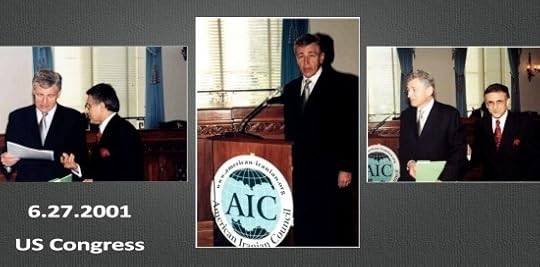
Chuck Hagel at American-Iranian Council event on Capital Hill, June 27, 2001
Amirahmadi has established a website, Amirahmadi.com, on which he is raising money that Timmerman insists will be used in his current effort to run as a candidate for president of Iran, in apparent violation of U.S. sanctions against the country.
The website page makes no mention of the purpose to which the funds donated will be applied. The website, however, suggests Amirahmadi is running for president of Iran, soliciting volunteers as well as financial contributions, under the campaign-like slogan “For Real Change in Iran.”
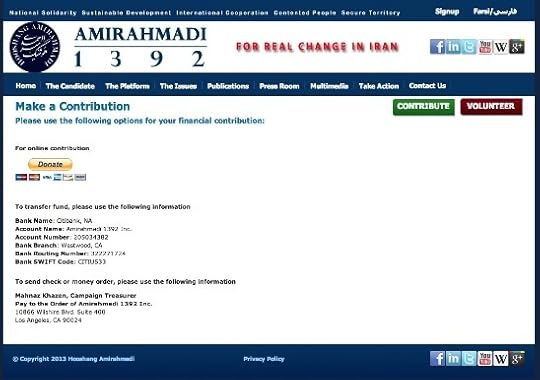
Screen shot of Amirahmadi website soliciting contributions
The Iranian state-controlled media has welcomed Hagel’s nomination saying, “Hagel’s selection is a message of peace from the Obama administration to Islamic Republic of Iran,” and noting, “The new U.S. secretary of defense staunchly opposes military action against Iran.”
On July 24, 2001, Hagel and former Sen. Richard Lugar, R-Ind., were the only two votes to oppose the Iran-Libya Sanctions Act, a measure that passed by a Senate vote of 96-2.
In April 2006, in a speech given in Islamabad, Pakistan, Hegel said, “I would say that a military strike against Iran, a military option, is not a viable, feasible, responsible option. … I believe a political settlement will be the answer. Not a military settlement. All these issues will require a political settlement.”
WND’s Aaron Klein has reported that Hagel serves on the board of the Ploughshares Fund, a George Soros-funded group that advocates a nuclear-free world and “is a partner of the Marxist-oriented Institute for Public Policies, which has urged the defunding of the Pentagon and massive decreases in U.S. defense capabilities, including slashing the American nuclear arsenal to 292 deployed weapons.”
In 2012, Timmerman ran as a Republican Party nominee for the House of Representatives in the newly redrawn Maryland’s 8th Congressional District, losing to Democratic Party incumbent, Rep. Chris Van Hollen, who has served as a Maryland congressman since 2003.
February 21, 2013
Obama skirting Congress in globalist plan?
NEW YORK – The Obama administration appears determined to ram through Congress a key part of a grandiose trade plan that transcends the vision for a “North American Union,” encompassing both Europe and Pacific Rim nations.
As WND reported, President Obama declared in his State of the Union address his intent to complete negotiations for a Trans-Pacific Partnership and announced the launch of talks “on a comprehensive Transatlantic Trade and Investment Partnership with the European Union.”
It was the first time a decision by the U.S. Trade Representative within the White House to expand negotiations to create a free trade zone with Pacific Rim countries was made public, along with a similar initiative with EU countries.
To implement the newly contemplated Trans-Pacific Partnership free-trade agreement, or FTA, the administration apparently plans to restrict congressional prerogatives to an up-or-down vote.
The issue centers on “fast-track authority,” a provision under the Trade Promotion Authority that requires Congress to review an FTA under limited debate, in an accelerated time frame subject to a yes-or-no vote.
Under fast-track authority, there is no provision for Congress to modify the agreement by submitting amendments. Fast-track authority also treats the FTA as if it were trade legislation being negotiated by the executive branch. The purpose is to assure foreign partners that the FTA, once signed, will not be changed during the legislative process.
A report released Jan. 24 by the Congressional Research Service, “The Trans-Pacific Partnership Negotiations and Issues for Congress,” makes clear the Obama administration does not have fast-track authority to negotiate the TPP, even though the office of the U.S. Trade Representative is acting as if fact-track authority is in effect.
The present negotiations are not being conducted under the auspices of formal trade promotion authority, or TPA, according to the CRS report. The latest TPA expired July 1, 2007. The administration, however, is informally following the procedures of the former TPA. If TPP implementing legislation is brought to Congress, TPA may need to be considered if the legislation is not to be subject to potentially debilitating amendments or rejection, the report says.
The CRS says Congress “may seek to weigh in on the addition of new members to the negotiations, before or after the negotiations conclude.”
The report makes clear that the TPP is being negotiated as a regional free-trade agreement that U.S. negotiators describe as a “comprehensive and high-standard” FTA. The U.S. hopes an agreement “will liberalize trade in nearly all goods and services and include commitments beyond those currently established in the World Trade Organization (WTO.)”
That the Obama administration is treating the TPP like a TPA and not a formal treaty obligation strongly suggests the Democrat majority in the Senate will seek passage of the TPP by a simple majority vote rather than a two-thirds vote, as required for the ratification of a formal treaty.
Still, the impact of the TPP will be equivalent to a formal treaty obligation, because certain agreements within the TPP will place regional authorities over U.S. law.
One of the few remaining strategies left to opponents of the TPP is to make sure Congress rejects any fast-track authority the Obama administration seeks to invoke when it comes time to get final congressional approval.
No formal steps have been taken to consult Congress as the agreement is being negotiated.
International tribunal dispute resolution
A leaked copy of the TPP draft makes clear in Chapter 15, “Dispute Settlement,” that the Obama administration intends to surrender U.S. sovereignty to an international tribunal to adjudicate disputes arising under the TPP.
Disputes concerning interpretation and application of the TPP agreement, according to Article 15.7, will be adjudicated by an “arbitral tribunal” composed of three TPP members. The purpose of the tribunal under Article 15.8 will be “to make an objective assessment of the dispute before it, including an examination of the facts of the case and the applicability of and conformity with this Agreement, and make such other findings and rulings necessary for the resolution of the dispute referred to it as it thinks fits.”
The TPP draft agreement does not specify that the arbitral tribunals must render decisions in compliance with U.S. law.
to the International Center for Settlement of Investment Disputes, an international authority created by 158 nations that are signatories to the ICSID Convention created under the auspices of the World Bank.
The TPP draft agreement specifies that foreign firms from Trans-Pacific signatory countries that seek to do business in the U.S. may apply to the arbitral tribunals to obtain relief under the trade pact from complying with onerous U.S. laws and regulations. The firms would be exempt from certain environmental and financial disclosure regulations, for example, if such regulations are deemed overly burdensome.
Because the TPP agreement places arbitral tribunals created under TPP to be above U.S. law, the Obama administration’s negotiation of the Trans-Pacific pact without specific consultation with Congress appears aimed at creating a judicial authority higher than the U.S. Supreme Court. The judicial entity could overrule decisions U.S. Federal District and Circuit courts make to apply U.S. laws and regulations to foreign corporations doing business within the United States.
The result appears to allow foreign companies doing business within the United States to operate in a legal and regulatory environment that would give the foreign companies decided economic advantages over U.S. companies that remain subject to U.S. laws and regulations.
Ignored by Romney
In the 2012 presidential campaign, Republican challenger Mitt Romney never elevated the TPP into a major campaign issue by questioning the authority or intentions of the Obama administration.
The Romney campaign even declined to refute Obama charges that the Republican nominee was a “venture capitalist” who sought to outsource U.S. jobs to the detriment of U.S. workers.
Romney did not make the TPP an issue because his free-trade strategists enthusiastically supported the Obama administration’s pursuit of TPP negotiations, objecting only that Japan should not be permitted to join the discussions until it opens its markets more to U.S. competition.
The comments developed after the New York Times published in November 2012 speculations that the government of Prime Minister Yoshihiko Noda was considering a declaration that Japan intended to join “the ambitious pan-Pacific free trade agreement” as a prelude to calling a snap election and campaigning on the trade advantages to be gained by the move.
Although Japan and China are not presently participating in TPP negotiations, “docking provisions” being written into the TPP draft agreement would permit either Japan or China to join the TPP at a later date without suffering any disadvantage.
That was A left-leaning analysis by WePartyPatriots, published by the DailyKos.com in the final days of the 2012 presidential campaign suggested the TPP is being negotiated in a stealth manner.
The TTP “has been mentioned exactly zero times by the Presidential candidates as far as we can tell, but if/when it is secretly approved it will become the most significant foreign and domestic policy initiative to come out of the Obama administration,” or out of the Romney administration, the writer said, “since both parties support it.”
February 20, 2013
Angry citizens rebuke gun-control lawmakers
DENVILLE, N.J. – Approximately 500 citizens crammed into a room at the Statehouse Annex in Trenton, N.J., for a raucous public hearing on gun-control held by the New Jersey State Assembly Committee on Law and Public Safety.
The stated purpose was to allow New Jersey citizens to comment on a package of 24 gun-control bills that have been rammed through the committee in recent weeks.
The various proposed bills aim to restrict severely or, in certain instances, to ban outright the possession of firearms in the Garden State.
While some of the bills have been modified slightly and some have been consolidated, most were voted out of committee as originally proposed.
The Feb. 13 hearing began with an unusual suggestion from the chairman that a committee vote on the proposed legislation be taken before citizens in attendance were permitted to testify.
As the hearing started, the chairman, Democratic Assemblyman Charles Mainor, told the packed hearing room, “Everyone who has applied to speak on the bills will speak at the end.”
That meant after the committee had voted, which generated howls of protest from the gallery.
Witness Helene Henkel received applause from citizens when she objected from the witness chair. She asserted Mainor’s suggested procedure of voting prior to hearing testimony would negate the First Amendment rights of citizens who had traveled to Trenton to express their views.
Assemblyman Erik C. Peterson, R-23rd District, also objected to the chairman’s tactic.
“We have a duty to make sure people are heard. … I would rather sit here and listen to what everyone has to say rather than deny them that right,” the Republican lawmaker said.
Finally, Mainor relented, agreeing to hear testimony on all the bills before the committee voted.
What transpired was a contentious seven-hour session in which dozens of Second-Amendment supporters voiced their opposition either to specific bills or to the entire package. The committee chairman held each speaker to a strict two-minute limit, enforced at times by shutting off the microphone in mid-sentence.
Despite strong public opposition, the committee, at the conclusion of a hearing that lasted from 10 a.m. until 5:30 p.m., voted all bills to the floor of the Assembly for a vote of the full Assembly, anticipated Thursday.
During the hearing, State Police in attendance removed several citizens for what was considered disruptive behavior.
See Chairman Mainor’s opening comments:
Helene Henkel challenges Mainor’s attempt to bypass citizen comments:
Among the organizations testifying were the New Jersey Second Amendment Society, or NJ2AS, and the Association of New Jersey Rifle and Pistol Clubs, the ANJRPC.
Frank Fiamingo, president of NJ2AS, questioned the rationale behind a bill that would reduce the maximum capacity of ammunition magazines to 10 rounds, arguing the number is arbitrary.
“Why not 12, why not nine?” he asked. “Why not seven?”
Speaking also in his capacity as a board member of the National Rifle Association, attorney Scott Bach, executive director of ANJRPC, criticized a bill that would deny the right to purchase firearms to anyone on the national terrorist watch list. He argued the list is notoriously arbitrary and prone to erroneously include people.
The legislation Bach found objectionable would permit social workers and marriage counselors to place other citizen’s names on the list, potentially denying them due process, Moreover, Bach argued the procedure for clearing one’s name was poorly designed, possibly requiring citizens to travel to Washington, D.C.
Attorney Scott Bach’s testimony:
Committee member Assemblywoman Bonnie Watson Coleman, D-15th District, countered that the process of getting a person’s name removed from the terrorist watch list to qualify for gun ownership in New Jersey would be a mere “inconvenience” when weighed against the “common good.”
Several of the ammunition-related bills were combined into one omnibus bill containing a provision to ban the purchase of ammunition over the Internet. The provision, various citizens testifying argued, would create a monopoly for in-state dealers that could limit the availability of ammunition in New Jersey, causing a large increase in the cost.
Critics pointed out a bill prohibiting the sale of ammunition in excess of .50 caliber would end up banning many hunting rifles and almost all shotguns, while doing nothing to affect the lower-caliber cartridges typically used by criminals.
Several citizens contended most of the bills were drafted in haste as an emotional reaction to the theater shooting in Aurora, Colo., and the school shooting in Newtown, Conn., with insufficient consideration of potential adverse consequences for Second Amendment rights.
One witness, Nora Craig, loudly castigated Chairman Mainor for ignoring her and carrying on a sidebar conversation during her testimony.
Mainor responded, “This is my meeting,” eliciting jeers from the audience.
U.S. Navy veteran Nora Craig:
A schoolteacher, who noted she is a firearms instructor and a fourth-generation gun owner, reminded the committee that historically, firearms confiscation preceded the ascent of dictators, citing Nazi Germany and others.
In spirited testimony that drew applause from the citizens, she loudly criticized the committee for ignoring the Constitution and insisted the principal of Sandy Hook Elementary School “should have had a firearm.”
Schoolteacher Carol Logan-Moore:
One of the most compelling statements came from college student Alexa Joan Macaluso, who described herself as “The Girl on Fire,” a reference to the movie “The Hunger Games.” Macaluso proceeded to read the full text of the Second Amendment, telling the committee members, “You will never, I repeat, never take my inalienable rights away,” before being cut off by the sergeant-at-arms.
Student Alexa Joan Macaluso:
Several observers concluded from the demeanor of the committee that a decision had been made by a majority of the members to vote all the bills out of committee, seemingly in complete disregard of the citizen testimony.
The New Jersey Assembly has scheduled a vote on the bills for Thursday at 1 p.m. Eastern Time.
A synopsis and critique of the bills is available on the website of the Association of New Jersey Rifle and Pistol Clubs.
Additional videos have been posted on a YouTube channel.
Jerome R. Corsi's Blog

- Jerome R. Corsi's profile
- 74 followers

